Yearly Archives: 2011

Balanced Budget Amendment the Answer? Pryor says no, Boozman says yes (part 9)(Famous Arkansan, Art Porter Sr.)(Conspirator Part 4)

I survived last night even though there were several tornadoes all through Arkansas last night.

America has too many bureaucrats and they are dramatically overpaid. This mini-documentary uses government data to show how federal, state, and local governments are in fiscal trouble in part because of excessive pay for a bloated civil service.

Photo detail

Steve Brawner in his article “Safer roads and balanced budgets,” Arkansas News Bureau, April 13, 2011, noted:

The disagreement is over the solutions — on what spending to cut; what taxes to raise (basically none ever, according to Boozman); whether or not to enact a balanced budget amendment (Boozman says yes; Pryor no); and on what policies would promote the kind of economic growth that would make this a little easier.

Over the next few days I want to take a closer look a Cato Policy Report from July/August 1996 called “Seven Reforms to Balance the Budget” by Stephen Moore. Stephen Moore was the Cato Institute’s director of fiscal policy studies, and afterwards, a Cato senior fellow. This article is based on testimony he delivered before the House Committee on Government Reform and Oversight on March 27, 1996. Moore commented:

7.) Debt Buy-Down Provision

This is Rep. Bob Walker’s idea that would allow taxpayers to dedicate up to 10 percent of their income tax payments to retirement of the national debt. Politicians earmark spending all the time. Taxpayers should have the same right.

Rules Matter

Those budget process reforms are vitally important to the balanced-budget exercise because the rules of the game matter. The rules dictate outcomes. For more than 20 years, forces that favor spending have consistently prevailed over forces that favor fiscal restraint. That pro-spending bias in Washington threatens to cripple our nation’s economic future.

Let me conclude by retelling a story about the late great Washington Redskins football coach George Allen. Allen lived by the motto “the future is now.” He traded all the Redskins draft picks for over-the-hill veterans. He spent millions of dollars of owner Jack Kent Cooke’s money to purchase expensive free agents. After several years of that, Cooke finally fired Allen. When asked why, Cooke responded, “When George Allen came to Washington I gave him an unlimited budget. But George managed to exceed it.” That’s the way taxpayers now feel about our politicians in Washington.

_______________________________________________

Arkansas Jazz Hall of Fame
1994 Candidates

Arthur (Art) L. Porter, Sr. (1934 – 1993)

Pianist Art Porter was born in Little Rock, Arkansas on February 8, 1934. Porter, the Arkansas Jazz Statesman, never officially worked as a touring musician, choosing instead to perform, teach, contribute to his church as well as to other charitable causes in his hometown and state. There were two exceptions: In 1977 at FESTAC 77 (the World Black and African Festival of Arts and Culture) and at jazz festivals in Belgium, Germany, and The Netherlands during a 1991 European Tour with his son, saxophonist Art Porter, Jr.

Porter graduated from Dunbar High School in 1950, and attended AM&N College in Pine Bluff, graduating with a Bachelor of Science in Music Education in 1954. He went on to earn a Master of Science in Music Education from Henderson State University in 1975. He taught at Mississippi Valley College, Horace Mann High School, Parkview High School and Philander Smith College. He also received an Honorary Doctorate of Humane Letters from Shorter College and was pianist/organist/choral director at Bethel AME Church in Little Rock.

Porter formed the now legendary Art Porter Trio in 1962. This group continued to work in Little Rock and around the state through May of 1993. The group performed jazz in local Little Rock night clubs such as The AfterThought, Cajuns Wharf (for 8 years), The Brown Bottle, The Camelot Hotel, Profiles, in a club bearing the name ‘Art’s Place’ and other locations too numerous to mention. Many musicians became part of the famed Art Porter University. His formation of the Art Porter Singers in 1976 and the musical mentoring of and friendship with President Bill Clinton is still felt even today.

Porter produced two ground breaking programs on the Arkansas Educational Television Network: “The Minor Key”: a weekly series portraying black culture in Arkansas, and “Porterhouse Cuts”, a series of 10 shows which were aired throughout the southeastern region covering 14 states. He produced several albums including “Little Rock A.M.” and “Something Else.” His latest recording, “Portrait of Art,” was released after his death, on February 8, 1994 (his birthday), with proceeds going to help promising young musicians realize their musical dreams.

Porter has appeared on stage with Pharoah Sanders, Steve Allen, O. C. Smith, James Leary, Al Hibbler, the Northwest Arkansas Symphony Orchestra, Little Rock Jazz Machine, and many others. His groups have performed at the Eureka Springs Jazz Festival, Jazzlites, Wildwood Jazz Festival, Music Festival of Arkansas, Hot Springs Arts Festival, and at the Arkansas Jazz Heritage Foundation’ss Monday Jazz Series. Porter was the first recipient of the Arkansas Jazz and Heritage Foundation’s Lifetime Achievement Award in 1993.

Photo #8

Toby Kebbell
I went to see the movie “The Conspirator” the other night and I really enjoyed it. Since then I have been digging up facts about the trial and the people involved in the trial.

(Boston Globe) Ty Burr and Wesley Morris review Robert Redford’s historical drama about President Abraham Lincoln’s assassination in ‘The Conspirator.’

I found this article on the internet:

The Hanging of Mary Surratt
Judicial murder and government dirty linen–Part One

by Al Benson Jr.

After the assassination of Abraham Lincoln, eight people were put on trial and found guilty–four sentenced to long prison terms and the other four sentenced to hang. One of those sentenced to hang was Mary Eugenia Jenkins Surratt, the first woman ever to be hung in the United States. John Wilkes Booth had supposedly been shot and John Surratt had escaped to Canada, eventually to make it all the way to Europe. These eight were seemingly all that were left and the government wanted to make sure they talked as little as possible to anyone.

Historical opinions have been divided as to whether Mary Surratt was really guilty as one of the Lincoln assassins. Author Nathaniel Weyl has called Mary Surratt “…an innocent woman hanged for conspiracy to assassinate Lincoln.” My own opinion is that this is pretty close to the truth. That doesn’t mean that Mrs. Surratt was totally without knowledge of all that went on. She may well have been aware of the proposed attempts to abduct Mr. Lincoln, but, as far as assassination went, I don’t think she had a clue.

When it came to the conspirators’ “trial” (if such it can really be called) Mrs. Surratt had a good lawyer to start out with, Reverdy Johnson, former U.S. senator and, in 1849, U.S. Attorney General, and at the time of her trial, a Maryland senator. According to the book The Lincoln Conspiracy: “He was such a formidable opponent, it was immediately apparent to the prosecution that he must be removed. Johnson was to be assisted by Frederick Aiken and John W. Clampitt, each in practice only one year and each trying his first big case. Clampitt was 24 and Aiken even younger.” After some judicial maneuverings, the prosecution succeeded in getting Johnson to remove himself and so Mrs. Surratt was stuck with the two younger, more inexperienced lawyers. While they did the best they could they were no match for the legal scalawags the federal prosecution brought forth to handle them.

The way the federal government dealt with Mrs. Surratt was strongly reminiscent of the way it would later deal with the Plains Indians in the far West–it flat out broke its word, but then, what else have we come to expect from government? Otto Eisenschiml wrote in In the Shadow of Lincoln’s Death“When the Washington authorities put hoods over the heads of the men accused of conspiracy against Lincoln’s life, they committed a strange act. When they added stiff shackles–manacles which made writing impossible–and forbade all intercourse with the outside world, there arose a misgiving that the purpose was not punishment, but the enforcement of silence.” Eisenschiml also noted that the government changed the prison locations of those not hung from Albany, New York to the far-out Dry Tortugas, where the convicted men were confined, literally for years in solitary cells and were prevented from conversing with any outsiders. You have to wonder what the government was afraid these men would have to say, and whatever that might have been, they were going to make darn sure no one ever heard it.

One man on Edwin Stanton’s staff was Colonel William P. Wood, the man who ran Old Capitol Prison. Though he worked for the government, it appears that Colonel Wood still had some modicum of conscience left. In 1883 he wrote a series of articles for the Washington Sunday Gazette, in which he sought to tell all he knew about the conspiracy trial, most of which he said had never been revealed to the public. Again, what else is new? Even today we get sanitized versions of everything from who killed Kennedy to the war in Iraq.

Wood wrote of Mrs. Surratt that: “…there were guarantees made to her brother by the writer, upon authority of Hon. Edwin M. Stanton, that she should not be executed.”  Wood hinted that such guarantees were given “…in exchange for information by Mrs. Surratt’s brother regarding (John Wilkes) Booth’s probable course of flight. The fact that the War Minister made such a promise gives food for thought. Very likely, he had at no time intended to live up to his promise.” And Wood, calling attention to this rank betrayal, said “…these conditions were violated, and…this deplorable execution of an innocent woman (followed).”

The court announced the guilty verdict on the morning of July 6th. Mrs. Surratt was not informed of it until the middle of the day, at which time she found out she was to be hung at noon the following day. Eisenschiml observed that “Such a short space of time between a sentence and its execution is practically unheard of.” Apparently whatever Mrs. Surratt and the others knew, the government was going to make sure they had no chance to pass it on to others.

John T. Ford, owner of Ford’s Theater, followed all these events as long as he lived. You could say he had somewhat of a consuming interest, so he gathered what facts he could. In 1889, he revealed something most people had never heard. He said that: “The very man of God who shrived her soul for eternity was said to be constrained to promise that she should not communicate with the world. Mr. Clampitt, one of her lawyers, confirmed what Ford stated. Mrs. Surratt pleaded with the priest to be allowed to tell people before she died that she was innocent of the crime of which she had been convicted. The priest refused her. It seems he had been made to tell her, after absolution and the sacrament, that she should be prevented from making any declaration as to her innocence. The priest later denied this. If the government had nothing to cover up, allowing her to make a last statement would have hurt nothing.

However, Eisenschiml has noted that: “What was vital was this: the condemned woman must not be permitted to harangue the crowd from the scaffold. There she might go beyond the mere question of her guilt, and every one of her words would be broadcast by news-hungry journalists.” And the powers that be couldn’t have that now, could they? Interestingly, our so-called “history” books never reveal any of this. The winners of the War of Northern Aggression have deemed that all this is information we are better off without. That way we don’t know enough to ask embarrassing questions.

To be continued.


___________________

About the Author

Al Benson Jr.’s, [send him email] columns are to found on many online journals such as Fireeater.Org, The Sierra Times, and The Patriotist. Additionally, Mr. Benson is editor of the Copperhead Chronicle [more information] and author of the Homeschool History Series, [more information] a study of the War of Southern Independence. The Copperhead Chronicle is a quarterly newsletter written with a Christian, pro-Southern perspective.

Is the Bible historically accurate? (part 14)(The Conspirator part 3)

This is a quick summary of the Bible’s reliability by a famous and well-respected former atheist. Please check out his website (http://www.leestrobel.com) for hundreds of FREE high quality videos investigating the critical aspects of our faith.

Todd Tyszka
www.toddtyszka.com

The Bible and Archaeology – Is the Bible from God? (Kyle Butt 42 min)

You want some evidence that indicates that the Bible is true? Here is a good place to start and that is taking a closer look at the archaeology of the Old Testament times. Is the Bible historically accurate? Here are some of the posts I have done in the past on the subject: 1. The Babylonian Chronicleof Nebuchadnezzars Siege of Jerusalem2. Hezekiah’s Siloam Tunnel Inscription. 3. Taylor Prism (Sennacherib Hexagonal Prism)4. Biblical Cities Attested Archaeologically. 5. The Discovery of the Hittites6.Shishak Smiting His Captives7. Moabite Stone8Black Obelisk of Shalmaneser III9A Verification of places in Gospel of John and Book of Acts., 9B Discovery of Ebla Tablets10. Cyrus Cylinder11. Puru “The lot of Yahali” 9th Century B.C.E.12. The Uzziah Tablet Inscription13. The Pilate Inscription14. Caiaphas Ossuary14 B Pontius Pilate Part 214c. Three greatest American Archaeologists moved to accept Bible’s accuracy through archaeology.

On April 19, 2011 on the Arkansas Blog an entry of mine got this response from a person under the user name of “Norma Bates”:

My favorite “fake” “unconfirmed” quotes are those beginning with “Jesus said,” followed by anything enclosed in quotation marks, since the earliest gospel was written between 70 and 117 years after his supposed death and there were no eye-or-ear-witnesses to any of it.

But no matter. That’s what “faith” is all about. Unquestioning acceptance of hearsay as fact. And viciously attacking all who won’t play along with that pretense.

I responded with this:

I wanted you to know that the gospels were all finished before 100 AD. Patrick Zukeran of Probe Ministries reports:

The Rylands Papyri that was found in Egypt that contains a fragment of John, and dates to A.D. 130. From this fragment we can conclude that John was completed well before A.D. 130 because, not only did the gospel have to be written, it had to be hand copied and make its way down from Greece to Egypt. Since the vast majority of scholars agree that John is the last gospel written, we can affirm its first century date along with the other three with greater assurance.

A final piece of evidence comes from the Dead Sea Scrolls Cave 7. Jose Callahan discovered a fragment of the Gospel of Mark and dated it to have been written in A.D. 50. He also discovered fragments of Acts and other epistles and dated them to have been written slightly after A.D. 50 (Norman Geisler, Baker Encyclopedia of Christian Apologetics, (Grand Rapids, Mich.: Baker Books, 2002), 530.)

I also earlier mentioned on another post about William Ramsey’s findings concerning the historical accuracy of the Book of Luke.  Of course, two of the most amazing finds are the Ossuary of Caiaphas and the Pilate Inscription. Both were very instrumental during the original Easter week.

Ossuary of Caiaphas
Ossuary of Caiaphas
Did this ossuary contain the bones of Caiaphas, high priest during the time of Jesus?

This beautifully decorated ossuary found in the ruins of Jerusalem, contained the bones of Caiaphas, the first century AD. high priest during the time of Jesus.

On the side (as seen above) and the back of the ossuary is inscribed Caiaphas’ name (“Yosef bar Caifa”).

(see Matt 26:3, 57; Luke 3:2; John 11:49; 18:13-14, 24, 28; Acts 4:6; Josephus, Ant. 23.25, 39). It was a custom in ancient Israel to store the bones of the dead in ossuaries. They gathered the bones about a year after burial.

Caiaphas, who’s name means “searcher” was appointed high priest (after Simon ben Camith) by the procurator Valerius Gratus, under Tiberius, 18 A.D.. He continued in office from A.D. 26 to 37, when the proconsul Vitellius deposed him. He was the president of the Jewish council (Sanhedrim) which condemned the Lord Jesus to death, Caiaphas declaring Him guilty of blasphemy.

Caiaphas was the official high priest during the ministry and trial of Jesus (Matt 26:3, 57; Luke 3:2; John 11:49; 18:13, 14, 24, 28; Acts 4:6).

It was Caiaphas who, unknowingly, made the incredible prophecy concerning God’s plan of sacrificing Jesus for the sins of the nation and even the whole world:

John 11:47-54 “Then the chief priests and the Pharisees gathered a council and said, “What shall we do? For this Man works many signs. If we let Him alone like this, everyone will believe in Him, and the Romans will come and take away both our place and nation.” And one of them, Caiaphas, being high priest that year, said to them, “You know nothing at all, nor do you consider that it is expedient for us that one man should die for the people, and not that the whole nation should perish.” Now this he did not say on his own authority; but being high priest that year he prophesied that Jesus would die for the nation, and not for that nation only, but also that He would gather together in one the children of God who were scattered abroad. Then, from that day on, they plotted to put Him to death.”

Matthew 26:3-5 “Then assembled together the chief priests, and the scribes, and the elders of the people, unto the palace of the high priest, who was called Caiaphas, And consulted that they might take Jesus by subtilty, and kill him. But they said, Not on the feast day, lest there be an uproar among the people.”

Matt 26:57-68 And those who had laid hold of Jesus led Him away to Caiaphas the high priest, where the scribes and the elders were assembled. But Peter followed Him at a distance to the high priest’s courtyard. And he went in and sat with the servants to see the end. Now the chief priests, the elders, and all the council sought false testimony against Jesus to put Him to death, but found none. Even though many false witnesses came forward, they found none. But at last two false witnesses came forward and said, “This fellow said, ‘I am able to destroy the temple of God and to build it in three days.’ ” And the high priest arose and said to Him, “Do You answer nothing? What is it these men testify against You?” But Jesus kept silent. And the high priest answered and said to Him, “I put You under oath by the living God: Tell us if You are the Christ, the Son of God!” Jesus said to him, “It is as you said. Nevertheless, I say to you, hereafter you will see the Son of Man sitting at the right hand of the Power, and coming on the clouds of heaven.” Then the high priest tore his clothes, saying, “He has spoken blasphemy! What further need do we have of witnesses? Look, now you have heard His blasphemy! What do you think?” They answered and said, “He is deserving of death.” Then they spat in His face and beat Him; and others struck Him with the palms of their hands, saying, “Prophesy to us, Christ! Who is the one who struck You?”

John 18:19-24 “The high priest then asked Jesus about His disciples and His doctrine. Jesus answered him, “I spoke openly to the world. I always taught in synagogues and in the temple, where the Jews always meet, and in secret I have said nothing. Why do you ask Me? Ask those who have heard Me what I said to them. Indeed they know what I said.” And when He had said these things, one of the officers who stood by struck Jesus with the palm of his hand, saying, “Do You answer the high priest like that?” Jesus answered him, “If I have spoken evil, bear witness of the evil; but if well, why do you strike Me?” Then Annas sent Him bound to Caiaphas the high priest.”


The Jewish High Priests from 200 B.C to the Reign of Herod the Great

1. Simon II the Just, 220-190 B.C.
2. Onias III, 190-174 B.C.
3. Jason/Jeshua,175-172 B.C.
4. Menelaus, 172-162 B.C.
5. Alcimus, 162-156 B.C.
6. Jonathan, 153-142 B.C.
7. Simon, 142-135 B.C.
8. John Hyrcanus I, 134-104 B.C.
9. Aristobulus I, 104-103 B.C.
10. Alexander Jannaeus, 103-76 B.C.
11. Hyrcanus II, 76-67 B.C.
12. Aristobulus II, 67-63 B.C.
13. Hyrcanus II, 63-40 B.C.
14. Antigonus, 40-37 B.C.

The Jewish High Priests from Herod the Great to the Destruction of Jerusalem

15. Ananel, 37-36 B.C. (Appointed by Herod the Great)
16. Aristobulus III, 35 B.C.
17. Jesus, son of Phiabi, ? -22 B.C.
18. Simon, son of Boethus, 22-5 B.C.
19. Matthias, son of Theophilus, 5-4 B.C.
20. Joseph, son of Elam, 5 B.C.
21. Joezer, son of Boethus, 4 B.C.
22. Eleazar, son of Boethus, 4-1 B.C. – (Appointed by Herod Archelaus)
23. Jesus, son of Sie, 1 – 6 A.D.
24. Annas, 6-15 A.D. (Appointed by Quirinius)
25. Ishmael, son of Phiabi I, 15-16 A.D. (Appointed by Valerius Gratus)
26. Eleazar, son of Annas, 16-17 A.D.
27. Simon, son of Kamithos, 17-18 A.D.
28. Joseph Caiaphas, 18-37 AD.
29. Jonathan, son of Annas, 37 A.D. (Appointed by Vitellius)
30. Theophilus, son of Annas, 37-41 A.D.
31. Simon Kantheras, son of Boethus, 41-43 A.D. (Appointed by Herod Agrippa I)
32. Matthias, son of Annas, 43-44 A.D.
33. Elionaius, son of Kantheras, 44-45 A.D.
34. Joseph, son of Kami, 45-47 A.D. (Appointed by Herod of Chalcis)
35. Ananias, son of Nebedaius, 47-55 A.D.
36. Ishmael, son of Phiabi III, 55-61 A.D. (Appointed by Herod Agrippa II)
37. Joseph Qabi, son of Simon, 61-62 A.D.
38. Ananus, son of Ananus, 62 A.D.
39. Jesus, son of Damnaius, 62-65 A.D.
40. Joshua, son of Gamal iel, 63-65 A.D.
41. Matthias, son of Theophilus, 65-67 A.D.
42. Phinnias, son of Samuel, 67-70 A.D. (Appointed by The People)

Some dates cannot be known for certain.

I went to see the movie “The Conspirator” the other night and I really enjoyed it. Since then I have been digging up facts about the trial and the people involved in the trial.

The southern widow’s Maryland house was a crucial stop on the escape route for assassin John Wilkes Booth the night he shot the president.

Rick Warner’s review of “The Conspirator” is below:

As she mounted the gallows on a broiling summer day in 1865, Mary Surratt was shaded from the sun by an umbrella. She and three men, all convicted of conspiring to kill President Abraham Lincoln, were about to be hanged in a prison courtyard in Washington, D.C.

The umbrella is one of many fascinating details in Robert Redford’s “The Conspirator,” which focuses on the trial of the first woman executed by the U.S. federal government.

Director Redford and screenwriter James Solomon deserve credit for making a historical drama that largely sticks to the facts. The depiction of Surratt’s trial by a military tribunal is based on Solomon’s exhaustive research into the court transcripts and other written accounts of the trial.

Accuracy, however, doesn’t always produce a stirring story. “The Conspirator,” which is being released on the 146th anniversary of Lincoln’s death, is a talky, often ponderous film that’s better suited to the History Channel than your local multiplex.

The movie offers a sympathetic portrayal of Surratt, a widow who owned the Washington boarding house where John Wilkes Booth and his fellow conspirators plotted to kill Lincoln, Vice President Andrew Johnson and Secretary of State William Seward.

The case against Surratt was relatively weak, mostly based on her son John’s involvement with Booth and the fact that the conspirators met under her roof. She denied knowing anything about the Lincoln plot and refused to turn against her son, who fled the country after the assassination. But the military court — Gitmo analogies are sure to be made — wanted a swift, sure resolution.

Ford’s Theatre

Surratt is played with quiet dignity by Robin Wright, looking as stern as a Sunday school teacher. The other central character is her unlikely attorney, Frederick Aiken (a bearded, studious James McAvoy), a Union war hero who reluctantly agreed to defend a Southern sympathizer accused of plotting to kill the president.

Redford quickly sets the stage with cross-cut scenes of Booth shooting Lincoln at Ford’s Theatre, co-conspirator Lewis Powell savagely stabbing Seward in his bed (he survived) and their partner George Atzerodt getting drunk and failing to carry out his assignment to murder Johnson. The momentum stalls during the courtroom scenes, which are robotically enacted like a 19th- century version of “Law & Order.”

The period costumes and setting (the film was shot in Savannah, Georgia) are first rate, and Redford gets solid supporting performances from Tom Wilkinson and Evan Rachel Wood.

“The Conspirator,” from Roadside Attractions, opened yesterday across the U.S. Rating: **1/2

oto 5 of 14
Photo #5

Balanced Budget Amendment the Answer? Pryor says no, Boozman says yes (part 8)(Famous Arkansan, Patsy Montana)(The Conspirator, part 2)

 It is 9:35 pm and we have been hiding from Tornadoes all night and I hope they are finished bothering us for the evening. 

Ronald Reagan on Balanced Budget Amendment

Photo detail

Steve Brawner in his article “Safer roads and balanced budgets,” Arkansas News Bureau, April 13, 2011, noted:

The disagreement is over the solutions — on what spending to cut; what taxes to raise (basically none ever, according to Boozman); whether or not to enact a balanced budget amendment (Boozman says yes; Pryor no); and on what policies would promote the kind of economic growth that would make this a little easier.

It’s rare in a democracy for anybody to get everything he or she wants, so only two paths remain: status quo, which is a slow march to the abyss; or compromise, which would save the country.

Last week, Republicans and Democrats chose compromise after making the country endure a lot of drama that was unnecessary and frankly not very interesting. Hours before shutting down the government, the two sides agreed to a budget deal involving relatively minor spending cuts and then went their separate ways, each blaming the other for the brouhaha. I don’t want to say the whole thing was orchestrated, but they have had a lot of practice at this.

Had the government actually shut down, the country would have felt the results. The last time that happened, 1995-96, was a prosperous and peaceful time that could absorb Washington shenanigans. Today the country is still in the midst of a weak economic recovery and involved in three major combat operations. Investors, no matter what language they speak, do not like uncertainty, and for the United States, these are uncertain times.

Temperatures are about to run even hotter. President Obama is scheduled to at last unveil some of his deficit reduction ideas this week, while some Republicans are threatening to oppose raising the country’s debt ceiling above its current $14.3 trillion limit absent meaningful spending cuts. Democrats say failing to raise the ceiling would undermine the government’s full faith and credit and would choke the economy’s recovery, and they probably are right. Some Republicans counter that, absent that threat, the government is never going to change, and they probably are right as well.

If Pryor and Boozman can jointly propose the Safe Roads Act, can Republicans and Democrats work together long enough to meaningfully address the deficit?

I am hoping that the answer to Brawner’s question is yes!!!! The deficit problem has to be addressed, and it is time for both Democrats and Republicans to stop playing politics and get us to a balanced budget.

Over the next few days I want to take a closer look a Cato Policy Report from July/August 1996 called “Seven Reforms to Balance the Budget” by Stephen Moore. Stephen Moore was the Cato Institute’s director of fiscal policy studies, and afterwards, a Cato senior fellow. This article is based on testimony he delivered before the House Committee on Government Reform and Oversight on March 27, 1996. Moore commented:

6.) A Statute of Limitation on All Spending Programs

It has been said that the closest thing to immortality on this earth is a government program. Congress doesn’t know how to end programs–even years and years after their missions have been accomplished. A five-year sunset provision should apply to every spending program in the budget–both entitlements and discretionary programs. That would require the true “reinvention” of programs by forcing the reexamination of every program, including entitlements, every five years.

Patsy Montana is another famous Arkansan.

Cowboy’s Sweetheart was recorded on August 16, 1935.

Patsy Montana (Rubye Blevins)

Inducted in 1996

 (1914-1996) – This Hot Springs native who grew up in Hope was known as the “Queen of Country Western Music.” She was one of the first country singers to successfully cultivate a cowgirl image. Her 1935 recording “I Want To Be a Cowboy’s Sweetheart,” which included a virtuoso yodeling piece, was the first big hit by a female country singer, making her the first female country singer to have a single sell more than one million copies. She wrote over 200 songs during her career. She was inducted into the Country Music Hall of Fame in 1996, shortly following her death. www.patsymontana.net

I went to see the movie “The Conspirator” the other night and I really enjoyed it. Since then I have been digging up facts about the trial and the people involved in the trial.

Ray Suarez reports on a new film profiling Mary Surratt, the sole woman implicated in the assassination of President Abraham Lincoln, and the questions raised about the use of military commission trials, both then and now. He is joined by screenwriter James Solomon and retired U.S. Army Col. Fred Borch

image 1

Mary Jenkins was born in in Waterloo, Maryland, in May, 1823. Educated at a Catholic femaleseminary in Alexandria, Virginia, she married John Harrison Surratt when she was seventeen. The couple went to live on land that he had inherited just outside of Washington at Oxon Hill. In 1851 a fire destroyed their home the couple decided to rebuild a combined home and tavern.

In 1853 Surratt purchased 287 acres of farmland in Prince George’s County. He built a tavern and post office and the community eventually became known as Surrattsville. Surratt worked as the local postmaster until his death on 25th August, 1862.

In October, 1864, Mrs. Surratt decided to rent the Surrattsville property for $500 a year to an ex-policeman, John M. Lloyd, and moved to a house she owned at 541 High Street,Washington. To make some extra money she rented out some of her rooms.

During the American Civil War, her eldest son, John Harrison Surratt, joined theConfederate Army. Her other son, John Surratt, worked as an agent for the Confederacy. He met others working as secret agents including John Wilkes Booth who stayed at the Surratt’s boardinghouse when he was in the area. It is not known if Mrs. Surratt knew if these men were working for the Confederacy.

On the 17th April, police officers arrived at Mrs. Surratt’s boardinghouse. Lewis Powell was also at the house and the two of them were arrested and charged with conspiring to assassinate President Abraham Lincoln. When the police searched the house they found a hidden photograph of John Wilkes Booth, the man who had assassinated Lincoln at Ford’s Theatre on 14th April.

Louis Weichmann, one of Mrs. Surratt’s borders, and John M. Lloyd, the man who rented the tavern at Surrattsville, were also arrested and threatened with being charged with the murder of Abraham Lincoln. Kept in solitary confinement both men eventually agreed to give evidence against Mrs. Surratt in return for their freedom.

On 1st May, 1865, President Andrew Johnson ordered the formation of a nine-man military commission to try the conspirators. It was argued by Edwin M. Stanton, the Secretary of War, that the men should be tried by a military court as Lincoln had been Commander in Chief of the army. Several members of the cabinet, including Gideon Welles(Secretary of the Navy), Edward Bates (Attorney General), Orville H. Browning (Secretary of the Interior), and Henry McCulloch (Secretary of the Treasury), disapproved, preferring a civil trial. However, James Speed, the Attorney General, agreed with Stanton and therefore the defendants did not enjoy the advantages of a jury trial.

The trial began on 10th May, 1865. The military commission included leading generals such as David HunterLewis WallaceThomas Harris and Alvin Howe and Joseph Holt was the government’s chief prosecutor. Mary SurrattLewis PowellGeorge AtzerodtDavid HeroldSamuel MuddMichael O’LaughlinEdman Spangler and Samuel Arnold were all charged with conspiring to murder Lincoln. During the trial Holt attempted to persuade the military commission thatJefferson Davis and the Confederate government had been involved in conspiracy.

Lincoln’s Assassins

Assassin’s Accomplice

Joseph Holt attempted to obscure the fact that there were two plots: the first to kidnap and the second to assassinate. It was important for the prosecution not to reveal the existence of a diary taken from the body of John Wilkes Booth. The diary made it clear that the assassination plan dated from 14th April. The defence surprisingly did not call for Booth’s diary to be produced in court.

At the trial John M. Lloyd told the court that on the Tuesday before the assassination Mrs. Surratt and Louis Weichmann visited him. Lloyd claimed that Mrs. Surratt “told me to have those shooting-irons ready that night, there would be some parties who would call for them. She gave me something wrapped in a piece of paper, which I took up stairs, and found to be a field-glass. She told me to get two bottles of whisky ready, and that these things were to be called for that night.”

When Louis Weichmann testified he told the court that he had seen John Wilkes BoothLewis PowellGeorge Atzerodtand David Herold in Mrs. Surratt’s house together. This supported the prosecution’s claim that the boarding house was where the assassination plot had been planned.

Weichmann also testified that as far as he knew Mrs. Surratt was not disloyal to the Union cause. A large number of friends and neighbours also appeared in court and stressed that they had never head her express support for the Confederacy.


Execution of Mary SurrattLewis PowellDavid Herold and 
George Atzerodt
 at Washington Penitentiary on 7th July, 1865.

On 29th June, 1865, Mrs. Mary Surratt, Lewis PowellGeorge AtzerodtDavid HeroldSamuel MuddMichael O’Laughlin,Edman Spangler and Samuel Arnold were found guilty of being involved in the conspiracy to murder Lincoln. Surratt, Powell, Atzerodt and Herold were all sentenced to be hanged at Washington Penitentiary on 7th July, 1865.

Five out of the nine members of the Military Commission, recommended that Mrs. Surratt be shown mercy “due to her sex and age”. President Andrew Johnson was later to say he was never told this and he gave the order to hang the woman who he pointed out “kept the nest that hatched the egg”.

On 7th July, 1865, Mary Surratt, still pleading her innocence, became the first woman in American history to be executed by the federal government.

Senator Pryor asks for Spending Cut Suggestions! Here are a few!(Part 14)(“The Conspirator” movie, part 1)


Senator Mark Pryor wants our ideas on how to cut federal spending. Take a look at this video clip below:

Senator Pryor has asked us to send our ideas to him at cutspending@pryor.senate.gov and I have done so in the past and will continue to do so in the future. Here are a few more I just emailed to him myself at 3:45 pm CST on April 19, 2011.

In my past posts I could have been accused of giving just general ideas of where to cut. Now I am starting in with specifics that are taken from the article “How to cut $343 Billion from the federal budget,” by Brian Riedl, Heritage Foundation, October 28, 2010(Spending cuts in millions of dollars:      

Health Care


 $6,200

 Reform Medigap.

 $5,000

 Repeal Obamacare (larger savings in later years).

 $3,700

 Require Medicare home health co-payments.

 $673

 Eliminate the Maternal and Child Health Block Grant.

 $414

 Eliminate Health Professions grants.

 $327

 Eliminate Title X Family Planning.

 $150

 Eliminate the National Health Service Corps.

 $98

 Repeal Rural Health Outreach and Flexibility grants.

Eliminating outdated and ineffective programs. Congress often allows the federal government to run the same programs for decades, despite many studies showing their ineffectiveness.

_____________________________________

Inspired by the book Manhunt, by James Swanson, I decided to try and piece together the escape route that John Wilkes Booth took.

I love the movie “The Conspirator” and I wanted to look at some of the historical figures involved with the movie.

Dr. SAMUEL MUDD


Library of Congress Photograph
Dr. Samuel Alexander Mudd was born on December 20, 1833, on a large plantation in Charles County, Maryland. He was the son of Henry Lowe Mudd and his wife, Sarah Ann Reeves. As a youngster, Sam enjoyed swimming, fishing, hunting, and weekend trips with his dad. He attended public schools for two years, and Miss Peterson, a governess hired by his father, also tutored him. At age 14 he entered St. John’s College in Frederick, Maryland. He stayed for two years. He then attended Georgetown College in Washington, D.C. In 1854 Mudd transferred to the University of Maryland in Baltimore and studied medicine and surgery. He graduated from that institution in 1856.After graduation Dr. Mudd returned home and began life as a practicing physician and farmer. On November 26, 1857, he married Sarah Frances Dyer, his childhood sweetheart. The Mudds’ first child, Andrew, was born in November of 1858. By 1859 the Mudds had a farm of their own. It was located about five miles north of Bryantown, Maryland, and 30 miles south of Washington, D.C. In 1860 the Mudds’ second child, Lillian Augusta, was born. Two more sons were born in 1862 and 1864. During the Civil War, Dr. Mudd was a Confederate sympathizer and member of the Confederate underground. On Sunday, November 13, 1864, John Wilkes Booth first met Dr. Mudd at St. Mary’s Church near Bryantown, Maryland. Evidence indicates a second meeting of the two men took place c. December 18 at the Bryantown Tavern. Then, on December 23, the two men met yet again in front of Booth’s hotel (the National Hotel) in Washington, D.C. Booth wanted Dr. Mudd to introduce him to the Confederate courier, John Surratt. Walking along 7th Street, the men came upon none other than Louis Weichmann and John Surratt! Booth invited all three men up to his hotel room for a drink. Depending on one’s point of view, the discussion and events at this “meeting” were either totally innocent or “suspicious.”

After he shot Lincoln, Booth broke his left leg in his leap to the stage at Ford’s Theatre. Needing a doctor’s assistance, he and David Herold arrived at Dr. Mudd’s (about 30 miles from Washington) at approximately 4:00 A.M. on April 15, 1865. Dr. Mudd set, splinted, and bandaged the broken leg. (The National Park Service photograph to the left shows Booth’s boot which Dr. Mudd removed when he treated the leg.) Although he had met Booth on at least three prior occasions, Dr. Mudd said he did not recognize his patient. He said the two used the names “Tyson” and “Henston.” Booth and Herold stayed at the Mudd residence until the next afternoon (roughly a 12-hour stay). Dr. Mudd asked his handyman, John Best, to make a pair of rough crutches for Booth. Dr. Mudd was paid $25 for his services. Booth and Herold left in the direction of Zekiah Swamp.Within days Dr. Mudd was under arrest by the United States Government. He was charged with conspiracy and with harboring Booth and Herold during their escape. He went on trial along with Lewis Powell, George Atzerodt, Mary Surratt, David Herold, Edman ‘Ned’ Spangler, Samuel Arnold, and Michael O’Laughlen. In court witnesses described Dr. Mudd as the most attentive of the accused. He was dressed in a black suit with a clean white shirt. Testimony against the doctor at the trial included his harsh treatment of some of his slaves. He shot one male slave (who survived). New information regarding Dr. Mudd surfaced in 1977. A previously unknown statement by conspirator George Atzerodt indicated that John Wilkes Booth had sent liquor and provisions to Dr. Mudd’s home two weeks prior to the assassination. Like the other defendants, Dr. Mudd was found guilty. His sentence: life imprisonment. He missed the death penalty by one vote.
Dr. Mudd was imprisoned at Ft. Jefferson in the Dry Tortugas about 70 miles from Key West. (The photo is from “Lincoln’s Assassins: A Complete Account of Their Capture, Trial, and Punishment” by Roy Z Chamlee, Jr.)  Dr. Mudd was allowed to stay in mail contact with his wife. Mrs. Mudd also wrote letters to President Andrew Johnson seeking her husband’s release. An attempted escape failed on September 25, 1865. In February of 1867 Dr. Mudd was assigned to the prison’s carpentry shop. In the summer of 1867, yellow fever broke out on the island. After the fort’s physician died on September 7, Dr. Mudd took a leadership role in aiding the sick. Dr. Mudd, himself, came down with the disease but recovered. Michael O’Laughlen was one of those who passed away due to the epidemic. Because of his outstanding efforts, all noncommissioned officers and soldiers on the island signed a petition to the government in support of Dr. Mudd.
In 2006 my good friend, Jim Dohren, took the photo to the right. It shows the view looking out of Dr. Mudd’s cell into the interior of Ft. Jefferson. There were no bars on the cell as there was no place to escape.

Early in 1869 a courier from the United States Government knocked on the front door of the Mudd farm. When Mrs. Mudd answered, the man handed her an envelope and said, “From the President of the United States. Please sign this receipt to certify that I have delivered it to you. If you have a reply, I shall return it for you.” Mrs. Mudd opened the envelope and found a letter written on White House stationery. It read:

Dear Mrs. Mudd:

As promised, I have drawn up a pardon for your husband, Dr. Samuel A. Mudd. Please come to my office at your earliest convenience. I wish to sign it in your presence and give it to you personally.

Sincerely,

ANDREW JOHNSON

President of the United States of America

Mrs. Mudd went to the White House the next morning. There the president signed and delivered to her the papers for the release of her husband. The date of the pardon was February 8, 1869.Dr. Mudd was released from Ft. Jefferson on March 8 and arrived home on March 20. He had served somewhat less than four years in prison. He partially regained his medical practice and lived a quiet life on the farm.Dr. Mudd’s father passed away in 1877. In January of 1878 Dr. Mudd’s youngest daughter and ninth child, Mary Eleanor (“Nettie”), was born. In January of 1883 Dr. Mudd had a busy schedule with many sick patients during a harsh winter. On New Year’s Day he put on his muffler and overshoes and called on patients. He came down with a severe cold. He was running a fever and had to remain in bed. As the days progressed, the fever rose. On January 10th, 1883, Dr. Mudd died of pneumonia or pleurisy at the age of 49. He was buried in St. Mary’s cemetery next to the Bryantown church where he first met Booth in 1864. Sarah Frances, who was buried next to him, lived until November 29, 1911.

Dr. Mudd’s descendants, most notably Dr. Richard Mudd (1901-2002) of Saginaw, Michigan, worked indefatigably to clear his name of any complicity with John Wilkes Booth. A petition (petitioner Richard D. Mudd, M.D.) was filed in the United States District Court for the District of Columbia (case No. 1:97CVO2946) bringing suit against the Secretary of the Army, Togo West et.al., ordering the Archivist of the United States to “…correct the records in his possession by showing that Dr. (Samuel A.) Mudd’s conviction was set aside pursuant to action taken under 10 U.S.C. sec. 1552.”, and that the court “…order the payment of Petitioner’s costs in bringing this action;…” On July 22, 1998, U.S. District Judge Paul Friedman said he would rule soon, and on Thursday, October 29, 1998, he ordered the Army to reconsider the conviction of Dr. Mudd. Friedman said the Army’s recent rulings (see below) against the request were arbitrary. The following decision was announced on March 9, 2000: SAGINAW, Mich. (AP) – The U.S. Army has rejected an appeal to overturn the 1865 conviction of Dr. Samuel Mudd as an accomplice in the escape of John Wilkes Booth after the Lincoln assassination. Mudd’s 99-year-old grandson, Dr. Richard Mudd of Saginaw, has waged a long campaign to clear his grandfather’s name. But this week, Army Assistant Secretary Patrick T. Henry rejected the latest request to throw out Samuel Mudd’s conviction by a military court. Henry said his decision was based on a narrow question – whether a military court had jurisdiction to try Samuel Mudd, who was a civilian. “I find that the charges against Dr. Mudd (i.e., that he aided and abetted President Lincoln’s assassins) constituted a military offense, rendering Dr. Mudd accountable for his conduct to military authorities,” he wrote in Monday’s decision.

On March 14, 2001, Judge Friedman rejected Richard Mudd’s contention that his grandfather should not have been tried by a military court because he was a citizen of Maryland, a state that did not secede from the Union, and thus entitled to a civil trial. John McHale, a Mudd family spokesman, said that an appeal of Judge Friedman’s ruling would be filed. On Friday, November 8, 2002, a federal appeals court dismissed the case. Judge Harry Edwards wrote that the law under which the Mudd family was seeking to have Samuel Mudd’s conspiracy conviction expunged applied only to records involving members of the military. Although a military tribunal tried Mudd, he was not a member of the military.

For more information CLICK HERE. For a chronology of the case CLICK HERE. For more discussion CLICK HERE.

PRO AND CON

In October of 1959 President Dwight D. Eisenhower authorized the placing of a plaque at Fort Jefferson honoring Dr. Mudd’s efforts there in the 1867 yellow fever outbreak. Both the Michigan State Legislature (Concurrent Resolution Number 126 adopted in July of 1973) and former President Jimmy Carter have stated their belief in Dr. Mudd’s innocence. In a letter dated December 8, 1987, President Ronald Reagan stated his belief that Dr. Mudd was innocent of any wrongdoing. In 1992 the Army Board for the Correction of Military Records recommended that relief be granted Samuel Mudd and his family. William D. Clark, Acting Assistant Secretary of the Army, denied the Board’s recommendation. In 1993 a mock trial was held at the University of Richmond. One of the defense attorneys was none other than F. Lee Bailey. The judges hearing the case (one of which was a member of the State Supreme Court of South Carolina) stated that Dr. Mudd’s conviction had been a flagrant violation of the United States Constitution.

It must be noted, however, that professional historians and writers who have spent years studying and researching the case differ in their analysis of Dr. Mudd’s guilt or innocence. In October 1997 a book titled “His Name is Still Mudd” was published. Written by noted Lincoln scholar Dr. Edward Steers Jr., the book presents the case against Dr. Mudd. It includes incriminating evidence against Dr. Mudd that most people are not generally aware of. CLICK HERE to order Dr. Steers’ book. Although many assassination experts share Dr. Steers’ beliefs about Dr. Mudd, this sentiment is certainly not unanimous among the professionals. However, given the current published research, it’s difficult to argue that Mudd was simply an innocent country doctor who set an injured man’s broken leg. On the other hand, it should definitely be noted that assassination expert Michael Kauffman makes a good case on Dr. Mudd’s behalf in his 2004 publication American Brutus: John Wilkes Booth and the Lincoln Conspiracies.

On Thursday, June 12, 1997, Rep. Steny Hoyer (D – Maryland) introduced in Congress The Samuel Mudd Relief Act of 1997. Co-sponsored by Rep. Thomas Ewing (R – Illinois), Rep. Robert Borsky (D-Pennsylvania), and Rep. Robert Ehrlich (R-Maryland), the bill, if passed and signed by President Clinton, would direct the Secretary of the Army to set aside the 1865 conviction of Dr. Mudd. In March 1996 Sara E. Lister, Assistant Secretary for the Department of the Army, declined to do what this bill seeks. In the April 1998 Surratt Courier, John E. McHale takes a detailed look at the legal aspects of Dr. Mudd’s case and explains why he feels the government never proved any kind of complicity by Dr. Mudd. Dr. Edward Steers’ equally detailed reply is in the June 1998 edition of the Courier. The July 1998 Courier contains articles on the lawsuit (written by Richard Willing) and further evidence of Dr. Mudd’s complicity with Booth (written by the late renowned assassination expert Dr. James O. Hall). The September 1998 issue contains James E.T. Lange’s views of the legal issues surrounding the case. In the October 1998 issue, Dr. Edward Steers supports the position taken in Dr. Hall’s article in the August issue about whether or not the authorities showed Dr. Mudd a picture of JWB or his brother, Edwin. To subscribe to the Courier, Click Here.

Dr. Richard Mudd, who passed away at the age of 101 on Tuesday, May 21, 2002, argued vehemently and sincerely for the innocence of his grandfather. In a taped interview which I listened to on July 7, 1999, Dr. Mudd was extremely articulate, impressive, and eloquent in his arguments. Stacy Nelson conducted the interview with Dr. Mudd, and I would like to thank her for sending me a copy of the tape. The photo of Dr. Richard Mudd is from the Associated Press. The effort to exonerate Samuel Mudd will now be carried on by Richard Mudd’s son, Thomas B. Mudd.

Join us as we explore the trail of John Wilkes Booth

Balanced Budget Amendment the Answer? Pryor says no, Boozman says yes (part 7)(Famous Arkansan, Tracy Lawrence) (Orsini murder trial part 2C)

 Senator Hatch talks with Fox News host Bret Baier about looming government shutdown. (At first Hatch talks about Planned Parenthood and the fact that they are the leading abortion provider and then he turns his attention to getting federal spending down.)

Photo detail 

Steve Brawner in his article “Safer roads and balanced budgets,” Arkansas News Bureau, April 13, 2011, noted:

You might not have noticed it last week amongst all the yelling in Washington, but a Republican and a Democrat, both from Arkansas, actually agreed on something.

Sen. John Boozman, the Republican, and Sen. Mark Pryor, the Democrat, introduced the Safe Roads Act, which would create a national database to keep track of commercial drivers who fail drug or alcohol tests while requiring employers to check that database prior to hiring.

At first glance, the bill would seem to have a good chance of passage. The problem it seeks to address is obvious and the solution relatively painless. Still, nothing in Washington is guaranteed. Pryor also introduced the bill in 2009, and also with Republican co-sponsors, and it didn’t pass then. If the measure fails again, it will be because the issue will be deemed better addressed through regulations or because Pryor and Boozman become distracted by other matters, not because anybody rallies against it on the Capitol steps. Democracy will survive.

So what about issues where the stakes are higher? If Arkansas’ senators can address irresponsible truck drivers, can they work together on the nation’s fiscal irresponsibility?

In that case, as with the Safe Roads Act, Boozman and Pryor, along with their colleagues on both sides of the aisle, agree on the problem: The government is going broke, creating an unhealthy dependence on unsavory entities such as the Chinese government and burdening future generations with this unconscionable debt. They also more or less agree on what kind of tone the debate should have. Boozman is a little more doctrinaire, but neither is a bomb-thrower

The disagreement is over the solutions — on what spending to cut; what taxes to raise (basically none ever, according to Boozman); whether or not to enact a balanced budget amendment (Boozman says yes; Pryor no); and on what policies would promote the kind of economic growth that would make this a little easier.


Brawner makes an excellent point. Since we can work together on other issues, why can’t we work together on the big issues like getting a balanced budget?

Over the next few days I want to take a closer look a Cato Policy Report from July/August 1996 called “Seven Reforms to Balance the Budget” by Stephen Moore. Stephen Moore was the Cato Institute’s director of fiscal policy studies, and afterwards, a Cato senior fellow. This article is based on testimony he delivered before the House Committee on Government Reform and Oversight on March 27, 1996. Moore asserted:

5.) An End to Baseline Budgeting

A 4.5 percent increase in spending on the School Lunch Program is a budget increase, not a budget “cut.” Baseline budgeting is a fraud. Lee Iacocca once stated that if business used baseline budgeting the way Congress does, “they’d throw us in jail.”


It’s time to end the false and misleading advertising in the budget. Congress should be required to use this year’s actual spending total as the baseline for the next year’s budget. If Congress spends more next year than it did in the current year, it is increasing the budget; if it spends less, it is cutting it.

_____________________________________________

Country singer Tracy Lawrence performs “Time Marches On” Live

Tracy Lawrence

Inducted in 1996

 (b. 1968) – Born in Atlanta, Texas, this country music artist spent his early years in Foreman. His hits include “Alibis,” “Sticks and Stones,” “If the Good Die Young,” and “Outlaws, Rebels and Rogues” from the movie “Maverick.” In 2007 he released his first studio collection in three years featuring the hit singles “Find Out Who Your Friends Are,” and “Til I Was A Daddy Too.” He was named Billboard’s Top New Male Vocalist in 1992, the Academy of County Music’s Top New Male Vocalist in 1993, and has received many other awards over the last several years. www.tracylawrence.com

____________________________________

Whatever happened to some of the main characters in the Orsini McArthur murder case? Carl Wilson’s story is below (part 2)

Trouble did seem to follow Carl, no matter where he went or whom he befriended. Many of his problems with the law were of his own making.

A few were just plain bad luck. In October 1974, while he was working as a construction foreman at a job in Saline County, Carl shot a co-worker in the thigh.

The shooting was ruled self-defense. Eight years later, Carl emerged as a pivotal witness in the investigation into the July 1982 slaying of Alice McArthur. Alice, the wife of prominent Little Rock attorney Bill McArthur, was murdered by two gunmen.

A few months before her death, someone tried to kill her by putting a bomb under her car. The explosives used to make the device were later traced to Carl Wilson. The man who bought them was Eugene “Yankee” Hall, a friend of Carl’s. Yankee and Larry McClendon would later be convicted of first-degree murder in Alice McArthur’s death.

The hitmen were hired by Mary Lee Orsini, who was convicted of capital murder. Carl testified against Orsini in her 1982 trial. He told the jury that Yankee and Orsini drove out to his home in Mayflower to pick up the explosive that was later used to build the bomb planted in Alice McArthur’s car. At that time, Tammy was living there, but the couple weren’t yet married. While Orsini and Tammy rode three-wheelers, Carl and Yankee smoked marijuana and took a walk to a hunting cabin on the property, Carl gave his buddy a shampoo bottle filled with Tovex, a plastic explosive used in construction. Carl said Yankee told him he wanted the explosive to blow up some stumps. During the lengthy investigation and grand jury proceedings involved in the McArthur case, Carl testified that he had few visitors to his out-of-the-way home. “I just try to stay off up there by myself,” Carl testified. “Even got a sign down there where you come in across the cattle guard: ‘Leave Me Alone.’ ” When asked if he had any enemies, he replied: “No. I don’t do people wrong.” Two days after testifying against Orsini, Carl found himself the subject of another shooting investigation after he killed his best friend, William E. “Sonny” Evans. Carl told detectives that Evans was showing him a .22-caliber rifle in the bedroom of Evans’ home and had taken out the clip when the telephone rang. While Evans went to answer it in the living room, Carl and Tammy examined the gun. The rifle had a unique safety lock on the trigger, and Carl told detectives he was pulling the lock back and forth when the gun fired.

Although the clip had been removed, there was a bullet in the chamber. Authorities ruled the shooting accidental. Five years later, on March 18, 1988, Carl shot Tammy at their home. In the midst of a fight about visiting Tammy’s parents, a drunken Carl pointed a .22 rifle at his wife and fired.

He missed the first time. On his second try, he didn’t. The bullet entered Tammy’s left side, hitting her liver and then ricocheting through her body. As she lay bleeding on the floor of their home, Carl was running around “like a wild man,” she says. Finally, he leaned over his injured wife. “My God, what do I do?” he asked. “Get me some help,” Tammy begged. “As far as I was concerned, he could go to hell in a handbasket,” she says, recalling the three months she spent in the hospital. “I hated him.” From his jail cell, Carl begged for a second chance.

Against the advice of many, including her father, Tammy took him back, but with strict stipulations, she says. “You take another drink, you hit me, you don’t go to church — then this is over,” she told him. Police dropped the case against Carl after Tammy refused to press charges. That same year, Carl went to work for Johnny Burnett’s pool and spa contracting business. Four years later, on July 21, 1992, Burnett was found shot to death in his Little Rock home, and Carl was again involved in a high-profile murder case. While police charged Burnett’s wife, Scharmel Burnett, in her husband’s murder, her defense attorneys pointed to Carl as a potential suspect. One of the documents they used to back up their assertion was a nine-page handwritten report by a Little Rock detective detailing a conversation with a Faulkner County law enforcement source. “According to the source, Carl Wilson was a shady character, and if he wasn’t the triggerman, he probably knew who was,” detective Ronnie Smith wrote. “Wilson is a drug user and probably involved in drug trafficking, according to the source.” Adding to the suspicion was Carl’s soured relationship with his former boss when Burnett fired him. The two men also were in a dispute over a worker’s compensation claim Carl made against Burnett’s company. Burnett was killed before the claim was resolved. Prosecutors questioned Wilson about the Burnett murder but determined that he had an alibi.

Scharmel Burnett was tried twice but was never convicted. No one else has ever been charged. Carl’s name didn’t appear in newspapers again until he was killed. “I got the impression that he was an old outlaw who had reformed,” prosecutor Melody Piazza recalled on the day of the shootout. “He had a new wife and … seemed to have changed his life.”

Once an alcoholic who sometimes lost himself in violent rages, Carl became a new man after shooting his wife, longtime friends say. That was almost 13 years ago. “Carl was so proud that he never took another drink,” says Stan Joyner, Carl’s boss at a construction company for several years. After Tammy’s shooting, Carl appeared to make good on his promise to reform, say the dozen or so friends who have known the couple in both good times and bad. Carl was eventually forced to retire after several light strokes and heart surgery. He wandered around Mayflower and Conway during they day, coffee thermos always in hand. In the evenings, he played dominoes and watched television well into the early-morning hours.

His dresser is covered with stacks of videotapes. Still known for a sharp wit and a rough-edged demeanor, Carl seemed to be slipping gratefully — if not always gracefully — into his retirement. In their many years together, Tammy says, this period was definitely the couple’s most peaceful era. “If this had happened 15 years ago, I wouldn’t have questioned it,” she says of the raid. Standing in Carl’s bedroom, which is still pockmarked with bullet holes, Tammy wonders what her husband could have been up to that would have piqued the interest of the ATF. “I’m willing to accept whatever it is. I just need to know. I hope that with all my heart there are no surprises.

But good or bad, I’ll take what they hand me.” Tammy has a few theories of her own. A family vendetta may have prompted some of Tammy’s relatives to go to the police with stories about Carl, she says. Tales of drugs, weapons and the note tacked onto his closet door may have been enough to open an investigation, she muses. She also thinks that perhaps some longtime law enforcement authorities, frustrated by their inability to do no more than link Carl to various crimes, might have been waiting for an opportunity — no matter how small — to strike. “Carl always had a past that haunted him,” Tammy says. “Society never pardoned him, but I know God did.” She describes a long-ago encounter with Buford, saying that during the McArthur trial, the ATF agent approached Carl in a courthouse hallway, telling him, “I’ll get you.” Buford says he cannot comment, adding that he would very much like to. Tammy’s life with Carl, as well as the nature of his death, have made her suspicious of law enforcement. After the shooting, she and Carl’s friends scoured the house, collecting slugs, shell casings and taking photos. All of these items have been turned over to Tammy’s attorney, she says. She also went to the funeral home before anything was done to Carl’s body and took pictures of all his wounds. “When I saw his face wasn’t distorted, God gave me the strength to take those pictures.”

As she sat in the state trooper’s car, waiting for word of her husband’s fate, Tammy occupied herself by counting vehicles. Twenty-six unmarked cars. Four state police cars. Four hours passed. The officers milling about were nice to her, she says. “None of them were mean or rude or ugly. The SWAT team was what scared the hell out of me.” Tammy finally dredged up the nerve to ask a trooper about Carl. “Is he alive or dead?” “Well, ma’am, I don’t think it’s fair to keep you in the dark,” she says the trooper told her. “He’s dead.” As Tammy’s handcuffs were removed, another trooper asked her, “Ma’am, is there anyone I can call to come comfort you?” Tammy asked for her mother, but she wasn’t home. Her grandfather, Daddy John, came instead. When he arrived, they sat there for two more hours. Finally, a white pickup with a camper shell arrived. “And that’s what they took Carl Ray Wilson out in,” Tammy says. Still barefoot and clad in her white, flower-sprigged nightgown, Tammy clutched her grandfather’s hand and turned away from her house. He drove her away in a white Cadillac, telling her that everything was going to be OK. But everything isn’t, Tammy says. It won’t be, she says, until she knows what happened and why.


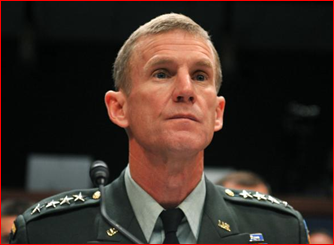
General McChrystal fired by President Obama in June, but cleared from any wrongdoing (1981 Orsini McArthur murder case Part 2B)

Late Tuesday afternoon President Obama addressed the media about a revealing Rolling Stone article on Gen. Stanley McChrystal — the top American commander in Afghanistan — and what implications it could have for his administration.

Hot Air pundet reported: 

Pentagon Review Clears Retired General Stanley McChrystal in ‘Rolling Stone’ Article Controversy


Cleared…

abcnews

A military investigation has cleared Gen. Stanley McChrystal and his staff of violating military policy in their interactions with a Rolling Stone reporter.

The ensuing article, “The Runaway General,” published in June of 2010, portrayed madcap and unruly General and staff frustrated with Washington policymakers and disrespectful of the chain of command. The article led to McChrystal being relieved of command of U.S. forces in Afghanistan and his subsequent retirement from the Army.

Then-staffers to McChrystal are quoted in the article saying disparaging things about everyone from Vice President Joe Biden and then-National Security Advisor Jim Jones to Sen. John McCain and others.

But the Pentagon’s review of an earlier investigation could not verify many of the claims and anonymous quotes in the article.

A six page memo, issued by the Department of Defense Inspector General disagrees with conclusions of an investigation by an Army Inspector General and issues the following two conclusions:

1 . The evidence was insufficient to substantiate a violation of applicable DoD standards with respect to any of the incidents on which we focused,

2. Not all of the events at issue occurred as reported in the article. In some instances, we found no witness who acknowledged making or hearing the comments as reported. In other instances, we confirmed that the general substance of an incident at issue occurred, but not in the exact context described in the article


New probe into an Rolling Stone article on Gen. McChrystal finds he nor any of his aides did anything wrong.

___________________________________________

Whatever happened to some of the main characters in the Orsini McArthur murder case? Carl Wilson’s story is below (part 1)

A FATAL RAID

Pubdate: Sun, 25 Feb 2001
Source: Arkansas Democrat-Gazette (AR)
Author: Jim Brooks, Cathy Frye, Amy Upshaw – Arkansas Democrat-Gazette

MAYFLOWER — Tammy Wilson’s windup alarm clock jangled her from a deep sleep at 6:30 a.m. As far as she could tell, her husband, Carl, was still slumbering undisturbed in his own room. Tammy, 42, worked at a local day-care center and was usually awake before daylight. Carl, on the other hand, often sat up into the wee hours of the morning, watching television or videos.

Since retiring, he had the luxury of sleeping in. After more than two decades together, the Wilsons were still a passionate couple who frequently shared the queen-size bed in Carl’s room. But most nights, they slept apart, especially if Tammy had to work the next morning. On Jan. 12, Tammy woke up alone.

She turned on the bedside lamp, chasing the darkness from her small room. “At that point, all hell broke loose,” she recalls. “I heard a firecracker sound and then I realized there was gunfire.” Within a few panic-stricken moments, Carl was dead and Tammy — barefoot, handcuffed and still in her nightgown — was led to a police car outside. “Only by the grace of God, I wasn’t cuddled up with him that night,” she says. “There’s no doubt I would have been dead too.”

Carl Wilson, 60, was shot at least five times in an exchange of gunfire with police. The shootout occurred when federal authorities raided the four-time convicted felon’s rural Faulkner County home in search of a .30-.30 Winchester rifle. The gun, which Carl’s family and friends say he had owned for more than 30 years, was wanted by the Bureau of Alcohol, Tobacco and Firearms. Before carrying out the raid in the chilly pre-dawn hours of Jan. 12, the agency was granted a “no-knock” search warrant, which allows law enforcement officers to enter a home without announcing themselves. The search warrant was the culmination of a two-month investigation conducted by the ATF. Bill Buford, the ATF agent-in-charge, says he cannot yet say why Carl was being investigated. Nor can he comment on the shootout until the Arkansas State Police finishes its inquiry. The other agencies involved also cannot comment. The case has been sealed in federal court, so many lingering questions remain unanswered. Tammy says she won’t let the matter drop until she knows what police thought her husband was up to when they came looking for his rifle. “I know the law is going to say a lot of bad things, and I’m trying to prepare myself for them. If there was something so crazy — right or wrong, good or bad — I want to know why. I can take it, but I’ve got to know why.”

Accounts of the raid differ between police and family members who were in the house. Police say Carl shot first.

The family says officers did. On the day of the shooting, Buford told the Arkansas Democrat-Gazette that officers were slowed by the long muddy driveway leading to the house and had trouble approaching Wilson’s home. Carl began firing as they neared the house, Buford said. “[Officers] returned fire, and Mr. Wilson was killed.” According to a statement issued by the Arkansas State Police, which is investigating the shooting, the gunbattle began after the SWAT team deployed a “distraction device,” and officers announced themselves. “Upon entry, officers were fired upon by [the] suspect, defensive shots were returned,” the statement says. Tammy and a niece who was there that morning say the shooting didn’t start until the special weapons and tactics team entered through two unlocked back doors, one to the porch and the other leading into the house, and set off a distraction device. Singed flooring and a sooty residue on the refrigerator indicate that the device, also known as a “flash-bang,” went off in the hall next to Carl’s bedroom. Tammy says it’s obvious Carl fired his .44 Magnum revolver — at least four spent casings were found after the shootout.

He kept the gun in his bedroom, a few feet away from the foot of his bed in the antique radio his television sat on. Carl wouldn’t have hesitated to shoot anyone he believed was breaking into his home, Tammy says, particularly if he were startled from sleep. “Carl did love and protect his family.

I have no doubt that he shot back.”

No-knock raids have long been a point of contention and have been argued repeatedly in U.S. courts. Under Arkansas law, this element of surprise is allowed if officers believe that announcing their presence would endanger themselves or the people inside. No-knocks also are permitted if there’s a possibility evidence might be destroyed in the time it takes for police to gain entry. In planning the Wilson raid, authorities decided to ask for a no-knock warrant because of Carl’s criminal background and the suspicion that he might be armed, says Lt. Bob Berry of the Conway Regional Drug Task Force. But Tammy says if Carl had known he was wanted by authorities, he would have surrendered voluntarily. “No one should have been shot at — my husband or the officers,” Tammy says. “This was senseless.

Why did it take that kind of excessive force for one gun? “Yes, he has a criminal history, but in that criminal history he’s always been notorious for cooperating with authorities. … When Tommy Robinson [former Pulaski County sheriff] came out here, Carl didn’t greet them with a pistol.

He sat out on the porch and had a cup of coffee with them.” He would have done the same on Jan. 12, she contends. During the exchange of gunfire, two members of the SWAT team were slightly injured. Carl died in his bedroom.

The blood from his wounds seeped through his covers, soaking the mattress beneath. “It may be completely foolhardy for a cop to raid no-knock, but for some reason they do it,” says Little Rock defense attorney John Wesley Hall Jr., who has represented several people involved in search-and-seizure cases. But Berry says the execution of the search warrant was carried out professionally and in the same manner other no-knock search warrants have been served. His agency, along with a local SWAT team, assisted the ATF in both the investigation and the raid. “I don’t see anything that could have possibly been done differently,” Berry adds. “We put long hours into planning this before carrying it out.” No-knocks are most commonly used in drug investigations, when there’s a chance that evidence might be destroyed. But, Hall says, “You can’t flush a .30-.30 rifle down the toilet, so that’s not an issue.

If they’re looking for a rifle, why don’t they stake out the house and wait for him to leave?” Berry says it’s better to corner suspects at home. Attempting to catch someone during his daily routine is just too dangerous. “Anytime you try to do something like that, you run the risk of some innocent person getting hurt or killed,” he says. As for putting the family members of a suspect in peril by raiding a home, he says, “that’s the one reason we do as much planning as we do.” And in the Wilson case, he notes, “The two other occupants were unhurt.” But Hall says the extreme methods used in surprise raids, though sometimes necessary, can be what gets somebody shot. “When they sneak in like that at six o’clock in the morning, they’re just asking for trouble.

Then the only question is, ‘Who’s going to be shot? Is it going to be them or is it going to be us?’ ” Berry says getting a no-knock warrant isn’t easy. A judge must first be convinced that the risk is worth it, especially if a raid is going to be carried out before daylight. In the Wilson raid, officers met at 2 a.m. to review their strategy, which had been mapped out days before. Meanwhile, a surveillance team was watching the home so officers would know who was where and whether any unexpected visitors had shown up, Berry says. That Tammy and Carl usually slept in separate bedrooms wasn’t known, he says, adding, “We weren’t sure on that.”

As the gunfire broke out that morning, Tammy says she ran toward Carl’s bedroom, which was separated from hers by a spare room and bathroom.

On the way, she collided with Dottie McKenzie, Carl’s 20-year-old niece who had been staying with them since the Christmas holidays. Dottie was sleeping in the spare bedroom. Tammy thrust the frightened Dottie behind her just before she was ordered by masked SWAT team members to hit the floor. “They hollered, ‘Get down! Get down! Don’t look at us!’ ” As Tammy lay on floor, facing Carl’s room, she strained to catch a glimpse of her husband. Officers had their guns pointed at him, she says, and were ordering him to get up. “I can’t. I can’t,” Carl replied. From her position on the floor, Tammy could see her husband, propped on a bloody elbow, trying to raise himself off the bed. Then she and Dottie, still barefoot, were hastily led through the house, dodging shards of glass from fallen picture frames, which were scattered across the hall and kitchen floors. As Dottie was escorted out the back door, she saw Carl kneeling at the foot of his bed. His arms were stretched in front of him, and his boxers were around his ankles, she says. After leaving the house, the women were put in separate police cars. For Tammy, it was a surreal ending to a 23-year relationship that no one, not even she, ever fully understood. Years ago, after learning Carl was an ex-con, she repeatedly cautioned herself: “You better buckle your britches, girl. You’re in for the long haul.” But once someone “falls into my heart,” Tammy says, she is loyal. “I honored that man until the day he died. That was my husband and he might not be precious to anyone else, but he was precious to me.”

When they went to the Wilson home, officers were looking for the Winchester, ammunition and any papers pertaining to the gun’s purchase. As a convicted felon, Carl wasn’t supposed to have the gun. But no one can yet say why it suddenly became imperative that the rifle be seized.

That Carl was an avid gun collector had never been any secret to anyone, including local authorities, Tammy says. Tammy thinks maybe the ATF believed the gun had once been used in a crime. Or, she says, it could have been an excuse to get into the Wilsons’ house, just to see what else might be found there. Seized from the Wilson home were the Winchester, seven other guns and ammunition, a bong, a pipe, scales, a plastic bag containing a fourth of a gram of “white powder,” a large Ziploc bag containing smaller bags of marijuana, a pill bottle of marijuana seeds and burned marijuana cigarettes, according to an inventory list prepared by ATF agents. Also taken was a “paper note signed by Wilson,” the list stated. Tammy says the note was tacked to the closet door and was meant to discourage visiting family members who might be tempted to poke around in Carl’s closet, where he kept his guns. It read: “If you open this door, the whole house will blow up. Try me — Wilson.” The probable cause affidavit, which would explain why the ATF was investigating Wilson, remains sealed in federal court. “The main thing the ATF was looking for was the weapons,” Berry says, adding that he can’t comment any further on another agency’s investigation. The task force became involved because there was a possibility drugs might be involved, he says. On Jan. 23, the Democrat-Gazette sent a letter to U.S. Magistrate J. Thomas Ray, requesting that all documents pertaining to the case be made public. In his own letter to the judge, dated Jan. 25, U.S Attorney Michael Johnson said it would be all right for the court to unseal the inventory list of what was seized from the Wilson home. However, he “strenuously” objected to unsealing the probable cause affidavit. “No legitimate purpose is served in unsealing the application for the search-and-seizure warrant and the accompanying attachments,” the prosecutor wrote. The judge responded by unsealing the inventory list. But if the newspaper wanted the affidavit, he said, it would need to file a motion with the court. He also said that the U.S. attorney has thus far offered “no grounds to support his position” in keeping the probable cause affidavit sealed. The Democrat-Gazette filed a motion on Feb. 15, asking that all documents in the case be unsealed.

A ruling is pending. In its motion, the newspaper argues numerous reasons the case should be unsealed. “First the subject of the search warrant is dead, and no criminal investigation concerning him can be on-going,” it states. “A civilian was killed and two law enforcement officers were injured during the execution of this search warrant.

The public is entitled to know the circumstances and manner in which state and federal law enforcement officials carried out their public duties.”

The Arkansas State Police was assigned to investigate the anatomy of the raid. Four days after the gunbattle, the agency issued a statement: “The Arkansas State Police investigation has revealed no evidence of wrongdoing on the part of the Metro SWAT team or any other agency.” This was a preliminary finding based on what investigators were told immediately after arriving at the scene, said state police Sgt. Don Birdsong. The two SWAT team members injured in the raid — Conway police officer Larry Hearn, who hit his head while diving to avoid the gunfire, and Faulkner County sheriff’s Sgt. Jason Young, who was hit in the upper left arm by a piece of shrapnel — have both returned to work. It’s unclear whether the state police investigation is actually finished. Last week, detectives said the results of their inquiry had been turned over to the prosecutor. But Faulkner County Prosecuting Attorney H.G. Foster said on Thursday that police are still waiting for information from the medical examiner, and the case hasn’t been given to him yet. When the inquiry is finished, Foster will decide whether to close the case, press charges or ask the state police to investigate further. Once the case is closed, the investigative file becomes public, and authorities involved in the shootout say they’ll be allowed to talk. So at this time, the silence surrounding the events of that January morning is impenetrable. “I know there are so many officers who want to tell their part,” Berry says. They believe their inability to discuss the shootout makes everybody involved “look bad,” he adds. “I’ve been in the narcotics part [of law enforcement] for nine years and have executed numerous search warrants,” Berry says. “This is the first time anything like this has happened.” Asked what made this raid deadly, he pauses. “I’d like to comment on it, but I can’t until after the investigation is over.”

Carl was well-known to local authorities, even though all of his criminal convictions occurred in the 1960s. Carl did time for burglary, robbery and stealing a car. All told, he served 5 1/2 years in Oklahoma and Arkansas prisons.

He was paroled from the Cummins Unit in 1968. Since then, the man dubbed a “reformed outlaw” by one Pulaski County prosecutor had been linked to two of Arkansas’ biggest and most infamous murder cases and was accused on three occasions of shooting people, including his wife and best friend. Of the three shooting victims, only his friend died. Carl was never charged in any of the incidents.

Tammy refused to press charges. The other shootings were ruled accidental and self-defense. After all of Carl’s brushes with notoriety — whether it was when he testified in murderess Mary Lee Orisini’s trial, or when he nearly became a suspect in the death of pool contractor Johnny Burnett — it is baffling to his family that he died over a long-cherished hunting rifle. Carl always had a “mysterious side,” Tammy says. But she can’t imagine what he might have been involved in that would have put their home and lives under surveillance. There were signs, Tammy says, that Carl had started using drugs again after 12 years of sobriety.

But when she confronted him about a syringe she had found in a rarely used drawer, Carl told her she was being paranoid.

The syringe, he said, was simply a remnant of his past. Tammy was still troubled. “I told him, ‘I’m not going back there,’ ” she says.

Trouble did seem to follow Carl, no matter where he went or whom he befriended. Many of his problems with the law were of his own making.

A few were just plain bad luck. In October 1974, while he was working as a construction foreman at a job in Saline County, Carl shot a co-worker in the thigh.

The shooting was ruled self-defense. Eight years later, Carl emerged as a pivotal witness in the investigation into the July 1982 slaying of Alice McArthur. Alice, the wife of prominent Little Rock attorney Bill McArthur, was murdered by two gunmen.

A few months before her death, someone tried to kill her by putting a bomb under her car. The explosives used to make the device were later traced to Carl Wilson. The man who bought them was Eugene “Yankee” Hall, a friend of Carl’s. Yankee and Larry McClendon would later be convicted of first-degree murder in Alice McArthur’s death.

The hitmen were hired by Mary Lee Orsini, who was convicted of capital murder. Carl testified against Orsini in her 1982 trial. He told the jury that Yankee and Orsini drove out to his home in Mayflower to pick up the explosive that was later used to build the bomb planted in Alice McArthur’s car. At that time, Tammy was living there, but the couple weren’t yet married. While Orsini and Tammy rode three-wheelers, Carl and Yankee smoked marijuana and took a walk to a hunting cabin on the property, Carl gave his buddy a shampoo bottle filled with Tovex, a plastic explosive used in construction. Carl said Yankee told him he wanted the explosive to blow up some stumps. During the lengthy investigation and grand jury proceedings involved in the McArthur case, Carl testified that he had few visitors to his out-of-the-way home. “I just try to stay off up there by myself,” Carl testified. “Even got a sign down there where you come in across the cattle guard: ‘Leave Me Alone.’ ” When asked if he had any enemies, he replied: “No. I don’t do people wrong.” Two days after testifying against Orsini, Carl found himself the subject of another shooting investigation after he killed his best friend, William E. “Sonny” Evans. Carl told detectives that Evans was showing him a .22-caliber rifle in the bedroom of Evans’ home and had taken out the clip when the telephone rang. While Evans went to answer it in the living room, Carl and Tammy examined the gun. The rifle had a unique safety lock on the trigger, and Carl told detectives he was pulling the lock back and forth when the gun fired.

Ronald Wilson Reagan Part 77 (1981 Orsini McArthur Murder case Part 2)

Anonymous / AP

No. 5: Villanova couldn’t miss

NCAA Championship game, April 1, 1985 — The Big East dominated the NCAA tournament, placing three teams in the Final Four. But few expected the Wildcats to be the eventual champ instead of powerhouses Georgetown or St. John’s. But No. 8 seed Villanova did just that, beating the Hoyas 66-64, largely because the Wildcats rarely missed. Their shooting (22-of-28, 78 percent from the field) remains a championship game record.

Picture of Nancy and Ronald Reagan at the Stork Club in New York City.
(Picture from the Ronald Reagan Library)

Ronald Reagan and Nancy Reagan at the “Stork Club” in New York City. (Early 1950s)


1980 Presidential Debate Reagan v Carter

 ___________________________________

GOVERNOR REAGAN

Yes, I would like to add my words of thanks, too, to the ladies of the League of Women Voters for making these debates possible. I’m sorry that we couldn’t persuade the bringing in of the third candidate, so that he could have been seen also in these debates. But still, it’s good that at least once, all three of us were heard by the people of this country.

Next Tuesday is election day. Next Tuesday all of you will go to the polls: you’ll stand there in the polling place and make a decision. I think when you make that decision. it might be well if you would ask yourself, are you better off than you were 4 years ago? Is it easier for you to go and buy things in the stores than it was 4 years ago? Is there more or less unemployment in the country than there was 4 years ago? Is America as respected throughout the world as it was? Do you feel that our security is as safe, that we’re as strong as we were 4 years ago? And if you answer all of those questions yes, why then, I think your choice is very obvious as to who you’ll vote for. If you don’t agree, if you don’t think that this course that we’ve been on for the last 4 years is what you would like to see us follow for the next 4, then I could suggest another choice that you have.

This country doesn’t have to be in the shape that it is in. We do not have to go on sharing in scarcity, with the country getting worse off, with unemployment growing. We talk about the unemployment lines. If all of the unemployed today were in a single line allowing 2 feet for each one of them, that line would reach from New York City to Los Angeles, California. All of this can be cured, and all of it can be solved.

I have not had the experience the President has had in holding that office, but I think in being Governor of California, the most populous State in the Union — if it were a nation, it would be the seventh-ranking economic power in the world — I, too, had some lonely moments and decisions to make. I know that the economic program that I have proposed for this Nation in the next few years can resolve many of the problems that trouble us today. I know because we did it there. We cut the cost — the increased cost of government — the increase in half over the 8 years. We returned $5.7 billion in tax rebates, credits, and cuts to our people. We, as I’ve said earlier, fell below the national average in inflation when we did that. And I know that we did give back authority and autonomy to the people.

I would like to have a crusade today, and I would like to lead that crusade with your help. And it would be one to take government off the backs of the great people of this country and turn you loose again to do those things that I know you can do so well, because you did them and made this country great.

Thank you.

MR. SMITH

Gentlemen, ladies and gentlemen, for 60 years the League of Women Voters has been committed to citizen education and effective participation of Americans in governmental and political affairs. The most critical element of all in that process is an informed citizen who goes to the polls and who votes.

On behalf of the League of Women Voters, now, I would like to thank President Carter and Governor Reagan for being with us in Cleveland tonight. And, ladies and gentlemen, thank you and good night.


Next image
Loading

japan disatster: US Navy deliver aid in Wakuya

A US naval air crewman hugs a resident after delivering supplies from the aircraft carrier USS Ronald Reagan in Wakuya, Miyagi prefecture

It has been 150 years since the beginning of the Civil War that started in April of 1861 at Ft Sumter.

The Cassius M. Clay Battery defending the White House in 1861

The Cassius M. Clay Battery defending the White House in 1861

____________________________________________

Book review – Widow’s Web – By Gene Lyons – Simon & Schuster, $23, hardcover, 447 pages


October 27, 1993|By Reviewed by Bill Kent, Washington Post Book Review Service


Those who imagine Little Rock, Ark., as a haven of jogging idealists, heartland virtues and journalists who don’t lie are about to get their wake-up call in Widow’s Web, a true-crime tale of a 1981 double murder that ensnared rival law enforcement agencies, craven judges, a publicity-mad county sheriff and the city’s astonishingly gullible newspapers.It should be noted that Bill Clinton was way out of the loop during the investigation, arrest and ultimate conviction of white trash femme fatale Mary Lee Orsini, a pathological liar who had almost the entire state believing that a conspiracy of honky-tonk nightclub owners, cocaine-snorting Chicago Mafiosi, Little Rock lowlifes and her former defense attorney, William McArthur, had murdered both her faithful, hard-working husband, Ron, and McArthur’s wife, Alice.But those seeking an insight into the character of leadership, as well as the integrity of the news media in a place that author Gene Lyons, a former Newsweek writer, describes as ”as brutally anonymous as any big city in America, and as intimate and small-minded as any country town” should look no further than former Pulaski County sheriff Tommy Robinson.Lyons exposes Robinson as an unabashed media demagogue, who freely tampered with evidence, made baseless arrests, withheld information from other police investigators and gleefully passed on Mary Lee Orsini’s preposterous conspiracy theories to the warring Little Rock Gazette and Democrat newspapers, which not only printed them without challenge, but added their own self-serving distortions (the newspapers have since merged).The events reported in Widow’s Web cover only two years, beginning with Mary Lee’s March 1981 discovery of her dead husband, shot in the head in her suburban Little Rock bedroom. While members of the North Little Rock Police Department are inclined to believe Mary Lee’s initial claim that the death was a suicide, the gun Ron may have used is missing, and other circumstantial evidence points toward murder.

October 27, 1993|By Reviewed by Bill Kent, Washington Post Book Review Service

(Page 2 of 2)
Mary Lee begins fabricating evidence that supports her increasingly convoluted tale of a midnight break-in, her husband’s shadowy dealings with criminal types and a police conspiracy to frame her. Her lawyer, William McArthur, who also is a partner in a Little Rock nightclub, is almost certain that she’s guilty, but he lives up to the ethics of his profession – don’t ask what you don’t want to know. When a grand jury finds insufficient evidence to indict Orsini, McArthur hopes only that Orsini will pay his fees.When McArthur isn’t impressed by Orsini’s attempt at seduction, and McArthur’s wife, Alice, snubs Orsini in their nightclub, Orsini has a different payback in mind. She starts by spreading rumors that the conspiracy that claimed her husband was much larger than even she had anticipated.At first, McArthur suspects that the car bomb that nearly kills his wife was planted by a rival nightclub owner. Then he finds his wife shot dead. Before the Little Rock cops even can begin their investigation, County Sheriff Tommy Robinson is on the local news, repeating Mary Lee Orsini’s wildly improbable conspiracy theories verbatim, naming William McArthur as the mastermind.From then on, Widow’s Web reads like a more intricate, but no less suspenseful, version of Scott Turow’s fictional Presumed Innocent, in which McArthur finds himself accused of his wife’s murder by corrupt cops, incompetent reporters, ignorant Little Rock citizens, devious newspaper editors embroiled in a circulation war and other people who don’t ask what they don’t want to know.Lyons skillfully juggles gossipy details, police procedures and the tedious complexities of Arkansas jurisprudence. Quite a bit of dust must settle before McArthur is exonerated and Mary Lee Orsini is convicted of first-degree murder and is sentenced to life in prison without parole.


Balanced Budget Amendment the Answer? Pryor says no, Boozman says yes (part 6)(Famous Arkansan, Norris Goff)


On Tuesday, March 29, Senator Marco Rubio appeared on Fox News’ “Hannity” for the first time since becoming a U.S. Senator. Senator Rubio talked about refusing to vote to raise the debt ceiling and the need for serious spending cuts.

Photo detail 

Steve Brawner in his article “Safer roads and balanced budgets,” Arkansas News Bureau, April 13, 2011, noted:

The disagreement is over the solutions — on what spending to cut; what taxes to raise (basically none ever, according to Boozman); whether or not to enact a balanced budget amendment (Boozman says yes; Pryor no); and on what policies would promote the kind of economic growth that would make this a little easier.

Over the next few days I want to take a closer look a Cato Policy Report from July/August 1996 called “Seven Reforms to Balance the Budget” by Stephen Moore. Stephen Moore was the Cato Institute’s director of fiscal policy studies, and afterwards, a Cato senior fellow. This article is based on testimony he delivered before the House Committee on Government Reform and Oversight on March 27, 1996. Moore commented:

4.) Dynamic Scoring of Tax Law Changes

The 1986 capital gains tax rate increase has raised roughly $100 billion less revenue than the Joint Tax Committee estimated when the law was passed. Capital gains realizations are less than half the level expected, as shown in Figure 2. Why such gigantic forecasting errors? Congress still uses static analysis to score tax rate changes–that is, it assumes little change in behavior in response to tax changes and thus almost no overall economic impact of new tax laws. The assumptions have been shown time and again to be wrong. We know the procedures are wrong, but we still use them.

The capital gains tax cut promised in the “Contract with America” will almost certainly raise revenues for the government–and it might raise substantial new revenues. The rich will actually pay more taxes with the rate cut. But the Joint Tax Committee refuses to score those dynamic effects. Scholars at the Cato Institute have long endorsed a zero capital gains tax. But the static revenue estimators say that will reduce revenues by $150 billion over five years. Dynamic estimates indicate that a zero capital gains tax would so energize our economy that total tax revenues might actually increase. But as long as we are slaves to static scoring, pro-growth tax initiatives will be torpedoed by faulty computer models.

Dynamic scoring will yield more accurate tax revenue estimates and thus encourage better policy.

 Recorded: 23-06-1946

Cast: Esther Williams, Peggy Lee, Ransom Sherman, Jack Fina, Chester Lauck, & Norris Goff

Norris Goff

Inducted in 1996

(1906-1978) – This Cove native created, along with Chester Lauck, the enormously popular 1940s radio show “Lum ‘n Abner” and subsequent movies. The setting for the program was mythical Pine Ridge, Arkansas, and its Jot-em-Down general store. Working in his father’s store while growing up made his role as grocer “Abner Peabody” a natural. www.norrisgoff.com

Lum and Abner on this last clip.

Ronald Wilson Reagan Part 76 (1981 Orsini McArthur Murder part1)

ASSOCIATED PRESS

No. 6: Wooden goes out with title No. 10

NCAA Championship game, March 31, 1975 — This was the only way to retire. John Wooden made UCLA into a dynasty, leading the Bruins to nine NCAA titles between 1964 and 1973. After a Final Four win against Louisville, and at age 65, he surprisingly announced his retirement during the postgame press conference. Two days later, the Bruins outran Kentucky, 92-85, for his 10th crown. No other coach has more than three.

Picture of Nancy and Ronald Reagan with their children, Ron and Patti.
(Picture from the Ronald Reagan Library)

Ronald Reagan, son Ron, Mrs. Reagan and daughter Patti outside their Pacific Palisades home in California. (1960)

1980 Presidential Debate Reagan v Carter

Governor Reagan, yours is the last word.

GOVERNOR REAGAN

Well, my last word is again to say that we were talking about this very simple amendment and women’s rights. And I make it plain again: I am for women’s rights. But I would like to call the attention of the people to the fact that so-called simple amendment could be used by mischievous men to destroy discriminations that properly belong, by law, to women, respecting the physical differences between the two sexes, labor laws that protect them against doing things that would be physically harmful to them. Those could all be challenged by men. And the same would be true with regard to combat service in the military and so forth.

I thought that was the subject we were supposed to be on. But, if we’re talking about how much we think about the working people and so forth, I’m the only fellow that ever ran for this job who was six times president of his own union and still has a lifetime membership in that union.

MR. SMITH

Japan earthquake: country on brink of massive blackouts

Millions of Japanese people are bracing themselves for massive blackouts as the country’s power system struggles to cope amid the nuclear crisis.

Densely populated Tokyo endured more rolling blackouts Thursday and faces at least six months of power shortages as earthquake 

Densely populated Tokyo endures more blackouts and faces at least six months of power shortages sfter earthquake Photo: AP

_____________________________________________

Free-lance columnist Rex Nelson is the president of Arkansas’ Independent Colleges and Universities. He’s also the author of the Southern Fried blog at rexnelsonsouthernfried. com.

Rex Nelson wrote in the Arkansas Democrat-Gazette on April 2, 2011 a great article called “Arkansas Bucket List.” The readers of his blog http://www.rexnelsonsouthernfried.com came up with a list of things you must do at least once in your life to be considered a well-rounded Arkansan. Nelson asked others to add their suggestions at his website. I am going through the list slowly.

1. Drive all the way from Helena to Fayetteville, staying off the interstate highways, in order to get a feel for the state. (That would take a lot of time.)
2. Fish for trout early one morning on the upper White River when the fog is thick. (My grandson who is four rode with me to Memphis the other day and I told him that was the “white river” and he said, “Maybe brown but not white.”)
3. Attend the blues festival in Helena. On the way home, walk into the swamp to see the Louisiana Purchase monument.

________________________________

Mary Lee Orsini (1947–2003)

On December 22, 1963, when she was sixteen, she married Douglas Sudbury, who was stationed at LRAFB. They moved briefly to Riverside, California. After divorcing, they remarried on July 14, 1966, but divorced again in 1967, the year their daughter was born. After the second divorce, she was living in North Little Rock (Pulaski County) and working as a sales representative for the Arkansas Democrat. In 1971, she married David Raymond May of North Little Rock but left him six months later.

In 1976, she met Ron Orsini, a partner at Central Heating and Air located in the Mabelvale (Pulaski County) area of southwest Little Rock. After the couple’s marriage on September 17, 1976, Orsini, her husband, and her daughter lived in the Indian Hills subdivision of North Little Rock.

On March 13, 1981, a report appeared in the Arkansas Gazette and the Arkansas Democrat stating that Ron Orsini of North Little Rock had been found dead in his bed the previous morning. The cause of death was a gunshot wound to the crown of the head. The case was investigated by the North Little Rock Police Department, who noticed some inconsistencies and curious elements in his wife’s story. They also uncovered financial problems incurred by Orsini, of which her husband had been apparently unaware. As suspicion mounted against her, Orsini enlisted noted Little Rock trial lawyer William Charles (Bill) McArthur to serve as her defense attorney for the grand jury investigation.

Later that year, in the fall of 1981, McArthur became a partner in BJ’s Star Studded Honky Tonk, located at 9515 Interstate 30 in Little Rock, during the height of the “Urban Cowboy” disco craze. The club opened in December 1981. Suspicious fires and other incidents involving the nightclub began. The news media quoted the Pulaski County sheriff as saying that these incidents represented an influx of organized crime into central Arkansas.

Orsini began spending a great deal of time at McArthur’s law office, once organizing a champagne party there for his birthday. Witnesses recall her visiting BJ’s and chatting with McArthur and his wife, Alice.

On May 21, 1982, Alice McArthur suffered cuts and abrasions when a bomb exploded in her car; it had failed to detonate fully. Again, some sources tied it to the nightclub and organized crime, with Orsini making a statement that she and Alice McArthur were on a “hit list.”

On Friday, July 2, 1982, Alice McArthur, in her Pleasant Valley home in west Little Rock, was packing for a holiday weekend trip to Hot Springs (Garland County) with her husband and several other couples. Later testimony indicated that she apparently answered her front door for what appeared to be a deliveryman carrying a bouquet of flowers at about 4:00 p.m. Orsini had requested a late afternoon meeting with Bill McArthur at his office. After determining she had no legal business to discuss, he left for the weekend at about 4:40, arriving home shortly after 5:00. He and a neighbor found his wife on the floor of an upstairs closet, dead of a gunshot wound to the head.

Alice McArthur’s murder generated an ensuing circus of competing law enforcement agencies and breathless media coverage. At one point, Bill McArthur was arrested by Pulaski County sheriff’s officers, marched before news reporters in handcuffs, and later photographed in an orange prison jumpsuit. Evidence against McArthur was presented in two hearings, the second before a grand jury, but he was never indicted.

Orsini was arrested for conspiracy to commit murder, having been implicated in the confession of Eugene “Yankee” Hall, who affirmed that he and Larry Darnell McClendon had killed Alice McArthur. In October 1982, Orsini was convicted of hiring Hall and McClendon to pose as florist deliverymen and kill Alice McArthur. She was again tried in 1983 and convicted of the murder of Ron Orsini, though this conviction was later overturned by the Arkansas Supreme Court. She was one of the first inmates transferred to the McPherson Unit near Newport (Jackson County) when that prison opened in 1998, and she died there of an apparent heart attack on August 11, 2003. Bill McArthur died in Little Rock of natural causes on October 4, 2009.

According to Gene Lyons in his book Widow’s Web, what came to be known as the McArthur case was the most meticulously documented homicide in the history of the Little Rock Police Department. In addition to a torrent of newspaper articles and Lyons’s book, it was also the subject of the book Murder in Little Rock (earlier published under the title Bouquet for Murder) by Jan Meins. A made-for-television filmed dramatization was broadcast during the first season of A&E TV’s City Confidential in 1999, titled “Little Rock: The Politics of Murder.”

There have been various speculations about Orsini’s motives, including mental illness, sociopathic tendencies, imagined romances, money problems, influence of the soap opera–style mentality of the time manifest in such TV shows as Dallas and Dynasty, and addiction to the drama and media spotlight. However, there has been no definitive conclusion to date, despite her confession, shortly before her death, to murdering her husband and being involved in the bombing of Alice McArthur’s car.

Jim Lendall makes comparison:”Let them Pay” (French Revolution)v Tea Party (American Revolution)

Dr. Francis Schaeffer examines the Revolutionary Age

Perhaps without knowing the deeper meaning that could be attached to his comparison, the liberal Jim Lendall compared his “Let them Pay” movement to the French Revolution.

Jason Tolbert wrote today:

A liberal group had a “Make Them Pay Rally” today on the steps of the Arkansas state capitol meant to counter the anti-tax Tea Party protest from April 15.  Around 30 people gathered hold signs that called for taxing the rich and eliminating what they felt are unfair special tax rules for corporations.

However, the rhetoric soon turned violent, much more so than any Tea Party rally I have ever attended.

“While whistling on their way to their offshore banks, (corporations) have destroyed more Americans than Al Qaeda,” said former state representative and 2010 Green Party Gubernatorial nominee Jim Lendall. “Corporations have become the fat aristocracy that dictates our government.”

“The French, inspired by our American Revolution, knew how to deal with the wealthy arrogant aristocrats. The French people built guillotines. Maybe we can park a guillotine in front of every chamber of commerce, corporate headquarters, bank, investment house, and Republican Party headquarters to remind them that democracy is about people not profits. We need to tell them in one clear voice, ‘no more greed’.”

Francis Schaeffer has rightly compared the French Revolution to the Communist take over of Russia and the American Revolution to the British Bloodless Revolution.

What was Enlightenment? Human-reason centered, basis of modernism (rejected by post-modernism).

Contrast the “Bloodless Revolution” with the horrible French Revolution [irony=secularists accuse religion of bloody persecution and intolerance. French Revolution was secular and had both!

The French desired a perfect society! (Utopia – remake the world.) How? By torture and killing! Crazy? Communists are still trying!

Key people of Enlightenment and French Revolution

Background for French Revolution:

Voltaire – saw church as source of problems, felt it should be crushed. He was impressed with England’s greater freedoms and felt France could do as well. A crucial difference:

England had Reformation base, France had Voltaire’s secular humanism, [the few French who were religious were deists].

Rousseau – felt people were naturally good and civilization produced evils. Talked of “noble savage” – need to get back to nature (like today!) and discover man’s original goodness. Need freedom from restraint, don’t suppress the person. Applications:

1. Social contract – government based on agreement of majority, others forced to agree.

2. Emile – book on permissive child rearing (his kids were real terrors – sent them away to orphanages.)

3. Education – little or none needed. Let child discover self and world, never force, letting the “beautiful flower bloom”. Still an influence today. [Planting without cultivating produces weeds!]

What was the French Revolution? (Enlightenment idealistically applied).

1789-1792 Key slogan “Liberty, equality, fraternity.” (brotherhood)

“Imagine”

Issued “Declaration of Rights of Man.” It stated the Supreme Being was the general will of the people (majority = God).

They worked on a constitution for 2 years, and felt they were beginning a new age (even new calendar – called 1792 “year one.”)

They proclaimed Reason as their goddess.

People were excited about this new world. Willing to do anything, even murder, to have the perfect society. This was secular humanism at its purest.

Result: “Reign of Terror” (1792-1794)

40,000 executed – many of them peasants. The bloodbath – distinct from other bloodbaths.

1. Desired to be perfect

2. Came from within, not outsiders

3. Terrible inflation also occurred

example – pound of candles

1790 – $.18 1795 – $8 1796 – $40

Anarchy reigned (Freedom without form)

Like just before Julius Caesar in Rome

Why did Napoleon take power?

By 1799 people had gotten their fill, and Napoleon takes charge.

Napoleon then took on the rest of Europe. He had read Machiavelli’s Prince and felt he could commit no crime. He was very brutal. He finally met his waterloo in Belgium.

(1815)

Similarities between French Revolution and Communist Revolution

Schaeffer compares communism with French Revolution and Napoleon.

1. Lenin took charge in Russia much as Napoleon took charge in France – when people get desperate enough, they’ll take a dictator.

Other examples: Hitler, Julius Caesar. It could happen again.

2. Communism is very repressive, stifling political and artistic freedom. Even allies have to be coerced. (Poland).

Communists say repression is temporary until utopia can be reached – yet there is no evidence of progress in that direction. Dictatorship appears to be permanent.

3. No ultimate basis for morality (right and wrong) – materialist base of communism is just as humanistic as French. Only have “arbitrary absolutes” no final basis for right and wrong.

How is Christianity different from both French Revolution and Communism?

Contrast N.T. Christianity – very positive government reform and great strides against injustice. (especially under Wesleyan revival).

Bible gives absolutes – standards of right and wrong. It shows the problems and why they exist (man’s fall and rebellion against God).

Is Christianity at all like Communism?

Sometimes Communism sounds very “Christian” – desirable goals of equality, justice, etc. Schaeffer elsewhere explains by saying Marxism is a Christian heresy – Karl Marx

borrowed some of the ideals of N.T.