Yearly Archives: 2011

The characters referenced in Woody Allen’s “Midnight in Paris” (Part 11, Rodin)

File:The Thinker, Rodin.jpg

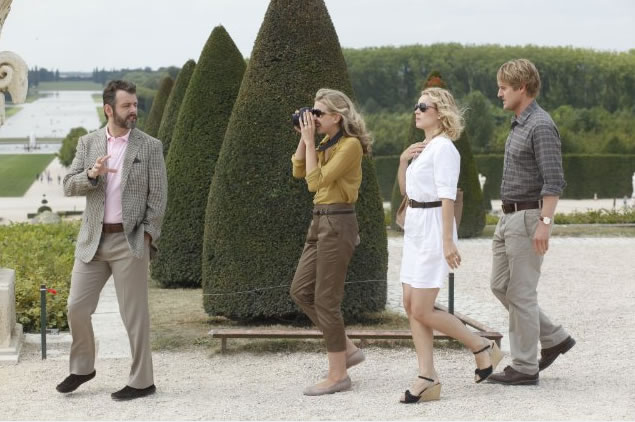
The Thinker (1879–1889) is among the most recognized works in all of sculpture. In fact, below you can see Paul who constantly is showing up Gil with his knowledge about these pieces of art. He shows off while describing Rodin’s life story when all four of them are taking in “The Thinker.” However, he is set straight by the museum worker (French  First Lady, Mrs. Bruni-Sarkozy). She is pictured below on the bench with Gil.

“Paul: If I am not mistaken Rodin’s work was influenced by his wife, Camille.
Mrs. Bruni-Sarkozy:[French First Lady] Rose was the wife.
Paul: No he was not married to Rose.”

https://i0.wp.com/www.awardsdaily.com/wp-content/uploads/2011/06/8.jpg

https://i0.wp.com/www.awardsdaily.com/wp-content/uploads/2011/06/9.jpg

Rodin’s Funeral in Meudon,
November 24, 1917

Photograph by Pierre Choumoff, 1917
Musée Rodin inventory Ph 1009
Gelatin silver print
© Cabinet des Photographies Anciennes

I am currently going through all the writers and artists mentioned in Woody Allen’s latest movie “Midnight in Paris.” Today I will look at Rodin. By the way, I know that some of you are wondering how many posts I will have before I am finished. Right now I have plans to look at Coco Chanel, Modigliani, Matisse, Luis Bunuel, Josephine Baker, Van Gogh, Picasso, Man Ray, T.S. Elliot and several more.

Photo of a bearded man wearing a beret, looking into the distance.
Birth name François-Auguste-René Rodin
Born 12 November 1840(1840-11-12)
Paris
Died 17 November 1917(1917-11-17) (aged 77)
Meudon, Île-de-France
Nationality French
Field Sculpture, drawing
Works The Age of Bronze (L’age d’airain), 1877
The Walking Man (L’homme qui marche), 1877–78
The Burghers of Calais (Les Bourgeois de Calais), 1889
The Kiss, 1889The Thinker (Le Penseur), 1902
Awards Légion d’Honneur

In the movie “Midnight in Paris” we have this exchange:

“Paul: If I am not mistaken Rodin’s work was influenced by his wife, Camille.
Mrs. Bruni-Sarkozy:[French First Lady] Rose was the wife.
Paul: No he was not married to Rose.”

It appears that Rose was the wife.

During his last year Rodin married his lifetime companion Rose Beuret on January 29, 1917. Rose died three weeks later and Rodin followed shortly, passing away on November 17, 1917. Friends and dignitaries came to Rodin’s funeral to see him laid to rest beside Rose at Meudon with The Thinker at the base of his tomb.

The Dr. Coleman A. Mopper Memorial Lecture at the DIA

October 4, 2005 (Detroit)—Marie Cheffer, sister; Rose Beuret, mistress and wife; Camille Claudel, lover and colleague—these women influenced the life and extraordinary art of famed sculptor Auguste Rodin.  Their personal and professional relationships with Rodin are the topic of this year’s annual Dr. Coleman A. Mopper Memorial Lecture at the Detroit Institute of Arts (DIA) on Oct. 29 at 2 p.m. Ruth Butler, world-renowned Rodin expert, professor emeriti at the University of Massachusetts, Boston, and author of the book “Rodin: The Shape of Genius,” presents a compelling perspective on Rodin’s work by focusing on the women who influenced his career, creativity and life. Butler will also reveal her speculations regarding the end of his relationship with his mistress for over 50 years, then finally his wife, Beuret, during their time in Paris and nearby Meudon, France. 

Auguste Rodin in Sculptor’s Smock
Photograph by Hippolyte Charles Aubry, 1862
Musée Rodin inventory Ph 4
Gelatin silver print
© Cabinet des Photographies Anciennes

________________________________________

The French first lady says no more than four words in the two-minute trailer for Midnight in Paris, a romantic comedy set in the French capital in which she plays a museum curator.

The wife of President Nicolas Sarkozy appears in the gardens of the capital’s Rodin Museum dedicated to the 19th century sculptor August Rodin and the sculptress Camille Claudel, also his mistress.

One of the two male protagonists played by Michael Sheen says: “If I’m not mistaken Rodin’s work was influenced by his wife, Camille.”

“Rose was the wife,” says Mrs Bruni-Sarkozy.

“No he was never married to Rose,” he replies erroneously.

The trailer shows picture postcard shots of the City of Lights, with captions, “Paris in the morning is beautiful, Paris in the afternoon is charming, Paris is enchanting in the evening, but Paris after midnight is magic.”

The plot revolves around a family travelling to the French capital for business. The party includes a young engaged couple forced to confront the illusion that a life different from their own is better.

The film, described as a “marvellous love letter to Paris” will open this year’s Cannes film festival on May 11. It also stars Owen Wilson, Marion Cotillard and Rachel McAdams.

Mr Allen recently scotched rumours during the shooting in Paris that a wooden Mrs Bruni-Sarkozy took 32 takes to shoot a single scene saying: “This is a hundred per cent untrue.”

“She’s in the picture. Everything she shot is in the picture. I love her. She’s great. It’s not a big part, but it’s a respectable part.”

Rodin in 1917 posing with friends and associates in front of the full scale plaster version of The Gates of Hell at Meudon. Left to right: two practitioners: Léonce Bénédite (first curator of the Musée Rodin); Rodin; his foreman, Henri Lebossé; Eugène Rudier; and another practitioner.

(photo, collection Robert Descharnes)

It would be impossible to overstate the significance of Auguste Rodin (1840-1917) to the history of art. More than any other sculptor since Michelangelo, Rodin changed the face of figurative sculpture and ushered in a whole new era of artistic expression. Many know Rodin for his famous controversies—the scandal around the Age of Bronze or the Monument to Honoré de Balzac—or for his unfinished projects, most famously The Gates of Hell. But few who recognize Rodin’s works have failed to be moved by them. The innovations he introduced into sculpture were elaborated by countless artists who followed him, including many who worked in his studio, such as Constantin Brancusi and Aristide Maillol.

This Tuesday, May 31, 2011 photo shows a visitor in the garden of the Rodin museum in Paris. Spend a day, and a de rigeur night, here and you can walk hand-in-hand with Woody Allen through the City of Light he portrays in “Midnight in Paris,” his sweet and zany Valentine to the French capital. In an instant anyone can amble down the 21st-century streets of this walking city. AP Photo/Remy de la Mauviniere.By: Elaine Ganley, Associated Press
  
PARIS (AP).- “Parlez-moi d’amour.” Speak to me of love.

This is Paris and the language is love — crazy love — amid the creative folly of a city whose ethereal beauty and bawdy underside spell magic.Spend a day, and a de rigueur night, here and you can walk hand-in-hand with Woody Allen through the City of Light he portrays in “Midnight in Paris,” his sweet and zany valentine to the French capital.Amble down the 21st-century streets of this walking city, and like Allen’s leading character, Gil (played by Owen Wilson), you could be swept into the past, with the iconic 1930s tune that haunts the movie whispering “Speak to me of love” in your ear.In Allen’s Paris, there is no place for rude taxi drivers or haughty waiters.”I wanted to show the city emotionally, the way I felt about it,” Allen said during a news conference last month in Cannes, where “Midnight in Paris” opened this year’s film festival. “It didn’t matter to me how real it was or what it reflected.”It was, he added, “Paris through my eyes.”

Visiting some of the postcard venues Allen splashes from the camera — like temples of gastronomy such as Le Grand Vefour on the Right Bank or Laperouse on a Left Bank quai — requires reservations and deep pockets.

Other don’t-miss sites, as well as some hidden delights packed with the Paris of yesteryear, are accessible to all. But don’t bother with a plan. Like leading man Gil, a Hollywood hack writer dreaming of penning that great novel, just soak up the atmosphere by wandering the Left Bank of the Seine river, the artsy and intellectual side of the city and the colorful heart of Woody’s Paris.

Then, step into Deyrolle at 46 rue du Bac, steps from the Metro of that name. Only in Paris could a taxidermy and curiosity shop be a source of inspiration to artists and occasionally their gathering place. Deyrolle, which dates from 1831, is imbued with history and magic.

You’ll begin to understand the eclectic ambiance that fed the souls of the “lost generation” of American writers from F. Scott Fitzgerald to Ernest Hemingway, and the likes of Picasso, Modigliani and others.

Climb the stairs to the wondrous menagerie, and into another dimension. You will be greeted by a lion at rest, the heads of deer, elk and other woodland and jungle creatures. Then comes the magnificent polar bear who makes a brief but notable appearance in “Midnight in Paris,” at a soiree hosted by Fitzgerald and his zany wife Zelda.

Owner Prince Louis Albert de Broglie (pronounced de broy) is a modern-day nobleman, preserving the heritage of Deyrolle. But he also makes it his mission to contribute to protecting the species that populate Deyrolle and pass the message of sustainable development.

“Our idea is not to sell an elephant a day but to give a little part of this magical place” to others, he said, stressing that animals on display here succumbed to natural deaths at zoos, circuses and elsewhere. “You cannot protect anything if you don’t know it,” he said.

“Deyrolle always received artists,” from Surrealist writer Andre Breton to Salvador Dali (given a cameo comeback in Allen’s film), de Broglie said. “Today, many are inspired by Deyrolle.”

Artists came to the rescue when Deyrolle was almost lost to a devastating fire in 2008, helping fund reconstruction with an auction.

While the polar bear and other large creatures go for princely sums, there are souvenirs a visitor can take away, from books to a line of gardening products, “Le Prince Jardinier,” with items starting at as little as a few euros.

Now, on to the next stop. Paris opens its panoply of wonder if the visitor walks down the Boulevard Saint-Germain to Saint-Germain des Pres, dotted by famed literary cafes. Turn left down rue Bonaparte toward the Seine, or get lost in the winding streets on the way. At some point, hit the quai of the Seine.

The true wanderer may take hours to reach Shakespeare and Company at 37 rue de la Bucherie, not far from the Saint Michel Metro in the 5th arrondissement, and just across the street from Notre Dame Cathedral. But that’s all the more reason to get there.

In his movie, Allen only winks with the camera at the shop, an institution steeped in the history of expatriate Americans. A visitor can curl up in a comfy nook, good book in hand, resting feet and soul until 11 p.m.

The original site of legendary literary matron Sylvia Beach, a magnet for English-speaking expats like Hemingway, Fitzgerald and the Irish James Joyce, was on the rue de l’Odeon not far from 27 rue de Fleurus where Gertrude Stein, writer, art collector and friend of Picasso lived with lover Alice B. Toklas — and who is featured in Allen’s film (played by Kathy Bates).

Shakespeare and Company got a second life in 1951, at the spot filmed in the movie. It, too, drew the expats, and still does.

Here, books — first, second- and thirdhand — line the walls, and floors, stacked in no particular order, with shelves on the patio outside the front door.

“My father says it’s a Socialist utopia masquerading as a bookstore,” said Sylvia Whitman, whose father took over from Beach and who now runs the shop.

A half-dozen writers can lodge there at a time in exchange for a hand in the shop. They also can visit with George Whitman, now 97 and living on the third floor.

“Some people who come are literally on a mission. Others have heard from friends that it’s a quirky place,” said his 30-year-old daughter. “For me, it’s a total fairytale land.”

There’s constant foot traffic in the bookstore at this time of year, so Whitman doesn’t know if the movie is bringing in new visitors. And while fans of the movie may not realize that Allen is a writer as well as a filmmaker, Whitman says the store has always sold his books.

But now it’s time to go back in time, moving deeper into the Left Bank by ascending the rue de la Montagne-Sainte-Genevieve, one of Paris’ most ancient streets. Turning away from the Seine, toward the Metro stop Maubert-Mutualite, one can spot it.

Despite a history dating from antiquity, the street today, paved and bustling, is undistinguished — until the end of the journey. At the top of the hill, cobblestones appear as the street spills onto a church, Saint-Etienne du Mont, first built in the 12th century.

Here, Gil, waiting on the church steps, was thrust back in time into the Paris of his dreams, a carefree, chaotic world of creation. With the Pantheon, where France has buried its heroes, just steps away, we are in the realm of greatness. But will the average traveler experience the same kind of magic as Allen’s hero?

Perhaps not. But at least there are restaurants galore.

Rodin was not educated at the École des Beaux-Arts, the most elevated school for the training of French artists, but his works achieved worldwide recognition in his own lifetime and his reputation continues to grow to this day. His genius was to express the inner truths of the human psyche and his gaze penetrated beneath the external appearance of the world. Exploring this realm beneath the surface, Rodin developed an agile technique for rendering extreme physical states which correspond to expressions of inner turmoil or overwhelming joy. Rodin was obsessed with myths, both ancient and modern, and his works commonly evoke classical mythology, the Bible, and the Divine Comedyof Dante, as well as the macabre modern Paris described in the poems of Charles Baudelaire. Deriving inspiration from such literary sources, Rodin sculpted a universe of great passion and tragedy, a world of imagination that exceeded the mundane reality of everyday existence.

Technically, Rodin introduced some very important innovations to the history of sculpture. His ability to make his figures lifelike caused him to be accused of modeling his sculptures directly from live subjects. The heightened expressive intensity of his works introduced a whole generation of artists to the potential for expressing internal depth through external features. In his Monument to Balzac, Rodin took his expressive technique to a new level, producing a figure of a great genius at the moment of his inspiration, wrapped in a cloak in the middle of the night. Though Rodin had made countless studies from life for this monument, he discarded these renderings in order to marry the expressive intensity of his modeling with the brilliance of the subject. This parallel between technique and subject, combined with the courage to throw away years of work in order to achieve a higher level of expression, mark Rodin as a unique and powerful artist.

__________________________________

Timeline of Rodin and major events in world:


Rodin and his sister Maria, c. 1859

  • United States Civil War; Franco-Prussian War
  • Victor Hugo writes Les Misérables; Dostoyevsky writes Crime and Punishment
  • Deaths of Henry Thoreau, Charles Dickens, and Alexandre Dumas
  • Karl Marx’s Das Kapital published in 1867; Suez canal opens in 1869
  • Napoleon III holds “Salon de Refusés” to exhibit works rejected by the Academy.


  • Rodin is discharged from the National Guard for nearsightedness
  • Works in Belgium with Carrier-Belleuse in the aftermath of the Franco-Prussian War; returns to Paris in 1877
  • Sees Michelangelo’s work in Florence
  • Creates Saint John the Baptist Preaching in 1878 and The Call to Arms in 1879
  • Commission for The Gates of Hell, 1880
  • German Empire proclaimed by Otto von Bismarck, 1871
  • The word “impressionism” is coined; Whistler paints portrait of his mother
  • Jules Verne publishes Around the World in Eighty Days; Tolstoy writes Anna Karenina
  • Sioux defeat Custer at Little Bighorn, 1876
  • Joseph Stalin is born, 1879


  • meets Camille Claudel in 1883
  • Commission for The Burghers of Calais, 1884; definitive model shown in a joint exhibition with Monet at Galerie Georges Petite in Paris, 1889
  • Original plaster example of The Kiss, 1886; French government purchases a marble version in 1888
  • Commission for the Monument to Victor Hugo, 1889


Rodin in his studio

  • Freedom of the press established in France; trade unions legalized
  • Pablo Picasso, Coco Chanel, and Adolf Hitler are born
  • Deaths of Victor Hugo, Vincent van Gogh, and Karl Marx
  • Statue of Liberty erected; Eiffel Tower built
  • Rapid expansion of railways in the western United States


  • Rodin receives commission for Balzac monument, 1891
  • Elected president of the sculpture section of the Société Nationale des Beaux-Arts
  • Ends relationship with Camille Claudel
  • Rodin’s marble sculpture is in great demand; he creates The Hand of God in marble, 1898
  • Retrospective, Paris World Exposition, 1900
  • Sigmund Freud publishes The Interpretation of Dreams
  • Paul Gauguin settles in Tahiti; Aubrey Beardsley spreads art nouveau style; the symbolist movement is active
  • Tate Gallery opens in London
  • Nobel Prize instituted; the Paris subway opens
  • Alfred Dreyfus arrested for treason, 1894; pardoned, 1899


  • Rodin is visited by Edward Steichen and King Edward VII
  • The Thinker is installed at the Panthéon in Paris
  • Rodin experiments with enlargements of partial figures such as The Cathedral, 1908, and The Hand from the Tomb, 1910
  • Picasso has first exhibition in Paris; paints Les Demoiselles d-Avignon
  • Deaths of Henri de Toulouse-Lautrec, Paul Gauguin, Whistler, and Paul Cézanne
  • Futurist movement active in Italy
  • Separation of church and state in France


  • Rodin travels despite wartime difficulties; his sculpture is shown throughout Europe
  • Bequeaths his estate to France in 1916
  • Marries Rose Beuret on January 29, 1917; she dies three weeks later
  • Rodin dies November 17, 1917, and is laid to rest at Meudon


Also reproduced in Descharnes & Descharnes.

Charges dropped against Osama bin Laden

ABC News reported:

Osama bin Laden is in the clear. Federal prosecutors
have elected to drop hundreds of criminal charges
against the al Qaeda leader and architect of the 9/11
terror attacks because he will be unable to appear in
court to answer them.

Bin Laden was indicted back in 1998 in the Southern
District of New York for his role in the al Qaeda attack
on the U.S. embassies in Tanzania and Kenya, which
killed more than 200 people, including a dozen
Americans. Several superseding indictments in the
same federal jurisdiction piled on more charges.

On Thursday, Assistant U.S. Attorney Nicholas Lewin
presented a formal recommendation to U.S. Attorney
Preet Bharara that Bin Laden not be prosecuted on any
of the charges, given that he is dead.

After reciting Bin Laden’s multiple aliases and then
listing the counts against him for ten pages, Lewin
notes, “On or about May 1, 2011, while this case was
still pending, defendant Usama Bin Laden was killed
in Abbottabad, Pakistan, in the course of an operation
conducted by the United States.”

Lewin then provides evidence that bin Laden was
actually killed in the raid, including the confirmation
of his identity by DNA analysis and facial recognition
analysis, eyewitness confirmation by one of bin
Laden’s wives, video of bin Laden found in the
Abbottabad compound and the “significant quantity”
of other al Qaeda material seized by U.S. Navy Seals
during last month’s raid.

He also notes that “al Qaeda has itself publicly
acknowledged the death of BIN LADEN. Among other
pronouncements, a recently released video depicts
senior al Qaeda leader and co-defendant Ayman al
Zawahiri acknowledging bin Laden’s death.”

The Characters referenced in Woody Allen’s “Midnight in Paris” (Part 10 Salvador Dali)

Artists and bohemians inspired Woody Allen for ‘Midnight in Paris

I love the movie “Midnight in Paris” by Woody Allen and I am going through the whole list of famous writers and artists that he included in the movie. Today we will look at Salvador Dali.  By the way, I know that some of you are wondering how many posts I will have before I am finished. Right now I have plans to look at Rodin,Coco Chanel, Modigliani, Matisse, Luis Bunuel, Josephine Baker, Van Gogh, Picasso, Man Ray, T.S. Elliot and several more.

In this clip below you will see when Picasso first met Dali.

Adrien Brody plays Salvador Dali in “Midnight in Paris.”

Adrien Brody 3

Associated Press

Salvador Dalí in 1971

Dalí, Salvador (1904-89): Spanish painter, sculptor, graphic artist, and designer. After passing through phases of Cubism, Futurism and Metaphysical painting, he joined the Surrealists in 1929 and his talent for self-publicity rapidly made him the most famous representative of the movement. Throughout his life he cultivated eccentricity and exhibitionism (one of his most famous acts was appearing in a diving suit at the opening of the London Surrealist exhibition in 1936), claiming that this was the source of his creative energy. He took over the Surrealist theory of automatism but transformed it into a more positive method which he named `critical paranoia’. According to this theory one should cultivate genuine delusion as in clinical paranoia while remaining residually aware at the back of one’s mind that the control of the reason and will has been deliberately suspended. He claimed that this method should be used not only in artistic and poetical creation but also in the affairs of daily life. His paintings employed a meticulous academic technique that was contradicted by the unreal `dream’ space he depicted and by the strangely hallucinatory characters of his imagery. He described his pictures as `hand-painted dream photographs’ and had certain favorite and recurring images, such as the human figure with half-open drawers protruding from it, burning giraffes, and watches bent and flowing as if made from melting wax (The Persistence of Memory, MOMA, New York; 1931).

(My wife and I saw the Alfred Hitchcock film “Spellbound” in 1985 at the University of Arkansas at Little Rock and we saw this dream that Dali contributed as seen in clip below.)

In 1937 Dalí visited Italy and adopted a more traditional style; this together with his political views (he was a supporter of General Franco) led Breton to expel him from the Surrealist ranks. He moved to the USA in 1940 and remained there until 1955. During this time he devoted himself largely to self-publicity; his paintings were often on religious themes (The Crucifixion of St John of the Cross, Glasgow Art Gallery, 1951), although sexual subjects and pictures centring on his wife Gala were also continuing preoccupations. In 1955 he returned to Spain and in old age became a recluse.

Apart from painting, Dalí’s output included sculpture, book illustration, jewellery design, and work for the theatre. In collaboration with the director Luis Buñuel he also made the first Surrealist films—Un chien andalou (1929) and L’Age d’or (1930)—and he contributed a dream sequence to Alfred Hitchcock’s Spellbound (1945). He also wrote a novel, Hidden Faces (1944) and several volumes of flamboyant autobiography. Although he is undoubtedly one of the most famous artists of the 20th century, his status is controversial; many critics consider that he did little if anything of consequence after his classic Surrealist works of the 1930s. There are museums devoted to Dalí’s work in Figueras, his home town in Spain, and in St Petersburg in Florida.

Dali

1904: Salvador Felipe Jacinto Dalí was born on May, 11th in Figueras, Catalonia, Spain.

1917: He started to visit the School of Art. First paintings.

1918: First small exhibition in the Theatre.

1921-25: Went to Academy of Arts in Madrid. Conflicts with his teachers.

1925: First stand-alone exibition of Dalí at the Galery of Dalmau.

1926-28: Early explorations of the Surrealism. Dalí in Cadaqués 1927

1929: Gala went into his life. Joined the group of Surrealists in 1930 Gala 1927, and Dalí 1929

1934-37: Dalí had his paranoid-critic-epoch. Dalí and Gala in 1937

1941-44: “Avida Dollars” in America.

1945-49: Dalí the Classic. Dalí and his Daddy in Cadaqués 1948

1950-65: His mystic period. He wrote several books (The secret life of Salvador Dalí).

1963-78: Dalí the Divine – Dalí and the Science.

1979-83: Theory of Disaster.

1982: Gala died.

1989: Dalí, Jan. 23th, died.

_______________________________________________

The above clip is from the film series by Francis Schaeffer “How should we then live?” Below is an outline of the 8th episode on the Impressionists and the age of Fragmentation.

AGE OF FRAGMENTATION

I. Art As a Vehicle Of Modern Thought

A. Impressionism (Monet, Renoir, Pissarro, Sisley, Degas) and Post-Impressionism (Cézanne, Van Gogh, Gauguin, Seurat): appearance and reality.

1. Problem of reality in Impressionism: no universal.

2. Post-Impression seeks the universal behind appearances.

3. Painting expresses an idea in its own terms as a work of art; to discuss the idea in a painting is not to intellectualize art.

4. Parallel search for universal in art and philosophy; Cézanne.

B. Fragmentation.

1. Extremes of ultra-naturalism or abstraction: Wassily Kandinsky.

2. Picasso leads choice for abstraction: relevance of this choice.

3. Failure of Picasso (like Sartre, and for similar reasons) to be fully consistent with his choice.

C. Retreat to absurdity.

1. Dada , and Marcel Duchamp: art as absurd. (Dada gave birth to Surrealism).

2. Art followed philosophy but came sooner to logical end.

3. Chance in his art technique as an art theory impossible to practice: Pollock.

II. Music As a Vehicle of Modern Thought

A. Non-resolution and fragmentation: German and French streams.

1. Influence of Beethoven’s last Quartets.

2. Direction and influence of Debussy.

3. Schoenberg’s non-resolution; contrast with Bach.

4. Stockhausen: electronic music and concern with the element of change.

B. Cage: a case study in confusion.

1. Deliberate chance and confusion in Cage’s music.

2. Cage’s inability to live the philosophy of his music.

C. Contrast of music-by-chance and the world around us.

1. Inconsistency of indulging in expression of chaos when we acknowledge order for practical matters like airplane design.

2. Art as anti-art when it is mere intellectual statement, divorced from reality of who people are and the fullness of what the universe is.

III. General Culture As the Vehicle of Modern Thought

A. Propagation of idea of fragmentation in literature.

1. Effect of Eliot’s Wasteland and Picasso’s Demoiselles d’ Avignon

compared; the drift of general culture.

2. Eliot’s change in his form of writing when he became a Christian.

3. Philosophic popularization by novel: Sartre, Camus, de Beauvoir.

B. Cinema as advanced medium of philosophy.

1. Cinema in the 1960s used to express Man’s destruction: e.g. Blow-up.

2. Cinema and the leap into fantasy:


The Hour of the Wolf, Belle de Jour, Juliet of the Spirits,

The Last Year at Marienbad.

3. Bergman’s inability to live out his philosophy (see Cage):

Silence and The Hour of the Wolf.

IV. Only on Christian Base Can Reality Be Faced Squarely

I looked up the definition of Surrealism and here it is:

(1920s-1930s)  Surrealism was both a art and literary movement that stressed the significance of letting one’s imagination rule through the use of the sub-conscious without the hindrances of logic and normal standards.  The anti-rationalist characteristic that stemmed from the Dadaist movement was a part of Surrealism.  However, Surrealism involved more playful and spontaneous in spirit.  Ways of thinking about how a viewer perceives the world around himself helped to shape the movement.  The movement was begun in 1924 in the city Paris by Andre Breton, the author of the ‘Manifeste du surrealisme.’  His writings encouraged the expression of one’s imagination through the use of dreams.  His writings attracted many artists of the Dadaist movement.  The Surrealist movement was helped along in its development during the 1920s and 1930s with the famous artist Salvador Dali.

From left to right: Tristan Tzara, Paul Eluard, Andre Breton, (Hans) Jean Arp, Salvador Dali, Yves Tanguy, Max Ernst, Rene Crevel, Man Ray

Jean Arp (Hans Arp)
Jean Arp is associated with the DADA movement. His collages were of torn pieces of paper dropped and affixed where they would land. His use of chance is intended to create free of human intervention. “Dada,” wrote Arp, “wished to destroy the hoaxes of reason and to discover an unreasoned order.”


Collage with Squares Arranged According to the Laws of Chance


Random Collage


Torn Paper and Gouache

Dada carried to its logical conclusion the notion of all having come about by chance; the result was the final absurdity of everything, including humanity.

Pictured below: Salvador Dalí (lower center) and Marcel Duchamp (upper left) attending a bullfight.

Nude Descending a Staircase (1912) by Marcel Duchamp

Francis Schaeffer continues: 

The man who perhaps most clearly and consciously showed this understanding of the resulting absurdity fo all things was Marcel Duchamp (1887-1969). He carried the concept of fragmentation further in Nude Descending a Staircase (1912), one version of which is now in the Philadelphia Museum of Art–a painting in which the human disappeared completely. The chance and fragmented concept of what is led to the devaluation and absurdity of all things. All one was left with was a fragmented view of a life which is absurd in all its parts. Duchamp realized that the absurdity of all things includes the absurdity of art itself. His “ready-mades” were any object near at hand, which he simply signed. It could be a bicycle wheel or a urinal. Thus art itself was declared absurd.

_____

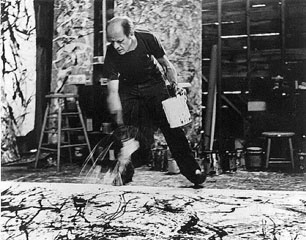
(Jackson Pollock pictured below dripping his paint)

Francis Schaeffer in his book HOW SHOULD WE THEN LIVE? noted on pages 200-203:

Jackson Pollock (1912-1956) is perhaps the clearest example in the United States of painting deliberately in order to make the statements that all is chance. He placed canvases horizontally on the floor and dripped paint on them from suspended cans swinging over them. Thus, his paintings were a product of chance. But wait a minute! Is there not an order in the lines of paint on his canvases? Yes, because it was not really chance shaping his canvases! The universe is not a random universe; it has order. Therefore, as the dripping paint from the swinging cans moved over the canvases, the lines of paint were following the order of the universe itself. The universe is not what these painters said it is.

(John Cage pictured above)

(Woody Allen, Peter O’Toole and Capucine)

________

(Marcel Duchamp plays white, John Cage plays black, on a chessboard modified to generate tones depending on where the chess pieces are. Toronto, 1968. Teeny Duchamp at far left, camerman in the background.  This was a performance.)

John Cage provides perhaps the clearest example of what is involved in the shift of music. Cage believed the universe is a universe of chance. He tried carrying this out with great consistency. For example, at times he flipped coins to decide what the music should be. At other times he erected a machine that led an orchestra by chance motions so that the orchestra would not know what was coming next. Thus there was no order. Or again, he placed two conductors leading the same orchestra, separated from each other by a partition, so that what resulted was utter confusion. There is a close tie-in again to painting; in 1947 Cage made a composition he called MUSIC FOR MARCEL DUCHAMP. But the sound produced by his music was composed only of silence (interrupted only by random environmental sounds), but as soon as he used his chance methods sheer noise was the outcome.

But Cage also showed that one cannot live on such a base, that the chance concept of the universe does not fit the universe as it is. Cage is an expert in mycology, the science of mushrooms. And he himself said, “I became aware that if I approached mushrooms in the spirit of my chance operation, I would die shortly.” Mushroom picking must be carefully discriminative. His theory of the universe does not fit the universe that exists.

All of this music by chance, which results in noise, makes a strange contrast to the airplanes sitting in our airports or slicing through our skies. An airplane is carefully formed; it is orderly (and many would also think it beautiful). This is in sharp contrast to the intellectualized art which states that the universe is chance. Why is the airplane carefully formed and orderly, and what Cage produced utter noise? Simply because an airplane must fit the orderly flow lines of the universe if it is to fly!

!Midnight in the Paris-best scene of the movie Salvador Dali, Man Ray and Woody Allen

published on Dec 18, 2012

Woody Allen talking with Salvador Dali and Man Ray and Luis Bunuel. 

This is the transcript of

DALI: We met, earlier tonight…At the party! Dali.

GIL: I remember!-

DALI: A bottle of red wine!

GIL: It can’t be… Yeah….So?

DALI: Another glass for this man, please. I love the language!The French! The waiters? No.You like the shape of the rhinoceros?

GIL: The rhinoceros? Uh…Haven’t really thought about it.I paint the rhinoceros.

DALI: I paint you. Your sad eyes.Your big lips, melting over the hot sand,with one tear.Yes! And in your tear, another face.The Christ’s face!Yes, in the rhinoceros.

GIL: Yeah. I mean, I probably do look sad. I’m in…a very perplexing situation.

DALI: Diablo…Luis! Oye, Luis!(Damn. Luis! Hey, Luis!)My friends.This… is Luis Bunuel…and…Mr. Man Ray.-

GIL: Man Ray? My Gosh!- How ’bout that?

DALI: This is Pen-der. Pen-der. Pender!- Yes. And I am Dalí!- Dalí. Yes.You have to remember. Pender is in a perplexing situation.

GIL: It sounds so crazy to say.You guys are going to think I’m drunk, but I have to tell someone. I’m…from a…a different time. Another era.The future. OK? I come…from the 2000th millennium to here.I get in a car, and I slide through time.

MAN RAY: Exactly correct.You inhabit two worlds.- So far, I see nothing strange.- Why?

GIL: Yeah, you’re surrealists!But I’m a normal guy. See, in one life,I‘m engaged to marry a woman I love.At least, I think I love her.Christ! I better love her! I’m marrying her!

DALI: The rhinoceros makes love by mounting the female.But…is there a difference in the beauty between two rhinoceroses?

MAN RAY: There is another woman?Adriana. Yes, and I’m…very drawn to her.I find her extremely alluring.The problem is that other men,great artists – geniuses- also find her alluring,and she finds them. So, there’s that…

MAN RAY: A man in love with a woman from a different era.I see a photograph.

LUIS BUNUEL: I see a film.I see an insurmountable problem.I see……a rhinoceros.

Let me make a few points here. We see that Gil Pender’s perplexing problem is that he is in love and this goes against his views that we are not put here for a purpose, but by mindless chance. God created us so we can’t deny that we are created for a purpose and when a person falls truly in love with another person then they have a hard time maintaining  this is only just a product of evolution and has no lasting significance.

Solomon wisely noted in Ecclesiastes 3:11 “God has planted eternity in the heart of men…” (Living Bible). No wonder Bertrand Russell wrote in his autobiography, “It is odd, isn’t it? I feel passionately for this world and many things and people in it, and yet…what is it all? There must be something more important, one feels, though I don’t believe there is. I am haunted. Some ghosts, for some extra mundane regions, seem always trying to tell me something that I am to repeat to the world, but I cannot understand that message.”

Bertrand Russell playing chess with his son (1940).

The Bible teaches that we all know that God exists and has made us in his image and if we deny that then we are suppressing the knowledge of our conscience in unrighteousness.  Romans 1:18-19 (Amplified Bible) ” For God’s wrath and indignation are revealed from heaven against all ungodliness and unrighteousness of men, who in their wickedness REPRESS and HINDER the truth and make it inoperative. For that which is KNOWN about God is EVIDENT to them and MADE PLAIN IN THEIR INNER CONSCIOUSNESS, because God  has SHOWN IT TO THEM,”(emphasis mine).

But let me respond further with the words of Francis Schaeffer from his book HE IS THERE AND HE IS NOT SILENT (the chapter is entitled, “Is Propositional Revelation Nonsense?”

Of course, if the infinite uncreated Personal communicated to the finite created personal, he would not exhaust himself in his communication; but two things are clear here:
 
1. Even communication between once created person and another is not exhaustive, but that does not mean that for that reason it is not true. 
 
2. If the uncreated Personal really cared for the created personal, it could not be thought unexpected for him to tell the created personal things of a propositional nature;otherwise as a finite being the created personal would have numerous things he could not know if he just began with himself as a limited, finite reference point. In such a case, there is no intrinsic reason why the uncreated Personal could communicate some vaguely true things, but could not communicate propositional truth concerning the world surrounding the created personal – for fun, let’s call that science. Or why he could not communicate propositional truth to the created personal concerning the sequence that followed the uncreated Personal making everything he made – let’s call that history. There is no reason we could think of why he could not tell these two types of propositional things truly. They would not be exhaustive; but could we think of any reason why they would not be true? The above is, of course, what the Bible claims for itself in regard to propositional revelation.
(Francis Schaeffer pictured below)
DOES THE BIBLE ERR IN THE AREA OF SCIENCE AND HISTORY? The Bible is true from cover to cover and can be trusted. Charles Darwin himself longed for evidence to come forward from the area of  Biblical Archaeology  but so much has  advanced  since Darwin wrote these words in the 19th century! Here are some of the posts I have done in the past on the subject and if you like you could just google these subjects: 1. The Babylonian Chronicleof Nebuchadnezzars Siege of Jerusalem, 2. Hezekiah’s Siloam Tunnel Inscription.13. The Pilate Inscription14. Caiaphas Ossuary14 B Pontius Pilate Part 214c. Three greatest American Archaeologists moved to accept Bible’s accuracy through archaeology.

________________________________

A Christian Manifesto Francis Schaeffer

Published on Dec 18, 2012

A video important to today. The man was very wise in the ways of God. And of government. Hope you enjoy a good solis teaching from the past. The truth never gets old.

The Roots of the Emergent Church by Francis Schaeffer

Francis Shaeffer – The early church (part1)

Francis Shaeffer – The early church (part 2)

Francis Shaeffer – The early church (part 3)

Francis Shaeffer – The early church (part 4)

Francis Shaeffer – The early church (part 5)

How Should We then Live Episode 7 small (Age of Nonreason)

#02 How Should We Then Live? (Promo Clip) Dr. Francis Schaeffer

10 Worldview and Truth

Two Minute Warning: How Then Should We Live?: Francis Schaeffer at 100

Francis Schaeffer “BASIS FOR HUMAN DIGNITY” Whatever…HTTHR

Below is a review I got off the internet:

Cannes (France), 12 May (EFE).- Woody Allen’s ‘Midnight in Paris’ was chosen to open the 64th Cannes Film Festival, a film partly set in Paris the 1920s, a point in time that fascinated the American director

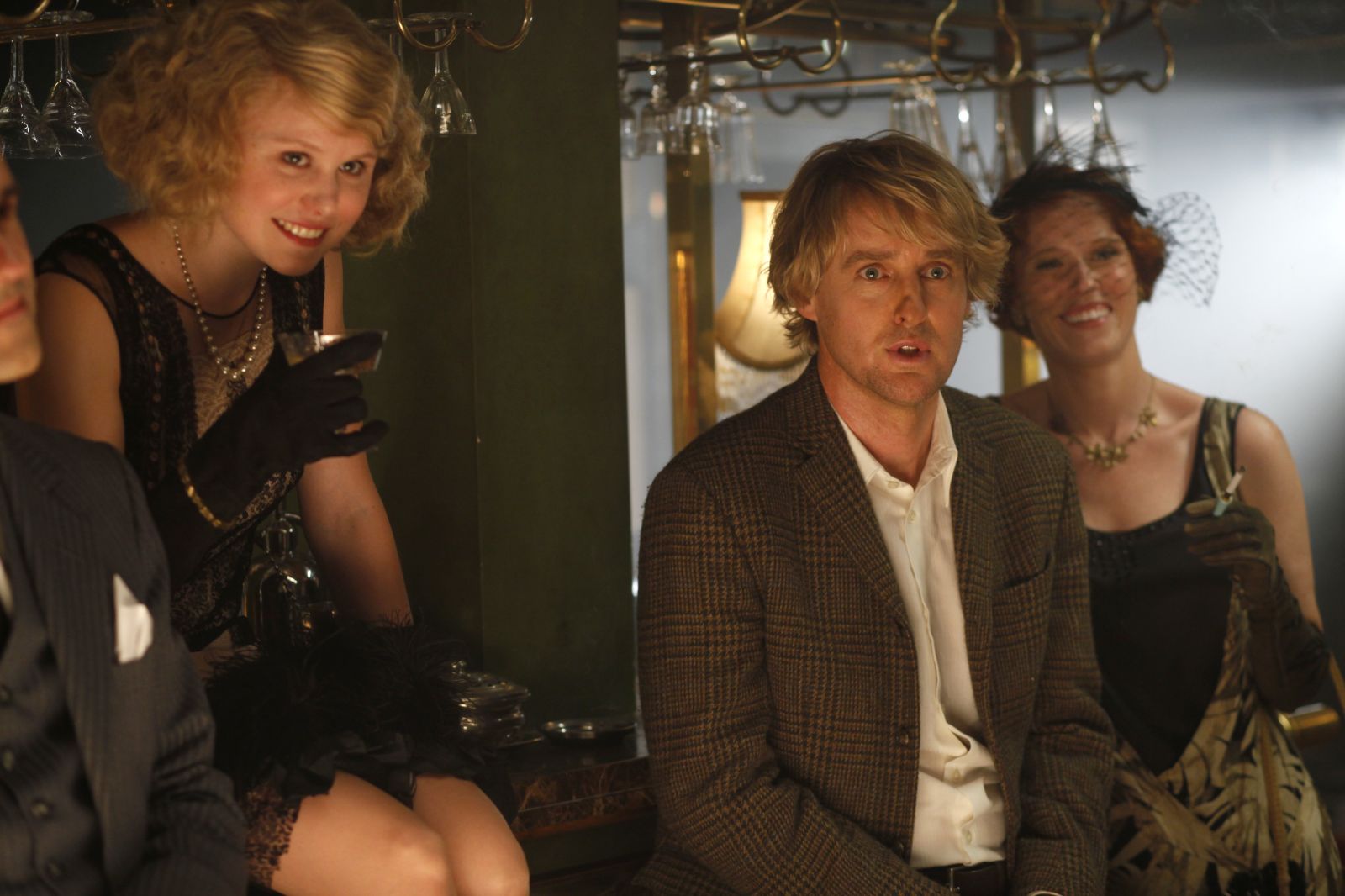
Owen Wilson as Gil and Rachel McAdams as Inez in "Midnight in Paris." 2011 Sony Pictures Classics.

Owen Wilson as Gil and Rachel McAdams as Inez in “Midnight in Paris.”

Paul Walker-Vin Diesel’s FAST FIVE Biggest 2011 Worldwide Blockbuster: Box Office

Woody Allen‘s latest, Midnight in Paris, is doing remarkably well in limited release. Starring Owen Wilson, Rachel McAdams, Marion Cotillard, Michael Sheen, Adrien Brody, Kathy Bates, Léa Seydoux, and Tom Hiddleston, Midnight in Paris collected $599k at six theaters, averaging an outstanding $99,834 per location.

That’s not only the best per-theater average of 2011, but also the best debut-weekend average of a Woody Allen movie since time immemorial, i.e., B.M — or before Manhattan (1979), as that’s where Box Office Mojo’s opening-weekend list ends.

Even adjusting for inflation (using Box Office Mojo’s chart), back in 1985 The Purple Rose of Cairo, one of Allen’s best-received efforts, averaged $84,205 at 3 locations. In 1995, Mighty Aphrodite, which would earn Mira Sorvino a Best Supporting Actress Oscar, collected $31,049 per site at 19 locations. Manhattanaveraged $52,450 at 29 locations. (Note: All things being equal, the higher the number of theaters, the lower the per-theater average.)

A few more comparisons: Midnight in Paris earned nearly four times more than You’ll Meet a Tall Dark Stranger‘s $160k — also at six sites — on its debut weekend in September last year. At four theaters, The King’s Speech averaged $88,863 in November last year.

According to Box Office Mojo, Midnight in Paris boasted the 16th highest weekend per-theater average among movies in limited release since 1982. (Most of those on the top-ten list are costlier, special screenings of Disney movies.)

Dreamgirls, Brokeback Mountain, Precious, and Red State (at a single location) are the four non-Disney, non-animated releases ahead of Midnight in Paris. The list, of course, hasn’t been adjusted for inflation.

Other posts with Woody Allen:

The Characters referenced in Woody Allen’s “Midnight in Paris” (Part 10 Salvador Dali)

Artists and bohemians inspired Woody Allen for ‘Midnight in Paris I love the movie “Midnight in Paris” by Woody Allen and I am going through the whole list of famous writers and artists that he included in the movie. Today we will look at Salvador Dali. In this clip below you will see when Picasso […]

The Characters referenced in Woody Allen’s “Midnight in Paris” (Part 9, Georges Braque)

2011 Roger Arpajou / Sony Pictures Classics Lea Seydoux as Gabrielle in “Midnight in Paris.” Adriana and Gil are seen above walking together in the movie “Midnight in Paris.” Adriana was a fictional character who was Picasso’s mistress in the film. Earlier she had been Georges Braque’s mistress before moving on to Picasso according to […]

The Characters referenced in Woody Allen’s “Midnight in Paris” (Part 8, Henri Toulouse Lautrec)

How Should We Then Live 7#3 2011 Roger Arpajou / Sony Pictures Classics Owen Wilson as Gil in “Midnight in Paris.” Paul Gauguin and Henri Toulouse Lautrec were the greatest painters of the post-impressionists. They are pictured together in 1890 in Paris in Woody Allen’s new movie “Midnight in Paris.” My favorite philosopher Francis Schaeffer […]

The Characters referenced in Woody Allen’s “Midnight in Paris” (Part 7 Paul Gauguin)

How Should We Then Live 7#1 Dr. Francis Schaeffer examines the Age of Non-Reason and he mentions the work of Paul Gauguin. 2011 Roger Arpajou / Sony Pictures Classics Kurt Fuller as John and Mimi Kennedy as Helen in “Midnight in Paris.” I love the movie “Midnight in Paris” by Woody Allen and I am […]

The Characters referenced in Woody Allen’s “Midnight in Paris” (Part 6 Gertrude Stein)

Midnight In Paris – SPOILER Discussion by What The Flick?! Associated Press Gertrude Stein and Alice B. Toklas in 1934 This video clip below discusses Gertrude Stein’s friendship with Pablo Picasso: I love the movie “Midnight in Paris” by Woody Allen and I am going through the whole list of famous writers and artists that […]

The Characters referenced in Woody Allen’s “Midnight in Paris” (Part 5 Juan Belmonte)

2011 Roger Arpajou / Sony Pictures Classics Gad Elmaleh as Detective Tisserant in “Midnight in Paris.” I love the movie “Midnight in Paris” by Woody Allen and I am going through the whole list of famous writers and artists that he included in the movie. Juan Belmonte was the most famous bullfighter of the time […]

The Characters referenced in Woody Allen’s “Midnight in Paris” (Part 4 Ernest Heminingway)

  Woody Allen explores fantasy world with “Midnight in Paris” 2011 Roger Arpajou / Sony Pictures Classics Corey Stoll as Ernest Hemingway in “Midnight in Paris.” The New York Times Ernest Hemingway, around 1937 I love the movie “Midnight in Paris” by Woody Allen and I am going through the whole list of famous writers […]

The Characters referenced in Woody Allen’s “Midnight in Paris” (Part 3 Scott and Zelda Fitzgerald)

What The Flick?!: Midnight In Paris – Review by What The Flick?! 2011 Roger Arpajou / Sony Pictures Classics Alison Pill as Zelda Fitzgerald and Tom Hiddleston as F. Scott Fitzgerald in “Midnight in Paris.” 2011 Roger Arpajou / Sony Pictures Classics Owen Wilson as Gil in “Midnight in Paris.” 2011 Roger Arpajou / Sony […]

The Characters referenced in Woody Allen’s “Midnight in Paris” (Part 2 Cole Porter)

The song used in “Midnight in Paris” I am going through the famous characters that Woody Allen presents in his excellent movie “Midnight in Paris.” This series may be a long one since there are so many great characters. De-Lovely – Movie Trailer De-Lovely – So in Love – Kevin Kline, Ashley Judd & Others […]

The Characters referenced in Woody Allen’s “Midnight in Paris” (Part 1 William Faulkner)

Photo by Phill Mullen The only known photograph of William Faulkner (right) with his eldest brother, John, was taken in 1949. Like his brother, John Faulkner was also a writer, though their writing styles differed considerably. My grandfather, John Murphey, (born 1910) grew up in Oxford, Mississippi and knew both Johncy and “Bill” Faulkner. He […]

I love Woody Allen’s latest movie “Midnight in Paris”

I love the movie “Midnight in Paris” was so good that I will be doing a series on it. My favorite Woody Allen movie is Crimes and Misdemeanors and I will provide links to my earlier posts on that great movie. Movie Guide the Christian website had the following review: MIDNIGHT IN PARIS is the […]

  The Associated Press reported today:   The signature under the typewritten words on yellowing sheets of nearly century-old paper is unmistakable: Adolf Hitler, with the last few scribbled letters drooping downward. The date is 1919 and, decades before the Holocaust, the 30-year-old German soldier — born in Austria — penned what are believed to be […]

Solomon, Woody Allen, Coldplay and Kansas (Coldplay’s spiritual search Part 6)

Here is an article I wrote a couple of years ago: Solomon, Woody Allen, Coldplay and Kansas What does King Solomon, the movie director Woody Allen and the modern rock bands Coldplay and Kansas have in common? All four took on the issues surrounding death, the meaning of life and a possible afterlife, although they all came up with their own conclusions on […]

Insight into what Coldplay meant by “St. Peter won’t call my name” (Series on Coldplay’s spiritual search, Part 3)

Coldplay seeks to corner the market on earnest and expressive rock music that currently appeals to wide audiences Here is an article I wrote a couple of years ago about Chris Martin’s view of hell. He says he does not believe in it but for some reason he writes a song that teaches that it […]

The Characters referenced in Woody Allen’s “Midnight in Paris” (Part 9, Georges Braque)

https://i0.wp.com/www.awardsdaily.com/wp-content/uploads/2011/06/18.jpg

Adriana pictured above is Picasso’s fictional mistress in the film “Midnight in Paris. Of course, Picasso did have plenty during his lifetime.

I am in the process of going through the characters referenced in  Woody Allen’s film “Midnight in Paris. Today I will be discussing Georges Braque. By the way, I know that some of you are wondering how many posts I will have before I am finished. Right now I have plans to look at Rodin,Coco Chanel, Modigliani, Matisse, Luis Bunuel, Josephine Baker, Van Gogh, Picasso, Man Ray, T.S. Elliot and several more.

Lea Seydoux as Gabrielle in "Midnight in Paris." 2011 Roger Arpajou / Sony Pictures Classics

Lea Seydoux as Gabrielle in “Midnight in Paris.”

midnight-in-paris-movie-image-slice-01

Adriana and Gil are seen above walking together in the movie “Midnight in Paris.” Adriana was a fictional character who was Picasso’s mistress in the film. Earlier she had been Georges Braque’s mistress before moving on to Picasso according to the film story line. Actually Picasso had taken girls from others quite often in the past. Picasso’s blue period was during a time when he moved into his best friend’s apartment and took up with his girl after his best friend’s suicide.

Along with Picasso Braque invented Cubism. I am currently going through the artists and writers mentioned in the movie “Midnight in Paris.” Below is a biography of Braque.

“Georges Braque developed his painting skills while working for his father, a house decorator. He moved to Paris in 1900 to study where he was drawn to the work of the Fauve artists, including Matisse, Derain and Dufy, as well as the late landscapes of Cézanne. Meeting Picasso marked a huge turning point in Braque’s development and together they evolved as leaders of Cubism. After a brief interlude in which he was called up to fight in the First World War, Braque’s style developed in the direction he was to follow for the rest of his life. In establishing the principle that a work of art should be autonomous and not merely imitate nature, Cubism redefined art in the twentieth century. Braque’s large compositions incorporated the Cubist aim of representing the world as seen from a number of different viewpoints. He wanted to convey a feeling of being able to move around within the painting. The still life subject remained his chief preoccupation from 1927 to 1955.”

This clip below mentions Georges Braque as one of Picasso’s friends who with Picasso developed cubism.

I doubt that Georges Braque lived the same type of life like Picasso with all the mistresses. Of course, Woody Allen’s film is fiction. I did want to make a comment about cubism. Both Braque and Picasso founded cubism together but Picasso could not live with the loss of humanism that the paintings pictured. Take a look at this post on Picasso.

A Christian Manifesto Francis Schaeffer

Published on Dec 18, 2012

A video important to today. The man was very wise in the ways of God. And of government. Hope you enjoy a good solis teaching from the past. The truth never gets old.

The Roots of the Emergent Church by Francis Schaeffer

How Should We then Live Episode 7 small (Age of Nonreason)

#02 How Should We Then Live? (Promo Clip) Dr. Francis Schaeffer

10 Worldview and Truth

Two Minute Warning: How Then Should We Live?: Francis Schaeffer at 100

Francis Schaeffer Whatever Happened to the Human Race (Episode 1) ABORTION

Francis Schaeffer “BASIS FOR HUMAN DIGNITY” Whatever…HTTHR

__________

Francis Schaeffer in the episode, “The Age of Fragmentation,” Episode 8 of HOW SHOULD WE THEN  LIVE? noted:

Monet, Renoir, Pissaro, Sisley, Degas were following nature as it has been called in their painting they were impressionists.They painted only what their eyes brought them. But was there reality behind the light waves reaching their eyes? After 1885 Monet carried this to its conclusion and reality tended to become a dream. With impressionism the door was open for art to become the vehicle for modern thought. As reality became a dream, impressionism began to fall apart. These men Cezanne, Van Gogh, 
Gauguin, Seurat, all great post Impressionists felt the problem, felt the loss  of meaning. They set out to solve the problem, to find the way back to reality, to the absolute behind the individual things, behind the particulars, ultimately they failed. I am not saying that these 
painters were always consciously painting their philosophy of life, but rather in their work as a whole their worldview was often reflected. Cezanne reduced nature to what he considered its basic geometric forms. In this he was searching for an universal which would tie all kinds of individual things in nature together, but this gave a broken fragmented appearance to his pictures. In his bathers there is much freshness, much vitality. An absolute wonder in the balance of the picture as a whole, but he portrayed not only nature but also man himself in fragmented form. 
I want to stress that I am not minimizing these men as men. To read van Gogh’s letters is to weep for the pain of this sensitive man. Nor do I minimize their talent as painters. Their work often has great beauty indeed. But their art did become the vehicle of modern man’s view of fractured truth and light. As philosophy had moved from unity to fragmentation so did painting. In 1912  Kaczynski wrote an article saying that in so far as the old harmony, that is an unity of knowledge have been lost, that only two possibilities remained: extreme abstraction or extreme naturalism, both he said were equal.
With this painting modern art was born. Picasso painted it in 1907 and called it Les Demoiselles d’Avignon. It unites Cezzanne’s fragmentation with Gauguin’s concept of the nobel savage using the form of the african mask which was popular with Parisian art circle of that 
time. In great art technique is united with worldview and the technique of  fragmentation works well with the worldview of modern man. A view of a fragmented world and a fragmented man and a complete break with the art of the Renaissance which was founded on man’s humanist hopes.
Here man is made to be less than man. Humanity is lost. Speaking of a part of Picasso’s private collection of his own works David Douglas Duncan says “Of course, not one of these pictures was actually a portrait, but his prophecy of a ruined world.”
But Picasso himself could not live  with this loss of the human. When he was in love with Olga and later  Jacqueline he did not consistently paint them in a fragmented way. At crucial 
points of their relationship he painted them as they really were with all his genius, with all their humanity. When he was painting his own young children he did not use fragmented techniques and presentation. I want you to understand that I am not saying that gentleness and humanness is not present in modern art, but as the techniques of modern art advanced, humanity was increasingly 
fragmented. The opposite of fragmentation would be unity, and the old philosophic thinkers thought they could bring forth this unity from  the humanist base and then they gave this up.

_____________________________________

Below is a review of “Midnight in Paris” that I got off the internet.

I can’t remember the last time Woody Allen made a film as delightful as Midnight in Paris.  He’s certainly done it before and it’s not one of his comedy classics like Annie Hall and Sleeper, but Midnight in Paris is undoubtedly one of Woody Allen’s best films of the past ten years.  It’s the rare Allen comedy where he doesn’t insert an Allen-like neurotic character, and the script finds inventive ways to be funny and thoughtful.  Johanne Debas and Darius Khondji’s cinematography is gorgeous, the film is filled with wonderful performances where you can tell that all of the actors are having a marvelous time, and Allen brings it all together with a joy rarely seen in his movies these days.

Gil (Owen Wilson) is having a miserable time in one of the most beautiful cities in the world: Paris.  He’s a screenwriter who’s struggling to finish his novel, his fiancée Inez (Rachel McAdams) seems more enamored of her pretentious friend Paul (Michael Sheen) than she does of Gil, and her parents (Kurt Fuller and Mimi Kennedy) hate Gil and think he’s cheap.  But none of that bothers him as much as the fact that he feels like he living in the wrong time.  When he walks around the museums and gardens of Paris, he takes in the beauty, but it also provides him with nostalgia for the 1920s and all the amazing writers and artists he never met.

owen-wilson-midnight-in-paris-movie-image-2

Despondent and a little drunk, Gil wanders the streets of Paris alone at midnight.  As he passes one particular street, an old-time motorcar offers to give him a lift.  He gets in and suddenly finds himself party talking up F. Scott Fitzgerald (Tom Hiddleston) and his wife Zelda (Alison Pill) while Cole Porter (Yves Heck) plays the piano.  Gil slowly realizes that he’s somehow been transported back to the Paris of the 1920s and that he has the rare opportunity to talk to his literary heroes about his book.  Matters become slightly more complicated when he starts to fall for Adriana (Marion Cotillard), a costume designer and a muse for giants like Ernest Hemingway (Corey Stoll) and Pablo Picasso (Marcial Di Fonzo Bo).

There’s a charming simplicity at the heart of Midnight in Paris and it comes from the  question of what would you do if you could go back in time and live in a world that you thought was better than your own?  Allen doesn’t try to recreate the 1920s as they actually were (this isn’t Boardwalk Empire), but rather as Gil imagines it and that everyone is larger than life.  Stoll almost steals the movie with his bombastic impersonation of a young Ernest Hemingway while Adrien Brody gets amusingly strange as he plays the eccentricities of Salvador Dalí.  And as for Wilson, I can’t remember the last time I saw him exuding such immeasurable joy and personality into a role, and I applaud both him and Allen for not making Gil the standard neurotic Woody Allen surrogate character.

midnight-in-paris-movie-image-alison-pill-owen-wilson-01

The movie pulls the majority of its entertainment value from watching Gil have fun with his 20th century artistic heroes (the rest of it comes from Michael Sheen’s performance), but it also has a thoughtful exploration at its core about artistic creation, inspiration, and criticism.  There’s a couple of simple observations like how the people who inspired us to be creative can inspire us to lead better lives through their art, and how nostalgia always makes people think an earlier time was better (Gil even remakes on the latter, “I’m having an insight!  It’s a minor one…”), but the idea I found most interesting was about the relationship between the critic and the creator.

Since I’m a critic, that should come as no surprise and neither should the fact that Allen sides with the creative.  It’s not that the film condemns criticism.  The constructive criticism Gertrude Stein (Kathy Bates) gives Gil on his manuscript is invaluable as are the life lessons he gets from all his other idols and Adriana.  But the ignorant, pompous criticism of Paul is where Allen clearly takes issue.  While the script veers a little too close to “Only the artist has the correct interpretation of their work,” Allen keeps it above water by letting us know that Paul is wrong not because he has an opinion on art, but because it’s an uninformed opinion that willfully ignores history and context.

owen-wilson-rachel-mcadams-michael-sheen-midnight-in-paris-movie-image

Woody Allen’s comedies are always at their best when they have a thoughtful idea at the middle and the revelation of that idea isn’t too heavy-handed.  He’s had some trouble with that formula in recent years, but he gets the mixture almost completely right with Midnight in Paris.  Even if you don’t want to engage in the subtext, you’ll be swept up in the performances and ache to live in the artist’s dream city of Paris (although I recommend staying out of the 17th century).

Rating: A-

Other posts with Woody Allen:

The Characters referenced in Woody Allen’s “Midnight in Paris” (Part 10 Salvador Dali)

Artists and bohemians inspired Woody Allen for ‘Midnight in Paris I love the movie “Midnight in Paris” by Woody Allen and I am going through the whole list of famous writers and artists that he included in the movie. Today we will look at Salvador Dali. In this clip below you will see when Picasso […]

The Characters referenced in Woody Allen’s “Midnight in Paris” (Part 9, Georges Braque)

2011 Roger Arpajou / Sony Pictures Classics Lea Seydoux as Gabrielle in “Midnight in Paris.” Adriana and Gil are seen above walking together in the movie “Midnight in Paris.” Adriana was a fictional character who was Picasso’s mistress in the film. Earlier she had been Georges Braque’s mistress before moving on to Picasso according to […]

The Characters referenced in Woody Allen’s “Midnight in Paris” (Part 8, Henri Toulouse Lautrec)

How Should We Then Live 7#3 2011 Roger Arpajou / Sony Pictures Classics Owen Wilson as Gil in “Midnight in Paris.” Paul Gauguin and Henri Toulouse Lautrec were the greatest painters of the post-impressionists. They are pictured together in 1890 in Paris in Woody Allen’s new movie “Midnight in Paris.” My favorite philosopher Francis Schaeffer […]

The Characters referenced in Woody Allen’s “Midnight in Paris” (Part 7 Paul Gauguin)

How Should We Then Live 7#1 Dr. Francis Schaeffer examines the Age of Non-Reason and he mentions the work of Paul Gauguin. 2011 Roger Arpajou / Sony Pictures Classics Kurt Fuller as John and Mimi Kennedy as Helen in “Midnight in Paris.” I love the movie “Midnight in Paris” by Woody Allen and I am […]

The Characters referenced in Woody Allen’s “Midnight in Paris” (Part 6 Gertrude Stein)

Midnight In Paris – SPOILER Discussion by What The Flick?! Associated Press Gertrude Stein and Alice B. Toklas in 1934 This video clip below discusses Gertrude Stein’s friendship with Pablo Picasso: I love the movie “Midnight in Paris” by Woody Allen and I am going through the whole list of famous writers and artists that […]

The Characters referenced in Woody Allen’s “Midnight in Paris” (Part 5 Juan Belmonte)

2011 Roger Arpajou / Sony Pictures Classics Gad Elmaleh as Detective Tisserant in “Midnight in Paris.” I love the movie “Midnight in Paris” by Woody Allen and I am going through the whole list of famous writers and artists that he included in the movie. Juan Belmonte was the most famous bullfighter of the time […]

The Characters referenced in Woody Allen’s “Midnight in Paris” (Part 4 Ernest Heminingway)

  Woody Allen explores fantasy world with “Midnight in Paris” 2011 Roger Arpajou / Sony Pictures Classics Corey Stoll as Ernest Hemingway in “Midnight in Paris.” The New York Times Ernest Hemingway, around 1937 I love the movie “Midnight in Paris” by Woody Allen and I am going through the whole list of famous writers […]

The Characters referenced in Woody Allen’s “Midnight in Paris” (Part 3 Scott and Zelda Fitzgerald)

What The Flick?!: Midnight In Paris – Review by What The Flick?! 2011 Roger Arpajou / Sony Pictures Classics Alison Pill as Zelda Fitzgerald and Tom Hiddleston as F. Scott Fitzgerald in “Midnight in Paris.” 2011 Roger Arpajou / Sony Pictures Classics Owen Wilson as Gil in “Midnight in Paris.” 2011 Roger Arpajou / Sony […]

The Characters referenced in Woody Allen’s “Midnight in Paris” (Part 2 Cole Porter)

The song used in “Midnight in Paris” I am going through the famous characters that Woody Allen presents in his excellent movie “Midnight in Paris.” This series may be a long one since there are so many great characters. De-Lovely – Movie Trailer De-Lovely – So in Love – Kevin Kline, Ashley Judd & Others […]

The Characters referenced in Woody Allen’s “Midnight in Paris” (Part 1 William Faulkner)

Photo by Phill Mullen The only known photograph of William Faulkner (right) with his eldest brother, John, was taken in 1949. Like his brother, John Faulkner was also a writer, though their writing styles differed considerably. My grandfather, John Murphey, (born 1910) grew up in Oxford, Mississippi and knew both Johncy and “Bill” Faulkner. He […]

I love Woody Allen’s latest movie “Midnight in Paris”

I love the movie “Midnight in Paris” was so good that I will be doing a series on it. My favorite Woody Allen movie is Crimes and Misdemeanors and I will provide links to my earlier posts on that great movie. Movie Guide the Christian website had the following review: MIDNIGHT IN PARIS is the […]

  The Associated Press reported today:   The signature under the typewritten words on yellowing sheets of nearly century-old paper is unmistakable: Adolf Hitler, with the last few scribbled letters drooping downward. The date is 1919 and, decades before the Holocaust, the 30-year-old German soldier — born in Austria — penned what are believed to be […]

Solomon, Woody Allen, Coldplay and Kansas (Coldplay’s spiritual search Part 6)

Here is an article I wrote a couple of years ago: Solomon, Woody Allen, Coldplay and Kansas What does King Solomon, the movie director Woody Allen and the modern rock bands Coldplay and Kansas have in common? All four took on the issues surrounding death, the meaning of life and a possible afterlife, although they all came up with their own conclusions on […]

Insight into what Coldplay meant by “St. Peter won’t call my name” (Series on Coldplay’s spiritual search, Part 3)

Coldplay seeks to corner the market on earnest and expressive rock music that currently appeals to wide audiences Here is an article I wrote a couple of years ago about Chris Martin’s view of hell. He says he does not believe in it but for some reason he writes a song that teaches that it […]

Brantley claims Barton is wrong about darwinism pt 4

On June 9th Max Brantley on the Arkansas Times Blog referred to a Mother Jones Article that noted:

On Wednesday, Right Wing Watch flagged a recent interview Barton gave with an evangelcial talk show, in which he argues that the Founding Fathers had explicitly rejected Charles Darwin’s theory of evolution. Yes, that Darwin. The one whose seminal work, On the Origin of Species, wasn’t even published until 1859. Barton declared, “As far as the Founding Fathers were concerned, they’d already had the entire debate over creation and evolution, and you get Thomas Paine, who is the least religious Founding Father, saying you’ve got to teach Creation science in the classroom. Scientific method demands that!” Paine died in 1809, the same year Darwin was born.

Here is the third part of the series that I started a few days ago about the founding fathers’ views on the origin of man. Below is an portion of an article by David Barton, “The Founding Fathers on Creation and Evolution.” 

While uninformed laymen erroneously believe the theory of evolution to be a product of Charles Darwin in his first major work of 1859 (The Origin of Species), the historical records are exceedingly clear that the evolution-creation-intelligent design debate was largely formulated well before the birth of Christ. Numerous famous writings have appeared on the topic for almost two thousand years; in fact, our Founding Fathers were well-acquainted with these writings and therefore the principle theories and teachings of evolution – as well as the science and philosophy both for and against that thesis – well before Darwin synthesized those centuries-old teachings in his writings.

Nobel-Prize winner Bertrand Russell (1872-1970) explains: “The general idea of evolution is very old; it is already to be found in Anaximander (sixth century B.C.). . . . [and] Descartes [1596-1650], Kant [1724-1804], and Laplace [1749-1827] had advocated a gradual origin for the solar system in place of sudden creation.” 1  ( Bertrand Russell, Human Knowledge: Its Scope and Limits (New York: Simon and Schuster, 1948), pp. 33-34.)…

John Quincy Adams

It is so obvious to every reasonable being, that he did not make himself; and the world which he inhabits could as little make itself that the moment we begin to exercise the power of reflection, it seems impossible to escape the conviction that there is a Creator. It is equally evident that the Creator must be a spiritual and not a material being; there is also a consciousness that the thinking part of our nature is not material but spiritual – that it is not subject to the laws of matter nor perishable with it. Hence arises the belief, that we have an immortal soul; and pursuing the train of thought which the visible creation and observation upon ourselves suggest, we must soon discover that the Creator must also he the Governor of the universe – that His wisdom and His goodness must be without bounds – that He is a righteous God and loves righteousness – that mankind are bound by the laws of righteousness and are accountable to Him for their obedience to them in this life, according to their good or evil deeds.19

But the first words of the Bible are, “In the beginning God created the heavens and the earth.” The blessed and sublime idea of God as the creator of the universe – the Source of all human happiness for which all the sages and philosophers of Greece and Rome groped in darkness and never found – is recalled in the first verse of the book of Genesis. I call it the source of all human virtue and happiness because when we have attained the conception of a Being Who by the mere act of His will created the world, it would follow as an irresistible consequence (even if we were not told that the same Being must also be the governor of his own creation) that man, with all other things, was also created by Him, and must hold his felicity and virtue on the condition of obedience to His will. 2019. John Quincy Adams, Letters of John Quincy Adams to His Son on the Bible and Its Teachings (Auburn: James M. Alden, 1850), Letter II, pp. 23-24. (Return)

20. John Quincy Adams, Letters of John Quincy Adams to His Son on the Bible and Its Teachings (Auburn: James M. Alden, 1850), Letter II, pp. 27-28.

Here are some other posts about David Barton’s word on the unconfirmed quotes that have been attributed to the Founding Father and Barton’s effort to stop the Righteous Right for using these quotes in the future:

Unconfirmed Quote attributed to Thomas Jefferson

HALT:HaltingArkansasLiberalswithTruth.com Part 6 David Barton:Were the Founding Fathers Deists? In 1988 only 25% of Christians voted but that doubled in 1994. Christians are the salt of the world. The last few days I have been  looking at this issue of unconfirmed quotes that people think that the Founding Fathers actually said and the historical evidence […]

Two Unconfirmed quotes attributed to Noah Webster

HALT:HaltingArkansasLiberalswithTruth.com Part 5 David Barton: Were the Founding Fathers Deists? First Bible printed in USA was printed by our founding fathers for use in the public schools. 20,000 Bibles. 10 commandments hanging in our courthouses. The last few days I have been  looking at this issue of unconfirmed quotes that people think that the Founding […]

Unconfirmed Quote attibuted to Patrick Henry

HALT:HaltingArkansasLiberalswithTruth.com Part 4 David Barton: Were Founding Fathers Deists? Only 5% of the original 250 founding fathers were not Christians (Ben Franklin, Thomas Jefferson, Aaron Burr, Thomas Paine, Ethan Allen, Joe Barlow, Charles Lee, Henry Dearborn, ect) In the next few weeks I will be looking at this issue of unconfirmed quotes that people think […]

Samuel Adams Unconfirmed Quote was Confirmed Eventually

HALT:HaltingArkansasLiberalswithTruth.com Part 3 David Barton: Were Founding Fathers Deists? American Bible Society filled with Founding Fathers Here is another in the series of  unconfirmed quotes that people think that the Founding Fathers actually said and the historical evidence concerning them. David Barton has collected these quotes and tried to confirm them over the last 20 […]

Unconfirmed Quote attributed to Ben Franklin

HALT:HaltingArkansasLiberalswithTruth.com Part 2 David Barton on Founding Fathers were they deists? Not James Wilson and William Samuel Johnson In the next few weeks I will be looking at this issue of unconfirmed quotes that people think that the Founding Fathers actually said and the historical evidence concerning them. David Barton has collected these quotes and […]

Unconfirmed Quote attributed to Alexis de Tocqueville

HALT: HaltingArkansasLiberalswithTruth.com Part 1 David Barton: Were the Founding Fathers Deists? Religious holidays, Court cases, punishing kids in school for praying in Jesus name In the next few weeks I will be looking at this issue of unconfirmed quotes that people think that the Founding Fathers actually said and the historical evidence concerning them. David […]

By Everette Hatcher III | Also posted in David Barton | Edit | Comments (0)

Supreme Court never said It.

Halting Arkansas Liberals with Truth David Barton goes through American History and looks at some of the obscure names in our history and how prayer and Bible Study affected some of our founding fathers In the next few weeks I will be looking at this issue of unconfirmed quotes that people think that the Founding […]

By Everette Hatcher III | Also posted in David Barton | Edit | Comments (0)

Lots of Fake Quotes of Founding Fathers in Circulation

HALT: Halting Arkansas Liberals with Truth   ___ I wanted to thank Gene Lyons for bringing this issue of fake quotes of the Founding Fathers to our attention because it should be addressed. In April 8, 2010 article “Facts Drowning in Disinformation,” he rightly notes that Thomas Jefferson never said, “The democracy will cease to [

The Characters referenced in Woody Allen’s “Midnight in Paris” (Part 8, Henri Toulouse Lautrec)

Owen Wilson as Gil in "Midnight in Paris." 2011 Roger Arpajou / Sony Pictures Classics

Owen Wilson as Gil in “Midnight in Paris.”

I am currently going through all the characters referenced in Woody Allen’s film “Midnight in Paris.” Today I will be discussing Henri de Toulouse Lautrec.  By the way, I know that some of you are wondering how many posts I will have before I am finished. Right now I have plans to look at Geores Brague, Dali, Rodin,Coco Chanel, Modigliani, Matisse, Luis Bunuel, Josephine Baker, Van Gogh, Picasso, Man Ray, T.S. Elliot and several more.

Vincent Van Gogh and Henri de Toulouse-Lautrec

Very early when he arrived in Paris, Vincent met him at the Cormon workshop and they quickly became friends.
Toulouse-Lautrec will introduce him to many painters and merchants during the weekly afternoons that he organizes at home. He will take him to the Mirliton, Aristide Bruant’s cabaret, for the first time.
He wants to challenge the painter de Groult to a duel, as the latter criticized Vincent’s paintings at an exhibition.
The duel won’t take place because de Groult will apologize to him.
Toulouse-Lautrec is deeply affected and sad when he learns about Vincent’s suicide and he will come to his funeral.

Paul Gauguin and Henri Toulouse Lautrec were the greatest painters of the post-impressionists. They are pictured together in 1890 in Paris in Woody Allen’s new movie “Midnight in Paris.” My favorite philosopher Francis Schaeffer did a great job in his film series “How should we then live?” looking at the artists of this period and I wanted to share a couple clips from that film and a portion of the written outline. First, here is a brief biography of Lautrec’s life.

Henri de Toulouse-Lautrec was born on November 24, 1864, in southern France. Son and heir of Comte Alphonse-Charles de Toulouse, he was the last in the line of an aristocratic family that dated back a thousand years. Today, the family estate houses the Musée Toulouse-Lautrec. As a child, Henri was weak and often sick. But by the time he was ten years old he had begun to draw and paint.

At age twelve Toulouse-Lautrec broke his left leg and at fourteen his right leg. The bones did not heal properly, and his legs ceased to grow. He reached maturity with a body trunk of normal size but with abnormally short legs. He was only 4 1/2 feet (1.5 meters) tall.

Deprived of the physical life that a normal body would have permitted, Toulouse-Lautrec lived completely for his art. He dwelt in the Montmartre section of Paris, the center of the cabaret entertainment and bohemian life that he loved to depict in his work. Dance halls and nightclubs, racetracks, prostitutes – all these were memorialized on canvas or made into lithographs.

Toulouse-Lautrec was very much an active part of this community. He would sit at a crowded nightclub table, laughing and drinking, meanwhile making swift sketches. The next morning in his studio he would expand the sketches into brightly colored paintings.

(Currently in Little Rock the exhibit “The Impressionists” presented by Harriet and Warren Stephens has the “Study of a Woman” by Henri Toulouse Lautrec. I saw the exhibit and enjoyed it very much.)

view

Henri de Toulouse-Lautrec. Study of a Woman (Etude de femme). (1893)

In order to join in the Montmartre life – as well as to fortify himself against the crowd’s ridicule of his appearance – Toulouse-Lautrec began to drink heavily. By the 1890s the drinking was affecting his health. He was confined first to a sanatorium and then to his mother’s care at home, but he could not stay away from alcohol. Toulouse-Lautrec died on September 9, 1901, at the family chateau of Malrome.

https://i0.wp.com/www.awardsdaily.com/wp-content/uploads/2011/06/6.jpg

How Should We Then Live Pt 7

AGE OF NON-REASON

I. Optimism Of Older Humanist Philosophers:

The unity and true knowledge of reality defined as starting from Man alone.

II. Shift in Modern Philosophy

A. Eighteenth century as the vital watershed.

B. Rousseau: ideas and influence.

1. Rousseau and autonomous freedom.

2. Personal freedom and social necessity clash in Rousseau.

3. Rousseau’s influence.

a) Robespierre and the ideology of the Terror.

b) Gauguin, natural freedom, and disillusionment.

C. DeSade: If nature is the absolute, cruelty equals non-cruelty.

D. Impossible tension between autonomous freedom and autonomous reasons conclusion that the

universe and people are a part of the total cosmic machine.

E. Kant, Hegel, and Kierkegaard and their followers sought for a unity but they did not solve the problem.

1. After these men and their followers, there came an absolute break between the area of meaning and values, and the area of reason.

2. Now humanistic philosophy sees reason as always leading to pessimism; any hope of optimism lies in non-reason.

III. Existentialism and Non-Reason

A. French existentialism.

1. Total separation of reason and will: Sartre.

2. Not possible to live consistently with this position.

B. German existentialism.

1. Jaspers and the “final experience.”

2. Heidegger and angst.


C. Influence of existentialism.


1. As a formal philosophy it is declining.

2. As a generalized attitude it dominates modern thought.

IV. Forms of Popularization of Nonrational Experience

A. Drug experience.

1. Aldous Huxley and “truth inside one’s head.”

2. Influence of rock groups in spreading the drug culture; psychedelic rock.

B. Eastern religious experience: from the drug trip to the Eastern religious trip.

C. The occult as a basis for “hope” in the area of non-reason.

V. Theological Liberalism and Existentialism

A. Preparation for theological existentialism.

1. Renaissance’s attempt to “synthesize” Greek philosophers and Christianity; religious liberals’ attempt to “synthesize” Enlightenment and Christianity.

2. Religious liberals denied supernatural but accepted reason.

3. Schweitzer’s demolition of liberal aim to separate the natural from the supernatural in the New Testament.

B. Theological existentialism.

1. Intellectual failure of rationalist theology opened door to theological existentialism.

2. Barth brought the existential methodology into theology.

a) Barth’s teaching led to theologians who said that the Bible is not true in the areas of science and history, but they nevertheless look for a religious experience from it.

b) For many adherents of this theology, the Bible does not give absolutes in regard to what is right or wrong in human behavior.

3. Theological existentialism as a cul-de-sac.

a) If Bible is divorced from its teaching concerning the cosmos and history, its values can’t be applied to a historic situation in either morals or law; theological pronouncements about morals or law are arbitrary.

b) No way to explain evil or distinguish good from evil. Therefore, these theologians are in same position as Hindu philosophers (as illustrated by Kali).

c) Tillich, prayer as reflection, and the deadness of “god.”

d) Religious words used for manipulation of society.

VI. Conclusion

With what Christ and the Bible teach, Man can have life instead of death—in having knowledge that is more than finite Man can have from himself.

_____________________________________

Comedy. Starring Owen Wilson, Marion Cotillard, Rachel Mc-Adams, Kathy Bates. Directed by Woody Allen. (PG-13. 100 minutes. At Bay Area theaters.)

Was there ever really a golden age? And if so, did people know it at the time? Are people even capable of recognizing a golden age when they’re in the midst of one? For Woody Allen, whose musical and cultural tastes run to the 1920s and ’30s, these questions have probably fueled countless daydreams. And now out of all that rumination comes “Midnight in Paris,” a movie that’s loving and wistful and often hysterically funny.

Romance is built into the design. A screenwriter, who has always been nostalgic, visits modern-day Paris and falls through a ripple in time: On a Paris street, a clock strikes midnight, and a 1920s taxicab drives up. F. Scott and Zelda Fitzgerald are inside, and they take him to a party. Though at first the writer thinks these are faux Fitzgeralds and that he’s at a costume party, he soon realizes that this is the real deal. He is surrounded by the music and styles he loves and is mingling with his idols and artistic heroes.

Our hero’s dislocation keeps the movie as light as it needs to be. Meeting celebrities can be awkward enough, but meeting legends of the past – the eagerness to please would be overwhelming. Yet always there is an edge of poignancy, too, because you are looking at the ’20s through the eyes of a modern person, as a world that is, by definition, past. The past is always romantic because it’s gone, just as the future is always frightening because you’regone.There’s an idea about Paris at work here, as well. Allen takes the notion of streets alive with the past and makes it literal in “Midnight in Paris,” so that everything that has ever happened in this city never goes away. It’s alive with parallel worlds – which is sometimes how we feel when we visit great cities like Paris, Rome or New York.Gil (Wilson) finds himself able to go back and forth between his own time and the ’20s, and so we keep feeling the contrast. In the 21st century, he is engaged to an awful spoiled brat played without compromise by Rachel Mc-Adams. Meanwhile, in his nightly ’20s rambles, he is falling in love with Adriana (Marion Cotillard), who is having an affair with Picasso. As was the case with Penélope Cruz in “Vicky Cristina Barcelona,” Woody Allen brings out, for the first time in an American film, the fire and allure Cotillard has shown in her European work.In the meantime, in between all the longing and wistfulness, this movie is sidesplitting because Allen gets to tap into an inexhaustible source of comedy: Whenever he wants a laugh, or 10 laughs, he just introduces another writer or painter and plays to our expectations. Every scene, for example, involving Ernest Hemingway (Corey Stoll) is a scream, because Allen has him talk the way Hemingway wrote. There is even a Man Ray joke here. And if you know Luis Buñuel’s “The Exterminating Angel,” you’ll fall out of your chair when Gil starts feeding him movie ideas.Adrien Brody shows up as the young Salvador Dalí – good casting. Alison Pill looks very much like Zelda, though Tom Hiddleston is too tall for Scott Fitzgerald, who was just a little bigger than Woody Allen. But Kathy Bates is just right as Gertrude Stein, as businesslike and motherly as you’d want her to be.— Advisory: Lots of smoking – they didn’t know better in those days.E-mail Mick LaSalle at mlasalle@sfchronicle.com.

Other posts with Woody Allen:

The Characters referenced in Woody Allen’s “Midnight in Paris” (Part 10 Salvador Dali)

Artists and bohemians inspired Woody Allen for ‘Midnight in Paris I love the movie “Midnight in Paris” by Woody Allen and I am going through the whole list of famous writers and artists that he included in the movie. Today we will look at Salvador Dali. In this clip below you will see when Picasso […]

The Characters referenced in Woody Allen’s “Midnight in Paris” (Part 9, Georges Braque)

2011 Roger Arpajou / Sony Pictures Classics Lea Seydoux as Gabrielle in “Midnight in Paris.” Adriana and Gil are seen above walking together in the movie “Midnight in Paris.” Adriana was a fictional character who was Picasso’s mistress in the film. Earlier she had been Georges Braque’s mistress before moving on to Picasso according to […]

The Characters referenced in Woody Allen’s “Midnight in Paris” (Part 8, Henri Toulouse Lautrec)

How Should We Then Live 7#3 2011 Roger Arpajou / Sony Pictures Classics Owen Wilson as Gil in “Midnight in Paris.” Paul Gauguin and Henri Toulouse Lautrec were the greatest painters of the post-impressionists. They are pictured together in 1890 in Paris in Woody Allen’s new movie “Midnight in Paris.” My favorite philosopher Francis Schaeffer […]

The Characters referenced in Woody Allen’s “Midnight in Paris” (Part 7 Paul Gauguin)

How Should We Then Live 7#1 Dr. Francis Schaeffer examines the Age of Non-Reason and he mentions the work of Paul Gauguin. 2011 Roger Arpajou / Sony Pictures Classics Kurt Fuller as John and Mimi Kennedy as Helen in “Midnight in Paris.” I love the movie “Midnight in Paris” by Woody Allen and I am […]

The Characters referenced in Woody Allen’s “Midnight in Paris” (Part 6 Gertrude Stein)

Midnight In Paris – SPOILER Discussion by What The Flick?! Associated Press Gertrude Stein and Alice B. Toklas in 1934 This video clip below discusses Gertrude Stein’s friendship with Pablo Picasso: I love the movie “Midnight in Paris” by Woody Allen and I am going through the whole list of famous writers and artists that […]

The Characters referenced in Woody Allen’s “Midnight in Paris” (Part 5 Juan Belmonte)

2011 Roger Arpajou / Sony Pictures Classics Gad Elmaleh as Detective Tisserant in “Midnight in Paris.” I love the movie “Midnight in Paris” by Woody Allen and I am going through the whole list of famous writers and artists that he included in the movie. Juan Belmonte was the most famous bullfighter of the time […]

The Characters referenced in Woody Allen’s “Midnight in Paris” (Part 4 Ernest Heminingway)

  Woody Allen explores fantasy world with “Midnight in Paris” 2011 Roger Arpajou / Sony Pictures Classics Corey Stoll as Ernest Hemingway in “Midnight in Paris.” The New York Times Ernest Hemingway, around 1937 I love the movie “Midnight in Paris” by Woody Allen and I am going through the whole list of famous writers […]

The Characters referenced in Woody Allen’s “Midnight in Paris” (Part 3 Scott and Zelda Fitzgerald)

What The Flick?!: Midnight In Paris – Review by What The Flick?! 2011 Roger Arpajou / Sony Pictures Classics Alison Pill as Zelda Fitzgerald and Tom Hiddleston as F. Scott Fitzgerald in “Midnight in Paris.” 2011 Roger Arpajou / Sony Pictures Classics Owen Wilson as Gil in “Midnight in Paris.” 2011 Roger Arpajou / Sony […]

The Characters referenced in Woody Allen’s “Midnight in Paris” (Part 2 Cole Porter)

The song used in “Midnight in Paris” I am going through the famous characters that Woody Allen presents in his excellent movie “Midnight in Paris.” This series may be a long one since there are so many great characters. De-Lovely – Movie Trailer De-Lovely – So in Love – Kevin Kline, Ashley Judd & Others […]

The Characters referenced in Woody Allen’s “Midnight in Paris” (Part 1 William Faulkner)

Photo by Phill Mullen The only known photograph of William Faulkner (right) with his eldest brother, John, was taken in 1949. Like his brother, John Faulkner was also a writer, though their writing styles differed considerably. My grandfather, John Murphey, (born 1910) grew up in Oxford, Mississippi and knew both Johncy and “Bill” Faulkner. He […]

I love Woody Allen’s latest movie “Midnight in Paris”

I love the movie “Midnight in Paris” was so good that I will be doing a series on it. My favorite Woody Allen movie is Crimes and Misdemeanors and I will provide links to my earlier posts on that great movie. Movie Guide the Christian website had the following review: MIDNIGHT IN PARIS is the […]

  The Associated Press reported today:   The signature under the typewritten words on yellowing sheets of nearly century-old paper is unmistakable: Adolf Hitler, with the last few scribbled letters drooping downward. The date is 1919 and, decades before the Holocaust, the 30-year-old German soldier — born in Austria — penned what are believed to be […]

Solomon, Woody Allen, Coldplay and Kansas (Coldplay’s spiritual search Part 6)

Here is an article I wrote a couple of years ago: Solomon, Woody Allen, Coldplay and Kansas What does King Solomon, the movie director Woody Allen and the modern rock bands Coldplay and Kansas have in common? All four took on the issues surrounding death, the meaning of life and a possible afterlife, although they all came up with their own conclusions on […]

Insight into what Coldplay meant by “St. Peter won’t call my name” (Series on Coldplay’s spiritual search, Part 3)

Coldplay seeks to corner the market on earnest and expressive rock music that currently appeals to wide audiences Here is an article I wrote a couple of years ago about Chris Martin’s view of hell. He says he does not believe in it but for some reason he writes a song that teaches that it […]

Kate Middleton and Prince William: Marriage made in Heaven? (Part 56)jh70

The Royal Wedding in Photos
Britain’s Prince William, center left, and his wife Kate, Duchess of Cambridge, center right, pose for a photograph with, clockwise from bottom right, Margarita Armstrong-Jones, Eliza Lopes, Grace van Cutsem, Lady Louise Windsor, Tom Pettifer, and William Lowther-Pinkerton in the Throne Room at Buckingham Palace, following their wedding at Westminster Abbey, London, on Friday, April 29, 2011 in this photo provided by Clarence House on Saturday, April 30, 2011. (Hugo Burnand, Clarence House/AP Photo)
I really do wish Kate and William success in their marriage. I hope they truly are committed to each other, and if they are then the result will be a marriage that lasts their whole lifetime. Nevertheless, I do not think it is best to live together before marriage like they did, and I writing this series to help couples see how best to prepare for marriage.

Permanence Before Experience – The Wisdom of Marriage

Thu, Mar. 04, 2010 Posted: 09:05 PM EDT


Rightly understood, marriage is all about permanence. In a world of transitory experiences, events, and commitments, marriage is intransigent. It simply is what it is – a permanent commitment made by a man and a woman who commit themselves to live faithfully unto one another until the parting of death.

That is what makes marriage what it is. The logic of marriage is easy to understand and difficult to subvert, which is one reason the institution has survived over so many millennia. Marriage lasts because of its fundamental status. It is literally what a healthy and functioning society cannot survive without.

And yet, modernity can be seen as one long attempt to subvert the permanent – including marriage. The modern age has brought the rise of individual autonomy, the collection of populations in cities, the weakening of family commitments, the waning of faith, the routinization of divorce, and a host of other developments that subvert marriage and the commitment it requires.

Added to this list is the phenomenon of cohabitation. The twentieth century saw the phenomenon of cohabitation become the expectation among many, if not most, young adults. But the end of the century, the progression of intimacy (including sexual intimacy) was likely to follow a line from “hooking up” to cohabiting.

A new study conducted by the National Center for Health Statistics suggests two very important findings: First, that cohabiting is now the norm for younger adults. Second, cohabiting makes divorce more likely after eventual marriage.

“Cohabitation is increasingly becoming the first co-residential union formed among young adults,” states the report. The facts seem daunting. The percentage of women in their 30s who report having cohabited is over 60 percent – doubled over the last fifteen years.

Reporting in The New York Times, Sam Roberts documents the rise of cohabitation among the young. He cites Pamela J. Smock of the University of Michigan’s Population Studies Center. “From the perspective of many young adults, marrying without living together first seems quite foolish,” she explains.

That perfectly captures the new logic – that it would be foolish to marry without first cohabiting. How can you know if you are really meant for each other? How can you measure compatibility without the experience of living together?

That logic makes perfect sense in a society that is increasingly sexualized, secularized, and “liberated” from the expectations of the past.

Reacting to the research findings, Professor Kelly A. Musick of Cornell University asserted, “The figures suggest to me that cohabitation is still a pathway to marriage for many college graduates, while it may be an end in itself for many less educated women.” The study report affirmed her assessment: “Cohabitation is increasingly becoming the first co-residential union formed among young adults . . . . As a result of the growing prevalence of cohabitation, the number of children born to unmarried cohabiting parents has also increased.”

But, as this new report suggests, cohabiting before marriage does not lead to a stronger and more permanent union. Instead, the experience of cohabiting weakens the union. As Roberts reports: “The likelihood that a marriage would last for a decade or more decreased by six percentage points if the couple had cohabited first, the study found.”

Pamela Smock argues that the research will fall on deaf ears. “Just because some academic studies have shown that living together may increase the chance of divorce somewhat, young adults themselves don’t believe that.”

That may be true, and it surely captures the spirit of the age. The experience of cohabiting just makes sense to many young adults. Their logic is that marriage is what happens after a relationship becomes sexually intimate and is found to be adequately fulfilling – not before.

They do not know that what they are actually doing is undoing marriage. They miss the central logic of marriage as an institution of permanence. They miss the essential wisdom of marriage – that the commitment must come before the intimacy, that the vows must come before the shared living, that the wisdom of marriage is its permanence before its experience.

Cohabitation weakens marriage – even a cohabiting couple’s eventual marriage – because a temporary and transitory commitment always weakens a permanent commitment. Having lived together with the open possibility of parting, that possibility always remains, and never leaves.

This research might not alter the plans of many young couples, who are not likely to read, much less be advised by such research. But it does affirm what makes marriage what it is, and what weakens and destroys marriage as an institution.

From a Christian perspective there is more, of course. We are reminded of marriage as God’s gift and expectation, and of the divine goodness of it. We are also reminded that it is our Creator, and not we ourselves, who knows that we need permanence before experience. We need marriage.

Adapted from R. Albert Mohler Jr.’s weblog at www.albertmohler.com. R. Albert Mohler, Jr. is president of The Southern Baptist Theological Seminary in Louisville, Kentucky. For more articles and resources by Dr. Mohler, and for information on The Albert Mohler Program, a daily national radio program broadcast on the Salem Radio Network, go to www.albertmohler.com. For information on The Southern Baptist Theological Seminary, go to www.sbts.edu. Send feedback to mail@albertmohler.com. Original Source: www.albertmohler.com.

R. Albert Mohler, Jr.
Christian Post Guest Columnist

____________________________

Dr. Adrian Rogers – Steadfast Loyalty To Your Wife

Benefits of Attending a Weekend to Remember

Tim Hawkins- Fire Ants

The Characters referenced in Woody Allen’s “Midnight in Paris” (Part 7 Paul Gauguin)

How Should We Then Live Pt 7

Dr. Francis Schaeffer examines the Age of Non-Reason and he mentions the work of Paul Gauguin.

Kurt Fuller as John and Mimi Kennedy as Helen in "Midnight in Paris." 2011 Roger Arpajou / Sony Pictures Classics

Kurt Fuller as John and Mimi Kennedy as Helen in “Midnight in Paris.”

I love the movie “Midnight in Paris” by Woody Allen and I am going through the whole list of famous writers and artists that he included in the movie. Today I am looking at Paul Gauguin. By the way, I know that some of you are wondering how many posts I will have before I am finished. Right now I have plans to look at Lautrec, Geores Brague, Dali, Rodin,Coco Chanel, Modigliani, Matisse, Luis Bunuel, Josephine Baker, Van Gogh, Picasso, Man Ray, T.S. Elliot and several more.

Gauguin was a financially successful stockbroker and self-taught amateur artist when he began collecting works by the impressionists in the 1870s. Inspired by their example, he took up the study of painting under Camille Pissarro. Pissarro and Edgar Degas arranged for him to show his early painting efforts in the fourth impressionist exhibition in 1879 (as well as the annual impressionist exhibitions held through 1882). In 1882, after a stock market crash and recession rendered him unemployed and broke, Gauguin decided to abandon the business world to pursue life as an artist full-time.

https://i0.wp.com/www.awardsdaily.com/wp-content/uploads/2011/06/22.jpg

In 1886, Gauguin went to Pont-Aven in Brittany, a rugged land of fervently religious people far from the urban sophistication of Paris. There he forged a new style. He was at the center of a group of avant-garde artists who dedicated themselves to synthétisme, ordering and simplifying sensory data to its fundamentals. Gauguin’s greatest innovation was his use of color, which he employed not for its ability to mimic nature but for its emotive qualities. He applied it in broad flat areas outlined with dark paint, which tended to flatten space and abstract form. This flattening of space and symbolic use of color would be important influences on early twentieth-century artists.

In Brittany, Gauguin had hoped to tap the expressive potential he believed rested in a more rural, even “primitive” culture. Over the next several years he traveled often between Paris and Brittany, spending time also in Panama and Martinique. In 1891 his rejection of European urban values led him to Tahiti, where he expected to find an unspoiled culture, exotic and sensual. Instead, he was confronted with a world already transformed by western missionaries and colonial rule. In large measure, Gauguin had to invent the world he sought, not only in paintings but with woodcarvings, graphics, and written works. As he struggled with ways to express the questions of life and death, knowledge and evil that preoccupied him, he interwove the images and mythology of island life with those of the west and other cultures. After a trip to France (1893 to 1895), Gauguin returned to spend his remaining years, marred by illness and depression, in the South Seas.

__________________________

Below is from an article by Brian Thomas and is based on Francis Schaeffer’s film series “How should we then live?”

Gauguin as an artist strived to give his work a more human touch, expressing feelings and knowledge and human reactions to the realities of life, while at the same time freeing himself as an artist to express color and design boldly, overcoming the narrowness of merely copying what the eye can register as the impressionists painted. In an attempt to obtain his goal of “regaining humanity,” as he called it, he moved to Tahiti in 1891. It was here that he painted his greatest work in 1897: Whence? What? Whither?

During the course of 1897 Gauguin referred increasingly to his own death, alluding to suicide in letters and his journal. In the autumn he noted that “The artist dies, his heirs make a grab for his works, sort out the copyright, his estate, and whatever else there might be to do. Now he has been stripped to the bone. I think about these things, and am going to strip myself first: it gives me a sense of relief.”

As Gauguin contemplated taking his own life he set out to create a painting that would leave a lasting legacy of his faith, worldview, artistic insight and intentions by asking three metaphysical questions: Where do we come from? What art we? Where are we going?

From Wikipedia:

Woher kommen wir Wer sind wir Wohin gehen wir.jpg
Artist Paul Gauguin
Year 1897-1898
Type oil on canvas
Dimensions 139.1 cm × 374.6 cm (54.8 in × 147.5 in)
Location Museum of Fine Arts, Boston

art_Gauguin.jpg

In a letter to friend Daniel de Monfreid, he describes the painting as a “philosophical work” which could be compared to the Gospels. We must read the work, he said, from right to left and interprets it as such:

“In the bottom right-hand corner there is a sleeping child, then three covering women. Two figures dressed in purple are deep in conversation. A crouching figure, which defies perspective, and is meant to do so, looks very large. This figure is raising its arm and looking in astonishment at the two women who dare to think about their own fate. The central figure is picking fruit from a tree. Two cats by a child…a white goat. The idol is raising both its arms with rhythmic energy and seems to be pointing to somewhere beyond here. A covering girl appears to be listening to the idol. An old woman, close to the end of life, completes the circle. She is ready to accept her fate. At her feet a strange, white bird with a lizard in its talons symbolizes the futility of empty words…”

Where do we come from? A baby lies next to some young women as the source of life. What are we? A woman stands reaching for the apple, a probable reference to Eve in the garden and man’s fall into sin and ruin. Where are we going? From right to left we see the process of ageing taking place culminating in an old woman, “ready to accept her fate.” Art historian H.R. Rookmaaker suggests that in the background “mysterious figures, in sad colors, standing near the tree of knowledge, are sad as a result of that knowledge.”

It is interesting to note that a few days after completing this work, Gauguin went off into the woods and swallowed a large amount of arsenic. But his body rejected it and he was unable to keep the poison down.

I give this example to show how form and content can beautifully integrate in such a way as to make the work a more powerful vehicle of expression. It should be obvious to the reader by now that I do not share Gauguin’s unfortunate outlook on life, but as an artist and a Christian, I appreciate the thought and purpose behind his masterpiece. Both the aesthetic quality and intellectual content marry to form an important and thought-provoking piece of art. The creators of the religious kitsch that line the shelves at your local happy Christian bookstore could learn much from the serious attention Gauguin put into his work.

As Schaeffer was quick to warn, we should not judge art by this criterion alone, but view all works of art by its technique, validity, worldview, and suiting of form to content to gain a deeper understanding, appreciation, and true evaluation.

________________________

I got to visit the exhibit “The Impressionists and their influence,” presented by Harriet and Warren Stephens at the Arkansas Arts Center in Little Rock in June of 2011. I got to see this painting below:

gaunoanoa.jpg

“Yes, indeed, the savages have taught many things to the man of an old civilization; these ignorant men have taught him much in the art of living and happiness. Above all, they have taught me to know myself better; they have told me the deepest truth. Was this thy secret, thou mysterious world? Oh mysterious world of all light, thou hast made a light shine within me, and I have grown in admiration of thy antique beauty, which is the immemorial youth of nature. I have become better for having understood and having loved thy human soul— a flower which has ceased to bloom and whose fragrance no one henceforth will breathe.”

Paul Gauguin, Noa Noa

The passage above comes from the end of Paul Gauguin’s travel journal in Tahiti entitled Noa Noa. Literally meaning “fragrant, fragrant”, the phrase noa noa is introduced to the reader at the end of the opening chapter when Gauguin describes the intoxicating scent of the Tahitian women upon his arrival. “A mingled perfume,” he writes, “half animal, half vegetable emanated from them; the perfume of their blood and of the gardenias— tiaré— which all wore in their hair. ‘Téiné merahi noa noa (now very fragrant),’ [the women] said.” (Gauguin 8).

During his first visit to Tahiti (1891-3), Gauguin documented his experiences on this two-year journey from beginning to end, even starting with his initial disappointment at the overwhelming presence of French civilization in Polynesia. Upon viewing the queen of the island at her husband’s funeral, however, Gauguin is taken by her “Maori charm” (Gauguin 6) marking the beginning of his passionate love affair with Tahiti. Gauguin not only recorded his personal encounters with the land, the people, and specifically the women, but he also made his journal a sort of anthropological report: providing first-hand accounts of their customs, religious beliefs and cultural history. In one section, Gauguin even discusses Tahitian astronomy, listing mythical histories behind the names of the stars, and the Polynesian version of Genesis, even complete with detailed accounts of whom originally begat who, as is provided in the Old Testament of the Bible.

TeFaruru.jpgWhile it is important to remember that Noa Noa is a journal and lacks the objectivity needed for a truly comprehensive and factual account of nineteenth century Tahiti, this bias gives us a personal window into what Gauguin saw through his eyes. The juxtaposition of sketches mixed with his own words allowed Gauguin to provide us with the Tahiti that he wanted to share with the world. One of the most interesting artistic elements of his original manuscript was his series of ten woodcuts that he intended to publish as a part of the journal. Drawn to the “primitive” techniques and materials used in this artform, Gauguin even used unsophisticated tools to achieve a new, less traditional print (Chapman, GroveArt.com). Unfortunately, as Noa Noa was considered “a bit much for stuffy 1900 Europe” (Gauguin ix), Gauguin had to publish the journal himself and omit the woodcuts. In newer versions of Noa Noa, however, the woodcuts have been included alongside his words and several of his original sketches.

In all, perhaps the most valuable thing to come out of Gauguin’s accounts in Noa Noa is an intimate look into the motive behind many of his great works of art. Frequent themes in the journal are also found throughout his works such as Polynesian mythical culture, Tahitian women, androgynous figures, sexual freedom, and the beauty of this Paradise on Earth. In the spirit of a true artist, Gauguin even has his journal come full circle as he ends the book with the flower that his wife once wore behind her ear, now wilted on her knee, a symbol of the end of a journey that opened with an introduction to the flowered, fragrant women observed at the start, who would eventually become the inspiration for such an important period in his life and career.

__________________________________________________

Ronald Wilson Reagan (Part 94)

https://i0.wp.com/www.reagan.utexas.edu/archives/photographs/large/c40615-18A.jpg

President Reagan attending the Bob Hope Salute to the United States Air Force 40th Anniversary celebration with Kirk Cameron, Phyllis Diller, Lucille Ball and Emmanuel Lewis at Pope Air Force base in Fayetteville, North Carolina. 5/10/87

7:40 PM EDT on November 6, 1984 from ABC7 WLS-TV Chicago.
ABC News – The 84 Vote
Peter Jennings, David Brinkley, Bert Lance – Georgia Dem State Chairman

Lee Edwards of the Heritage Foundation wrote an excellent article on Ronald Reagan and the events that transpired during the Reagan administration,  and I wanted to share it with you. Here is the seventh portion:

There is no denying that American indebtedness increased significantly during the Reagan years. Reagan borrowed $1 for every $5 he spent, increasing the national debt by $1.5 trillion through 1988. He didn’t have to worry too much about where to get the money — America was still such a good credit risk that people around the world “pressed money on us, and we obliged, borrowing easily, quickly, and almost guiltlessly,” in Cannon’s words, [xxi] But Reagan did feel guilty about the accumulated debt or as much as anyone with his unassailable optimism could feel guilty. He admitted that his failures to cut federal spending absolutely and to balance the federal budget were his “biggest disappointments” as president.[xxii]

But it is a little-remembered fact, as Cato Institute economist Stephen Moore has emphasized, that by the end of the Reagan era, the federal deficit as a share of gross domestic product was falling, and rapidly — from 6 percent in 1985 to 3 percent in 1989. As Reagan left office, the Democrat-controlled Congressional Budget Office projected that “deficits were on a path to fall to about one percent of GDP by 1993,” without any action by future presidents.[xxiii]

Reagan never ignored the deficit — he just had more important things on his mind. As he said in 1981, “I did not come here to balance the budget — not at the expense of my tax-cutting program and my defense program.”[xxiv] Still, every budget he submitted to Congress outlined spending reductions which would have reduced the cumulative deficit during the 1980s by several hundred billion dollars. But Congress nullified this possibility with a succession of “continuing resolutions” that enabled the government to keep operating and keep spending at the same level.

The persistent deficits did, however, have an unintended impact on Congress, which for the first time in the post-war era began to “impose limits on the growth of government.” Of all the measures we know, Milton Friedman wrote, “the deficit has been the only effective restraint on congressional spending.”[xxv]

President Reagan devoted most of his time in the spring and early summer of 1981 (after he had recovered from the March 30th shooting by would-be assassin John Hinckley) building a consensus for his economic recovery program. Time’s Lawrence Barrett described the president’s strategy as initial “seduction” followed by a “blitzkreig.”[xxvi] Reagan began by showing the Washington establishment that he was not a dangerous man or a “political freak.” He had drinks with House Speaker Tip O’Neill, a meeting with Senator Edward Kennedy, and a chat with publisher Katharine Graham of the Washington Post. Quite a charmer, they agreed, but certainly no real threat to the way Washington works.

O’Neill was so deceived that he condescendingly offered some advice to the new fellow in town: “You were governor of a state,” he told Reagan, “but a governor plays in the minor leagues. Now you’re in the big leagues. Things might not move as quickly as you would like.” Just eight months later, the House of Representatives passed Reagan’s economic recovery plan by 238-195, with the cross-over help of forty-eight Democrats who didn’t mind going against their Speaker when it was in the best interests of their constituents.

Reagan called Congress’s passage of the bill “the greatest political victory in half a century.” Jubilant conservatives described it as a “new economic beginning.” David Broder of the Washington Post proclaimed Reagan’s tax victory as “one of the most remarkable demonstrations of presidential leadership in modern history.”[xxvii] The $162 billion tax cut dwarfed any previous one in the postwar period — Ford’s $22.8 billion reduction in 1975 was a distant second.

The cuts in personal income taxes “had a permanency unlike that of any [previous] tax bill” because of the indexing provision. In the past, individuals were pushed into higher tax brackets whenever their income rose along with inflation. ERTA did away with “bracket creep” and prevented political leaders from “solving” fiscal deficits by waiting for inflation to increase revenues each year. From now on, Congress had to pass and the president had to sign any tax increase out in the open. How to collect government revenues “became the dominating political issue of the 1980s.”[xxviii]

Kate Middleton and Prince William: Marriage made in Heaven? (Part 55)

The Royal Wedding Ceremony of William and Kate Live part 3/4

I really do wish Kate and William success in their marriage. I hope they truly are committed to each other, and if they are then the result will be a marriage that lasts their whole lifetime. Nevertheless, I do not think it is best to live together before marriage like they did, and I am writing this series to help couples see how best to prepare for marriage.
• Cohabitation also deteriorates parental authority. For single parents who are interested in the spiritual training of their children, cohabitation makes the strength of their message weaker.  ”How can mom tell me not to do something when she moved us into his house before they were married?” I’ve heard many an adolescent ask.  ”Good point,” I respond.  I’ll never forget hearing one child say, “We go to church, but I’m not sure why.  In the end, my dad lives by convenience.  That’s why he lives with Marsha.”  Parents who want children who live by God’s moral standards must themselves live by those same standards, no matter how “impractical” it may be. (Ron L. Deal, from Growthtrac.com article “The Elephant in the Bedroom”)

Weekend to Remember Story – Dennis Rainey

Tim Hawkins – “Some Songs Should Be One Verse”

Revelation (Biblical Numbers 4 of 4)-Dr Adrian Rogers

Tara Palmer-Tomkinson’s topper stood out in a sea of hats—there’s just something about a full-on electric blue ensemble that grabs your attention.