Tag Archives: Dan Mitchell

Canada’s conservative government has them heading the right direction

If we cut spending and balance our budget and enact pro-market reforms then our economy would boom too.  

______________

Those Sneaky Canadians Are Overtaking the United States

May 30, 2012 by Dan Mitchell

I’m not quite ready to trade places with Canada, but it may just be a matter of time. Like Germany and Sweden, they seem to be slowly but surely trying to move in the right direction.

I’ve already commented on good Canadian fiscal policy (including a much-needed lesson for Paul Krugman), and I’ve also praised our northern neighbors for privatizing their air traffic control system and opposing global bank taxes.

But I’ve just been skating along the surface. My Cato colleague Chris Edwards (a Canadian transplant) has just written up a report with some of the key details.

Two decades ago Canada suffered a deep recession and teetered on the brink of a debt crisis caused by rising government spending. The Wall Street Journalsaid that growing debt was making Canada an “honorary member of the third world” with the “northern peso” as its currency. But Canada reversed course and cut spending, balanced its budget, and enacted various pro-market reforms. The economy boomed, unemployment plunged, and the formerly weak Canadian dollar soared to reach parity with the U.S. dollar. …[In] the early 1990s combined federal, provincial, and local spending peaked at more than half of gross domestic product (GDP). In the 1993 elections, Prime Minister Jean Chretien’s Liberals gained power promising fiscal restraint, but this was the party of Trudeau, and so major reforms seemed unlikely. In the first Liberal budget in 1994, Finance Minister Paul Martin provided some modest spending restraint. But in his second budget in 1995, he began serious cutting. In just two years, total noninterest spending fell by 10 percent, which would be like the U.S. Congress chopping $340 billion from this year’s noninterest federal spending of $3.4 trillion. When U.S. policymakers talk about “cutting” spending, they usually mean reducing spending growth rates, but the Canadians actually spent less when they reformed their budget in the 1990s. The Canadian government cut defense, unemployment insurance, transportation, business subsidies, aid to provincial governments, and many other items. After the first two years of cuts, the government held spending growth to about 2 percent for the next three years. With this restraint, federal spending as a share of GDP plunged from 22 percent in 1995 to 17 percent by 2000. The spending share kept falling during the 2000s to reach 15 percent by 2006, which was the lowest level since the 1940s. …The spending reforms of the 1990s allowed the Canadian federal government to balance its budget every year between 1998 and 2008. The government’s debt plunged from 68 percent of GDP in 1995 to just 34 percent today.

Total government spending, including sub-national units such as states and provinces, is still slightly higher in Canada than in the United States. But I suspect that will change within the next five years.

Not surprisingly, good spending policy leads to good tax policy, as Chris explains.

a slimmed-down Canadian government under the Liberals enjoyed large budget surpluses and pursued an array of tax cuts. The Conservatives continued cutting after they assumed power in 2006. During the 2000s the top capital gains tax rate was cut to 14.5 percent, special “capital taxes” on businesses were mainly abolished, income taxes were trimmed, and income tax brackets were fully indexed for inflation. Another reform was the creation of Tax-Free Savings Accounts, which are like Roth IRAs in the United States, except more flexible. The most dramatic cuts were to corporate taxes. The federal corporate tax rate was cut from 29 percent in 2000 to 15 percent in 2012. Most provinces also trimmed their corporate taxes, so that the overall average rate in Canada is just 27 percent today. By contrast, the average U.S. federal-state rate is 40 percent. …Canada’s federal corporate tax rate has been cut from 38 percent in the early 1980s to just 15 percent today. Despite the much lower rate, tax revenues have not declined. Indeed, corporate tax revenues averaged 2.1 percent of GDP during the 1980s and a slightly higher 2.3 percent during the 2000s.

The Laffer Curve effect of higher tax revenue shouldn’t be surprising, though American policymakers still operate in a fantasy world where taxes are assumed to have no impact on the economy and no impact on taxable income.

But that’s a secondary point. The main lesson of this research by Chris is that it is both possible and desirable to shrink the burden of government spending.

And it’s not just Canada that has done the right thing. This video outlines past reforms in Ireland, Slovakia, and New Zealand as well.

P.S. Other than the cold weather, another reason why I don’t quite yet want to trade places with Canada is the government-run healthcare system. Right now, high-ranking politicians from the frozen wastelands can escape to America when they fall ill. If we copy Canada (and we’re already pretty far down that path), then where will we be able to go to get high-quality and cutting-edge care?

P.P.S. The Canadians aren’t know for having a sense of humor, but the person who wrote this parody about emigrating American leftists definitely has a good sense of humor.
A flat tax is the answer

Uploaded by on Mar 29, 2010

This Center for Freedom and Prosperity Foundation video shows how the flat tax would benefit families and businesses, and also explains how this simple and fair system would boost economic growth and eliminate the special-interest corruption of the internal revenue code. www.freedomandprosperity.org

__________________________________

Dan Mitchell hits the nail on the head again.

A Flat Tax Is the Answer

by Daniel J. Mitchell

Daniel J. Mitchell is a top expert on tax reform and supply-side tax policy at the Cato Institute.

Added to cato.org on January 31, 2012

This article appeared on US News and World Report Online on January 31, 2012.

The class-warfare crowd is predictably outraged that Mitt Romney supposedly paid just 13.9 percent of his income to the crowd in Washington. Surely this is a sign of both inequity and iniquity. Meanwhile, previewing a theme for the general election, President Obama said in his State of the Union address that “millionaires and billionaires” should cough up at least 30 percent of their earnings to the IRS.

This is bad policy based on inaccurate data.

Let’s deal first with the flawed numbers. Capital gains taxes and dividend taxes are both forms of double taxation. That income already is hit by the 35 percent corporate income tax. So the real tax rate for people like Mitt Romney is closer to 45 percent. And if you add the death tax to the equation, the effective tax rate begins to approach 60 percent.

Daniel J. Mitchell is a top expert on tax reform and supply-side tax policy at the Cato Institute.

More by Daniel J. Mitchell

Here’s a simply analogy. Imagine you make $50,000 per year and your employer withholds $5,000 for personal income tax. How would you feel if the IRS then told you that your income was $45,000 and you had to pay full tax on that amount, and that you weren’t allowed to count the $5,000 withholding when you filled out your 1040 form? You would be outraged, correctly yelling and screaming that you should be allowed to count those withheld tax payments.

Welcome to the world of double taxation.

The Obama approach is also bad economics. Every economic theory — even socialism and Marxism — agrees that saving and investment are the key to long-run growth and higher living standards. So does it make sense to deprive the economy of productive capital by imposing punitive layers of double taxation? To make matters worse, double taxation means transferring the money to the buffoons in Washington, where it will be squandered on inefficient and wasteful programs.

Europe’s welfare states are on the brink of collapse because they adopted the mentality that government spending was better than private saving and investment. Should we copy their failures?

The right way to ensure both fairness and growth is the flat tax. Get rid of the 72,000 pages of corruption and complexity in the Internal Revenue Service code and replace it with a postcard-sized flat tax. One low tax rate with no double taxation. That’s good for the economy and competitiveness.

And if Mitt Romney makes 100,000 times more than me, he’ll pay 100,000 times more in tax.

Dan Mitchell: Rex Nutting’s recent claim that Obama is not a big spender is false

Dan Mitchell explains in the above video that Europe can grow and prosper, but only if politicians are willing to reduce the burden of government spending and lower tax rates.

_____________

I have a lot of respect for Tea Party heroes like Tim Huelskamp , Idaho First District Congressman Raúl R. Labrador, and Justin Amash who are willing to propose deep spending cuts so we can eventually balance our budget.  

It is a fact that we must balance the budget soon. I do not believe that we can wait to balance the budget at some distant time in the future. The financial markets will not allow us a long time to get our house in order. Look at how things have been going the last four years and no matter how anyone tries to spin it, we are going down the financial drain fast.

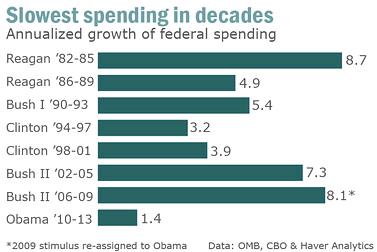
A financial columnist named Rex Nutting recently triggered a firestorm of controversy by claiming that Barack Obama is not a big spender.

Here’s the chart he prepared, which certainly seems to indicate that Obama is a fiscal conservative. Not only that, it shows that Republicans generally are the big spenders, while Democrats are frugal with other people’s money.

In some ways, these numbers don’t surprise me. I’ve explained before that Bush bears a lot of blame for the big expansion in the burden of government this century, and I’ve specifically pointed out that he deserves the blame for most of the higher spending from the 2009 fiscal year (which began October 1, 2008).

That being said, Nutting’s numbers seemed a bit nutty. Sorry, couldn’t resist. Nutting’s numbers actually seem accurate, including the fact that he decided that Obama should be responsible for $140 billion of the spending in Bush’s last fiscal year (a number he may have taken from one of my posts).

But sometimes accurate can be misleading, so I decided to dig into the data.

I went to the Historical Tables of the Budget from the Office of Management and Budget, and I calculated all the numbers for every President since LBJ (with the exception of Gerald Ford, whose 2-year reign didn’t seem worth including).

But I corrected a big mistake in Nutting’s analysis. I adjusted the numbers for inflation, using OMB’s GDP deflator.

As you can see, this changes the results. My chart isn’t as pretty, but based on the inflation-adjusted average annual growth of outlays, it shows that Clinton was the most frugal president, followed by the first President Bush and Obama.

With his guns-n-butter Keynesianism, it’s no big surprise that LBJ ranks last. And “W” also gets a very low grade.

But then I figured we should take interest payments out of the budget and focus on inflation-adjusted “primary spending.” After all, Presidents shouldn’t be held responsible for the national debt that existed before they took office.

Looking at these numbers, it turns out that Obama does win the prize for being the most fiscally conservative president in recent memory. Reagan jumps to second place. Clinton is in third place, which won’t surprise people who watched this video, while W and LBJ again are in last place.

But I don’t want my Republican friends to get too angry with me, so let’s expand our analysis. Just as we don’t want to blame Presidents for net interest payments on debt that was accrued before their tenure, perhaps we should make sure they don’t get credit or blame for defense outlays that often are dictated by external events.

There’s obviously room for disagreement, but most people will agree that the Cold War and 9/11 meant higher defense spending, regardless of which party controlled the White House. Similarly, the collapse of the Soviet Empire inevitably meant lower military expenditures, regardless of whether Republicans or Democrats were in charge.

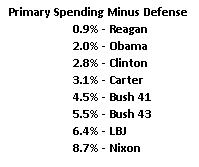
So let’s now look at primary spending after subtracting defense outlays (still adjusting for inflation, of course). All of a sudden, Reagan jumps to the top of the list by a comfortable margin. LBJ and W continue to score poorly, but Nixon takes over last place.

But it’s also worth noting that Obama still scores relatively well, beating Clinton for second place. Inflation-adjusted domestic spending (which is mostly what we’re measuring) has grown by 2.0 percent annually during his three years in office.

So does that mean Obama deserves re-election? Well, before you answer, I want to make one final calculation. Just as there are good reasons to exclude interest payments because they’re not something a president can control, we also should take a look at what spending would be if we don’t count the cost of bailouts.

To be sure, these types of expenditures can be controlled, but if we go with the assumption that the federal government was going to re-capitalize the banking system (whether using the good FDIC-resolution approach or the corrupt TARP approach), then it seems that Presidents shouldn’t get arbitrary blame or credit simply because some financial institutions failed during their tenure.

So let’s take the preceding set of numbers and subtract out the long-run numbers for deposit insurance, as well as the TARP outlays since 2009. And keep in mind that repayments of TARP monies (as well as deposit insurance premiums) show up in the budget as “negative spending.”

As you can see, this produces a remarkable result. All of a sudden, Obama drops from second to second-to-last.

This is because there was a lot of TARP spending in Bush’s last fiscal year (FY2009), which created an artificially high benchmark. And then repayments by banks during Obama’s fiscal years counted as negative spending.

When you subtract out the big TARP spending surge, as well as the repayments, then Bush 43 doesn’t look quite as bad (though still worse than Carter and Clinton), while Obama takes a big fall.

In other words, Obama’s track record does show that he favors an expanding social welfare state. Outlays on those programs have jumped by 7.0 percent annually. And that’s after adjusting for inflation! Not as bad as Nixon, but that’s not saying much since he was one of America’s most statist presidents.

Allow me to conclude with some caveats. None of the tables perfectly captures what any president’s fiscal record. Even my first table may be wrong if you want to blame or credit presidents for the inflation that occurs on their watch. And there certainly are strong arguments that bailout spending and defense spending are affected by presidential policies rather than external events.

And keep in mind that presidents don’t have full power over fiscal policy. The folks on Capitol Hill are the ones who actually enact the bills and appropriate the money.

Moreover, the federal government is akin to a big rusty cargo ship that is traveling in a certain direction, and presidents are like tugboats trying to nudge the boat one way or the other.

But enough equivocating. The four different tables at least show more clearly which presidents presided over faster-growing government or slower-growing government. More importantly, the various tables provide a good idea of where most of the new spending was taking place.

We can presumably say Reagan and Clinton were comparatively frugal, and we can also say that Nixon, LBJ, and Bush 43 were relatively profligate. As for Obama, I think his tugboat is pushing in the wrong direction, but it’s only apparent when you strip out the distorting budgetary impact of TARP.

Related posts:

Some Tea Party heroes (Part 1)

DEBT LIMIT – A GUIDE TO AMERICAN FEDERAL DEBT MADE EASY. Uploaded by debtlimitusa on Nov 4, 2011 A satirical short film taking a look at the national debt and how it applies to just one family. Watch the guy from the Ferris Bueller Superbowl Spot! Produced by Seth William Meier, DP/Edited by Craig Evans, […]

Some Tea Party heroes (Part 2)

Congressmen Tim Huelskamp on the debt ceiling I just don’t understand why people think we can go on and act like everything is okay when we have a trillion dollar deficit. Sometimes you run across some very wise words like I did the other day. Kansas Congressman Tim Huelskamp made the following comment on the […]


Dan Mitchell demonstrates again that spending is our problem but it can be solved

Sometimes it appears that our problems are impossible to solve. Take a look at a good solution:

New Congressional Budget Office Numbers Once Again Show that Modest Spending Restraint Would Eliminate Red Ink

Posted by Daniel J. Mitchell

Back in 2010, I crunched the numbers from the Congressional Budget Office and reported that the budget could be balanced in just 10 years if politicians exercised a modicum of fiscal discipline and limited annual spending increases to about two percent yearly.

When CBO issued new numbers early last year, I repeated the exercise and again found that the same modest level of budgetary restraint would eliminate red ink in about 10 years.

And when CBO issued their update last summer, I did the same thing and once again confirmed that deficits would disappear in a decade if politicians didn’t let the overall budget rise by faster than two percent each year.

Well, the new CBO 10-year forecast was released this morning. I’m going to give you three guesses about what I discovered when I looked at the numbers, and the first two don’t count.

Yes, you guessed it. As the chart illustrates (click to enlarge), balancing the budget doesn’t require any tax increases. Nor does it require big spending cuts (though that would be a very good idea).

Even if we assume that the 2001 and 2003 tax cuts are made permanent, all that is needed is for politicians to put government on a modest diet so that overall spending grows by about two percent each year. In other words, make sure the budget doesn’t grow faster than inflation.

Tens of millions of households and businesses manage to meet this simple test every year. Surely it’s not asking too much to get the same minimum level of fiscal restraint from the crowd in Washington, right?

At this point, you may be asking yourself whether it’s really this simple. After all, you’ve probably heard politicians and journalists say that deficits are so big that we have no choice but to accept big tax increases and “draconian” spending cuts.

But that’s because politicians use dishonest Washington budget math. They begin each fiscal year by assuming that spending automatically will increase based on factors such as inflation, demographics, and previously legislated program changes.

This creates a “baseline,” and if they enact a budget that increases spending by less than the baseline, that increase magically becomes a cut. This is what allowed some politicians to say that last year’s Ryan budget cut spending by trillions of dollars even though spending actually would have increased by an average of 2.8 percent each year.

Needless to say, proponents of big government deliberately use dishonest budget math because it tilts the playing field in favor of bigger government and higher taxes.

There are two important caveats about these calculations.

1. We should be dramatically downsizing the federal government, not just restraining its growth. Even if he’s not your preferred presidential candidate, Ron Paul’s proposal for an immediate $1 trillion reduction in the burden of federal spending is a very good idea. Merely limiting the growth of spending is a tiny and timid step in the right direction.

2. We should be focusing on the underlying problem of excessive government, not the symptom of too much red ink. By pointing out the amount of spending restraint that would balance the budget, some people will incorrectly conclude that getting rid of deficits is the goal.

Last but not least, here is the video I narrated in 2010 showing how red ink would quickly disappear if politicians curtailed their profligacy and restrained spending growth.

___________________________

Other than updating the numbers, the video is just as accurate today as it was back in 2010. And the concluding message—that there is no good argument for tax increases—also is equally relevant today.

P.S. Some people will argue that it’s impossible to restrain spending because of entitlement programs, but this set of videos shows how to reform Social Security, Medicare, and Medicaid.

P.P.S. Some people will say that the CBO baseline is unrealistic because it assumes the sequester will take place. They may be right if they’re predicting politicians are too irresponsible and profligate to accept about $100 billion of annual reductions from a $4,000 billion-plus budget, but that underscores the core message that there needs to be a cap on total spending so that the crowd in Washington isn’t allowed to turn America into Greece.

Got to avoid raising taxes if we want the economy to grow and eventually balance the budget

Dan Mitchell on Austerity in Europe 2012

In order to balance the budget we must make deep cuts. Take a look at the study refers to below by Dan Mitchell of the Cato Institute in his fine article on the French mess. Raising taxes has not worked in the thirty countries studied.

Having written several times about crazy French statism, you will understand why I like this cartoon.

Though, to be fair, France hasn’t gotten to the point where it’s being bailed out (it’s probably just a matter of time).

If you want some good analysis of the situation in Europe, Veronique de Rugy of the Mercatus Center hits the nail on the head in her column in today’s Washington Examiner.

France has yet to cut spending. In fact, to the extent that the French are frustrated with “budget cuts,” it’s only because the increase in future spending won’t be as large as they had planned. The same can be said about the United Kingdom. Spain, Italy and Greece have had no choice to cut some spending. However, in the case of these particular countries, the cuts were implemented alongside large tax increases. …This approach to austerity, also known in the United States as the “balanced approach,” has unfortunately proven a recipe for disaster. In a 2009 paper, Harvard University’s Alberto Alesina and Silvia Ardagna looked at 107 attempts to reduce the ratio of debt to gross domestic product over 30 years in countries in the Organisation for Economic Co-operation and Development. They found fiscal adjustments consisting of both tax increases and spending cuts generally failed to stabilize the debt and were also more likely to cause economic contractions. On the other hand, successful austerity packages resulted from making spending cuts without tax increases. They also found this form of austerity is more likely associated with economic expansion rather than with recession. …While the debate over austerity continues, the evidence seems to point to the conclusion that austerity can be successful, if it isn’t modeled after the “balanced approach.” It’s a lesson for the French and other European countries, as well as for American lawmakers who often seem tempted by the lure of closing budget gaps with higher taxes.

This is similar to my recent analysis, and Veronique also is kind enough to cite my analysis of how the Baltic nations have done the right thing and cut spending.

There are obvious lessons from Europe for the United States. If politicians don’t reform entitlement programs, we’re doomed to have our own fiscal crisis at some point in the not-too-distant future.

Only there won’t be anybody there to bail us out.

Liberal blogger makes a good point about surplus under Bill Clinton

One of my liberal opponents on the Arkansas Times Blog is a person who uses the username of “Sound Policy.” He recently asserted:

Here, try some sobering facts for a change of diet:

http://www.taxpolicycenter.org/taxfacts/displayafact.cfm?Docid=200
The 4th column (surplus or deficit in current dollars) is annual federal budget deficits/surpluses. The Bill Clinton years? Why, amazingly every year after Clinton took his oath of office the deficit dropped lower and lower until it completely disappeared and magically turned into a record surplus which he left as a present for W Bush.

And W’s team? They took that surplus and turned it into a record deficit of $1.4+ trillion in Fiscal Year 2009 when they left office.

I am not happy at all with the way that George Bush spent money and I am very pleased that Newt Gingrinch and President Bill Clinton were able to put in real spending cuts and balance our budget.

I really got out of this table that “Sound Policy” told me about ( http://www.taxpolicycenter.org/taxfacts/displayafact.cfm?Docid=200 ).

In Bush’s last two years there was a Democratic congress that he had to deal with. In 2009 President Obama went in and had a 60-40 margin in the Senate. Since 2009 the deficit has been in the worst condition of any nonwartime president.

Below you see an article and videos by Dan Mitchell of the Cato Institute concerning Reagan and Clinton. First lets look at where we are now with Obama.

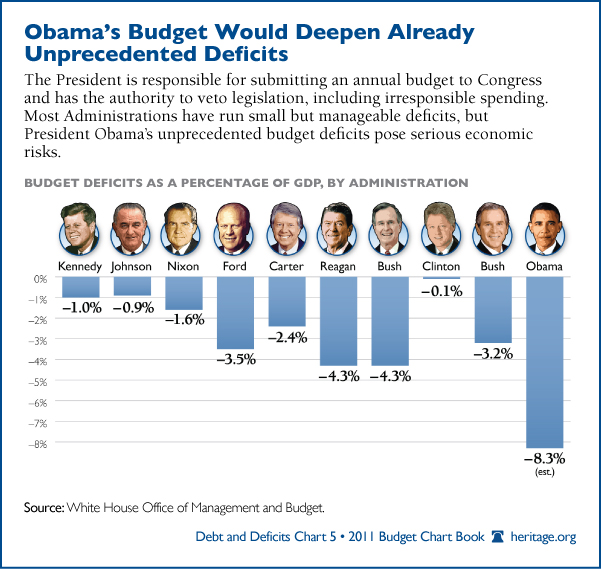
Over the last 10 presidents was have had 16.9% of GDP of deficits total from five Republican presidents and 12.7% total from Democratic presidents. However, what is most disturbing is that 8.3% of the 12.7% comes from the Obama administration who is currently in power and we are no longer in the cold war era. That is almost double the total of all the other four Democratic presidents combined under just one president. Take a look at the chart below from the Heritage Foundation:

Rob Bluey

January 1, 2012 at 9:56 am

Over the past 50 years, 10 U.S. presidents have made annual budget requests to Congress, projecting deficits both big and small. But no other president compares to Barack Obama when it comes to the size and scale of the current budget deficit facing the United States.

The country is facing an 8.3 percent estimated average national deficit of a two-term Obama administration — the biggest of the past 50 years. By comparison, the current estimate for Obama is nearly double the percentage under Presidents Ronald Reagan and George H.W. Bush — and they were fighting the Cold War.

Political party doesn’t tell the whole story, however. President Bill Clinton leads the pack of presidents since 1961, according to data from the White House Office of Management and Budget. Heritage put together this graphic as part of our Budget Chart Book.

So what does the current trajectory mean for the United States? We’re certainly no longer looking at a continuation of manageable deficits in the years to come. This is a dramatic change in the magnitude of annual shortfalls at the federal level. That’s one reason Heritage came up with a plan to fix the debt crisis.

If you have a suggestion for a chart we should feature in the future, please post a comment below, email us at scribe@heritage.org, or send me at tweet @RobertBluey.

_______________________
Here is a perspective from Dan Mitchell of the Cato Institute:

To Fix the Budget, Bring Back Reagan…or Even Clinton

Posted by Daniel J. Mitchell

President Obama unveiled his fiscal year 2012 budget today, and there’s good news and bad news. The good news is that there’s no major initiative such as the so-called stimulus scheme or the government-run healthcare proposal. The bad news, though, is that government is far too big and Obama’s budget does nothing to address this problem.

But perhaps the folks on Capitol Hill will be more responsible and actually try to save America from becoming a big-government, European-style welfare state. The solution may not be easy, but it is simple. Lawmakers merely need to restrain the growth of government spending so that it grows slower than the private economy.

Actual spending cuts would be the best option, of course, but limiting the growth of spending is all that’s needed to slowly shrink the burden of government spending relative to gross domestic product.

Fortunately, we have two role models from recent history that show it is possible to control the federal budget. This video from the Center for Freedom and Prosperity uses data from the Historical Tables of the Budget to demonstrate the fiscal policy achievements of both Ronald Reagan and Bill Clinton.

Spending Restraint, Part I: Lessons from Ronald Reagan and Bill Clinton

Uploaded by on Feb 14, 2011

Ronald Reagan and Bill Clinton both reduced the relative burden of government, largely because they were able to restrain the growth of domestic spending. The mini-documentary from the Center for Freedom and Prosperity uses data from the Historical Tables of the Budget to show how Reagan and Clinton succeeded and compares their record to the fiscal profligacy of the Bush-Obama years.

_____________________


Some people will want to argue about who gets credit for the good fiscal policy of the 1980s and 1990s.

Bill Clinton’s performance, for instance, may not have been so impressive if he had succeeded in pushing through his version of government-run healthcare or if he didn’t have to deal with a Republican Congress after the 1994 elections. But that’s a debate for partisans. All that matters is that the burden of government spending fell during Bill Clinton’s reign, and that was good for the budget and good for the economy. And there’s no question he did a much better job than George W. Bush.

Indeed, a major theme in this new video is that the past 10 years have been a fiscal disaster. Both Bush and Obama have dramatically boosted the burden of government spending — largely because of rapid increases in domestic spending.

This is one of the reasons why the economy is weak. For further information, this video looks at the theoretical case for small government and this video examines the empirical evidence against big government.

Another problem is that many people in Washington are fixated on deficits and debt, but that’s akin to focusing on symptoms and ignoring the underlying disease. To elaborate, this video explains that America’s fiscal problem is too much spending rather than too much debt.

Last but not least, this video reviews the theory and evidence for the “Rahn Curve,” which is the notion that there is a growth-maximizing level of government outlays. The bad news is that government already is far too big in the United States. This is undermining prosperity and reducing competitiveness.

Spending Restraint, Part II: Lessons from Canada, Ireland, Slovakia, and New Zealand

Uploaded by on Feb 22, 2011

Nations can make remarkable fiscal progress if policy makers simply limit the growth of government spending. This video, which is Part II of a series, uses examples from recent history in Canada, Ireland, Slovakia, and New Zealand to demonstrate how it is possible to achieve rapid improvements in fiscal policy by restraining the burden of government spending. Part I of the series examined how Ronald Reagan and Bill Clinton were successful in controlling government outlays — particularly the burden of domestic spending programs. http://www.freedomandprosperity.org


Christians welcome nonbelievers like Dan Mitchell in their criticism of Ayn Rand’s view of altruism

Nonbelievers like Rand really do not have an answer to the question “What is the meaning of life?”

Ayn Rand on the Purpose of Life

Christians are commanded to help others by Christ. However, many Christians do believe in the free market and think that system best suits the ideas that flow from Christianity. (Doug Douma wrote a fine article on this.)

Ayn Rand was very critical of altruism and she said it was evil. I have a four part series on that and I have posted the links below. Many nonbelievers like Dan Mitchell of the Cato Institute also have been critical of Rand’s attack on altruism and below is his recent article.

I’m in Monaco for the 10th forum of the Convention of Independent Financial Advisors, a Swiss-based NGO that focuses on promoting an ethical and productive environment for private investment. I moderated a couple of panels on interesting topics, including the European fiscal crisis.

Matthieu Ricard

But I want to focus on the comments of another speaker, Monsieur Matthieu Ricard, a French-born Buddhist monk. As you can see from his Wikipedia entry, he’s a very impressive individual. In addition to his other accomplishments, he serves as the French translator for the Dalai Lama.

During one of the dinners, we got into a fascinating conversation about the Buddhist concept of altruism (or at least one strain of that tradition) and Ayn Rand’s concept of selfishness, both as general ideas and as they relate to happiness.

At the risk of sounding un-libertarian, I’m siding with the monk.

Even though I’m a big fan of Ayn Rand and periodically give away copies of Atlas Shrugged to unwary young people, I’ve always been puzzled by the Randian hostility to altruism.

Yes, coercive altruism is wrong. Indeed, it’s not even altruism, particularly if you think (like Michael Gerson or Barack Obama) it’s noble or selfless to forcibly give away other people’s money.

But Rand seemed to think (and some Randians definitely think) that voluntary acts of charity and compassion are somehow wrong. In some sense, these folks take an ultra-homo economicus view that people are relentless utility maximizers based on self interest.

If this is a correct interpretation of Randianism (perhaps I should say Objectivism?), then I think it is inadequate. Yes, people want money, and almost everybody would like more money, but I’m guessing that it is non-monetary things that make people happiest.

I don’t want to sound too warm and fuzzy and ruin my image, but aren’t children, friends, family, and love the things that make the world go ’round for most of us? Yes, we also value achievement, but even that can be unrelated to pecuniary considerations.

These are amateur ramblings on my part, and I’ve probably done a poor job of describing the views of Randians and Monsieur Ricard. Moreover, I’m sure that very intelligent people have examined this issue in a much more sophisticated fashion.

For a fiscal policy wonk like me, though, this conference and this encounter forced me to give some thought to how you can be a big fan of Ayn Rand while also feeling good about holding open doors for little old ladies.

Uploaded by on Jul 17, 2009

Questioned by Mike Wallace, Ayn Rand explains her philosophy of objective reality and contrasts it with altruism.

Related posts:

Christian view versus Ayn Rand on altruism (Part 4)

Ayn Rand on the Purpose of Life Uploaded by prosumption on Apr 27, 2010 Ayn Rand on the Purpose of Life _________________ I ran across a fine article that takes a look at Ayn Rand’s view of capitalism and selfishness and compares it to the Christian view found in the Bible. I have decided to […]

Christians welcome nonbelievers like Dan Mitchell in their criticism of Ayn Rand’s view of altruism

Nonbelievers like Rand really do not have an answer to the question “What is the meaning of life?” Ayn Rand on the Purpose of Life Christians are commanded to help others by Christ. However, many Christians do believe in the free market and think that system best suits the ideas that flow from Christianity. Ayn […]

Christian view versus Ayn Rand on altruism (Part 3)

Uploaded by MetrazolElectricity on Oct 30, 2010 Talking to Rose, patron-saint of the conservative movement , Bill buckley chats about ayn and her magnum opus atlas shrugged. On atlas shrugged, WFB:”I had to flog myself to read it.” On ayn, WFB : “Her scorn for charity,for altruism was such as to build up an unfeeling […]

Christian view versus Ayn Rand on altruism (Part 2)

Uploaded by LibertyPen on Jul 17, 2009 Questioned by Mike Wallace, Ayn Rand explains her philosophy of objective reality and contrasts it with altruism. _________________ I ran across a fine article that takes a look at Ayn Rand’s view of capitalism and selfishness and compares it to the Christian view found in the Bible. I […]

Christian view versus Ayn Rand on altruism (Part 1)

Uploaded by LibertyPen on Oct 26, 2009 Ayn Rand makes the case that altruism is evil. ___________________  I ran across a fine article that takes a look at Ayn Rand’s view of capitalism and selfishness and compares it to the Christian view found in the Bible. I have decided to start a series on this […]


Dan Mitchell of the Cato Institute: How to balance the budget

It’s Simple to Balance The Budget Without Higher Taxes

Uploaded by on Oct 4, 2010

Politicians and interest groups claim higher taxes are necessary because it would be impossible to cut spending by enough to get rid of red ink. This Center for Freedom and Prosperity video shows that these assertions are nonsense. The budget can be balanced very quickly by simply limiting the annual growth of federal spending.

____________________

People are being told that radical spending cuts are a must if we are to balance the budget, but maybe that is not true.

Even though I favor radical reductions in the burden of government, I’ve made the point that good fiscal policy merely requires that government spending grow slower than the private sector – what I call Mitchell’s Golden Rule.

And if lawmakers simply cap the growth of spending, so that it grows by about 2 percent annually, the budget deficit disappears in a decade.

It’s even better to impose more restraint, of course, which is why I’ve said favorable things about Senator Rand Paul’s plan.

There’s also a “Penny Plan” that would reduce primary spending (non-interest spending) by 1 percent each year. As James Carter and Jason Fichtner explain, this degree of fiscal restraint would reduce the burden of government spending to about 18 percent of economic output.

Any viable solution must cut spending growth. Sen. Mike Enzi of Wyoming and Rep. Connie Mack of Florida have introduced legislation in their respective chambers to do just that. Their “Penny Plan” – recently updated to reflect the latest budget developments – calls for reducing federal spending (excluding interest payments) 1 percent a year for five years, balancing the budget in the fifth year. To maintain balance once it’s reached, Mr. Enzi and Mr. Mack would cap federal spending at 18 percent of GDP. By no small coincidence, 18 percent of GDP roughly matches the U.S. long-run average level of taxation since World War II. Is it realistic to think Congress could limit federal spending to 18 percent of GDP? Actually, there is precedent. Federal spending fell as a share of GDP for nine consecutive years before bottoming out at 18.2 percent of GDP in fiscal 2000 and 2001. The Penny Plan would return federal spending, expressed as a share of GDP, near the level achieved during the last two years of the Clinton administration.

The various interest groups that infest Washington would complain about this degree of spending discipline, but Carter and Fichtner make a good point when they say that this simply means the same size government – as a share of GDP – that we had when Bill Clinton left office.

I realize I’m getting old and my memory may not be what it used to be, but I don’t recall people starving in the streets and grannies being ejected from hospitals during the Clinton years. Am I missing something?

Lessons to Obama on how to prosper from selected states

https://i0.wp.com/www.freetochoosemedia.org/production/POC/presskit2/milton-president-reagan.jpg

Milton Friedman served as economic advisor for two American Presidents – Richard Nixon and Ronald Reagan. Although Friedman was inevitably drawn into the national political spotlight, he never held public office.

Milton Friedman’s Free to Choose (1980), episode 1 – Power of the Market. part 1

Today President Obama is telling us that we must raise taxes in order for us to prosper and grow our economy. I have heard that before and it has never worked!!!!

Liberals like Ernie Dumas and Max Brantley who write for the Arkansas Times have always bragged on the 7% state income tax that Dale Bumpers raised in 1971 and how Arkansas has grown economically since then. However, the facts are quite different.

Ernie Dumas in his article “Arkansas” A tax myth-maker too,” Arkansas Times, April 13, 2011 asserts:

Until Gov. Dale Bumpers raised income-tax rates and other taxes in 1971, Arkansas had by far the lowest per-capita state and local taxes in the United States. Afterward, we were still 50th but within shouting distance of 49th.

Here are the real facts  according to Greg Kaza of the Arkansas Policy Foundation:

(June 2006) Democratic Gov. Dale Bumpers and the General Assembly raised Arkansas’ top income tax rate to “broaden the tax base” in 1971(1). Yet Arkansas’ per capita income, expressed as a percentage of the U.S. total, has barely improved, moving from 71 (1971) to 77.7 percent (2005) over the 34-year period, according to data from the U.S. Bureau of Economic Analysis. The 1971 income tax increase reversed a decades-long strong growth trend and left Arkansas with the highest income tax rate among bordering states (Mississippi, Missouri, Louisiana, Oklahoma, Tennessee and Texas).

Income Stagnation: The 1930s

One has to turn to the 1930s-the decade of the Great Depression-to find weaker income growth than in recent years.

Arkansas per capita personal income was 44 percent of the U.S. in 1929, the first year data was compiled in the BEA time series. The Great Depression started that year, and by the time it ended in 1933 Arkansas per capita income had fallen to 41 percent of the U.S. By decade’s end (1939) it had returned to 44 percent.

Growth Decades: The 1940s, 1950s & 1960s
Arkansas per capita income increased as a percentage of the U.S. in the next three decades.
In 1941, at the onset of World War II, Arkansas per capita income was 47 percent of the U.S. It was 59 percent at war’s end in 1945 and again in 1949. It was 56 percent in 1950, 62 percent a decade later in 1960, and 68 percent in 1969. If this growth rate had continued Arkansas would have exceeded 100 percent of the U.S. average in the current decade (2000-2009).

To summarize, Arkansas per capita income increased from 44 to 71 percent of the U.S. total between 1939 and 1971.

Anemic Income Growth (1971-2005)

The trend in recent decades is anemic growth in Arkansas per capita personal income. Fiscal policy changes effect economic behavior with a time lag. Arkansas per capita income was 71 percent of the U.S. in 1971 and 76 percent in 1973. Income growth stagnated for the rest of the decade, reaching 77 percent of the U.S. in 1979. It fell to 75 percent in 1989, and was 76 percent in 1999. Today, Arkansas per capita income, at 77.7 percent of the U.S., is barely above its high point of the 1970s.

_____________

We can look at other states and see what their experience is too.

I’ve done a couple of posts comparing Reaganomics and Obamanomics, mostly based on data from the Minneapolis Federal Reserve on employment and economic output.

I even did a TV interview on the subject, which generated some comments on my taste in clothing, and also cited a Richard Rahn column that got Paul Krugman and Ezra Klein upset.

Some of the best evidence about high tax rates vs. low tax rates comes from inside America. Art Laffer (yes, that Art Laffer) and Steve Moore have a great column in today’s Wall Street Journal. It’s sort of Reaganomics vs. Obamanomics, looking at evidence from the states.

Barack Obama is asking Americans to gamble that the U.S. economy can be taxed into prosperity. …Mr. Obama needs a refresher course on the 1920s, 1960s, 1980s and even the 1990s, when government spending and taxes fell and employment and incomes grew rapidly. But if the president wants to see fresher evidence of how taxes matter, he can look to what’s happening in the 50 states. In our new report “Rich States, Poor States,” prepared for the American Legislative Exchange Council, we compare the economic performance of states with no income tax to that of states with high rates. It’s like comparing Hong Kong with Greece… Every year for the past 40, the states without income taxes had faster output growth (measured on a decadal basis) than the states with the highest income taxes. In 1980, for example, there were 10 zero-income-tax states. Over the decade leading up to 1980, those states grew 32.3 percentage points faster than the 10 states with the highest tax rates. Job growth was also much higher in the zero-tax states. The states with the nine highest income tax rates had no net job growth at all, and seven of those nine managed to lose jobs.

Tax rates also lead people to “vote with their feet.” Laffer and Moore look at migration patterns.

Over the past decade, states without an income tax have seen 58% higher population growth than the national average, and more than double the growth of states with the highest income tax rates. …Illinois, Oregon and California are state practitioners of Obamanomics. All have passed soak-the-rich laws like the Buffett Rule (plus economically harmful regulations, like California’s cap-and-trade scheme), and all face big deficits because their economies continue to sink. Illinois has lost one resident every 10 minutes since hiking tax rates in January. California has 10.9% unemployment, having lost 4.8% of its jobs over the past decade. …Every time California, Illinois or New York raises taxes on millionaires, Florida, Texas and Tennessee see an influx of rich people who buy homes, start businesses and shop in the local economy.

Competition among the states is leading some states to make further improvements. Some are even trying to get rid of their income taxes.

Republican governors in Florida, Georgia, Idaho, North Dakota, South Carolina, Ohio, Tennessee, Wisconsin and even Michigan and New Jersey are cutting taxes to lure new businesses and jobs. Asked why he wants to reduce the cost of doing business in Wisconsin, Gov. Scott Walker replies: “I’ve never seen a store get more customers by raising its prices, but I’ve seen customers knock down the doors when they cut prices.” Georgia, Kansas, Missouri and Oklahoma are now racing to become America’s 10th state without an income tax.

I like the quote from Governor Walker. He seems to know what he’s talking about, so it will be interesting to see whether he survives the upcoming recall election. I guess it depends whether voters understand that big government and high tax rates is a recipe for continued decline.

Some states, such as Illinois and California, are filled with voters who refuse to recognize reality. Think of them as the Greece and Spain of America, perhaps because the number of tax-consumers is greater than the number of tax-producers.

And even though parasites should understand it doesn’t make sense to kill their host animals, this cartoon illustrates how the welfare states lures a growing number of people to ride in the wagon. And this cartoon shows the consequences of too many moochers and not enough producers.

______________

Take a look at all the Milton Friedman clips that I have posted today. These liberals I mentioned above have truly forgotten how powerful the market is if not interferred with by the government.

Milton Friedman’s Free to Choose (1980), episode 1 – Power of the Market. part 2

Related posts:


Why do people move to other states to avoid Arkansas’ high state income tax? (If you love Milton Friedman then you will love this post)

Milton Friedman served as economic advisor for two American Presidents – Richard Nixon and Ronald Reagan. Although Friedman was inevitably drawn into the national political spotlight, he never held public office. Milton Friedman’s Free to Choose (1980), episode 1 – Power of the Market. part 1 Mike Huckabee recently moved to Florida? Why? The answer […]

Milton Friedman’s Free to Choose (1980), episode 1 – Power of the Market. part 3

The real truth about the financial condition of Social Security can be seen on the www.thedailyhatch.org

Uploaded by on Jan 8, 2009

Professor Williams explains what’s ahead for Social Security

If you want to know the real truth about the financial condition of Social Security then check out these links below:

Ark Times reader says Social Security is not Ponzi Scheme

Social Security is a Ponzi Scheme but Blake who is a blogger said I was off base. Ark Times reader says Social Security is not Ponzi Scheme Social Security Disaster Walter E. Williams Columnist, Townhall.com Politicians who are principled enough to point out the fraud of Social Security, referring to it as a lie and […]

Social Security is a Ponzi scheme that needs to be reformed

We got to do something soon about Social Security. The Case for Social Security Personal Accounts Posted by Daniel J. Mitchell There are two crises facing Social Security. First the program has a gigantic unfunded liability, largely caused by demographics. Second, the program is a very bad deal for younger workers, making them pay record […]

Senator Obama’s ideas on Social Security

Senator Obama’s Social Security Tax Plan Uploaded by afq2007 on Jul 23, 2008 In addition to several other tax increases, Senator Barack Obama wants to increase the Social Security payroll tax burden by imposing the tax on income above $250,000. This would be a sharp departure from current law, which only requires that the tax […]

Social Security is a Ponzi scheme (part 13)

Saving Social Security with Personal Retirement Accounts Uploaded by afq2007 on Jan 10, 2011 There are two crises facing Social Security. First the program has a gigantic unfunded liability, largely thanks to demographics. Second, the program is a very bad deal for younger workers, making them pay record amounts of tax in exchange for comparatively meager benefits. This […]

What does the Heritage Foundation have to say about saving Social Security:Study released May 10, 2011 (Part 7)

“Saving the American Dream: The Heritage Plan to Fix the Debt, Cut Spending, and Restore Prosperity,” Heritage Foundation, May 10, 2011 by  Stuart Butler, Ph.D. , Alison Acosta Fraser and William Beach is one of the finest papers I have ever read. Over the next few days I will post portions of this paper, but […]

Only difference between Ponzi scheme and Social Security is you can say no to Ponzi Scheme jh2d

Is Social Security  a Ponzi Scheme? I just started a series on this subject. In this article below you will see where the name “Ponzi scheme” came from and if it should be applied to the Social Security System. Ponzi! Ponzi! Ponzi! 9/14/2011 | Email John Stossel | Columnist’s Archive Ponzi! Ponzi! Ponzi! There, I […]

Social Security a Ponzi scheme?

Uploaded by LibertyPen on Jan 8, 2009 Professor Williams explains what’s ahead for Social Security Dan Mitchell on Social Security I have said that Social Security is a Ponzi scheme and sometimes you will hear someone in the public say the same thing. Yes, It Is a Ponzi Scheme by Michael D. Tanner Michael Tanner […]

Dan Mitchell on Social Security