Tag Archives: Dan Mitchell

“Feedback Friday” Letter to White House generated form letter response (on government spending) July 6, 2012 (part 10)

I have been writing President Obama letters and have not received a personal response yet.  (He reads 10 letters a day personally and responds to each of them.) However, I did receive a form letter in the form of an email July 6,  2012. I don’t know which letter of mine generated this response, but if I had to guess then I think it would be this one below.

Obama on Ryan Plan: “It’s Laughable. It Is a Trojan Horse. It’s Thinly-Veiled Social Darwinism.”

President Obama c/o The White House
1600 Pennsylvania Avenue NW
Washington, DC 20500

Dear Mr. President,

I know that you receive 20,000 letters a day and that you actually read 10 of them every day. I really do respect you for trying to get a pulse on what is going on out here.

Dan Mitchell of the Cato Institute has hit a home run with this post. If Congressman Paul Ryan could get criticized for wanting to bring down our federal spending to around 20% in 11 years  and earn the label of “social darwinist” from you  then surely you would have thought President Clinton’s effort to cut spending to 18.2 % of GDP in 2001 as extremely devilish.

President Obama Accuses Bill Clinton of “Thinly Veiled Social Darwinism”

April 3, 2012 by Dan Mitchell

Actually, Bill Clinton must be something even worse than a social Darwinist. That’s because the title of this post is wrong. Obama said that Paul Ryan’s plan (which allows spending to grow by an average of 3.1 percent per year over the next decade) is a form of “social Darwinism.”

Proponent of social Darwinism?

But the proposal from the House Budget Committee Chairman only reduces the burden of federal spending to 20.25 percent of GDP by the year 2023.

Yet when Bill Clinton left office in 2001, following several years of spending restraint, the federal government was consuming 18.2 percent of economic output.

And by the President’s reasoning, this must make Clinton something worse than a Darwinist. Perhaps Marquis de Sade or Hannibal Lecter.

Here’s a blurb from the New York Times on Obama’s speech.

Mr. Obama’s attack, in a speech during a lunch with editors and reporters from The Associated Press, was part of a broader indictment of the Republican economic blueprint for the nation. The Republican budget, and the philosophy it represents, he said in remarks prepared for delivery, is “antithetical to our entire history as a land of opportunity and upward mobility for everyone who’s willing to work for it.” …“Disguised as a deficit reduction plan, it’s really an attempt to impose a radical vision on our country. It’s nothing but thinly veiled social Darwinism,” Mr. Obama said. “By gutting the very things we need to grow an economy that’s built to last — education and training, research and development — it’s a prescription for decline.”

I’m particularly amused by the President’s demagoguery that Ryan’s plan is “antithetical to our entire history” and “a radical vision.”

Is he really unaware that a small and constrained central government is part of America’s history and vision? Doesn’t he know that the federal government, for two-thirds of our nation’s history, consumed less than 5 percent of GDP?

Of course, that was back in the dark ages when people in Washington actually believed that the Constitution’s list of enumerated powers in Article 1, Section 8, actually enumerated the powers of the federal government. How quaint.

No wonder this Ramirez cartoon is so effectively amusing. It certainly seems to capture the President’s view of America’s founding principles.

_______________

Thank you so much for your time. I know how valuable it is. I also appreciate the fine family that you have and your commitment as a father and a husband.

Sincerely,

Everette Hatcher III, 13900 Cottontail Lane, Alexander, AR 72002, ph 501-920-5733, lowcostsqueegees@yahoo.com

The White House, Washington

July 6, 2012

Dear Everette:

Thank you for writing.  I have heard from many Americans about Government spending and our national debt.  I appreciate your perspective. 

I am committed to working in a bipartisan way to solve the financial challenges before us and to construct an economy where every hard-working American gets a fair shot, does their fair share, and plays by the same rules.  By focusing on job creation, security for working families, and fiscal responsibility, we can get people the help they need, prepare for the future, and reduce the Federal deficit. 

This is a make-or-break moment for the middle class and those trying to reach it.  After decades of eroding middle-class security and after a recession that plunged our economy into a crisis from which we are still fighting to recover, it is time to construct an economy built to last.  To put our Nation back on a path of living within our means, we must cut wasteful spending, ask all Americans to shoulder their fair share, and make tough choices on some things we cannot afford.  The Federal Government, like families across America, is going to have to cut spending while protecting investments that are vital to growing our economy and creating jobs.  My proposed budget for Fiscal Year 2013 targets scarce Federal resources to the areas critical to growing our economy and restoring middle-class security:  education and skills for American workers, innovation and manufacturing, clean energy, and infrastructure.  This proposal will reduce our deficit by $4 trillion by 2022 and will help put our country back on a more sustainable fiscal path.    

An economy built to last also demands we renew the American values of fair play and shared responsibility—principles that must guide our approach to solving our Nation’s deficit problem.  As we extend middle-class tax cuts to help working families, I am pursuing the end of costly tax breaks and special deductions for the wealthiest Americans and biggest corporations.  I have repeatedly called on Congress to stop giving away $4 billion a year in oil subsidies to an industry that has never been more profitable, and instead, to pass clean energy tax credits to cultivate a market for innovation in clean energy technology.  I also proposed a fee on big banks and other major financial institutions to recoup taxpayer assistance that was crucial to saving the economy. 

To prevent Congress from worsening our deficit outlook, I pushed for and signed into law pay-as-you-go rules for Congress—rules critical to creating the surpluses of the 1990s.  Additionally, I established the Campaign to Cut Waste, which is aggressively rooting out misspent tax dollars, and sent Congress the Consolidating and Reforming Government Act to reinstate the authority past presidents have had to streamline the Executive Branch and create a leaner, more efficient Federal Government.  Through these and other efforts, we can reduce the deficit and ensure a more stable future for our children.  

To learn more about our budget, please visit www.Budget.gov.  Thank you, again, for writing.

Sincerely,

Barack Obama

Open letter to President Obama (Part 100)

Government Spending Doesn’t Create Jobs

Uploaded by on Sep 7, 2011

Share this on Facebook: http://on.fb.me/qnjkn9 Tweet it: http://tiny.cc/o9v9t

In the debate of job creation and how best to pursue it as a policy goal, one point is forgotten: Government doesn’t create jobs. Government only diverts resources from one use to another, which doesn’t create new employment.

Video produced by Caleb Brown and Austin Bragg.

__________________

President Obama c/o The White House
1600 Pennsylvania Avenue NW
Washington, DC 20500

Dear Mr. President,

I know that you receive 20,000 letters a day and that you actually read 10 of them every day. I really do respect you for trying to get a pulse on what is going on out here.

I really think that Dan Mitchell of the Cato Institute is one of the best at explaining conservative economic policies and how they would benefit us all. Here he takes a look at your economic policies.

In a recent post comparing Reaganomics and Obamanomics, I explained why I think Barack Obama’s policies have been hurting the economy.

In today’s New York Post, I do a full-scale indictment. Here are my bullet points.

* The unemployment rate is still above 8 percent, even though the White House promised it would drop to about 6 percent today if the stimulus was enacted.

* Several million fewer Americans have jobs today than five years ago.

* The poverty rate has jumped to more than 15 percent, with a record number of Americans living below the poverty level of income.

* According to the most recent data, median household income is lower than when the recession began.

* The burden of government spending remains high, and record levels of red ink are a symptom of that bloat in Washington.

* The threat of higher taxes is omnipresent, serving as a Sword of Damocles over the economy’s neck.

* Continued weakness in the housing and financial sectors reminds people that bailouts and intervention have left lots of problems unsolved.

I also explain that some of  the recent good news is in spite of the President’s statist policies.

* The recovery began just as Obama’s stimulus spending ended, thus confirming suspicions that lots of money was wasted as part of a process that hindered the economy’s growth.

* The job numbers only began to improve at the end of 2010, right as Republicans took control of the House and presumably ended Obama’s ability to further shift the nation’s course.

The final point is one deserving of elaboration. People in the private sector necessarily have to make educated guesses about the future economic environment. With this in mind, I think it’s quite reasonable – as I commented last month – to argue that the GOP takeover on Capitol Hill boosted the economy since entrepreneurs could feel more comfortable that the federal government wasn’t going to be imposing additional burdens.

This indictment of Obama’s dismal economic track record does not suggest, I should hasten to add, that Mitt Romney or Rick Santorum would be any better. Both of them seem closer to Bush than Reagan, so it’s not clear they would make any substantive changes in the burden of the federal government.

__________

Thank you so much for your time. I know how valuable it is. I also appreciate the fine family that you have and your commitment as a father and a husband.

Sincerely,

Everette Hatcher III, 13900 Cottontail Lane, Alexander, AR 72002, ph 501-920-5733, lowcostsqueegees@yahoo.com

Related posts:

John Brummett and Rick Crawford don’t see that the real problem is how much government spends!!!!!

Washington Could Learn a Lot from a Drug Addict The problem with Washington is they are addicted to overspending our money and the problem is not that the government needs more money to waste. They survived on less than 4% of GDP the first 150 years that our nation existed (except in wartimes), but this […]

Tea Party solutions versus Occupy Wall Street

Dan Mitchell is right about the “Occupy Wall St crowd” The Arkansas Times Blog reported: Occupy Little Rock occupies Clinton Library parking lot Gabe Gentry Members of the Occupy Little Rock group have set up camp outside the Clinton Library, video contributor Gabe Gentry reports. Around 65 are gathered currently with chimineas and grills and pizzas. Thirty […]

Bigger government hurts economic growth

The Cato Institute videos are always good and these are no different. New Video Has Important Message: Freedom and Prosperity vs. Big Government and Stagnation Posted by Daniel J. Mitchell The folks from the Koch Institute put together a great video a couple of months ago looking at why some nations are rich and others […]

President Obama’s good advice does not apply to USA

Uploaded by WSJDigitalNetwork on Feb 23, 2012 Editorial board member Steve Moore breaks down Mitt Romney’s and President Obama’s tax plans. _____________________ Here is an excellent article by Dan Mitchell of the Cato Institute concerning President Obama great advice for another country. When Obama Rejects Government Intervention and Says It Is Better to “Let the […]

Updated version:Rick Crawford falls for Democrats’ trick:raise taxes first and we will cut spending later

RAISE TAXES: Report says Rick Crawford will break from GOP and back millionaires’ tax. The Arkansas Times reported that Congressman Rick Crawford has a plan that includes raising taxes for 5 years if there is an agreement to pass the Balanced Budget Amendment. However, if after 5 years the Balanced Budget Amendment does not get […]

Ronald Wilson Reagan versus Barrack Obama

Government Spending Doesn’t Create Jobs Uploaded by catoinstitutevideo on Sep 7, 2011 Share this on Facebook: http://on.fb.me/qnjkn9 Tweet it: http://tiny.cc/o9v9t In the debate of job creation and how best to pursue it as a policy goal, one point is forgotten: Government doesn’t create jobs. Government only diverts resources from one use to another, which doesn’t […]

Cato Institute:Spending is our problem Part 6

But we also know that it is difficult to convince politicians to do what’s right for the nation. And if they don’t change the course of fiscal policy, and we leave the federal government on autopilot, then America is doomed to become another Greece. The combination of poorly designed entitlement programs (mostly Medicare and Medicaid) and an aging population […]

Cato Institute:Spending is our problem Part 5

Uploaded by NatlTaxpayersUnion on Feb 15, 2011 Dan Mitchell, Senior Fellow at the Cato Institute, speaks at Moving Forward on Entitlements: Practical Steps to Reform, NTUF’s entitlement reform event at CPAC, on Feb. 11, 2011. People think that we need to raise more revenue but I say we need to cut spending. Take a look […]

Cato Institute:Spending is our problem Part 3

Uploaded by NatlTaxpayersUnion on Feb 15, 2011 Dan Mitchell, Senior Fellow at the Cato Institute, speaks at Moving Forward on Entitlements: Practical Steps to Reform, NTUF’s entitlement reform event at CPAC, on Feb. 11, 2011. ____________________ People think that we need to raise more revenue but I say we need to cut spending. Take a […]

Videos by Cato Institute on failed stimulus plans

In this post I have gathered several videos from the Cato Institute concerning the subject of failed stimulus plans. _____ Government Spending Doesn’t Create Jobs Uploaded by catoinstitutevideo on Sep 7, 2011 Share this on Facebook: http://on.fb.me/qnjkn9 Tweet it: http://tiny.cc/o9v9t In the debate of job creation and how best to pursue it as a policy […]

Open letter to President Obama (Part 98)

Keynesian Catastrophe: Big Money, Big Government & Big Lies

Uploaded by on Jan 19, 2012

The Cato Institute’s Dan Mitchell explains why Obama’s stimulus was a flop! With Glenn Reynolds.

See more at http://www.pjtv.com and http://www.cato.org

___________________

President Obama c/o The White House
1600 Pennsylvania Avenue NW
Washington, DC 20500

Dear Mr. President,

I know that you receive 20,000 letters a day and that you actually read 10 of them every day. I really do respect you for trying to get a pulse on what is going on out here.

I wonder what the people would have said if Rutherford Hayes had spent 24.7% of GDP a year? You laughed at the thought of Rutherford on Mount Rushmore, but with the economic mess we have now I don’t there is much of a chance that you will end up on there EITHER UNLESS YOU START CUTTING SPENDING. Here is an excellent article by Dan Mitchell of the Cato Institute:

A Simple Choice: Barack Obama or Rutherford Hayes?

March 19, 2012 by Dan Mitchell

Other than my ongoing adulation for Ronald Reagan, occasional praise for Calvin Coolidge, and one post about John F. Kennedy, I don’t have many nice things to say about previous Presidents.

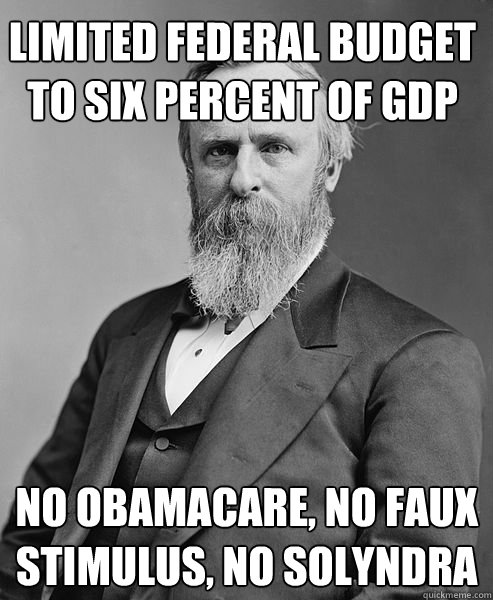
But I feel the need to rise to the defense of Rutherford B. Hayes, who was mocked recently by the current President. This Mark Steyn column is a deliciously vicious commentary on Obama’s speech, so no need for me to delve into the details.

Instead, I want to jump on the bandwagon and produce some posters comparing the 19th President and the 44th President (if you’re not aware, posters of Pres. Hayes with self-created captions have been all over the Internet).

You won’t be surprised to learn that I’m focused on the policy differences between Hayes and Obama.

Most important, Hayes largely was true to the Founding Fathers’ vision of a limited central government. Government spending averaged only about 6 percent of economic output during his tenure (probably less, the data are not very robust, so I took the worst-case numbers) and America was blessedly free of the income tax.

Obama, on the other hand, is repeating all of Bush’s mistakes and making government an even bigger burden, and then compounding his error by pursuing class warfare tax policy.

So which President would you prefer, Hayes or Obama?

_____________

Thank you so much for your time. I know how valuable it is. I also appreciate the fine family that you have and your commitment as a father and a husband.

Sincerely,

Everette Hatcher III, 13900 Cottontail Lane, Alexander, AR 72002, ph 501-920-5733, lowcostsqueegees@yahoo.com

Sweden cutting back welfare state and having good results

Milton Friedman

Economics 101: Learning From Sweden’s Free Market Renaissance

Uploaded by on Mar 8, 2010

Sweden is a powerful example of the importance of public policy. The Nordic nation became rich between 1870 and 1970 when government was very small, but then began to stagnate as welfare state policies were implemented in the 1970s and 1980s. The CF&P Foundation video explains that Sweden is now shifting back to economic freedom in hopes of undoing the damage caused by an excessive welfare state. www.freedomandprosperity.org

__________________

Milton Friedman – The Negative Income Tax

Published on May 11, 2012 by

In this 1968 interview, Milton Friedman explained the negative income tax, a proposal that at minimum would save taxpayers the 72 percent of our current welfare budget spent on administration. http://www.LibertyPen.com

Source: Firing Line with William F Buckley Jr.

________________

We got to cut our welfare state. Why not look at other countries like Sweden have learned this lesson of over spending and are trying to cut back now.

Sweden must be a schizophrenic country. Something strange is happening, after all, if a statist like Jeffrey Sachs and a rabid libertarian like yours truly both cited it as a role model in our remarks last month at the United Nations.

So who’s right? Well, it depends what you care about.

In a column for Bloomberg, Anders Aslund elaborates on Sweden’s efforts to reduce the size of the state.

Not so long ago, Sweden could claim world leadership in unmitigated Keynesian economics, with a 90 percent marginal tax rate and a welfare state second to none. …but in the last two decades the country has been reformed. Public spending has fallen by no less than one-fifth of gross domestic product, taxes have dropped and markets have opened up. …no turnabout has been as dramatic as Sweden’s. From 1970 until 1989, taxes rose exorbitantly, killing private initiative, while entitlements became excessive. Laws were often altered and became unpredictable. As a consequence, Sweden endured two decades of low growth. In 1991-93, the country suffered a severe crash in real estate and banking that reduced GDP by 6 percent. Public spending had surged to 71.7 percent of GDP in 1993, and the budget deficit reached 11 percent of GDP. …Sweden’s traditional scourge is taxes, which used to be the highest in the world. The current government has cut them every year and abolished wealth taxes. Inheritance and gift taxes are also gone. Until 1990, the maximum marginal income tax rate was 90 percent. Today, it is 56.5 percent. That is still one of the world’s highest, after Belgium’s 59.4 and there is strong public support for a cut to 50 percent. The 26 percent tax on corporate profits may seem reasonable from an American perspective, but Swedish business leaders want to reduce it to 20 percent.

Interestingly, the Swedish people and the Swedish elite (just like the Estonians, as I discussed in my takedown of Paul Krugman) seem to understand that there’s no going back to the statist era of the 1970s and 1980s.

Where are the left-wing intellectuals to challenge this new order? They have disappeared. The old socialist research organizations have closed down. The Center for Labor Market Studies was a state institution that generated propaganda, not research, and the government closed it. The Trade Union Confederation had a sophisticated research institute, which it eliminated for not being sufficiently political. The union economists, who dominated Swedish economic debate in the 1970s and ’80s, have been replaced by bank economists. The free-market right has influential research centers in Stockholm. After many years of absence from the debate, I attended a conference on the Swedish economy in the southern city of Malmo last month. …the 180 speakers represented the full range of Swedish views. I was amazed to hear how far the consensus had moved to the free- market right, even among Social Democrats and trade-union leaders. …The Social Democrats haven’t only joined the free-market consensus, but seem to attack the current government from the right, pushing for a better business environment. Gone are demands for the restoration of social benefits. Opinion polls have rewarded the Social Democrats for their right turn with sharply improved ratings.

In other words, Sweden is a lot like Canada – a nation that took a misguided turn to the left but since then has moved significantly in the right direction.

I’m not willing to trade places with either nation, but that may change at some point. The Bush-Obama policies of bigger government and more intervention have made America less attractive, while other nations have learned from their mistakes.

If Sweden adopts a flat tax and figures out how to cancel winter, I may have to move there.

P.S. Sweden’s government-run healthcare system can be quite emasculating.

Will Republicans fall for Democrats trick?

We got to lower taxes if we want to encourage job creation.

I am sometimes at a loss for words to describe the stupidity of the Republican Party.

Let’s use an analogy to explain what I mean. Imagine you were playing a game of chess and your opponent openly stated that he wanted you to move your rook to a certain point on the board.

If your IQ was above room temperature, you would probably be suspicious that he wasn’t trying to help you win the game.

Well, the same thing happens in fiscal policy. I quoted the Hill newspaper last year when some Democrats admitted that their top political goal was to seduce the GOP into a tax increase.

Now we have more evidence.

The Democrats’ counter-strategy is a bit more subtle, but has essentially been to find ways to make it very uncomfortable for Republicans to maintain such a rigid anti-tax orthodoxy — to ultimately force Republicans to break their anti-tax pledges and badly splinter their party. That’s what the Buffett Rule is about; that why Dems insist they won’t dismantle the so-called “sequester” — big cuts to defense and even to Medicare — unless Republicans agree to tackle deficits in a balanced way, i.e. by supporting significant new tax revenues. The results have been mixed. They’ve won a small number of GOP votes here and there, and vulnerable members are nowadays more likely to trash or dismiss Grover Norquist in the press than they were last year. But at a very high level within the Democratic Party, there’s a recognition that breaking the GOP on taxes is an absolutely crucial strategic imperative for defending safety net programs over the long term.

That’s a pretty clear statement. We have folks on the left who say they want higher taxes both to prop up big government and to cause internal damage to the GOP.

So we’re now left with a rather strange puzzle. Why would any Republicans (most recently Sen. Lindsey Graham and Jeb Bush) want to help the Democrats achieve those goals?!?

Unless, of course, they’re motivated by a belief in bigger government (high likely) or a suicidal desire to harm their own electoral prospects (highly unlikely since even I don’t think GOPers are that stupid).

Funny cartoon from Dan Mitchell’s blog on Greece

Sometimes it is so crazy that you just have to laugh a little.

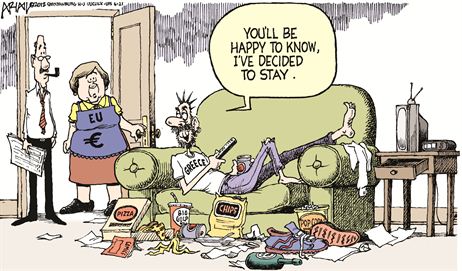
The self-inflicted economic crisis in Europe has generated some good humor, as you can see from these cartoons by Michael Ramirez and Chuck Asay.

But for pure laughter, I don’t think anything will ever match the hilarious “Europe According To…” maps that I posted last year.

That being said, this new cartoon by Robert Ariail ranks high on my list for European humor.

And if you need some more European-oriented laughs, I also recommend this photo-shopped image of “Merkozy” and this Hitler parody about the downgrade.

Obama going to win in November or will economy sink him?

I wonder what is going to happen in November with Obama?

At the start of the year, I predicted Obama would be reelected, largely because of my assumption that the unemployment rate would drop below 8 percent.

But my prediction on jobs is looking quite shaky, so this discussion about the economy and the election with Fox Business News is very timely.

I argued, unsurprisingly, that the economy is anemic because Obama’s been pursuing an agenda of wasteful spending and class warfare.

So if he loses, he has nobody to blame but himself.

That doesn’t mean Romney would be an improvement, especially if the warning signs are correct and he saddles the country with a value-added tax, so the American people may be tossed from one frying pan to another.

P.S. Hadley Heath may look familiar because she narrated this video about the damaging impact of welfare programs for the Center for Freedom and Prosperity.

P.P.S. On the completely separate topic of the Greek elections, I am more peeved than ever that the idiots in the media are reporting the results as a victory for the pro-bailout parties over the anti-bailout parties. That is nonsense. All the parties favored bailouts. As I wrote earlier this year, the election was a fight between parties that want no-strings bailout money and parties that at least pretend they are willing to implement reforms as a condition of getting bailout money.

President Obama a socialist?

Uploaded by on Dec 14, 2008

Thomas Sowell discusses his concerns with the unconstrained vision of Barack Obama. http://www.LibertyPen.com

_______________

Government does not have the answer to all of our problems. I wish people would stop looking to it for every answer.

A couple of years ago, Newt Gingrich accused Obama of being a socialist, causing some squawking and grousing about incivility from the more sensitive types in Washington.

I jumped to the President’s defense, pointing out that Obama is a different type of statist.

I’m gratified that Thomas Sowell of Stanford University’s Hoover Institution agrees with me.

It bothers me a little when conservatives call Barack Obama a “socialist.” He certainly is an enemy of the free market, and wants politicians and bureaucrats to make the fundamental decisions about the economy. But that does not mean that he wants government ownership of the means of production, which has long been a standard definition of socialism. What President Obama has been pushing for, and moving toward, is more insidious: government control of the economy, while leaving ownership in private hands. That way, politicians get to call the shots but, when their bright ideas lead to disaster, they can always blame those who own businesses in the private sector. Politically, it is heads-I-win when things go right, and tails-you-lose when things go wrong. This is far preferable, from Obama’s point of view, since it gives him a variety of scapegoats for all his failed policies… Thus the Obama administration can arbitrarily force insurance companies to cover the children of their customers until the children are 26 years old. Obviously, this creates favorable publicity for President Obama. But if this and other government edicts cause insurance premiums to rise, then that is something that can be blamed on the “greed” of the insurance companies.

So what is the right technical description of what Obama is proposing? Well, if you allow nominal private property, but impose government control, it’s called fascism. Sowell agrees, and also adds some history for the unenlightened.

One of the reasons why both pro-Obama and anti-Obama observers may be reluctant to see him as fascist is that both tend to accept the prevailing notion that fascism is on the political right, while it is obvious that Obama is on the political left. Back in the 1920s, however, when fascism was a new political development, it was widely — and correctly — regarded as being on the political left. Jonah Goldberg’s great book “Liberal Fascism” cites overwhelming evidence of the fascists’ consistent pursuit of the goals of the left, and of the left’s embrace of the fascists as one of their own during the 1920s.Mussolini, the originator of fascism, was lionized by the left, both in Europe and in America, during the 1920s. Even Hitler, who adopted fascist ideas in the 1920s, was seen by some, including W.E.B. Du Bois, as a man of the left. …What socialism, fascism and other ideologies of the left have in common is an assumption that some very wise people — like themselves — need to take decisions out of the hands of lesser people, like the rest of us, and impose those decisions by government fiat. …Only our own awareness of the huge stakes involved can save us from the rampaging presumptions of our betters, whether they are called socialists or fascists. So long as we buy their heady rhetoric, we are selling our birthright of freedom.

All this being said, I want to reiterate something else that I wrote back in 2010. It is counterproductive to call Obama a fascist because that term is now linked to the specific form of evil produced by Hitler and the National Socialist Party.

So if you disapprove of Obama’s policies, call him a statist or a corporatist. Heck, you can say he believes in cronyism or maybe even collectivism. Those terms get across that he wants more government without causing needless controversy that distracts from the main message.

But make sure you apply the same term to Republicans who impose the same types of policies, such as Bush and Nixon.

If we don’t tackle entitlements we will end up in Greece

If we don’t cut spending then we will end up at Greece. We have to tackle entitlement reforms.

Will America Face a Greek-Style Fiscal Crisis?

June 14, 2012 by Dan Mitchell

Since I’ve written several times that the United States will face a fiscal crisis if entitlement programs aren’t reformed, you won’t be surprised to see that I repeat those points in this CNBC debate.

But I’m not happy with my performance.

Not because my leftist opponent grabbed more air time (mostly because the host started challenging him, which also happens periodically when I’m on Kudlow’s show), but because he gave me a giant opening to completely destroy his arguments and I failed to seize the opportunity.

He kept arguing that America is more dynamic and innovative than Europe, which generally is true, but then he argued that we should copy Europe’s fiscal policy by increasing the burden of government spending.

I think the points I made to wrap up the debate were fine, but I would be much happier with my performance if I had pointed out this huge hole in his position.

As shown in this amusing and clever poster, you don’t solve the problems created by government with more government.

Dan Mitchell of the Cato Institute takes on entitlement reform

It is the elephant in the room that nobody wants to talk about. Here Dan Mitchell takes it on.

Most people have a vague understanding that America has a huge long-run fiscal problem.

They’re right, though they probably don’t realize the seriousness of that looming crisis.

Here’s what you need to know: America’s fiscal crisis is actually a spending crisis, and that spending crisis is driven by entitlements.

More specifically, the vast majority of the problem is the result of Medicaid, Medicare, and Social Security, programs that are poorly designed and unsustainable.

America needs to fix these programs…or eventually become another Greece.

Fortunately, all of the problems can be solved, as these three videos demonstrate.

The first video explains how to fix Medicaid.

Promote Federalism and Replicate the Success of Welfare Reform with Medicaid Block Grants

Uploaded by on Jun 26, 2011

The Medicaid program imposes high costs while generating poor results. This Center for Freedom and Prosperity Foundation video explains how block grants, such as the one proposed by Congressman Paul Ryan, will save money and improve healthcare by giving states the freedom to innovate and compete.

The second video shows how to fix Medicare.

Saving Medicare: Free Market Reforms Are Better than Bureaucratic Rationing

Uploaded by on May 17, 2011

This Center for Freedom and Prosperity Foundation video explains how a “premium-support” plan would solve Medicare’s fiscal crisis and improve the overall healthcare system. This voucher-based system also would protect seniors from bureaucratic rationing. http://www.freedomandprosperity.org

And the final video shows how to fix Social Security.

Saving Social Security with Personal Retirement Accounts

Uploaded by on Jan 10, 2011

There are two crises facing Social Security. First the program has a gigantic unfunded liability, largely thanks to demographics. Second, the program is a very bad deal for younger workers, making them pay record amounts of tax in exchange for comparatively meager benefits. This video explains how personal accounts can solve both problems, and also notes that nations as varied as Australia, Chile, Sweden, and Hong Kong have implemented this pro-growth reform. www.freedomandprosperity.org

_______________________

Regular readers know I’m fairly gloomy about the future of liberty, but this is one area where there is a glimmer of hope.

The Chairman of the House Budget Committee actually put together a plan that addresses the two biggest problems (Medicare and Medicaid) and the House of Representatives actually adopted the proposal.

The Senate didn’t act, of course, and Obama would veto any good legislation anyhow, so I don’t want to be crazy optimistic. Depending on how things play out politically in the next six years, I’ll say there’s actually a 20 percent chance to save America.