Tag Archives: Dan Mitchell

The Laffer Curve Wreaks Havoc in the United Kingdom

I got to hear Arthur Laffer speak back in 1981 and he predicted what would happen in the next few years with the Reagan tax cuts and he was right with every prediction.

The Laffer Curve Wreaks Havoc in the United Kingdom

July 1, 2012 by Dan Mitchell

Back in 2010, I excoriated the new Prime Minister of the United Kingdom, noting that David Cameron was increasing tax rates and expanding the burden of government spending (including an increase in the capital gains tax!).

I also criticized Cameron for leaving in place the 50 percent income tax rate imposed by his feckless predecessor, and was not surprised when experts began to warn that this class-warfare tax hike might actually result in less revenue because the reduction in taxable income could be more significant than the increase in the tax rate.
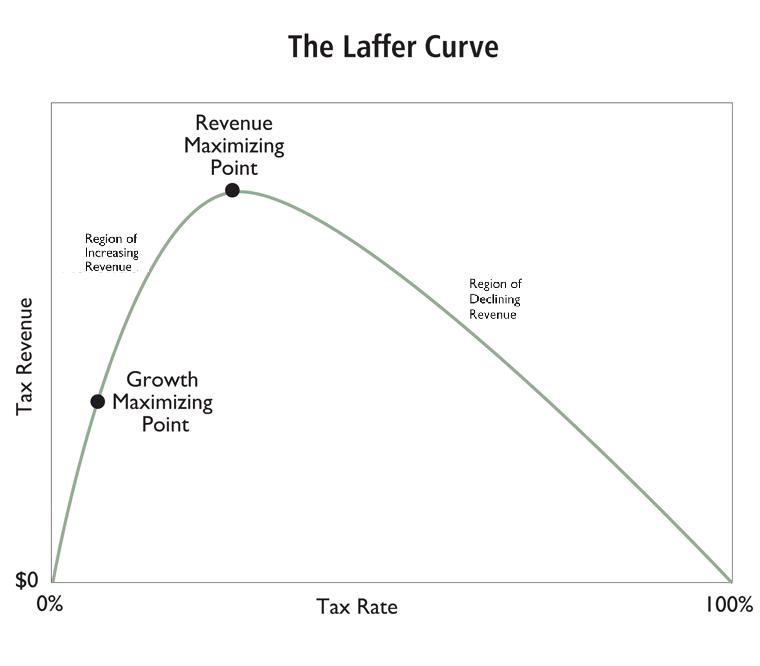
In other words, bad policy might lead to a turbo-charged version of the Laffer Curve.

Allow me to elaborate. In most cases, punitive tax hikes do raise revenue, but not as much as politicians predict. As explained in this three-part video series, this is because it takes a very significant reduction in taxable income to offset the revenue-generating impact of the higher tax rate.

But if a tax increase imposes a lot of damage and taxpayers have enough flexibility in their financial affairs, then it’s possible that a tax hike can lose revenue (or, as we saw with Reagan’s “tax cuts for the rich,” a well-designed reduction in tax rates can actually generate higher revenue).

With that background knowledge, let’s now take a closer look at David Cameron’s tax increases. They’ve been in place for a while, so we can look at some real-world data. Allister Heath of City AM has the details.

Something very worrying is happening to the UK’s public finances. Income tax and capital gains tax receipts fell by 7.3 per cent in May compared with a year ago, according to official figures. Over the first two months of the fiscal year, they are down by 0.5 per cent. This is merely the confirmation of a hugely important but largely overlooked trend: income and capital gains tax (CGT) receipts were stagnant in 2011-12, edging up by just £414m to £151.7bn, from £151.3bn, a rise of under 0.3 per cent. By contrast, overall tax receipts rose 3.9 per cent.

Is this because the United Kingdom is cutting tax rates? Nope. As we mentioned in the introduction, Cameron is doing just the opposite.

…overall taxes on labour and capital have been hiked: the 50p tax was introduced from April 2010 (and will fall to a still high 45p in April 2013), those earning above £150,000 have lost their personal allowance, CGT has risen to 28 per cent, many workers have been dragged into higher tax thresholds, and so on. In theory, if one were to believe the traditional static model of tax, beloved of establishment economists, this should have meant higher receipts, not lower revenues.

So what’s the problem? Well, it seems that there’s thing called the Laffer Curve.

…there is a revenue-maximising rate of tax – and that if you set rates too high, you raise less because people work less, find ways of avoiding tax or quit the country. The world isn’t static, it is dynamic; people respond to tax rates, just as they respond to other prices. Laffer told a gathering at the Institute of Economic Affairs that this is definitely true in the UK today – and the struggling tax take revealed in the official numbers suggest that he is right. Tax rates and levels are so high as to be counterproductive: slashing capital gains tax would undoubtedly increase its yield, for example. Many self-employed workers are delaying incomes as much as possible until the new, lower top rate of tax kicks in.

Allister’s column also makes the critical point that not all taxes are created equal.

…higher VAT is also damaging growth, though it is still yielding more. Some taxes can still raise more – but try doing that with income tax, CGT or corporation tax and the result is now clearly counter-productive. These taxes are maxed out; they have been pushed beyond their ability to raise revenues.

Last but not least, he makes an essential point about the role of bad spending policy.

The problem is that spending is too high – central government current expenditure is up by 3.7 per cent year on year in April-May – not that taxes are too low. The result is that the April-May budget deficit reached £30.7bn, some £6.2bn higher than a year ago.

By the way, you won’t be surprised to learn that Paul Krugman has been whining about “spending cuts” in the United Kingdom, even though the burden of the public sector has been climbing. But given his outlandish errors about Estonia, we shouldn’t be surprised.

But that’s not the point of this post. The relevant question is why do politicians pursue bad policy and why do some economists aid and abet bad policy?

For politicians, I think the answer is easy. They simply care about getting elected and holding power. So if they think class-warfare tax policy is the way of achieving those narcissistic goals, they’ll push higher tax rates. Even if it means lower revenue, notwithstanding their usual desire to have more money so they can buy more votes.

I’m more mystified by the behavior of economists. Let’s look at a couple of examples. Justin Wolfers and Mark Thoma recently cited some survey data to claim that the Laffer Curve was universally rejected by the profession.

But as James Pethokoukis of the American Enterprise Institute explained, the survey actually showed just the opposite, with economists by a margin of nearly 5-1 agreeing that lower tax rates could boost GDP (and therefore taxable income).

Those economists did say that a reduction in tax rates, based on current levels, would not cause taxable income to jump by a large enough amount to fully offset the revenue-losing impact of the lower tax rate. But the Laffer Curve says that only happens in extreme circumstances, so there’s zero contradiction.

So why did Wolfers and Thoma create a straw man in an attempt to discredit the Laffer Curve?

I have no idea, but Republican politicians probably deserve some of the blame. Too many of them make silly claims that “all tax cuts pay for themselves,” even when talking about new credits and deductions that have no positive impact on economic performance.

To the extent that Wolfers, Thoma, and others think that’s what the Laffer Curve is all about, then their skepticism is warranted.

But if that’s the case, they should read what Art Laffer actually wrote so they can be more accurate in the future. Or they can watch these three videos.

Part I describes the theory.

Part II describes the evidence.

And Part III explains the sloppy and inaccurate revenue-estimating methodology of the Joint Committee on Taxation.

But if they think I’m too biased or that Art is similarly misguided, then they should look at some of the evidence produced by other economists.

The sooner they get up to speed on these issues, the sooner they can help give politicians good advice so that the Laffer Curve doesn’t cause more unpleasant surprises.
The lesson from history: We must slow down spending in order to balance the budget

Dan Mitchell Explaining Why “Taxing the Rich” Is a Precursor for Going after the Middle Class

Published on Apr 13, 2012 by

_________________

Raising taxes is not the answer but we must lower spending in order to balance the budget. That is the lesson from history too.

This should be a lesson for Obama and any Republican out there that wants  to raise taxes:

Tax Hikes Are Economically Destructive, Politically Poisonous, and Completely Ineffective at Reducing Red Ink

July 3, 2012 by Dan Mitchell

Back in April, I explained that I would accept a tax increase if “the net long-run effect is more freedom, liberty, and prosperity.”

I even outlined several specific scenarios where that might occur, including giving the politicians more money in exchange for a flat tax or giving them additional revenue in exchange for real entitlement reform.

But I then pointed out that all of those options are unrealistic. And I’ve expanded on that thesis in a new article. Here’s some of what I wrote for The Blaze.

The no-tax pledge of Americans for Tax Reform generates a lot of controversy. With record levels of red ink, the political elite incessantly proclaims that all options must be “on the table.” This sounds reasonable. And when some Republicans say no tax hikes under any circumstances, there’s a lot of criticism about dogmatism. Theoretically, I agree with the elitists.

So does that make me a squish, the fiscal equivalent of Chief Justice John Roberts?

Nope, because I’m tethered to the real world. I know that there is zero chance of getting a good agreement. Once you put taxes “on the table,” any impetus for spending restraint evaporates.

But even though I’m theoretically open to a tax hike, I am a de facto opponent of tax increases for the simple reason that we will never get a good deal. We won’t get sustainable spending cuts. Not even in our dreams. We won’t get real entitlement reforms. Even if we hold our breath ‘til we turn blue. And we won’t get the “Simpson-Bowles” tax reform swap, where taxpayers give up $2 of deductions in exchange for $1 of lower tax rates. Let’s not kid ourselves. In other words, reality trumps theory. Yes, there are tax-hike deals that would be good, but they’re about as realistic as me speculating on whether I’d be willing to play for the New York Yankees, but only if they guarantee me $5 million per year.

I then point out that a budget deal inevitably would lead to bad policy – just as we saw in 1982 and 1990.

Here’s the bottom line: There is no practical way to get a good deal from either the Democrats in the Senate or the Obama Administration. Notwithstanding the good intentions of some people, any grand bargain would be a failure that leads to higher spending and more red ink, just as we saw after the 1982 and 1990 budget deals. The tax increases would not be relatively benign loophole closers. Instead, the economy would be hit by higher marginal tax rates on work, savings, investment, and entrepreneurship. And the entitlement reform would be unsustainable gimmicks rather than structural changes to fix the underlying programs. Ironically, when a columnist for the New York Times complained that Republicans were being unreasonable for opposing tax hikes, she inadvertently revealed that the only successful budget deal was the one in 1997 – the one that had no tax hikes!

The last sentence is worth some additional commentary. As I explained in a previous post, the only bipartisan budget agreement that generated a balanced budget was the 1997 pact – and that deal lowered taxes rather than increasing them.

Some people try to argue that Bill Clinton’s 1993 tax hike deserves some of the credit, but I previously showed that the Administration’s Office of Management and Budget admitted – 18 months later! – that the nation would have triple-digit budget deficits for the foreseeable future.

What changed (and this is where Bill Clinton deserves credit) is that the nation enjoyed a multi-year period of spending restraint in the mid-1990s.

And when policy makers addressed the underlying disease of too much government spending, they solved the symptom of red ink.

Dan Mitchell’s article on Chili and video clip on Milton Friedman’s influence

Milton Friedman and Chile – The Power of Choice

Uploaded by on May 13, 2011

In this excerpt from Free To Choose Network’s “The Power of Choice (2006)”, we set the record straight on Milton Friedman’s dealings with Chile — including training the Chicago Boys and his meeting with Augusto Pinochet. Was the tremendous prosperity unleashed after the Chicago Boys reforms worth the free-market therapy Friedman suggested? You be the judge. But when doing so, just remember the policies leading up to liberalization (land seizures, industry nationalizations and price controls).

________________

Milton Friedman got the ball rolling in Chili a long time ago. Take a look at the video above.

One of the reasons why this blog is called International Liberty is that the world is a laboratory, with some nations (such as France) showing why statism is a mistake, other jurisdictions (such as Hong Kong) showing that freedom is a key to prosperity, and other countries (such as Sweden) having good and bad features.

It’s time to include Chile in the list of nations with generally good policies. That nation’s transition from statism and dictatorship to freedom and prosperity must rank as one of the most positive developments over the past 30 years.

Here’s some of what I wrote with Julia Morriss for the Daily Caller. Let’s start with the bad news.

Thirty years ago, Chile was a basket case. A socialist government in the 1970s had crippled the economy and destabilized society, leading to civil unrest and a military coup. Given the dismal situation, it’s no surprise that Chile’s economy was moribund and other Latin American countries, such as Mexico, Venezuela, and Argentina, had about twice as much per-capita economic output.

Realizing that change was necessary, the nation began to adopt pro-market reforms. Many people in the policy world are at least vaguely familiar with the system of personal retirement accounts that was introduced in the early 1980s, but we explain in the article that pension reform was just the beginning.

Let’s look at how Chile became the Latin Tiger. Pension reform is the best-known economic reform in Chile. Ever since the early 1980s, workers have been allowed to put 10 percent of their income into a personal retirement account. This system, implemented by José Piñera, has been remarkably successful, reducing the burden of taxes and spending and increasing saving and investment, while also producing a 50-100 percent increase in retirement benefits. Chile is now a nation of capitalists. But it takes a lot more than entitlement reform, however impressive, to turn a nation into an economic success story. What made Chile special was across-the-board economic liberalization.

We then show the data (on a scale of 1-10) from the Fraser Institute’s Economic Freedom of the World, which confirm significant pro-market reforms in just about all facets of economic policy over the past three decades.

But have these reforms made a difference for the Chilean people? The answer seems to be a firm yes.

This has meant good things for all segments of the population. The number of people below the poverty line dropped from 40 percent to 20 percent between 1985 and 1997 and then to 15.1 percent in 2009. Public debt is now under 10 percent of GDP and after 1983 GDP grew an average of 4.6 percent per year. But growth isn’t a random event. Chile has prospered because the burden of government has declined. Chile is now ranked number one for freedom in its region and number seven in the world, even ahead of the United States.

But I think the most important piece of evidence (building on the powerful comparison in this chart) is in the second table we included with the article.

Chile’s per-capita GDP has increased by about 130 percent, while other major Latin American nations have experienced much more modest growth (or, in the tragic case of Venezuela, almost no growth).

Perhaps not as impressive as the performance of Hong Kong and Singapore, but that’s to be expected since they regularly rank as the world’s two most pro-market jurisdictions.

But that’s not to take the limelight away from Chile. That nation’s reforms are impressive – particularly considering the grim developments of the 1970s. So our takeaway is rather obvious.

The lesson from Chile is that free markets and small government are a recipe for prosperity. The key for other developing nations is to figure out how to achieve these benefits without first suffering through a period of socialist tyranny and military dictatorship.

Heck, if other developing nations learn the right lessons from Chile, maybe we can even educate policy makers in America about the benefits of restraining Leviathan.

P.S. One thing that Julia and I forgot to include in the article is that Chile has reformed its education system with vouchers, similar to the good reforms in Sweden and the Netherlands.

Dan Mitchell’s video on Social Security mentions Chili:

Uploaded by on Jan 10, 2011

There are two crises facing Social Security. First the program has a gigantic unfunded liability, largely thanks to demographics. Second, the program is a very bad deal for younger workers, making them pay record amounts of tax in exchange for comparatively meager benefits. This video explains how personal accounts can solve both problems, and also notes that nations as varied as Australia, Chile, Sweden, and Hong Kong have implemented this pro-growth reform. http://www.freedomandprosperity.org

“Feedback Friday” Letter to White House generated form letter response July 18, 2012 on Social Security (part 12)

I have been writing President Obama letters and have not received a personal response yet.  (He reads 10 letters a day personally and responds to each of them.) However, I did receive a form letter in the form of an email on July 18, 2012. I don’t know which letter of mine generated this response so I have linked several of the letters I sent to him below with the email that I received. However, I think it was probably this one below:

Sweden produced ABBA in the 1970’s, but now they are producing some pretty good economic policies.

One of my favorite groups growing up was ABBA. Here are some of my favorite songs:

_______________

President Obama c/o The White House
1600 Pennsylvania Avenue NW
Washington, DC 20500

Dear Mr. President,

I know that you receive 20,000 letters a day and that you actually read 10 of them every day. I really do respect you for trying to get a pulse on what is going on out here.

I have been impressed recently with Sweden’s resolve to cut taxes and how that has caused growth.

Sweden has a very large and expensive welfare state, but it’s actually becoming a bit of a role model for economic reform. I’ve already commented on the country’s impressive school choice system and noted that the Swedes have partially privatized their Social Security system.

I even wrote a Cato study looking at the good and bad features of economic policy in the Nordic nations, and cited a Swedish parliamentarian who explained that his nation became rich because of small government and free markets and how he is hopeful his country is returning to its libertarian roots.

Notwithstanding the many admirable features of Sweden, I never thought they would be moving in the right direction on fiscal policy while the United States was heading in the opposite direction.

Yet that’s the case. We all know that America has had made many mistakes during the Bush-Obama years, particularly with failed stimulus schemes in 2008 and 2009.

Sweden, by contrast, has put in place pro-growth reforms. Here’s what Fraser Nelson wrote for the UK-based Spectator.

Can we trade Geithner for Borg?

When Europe’s finance ministers meet for a group photo, it’s easy to spot the rebel — Anders Borg has a ponytail and earring. What actually marks him out, though, is how he responded to the crash. While most countries in Europe borrowed massively, Borg did not. Since becoming Sweden’s finance minister, his mission has been to pare back government. His ‘stimulus’ was a permanent tax cut. …Three years on, it’s pretty clear who was right. ‘Look at Spain, Portugal or the UK, whose governments were arguing for large temporary stimulus,’ he says. ‘Well, we can see that very little of the stimulus went to the economy. But they are stuck with the debt.’ Tax-cutting Sweden, by contrast, had the fastest growth in Europe last year, when it also celebrated the abolition of its deficit. …‘Everybody was told “stimulus, stimulus, stimulus”,’ he says — referring to the EU, IMF and the alphabet soup of agencies urging a global, debt-fuelled spending splurge. Borg, an economist, couldn’t work out how this would help. ‘It was surprising that Europe, given what we experienced in the 1970s and 80s with structural unemployment, believed that short-term Keynesianism could solve the problem.’ …He continued to cut taxes and cut welfare-spending to pay for it; he even cut property taxes for the rich to lure entrepreneurs back to Sweden. The last bit was the most unpopular, but for Borg, economic recovery starts with entrepreneurs. If cutting taxes for the rich encouraged risk-taking, then it had to be done.

The article notes that government is still far too large in Sweden, but it’s also clear that moving in the right direction generates immediate benefits.

I posted a video back in 2010, narrated by a Swedish economics student, and asked a rhetorical question of why Obama wants to make America more like Sweden when the Swedes are moving in the other direction.

Unfortunately, there was no good answer then and there’s no good answer now.

Let’s close with some irony. Last year, I cited a study showing how large public sectors undermine economic performance. The study was written by two Swedish economists. In addition to trading Geithner for Borg, perhaps we can ship Krugman to Stockholm and bring those economists to America.

______________________

Thank you so much for your time. I know how valuable it is. I also appreciate the fine family that you have and your commitment as a father and a husband.

Sincerely,

Everette Hatcher III, 13900 Cottontail Lane, Alexander, AR 72002, ph 501-920-5733, lowcostsqueegees@yahoo.com

The White House, Washington


July 18, 2012

Dear Everette:

Thank you for writing.  I have heard from many Americans about issues affecting seniors.  Today’s economic climate further intensifies the unique challenges they face, and I appreciate your perspective.

My Administration continues to support older Americans encountering unfair treatment, financial hardship, or difficulty obtaining health care.  The historic Affordable Care Act strengthens Medicare by not only preserving, but also expanding benefits for Americans who depend on Medicare every day.  In 2010 and 2011, over 5.1 million seniors and people with disabilities on Medicare saved over $3.2 billion on prescription drugs thanks to the law.  These savings include a one-time $250 rebate check to eligible seniors who fell into the prescription drug coverage gap known as the “donut hole” in 2010.  And more than 32 million seniors have already received one or more free preventive services, including the new Annual Wellness Visit.  To learn about help available through the Center for Medicare and Medicaid Services, visit www.CMS.gov.

The Affordable Care Act also helps prevent and eliminate elder abuse, neglect, and exploitation.  Additionally, this law implements unprecedented measures to fight waste and fraud, and to improve the quality and outcomes of care for Medicare beneficiaries.  It ends unwarranted subsidies to private insurance companies, and takes important steps to reduce unnecessary hospital admissions, improve patient safety, modernize payment systems, and streamline record-keeping.  It also realigns incentives to reward medical providers for the value, not the volume, of their care.  For resources and information on how to prevent, report, and stop Medicare fraud, visit www.StopMedicareFraud.gov.  To learn more about the Affordable Care Act, please visit www.HealthCare.gov.

By protecting Social Security from risky privatization plans, we are preserving its solvency and maintaining it as a reliable income source for seniors.  The American Recovery and Reinvestment Act included an additional payment to supplement Social Security benefits for seniors struggling to make ends meet, and I have called on Congress to extend this relief again.  Together, we will ensure all our citizens—not just a privileged few—can retire with dignity and security.

Finally, as we work to keep America’s promises to senior citizens, we are helping make sure older Americans can continue to enrich communities across our Nation through service and community involvement.  By expanding the Senior Corps and implementing the Edward M. Kennedy Serve America Act, we are creating more opportunities for seniors to share their knowledge and experience with younger generations.  For more information regarding service opportunities in your area, or to share your story of service, please visit www.Serve.gov.

To find assistance for senior citizens and their families, visit www.Eldercare.gov or call 1-800-677-1116.  For help with Medicare, visit www.Medicare.gov or call 1-800-MEDICARE.  Additional information and resources are available at www.USA.gov/Topics/Seniors.shtml.  For assistance using internet resources, I encourage you to visit your local library or community center.

Thank you, again, for being in touch.

Sincerely,

Barack Obama

Related posts:

Open letter to President Obama (Part 97)

Michael Cannon on Medicare and Healthcare President Obama c/o The White House 1600 Pennsylvania Avenue NW Washington, DC 20500 Dear Mr. President, I know that you receive 20,000 letters a day and that you actually read 10 of them every day. I really do respect you for trying to get a pulse on what is […]

Open letter to President Obama (Part 96)

Government Spending Doesn’t Create Jobs Uploaded by catoinstitutevideo on Sep 7, 2011 Share this on Facebook: http://on.fb.me/qnjkn9 Tweet it: http://tiny.cc/o9v9t In the debate of job creation and how best to pursue it as a policy goal, one point is forgotten: Government doesn’t create jobs. Government only diverts resources from one use to another, which doesn’t […]

Videos by Cato Institute on failed stimulus plans

In this post I have gathered several videos from the Cato Institute concerning the subject of failed stimulus plans. _____ Government Spending Doesn’t Create Jobs Uploaded by catoinstitutevideo on Sep 7, 2011 Share this on Facebook: http://on.fb.me/qnjkn9 Tweet it: http://tiny.cc/o9v9t In the debate of job creation and how best to pursue it as a policy […]

“Feedback Friday” Letter to White House generated form letter response June 22, 2012 (part 9)

I have been writing President Obama letters and have not received a personal response yet.  (He reads 10 letters a day personally and responds to each of them.) However, I did receive a form letter in the form of an email on June 22, 2012. I don’t know which letter of mine generated this response so I have […]

An open letter to President Obama jh100

 January 25, 2012 President Obama c/o The White House 1600 Pennsylvania Avenue NW Washington, DC 20500 Dear Mr. President, I know that you receive 20,000 letters a day and that you actually read 10 of them every day. I really do respect you for trying to get a pulse on what is going on out […]

Recent posts on Obamacare (including letters to the president and his responses)

Anyone who has followed this blog knows I have been writing letters to President Obama and he has actually responded 12 times now. Below are some videos and past posts about Obamacare and some of the open letters to the President are included with some of his responses: Dear Senator Pryor, why not pass the […]

Dear Senator Pryor, why not pass the Balanced Budget Amendment? (“Thirsty Thursday”, Open letter to Senator Pryor)

Sadly Senator Pryor has voted against the Balanced Budget Amendment over and over in his long time in the Senate. Senator Pryor: “There are a lot of people who think a balanced-budget amendment solves all the fiscal problems. I completely disagree.” (Peter Urban, Pryor Tilts Balanced Budget, Southwest Times Record, 11/17/11) Dear Senator Pryor, Why […]

Open letter to President Obama (Part 95)

Religious Liberty: Obamacare’s First Casualty Uploaded by HeritageFoundation on Feb 22, 2012 http://blog.heritage.org/2012/02/22/morning-bell-religious-liberty-under-attack/ | The controversy over the Obama Administration’s anti-conscience mandate and the fight for religious liberty only serves to highlight the inherent flaws in Obamacare. This conflict is a natural result of the centralization laid out under Obamacare and will only continue until […]

“Feedback Friday” Letter to White House generated form letter response June 15, 2012 on Healthcare (part 8)

I have been writing President Obama letters and have not received a personal response yet.  (He reads 10 letters a day personally and responds to each of them.) However, I did receive a form letter in the form of an email on June 15, 2012. I don’t know which letter of mine generated this response so I have […]


Open letter to President Obama (Part 116)

It’s Simple to Balance The Budget Without Higher Taxes

Uploaded by on Oct 4, 2010

Politicians and interest groups claim higher taxes are necessary because it would be impossible to cut spending by enough to get rid of red ink. This Center for Freedom and Prosperity video shows that these assertions are nonsense. The budget can be balanced very quickly by simply limiting the annual growth of federal spending.

____________________

President Obama c/o The White House
1600 Pennsylvania Avenue NW
Washington, DC 20500

Dear Mr. President,

I know that you receive 20,000 letters a day and that you actually read 10 of them every day. I really do respect you for trying to get a pulse on what is going on out here. 

People are being told that radical spending cuts are a must if we are to balance the budget, but maybe that is not true. Why don’t you favor holding the line on spending so we can get to a balanced budget? The Republicans are going to beat you up on this issue during the election.

Even though I favor radical reductions in the burden of government, I’ve made the point that good fiscal policy merely requires that government spending grow slower than the private sector – what I call Mitchell’s Golden Rule.

And if lawmakers simply cap the growth of spending, so that it grows by about 2 percent annually, the budget deficit disappears in a decade.

It’s even better to impose more restraint, of course, which is why I’ve said favorable things about Senator Rand Paul’s plan.

There’s also a “Penny Plan” that would reduce primary spending (non-interest spending) by 1 percent each year. As James Carter and Jason Fichtner explain, this degree of fiscal restraint would reduce the burden of government spending to about 18 percent of economic output.

Any viable solution must cut spending growth. Sen. Mike Enzi of Wyoming and Rep. Connie Mack of Florida have introduced legislation in their respective chambers to do just that. Their “Penny Plan” – recently updated to reflect the latest budget developments – calls for reducing federal spending (excluding interest payments) 1 percent a year for five years, balancing the budget in the fifth year. To maintain balance once it’s reached, Mr. Enzi and Mr. Mack would cap federal spending at 18 percent of GDP. By no small coincidence, 18 percent of GDP roughly matches the U.S. long-run average level of taxation since World War II. Is it realistic to think Congress could limit federal spending to 18 percent of GDP? Actually, there is precedent. Federal spending fell as a share of GDP for nine consecutive years before bottoming out at 18.2 percent of GDP in fiscal 2000 and 2001. The Penny Plan would return federal spending, expressed as a share of GDP, near the level achieved during the last two years of the Clinton administration.

The various interest groups that infest Washington would complain about this degree of spending discipline, but Carter and Fichtner make a good point when they say that this simply means the same size government – as a share of GDP – that we had when Bill Clinton left office.

I realize I’m getting old and my memory may not be what it used to be, but I don’t recall people starving in the streets and grannies being ejected from hospitals during the Clinton years. Am I missing something?

__________________

Thank you so much for your time. I know how valuable it is. I also appreciate the fine family that you have and your commitment as a father and a husband.

Sincerely,

Everette Hatcher III, 13900 Cottontail Lane, Alexander, AR 72002, ph 501-920-5733, lowcostsqueegees@yahoo.com

Open letter to President Obama (Part 110)

The Rahn Curve and the Growth-Maximizing Level of Government

Uploaded by on Jun 29, 2010

Government spending can promote economic growth if money is used for core “public goods” such as rule of law and property rights. But the burden of government spending in the United States and other industrialized nations is far higher than needed to finance such activities. Citing scholarly studies, this CF&P Foundation video examines the Rahn Curve, which graphically illustrates the negative impact of excessive government spending. www.freedomandprosperity.org

___________

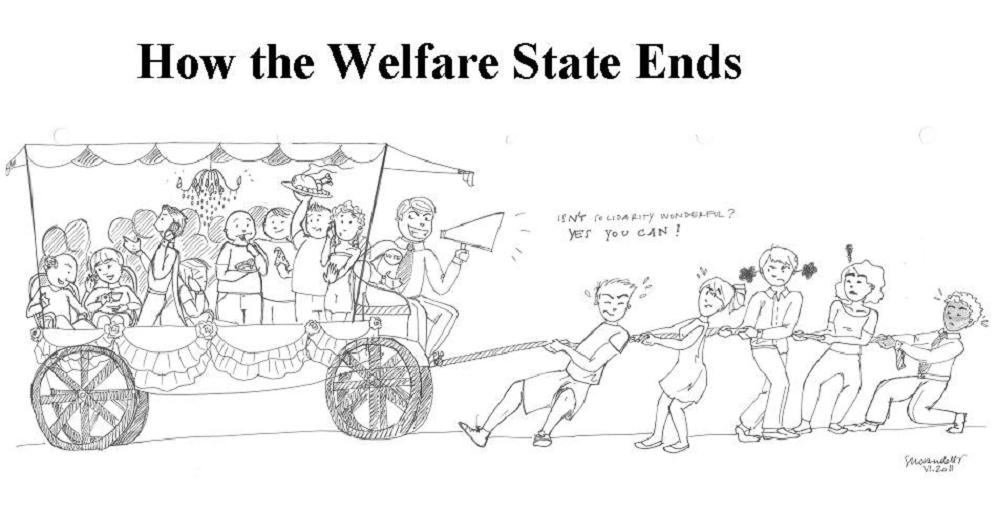
These images are remarkably accurate. The welfare state starts with small programs targeted at a handful of genuinely needy people. But as  politicians figure out the electoral benefits of expanding programs and people figure out the that they can let others work on their behalf, the ratio of producers to consumers begins to worsen.

_________

President Obama c/o The White House
1600 Pennsylvania Avenue NW
Washington, DC 20500

Dear Mr. President,

I know that you receive 20,000 letters a day and that you actually read 10 of them every day. I really do respect you for trying to get a pulse on what is going on out here.

When the government gets so big that it distorts the behavior of the private market then it is too big. The federal government is  now spending 24.8% of GDP and traditionally for the first 150 years of our nation’s history we spent under 5% unless in wartime. This massive spending now by the federal encourages people to lie in order to get money for the government too instead of trying to work hard to earn money in the private market.

Why is big government bad for an economy? The easy answer is that big government usually means high tax rates, and this penalizes work, saving, investment, and entrepreneurship. And perhaps some of the spending is financed by borrowing, and this diverts money from private investment.

That’s a correct answer, but it’s only part of the story. In most cases, there is added damage because politicians spend money in ways that further undermine incentives to produce.

For instance, let’s assume a government spends $1 billion on some sort of redistribution program. Extracting that money from the productive sector of the economy obviously will cause some damage, but it’s also important to estimate how the supposed beneficiaries of the money will react. What if they decide to earn less income in order to be eligible for the handouts, as even the statists at the OECD have recognized?

In other words, it hurts the economy when government collects money, and it often hurts the economy when government spends money. Sort of a perverse 2-for-1 special (though “Rahn Curve” analysis does show that some types of spending – on core public goods – is correlated with better economic performance)

Let’s look at an example from Greece, showing how handouts distort behavior and corrupt people. Here are some remarkable tidbits from a Wall Street Journal story.

The Greek health ministry is investigating on Zakynthos after local officials flagged records showing what they said is an implausibly high number of disability claims for blindness. About 1.8% of the island’s population of 39,000 claimed the benefit last year, according to the health ministry. That is around nine times the prevalence of blindness estimated for many European countries in a 2004 study published in a World Health Organization journal. Among those who put in for the blindness benefit on Zakynthos, a local official said, were a taxi driver and a bird hunter. …But the island is hardly alone, according to health ministry officials, who say fraudulent disability claims are a problem across the nation… Zakynthos Mayor Stelios Bozikis on a Greek television talk show said residents angry about the benefits crackdown and other financial overhauls pelted him with yogurt at a recent event.

Before sneering at the Greeks, keep in mind that “disability” claims also are rising in the United States, which is rather remarkable since jobs have become less arduous over time. Heck, the Social Security Administration decided to give disability payments to a grown man who gets his jollies by wearing diapers.

I’m not sure if that’s better or worse than the Greek government deciding to reward pedophiles with disability payments, but taxpayers are getting screwed in both examples.

Let’s go back to the story and look at a rough estimate of how much fraud exists.

In an attempt to root out fraud, the Greek health ministry recently required disability claimants nationwide to register in a centralized database, appearing in person or sending a representative. The registration resulted in 36,000 fewer disability claims than in 2011, the health ministry said. The ministry alleges these dropped claims were fraudulent, in many cases reflecting multiple claims for the same disability or payments in the name of dead beneficiaries. It also alleges that some doctors accepted money for false diagnoses and some local politicians signed off on the benefits to win support, and said it is giving public prosecutors information about areas where it suspects a high level of fraud. Only 190 of the nearly 700 people it says had been collecting the blindness benefit on Zakynthos participated in the registration, the ministry said.

I have no idea if Zakynthos is representative, but that’s an incredibly high fraud rate. And this is just a glimpse at the workings of one government program. Now multiply that by some large number and you’ll begin to understand the damage caused by government.

And America is not immune. When politicians make it easier to ride in the wagon than to pull the wagon (as this cartoon illustrates), society sooner or later gets in trouble.

____________

Thank you so much for your time. I know how valuable it is. I also appreciate the fine family that you have and your commitment as a father and a husband.

Sincerely,

Everette Hatcher III, 13900 Cottontail Lane, Alexander, AR 72002, ph 501-920-5733, lowcostsqueegees@yahoo.com

Jeb Bush and Lindsey Graham join small naive group of Republicans that want to raise taxes

Below is a speech by George W. Bush honoring Milton Friedman:

Milton Friedman Honored for Lifetime Achievements 2002/5/9

Milton Friedman said that getting George Bush I to be his vice president was his biggest mistake because he knew that Bush was not a true conservative and sure enough George Bush did raise taxes when he later became President. I wonder if Jeb Bush has the same genes as his father.

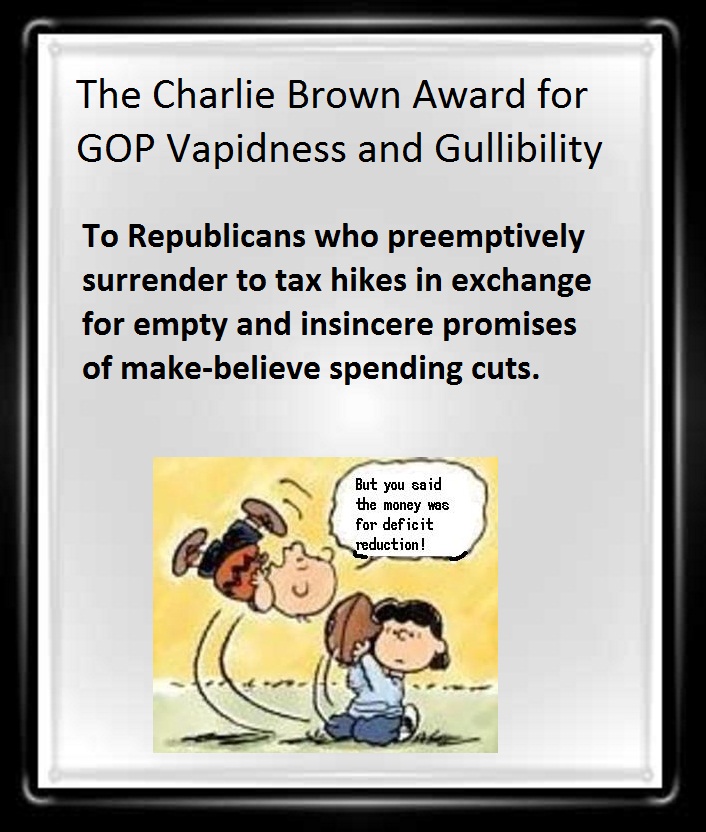
What we need is some people in Washington that are brave enough to say that we have taken too much of the american people’s money and we have to make the painful spending cuts in order to balance the budget and not ask for any more tax increases!!!! Arkansas’ congressman Rick Crawford has also made the Charlie Brown mistake.

Even though America’s fiscal problem is entirely the result of too much government spending, I wrote earlier this year that there were all sorts of scenarios where I would agree to a tax increase.

But I then pointed out that all of those scenarios were total fantasies and that it would be more realistic to envision me playing center field for the New York Yankees.

The fundamental problem is that politicians never follow through on promises to reduce spending – even if you use the dishonest Washington definition that a spending cut occurs whenever the budget doesn’t rise as fast as previously planned.

And to make matters worse, they always seem to want class-warfare tax hikes that do heavy economic damage rather than the loophole closers that at least get rid of some of the inefficient corruption in the tax code.

That’s why I like the anti-tax pledge of Americans for Tax Reform. You don’t solve America’s fiscal problems by saying no to all tax increases, but at least you don’t move in the wrong direction at a faster rate.

Notwithstanding the principled and pragmatic arguments against putting tax increases on the table, some Republicans – in a triumph of hope over experience – are preemptively acquiescing to tax hikes.

Here’s what Jeb Bush said.

Jeb Bush, the former Florida governor, said Friday that he could back a broad deficit plan that increased taxes, a stance that puts him at odds with other prominent Republicans. Bush told a House panel he could get behind a plan that combined 10 dollars in spending cuts for every dollar of new revenue… “The problem is the 10 never materializes,” [Congressman Paul] Ryan said after Bush said he could support a revenue-increasing deficit deal. Norquist also has criticized deficit deals crafted in 1982 and 1990 – the latter agreed to by then-President George H.W. Bush, Jeb’s father – for failing to deliver on the spending side.

Kudos to Paul Ryan for making the obvious point about make-believe spending cuts. And Grover is correct about the failure of previous budget deals.

Indeed, I cited a New York Times column that inadvertently revealed that the only budget deal that worked was the 1997 pact that cut taxes rather than raised them.

Jeb Bush isn’t the only apostate. Here’s what Senator Graham had to say.

Sen. Lindsey Graham (R-S.C.) said Tuesday he believed Republicans should consider eliminating loopholes in the tax code even if they aren’t replaced by additional tax cuts, a move that would break with an anti-tax pledge many GOP lawmakers have signed with activist Grover Norquist. “When you eliminate a deduction, it’s OK with me to use some of that money to get us out of debt. That’s where I disagree with the pledge,” Graham told ABC News. …”I’m willing to move my party, or try to, on the tax issue. I need someone on the Democratic side being willing to move their party on structural changes to entitlements.” Graham said, for instance, he would support a plan that included $4 in spending cuts for every $1 in tax increases. During a Republican debate last August, all eight Republican candidates in attendance said they would reject a proposal to trade $10 in spending cuts for even $1 in tax increases.

In some sense, Senator Graham’s comments are reasonable. With real spending cuts and less-damaging forms of tax hikes, an acceptable deal is possible. But only in Fantasia, not in Washington.

In the real world, all that Senator Graham has done is to move the debate slightly to the left.

I’ve noted that tax increases are political poison for the Republican Party, but I don’t lose sleep worrying about the GOP.

But I do have nightmares about government getting even bigger, and that’s why I don’t want tax increases on the table. I don’t even want them in the room. Or the house. Or the neighborhood.

That’s why Jeb Bush and Lindsey Graham are the newest winners of the Charlie Brown Award. They’ve put blood in the water. I wonder if they’ll act surprised when hungry sharks show up looking for a meal?

Open letter to President Obama (Part 109)

Government Spending Doesn’t Create Jobs

Uploaded by on Sep 7, 2011

Share this on Facebook: http://on.fb.me/qnjkn9 Tweet it: http://tiny.cc/o9v9t

In the debate of job creation and how best to pursue it as a policy goal, one point is forgotten: Government doesn’t create jobs. Government only diverts resources from one use to another, which doesn’t create new employment.

Video produced by Caleb Brown and Austin Bragg.

_________

President Obama c/o The White House
1600 Pennsylvania Avenue NW
Washington, DC 20500

Dear Mr. President,

I know that you receive 20,000 letters a day and that you actually read 10 of them every day. I really do respect you for trying to get a pulse on what is going on out here.

Judging from what you had to say in your State of the Union address you haven’t changed at all. You still believe we should make “investments” but what you really mean is that government can provide everyone jobs. I just don’t believe that and I don’t believe you are brave enough to make the tough cuts in government spending to bring down out federal spending from almost 25% of GDP to more acceptable levels like under 19% under Clinton.

After saddling the nation with trillion-dollar boondoggles like the faux stimulus and Obamacare, I’m not sure it’s possible for Obama to reinvent himself as a budget cutter before the election.

But I welcome converts, even ones that are insincere, so I’m happy he’s at least pretending to want to deal with waste and duplication in the federal budget.

Here’s a blurb from the Daily Beast about his new idea.

President Barack Obama is seeking the power to merge agencies in a bid to shrink the federal government in a sweeping move. Obama will ask Congress to give him authority to consolidate six trade and commerce agencies that have overlapping programs, cutting up to 2,000 jobs and saving $3 billion over 10 years. He’ll call for a vote by Congress within 90 days.

But I’ll definitely wait to see the fine print. After all, the President claimed in 2009 that he was directing his Cabinet to find $100 million of budget cuts.

“I hate pretending to be a fiscal conservative”

But even that trivial gesture (almost immeasurably small compared to t a$3.6 trillion budget) turned out to be empty rhetoric.

And even if he’s serious about this latest plan, $3 billion of saving over 10 years is chicken feed compared to all of his new spending.

But if you allow me to modify an old saying, a journey of tens of trillions of dollars begins with the first $3 billion.

__________

Thank you so much for your time. I know how valuable it is. I also appreciate the fine family that you have and your commitment as a father and a husband.

Sincerely,

Everette Hatcher III, 13900 Cottontail Lane, Alexander, AR 72002, ph 501-920-5733, lowcostsqueegees@yahoo.com

Open letter to President Obama (Part 108)

The Economic Case for Tax Havens

Uploaded by on Sep 10, 2008

Statist politicians and international bureaucracies such as the OECD and UN routinely attack tax havens, claiming that they lead to “harmful tax competition.” Yet at no point do critics bother to provide any evidence for this claim. This mini-documentary from the Center for Freedom and Prosperity looks at the empirical data and scholarly research and reports that tax havens actually have a very positive impact on the global economy.

______________

President Obama c/o The White House
1600 Pennsylvania Avenue NW
Washington, DC 20500

Dear Mr. President,

I know that you receive 20,000 letters a day and that you actually read 10 of them every day. I really do respect you for trying to get a pulse on what is going on out here.

The size of government needs to be reduced. Eventually people will revolt against the tremendous amount of taxes they are forced to pay. Furthermore, corrupt scams like Solyndra and bailouts make people resent paying their taxes and people will look for tax havens in other countries if taxes are not reduced. Please look at ways to decrease taxes so people will not flee with their money!!!

I wrote last year about a backlash from long-suffering Greek taxpayers. These people – the ones pulling the wagon rather than riding in the wagon – are being raped and pillaged by a political class that is trying to protect the greedy interest groups that benefit from Greece’s bloated public sector.

We now have another group of taxpayers who are fighting back against greedy government. My ancestors in Ireland have decided that enough is enough and there is widespread civil disobedience against a new property tax.

Here are the key details from an AP report.

The Serfs Fight Back

Ireland is facing a revolt over its new property tax. The government said less than half of the country’s 1.6 million households paid the charge by Saturday’s deadline to avoid penalties. And about 5,000 marched in protest against the annual conference of Prime Minister Enda Kenny’s Fine Gael party. Emotions ran raw as police backed by officers on horseback stopped demonstrators from entering the Dublin Convention Centre. …One man mistakenly identified as the government minister responsible for collecting the tax had to be rescued by police from an angry scrum. Kenny said his government had no choice, but to impose the new charge as part of the nation’s efforts to emerge from an international bailout. …The charge this year is a flat-fee €100 ($130) per dwelling, but is expected to rise dramatically next year once Ireland starts to vary the charge based on a property’s estimated value. Anti-tax campaigners have urged the public to ignore the tax demand, arguing that the government doesn’t have the power to collect it.

What makes this new tax so outrageous is that Irish taxpayers already have been victimized with higher income tax rates and a more onerous value-added tax. Yet they weren’t the ones to cause the nation’s fiscal crisis. Ireland is in trouble for two reasons, and both deal with the spending side of the fiscal equation.

1. The burden of government spending exploded last decade, more than doubling in less than 10 years. This wiped out all the gains from fiscal restraint in the 1980s and 1990s.

2. Irish politicians decided to give a bailout not only to depositors of the nation’s failed banks, but also to bondholders. This is a grotesque transfer of wealth from ordinary people to those with higher incomes – and therefore a violation of Mitchell’s Guide to an Ethical Bleeding Heart.

It’s worth noting that academic studies find that tax evasion is driven largely by high tax rates. This makes sense since there is more incentive to hide money when the government is being very greedy. But there is also evidence that tax evasion rises when people perceive that government is wasting money and being corrupt.

Heck, no wonder the Irish people are up in arms. They’re being asked to cough up more money to finance a bailout that was both corrupt and wasteful.

Let’s close by looking at American attitudes about tax evasion. Here’s part of a column from Forbes, which expresses surprise that Americans view tax evasion more favorably than behaviors such as shoplifting and littering.

A new survey suggests Americans consider cheating on their taxes more socially acceptable than shoplifting, drunk driving or even throwing trash out the window of a moving car. …only 66% of  the participants said they “completely agree” that “everyone who cheats on their taxes should be held accountable”  and only 72% completely agreed that “it’s every American’s civic duty to pay their fair share of taxes”–suggesting, as the Shelton study does, that perhaps disapproval of tax evasion is not as strong as, say, disapproval of stealing from private businesses.

I’m not sure, though, why anybody would be shocked by these results. We have a government in Washington that is pervasively corrupt, funneling money to corrupt scams like Solyndra.

These same people want higher tax rates, which will further encourage people to protect their income.

If we really want to promote better tax compliance, whether in the U.S., Ireland, or anywhere in the world, there are two simple answers. First, enact a simple and fair flat tax to keep rates low. Second, shrink government to its proper size, which will automatically reduce waste and limit opportunities for corruption.

But none of this is in the interests of the political class, so don’t hold your breath waiting for these reforms.

____________

Thank you so much for your time. I know how valuable it is. I also appreciate the fine family that you have and your commitment as a father and a husband.

Sincerely,

Everette Hatcher III, 13900 Cottontail Lane, Alexander, AR 72002, ph 501-920-5733, lowcostsqueegees@yahoo.com

________

The Moral Case for Tax Havens

Uploaded by on Oct 22, 2008

This Center for Freedom and Prosperity Foundation video demonstrates that low-tax jurisdictions offer millions of people around the world a safe haven from tyrannical and oppressive government. For this, and many other reasons, there is a powerful moral case for preserving and promoting tax havens. This mini-documentary is the second installment of a three-part series on the beneficial impact of low-tax jurisdictions. In addition to showing how tax havens promote human rights and individual liberty, the video exposes the hypocritical anti-tax competition efforts of statist international bureaucracies such as the Organization for Economic Cooperation and Development. For more information: http://www.freedomandprosperity.org Link to Part 1 — The Economic Case for Tax Havens: http://www.youtube.com/watch?v=yi0lkJBTi58

Related posts:

Here are some posts that include videos from Dan Mitchell:

Videos by Cato Institute on failed stimulus plans

In this post I have gathered several videos from the Cato Institute concerning the subject of failed stimulus plans. _____ Government Spending Doesn’t Create Jobs Uploaded by catoinstitutevideo on Sep 7, 2011 Share this on Facebook: http://on.fb.me/qnjkn9 Tweet it: http://tiny.cc/o9v9t In the debate of job creation and how best to pursue it as a policy […]

Balanced Budget Amendment the answer? Boozman says yes, Pryor no, Part 28 (Input from Norm Coleman, former Republican Senator from MN)

  It’s Simple to Balance The Budget Without Higher Taxes Steve Brawner in his article “Safer roads and balanced budgets,” Arkansas News Bureau, April 13, 2011, noted: The disagreement is over the solutions — on what spending to cut; what taxes to raise (basically none ever, according to Boozman); whether or not to enact a […]

Obama’s plan is not too smart on taxes

Dan Mitchell did a great article concerning the affect of raising taxes in these two areas and horrible results: How Can Obama Look at these Two Charts and Conclude that America Should Have Higher Double Taxation of Dividends and Capital Gains? Posted by Daniel J. Mitchell As discussed yesterday, the most important number in Obama’s […]

______________

Tax Havens: Myths vs. Facts

Uploaded by on Dec 1, 2008

The Center for Freedom and Prosperity Foundation has produced videos showing the economic and moral benefits of so-called tax havens. This final video in the three-part series addresses some of the most common myths put forth by politicians from high-tax nations. Using academic research and data from international organizations, the video shows that the most common attacks made against low-tax jurisdictions are empty demagoguery.

Open letter to President Obama (Part 105)

Obama on Ryan Plan: “It’s Laughable. It Is a Trojan Horse. It’s Thinly-Veiled Social Darwinism.”

President Obama c/o The White House
1600 Pennsylvania Avenue NW
Washington, DC 20500

Dear Mr. President,

I know that you receive 20,000 letters a day and that you actually read 10 of them every day. I really do respect you for trying to get a pulse on what is going on out here.

Dan Mitchell of the Cato Institute has hit a home run with this post. If Congressman Paul Ryan could get criticized for wanting to bring down our federal spending to around 20% in 11 years  and earn the label of “social darwinist” from you  then surely you would have thought President Clinton’s effort to cut spending to 18.2 % of GDP in 2001 as extremely devilish.

President Obama Accuses Bill Clinton of “Thinly Veiled Social Darwinism”

April 3, 2012 by Dan Mitchell

Actually, Bill Clinton must be something even worse than a social Darwinist. That’s because the title of this post is wrong. Obama said that Paul Ryan’s plan (which allows spending to grow by an average of 3.1 percent per year over the next decade) is a form of “social Darwinism.”

Proponent of social Darwinism?

But the proposal from the House Budget Committee Chairman only reduces the burden of federal spending to 20.25 percent of GDP by the year 2023.

Yet when Bill Clinton left office in 2001, following several years of spending restraint, the federal government was consuming 18.2 percent of economic output.

And by the President’s reasoning, this must make Clinton something worse than a Darwinist. Perhaps Marquis de Sade or Hannibal Lecter.

Here’s a blurb from the New York Times on Obama’s speech.

Mr. Obama’s attack, in a speech during a lunch with editors and reporters from The Associated Press, was part of a broader indictment of the Republican economic blueprint for the nation. The Republican budget, and the philosophy it represents, he said in remarks prepared for delivery, is “antithetical to our entire history as a land of opportunity and upward mobility for everyone who’s willing to work for it.” …“Disguised as a deficit reduction plan, it’s really an attempt to impose a radical vision on our country. It’s nothing but thinly veiled social Darwinism,” Mr. Obama said. “By gutting the very things we need to grow an economy that’s built to last — education and training, research and development — it’s a prescription for decline.”

I’m particularly amused by the President’s demagoguery that Ryan’s plan is “antithetical to our entire history” and “a radical vision.”

Is he really unaware that a small and constrained central government is part of America’s history and vision? Doesn’t he know that the federal government, for two-thirds of our nation’s history, consumed less than 5 percent of GDP?

Of course, that was back in the dark ages when people in Washington actually believed that the Constitution’s list of enumerated powers in Article 1, Section 8, actually enumerated the powers of the federal government. How quaint.

No wonder this Ramirez cartoon is so effectively amusing. It certainly seems to capture the President’s view of America’s founding principles.

_______________

Thank you so much for your time. I know how valuable it is. I also appreciate the fine family that you have and your commitment as a father and a husband.

Sincerely,

Everette Hatcher III, 13900 Cottontail Lane, Alexander, AR 72002, ph 501-920-5733, lowcostsqueegees@yahoo.com