Tag Archives: Dan Mitchell

Dan Mitchell of Cato Institute discusses Paul Ryan VP pick

I respect the Cato Institute and especially Dan Mitchell and here is an article he just wrote:

The honest answer is that it probably means nothing. I don’t think there’s been an election in my lifetime that was impacted by the second person on a presidential ticket.

And a quick look at Intrade.com shows that Ryan’s selection hasn’t (at least yet) moved the needle. Obama is still in the high 50s.

Moreover, the person who becomes Vice President usually plays only a minor role in Administration policy.

With those caveats out of the way, the Ryan pick is mostly good news.

Here are the reasons why I’m happy.

Here are two reasons why I’m worried.

  • Both Romney and Ryan are somewhat sympathetic to a value-added tax. My worst-case scenario is they win the election, but then can’t get a good budget approved because of some squishy Republican senators who put self interest above national interest. Romney and Ryan then decide that this European-style national sales tax is the only way – on paper – of making the budget balance. In reality, of course, we’ll suffer the same fate as Europe since the VAT revenues will be used to finance ever-larger government.
  • Ryan has some very bad votes in his past, including support for TARP, the auto bailout, the no-bureaucrat-left-behind education legislation, and the reckless Medicare prescription drug entitlement. Everyone says to ignore those votes because Ryan knew he was voting the wrong way, but if he’s already made some deliberately bad decisions for political reasons, what’s to stop him from making more deliberately bad decisions for political reasons?

But as I said above, don’t read too much into Ryan’s selection. if Republicans win, Romney will be the one calling the shots.

Though this does give Ryan a big advantage the next time there’s an open contest for the GOP nomination – either 2016 or 2020.

P.S. I suspect putting Ryan on the ticket will shift Wisconsin into the GOP column. Based on my last prediction, that would be enough to defeat Obama. But I’ll have to contemplate whether the pick hurts Romney’s chances in another state. You’ll have to wait until September 6 for my updated election prediction.

P.P.S. For those who care about politics, some are saying that selecting Ryan was risky because it gives Obama and his allies an opportunity to demagogue the GOP ticket about entitlement reform. I disagree. Even if Romney picked Nancy Pelosi, that demagoguery was going to happen. Heck, they’ve already accused Romney of causing a woman’s death, so I hardly think they’ll be bashful about throwing around other accusations.

Related posts:

Churches, not the government, have traditionally helped the poor in the long history of the USA

If you look at the first 150 years of our nation’s history you will find practically no welfare or assistance to the poor coming from the government. In fact, most of the help came from local churches. During the last few decades the government had created the welfare trap that robs people of responsibility to […]

Obamacare: A Medicaid Monster

Cato’s Michael F. Cannon Discusses ObamaCare’s Individual Mandate Uploaded by catoinstitutevideo on Mar 26, 2012 http://www.cato.org/event.php?eventid=9074 The individual mandate to purchase health insurance is the linchpin of the Patient Protection and Affordable Care Act. It is among the issues to be handled by the Supreme Court beginning March 26, 2012. Michael F. Cannon is the […]

Taxed Enough Already? Just wait until Obamacare kicks in

Tim Sandefur Discusses ObamaCare’s Medicaid Expansion Uploaded by catoinstitutevideo on Mar 26, 2012 http://www.cato.org/event.php?eventid=9074 Tim Sandefur of the Pacific Legal Foundation explains some of the implications of the Affordable Care Act’s Medicaid expansion. ___________________ Obamacare will tax us to death. Here is a chart from the Heritage Foundation: Created on March 23, 2012 DOWNLOAD HIGH-RES […]

Interview with Paul Ryan

Rep. Paul Ryan’s Budget Problem – CBN.com A biblical justification for getting our spending in order. Subsidiarity: An Important Principle in Federal Budget Debates Ryan Messmore April 16, 2012 at 1:00 pm How should one’s faith shape his or her engagement in the policy arena? Political Correspondent David Brody recently asked that question of House […]

Obama wants to claim Reagan again

  I have a son named Wilson Daniel Hatcher and he is named after two of the most respected men I have ever read about : Daniel from the Old Testament and Ronald Wilson Reagan. One of the thrills of my life was getting to hear President Reagan speak in the beginning of November of […]

Obama is easy to make fun of at times

Exempting half the people from paying income tax does not seem like a bright idea. President Obama has a funny way of spinning that.  Dan Mitchell’s blog has a good way of presenting that. Obama’s Understanding of Taxation, Captured by a Cartoon July 11, 2011 by Dan Mitchell I’ve already posted on Obama’s class-warfare approach to […]

Dan Mitchell of the Cato Institute on President Obama’s “Social Darwinism speech”

Dan Mitchell of the Cato Institute rightly has pointed out that President Obama is off base to be critical of Paul Ryan’s budget since it allows the government to grow by over 3% each year and he wished that the Republicans would taking a sharper knife to the budget cuts!!!! Appearing on PBS to Debate […]

The “Death tax” is immoral

Dan Mitchell notes, “To make matters worse, the United States also has one of the most onerous death taxes in the world.” I just don’t understand why a person has to pay a death tax when he dies. If a person is a very talented pianist is he allowed to pass that teaching and skill along to his children? Parents should not be encouraged to spend their money on wild living versus building up their businesses for their children. How would that affect the economy to encourage people to divide and sell their businesses versus building them up?

On Death Tax, the U.S. Is Worse than Greece, Worse than France, and Even Worse than Venezuela

July 29, 2012 by Dan Mitchell

Considering that every economic theory agrees that living standards and worker compensation are closely correlated with the amount of capital in an economy (this picture is a compelling illustration of the relationship), one would think that politicians – particularly those who say they want to improve wages – would be very anxious not to create tax penalties on saving and investment.

Yet the United States imposes very harsh tax burdens on capital formation, largely thanks to multiple layers of tax on income that is saved and invested.

But we compound the damage with very high tax rates, including the highest corporate tax burden in the developed world.

And the double taxation of dividends and capital gains is nearly the worst in the world (and will get even worse if Obama’s class-warfare proposals are approved).

To make matters worse, the United States also has one of the most onerous death taxes in the world. As you can see from this chart prepared by the Joint Economic Committee, it is more punitive than places such as Greece, France, and Venezuela.

Who would have ever thought that Russia would have the correct death tax rate, while the United States would have one of the world’s worst systems?

Fortunately, not all U.S. tax policies are this bad. Our taxation of labor income is generally not as bad as other industrialized nations. And the burden of government spending in the United States tends to be lower than European nations (though both Bush and Obama have undermined that advantage).

And if you look at broad measures of economic freedom, America tends to be in – or near – the top 10 (though that’s more a reflection of how bad other nations are).

But these mitigating factors don’t change the fact that the U.S. needlessly punishes saving and investment, and workers are the biggest victims. So let’s junk the internal revenue code and adopt a simple and fair flat tax.

Great cartoon from Dan Mitchell’s blog on government moochers

I thought it was great when the Republican Congress and Bill Clinton put in welfare reform but now that has been done away with and no one has to work anymore it seems. In fact, over 40% of the USA is now on the government dole. What is going to happen when that figure gets over 50%? Maybe this cartoon below will be true.  


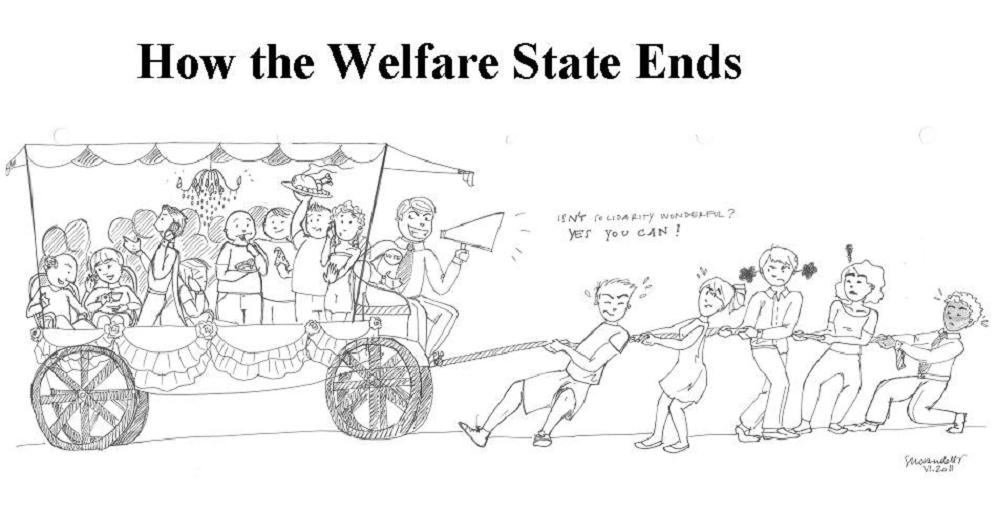
The all-time, most-viewed post on this blog is this set of cartoons showing how the welfare state begins and how it eventually becomes an unsustainable mess.

The great Chuck Asay has a cartoon that takes the next step, showing what happens when the looters and moochers who ride in the wagon get pitted against those who are pulling the wagon.

Since I’m not a Romney fan (for a bunch of reasons outlined here), I would have preferred if the cartoon didn’t imply anything about the current election and instead focused on the rhetorical question of what happens to a society when those living off the government outnumber those who get stuck picking up the tab.

It also would have been more accurate to have the two slave drivers somehow identified as “politicians” and the “IRS.”

But it’s a very clever cartoon, so it’s worth sharing even if I’m nitpicking.

You can see my favorite Asay cartoons here, here, herehere, here, here, here, here, here, here, herehereherehere, and here.

Related posts:

Open letter to President Obama (Part 120)

President Obama c/o The White House 1600 Pennsylvania Avenue NW Washington, DC 20500 Dear Mr. President, I know that you receive 20,000 letters a day and that you actually read 10 of them every day. I really do respect you for trying to get a pulse on what is going on out here.  Dan Mitchell […]

“Feedback Friday” Letter to White House generated form letter response July 10,2012 on welfare, etc (part 14)

I have been writing President Obama letters and have not received a personal response yet.  (He reads 10 letters a day personally and responds to each of them.) However, I did receive a form letter in the form of an email on July 10, 2012. I don’t know which letter of mine generated this response so I have […]

Welfare reform part 1

Welfare reform was working so good. Why did we have to abandon it? Look at this article from 2003. The Continuing Good News About Welfare Reform By Robert Rector and Patrick Fagan, Ph.D. February 6, 2003 Six years ago, President Bill Clinton signed legislation overhauling part of the nation’s welfare system. The Personal Responsibility and […]

Open letter to President Obama (Part 119B)

Ep. 4 – From Cradle to Grave [3/7]. Milton Friedman’s Free to Choose (1980) President Obama c/o The White House 1600 Pennsylvania Avenue NW Washington, DC 20500 Dear Mr. President, I know that you receive 20,000 letters a day and that you actually read 10 of them every day. I really do respect you for […]

Open letter to President Obama (Part 118B)

President Obama c/o The White House 1600 Pennsylvania Avenue NW Washington, DC 20500 Dear Mr. President, I know that you receive 20,000 letters a day and that you actually read 10 of them every day. I really do respect you for trying to get a pulse on what is going on out here. With the […]

40% of USA on government dole, need to eliminate welfare and put in Friedman’s negative income tax

Eight Reasons Why Big Government Hurts Economic Growth We got to cut these welfare programs before everyone stops working and wants to get the free stuff. The Bible says if you don’t work then you should not eat. It also says that churches should help the poor but it doesn’t say that the government should […]


“Feedback Friday” Letter to White House generated form letter response July 10,2012 on welfare, etc (part 14)

I have been writing President Obama letters and have not received a personal response yet.  (He reads 10 letters a day personally and responds to each of them.) However, I did receive a form letter in the form of an email on July 10, 2012. I don’t know which letter of mine generated this response so I have linked several of the letters I sent to him below with the email that I received. All these letters listed below include articles by Dan Mitchell of the Cato Institute. However, I think it was probably this one below:

The Rahn Curve and the Growth-Maximizing Level of Government

Uploaded by on Jun 29, 2010

Government spending can promote economic growth if money is used for core “public goods” such as rule of law and property rights. But the burden of government spending in the United States and other industrialized nations is far higher than needed to finance such activities. Citing scholarly studies, this CF&P Foundation video examines the Rahn Curve, which graphically illustrates the negative impact of excessive government spending. www.freedomandprosperity.org

___________

These images are remarkably accurate. The welfare state starts with small programs targeted at a handful of genuinely needy people. But as  politicians figure out the electoral benefits of expanding programs and people figure out the that they can let others work on their behalf, the ratio of producers to consumers begins to worsen.

_________

President Obama c/o The White House
1600 Pennsylvania Avenue NW
Washington, DC 20500

Dear Mr. President,

I know that you receive 20,000 letters a day and that you actually read 10 of them every day. I really do respect you for trying to get a pulse on what is going on out here.

When the government gets so big that it distorts the behavior of the private market then it is too big. The federal government is  now spending 24.8% of GDP and traditionally for the first 150 years of our nation’s history we spent under 5% unless in wartime. This massive spending now by the federal encourages people to lie in order to get money for the government too instead of trying to work hard to earn money in the private market.

Why is big government bad for an economy? The easy answer is that big government usually means high tax rates, and this penalizes work, saving, investment, and entrepreneurship. And perhaps some of the spending is financed by borrowing, and this diverts money from private investment.

That’s a correct answer, but it’s only part of the story. In most cases, there is added damage because politicians spend money in ways that further undermine incentives to produce.

For instance, let’s assume a government spends $1 billion on some sort of redistribution program. Extracting that money from the productive sector of the economy obviously will cause some damage, but it’s also important to estimate how the supposed beneficiaries of the money will react. What if they decide to earn less income in order to be eligible for the handouts, as even the statists at the OECD have recognized?

In other words, it hurts the economy when government collects money, and it often hurts the economy when government spends money. Sort of a perverse 2-for-1 special (though “Rahn Curve” analysis does show that some types of spending – on core public goods – is correlated with better economic performance)

Let’s look at an example from Greece, showing how handouts distort behavior and corrupt people. Here are some remarkable tidbits from a Wall Street Journal story.

The Greek health ministry is investigating on Zakynthos after local officials flagged records showing what they said is an implausibly high number of disability claims for blindness. About 1.8% of the island’s population of 39,000 claimed the benefit last year, according to the health ministry. That is around nine times the prevalence of blindness estimated for many European countries in a 2004 study published in a World Health Organization journal. Among those who put in for the blindness benefit on Zakynthos, a local official said, were a taxi driver and a bird hunter. …But the island is hardly alone, according to health ministry officials, who say fraudulent disability claims are a problem across the nation… Zakynthos Mayor Stelios Bozikis on a Greek television talk show said residents angry about the benefits crackdown and other financial overhauls pelted him with yogurt at a recent event.

Before sneering at the Greeks, keep in mind that “disability” claims also are rising in the United States, which is rather remarkable since jobs have become less arduous over time. Heck, the Social Security Administration decided to give disability payments to a grown man who gets his jollies by wearing diapers.

I’m not sure if that’s better or worse than the Greek government deciding to reward pedophiles with disability payments, but taxpayers are getting screwed in both examples.

Let’s go back to the story and look at a rough estimate of how much fraud exists.

In an attempt to root out fraud, the Greek health ministry recently required disability claimants nationwide to register in a centralized database, appearing in person or sending a representative. The registration resulted in 36,000 fewer disability claims than in 2011, the health ministry said. The ministry alleges these dropped claims were fraudulent, in many cases reflecting multiple claims for the same disability or payments in the name of dead beneficiaries. It also alleges that some doctors accepted money for false diagnoses and some local politicians signed off on the benefits to win support, and said it is giving public prosecutors information about areas where it suspects a high level of fraud. Only 190 of the nearly 700 people it says had been collecting the blindness benefit on Zakynthos participated in the registration, the ministry said.

I have no idea if Zakynthos is representative, but that’s an incredibly high fraud rate. And this is just a glimpse at the workings of one government program. Now multiply that by some large number and you’ll begin to understand the damage caused by government.

And America is not immune. When politicians make it easier to ride in the wagon than to pull the wagon (as this cartoon illustrates), society sooner or later gets in trouble.

____________

Thank you so much for your time. I know how valuable it is. I also appreciate the fine family that you have and your commitment as a father and a husband.

Sincerely,

Everette Hatcher III, 13900 Cottontail Lane, Alexander, AR 72002, ph 501-920-5733, lowcostsqueegees@yahoo.com

The White House, Washington


July 10, 2012

Dear Everette:

Thank you for writing.  As President, it is my privilege to hear from Americans like you who take time to offer their perspective on the serious issues facing our Nation.  I appreciate your message and value your input.

From putting Americans back to work to expanding access to medical care, my Administration continues to take bold action to do what is right for our Nation.  We have enacted the most comprehensive financial reforms in decades, rescued and helped retool our auto industry, expanded student aid to millions of young people, helped level the playing field for working women, and made the largest investment in clean energy in our history.  Because of the courageous acts of our service members, we have been able to end the war in Iraq and take down Osama bin Laden.  We have also made historic commitments to provide for our troops as they return home.  Securing our country’s future will take time, but I will not stop working to rebuild the kind of America where everyone gets a fair shot, everyone does their fair share, and everyone plays by the same rules. 

I am always eager to hear ideas that will help our country adapt to changing times and lead us toward a brighter day.  The enduring American spirit is revealed in the letters I receive, and I remain dedicated to ensuring it is reflected in our efforts to improve the lives of all Americans.

Thank you, again, for sharing your views.  I encourage you to explore www.WhiteHouse.gov to learn more about the ways we are moving America forward.

Sincerely,

Barack Obama

Visit WhiteHouse.gov


Related posts:

Open letter to President Obama (Part 112)

Dan Mitchell on Austerity in Europe 2012 President Obama c/o The White House 1600 Pennsylvania Avenue NW Washington, DC 20500 Dear Mr. President, I know that you receive 20,000 letters a day and that you actually read 10 of them every day. I really do respect you for trying to get a pulse on what […]

A way to understand the current federal budget

I got this off the internet. U.S. Tax revenue: $2,170,000,000,000 Fed budget: $3,820,000,000,000 New debt: $1,650,000,000,000 National debt: $14,271,000,000,000 Recent budget cut: $38,500,000,000 Now, remove 8 zeros and pretend it’s a household budget Annual family income: $21,700 Money the family spent: $38,200 New debt on the credit card: $16,500 Outstanding balance on credit card: $142,710 […]

Open letter to President Obama (Part 111)

President Obama c/o The White House 1600 Pennsylvania Avenue NW Washington, DC 20500 Dear Mr. President, I know that you receive 20,000 letters a day and that you actually read 10 of them every day. I really do respect you for trying to get a pulse on what is going on out here. If our […]

Open letter to President Obama (Part 110)

The Rahn Curve and the Growth-Maximizing Level of Government Uploaded by afq2007 on Jun 29, 2010 Government spending can promote economic growth if money is used for core “public goods” such as rule of law and property rights. But the burden of government spending in the United States and other industrialized nations is far higher […]

Open letter to President Obama (Part 109)

Government Spending Doesn’t Create Jobs Uploaded by catoinstitutevideo on Sep 7, 2011 Share this on Facebook: http://on.fb.me/qnjkn9 Tweet it: http://tiny.cc/o9v9t In the debate of job creation and how best to pursue it as a policy goal, one point is forgotten: Government doesn’t create jobs. Government only diverts resources from one use to another, which doesn’t […]

Open letter to President Obama (Part 108)

The Economic Case for Tax Havens Uploaded by afq2007 on Sep 10, 2008 Statist politicians and international bureaucracies such as the OECD and UN routinely attack tax havens, claiming that they lead to “harmful tax competition.” Yet at no point do critics bother to provide any evidence for this claim. This mini-documentary from the Center […]

Open letter to President Obama (Part 107)

Sweden produced ABBA in the 1970′s, but now they are producing some pretty good economic policies. One of my favorite groups growing up was ABBA. Here are some of my favorite songs: _______________ President Obama c/o The White House 1600 Pennsylvania Avenue NW Washington, DC 20500 Dear Mr. President, I know that you receive 20,000 letters a […]

Open letter to President Obama (Part 106)

President Obama c/o The White House 1600 Pennsylvania Avenue NW Washington, DC 20500 Dear Mr. President, I know that you receive 20,000 letters a day and that you actually read 10 of them every day. I really do respect you for trying to get a pulse on what is going on out here. You want […]

Subjects mentioned in letters from President Obama’s White House

“Feedback Friday” Letter to White House generated form letter response June 22, 2012(part B) on Healthcare (part 11) This letter from President Obama was a response to a letter I wrote that was both emailed and mailed to President Obama and the emailed version included this video below:

Below are the subjects that President Obama or his staff chose to respond to when they read my letters:

“Feedback Friday” Letter to White House generated form letter response July 16,2012 on small businesses (part 13)

I have been writing President Obama letters and have not received a personal response yet.  (He reads 10 letters a day personally and responds to each of them.) However, I did receive a form letter in the form of an email on July 16, 2012. I don’t know which letter of mine generated this response so I have linked several […]

“Feedback Friday” Letter to White House generated form letter response July 18, 2012 on Social Security (part 12)

I have been writing President Obama letters and have not received a personal response yet.  (He reads 10 letters a day personally and responds to each of them.) However, I did receive a form letter in the form of an email on July 18, 2012. I don’t know which letter of mine generated this response so I have […]

“Feedback Friday” Letter to White House generated form letter response June 22, 2012(part B) on Healthcare (part 11)

I have been writing President Obama letters and have not received a personal response yet.  (He reads 10 letters a day personally and responds to each of them.) However, I did receive a form letter in the form of an email on June 22, 2012. I don’t know which letter of mine generated this response so I have […]

“Feedback Friday” Letter to White House generated form letter response (on government spending) July 6, 2012 (part 10)

I have been writing President Obama letters and have not received a personal response yet.  (He reads 10 letters a day personally and responds to each of them.) However, I did receive a form letter in the form of an email July 6,  2012. I don’t know which letter of mine generated this response, but if I had […]

“Feedback Friday” Letter to White House generated form letter response (on expanding unemployment benefits) June 22, 2012 (part 9)

I have been writing President Obama letters and have not received a personal response yet.  (He reads 10 letters a day personally and responds to each of them.) However, I did receive a form letter in the form of an email on June 22, 2012. I don’t know which letter of mine generated this response so I have […]

“Feedback Friday” Letter to White House generated form letter response June 15, 2012 on Healthcare (part 8)

I have been writing President Obama letters and have not received a personal response yet.  (He reads 10 letters a day personally and responds to each of them.) However, I did receive a form letter in the form of an email on June 15, 2012. I don’t know which letter of mine generated this response so I have […]


“Feedback Friday” Letter to White House generated form letter response May 23, 2012 on gun control (part 7)

I have been writing President Obama letters and have not received a personal response yet.  (He reads 10 letters a day personally and responds to each of them.) However, I did receive a form letter in the form of an email on May 23, 2012. I don’t know which letter of mine generated this response so I have […]

“Feedback Friday” Letter to White House generated form letter response (on spending and national debt) May 9, 2012 (part 6)

I have been writing President Obama letters and have not received a personal response yet.  (He reads 10 letters a day personally and responds to each of them.) However, I did receive a form letter in the form of an email on May 9, 2012. I don’t know which letter of mine generated this response so I have […]

“Feedback Friday” Letter to White House generated form letter response (on abortion) April 16, 2012 (part 5)

I have been writing President Obama letters and have not received a personal response yet.  (He reads 10 letters a day personally and responds to each of them.) However, I did receive a form letter in the form of an email on April 16, 2011. First you will see my letter to him which was mailed around April 9th. […]


Letter to White House generated form letter response April 3, 2011 (part 4)

I have been writing President Obama letters and have not received a personal response yet.  (He reads 10 letters a day personally and responds to each of them.) However, I did receive a form letter in the form of an email on April 3, 2011. I don’t know which letter of mine generated this response so I have linked […]

“Feedback Friday” Letter to White House generated form letter response (on how to jumpstart the economy) March 7, 2011 (part 3)

I have been writing President Obama letters and have not received a personal response yet.  (He reads 10 letters a day personally and responds to each of them.) However, I did receive a form letter in the form of an email on March 7, 2011. I don’t know which letter of mine generated this response so I have […]

“Feedback Friday” Letter to White House generated form letter response Jan 27, 2011 (part 2)

I have been writing President Obama letters and have not received a personal response yet.  (He reads 10 letters a day personally and responds to each of them.) However, I did receive a form letter in the form of an email on January 27, 2011. I don’t know which letter of mine generated this response so I have […]


“Feedback Friday” Letter to White House generated form letter response (on deficit spending) Jan 25, 2011 (part 1)

I have been writing President Obama letters and have not received a personal response yet.  (He reads 10 letters a day personally and responds to each of them.) However, I did receive a form letter in the form of an email on January 25, 2011. I don’t know which letter of mine generated this response so I have […]


KIreland.jpg 

Science Matters #2: Former supermodel Kathy Ireland tells Mike Huckabee about how she became pro-life after reading what the science books have to say.

Below is a portion of a letter I sent to President Obama that generated a response on May 23, 2012.

Great post from Dan Mitchell:

This image really captures the essence of the issue. Share this with your statist friends and maybe they’ll begin to understand.

_____________

Dan Mitchell of the Cato Institute takes on entitlement reform

It is the elephant in the room that nobody wants to talk about. Here Dan Mitchell takes it on.

Most people have a vague understanding that America has a huge long-run fiscal problem.

They’re right, though they probably don’t realize the seriousness of that looming crisis.

Here’s what you need to know: America’s fiscal crisis is actually a spending crisis, and that spending crisis is driven by entitlements.

More specifically, the vast majority of the problem is the result of Medicaid, Medicare, and Social Security, programs that are poorly designed and unsustainable.

America needs to fix these programs…or eventually become another Greece.

Fortunately, all of the problems can be solved, as these three videos demonstrate.

The first video explains how to fix Medicaid.

Promote Federalism and Replicate the Success of Welfare Reform with Medicaid Block Grants

Uploaded by on Jun 26, 2011

The Medicaid program imposes high costs while generating poor results. This Center for Freedom and Prosperity Foundation video explains how block grants, such as the one proposed by Congressman Paul Ryan, will save money and improve healthcare by giving states the freedom to innovate and compete.

The second video shows how to fix Medicare.

Saving Medicare: Free Market Reforms Are Better than Bureaucratic Rationing

Uploaded by on May 17, 2011

This Center for Freedom and Prosperity Foundation video explains how a “premium-support” plan would solve Medicare’s fiscal crisis and improve the overall healthcare system. This voucher-based system also would protect seniors from bureaucratic rationing. http://www.freedomandprosperity.org

And the final video shows how to fix Social Security.

Saving Social Security with Personal Retirement Accounts

Uploaded by on Jan 10, 2011

There are two crises facing Social Security. First the program has a gigantic unfunded liability, largely thanks to demographics. Second, the program is a very bad deal for younger workers, making them pay record amounts of tax in exchange for comparatively meager benefits. This video explains how personal accounts can solve both problems, and also notes that nations as varied as Australia, Chile, Sweden, and Hong Kong have implemented this pro-growth reform. www.freedomandprosperity.org

_______________________

Regular readers know I’m fairly gloomy about the future of liberty, but this is one area where there is a glimmer of hope.

The Chairman of the House Budget Committee actually put together a plan that addresses the two biggest problems (Medicare and Medicaid) and the House of Representatives actually adopted the proposal.

The Senate didn’t act, of course, and Obama would veto any good legislation anyhow, so I don’t want to be crazy optimistic. Depending on how things play out politically in the next six years, I’ll say there’s actually a 20 percent chance to save America.

Dan Mitchell takes on gun control nuts!!!

The Colorado tragedy has got a lot of people talking about gun control again. Here are some facts for you from Dan Mitchell’s blog.

It’s not much of an exaggeration to say that John Lott has changed the national debate on gun control. His rigorous research and prolific pen have exposed the slip-shod analysis of anti-Constitution advocates.

I’ve cited his work on several occasions.

It’s now time to share more of Lott’s work.

Responding to some of the demagoguery after the Colorado killings, here’s some of what he wrote for National Review.

…the M&P 15 and the AK-47 are “military-style weapons.” But the key word is “style” — they are similar to military guns in their aesthetics, not in the way they actually operate. The guns covered by the federal assault-weapons ban (which was enacted in 1994 and expired ten year later) were not the fully automatic machine guns used by the military but semi-automatic versions of those guns. The civilian version of the AK-47 uses essentially the same sorts of bullets as deer-hunting rifles, fires at the same rapidity (one bullet per pull of the trigger), and does the same damage.

This is a key point. I suspect most journalists (and far too many people who get their news from these clowns) genuinely think an “assault weapon” is akin to a machine gun.

Lott also shows that there is nothing about “military-style” weapons that enables a bigger magazine.

The Aurora killer’s large-capacity ammunition magazines are also misunderstood. The common perception that so-called “assault weapons” can hold larger magazines than hunting rifles is simply wrong. Any gun that can hold a magazine can hold one of any size. That is true for handguns as well as rifles. A magazine, which is basically a metal box with a spring, is also trivially easy to make and virtually impossible to stop criminals from obtaining.

Lott then discusses some of the research showing that Clinton’s assault-weapons ban didn’t reduce crime.

…despite Obama’s frightening image of military weapons on America’s streets, it is pretty hard to seriously argue that a new ban on “assault weapons” would reduce crime in the United States. Even research done for the Clinton administration didn’t find that the federal assault-weapons ban reduced crime. Indeed, banning guns on the basis of how they look, and not how they operate, shouldn’t be expected to make any difference. And there are no published academic studies by economists or criminologists that find the original federal assault-weapons ban to have reduced murder or violent crime generally. There is no evidence that the state assault-weapons bans reduced murder or violent-crime rates either.

Indeed, it appears that crime has dropped because the ban no longer exists.

Since the federal ban expired in September 2004, murder and overall violent-crime rates have actually fallen. In 2003, the last full year before the law expired, the U.S. murder rate was 5.7 per 100,000 people. Preliminary numbers for 2011 show that the murder rate has fallen to 4.7 per 100,000 people. In fact, murder rates fell immediately after September 2004, and they fell more in the states without assault-weapons bans than in the states with them.

Correlation is not causation, of course, but these results also are consistent with logic and intuition. If law-abiding people have more access to guns, it makes sense that this makes life more difficult for criminals.

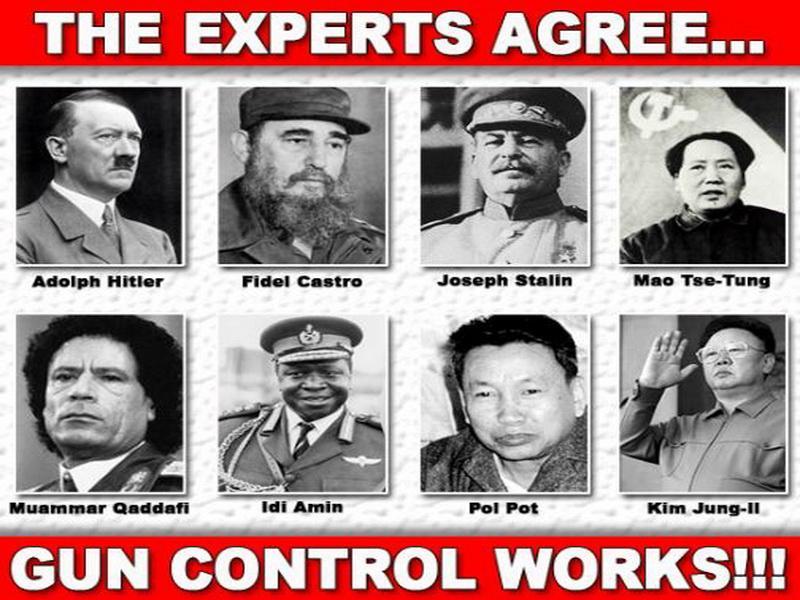
P.S. For fans of the Second Amendment, you’ll enjoy these gun control posters (here, hereherehere, and here). And here are some amusing images of t-shirts and bumper stickers on gun control (herehere, and here). In addition, I’ve posted four different videos on gun control (herehere, here, and here). And here’s my interview on NRA-TV.

The real truth about the financial condition of Social Security can be seen on the www.thedailyhatch.org

Uploaded by on Jan 8, 2009

Professor Williams explains what’s ahead for Social Security

If you want to know the real truth about the financial condition of Social Security then check out these links below:

Ark Times reader says Social Security is not Ponzi Scheme

Social Security is a Ponzi Scheme but Blake who is a blogger said I was off base. Ark Times reader says Social Security is not Ponzi Scheme Social Security Disaster Walter E. Williams Columnist, Townhall.com Politicians who are principled enough to point out the fraud of Social Security, referring to it as a lie and […]

Social Security is a Ponzi scheme that needs to be reformed

We got to do something soon about Social Security. The Case for Social Security Personal Accounts Posted by Daniel J. Mitchell There are two crises facing Social Security. First the program has a gigantic unfunded liability, largely caused by demographics. Second, the program is a very bad deal for younger workers, making them pay record […]

Senator Obama’s ideas on Social Security

Senator Obama’s Social Security Tax Plan Uploaded by afq2007 on Jul 23, 2008 In addition to several other tax increases, Senator Barack Obama wants to increase the Social Security payroll tax burden by imposing the tax on income above $250,000. This would be a sharp departure from current law, which only requires that the tax […]

Social Security is a Ponzi scheme (part 13)

Saving Social Security with Personal Retirement Accounts Uploaded by afq2007 on Jan 10, 2011 There are two crises facing Social Security. First the program has a gigantic unfunded liability, largely thanks to demographics. Second, the program is a very bad deal for younger workers, making them pay record amounts of tax in exchange for comparatively meager benefits. This […]

What does the Heritage Foundation have to say about saving Social Security:Study released May 10, 2011 (Part 7)

“Saving the American Dream: The Heritage Plan to Fix the Debt, Cut Spending, and Restore Prosperity,” Heritage Foundation, May 10, 2011 by  Stuart Butler, Ph.D. , Alison Acosta Fraser and William Beach is one of the finest papers I have ever read. Over the next few days I will post portions of this paper, but […]

Only difference between Ponzi scheme and Social Security is you can say no to Ponzi Scheme jh2d

Is Social Security  a Ponzi Scheme? I just started a series on this subject. In this article below you will see where the name “Ponzi scheme” came from and if it should be applied to the Social Security System. Ponzi! Ponzi! Ponzi! 9/14/2011 | Email John Stossel | Columnist’s Archive Ponzi! Ponzi! Ponzi! There, I […]

Social Security a Ponzi scheme?

Uploaded by LibertyPen on Jan 8, 2009 Professor Williams explains what’s ahead for Social Security Dan Mitchell on Social Security I have said that Social Security is a Ponzi scheme and sometimes you will hear someone in the public say the same thing. Yes, It Is a Ponzi Scheme by Michael D. Tanner Michael Tanner […]

Dan Mitchell on Social Security


Excessive spending will get you in trouble every time, Cyprus another example

USTV-GOP Address: Spending Crisis Still Looms

Uploaded by on Apr 9, 2011

In the Saturday Republican radio address, House Budget Committee Chairman Paul Ryan, R-Wis., warns of a coming crisis. (April 9)

___________________

Overspending will get you in troublc every time.

The Simple and Predictable Story of Fiscal Bankruptcy in Cyprus

July 5, 2012 by Dan Mitchell

With all the fiscal troubles in Greece, Spain, Ireland, Portugal, and Italy, there’s not much attention being paid to Cyprus.

But the Mediterranean island nation is a good case study illustrating the economic dangers of big government.

For all intents and purposes, Cyprus is now bankrupt, and the only question that remains to be answered is whether it will get handouts from the IMF-ECB-EC troika, handouts from Russia, or both. Here’s some of what has been reported by AP.

Cyprus’ president on Thursday defended his government’s decision to seek financial aid from the island nation’s eurozone partners while at the same time asking for a loan from Russia, insisting that the two are perfectly compatible. …Cyprus, with a population of 862,000 people, last week became the fifth country that uses the euro currency to seek a European bailout… The country is currently in talks with the so-called ‘troika’ — the body made up of officials from the European Commission, the European Central Bank and the International Monetary Fund — on how much bailout money it will need and the conditions that will come attached. Locked out of international markets because of its junk credit rating status, Cyprus is paying its bills thanks to a €2.5 billion ($3.14 billion) Russian loan that it clinched last year. But that money is expected to run out by the end of the year.

So what caused this mess? Is Cyprus merely the helpless and innocent victim of economic turmoil in nearby Greece?

That’s certainly the spin from Cypriot politicians, but the budget data shows that Cyprus is in trouble because of excessive spending. This chart, based on data from the International Monetary Fund, shows that the burden of government spending has jumped by an average of 8.3 percent annually since the mid-1990s.

My Golden Rule of fiscal policy is that government spending should grow slower than economic output. Nations that follow that rule generally enjoy good results, while nations that violate that rule inevitably get in trouble.

Interestingly, if Cypriot politicians had engaged in a very modest amount of spending restraint and limited annual budgetary increases to 3 percent, there would be a giant budget surplus today and the burden of government spending would be down to 21.4 percent of GDP, very close to the levels in the hyper-prosperous jurisdictions of Hong Kong and Singapore.

Actually, that’s not true. If the burden of government spending had grown as 3 percent instead of 8.3 percent, economic growth would have been much stronger, so GDP would have been much larger and the public sector would be an ever smaller share of economic output.

Speaking of GDP, the burden of government spending in Cyprus, measured as a share of GDP, has climbed dramatically since 1995.

A simple way to look at this data is that Cyprus used to have a Swiss-sized government and now it has a Greek-sized government. Government spending is just one of many policies that impact economic performance, but is anyone surprised that this huge increase in the size of the public sector has had a big negative impact on Cyprus?

Interestingly, if government spending had remained at 33.9 percent of GDP in Cyprus, the nation would have a big budget surplus today. Would that have required huge and savage budget cuts? Perhaps in the fantasy world of Paul Krugman, but politicians could have achieved that modest goal if they had simply limited annual spending increases to 6 percent.

But that was too “draconian” for Cypriot politicians, so they increased spending by an average of more than 8 percent each year.

What’s the moral of the story? Simply stated, the fiscal policy variable that matters most is the growth of government. Cyprus got in trouble because the burden of government grew faster than the productive sector of the economy.

That’s the disease, and deficits and debt are the symptoms of that underlying problem.

Europe’s political elite doubtlessly will push for higher taxes, but that approach – at best – simply masks the symptoms in the short run and usually exacerbates the disease in the long run.

Europe in trouble because of too much spending

Dan Mitchell Discussing Fake Austerity in Europe on Fox Business

Published on May 9, 2012 by

No description available.

The mess in Europe has been rather frustrating, largely because almost everybody is on the wrong side.

Some folks say they want “austerity,” but that’s largely a code word for higher taxes. They’re fighting against the people who say they want “growth,” but that’s generally a code word for more Keynesian spending.

So you can understand how this debate between higher taxes and higher spending is like nails on a chalkboard for someone who wants smaller government.

And then, to get me even more irritated, lots of people support bailouts because they supposedly are needed to save the euro currency.

When I ask these people why a default in, say, Greece threatens the euro, they look at me as if it’s the year 1491 and I’ve declared the earth isn’t flat.

So I’m delighted that the Wall Street Journal has published some wise observations by a leading French economist (an intellectual heir to Bastiat!), who shares my disdain for the current discussion. Here are some excerpts from Prof. Salin’s column, starting with his common-sense hypothesis.

…there is no “euro crisis.” The single currency doesn’t have to be “saved” or else explode. The present crisis is not a European monetary problem at all, but rather a debt problem in some countries—Greece, Spain and some others—that happen to be members of the euro zone. Specifically, these are public-debt problems, stemming from bad budget management by their governments. But there is no logical link between these countries’ fiscal situations and the functioning of the euro system.

Salin then looks at how the artificial link was created between the euro currency and the fiscal crisis, and he makes a very good analogy (and I think it’s good because I’ve made the same point) to a potential state-level bankruptcy in America.

The public-debt problem becomes a euro problem only insofar as governments arbitrarily decide that there must be some “European solidarity” inside the euro zone. But how does mutual participation in the same currency logically imply that spendthrift governments should get help from the others? When a state in the U.S. has a debt problem, one never hears that there is a “dollar crisis.” There is simply a problem of budget management in that state.

He then says a euro crisis is being created, but only because the European Central Bank has surrendered its independence and is conducting backdoor bailouts.

Because European politicians have decided to create an artificial link between national budget problems and the functioning of the euro system, they have now effectively created a “euro crisis.” To help out badly managed governments, the European Central Bank is now buying public bonds issued by these governments or supplying liquidity to support their failing banks. In so doing, the ECB is violating its own principles and introducing harmful distortions.

Last but not least, Salin warns that politicians are using the crisis as an excuse for more bad policy – sort of the European version of Mitchell’s Law, with one bad policy (excessive spending) being the precursor of additional bad policy (centralization).

Politicians now argue that “saving the euro” will require not only propping up Europe’s irresponsible governments, but also centralizing decision-making. This is now the dominant opinion of politicians in Europe, France in particular. There are a few reasons why politicians in Paris might take that view. They might see themselves being in a similar situation as Greece in the near future, so all the schemes to “save the euro” could also be helpful to them shortly. They might also be looking to shift public attention away from France’s internal problems and toward the rest of Europe instead. It’s easier to complain about what one’s neighbors are doing than to tackle problems at home. France needs drastic tax cuts and far-reaching deregulation and labor-market liberalization. Much simpler to get the media worked up about the next “euro crisis” meeting with Angela Merkel.

This is a bit of a dry topic, but it has enormous implications since Europe already is a mess and the fiscal crisis sooner or later will spread to the supposedly prudent nations such as Germany and the Netherlands. And, thanks to entitlement programs, the United States isn’t that far behind.

So may as well enjoy some humor before the world falls apart, including this cartoon about bailouts to Europe from America, the parody video about Germany and downgrades, this cartoon about Greece deciding to stay in the euro, this “how the Greeks see Europe” map, and this cartoon about Obama’s approach to the European model.

P.S. Here’s a video narrated by a former Cato intern about the five lessons America should learn from the European fiscal crisis.