Tag Archives: Dan Mitchell

Corrupt scams like Solyndra and bailouts make people resent paying their taxes and look for tax havens

The Economic Case for Tax Havens

Uploaded by on Sep 10, 2008

Statist politicians and international bureaucracies such as the OECD and UN routinely attack tax havens, claiming that they lead to “harmful tax competition.” Yet at no point do critics bother to provide any evidence for this claim. This mini-documentary from the Center for Freedom and Prosperity looks at the empirical data and scholarly research and reports that tax havens actually have a very positive impact on the global economy.

______________

The size of government needs to be reduced. Eventually people will revolt against the tremendous amount of taxes they are forced to pay. Furthermore, corrupt scams like Solyndra and bailouts make people resent paying their taxes and people will look for tax havens in other countries if taxes are not reduced.

I wrote last year about a backlash from long-suffering Greek taxpayers. These people – the ones pulling the wagon rather than riding in the wagon – are being raped and pillaged by a political class that is trying to protect the greedy interest groups that benefit from Greece’s bloated public sector.

We now have another group of taxpayers who are fighting back against greedy government. My ancestors in Ireland have decided that enough is enough and there is widespread civil disobedience against a new property tax.

Here are the key details from an AP report.

The Serfs Fight Back

Ireland is facing a revolt over its new property tax. The government said less than half of the country’s 1.6 million households paid the charge by Saturday’s deadline to avoid penalties. And about 5,000 marched in protest against the annual conference of Prime Minister Enda Kenny’s Fine Gael party. Emotions ran raw as police backed by officers on horseback stopped demonstrators from entering the Dublin Convention Centre. …One man mistakenly identified as the government minister responsible for collecting the tax had to be rescued by police from an angry scrum. Kenny said his government had no choice, but to impose the new charge as part of the nation’s efforts to emerge from an international bailout. …The charge this year is a flat-fee €100 ($130) per dwelling, but is expected to rise dramatically next year once Ireland starts to vary the charge based on a property’s estimated value. Anti-tax campaigners have urged the public to ignore the tax demand, arguing that the government doesn’t have the power to collect it.

What makes this new tax so outrageous is that Irish taxpayers already have been victimized with higher income tax rates and a more onerous value-added tax. Yet they weren’t the ones to cause the nation’s fiscal crisis. Ireland is in trouble for two reasons, and both deal with the spending side of the fiscal equation.

1. The burden of government spending exploded last decade, more than doubling in less than 10 years. This wiped out all the gains from fiscal restraint in the 1980s and 1990s.

2. Irish politicians decided to give a bailout not only to depositors of the nation’s failed banks, but also to bondholders. This is a grotesque transfer of wealth from ordinary people to those with higher incomes – and therefore a violation of Mitchell’s Guide to an Ethical Bleeding Heart.

It’s worth noting that academic studies find that tax evasion is driven largely by high tax rates. This makes sense since there is more incentive to hide money when the government is being very greedy. But there is also evidence that tax evasion rises when people perceive that government is wasting money and being corrupt.

Heck, no wonder the Irish people are up in arms. They’re being asked to cough up more money to finance a bailout that was both corrupt and wasteful.

Let’s close by looking at American attitudes about tax evasion. Here’s part of a column from Forbes, which expresses surprise that Americans view tax evasion more favorably than behaviors such as shoplifting and littering.

A new survey suggests Americans consider cheating on their taxes more socially acceptable than shoplifting, drunk driving or even throwing trash out the window of a moving car. …only 66% of  the participants said they “completely agree” that “everyone who cheats on their taxes should be held accountable”  and only 72% completely agreed that “it’s every American’s civic duty to pay their fair share of taxes”–suggesting, as the Shelton study does, that perhaps disapproval of tax evasion is not as strong as, say, disapproval of stealing from private businesses.

I’m not sure, though, why anybody would be shocked by these results. We have a government in Washington that is pervasively corrupt, funneling money to corrupt scams like Solyndra.

These same people want higher tax rates, which will further encourage people to protect their income.

If we really want to promote better tax compliance, whether in the U.S., Ireland, or anywhere in the world, there are two simple answers. First, enact a simple and fair flat tax to keep rates low. Second, shrink government to its proper size, which will automatically reduce waste and limit opportunities for corruption.

But none of this is in the interests of the political class, so don’t hold your breath waiting for these reforms.

________

The Moral Case for Tax Havens

Uploaded by on Oct 22, 2008

This Center for Freedom and Prosperity Foundation video demonstrates that low-tax jurisdictions offer millions of people around the world a safe haven from tyrannical and oppressive government. For this, and many other reasons, there is a powerful moral case for preserving and promoting tax havens. This mini-documentary is the second installment of a three-part series on the beneficial impact of low-tax jurisdictions. In addition to showing how tax havens promote human rights and individual liberty, the video exposes the hypocritical anti-tax competition efforts of statist international bureaucracies such as the Organization for Economic Cooperation and Development. For more information: http://www.freedomandprosperity.org Link to Part 1 — The Economic Case for Tax Havens: http://www.youtube.com/watch?v=yi0lkJBTi58

Related posts:

Here are some posts that include videos from Dan Mitchell:

Videos by Cato Institute on failed stimulus plans

In this post I have gathered several videos from the Cato Institute concerning the subject of failed stimulus plans. _____ Government Spending Doesn’t Create Jobs Uploaded by catoinstitutevideo on Sep 7, 2011 Share this on Facebook: http://on.fb.me/qnjkn9 Tweet it: http://tiny.cc/o9v9t In the debate of job creation and how best to pursue it as a policy […]

Balanced Budget Amendment the answer? Boozman says yes, Pryor no, Part 28 (Input from Norm Coleman, former Republican Senator from MN)

  It’s Simple to Balance The Budget Without Higher Taxes Steve Brawner in his article “Safer roads and balanced budgets,” Arkansas News Bureau, April 13, 2011, noted: The disagreement is over the solutions — on what spending to cut; what taxes to raise (basically none ever, according to Boozman); whether or not to enact a […]

Obama’s plan is not too smart on taxes

Dan Mitchell did a great article concerning the affect of raising taxes in these two areas and horrible results: How Can Obama Look at these Two Charts and Conclude that America Should Have Higher Double Taxation of Dividends and Capital Gains? Posted by Daniel J. Mitchell As discussed yesterday, the most important number in Obama’s […]

______________

Tax Havens: Myths vs. Facts

Uploaded by on Dec 1, 2008

The Center for Freedom and Prosperity Foundation has produced videos showing the economic and moral benefits of so-called tax havens. This final video in the three-part series addresses some of the most common myths put forth by politicians from high-tax nations. Using academic research and data from international organizations, the video shows that the most common attacks made against low-tax jurisdictions are empty demagoguery.

Obamacare proponents say the Supreme Court should let it become law because the people want it!!!!

Randy Barnett Discusses ObamaCare at the Supreme Court

Uploaded by on Mar 26, 2012

http://www.cato.org/event.php?eventid=9074

Cato Institute Senior Fellow and Georgetown University law professor Randy E. Barnett discusses the arguments to be presented to the Supreme Court beginning March 26.

I know that many people feel strongly that we live in a democracy and because the people want Obamacare then they should be able to get it. However, that is not exactly true that we live in a pure democracy.

My daily email containing the editorials and opinion columns from the Washington Post included an item written by E.J. Dionne entitled “Supreme Court activists: Conservative justices forget we’re a democracy.”

Surely this was a mistake.

I suspect he does understand, at least with regard to the first question. For instance, I’d bet a lot of money that he was correctly in favor of the Court’s decision to protect flag burning as a form of political speech, notwithstanding public opinion and congressional approval.

But he seems to join with other leftists in treating the interstate commerce clause as some sort of blank check for federal intervention into every aspect of our lives. And it shows up in various ways in his column.

…conservative justices are prepared to act as an alternative legislature…discussing whether parts of the law could stand if other parts fell… Sotomayor asked what was wrong with leaving as much discretion as possible “in the hands of the people who should be fixing this, not us.” It was nice to be reminded that we’re a democracy, not a judicial dictatorship. …This is what conservative justices will do if they strike down or cripple the health-care law. …a court that…sees no limits on its power, no need to defer to those elected to make our laws.

At the risk of being blunt, the conservative justices are doing exactly what they should be doing. They’re deciding if a law enacted by Congress is consistent with the powers granted to Congress by the Constitution.

America has a democratic form of government, but we are not a democracy. At least not in the sense that 51 percent of the people have the unlimited right to rape and pillage 49 percent of the people.

I have no idea of the Supreme Court will make the right decision, but I am overwhelmingly confident that the Founding Fathers didn’t envision mandated health insurance as a function of the federal government.

But maybe I’m just too old fashioned, because when I peruse the enumerated powers, I don’t see any authority for a Department of Energy either. Or a Department of Agriculture. Or a Department of Commerce. Or Department of Housing and Urban Development. Or Department of Education. Or a Department of Transportation. Or…well, you get the idea.

Bill Clinton getting praise from Cato Institute

Spending Restraint, Part I: Lessons from Ronald Reagan and Bill Clinton

Uploaded by on Feb 14, 2011

Ronald Reagan and Bill Clinton both reduced the relative burden of government, largely because they were able to restrain the growth of domestic spending. The mini-documentary from the Center for Freedom and Prosperity uses data from the Historical Tables of the Budget to show how Reagan and Clinton succeeded and compares their record to the fiscal profligacy of the Bush-Obama years.

______________

I wish we could get a budget that did not spend away our children’s future. Dan Mitchell of the Cato Institute feels the same way about this issue and he actually praises Democratic President Bill Clinton from Arkansas for his efforts to keep spending down in the 1990’s. Take a look:

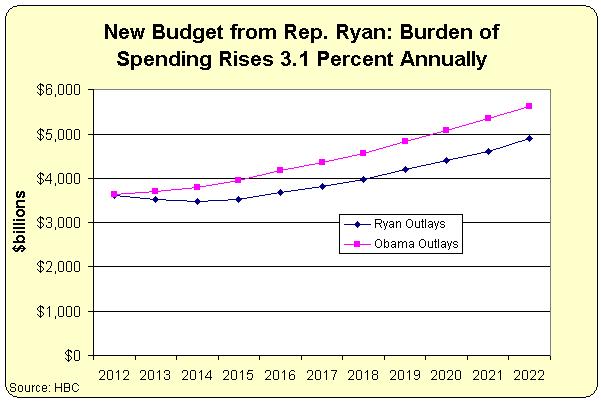
A couple of weeks ago, I offered some guarded praise for Paul Ryan’s budget, pointing out that it satisfies the most important requirement of fiscal policy by restraining spending – to an average of 3.1 percent per year over the next 10 years – so that government grows slower than the productive sector of the economy (I call this my Golden Rule).

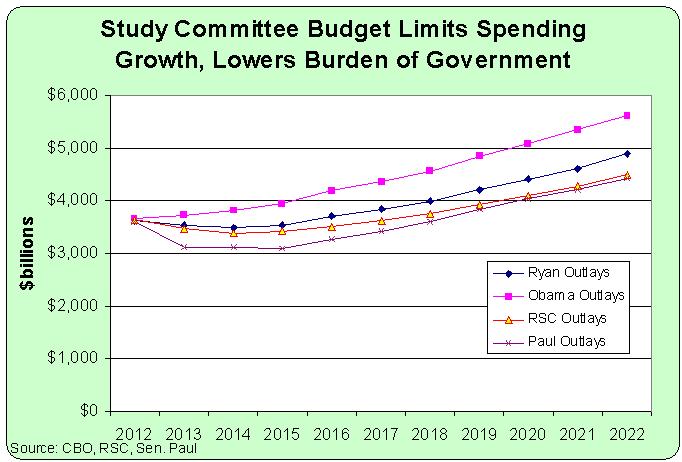
I was more effusive in my comments about Senator Rand Paul’s budget, which limited the growth of the federal budget over the next 10 years to an average of 2.2 percent each year.

Now the Republican Study Committee from the House of Representatives has put forth a plan that also deserves considerable applause. Like Senator Paul, the RSC plan would impose immediate significant fiscal discipline such that spending in 2017 would be about the same level as it is this year.

Think of this as being similar to the very successful fiscal reforms of New Zealand and Canada in the 1990s.

After the initial period of spending restraint, the budget would be allowed to grow, but only about as fast as the private economy. This chart shows spending levels for the Obama budget, the Paul Ryan budget, the Rand Paul budget, and the RSC budget.

A couple of final points.

1. For all the whining and complaining from the pro-spending lobbies, the RSC budget is hardly draconian. Federal spending, measured as a share of GDP, would only drop to where it was when Bill Clinton left office.

2. One preferable feature of the Rand Paul budget is that the Kentucky Senator eliminates four needless and wasteful federal departments – Commerce, Education, Energy, and Housing and Urban Development. As far as I can tell, no departments are eliminated in the RSC plan. Also, Senator Paul’s plan is bolder on tax reform, scrapping the corrupt internal revenue code and replacing it with a simple and fair flat tax.

3. The RSC comes perilously close to winning a Bob Dole Award. The first chapter of their proposal fixates on symptoms of debt and deficits rather than the real problem of excessive government spending. Indeed, the first six charts all relate to deficits and debt, creating an easy opening for leftists to say they can solve the mis-defined problem with higher taxes.

There are lots of other details worth exploring, but the main lesson is that restraining spending is the key to good fiscal policy.

And that’s what’s happening.  Indeed, the good news is that policymakers have proposed several budget plans that would shrink the burden of spending as a share of GDP. It’s refreshing to debate the features of several good plans (rather than comparing the warts in the competing plans during the big-government Bush years).

The bad news is that Harry Reid and Barack Obama will succeed in blocking any progress this year, so America will move ever closer to becoming another Greece.

____________

Spending Restraint, Part II: Lessons from Canada, Ireland, Slovakia, and New Zealand

Uploaded by on Feb 22, 2011

Nations can make remarkable fiscal progress if policy makers simply limit the growth of government spending. This video, which is Part II of a series, uses examples from recent history in Canada, Ireland, Slovakia, and New Zealand to demonstrate how it is possible to achieve rapid improvements in fiscal policy by restraining the burden of government spending. Part I of the series examined how Ronald Reagan and Bill Clinton were successful in controlling government outlays — particularly the burden of domestic spending programs. www.freedomandprosperity.org

______________

Dan Mitchell of the Cato Institute takes on entitlement reform

It is the elephant in the room that nobody wants to talk about. Here Dan Mitchell takes it on.

Most people have a vague understanding that America has a huge long-run fiscal problem.

They’re right, though they probably don’t realize the seriousness of that looming crisis.

Here’s what you need to know: America’s fiscal crisis is actually a spending crisis, and that spending crisis is driven by entitlements.

More specifically, the vast majority of the problem is the result of Medicaid, Medicare, and Social Security, programs that are poorly designed and unsustainable.

America needs to fix these programs…or eventually become another Greece.

Fortunately, all of the problems can be solved, as these three videos demonstrate.

The first video explains how to fix Medicaid.

Promote Federalism and Replicate the Success of Welfare Reform with Medicaid Block Grants

Uploaded by on Jun 26, 2011

The Medicaid program imposes high costs while generating poor results. This Center for Freedom and Prosperity Foundation video explains how block grants, such as the one proposed by Congressman Paul Ryan, will save money and improve healthcare by giving states the freedom to innovate and compete.

The second video shows how to fix Medicare.

Saving Medicare: Free Market Reforms Are Better than Bureaucratic Rationing

Uploaded by on May 17, 2011

This Center for Freedom and Prosperity Foundation video explains how a “premium-support” plan would solve Medicare’s fiscal crisis and improve the overall healthcare system. This voucher-based system also would protect seniors from bureaucratic rationing. http://www.freedomandprosperity.org

And the final video shows how to fix Social Security.

Saving Social Security with Personal Retirement Accounts

Uploaded by on Jan 10, 2011

There are two crises facing Social Security. First the program has a gigantic unfunded liability, largely thanks to demographics. Second, the program is a very bad deal for younger workers, making them pay record amounts of tax in exchange for comparatively meager benefits. This video explains how personal accounts can solve both problems, and also notes that nations as varied as Australia, Chile, Sweden, and Hong Kong have implemented this pro-growth reform. www.freedomandprosperity.org

_______________________

Regular readers know I’m fairly gloomy about the future of liberty, but this is one area where there is a glimmer of hope.

The Chairman of the House Budget Committee actually put together a plan that addresses the two biggest problems (Medicare and Medicaid) and the House of Representatives actually adopted the proposal.

The Senate didn’t act, of course, and Obama would veto any good legislation anyhow, so I don’t want to be crazy optimistic. Depending on how things play out politically in the next six years, I’ll say there’s actually a 20 percent chance to save America.

Ryan’s plan better than Democrat’s plan but not as good as Rand Paul’s

Promote Federalism and Replicate the Success of Welfare Reform with Medicaid Block Grants

Uploaded by on Jun 26, 2011

The Medicaid program imposes high costs while generating poor results. This Center for Freedom and Prosperity Foundation video explains how block grants, such as the one proposed by Congressman Paul Ryan, will save money and improve healthcare by giving states the freedom to innovate and compete

__________

President Obama thinks the answer to our budget problem is to raise taxes. I disagree and think that we must restrain spending and reform entitlements.

Below is an article by Dan Mitchell of the Cato Institute on the Ryan plan.

The Chairman of the House Budget Committee has produced a new budget plan which contrasts very favorably with the tax-heavy, big-spending proposal submitted by the President last month.

Perhaps most important, Congressman Ryan’s plan restrains spending growth, allowing the private sector to grow faster than the burden of government, thus satisfying Mitchell’s Golden Rule so that spending falls as a share of GDP.

The most important detail in the proposal is that the federal budget, which currently consumes 24 percent of GDP, would fall to less than 20 percent of GDP beginning in 2016.

That’s the good news. There are three pieces of not-so-good news.

1. Ryan’s plan allows spending to grow by an average of 3.1 percent annually over the next 10 years, with is faster than the 2.8 percent average annual growth in last year’s budget.

2. His proposed Medicare reform, while far better than current law, also is not as good as what was proposed last year.

3. The federal budget would still consume a greater share of the economy’s output than it did when Bill Clinton left office.

I suppose it’s also worth mentioning that Ryan’s proposal isn’t as good as Rand Paul’s budget. Spending only climbs 2.2 percent yearly under the plan put together by the Kentucky Senator, and he also abolishes several useless cabinet-level departments.

But the very good shouldn’t be the enemy of the good. As noted already, Congressman Ryan’s plan meets the most important test, which is restraining spending so that the federal budget grows slower than the private economy. And, as the chart shows, he obviously imposes more fiscal restrain then President Obama.

Regular readers know that I generally show no mercy to jelly-spined Republicans, but I praised GOPers for approving last year’s Ryan budget. The same will be true if they approve this year’s version.

P.S. I am frustrated and nauseated by all the people who are fixating on whether Congressman Ryan’s plan balances the budget in 10 years, 20 years, or whenever. What matters is shrinking the burden of government. I hereby bestow the Bob Dole Award on all the people who are mistakenly focusing on the symptom of red ink rather than the underlying disease of bloated government.

P.P.S. I’m happy to report that there is no value-added tax in the revenue portion of Congressman Ryan’s budget. There is a VAT in his Roadmap plan, and I endlessly worry that this poison pill will re-emerge and ruin other good fiscal plans put forth by the Wisconsin lawmaker.

_______

Saving Medicare: Free Market Reforms Are Better than Bureaucratic Rationing

Uploaded by on May 17, 2011

This Center for Freedom and Prosperity Foundation video explains how a “premium-support” plan would solve Medicare’s fiscal crisis and improve the overall healthcare system. This voucher-based system also would protect seniors from bureaucratic rationing. http://www.freedomandprosperity.org


Arkansas Times praises good results of Obamacare

Gerard Matthews wrote on March 21, 2012 in the Arkansas Times:

Children cannot be denied coverage because of a pre-existing condition. Young people can stay on their parents’ health insurance plan until they are 26 years old. Preventive services, which will ultimately help control health care costs, have been added to some plans at no extra charge. Those are real changes — which can have a huge, positive impact on people’s lives — that have nothing to do with petty attempts to pin a seemingly unpopular program to the president right before election time. 

Take these things away, and folks are likely to notice. A lot of folks. According to the U.S. Department of Health and Human Services, the Affordable Care Act has had the following impact on Arkansans: 865,000 people who already had private insurance no longer have a lifetime limit on their health insurance plans; 439,000 people received added preventive services from their insurance companies without cost-sharing (that’s including 110,000 children); 380,845 Medicare recipients have received preventive services; 23,837 young people have acquired health care coverage by staying on their parents’ plans.

I see a few problems with this assessment. Why did Matthews fail to mention that Obamacare will not give everyone coverage!!! Also he failed to mention the religious values that Obamacare would trangress or the drop in quality we will be seeing or the millions that will be shoved into an already bankrupt Medicaid system that will bankrupt Arkansas’ state government.

There is always a cost and somebody always pays. The real question is how efficient is the government versus the private market. Take Obama’s lightbulb.

I’ve written about the government’s war on consumer-friendly light bulbs (and also similar attacks on working toilets and washing machines that actually clean), so I’m generally not surprised by bureaucratic nonsense.

But even I’m shocked the federal government gave an affordability award for a light bulb that costs $50. I’m not making this up. Here’s a blurb from ABC News.

The U.S. government has awarded appliance-maker Philips $10 million for devising an “affordable” alternative to today’s standard 60-watt incandescent bulb. That standard bulb sells for around $1. The Philips alternative sells for $50. Of course, the award-winner is no ordinary bulb. It uses only one-sixth the energy of an incandescent. And it lasts 30,000 hours–about 30 times as long. In fact, if you don’t drop it, it may last 10 years or more. But only the U.S. Government (in this case, the Department of Energy) could view a $50 bulb as cheap.

Isn’t that wonderful? My tax dollars were used to reward a company that produced a light bulb I can’t afford.

Lisa Benson has a very good cartoon about this light bulb, as well as the less-than-shocking news that Obamacare will be more costly than originally forecast.

If you like Lisa’s work, there are some other good examples here and here.

Michael Cannon on Medicare and Healthcare

Obamacare, Two Years Later

by Michael D. Tanner

Michael Tanner is a senior fellow at the Cato Institute and author of Leviathan on the Right: How Big-Government Conservatism Brought Down the Republican Revolution.

Added to cato.org on March 21, 2012

This article appeared in National Review Online on March 21, 2012.

This week marks two years since of the passage of the Patient Protection and Affordable Care Act, and if the Obama administration has chosen to all but ignore the second anniversary of Obamacare, the rest of us should pause and reflect on just what a monumental failure of policy the health-care-reform law has been.

What’s more, it has been a failure on its own terms. After all, when health-care reform was passed, we were promised that it would do three things: 1) provide health-insurance coverage for all Americans; 2) reduce insurance costs for individuals, businesses, and government; and 3) increase the quality of health care and the value received for each dollar of health-care spending. At the same time, the president and the law’s supporters in Congress promised that the legislation would not increase the federal-budget deficit or unduly burden the economy. And it would do all these things while letting those of us who were happy with our current health insurance keep it unchanged. Two years in, we can see that none of these things is true.

Obamacare is a costly and dangerous failure.

For example, we now know that, contrary to claims made when the bill passed, the law will not come close to achieving universal coverage. In fact, as time goes by, it looks as if the bill will cover fewer and fewer people than advertised. According to a report from the Congressional Budget Office released last week, Obamacare will leave 27 million Americans uninsured by 2022. This represents an increase of 2–4 million uninsured over previous reports. Moreover, it should be noted that, of the 23 million Americans who will gain coverage under Obamacare, 17 million will not be covered by real insurance, but will simply be dumped into the Medicaid system, with all its problems of access and quality. Thus, only about 20 million Americans will receive actual insurance coverage under Obamacare. That’s certainly an improvement over the status quo, but it’s also a far cry from universal coverage — and not much bang for the buck, given Obamacare’s ever-rising cost.

At the same time, the legislation is a major failure when it comes to controlling costs. While we were once told that health-care reform would “bend the cost curve down,” we now know that Obamacare will actually increase U.S. health-care spending. This should come as no surprise: If you are going to provide more benefits to more people, it is going to cost you more money. The law contained few efforts to actually contain health-care costs, and the CBO now reports that many of the programs it did contain, such as disease management and care coordination, will not actually reduce costs. As the CBO noted, “in nearly every program involving disease management and care coordination, spending was either unchanged or increased relative to the spending that would have occurred in the absence of the program, when the fees paid to the participating organization were considered.”

This failure to control costs means that the law will add significantly to the already-crushing burden of government spending, taxes, and debt. According to the CBO, Obamacare will cost $1.76 trillion by 2022. To be fair, some media outlets misreported this new estimate as a doubling of the law’s originally estimated cost of $940 billion. In reality, most of the increased cost estimate is the result, not of increased programmatic costs, but of an extra two years of implementation. Still, many observers warned at the time that the original $940 million estimate was misleading because it included only six years of actual expenditures, with the ten-year budget window. The new estimate is, therefore, a more accurate measure of how expensive this law will be. Yet even this estimate covers only eight years of implementation. And it leaves out more than $115 billion in important implementation costs, as well as costs of the so-called doc fix. It also double-counts Social Security taxes and Medicare savings. Some studies suggest a better estimate of Obamacare’s real ten-year cost could run as high as $2.7–3 trillion. And this does not even include the over $4.3 trillion in costs shifted to businesses, individuals, and state governments.

All this spending means that we will pay much more in debt and taxes. But we will also pay more in insurance premiums. Once upon a time, the president promised us that health-care reform would lower our insurance premiums by $2,500 per year. That claim has long since been abandoned. Insurance premiums are continuing to rise at record rates. And, while there are many factors driving premiums up, Obamacare itself is one of them. According to the Kaiser Family Foundation, insurance premiums had been rising at roughly 5 percent per year pre-Obamacare. That jumped to 9 percent last year. And roughly half that four-percentage-point increase can be directly attributed to Obamacare. Even Jonathan Gruber of MIT, one of the architects of both Obamacare and Romneycare, now admits that many individuals will end up paying more for insurance than they would have without the reform — even after taking into account government subsidies — and that those increases will be substantial. According to Gruber, “after the application of tax subsidies, 59 percent of the individual market will experience an average premium increase of 31 percent.”

Finally, if the past two years should have taught us anything, it is that we may not be able to keep our current insurance, even if we are happy with it. The CBO suggests that as many as 20 million workers could lose their employer-provided health insurance as a result of Obamacare. Instead, they will be dumped into government-run insurance exchanges. And, the recent dust-up over insurance coverage for contraceptives is a clear illustration of how the government will now be designing insurance plans for all of us. Regardless of how one feels about the contraceptive mandate itself, it is just the tip of the iceberg as government mandates tell employers what insurance they must provide, and tell us what insurance we must buy, even if that insurance is more expensive, contains benefits we don’t want, or violates our consciences.

Next week, Obamacare will slouch its way to the Supreme Court. How the justices decide will be based on questions of constitutional law. Their decision will set a crucial precedent in setting the boundaries between government power and individual rights. But regardless of whether the Court upholds Obamacare or strikes it down, in whole or in part, we should understand that, simply as a matter of health-care reform, Obamacare is a costly and dangerous failure.

Dan Mitchell of the Cato Institute discusses Obama’s record on economy

Government Spending Doesn’t Create Jobs

Uploaded by on Sep 7, 2011

Share this on Facebook: http://on.fb.me/qnjkn9 Tweet it: http://tiny.cc/o9v9t

In the debate of job creation and how best to pursue it as a policy goal, one point is forgotten: Government doesn’t create jobs. Government only diverts resources from one use to another, which doesn’t create new employment.

Video produced by Caleb Brown and Austin Bragg.

______________

I really think that Dan Mitchell of the Cato Institute is one of the best of explaining conservative economic policies and how they would benefit us all. Here he takes a look at Obama’s economic policies.

In a recent post comparing Reaganomics and Obamanomics, I explained why I think Barack Obama’s policies have been hurting the economy.

In today’s New York Post, I do a full-scale indictment. Here are my bullet points.

* The unemployment rate is still above 8 percent, even though the White House promised it would drop to about 6 percent today if the stimulus was enacted.

* Several million fewer Americans have jobs today than five years ago.

* The poverty rate has jumped to more than 15 percent, with a record number of Americans living below the poverty level of income.

* According to the most recent data, median household income is lower than when the recession began.

* The burden of government spending remains high, and record levels of red ink are a symptom of that bloat in Washington.

* The threat of higher taxes is omnipresent, serving as a Sword of Damocles over the economy’s neck.

* Continued weakness in the housing and financial sectors reminds people that bailouts and intervention have left lots of problems unsolved.

I also explain that some of  the recent good news is in spite of the President’s statist policies.

* The recovery began just as Obama’s stimulus spending ended, thus confirming suspicions that lots of money was wasted as part of a process that hindered the economy’s growth.

* The job numbers only began to improve at the end of 2010, right as Republicans took control of the House and presumably ended Obama’s ability to further shift the nation’s course.

The final point is one deserving of elaboration. People in the private sector necessarily have to make educated guesses about the future economic environment. With this in mind, I think it’s quite reasonable – as I commented last month – to argue that the GOP takeover on Capitol Hill boosted the economy since entrepreneurs could feel more comfortable that the federal government wasn’t going to be imposing additional burdens.

This indictment of Obama’s dismal economic track record does not suggest, I should hasten to add, that Mitt Romney or Rick Santorum would be any better. Both of them seem closer to Bush than Reagan, so it’s not clear they would make any substantive changes in the burden of the federal government.

Related posts:

John Brummett and Rick Crawford don’t see that the real problem is how much government spends!!!!!

Washington Could Learn a Lot from a Drug Addict The problem with Washington is they are addicted to overspending our money and the problem is not that the government needs more money to waste. They survived on less than 4% of GDP the first 150 years that our nation existed (except in wartimes), but this […]

Tea Party solutions versus Occupy Wall Street

Dan Mitchell is right about the “Occupy Wall St crowd” The Arkansas Times Blog reported: Occupy Little Rock occupies Clinton Library parking lot Gabe Gentry Members of the Occupy Little Rock group have set up camp outside the Clinton Library, video contributor Gabe Gentry reports. Around 65 are gathered currently with chimineas and grills and pizzas. Thirty […]

Bigger government hurts economic growth

The Cato Institute videos are always good and these are no different. New Video Has Important Message: Freedom and Prosperity vs. Big Government and Stagnation Posted by Daniel J. Mitchell The folks from the Koch Institute put together a great video a couple of months ago looking at why some nations are rich and others […]

President Obama’s good advice does not apply to USA

Uploaded by WSJDigitalNetwork on Feb 23, 2012 Editorial board member Steve Moore breaks down Mitt Romney’s and President Obama’s tax plans. _____________________ Here is an excellent article by Dan Mitchell of the Cato Institute concerning President Obama great advice for another country. When Obama Rejects Government Intervention and Says It Is Better to “Let the […]

Updated version:Rick Crawford falls for Democrats’ trick:raise taxes first and we will cut spending later

RAISE TAXES: Report says Rick Crawford will break from GOP and back millionaires’ tax. The Arkansas Times reported that Congressman Rick Crawford has a plan that includes raising taxes for 5 years if there is an agreement to pass the Balanced Budget Amendment. However, if after 5 years the Balanced Budget Amendment does not get […]

Ronald Wilson Reagan versus Barrack Obama

Government Spending Doesn’t Create Jobs Uploaded by catoinstitutevideo on Sep 7, 2011 Share this on Facebook: http://on.fb.me/qnjkn9 Tweet it: http://tiny.cc/o9v9t In the debate of job creation and how best to pursue it as a policy goal, one point is forgotten: Government doesn’t create jobs. Government only diverts resources from one use to another, which doesn’t […]

Cato Institute:Spending is our problem Part 6

But we also know that it is difficult to convince politicians to do what’s right for the nation. And if they don’t change the course of fiscal policy, and we leave the federal government on autopilot, then America is doomed to become another Greece. The combination of poorly designed entitlement programs (mostly Medicare and Medicaid) and an aging population […]

Cato Institute:Spending is our problem Part 5

Uploaded by NatlTaxpayersUnion on Feb 15, 2011 Dan Mitchell, Senior Fellow at the Cato Institute, speaks at Moving Forward on Entitlements: Practical Steps to Reform, NTUF’s entitlement reform event at CPAC, on Feb. 11, 2011. People think that we need to raise more revenue but I say we need to cut spending. Take a look […]

Cato Institute:Spending is our problem Part 3

Uploaded by NatlTaxpayersUnion on Feb 15, 2011 Dan Mitchell, Senior Fellow at the Cato Institute, speaks at Moving Forward on Entitlements: Practical Steps to Reform, NTUF’s entitlement reform event at CPAC, on Feb. 11, 2011. ____________________ People think that we need to raise more revenue but I say we need to cut spending. Take a […]

Videos by Cato Institute on failed stimulus plans

In this post I have gathered several videos from the Cato Institute concerning the subject of failed stimulus plans. _____ Government Spending Doesn’t Create Jobs Uploaded by catoinstitutevideo on Sep 7, 2011 Share this on Facebook: http://on.fb.me/qnjkn9 Tweet it: http://tiny.cc/o9v9t In the debate of job creation and how best to pursue it as a policy […]

Barack Obama on Mount Rushmore?

Keynesian Catastrophe: Big Money, Big Government & Big Lies

Uploaded by on Jan 19, 2012

The Cato Institute’s Dan Mitchell explains why Obama’s stimulus was a flop! With Glenn Reynolds.

See more at http://www.pjtv.com and http://www.cato.org

___________________

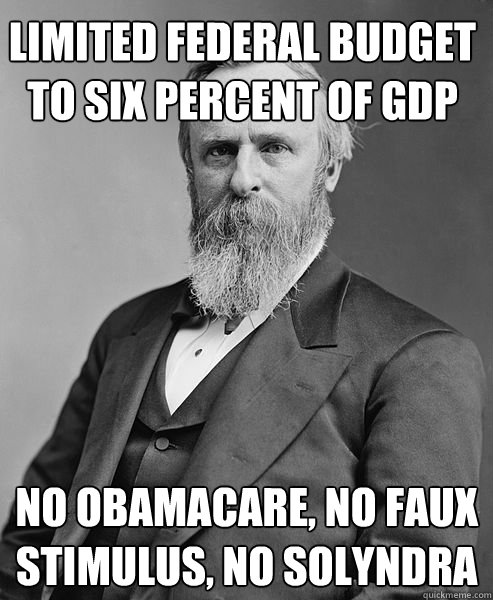
I wonder what the people would have said if Rutherford Hayes had spent 24.7% of GDP a year? Obama laughs at the thought of Rutherford on Mount Rushmore, but with the economic mess we have now I don’t there is much of a chance that President Obama will end up on there either. Here is an excellent article by Dan Mitchell of the Cato Institute:

 A Simple Choice: Barack Obama or Rutherford Hayes?

March 19, 2012 by Dan Mitchell

Other than my ongoing adulation for Ronald Reagan, occasional praise for Calvin Coolidge, and one post about John F. Kennedy, I don’t have many nice things to say about previous Presidents.

But I feel the need to rise to the defense of Rutherford B. Hayes, who was mocked recently by the current President. This Mark Steyn column is a deliciously vicious commentary on Obama’s speech, so no need for me to delve into the details.

Instead, I want to jump on the bandwagon and produce some posters comparing the 19th President and the 44th President (if you’re not aware, posters of Pres. Hayes with self-created captions have been all over the Internet).

You won’t be surprised to learn that I’m focused on the policy differences between Hayes and Obama.

Most important, Hayes largely was true to the Founding Fathers’ vision of a limited central government. Government spending averaged only about 6 percent of economic output during his tenure (probably less, the data are not very robust, so I took the worst-case numbers) and America was blessedly free of the income tax.

Obama, on the other hand, is repeating all of Bush’s mistakes and making government an even bigger burden, and then compounding his error by pursuing class warfare tax policy.

So which President would you prefer, Hayes or Obama?

Dan Mitchell demonstrates again that spending is our problem but it can be solved

Sometimes it appears that our problems are impossible to solve. Take a look at a good solution:

New Congressional Budget Office Numbers Once Again Show that Modest Spending Restraint Would Eliminate Red Ink

Posted by Daniel J. Mitchell

Back in 2010, I crunched the numbers from the Congressional Budget Office and reported that the budget could be balanced in just 10 years if politicians exercised a modicum of fiscal discipline and limited annual spending increases to about two percent yearly.

When CBO issued new numbers early last year, I repeated the exercise and again found that the same modest level of budgetary restraint would eliminate red ink in about 10 years.

And when CBO issued their update last summer, I did the same thing and once again confirmed that deficits would disappear in a decade if politicians didn’t let the overall budget rise by faster than two percent each year.

Well, the new CBO 10-year forecast was released this morning. I’m going to give you three guesses about what I discovered when I looked at the numbers, and the first two don’t count.

Yes, you guessed it. As the chart illustrates (click to enlarge), balancing the budget doesn’t require any tax increases. Nor does it require big spending cuts (though that would be a very good idea).

Even if we assume that the 2001 and 2003 tax cuts are made permanent, all that is needed is for politicians to put government on a modest diet so that overall spending grows by about two percent each year. In other words, make sure the budget doesn’t grow faster than inflation.

Tens of millions of households and businesses manage to meet this simple test every year. Surely it’s not asking too much to get the same minimum level of fiscal restraint from the crowd in Washington, right?

At this point, you may be asking yourself whether it’s really this simple. After all, you’ve probably heard politicians and journalists say that deficits are so big that we have no choice but to accept big tax increases and “draconian” spending cuts.

But that’s because politicians use dishonest Washington budget math. They begin each fiscal year by assuming that spending automatically will increase based on factors such as inflation, demographics, and previously legislated program changes.

This creates a “baseline,” and if they enact a budget that increases spending by less than the baseline, that increase magically becomes a cut. This is what allowed some politicians to say that last year’s Ryan budget cut spending by trillions of dollars even though spending actually would have increased by an average of 2.8 percent each year.

Needless to say, proponents of big government deliberately use dishonest budget math because it tilts the playing field in favor of bigger government and higher taxes.

There are two important caveats about these calculations.

1. We should be dramatically downsizing the federal government, not just restraining its growth. Even if he’s not your preferred presidential candidate, Ron Paul’s proposal for an immediate $1 trillion reduction in the burden of federal spending is a very good idea. Merely limiting the growth of spending is a tiny and timid step in the right direction.

2. We should be focusing on the underlying problem of excessive government, not the symptom of too much red ink. By pointing out the amount of spending restraint that would balance the budget, some people will incorrectly conclude that getting rid of deficits is the goal.

Last but not least, here is the video I narrated in 2010 showing how red ink would quickly disappear if politicians curtailed their profligacy and restrained spending growth.

___________________________

Other than updating the numbers, the video is just as accurate today as it was back in 2010. And the concluding message—that there is no good argument for tax increases—also is equally relevant today.

P.S. Some people will argue that it’s impossible to restrain spending because of entitlement programs, but this set of videos shows how to reform Social Security, Medicare, and Medicaid.

P.P.S. Some people will say that the CBO baseline is unrealistic because it assumes the sequester will take place. They may be right if they’re predicting politicians are too irresponsible and profligate to accept about $100 billion of annual reductions from a $4,000 billion-plus budget, but that underscores the core message that there needs to be a cap on total spending so that the crowd in Washington isn’t allowed to turn America into Greece.


Senator Obama’s ideas on Social Security

Senator Obama’s Social Security Tax Plan

Uploaded by on Jul 23, 2008

In addition to several other tax increases, Senator Barack Obama wants to increase the Social Security payroll tax burden by imposing the tax on income above $250,000. This would be a sharp departure from current law, which only requires that the tax be imposed on the amount of income needed to “pay for” promised benefits. But more important, at least from an economic perspective, the Senator’s initiative would increase the top tax rate on productive behavior by as much as 12 percentage points – and this would be in addition to his proposal to kill the 2003 tax rate reductions and further boost the top rate by 4.6 percentage points. This mini-documentary explains why a big tax rate increase on highly productive people would be very damaging to America’s prosperity, especially in a competitive global economy. Simply stated, pushing top tax rates in the United States to French and German levels means at least some degree of French-style and German-style economic stagnation. Visit http://www.freedomandprosperity.org for more information.