Tag Archives: Arkansas people

Reasons why Mark Pryor will be defeated in 2014 (Part 4)

It is apparent from this statement below that Senator Mark Pryor is against the Balanced Budget Amendment. He has voted against it over and over like his father did and now I will give reasons in this series why Senator Pryor will be defeated in his re-election bid in 2014. However, first I wanted to quote the statement Senator Pryor gave on December 14, 2011. This information below is from the Arkansas Times Blog on 12-14-11 and Max Brantley:

THREE CHEERS FOR MARK PRYOR: Our senator voted not once, but twice, today against one of the hoariest (and whoriest) of Republican gimmicks, a balanced budget amendment. Let’s quote him:

As H.L. Mencken once said, “For every complex problem there is a solution which is simple, clean, and wrong.” This quote describes the balanced budget amendment. While a balanced budget amendment makes for an easy talking point, it is an empty solution. Moreover, it’s a reckless choice that handcuffs our ability to respond to an economic downturn or national emergencies without massive tax increases or throwing everyone off Medicare, Social Security, or veteran’s care.There is a more responsible alternative to balance the budget. President Clinton led the way in turning deficits into record surpluses. We have that same opportunity today, using the blueprint provided by the debt commission as a starting point. We need to responsibly cut spending, reform our tax code and create job growth. This course requires hard choices over a number of years. However, it offers a more balanced approach over jeopardizing safety net programs and opportunity for robust economic growth.

____________________

Senator Pryor has continued to vote for budgets in the past that have allowed the federal government to spend an increasing amount of GDP. ONE OF THE MAIN REASONS PRYOR WILL BE DEFEATED IN 2014 IS THAT HE DOES NOT SUPPORT THE IDEA THAT THE FEDERAL GOVERNMENT SHOULD BE LIMITED TO SPENDING 18% OR LESS OF GDP. SENATOR PRYOR THINKS IT WOULD BE GREAT IF THE FEDERAL GOVERNMENT CONTINUES TO SPEND MORE. WHY ELSE DID HE VOTE FOR THE STIMULUS?

(CNSNews.com) – Rep. Louie Gohmert (R-Texas) will not vote for a balanced budget amendment proposal unless it includes a cap on federal spending. However, he is undecided whether the amendment absolutely must require a supermajority of Congress to approve a tax hike for him to support it.

“The most important element is the cap on spending,” Gohmert told CNSNews.com. “If there is no cap on spending, then the balanced budget amendment is a formula for ever- increasing spending and ever-increasing taxing that will just spiral upward and upward again. So there’s got to be included a cap on spending, and best if it’s related to a percentage of GDP. But, absolutely, if there is no cap on spending, I could not vote for it.”

The actual language of the balanced budget amendment that Congress will vote on before the end of the year has not yet been determined. However, many conservatives fear that Republican leaders may agree to vote on a stripped down amendment that requires Congress to balance the budget but does not cap spending as a percentage of GDP or require supermajorities to raise taxes. They fear that an amendment of that nature–which might win the backing of some incumbent congressional liberals–would become a constitutional lever for sustaining big government via ever-escalating federal taxation.

When the Republican-controlled-House approved the cut, cap and balance plan last on July 19 in 234-190 vote, it included a version of the balanced budget amendment to cap federal spending at 19.9 percent of GDP. The GOP originally sought to hold federal spending to 18 percent of GDP.

The version of the balanced budget amendment in the cut, cap and balance plan also required two-thirds majorities in both houses to approve a tax increase. The amendment also would have prohibited deficit spending unless there was a national security emergency or a supermajority of Congress voted for it. On July 22, the Senate voted 51-46 to approve a procedural motion that blocked substantive consideration of the cut, cap and balance bill in that body.

The debt-limit deal reached by President Barack Obama, House Speaker John Boehner (R-Ohio) and Senate Majority Leader Harry Reid (D-Nev.) requires that both houses of Congress give an up or down vote to a balanced budget amendment before the end of the year. However, it does not specify what the language of the amendment would be.

If two-thirds of Congress votes to approve a balanced budget amendment, it would then have to be ratified by 38 states, or three-fourths.

The House passed that debt-limit deal by a 269-161 vote on Aug. 1. Gohmert was one of 66 Republicans who voted against it.

“As far as the supermajority to raise taxes, that’s our preference, but the key element, the most important element is the cap on spending,” Gohmert said. “If there is no supermajority to raise taxes then I’d just have to look at it more closely to see what all was there to see if it was something I could vote for or not.”

Gohmert believes this is a winning issue for Republicans.

“Well, I think it’s like this: We either have a legitimate Balanced Budget Amendment pass with a cap on spending, or I really believe if it does not pass, you will see many of those who voted against it turned out both in the House and Senate in the next election,” Gohmert said. “So I think it’s an either/or. Either people vote for it and it passes, or we have a significant change in the people that are in the House and Senate that voted against it.”

Reasons why Mark Pryor will be defeated in 2014 (Part 3)

It is apparent from this statement below that Senator Mark Pryor is against the Balanced Budget Amendment. He has voted against it over and over like his father did and now I will give reasons in this series why Senator Pryor will be defeated in his re-election bid in 2014. However, first I wanted to quote the statement Senator Pryor gave on December 14, 2011. This information below is from the Arkansas Times Blog on 12-14-11 and Max Brantley:

THREE CHEERS FOR MARK PRYOR: Our senator voted not once, but twice, today against one of the hoariest (and whoriest) of Republican gimmicks, a balanced budget amendment. Let’s quote him:

As H.L. Mencken once said, “For every complex problem there is a solution which is simple, clean, and wrong.” This quote describes the balanced budget amendment. While a balanced budget amendment makes for an easy talking point, it is an empty solution. Moreover, it’s a reckless choice that handcuffs our ability to respond to an economic downturn or national emergencies without massive tax increases or throwing everyone off Medicare, Social Security, or veteran’s care.There is a more responsible alternative to balance the budget. President Clinton led the way in turning deficits into record surpluses. We have that same opportunity today, using the blueprint provided by the debt commission as a starting point. We need to responsibly cut spending, reform our tax code and create job growth. This course requires hard choices over a number of years. However, it offers a more balanced approach over jeopardizing safety net programs and opportunity for robust economic growth.

____________________

Mark Pryor has voting over and over to spend more than we have. A Balanced Budget Amendment would make that impossible. PROBABLY ONE OF THE MOST OFFENSIVE THINGS THAT PRYOR HAS DONE IS CONTINUE TO VOTE TO PASS BUDGETS THAT ARE NOT BALANCED AND NOW HE HAS BEEN GUILTY OF EARNING OUR COUNTRY A CREDIT DOWNGRADE. THAT IS ONE OF THE MAIN REASONS ARKANSANS WILL VOTE HIM OUT IN 2014 AND PUT SOMEONE IN THAT WILL VOTE FOR A BALANCED BUDGET AMENDMENT (like they did in 2010 when they replaced Senator Lincoln with a conservative Republican).

Congressman Walsh Issues Statement on His Vote Against Debt Deal

08/01/11

WASHINGTON–  Today, Congressman Joe Walsh (IL-08) voted against the latest debt ceiling deal brokered by President Obama and Congressional leaders.

“Last night’s deal shows how far the debate has moved in just a few months,” said Congressman Walsh. “At the beginning of this debate President Obama demanded a blank check increase in the debt limit with no spending cuts attached.  When that didn’t work, he insisted on huge tax increases on American families and job creators. The Republican Party, however, stood strong and refused to pay for reckless spending withmoretax increases.”

“While I give my Republican leadership all the credit in the world, I cannot support this latest deal: it spends too much and cuts too little.  While this deal will cut $2.4 trillion from the national debt over the next 10 years, Washington will still add another $7 trillion to the national debt over that same period.”

“The fact that there are only $7 billion in cuts next year, an election year, shows how blatantly political this bill is.  We need to be slashing reckless spending now and in the future, not just when it is politically convenient for the President.”

Democrats still don’t get it and refuse to make the spending cuts necessary to avoid a credit downgrade. I have made it clear from day one that I will never vote for an increase in the debt ceiling unless it fundamentally and structurally changes the way Washington spends money. I believe that the way to do that is through statutory spending caps and a Balanced Budget Amendment to the Constitution.”

Uploaded by on Jun 14, 2011

Our country’s debt continues to grow — it’s eating away at the American Dream. We need to make real cuts now. We need Cut, Cap, and Balance.


Reasons why Mark Pryor will be defeated in 2014 (Part 1)

It is apparent from this statement below that Senator Mark Pryor is against the Balanced Budget Amendment. He has voted against it over and over like his father did and now I will give reasons in this series why Senator Pryor will be defeated in his re-election bid in 2014. However, first I wanted to quote the statement Senator Pryor gave on December 14, 2011. This information below is from the Arkansas Times Blog on 12-14-11 and Max Brantley:

THREE CHEERS FOR MARK PRYOR: Our senator voted not once, but twice, today against one of the hoariest (and whoriest) of Republican gimmicks, a balanced budget amendment. Let’s quote him:

As H.L. Mencken once said, “For every complex problem there is a solution which is simple, clean, and wrong.” This quote describes the balanced budget amendment. While a balanced budget amendment makes for an easy talking point, it is an empty solution. Moreover, it’s a reckless choice that handcuffs our ability to respond to an economic downturn or national emergencies without massive tax increases or throwing everyone off Medicare, Social Security, or veteran’s care.There is a more responsible alternative to balance the budget. President Clinton led the way in turning deficits into record surpluses. We have that same opportunity today, using the blueprint provided by the debt commission as a starting point. We need to responsibly cut spending, reform our tax code and create job growth. This course requires hard choices over a number of years. However, it offers a more balanced approach over jeopardizing safety net programs and opportunity for robust economic growth.

____________________

Arkansans clearly see that if our leaders in Washington do not take the bull by the horns and pass the Balanced Budget Amendment that will continue to head toward the direction we are going now. Soon and I am afraid sooner than Mark Pryor realizes, we will be arriving where Greece is now. WE MUST AVOID HEADING TO GREECE AND THE PEOPLE OF ARKANSAS REALIZE THIS AND PRYOR DOES NOT. THIS IS ONE OF THE MAIN REASONS PRYOR WILL BE DEFEATED IN 2014.

Cato Institute scholar Dan Mitchell is right about Greece and the fate of socialism:

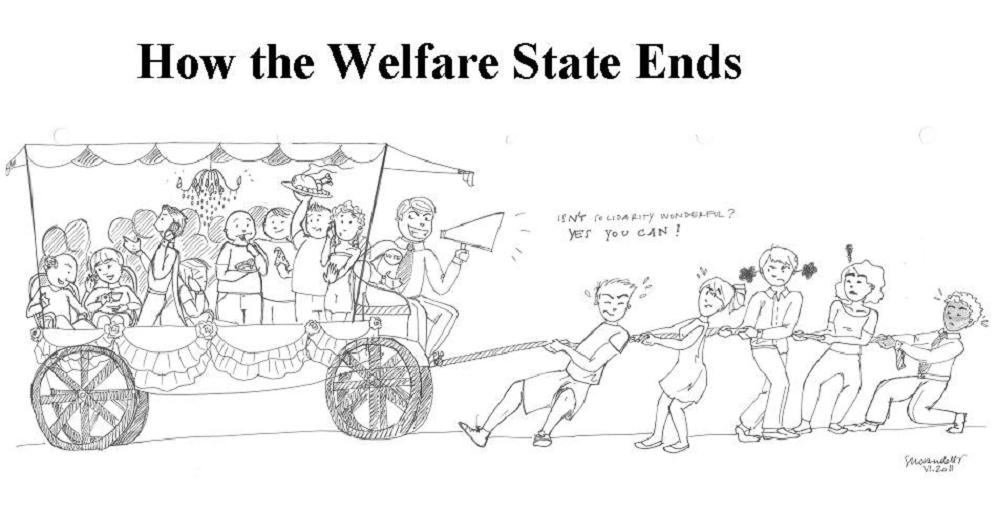
In my speeches, especially when talking about the fiscal crisis in Europe (or the future fiscal crisis in America), I often warn that the welfare state reaches a point-of-no-return when the number of people riding in the wagon begins to outnumber the number of people pulling the wagon.

To be more specific, if more than 50 percent of the population is dependent on government (employed in the bureaucracy, living off welfare, receiving pensions, etc), it becomes rather difficult to form a coalition to fix the mess. This may explain why Greek politicians have resisted significant reforms, even though the nation faces a fiscal death spiral.

But you don’t need me to explain this relationship. One of our Cato interns, Silvia Morandotti, used her artistic skills to create two images (click pictures for better resolution) that show what a welfare state looks like when it first begins and what it eventually becomes.

These images are remarkably accurate. The welfare state starts with small programs targeted at a handful of genuinely needy people. But as  politicians figure out the electoral benefits of expanding programs and people figure out the that they can let others work on their behalf, the ratio of producers to consumers begins to worsen.

Eventually, even though the moochers and looters should realize that it is not in their interest to over-burden the people pulling the wagon, the entire system breaks down.

Then things get really interesting. Small nations such as Greece can rely on permanent bailouts from bigger countries and the IMF, but sooner or later, as larger nations begin to go bankrupt, that approach won’t be feasible.

I often conclude my speeches by joking with the audience that it’s time to stock up on canned goods, bottled water, and ammo. Many people, I’m finding, don’t think that line very funny.

___________________

The Department of Health and Human Services administers the huge and fast-growing Medicare and Medicaid programs. These programs fuel rising health costs, distort health markets, and are plagued by waste and fraud. The department also runs an array of other expensive subsidy programs, including Head Start, TANF, and LIHEAP. Growth in HHS spending is creating a federal financial crisis, and the 2010 health care law sadly makes the situation worse.

The department will spend $910 billion in 2011, or $7,710 for every U.S. household. It employs 68,000 workers and runs more than 420 subsidy programs.


Timeline of Government Growth

  • See this timeline for key events in the department’s growth.

Reading Room

Cato Experts

Spending Cuts Summary

  • Here are proposed reforms to save $81 billion annually in the short-run and prevent federal health costs from consuming a growing share of the economy in the long-run.

Downsize This!

  • Medicare Reforms. Medicare should be transformed into a system based on vouchers, individual savings, and competitive insurance markets.
  • Medicaid Reforms. Federal spending on low-income health care should be converted to block grants for the states.
  • TANF and Welfare Spending. Welfare reforms in 1996 created Temporary Assistance for Needy Families, but this sort of aid should be provided by private charities.
  • Head Start and Other Subsidies. HHS funds a vast array of other subsidy programs, many of which are wasteful and ineffective.
  • 2010 Health Care Legislation. The law expanded Medicaid, added new taxes and subsidies, created new bureaucracies, and did little to reduce cost growth in health care.

The government of the United States is a definite government, confined to specified objects. It is not like the state governments, whose powers are more general. Charity is no part of the legislative duty of the government.

– James Madison. A paraphrase from Elliot’s Debates regarding a proposed subsidy bill, House of Representatives, January 10, 1794.