Open letters to President Obama displayed here on www.thedailyhatch.org

I have been writing letters to President Obama almost all of 2012. I have received several responses from the White House but none of the responses have been personal responses from the President.

Below is a letter I wrote to the President and a form letter response that I got followed by links to other letters I have written him.

KIreland.jpg 

Science Matters #2: Former supermodel Kathy Ireland tells Mike Huckabee about how she became pro-life after reading what the science books have to say.

President Obama c/o The White House
1600 Pennsylvania Avenue NW
Washington, DC 20500

Dear Mr. President,

I know that you receive 20,000 letters a day and that you actually read 10 of them every day. I really do respect you for trying to get a pulse on what is going on out here.

I wanted to talk to you today about your views on abortion. Everyone remembers Kathy Ireland from her Sports Illustrated days and actually she has became a very successful business person.  However, I wanted to talk about her pro-life views.

_____________

Back on April 27, 2009 Fox News ran a story by Hollie McKay(“Supermodel Kathy Ireland Lashes Out Against Pro Choice,”) on  Ireland.

It’s no secret that the majority of Hollywood stars are strong advocates for a woman’s right to choose whether or not she wants to terminate a pregnancy, however former “Sports Illustrated” supermodel-turned-entrepreneur-turned-author Kathy Ireland has gone against the grain of the glitterati and spoken out against abortion.

“My entire life I was pro-choice — who was I to tell another woman what she could or couldn’t do with her body? But when I was 18, I became a Christian and I dove into the medical books, I dove into science,” Ireland told Tarts while promoting her insightful new book “Real Solutions for Busy Mom: Your Guide to Success and Sanity.”

“What I read was astounding and I learned that at the moment of conception a new life comes into being. The complete genetic blueprint is there, the DNA is determined, the blood type is determined, the sex is determined, the unique set of fingerprints that nobody has had or ever will have is already there.”

However Ireland admitted that she did everything she could to avoid becoming a believer in pro-life.

“I called Planned Parenthood and begged them to give me their best argument and all they could come up with that it is really just a clump of cells and if you get it early enough it doesn’t even look like a baby. Well, we’re all clumps of cells and the unborn does not look like a baby the same way the baby does not look like a teenager, a teenager does not look like a senior citizen. That unborn baby looks exactly the way human beings are supposed to look at that stage of development. It doesn’t suddenly become a human being at a certain point in time,” Ireland argued. “I’ve also asked leading scientists across our country to please show me some shred of evidence that the unborn is not a human being. I didn’t want to be pro-life, but this is not a woman’s rights issue but a human rights issue.”

My good friend Dr. Kevin R. Henke is a scientist and also an atheistic evolutionist. I had a lot of discussions with Kevin over religious views. I remember going over John 7:17 with him one day. It says:

John 7:17 (Amplified Bible)

17If any man desires to do His will (God’s pleasure), he will know (have the needed illumination to recognize, and can tell for himself) whether the teaching is from God or whether I am speaking from Myself and of My own accord and on My own authority.

I challenged Kevin to read a chapter a day of the Book of John and pray to God and ask God, “Dear God, if you are there then reveal yourself to me, and I pledge to serve you the rest of my life.”

Kevin did that and he even wrote down the thoughts that came to his mind and sent it to me and these thoughts filled a notebook.

Kevin did not become a Christian, but I am still praying for him. I do respect Kevin because he is an honest man. Interestingly enough he  told me that he was pro-life because the unborn baby has all the genetic code at  the time of conception that they will have for the rest of their life. Below are some other comments by other scientists:

Dr. Hymie Gordon (Mayo Clinic): “By all criteria of modern molecular biology, life is present from the moment of conception.”

Dr. Micheline Matthews-Roth (Harvard University Medical School): “It is scientifically correct to say that an individual human life begins at conception.”

Dr. Alfred Bongioanni (University of Pennsylvania): “I have learned from my earliest medical education that human life begins at the time of conception.”

Dr. Jerome LeJeune, “the Father of Modern Genetics” (University of Descartes, Paris): “To accept the fact that after fertilization has taken place a new human has come into being is no longer a matter of taste or opinion . . . it is plain experimental evidence.”

__

Thank you so much for your time. I know how valuable it is. I also appreciate the fine family that you have and your committment as a father and a husband.

Sincerely,

Everette Hatcher III, 13900 Cottontail Lane, Alexander, AR 72002, ph 501-920-5733, lowcostsqueegees@yahoo.com

_______________

I actually mailed this to President Obama about a week ago and got this email back:

The White House, Washington


April 16, 2012

Dear Everette:

Thank you for taking the time to share your views on abortion.  This is a heart-wrenching issue, and I appreciate your input and thoughts.

I am committed to making my Administration the most open and transparent in history, and part of delivering on that promise is hearing from people like you.  I take seriously your opinions and respect your point of view on this issue.  Please know that your concerns will be on my mind in the days ahead.

Thank you, again, for writing.  I encourage you to visit www.WhiteHouse.gov to learn more about my Administration or to contact me in the future.

Sincerely,

Barack Obama

An open letter to President Obama (Part 65)

Leader Cantor On CNN Responding To President Obama’s State of the Union Address Uploaded by EricCantor on Jan 25, 2012 ______________ President Obama c/o The White House 1600 Pennsylvania Avenue NW Washington, DC 20500 Dear Mr. President, I know that you receive 20,000 letters a day and that you actually read 10 of them every day. I […]


“Feedback Friday” Letter to White House generated form letter response March 7, 2011 (part 3)

I have been writing President Obama letters and have not received a personal response yet.  (He reads 10 letters a day personally and responds to each of them.) However, I did receive a form letter in the form of an email on March 7, 2011. I don’t know which letter of mine generated this response so I have […]


An open letter to President Obama (Part 58) “Our national debt threatens our security”

Liam Fox Issues a Warning to America Uploaded by HeritageFoundation on Feb 28, 2012 Britain’s Liam Fox has a warning for America: Fix the debt problem now or suffer the consequences of less power on the world stage. The former U.K. secretary of state for defense visited Heritage to explain why the America’s debt is […]

“Feedback Friday” Letter to White House generated form letter response Jan 27, 2011 (part 2)

I have been writing President Obama letters and have not received a personal response yet.  (He reads 10 letters a day personally and responds to each of them.) However, I did receive a form letter in the form of an email on January 27, 2011. I don’t know which letter of mine generated this response so I have […]

“Feedback Friday” Letter to White House generated form letter response Jan 25, 2011 (part 1)

I have been writing President Obama letters and have not received a personal response yet.  (He reads 10 letters a day personally and responds to each of them.) However, I did receive a form letter in the form of an email on January 25, 2011. I don’t know which letter of mine generated this response so I have […]

An open letter to President Obama (Part 48 of my response to State of Union Speech 1-24-12)

An open letter to President Obama (Part 48 of my response to State of Union Speech 1-24-12) Rep Michael Burgess response Uploaded by MichaelCBurgessMD on Jan 25, 2012 This week Dr. Burgess provides an update from Washington and responds to President Obama’s State of the Union address. President Obama’s state of the union speech Jan 24, 2012 […]

An open letter to President Obama (Part 47, A response to your budget)

Corker Says President’s 2012 Budget Proposal Shows “Lack of Urgency” on Spending Uploaded by senatorcorker on Feb 14, 2011 In remarks on the Senate floor today, U.S. Senator Bob Corker, R-Tenn., expressed disappointment in President Obama’s 2012 budget proposal, saying it displayed a “lack of urgency” to get federal spending under control. Corker has introduced […]

An open letter to President Obama (Part 1 of State of Union Speech 1-24-12)

President Obama’s state of the union speech Jan 24, 2012 Feb 6, 2012 President Obama c/o The White House 1600 Pennsylvania Avenue NW Washington, DC 20500 Dear Mr. President, I know that you receive 20,000 letters a day and that you actually read 10 of them every day. I really do respect you for trying […]

An open letter to President Obama

  January 25, 2012 President Obama c/o The White House 1600 Pennsylvania Avenue NW Washington, DC 20500 Dear Mr. President, I know that you receive 20,000 letters a day and that you actually read 10 of them every day. I really do respect you for trying to get a pulse on what is going on […]


Listing of transcripts and videos of Free to Choose by Milton Friedman: Episode “Created Equal” on www.theDailyHatch.org


Milton Friedman in his series “Free to Choose” used a pencil as a simple example to should have the “invisible hand” of the freemarket works (phrase originally used by Adam Smith).
 
 
Milton Friedman congratulated by President Ronald Reagan. © 2008 Free To Choose Media, courtesy of the Power of Choice press kit

Here are some great quotes about Milton Friedman:

“Milton Friedman is a scholar of first rank whose original contributions to economic science have made him one of the greatest thinkers in modern history.”
—President Ronald Reagan

“How grateful I have been over the years for the cogency of Friedman’s ideas which have influenced me. Cherishers of freedom will be indebted to him for generations to come.”
—Alan Greenspan, former Chairman, Federal Reserve System

“Right at this moment there are people all over the land, I could put dots on the map, who are trying to prove Milton wrong. At some point, somebody else is trying to prove he’s right That’s what I call influence.”
—Paul Samuelson, Nobel Laureate in Economic Science

“Friedman’s influence reaches far beyond the academic community and the world of economics. Rather than lock himself in an ivory tower, he has joined the fray to fight for the survival of this great country of ours.”
—William E. Simon, former Secretary of the Treasury

“Milton Friedman is the most original social thinker of the era.”
—John Kenneth Galbraith, former Professor of Economics, Harvard University

Perhaps Friedman’s greatest success began in 1979 when he and his wife Rose authored the book, Free to Choose, based on the famous ten-part TV series for PBS by the same title. Both the TV program and the book were drawn from an earlier series of lectures presented by Friedman. Because it aired during a period of critical economic distress during the Carter Administration and in the aftermath of the Vietnam War, Watergate scandal, and Richard Nixon’s resignation as President, the program is widely regarded as being a major factor in shifting American public opinion toward appreciating the need to dismantle government largess. The series was shown in England, Japan, Italy, Australia, Germany, Canada, and many other countries, and the book was translated for distribution around the world, selling more than one million copies.

__________

No other issue is more misunderstood today than equality. President Obama has used class warfare over and over the last few months and according to him equality at the finish line is the equality that we should all be talking about. However, socialism has never worked and it has always killed incentive to produce more. Milton Friedman expressed the conversative’s best and I am glad that I had the chance to be studying his work for over 30 years now.

In 1980 when I first sat down and read the book “Free to Choose” I was involved in Ronald Reagan’s campaign for president and excited about the race. Milton Friedman’s books and film series really helped form my conservative views. Take a look at one of my favorite films of his:

Created Equal [1/7]. Milton Friedman’s Free to Choose (1980)

Uploaded by on May 30, 2010

In this program, Milton Friedman visits India, the U.S., and Britain, examining the question of equality. He points out that our society traditionally has embraced two kinds of equality: equality before God and equality of opportunity. The first of these implies that human beings enjoy a certain dignity simply because they are members of the human community. The second suggests societies should allow the talents and inclinations of individuals to unfold, free from arbitrary barriers. Both of these concepts of equality are consistent with the goal of personal freedom.

In recent years, there has been growing support for a third type of equality, which Dr. Friedman calls “equality of outcome.” This concept of equality assumes that justice demands a more equal distribution of the economic fruits of society. While admitting the good intentions of those supporting the idea of equality of outcome, Dr. Friedman points out that government policies undertaken in support of this objective are inconsistent with the ideal of personal freedom. Advocates of equality of outcome typically argue that consumers must be protected by government from the insensitivities of the free market place.

Dr. Friedman demonstrates that in countries where governments have pursued the goal of equality of outcome, the differences in wealth and well being between the top and the bottom are actually much greater than in countries that have relied on free markets to coordinate economic activity. Indeed, says Dr. Friedman, it is the ordinary citizen who benefits most from the free market system. Dr. Friedman concludes that any society that puts equality ahead of freedom will end up with neither. But the society that puts freedom before equality will end up with both greater freedom and great equality.

___________________________

FREE TO CHOOSE 5: “Created Equal” (Milton Friedman)
Free to Choose ^ | 1980 | Milton Friedman

Posted on Friday, July 21, 2006 3:58:44 PM by Choose Ye This Day

FREE TO CHOOSE: Created Equal

Friedman: From the Victorian novelists to modern reformers, a favorite device to stir our emotions is to contrast extremes of wealth and of poverty. We are expected to conclude that the rich are responsible for the deprivations of the poor __ that they are rich at the expense of the poor.

Whether it is in the slums of New Delhi or in the affluence of Las Vegas, it simply isn’t fair that there should be any losers. Life is unfair __ there is nothing fair about one man being born blind and another man being born with sight. There is nothing fair about one man being born of a wealthy parent and one of an indigenous parent. There is nothing fair about Mohammed Ali having been born with a skill that enables him to make millions of dollars one night. There is nothing fair about Marleena Detrich having great legs that we all want to watch. There is nothing fair about any of that. But on the other hand, don’t you think a lot of people who like to look at Marleena Detrich’s legs benefited from nature’s unfairness in producing a Marleena Detrich. What kind of a world would it be if everybody was an absolute identical duplicate of anybody else. You might as well destroy the whole world and just keep one specimen left for a museum. In the same way, it’s unfair that Muhammed Ali should be a great fighter and should be able to earn millions. But would it not be even more unfair to the people who like to watch him if you said that in the pursuit of some abstract idea of equality we’re not going to let Muhammed Ali get more for one nights fight than the lowest man on the totem pole can get for a days unskilled work on the docks. You can do that but the result of that would be to deny people the opportunity to watch Mohammad Ali. I doubt very much he would be willing to subject himself to the kind of fights he’s gone through if he were to get the pay of an unskilled docker.

This beautiful estate, its manicured lawns, its trees, its shrubs, was built by men and women who were taken by force in Africa and sold as slaves in America. These kitchen gardens were planted and tended by them to furnish food for themselves and their master, Thomas Jefferson, the Squire of Monticello. It was Jefferson who wrote these words: We hold these truths to be self-evident that all men are created equal. That they are endowed by their creator with certain inalienable rights, that among these are life, liberty and the pursuit of happiness. These words penned by Thomas Jefferson at the age of 33 when he wrote the Declaration of Independence, have served to define a basic ideal of the United States throughout its history.

Much of our history has revolved about the definition and redefinition of the concept of equality, about the intent to translate it into practice. What did Thomas Jefferson mean by the words all men are created equal? He surely did not mean that they were equal and/or identical in what they could do and what they believed. After all, he was himself a most remarkable person. At the age of 26, he designed this beautiful house of Monticello, supervised its construction and indeed is said to have worked on it with his own hands. He was an inventor, a scholar, an author, a statesman, governor of Virginia, President of the United States, minister to France, he helped shape and create the United States. What he meant by the word “equal” can be seen in the phrase “endowed by their creator”. To Thomas Jefferson, all men are equal in the eyes of God. They all must be treated as individuals who have each separately a right to life, liberty and the pursuit of happiness.

Of course, practice did not conform to the ideals. In Jefferson’s life or in ours as a nation, he agonized repeatedly during his lifetime about the conflict between the institution of slavery and the fine words of the declaration. Yet, during his whole life, he was a slave owner.

This is the City Palace in Jaipur, the capitol of the Indian state of Rajasthan, is just one of the elegant houses that were built here 150 years ago by the prince who ruled this land. There are no more princes, no more Maharajas in India today. All titles were swept away by the government of India in its quest for equality. But as you can see, there are still some people here who live a very privileged life. The descendants of the Maharajas financed this kind of life partly by using other palaces as hotels for tourists __ tourists who come to India to see how the other half lives. This side of India, the exotic glamorous side, is still very real. Everywhere in the world there are gross inequalities of income and wealth. They offend most of us.

A myth has grown up that free market capitalism increases such inequalities, that the rich benefit at the expense of the poor. Nothing could be further from the truth. Wherever the free market has been permitted to operate, the ordinary man has been able to attain levels of living never dreamed of before. Nowhere is the gap between rich and poor. Nowhere are the rich richer and the poor poorer than in those societies that do not permit the free market to operate, whether they be feudal societies where status determines position, or modern, centrally-planned economies where access to government determines position.

Central planning was introduced in India in considerable part in the name of equality. The tragedy is that after 30 years, it is hard to see any significant improvement in the lot of the ordinary person.

__________________

Other segments:

Free to Choose by Milton Friedman: Episode “Created Equal” (Part 7 of transcript and video)

Liberals like President Obama want to shoot for an equality of outcome. That system does not work. In fact, our free society allows for the closest gap between the wealthy and the poor. Unlike other countries where free enterprise and other freedoms are not present.  This is a seven part series. Created Equal [7/7]. Milton Friedman’s Free to Choose […]

Liberals’ solution for the poor is more welfare, but that will not work

Milton Friedman’s solution to limiting poverty Liberals like Michael Cook just don’t get it. They should listen to Milton Friedman (who is quoted in this video below concerning the best way to limit poverty). New Video Shows the War on Poverty Is a Failure Posted by Daniel J. Mitchell The Center for Freedom and Prosperity has […]

Free to Choose by Milton Friedman: Episode “Created Equal” (Part 6 of transcript and video)

Liberals like President Obama want to shoot for an equality of outcome. That system does not work. In fact, our free society allows for the closest gap between the wealthy and the poor. Unlike other countries where free enterprise and other freedoms are not present.  This is a seven part series. Created Equal [6/7]. Milton Friedman’s Free to Choose […]

“Friedman Friday” Free to Choose by Milton Friedman: Episode “Created Equal” (Part 5 of transcript and video)

Liberals like President Obama want to shoot for an equality of outcome. That system does not work. In fact, our free society allows for the closest gap between the wealthy and the poor. Unlike other countries where free enterprise and other freedoms are not present.  This is a seven part series. Created Equal [5/7]. Milton Friedman’s Free to Choose […]

Republican debate Oct 18, 2011 (last part) with video clips and transcript

Republican debate Oct 18, 2011 (last part) with video clips and transcript Below are video clips and the transcript. pt 5 pt 6 pt 7 COOPER: We’re going to move on to an issue very important here in the state of Nevada and throughout the West. We have a question from the hall. QUESTION: Yeah, […]

Milton Friedman discusses Reagan and Reagan discusses Friedman

Uploaded by YAFTV on Aug 19, 2009 Nobel Laureate Dr. Milton Friedman discusses the principles of Ronald Reagan during this talk for students at Young America’s Foundation’s 25th annual National Conservative Student Conference MILTON FRIEDMAN ON RONALD REAGAN In Friday’s WSJ, Milton Friedman reflectedon Ronald Reagan’s legacy. (The link should work for a few more […]

Free to Choose by Milton Friedman: Episode “Created Equal” (Part 4 of transcript and video)

Liberals like President Obama want to shoot for an equality of outcome. That system does not work. In fact, our free society allows for the closest gap between the wealthy and the poor. Unlike other countries where free enterprise and other freedoms are not present.  This is a seven part series. Created Equal [4/7]. Milton Friedman’s Free to Choose […]

Friedman Friday” Free to Choose by Milton Friedman: Episode “Created Equal” (Part 3 of transcript and video)

Friedman Friday” Free to Choose by Milton Friedman: Episode “Created Equal” (Part 3 of transcript and video) Liberals like President Obama want to shoot for an equality of outcome. That system does not work. In fact, our free society allows for the closest gap between the wealthy and the poor. Unlike other countries where free enterprise and other […]

Free to Choose by Milton Friedman: Episode “Created Equal” (Part 2 of transcript and video)

Free to Choose by Milton Friedman: Episode “Created Equal” (Part 2 of transcript and video) Liberals like President Obama want to shoot for an equality of outcome. That system does not work. In fact, our free society allows for the closest gap between the wealthy and the poor. Unlike other countries where free enterprise and other freedoms are […]

Free to Choose by Milton Friedman: Episode “Created Equal” (Part 1 of transcript and video)

 Milton Friedman and Ronald Reagan Liberals like President Obama (and John Brummett) want to shoot for an equality of outcome. That system does not work. In fact, our free society allows for the closest gap between the wealthy and the poor. Unlike other countries where free enterprise and other freedoms are not present.  This is a seven part series. […]


Will Derek Dooley’s hot seat cool down?

Tennessee head coach Derek Dooley, right, shakes hands with Georgia State head coach Bill Curry, left, after the Vols defeated the Panthers 51-13 at Neyland Stadium Saturday, Sept. 8, 2012. (ADAM BRIMER/NEWS SENTINEL)

Photo by Adam Brimer

Tennessee head coach Derek Dooley, right, shakes hands with Georgia State head coach Bill Curry, left, after the Vols defeated the Panthers 51-13 at Neyland Stadium Saturday, Sept. 8, 2012. (ADAM BRIMER/NEWS SENTINEL)

______________

It could be argued that Tennessee is going to have a good year with an improved defense and a healthy quarterback to lead them this year. Actually Mark May picked the Vols to surpise a lot of people because of these two reasons when he spoke at the Little Rock Touchdown Club a few weeks ago.

Here is what a few local journalists had to say on the matter on Arkansas Sports360:

COOLING SEATS
Harris: Derek Dooley (Tennessee) and Will Muschamp (Florida) square off this weekend? Who needs it the most? Is the loser squarely back on the hot seat?

Schroeder: Dooley needs it more. Somewhat lost in the hoopla over Texas A&M’s entrance into the SEC was that it was a pretty big game for Muschamp, too. He’s only in his second season, but the Gators haven’t been very good, and haven’t looked very good, and that fan base is not a patient bunch. The Aggies aren’t good, either — but that was an important road win for Muschamp. Yeah, he needs to win at Tennessee — but Dooley’s seat is much, much hotter.

Acri: I think they have led their teams to nice wins early and I think neither guy has to win this game. Sorry, I am not normally one who falls in line with the overhyping of Week 3 games, but they are both in good shape today, I think. I do like Tennessee, not that you asked.

Doc: I say Dooley, just because he’s in his third year and Muschamp is just in his second. I think Dooley’s hot seat would be much warmer than Muschamp’s just because of the extra year Dooley’s had to turn things around in Knoxville.

Schroeder: The win over NC State helped Dooley. But he has to win SEC games, especially at home, or he’ll be coaching elsewhere in 2013. (Aside: Wonder if the Vols could find a way to hire Bobby? Nah, couldn’t happen, right?)

Also, and this is completely unsolicited: Please, Derek, drop the orange pants (no, wait, that came out wrong). Try some khakis, man.

Robin Hood was not a left-wing hero who stole from the rich and redistributed to the poor

Not many people know the truth about Robin Hood. Robin Hood was not a left-wing hero who stole from the rich and redistributed to the poor.

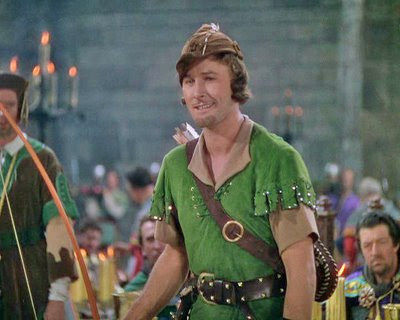
When I was a kid, I was a big fan of Robin Hood. I remember reading at least two books recounting the legend and I watched the Errol Flynn version of the movie several times.

And, as an adult, I saw both the Kevin Costner and Russell Crowe versions of Robin Hood.

“I’m not an occupy-Wall-Street moocher”

None of this makes me an expert, but it does allow me to state with some confidence that Robin Hood was not a left-wing hero who stole from the rich and redistributed to the poor.

Instead, he was a quasi-libertarian tax protestor. Okay, maybe it’s an exaggeration to claim he was a libertarian, but Robin Hood was on the side of ordinary people who were being exploited by incessant tax demands from the ruling class. His main enemies were Prince John and the Sheriff on Nottingham, not the medieval equivalents of Wall Street.

In the Russell Crowe version of the movie, Robin Hood even gives a speech about the importance of liberty.

So you can imagine how irked I get when statists agitate for things such as the “Robin Hood Tax” in this moronic video. But what motivated me today is a story in the Financial Times about a Cesar Chavez wannabee politician from Spain.

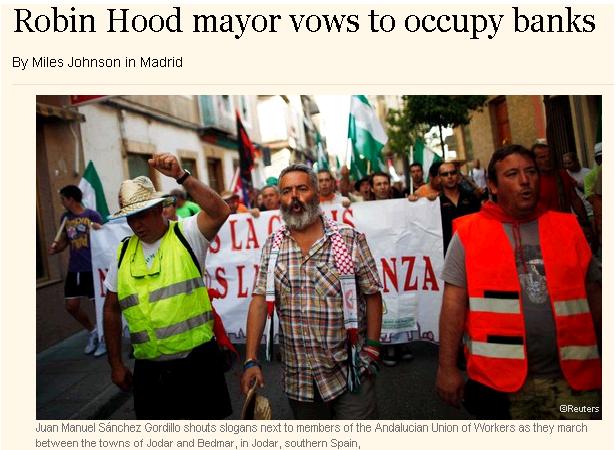
For Spain’s ruling politicians he is a criminal; for his supporters he is Robin Hood, stealing from supermarkets and redistributing the food to the poor. Juan Manuel Sánchez Gordillo, the mayor of Marinaleda, a southern town with a population of 2,600, has been catapulted to cult hero status in Spain after setting out this week on an anti-austerity march across Andalucia – occupying banks and stealing food… “We are fighting a war for the poor … going to jail is not important for me, it would be an honour,” Mr Sánchez Gordillo told the Financial Times. “We are going to occupy all of the banks and supermarkets we are able to in Andalucia. The robbers who have caused this crisis must pay the consequences for what they have done.”

But if the Mayor really wants to make robbers pay, he should march straight to jail and turn himself in. Not for the empty publicity stunt of robbing grocery stores, but for being part of a political class that has dramatically increased the burden of government spending in Spain, from about 30 percent of GDP in 1980 to well over 40 percent today.

But don’t hold your breath waiting for self-awareness from this clown.

Not surprisingly, unions are part of the protest. I’m guessing that Mr. Canamero represents government employees.

On Friday, the marchers, who plan to sleep in the open or in parks, occupied a branch of Banco Santander in the town of Mancha Real in the province of Jaén before leaving later in the day. Diego Canamero, head of the Andalucian Workers Union, was in the branch on Friday. He said critics of the protests were politicians protecting their own interests. “These are symbolic actions against an unsustainable economic situation,” he said. “The bankers rob us, and take our money to tax havens…”

The dig against tax havens is particularly laughable. Ordinary Spaniards should hope and pray that their deposits in the local banks are safely re-deposited in banks based in well-run and honest jurisdictions such as Switzerland, the Cayman Islands, or Singapore.

And if they’re smart, they already cut out the middleman and directly placed their savings in one of these low-tax jurisdictions. That way, they’re not only at much less risk of a bank collapse, but they also have greater ability to protect their assets from the venal and incompetent tax-hungry political elite.

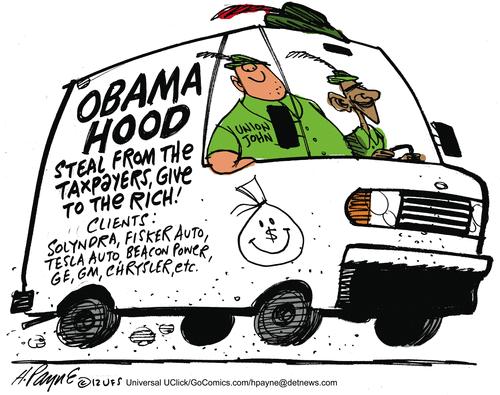
Returning to the mischaracterization of Robin Hood, this Payne cartoon does a good job of capturing my thoughts.

I especially like how Payne shows that the left-wing version of Robin Hood is all about a perniciously corrupt version of redistribution (though he should have included the Export-Import Bank on the side of the van). The genuine poor get crumbs while the well-connected interests make out like bandits.

P.S. Other good Payne cartoons can be seen here, here, here, here, here, here, and here.

Open letter to Republican Presidential Candidate Mitt Romney on our pro-life views (Part 11)

To Mitt Romney, Box 96861, Washington, DC 20090-6861,  From Everette Hatcher of www.thedailyhatch.org 13900 Cottontail Lane, Alexander, AR 72002

Did we forgive George Bush in 1988 for being pro-choice originally in 1980? We sure did. In fact, my former pastor, Adrian Rogers, had a chance to visit with Bush several times. He told him that the Religious Right did not have enough votes to get him elected on their own, but if he ever went against the pro-life view then they could definately derail his election bid.

Today I am writing you to remind you of the same thing. We in the pro-life movement are firmly behind you but we want to know some of the reasons are passionately pro-life.

 
First published in 1981, Francis Schaeffer’s A Christian Manifestois increasingly relevant today in 2010. The book, penned as a Christian response to the Communist and Humanist Manifestos, describes how the United States is being systematically torn apart by secular humanism and its “material-energy, chance world view.” The second half of the book details what actions the Christian should take in defending one’s self and country.In explaining civil disobedience, Schaeffer uses Samuel Rutherford’smodel of “three appropriate levels of resistance.”“First, he must defend himself by protest (in contemporary society this would most often be by legal action); second, he must flee if at all possible; and, third, he may use force, if necessary, to defend himself (Schaeffer 103).”Schaeffer then goes on to provide an example that would be worthy of Rutherford’s first level of resistance.“In our day an illustration for the need of protest is tax money used for abortion. After all the normal constitutional means of protest had been exhausted, then what could be done? At some point protest could lead some Christians to refuse to pay some portion of their tax money. Of course, this would mean a trial. Such a move would have to be the individual’s choice under God. No one should decide for another. But somewhere along the way, such a decision might easily have to be faced. Happily, at the present time in the United States the Hyde Amendment has removed the use of national tax money for abortions, but that does not change the possibility that in some cases such a protest would be the only way to be heard (Schaeffer 108).”

Fastforward 19 years. Today, the concern for pro-lifers is no longer the Hyde Amendment. The United States now has a tax-funded federal healthcare program that, according to a new Congressional Research Service report, allows federal tax dollars to fund elective abortions.

What should be the Christian response? If the legal challenges fail and our government does indeed choose to use federal tax money to fund the killing of unborn babies, how will God’s people respond?

It is interesting just how prophetic Francis Schaeffer’s thoughts and concerns were. This is the first of his writings I have read and I look forward to reading more of his work. The abortion fight is no different than any other war in the sense that individual battles will decide victory. But the battles involved have so much more at stake than I often realize. There is certainly a “war of world views” going on in this country and the preservation or destruction of the U.S. Constitution will surely determine if liberty is for all or none.

Schaeffer, Francis A. A Christian Manifesto. Westchester: Crossway, 1982

“Woody Wednesday” Atheists have no basis for saying that Hitler was wrong!!!!!

On April 30, 2012 (67 years after Hitler killed himself) I stated on the Arkansas Times Blog:

Hitler’s last few moments of life were filled with anxiety as they should have been. He went on to face his maker and pay dearly for his many sins. When I look at the never before released pictures of Hitler’s bunker, it makes me wonder how anyone can claim that this life doesn’t count for all eternity and people like Hitler are home free like Woody Allen’s movie “Crimes and Misdemeanors” suggests.

I am not going to give all the blog posts but there were many. Here is another one.

“Elwood” responded to my post with this on the Arkansas Times Blog:

No Everette, god does not establish moral codes. We do. We can attribute them to any deity of your choosing but make no mistake we, society, set moral codes. I suppose you were at prayer meeting on the occasions we discussed civil and moral codes and origins. They existed long before the Hebrewic god came along.

Elwood later asserted on the Arkansas Times Blog:

Warning to fundamentalists: Don’t let go of your imaginary place called “Hell.”
It could cost you a job, family and friends. So, since security is our most important possession hang on to Hell.

That is when I responded on the Arkansas Times Blog:

Elwood, answer this one question. HOW COULD JUDAH HAVE REMOVED HIS TROUBLESOME MISTRESS FROM HIS LIFE WITHOUT KILLING HER? Woody Allen knew what he was doing in this film and he was showing that without God and an afterlife then there is no reason not to murder!!!!

Woody Allen’s 1989 movie, CRIMES AND MISDEMEANORS , is concerning the need of God while making decisions in the area of personal morality. In this film, Allen attacks his own atheistic view of morality. Martin Landau plays a Jewish eye doctor named Judah Rosenthal raised by a religious father who always told him, “The eyes of God are always upon you.” However, Judah later concludes that God doesn’t exist. He has his mistress (played in the film by Anjelica Huston) murdered because she continually threatened to blow the whistle on his past questionable, probably illegal, business activities. She also attempted to break up Judah ‘s respectable marriage by going public with their two-year affair. Judah struggles with his conscience throughout the remainder of the movie. He continues to be haunted by his father’s words: “The eyes of God are always upon you.” This is a very scary phrase to a young boy, Judah observes. He often wondered how penetrating God’s eyes are.

Later in the film, Judah reflects on the conversation his religious father had with Judah ‘s unbelieving Aunt May at the dinner table many years ago:

“Come on Sol, open your eyes. Six million Jews burned to death by the Nazis, and they got away with it because might makes right,” says aunt May

Sol replies, “May, how did they get away with it?”

Judah asks, “If a man kills, then what?”

Sol responds to his son, “Then in one way or another he will be punished.”

Aunt May comments, “I say if he can do it and get away with it and he chooses not to be bothered by the ethics, then he is home free.”

Judah ‘s final conclusion was that might did make right. He observed that one day, because of this conclusion, he woke up and the cloud of guilt was gone. He was, as his aunt said, “home free.”

Woody Allen has exposed a weakness in his own humanistic view that God is not necessary as a basis for good ethics. There must be an enforcement factor in order to convince Judah not to resort to murder. Otherwise, it is fully to Judah ‘s advantage to remove this troublesome woman from his life.

…Elwood, are you missing in action? Earlier you asserted, “No everette, God does not establish moral codes. We do.” However, you will not elaborate on what the atheist Judah should have done to silence his mistress and save his marriage. Should he have confessed it all (including his past illegal activities) and faced the penalties or pay his hitman brother to have her done away with quietly like he did?

When it comes to morals you like to make big statements but you can not back it up by answering this simple question. I would love to hear from other atheists on this too. Maybe they will run and hide.

At this point Elwood went missing in action. However, several days later another atheist jumped in. A person using the username “John Arkansawyer” asserted:

 I don’t think eLwood is going to drop by, so I’ll take my shot at this.

You are correct that Woody Allen has pointed up a feature of the world as it exists, a feature that I don’t happen to like: People sometimes get away with murder.

What you don’t get, though, is what I just said: It is a feature of the world as it exists that justice is not inherent. Whether you or I like that or not, it’s how it is. In a world without any god, justice and meaning and all good and moral things have to be determined and imposed by people.

With god, one could, in theory, just shrug one’s shoulders at Hitler and say, “You’ll get yours, someday.” With the Christian god as accepted by many fundamentalists, Hitler could make a deathbed conversion and go straight to heaven, do not pass hell, do not collect eternal damnation.

Another great artist, Randy Newman, speaking as the Devil makes this point to an angel, “a good girl, cut down in your prime”, recently arrived in heaven:

“The man who shot you in the head
In that ‘Burger King in Tucson
Well, he never will be punished you know
He will move to Big Pine, California
Become the richest man in Inyo County
While that may not be much, it’s enough
When he dies
Sixty-five years from today
With his loved ones all around him
He’ll be whisked right up to heaven
He won’t pass go or have to wait
He’ll just march right through the Goddamned gate
And why, you may ask yourself why
For thousands and thousands of years
I have asked myself why”

To which James Taylor, playing God, answers:

“Faith.
Contrition.
Sincere contrition.
Confession.
Sincere confession
Redemption.
Absolution
Those who seek Me shall find Me
In the case of this man,
Predestination

My ways are mysterious
Sometimes even to myself
My ways are mysterious”

Now, that’s not terribly satisfying from a moral point of view either. The “death and glory” version of Universalism, where all souls go to heaven as soon as they leave the body makes much more sense from an ethical point of view, especially if you accept the late Bill Hicks’ description of life:

“It’s just a ride and we can change it any time we want. It’s only a choice. No effort, no work, no job, no savings and money, a choice right now, between fear and love. The eyes of fear want you to put bigger locks on your door, buy guns, close yourself off. The eyes of love instead see all of us as one.”

Of course, Hicks, like myself, was somewhere between an agnostic and an atheist. Like Hicks, I don’t expect any life after death or eternal reward. Justice has to be provided here on earth.

So when a Hitler or a Nixon dies, not unpunished–both those men suffered, though not in proportion to their evil–or scot free, but still without having truly experienced justice for their sins, it’s the fault of those women and men who didn’t work hard enough to impose justice upon them.

That’s the ethical duty we face in the absence of god: Justice here and now, determined by human reason and imposed by human action.

Martin King’s riff on Theodore Parker’s claim, that the arc of the universe is long but that it bends toward justice, is true in a world populated by humans, who aren’t bad and who take that arc in their hands and bend it for all they’re worth. Atheists and thoughtful theists alike don’t depend on god to git-r-done (for values of ‘r’ which include ‘justice’).

__________

Let me start responding by first quoting two points that you make:

You are correct that Woody Allen has pointed up a feature of the world as it exists, a feature that I don’t happen to like: People sometimes get away with murder.

What you don’t get, though, is what I just said: It is a feature of the world as it exists that justice is not inherent. Whether you or I like that or not, it’s how it is. In a world without any god, justice and meaning and all good and moral things have to be determined and imposed by people.

_____________

Let us take a close look at how you are going to come up with morality as an atheist. When you think about it there is no way around the final conclusion that it is just your opinion against mine concerning morality. There is no final answers. However, if God does exist and he has imparted final answers to us then everything changes.

Take a look at a portion of this paper by Greg Koukl. In this article he points out that atheists don’t even have a basis for saying that Hitler was wrong:

What doesn’t make sense is to look at the existence of evil and question the existence of God. The reason is that atheism turns out being a self-defeating philosophic solution to this problem of evil. Think of what evil is for a minute when we make this kind of objection. Evil is a value judgment that must be measured against a morally perfect standard in order to be meaningful. In other words, something is evil in that it departs from a perfect standard of good. C.S. Lewis made the point, “My argument against God was that the universe seemed so cruel and unjust. But how had I got this idea of just and unjust? A man does not call something crooked unless he has some idea of a straight line.”[ 1 ] He also goes on to point out that a portrait is a good or a bad likeness depending on how it compares with the “perfect” original. So to talk about evil, which is a departure from good, actually presumes something that exists that is absolutely good. If there is no God there’s no perfect standard, no absolute right or wrong, and therefore no departure from that standard. So if there is no God, there can’t be any evil, only personal likes and dislikes–what I prefer morally and what I don’t prefer morally.

This is the big problem with moral relativism as a moral point of view when talking about the problem of evil. If morality is ultimately a matter of personal taste–that’s what most people hold nowadays–then it’s just your opinion what’s good or bad, but it might not be my opinion. Everybody has their own view of morality and if it’s just a matter of personal taste–like preferring steak over broccoli or Brussels sprouts–the objection against the existence of God based on evil actually vanishes because the objection depends on the fact that some things are intrinsically evil–that evil isn’t just a matter of my personal taste, my personal definition. But that evil has absolute existence and the problem for most people today is that there is no thing that is absolutely wrong. Premarital sex? If it’s right for you. Abortion? It’s an individual choice. Killing? It depends on the circumstances. Stealing? Not if it’s from a corporation.

The fact is that most people are drowning in a sea of moral relativism. If everything is allowed then nothing is disallowed. Then nothing is wrong. Then nothing is ultimately evil. What I’m saying is that if moral relativism is true, which it seems like most people seem to believe–even those that object against evil in the world, then the talk of objective evil as a philosophical problem is nonsense. To put it another way, if there is no God, then morals are all relative. And if moral relativism is true, then something like true moral evil can’t exist because evil becomes a relative thing.

An excellent illustration of this point comes from the movie The Quarrel . In this movie, a rabbi and a Jewish secularist meet again after the Second World War after they had been separated. They had gotten into a quarrel as young men, separated on bad terms, and then had their village and their family and everything destroyed through the Second World War, both thinking the other was dead. They meet serendipitously in Toronto, Canada in a park and renew their friendship and renew their old quarrel.

divider

To paraphrase the late Dr. Francis Schaeffer, the person who argues against the existence of God based on the existence of evil in the world has both feet firmly planted in mid-air.

divider

Rabbi Hersch says to the secularist Jew Chiam, “If a person does not have the Almighty to turn to, if there’s nothing in the universe that’s higher than human beings, then what’s morality? Well, it’s a matter of opinion. I like milk; you like meat. Hitler likes to kill people; I like to save them. Who’s to say which is better? Do you begin to see the horror of this? If there is no Master of the universe then who’s to say that Hitler did anything wrong? If there is no God then the people that murdered your wife and kids did nothing wrong.”

That is a very, very compelling point coming from the rabbi. In other words, to argue against the existence of God based on the existence of evil forces us into saying something like this: Evil exists, therefore there is no God. If there is no God then good and evil are relative and not absolute, so true evil doesn’t exist, contradicting the first point. Simply put, there cannot be a world in which it makes any sense to say that evil is real and at the same time say that God doesn’t exist. If there is no God then nothing is ultimately bad, deplorable, tragic or worthy of blame. The converse, by the way, is also true. This is the other hard part about this, it cuts both ways. Nothing is ultimately good, honorable, noble or worthy of praise. Everything is ultimately lost in a twilight zone of moral nothingness. To paraphrase the late Dr. Francis Schaeffer, the person who argues against the existence of God based on the existence of evil in the world has both feet firmly planted in mid-air.

Francis Schaeffer

Francis Schaeffer pictured above.

_______

By your own admission man imposes his own morality and that is why I want to challenge atheist like “John Arkansawyer” to show what basis he has for saying Hitler was wrong!!!

Early in his career Hitler was popular and many of the German people bought into his anti-semetic views. Does the atheist have an intellectual basis to condemn Hitler’s actions?

____________________________________ 


I personally met someone who was part of the Hitler youth movement in Germany in the 1930’s and until his dying day he believed that Hitler was right. I had a basis for knowing that Hitler was wrong and here it is below.
 
It is my view that according the Bible all men are created by God and are valuable.  However, the atheist has no basis for coming to this same conclusion. Francis Schaeffer put it this way:
 
We cannot deal with people like human beings, we cannot deal with them on the high level of true humanity, unless we really know their origin—who they are. God tells man who he is. God tells us that He created man in His image. So man is some- thing wonderful.
 
Francis Schaeffer died in 1984, but there is a website dedicated to his works. In 1972 he wrote the book “He is There and He is Not Silent.” Here is the statement that sums up that book: 

One of philosophy’s biggest problems is that anything exists at all and has the form that it does. Another is that man exists as a personal being and makes true choices and has moral responsibility. The Bible gives sufficient answers to these problems. In fact, the only sufficient answer is that the infinite-personal triune God is there and He is not silent. He has spoken to man in the Bible.

The basic question Woody Allen is presenting to his own agnostic humanistic worldview is: If you really believe there is no God there to punish you in an afterlife, then why not murder if you can get away with it?  The secular humanist worldview that modern man has adopted does not work in the real world that God has created. God “has planted eternity in the human heart…” (Ecclesiastes 3:11). This is a direct result of our God-given conscience. The apostle Paul said it best in Romans 1:19, “For that which is known about God is evident to them and made plain in their inner consciousness, because God  has shown it to them” (Amplified Version).

It’s no wonder, then, that one of Allen’s fellow humanists would comment, “Certain moral truths — such as do not kill, do not steal, and do not lie — do have a special status of being not just ‘mere opinion’ but bulwarks of humanitarian action. I have no intention of saying, ‘I think Hitler was wrong.’ Hitler WAS wrong.” (Gloria Leitner, “A Perspective on Belief,” The Humanist, May/June 1997, pp.38-39). Here Leitner is reasoning from her God-given conscience and not from humanist philosophy. It wasn’t long before she received criticism.

Humanist Abigail Ann Martin responded, “Neither am I an advocate of Hitler; however, by whose criteria is he evil?” (The Humanist, September/October 1997, p. 2.). Humanists don’t really have an intellectual basis for saying that Hitler was wrong, but their God-given conscience tells them that they are wrong on this issue.

Crimes and Misdemeanors (Woody Allen – 1989) – Final scenes

Open letter to President Obama (Part 139 B)

3 Of 5 / The Bible’s Influence In America / American

Heritage Series / David Barton

President Obama c/o The White House
1600 Pennsylvania Avenue NW
Washington, DC 20500

Dear Mr. President,

I know that you receive 20,000 letters a day and that you actually read 10 of them every day. I really do respect you for trying to get a pulse on what is going on out here.

You have said in the past that we are not a Christian nation. I am not going to get into that discussion right now but I wanted to make some points about our origin.

There were 55 gentlemen who put together the constitution and their church affliation is of public record. Greg Koukl notes:

Members of the Constitutional Convention, the most influential group of men shaping the political foundations of our nation, were almost all Christians, 51 of 55–a full 93%. Indeed, 70% were Calvinists (the Episcopalians, Presbyterians, and the Dutch Reformed), considered by some to be the most extreme and dogmatic form of Christianity.

independence The Faith of Our FathersWas the faith of the Founding Fathers deism or Christianity? What does the answer mean for us today? Both the secularists and the Christians have missed the mark. By: Gregory Koukl

There’s been a lot of rustle in the press lately–and in many Christian publications–about the faith of the Founding Fathers and the status of the United States as a “Christian nation.” Home schooling texts abound with references to our religious heritage, and entire organizations are dedicated to returning America to its spiritual roots. On the other side, secularists cry “foul” and parade their own list of notables among our country’s patriarchs. They rally around the cry of “separation of church and state.” Which side is right? Oddly both, after a fashion.

Who Were the Founding Fathers?
Historical proof-texts can be raised on both sides. Certainly there were godless men among the early leadership of our nation, though some of those cited as examples of Founding Fathers turn out to be insignificant players. For example, Thomas Paine and Ethan Allen may have been hostile to evangelical Christianity, but they were firebrands of the Revolution, not intellectual architects of the Constitution. Paine didn’t arrive in this country until 1774 and only stayed a short time.As for others–George Washington, Samuel Adams, James Madison, John Witherspoon, Alexander Hamilton, John Jay, John Adams, Patrick Henry, and even Thomas Jefferson–their personal correspondence, biographies, and public statements are replete with quotations showing that these thinkers had political philosophies deeply influenced by Christianity.The Constitutional ConventionIt’s not necessary to dig through the diaries, however, to determine which faith was the Founder’s guiding light. There’s an easier way to settle the issue.The phrase “Founding Fathers” is a proper noun. It refers to a specific group of men, the 55 delegates to the Constitutional Convention. There were other important players not in attendance, like Jefferson, whose thinking deeply influenced the shaping of our nation. These 55 Founding Fathers, though, made up the core.The denominational affiliations of these men were a matter of public record. Among the delegates were 28 Episcopalians, 8 Presbyterians, 7 Congregationalists, 2 Lutherans, 2 Dutch Reformed, 2 Methodists, 2 Roman Catholics, 1 unknown, and only 3 deists–Williamson, Wilson, and Franklin–this at a time when church membership entailed a sworn public confession of biblical faith.[1]This is a revealing tally. It shows that the members of the Constitutional Convention, the most influential group of men shaping the political foundations of our nation, were almost all Christians, 51 of 55–a full 93%. Indeed, 70% were Calvinists (the Episcopalians, Presbyterians, and the Dutch Reformed), considered by some to be the most extreme and dogmatic form of Christianity.Benjamin Franklin

Even Franklin the deist is equivocal. He was raised in a Puritan family and later adopted then abandoned deism. Though not an orthodox Christian, it was 81-year-old Franklin’s emotional call to humble prayer on June 28, 1787, that was the turning point for a hopelessly stalled Convention. James Madison recorded the event in his collection of notes and debates from the Federal Convention. Franklin’s appeal contained no less than four direct references to Scripture.

And have we forgotten that powerful Friend? Or do we imagine that we no longer need His assistance? I have lived, sir, a long time and the longer I live the more convincing proofs I see of this truth: that God governs in the affairs of men. And if a sparrow cannot fall to the ground without his notice, is it probable that an empire can rise without His aid? We have been assured, sir, in the sacred writings that ‘except the Lord build the house, they labor in vain that build it.’ I firmly believe this and I also believe that without His concurring aid, we shall succeed in this political building no better than the builders of Babel.[2]

Three of the four cornerstones of the Constitution–Franklin, Washington, and Madison–were firmly rooted in Christianity. But what about Thomas Jefferson? His signature cannot be found at the end of the Constitution, but his voice permeates the entire document.

Thomas Jefferson

Though deeply committed to a belief in natural rights, including the self-evident truth that all men are created equal, Jefferson was individualistic when it came to religion; he sifted through the New Testament to find the facts that pleased him.

Sometimes he sounded like a staunch churchman. The Declaration of Independence contains at least four references to God. In his Second Inaugural Address he asked for prayers to Israel’s God on his behalf. Other times Jefferson seemed to go out of his way to be irreverent and disrespectful of organized Christianity, especially Calvinism.

It’s clear that Thomas Jefferson was no evangelical, but neither was he an Enlightenment deist. He was more Unitarian than either deist or Christian.[3]

This analysis, though, misses the point. The most important factor regarding the faith of Thomas Jefferson–or any of our Founding Fathers–isn’t whether or not he had a saving knowledge of Jesus Christ. The debate over the religious heritage of this country is not about who is ultimately going to heaven, but rather about what the dominant convictions were that dictated the structure of this nation.

Even today there are legions of born-again Christians who have absolutely no skill at integrating their beliefs about Christ with the details of their daily life, especially their views of government. They may be “saved,” but they are completely ineffectual as salt and light.

By contrast, some of the Fathers may not have been believers in the narrowest sense of the term, yet in the broader sense–the sense that influences culture–their thinking was thoroughly Christian. Unlike many evangelicals who live lives of practical atheism, these men had political ideals that were deeply informed by a robust Christian world view. They didn’t always believe biblically, having a faith leading to salvation, but almost all thoughtbiblically, resulting in a particular type of government.

Thomas Jefferson was this kind of man. In Defending the Declaration, legal historian Gary Amos observes, “Jefferson is a notable example of how a man can be influenced by biblical ideas and Christian principles even though he never confessed Jesus Christ as Lord in the evangelical sense.”[4]

What Did the Founding Fathers Believe and Value?
When you study the documents of the Revolutionary period, a precise picture comes into focus. Here it is:

  • Virtually all those involved in the founding enterprise were God-fearing men in the Christian sense; most were Calvinistic Protestants.
  • The Founders were deeply influenced by a biblical view of man and government. With a sober understanding of the fallenness of man, they devised a system of limited authority and checks and balances.
  • The Founders understood that fear of God, moral leadership, and a righteous citizenry were necessary for their great experiment to succeed.
  • Therefore, they structured a political climate that was encouraging to Christianity and accommodating to religion, rather than hostile to it.
  • Protestant Christianity was the prevailing religious view for the first 150 years of our history.

However…

  • The Fathers sought to set up a just society, not a Christian theocracy.
  • They specifically prohibited the establishment of Christianity–or any other faith–as the religion of our nation.

A Two-Sided Coin

We can safely draw two conclusions from these facts, which serve to inform our understanding of the relationship between religion and government in the United States.

First, Christianity was the prevailing moral and intellectual influence shaping the nation from its outset. The Christian influence pervaded all aspects of life, from education to politics. Therefore, the present concept of a rigid wall of separation hardly seems historically justified.

Virtually every one of the Founders saw a vital link between civil religion and civil government. George Washington’s admonitions in his Farewell Speech, September 19, 1796, were characteristic of the general sentiment:

Of all the dispositions and habits which lead to political prosperity, religion and morality are indispensable supports….And let us indulge with caution the supposition that morality can be maintained without religion. Reason and experience both forbid us to expect that national morality can prevail in exclusion of religious principles.[5]

Second, the Founders stopped short of giving their Christian religion a position of legal privilege. In the tradition of the early church, believers were to be salt and light. The First Amendment insured the liberty needed for Christianity to be a preserving influence and a moral beacon, but it also insured Christianity would never be the law of the land.

This ought to call into serious question a common tactic of the so-called Religious Right. “We were here first,” their apologists proclaim. “Our country was stolen from us, and we demand it back.” Author John Seel calls this “priority as entitlement.”

The sad fact of the matter is that cultural authority was not stolen from us; we surrendered it through neglect. Os Guinness pointed out that Christians have not been out-thought. Rather, they have not been around when the thinking was being done.

Choosing cultural monasticism rather than hard-thinking advocacy, Christians abandoned the public square to the secularists. When the disciples of Jesus Christ retreated, the disciples of Dewey, Marx, Darwin, Freud, Nietzsche, Skinner, and a host of others replaced them.

Seel warns of the liability of an “appeal to history as a basis of Christian grounds to authority.”[6]Playing the victim will not restore our influence, nor will political strong-arm tactics. Shouldn’t our appeal rather be on the basis of truth rather than on the patterns of the past?

The faith of our Founding Fathers was Christianity, not deism. In this regard, many secularists–and even some Christians–have been wrong in their assessment of our history. On the other hand, many Christians have also been mistaken in their application of the past to the present.

Christians have no special privileges simply because Christianity was America’s first faith. “If America ever was or ever will be a ‘Christian nation,'” Seel observes, “it is not by conscious design or written law, but by free conviction.”[7]

Success for the Christian cannot be measured in numbers or political muscle, but only in faithfulness. Our most important weapon is not our voting power, but the power of the truth freely spoken and freely heard.

Recommended Reading:

Let Freedom Ring–A Basic Outline of American History, available through the Family Research Council, 700 Thirteenth St., N.W., Suite 500, Washington D.C. 20005, 1-800-225-4008

The Light and the Glory, Peter Marshall and David Manuel (Grand Rapids: Revell, 1977)

Christianity and the Constitution–The Faith of Our Founding Fathers, John Eidsmoe (Grand Rapids: Baker, 1987)

Defending the Declaration–How the Bible and Christianity Influenced the Writing of the Declaration of Independence, Gary T. Amos (Brentwood, TN: Wogelmuth & Hyatt, 1989)

Positive Neutrality: Letting Religious Freedom Ring, Stephen T. Monsma, (Grand Rapids: Baker, 1993)


[1] John Eidsmoe, Christianity and the Constitution, (Grand Rapids: Baker, 1987), p. 43.[2] Benjamin Franklin, quoted by James Madison in Notes on Debates in the Federal Convention of 1787(Athens: Ohio University Press, 1966, 1985), p. 209.[3]Eidsmoe has a very thorough and even-handed section on Jefferson.[4] Gary T. Amos, Defending the Declaration, (Brentwood, TN: Wogelmuth & Hyatt, 1989), p. 9.[5] The Annals of America, (Chicago: Encyclopedia Britannica, 1976), vol. 3, p. 612.[6] John Seel, No God But God–Breaking with the Idols of Our Age, Os Guinness and John Seel, eds., (Chicago: Moody Press, 1992), p. 64.[7] John Seel, No God But God–Breaking with the Idols of Our Age, Os Guinness and John Seel, eds., (Chicago: Moody Press, 1992), p. 69.


This is a transcript of a commentary from the radio show“Stand to Reason,” with Gregory Koukl. It is made available to you at no charge through the faithful giving of those who support Stand to Reason. Reproduction permitted for non-commercial use only. ©2002 Gregory Koukl

For more information, contact Stand to Reason at 1438 East 33rd St., Signal Hill, CA 90755
(800) 2-REASON (562) 595-7333 www.str.org

__________________

Thank you so much for your time. I know how valuable it is. I also appreciate the fine family that you have and your committment as a father and a husband.

Sincerely,

Everette Hatcher III, 13900 Cottontail Lane, Alexander, AR 72002, ph 501-920-5733, lowcostsqueegees@yahoo.com

Recap of SEC football from Sept 8, 2012

I don’t have anything good to say about the Hogs’ performance last Saturday but some other SEC teams did pretty well. I am looking forward to the Tennessee Florida game since both teams looked very good last week. QB TYLER BRAY (Tennessee) — Completed 18-of-20 passes for 310 yards and four touchdowns in Tennessee’s 51-13 win against Georgia State. DL COREY MILLER (Tennessee) — Had six tackles with 1.5 for losses, including a sack, in Tennessee’s 51-13 win against Georgia State.

SEC FOOTBALL PLAYERS OF THE WEEK (Games of September 8, 2012)

SEC OFFENSIVE PLAYER OF THE WEEK
TYLER RUSSELL (Watch Mississippi State Highlights)
Quarterback
MISSISSIPPI STATE
6-4 • 220 • Jr. • Meridian, Miss.

• Russell led Mississippi State to a 28-10 victory over Auburn in the SEC opener for both teams, State’s first win in an SEC opener since 1999.
• He completed 20-of-29 passes for 222 yards and three touchdowns without an interception.
• Russell led the Bulldogs on three touchdown drives in its first four second half possessions as State scored 21 unanswered points to seal the game.
• He completed passes to nine different receivers.

SEC DEFENSIVE PLAYER OF THE WEEK
JARVIS JONES (Watch Georgia Highlights)
Outside Linebacker
GEORGIA
6-3 • 241 • Jr. • Columbus, Ga.

• Jones had the second-most tackles for the Bulldogs (9), two sacks/TFLs, an interception, two forced fumbles and five quarterback pressures during Georgia’s 41-20 victory over Missouri.
• Jones now has 16.5 sacks over his last 16 games and 24 tackles for loss in that span and is leading the SEC in TFLs this season.
• Jones’ first career INT came midway through the final quarter with the Bulldogs up 27-20 as he managed to grab the pick and return it 21 yards to the Tiger 1-yard line.
• On Missouri’s next possession, Jones sacked James Franklin for a loss of 11 yards and forced a fumble that the Bulldogs recovered deep in Tiger territory.

SEC SPECIAL TEAMS PLAYER OF THE WEEK
CALEB STURGIS (Watch Florida Highlights)
Placekicker
FLORIDA
5-9 • 185 • So. • DeSoto, Texas

• Sturgis connected on both of his field goal attempts and accounted for eight points in Florida’s 20-17 win at Texas A&M.
• He connected on a 51-yard field goal in the second quarter, which closed the Aggie lead to 17-10 going into halftime.
• Sturgis extended his school record of 50-plus yard kicks to seven, which is also tops among all active kickers nationally.
• He now has 100 career PATs made and his 76.9 career field goal percentage is currently 10th in SEC history.

SEC Co-OFFENSIVE LINEMAN PLAYER OF THE WEEK
LARRY WARFORD (Watch Kentucky Highlights)
Guard
KENTUCKY
6-3 • 343 • Sr. • Richmond, Ky.

• Warford graded out at 91.7 percent with eight knockdown blocks, no penalties and allowed no sacks in Kentucky’s  47-14 win againt Kent State.  UK’s 47 points and 539 yards total offense were the most since 2010

A.J. HAWKINS (Watch Ole Miss Highlights)
Guard
OLE MISS
6-1 • 310 • Sr. • Lithonia, Ga.

• Hawkins helped the Ole Miss offense rack up 538 total yards, including 332 on the ground, in a 28-10 win over UTEP.  He made his 18th career start and second at right guard after playing center and left guard his first three seasons.

SEC Co-DEFENSIVE LINEMAN OF THE WEEK
SAM MONTGOMERY (Watch LSU Highlights)
Defensive End
LSU
6-5 • 260 • Jr. • Greenwood, S.C.

• Montgomery registered 4 tackles, 1 sack (3-yard loss) and 1.5 TFL (4-yard loss) in LSU’s 41-3 win over Washington.  He also added 3 QB hurries as the Tigers held Washington to only 12 first downs and 183 yards of total offense.

DAMONTRE MOORE (Watch Texas A&M Highlights)
Defensive End
TEXAS A&M
6-4 • 250 • Jr. • Rowlett, Texas

• Moore registered 10 total tackles, seven solos, and had three QB sacks (-21 yards) in Texas A&M’s 20-17 loss to Florida.  Moore now leads the nation in sacks per game (3.00) and is fifth in tackles for loss per game (3.00).

SEC FRESHMAN OF THE WEEK
JALEN MILLS (Watch LSU Highlights)
Cornerback
LSU
6-0 • 185 • DeSoto, Texas

• Mills, a true freshman, made his second straight start at cornerback for the Tigers and was second on team with 7 tackles to go with first interception of career in 41-3 win over Washington.

• He added one pass breakup as the Tiger defense dominated the Huskies, holding Washington to just 183 yards of total offense (26 rushing, 157 passing).

•  Washington’s longest drive was just 45 yards and outside of LSU fumbling the opening kickoff at its own 16-yardline, the Huskies never got inside the LSU 30-yard line the entire game.

OTHER OUTSTANDING PERFORMANCES FROM WEEK 2

LB C.J. MOSLEY (Alabama) — Recorded game-high 11 tackles with a sack and pass deflection in Alabama’s 35-0 win against Western Kentucky.

WR KEVIN NORWOOD (Alabama) — Caught three passes for a game-high 92 yards and two touchdowns in Alabama’s 35-0 win against Western Kentucky.

TE CHRIS GRAGG (Arkansas) — Caught team-high seven passes for 83 yards in Arkansas’ 34-31 loss to Louisiana-Monroe.

RB/RS ONTERIO McCALEBB (Auburn) — Returned kick 100 yards for a touchdown and accounted for 149 all-purpose yards in Auburn’s 28-10 loss at Mississippi State.

RB MIKE GILLISLEE (Florida) — Rushed for 83 yards and two touchdowns in Florida’s 20-17 win at Texas A&M.

SE MARLON BROWN (Georgia) — Hauled in a career-high eight catches for 106 yards and two touchdowns in Georgia’s 41-20 win at Missouri.

QB MAXWELL SMITH (Kentucky) — Completed 30-of-39 passes for 354 yards with four touchdowns and no interceptions in Kentucky’s 47-14 win against Kent State.

QB BO WALLACE (Ole Miss) — Completed 15-of-22 passes for 174 yards and three touchdowns and rushed for 53 yards and a TD in Ole Miss’ 28-10 win against UTEP.

DB JOHNTHAN BANKS (Mississippi State) — Registered six total tackles and two interceptions in the Bulldogs’ 28-10 win against Auburn.

QB JAMES FRANKLIN (Missouri) — Completed 25-of-41 passes for 269 yards with two TDs and an interception in Missouri’s 41-20 loss to Georgia.

QB DYLAN THOMPSON (South Carolina) — In his first career start, completed 21-of-37 passes for 330 yards and three touchdowns in South Carolina’s 48-10 win over East Carolina.

CB JIMMY LEGREE (South Carolina) — Tied for team-high five total tackles and returned an interception for a touchdown in South Carolina’s 48-10 win over East Carolina.

QB TYLER BRAY (Tennessee) — Completed 18-of-20 passes for 310 yards and four touchdowns in Tennessee’s 51-13 win against Georgia State.

DL COREY MILLER (Tennessee) — Had six tackles with 1.5 for losses, including a sack, in Tennessee’s 51-13 win against Georgia State.

OLB KARL BUTLER (Vanderbilt) — Tallied five total tackles (four solos) with 2.5 for losses (-7 yards) in Vanderbilt’s 23-13 loss at Northwestern.
 

<!–

msu_tyler_russell_ap_090812.jpg

–>

Got a question for the sec? Send it to secfeedback@xosdigital.com.

T. Kurt Jaros book review of Free to Choose (Part 3)

Johan Norberg: Naomi Klein on Milton Friedman

I have enjoyed reading this series of reviews by T. Kurt Jaros on Milton and Rose Friedman’s book “Free to Choose.” I hope you enjoy it as much as I did.

I have posted several transcripts and videos of the FREE TO CHOOSE film series on my blog. My favorite episodes are the “Failure of Socialism” and  “Power of the Market.” (This is the 1990 version but the 1980 version is good too.) Today with the increase of the welfare state maybe people should take a long look again at the episode “From Cradle to Grave.” 

Milton Friedman’s  view on vouchers for the schools needs to be heeded now more than ever too. “Created Equal” is probably the episode that I want  President Obama to see the most and I wrote several letters to him suggesting that.

T. Kurt Jaros is currently a Master’s student studying Systematic Theology at King’s College in London.  He holds a B.A. in Philosophy and Political Science cum laude and an M.A. in Christian Apologetics high honors from Biola University, an evangelical Christian university outside of Los Angeles.

He enjoys learning and thinking about theology, specifically historical theology, philosophical theology and philosophy of religion, and issues pertaining to monergism and synergism.  Additionally, he enjoys learning and thinking about political philosophy, economics, American political history, and campaigns.

Created Equal

T. Kurt Jaros on Society

This is part of a series on Milton Friedman’s “Free to Choose.”

In the fifth chapter of his book “Free to Choose,” Milton Friedman discusses the three different ways that humans are considered to be equal. Yes, for those that have been faithfully following along, we are only in the fifth chapter.

Friedman has three categories for human equality: equality before God, equality of opportunity and equality of outcome. He thinks the first is the Founders’ use, the second is compatible with liberty, and the third is socialism.

Equality before God was not something the Founders took literally. “They did not regard ‘men’—or as we would say today, ‘persons’—as equal in physical characteristics, emotional reactions, mechanical and intellectual abilities.” Jefferson himself was a remarkable man: He designed and built his own house, was an inventor, scholar, statesman, founder of the University of Virginia, governor of Virginia, and became the president of the U.S. Hardly equal in all senses to a white-collar, working class man.

So what did Jefferson mean when he wrote that, “all men are created equal?” The answer is found in the proceeding phrase, “endowed by their Creator with certain unalienable rights.” This is how all persons are created equal, because God created us and gave us intrinsic value that we speak of in terms of ‘rights’ language.

Equality of opportunity more simply describes some of our rights and how we are all equal before the law. This type of equality is not inconsistent with liberty, but “an essential component of liberty.” Friedman notes that if someone is denied a job they are qualified for based on their ethnic background, color or religion, then they are being denied equal opportunity.

Equality of outcome is the problematic view. This is the idea that everybody should literally be equal. There are many problems with this idea.

First of all, ‘fairness’ is not an objective concept when dealing with wealth. One man’s garbage is another man’s treasure. Second, the passion behind this idea is that it isn’t fair for some kids to have advantages over others just because of the socioeconomic status of their parents. The focus against those who are advantaged is based on one’s property such as home or business values. However, property can also take the form of talents: musical ability, strength and intelligence. From an ethical standpoint, is there really any difference between the two? Many people resent the inheritance of property like houses and businesses, but don’t resent the inheritance of talents. I wish I could play basketball as well as Kobe Bryant. I’d be a multi-millionaire if I had that type of talent.

But let’s consider where this leads. If we were to really try and equal the outcomes, then less advantaged kids would be given the greatest amount of training and the advantaged kids would be given the least amount of training. That’s fair, right? Not for the advantaged kids. The fact is, life is not fair. It is important to realize how we benefit from things being unfair. I take great pleasure in watching the best of the best play against the best of the best. That’s why we pay money to go to sporting events or watch movies with the best actors. “What kind of world would it be if everyone were a duplicate of everyone else?”

To close, I want to take up a point with Friedman. It’s true today that religion is something that you cannot judge an applicant on. But why think this? Couldn’t someone’s religious beliefs disqualify them? Why can’t we judge someone based upon the values that they uphold and praise? For example, if religion X holds that laziness is a great virtue, why would an employer want to hire someone who strives to become lazy? But let’s take this a next step further. Suppose there is a Christian family who owns a small business. And suppose there is an applicant who is a Satanist, something that Christians believe is evil. In fact, Satanism distorts the true Christian message, and that is insulting to this family. The Christians have a right to call evil by its name and to have no part of it. Government policies must protect employers, too.

The real truth about the financial condition of Social Security can be seen on the www.thedailyhatch.org

Uploaded by on Jan 8, 2009

Professor Williams explains what’s ahead for Social Security

If you want to know the real truth about the financial condition of Social Security then check out these links below:

Ark Times reader says Social Security is not Ponzi Scheme

Social Security is a Ponzi Scheme but Blake who is a blogger said I was off base. Ark Times reader says Social Security is not Ponzi Scheme Social Security Disaster Walter E. Williams Columnist, Townhall.com Politicians who are principled enough to point out the fraud of Social Security, referring to it as a lie and […]

Social Security is a Ponzi scheme that needs to be reformed

We got to do something soon about Social Security. The Case for Social Security Personal Accounts Posted by Daniel J. Mitchell There are two crises facing Social Security. First the program has a gigantic unfunded liability, largely caused by demographics. Second, the program is a very bad deal for younger workers, making them pay record […]

Senator Obama’s ideas on Social Security

Senator Obama’s Social Security Tax Plan Uploaded by afq2007 on Jul 23, 2008 In addition to several other tax increases, Senator Barack Obama wants to increase the Social Security payroll tax burden by imposing the tax on income above $250,000. This would be a sharp departure from current law, which only requires that the tax […]

Social Security is a Ponzi scheme (part 13)

Saving Social Security with Personal Retirement Accounts Uploaded by afq2007 on Jan 10, 2011 There are two crises facing Social Security. First the program has a gigantic unfunded liability, largely thanks to demographics. Second, the program is a very bad deal for younger workers, making them pay record amounts of tax in exchange for comparatively meager benefits. This […]

What does the Heritage Foundation have to say about saving Social Security:Study released May 10, 2011 (Part 7)

“Saving the American Dream: The Heritage Plan to Fix the Debt, Cut Spending, and Restore Prosperity,” Heritage Foundation, May 10, 2011 by  Stuart Butler, Ph.D. , Alison Acosta Fraser and William Beach is one of the finest papers I have ever read. Over the next few days I will post portions of this paper, but […]

Only difference between Ponzi scheme and Social Security is you can say no to Ponzi Scheme jh2d

Is Social Security  a Ponzi Scheme? I just started a series on this subject. In this article below you will see where the name “Ponzi scheme” came from and if it should be applied to the Social Security System. Ponzi! Ponzi! Ponzi! 9/14/2011 | Email John Stossel | Columnist’s Archive Ponzi! Ponzi! Ponzi! There, I […]

Social Security a Ponzi scheme?

Uploaded by LibertyPen on Jan 8, 2009 Professor Williams explains what’s ahead for Social Security Dan Mitchell on Social Security I have said that Social Security is a Ponzi scheme and sometimes you will hear someone in the public say the same thing. Yes, It Is a Ponzi Scheme by Michael D. Tanner Michael Tanner […]

Dan Mitchell on Social Security