Open letter to Speaker of the House John Boehner (Part 45)

Open letter to Speaker of the House John Boehner (Part 45)

John Boehner, Speaker of the House

H-232, The Capital, Washington, DC 20515

Dear Mr. Speaker,

I know that you will have to meet with newly re-elected President Obama soon and he will probably be anxious for you to raise taxes and  federal spending, but he will want you to leave runaway entitlement programs alone. When that happens then you have one thing you can hold over his head and that is the debt ceiling.

You must stand up to him and tell him that you can not raise it. In December of 2012 or January of 2013 at the latest we will be shutting down the government if we don’t increase the debt limit according to the LA Times. You got to listen to the Tea Party heroes like Rep. Todd Rokita, Ben Quayle (R-AZ), Jeff Landry (R, LA-03), Raúl R. Labrador , Tim Huelskamp,  Rep. Justin Amash (R-MI),  , Brooks, Mo (AL – 5), Buerkle, Ann Marie (NY – 25),Chabot, Steven (OH – 1),Duncan, Jeff (SC – 3), Fleischmann, Chuck (TN – 3) ,Gowdy, Trey (SC – 4) ,Griffith, H. Morgan (VA – 9) , Harris, Andy (MD – 1) ,Huizenga, Bill (MI – 2) , Mulvaney, Mick (SC – 5) , Pompeo, Mike (KS – 4) , Ribble, Reid (WI – 8), Rigell, E. Scott (VA – 2) , Ross, Dennis (FL – 12) ,Schweikert, David (AZ – 5), Scott, Austin (GA – 8) , Scott, Tim (SC – 1) , Southerland, Steve (FL – 2) , Stutzman, Marlin (IN – 3) , Walberg, Timothy (MI – 7) , Walsh, Joe (IL – 8),and Woodall, Rob (GA – 7) .

__________

Here is another Tea Party hero you need to listen to:

Press Release: Dennis Ross Statement on Debt Deal Vote
Solving our Long Term Debt Crisis Will Require a Balanced Budget Amendment, Tax Reform, and a National Discussion on the Role of the Federal Government


Jobs – June Job Fair 26
Jobs – June Job Fair 27
Jobs – June Job Fair 28
Jobs – June Job Fair 30
Jobs – June Job Fair 31
Jobs – June Job Fair 32


Jobs – June Job Fair 32


Jobs – June Job Fair 33


Jobs – June Job Fair 34

Related Documents

Zero Based Budget Bill

Budget – GOP Budget Plan

Oversight – AmericanJobCreators.com Radio Actuality


Washington, Aug 1 –

Washington, DC – Congressman Dennis A. Ross (R-FL) released the following statement announcing his intention to vote NO on the “Debt Deal.”   Congressman Ross released the following statement,

“America is nearly upside down on the national mortgage and this legislation is not a viable long term solution to put our fiscal house in order.  No responsible bank would lend to a family in the financial condition our nation is in without a realistic and enforceable plan to get their spending under control.  Without a Balanced Budget Amendment in place, this deal, as with dozens of others, will barely last through this election, let alone ten years.  My kids and grandkids cannot afford trillions more in debt and I was not sent here to heel like a good puppy when the President or the Treasury Secretary says so.  I was sent here to do what is right for my constituents and the nation, even if that makes me unpopular or costs me my seat.”

Congressman Ross continued, “The Speaker is up against the most liberal President since Jimmy Carter and a Senate that spends more time bloviating than legislating.  I do not envy him that task.  No one should mistake my differences with this legislation as an indication of any problem with my Speaker.  Those of us who vote no on today’s legislation will send a message to the President that 75% of the American people want to tie Washington’s hands when it comes to spending with a Balanced Budget Amendment and we know our Speaker will be there when it happens.”

Dennis Ross, son of Bill and Loyola Ross, was born in 1959 and raised in Lakeland, Florida.   He graduated from Auburn University and the Cumberland School of Law at Sanford University.  He has served as in-house counsel to the Walt Disney Company and as an associate of the law firm of Holland & Knight.  He previously served in the Florida Legislature from 2000 until being term limited in 2008.  Dennis and his wife, Cindy Hartley, were married in 1983 and have two sons, Shane and Travis.

Sincerely,

Everette Hatcher, 13900 Cottontail Lane, Alexander, AR 72002, lowcostsqueegees@yahoo.com, www.thedailyhatch.org, ph 501-920-5733

___________

Related posts:

Government shutdown coming, will there be any tea party heroes available to stand up to Obama?

DEBT LIMIT – A GUIDE TO AMERICAN FEDERAL DEBT MADE EASY. Uploaded by debtlimitusa on Nov 4, 2011 A satirical short film taking a look at the national debt and how it applies to just one family. Watch the guy from the Ferris Bueller Superbowl Spot! Produced by Seth William Meier, DP/Edited by Craig Evans, […]

Some Tea Party heroes (Part 1)

DEBT LIMIT – A GUIDE TO AMERICAN FEDERAL DEBT MADE EASY. Uploaded by debtlimitusa on Nov 4, 2011 A satirical short film taking a look at the national debt and how it applies to just one family. Watch the guy from the Ferris Bueller Superbowl Spot! Produced by Seth William Meier, DP/Edited by Craig Evans, […]

Some Tea Party heroes (Part 8)

Rep Himes and Rep Schweikert Discuss the Debt and Budget Deal Michael Tanner of the Cato Institute in his article, “Hitting the Ceiling,” National Review Online, March 7, 2012 noted: After all, despite all the sturm und drang about spending cuts as part of last year’s debt-ceiling deal, federal spending not only increased from 2011 […]

Some Tea Party heroes (Part 7)

Michael Tanner of the Cato Institute in his article, “Hitting the Ceiling,” National Review Online, March 7, 2012 noted: After all, despite all the sturm und drang about spending cuts as part of last year’s debt-ceiling deal, federal spending not only increased from 2011 to 2012, it rose faster than inflation and population growth combined. […]

Who are the Tea Party Heroes from the 87 Freshmen Republicans?

Here is a study done on the votes of the 87 incoming freshman republicans frm the Club for Growth. Freshman Vote Study In the 2010 election, 87 freshmen House Republicans came to Washington pledging fealty to the Tea Party movement and the ideals of limited government and economic freedom. The mainstream media likes to say […]

Tea Party Conservative Senator Mike Lee interview

Tea Party Conservative Senator Mike Lee interview Here is an excellent interview above with Senator Lee with a fine article below from the Heritage Foundation. Sen. Mike Lee (R-UT) came to Washington as the a tea-party conservative with the goal of fixing the economy, addressing the debt crisis and curbing the growth of the federal […]

Some Tea Party heroes (Part 6)

I feel so strongly about the evil practice of running up our national debt. I was so proud of Rep. Todd Rokita who voted against the Budget Control Act of 2011 on August 11, 2011. He made this comment:   For decades now, we have spent too much money on ourselves and have intentionally allowed our […]

Some Tea Party heroes (Part 5)

Rep. Quayle on Fox News with Neil Cavuto __________________ We have to get people realize that the most important issue is the debt!!! Recently I read a comment by Congressman Ben Quayle (R-AZ) made  after voting against the amended Budget Control Act on August 1, 2011. He said it was important to compel “Congressional Democrats and […]

Some Tea Party heroes (Part 4)

What future does our country have if we never even attempt to balance our budget. I read some wise words by Congressman Jeff Landry (R, LA-03) regarding the  debt ceiling deal that was passed on August 1, 2011:”Throughout this debate, the American people have demanded a real cure to America’s spending addiction – a Balanced Budget […]

Some Tea Party heroes (Part 3)

I read some wise comments by Idaho First District Congressman Raúl R. Labrador concerning the passage of the Budget Control Act on August 1, 2011 and I wanted to point them out: “The legislation  lacks a rock solid commitment to passage of a balanced budget amendment, which I believe is necessary to saving our nation.” I just […]

Some Tea Party heroes (Part 2)

Congressmen Tim Huelskamp on the debt ceiling I just don’t understand why people think we can go on and act like everything is okay when we have a trillion dollar deficit. Sometimes you run across some very wise words like I did the other day. Kansas Congressman Tim Huelskamp made the following comment on the […]

What is in a handshake?

  1. Former President Bill Clinton and former Vice President Al Gore are scheduled to attend a memorial service on Saturday for former Tennessee Gov. Ned McWherter. I remember like yesterday a conversation I had with my great uncle Mack Hatcher who was the Road Commissioner of Williamson County which was located right outside of Nashville, Tennessee.

Mack was a yellow dog Democrat that had never voted for a Republican. However, it took me by suprise when he told me that there was not much to our Republican Governor Lamar Alexander (in 1980). I asked him for specific reasons that he did not like Alexander. He did not have any but he did say with much authority:

“I SHOOK GOVERNOR ALEXANDER’S HAND AND THERE WAS NOT MUCH THERE. NOW MY BUDDY NED MCWHERTER KNOWS HOW TO SHAKE A HAND. THERE IS SUBSTANCE THERE!!

I laughed and just said I wondered what Mack  thought when he shook my hand!!!

It just so happened that a few months later I was at Memphis State and heard George Bush speak at an campaign event. Afterwards both Governor Alexander and candidate Bush walked out and shook my hand on the way out. I could not help but smile because I thought about what about Mack had said about how a man shakes a hand. Governor Alexander gave me a good handshake, but maybe McWherter had a more firm hand shake?

The Associated Press reported:

McWherter, a two-term Democratic governor and longtime House speaker from West Tennessee, died Monday of cancer at the age of 80.

The service at 2 p.m. in the War Memorial Auditorium in Nashville will be open to the public. Another service is set for 1:30 p.m. Sunday in Dresden on the front lawn of McWherter’s home.

On Thursday, members of the House and Senate both unanimously honored McWherter with a resolution.

————————————————————————————

Open letter to Speaker of the House John Boehner (Part 44)

Open letter to Speaker of the House John Boehner (Part 44)

John Boehner, Speaker of the House

H-232, The Capital, Washington, DC 20515

Dear Mr. Speaker,

I know that you will have to meet with newly re-elected President Obama soon and he will probably be anxious for you to raise taxes and  federal spending, but he will want you to leave runaway entitlement programs alone. When that happens then you have one thing you can hold over his head and that is the debt ceiling.

You must stand up to him and tell him that you can not raise it. In December of 2012 or January of 2013 at the latest we will be shutting down the government if we don’t increase the debt limit according to the LA Times. You got to listen to the Tea Party heroes like Rep. Todd Rokita, Ben Quayle (R-AZ), Jeff Landry (R, LA-03), Raúl R. Labrador , Tim Huelskamp,  Rep. Justin Amash (R-MI),  , Brooks, Mo (AL – 5), Buerkle, Ann Marie (NY – 25),Chabot, Steven (OH – 1),Duncan, Jeff (SC – 3), Fleischmann, Chuck (TN – 3) ,Gowdy, Trey (SC – 4) ,Griffith, H. Morgan (VA – 9) , Harris, Andy (MD – 1) ,Huizenga, Bill (MI – 2) , Mulvaney, Mick (SC – 5) , Pompeo, Mike (KS – 4) , Ribble, Reid (WI – 8), Rigell, E. Scott (VA – 2) , Ross, Dennis (FL – 12) ,Schweikert, David (AZ – 5), Scott, Austin (GA – 8) , Scott, Tim (SC – 1) , Southerland, Steve (FL – 2) , Stutzman, Marlin (IN – 3) , Walberg, Timothy (MI – 7) , Walsh, Joe (IL – 8),and Woodall, Rob (GA – 7) .

__________

Here is another Tea Party hero you need to listen to:


Southerland: Cuts and Caps Will Help Us Conquer the Debt Crisis

Steve Southerland, II (published by The Tallahassee Democrat)
Jul 25, 2011 Issues: Jobs, Economy and Spending

By the time you finish reading this sentence, Washington will add another $360,000 to our national debt. With each day of delay, we dig our economic hole $4 billion deeper.

Make no mistake about it — we’re gazing into an economic abyss. Incredibly, some in Washington believe the best way to get back on track is to move the guardrail closer to the cliff’s edge. I refuse to join the agents of inaction who would rather bankrupt this great nation than make the tough, forward-thinking decisions necessary to fix our fiscal future.

Since 1962, Washington has raised the debt ceiling a mind-boggling 74 times. Yet with every increase, our elected officials failed to implement cost controls on future spending, choosing instead to shift responsibility onto the shoulders of future generations.

We simply cannot afford to continue down this path to economic ruin. The buck stops here and accountability begins now.

There’s an adage that says success has many fathers, but failure is an orphan.

Those words could fittingly be the official motto of Washington, D.C.

The time has come for Republicans and Democrats alike to take ownership of this massive failure of governance. Short-sighted neglect from both parties helped create our $14.3 trillion debt. Both parties have, at one time or another, been more concerned with maintaining their grip on power than with empowering a change of culture in Washington.

I’ve heard loud and clear from citizens across North and Northwest Florida: You’ve had enough. You want Washington to reflect the challenges you face every day in meeting a family budget or keeping a small business afloat. You rightly expect the federal government to do more with less.

Nearly 100 days ago, I publicly announced my support for a common-sense plan of cuts and caps to conquer our debt crisis. I am pleased that a bipartisan majorityof the House joined me in committing to this effort by approving last week the Cut, Cap, and Balance Act of 2011.

This responsible plan would ensure that Washington cuts its spending immediately while enforcing caps on future spending and sending a federal balanced budget amendment to the states.

If you are a senior or a veteran, your benefits are protected under this plan. Wasteful spending will be weeded out, but your Medicare, Social Security and veterans benefits absolutely will not change.

If you are a small-business owner, lifting our crushing burden of debt will restore certainty and stability to the marketplace, allowing you to expand operations and create jobs.

And if you are a parent, you can take comfort in knowing that your children and grandchildren have hope for a day when they won’t be saddled with the consequences of poor economic decisions from the past.

The House has acted boldly to approve a concrete, measurable strategy to cut the debt.

I am hopeful that ongoing negotiations between President Obama and congressional leaders will build upon this momentum to achieve an agreement in line with the House-passed plan.

As I have consistently stated, I am firmly opposed to increasing the debt limit unless there is a serious, game-changing plan to cut, cap and balance Washington’s checkbook. We will never digest this mountain of debt by simply nibbling around the edges.

With the president’s self-imposed Aug. 2 deadline fast approaching, many Americans are understandably concerned about what will happen if a debt-ceiling agreement proves elusive.

Whether there is an agreement in the next 10 days or not, revenue will continue to come in to the federal treasury. The president will continue to have the constitutional responsibility to prioritize federal spending. His administration will continue to set the timetable by which Social Security, Medicare and veteran benefits are paid.

In an effort to reassure those who have earned federal benefits, I introduced legislation that would ensure our seniors, veterans and active duty troops come first, receiving their full pay and benefits even if there is no debt limit agreement in place by Aug. 2. Your government made a promise to you, and you deserve to know that promise will be honored.

Great nations have fallen throughout history when they grew too bloated and careless to prepare for their economic future. We must not repeat those same mistakes.

When our children and grandchildren look back on the debates of today, do we want them to mark these times as the moment when the American Dream slipped away? Or do we want them to be thankful that we finally stood up, fought for their future and changed the culture in Washington?

I know where I stand.

Sincerely,

Everette Hatcher, 13900 Cottontail Lane, Alexander, AR 72002, lowcostsqueegees@yahoo.com, www.thedailyhatch.org, ph 501-920-5733

___________

Related posts:

Government shutdown coming, will there be any tea party heroes available to stand up to Obama?

DEBT LIMIT – A GUIDE TO AMERICAN FEDERAL DEBT MADE EASY. Uploaded by debtlimitusa on Nov 4, 2011 A satirical short film taking a look at the national debt and how it applies to just one family. Watch the guy from the Ferris Bueller Superbowl Spot! Produced by Seth William Meier, DP/Edited by Craig Evans, […]

Some Tea Party heroes (Part 1)

DEBT LIMIT – A GUIDE TO AMERICAN FEDERAL DEBT MADE EASY. Uploaded by debtlimitusa on Nov 4, 2011 A satirical short film taking a look at the national debt and how it applies to just one family. Watch the guy from the Ferris Bueller Superbowl Spot! Produced by Seth William Meier, DP/Edited by Craig Evans, […]

Some Tea Party heroes (Part 8)

Rep Himes and Rep Schweikert Discuss the Debt and Budget Deal Michael Tanner of the Cato Institute in his article, “Hitting the Ceiling,” National Review Online, March 7, 2012 noted: After all, despite all the sturm und drang about spending cuts as part of last year’s debt-ceiling deal, federal spending not only increased from 2011 […]

Some Tea Party heroes (Part 7)

Michael Tanner of the Cato Institute in his article, “Hitting the Ceiling,” National Review Online, March 7, 2012 noted: After all, despite all the sturm und drang about spending cuts as part of last year’s debt-ceiling deal, federal spending not only increased from 2011 to 2012, it rose faster than inflation and population growth combined. […]

Who are the Tea Party Heroes from the 87 Freshmen Republicans?

Here is a study done on the votes of the 87 incoming freshman republicans frm the Club for Growth. Freshman Vote Study In the 2010 election, 87 freshmen House Republicans came to Washington pledging fealty to the Tea Party movement and the ideals of limited government and economic freedom. The mainstream media likes to say […]

Tea Party Conservative Senator Mike Lee interview

Tea Party Conservative Senator Mike Lee interview Here is an excellent interview above with Senator Lee with a fine article below from the Heritage Foundation. Sen. Mike Lee (R-UT) came to Washington as the a tea-party conservative with the goal of fixing the economy, addressing the debt crisis and curbing the growth of the federal […]

Some Tea Party heroes (Part 6)

I feel so strongly about the evil practice of running up our national debt. I was so proud of Rep. Todd Rokita who voted against the Budget Control Act of 2011 on August 11, 2011. He made this comment:   For decades now, we have spent too much money on ourselves and have intentionally allowed our […]

Some Tea Party heroes (Part 5)

Rep. Quayle on Fox News with Neil Cavuto __________________ We have to get people realize that the most important issue is the debt!!! Recently I read a comment by Congressman Ben Quayle (R-AZ) made  after voting against the amended Budget Control Act on August 1, 2011. He said it was important to compel “Congressional Democrats and […]

Some Tea Party heroes (Part 4)

What future does our country have if we never even attempt to balance our budget. I read some wise words by Congressman Jeff Landry (R, LA-03) regarding the  debt ceiling deal that was passed on August 1, 2011:”Throughout this debate, the American people have demanded a real cure to America’s spending addiction – a Balanced Budget […]

Some Tea Party heroes (Part 3)

I read some wise comments by Idaho First District Congressman Raúl R. Labrador concerning the passage of the Budget Control Act on August 1, 2011 and I wanted to point them out: “The legislation  lacks a rock solid commitment to passage of a balanced budget amendment, which I believe is necessary to saving our nation.” I just […]

Some Tea Party heroes (Part 2)

Congressmen Tim Huelskamp on the debt ceiling I just don’t understand why people think we can go on and act like everything is okay when we have a trillion dollar deficit. Sometimes you run across some very wise words like I did the other day. Kansas Congressman Tim Huelskamp made the following comment on the […]

Open letter to President Obama (Part 180.1)

Johan Norberg – Free or Equal – Free to Choose 30 years later 3/5

Published on Jun 10, 2012 by

In 1980 economist and Nobel laureate Milton Friedman inspired market reform in the West and revolutions in the East with his celebrated television series “Free To Choose.”
Thirty years later, in this one-hour documentary, the young Swedish writer, analyst and Cato Institute Fellow Johan Norberg travels in Friedman’s footsteps to see what has
actually happened in the places Friedman’s ideas helped transform. In location after location Norberg examines the contemporary relevance of Friedman’s ideas in the 2011 world of globalization and financial crisis. Central to his examination are the perennial questions concerning power and prosperity, and the trade-offs between individual liberty and income equality.

___________

(Mailed before 9-1-12)

President Obama c/o The White House
1600 Pennsylvania Avenue NW
Washington, DC 20500

Dear Mr. President,

I know that you receive 20,000 letters a day and that you actually read 10 of them every day. I really do respect you for trying to get a pulse on what is going on out here.

I am writing you today because the federal government has overstepped its responsibilities according to Adam Smith. Milton Friedman has rightly shown that

First, a government has a duty to protect its people from violence and invasion from other societies. Second, a government has a duty to protect its people from people within the society (and to set up a system that administers justice). Third, a government should erect and maintain certain public works and institutions.

Sadly this third point has been grossly misused to defend all sorts of government programs and that is why I wrote this letter to you today.

I have enjoyed reading this series of reviews by T. Kurt Jaros on Milton and Rose Friedman’s book “Free to Choose.” I hope you enjoy it as much as I did.

I have posted several transcripts and videos of the FREE TO CHOOSE film series on my blog. My favorite episodes are the “Failure of Socialism” and  “Power of the Market.” (This is the 1990 version but the 1980 version is good too.) Today with the increase of the welfare state maybe people should take a long look again at the episode “From Cradle to Grave.” 

Milton Friedman’s  view on vouchers for the schools needs to be heeded now more than ever too. “Created Equal” is probably the episode that I wanted you to see the most and I wrote several letters to you suggesting that.

T. Kurt Jaros is currently a Master’s student studying Systematic Theology at King’s College in London.  He holds a B.A. in Philosophy and Political Science cum laude and an M.A. in Christian Apologetics high honors from Biola University, an evangelical Christian university outside of Los Angeles.

He enjoys learning and thinking about theology, specifically historical theology, philosophical theology and philosophy of religion, and issues pertaining to monergism and synergism.  Additionally, he enjoys learning and thinking about political philosophy, economics, American political history, and campaigns.

The Power of the Market: Part 2

T. Kurt Jaros on Economics
5 comments

This is part of a series on Milton Friedman’s “Free to Choose.”

In my previous post I explained the three ways a market economy naturally regulates prices in a way that is more efficient than a command economy. This is part three of a book series on Free to Choose by Milton Friedman.

Some people think the free market is full of greedy men who respond to monetary stimuli. But this isn’t the essence of a market (despite some types of those men acting within the free market). Rather, self-interest is “whatever it is that interests the participants, whatever they value, whatever goals they pursue.” This is why an economy is very much like any industry: science, linguistics, theology, etc. In each industry there is the attempt to build and grow the knowledge within the field, so that the bad ideas will dissolve over time and the good ideas succeed and live on.

So what is the role of the government in all of this? In a way, the government is like a market because people voluntarily choose what they believe is the most effective way of achieving something (like universal healthcare). Friedman points to local governments as entities where we can object to what the government does because we can move. And yet government is more than a voluntary cooperation of individuals because “it is also the agency that is widely regarded as having a monopoly on the legitimate use of force or the threat of force as the means through which some of us can legitimately imposes restraints through force upon others.”

Friedman cites three points from Adam Smith. First, a government has a duty to protect its people from violence and invasion from other societies. Second, a government has a duty to protect its people from people within the society (and to set up a system that administers justice). Third, a government should erect and maintain certain public works and institutions. This third point has been grossly misused to defend all sorts of government programs. “In our view it describes a valid duty of a government directed to preserving and strengthening a free society; but it can also be interpreted to justify unlimited extensions of government power.”

Consider the example of road building. The costs may be too high for any one organization to build roads and then collect tolls to cover their costs. Therefore we give this task to the government to handle. However, despite the benefits there are also costs, and often, unforeseen costs. Aside from poorly budgeted projects, delays and unions to work with, there are third parties that are affected. Parties that do not use the roads and would otherwise never have paid to use such a government program or institution. Friedman writes, “as a result a government attempt to rectify the situation may very well end up making matters worse rather than better—imposing costs on innocent third parties or conferring benefits on lucky bystanders.” Moreover, there is a greater risk with power for some of the citizens to take advantage of others. This is seen on the low-income end where people may abuse the system or on the high-income end where the crony capitalism takes place.

The lesson to be learned is that there ought to be a very clear cost-benefit analysis where the burden of proof is on the bureaucrats before any plan is implemented. Even still, “experience shows that once government undertakes an activity, it is seldom terminated.” Rather than its abolition, a license for more power and more money is granted. Today we are suffering under the size and power of the federal government. Some of us are suffering from the size of our state governments, too! We need to elect wise individuals who have a basic knowledge of economics and markets, who can understand that the government is not the solution to our problems, but the cause.

Thank you so much for your time. I know how valuable it is. I also appreciate the fine family that you have and your commitment as a father and a husband.

Sincerely,

Everette Hatcher III, 13900 Cottontail Lane, Alexander, AR 72002, ph 501-920-5733, lowcostsqueegees@yahoo.com

Related posts:

Reason Magazine’s rightly praises Milton Friedman but makes foolish claim along the way

I must say that I have lots of respect for Reason Magazine and for their admiration of Milton Friedman. However, I do disagree with one phrase below. At the end of this post I will tell you what sentence it is. Uploaded by ReasonTV on Jul 28, 2011 There’s no way to appreciate fully the […]

Video clip:Milton Friedman discusses his view of numerous political figures and policy issues in (Part 1)

Milton Friedman on Hayek’s “Road to Serfdom” 1994 Interview 1 of 2 Uploaded by PenguinProseMedia on Oct 25, 2011 Says Federal Reserve should be abolished, criticizes Keynes. One of Friedman’s best interviews, discussion spans Friedman’s career and his view of numerous political figures and public policy issues. ___________________ Two Lucky People by Milton and Rose Friedman […]

Milton Friedman remembered at 100 years from his birth (Part 1)

What a great man Milton Friedman was. The Legacy of Milton Friedman November 18, 2006 Alexander Tabarrok Great economist by day and crusading public intellectual by night, Milton Friedman was my hero. Friedman’s contributions to economics are profound, the permanent income hypothesis, the resurrection of the quantity theory of money, and his magnum opus with […]

Milton Friedman videos and transcripts Part 7

Milton Friedman videos and transcripts Part 7 On my blog http://www.thedailyhatch.org I have an extensive list of posts that have both videos and transcripts of MiltonFriedman’s interviews and speeches. Here below is just small list of those and more can be accessed by clicking on “Milton Friedman” on the side of this page or searching […]

Milton Friedman at Hillsdale College 2006 (part 1)

Milton Friedman at Hillsdale College 2006 July 2006 Free to Choose: A Conversation with Milton Friedman Milton Friedman Economist Milton Friedman is a senior research fellow at the Hoover Institution at Stanford University and a professor emeritus of economics at the University of Chicago, where he taught from 1946-1976. Dr. Friedman received the Nobel Memorial […]

Open letter to President Obama (Part 116.6)

Milton Friedman said that getting George Bush I to be his vice president was his biggest mistake because he knew that Bush was not a true conservative and sure enough George Bush did raise taxes when he later became President. Below is a speech by George W. Bush honoring Milton Friedman: Milton Friedman Honored for […]

Transcript and video of Milton Friedman on Bill Clinton and Ronald Reagan (Part 1)

Below is a discussion from Milton Friedman on Bill Clinton and Ronald Reagan. February 10, 1999 | Recorded on February 10, 1999 audio, video, and blogs » uncommon knowledge PRESIDENTIAL REPORT CARD: Milton Friedman on the State of the Union with guest Milton Friedman Milton Friedman, Senior Research Fellow, Hoover Institution and Nobel Laureate in […]

Dan Mitchell’s article on Chili and video clip on Milton Friedman’s influence

Milton Friedman and Chile – The Power of Choice Uploaded by FreeToChooseNetwork on May 13, 2011 In this excerpt from Free To Choose Network’s “The Power of Choice (2006)”, we set the record straight on Milton Friedman’s dealings with Chile — including training the Chicago Boys and his meeting with Augusto Pinochet. Was the tremendous […]

Open letter to President Obama (Part 116.5)

Milton Friedman’s negative income tax explained by Friedman in 1968: President Obama c/o The White House 1600 Pennsylvania Avenue NW Washington, DC 20500 Dear Mr. President, I know that you receive 20,000 letters a day and that you actually read 10 of them every day. I really do respect you for trying to get a […]

“Friedman Friday” :“A Nobel Laureate on the American Economy” VTR: 5/31/77 Transcript and video clip (Part 5)

Milton Friedman on the American Economy (5 of 6)   Uploaded by donotswallow on Aug 9, 2009 THE OPEN MIND Host: Richard D. Heffner Guest: Milton Friedman Title: A Nobel Laureate on the American Economy VTR: 5/31/77 _____________________________________ Below is a transcipt from a portion of an interview that Milton Friedman gave on 5-31-77: Friedman: […]

Civil war battle of Jenkins Ferry depicted in movie “Lincoln” took place near Sheridan, Arkansas

Jenkins’ Ferry Battlefield State Park

Published on Nov 23, 2012 by

Jenkins’ Ferry Battlefield State Park, located in Grant County, Arkansas near the town of Sheridan was the scene of one of the largest Civil War battles in Arkansas history, on April 29-30, 1864.

The Civil War in Arkansas: 150 Years Later, Part 1

Uploaded by on May 6, 2011

Mark Crist of the Department of Arkansas Heritage and Richard Davies, Director of Arkansas Parks and Tourism, discuss the Civil War as it pertains to Arkansas history and heritage.

___________

The Civil War in Arkansas: 150 Years Later, Part 2

_______

I have spent a lot of time researching details about the historical characters mentioned in the movie “Lincoln” but I failed to look up the details on this battle which was fought in Arkansas. You will notice a scene from the movie shows the battle in the trailer above. I have put links to several of my previous posts below.  This article is from the 11-29-12 Arkansas Democrat-Gazette.

Lincoln battle scene depicts Jenkins Ferry

By Wayne Bryan Published 12:00 a.m.
Updated November 28, 2012 at 9:22 a.m.

0 Comments A A Font Size share
PHOTO BY: Curt Youngblood

Joe Walker, author of Harvest of Death: The Battle of Jenkins’ Ferry, Arkansas, talks about the battle near the site where the Union Army crossed the Saline River. The battle is featured in the opening scene of Lincoln.


SHERIDAN — The movie Lincoln, now attracting crowds across the country, begins with a violent Civil War battle, set on marshy ground during a heavy rain.

In the fighting, African-American Union soldiers ferociously kill Confederate soldiers who are trying to surrender.

The scene, depicted in the movie, portrays an attack during the Battle of Jenkins Ferry, along the Saline River in April of 1864, in what is now Grant County.

Joe Walker, author of Harvest of Death: The Battle of Jenkins’ Ferry, Arkansas, said the scene in the movie is historically accurate.

“It was during a hard rain,” Walker said. “One Union officer wrote that he had never seen it rain so heavy before in his life. The Saline River was filled up to the full height of the banks so that the Confederate forces caught up with the Union Army as it was slowly crossing the river on a pontoon bridge.”

Jenkins Ferry Battleground State Park is at the site of the pontoon-bridge crossing southwest of Sheridan. Visitors can still see where soldiers dug into the banks on both sides so that the temporary bridge, resting on boats, could be anchored.

“Imagine there were 15,000 men standing around on this spot and across the river in a terrible storm, trying to get horses and wagons over the bridge,” Walker said, standing along the slope to the river on a quiet Friday morning.

Walker said most of the fighting occurred across the river from the park where Union soldiers were waiting for the rest of the force to cross the river.

The part of the battle shown in the movie Lincoln was at the end of an encounter in a soggy cornfield between the 2nd Colored Kansas Infantry, commanded by Col. Samuel Crawford, and members of two Confederate artillery batteries under the command of Lt. John Lockart.

The two batteries, each with about 12 cannons, were moved across the cornfield to slow the Union assault.

What was about to happen, Walker said, began with a clash between the 1st Colored Infantry and Southern troops near Camden on April 15, in an area known as Poison Springs.

A Confederate assault overwhelmed the Kansans. No black troops were captured, and those left wounded on the battlefield were killed, scalped and stripped.

The Confederate forces were fighting under the “Black Flag,” meaning they would take no African-American prisoners or spare any wounded.

Days later, a newspaper in Arkansas justified the action, declaring, “We cannot treat Negroes taken in arms as prisoners of war without the destruction of the social system for which we contend.”

As the 2nd Kansas Colored crossed the muddy field of knee-high corn, the cannons fired on the soldiers with canister shot.

“Canister is a can or bag filled with these,” Walker said, taking from his pocket an oval-shaped ball of iron, almost an inch wide. “The shot, along with nails and other pieces of metal, would go through the oncoming soldiers like a huge shotgun blast.”

After the cannons has fired a round, Col. Crawford ordered his men to fix bayonets and charge.

Again from a pocket, Walker drew a bayonet more than a foot long. He pointed to how the blade was shaped like a solid triangle.

“The Civil War bayonet was a French invention,” he said. “With three sides on the blade, the wound would not close. This type of bayonet was outlawed before World War I.”

A third of the way across the field, the Kansas unit fired, killing the horses used to move three of the guns and scattering the other animals. With a cry of “Poison Springs,” the African-American troops overran the batteries and fell upon the 60 or so men with their bayonets.

“As you see in the movie, it was raining, and the mud was about ankle deep, with standing water on the ground,” Walker said. “The fighting was fierce and hand to hand.”

According to Walker’s book, a group of white soldiers from Iowa came in behind the Kansas troops during the fighting around the Confederate guns. The new troops intervened, stopping the fighting.

Confederate doctors who later treated the wounded found near the guns reported what had happened.

“We found many of our wounded had been mutilated in many ways,” states one letter now held by the University of Arkansas. “Some of the ears were cut off, throats cut, and there were knife wounds.”

Lt. Lockart was captured unharmed and taken to Col. Crawford after the engagement.

According to a book written by Crawford years after the war and quoted in Walker’s book, he told the young Confederate officer he would be released.

“You are not a prisoner of war. We do not take prisoners,” Crawford said. “Your president has placed his army under the ‘Black Flag,’ so far as our colored troops and their officers are concerned, and Gen. Price’s troops carried out that order to the letter over there at Poison Springs, the other day.

“We are the 2nd Kansas Colored Infantry. My name is Crawford, and I am colonel of this regiment. You see and know what this regiment has done here today. I am going to send you back through the lines, not as a prisoner of war, but as a messenger of peace. Tell them I accept their new flag and that from this day forward, … I shall simply tell the men to remember Poison Springs.”

As the battle ended and the Union wagons and any soldiers began to make their way to Little Rock, the 2nd Kansas was stayed as the rear guard and were the last to cross the bridge.

Some of the Union wounded were left behind, including some men from the Kansas regiment. They were taken to a field hospital, but some were then shot by Confederate officers, Walker said.

In the movie, two veterans of the 2nd Kansas are talking with President Lincoln at a train station as solders are headed to fighting in Virginia in 1865. They talk with the president about the battle.

According to one review published nationally, the scene introduces the issues facing Lincoln in the last months of the war that move him to work for passage of the 13th Amendment to the U.S. Constitution, outlawing slavery in America.

Walker said the Battle of Jenkins Ferry left a permanent mark on the land.

“About five farms were destroyed, the corn trampled and the soil torn up,” he said. “People just moved away, and no one has lived there again.”

The battlefield is now covered with trees, and Walker said he would not venture into the battle area during deer season.

“There are still two burial trenches out there that have never been touched,” he said. “It has all been reclaimed by nature after what happened.”

Another reminder of the Civil War activity in the area is place names. Grant County, which was formed from out of Saline County, is named for the commanding general of the Union army and later president, Ulysses S. Grant, and the county seat is named for Gen. Philip Sheridan, a major Union commander in the western campaign of the war and cavalry general in Virginia.

The battlefield park beside Arkansas 46 is small and features a few picnic tables and a pavilion, along with a few historic markers.

Some of the markers are based on information gathered in 1961 during the Civil War Centennial. Walker said he found military engineers’ maps that unveiled two additional fields through which the battle raged, including Groom Field, where the Kansans fought.

Walker said he hopes the movie generates more interest in the battle and the park, not only locally, but around the country.

To get to Jenkins Ferry Battleground State Park from Sheridan, take Center Street to South Rose Street, and turn left on Arkansas 46. The battle field is about 12 miles from downtown Sheridan. The park is on the right.

Staff writer Wayne Bryan can be reached at (501) 244-4460 or wbryan@arkansasonline.com.

Tri-Lakes Edition Writer Wayne Bryan can be reached at 501-244-4460 or wbryan@arkansasonline.com.

Dear Senator Pryor, why not pass the Balanced Budget Amendment? (“Thirsty Thursday”, Open letter to Senator Pryor, quotes Milton Friedman)

Broun Introduces Balanced Budget Amendment

Uploaded by on Feb 23, 2010

No description available.

_______________

Dear Senator Pryor,

Why not pass the Balanced  Budget Amendment? As you know that federal deficit is at all time high (1.6 trillion deficit with revenues of 2.2 trillion and spending at 3.8 trillion).

On my blog www.HaltingArkansasLiberalswithTruth.com I took you at your word and sent you over 100 emails with specific spending cut ideas. However, I did not see any of them in the recent debt deal that Congress adopted. Now I am trying another approach. Every week from now on I will send you an email explaining different reasons why we need the Balanced Budget Amendment. It will appear on my blog on “Thirsty Thursday” because the government is always thirsty for more money to spend.

When I think about the life work of Milton Friedman two issues keep coming up. Private vouchers for schools and lowering federal government spending. Those two issues were very close to his heart. I am hoping in the future our leaders will see that after increasing spending every year for the last 40 years and at the same time our test results have dropped that we must gave private vouchers a chance.

Also as our national debt keep rising we must adopt the Balanced Budget Amendment which was also close to Friedman’s heart.

The US Needs Milton Friedman More Than Ever


In compiling a list of the greatest economists of all time, Milton Friedman’s name will surely be one of the first to come to mind.  There is of course his technical work, such as his famous Monetary History of the United States (co-authored with Anna Schwartz), that established him as the chief architect of the theory of monetarism. More important was his ability to explain in clear layman’s terms the basic principles of our economic system, how it creates wealth for all members of society, and the importance to a successful society of individual liberty.  If one were to pick two books that our country’s leaders should read, they would be his Capitalism and Freedom and Free to Choose.  They are a treasure trove of solutions to the social problems of today.

Freidman wrote the first of these in 1962.  In a period where we were about to launch The Great Society, as is the case today, people were looking to the federal government to improve their lives. Friedman offered an alternative based upon market forces and individual liberty. His cogent examination of the effect of incentives on people’s behavior led him to offer solutions to societal problems that were both insightful and effective.  He offered ideas such as allowing individuals to invest in the education of others, so poor children would be able to obtain funding for high school and college in return for the investor receiving a fraction of their future earnings.  This innovative idea would be much more successful than Pell Grants in encouraging and enabling students to finish high school and graduate from college.  

Today we are more than ever in need of a resurgence and rediscovery of Milton Friedman’s ideas. Examples of this need abound.  The stimulus package was supposed to keep the unemployment rate below 8 percent. Instead we have unemployment between 9.5 and 10 percent and $800 billion added to the federal debt.  The Obama administration is now pushing for a second stimulus package. Thirty years ago Friedman explained that fiscal policy is not an effective method of reducing unemployment.  Had we followed Friedman’s advice, we would be less burdened in debt and further along in economic recovery. 

His argument for vouchers as a mechanism of moving public education from a socialist system to a market system has found traction in the last decade.  Nonetheless, voucher proposals are very difficult to pass due to the power of the teachers unions.  As a consequence of not following Friedman’s advice thousands of children in our urban schools have lost their chance for a good education.   

Due to a massive 2000 page health care bill, the federal government is now managing the entire health care and health insurance industry.  Freidman explained in a cogent article in The Public Interest, that health care costs are so high and customer satisfaction with the system is so low because government intervention has pushed us into an employer and government-based third party payment system.  In typical Friedman fashion he forces us to observe that advances in technology in every area other than health care have led to reduced costs and increased satisfaction with the product or service and to ask why this is so.  He asks why we single out medical care for tax-free status.  Food is more important than medical care and yet we do not exempt the cost of food if provided by the employer. He must be surely rolling over in his grave the new health care legislation will compound the problem of third-party payment.

The President recently signed a 2300 page bill granting the federal government control over the entire financial industry.  Professor Friedman wrote famously of how the Federal Reserve was not capable of determining how to manipulate the credit markets effectively due to its inability to know the information necessary to conduct effective monetary policy, and thus argued that the Federal Reserve should be constrained by rules. He certainly would have argued strenuously against giving the Federal Reserve and Securities and Exchange Commission the enormous powers that they received under the financial regulation legislation.

In Free to Choose, Friedman and his wife, Rose, argued for a constitutional amendment requiring a balanced budget.  As we see deficits of nearly $1.5 trillion staring us in the face for at least the next few years, this suggestion too has gained new relevance.

Concluding Free to Choose, he wrote:

“The two ideas of human freedom and economic freedom working together cane to their greatest fruition in the United States.  Those ideas are still very much with us. But we have been straying from them.  We have been forgetting the basic truth that the greatest threat to human freedom is the concentration of power, whether in the hands of government or anyone else.  We have persuaded ourselves that it is safe to grant power, provided it is for good purposes.”

Some thirty years later those words again ring true.  Our hope should be that his final statement also is true:

“Fortunately, we are waking up….Fortunately, also, we are as a people still free to choose which way we should go—whether to continue along the road we have been following to ever bigger government, or to call a halt and change direction.”

This post originally appeared at The Business and Media Insitute’s Balance Sheet of July 28, 2010

__________

Thank you again for your time and for this opportunity to share my ideas with you.

Sincerely,

Everette Hatcher

Is Michael Cannon of the Cato Institute right about states blocking Obamacare, factchecker says he is wrong.

Cato’s Michael F. Cannon Discusses ObamaCare’s Individual Mandate

Is Michael Cannon of the Cato Institute right about states blocking Obamacare, factchecker says he is wrong.

I Have Been False*

Posted by Michael F. Cannon

*According to PolitiFact.

In an unconscious parody of everything that’s wrong with the “fact-checker” movement in journalism, PolitiFact Georgia (a project of the Atlanta Journal-Constitution) has rated false my claim that operating an ObamaCare Exchange would violate Georgia law. (For some of the “fact-checker” genre’s greatest worst hits, see Ben Domenech’s top 10 list.)

PolitiFact’s analysis is one-sided. It confuses opinions with facts. It was written with “no particular policy domain knowledge.” It therefore not only reaches the wrong result — it analyzes a claim I did not make and never would make.

PolitiFact began by saying that it was fact-checking the following claim, which I made in a November 9 opinion piece at National Review Online:

[O]perating an Obamacare exchange would be illegal in 14 states. Alabama, Arizona, Georgia, Idaho, Indiana, Kansas, Louisiana, Missouri, Montana, Ohio, Oklahoma, Tennessee, Utah, and Virginia have enacted either statutes or constitutional amendments (or both) forbidding state employees to participate in an essential exchange function: implementing Obamacare’s individual and employer mandates.

Lest anyone think I meant it would be illegal for the federal government to operate Exchanges in those states, the context and the text (“forbidding state employees”) of that opinion piece make it clear I was discussing whether states should establish Exchanges. Unfortunately, the context was lost on PolitiFact readers, because PolitiFact provided neither a citation nor a link to the opinion piece it was fact-checking.

In Georgia’s case, the relevant statute is that state’s version of the “Health Care Freedom Act” (GA. CODE ANN. § 31-1-11), enacted in 2010. It reads:

To preserve the freedom of citizens of this state to provide for their health care: No law or rule or regulation shall compel, directly or indirectly, any person, employer, or health care provider to participate in any health care system.

The statute defines “compel” as including “‘penalties or fines.”

PolitiFact notes that I cited that provision to “an Atlanta Journal-Constitution health reporter [Carrie Teegardin] via email.” Thus PolitiFact presumably had access to the rest of my November 9 email to Teegardin, in which I explained why that provision precludes Georgia from establishing an ObamaCare Exchange:

Determining eligibility for and distributing ObamaCare’s “premium assistance tax credits” is a key function of an Exchange. Those tax credits trigger penalties against employers (under the employer mandate) and residents (under the individual mandate).

Indeed, there are many ways Exchanges assist the federal government in the enforcement of those mandates. State-run Exchanges must report to the IRS on which residents have dropped their coverage and when (Section 1311(d)(4)(I)). State-run Exchanges must notify employers when one of their employees receives a tax credit  (Section 1411(e)(4)(B)(iii)). That very notification triggers penalties against the employer (Section 1513/I.R.C. Section 4980H(a)). State-run Exchanges must collect all the information the federal government needs to determine eligibility for tax credits and deliver it to the federal government (Section 1401/I.R.C. Section 36B(f)(3)) – a crucial component of enforcing both the individual and employer mandates. The  Secretary can require state-run Exchanges to verify that information for the federal government (Section 1411(d)), and state-run Exchanges must resolve any inconsistencies between the information provided by applicants and official records (Section 1411(e)). If a state-run Exchange can’t resolve an inconsistency between the application and the official records within a certain time period, it has to notify residents that they will be penalized under the individual mandate (Section 1411(e)(4)(B)(iv)). State-run Exchanges must maintain an appeals process for individuals and employers who believe they were wrongly assessed penalties (Section 1411(f)).

My email to Teegardin continued:

Ergo, if Georgia establishes an Exchange, then a Georgia law and state employees would be indirectly compelling employers and residents to participate in a health care system.

In other words, the activities required of an ObamaCare Exchange are exactly the sorts of things that the Health Care Freedom Acts in Georgia and 13 other states exist to prohibit those states’ employees from doing. In a November 15 opinion piece Atlanta Journal-Constitution, no less, I reiterated that same point: legislatures and voters in those 14 states have enacted state laws that make it illegal (and in some cases unconstitutional) for state employees to operate an ObamaCare Exchange.

Rather than evaluate that claim, PolitiFact asked a handful of Georgia scholars about something completely different: whether Georgia’s Health Care Freedom Act prevents the federal government from creating an Exchange for Georgia, or otherwise trumps federal law. It’s difficult to see how anyone who had read my two opinion pieces, much less my email to Teegardin, could think I was saying anything of the sort. Of course such a claim would be false; that’s why I never made it. (ObamaCare does itself give each state the power to stop the federal government from running an Exchange within its borders. But that’s a topic for another day.)

Then again, I could have set them straight. PolitiFact contacted me for help with this “fact-check.” I politely refused, citing my ongoing boycott of their organization. One might say my refusal to assist with this “fact-check” means I have no right to complain.

Another way of looking at it is that this episode validates my boycott. Consider how they responded to my refusal to help: Cannon won’t speak to us because he says we’re not reputable. Should we try to find someone else who might argue his side? Nah. PolitiFact could have proven me wrong by conducting a thorough analysis. Off the top of my head, I can think of seven other experts they might have consulted. A simple online search would have produced two attorneys who have threatened to sue the State of Arizona under the Health Care Freedom Amendment to its Constitution if state officials establish an Exchange. Instead, PolitiFact considered a discussion of my email auto-signature – “Tyrannis delenda est” — more worthy of inclusion in their “fact-check” than another expert who would take up my side.

My boycott of PolitiFact hasn’t succeeded in bringing about the desired behavior change. But if they keep this up, I don’t see how I can fail.

Related posts:

Can states stop Obamacare from becoming law in their states?

Sen. Max Baucus admits the PPACA conditions tax credits on state compliance Published on Sep 21, 2012 by Michael F. Cannon I really don’t know the answer to this question and would love it if someone would enlighten me. This article below from the Cato Institute makes the case that States can stop Obamacare from […]

Obamacare going to happen?

What is going to happen with Obamacare? November 18, 2012, 5:53 p.m. ET Capretta and Levin: Why ObamaCare Is Still No Sure Thing The majority of state governors are Republicans, and they have the power to disarm the health-care law. By JAMES C. CAPRETTA AND YUVAL LEVIN Champions of ObamaCare want Americans to believe that […]

Open letter to President Obama (Part 168.2)

  President Obama c/o The White House 1600 Pennsylvania Avenue NW Washington, DC 20500 Dear Mr. President, I know that you receive 20,000 letters a day and that you actually read 10 of them every day. I really do respect you for trying to get a pulse on what is going on out here. Obamacare […]

Obamacare going down no matter who wins?

It seems that Obamacare is going to go down according to this article below: GOP Vows to Keep Fighting IRS’s Illegal ObamaCare Taxes if Obama Wins Posted by Michael F. Cannon Roll Call reports that if President Obama wins re-election, House and Senate Republicans will hold votes on rescinding his illegal IRS rule that unlawfully […]


Francis Schaeffer’s prayer for us in USA


In the film series “WHATEVER HAPPENED TO THE HUMAN RACE?” the arguments are presented  against abortion (Episode 1),  infanticide (Episode 2),   euthanasia (Episode 3), and then there is a discussion of the Christian versus Humanist worldview concerning the issue of “the basis for human dignity” in Episode 4 and then in the last episode a close look at the truth claims of the Bible.

Francis Schaeffer: How Should We Then Live? (Full-Length Documentary)

Francis Schaeffer Whatever Happened to the Human Race (Episode 1) ABORTION

Francis Schaeffer: What Ever Happened to the Human Race? (Full-Length Documentary)

Part 1 on abortion runs from 00:00 to 39:50, Part 2 on Infanticide runs from 39:50 to 1:21:30, Part 3 on Youth Euthanasia runs from 1:21:30 to 1:45:40, Part 4 on the basis of human dignity runs from 1:45:40 to 2:24:45 and Part 5 on the basis of truth runs from 2:24:45 to 3:00:04


Dr. Francis schaeffer – The flow of Materialism(from Part 4 of Whatever happened to human race?)

Dr. Francis Schaeffer – The Biblical flow of Truth & History (intro)

Francis Schaeffer – The Biblical Flow of History & Truth (1)

Dr. Francis Schaeffer – The Biblical Flow of Truth & History (part 2)

The 45 minute video above is from the film series created from Francis Schaeffer’s book “Whatever Happened to the Human Race?” with Dr. C. Everett Koop. This book  really helped develop my political views concerning abortion, infanticide, and youth euthanasia, and it gave me a good understanding of those issues.
I was able to watch Francis Schaeffer deliver a speech on a book he wrote called “A Christian Manifesto” and I heard him in several interviews on it in 1981 and 1982. I listened with great interest since I also read that book over and over again. Below is a portion of one of Schaeffer’s talks  on a crucial subject that is very important today too.
A Christian Manifesto
by Dr. Francis A. Schaeffer
This address was delivered by the late Dr. Schaeffer in 1982 at the Coral Ridge Presbyterian Church, Fort Lauderdale, Florida. It is based on one of his books, which bears the same title.

——-

Schaeffer’s prayer for Christians in this post Christian era:
—–

May we pray together?

Our heavenly Father, we come together, and we have no illusions that these things are serious, but have no illusions, either, that they were serious to the early Church when they watched their loved ones dragged off and thrown to their death when all they had to do was say that they worshipped Caesar.
We have no illusions that it was easy for Peter to stand and say that he would obey God rather than the Sanhedrin. We have no illusion that for our Reformation forefathers who won the liberties that we have, not only in the church but in state, that it was easy for them in those hard and difficult days.
And, our heavenly Father, we would ask tonight that you will forgive the Christians of the United States. May we be repentant for the silence of the last forty years, when we have denied what we say we believe by our silence.
We ask Thee, that you will stir the Church of the Lord Jesus, across this country, across northern Europe, across other places. Give us that which, our heavenly Father, Wesley really understood, and Finney, the evangelist that most people know in this country and Whitefield and many of the others. A call for the individual to accept Christ as Savior and come under the shed blood of Christ and pass from death to life. A call for those of us who are Christians, oh God, to bow our hearts more completely and not let other things get in the way — to let the Holy Spirit have His place under the teaching of Scripture and within the circle of the teaching of Scripture, and then, Heavenly Father, to realize that everything belongs to the Lord Jesus. That He died not only to take our souls to heaven — but that our bodies will be raised one day from the dead.
The one day, as Peter said, just right after His ascension, “He’s going to heaven until He comes back to restore all things.” That His death there on Calvary’s cross is for us individually, but it’s not egotistically individualistic. Our individual salvation will one day be a portion of the restoration of all things. It is our calling until He comes back again that happy day, to do all we can — while it won’t be perfect as when He comes back — to see substantial healing in every area that He will then perfectly heal, and that Wesley did understand. Finney understood. Men like Blanchard, who founded Wheaton College, understood that if there is a true preaching of the Gospel, it carries with it then an action out into the social life around us into the world. That the Church is to preach the Gospel, but it is also to live the Good News — that there are answers to these horrendous questions, and that we might see a turning back from the absolute tragedy and tyranny which we face in our Western culture and in this country tonight. Help us! Forgive us! Use us!
And Father, as we just think of the number of people sitting here from so many backgrounds and different churches and different levels of life: If only these things were carried out into something in the power of the Holy Spirit… into the totality of life, as salt and light… that we might make a change and save this country from utter tragedy. Help Thou us, so we ask, and we ask it in no lesser name than the Lord Jesus Christ, our Lamb and our God. Amen.
___________
Related posts:

Francis Schaeffer: “Whatever Happened to the Human Race” (Episode 1) ABORTION OF THE HUMAN RACE

It is not possible to know where the pro-life evangelicals are coming from unless you look at the work of the person who inspired them the most. That person was Francis Schaeffer.  I do care about economic issues but the pro-life issue is the most important to me. Several years ago Adrian Rogers (past president of […]

Francis Schaeffer affected pro-life movement (Part 12) “Schaeffer Sunday”

If you want to understand why the evangelical pro-life movement then you need to read the material from Francis Schaeffer. Here is some good material about both Schaeffer and his good friend Dr. C. Everett Koop. Francis Schaeffer and C. Everett Koop’s Invaluable Impact on Pro-Life Evangelicalism By Dr. Richard Land It is difficult to […]

Francis Schaeffer affected pro-life movement (Part 11) “Schaeffer Sunday”

Many evangelicals today are pro-life because of Francis Schaeffer. Francis Schaeffer On Tax Funded Abortion On July 28, 2010 · Leave a Comment First published in 1981, Francis Schaeffer’s A Christian Manifestois increasingly relevant today in 2010. The book, penned as a Christian response to the Communist and Humanist Manifestos, describes how the United States […]

Francis Schaeffer: “Whatever Happened to the Human Race” (Episode 5) TRUTH AND HISTORY

Francis Schaeffer: “Whatever Happened to the Human Race” (Episode 5) TRUTH AND HISTORY Published on Oct 7, 2012 by AdamMetropolis This crucial series is narrated by the late Dr. Francis Schaeffer and former Surgeon General Dr. C. Everett Koop. Today, choices are being made that undermine human rights at their most basic level. Practices once […]

Francis Schaeffer: “Whatever Happened to the Human Race” (Episode 4) THE BASIS FOR HUMAN DIGNITY

The opening song at the beginning of this episode is very insightful. Francis Schaeffer: “Whatever Happened to the Human Race” (Episode 4) THE BASIS FOR HUMAN DIGNITY Published on Oct 7, 2012 by AdamMetropolis This crucial series is narrated by the late Dr. Francis Schaeffer and former Surgeon General Dr. C. Everett Koop. Today, choices […]

Francis Schaeffer: “Whatever Happened to the Human Race” (Episode 3) DEATH BY SOMEONE’S CHOICE

Francis Schaeffer: “Whatever Happened to the Human Race” (Episode 3) DEATH BY SOMEONE’S CHOICE Published on Oct 6, 2012 by AdamMetropolis This crucial series is narrated by the late Dr. Francis Schaeffer and former Surgeon General Dr. C. Everett Koop. Today, choices are being made that undermine human rights at their most basic level. Practices […]

Francis Schaeffer: “Whatever Happened to the Human Race?” (Episode 2) SLAUGHTER OF THE INNOCENTS

Francis Schaeffer: “Whatever Happened to the Human Race?” (Episode 2) SLAUGHTER OF THE INNOCENTS Published on Oct 6, 2012 by AdamMetropolis This crucial series is narrated by the late Dr. Francis Schaeffer and former Surgeon General Dr. C. Everett Koop. Today, choices are being made that undermine human rights at their most basic level. Practices […]

Francis Schaeffer affected pro-life movement (Part 10) “Schaeffer Sunday”

A Ronald Reagan radio address from 1975 addresses the topics of abortion and adoption. This comes from a collection of audio commentaries titled “Reagan in His Own Voice.” Francis Schaeffer said in the book CHRISTIAN MANIFESTO: Certainly every Christian ought to be praying and working to nullify the abominable abortion law. But as we work […]

The following essay explores the role that Francis Schaeffer played in the rise of the pro-life movement. It examines the place of How Should We Then Live?, Whatever Happened to the Human Race?, and A Christian Manifesto in that process.

This essay below is worth the read. Schaeffer, Francis – “Francis Schaeffer and the Pro-Life Movement” [How Should We Then Live?, Whatever Happened to the Human Race?, A Christian Manifesto] Editor note: <p> </p> [The following essay explores the role that Francis Schaeffer played in the rise of the pro-life movement.  It examines the place of […]

Who was Francis Schaeffer? by Udo Middelmann

Great article on Schaeffer. Who was Dr. Francis A. Schaeffer? By Francis Schaeffer The unique contribution of Dr. Francis Schaeffer on a whole generation was the ability to communicate the truth of historic Biblical Christianity in a way that combined intellectual integrity with practical, loving care. This grew out of his extensive understanding of the Bible […]

Is President Obama going to bankrupt our country by going from 10 trillion to 22 trillion in debt? (Part 15)

Dan Mitchell explains in the above video that Europe can grow and prosper, but only if politicians are willing to reduce the burden of government spending and lower tax rates.

_____________

These posts are all dealing with issues that President Obama did not help on in his first term. I am hopeful that he will continue to respond to my letters that I have written him and that he will especially reconsider his view on the following import issue which deals with holding down federal spending!!! Is President Obama going to bankrupt our country by going from 10 trillion to 22 trillion in debt?

I have a lot of respect for Tea Party heroes like Tim Huelskamp and Justin Amash who are willing to propose deep spending cuts so we can eventually balance our budget.  

It is a fact that we must balance the budget soon. I do not believe that we can wait to balance the budget at some distant time in the future. The financial markets will not allow us a long time to get our house in order. Look at how things have been going the last four years and no matter how anyone tries to spin it, we are going down the financial drain fast.

That is why I am so thrilled that you are no longer president because you were not willing to make the deep cuts to balance our budget.

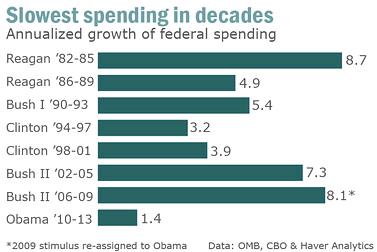
A financial columnist named Rex Nutting recently triggered a firestorm of controversy by claiming that Barack Obama is not a big spender.

Here’s the chart he prepared, which certainly seems to indicate that Obama is a fiscal conservative. Not only that, it shows that Republicans generally are the big spenders, while Democrats are frugal with other people’s money.

In some ways, these numbers don’t surprise me. I’ve explained before that Bush bears a lot of blame for the big expansion in the burden of government this century, and I’ve specifically pointed out that he deserves the blame for most of the higher spending from the 2009 fiscal year (which began October 1, 2008).

That being said, Nutting’s numbers seemed a bit nutty. Sorry, couldn’t resist. Nutting’s numbers actually seem accurate, including the fact that he decided that Obama should be responsible for $140 billion of the spending in Bush’s last fiscal year (a number he may have taken from one of my posts).

But sometimes accurate can be misleading, so I decided to dig into the data.

I went to the Historical Tables of the Budget from the Office of Management and Budget, and I calculated all the numbers for every President since LBJ (with the exception of Gerald Ford, whose 2-year reign didn’t seem worth including).

But I corrected a big mistake in Nutting’s analysis. I adjusted the numbers for inflation, using OMB’s GDP deflator.

As you can see, this changes the results. My chart isn’t as pretty, but based on the inflation-adjusted average annual growth of outlays, it shows that Clinton was the most frugal president, followed by the first President Bush and Obama.

With his guns-n-butter Keynesianism, it’s no big surprise that LBJ ranks last. And “W” also gets a very low grade.

But then I figured we should take interest payments out of the budget and focus on inflation-adjusted “primary spending.” After all, Presidents shouldn’t be held responsible for the national debt that existed before they took office.

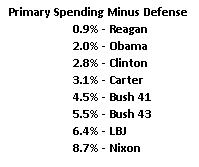
Looking at these numbers, it turns out that Obama does win the prize for being the most fiscally conservative president in recent memory. Reagan jumps to second place. Clinton is in third place, which won’t surprise people who watched this video, while W and LBJ again are in last place.

But I don’t want my Republican friends to get too angry with me, so let’s expand our analysis. Just as we don’t want to blame Presidents for net interest payments on debt that was accrued before their tenure, perhaps we should make sure they don’t get credit or blame for defense outlays that often are dictated by external events.

There’s obviously room for disagreement, but most people will agree that the Cold War and 9/11 meant higher defense spending, regardless of which party controlled the White House. Similarly, the collapse of the Soviet Empire inevitably meant lower military expenditures, regardless of whether Republicans or Democrats were in charge.

So let’s now look at primary spending after subtracting defense outlays (still adjusting for inflation, of course). All of a sudden, Reagan jumps to the top of the list by a comfortable margin. LBJ and W continue to score poorly, but Nixon takes over last place.

But it’s also worth noting that Obama still scores relatively well, beating Clinton for second place. Inflation-adjusted domestic spending (which is mostly what we’re measuring) has grown by 2.0 percent annually during his three years in office.

So does that mean Obama deserves re-election? Well, before you answer, I want to make one final calculation. Just as there are good reasons to exclude interest payments because they’re not something a president can control, we also should take a look at what spending would be if we don’t count the cost of bailouts.

To be sure, these types of expenditures can be controlled, but if we go with the assumption that the federal government was going to re-capitalize the banking system (whether using the good FDIC-resolution approach or the corrupt TARP approach), then it seems that Presidents shouldn’t get arbitrary blame or credit simply because some financial institutions failed during their tenure.

So let’s take the preceding set of numbers and subtract out the long-run numbers for deposit insurance, as well as the TARP outlays since 2009. And keep in mind that repayments of TARP monies (as well as deposit insurance premiums) show up in the budget as “negative spending.”

As you can see, this produces a remarkable result. All of a sudden, Obama drops from second to second-to-last.

This is because there was a lot of TARP spending in Bush’s last fiscal year (FY2009), which created an artificially high benchmark. And then repayments by banks during Obama’s fiscal years counted as negative spending.

When you subtract out the big TARP spending surge, as well as the repayments, then Bush 43 doesn’t look quite as bad (though still worse than Carter and Clinton), while Obama takes a big fall.

In other words, Obama’s track record does show that he favors an expanding social welfare state. Outlays on those programs have jumped by 7.0 percent annually. And that’s after adjusting for inflation! Not as bad as Nixon, but that’s not saying much since he was one of America’s most statist presidents.

Allow me to conclude with some caveats. None of the tables perfectly captures what any president’s fiscal record. Even my first table may be wrong if you want to blame or credit presidents for the inflation that occurs on their watch. And there certainly are strong arguments that bailout spending and defense spending are affected by presidential policies rather than external events.

And keep in mind that presidents don’t have full power over fiscal policy. The folks on Capitol Hill are the ones who actually enact the bills and appropriate the money.

Moreover, the federal government is akin to a big rusty cargo ship that is traveling in a certain direction, and presidents are like tugboats trying to nudge the boat one way or the other.

But enough equivocating. The four different tables at least show more clearly which presidents presided over faster-growing government or slower-growing government. More importantly, the various tables provide a good idea of where most of the new spending was taking place.

We can presumably say Reagan and Clinton were comparatively frugal, and we can also say that Nixon, LBJ, and Bush 43 were relatively profligate. As for Obama, I think his tugboat is pushing in the wrong direction, but it’s only apparent when you strip out the distorting budgetary impact of TARP.

Related posts:

Some Tea Party heroes (Part 1)

DEBT LIMIT – A GUIDE TO AMERICAN FEDERAL DEBT MADE EASY. Uploaded by debtlimitusa on Nov 4, 2011 A satirical short film taking a look at the national debt and how it applies to just one family. Watch the guy from the Ferris Bueller Superbowl Spot! Produced by Seth William Meier, DP/Edited by Craig Evans, […]

Some Tea Party heroes (Part 2)

Congressmen Tim Huelskamp on the debt ceiling I just don’t understand why people think we can go on and act like everything is okay when we have a trillion dollar deficit. Sometimes you run across some very wise words like I did the other day. Kansas Congressman Tim Huelskamp made the following comment on the […]


Open letter to President Obama (Part 180)


President Obama c/o The White House
1600 Pennsylvania Avenue NW
Washington, DC 20500

Dear Mr. President,

I know that you receive 20,000 letters a day and that you actually read 10 of them every day.I really do respect you for trying to get a pulse on what is going on out here.

When think of how simple the ten commandments are it is impossible to see how anyone can argue against them.

I read back on Dec 8, 2011 that Tony Perkins, president of Family Research Council, a social conservative advocacy organization, said in 2011 that President Obama has been “hostile” and “disdainful” toward Christianity. Rick Perry actually said President Obama had a war on religion. One of the most basic things that our founding fathers did is base our laws on the ten commandments. At the Supreme Court there is one depiction showing Moses sitting, holding two blank stone tablets. There is one depiction showing Moses standing holding one stone tablet. There are two stone tablets depicted with Roman Numbers I-X carved in the oak doors.

David Barton has studied the history of the founding of our country for many years and I wanted to share a portion of adocument he wrote concerning the 10 Commandments:


David Barton – 01/03/2001
(View the footnoted version on Liberty Council’s website)UNITED STATES DISTRICT COURT

EASTERN DISTRICT OF KENTUCKY

LONDON DIVISION

SARAH DOE and THOMAS DOE, on behalf

of themselves and their minor child, JAN DOE

Plaintiffs,

v Civil Action No. 99-508

HARLAN COUNTY SCHOOL DISTRICT;

DON MUSSELMAN, in his official capacity

as Superintendent of the Harlan Country

School District,

Defendents.

______________________________________________

AFFIDAVIT OF DAVID BARTON IN SUPPORT OF DEFENDANTS’ OPPOSITION TO PLAINTIFFS’ MOTION FOR CONTEMPT, OR, IN THE ALTERNATIVE, FOR SUPPLEMENTAL PRELIMINARY INJUNCTION

STATE OF TEXAS

COUNTY OF PARKER


WHICH ARE THE TEN COMMANDMENTS ?

18. In order to avoid the alleged misunderstanding that critics claim accompanies the reading of the Decalogue, for the purposes of this affidavit, these Commandments as listed in the Bible in Exodus 20:3-17 and Deuteronomy 5:7-21 (and in a shortened version in Exodus 34:14-28) will be summarized as

1. Have no other gods.

2. Have no idols.

3. Honor God’s name.

4. Honor the Sabbath day.

5. Honor your parents.

6. Do not murder.

7. Do not commit adultery.

8. Do not steal.

9. Do not perjure yourself.

10. Do not covet.


19. The following sections will fully demonstrate that each of these commandments was individually encoded in the civil laws, and consequently became a part of the common law of the various colonies.


______________

Thank you so much for your time. I know how valuable it is. I also appreciate the fine family that you have and your commitment as a father and a husband.

Sincerely,

Everette Hatcher III, 13900 Cottontail Lane, Alexander, AR 72002, ph 501-920-5733, lowcostsqueegees@yahoo.com