Open letter to President Obama (Part 190.1)

Johan Norberg – Free or Equal – Free to Choose 30 years later 5/5

Published on Jun 10, 2012 by

In 1980 economist and Nobel laureate Milton Friedman inspired market reform in the West and revolutions in the East with his celebrated television series “Free To Choose.”
Thirty years later, in this one-hour documentary, the young Swedish writer, analyst and Cato Institute Fellow Johan Norberg travels in Friedman’s footsteps to see what has
actually happened in the places Friedman’s ideas helped transform. In location after location Norberg examines the contemporary relevance of Friedman’s ideas in the 2011 world of globalization and financial crisis. Central to his examination are the perennial questions concerning power and prosperity, and the trade-offs between individual liberty and income equality.

___________


President Obama c/o The White House
1600 Pennsylvania Avenue NW
Washington, DC 20500

Dear Mr. President,

I know that you receive 20,000 letters a day and that you actually read 10 of them every day. I really do respect you for trying to get a pulse on what is going on out here.

If you want better cooperation among the countries then you better believe in free trade.

I have enjoyed reading this series of reviews by T. Kurt Jaros on Milton and Rose Friedman’s book “Free to Choose.” I hope you enjoy it as much as I did.

I have posted several transcripts and videos of the FREE TO CHOOSE film series on my blog. My favorite episodes are the “Failure of Socialism” and  “Power of the Market.” (This is the 1990 version but the 1980 version is good too.) Today with the increase of the welfare state maybe people should take a long look again at the episode “From Cradle to Grave.” 

Milton Friedman’s  view on vouchers for the schools needs to be heeded now more than ever too. “Created Equal” is probably the episode that I wanted you to see the most and I wrote several letters to you suggesting that.

T. Kurt Jaros is currently a Master’s student studying Systematic Theology at King’s College in London.  He holds a B.A. in Philosophy and Political Science cum laude and an M.A. in Christian Apologetics high honors from Biola University, an evangelical Christian university outside of Los Angeles.

He enjoys learning and thinking about theology, specifically historical theology, philosophical theology and philosophy of religion, and issues pertaining to monergism and synergism.  Additionally, he enjoys learning and thinking about political philosophy, economics, American political history, and campaigns.

The Tyranny of Controls: Part 2

T. Kurt Jaros on Economics

This is part of a series on Milton Friedman’s “Free to Choose.”

In my previous post I explained why the government should not regulate tariffs due to their harmful consequences toward consumers and innovation. This is part five of a series on Free to Choose by Milton Friedman. In the second chapter, Friedman writes on the role of government as it relates to trade. He makes a strong case for free trade, and specifically focuses on international trade.

Economic arrangements are attached to political arrangements among countries. “International free trade fosters harmonious relations among nations that differ in culture and institutions,” just as the same thing happens domestically at a smaller scale. Cooperation among the countries is the rule, and both sides end up happy if they believe they benefit. Otherwise the trade would not take place.

However, once government intervenes, problems begin to rise. If regulation occurs within a country, there is fierce lobbying between businesses to gain exemptions to regulations or for subsidies. The matter only gets worse when you consider trade agreements between two nations. If the government stayed out of regulation, there would be peace and harmony between the two businesses trading. Yet, instead, “high government officials jet around the world to trade conferences” and tension is developed. Instead of a completely private agreement between two companies, the collectivist bureaucrats of their countries represent the businesses.

It is then that the economic matters become political ones, and may even lead to deadly consequences: trade becomes a political weapon. Consider how our federal government uses trade agreements as leverage between Asian or South American countries. In my humble opinion, this just gives politicians another thing to keep busy about. They take time to have “hearings” that include irrelevant sources, use staffers to print up more paperwork and take time to find more politicians that can vote for their bill, etc. If there are no regulations, then there are no politicians wasting time and money harming the economy and diplomatic relations.

Friedman uses the section “Central Economic Planning” to provide historical evidence that wherever there is central economic planning, “ordinary citizens are in political fetters, have a low standard of living, and have little power to control their own destiny.” Consider the stark contrast between East and West Germany. These people were of the same heritage, same skills and same knowledge. But one side had to build a wall not to stop people from coming in, but to stop people from leaving. As Friedman was writing this book, the wall still existed! 

“Which [side] must man it today with armed guards, assisted by fierce dogs, minefields, and similar devices of devilish ingenuity in order to frustrate brace and desperate citizens who are willing to risk their lives to leave their communist paradise for the capitalist hell on the other side of the wall?”

We know too well where socialism and communism lead. Why can’t we see the reality that these philosophies are taking over our own country? In schools we’re taught that FDR’s New Deal was that great thing to help people get through the Great Depression. In reality, he was responsible for extending it. We’re taught that LBJ had this great vision for the Great Society and his war on poverty. In reality, he’s extended it. We think the Department of Education (signed into law by Jimmy Carter) is well intentioned.  Yet it is still central economic planning. That is socialism.

On the other side of the Berlin wall, there were brightly lit, not dull, stores. The streets were filled with cheerful people, not empty and quiet. The newspapers provided all sorts of opinions, not one. The buildings were nicely built, unlike on the other side, where “wartime destruction ha[d] not yet been repaired after more than three decades.” The beauty of our system of government is that we have something to say and can change the way our government regulates the economy. Although we may have to work through the political corruption, it’s possible to bring real change to the path of statism with an irate minority or by having that minority grow to become a majority.

________

Thank you so much for your time. I know how valuable it is. I also appreciate the fine family that you have and your commitment as a father and a husband.

Sincerely,

Everette Hatcher III, 13900 Cottontail Lane, Alexander, AR 72002, ph 501-920-5733, lowcostsqueegees@yahoo.com

Related posts:

Reason Magazine’s rightly praises Milton Friedman but makes foolish claim along the way

I must say that I have lots of respect for Reason Magazine and for their admiration of Milton Friedman. However, I do disagree with one phrase below. At the end of this post I will tell you what sentence it is. Uploaded by ReasonTV on Jul 28, 2011 There’s no way to appreciate fully the […]

Video clip:Milton Friedman discusses his view of numerous political figures and policy issues in (Part 1)

Milton Friedman on Hayek’s “Road to Serfdom” 1994 Interview 1 of 2 Uploaded by PenguinProseMedia on Oct 25, 2011 Says Federal Reserve should be abolished, criticizes Keynes. One of Friedman’s best interviews, discussion spans Friedman’s career and his view of numerous political figures and public policy issues. ___________________ Two Lucky People by Milton and Rose Friedman […]

Milton Friedman remembered at 100 years from his birth (Part 1)

What a great man Milton Friedman was. The Legacy of Milton Friedman November 18, 2006 Alexander Tabarrok Great economist by day and crusading public intellectual by night, Milton Friedman was my hero. Friedman’s contributions to economics are profound, the permanent income hypothesis, the resurrection of the quantity theory of money, and his magnum opus with […]

Milton Friedman videos and transcripts Part 7

Milton Friedman videos and transcripts Part 7 On my blog http://www.thedailyhatch.org I have an extensive list of posts that have both videos and transcripts of MiltonFriedman’s interviews and speeches. Here below is just small list of those and more can be accessed by clicking on “Milton Friedman” on the side of this page or searching […]

Milton Friedman at Hillsdale College 2006 (part 1)

Milton Friedman at Hillsdale College 2006 July 2006 Free to Choose: A Conversation with Milton Friedman Milton Friedman Economist Milton Friedman is a senior research fellow at the Hoover Institution at Stanford University and a professor emeritus of economics at the University of Chicago, where he taught from 1946-1976. Dr. Friedman received the Nobel Memorial […]

Open letter to President Obama (Part 116.6)

Milton Friedman said that getting George Bush I to be his vice president was his biggest mistake because he knew that Bush was not a true conservative and sure enough George Bush did raise taxes when he later became President. Below is a speech by George W. Bush honoring Milton Friedman: Milton Friedman Honored for […]

Transcript and video of Milton Friedman on Bill Clinton and Ronald Reagan (Part 1)

Below is a discussion from Milton Friedman on Bill Clinton and Ronald Reagan. February 10, 1999 | Recorded on February 10, 1999 audio, video, and blogs » uncommon knowledge PRESIDENTIAL REPORT CARD: Milton Friedman on the State of the Union with guest Milton Friedman Milton Friedman, Senior Research Fellow, Hoover Institution and Nobel Laureate in […]

Dan Mitchell’s article on Chili and video clip on Milton Friedman’s influence

Milton Friedman and Chile – The Power of Choice Uploaded by FreeToChooseNetwork on May 13, 2011 In this excerpt from Free To Choose Network’s “The Power of Choice (2006)”, we set the record straight on Milton Friedman’s dealings with Chile — including training the Chicago Boys and his meeting with Augusto Pinochet. Was the tremendous […]

Open letter to President Obama (Part 116.5)

Milton Friedman’s negative income tax explained by Friedman in 1968: President Obama c/o The White House 1600 Pennsylvania Avenue NW Washington, DC 20500 Dear Mr. President, I know that you receive 20,000 letters a day and that you actually read 10 of them every day. I really do respect you for trying to get a […]

“Friedman Friday” :“A Nobel Laureate on the American Economy” VTR: 5/31/77 Transcript and video clip (Part 5)

Milton Friedman on the American Economy (5 of 6)   Uploaded by donotswallow on Aug 9, 2009 THE OPEN MIND Host: Richard D. Heffner Guest: Milton Friedman Title: A Nobel Laureate on the American Economy VTR: 5/31/77 _____________________________________ Below is a transcipt from a portion of an interview that Milton Friedman gave on 5-31-77: Friedman: […]

This is how we need to act in order to get the economy to grow. (Part 23)

The Rahn Curve and the Growth-Maximizing Level of Government

These posts are all dealing with issues that President Obama did not help on in his first term. I am hopeful that he will continue to respond to my letters that I have written him and that he will especially reconsider his view on the following import issue which deals with growing our economy.This is how we need to act in order to get the economy to grow.

How to Get Economy Growing Fast

by Jeffrey A. Miron

Jeffrey Miron is senior lecturer and director of undergraduate studies at Harvard University and Senior Fellow at the Cato Institute. Miron is the author of Libertarianism, from A to Z and a member of Expert Insight.

Added to cato.org on May 26, 2012

This article appeared in CNN.com on May 26, 2012.

In a recent discussion of what his administration might accomplish, Mitt Romney claimed that “by virtue of the policies that we put in place, we’d get the unemployment rate down to 6%, and perhaps a little lower,” over a period of four years.

Is this goal attainable?

It is. Indeed, it is not that tough a task. If the United States avoids new growth-retarding policies, such as the tax hikes scheduled for January 1, the economy’s natural adjustments will lower unemployment substantially. These include downward adjustments in wages, reallocation of job-seekers from slower to faster growing sectors and regions, reduced in-migration plus increased out-migration, and withdrawals from the labor force.

Jeffrey Miron is senior lecturer and director of undergraduate studies at Harvard University and Senior Fellow at the Cato Institute. Miron is the author of Libertarianism, from A to Z and a member of Expert Insight.


More by Jeffrey A. Miron

These adjustments do not always work quickly or for everyone (not every former construction worker can become a computer technician). But history suggests the adjustments do occur, as they have since the recession began. Over the next four years, they will continue to lower the unemployment rate, if not to 6%, at least near that territory.

The more important task for either presidential candidate is restoring the economy to its prerecession growth path. Real GDP has historically grown about 3% per year, and major downturns have been followed by strong recoveries. Within two to three years, therefore, output is typically “back where it would have been.”

In this recession, the rapid recovery phase has so far been absent; real GDP is still well below where one would have predicted pre-2008, and with average growth under 3% since the recession ended, the gap grows larger every quarter.

So can Romney, or anyone, get us back to a higher growth rate? Yes. Here is a program that will restore U.S. economic performance:

  • Cancel all the tax increases scheduled to take effect at the end of 2012 and provide tax stability going forward. Make (all) the Bush tax cuts permanent. Repeal the alternative minimum tax. Eliminate the health care law’s increases in the hospital insurance tax. All this will stimulate in the short term and set the stage for long-term growth.
  • Reform the tax code by eliminating the misguided deductions, exemptions, credits and loopholes that distort incentives and reward special interests. These features include big-ticket items like the deductibility of mortgage interest and employer-paid health insurance premiums, plus myriad small but senseless other provisions.
  • Lower the corporate income tax rate. The U.S. corporate tax environment is one of the least business-friendly in the world. Driving investment overseas cannot be good policy.
  • Slow the growth of entitlements. The U.S. can afford a social safety net, but our current programs are not sustainable, even in a robustly growing economy. Everyone should agree, at a minimum, to cuts that are sufficient to prevent these programs — Medicaid, Medicare, and Social Security — from bankrupting the country.
  • Embrace immigration. Despite recent difficulties, the United States is still an attractive destination for those seeking a better life. By expanding immigration for low-skill workers, we restrain labor costs and reduce out-migration of manufacturing and other business. By easing immigration for high-skill workers — many of them trained in the United States at taxpayer expense — we get a return on our investment and retain industrious and innovative people.
  • Scale back military involvements around the world. A strong national defense makes sense, but it must focus on protecting the United States, not paying for Europe’s defense or trying to force democracy down the throats of countries that are not receptive.
  • Cease the campaign against carbon-based fuels. Green energy may have its day, but only when coal, oil and gas become truly scarce. In the foreseeable future, traditional energy is much cheaper, and subsidies for alternative energy are a waste.
  • Stop scapegoating the rich and pretending that tax-hikes on the 1% can balance the budget. Everyone knows the numbers do not add up.
  • Respect capitalism. Anti-business rhetoric, which casts all success as undeserved, and which fails to recognize the improvements in material well-being that result from entrepreneurial success, just drive away talented people and guarantee our economic demise.

If the United States adopts these policies, it will not only attain Romney’s 6% unemployment goal, it will once again be the economic beacon of the world.

What’s wrong with that?

Remembering Francis Schaeffer at 100 (Part 11)

The Gospel of Christ in the pages of the Bible

_______________________

 This year Francis Schaeffer would have turned 100 on Jan 30, 2012. I remember like yesterday when I first was introduced to his books. I was even more amazed when I first saw his films. I was so influenced by them that I bought every one of his 30 something books and his two film series. Chuck Colson’s website www.breakpoint.org  and I was directed from there to Probe’s website where I found this great article below. I will share it in 4 parts. Todd Kappelman is the author and here is some info on him and Probe.

Todd KappelmanTodd A. Kappelman is a field associate with Probe Ministries. He is a graduate of Dallas Baptist University (B.A. and M.A.B.S., religion and Greek), and the University of Dallas (M.A., philosophy/humanities). Currently he is pursuing a Ph.D. in philosophy at the University of Dallas. He has served as assistant director of the Trinity Institute, a study center devoted to Christian thought and inquiry. He has been the managing editor of The Antithesis, a bi-monthly publication devoted to the critique of foreign and independent film. His central area of expertise is Continental philosophy (especially nineteenth and twentieth century) and postmodern thought.

What is Probe?

Probe Ministries is a non-profit ministry whose mission is to assist the church in renewing the minds of believers with a Christian worldview and to equip the church to engage the world for Christ. Probe fulfills this mission through our Mind Games conferences for youth and adults, our 3-minute daily radio program, and our extensive Web site at www.probe.org.

Further information about Probe’s materials and ministry may be obtained by contacting us at:

Probe Ministries
2001 W. Plano Parkway, Suite 2000
Plano TX 75075
(972) 941-4565
info@probe.org
www.probe.org
Copyright information

This is the fifth part:

The Need to Read: Francis Schaeffer Print E-mail

Todd Kappelman Written by Todd Kappelman

The Need to Read series began several months ago with a program on C.S. Lewis . The rationale for this series is that many of the great writers who have helped many Christians mature are now either unknown or neglected by many who could use these authors insights into the faith.

This installment focuses on Francis Schaeffer (1912-1984), one of the most recognized and respected Christian authors of the twentieth century.

Francis Schaeffer and “The Man Without a Bible”

The purpose of this discussion of the works of Francis Schaeffer is that we hope Christians will once again turn to this great apologist for the Christian faith and learn from him. In closing, we will address one of his lesser known works titled Death In The City. In chapter seven, The Man Without a Bible, Schaeffer offers some advice for Christians living in a post-Christian world. He argues very convincingly that the church in America has largely turned away from God and the knowledge of the things of God. This occurred in just a few short decades, from the 1920s to the 1960s.{12}

We must always bear in mind that many people do not believe that the Bible is inspired or authoritative. For these people the Bible is just another book. The dismantling of biblical authority has been very efficient in the last 150 years. Very few of our major secular universities treat the Bible as authoritative anymore. Yet many of these universities were founded at a time when no one would have doubted the importance of the Holy Scriptures. The majority of men at the end of this century hold vastly different views about the Bible than did their ancestors at the close of the previous century. So, how do we share the Christian message with the man without the Bible?

Schaeffer cites three instances where Paul spoke to non-Christians and did not appeal to the Scriptures. These are found in Acts 14:15-17; 17:16-32, and Romans 1:18-2:16. The reason that Paul did not use the Scriptures on these three occasions is that the people he was addressing did not recognize the claims that the Holy Scriptures made on their lives. In approaching these individuals, Paul appealed to the moral knowledge that men possess as a feature of their created being. Schaeffer refers to this as the manishness of man.

In Romans 1:18 we have the description of Gods wrath being poured out on man. Schaeffer believes that this is an ideal place to approach modern man. We may tell the modern non-believer that he knows that God exists and that he has suppressed this knowledge. (The knowledge of God must be understood here as natural revelation, and not the gospel.) Paul means that each and every man, regardless of what he says, knows that God exists. This knowledge of God that the non-believer possesses is supplemented by the moral argument for Gods existence. The fact that men hold beliefs about right and wrong betrays the fact that they know that God necessarily exists. Men willingly suppress this knowledge of God and this brings His wrath.

The man without the Bible has suppressed the natural revelation of God, not the special revelation found in the Scriptures. The man without the Bible has not followed his initial knowledge of God to the proper conclusions and therefore remains lost. The many men without the Bible present both an opportunity and a challenge for the Christian. The opportunity is that this man is lost and Christians can share their faith with him. The challenge is in showing these lost people how the world around them and the human nature within them point toward the existence of God.

Francis Schaeffer was wonderful at discussing Christian truths with non-believers without appealing to the Scriptures. It is our loss if we do not familiarize ourselves with, and use, the works of one of this countrys greatest Christian thinkers.

Notes

  1. J.I. Packer, forward to Francis A. Schaeffer Trilogy, by Francis Schaeffer (Wheaton: Crossway Publishers, 1990), xiv.
  2. Hosea 4:6.
  3. Francis Schaeffer, The God Who Is There in Francis A. Schaeffer Trilogy (Wheaton: Crossway Publishers, 1990), 109-114.
  4. Ibid., 196.
  5. Ibid., 217-224.
  6. Ibid., 225-236.
  7. Ibid., 261-270.
  8. Ibid., 207-208.
  9. Francis Schaeffer, He Is There and He Is Not Silent in Francis A. Schaeffer Trilogy (Wheaton: Crossway Publishers, 1990), 277.
  10. Ibid., 275-290.
  11. Ibid., 291-302.
  12. Ibid., 211.

©1999 Probe Ministries.

schaeffer

Related posts:

Francis Schaeffer would be 100 years old this year (Schaeffer Sunday)

Dr. Francis Schaeffer – Extra – Interview – Part 2 Francis Schaeffer had a big impact on me in the late 1970′s and I have been enjoying his books and films ever since. Here is great video clip of an interview and below is a fine article about him. Francis Schaeffer 1912-1984 Christian Theologian, Philosopher, […]

Francis Schaeffer’s “How should we then live?” Video and outline of episode 10 “Final Choices” (Schaeffer Sundays)

E P I S O D E 1 0 How Should We Then Live 10#1 FINAL CHOICES I. Authoritarianism the Only Humanistic Social Option One man or an elite giving authoritative arbitrary absolutes. A. Society is sole absolute in absence of other absolutes. B. But society has to be led by an elite: John Kenneth […]

Fellow admirer of Francis Schaeffer, Michele Bachmann quits presidential race

What Ever Happened to the Human Race? Bachmann was a student of the works of Francis Schaeffer like I am and I know she was pro-life because of it. (Observe video clip above and picture of Schaeffer.) I hated to see her go.  DES MOINES, Iowa — Last night, Minnesota Rep. Michele Bachmann vowed to […]

Francis Schaeffer’s “How should we then live?” Video and outline of episode 9 “The Age of Personal Peace and Affluence” (Schaeffer Sundays)

E P I S O D E 9 How Should We Then Live 9#1 T h e Age of Personal Peace and Afflunce I. By the Early 1960s People Were Bombarded From Every Side by Modern Man’s Humanistic Thought II. Modern Form of Humanistic Thought Leads to Pessimism Regarding a Meaning for Life and for Fixed […]

Francis Schaeffer’s “How should we then live?” Video and outline of episode 8 “The Age of Fragmentation” (Schaeffer Sundays)

E P I S O D E 8 How Should We Then Live 8#1 I saw this film series in 1979 and it had a major impact on me. T h e Age of FRAGMENTATION I. Art As a Vehicle Of Modern Thought A. Impressionism (Monet, Renoir, Pissarro, Sisley, Degas) and Post-Impressionism (Cézanne, Van Gogh, Gauguin, […]

Francis Schaeffer’s “How should we then live?” Video and outline of episode 7 “The Age of Non-Reason” (Schaeffer Sundays)

E P I S O D E 7 How Should We Then Live 7#1 I am thrilled to get this film series with you. I saw it first in 1979 and it had such a big impact on me. Today’s episode is where we see modern humanist man act on his belief that we live […]

Francis Schaeffer would be 100 years old this year (Schaeffer Sunday)

Dr. Francis Schaeffer – Extra – Interview – Part 2 Francis Schaeffer had a big impact on me in the late 1970′s and I have been enjoying his books and films ever since. Here is great video clip of an interview and below is a fine article about him. Francis Schaeffer 1912-1984 Christian Theologian, Philosopher, […]

Francis Schaeffer’s “How should we then live?” Video and outline of episode 6 “The Scientific Age” (Schaeffer Sundays)

E P I S O D E 6 How Should We Then Live 6#1 I am sharing with you a film series that I saw in 1979. In this film Francis Schaeffer asserted that was a shift in Modern Science. A. Change in conviction from earlier modern scientists.B. From an open to a closed natural system: […]

Francis Schaeffer’s “How should we then live?” Video and outline of episode 5 “The Revolutionary Age” (Schaeffer Sundays)

E P I S O D E 5 How Should We Then Live 5-1 I was impacted by this film series by Francis Schaeffer back in the 1970′s and I wanted to share it with you. Francis Schaeffer noted, “Reformation Did Not Bring Perfection. But gradually on basis of biblical teaching there was a unique improvement. A. […]

Francis Schaeffer’s “How should we then live?” Video and outline of episode 4 “The Reformation” (Schaeffer Sundays)

How Should We Then Live 4-1 I was impacted by this film series by Francis Schaeffer back in the 1970′s and I wanted to share it with you. Schaeffer makes three key points concerning the Reformation: “1. Erasmian Christian humanism rejected by Farel. 2. Bible gives needed answers not only as to how to be right with […]

Francis Schaeffer’s “How should we then live?” Video and outline of episode 3 “The Renaissance”

How Should We Then Live 3-1 I was impacted by this film series by Francis Schaeffer back in the 1970′s and I wanted to share it with you. Schaeffer really shows why we have so many problems today with this excellent episode. He noted, “Could have gone either way—with emphasis on real people living in […]

Francis Schaeffer’s “How should we then live?” Video and outline of episode 2 “The Middle Ages” (Schaeffer Sundays)

How Should We Then Live 2-1 I was impacted by this film series by Francis Schaeffer back in the 1970′s and I wanted to share it with you. Schaeffer points out that during this time period unfortunately we have the “Church’s deviation from early church’s teaching in regard to authority and the approach to God.” […]

Francis Schaeffer’s “How should we then live?” Video and outline of episode 1 “The Roman Age” (Schaeffer Sundays)

How Should We Then Live 1-1 Today I am starting a series that really had a big impact on my life back in the 1970′s when I first saw it. There are ten parts and today is the first. Francis Schaeffer takes a look at Rome and why it fell. It fell because of inward […]

Andy Rooney was an atheist

How Now Shall We LiveClick here to purchase Chuck Colson and Nancy Pearcey’s How Now Shall We Live?, dedicated to Francis Schaeffer.

Click here for a list of Francis Schaeffer’s greatest works, from the Colson Center store!
SchaefferBooks

Atheists confronted here on www.thedailyhatch.org

If you want to check out some of the past posts where atheists have been confronted then check out these links below.

Back in March of 2011 my sons, Hunter and Wilson were  attending church on a Sunday at Grace Community Church where John MacArthur preached. They actually got to visit with him briefly. Here is a clip of him from “Larry King Live.”

In the Arkansas Times Blog today there is a post by “mudturtle” that goes like this:

Genesis is filled with Creation myths, myths that appear in one form or another and virtually every culture. Do you want your kid’s teacher talking about the myth of “Adam and Eve”? Leviticus is down right scary, but it is a good place to point out the inconsistencies in Bible and how contrary they are to our common life.

The Gospels? Like 5 blind men describing an elephant. What were Matthew, Mark, Luke and John thinking?

_______________________

I understand how skeptics love to take pot shots at the Bible, but let us take a look at some of the facts.

Craig L. Blomberg records a number of archaeological finds that coincide with events recorded in the gospel according to John:

Archaeologists have unearthed the five porticoes of the pool of Bethesda by the Sheep Gate (John 5:2), the pool of Siloam (9:1-7), Jacob’s well at Sychar (4:5), the ‘Pavement’ (Gabbatha) where Pilate tried Jesus (19:13), and Solomon’s porch in the temple precincts (10:22-23)… Since then, discovery of an ossuary (bone-box) of a crucified man named Johanan from first-century Palestine confirms that nails were driven in his ankles, as in Christ’s; previously some skeptics thought that the Romans used only ropes to affix the legs of condemned men to their crosses. And less than five years ago, in 1990, the burial grounds of Caiaphas, the Jewish high priest, and his family were uncovered in Jerusalem. These and numerous other details create a favorable impression of the Gospel’s trustworthiness in the areas in which they can be tested.

Sir William Ramsay, famed archaeologist, began a study of Asia Minor with little regard for the book of Acts. He later wrote:

I may fairly claim to have entered on this investigation without prejudice in favor of the conclusion which I shall now seek to justify to the reader. On the contrary, I began with a mind unfavorable to it,… It did not then lie in my line of life to investigate the subject minutely; but more recently I found myself brought into contact with the Book of Acts as an authority for the topography, antiquities and society of Asia Minor. It was gradually borne upon me that in various details the narrative showed marvelous truth.

________________________________________

I wrote the famous atheist Anthony Flew a series of letters during the 1990’s and he was kind to answer several of them. I also sent him several cassette tapes and video tapes of Adrian Rogers messages. I will start a new series on this subject and post his responses. Below is a video clip filmed close to end of Dr Flew’s life.

Adrian Rogers:

pastor_wfl

Related posts:

Review of Carl Sagan book (Part 4 of series on Evolution)jh68

Review of Carl Sagan book (Part 4 of series on Evolution) The Long War against God-Henry Morris, part 5 of 6 Uploaded by FLIPWORLDUPSIDEDOWN3 on Aug 30, 2010 http://www.icr.org/ http://store.icr.org/prodinfo.asp?number=BLOWA2 http://store.icr.org/prodinfo.asp?number=BLOWASG http://www.fliptheworldupsidedown.com/blog _______________________ This is a review I did a few years ago. THE DEMON-HAUNTED WORLD: Science as a Candle in the Dark by Carl […]

Review of Carl Sagan book (Part 3 of series on Evolution)

Review of Carl Sagan book (Part 3 of series on Evolution) The Long War against God-Henry Morris, part 4 of 6 Uploaded by FLIPWORLDUPSIDEDOWN3 on Aug 30, 2010 http://www.icr.org/ http://store.icr.org/prodinfo.asp?number=BLOWA2 http://store.icr.org/prodinfo.asp?number=BLOWASG http://www.fliptheworldupsidedown.com/blog ______________________________________ I was really enjoyed this review of Carl Sagan’s book “Pale Blue Dot.” Carl Sagan’s Pale Blue Dot by Larry Vardiman, Ph.D. […]

Dr. Bergman: “Evolution teaches that the living world has no plan or purpose except survival”(Section B of Part 2 of series on Evolution)

Dr. Bergman: “Evolution teaches that the living world has no plan or purpose except survival”(Section B of Part 2 of series on Evolution) The Long War against God-Henry Morris, part 3 of 6 Uploaded by FLIPWORLDUPSIDEDOWN3 on Aug 30, 2010 http://www.icr.org/ http://store.icr.org/prodinfo.asp?number=BLOWA2 http://store.icr.org/prodinfo.asp?number=BLOWASG http://www.fliptheworldupsidedown.com/blog ________________________________________ Is there any purpose in life? Evolution is clear on […]

Dr. Bergman: “Evolution teaches that the living world has no plan or purpose except survival”(Section A of Part 2 of series on Evolution)

Dr. Bergman: “Evolution teaches that the living world has no plan or purpose except survival”(Section A of Part 2 of series on Evolution) The Long War against God-Henry Morris, part 2 of 6 Uploaded by FLIPWORLDUPSIDEDOWN3 on Aug 30, 2010 http://www.icr.org/ http://store.icr.org/prodinfo.asp?number=BLOWA2 http://store.icr.org/prodinfo.asp?number=BLOWASG http://www.fliptheworldupsidedown.com/blog Is there any purpose in life? Evolution is clear on this […]

THREE TELLING ARGUMENTS AGAINST EVOLUTION by Adrian Rogers (Part 1 of series on Evolution)jh57

The Long War against God-Henry Morris, part 1 of 6 Uploaded by FLIPWORLDUPSIDEDOWN3 on Aug 30, 2010 http://www.icr.org/ http://store.icr.org/prodinfo.asp?number=BLOWA2 http://store.icr.org/prodinfo.asp?number=BLOWASG http://www.fliptheworldupsidedown.com/blog _____________________________________ Do you think the theory of evolution is true? Check out this short article by Adrian Rogers: “O Timothy, keep that which is committed to thy trust, avoiding profane and vain babblings, and […]

Atheists confronted: How I confronted Carl Sagan the year before he died jh47

In today’s news you will read about Kirk Cameron taking on the atheist Stephen Hawking over some recent assertions he made concerning the existence of heaven. Back in December of 1995 I had the opportunity to correspond with Carl Sagan about a year before his untimely death. Sarah Anne Hughes in her article,”Kirk Cameron criticizes […]

Christopher Hitchens’ debate with Douglas Wilson (Part 12)

Christopher Hitchens vs. Douglas Wilson Debate at Westminster Theological Seminary, Part 12 of 12 Douglas Wilson I am afraid your argument is tangled up with greater difficulties than the ethnicity of the Samaritan, and so that issue really need not detain us any longer. I have been asking you to provide a warrant for morality, […]


Francis Schaeffer’s own words concerning our view of acceptable killing versus Stalin, Mao and Hitler

Francis Schaeffer pictured above.

Pt 1 of 2 Listen to this Important Message by Francis Schaeffer

Published on Sep 30, 2013

This message “A Christian Manifesto” was given in 1982 by the late Christian Philosopher Francis Schaeffer when he was age 70 at D. James Kennedy’s Corral Ridge Presbyterian Church.
Listen to this important message where Dr. Schaeffer says it is the duty of Christians to disobey the government when it comes in conflict with God’s laws. So many have misinterpreted Romans 13 to mean unconditional obedience to the state. When the state promotes an evil agenda and anti-Christian statues we must obey God rather than men. Acts
I use to watch James Kennedy preach from his TV pulpit with great delight in the 1980’s. Both of these men are gone to be with the Lord now. We need new Christian leaders to rise up in their stead.
To view Part 2 See Francis Schaeffer Lecture- Christian Manifesto Pt 2 of 2 video
The religious and political freedom’s we enjoy as Americans was based on the Bible and the legacy of the Reformation according to Francis Schaeffer. These freedoms will continue to diminish as we cast off the authority of Holy Scripture.
In public schools there is no other view of reality but that final reality is shaped by chance.
Likewise, public television gives us many things that we like culturally but so much of it is mere propaganda shaped by a humanistic world and life view.

_____________________________

Pt 2 -Listen to this Important Message by Francis Schaeffer

I was able to watch Francis Schaeffer deliver a speech on a book he wrote called “A Christian Manifesto” and I heard him in several interviews on it in 1981 and 1982. I listened with great interest since I also read that book over and over again. Below is a portion of one of Schaeffer’s talks  on a crucial subject that is very important today too.

A Christian Manifesto
by Dr. Francis A. Schaeffer
This address was delivered by the late Dr. Schaeffer in 1982 at the Coral Ridge Presbyterian Church, Fort Lauderdale, Florida. It is based on one of his books, which bears the same title.
Stalin,Mao,and Hitler versus our  view in the USA today of acceptable killing 
NEWSWEEK January 11 1982 HOW LIFE BEGINS THE BOMB CLAY
—–

The January 11 Newsweek has an article about the baby in the womb. The first 5 or 6 pages are marvelous. If you haven’t seen it, you should see if you can get that issue. It’s January 11 and about the first 5 or 6 pages show conclusively what every biologist has known all along, and that is that human life begins at conception. There is no other time for human life to begin, except at conception. Monkey life begins at conception. Donkey life begins at conception. And human life begins at conception. Biologically, there is no discussion — never should have been — from a scientific viewpoint. I am not speaking of religion now. And this 5 or 6 pages very carefully goes into the fact that human life begins at conception. But you flip the page and there is this big black headline, “But is it a person?” And I’ll read the last sentence, “The problem is not determining when actual human life begins, but when the value of that life begins to out weigh other considerations, such as the health or even the happiness of the mother.”
We are not just talking about the health of the mother (it’s a propaganda line), or even the happiness of the mother. Listen! Spell that out! It means that the mother, for her own hedonistic happiness — selfish happiness — can take human life by her choice, by law. Do you understand what I have said? By law, on the basis of her individual choice of what makes her happy. She can take what has been declared to be, in the first five pages [of the article], without any question, human life. In other words, they acknowledge that human life is there, but it is an open question as to whether it is not right to kill that human life if it makes the mother happy.
And basically that is no different than Stalin, Mao, or Hitler, killing who they killed for what they conceived to be the good of society. There is absolutely no line between the two statements — no absolute line, whatsoever. One follows along: Once that it is acknowledged that it is human life that is involved (and as I said, this issue of Newsweek shows conclusively that it is) the acceptance of death of human life in babies born or unborn, opens the door to the arbitrary taking of any human life. From then on, it’s purely arbitrary.
It was this view that opened the door to all that followed in Germany prior to Hitler. It’s an interesting fact here that the only Supreme Court in the Western World that has ruled against easy abortion is the West German Court. The reason they did it is because they knew, and it’s clear history, that this view of human life in the medical profession and the legal profession combined, before Hitler came on the scene, is what opened the way for everything that happened in Hitler’s Germany. And so, the German Supreme Court has voted against easy abortion because they know — they know very well where it leads.
Related posts:

Francis Schaeffer’s prayer for us in USA

 Francis Schaeffer: “Whatever Happened to the Human Race” (Episode 1) ABORTION OF THE HUMAN RACE Published on Oct 6, 2012 by AdamMetropolis The 45 minute video above is from the film series created from Francis Schaeffer’s book “Whatever Happened to the Human Race?” with Dr. C. Everett Koop. This book  really helped develop my political views […]

Francis Schaeffer’s “How should we then live?” Video and outline of episode 10 “Final Choices” (Schaeffer Sundays)

E P I S O D E 1 0   Dr. Francis Schaeffer – Episode X – Final Choices 27 min FINAL CHOICES I. Authoritarianism the Only Humanistic Social Option One man or an elite giving authoritative arbitrary absolutes. A. Society is sole absolute in absence of other absolutes. B. But society has to be […]

Francis Schaeffer’s “How should we then live?” Video and outline of episode 9 “The Age of Personal Peace and Affluence” (Schaeffer Sundays)

E P I S O D E 9 Dr. Francis Schaeffer – Episode IX – The Age of Personal Peace and Affluence 27 min T h e Age of Personal Peace and Afflunce I. By the Early 1960s People Were Bombarded From Every Side by Modern Man’s Humanistic Thought II. Modern Form of Humanistic Thought Leads […]

Francis Schaeffer’s “How should we then live?” Video and outline of episode 8 “The Age of Fragmentation” (Schaeffer Sundays)

E P I S O D E 8 Dr. Francis Schaeffer – Episode VIII – The Age of Fragmentation 27 min I saw this film series in 1979 and it had a major impact on me. T h e Age of FRAGMENTATION I. Art As a Vehicle Of Modern Thought A. Impressionism (Monet, Renoir, Pissarro, Sisley, […]

Francis Schaeffer’s “How should we then live?” Video and outline of episode 7 “The Age of Non-Reason” (Schaeffer Sundays)

E P I S O D E 7 Dr. Francis Schaeffer – Episode VII – The Age of Non Reason I am thrilled to get this film series with you. I saw it first in 1979 and it had such a big impact on me. Today’s episode is where we see modern humanist man act […]

Francis Schaeffer’s “How should we then live?” Video and outline of episode 6 “The Scientific Age” (Schaeffer Sundays)

E P I S O D E 6 How Should We Then Live 6#1 Uploaded by NoMirrorHDDHrorriMoN on Oct 3, 2011 How Should We Then Live? Episode 6 of 12 ________ I am sharing with you a film series that I saw in 1979. In this film Francis Schaeffer asserted that was a shift in […]

Francis Schaeffer’s “How should we then live?” Video and outline of episode 5 “The Revolutionary Age” (Schaeffer Sundays)

E P I S O D E 5 How Should We Then Live? Episode 5: The Revolutionary Age I was impacted by this film series by Francis Schaeffer back in the 1970′s and I wanted to share it with you. Francis Schaeffer noted, “Reformation Did Not Bring Perfection. But gradually on basis of biblical teaching there […]

Francis Schaeffer’s “How should we then live?” Video and outline of episode 4 “The Reformation” (Schaeffer Sundays)

Dr. Francis Schaeffer – Episode IV – The Reformation 27 min I was impacted by this film series by Francis Schaeffer back in the 1970′s and I wanted to share it with you. Schaeffer makes three key points concerning the Reformation: “1. Erasmian Christian humanism rejected by Farel. 2. Bible gives needed answers not only as to […]

“Schaeffer Sundays” Francis Schaeffer’s “How should we then live?” Video and outline of episode 3 “The Renaissance”

Francis Schaeffer’s “How should we then live?” Video and outline of episode 3 “The Renaissance” Francis Schaeffer: “How Should We Then Live?” (Episode 3) THE RENAISSANCE I was impacted by this film series by Francis Schaeffer back in the 1970′s and I wanted to share it with you. Schaeffer really shows why we have so […]

Francis Schaeffer’s “How should we then live?” Video and outline of episode 2 “The Middle Ages” (Schaeffer Sundays)

  Francis Schaeffer: “How Should We Then Live?” (Episode 2) THE MIDDLE AGES I was impacted by this film series by Francis Schaeffer back in the 1970′s and I wanted to share it with you. Schaeffer points out that during this time period unfortunately we have the “Church’s deviation from early church’s teaching in regard […]

Francis Schaeffer’s “How should we then live?” Video and outline of episode 1 “The Roman Age” (Schaeffer Sundays)

Francis Schaeffer: “How Should We Then Live?” (Episode 1) THE ROMAN AGE   Today I am starting a series that really had a big impact on my life back in the 1970′s when I first saw it. There are ten parts and today is the first. Francis Schaeffer takes a look at Rome and why […]

Francis Schaeffer: “Whatever Happened to the Human Race” (Episode 5) TRUTH AND HISTORY

Francis Schaeffer: “Whatever Happened to the Human Race” (Episode 5) TRUTH AND HISTORY Published on Oct 7, 2012 by AdamMetropolis This crucial series is narrated by the late Dr. Francis Schaeffer and former Surgeon General Dr. C. Everett Koop. Today, choices are being made that undermine human rights at their most basic level. Practices once […]

Francis Schaeffer: “Whatever Happened to the Human Race” (Episode 4) THE BASIS FOR HUMAN DIGNITY

The opening song at the beginning of this episode is very insightful. Francis Schaeffer: “Whatever Happened to the Human Race” (Episode 4) THE BASIS FOR HUMAN DIGNITY Published on Oct 7, 2012 by AdamMetropolis This crucial series is narrated by the late Dr. Francis Schaeffer and former Surgeon General Dr. C. Everett Koop. Today, choices […]

Francis Schaeffer: “Whatever Happened to the Human Race” (Episode 3) DEATH BY SOMEONE’S CHOICE

Francis Schaeffer: “Whatever Happened to the Human Race” (Episode 3) DEATH BY SOMEONE’S CHOICE Published on Oct 6, 2012 by AdamMetropolis This crucial series is narrated by the late Dr. Francis Schaeffer and former Surgeon General Dr. C. Everett Koop. Today, choices are being made that undermine human rights at their most basic level. Practices […]

Francis Schaeffer: “Whatever Happened to the Human Race?” (Episode 2) SLAUGHTER OF THE INNOCENTS

Francis Schaeffer: “Whatever Happened to the Human Race?” (Episode 2) SLAUGHTER OF THE INNOCENTS Published on Oct 6, 2012 by AdamMetropolis This crucial series is narrated by the late Dr. Francis Schaeffer and former Surgeon General Dr. C. Everett Koop. Today, choices are being made that undermine human rights at their most basic level. Practices […]

Francis Schaeffer: “Whatever Happened to the Human Race” (Episode 1) ABORTION OF THE HUMAN RACE

It is not possible to know where the pro-life evangelicals are coming from unless you look at the work of the person who inspired them the most. That person was Francis Schaeffer.  I do care about economic issues but the pro-life issue is the most important to me. Several years ago Adrian Rogers (past president of […]

The following essay explores the role that Francis Schaeffer played in the rise of the pro-life movement. It examines the place of How Should We Then Live?, Whatever Happened to the Human Race?, and A Christian Manifesto in that process.

This essay below is worth the read. Schaeffer, Francis – “Francis Schaeffer and the Pro-Life Movement” [How Should We Then Live?, Whatever Happened to the Human Race?, A Christian Manifesto] Editor note: <p> </p> [The following essay explores the role that Francis Schaeffer played in the rise of the pro-life movement.  It examines the place of […]

Who was Francis Schaeffer? by Udo Middelmann

Great article on Schaeffer. Who was Dr. Francis A. Schaeffer? By Francis Schaeffer The unique contribution of Dr. Francis Schaeffer on a whole generation was the ability to communicate the truth of historic Biblical Christianity in a way that combined intellectual integrity with practical, loving care. This grew out of his extensive understanding of the Bible […]

Political arguments against higher taxes from Dan Mitchell

Republicans would be stupid to raise taxes.

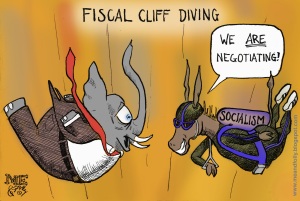
The politicians claim that they are negotiating about how best to reduce the deficit. That irks me because our fiscal problem is excessive government spending. Red ink is merely a symptom of that underlying problem.

But that’s a rhetorical gripe. My bigger concern is that politicians are prevaricating. They’re really talking about higher taxes in order to enable a bigger burden of government spending, not less red ink. I make this point in an interview on Fox Business Network.

This is the point where I often elaborate on issues raised in the interview, but let’s instead build on the discussion to look at policy and political reasons why the GOP  should not surrender to Obama’s tax demands as part of fight over the fiscal cliff.

Here are the policy arguments against higher taxes.

1. There is no need for higher taxes since the budget can be balanced merely by restraining spending so that it grows 2.5 percent each year.

According to the most recent Congressional Budget Office fiscal estimate, the 2001 and 2003 tax cuts can be made permanent and red ink can be wiped out in just 10 years so long as politicians simply control the growth of federal spending so that outlays don’t grow faster than 2.5 percent each year. Other nations have shown that this type of spending restraint is very successful, while no nation has ever taxed its way to fiscal success.

2. Since the tax increases stick and the supposed spending cuts quickly evaporate, budget deals that raise taxes have a long history of failure.

Last year, in an article that was designed to browbeat Republicans for being unreasonable about tax hikes, a New York Times columnist inadvertently revealed that the only budget deal that actually led to a fiscal surplus was the 1997 agreement that lowered taxes instead of increasing them. None of the tax-hike budget deals ever resulted in a balanced budget.

3. America’s short-run fiscal problem is the result of too much government spending, not inadequate tax revenue.

Because of large spending increases during the Bush-Obama years, the burden of federal spending has doubled in just 11 years. This is why today’s fiscal numbers look so grim. Some argue that tax revenues are below their long-run average of 18 percent of GDP, but CBO estimates show that tax collections will be above the long-run average by the end of the decade even if all the 2001 and 2003 tax cuts are made permanent. And the White House recently admitted this was true as well.

4. America’s long-run fiscal problem is the result of too much government spending, not inadequate tax revenue.

In the absence of entitlement reform, the burden of federal spending will double, measured as a share of GDP, and the overall burden of government will exceed the levels that currently exist in every single European welfare state. Tax revenues also will climb as a share of GDP thanks to “real-bracket creep,” so there is no plausible argument that the long-run problem is inadequate revenue.

5. The European evidence shows that genuine spending cuts are the only effective way of solving a fiscal crisis.

Nations such as Italy, Greece, France, Spain, Ireland, Portugal, and the United Kingdom have imposed massive tax increases, yet their fiscal problems remain. Indeed, in some cases, these nations are in worse shape because the tax hikes contributed to anemic economic performances.  Some of these countries have belatedly begun to trim their spending burdens, but generally by relying on transitory savings rather than permanent reductions in the obligations of the welfare state. The only relative success stories on the continent are Switzerland, which never got into trouble in the first place thanks to a spending cap, and the Baltic nations, which imposed genuine spending cuts when the crisis first began and now are reaping the rewards of that fiscal discipline.

And here are the political arguments against higher taxes.

1. With Republicans easily retaining control of the House of Representatives, the election was not a mandate to raise taxes.

Nobody argued that there was a mandate to raise taxes before the election, when Republicans controlled the House and Democrats controlled the White House and Senate, so how can there be a mandate to raise taxes today since the election didn’t change anything? Some assert that Obama has a mandate since he campaigned in favor of his soak-the-rich tax plan. That’s true, but House Republicans prevailed after campaigning against class-warfare taxes, so that’s a wash.

2. The GOP prevailed in the exact same tax battle back in 2010, before they controlled the House and when they had fewer seats in the Senate.

This is not the first fiscal cliff battle. The same fight took place at the end of 2010. At the time, Democrats has an overwhelming majority in the House and even stronger control of the Senate than they do today. But by holding firm and staying united, Republicans prevailed. If they lose today, when they have far more political power, it will be a damning indictment of their incompetence.

3. Acquiescing to tax hikes would set a tone of weakness for 2013 and 2014, much as the 2011 “shutdown fight” needlessly gave Obama the upper hand on fiscal battles in 2011 and 2012.

Back in early 2011, the GOP had a pivotal battle with Barack Obama over spending levels for the remainder of the fiscal year. Being a thoughtful guy, I gave them some unsolicited advice on how to prevail, explaining for National Review how Republicans basically won the shutdown fight of 1995-1996. Sadly, they didn’t take my advice and they wound up with a crummy deal. And that paved the way for subsequent defeats, such as the debt limit debacle that planted the seeds for the current tax-hike dilemma. The GOP needs to stop this carousel of capitulation. The fiscal cliff, while bad, is not as bad as a tax deal imposed on them by Obama.

4. If Republicans give up on taxes, they will get nothing in exchange.

I’ve actually written that I would accept higher taxes if we got some real fiscal reform to restrain the growth of government. There is zero chance, however, of any meaningful changes on the spending side of the fiscal ledger, such as program terminations or real entitlement reform. Heck, Obama even proposed more spending for additional Keynesian faux stimulus. Republicans will be laughingstocks if they get suckered…again.

5. Integrity matters, so politicians who promised the people that they wouldn’t raise taxes should honor those commitments.

I realize that it is silly to make an argument about honor and integrity when we’re discussing the actions of politicians, but I’m old fashioned. A promise should mean something. And even if promises don’t mean anything to these guys, they should remember that voters don’t like dishonesty.

Fiscal Cliff Parachute CartoonI’m not terribly hopeful that any of my advice will be followed, so let’s close this post with some gallows humor.

This cartoon has the same message as the seven classics I posted over the weekend.

Simply stated, Republicans are caught between a rock and hard place, and it looks like taxpayers are going to get screwed.

But they do have a choice about whether their fingerprints should be on the screw.

Feeling sorry for Josh Brent of the Dallas Cowboys?

US PRESSWIRE

The Dallas

Most people have now heard the news about Josh Brent speeding while he was driving drunk and as a result he flipped his car and his passenger Jerry Brown was killed.

Today I read this below from SB Nation:

While the team embraced the memory of Brown, they also mourned the loss of teammate Josh Brent, who faces an uncertain future with the team. Brent had a rocky past in college in Illinois but was enjoyed a breakout season in 2012 and was highly respected by his teammates. The Cowboys stated on Sunday they will continue to support Brent during a troubling time:

“As far as Josh goes, you know how close we are,” Cowboys defensive end Marcus Spears said. “We all are hurting and in pain and feeling devastated. At this point, you’ve got to be brothers, through the tough times and get to him and try to encourage him and comfort him, because there are going to be some tough days ahead. That’s no secret. We won’t run away from him, probably like the world did.”

Cowboys linebacker Anthony Spencer also stood behind his teammate, stating that the accident could have happened to any of them.

“It could have been any of us. It really could have,” said Spencer. “We’ve all been in that situation where we’ve gone out and had a few drinks and then drove home, whatever the situation was, it really could have been any of us in this locker room that it happened to. It’s hard not to feel for him.”

_______

I do feel sorry for Josh Brent and I think it would be great to reach out to him at this time. I love the response of Brown’s grandmother who has no hard feelings towards Brent. “Nothing can put more punishment on someone than their own conscience,” said Theresa Clark, 63.

However, I must take exception to one of the comments of Anthony Spencer. Let me look at this sentence, “It could have been any of us.” Surely there are some players on the Dallas Cowboy team that abstain from drinking. There are good reasons to abstain, and the  three reasons that I do not drink are as follows. 

First,alcohol has brought a social plague on our country not matched by anything we have ever seen in the past.  I will never forget the day I heard this statistic in 1975:  “Drunk drivers are responsible for 50% of highway fatalities.”My pastor Adrian Rogers shared that statistic from the pulpit. I was only 14 years old at the time, but I was looking forward to driving. It caused me to realize that I had to abstain from alcohol and try to convince my friends and family to do likewise.

Second, the Bible does condemn alcoholic wine. There were three kinds of wine mentioned in the Bible (grapes, grape juice and strong drink). Wine in the cluster which is equal to our grapes. Isaiah 65:8 ” “As the new wine is found in the cluster…”  The point I am making here is very clear. The Bible does refer to nonalcoholic wine which is equal to our grape juice. Don’t take for granted everytime you read the word “wine” in the Bible that it is referring to the kind of wine we are used to today.Next we have the term “strong drink” which is equal to our wine today. Strong drink is condemned. .Proverbs 20:1 states, “Wine is a mocker, strong drink is raging: and whosoever is deceived thereby is not wise. ”

  • WHAT WAS “STRONG DRINK” IN BIBLE TIMES?

Distillation was not discovered until about 1500 A.D. Strong drink and unmixed wine in Bible times was from 3% to 11% alcohol. Dr. John MacArthur says “…since anybody in biblical times who drank unmixed wine (9-11% alcohol) was definitely considered a barbarian, then we dont even need to discuss whether a Christian should drink hard liquor–that is apparent!”

Since wine has 9 to 11% alcohol and one brand 20% alcohol, you should not drink that. Brandy contains 15 to 20% alcohol, so thats out! Hard liquor has 40 to 50% alcohol (80 to 100 proof), and that is obviously excluded!

For documentation on this subject Google “alcohol” with the name of Adrian Rogers or John MacArthur. These theologians  have covered this subject fully with biblical references. 

Third, Romans 14:21 states, “It is better not to eat meat (that had been offered to idols) or drink wine or to do anything else that will cause your brother to fall.” If a person rejects all the linguistic arguments, there is still Romans 14:21 concerning not causing a weaker brother to stumble..

It is consistent with the ethic of love for believers and unbelievers alike. Because I am an example to others, I will make certain no one ever walks the road of sorrow called alcoholism because they saw me take a drink and assumed, “if it is alright for Everette Hatcher, it is alright for me.” No, I will choose to set an uncompromising example of abstinence because I love them. The fact is that 1 of every 6 drinkers in the USA are problem drinkers. Maybe if my family of 6 drank, that could be me or one of my children?

Billy Sunday told a story that illustrates this principle and I heard this story while Adrian Rogers was my pastor at Bellevue Baptist:

I feel like an old fellow in Tennessee who made his living by catching rattlesnakes. He caught one with fourteen rattles and put it in a box with a glass top. One day when he was sawing wood his little five-year old boy,Jim, took the lid off and the rattler wriggled out and struck him in the cheek. He ran to his father and said, “The rattler has bit me.” The father ran and chopped the rattler to pieces, and with his jackknife he cut a chunk from the boy’s cheek and then sucked and sucked at the wound to draw out the poison. -He looked at little Jim, watched the pupils of his eyes dilate and watched him swell to three times his normal size, watched his lips become parched and cracked, and eyes roll, and little Jim gasped and died.

The father took him in his arms, carried him over by the side of the rattler, got on his knees and said, “God, I would not give little Jim for all the rattlers that ever crawled over the Blue Ridge mountains.”

That is the question that must be answered by everyone no matter what their religious beliefs. Is the pleasure of drinking alcohol worth the life of one of your children?

Here is a scripture that describes what will happen to a person addicted to alcohol:

Proverbs 23:29-35
(29) Who hath woe? who hath sorrow? who hath contentions? who hath babbling? who hath wounds without cause? who hath redness of eyes?
(30) They that tarry long at the wine; they that go to seek mixed wine.
(31) Look not thou upon the wine when it is red, when it giveth his color in the cup, when it moveth itself aright.
(32) At the last it biteth like a serpent, and stingeth like an adder.
(33) Thine eyes shall behold strange women, and thine heart shall utter perverse things.
(34) Yea, thou shalt be as he that lieth down in the midst of the sea, or as he that lieth upon the top of a mast.
(35) They have stricken me, shalt thou say, and I was not sick; they have beaten me, and I felt it not: when shall I awake? I will seek it yet again.

        More alcohol statistics:

  • More than one-half of American adults have a close family member who has or has had alcoholism.
  • Alcohol is a factor in nearly half of America’s murders, suicides and accidental deaths.
  • The highest rates of current and past year heavy alcohol use are reported by workers in the following occupations: construction, food preparation and waiters/waitresses, along with auto mechanics, vehicle repairers, light truck drivers and laborers. 95% of alcoholics die from their disease and die approximately 26 years earlier than their normal life expectancy.
  • Up to 40% of industrial fatalities and 47% of injuries in the workplace are linked to alcohol consumption and alcoholism.
  • Absenteeism among alcoholics or problem drinkers is 3.8 to 8.3 times greater than normal.
  • More than three fourths of female victims of nonfatal, domestic violence reported that their assailant had been drinking or using drugs.
  • More than one third of pedestrians killed by automobiles were legally drunk.
  • About half of state prison inmates and 40% of federal prisoners incarcerated for committing violent crimes report they were under the influence of alcohol or drugs at the time of their offense.
  • Long-term, heavy alcohol use is the leading cause of illness and death from liver disease in the U.S.
  • Alcoholics spend four times the amount of time in a hospital as non-drinkers, mostly from drinking-related injuries.

Probably the most telling is the last statistic: 95% of alcoholics die from their disease and die approximately 26 years earlier than their normal life expectancy.

___________

I wish that Josh Brent would abstain from alcohol in the future and spend his time going around the world telling other young people to do that same. That would be the best way he could honor the memory of his good friend Jerry Brown.

HEAVY HEART: NFLer Josh Brent, with lawyer but without shoes, leaves jail yesterday in grief over his pal’s death.

Brandon Wade
HEAVY HEART: NFLer Josh Brent, with lawyer but without shoes, leaves jail yesterday in grief over his pal’s death.
BROWN JR. -

 
BROWN JR.

Is President Obama going to bankrupt our country by going from 10 trillion to 22 trillion in debt? (Part 22)

Government Spending Doesn’t Create Jobs

Uploaded by on Sep 7, 2011

Share this on Facebook: http://on.fb.me/qnjkn9 Tweet it: http://tiny.cc/o9v9t

In the debate of job creation and how best to pursue it as a policy goal, one point is forgotten: Government doesn’t create jobs. Government only diverts resources from one use to another, which doesn’t create new employment.

Video produced by Caleb Brown and Austin Bragg.

_____________

These posts are all dealing with issues that President Obama did not help on in his first term. I am hopeful that he will continue to respond to my letters that I have written him and that he will especially reconsider his view on the following import issue which deals with holding down federal spending. Is President Obama going to bankrupt our country by going from 10 trillion to 22 trillion in debt?

I have a lot of respect for Tea Party heroes like Tim Huelskamp , Idaho First District Congressman Raúl R. Labrador, and Justin Amash who are willing to vote against proposals that increase our spending. They all favor balancing the budget.   

It is a fact that we must balance the budget soon. I do not believe that we can wait to balance the budget at some distant time in the future. The financial markets will not allow us a long time to get our house in order. Look at how things have been going the last four years and no matter how anyone tries to spin it, we are going down the financial drain fast.

Brian Darling

May 24, 2012 at 2:51 pm

Spending has skyrocketed under President Obama, but of late some are claiming that the opposite is true. Case in point: MarketWatch columnist Rex Nutting wrote, “Obama spending binge never happened,” and Politifact rated this statement “mostly true.”

But Mitt Romney this week said that “Since President Obama assumed office three years ago, federal spending has accelrated at a pace without precedent in recent history.” So who has it right? Mitt Romney.

What Politifact must have missed is a very important data point: President Obama signed most of the spending attributed to President George W. Bush’s last year in office, which was assigned wrongly to Bush in Nutting’s piece. (Heritage’s Emily Goff and Alison Fraser set the record straight on The Foundry.)

Nutting argues that President G.W. Bush’s second term spending bills from Fiscal Year 2006-2009 averaged 8.1% and President Obama’s annualized growth averaged 1.4%.  The reason why Nutting included FY 2009 is because it was “the last of George W. Bush’s presidency — federal spending rose by 17.9% from $2.98 trillion to $3.52 trillion.”  This assumption is incorrect and dishonest.  This flaw in Nutting’s analysis is the reason why the Obama numbers are wrong and Nutting’s whole piece is based on flawed data.

Nutting operates under the flawed assumption that President Obama is not responsible for FY 2009 spending.  Under normal circumstances Nutting would be correct.  If Congress were a functioning body that passed appropriations bills on time, then this analysis would be correct.  The fact of the matter is that in recent history Congress has not done appropriations bills on time and in FY 2009, President Obama signed these spending bills into law that President Bush would have under different circumstances.

Usually, the president in office prior to a new president would have helped craft and sign into law government spending bills applied to the first 9 months of spending the next year and a president’s new term.  A fiscal year starts on October 1 of the year prior to the calendar year to September 30th of the calendar year.  In other words the fiscal year starts three months early.

In FY2009, Congress did not complete work by September 30, 2008.  President Bush did sign some appropriations bills and a continuing resolution to keep the government running into President Obama’s first term, yet a Democrat controlled Congress purposely held off on the big spending portions of the appropriations bills until Obama took office.  They did so for the purposes of jacking up spending.  President Obama signed the final FY2009 spending bills on March 11, 2009.

Congressional Quarterly (subscription required) maps out a history of the FY 2009 final appropriations bills (H.R. 1105 and PL 111-8), that would lead one to attribute most of the accelerated spending in FY 2009 to President Obama in a piece titled “2009 Legislative Summary: Fiscal 2009 Omnibus.” From CQ, “the omnibus provided a total of $1.05 trillion — $410 billion of it for discretionary programs — and included many of the domestic spending increases Democrats were unable to get enacted while George W. Bush was president.”  If accepted as true, this statement alone undercuts Nutting’s whole premise that FY 2009 is wholly Bush spending.

President Bush signed only three of the twelve appropriations bills for FY 2009:  Defense; Military Construction/Veterans Affairs; and, Homeland Security.  President Bush also signed a continuing resolution that kept the government running until March 6, 2009 that level of funding the remaining nine appropriations bills at FY 2008 levels.  President Bush and his spending should only be judged on these three appropriations bills and FY 2008 levels of funding for the remaining nine appropriations bills.  Bush never consented to the dramatic increase in spending for FY 2009 and he should not be blamed for that spending spree.

The Democrats purposely held off on the appropriations process because they hoped they could come into 2009 with a new Democrat-friendly Congress and a President who would sign bloated spending bills.  Remember, President Obama was in the Senate when these bills were crafted and he was part of this process to craft bloated spending bills.  CQ reported that “in delaying the nine remaining bills until 2009, Democrats gambled that they would come out of the November 2008 elections with bigger majorities in both chambers and a Democrat in the White House who would support more funding for domestic programs.”  And they did.

If you trust CQ’s reporting, and I do, then this is damning.  Democrats in Congress purposely held off on pushing bloated appropriations bills because they knew President Bush would not sign the bill and Republicans in the Senate would block consideration of it.  You have to remember that the Senate went from 51-49 Democrat control under President Bush’s last year to 59-41 in the early days of President Obama.  On April 28, 2009, Senator Arlen Specter switched parties from Republican to Democrat to give the Democrats a 60 vote filibuster proof majority in the Senate.  The House had a similar conversion from a 233-202 Democrat majority to 257-178 Democrat majority. Democrats were banking on a big enough majorities in the Senate and House that they could pass the bloated spending bill and they got it.

Bush issued a veto threat on the bloated spending bills pending in Congress in late 2008.  CQ estimated that the final spending bill “provided about $31 billion more in discretionary funding than was included in the fiscal 2008 versions of the nine bills” which is “about $19 billion more than Bush sought.”  I would argue that Obama gets credit for the whole $31 billion in new spending.  The most damning fact from the CQ piece is that “Bush had threatened to veto spending bills that exceeded his request.”

Now one can argue that even $31 billion is a drop in the bucket when one considers that spending went from $2.98 trillion to $3.52 trillion.  Much of the spike in increased spending is on the mandatory spending side, and much of it can be attributed to President Obama.  Look at OMB Tables on FY 2008 spending versus FY 2009 spending and you can see why the numbers spiked between those two years.

Overall spending, mandatory and discretionary spending went from $2.98 trillion in FY 2008 to $3.52 trillion in FY 2009.  There were two of the big spikes in spending from FY’08 to ’09.  One was in Federal Payments for Individuals not including Social Security and Medicare from $758 billion in FY’08 to 918 billion in FY’09.  President Obama’s Stimulus spending bill included an increase in food stamps and an extension of unemployment benefits that should not be attributable to President Bush.  Also, the category of “Other Federal” spending spiked from $261 billion to $540 billion.  This includes TARP spending that was recovered on the back end by President Obama further distorting the Nutting analysis.

So how can Nutting attribute spending to President Bush that he expressly vowed to veto?  Also, some of the mandatory spending has been wrongly attributed to President Bush in Nutting’s analysis.  Finally, TARP spending under Bush and the recovery of TARP money under Obama further distorts these numbers.

This is unethical and fuzzy math.  The Truth-O-Meter may want to consider these facts when further analyzing the complications and distortions in analysis used by Nutting to argue that Obama is more fiscally responsible than his predecessors.

Open letter to President Obama (Part 190)


President Obama c/o The White House
1600 Pennsylvania Avenue NW
Washington, DC 20500

Dear Mr. President,

I know that you receive 20,000 letters a day and that you actually read 10 of them every day. I really do respect you for trying to get a pulse on what is going on out here.

People need to try to better their own lives instead of asking the government to treat them like kids for the rest of their lives.

The Obama campaign’s “Life of Julia” ad is a disturbing sign. It suggests that political strategists, pollsters, and campaign advisers must think that the people living off government are getting to the point where they can out-vote the people paying for government.

If that’s true, America is doomed to become another Greece – which would be an appropriate fate since, for all intents and purposes, Julia is the fictional twin of a real-life Greek woman who thought it was government’s job to give her things.

In general, I think the best response to Julia is mockery, which is why I shared this Iowahawk parody and this Ramirez cartoon.

But we also need a serious discussion of why dependency is a bad thing, which is why I’m glad the Center for Freedom and Prosperity has produced this new “Economics 101″ video.

It’s narrated by Emily O’Neill, who contrasts the moocher mentality of Julia with how she wants her life to develop. To give away the message, she wants the kind of fulfillment that only exists when you earn things.

Emily’s view could be considered Randian libertarianism, conventional conservatism, or both. That’s because there’s a common moral belief in both philosophies that government-imposed coercion and redistribution erode the social capital of a people.

This is perhaps the key issue for America’s future, which is why I hope you’ll share this video widely. Otherwise, we my face a future where this Chuck Asay cartoon becomes reality. Speaking of Asay, this cartoon is a pretty good summary of what the Julia ad is really saying.

___________

Thank you so much for your time. I know how valuable it is. I also appreciate the fine family that you have and your commitment as a father and a husband.

Sincerely,

Everette Hatcher III, 13900 Cottontail Lane, Alexander, AR 72002, ph 501-920-5733, lowcostsqueegees@yahoo.com

Remembering Francis Schaeffer at 100 (Part 10)

Truth With Tears – A Story of Dr. Schaeffer Shedding Tears At the Lausanne Congress, 1974

Uploaded by on Dec 10, 2011

This video is a segment of an interview we did with Dr. David Calhoun of Covenant Theological Seminary where he described a touching moment with Dr. Schaeffer when he sheds tears at the Lausanne Congress, 1974. The significance of this event is that it depicts both the character of Dr. Schaeffer over schisms in the church but also the deep hurt that he felt over divisions in the church during the early splits with in the church over modernism (Religious Liberalism). The results of these deep feelings would eventually produce a crisis in Schaeffer, and out of that crisis came the work True Spirituality, which is at the foundation of all of Schaeffer’s works. He further elaborated on this topic in a more succinct way in his work The Mark Of A Christian.

__________________________

______________

schaeffer

This year Francis Schaeffer would have turned 100 on Jan 30, 2012. I remember like yesterday when I first was introduced to his books. I was even more amazed when I first saw his films. I was so influenced by them that I bought every one of his 30 something books and his two film series. Chuck Colson’s website www.breakpoint.org  and I was directed from there to Probe’s website where I found this great article below. I will share it in 4 parts. Todd Kappelman is the author and here is some info on him and Probe.

Todd KappelmanTodd A. Kappelman is a field associate with Probe Ministries. He is a graduate of Dallas Baptist University (B.A. and M.A.B.S., religion and Greek), and the University of Dallas (M.A., philosophy/humanities). Currently he is pursuing a Ph.D. in philosophy at the University of Dallas. He has served as assistant director of the Trinity Institute, a study center devoted to Christian thought and inquiry. He has been the managing editor of The Antithesis, a bi-monthly publication devoted to the critique of foreign and independent film. His central area of expertise is Continental philosophy (especially nineteenth and twentieth century) and postmodern thought.

What is Probe?

Probe Ministries is a non-profit ministry whose mission is to assist the church in renewing the minds of believers with a Christian worldview and to equip the church to engage the world for Christ. Probe fulfills this mission through our Mind Games conferences for youth and adults, our 3-minute daily radio program, and our extensive Web site at www.probe.org.

Further information about Probe’s materials and ministry may be obtained by contacting us at:

Probe Ministries
2001 W. Plano Parkway, Suite 2000
Plano TX 75075
(972) 941-4565
info@probe.org
www.probe.org
Copyright information

This is the fourth part:

The Need to Read: Francis Schaeffer Print E-mail

Todd Kappelman Written by Todd Kappelman

The Need to Read series began several months ago with a program on C.S. Lewis . The rationale for this series is that many of the great writers who have helped many Christians mature are now either unknown or neglected by many who could use these authors insights into the faith.

This installment focuses on Francis Schaeffer (1912-1984), one of the most recognized and respected Christian authors of the twentieth century.

THE FRANCIS SCHAEFFER CENTENNIAL – INVOCATION – PASTOR TONY FELICH

Uploaded by on Feb 3, 2012

Pastor Tony Felich of Redeemer Presbyterian Church in Overland Park, KS gives the invocation to the mini conference event in honor of Francis Schaeffer’s 100th Birthday.

He Is There and He Is Not Silent

In the analysis of the previous two books, we have seen that Schaeffer explains the development of modern history and how mankind has largely embraced non-reason in the area of morals. In He Is There and He Is Not Silent, Schaeffer outlines a solution for the predicament that faces modern man. He argues that there are three areas in which modern mankind has an absolute necessity for God: metaphysics, morals, and epistemology.{9} These are three areas of philosophy which have to do with, respectively, the problem of existence, the problem of mans moral behavior, and how man can come to a true knowledge of anything at all.

Prior to the seventeenth century, philosophy and theology recognized that they were dealing with the same basic questions. The only difference between the two disciplines was that the former appealed largely to reason and natural revelation, while the latter appealed mostly to reason and special revelation. In the middle ages, philosophy was said to be the handmaiden to theology. Theology was understood to be the queen of the sciences. When philosophy took the lead, it soon became apparent that it was not up to the task of answering the big questions. The reality of God known through His revelation, however, does provide the answers for such questions.

Lets consider the areas of metaphysics, moral, and epistemology. The metaphysical need for the existence of God implies that there must be something or someone who is big enough, powerful enough, wise enough, and willing enough to create and maintain the universe we live in. If these requirements are not met, then man is forced to admit that he is here by chance occurrence and has no special destiny.{10}

The moral necessity of Gods existence centers on man as a personal being and a being who distinguishes between right and wrong. There are only two options. Either man was created from an impersonal beginning and his moral system is a product of his culture, or man had a personal beginning and was given laws to follow and an internal sense of right and wrong.{11} The moral necessity of God is founded on the philosophical need to account for why man is both cruel and wonderful at the same time. This can only be explained in terms of the biblical account of the Fall.

The epistemological necessity of Gods existence addresses our ability to know what is ultimately real. Much of the modern problem in the area of knowledge began in the seventeenth century. As the scientific revolution developed, the criteria for truth became that which could be demonstrated in a laboratory. The result was that belief in God and the miraculous, which cannot be demonstrated in a laboratory, came into doubt and were eventually dismissed by many. The final result was pessimism regarding theological truths and, more recently, any truth at all. We have all encountered the individual who asks, How do you know that? And often this question is repeated for every subsequent answer.

The only answer to these three dilemmas is an appeal to the God who is there, and to His natural and special revelation. The basis of Christianity is the belief that God is there and that man can communicate with Him. If this is not true, then we are without a foundation.

Related posts:

Francis Schaeffer would be 100 years old this year (Schaeffer Sunday)

Dr. Francis Schaeffer – Extra – Interview – Part 2 Francis Schaeffer had a big impact on me in the late 1970′s and I have been enjoying his books and films ever since. Here is great video clip of an interview and below is a fine article about him. Francis Schaeffer 1912-1984 Christian Theologian, Philosopher, […]

Francis Schaeffer’s “How should we then live?” Video and outline of episode 10 “Final Choices” (Schaeffer Sundays)

E P I S O D E 1 0 How Should We Then Live 10#1 FINAL CHOICES I. Authoritarianism the Only Humanistic Social Option One man or an elite giving authoritative arbitrary absolutes. A. Society is sole absolute in absence of other absolutes. B. But society has to be led by an elite: John Kenneth […]

Fellow admirer of Francis Schaeffer, Michele Bachmann quits presidential race

What Ever Happened to the Human Race? Bachmann was a student of the works of Francis Schaeffer like I am and I know she was pro-life because of it. (Observe video clip above and picture of Schaeffer.) I hated to see her go.  DES MOINES, Iowa — Last night, Minnesota Rep. Michele Bachmann vowed to […]

Francis Schaeffer’s “How should we then live?” Video and outline of episode 9 “The Age of Personal Peace and Affluence” (Schaeffer Sundays)

E P I S O D E 9 How Should We Then Live 9#1 T h e Age of Personal Peace and Afflunce I. By the Early 1960s People Were Bombarded From Every Side by Modern Man’s Humanistic Thought II. Modern Form of Humanistic Thought Leads to Pessimism Regarding a Meaning for Life and for Fixed […]

Francis Schaeffer’s “How should we then live?” Video and outline of episode 8 “The Age of Fragmentation” (Schaeffer Sundays)

E P I S O D E 8 How Should We Then Live 8#1 I saw this film series in 1979 and it had a major impact on me. T h e Age of FRAGMENTATION I. Art As a Vehicle Of Modern Thought A. Impressionism (Monet, Renoir, Pissarro, Sisley, Degas) and Post-Impressionism (Cézanne, Van Gogh, Gauguin, […]

Francis Schaeffer’s “How should we then live?” Video and outline of episode 7 “The Age of Non-Reason” (Schaeffer Sundays)

E P I S O D E 7 How Should We Then Live 7#1 I am thrilled to get this film series with you. I saw it first in 1979 and it had such a big impact on me. Today’s episode is where we see modern humanist man act on his belief that we live […]

Francis Schaeffer would be 100 years old this year (Schaeffer Sunday)

Dr. Francis Schaeffer – Extra – Interview – Part 2 Francis Schaeffer had a big impact on me in the late 1970′s and I have been enjoying his books and films ever since. Here is great video clip of an interview and below is a fine article about him. Francis Schaeffer 1912-1984 Christian Theologian, Philosopher, […]

Francis Schaeffer’s “How should we then live?” Video and outline of episode 6 “The Scientific Age” (Schaeffer Sundays)

E P I S O D E 6 How Should We Then Live 6#1 I am sharing with you a film series that I saw in 1979. In this film Francis Schaeffer asserted that was a shift in Modern Science. A. Change in conviction from earlier modern scientists.B. From an open to a closed natural system: […]

Francis Schaeffer’s “How should we then live?” Video and outline of episode 5 “The Revolutionary Age” (Schaeffer Sundays)

E P I S O D E 5 How Should We Then Live 5-1 I was impacted by this film series by Francis Schaeffer back in the 1970′s and I wanted to share it with you. Francis Schaeffer noted, “Reformation Did Not Bring Perfection. But gradually on basis of biblical teaching there was a unique improvement. A. […]

Francis Schaeffer’s “How should we then live?” Video and outline of episode 4 “The Reformation” (Schaeffer Sundays)

How Should We Then Live 4-1 I was impacted by this film series by Francis Schaeffer back in the 1970′s and I wanted to share it with you. Schaeffer makes three key points concerning the Reformation: “1. Erasmian Christian humanism rejected by Farel. 2. Bible gives needed answers not only as to how to be right with […]

Francis Schaeffer’s “How should we then live?” Video and outline of episode 3 “The Renaissance”

How Should We Then Live 3-1 I was impacted by this film series by Francis Schaeffer back in the 1970′s and I wanted to share it with you. Schaeffer really shows why we have so many problems today with this excellent episode. He noted, “Could have gone either way—with emphasis on real people living in […]

Francis Schaeffer’s “How should we then live?” Video and outline of episode 2 “The Middle Ages” (Schaeffer Sundays)

How Should We Then Live 2-1 I was impacted by this film series by Francis Schaeffer back in the 1970′s and I wanted to share it with you. Schaeffer points out that during this time period unfortunately we have the “Church’s deviation from early church’s teaching in regard to authority and the approach to God.” […]

Francis Schaeffer’s “How should we then live?” Video and outline of episode 1 “The Roman Age” (Schaeffer Sundays)

How Should We Then Live 1-1 Today I am starting a series that really had a big impact on my life back in the 1970′s when I first saw it. There are ten parts and today is the first. Francis Schaeffer takes a look at Rome and why it fell. It fell because of inward […]

Andy Rooney was an atheist

How Now Shall We LiveClick here to purchase Chuck Colson and Nancy Pearcey’s How Now Shall We Live?, dedicated to Francis Schaeffer.

Click here for a list of Francis Schaeffer’s greatest works, from the Colson Center store!
SchaefferBooks