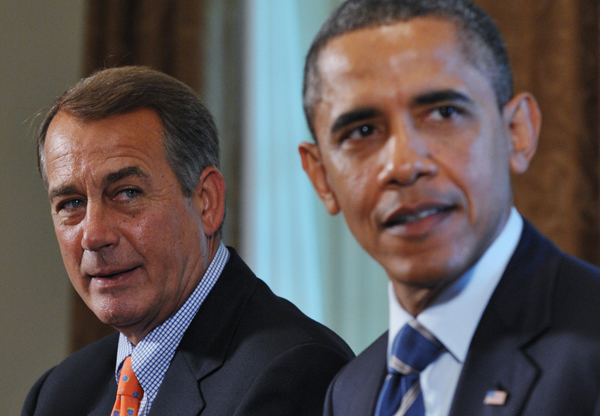
Open letter to President Obama (Part 200.1)Tea Party favorite Representative shares link on facebook

(Emailed to White House on 12-21-12)

President Obama c/o The White House
1600 Pennsylvania Avenue NW
Washington, DC 20500

Dear Mr. President,

I know that you receive 20,000 letters a day and that you actually read 10 of them every day. I really do respect you for trying to get a pulse on what is going on out here.

Does Government Have a Revenue or Spending Problem?

People say the government has a debt problem. Debt is caused by deficits, which is the difference between what the government collects in tax revenue and the amount of government spending. Every time the government runs a deficit, the government debt increases. So what’s to blame: too much spending, or too little tax revenue? Economics professor Antony Davies examines the data and concludes that the root cause of the debt is too much government spending.

Rep Todd Rokita of Indiana noted on facebook:

Another on-point column by John Stossel. “It’s the spending, stupid” sums up the adult conversation Hoosiers are having about government spending and the true drivers of our debt.

“People will have to see the wisdom of giving up government benefits now — in exchange for something more abstract: a future free society in which our children won’t be burdened by debt and taxes.”

It’s the Spending, Stupid!

By John Stossel – December 19, 2012

Listening to progressive media pundits, I’d think the most evil man in the universe is Grover Norquist, head of Americans for Tax Reform. His crime? He heads a movement that asks political candidates to pledge not to raise taxes.

I think Grover accomplished a lot. But I wish he’d convinced politicians to pledge not to increase spending.

President Obama says raising taxes to cut the deficit is a “balanced” approach.

Balanced …

But what’s “balanced” about raising taxes after vast increases in spending? Trillions for war, Medicare, “stimulus” and solar panels. Tax receipts rose — after tax-rate cuts — from $1.9 billion in 2003 to $2.3 billion in 2008, the year the recession started. That increase couldn’t keep up with the spending. The deficit doubled — actually, more than doubled — as politicians increased spending to nearly $4 trillion! Our debt, at more than $16 trillion, now exceeds our gross domestic product.

Ludicrous, irresponsible spending is why we’re in trouble. As columnist Ron Hart points out, Bill Clinton’s balanced budget spent $1.7 trillion. “Adjusted for inflation,” he writes, “our federal government would (have) a $200 billion surplus. But instead of increasing government spending in line with normal inflation, under Bush and Obama we are spending $3.8 trillion today. Democrats, who believe we have a ‘revenue’ problem instead of a ‘spending’ problem, must also think they have a bartender problem, not a drinking problem.”

The media obsess about tax rates, but spending is more important. As Milton Friedman taught us, spending is a far more accurate gauge of the government burden. If government spends a dollar, that dollar is taxed away from someone. If it’s borrowed, it’s removed from productive use, setting the stage for higher taxes later. If the government prints more dollars to fund spending, our purchasing power falls. Transferring purchasing power from the people to the government via inflation is a form of taxation.

If Republicans and Democrats reach a deal, the tax increases will be real — but spending “cuts” probably illusions. If they actually happen, they will only be reductions in already planned increases. The Wall Street Journal notes that when the two parties talk about cutting spending by $4 trillion over a decade, “those numbers have no real meaning because they are conjured in the wilderness of mirrors that is the federal budget process. Since 1974, Capitol Hill’s ‘baseline’ has automatically increased spending every year according to Congressional Budget Office projections … . Tax and spending changes are then measured off that inflated baseline.”

Given our growing debt, can’t they even slow the growth of government to the rate of inflation? Or inflation plus 1 percent? Or even inflation plus 2 percent? That might balance the budget within a decade.

But the spenders won’t even give me that. They want more. Always more.

Jonathan Bydlak, founder of the Coalition to Reduce Spending, has a good idea. “It’s important to do for spending what Norquist has done for taxes: create a means for voters to hold elected officials accountable when they break campaign promises of fiscal responsibility.”

Bydlak has no time for any politician who pledges not to raise taxes without pledging to cut spending. He praises Doug Collins, representative-elect from Georgia, and Ted Cruz, senator-elect from Texas, for signing the Reject the Debt pledge and thereby promising voters they would:

“ONE, not vote for any budget that is not balanced nor for any appropriations bill that increases total spending;

“and TWO, consider all spending open for reduction, and not vote to authorize or fund new programs without offsetting cuts in other programs.”

Well, sure. Good luck to him.

But people are reluctant to give up their favorite programs. Or any programs.

Let’s not fool ourselves about how dependent politicians have made people on government.

To succeed, the crusade to cut spending needs an ideological understanding of how unsustainable our current course is, not just a narrow appeal to short-term self-interest. People will have to see the wisdom of giving up government benefits now — in exchange for something more abstract: a future free society in which our children won’t be burdened by debt and taxes. 


Copyright 2012, Creators Syndicate Inc.

________

https://i0.wp.com/www.reagan.utexas.edu/archives/photographs/large/c32382-1.jpg

President Reagan and Bob Hope laughing with George Shultz at the Kennedy Center Honors. Washington, DC 12/8/85.

_________

President Ronald Reagan wisely said:

Milton Friedman points to four ways you can spend money. You can A) spend your own money on yourself, B) spend your money on someone else, C) spend someone else’s money on yourself, and D) spend someone else’s money on someone else. The order of efficiency is A, B, C and D. Watch this clip for Friedman’s explanation:

We have too much of C and D and we need more of A and B.

___________

Thank you so much for your time. I know how valuable it is. I also appreciate the fine family that you have and your commitment as a father and a husband.

Sincerely,

Everette Hatcher III, 13900 Cottontail Lane, Alexander, AR 72002, ph 501-920-5733, lowcostsqueegees@yahoo.com

Related posts:

Open letter to President Obama (Part 201)Tea Party favorite Representative links article “Prescott and Ohanian: Taxes Are Much Higher Than You Think”

    (Emailed to White House on 12-21-12.) President Obama c/o The White House 1600 Pennsylvania Avenue NW Washington, DC 20500 Dear Mr. President, I know that you receive 20,000 letters a day and that you actually read 10 of them every day. I really do respect you for trying to get a pulse on […]

Open letter to President Obama (Part 200.2)Tea Party Republican Representative takes on the President concerning fiscal cliff

(Emailed to White House on 12-21-12.) President Obama c/o The White House 1600 Pennsylvania Avenue NW Washington, DC 20500 Dear Mr. President, I know that you receive 20,000 letters a day and that you actually read 10 of them every day. I really do respect you for trying to get a pulse on what is […]

Open letter to President Obama (Part 200.1)Tea Party favorite Representative shares link on facebook

 (Emailed to White House on 12-21-12) President Obama c/o The White House 1600 Pennsylvania Avenue NW Washington, DC 20500 Dear Mr. President, I know that you receive 20,000 letters a day and that you actually read 10 of them every day. I really do respect you for trying to get a pulse on what is […]

Open letter to President Obama (Part 199) Tea Party favorite takes on President

  The federal government has a spending problem and Milton Friedman came up with the negative income tax to help poor people get out of the welfare trap. It seems that the government screws up about everything. Then why is President Obama wanting more taxes? _______________ Milton Friedman – The Negative Income Tax Published on […]

Tea Party Heroes Rep. David Schweikert (R-AZ),Justin Amash (R-MI), Tim Huelskamp (R-KS) have been punished by Boehner

I was sad to read that the Speaker John Boehner has been involved in punishing tea  party republicans. Actually I have written letters to several of these same tea party heroes telling them that I have emailed Boehner encouraging him to listen to them. Rep. David Schweikert (R-AZ),Justin Amash (R-MI), and Tim Huelskamp (R-KS). have been contacted […]

Some Tea Party heroes (Part 10)

Michael Tanner of the Cato Institute in his article, “Hitting the Ceiling,” National Review Online, March 7, 2012 noted: After all, despite all the sturm und drang about spending cuts as part of last year’s debt-ceiling deal, federal spending not only increased from 2011 to 2012, it rose faster than inflation and population growth combined. […]


Can you blame the rich for moving when you raise taxes up too high? Milton Friedman weighes in!!!

Will Taxing the Rich Fix the Deficit?

Published on Jul 2, 2012

The government’s budget deficit in 2009 was $1.5 trillion. Many have suggested raising taxes on the rich to cover the difference between what the government collected in revenue and what it spent. Is that a realistic solution? Economics professor Antony Davies uses data to demonstrate why taxing the rich will not be sufficient to make the budget deficit disappear. He says, “The budget deficit is so large that there simply aren’t enough rich people to tax to raise enough to balance the budget.” Instead, it’s time to work on legitimate solutions, like cutting spending.

___________

Can you blame the rich for moving when you raise taxes up too high? Milton Friedman rightly noted that people will seek their own self interest. He asked, “Is it really true that political self-interest is nobler somehow than economic self-interest?” The obvious answer is no. Take a look at this exchange between Friedman and Phil Donahue and then look at this article below that discusses what is going on now in France. No wonder that people are fleeing California for Texas too.

Phil Donohue: When you see around the globe the maldistribution of wealth, the desperate plight of millions of people in underdeveloped countries, when you see so few haves and so many have-nots, when you see the greed and the concentration of power, did you ever have a moment of doubt about capitalism? And whether greed is a good idea to run on?

Milton Friedman: Well first of all tell me, is there some society you know that doesn’t run on greed? You think Russia doesn’t run on greed? You think China doesn’t run on greed? What is greed? Of course none of us are greedy. It’s only the other fella that’s greedy. The world runs on individuals pursuing their separate interests. The greatest achievements of civilization have not come from government bureaus. Einstein didn’t construct his theory under order from a bureaucrat. Henry Ford didn’t revolutionize the automobile industry that way. In the only cases in which the masses have escaped from the kind of grinding poverty that you are talking about, the only cases in recorded history are where they have had capitalism and largely free trade. If you want to know where the masses are worst off, it’s exactly in the kind of societies that depart from that. So that the record of history is absolutely crystal clear, there is no alternative way, so far discovered, of improving the lot of the ordinary people that can hold a candle to the productive activities that are unleashed by a free enterprise system.

Phil Donohue: Seems to reward not virtue as much as the ability to manipulate the system.

Milton Friedman: And what does reward virtue? You think the Communist commissar rewards virtue? You think a Hitler rewards virtue? Do you think… American presidents reward virtue? Do they choose their appointees on the basis of the virtue of the people appointed or on the basis of political clout? Is it really true that political self-interest is nobler somehow than economic self-interest? You know I think you are taking a lot of things for granted. And just tell me where in the world you find these angels that are going to organize society for us? Well, I don’t even trust you to do that.

Atlas is shrugging and Dan Mitchell is laughing.

I predicted back in May that well-to-do French taxpayers weren’t fools who would meekly sit still while the hyenas in the political class confiscated ever-larger shares of their income.

But the new President of France, Francois Hollande, doesn’t seem overly concerned by economic rationality and decided (Obama must be quite envious) that a top tax rate of 75 percent is fair.” And patriotic as well!

French Prime Minister: “I’m upset that the wildebeest aren’t remaining still for their disembowelment.”

So I was pleased – but not surprised – when the news leaked out that France’s richest man was saying au revoir and moving to Belgium.

But he’s not the only one. The nation’s top actor also decided that he doesn’t want to be a fatted calf. Indeed, it appears that there are entire communities of French tax exiles living just across the border in Belgium.

Best of all, the greedy politicians are throwing temper tantrums that the geese have found a better place for their golden eggs.

France’s Prime Minister seems particularly agitated about this real-world evidence for the Laffer Curve. Here are some excerpts from a story in the UK-based Telegraph.

“No fair!”

France’s prime minister has slammed wealthy citizens fleeing the country’s punitive tax on high incomes as greedy profiteers seeking to “become even richer”. Jean-Marc Ayrault’s outburst came after France’s best-known actor, Gerard Dépardieu, took up legal residence in a small village just over the border in Belgium, alongside hundreds of other wealthy French nationals seeking lower taxes. “Those who are seeking exile abroad are not those who are scared of becoming poor,” the prime minister declared after unveiling sweeping anti-poverty measures to help those hit by the economic crisis. These individuals are leaving “because they want to get even richer,” he said. “We cannot fight poverty if those with the most, and sometimes with a lot, do not show solidarity and a bit of generosity,” he added.

In the interests of accuracy, let’s re-write Monsieur Ayrault’s final quote from the excerpt. What he’s really saying is: “We cannot buy votes and create dependency if those that produce, and sometimes produce a lot, do not act like morons and let us rape and pillage without consequence.”

So what’s going to happen? Well, I wrote in September that France was going to suffer a fiscal crisis, and I followed up in October with a post explaining how a bloated welfare state was a form of economic suicide.

Yet French politicians don’t seem to care. They don’t seem to realize that a high burden of government spending causes economic weakness by misallocating labor and capital. They seem oblivious  to basic tax policy matters, even though there is plenty of evidence that the Laffer Curve works even in France.

So as France gets ever-closer to fiscal collapse, part of me gets a bit of perverse pleasure from the news. Not because of dislike for the French. The people actually are very nice, in my experience, and France is a very pleasant place to visit. And it was even listed as the best place in the world to live, according to one ranking.

But it helps to have bad examples. And just as I’ve used Greece to help educate American lawmakers about the dangers of statism, I’ll also use France as an example of what not to do.

P.S. France actually is much better than the United States in that rich people actually are free to move across the border without getting shaken down with exit taxes that are reminiscent of totalitarian regimes.

P.P.S. This Chuck Asay cartoon seems to capture the mentality of the French government.

“Friedman Friday” EPISODE “The Failure of Socialism” of Free to Choose in 1990 by Milton Friedman (Part 3)

Milton Friedman: Free To Choose – The Failure Of Socialism With Ronald Reagan (Full)

Published on Mar 19, 2012 by

Milton Friedman’s writings affected me greatly when I first discovered them and I wanted to share with you.

Ronald Reagan introduces this program, and traces a line from Adam Smith’s “The Wealth of Nations” to Milton Friedman’s work, describing Free to Choose as “a survival kit for you, for our nation and for freedom.” Dr. Friedman travels to Hungary and Czechoslovakia to learn how Eastern Europeans are rebuilding their collapsed economies. His conclusion: they must accept the verdict of history that governments create no wealth. Economic freedom is the only source of prosperity. That means free, private markets. Attempts to find a “third way” between socialism and free markets are doomed from the start. If the people of Eastern Europe are given the chance to make their own choices they will achieve a high level of prosperity. Friedman tells us individual stories about how small businesses struggle to survive against the remains of extensive government control. Friedman says, “Everybody knows what needs to be done. The property that is now in the hands of the state, needs to be gotten into the hands of private people who can use it in accordance with their own interests and values.” Eastern Europe has observed the history of free markets in the United States and wants to copy our success. After the documentary, Dr. Friedman talks further about government and the economy with Gary Becker of the University of Chicago and Samuel Bowles of the University of Massachusetts. In a wide-ranging discussion, they disagree about the results of economic controls in countries around the world, with Friedman defending his thesis that the best government role is the smallest one.
___________
Below is a portion of the transcript of the program and above you will find the complete video of the program:
 
 
 DISCUSSIONHello, I am Linda Chavez and welcome to Free to Choose. Joining Dr. Friedman for a discussion of the failure of socialism are Gary Becker from the University of Chicago and Samuel Bowles of the University of Massachusetts. Dr. Bowles, I think we can all agree that socialism has failed Eastern Europe. Dr. Friedman believes that the path out of that is the free market and I think he thinks there are lessons for the United States. What do you think?Chavez: I would like to bring this discussion back to the United States for a moment. What about socialism in the United States. There has been one area where we have tried to redistribute wealth. We have done that through our welfare policies and social security. Has that worked?

Bowles: Well, there is much to celebrate in Eastern Europe __ not only the elimination of dictatorial rule. I go back on that a long time. I was in the Soviet Union in the late 50’s (1958 and 1959) as a musician and I met many Russian musicians and made friends with a lot of Russian people who found themselves harassed and victimized by the police. In fact, my own musical group was prevented from singing a couple of times by the police. That is all on the way out and I hope it is gone for good. Equally welcome is the end of this myth of a centrally planned society. That is gone too and I hope that basically the lesson is learned. But Milton seems to think that we have to choose between either a centrally planned society or a society in which we have markets which are basically unregulated. So the choice is really between all or nothing.

I don’t think that is the choice. I think what Milton is posing for us is a model which is as unrealistic as a centrally planned model. It is outdated, it won’t work, it is extreme, and I think it is undemocratic. I think that we have choices in between, what Milton called the third way, a way that he said wouldn’t work, has been shown to work around the world. I think that Eastern Europe would be very ill-advised to take Milton’s advise on this. Yet, the last time anybody took Milton’s advise on economic policy was Ronald Reagan and Ronald Reagan has put the U.S. economy into a situation where it can’t pay its bills and is facing mounting economic instability and difficulties.

Chavez: Dr. Friedman, what about this midway path?

Friedman: First of all, I utterly reject what Sam says about the results of Ronald Reagan’s changes. We had a decade of extraordinary growth, increased employment in which inflation was brought down sharply. Ronald Reagan came into office at a period of very high inflation, and so on. But this program is not about the Reagan administration. This program is about Eastern Europe and I want to go to Eastern Europe.

I believe Sam is completely wrong in saying that the model I propose is outdated. I believe that what he calls obsolete is something very different. You have had the third way __ you have had it in the United States; you have had it in Sweden; you have had it in Britain; you’ve had it elsewhere. In every case it has been built on the foundation of a long period of what I call the first way. The United States had 150 years of essentially a free private market before it launched on this period of the welfare state. The same thing was true in Britain, the same thing was true in Sweden. I believe he will find it very difficult to site any example of a country which started from a very low level and immediately adopted that combination of policies.

Becker: Let me add something on that. I think the lesson that we learned from what happened in Eastern Europe goes beyond simply that central planning doesn’t work. I think we all agree that it doesn’t work. But it is more than that __ it is the role of private property in the system and the incentives provided by private property.

I don’t know what socialism means anymore, but I remember when I was in Poland I asked the head of the ideology department is private property consistent with socialism? He said, it may be. Then I asked him, well what is the difference between socialism and capitalism. His answer was, we are still working on that. I think what we have seen is a rejection of the ideas associated with traditional socialism which are suppression of private property, government ownership of property, and so on.

Now, how far should we move in the other direction? I think that is question you are asking Sam, and is there a middle way. I think the middle ways that have been successful have all been largely reliant on private property, private ownership, private incentives. The difficult question is one that Milton raised in the documentary. How far can you redistribute income and make it consistent with effective incentives?

I don’t think we know the boundary point, whether 30% of the income being redistributed is too much, 40%, 50% __ my own feeling is that we have gone much too far in Sweden and some of the other Scandinavian countries, and they are beginning to step back from this. They are lowering maximum tax rates to 50% now __ they were up to 80%. So I think there is a third way, but that third way is going to be a lot closer to unregulated market than toward a socialist organization of resources and a suppression of private property.

Bowles: Let’s get back to the particulars though. You talk about Sweden and you talk about the third way failing, and Milton says nobody has ever really gotten rich on the third way __ they have only benefited from that. Let’s talk about the United States. The period you described included a very long period in which the United States was a highly protectionist country in which our industrial base was developed from Alexander Hamilton on for some time, and then during the late 19th and early 20th century. To call that a free market solution would be against everything you have taught. Or, if one wants to go back into the 19th century, the huge subsidies of the railroads were, of course, an intervention in the market.

In the case of England that you talk about, the same is true. The role of the British Navy and for example the Parliament in actually establishing the private property which is what you favor. This was done by a government intervention. We talk about the other cases. Talk about Sweden or about Korea. These are two countries which I think are justly admired for their economic performance. Both countries have income distributions far more equal than the United States.

In Sweden, over the half the GNP is taxed. Now, people in this country would say that obviously they have gone too far. But let’s look at the test of the market. Sweden and Korea have been defeating the United States in world markets. Exports have grown five percent per year during the Reagan/Bush years in Sweden. In the United States, they have grown one percent per year. In Korea we know they have grown much better. If you want to go on to Norway, where much of the investing is done by the government, they have grown their exports even faster than Sweden. Meanwhile, we can’t compete in world markets.

So the lesson of these countries is if you look at the facts Milton, a combination of government regulation and the market works. I agree with Gary. I think private property is extremely important because the incentives associated with owning the results of your work is essential. But private property does not mean that we have to let the market go unregulated and all the evidence says that the countries that are beating us in the world market today don’t do it. They are not that dumb. Japan doesn’t do it; Korea doesn’t do it; Sweden doesn’t do it.

Friedman: Let’s not throw straw men around. Obviously I am not in favor of no government. Government has some very important roles to play. Those are very limited. You take the case of the United States during the 19th century and of Britain in the 19th century. At the time of Queen Victoria’s jubilee in 1899, total government spending in Britain was 10% of the national income. Up until 1929 in the United States, except for periods of great war, total government spending in the United States was about 10% of national income. Now that is a very far cry from a government which spends over half of the national income . . . . and a little less than half in the United States.

Bowles: You are opposed to capital controls. You are opposed to telling people they can’t move their money internationally. That is what Korea does. You are opposed to . . .

Friedman: I think Korea makes a mistake by doing it.

Bowles: Korea has beaten us by exactly the policies you are posing.

Friedman: So has Hong Kong. Hong Kong has beaten us by the policies I am proposing.

Bowles: . . . if Korea is not a middle way and if Sweden is not a middle way, then I would like to know what you call it.

Becker: Korea is a lot closer to a market-oriented economy than any of the economies we have been talking about.

Bowles: The government approves the heads of the banks in Korea. They have nationalized their steel industry and have one of the most efficient plants in the world at Palhang. If you call that a private economy . . .

Becker: What fraction of resources in Korea goes through the government?

Bowles: A tremendous fraction if you take account of the fact that the banks are centrally run and they control the credit allocations there and they don’t let people take their money out of the . . .


Liberal plan will not work but just load more debt on our children

Funding Government by the Minute

Published on Mar 28, 2012

At the rate the federal government spends, it runs out of money on July 31. What programs should be cut to balance the budget and fund the government for the remaining five months of the year? Cutting NASA might buy two days; cutting the Navy could buy fifteen. It seems that balancing the budget may require more than just cutting government programs. What should be done?

The Debt Limit: Made Simple

We got some big problems we got to take care of in this country. Will the liberal plan make things run smooth in the USA? There is no way that is going to happen. We got to take conservative principles and put them into practice in order to grow the economy. Instead, the liberal plan just loads more debt on our children.

Liberal Welfare State in Decline

Rich Tucker

December 10, 2012 at 1:06 pm

Even as the country deals with the crisis of the “fiscal cliff,” there’s another crisis waiting in the wings. “The second act will occur early in 2013 when the federal government will exhaust its ability to issue debt legally,” writes Heritage’s J. D. Foster.

As computer programmers would say, the seemingly endless series of crises isn’t a bug; it’s a feature, a fundamental debate over the future of the country.

With Obamacare in place, the left has finished building its dream: a liberal welfare state. Yet that dream seems likely to turn into a nightmare. Without massive tax increases on the middle class, the welfare state is simply not affordable. “The foundation is falling out from beneath the building just as they have finished construction,” quips Yuval Levin.

That’s why Charles Kesler, editor of the Claremont Review of Books, remains upbeat that the future of the country is conservative.

In a Heritage First Principles essay published before the 2012 election, he wrote:

If the bankruptcy of the entitlement programs were handled just the right way, with world-class cynicism and opportunism, in an emergency demanding quick, painful action lest Grandma descend into an irreversible diabetic coma, then liberalism might succeed in maneuvering America into a Scandinavia-style überwelfare state, fueled by massive and regressive taxes cheerfully accepted by the citizenry.

But all that remains unlikely:

Odds are we stand instead at the twilight of the liberal welfare state. As it sinks, a new, more conservative system will likely rise that will feature some combination of more means-testing of benefits, a switch from defined-benefit to defined-contribution programs, greater devolution of authority to the states and localities, a new budget process that will force welfare expenditures to compete with other national priorities, and the redefinition of the welfare function away from fulfilling socioeconomic “rights” and toward charitably taking care of the truly needy as best the community can afford when private efforts have failed or proved inadequate.

His optimism about the future explains why Kesler’s book I Am the Change is subtitled Barack Obama and the Crisis of Liberalism.

Despite the election results, it’s the left that faces an existential crisis. Conservatives, meanwhile, have detailed plans that can transform entitlement programs, reduce federal spending and debt, and hold the line on taxes. That’s worth remembering—no matter how the fiscal cliff talks end up.

“Francis Schaeffer’s legacy”

 Francis Schaeffer: “Whatever Happened to the Human Race” (Episode 1) ABORTION OF THE HUMAN RACE
Great article below on Francis Schaeffer.
COVER STORY ARTICLE | Issue: “Francis Schaeffer’s legacy” March 26, 2005

Taking the roof off

For L’Abri, the brainchild of 20th-century giant Francis Schaeffer, turning 50 is an opportunity to celebrate and revive what is golden in its unique approach to evangelism | Gene Edward Veith

Half a century ago, an American pastor named Francis Schaeffer opened his home in Switzerland to anyone who was struggling with the basic questions of life. It was the beginning of L’Abri, a word meaning “shelter.” Over the years, student backpackers, troubled atheists, and thoughtful Christians found their way to this chalet in the Alps. Here they met biblical truth, explained not only with a sophistication that was then rare in evangelicalism—but lived out.

Many who trekked the Alpine hillsides to L’Abri became Christians and learned how to engage their cultures and to apply their faith to all of life. Two generations on, the influence of Francis and Edith Schaeffer and the ministry of L’Abri is evident among evangelical Christians everywhere in their approach not only to evangelism and the church but also to the sciences, arts, business, and politics.

ARTICLE CONTINUES BELOW

Schaeffer died of cancer in 1984. But L’Abri continues with branches all over the world: in Australia, Germany, the Netherlands, Sweden, England, Korea, Canada, and two in the United States (in Southborough, Mass., and Rochester, Minn.). These centers for training in Christian philosophy are the legacy of a man who—according to long-time associate and founder of the Francis Schaeffer Institute Jerram Barrs—never considered himself a theologian or philosopher, but simply a pastor and an evangelist.

Schaeffer became a Christian when he was 17, after reading the Bible from beginning to end and finding that it gave answers to questions he struggled with. He studied at Faith Seminary and pastored churches in Delaware, Pennsylvania, and St. Louis.

In St. Louis, Schaeffer and his wife Edith started a ministry, Children for Christ. At the same time, conflicts and schisms in the Presbyterian Church forced him to defend a high view of Scripture against liberal theology. He started the International Council of Christian Churches to counter the World Council of Churches. This took him to Europe, where he settled in Switzerland in 1948.

But L’Abri had its genesis in a spiritual crisis that engulfed Schaeffer in 1950-1951. Depressed by church politics and power struggles, Schaeffer wrestled with the question: “How could people stand for truth and purity and God’s holiness without ugliness and harshness?” He became dissatisfied, too, with his own failures to live out the faith as the Bible describes it, according to Mr. Barrs.

Schaeffer felt these problems so deeply that he began to question whether Christianity, if it has so little effect, could be true. Once again, as he did when he was 17, he plunged into Bible reading in search of answers. He found them, becoming convinced that not only salvation but sanctification and the whole of the Christian’s life are by faith. “The sun came out again,” he said, and he found “a new song in my heart.”

Now, in addition to holding Bible studies in the Schaeffer home and working with children, the Schaeffers began discussion groups for their teenage daughters and friends to hear their questions and to tell about the Bible’s answers.

On June 5, 1955, the Schaeffers drew up a plan to turn their home into a place where people could come to work out their problems and to practice “true spirituality.” Without finances and with no assurance that they would be allowed to stay in Switzerland, the Schaeffers purchased property in Huemoz, a rural village high in the mountains with a spectacular view of the Alps.

Ranald Macaulay, a student at Cambridge who became involved with the Schaeffers in the early days (and later married their daughter Susan), said the founding of L’Abri was consistent with its organizing principle: to live in constant dependence on the grace of God. At a March 11-13 Jubilee for L’Abri Fellowship at the America’s Center in St. Louis, Mr. Macaulay said the Schaeffers resolved to do no advertising for workers, no marketing to attract newcomers, no fundraising, and no planning—principles in stark contrast to most other ministries.

The Schaeffers saw L’Abri as a unique experiment—they did not necessarily recommend this radical dependence on God’s providence as a pattern for other ministries—but the needs always were met. Concerned with reaching individuals, the Schaeffers were content with small numbers. Over time, however, the effect of their work multiplied. Over 1,000 L’Abri alumni attended the jubilee celebration, an event that was equal parts conference and family reunion.

Os Guinness, Harold O.J. Brown, and Chuck Colson—all major evangelical thinkers who were shaped by L’Abri—gave addresses. Screenwriter Brian Godawa, who wrote To End All Wars, gave a workshop on transforming Hollywood. Theologian and cultural critic Vishal Mangalwadi, from India, talked about his upcoming television documentary series on the impact of the Bible, The Book of the Millennium. Book tables overflowed with titles by L’Abri alumni.

Workshops focused on the various facets of “The Central Themes of L’Abri,” “Transforming All of Life,” and “True Spirituality.” The evenings closed with classical music concerts.

But unlike most idea-packed conferences, the program also scheduled in time for fellowship: an hour and a half devoted to lunch; 30 minutes between sessions; free afternoons and early evenings so people had time to talk. People who had grown close in the Christian community of L’Abri but who had not seen each other for decades hugged and laughed and resumed their conversations. Family members recalled the early days. Mr. Macaulay said the Schaeffers cleared out the furniture, set up chairs, and made elaborate preparations in their chalet, while Schaeffer, wearing a black suit, preached a brilliant sermon—all for three people. Mr. Macaulay remembers thinking, “Oh, if everybody could hear this!” In those days, he said, it was exciting when 10 people showed up at L’Abri.

At first Schaeffer resisted taping the lectures, fearing it would spoil his spontaneity. But one day his daughter Susan surreptitiously hid in an ivy plant a microphone attached to her portable cassette player. The tapes circulated in student groups in England, creating a demand for more tapes and a steady supply of L’Abri pilgrims. Eventually, he turned some of his lectures into books.

More and more people—students, hippies, homosexual priests, drug addicts, and other wanderers trying to “find themselves”—sought out this “shelter” in the mountains. Some stayed for a few weeks, others for several months. By the 1970s, several hundred might be there at a time, staying in chalets built on the expanding property above a switchback mountain road.

Schaeffer exchanged his American preacher’s black suit for lederhosen and a walking stick. He engaged visitors in personal discussions fed also by the growing number of L’Abri workers who joined in the ministry. Visitors took part in the life of the community, eating meals together, doing physical labor, studying the Bible, prizing deep conversations, and walking in the mountains. This remains the pattern today in the L’Abri branches around the world, except that Schaeffer is heard only on tape.

In the course of 50 years, according to Larry Snyder, director of Rochester L’Abri, no one knows how many people went through L’Abri. No one kept records. What mattered then—and is evident now (see sidebar)—is that L’Abri was a life-changing experience.

Schaeffer persuaded nonbelievers to face up to the contradictions in their own worldviews by revealing their inability to account for what is most important in life (love, beauty, meaning). He would, as he described it, “take the roof off,” bringing the nonbeliever almost to the point of despair, to acknowledge his lost condition. Then he applied the gospel of Christ. While conversant in the theology of Kuyper, Dooyeweerd, and Van Til, Schaeffer was captive only to the worldview set forth in the Bible—God’s good creation, man’s fall into sin and its consequences, the redemption through Christ—which he said accords with reality in all of its dimensions. Nonbelievers cannot bring themselves to be completely consistent with their own presuppositions, an inconsistency that is a result of common grace. “Thus, illogically,” he wrote in 1948, “men have in their accepted worldviews various amounts of that which is ours. But, illogical though it may be, it is there and we can appeal to it.”

Even with hostile visitors, Mr. Barrs said, Schaeffer “had an acute sense of people’s brokenness and fallenness,” and “thus would treat them with compassion.”

Out of those encounters grew a body of written work: Escape from Reason (1968), True Spirituality (1971), and He Is There and He Is Not Silent (1972). Schaeffer developed extraordinarily fruitful concepts: how human beings need both “form and freedom”; how people today compartmentalize their lives into a meaningless objective “lower story” (the realm of science and fact) and a mystical, nonrational “upper story” of subjectivity and emotion (which becomes the realm of religion, aesthetics, and morality); how human beings are sinful and broken due to the Fall, yet how at the same time human beings have an intrinsic value and dignity, bearing the image of God.

Those concepts—fueled by practical discussions and communal living at L’Abri—quickly gathered public momentum. Before L’Abri, many conservative Protestants had no problem with legalizing abortion, considering it a Catholic issue and responding out of a knee-jerk anti-Catholicism. But the Schaeffers showed that abortion—along with the growing acceptance of euthanasia and the coming genetic engineering—constitutes a horrible assault on all that it means to be human. With the book and video series How Should We Then Live? (1976) and Whatever Happened to the Human Race? (1979), Schaeffer’s ideas spread to a broader audience. With A Christian Manifesto (1981), he called evangelicals to the fight against abortion and to political activism to reverse what he saw as the trend toward both moral anarchy and political tyranny.

Such an extended ministry was a partnership with Schaeffer’s wife. “If time allowed, a whole seminar could be devoted to the work of Edith Schaeffer,” author and L’Abri alum Os Guinness told the jubilee crowd. Health problems, including a deteriorating esophagus, prevented Schaeffer’s wife Edith, 92, from attending the St. Louis jubilee. Always an active part of L’Abri and an author herself, she is currently in a Swiss hospital. There, according to Udo Middleman, husband to Schaeffer daughter Debbie, the family is battling the very dangers Schaeffer described as family members insist on active treatment and care for Mrs. Schaeffer against a European medical establishment that is content to withhold treatment and to allow her simply to die.

Those struggles only emphasize that, in many ways, the culture of relativism, irrationalism, and self-centeredness that Schaeffer anticipated is here. “Postmodernists are so focused on I, me, myself that they have trouble focusing on any thing beyond themselves,” said L’Abri Australia leader Frank Stootman. And yet, he said, the Schaeffer method of taking people with their presuppositions to their logical conclusions and showing the superiority of a biblical worldview is still effective.

Per Staffan Johansson, of L’Abri in Sweden, told WORLD that seekers today are less philosophical than they were in the 1960s. Instead of wrestling with questions about the meaning of life and other objective truth, they are more preoccupied with problems of relationships and the meaning of their jobs and professions. “We do more in Sweden with vocation,” he said. “And yet, this is what L’Abri has always done,” relating faith to all of life.

Mr. Guinness said that “the genius of Schaeffer’s apologetics has yet to be fully unwrapped.” When asked about reaching the culture, Mr. Guinness said that one of Schaeffer’s great insights is that we have to reach not cultures but individuals. Each individual has his or her own questions, personal struggles, and moral brokenness. Schaeffer took them all seriously, addressing people one by one, while giving them—sometimes for the first time—a sense of belonging to a community.

Many approaches to evangelism and church growth today are impersonal, relying on manipulative formulas and the techniques of mass marketing and consumerism. L’Abri honors the dignity and the distinct spiritual needs of each individual. Many evangelicals think Christianity needs to be dumbed down and made easier to make it attractive to people today. L’Abri teaches that Christianity has substance and depth, that it has something to offer to thoughtful, educated people, and that—undiluted—biblical Christianity can change their lives.

Fifty years later, evangelicalism once again faces the problem of being negative or ineffectual, worldly, or out of touch. L’Abri remains.

Open letter to President Obama (Part 200) Rep Womack of Arkansas shares link “Spending is the problem”


Milton Friedman said that getting George Bush I to be his vice president was Reagan’s biggest mistake because he knew that Bush was not a true conservative and sure enough George Bush did raise taxes when he later became President. I HOPE THE REPUBLICANS DON’T MAKE THE SAME MISTAKE THAT BUSH DID!!!Below is a speech by George W. Bush honoring Milton Friedman:

Milton Friedman Honored for Lifetime Achievements 2002/5/9

Milton Friedman had a big influence on Ronald Reagan and what did Reagan do when he found the economy sluggish? He cut taxes!!! What does President Obama do? He wants to raise taxes!!

(This letter was emailed to White House on 12-20-12.)

President Obama c/o The White House
1600 Pennsylvania Avenue NW
Washington, DC 20500

Dear Mr. President,

I know that you receive 20,000 letters a day and that you actually read 10 of them every day. I really do respect you for trying to get a pulse on what is going on out here.

Fiscal Cliff Common Ground

Published on Dec 17, 2012

Senator Boozman discusses the common ground in fiscal cliff negotations.

______________

Rep Womack of Arkansas shared a link on facebook for a story that was posted on the Speaker of the House Boehner’s website. I wish the Speaker would follow his own advice!!!!

Posted by Don Seymour
December 13, 2012
General
 

In the debate over avoiding the “fiscal cliff,” an important point has been forgotten: when it comes to solving our debt, government spending is the problem that must be addressed.

Republicans have offered a balanced, pro-growth solution that would avert the fiscal cliff by making needed spending cuts and reforming our tax code in ways the president previously supported. This kind of plan – backed by a majority of the American people in survey after survey – would help address our debt and pave the way for long-term job growth.

President Obama and Democrats, on the other hand, want to punish small businesses with higher tax rates while increasing spending. The president has demanded as much as four times in tax hikes versus spending cuts, which are dwarfed by new ‘stimulus.’ This isn’t balanced. And it won’t do any good.

The chart above – prepared by Chairman Paul Ryan (R-WI) and the House Budget Committee – shows what happens to projected levels of tax revenue (green) if President Obama’s tax increases kick in (blue), and compares that with recent and projected spending trajectory (red). As you can see, if the president gets his tax hikes, we still face a mountain of spending-driven debt.

Even Democrats like Erskine Bowles admit, “We have to cut spending.” As said on CBS Face the Nation, “Even if you raise the top rates back to the Clinton rates, that only creates about $400 billion over 10 years. That’s $40 billion a year. We have a trillion dollar a year deficit.”

Spending is the problem. Republicans want to make needed spending cuts; Democrats are silent. And that’s why there’s still no agreement on averting the fiscal cliff.

________

_____________

Thank you so much for your time. I know how valuable it is. I also appreciate the fine family that you have and your commitment as a father and a husband.

Sincerely,

Everette Hatcher III, 13900 Cottontail Lane, Alexander, AR 72002, ph 501-920-5733, lowcostsqueegees@yahoo.com

Related posts:

Open letter to President Obama (Part 201)Tea Party favorite Representative links article “Prescott and Ohanian: Taxes Are Much Higher Than You Think”

    (Emailed to White House on 12-21-12.) President Obama c/o The White House 1600 Pennsylvania Avenue NW Washington, DC 20500 Dear Mr. President, I know that you receive 20,000 letters a day and that you actually read 10 of them every day. I really do respect you for trying to get a pulse on […]

Open letter to President Obama (Part 200.2)Tea Party Republican Representative takes on the President concerning fiscal cliff

(Emailed to White House on 12-21-12.) President Obama c/o The White House 1600 Pennsylvania Avenue NW Washington, DC 20500 Dear Mr. President, I know that you receive 20,000 letters a day and that you actually read 10 of them every day. I really do respect you for trying to get a pulse on what is […]

Open letter to President Obama (Part 200.1)Tea Party favorite Representative shares link on facebook

 (Emailed to White House on 12-21-12) President Obama c/o The White House 1600 Pennsylvania Avenue NW Washington, DC 20500 Dear Mr. President, I know that you receive 20,000 letters a day and that you actually read 10 of them every day. I really do respect you for trying to get a pulse on what is […]

Open letter to President Obama (Part 199) Tea Party favorite takes on President

  The federal government has a spending problem and Milton Friedman came up with the negative income tax to help poor people get out of the welfare trap. It seems that the government screws up about everything. Then why is President Obama wanting more taxes? _______________ Milton Friedman – The Negative Income Tax Published on […]

Tea Party Heroes Rep. David Schweikert (R-AZ),Justin Amash (R-MI), Tim Huelskamp (R-KS) have been punished by Boehner

I was sad to read that the Speaker John Boehner has been involved in punishing tea  party republicans. Actually I have written letters to several of these same tea party heroes telling them that I have emailed Boehner encouraging him to listen to them. Rep. David Schweikert (R-AZ),Justin Amash (R-MI), and Tim Huelskamp (R-KS). have been contacted […]

Some Tea Party heroes (Part 10)

Michael Tanner of the Cato Institute in his article, “Hitting the Ceiling,” National Review Online, March 7, 2012 noted: After all, despite all the sturm und drang about spending cuts as part of last year’s debt-ceiling deal, federal spending not only increased from 2011 to 2012, it rose faster than inflation and population growth combined. […]

France going to collapse?

Dan Mitchell Discussing Fake Austerity in Europe on Fox Business

Published on May 9, 2012 by

No description available.

_________________

I think Dan Mitchell is right about France heading the wrong direction.

I’m a bad person. I know it’s not nice to take joy in the misery of others, but I can’t help but smile when I see a story about bad news in France.

In my defense, this is not because of hostility to French people, who have always been friendly to me. Instead, France has become the global symbol of statism (particularly since Sweden has been moving in the right direction). The French, for instance, are increasingly infamous for class-warfare tax policy and onerous levels of intervention.

And since it’s my job to promote liberty, I’ll confess that it’s easier for me to convince non-French policy makers that free markets and small government are the right approach when there’s more evidence that statism is failing in France.

So why am I smiling? Well, France wasn’t doing so well under the de facto socialist Nicolas Sarkozy, and it seems that things are looking even worse now that the de jure socialist Francois Hollande is in charge.

Here’s some of what Reuters recently reported.

“It’s always time for a tax hike!”

The French are bleaker about their country’s future than at any time since 2005, a new poll showed on Saturday, with 68 percent saying they are “rather” or “very” pessimistic… Hollande’s government has been reeling from unemployment at a 13-year high and a rash of job cuts in recent weeks at top employers like carmaker Peugeot and retailer Carrefour. The government launched a plan this week to create 150,000 state-sponsored jobs for youth. Only 34 percent of those surveyed were confident in the government’s ability to battle unemployment, and just 20 percent expect the government to be able to improve their buying power. …The poll found that the pessimism extended even to 58 percent of Socialist party supporters.

I’m wondering when the pessimism will spread to investors. France recently lost its triple-A credit rating, but the rating agencies don’t do a good job, so I think it’s much more important to look at the prices of credit default swaps.

In other words, how much does it cost for an investor to insure debt from the French government? According to this CNBC site, France isn’t viewed as being as creditworthy as nations such as Switzerland, Germany, and the United States, but it is closer to those countries than it is to Spain, Italy, or Portugal.

This is just a guess on my part, but I think France is reaching the point where investors are suddenly going to get concerned about the government’s ability to fulfill its promises.

If Hollande follows through on his threat to impose a “patriotic” 75-percent tax rate, for example, that could be the trigger that makes the bond market a lot more skittish. Particularly since it will result in fewer rich people in France.

I’ve already written about French entrepreneurs and investors leaving the country because of Hollande’s class-warfare tax agenda. It’s gotten so bad that even Hollywood types are packing their bags.

Actor Johnny Depp has moved out of France and returned to America because he didn’t want to become a permanent French resident and pay income tax there. …Depp has now moved his family out of France after government officials asked him to become a permanent resident, as he feared he would end up paying tax in both countries. He tells Britain’s The Guardian newspaper, “…France wanted a piece of me. They wanted me to become a permanent resident. Permanent residency status – which changes everything. They just want… Dough. Money… ” Depp goes on to explain that if he spends more than 183 days a year in France he will have to pay income tax in both Europe and America, adding, “So you essentially work for free.”

Wow, complaining that he doesn’t want to “work for free.” What is he, some sort of radical libertarian from the Tea Party?

But he may want to chat with fellow tax-averse actor Jon Lovitz before moving back to America. Obama’s class-warfare agenda isn’t as bad as what Hollande is trying to impose, but it’s not Hong Kong or the Cayman Islands either.

P.S. Here’s a very good Chuck Asay cartoon about the French economy.

P.P.S. In a few areas, France has better policy than the United States.

Open letter to President Obama (Part 199) Tea Party favorite takes on President


The federal government has a spending problem and Milton Friedman came up with the negative income tax to help poor people get out of the welfare trap. It seems that the government screws up about everything. Then why is President Obama wanting more taxes?

_______________

Milton Friedman – The Negative Income Tax

Published on May 11, 2012 by

In this 1968 interview, Milton Friedman explained the negative income tax, a proposal that at minimum would save taxpayers the 72 percent of our current welfare budget spent on administration. http://www.LibertyPen.com

Source: Firing Line with William F Buckley Jr.

________________

Milton Friedman describes the welfare state’s effect on private charitable activity

Uploaded by on Oct 12, 2009

From “Free to Choose” (1980), Part IV: “From Cradle to Grave.”

(This letter was emailed to White House on 12-20-12.)

President Obama c/o The White House
1600 Pennsylvania Avenue NW
Washington, DC 20500

Dear Mr. President,

I know that you receive 20,000 letters a day and that you actually read 10 of them every day. I really do respect you for trying to get a pulse on what is going on out here.

Does Government Have a Revenue or Spending Problem?

People say the government has a debt problem. Debt is caused by deficits, which is the difference between what the government collects in tax revenue and the amount of government spending. Every time the government runs a deficit, the government debt increases. So what’s to blame: too much spending, or too little tax revenue? Economics professor Antony Davies examines the data and concludes that the root cause of the debt is too much government spending.

____________

Marlin Stutzman represents Indiana’s 3rd District in the U.S. House of Representatives and I have written about him several times before. The Cato Institute has given him a 99% rating on keeping his promises about cutting spending. Here is his article on the “Fiscal Cliff” for The Journal Gazette

Published: December 16, 2012 3:00 a.m.

New approach beckons for the new year …

Marlin Stutzman

As Hoosiers look forward to spending the upcoming holidays with family and friends, Washington is on the cusp of its latest fiscal crisis, and the menace of tax hikes on Jan. 1 is casting a shadow over what should be a joyful season. Unfortunately, this scene is all too familiar to the American people.

Despite numerous opportunities, Congress and the White House refuse to come to grips with out-of-control spending and offer long-term solutions to solve the federal government’s $16 trillion debt crisis.

Hoosiers have every right to be frustrated and discouraged with Washington, D.C., as the country heads toward bankruptcy, our nation’s broken entitlement programs teeter on the verge of insolvency, and looming tax hikes threaten thousands of Hoosier jobs.

The facts are alarming. Washington borrows more than 40 cents of every dollar it spends, Medicare’s own trustees have calculated that the program will reach insolvency in just 12 short years, and President Obama’s tax proposals jeopardize more than 15,000 jobs here in Indiana.

Despite his promise to cut the deficit in half by the end of his first term, Obama increased the national debt by more than $4 trillion. In just four years, this administration has stacked up more debt than every president from George Washington to Bill Clinton combined. A child born today inherits a $52,000 share of Uncle Sam’s borrowed spending. Meanwhile, their grandparents are left with the empty promises of a broken entitlement system.

Each day, 10,000 baby boomers reach retirement age and Medicare’s worker-to-beneficiary ratio grows weaker. In 2000, four current workers supported each beneficiary, but that number is on pace to fall below three. As that number declines, health care costs continue to climb. Nearly one in three primary care doctors is limiting the number of Medicare patients they see, and that number will only grow as Obamacare continues to be implemented. That’s unacceptable to the millions of seniors who were promised that the program would be there in their retirement.

Although Hoosiers understand that our economic crisis is, at heart, a debt crisis, Obama has focused nearly exclusively on tax hikes to fuel more deficit spending. Hoosiers know Washington can’t tax its way out of a spending mess. Under the most optimistic projections, Obama’s taxes will only cover eight days of government spending.

Despite these facts, the focus of the current fiscal cliff talks seems to remain on taxes, and when politicians focus on taxes instead of cuts and reforms, they leave middle class families out to dry. If we’re serious about fixing these fundamental problems, we have to rein in Washington’s runaway spending, give permanent tax certainty, and do the tough work of entitlement reform.

We need immediately to cut spending, responsibly cap future expenditures and put our nation’s finances on a path toward healthy balance. The House-passed budget, The Path to Prosperity, would have reduced the fiscal year 2013 deficit to less than $800 billion and put us on a path to paying off the debt.

Instead of threatening families and small businesses with the constant threat of higher taxes, we need to give certainty by extending the current tax rates for all Americans. In August, House Republicans and some Democrats voted to prevent these looming tax hikes, setting the stage for real tax reform in the year to come. The Senate should pass that extension without delay.

In addition, we must save Medicare while there’s still time. House Republicans have shown that we can reform Medicare for future generations without making any changes for current seniors. By expanding opportunity and empowering patients, younger workers can choose plans that meet their individual needs. We offer multiple guaranteed coverage options and, if it meets their unique needs, patients can choose the traditional Medicare plan.

In Indiana, we know that problems are only solved with honesty and hard work. Washington has an opportunity to tackle these challenges. This is difficult work, but no one was sent to Washington to make easy decisions.

As the new year approaches, there’s no better time to break Washington’s old habits and fix what’s broken.

Marlin Stutzman, a Republican, represents Indiana’s 3rd District in the U.S. House of Representatives. He wrote this for The Journal Gazette.
_____________

_____________

Thank you so much for your time. I know how valuable it is. I also appreciate the fine family that you have and your commitment as a father and a husband.

Sincerely,

Everette Hatcher III, 13900 Cottontail Lane, Alexander, AR 72002, ph 501-920-5733, lowcostsqueegees@yahoo.com

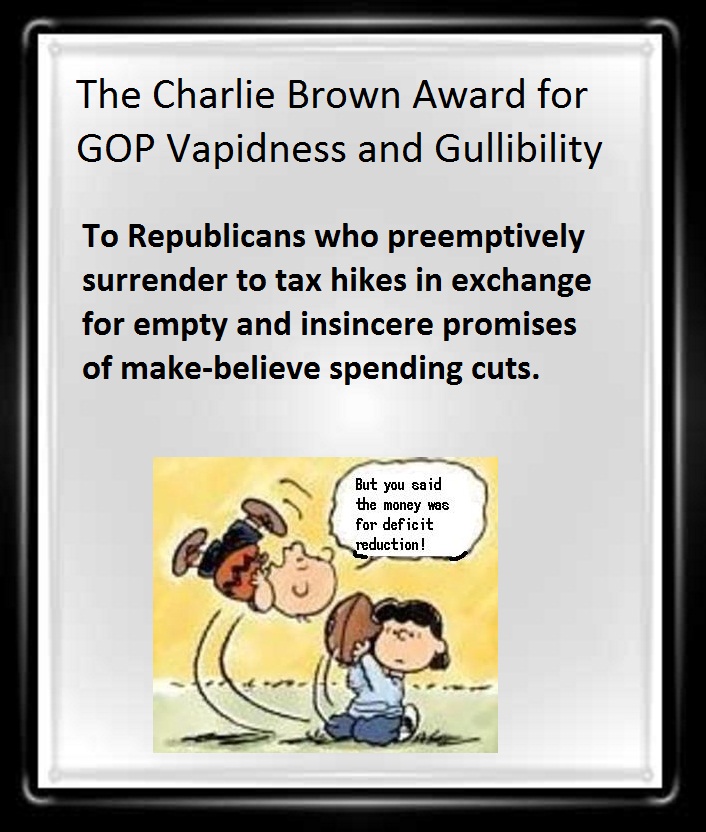
Why does the “Lucy move the football” reference apply to Republicans on the fiscal cliff?

I truly do wonder how smart our elected representatives are in Washington. I got up on 12-20-12 and read this article below from the Heritage Foundation with the reference to Charlie Brown getting fooled by Lucy again when he runs up and tries  to kick the football and of course she moves it again.

Liberals in Congress have always tried to fool conservatives by promising future cuts if they provide higher taxes now. (This article below appeared on www.heritage.org on 12-20-12.)

Obama’s “Lucy Move the Football” Fiscal Cliff Plan Still Not Balanced

Alison Acosta Fraser

December 18, 2012 at 3:25 pm

Volleys of negotiating counter-offers are coming in faster now that Christmas break and the looming fiscal cliff are just around the corner.

While there is much unsatisfactory with Speaker of the House John Boehner’s (R–OH) Sunday night proposal, let us not forget that the reason we are watching this needless, high stakes drama unfold is due to President Obama’s intractable insistence on tax increases on America’s high earners. After all, he and Congress could simply and quickly pass a bill to extend all current policies and avoid the fiscal cliff entirely—if he wanted to. No, this is really about hiking taxes on high earners. Thus the charade of deficit reduction continues.

Obama’s latest counteroffer is no more acceptable than his first offer. Short on details concerning actual spending reductions, especially on entitlements, it is replete with his requisite tax hikes and (we are shocked) new stimulus spending. The cherry on top is an extension of the debt limit for two years, essentially handing over authority to raise it to the President.

Right.

The President originally called for around $800 billion in tax hikes on America’s “highest” earners—those earning $250,000 and up. A ridiculous demand when the economy is still struggling under his big spending and regulatory policies, and one which would squarely hit smaller businesses. You know, the ones who actually create jobs.

Yet, just like Lucy and the football, when Boehner and company offered up $800 billion in tax hikes, Obama quickly doubled his demand to $1.5 trillion in tax hikes—again, all from the highest earners. They, he tells us, can afford to pay a little more. Never mind, of course, that the top 1 percent of earners already pay 37 percent of all income taxes. Somehow we are to believe this is a “balanced approach.”

Obama pitches all this on the pretext that we can simply go back to the tax rates we had under Clinton. Wrong! His dirty little tax secret is that he has already hiked taxes on high earners under Obamacare. First the law added a surtax of 0.9 percent in addition to the Medicare payroll tax on those earning over $250,000. For the first time ever, Obamacare will apply this higher rate of 3.8 percent to investment income on January 1. Obama won’t tell you that going back to Clinton-era tax rates will actually result in higher taxes on wages, dividends, and capital gains.

They say if you want less of something, then tax it. For Obama, this works fine on financial transactions, carbon emissions, driving, and junk food. But evidently, for him, not so much on a strong vibrant economy. And those Clinton boom years? They weren’t ushered in after the Clinton tax hike—only after the Clinton–Gingrich tax cut!

Rather than working with Republicans on tax proposals that will actually grow the economy, Obama is now simply fighting over his definition of “high income” while we are left to wonder how much this $1.2 trillion tax hike will slow the economy.

As for the $1.2 trillion spending reductions, the only reason they are there is because Boehner insisted on them. But $100 billion in cuts would whack the defense budget, which is already reeling from earlier budget cuts. Yet the real spending and debt crisis comes from unaffordable entitlement programs. While Obama is insisting on balance on the tax side, he is sorely lacking in leadership here. As a recent Washington Post editorial opined:

Elections do have consequences, and Mr. Obama ran on a clear platform of increasing taxes on the wealthy. But he was clear on something else, too: Deficit reduction must be “balanced,” including spending cuts as well as tax increases. Since 60 percent of the federal budget goes to entitlement programs such as Medicare, Medicaid and Social Security, there’s no way to achieve balance without slowing the rate of increase of those programs.

We know Obama is open to changing the inflation calculation and slowing the benefit growth in Social Security. But what else? What about the proposals in his own budget, which would increase premiums on Medicare? He could easily broaden his proposals with additional uncontroversial steps to begin the process of strengthening and reining in Social Security and Medicare. All he needs to do is lead.

Some polls may show that Americans think taxes should be part of a deficit deal; but what the polls do not always show is their utter distrust that Washington would use new revenues to actually reduce the deficit. Here, Obama does not let them down. He reportedly wants $80 billion in new spending on infrastructure and unemployment benefits.

In exchange for all of this, he wants to raise the debt limit by enough to fuel his big spending goals for two years. This is utterly unacceptable. Americans know you cannot reduce the deficit when you plan to actually spend more. Americans also know that when Washington lifts the debt limit, it will not control spending. The debt limit puts the very pressure lawmakers need to account for out-of-control spending and make vital course corrections to bring spending under control, lest we face a Euro-style debt crisis in the future.

White House Press Secretary Jay Carney is actually insisting that “[t]he President’s proposal is the only proposal we have seen that achieves the balance that is so necessary.” Balance, evidently, is in the eyes of the beholder. As the Post noted, 60 percent of the budget stems from entitlements.

In just 13 short years—by the time today’s kindergarteners enter college—entitlements and interest on the debt will eat up all tax revenues. A truly balanced approach must start where the problem starts—with substantive reforms to entitlements. While the President maintains that you cannot cut your way to prosperity, you certainly cannot tax your way there.

_______________

Below is a speech by George W. Bush honoring Milton Friedman:

Milton Friedman Honored for Lifetime Achievements 2002/5/9

Milton Friedman said that getting George Bush I to be his vice president was his biggest mistake because he knew that Bush was not a true conservative and sure enough George Bush did raise taxes when he later became President. I wonder if Jeb Bush has the same genes as his father.

What we need is some people in Washington that are brave enough to say that we have taken too much of the american people’s money and we have to make the painful spending cuts in order to balance the budget and not ask for any more tax increases!!!! Arkansas’ congressman Rick Crawford has also made the Charlie Brown mistake but he has backed off it since.

Even though America’s fiscal problem is entirely the result of too much government spending, I wrote earlier this year that there were all sorts of scenarios where I would agree to a tax increase.

But I then pointed out that all of those scenarios were total fantasies and that it would be more realistic to envision me playing center field for the New York Yankees.

The fundamental problem is that politicians never follow through on promises to reduce spending – even if you use the dishonest Washington definition that a spending cut occurs whenever the budget doesn’t rise as fast as previously planned.

And to make matters worse, they always seem to want class-warfare tax hikes that do heavy economic damage rather than the loophole closers that at least get rid of some of the inefficient corruption in the tax code.

That’s why I like the anti-tax pledge of Americans for Tax Reform. You don’t solve America’s fiscal problems by saying no to all tax increases, but at least you don’t move in the wrong direction at a faster rate.

Notwithstanding the principled and pragmatic arguments against putting tax increases on the table, some Republicans – in a triumph of hope over experience – are preemptively acquiescing to tax hikes.

Here’s what Jeb Bush said.

Jeb Bush, the former Florida governor, said Friday that he could back a broad deficit plan that increased taxes, a stance that puts him at odds with other prominent Republicans. Bush told a House panel he could get behind a plan that combined 10 dollars in spending cuts for every dollar of new revenue… “The problem is the 10 never materializes,” [Congressman Paul] Ryan said after Bush said he could support a revenue-increasing deficit deal. Norquist also has criticized deficit deals crafted in 1982 and 1990 – the latter agreed to by then-President George H.W. Bush, Jeb’s father – for failing to deliver on the spending side.

Kudos to Paul Ryan for making the obvious point about make-believe spending cuts. And Grover is correct about the failure of previous budget deals.

Indeed, I cited a New York Times column that inadvertently revealed that the only budget deal that worked was the 1997 pact that cut taxes rather than raised them.

Jeb Bush isn’t the only apostate. Here’s what Senator Graham had to say.

Sen. Lindsey Graham (R-S.C.) said Tuesday he believed Republicans should consider eliminating loopholes in the tax code even if they aren’t replaced by additional tax cuts, a move that would break with an anti-tax pledge many GOP lawmakers have signed with activist Grover Norquist. “When you eliminate a deduction, it’s OK with me to use some of that money to get us out of debt. That’s where I disagree with the pledge,” Graham told ABC News. …”I’m willing to move my party, or try to, on the tax issue. I need someone on the Democratic side being willing to move their party on structural changes to entitlements.” Graham said, for instance, he would support a plan that included $4 in spending cuts for every $1 in tax increases. During a Republican debate last August, all eight Republican candidates in attendance said they would reject a proposal to trade $10 in spending cuts for even $1 in tax increases.

In some sense, Senator Graham’s comments are reasonable. With real spending cuts and less-damaging forms of tax hikes, an acceptable deal is possible. But only in Fantasia, not in Washington.

In the real world, all that Senator Graham has done is to move the debate slightly to the left.

I’ve noted that tax increases are political poison for the Republican Party, but I don’t lose sleep worrying about the GOP.

But I do have nightmares about government getting even bigger, and that’s why I don’t want tax increases on the table. I don’t even want them in the room. Or the house. Or the neighborhood.

That’s why Jeb Bush and Lindsey Graham are the newest winners of the Charlie Brown Award. They’ve put blood in the water. I wonder if they’ll act surprised when hungry sharks show up looking for a meal?

_____________

In 1982 the Democrats promised future spending cuts if Ronald Reagan would agree to a tax increase, but you guessed it, the taxes were increased and the spending cuts never came. THE REAL PROBLEM IS NOT THAT WE DON’T HAVE ENOUGH TAXES BUT WE DON’T WANT TO CUT SPENDING!!!

Washington Could Learn a Lot from a Drug Addict

Concerning spending cuts Reagan believed, that members of Congress “wouldn’t lie to him when he should have known better.” However, can you believe a drug addict when he tells you he is not ever going to do his habit again? Congress is addicted to spending too much money.  Lee Edwards wrote in his article “Golden Years” about Ronald Reagan:

Sometimes Reagan went along with a pragamatist like chief of staff James Baker, who persuaded the president to accept the Tax Equity and Fiscal Responsibility Act of 1982 (TEFRA), which turned out to be the great tax increase of 1982 — $98 billion over the next three years. That was too much for eighty-nine House Republicans (including second-term Congressman Newt Gingrich of Georgia) or for prominent conservative organizations from the American Conservative Union like the Conservative Caucus and the U.S. Chamber of Commerce, which all opposed the measure.

Baker assured his boss that Congress would approve three dollars in spending cuts for every dollar of tax increase. To Reagan, TEFRA looked like a pretty good “70 percent” deal. But Congress wound up cutting less than twenty-seven cents for every new tax dollar. What had seemed to be an acceptable 70-30 compromise turned out to be a 30-70 surrender. Ed Meese described TEFRA as “the greatest domestic error of the Reagan administration,” although it did leave untouched the individual tax rate reductions approved the previous year. (TEFRA was built on a series of business and excise taxes plus the removal of business tax deductions.)[xxx]

The basic problem was that Reagan believed, as Lyn Nofziger put it, that members of Congress “wouldn’t lie to him when he should have known better.”[xxxi] As a result of TEFRA, Reagan learned to “trust but verify,” whether he was dealing with a Speaker of the House or a president of the Soviet Union.

_________

Related posts:

Open letter to President Obama (Part 201)Tea Party favorite Representative links article “Prescott and Ohanian: Taxes Are Much Higher Than You Think”

    (Emailed to White House on 12-21-12.) President Obama c/o The White House 1600 Pennsylvania Avenue NW Washington, DC 20500 Dear Mr. President, I know that you receive 20,000 letters a day and that you actually read 10 of them every day. I really do respect you for trying to get a pulse on […]

Open letter to President Obama (Part 200.2)Tea Party Republican Representative takes on the President concerning fiscal cliff

(Emailed to White House on 12-21-12.) President Obama c/o The White House 1600 Pennsylvania Avenue NW Washington, DC 20500 Dear Mr. President, I know that you receive 20,000 letters a day and that you actually read 10 of them every day. I really do respect you for trying to get a pulse on what is […]

Open letter to President Obama (Part 200.1)Tea Party favorite Representative shares link on facebook

 (Emailed to White House on 12-21-12) President Obama c/o The White House 1600 Pennsylvania Avenue NW Washington, DC 20500 Dear Mr. President, I know that you receive 20,000 letters a day and that you actually read 10 of them every day. I really do respect you for trying to get a pulse on what is […]

Open letter to President Obama (Part 199) Tea Party favorite takes on President

  The federal government has a spending problem and Milton Friedman came up with the negative income tax to help poor people get out of the welfare trap. It seems that the government screws up about everything. Then why is President Obama wanting more taxes? _______________ Milton Friedman – The Negative Income Tax Published on […]

Tea Party Heroes Rep. David Schweikert (R-AZ),Justin Amash (R-MI), Tim Huelskamp (R-KS) have been punished by Boehner

I was sad to read that the Speaker John Boehner has been involved in punishing tea  party republicans. Actually I have written letters to several of these same tea party heroes telling them that I have emailed Boehner encouraging him to listen to them. Rep. David Schweikert (R-AZ),Justin Amash (R-MI), and Tim Huelskamp (R-KS). have been contacted […]

Some Tea Party heroes (Part 10)

Michael Tanner of the Cato Institute in his article, “Hitting the Ceiling,” National Review Online, March 7, 2012 noted: After all, despite all the sturm und drang about spending cuts as part of last year’s debt-ceiling deal, federal spending not only increased from 2011 to 2012, it rose faster than inflation and population growth combined. […]

Open letter to President Obama (Part 198)

Moving Forward On Entitlements: Dan Mitchell

(This letter was mailed before October 1, 2012)

President Obama c/o The White House
1600 Pennsylvania Avenue NW
Washington, DC 20500

Dear Mr. President,

I know that you receive 20,000 letters a day and that you actually read 10 of them every day. I really do respect you for trying to get a pulse on what is going on out here. David Axelrod has said“They help him focus on the real problems people are facing. He really a absorbs these letters, and often shares then with us.” 

I watched the video by the Democrat National Convention on 9-6-12 that showed your beautiful wife saying about your family: “We sit around the dinner table (with our kids) and he is he last to be asked, ‘Oh yeah, how was your day Dad?’ You know really he is an afterthought.”

As a father and a husband I want to thank you for demonstrating to others that men need to keep their priorities straight.

Entitlement spending will bury this country if we do nothing about it.

Drew Gonshorowski

June 6, 2012 at 7:03 am

Some policymakers have difficulty understanding competition’s role in health care. There is a historical reason: With a legacy of third-party micromanagement, something like Medicare Part D—a program where about 1,100 drug plans compete for enrollees—is remarkably foreign. Several analysts cite this program as a marked success for competition in health care. However, a recent Kaiser Family Foundation issue brief claimed that the effect of competition was overstated and unclear.

Interestingly, the arguments intended to downplay the role of competition actually provide evidence that Medicare Part D competition is working. Consider these examples.

Departure from original cost projections. There was a difference between budget projections and actual spending in Part D, which can be explained partly by an overestimate of Part D enrollment; still, market competition clearly provided savings. Enrollment in Medicare Part D was lower than the original Congressional Budget Office projections over the past six years by an average of 7.1 million people per year. Research calculations show, however, that this effect can account for only 17 percent of the difference in actual cost.

Prescription drug costs. One example of competition working is the “flat price trend.” In other words, people substitute their brand-name prescriptions with generics in order to save money. For example, if a patient was taking Niaspan, which averages around $125 for a prescription, he could switch to Niacin, a generic version, which costs $70 on average for the same refill. Many Medicare beneficiaries switch to generics just for this reason. Although brand-name drugs have experienced a modest increase in price, this generic effect has kept prices of prescription drugs relatively constant. Hence, spending grows more slowly.

Those who downplay the role of competition claim that such behavior is not competitive, but understanding this behavior in a context without competition is simply impossible. As Joseph Antos of the American Enterprise Institute points out, “If we paid for each individual prescription the way we pay for each individual health service, there would be no incentive for drug plans to encourage the use of generics over brands.” Competition in Medicare Part D allows individual choice to play a role in prescription drug consumption. This directly encourages generic substitution, since individuals seek out the best value.

Few patients switching plans. Another critique of competition is that a general reluctance to switch plans “reflects the large number of plan choices available combined with the costs in terms of time and energy of doing research and of actually making a switch.” This claim, taken from behavioral economics, does not negate a person’s price sensitivity. Experience with the Federal Employees Health Benefits Plan (FEHBP) shows that about 5 percent of patients switch plans each year. This reluctance to switch reflects well-documented satisfaction with plan choices. This only proves that people make decisions based on many factors, including how much they like their plans.

Considering the growth figures in Medicare, competition appears to be working. Spending in Medicare Parts A and B has grown at an average of 4.9 percent over the past six years, while Medicare Part D grew at 2.8 percent. Imagine if total Medicare spending grew at 2.8 percent—as opposed to its actual growth rate of 8.7 percent. This is the effect of market-based reforms. For example, if Heritage’s Saving the American Dream plan had been implemented five years ago, annual Medicare spending growth would have likely topped out at 3.5 percent.

In health care, competition allows individual behavior to drive down costs and constrains spending without top-down mandates that ultimately limit choice and freedom. A fundamental shift toward reform that focuses on consumer choice and market competition, like Heritage’s Saving the American Dream plan, is good not only for the federal budget, but also for the individual who desires to secure the best value for his or her health care dollars.

_______________

Thank you so much for your time. I know how valuable it is. I also appreciate the fine family that you have and your commitment as a father and a husband.

Sincerely,

Everette Hatcher III, 13900 Cottontail Lane, Alexander, AR 72002, ph 501-920-5733, lowcostsqueegees@yahoo.com