We need to pass a Balanced Budget Amendment!!!! It is obvious to me that if President Obama gets his hands on more money then he will continue to spend away our children’s future. He has already taken the national debt from 11 trillion to 16 trillion in just 4 years. Over, and over, and over, and over, and over and over I have written Speaker Boehner and the Congressmen (Griffin, Womack, Crawford) in Arkansas concerning this. I am hoping they will stand up against this reckless spending that our federal government has done and will continue to do if given the chance.
Democrats not allergic to arithmetic must know the cost of their “fiscal cliff” victory. When they flinched from allowing all of George W. Bush’s tax rates, especially those on middle-class incomes, to expire, liberalism lost its nerve and began what will be a long slide into ludicrousness.
Those temporary rates were enacted in 2001, when only 28 House Democrats supported them, and in 2003, when only seven did. But with the “American Taxpayer Relief Act of 2012” — did liberals think about that title? — 172 House Democrats voted to make the Bush income-tax rates permanent for all but 0.7 percent of taxpayers — individuals earning more than $400,000 and couples earning more than $450,000.
Liberals could have had a revenue increase of $3.7 trillion over 10 years. Instead, they surrendered nearly $3.1 trillion of that. They cannot have repeated bites at this apple. They cannot now increase government revenue as a share of gross domestic product through tax reform because Republicans insist that the Taxpayer Relief Act closed the revenue question. And because tax reform is dead for the foreseeable future, so are hopes for a revenue surge produced by vigorous economic growth.
No numerate person thinks that today’s entitlement state, let alone the steady expansion of it that is liberalism’s aspiration, can be funded by taxing the income of the 0.7 percent of taxpayers whose rates were just raised. Or the 2 percent whose rates would have been raised had liberals and their president simply allowed the automatic increase of rates for individuals earning more than $200,000 and couples earning more than $250,000.
Because 82 percent of American earners pay more in payroll taxes than income taxes, no politically conceivable or economically feasible middle-class tax rate can fund the entitlement state. And America’s political culture rules out funding it with new consumption or energy taxes. By rescuing almost everyone from the restoration of Clinton-era rates, liberals abandoned any pretense of paying for their program of ever- expanding entitlements. Instead, they made trillion-dollar deficits their program.
From 1950 to 2000, economic growth averaged 3.6 percent; since then, it has averaged less than 2 percent. Liberals think today’s correlation between the slow economic growth and rapid governmental growth — including under George W. Bush — is a coincidence. Conservatives do not. And they note some recent actions, done in December’s bright light of public attention and fiscal anxiety, which indicate that this government’s indiscipline is incorrigible and shameless. Consider one detail in the Taxpayer Relief Act, and an issue pertinent to the aftermath of Hurricane Sandy.
Years ago, Congress decided that, to save the planet, there should be tax credits to bribe Americans to buy electric cars. Sen. Ron Wyden (D-Ore.) believes it only fair that buyers of electric motorcycles, some of which are made in Oregon, not get left out of the bribery business. Thanks to the Taxpayer Relief Act, they won’t.
People who choose to live in places vulnerable to flooding believe it would be unfair that the cost of their property insurance fully reflect this risk. So government subsidizes their insurance, and hence their decision to live where there is increased risk of property damage that, when it happens, the government helps pay to rebuild.
Today’s government, whose railroad, Amtrak, lost $834 million over the past 10 years just on its food service, has neither wit nor will to stop subsidizing electric motorcycles or to reform flood insurance. Hence Republicans should rally ’round one of several well-refined constitutional amendments requiring balanced budgets. Such an amendment would be popular everywhere, but especially in six states important in 22 months.
Republicans need to gain six seats to win Senate control in 2014, when Democrats will be defending 20 seats, Republicans only 13. Six Democratic incumbents represent states in which Barack Obama received less than 42 percent of the 2012 vote — Montana’s Max Baucus (41.7), Alaska’s Mark Begich (40.8), Louisiana’s Mary Landrieu (40.6), South Dakota’s Tim Johnson (39.9), Arkansas’s Mark Pryor (36.9) and West Virginia’s Jay Rockefeller (35.5).
Sixty-seven Senate votes are needed to send a proposed amendment to the states for ratification. There are 45 Republican senators. There are nowhere near 22 Democrats who would vote for an amendment Republicans could support. Still, Republicans, whose divisions cause Democratic gloating, could use a balanced-budget amendment to divide Democrats who threw the remnants of their fiscal self-respect off the cliff.
Dan Mitchell is so right in this article about the greatest president of the last 100 years. Calvin Coolidge also was the first president recording on film with sound.
It’s tempting to say Ronald Reagan is the best President of the past century, and I’ve certainly demonstrated my man-crush on the Gipper, but earlier today at the Mont Pelerin Society (it’s currently Friday night in Australia) I had the privilege of listening to Amity Shlaes of the Council on Foreign Relations make the case for Calvin Coolidge.
So I dug around online and found an article Amity wrote for Forbes, which highlights some of the attributes of “Silent Cal” that she mentioned in her speech. As you can see, she makes a persuasive case.
… the Coolidge style of government, which included much refraining, took great strength and yielded superior results. …Coolidge and Mellon tightened and pulled multiple times, eventually getting the top rate down to 25%, a level that hasn’t been seen since. Mellon argued that lower rates could actually bring in greater revenues because they removed disincentives to work. Government, he said, should operate like a railroad, charging a price for freight that “the traffic will bear.” Coolidge’s commitment to low taxes came from his concept of property rights. He viewed heavy taxation as the legalization of expropriation. “I want taxes to be less, that the people may have more,” he once said. In fact, Coolidge disapproved of any government intervention that eroded the bond of the contract. …More than once Coolidge vetoed what would later be called farm allotment–the government purchase of commodities to reduce supply and drive up prices. …Today our government has moved so far from Coolidge’s tenets that it’s difficult to imagine such policies being emulated.
But if you don’t want to believe Amity, here’s Coolidge in his own words. This video is historically significant since it is the first film (with sound) of an American President. The real value, however, is in the words that are being said.
The Laffer Curve – Explained Uploaded by Eddie Stannard on Nov 14, 2011 This video explains the relationship between tax rates, taxable income, and tax revenue. The key lesson is that the Laffer Curve is not an all-or-nothing proposition, where we have to choose between the exaggerated claim that “all tax cuts pay for themselves” […]
I enjoyed this article below because it demonstrates that the Laffer Curve has been working for almost 100 years now when it is put to the test in the USA. I actually got to hear Arthur Laffer speak in person in 1981 and he told us in advance what was going to happen the 1980′s […]
The Laffer Curve, Part I: Understanding the Theory Uploaded by afq2007 on Jan 28, 2008 The Laffer Curve charts a relationship between tax rates and tax revenue. While the theory behind the Laffer Curve is widely accepted, the concept has become very controversial because politicians on both sides of the debate exaggerate. This video shows […]
If our country is the grow the economy and get our budget balanced it will not be by raising taxes!!! The recipe for success was followed by Ronald Reagan in the 1980′s when he cut taxes and limited spending. As far as limiting spending goes only Bill Clinton (with his Republican Congress) were ability to […]
President Reagan and Nancy Reagan greeting Billy Graham at the National Prayer Breakfast held at the Washington Hilton Hotel. 2/5/81. HALT:HaltingArkansasLiberalswithTruth.com Recently on my series on Ronald Reagan (part 10), a gentleman by the name of Elwood who a regular on the Ark Times Blog site, rightly noted, “Ray-gun created the highest unemployment rate we […]
FIRST PRESIDENTIAL DEBATE – Barack Obama VS Mitt Romney (Part 1) Published on Oct 3, 2012 by LearnTVMore Barack Obama & Mitt Romney Full Presidential Debate __________ I heard Arthur Laffer speak in 1981 when he came to Memphis to speak to a group of students. He told exactly what was going to happen the […]
December 17, 2012 Congressman Tim Griffin, c/o Little Rock Office, 1501 N. University, Suite 150, Little Rock, AR 72207 Dear Congressman Griffin, This is the second time I have written you on this subject. I have met you several times and I have always enjoyed visiting with you. I got to hear you speak […]
MILTON FRIEDMAN: THE MIND BEHIND THE REPUBLICAN TAX REVOLT Jack Roberts | Jul 22, 2011 | 0 comments The on-going debate over raising the debt ceiling has focused on many areas of disagreement between Democrats and Republicans but none bigger than the Republican determination not to raise taxes. Many pundits credit this to the […]
President Obama c/o The White House 1600 Pennsylvania Avenue NW Washington, DC 20500 Dear Mr. President, I know that you receive 20,000 letters a day and that you actually read 10 of them every day. I really do respect you for trying to get a pulse on what is going on out here. If our […]
Milton Friedman’s Free to Choose (1980), episode 1 – Power of the Market. part 1 January 29, 2012 President Obama c/o The White House 1600 Pennsylvania Avenue NW Washington, DC 20500 Dear Mr. President, I know that you receive 20,000 letters a day and that you actually read 10 of them every day. I really […]
Cato Institute scholars Michael Tanner, Alex Nowrasteh, Julian Sanchez, Simon Lester, John Samples, Pat Michaels, Jagadeesh Gokhale, Michael F. Cannon, Jim Harper, Malou Innocent, Juan Carlos Hidalgo, Ilya Shapiro, Trevor Burrus and Neal McCluskey respond to President Obama’s 2013 State of the Union Address.
Video produced by Caleb O. Brown, Austin Bragg and Lester Romero.
Today I am taking a look at the response of the scholars of the Heritage Foundation and the Cato Institute scholars to the 2013 State of the Union Address.
President Obama talked about voting rights, claiming we are “betraying our ideals” when any American has to “wait for five, six, seven hours just to cast their ballot.” He announced a “nonpartisan commission to improve the voting experience in America.” His view of “nonpartisan” is putting two attorneys, one from his campaign and another from Governor Romney’s campaign, in charge of the effort. While there may have been some Americans who waited for long periods to vote in 2012, the vast majority did not. A recent study of the 2012 election reported that the average wait time nationally was only 14 minutes.
We already had such an election reform commission back in 2005, the Baker-Carter Commission, whose findings were largely ignored. It is especially hard to have confidence in any commission Obama might appoint, given that his attorney general has tried to stop state election reform efforts like voter ID intended to improve the security and integrity of the election process. Moreover, Obama’s commission may just be a stalking horse to implement liberals’ latest partisan fantasies of automatic and election day voter registration, so-called reforms that will stifle real improvements and endanger the integrity of our elections.
– Hans von Spakovsky, senior legal fellow, EdwinMeeseIIICenter for Legal and Judicial Studies
Is President Obama gutting the welfare reform that Bill Clinton signed into law? Morning Bell: Obama Denies Gutting Welfare Reform Amy Payne August 8, 2012 at 9:15 am The Obama Administration came out swinging against its critics on welfare reform yesterday, with Press Secretary Jay Carney saying the charge that the Administration gutted the successful […]
Senator Blunt Vows to Keep Pressure on President Obama Over Contraceptive Mandate Uploaded by HeritageFoundation on Feb 13, 2012 http://blog.heritage.org/2012/02/13/sen-blunt-vows-to-keep-pressure-on-obama-… | Sen. Roy Blunt (R-MO) introduced legislation to protect religious organizations from Obamacare’s overreach last summer. Now, as President Obama presses forward with his anti-conscience mandate, Blunt is prepared to keep the pressure on the […]
Max Brantley is wrong about Tom Cotton’s accusation concerning the rise of welfare spending under President Obama. Actually welfare spending has been increasing for the last 12 years and Obama did nothing during his first four years to slow down the rate of increase of welfare spending. Rachel Sheffield of the Heritage Foundation has noted: […]
Sen. Mitch McConnell: Americans Don’t Approve of Anything Obama Has Done Uploaded by HeritageFoundation on Dec 8, 2011 In an exclusive interview at The Heritage Foundation, Senate Minority Leader Mitch McConnell (R-KY) sharply criticized President Obama for engaging in class warfare and accused him of shifting the focus away from his own failed policies in […]
Obamanomics: A Legacy of Wasteful Spending Published on Aug 12, 2012 by CFPEcon101 This mini-documentary from the Center for Freedom and Prosperity Foundation highlights egregious examples of wasteful spending from the so-called stimulus legislation and explains why government spending hurts economic performance. **Links to additional reading material** Thomas Sowell, “Stimulus or Sedative?” http://www.realclearpolitics.com/articles/2010/03/09/stimulus_or_sedative_104… Veronique de […]
President Obama c/o The White House 1600 Pennsylvania Avenue NW Washington, DC 20500 Dear Mr. President, I know that you receive 20,000 letters a day and that you actually read 10 of them every day. I really do respect you for trying to get a pulse on what is going on out here. Is […]
President Obama c/o The White House 1600 Pennsylvania Avenue NW Washington, DC 20500 Dear Mr. President, I know that you receive 20,000 letters a day and that you actually read 10 of them every day. I really do respect you for trying to get a pulse on what is going on out here. The […]
Thomas Sowell (This letter was mailed before September 1, 2012) President Obama c/o The White House 1600 Pennsylvania Avenue NW Washington, DC 20500 Dear Mr. President, I know that you receive 20,000 letters a day and that you actually read 10 of them every day. I really do respect you for trying to get a […]
I have been writing letters to President Obama almost all of 2012. I have received several responses from the White House but none of the responses have been personal responses from the President. Below is a letter I wrote to the President and a form letter response that I got followed by links to other […]
Instead of celebrating George Washington’s birthday, today we’ve lumped him in together with no-names including Millard Fillmore and William Henry Harrison as we celebrate a generic “Presidents’ Day.”
But George Washington was not simply a President. He was the indispensible man of the American Founding. Washington’s words, thoughts, and deeds as a military commander, a President, and a patriotic leader make him arguably the greatest statesman in our history.
All Presidents can learn from Washington’s leadership in foreign policy, in upholding the rule of law, and—especially now—in the importance of religion and religious liberty. While the Obama Administration claims to be “accommodating” Americans’ religious freedom concerns regarding the Health and Human Services (HHS) Obamacare mandate, it is actually trampling religious freedom. President Washington set a tremendous example for the way that Presidents should handle such conflicts.
Washington knew that religion and morality are essential to creating the conditions for decent politics. “Where,” Washington asked, “is the security for property, for reputation, for life, if the sense of religious obligation desert the oaths which are the instruments of investigation in courts of justice?”
Religion and morality are, Washington wrote, essential to the happiness of mankind: “A volume could not trace all their connections with private and public felicity.”
To match his high praise of religion, Washington had a robust understanding of religious liberty. Freedom allows religion, in the form of morality and through the teachings of religion, to exercise an unprecedented influence over private and public opinion. Religious liberty shapes mores, cultivates virtues, and provides an independent source of moral reasoning and authority. In his letter to the Newport Hebrew congregation—at the time the largest community of Jewish families in America—President Washington grounded America’s religious and civil liberties in natural rights, and not mere toleration.
Washington also confronted the limits of religious liberty. In one letter, Washington praised the Quakers for being good citizens but chastised their pacifism: “Your principles and conduct are well known to me; and it is doing the people called Quakers no more than justice to say, that (except their declining to share with others the burden of the common defense) there is no denomination among us, who are more exemplary and useful citizens.” Yet Washington ended his letter assuring them of his “wish and desire that the laws may always be as extensively accommodated” to their practice.
Such a true accommodation upholds the rule of law and religious liberty, because it allows men and women of religious faith to follow the law and their faith.
In his letter to the Quakers, Washington explained that government is instituted to “protect the persons and consciences of men from oppression.” Further, it was the duty of rulers “not only to abstain from [oppression] themselves, but, according to their stations, to prevent it in others.”
Washington’s advice has gone unheeded.
We are told that religion and politics require a strict separation; that religion is a hindrance to happiness and therefore has been gradually stripped from the public square. We’re told that displays of religious faith don’t support the community but are downright offensive to non-adherents. The Supreme Court has supported and extenuated this tortured logic. Since the 1940s, the Court has put religion and religious liberty into a smaller and smaller box. At best, religion is a private good—but one that and should not be presented to others. And religious beliefs have no bearing on public life.
We can see where this logic goes. Under Obamacare all insurance plans must cover, at no cost to the insured, abortion-inducing drugs, contraceptives, sterilization, and patient education and counseling for women of reproductive age. Illustrating the Obama Administration’s narrow view of religion, only formal houses of worship are afforded an exemption from the coercive mandate. Many other religious employers such as Catholic hospitals, Christian schools, and faith-based pregnancy care centers are forced to provide and pay for coverage of services that, as a matter of faith, they find morally objectionable.
Even the recently proposed “accommodation” to the rule isn’t really an accommodation. As Sarah Torre explains, the suggested fix “fails to encompass many employers—and certainly all individuals—with moral or religious objections to complying with the mandate.” To comply with the mandate requires religious men and women to violate church doctrine and their consciences. Under President Obama, we have returned to religious toleration, as defined by a bureaucrat somewhere.
1 Of 3 / Faith Of The Founding Fathers / American Heritage Series / David Barton ___________________________ I wonder if George Washington was our best president? I think he probably was. Take a look at this article below: Morning Bell: Washington, the Indispensable Man of the Revolution David Azerrad February 20, 2012 at 8:22 am […]
n pictures: Japan earthquake and tsunami In association with // // In the Miyagi port city of Kesennuma, which has a population of 74,000, the waves smashed cars up against houses. Steeling the Mind Bible Conference Pt 5 of 6 David Barton In Washington’s own words: In offering to you, my countrymen, these counsels of […]
Steeling the Mind Bible Conference pt 4 of 6 David Barton In Washington’s own words: The great rule of conduct for us, in regard to foreign nations, is, in extending our commercial relations to have with them as little political connection as possible. So far as we have already formed engagements, let them be […]
Steeling the Mind Bible Conference Pt 3 of 6 David Barton In the next few days I will post portions of George Washington’s Farewell speech (which really was just a newspaper article) but since it is so long I will put an outline of the speech that is provided by David Barton of Wallbuilders. Foreign “attachments” are […]
Amy Sancetta / ASSOCIATED PRESS No 1: Laettner sinks Kentucky NCAA East Regional final, March 28, 1992 — You’ve seen the replay: With 2.1 seconds remaining, Duke’s Grant Hill hurls a three-quarters court pass to Christian Laettner, who catches it at the free-throw line. He takes one dribble to his right, spins left and shoots […]
ASSOCIATED PRESS No. 2: Magic vs. Bird NCAA Championship game, March 26, 1979 — This wasn’t a moment as much as a movement. This was the start of Bird vs. Magic, which only grew in stature after the pair’s rivalry continued to grow in the NBA. But the fans knew. Michigan State’s win against unbeaten […]
Jr / Associated Press No. 3: Texas Western beats Rupp’s runts NCAA Championship game, March 19, 1966 — This moment’s stature has only grown with time. Texas Western (now UTEP) started five black players against Kentucky, which started five white players. Texas Western’s 72-65 victory was a win for the school and the Civil […]
ASSOCIATED PRESS No. 4: Lorenzo Charles dunks Houston NCAA Championship game, April 4, 1983 — Dereck Wittenburg was running out of time. Tied 52-52, N.C. State – a No. 6 seed, playing powerhouse Houston with two future NBA stars in Akeem Olajuwon and Clyde Drexler – had a chance to pull off a huge […]
George Washington a Christian? I went to Memphis yesterday and I actually got to walk across a bridge over the Mississippi River. Frankly it was so frightening that I turned around and came back since the bridge was shaking so much. George Washington wore a lot of hats: JUDGE; MEMBER OF THE CONTINENTAL CONGRESS; COMMANDER-IN-CHIEF […]
3 Of 3 / Faith Of The Founding Fathers / American Heritage Series / David Barton Last night at 10:45 after a visit to Walmart, I noticed 5 Bryant Policemen running across Reynolds Road and Murphey and I pulled in a parking lot to see all the action. Evidently someone tried to rob the McDonalds […]
HALT:HaltingArkansasLiberalswithTruth.com George Washington by Gilbert Stuart (1755 – 1828) Oil on canvas, 1796 ca. – 1805 2 Of 3 / Faith Of The Founding Fathers / American Heritage Series / David Barton I really enjoy the basketball tournaments every year this time of the season when the highschool state playoffs are being […]
HALT:HaltingArkansasLiberalswithTruth.com 1 Of 3 / Faith Of The Founding Fathers / American Heritage Series / David Barton My friend Sherwood Haisty Jr. is a minister in Santa Monica, California and he has done a lot of studying on the Founding Fathers. One of his favorites is George Washington. I am going to invite him to […]
HALT:HaltingArkansasLiberalswithTruth.com George Washington’s Farewell Address I am hoping to go see UCA boys basketball team play this Saturday. I sat with them on a plane from Dallas to Little Rock this morning. I asked how they did in their game and they said not too good. Coach Williamson was wearing sweats and I told him […]
HALT:HaltingArkansasLiberalswithTruth.com Glenn Beck discusses this topic with Peter Lillback and David Barton. Also discussed is the revisionist history done by the Progressives that has created the current widely held view that Washington was a Deist. My son Wilson was born in Sept of 1996. Shortly after that I got to go on a trip through […]
Mindy McCready, 1975-2013 [photo: Frederick Breedon IV]Troubled country singer Mindy McCready, age 37, has died of an apparent suicide, the result of a single self-inflicted gunshot, the Cleburne County Sheriff’s Office has confirmed. According to E! News, McCready shot herself and her dog. The Associated Press reports that her body was found 4pm Sunday on the front porch of her home in Heber Springs, Arkansas, after neighbors heard gunshots and called the police.
McCready leaves behind two children, 6-year-old Zander and 9-month-old Zayne. Her death comes just a little more than a month after the death of her boyfriend, songwriter David Wilson, age 34. Wilson’s death is still under investigation.
McCready’s tragic death follows a recent commitment to rehab and her children being removed from her home. A petition filed by McCready’s father this year revealed serious issues in the singer’s life, including alcohol and prescription drug abuse, as well as erratic behavior. According to a report from E!, who exclusively obtained the file, Tim McCready attested that his daughter had taken to her bed since the death of her boyfriend last month. “Sleeps all day,” he reported. “Drinks all night and is taking Rx drugs.”
Furthermore, McCready’s dad detailed that his daughter was refusing to bathe, was not taking care of her two young sons, and was acting violently. “Screams about everything,” he recorded. “Trying to hit father. Is not making any sense of any conversations with anyone.” The elder McCready also noted that Mindy was “very verbally abusive” to her older son.
The judge in the case responded to this by ordering admission to an inpatient facility for up to three weeks, stating: “There is cause to find there is clear and convincing evidence that Respondent is in imminent danger of harm to herself or others, suicidal or gravely disabled.” E! additionally reported that Tim McCready’s former son-in-law, Billy McKnight–who is Zander’s father–filed motions in family court a week ago seeking detailed investigation into Mindy’s ability to care for their son. Both of Mindy’s children were subsequently taken into custody by state family services.
Interestingly, E! reports that Mindy’s father had been staying with her at her Arkansas home until Sunday morning, the day of her death. When he left, “she was in good spirits and seemed to be fine,” a source told E! News.
Mindy chose suicide because she felt there was no other way like so many others today. It is sad that this is such a pressing problem. I think of songs that point this out: Adam’s Song, The Last Resort, etc.
There are two usual approaches to this problem that young people take.
First, you have the worm approach. They crawl into the ground because they don’t want to be close to anyone.
Second, the puppy approach. They do anything they can to get people to like them.
The better approach is to act like the child of God that you are. Feeling loved and accepted starts with your relationship with Christ who is the only one able to meet the deepest needs of your life. (Fast forward to the end of this post if you need a relationship with Christ.) Talking to Jesus and reading his Word- The Bible – are steps to strengthening your friendship with him. He laid down his life for you, so it is obvious that he regards you as a friend worth dying for (John 15:13) That is powerful comfort when you wonder if anyone cares.
Portions of the above post were taken from the excellent devotional book by Josh McDowell, and Ed Stewart “Youth Devotions 2,” published in 2003 by Tyndale. Back then my kids were 17, 14, 9 and 7 and we went through several of these devotions together. Just recently I got the book out of the garage and three of my kids have been meeting with me at 5:30 am every morning and we are going through some of these same devotions again. I thank God for kids who came to me and asked to start meeting with me every morning to spend 30 minutes studying Bible applications and praying together. To God be the glory.
The band’s place in the pop music landscape was established with the release of their breakout single, “Last Resort,” which was quickly picked up by MTV and nominated for a “Best New Artist Video” award at the 2000 Video Music Awards. The song is a gut-wrenching first-person chronicle of hopelessness that’s gone so deep the singer is seriously contemplating suicide. But the band is adamant about the fact that the song is about fighting to survive by overcoming depression, rather than allowing it to lead to suicide. “It’s not saying I can’t go on living. It’s saying I can’t go on living this way,” says Dick (Spin, 10/00).
I know there are some curse words in the following song. I have eliminated both times the curse word is used. I really think that there needs to be a response to the young people who are saying things like the words in this song Here are some of the words:
Do you even care if I die pleading, Would it be wrong, would it be right, If I took my life tonight, Chances are that I might, and I’m contimplating suicide, ‘Cause I’m losing my sight, losing my mind, Wish somebody would tell me I’m fine, Nothing’s alright, nothing is fine, I’m running and I’m crying, I never realized I was spread too thin, Till it was too late andI was empty within, Hungry, feeding on my chaos and living in sin, Downward spiral, where do i begin, It all started when i lost my mother, No love for myself and no love for another,Searching to find a love upon a higher level, finding nothing but QUESTIONS AND DEVILS, I can’t go on living this way, Cut my life into pieces, This is my last resort.
My response to these words:”Do you even care if I die pleading, Would it be wrong, would it be right, If I took my life tonight, Chances are that I might, and I’m contimplating suicide” is that you should plead to someone who can do something about your situation and that is Christ!!!!
Below David Powlison asserts:
How do you get the living hope that God offers you in Jesus? By asking. Jesus said, “Ask and it will be given to you; seek and you will find; knock and the door will be opened to you. For everyone who asks receives; he who seeks finds; and to him who knocks, the door will be opened” (Matthew 7:7-8).
Suicide operates in a world of death, despair, and aloneness. Jesus Christ creates a world of life, hope, and community. Ask God for help, and keep on asking. Don’t stop asking. You need Him to fill you every day with the hope of the resurrection.
In a day and age where the walls are crumbling between what had been a variety of distinctive popular music genres, Papa Roach is like many other chart-topping bands whose music combines sounds that were once distinct. Coby Dick’s raspy and throat-wrenching vocals join with music that incorporates sounds of rap, rock, thrash, funk and metal. Listeners familiar with popular music will hear the influence of Faith No More, the band Dick cites as one of his early favorites. Similar contemporary bands include Korn, Limp Bizkit, The Deftones and P.O.D.
Reviewer Tim Kennedy of Spin describes the resulting sound as “an amalgam of below-the-belt guitar riffage, punk-rock urgency, and half-sung, half-rapped vocals (10/00). Rolling Stone’s Anthony Bozza says listening to Papa Roach is “like standing on a precipice—sustained tension and the threat of a tumble” (8/31/00).
The sound combines with Dick’s lyrics in a powerful and emotional blend that addresses the reality of life for kids who have been burned over and over again. Tobin Esperance says, “We write about things that have happened to our singer, specifically, and friends around us. It’s real life stuff. We’re not writing about s___ that we don’t know about, like girls and cars and money … we only know real life bulls___ that happens” (nyrock.com). Coby Dick says of his autobiographical music, “I’m venting my emotions. It’s blunt” (Rolling Stone, 8/31/00). He says “Papa Roach, lyrically, is my counseling” (Billboard,6/10/00).
Infest (2000)
Papa Roach released the album they now consider their first in April of 2000. The album quickly began to sell as a result of radio and MTV exposure, went gold after two months thanks to scoring with MTV’s Total Request Live audience, and had gone double platinum by September 2000.
Papa Roach offers an introduction to their music, mission, message and intentions on the album’s title cut. After introducing himself to his listeners, Coby Dick informs them his “God-given talent is to rock all the nations.” In this, the band’s “first manifesto,” the group lays out their plan to “infest” the world and young minds (“wrap you in my thoughts”) with an angry musical message of anarchy and rebellion against a messed-up world that’s let them down: “We’re going to infest/We’re getting in your head/What is wrong with the world today/The government, media or your family.” Institutions and people are not to be trusted. In fact, “First they shackle your feet/Then they stand you in a line/Then they beat you like meat/Then they grab you by your mind … people are the problem today.” Dick admits the struggle so many young people feel: “the game of life is crazy.” Alone in this sea of brokenness and hopelessness, Dick asks, “Would you cry if I died today/I think it be better if you did not say.”
The band’s place in the pop music landscape was established with the release of their breakout single, “Last Resort,” which was quickly picked up by MTV and nominated for a “Best New Artist Video” award at the 2000 Video Music Awards. The song is a gut-wrenching first-person chronicle of hopelessness that’s gone so deep the singer is seriously contemplating suicide. (See lyrics on page 7.) The fact that “Last Resort” is part of the mainstream pop music landscape indicates it is connecting with more and more kids who see it as an expression of their own inner struggles. For casual listeners, the song is very confusing. Listening to the song reveals the criticisms claiming the song promotes suicide could certainly be warranted. Kids who are riding the fence because of numerous other problems in their lives could interpret the song in a way that would give them permission to go over the edge, especially if they don’t know the story behind the song. But the band is adamant about the fact that the song is about fighting to survive by overcoming depression, rather than allowing it to lead to suicide. “It’s not saying I can’t go on living. It’s saying I can’t go on living this way,” says Dick (Spin, 10/00). He also says, “Last Resort” has “a positive edge to it, as far as like, ‘Don’t succumb to it. Keep yourself afloat.’ With these problems in your life, find a friend you can confide in” (Sonicnet.com). Based on the band’s resolve to survive like a roach, one would have to take them at their word. The song chronicles the suicide attempt of one of Coby Dick’s former roommates. After his “unsuccessful” attempt, the young man “turned to God” … Dick claims the attempt was what killed the rotting part of his roommate’s soul. The song has definitely connected. “We’ve gotten so many e-mails from people who tell us ‘Last Resort’ saved their lives,” says Dick. “It makes some people feel less alone” (Rolling Stone,8/31/00).
The album’s third cut is equally powerful. Released as a single and put in heavy rotation on MTV, “Broken Home” (See lyrics) is an overt lyrical, sonic and visual cry from the heart of one whose young life has been shattered by family breakdown. Written by Dick about his feelings after his parents’ divorce, the song offers listeners an emotional window into the reality of kids beaten up by our current culture of divorce. Every parent considering divorce should sit and watch this video. It is powerful.
“Dead Cell” has been called “a darkly sarcastic paean to Columbine kids the world over” (Alternative Press, 10/00). If that’s the case, the sarcasm is not easily heard. The dead cells are described as “born with no soul/lack of control/cut from the mold of the anti-social … sick in the head/living but dead.” Loud, angry and fast, the song could be interpreted by some who are young and angry as a call to arms: “I’m telling ya the kids are getting singled out/Let me hear the dead cells shout.”
“Between Angels and Insects” is an insightful rant against American greed and materialism. Dick says he wrote the song to remind himself that the things the band’s success will bring are not the things that make one happy. The lyrics are powerful and excerpts could serve to spark discussion with teens about the false promises of materialism: “Diamond rings get you nothing/But a life-long lesson/And your pocketbook stressin’/You’re a slave to the system/Working jobs that you hate/For s___ that you don’t need/It’s too bad the world is based on greed/Step back and stop thinking ‘bout yourself … ‘cause everything is nothing/And emptiness is in everything … Possessions they are never gonna fill the void … the things you own, own you.” When discussing the message of the song Buckner says, “all the worldly things that people equate with happiness—do they necessarily make you happy? You can have Rolexes and diamond rings and cars and houses … but really the things that make you happy are peace of mind and passion in your life” (Alternative Press, 10/00).
Relational selfishness and greed are the subject of “Blood Brothers,” a song offering powerful evidence of the depth of sin’s hold on humanity: “It’s our nature to destroy ourselves/It’s our nature to kill ourselves/It’s our nature to kill each other/It’s in our nature to kill, kill, kill.” The song speaks about allegiance in a world where you can’t trust anybody and you’ve got to watch your back. The lyrics leave one thinking the song could serve as an anthem for a street gang or other fringe subculture: “Blood brothers keep it real to the end.”
Themes of severe relational breakdown and the resulting pain continue in “Revenge,” a song about a girl who was “abused with forks, knives and razorblades” and who finally left the man who abused her in fits of rage. Listeners who have been abused will identify with the song’s mention of the ever-present and visible emotional scars they so often feel: “Chaos is what she saw in the mirror/Scared of herself/And the power that was in her/It took over and weighed heavily on her shoulders/Militant insanity is now what controlled her.” The song indicates that she exacts revenge on him, although the method and outcome is unclear.
Backstabbers are the subject of “Snakes,” an angry and threatening rant at those who betray friends. The song reflects the distrust so many kids feel because of the parade of letdowns they’ve experienced. The chorus asks, “Do you like how it feels to be bit in the neck by the snake that kills?/Do you know how it feels to be stabbed in the back then watch the blood spill?/I don’t like how it feels.”
Coby Dick chronicles his wrestling match with alcohol on “Binge,” a song that serves as a personal confession. “All I need is a bottle/And I don’t need no friends/Now wallow in my pain/I swallow as I pretend/To act like I’m happy when I drink till no end/I’m losing all my friends, I’m losing in the end … When I’m sober, life bores me/So I get drunk again.” The song is a heart cry about what drives the binge drinker, how he really feels inside and his desire to see it end. In the song’s final lines, Dick sings, “I wish things would change/Wish they’d rearrange.”
“Never Enough” is another cry for help from a confused and tortured young soul that is deeply longing for redemption. “Life’s been sucked out of me/And this routine’s killing me … somebody put me out of my misery,” Dick sings. The song will resonate with kids who are lost, purposeless and without peace. The song’s conclusion is a loud cry for help: “I feel as if I’m running/Life will knock me down.”
“Thrown Away” offers a view of life through the eyes of a kid struggling with ADD, something Coby Dick knows well as he watched his brother’s personal struggle with the disorder. “My heart is bleeding and the pain will not pass … I want to be thrown away … I am a mess, I’ve made a huge mess/I can’t control myself/I’m losing it, I’ve lost it/I’ve spilt all my marbles … sometimes I want to be thrown away.”
The album concludes with an unlisted hidden cut called “Tightrope.” The track is stylistically unlike any other cuts on the album as it is done in reggae style. The lyrics are a confusing mix of thoughts where Dick calls his words “weapons in which I murder you.” The song offers a confession regarding the ethical dilemmas faced by kids in these confusing times: “there is a thin line between what’s good and what is evil/I will tiptoe down that line/But I feel unstable/My life is a circus and I’m tripping down the tightrope/There’s nothing left to save me now so I will not look down.”
It’s easy to see the risk factors for suicide—depression, suffering, disillusioning experiences, failure—but there are also ways to get your life back on track by building protective factors into your life.
Ask for help
How do you get the living hope that God offers you in Jesus? By asking. Jesus said, “Ask and it will be given to you; seek and you will find; knock and the door will be opened to you. For everyone who asks receives; he who seeks finds; and to him who knocks, the door will be opened” (Matthew 7:7-8).
Suicide operates in a world of death, despair, and aloneness. Jesus Christ creates a world of life, hope, and community. Ask God for help, and keep on asking. Don’t stop asking. You need Him to fill you every day with the hope of the resurrection.
At the same time you are asking God for help, tell other people about your struggle with hopelessness. God uses His people to bring life, light, and hope. Suicide, by definition, happens when someone is all alone. Getting in relationship with wise, caring people will protect you from despair and acting out of despair.
But what if you are bereaved and alone? If you know Jesus, you still have a family—His family is your family. Become part of a community of other Christians. Look for a church where Jesus is at the center of teaching and worship. Get in relationship with people who can help you, but don’t stop with getting help. Find people to love, serve, and give to. Even if your life has been stripped barren by lost relationships, God can and will fill your life with helpful and healing relationships.
Grow in godly life skills
Another protective factor is to grow in godly living. Many of the reasons for despair come from not living a godly, fruitful life. You need to learn the skills that make godly living possible. What are some of those skills?
Conflict resolution. Learn to problem-solve by entering into human difficulties and growing through them. (See Ask the Christian Counselor article, “Fighting the Right Way.”)
Seek and grant forgiveness. Hopeless thinking is often the result of guilt and bitterness.
Learn to give to others. Suicide is a selfish act. It’s a lie that others will be better off without you. Work to replace your faulty thinking with reaching out to others who are also struggling. Take what you have learned in this article and pass it on to at least one other person. Whatever hope God gives you, give to someone who is struggling with despair.
Live for God
When you live for God, you have genuine meaning in your life. This purpose is far bigger than your suffering, your failures, the death of your dreams, and the disillusionment of your hopes. Living by faith in God for His purposes will protect you from suicidal and despairing thoughts. God wants to use your personality, your skills, your life situation, and even your struggle with despair to bring hope to others.
He has already prepared good works for you to do. Paul says, “For we are his workmanship, created in Christ Jesus for good works, which God prepared beforehand, that we should walk in them” (Ephesians 2:10). As you step into the good works God has prepared for you—you will find that meaning, purpose, and joy.
Success does not bring satisfaction in life. How many times have we witnessed that play out. I am truly sorrow that Junior Seau chose to take his life. He was always happy go lucky on the outside. Arkansas Razorback Tony Bua played with Junior Seau at Miami and one time Michael Jordan walked in the […]
AFP reported this morning: Whitney Houston ‘drowned in bath after taking cocaine’ By Michael Thurston | AFP – 9 hrs ago Grammy-winning pop legend Whitney Houston died from accidental drowning in her hotel bathtub after taking cocaine which could have triggered a heart attack, coroners said. Houston, who died at age 48 in the bathtub of […]
Below you will find the rare pictures that surfaced and then there are links to previous posts that talked about Marilyn’s spiritual search. Evidently she consulted the psychic Kenny Kingston on several occasions. Rare Marilyn Monroe photos hit auction block This image, taken in 1960, released by Julien’s Auctions, shows a black and white photograph of […]
Uploaded by MrDAILYINFO on Feb 12, 2012 R.I.P WHITNEY HOUSTON; Last Performance at Kelly Price’s “For the Love of R&B” Pre-Grammy Party Thursday, Feb. 9, 2012. COURTESY OF JET ____________________________ It seems that alcohol and drugs are a bad combination. The report below from Yahoo News: Whitney Houston Died of Prescription Drug, Alcohol Combination, TMZ […]
Amy Winehouse wins a Grammy!!! Take a look. Amy Winehouse’s parents accept Grammy Late Amy Winehouse gets Grammy award for best pop performance by a duo for duet with Tony Bennett. Singer Tony Bennett and parents of the late Amy Winehouse Mitch and Janis Winehouse accept the award for Best Pop Duo/Group Performance for “Body […]
It was so sad to lose these people so soon. The Curse of 27 This page is in response to my most frequently asked questions – is there really a Curse of 27, how many musicians actually died at that age, and who are they. When legendary Blues man, Robert Johnson, was killed at the age […]
A curve ball in the Amy Winehouse case. Troubled Brit singer Amy Winehouse was found dead at her London home in July. / AP FILE PHOTO Written by JILL LAWLESS, | Associated Press FILED UNDER Entertainment LONDON — The coroner who oversaw the inquest into the death of singer Amy Winehouse has resigned after her […]
Jim Morrison’s picture above. He died way too young and many of our young people turn to drugs and suicide because of loneliness. It is sad that this is such a pressing problem. I think of songs that point this out: Adam’s Song, The Last Resort, etc. There are two usual approaches to this problem that […]
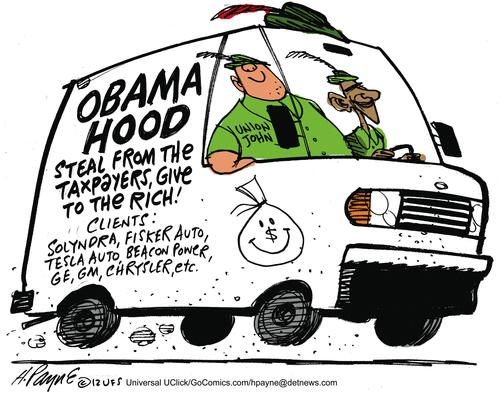
Not many people know the truth about Robin Hood. Robin Hood was not a left-wing hero who stole from the rich and redistributed to the poor. That is what you are trying to do though Mr. President.
When I was a kid, I was a big fan of Robin Hood. I remember reading at least two books recounting the legend and I watched the Errol Flynn version of the movie several times.
And, as an adult, I saw both the Kevin Costner and Russell Crowe versions of Robin Hood.
“I’m not an occupy-Wall-Street moocher”
None of this makes me an expert, but it does allow me to state with some confidence that Robin Hood was not a left-wing hero who stole from the rich and redistributed to the poor.
Instead, he was a quasi-libertarian tax protestor. Okay, maybe it’s an exaggeration to claim he was a libertarian, but Robin Hood was on the side of ordinary people who were being exploited by incessant tax demands from the ruling class. His main enemies were Prince John and the Sheriff on Nottingham, not the medieval equivalents of Wall Street.
In the Russell Crowe version of the movie, Robin Hood even gives a speech about the importance of liberty.
So you can imagine how irked I get when statists agitate for things such as the “Robin Hood Tax” in this moronic video. But what motivated me today is a story in the Financial Times about a Cesar Chavez wannabee politician from Spain.
For Spain’s ruling politicians he is a criminal; for his supporters he is Robin Hood, stealing from supermarkets and redistributing the food to the poor. Juan Manuel Sánchez Gordillo, the mayor of Marinaleda, a southern town with a population of 2,600, has been catapulted to cult hero status in Spain after setting out this week on an anti-austerity march across Andalucia – occupying banks and stealing food… “We are fighting a war for the poor … going to jail is not important for me, it would be an honour,” Mr Sánchez Gordillo told the Financial Times. “We are going to occupy all of the banks and supermarkets we are able to in Andalucia. The robbers who have caused this crisis must pay the consequences for what they have done.”
But don’t hold your breath waiting for self-awareness from this clown.
Not surprisingly, unions are part of the protest. I’m guessing that Mr. Canamero represents government employees.
On Friday, the marchers, who plan to sleep in the open or in parks, occupied a branch of Banco Santander in the town of Mancha Real in the province of Jaén before leaving later in the day. Diego Canamero, head of the Andalucian Workers Union, was in the branch on Friday. He said critics of the protests were politicians protecting their own interests. “These are symbolic actions against an unsustainable economic situation,” he said. “The bankers rob us, and take our money to tax havens…”
The dig against tax havens is particularly laughable. Ordinary Spaniards should hope and pray that their deposits in the local banks are safely re-deposited in banks based in well-run and honest jurisdictions such as Switzerland, the Cayman Islands, or Singapore.
And if they’re smart, they already cut out the middleman and directly placed their savings in one of these low-tax jurisdictions. That way, they’re not only at much less risk of a bank collapse, but they also have greater ability to protect their assets from the venal and incompetent tax-hungry political elite.
Returning to the mischaracterization of Robin Hood, this Payne cartoon does a good job of capturing my thoughts.
I especially like how Payne shows that the left-wing version of Robin Hood is all about a perniciously corrupt version of redistribution (though he should have included the Export-Import Bank on the side of the van). The genuine poor get crumbs while the well-connected interests make out like bandits.
Thank you so much for your time. I know how valuable it is. I also appreciate the fine family that you have and your commitment as a father and a husband.
Sincerely,
Everette Hatcher III, 13900 Cottontail Lane, Alexander, AR 72002, ph 501-920-5733, lowcostsqueegees@yahoo.com
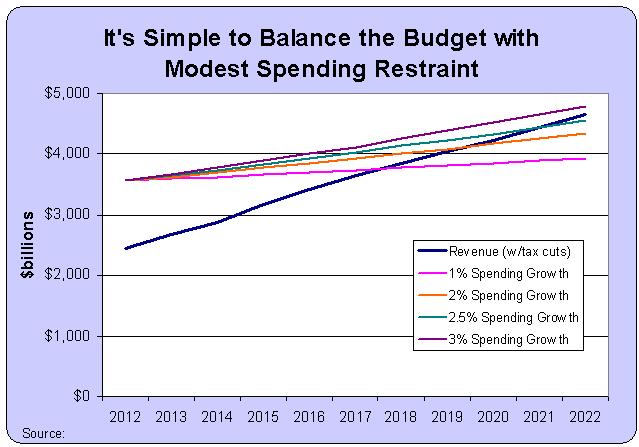
Now that new numbers have been released by the Congressional Budget Office, it’s time once again for me to show how easy it is to balance the budget with modest spending restraint (though please remember our goal should be smaller government, not fiscal balance).
I first did this back in September 2010, and showed that we could balance the budget in 10 years if federal spending was limited so it grew by 2 percent annually.
I repeated the exercise in January 2011 after new CBO numbers were released, and re-confirmed that a spending cap of 2 percent would eliminate red ink in just 10 years.
Most recently, back in January after CBO produced the new Economic and Budget Outlook, I crunched the numbers again and showed how a spending cap of 2 percent would balance the budget.
I’m happy to say that the new numbers finally give me some different results. We can now balance the budget if spending grows 2.5 percent annually.
In other words, spending can grow faster than inflation and the budget can be balanced with no tax hikes.
And here’s the video I narrated almost two years ago on this topic. The numbers have changed a bit, but the analysis is exactly the same.
In other words, ignore the politicians, bureaucrats, lobbyists, and special interests when they say we have to raises taxes because otherwise the budget would have to be cut by trillions of dollars. They’re either stupid or lying (mostly the latter, deliberately using the dishonest version of Washington budget math).
Modest fiscal restraint is all that we need, though it would be preferable to make genuine cuts in the burden of government spending.
______
Thank you so much for your time. I know how valuable it is. I also appreciate the fine family that you have and your commitment as a father and a husband.
Sincerely,
Everette Hatcher III, 13900 Cottontail Lane, Alexander, AR 72002, ph 501-920-5733, lowcostsqueegees@yahoo.com
Another good cartoon from Dan Mitchell’s blog on gun control. It seems that Colorado is the only state that has passed sensible gun control laws after a gun tragedy and that was after the 1999 Columbine shootings.
Subcommittee on the Constitution, Civil Rights and Human Rights
Committee on the Judiciary
United States Senate
Thank you for your interest in my and the Cato Institute’s perspective regarding the various legislative proposals that have been offered in response to the tragedy at Newtown. As you know, Cato is one of the nation’s leading advocates of individual liberty and limited government and so we are at the forefront of all public debates regarding constitutional civil rights — including the Second Amendment’s protection of the natural right to armed self-defense.
Being an advocate for individual rights and civil liberties can be difficult. When terrorists attack, when the economy fails, and yes, when evil visits elementary schools, the natural instinct is to demand security above all else. Politicians’ natural instinct is just do something, anything, that seems responsive to the crisis of the day.
A good example of this tendency is the law signed by New York Governor Andrew Cuomo last month, which Cato research fellow Trevor Burrus dissects in a blogpost (“A Cosmetic Gun Law”) that I enclose here. See also the absurd situations that the District of Columbia’s draconian — but ineffectual — restrictions provoke, as I describe in a second attached blogpost (“D.C. Treats Celebrities Better Than Veterans, Illustrating the Absurdity of Gun Laws”).
Yet, as Cato’s chairman Bob Levy wrote after the Tucson shooting — I enclose his op-ed (“Gun Control Measures Don’t Stop Violence”) — no gun regulation has ever been shown to reduce the incidence of violent crime, suicide, or accidents. So found a 2004 National Academy of Sciences study that reviewed 253 journal articles, 99 books, and 43 government publications evaluating 80 gun-control measures. A year earlier, the Centers for Disease Control examined a host of policies, ranging from ammunition bans to waiting periods, registration to zero-tolerance laws — and likewise found no evidence that the laws reduced gun violence.
The problem, as I write in a second op-ed that I enclose (“Why I Still Support the Right to Bear Arms,” on which this letter is based), is that no law could make the 300 million firearms in America disappear, even if we wanted to do that. Even making it illegal to own a gun, were that constitutional, wouldn’t prevent a criminal or madman from doing his malevolent deed. Robust policies to prevent legal gun ownership only translate to guns being overwhelmingly possessed by those willing to break the law.
Indeed, Connecticut has some of the strictest gun laws in the country, and Sandy Hook Elementary is a “gun-free zone” — as was the movie theater in Aurora, Colorado (which is why the killer there chose it, passing up more convenient venues).
None of the measures at the top of gun-control advocates’ agenda — such as banning so-called assault weapons and closing gun-show loopholes — would’ve averted these shootings. And as you yourself demonstrated during the Senate Judiciary Committee hearing on January 30, adding certain cosmetic features such as pistol grips and bayonet mounts to ordinary hunting rifles does not in any way affect their functionality or otherwise transform them into weapons of war.
As Cato associate policy analyst David Kopel wrote in the third op-ed I’m enclosing (“Guns, Mental Illness and Newtown”), we’d be better off focusing on the identification and treatment of mental illness — the common factor in all these incidents — and ensuring that disqualifying records make it into the database used for background checks (which would’ve stopped the Virginia Tech shooter from buying his guns).
That’s not to say that we shouldn’t have any gun regulations. Cracking down on “straw purchasers” is a good idea and military-grade weapons like fully automatic “machine guns” — or rocket launchers, as I told Stephen Colbert on his July 8, 2010 show — indeed have no place in civilian life.
On the other hand, it’s perfectly reasonable for someone to have a gun to protect herself or her family. That’s why the Second Amendment is so important: Americans cherish their life, liberty, and pursuit of happiness so much that they instituted a government that protects their right to defend against anyone who would threaten them.
After the 1999 Columbine shootings, Colorado passed a series of laws that should serve as a national model (for states; the Constitution doesn’t give the federal government the power to enact most of the legislation that’s been floated lately.) As Kopel details in the fourth op-ed I’m enclosing (“Colorado Consensus on Gun Laws”), some of them consist of what people call “gun control,” while others are in the “gun rights” category. The most important one was the Concealed Carry Act, which has already saved countless lives, including at an Aurora church — three months before the theater shooting — where an off-duty cop killed a career criminal who was targeting congregants.
These cohesive measures are based on an obvious principle that enjoys broad public support: Guns in the wrong hands are dangerous, while guns in the right hands protect public safety — as Burrus details in the fifth op-ed that I enclose (“Face It: Guns Are Here to Stay”). The Second Amendment exists to protect the grand American experiment in self-government. Call me a “Constitution nut,” but I’m crazy about allowing people to live their lives with the maximum freedom possible.
If I could snap my fingers and end gun violence, I would. I would even take guns away from hunters and sportsmen if it meant better self-defense for the rest of us. Men aren’t angels, however, and, by definition, criminals don’t follow the law. Yes, in the wake of Newtown, my colleagues and I still support the right to bear arms.
Gun Free Zones???? Stalin and gun control On 1-31-13 ”Arkie” on the Arkansas Times Blog the following: “Remember that the biggest gun control advocate was Hitler and every other tyrant that every lived.” Except that under Hitler, Germany liberalized its gun control laws. __________ After reading the link from Wikipedia that Arkie provided then I responded: […]
On 1-31-13 I posted on the Arkansas Times Blog the following: I like the poster of the lady holding the rifle and next to her are these words: I am compensating for being smaller and weaker than more violent criminals. __________ Then I gave a link to this poster below: On 1-31-13 also I posted […]
Will “CARRYING HANDGUN IS PROHIBITED” poster work? Dan Mitchell of the Cato Institute on gun control On 1-13-13 on the Arkansas Times Blog the person with the username “ArkDemocrat” stated, “I visited a church in another state that allows guns, and there was a sign similar to the “No Smoking” signs (i.e. smoking cigarette with […]
Poster for November 2008 benefit for Pressly family, held at Peabody Hotel in Little Rock. ______________ Max Brantley of the Ark Times Blog often attacks those on my side of the gun control debate and that makes me argue even harder for the 2nd amendment. Several months ago Lindsey Miller and Max Brantley were talking […]
I have posted some cartoons featured on Dan Mitchell’s blog before and they are very funny. An Amusing Look at Gun-Free Zones September 26, 2012 by Dan Mitchell I’ve shared a very clever Chuck Asay cartoon about gun-free zones, so let’s now enjoy four posters on the topic. Let’s begin with a good jab at one […]
The recent killing by a mad gunman in CT is not indicating a trend. School killings have gone down and probably peaked in 1929. Nick Gillespie reported in the below video, “Across the board, schools are less dangerous than they used be. Over the past 20 years, the rate of theft per 1,000 students dropped […]
Pretty shocking admissions from the liberal Jeffrey Goldberg on gun control. An Honest Liberal Writes about Gun Control December 16, 2012 by Dan Mitchell I wrote earlier this month about an honest liberal who acknowledged the problems created by government dependency. Well, it happened again. First, some background. Like every other decent person, I was horrified […]
Despite what Max Brantley of the Arkansas Times Blog (1-9-13) would have you believe gun control does not make since unless you suspend your reasoning ability. There are so many examples that show how silly gun control is. Mocking Gun Control Fanatics October 18, 2012 by Dan Mitchell Last month, I shared some very amusing images […]
It seems to me that most of the gun control arguments I have heard are not very logical. Deciphering How Statists Think about Gun Control September 9, 2012 by Dan Mitchell Even though I don’t own that many guns, I’m an unyielding supporter of the 2nd Amendment. Indeed, I use gun control as a quick and […]
John Stossel report “Myth: Gun Control Reduces Crime After this horrible shooting in the school the other day it seems the gun control debate has fired up again. Max Brantley of the Arkansas Times jumped on Charlie Collins concerning his position on concealed weapons but I think that would lower gun crimes and not raise […]
Ron Paul has made “End the Fed” a popular slogan, but some people worry that this is a radical untested idea. In part, this is because it is human nature to fear the unknown.
But there are plenty of examples of policy reforms that used to be considered radical but are now commonplace.
Self-styled progressives used to say that air traffic control system needs to be a government monopoly, but our Canadian neighbors privatized their system and now have more safety and efficiency.
Defenders of the status quo used to claim that school choice was a radical idea, but it’s hard to defend that position since nations such as Sweden, Chile, and the Netherlands have adopted competitive systems.
This list could go on, but the pattern is always the same. People assume something has to be done by government because “that’s the way it’s always been.” Then reform begins to happen and the myth is busted.
But is money somehow different? Not according to some experts.
Why must our government make currency competition illegal? …Competition is generally good. Why not competition in currencies? Most people I interviewed scoffed at the idea. They said private currency should be illegal. But impressive thinkers disagree. In 1975, a year after he won the Nobel Prize in economics, F.A. Hayek published “Choice in Currency,”which has inspired a generation of “free banking” economists. Hayek taught us that competition not only respects individual liberty, it produces essential knowledge we cannot obtain any other way. Any central bank is limited in its access to such knowledge, and subject to political pressure, no matter how independent it’s supposed to be. “This monopoly of government, like the postal monopoly, has its origin not in any benefit it secures for the people but solely in the desire to enhance the coercive powers of government,” Hayek wrote. “I doubt whether it has ever done any good except to the rulers and their favorites. All history contradicts the belief that governments have given us a safer money than we would have had without their claiming an exclusive right to issue it.” Former Federal Reserve economist David Barker discussed this idea recently with me. “There are a lot of ways that private money might be better,” Barker said. “It might have embedded chips that would make it easier to count.” The chips would also prevent counterfeiting. There used to be private currencies. A businessman who sold iron and tin made coins that advertised his business. The Georgia Railroad Co. also produced its own currency. This became illegal in 1864 — Abraham Lincoln was a fan of central banking.
Stossel’s historical references are particularly important. As I explain in this video, many nations – including the United States – used to have competing currencies.
The Federal Reserve has existed for almost 100 years and it has created depressions, recessions, inflation, and bubbles. This CF&P Foundation video explains the origin of central banking and mentions possible alternatives that will be discussed in subsequent mini-documentaries.
________________-
And if you want a thorough analysis of the Fed’s performance, I urge you to watch this George Selgin speech. Then ask yourself whether we would have been in better shape with private currencies.
__________
Thank you so much for your time. I know how valuable it is. I also appreciate the fine family that you have and your commitment as a father and a husband.
Sincerely,
Everette Hatcher III, 13900 Cottontail Lane, Alexander, AR 72002, ph 501-920-5733, lowcostsqueegees@yahoo.com