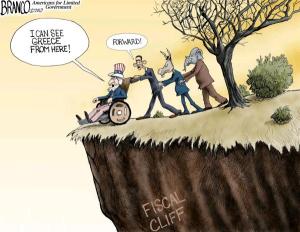
Congress better step up to the plate and avoid the huge tax increase coming at the end of 2012. You don’t want that this tax increase to go into affect do you?
In a bit of scheduling serendipity, Tax Freedom Day—the day when Americans finally earn enough income to pay off the bill for all federal, state, and local taxes for the year—falls on April 17 this year. That also happens to be Tax Filing Day 2012.
Absent tax changes made by Congress, Tax Freedom Day moves earlier or later in the calendar from year to year based on the economy. If the economy is stronger, then more Americans are working and wages are rising. Larger incomes mean they pay more taxes and Tax Freedom day falls later in the year. The reverse happens when the economy is weak, as it is today.
Tax Freedom Day next year promises to be much later than April 17, but unfortunately not because of a strong economy, which even the Obama Administration is not predicting. No, Tax Freedom Day will be much later if Congress and President Obama fail to act promptly and prevent Taxmageddon from striking America’s families and small businesses.
Taxmageddon is a $494 billion tax hike. Not only would it push Tax Freedom Day much deeper into 2013, it would also make next year’s Tax Day considerably more painful than it was this year: American households would face an average tax increase of $3,800.
A big portion of the Taxmageddon increase would occur because tax cuts enacted more than a decade ago lowered all tax rates and put in place a new 10 percent bracket. They also doubled the child tax credit from $500 to $1,000, reduced the marriage penalty, and reduced the tax disincentives toward saving. These tax cuts are all slated to expire at the end of 2012. In total, because of the expiration of just these three tax policies, 70 percent of Taxmageddon would fall directly on low-income and middle-income families. That’s about $346 billion less for families to spend and a whole lot more for government to spend.
That’s not all. If Congress fails to act, then a lot more Americans are going to pay the alternative minimum tax, or AMT. This tax was only supposed to be paid by “the rich.” But, as so often happens, a tax targeted at the rich expanded over time so that it now threatens millions of middle-income families.
If Congress fails to act, workers won’t have to wait very long to feel the effects. Every payday, they would see a jump in their payroll tax as it takes a bigger bite out of every paycheck. And that only reflects the direct hit they’ll face. The health care surtax on investment income and salaries over $250,000—which begins in 2013 along with five other tax hikes—would slow job creation, because it would take away resources from businesses, investors, and entrepreneurs.
Other Taxmageddon tax hikes, such as the expiration of the “tax extenders,” the rise of the death tax, and end of 100 percent expensing for business investment, would also slow the economy. These would make it harder for those out of work to find a job or for those looking for a new opportunity to land a better job. It would also slam the stock market, making it harder to rebuild depleted retirement savings.
Congress and President Obama need to show voters they actually can get important things done, even in an election year. Stopping a nearly $500 billion economy-crushing tax hike shouldn’t be controversial. So what’s the hold up?
_________
Thank you so much for your time. I know how valuable it is. I also appreciate the fine family that you have and your commitment as a father and a husband.
Sincerely,
Everette Hatcher III, 13900 Cottontail Lane, Alexander, AR 72002, ph 501-920-5733, lowcostsqueegees@yahoo.com
Why not pass the Balanced Budget amendment? As you know that federal deficit is at all time high (1.6 trillion deficit with revenues of 2.2 trillion and spending at 3.8 trillion).
On my blog www.HaltingArkansasLiberalswithTruth.com I took you at your word and sent you over 100 emails with specific spending cut ideas. However, I did not see any of them in the recent debt deal that Congress adopted. Now I am trying another approach. Every week from now on I will send you an email explaining different reasons why we need the Balanced Budget Amendment. It will appear on my blog on “Thirsty Thursday” because the government is always thirsty for more money to spend.
In January of 2013 I read this fine article by George Will:
Democrats not allergic to arithmetic must know the cost of their “fiscal cliff” victory. When they flinched from allowing all of George W. Bush’s tax rates, especially those on middle-class incomes, to expire, liberalism lost its nerve and began what will be a long slide into ludicrousness.
Those temporary rates were enacted in 2001, when only 28 House Democrats supported them, and in 2003, when only seven did. But with the “American Taxpayer Relief Act of 2012” — did liberals think about that title? — 172 House Democrats voted to make the Bush income-tax rates permanent for all but 0.7 percent of taxpayers — individuals earning more than $400,000 and couples earning more than $450,000.
Liberals could have had a revenue increase of $3.7 trillion over 10 years. Instead, they surrendered nearly $3.1 trillion of that. They cannot have repeated bites at this apple. They cannot now increase government revenue as a share of gross domestic product through tax reform because Republicans insist that the Taxpayer Relief Act closed the revenue question. And because tax reform is dead for the foreseeable future, so are hopes for a revenue surge produced by vigorous economic growth.
No numerate person thinks that today’s entitlement state, let alone the steady expansion of it that is liberalism’s aspiration, can be funded by taxing the income of the 0.7 percent of taxpayers whose rates were just raised. Or the 2 percent whose rates would have been raised had liberals and their president simply allowed the automatic increase of rates for individuals earning more than $200,000 and couples earning more than $250,000.
Because 82 percent of American earners pay more in payroll taxes than income taxes, no politically conceivable or economically feasible middle-class tax rate can fund the entitlement state. And America’s political culture rules out funding it with new consumption or energy taxes. By rescuing almost everyone from the restoration of Clinton-era rates, liberals abandoned any pretense of paying for their program of ever- expanding entitlements. Instead, they made trillion-dollar deficits their program.
From 1950 to 2000, economic growth averaged 3.6 percent; since then, it has averaged less than 2 percent. Liberals think today’s correlation between the slow economic growth and rapid governmental growth — including under George W. Bush — is a coincidence. Conservatives do not. And they note some recent actions, done in December’s bright light of public attention and fiscal anxiety, which indicate that this government’s indiscipline is incorrigible and shameless. Consider one detail in the Taxpayer Relief Act, and an issue pertinent to the aftermath of Hurricane Sandy.
Years ago, Congress decided that, to save the planet, there should be tax credits to bribe Americans to buy electric cars. Sen. Ron Wyden (D-Ore.) believes it only fair that buyers of electric motorcycles, some of which are made in Oregon, not get left out of the bribery business. Thanks to the Taxpayer Relief Act, they won’t.
People who choose to live in places vulnerable to flooding believe it would be unfair that the cost of their property insurance fully reflect this risk. So government subsidizes their insurance, and hence their decision to live where there is increased risk of property damage that, when it happens, the government helps pay to rebuild.
Today’s government, whose railroad, Amtrak, lost $834 million over the past 10 years just on its food service, has neither wit nor will to stop subsidizing electric motorcycles or to reform flood insurance. Hence Republicans should rally ’round one of several well-refined constitutional amendments requiring balanced budgets. Such an amendment would be popular everywhere, but especially in six states important in 22 months.
Republicans need to gain six seats to win Senate control in 2014, when Democrats will be defending 20 seats, Republicans only 13. Six Democratic incumbents represent states in which Barack Obama received less than 42 percent of the 2012 vote — Montana’s Max Baucus (41.7), Alaska’s Mark Begich (40.8), Louisiana’s Mary Landrieu (40.6), South Dakota’s Tim Johnson (39.9), Arkansas’s Mark Pryor (36.9) and West Virginia’s Jay Rockefeller (35.5).
Sixty-seven Senate votes are needed to send a proposed amendment to the states for ratification. There are 45 Republican senators. There are nowhere near 22 Democrats who would vote for an amendment Republicans could support. Still, Republicans, whose divisions cause Democratic gloating, could use a balanced-budget amendment to divide Democrats who threw the remnants of their fiscal self-respect off the cliff.
The Balanced Budget Amendment is the only thing I can think of that would force Washington to cut spending. We have only a handful of balanced budgets in the last 60 years, so obviously what we are doing is not working. We are passing along this debt to the next generation.
Thank you for this opportunity to share my ideas with you.
Over and over in Proverbs you hear the words “fear the Lord.” In fact, some of he references are Proverbs 1:7, 29; 2:5; 8:13; 9:10;14:26,27; 15:16 and many more. Below is a sermon by John MacArthur from the Book of Luke on 3 reasons we should fear the Lord.
What does it mean to fear the Lord? That is what John MacArthur looks at today. I really believe if I feared the Lord more then I would sin less. I am convicted about this and I hope to live a life in the future that will indicate to those around me that I am fearing the Lord.
John MacArthur
I remember hearing Dr. Adrian Rogers say that if he had to do it over again he would read from Proverbs every day to his kids. They turned out to be great kids and they were raised right. Nevertheless, if he had to do it over again he thought a more emphasis on Proverbs is the way to go. That is why I am spending so much time in Proverbs with my kids today.
John MacArthur does a great job on Proverbs and here is a portion of his sermon on Proverbs.
Now in this process of teaching there is one compelling over‑arching consummate summary lesson and that is that we are to teach them wisdom. The word which dominates the Proverbs is the word “wisdom.” Sometimes the word instruction appears, sometimes the word understanding appears, sometimes the word discretion appears. But all of those words are simply elements of wisdom…to know, to understand, to be instructed, to have discretion means to act in wisdom. Wisdom means not simply thought but conduct. It means to live righteously. We are to teach our sons spiritual wisdom is the noblest and greatest and purest pursuit of their life.
In chapter 1 verse 20 wisdom is shouting in the streets, wisdom is personified here. Wisdom is lifting up her voice in the square. She is crying out in verse 22 for people to turn away from being naive, scoffers who are fools and to turn to wisdom.
The call of the whole book of Proverbs is that call, a call to wisdom. In fact, in chapter 2, would you please notice, the call by wisdom comes at the end of chapter 1 as wisdom personified cries out and cries out for men to come to her. In chapter 2 then we find the father encouraging his son to seek wisdom. Verse 4, “If you seek her as silver and search for her as for hidden treasure, then you will discern the fear of the Lord and discover the knowledge of God, for the Lord gives wisdom, from His mouth come knowledge and understanding.” The father is saying pursue wisdom…pursue wisdom…pursue wisdom.
In chapter 8 the whole chapter is about pursuing wisdom, going after wisdom. Verse 11 says wisdom is better than jewels and all desirable things cannot compare with her. Again the pursuit of wisdom. And so, the overarching lesson that a father teaches his son is to pursue wisdom. And chapter 10 verse 1 says a wise son will make a father glad…a foolish son will be a grief to his mother.
We are then, fathers, responsible on this Father’s Day to rethink this priority of teaching our sons wisdom. And I would like us to look at these first ten chapters and just pick and choose the elements that are here that I think make up ten crucial lessons a faithful father must teach his sons. And I want to tell you from my own life that these are the things that I have endeavored as a father to teach my two sons. If a son learns these ten things, he will be a blessing to you and he will be blessed by God. If you want your son to be a blessing to you, to be blessed by God, to bless the culture in which he lives, these are the ten lessons that you must teach your son. The sum of them is spiritual wisdom. This is a listing of the component parts of spiritual wisdom.
Lesson number one, teach your son to fear your God…fear your God. In chapter 1 and verse 7, “The fear of the Lord is the beginning of knowledge,” and chapter 9 verse 10 says, “The fear of the Lord is the beginning of wisdom.” But everything starts with fearing God. Teach your son…”Son, fear your God.”
What do you mean fear? Well it has on the one hand a positive aspect, a reverential respect, a reverential awe. That means that I have to teach my son about God. I have to teach my son what God is like. I have to teach my son the attributes of God. I have to teach my son that God is powerful, that God is holy, that God is omniscient, omnipresent. I have to teach my son that God is immutable, his nature does not change, that He is just, that He is merciful, that He is kind, that He is loving, that He is gracious, that He is merciful, that He orders providentially all the circumstance of human history and the universe for His good, that He is a sovereign, in a word. I must teach my son to reverence the greatness of God.
And then the other side of it is I must teach my son to fear God’s displeasure…to fear God’s right to punish, God’s right to chasten, God’s right to judge. And in that awe of reverencing God’s holy character there is a healthy sense of apprehension because I know as a holy God He has a right to punish sin, including mine. If you want to do your son the greatest favor any father could ever do, teach him the character of God. Teach him what God is like. On the positive side, all of His attributes.
I remember when our children were little we took them through a book, Leading Little Ones To God which taught the attributes of God. We’ve always emphasized the attributes of God. They must know who their God is and they must learn to worship their God…that’s part of fearing Him. Teach your sons to worship. And you teach not only by what you say but by what you do. Do you worship faithfully on the Lord’s day? Are you consistent and faithful in worshiping the Lord? Are you here at the opening of the day in the morning and the closing in the evening service? Are you faithful to worship God in the Word yourself personally? Does your son look at you and see a true worshiper? Because whatever patterns of worship you have established for yourself, you have established for your son and he will likely establish for his son. What kind of legacy are you leaving?
And what about living in a healthy fear of God’s holy right to punish sin? Do you have that healthy fear? Do you understand that God has the right to punish you? Do you so live to avoid that?
Notice chapter 3 of Proverbs verse 5, this is really a description of a worshiping heart. “Trust in the Lord with all your heart and do not lean on your own understanding; in all your ways acknowledge Him and He will make your paths straight.” The point being that if I am completely focused on God, He’s going to guard my life, He’s going to straighten my path. I want to teach my son how to trust the Lord with all his heart. The word trust in the Hebrew originally meant to lie helplessly face down. And there’s a sense of humility there, but there’s also a sense of submission there to the total sovereign control of God in which the worshiper says I not only am humbled in Your presence but I bow in Your presence submissively to anything that You would choose to do, that’s how much I trust You. Teach your son to trust that way. Teach him not to lean on his own understanding. The Hebrew word does not mean to incline, it means to support yourself. Teach him not to support himself by his own wisdom but to support himself by God’s wisdom. In all your ways acknowledge Him. The word there means to be aware of, to know, to have fellowship with.In everything in life teach him to do it in union communion with the living God. Teach him how to trust God for everything. How to lean on God for support totally and how to be aware of God’s consistent presence in his life. And if he so lives with that kind of trust and that kind of leaning and that kind of acknowledging, God’s going to direct his path. Teach him to fear his God.
And I believe that when God is feared, so is sin…so is sin. Proverbs says fearing the Lord prolongs life. You want to give your son that kind of rich full life? Proverbs says fearing the Lord is more profitable than wealth, it brings about life. It keeps one from evil. It results in riches and honor and it breeds humility. Proverbs says that those who fear God sleep satisfied and are untouched by evil. They have confidence, they will be praised and they have their prayers answered. Would you like that for your son? Would you like to know that your son will have his life prolonged to its fullness? Would you like to know that he will be kept from evil, that he will be brought honor and riches? That he would be humble, untouched by evil? Satisfied, confident, praised and have his prayers answered? Then teach him to fear God. This is the most crucial lesson a father could ever teach a son.
_____________
FINAL QUESTION: WHAT DOES PROVERBS 3:5 MEAN?
“Trust in the Lord with all your heart and do not lean on your own understanding; in all your ways acknowledge Him and He will make your paths straight.”
#02 How Should We Then Live? (Promo Clip) Dr. Francis Schaeffer
The clip above is from episode 9 THE AGE OF PERSONAL PEACE AND AFFLUENCE
10 Worldview and Truth
In above clip Schaeffer quotes Paul’s speech in Greece from Romans 1 (from Episode FINAL CHOICES)
Two Minute Warning: How Then Should We Live?: Francis Schaeffer at 100
A Christian Manifesto Francis Schaeffer
Published on Dec 18, 2012
A video important to today. The man was very wise in the ways of God. And of government. Hope you enjoy a good solis teaching from the past. The truth never gets old.
How Should We then Live Episode 7 small (Age of Nonreason)
_______________________
If you take the time to watch the film HOW SHOULD WE THEN LIVE? you will find this statement by Chad Brand is true: “Francis Schaeffer wanted to tell these young persons who have been steeped in Marcuse, Sartre, and Nietzsche that they do not have to sell their souls to the devil of a fractured metaphysic. The answer to the human condition lies not in nihilism, but in the Infinite-Personal God of biblical revelation.”
by Chad Brand | Dec 01 2012 | Published in Uncategorized
For me, the ‘Seventies were virtually bookended by Francis Schaeffer. I read The God Who Is There for the first time in 1972 and my intellectual life was transformed. Though I struggled with some of the ideas in the book and at times I wished the author might have given a bit more background material to explain his assessments, I had the overwhelming sense that I had crossed over into a new world. Then in 1978 I spent ten successive Thursday nights going to a church in Ft. Worth, Texas, to view the successive installments of the film series, “How Should We Then Live?” At the time it was a tour de force in Christian film production, and it convinced me that it was possible not only to make a credible case for Christianity, but that it might also be done in an attractive and compelling format.
Schaeffer was the first apologist I ever read, and his impact on my thinking was profound. But he is more than that. Hegel reminded us that the Owl of Minerva flies at dusk, and if this is so, then one might surmise that the real jolt of Schaeffer’s work would not be felt until after he was gone. I personally believe this to be the case. As helpful as he was as a teacher to me when I was eighteen years old, now I read him as a prophet.
Schaeffer was one of the first evangelical thinkers to take note of rising postmodernity, though that term was not au courant in his time, and to recognize it for what it was, not what it claimed to be. His criticisms of Samuel Beckett and Mondrian, for example, show that though these postmodern cultural icons claim to be critiquing any possibility for objective truth claims, the fact is that they offer their own tacit affirmations about truth.
He labored as an evangelist. Schaeffer’s work might be seen as the reverse of the strategy exercised by postmodern critics such as Herbert Marcuse and Theodore Adorno in the early ‘Sixties. These members of the Frankfurt School launched a very caustic critique of all claims to knowledge and truth that stood in the heritage of classical antiquity, of the Christian worldview, or even of modernity. However it may seem to the casual reader of books like One-Dimensional Man, though, the goal of these iconoclasts was not the rejection of outmoded forms of discourse so that marginalized speech might finally have its place in cultural life. These men had political ends in view—they wanted to take over the state. In order to do that, of course, they needed to gain a mass following. Knowing that it was highly unlikely that their intellectual concerns would find a sympathetic hearing among either the working class or the bourgeoisie, these left-wing intellectuals turned to university students to obtain a pool of disciples. Marcuse and company knew full well that their stance of negativity toward prevailing institutions and truth claims would find a ready hearing among the disaffected youth of the (mostly) middle class. The result was the student protest movement in places such as Paris, Columbia University, and Berkeley.
Schaeffer’s work was an antidote to all of this in two ways. First, in his radical demythologizing of the (post)modern and existentialist myths, Schaeffer lifted the lid off of prevailing ideologies and demonstrated that non-Christians cannot give a unified account of reality. This is especially true of the intellectual traditions of the last century, in which thinking persons, under the spell of Kant, Hegel, and Kierkegaard, have slipped below the “line of despair.” Feeling self-conscious about the disarray in their worldview, such persons have thrown a blanket over the chaos to hide it from view, and then have assumed a Protean stance, like James Cagney standing atop a burning building and crying, “I’m on top of the world.” American youth in particular had fallen prey to the notion that nihilism was innocuous, a sort of playful exercise. Louis Armstrong, Bobby Darin, and Frank Sinatra all made hit recordings of the song, “Mack the Knife,” a song about a serial murderer, sung to a sprightly tune, putting a sort of happy face on nihilism. (The full version of the song, from Brecht’s “Three Penny Opera” is more explicit than the American version.) Schaeffer sought to remove the blanket and let the daylight come streaming in to reveal the fractured character of these newly canonical epistemologies. Without diminishing the lure of relativism and nihilism or downplaying the genuine angst of young people in the contemporary world, Francis Schaeffer displayed the vacuity of the postmodern and existentialist “cures.” For me, reading Camus, Nietzsche, and Kafka through the decade of the ‘Seventies, Schaeffer’s sermons kept ringing back: “These men have fallen below the line of despair—they are of no final help to you.”
Second, Schaeffer wanted to tell these young persons who have been steeped in Marcuse, Sartre, and Nietzsche that they do not have to sell their souls to the devil of a fractured metaphysic. The answer to the human condition lies not in nihilism, but in the Infinite-Personal God of biblical revelation. This God seeks a relationship with humans through the death and resurrection of his Son, Jesus Christ. Though the church has often obscured the essence of the faith through its traditions, biblical Christianity understood in terms of the Reformation traditions provides the real solution to the human dilemma. We can know that this message is true both because it rings true in our lives and because it is presented in a Book that is absolutely trustworthy. Again, though my own approach to apologetics may not be completely Schaeferrian any more, his approach helped me work through issues related to presuppositionalism, evidentialism, and the classical approach.
Francis Schaeffer the prophet points us the way through the maze of postmodernity. Like other prophets to postmodernity, such as Solzhenitsyn and Alvin Gouldner, he reminds us that the advocates of existentialism and postmodernism are not disinterested, objective observers of the contemporary situation. They rather have adopted a discourse of radical suspicion for the purposes of transforming the moral condition of this world into something more fitting with their own rejection of Judeo-Christian values. Further, in their defense of marginalized discourses, though they appear to be the Robin Hoods of postmodern culture, taking from the bourgeoisie and their intellectual hired guns, in fact, beneath the mask they really are the Sheriff of Nottingham, with political goals of their own. Postmodernity is a power play by humanistic intellectuals for the purposes of intellectuals, and we ought not to be deluded into thinking otherwise.
The Francis and Edith Schaeffer Story Pt.1 – Today’s Christian Videos The Francis and Edith Schaeffer Story – Part 3 of 3 Francis Schaeffer: “Whatever Happened to the Human Race” (Episode 1) ABORTION OF THE HUMAN RACE Published on Oct 6, 2012 by AdamMetropolis ________________ Picture of Francis Schaeffer and his wife Edith from the […]
THE MARK OF A CHRISTIAN – CLASS 1 – Introduction Published on Mar 7, 2012 This is the introductory class on “The Mark Of A Christian” by Francis Schaeffer. The class was originally taught at Redeemer Presbyterian Church in Overland Park, KS by Dan Guinn from FrancisSchaefferStudies.org as part of the adult Sunday School hour […]
The Francis and Edith Schaeffer Story Pt.1 – Today’s Christian Videos The Francis and Edith Schaeffer Story – Part 3 of 3 Francis Schaeffer: “Whatever Happened to the Human Race” (Episode 1) ABORTION OF THE HUMAN RACE Published on Oct 6, 2012 by AdamMetropolis ________________ Picture of Francis Schaeffer and his wife Edith from the […]
The Francis and Edith Schaeffer Story Pt.1 – Today’s Christian Videos The Francis and Edith Schaeffer Story – Part 3 of 3 Francis Schaeffer: “Whatever Happened to the Human Race” (Episode 1) ABORTION OF THE HUMAN RACE Published on Oct 6, 2012 by AdamMetropolis ________________ Picture of Francis Schaeffer and his wife Edith from the […]
The Francis and Edith Schaeffer Story Pt.1 – Today’s Christian Videos The Francis and Edith Schaeffer Story – Part 3 of 3 Francis Schaeffer: “Whatever Happened to the Human Race” (Episode 1) ABORTION OF THE HUMAN RACE Published on Oct 6, 2012 by AdamMetropolis ________________ Picture of Francis Schaeffer and his wife Edith from the […]
The Francis and Edith Schaeffer Story Pt.1 – Today’s Christian Videos The Francis and Edith Schaeffer Story – Part 3 of 3 Francis Schaeffer: “Whatever Happened to the Human Race” (Episode 1) ABORTION OF THE HUMAN RACE Published on Oct 6, 2012 by AdamMetropolis ________________ Picture of Francis Schaeffer and his wife Edith from the […]
Francis Schaeffer: “Whatever Happened to the Human Race?” (Episode 2) SLAUGHTER OF THE INNOCENTS Published on Oct 6, 2012 by AdamMetropolis The 45 minute video above is from the film series created from Francis Schaeffer’s book “Whatever Happened to the Human Race?” with Dr. C. Everett Koop. This book really helped develop my political views concerning […]
Francis Schaeffer: “Whatever Happened to the Human Race” (Episode 1) ABORTION OF THE HUMAN RACE Published on Oct 6, 2012 by AdamMetropolis The 45 minute video above is from the film series created from Francis Schaeffer’s book “Whatever Happened to the Human Race?” with Dr. C. Everett Koop. This book really helped develop my political views […]
I have gone back and forth and back and forth with many liberals on the Arkansas Times Blog on many issues such as abortion, human rights, welfare, poverty, gun control and issues dealing with popular culture. Here is another exchange I had with them a while back. My username at the Ark Times Blog is Saline […]
Francis Schaeffer: “Whatever Happened to the Human Race” (Episode 5) TRUTH AND HISTORY Published on Oct 7, 2012 by AdamMetropolis The 45 minute video above is from the film series created from Francis Schaeffer’s book “Whatever Happened to the Human Race?” with Dr. C. Everett Koop. This book really helped develop my political views concerning abortion, […]
In his book The New Reagan Revolution, Michael Reagan examined six great economic crossroads of the 20th and 21st centuries. These six critical junctures in the history of the United States serve as economic laboratories to test two contrasting economic theories. One theory consistently produced economic expansion and sustained growth. The other theory invariably produced failure and misery. Here are Michael Reagan findings:
1. The “Forgotten Depression” of January 1920. During the last year of Woodrow Wilson’s presidency, the economy nosedived. GNP fell 17 percent; unemployment soared from 4 to almost 12 percent. This was the “Forgotten Depression” of 1920. Wilson’s successor, Warren G. Harding, came into office and immediately cut tax rates for all income brackets, slashed federal spending, and balanced the budget. Long before the world ever heard of Ronald Reagan, Harding practiced “Reaganomics.”
“President Harding applied the principles of Reaganomics,” Michael Reagan observed, “even though Ronald Reagan was at that time a nine-year-old boy living in Dixon, Illinois. Harding was not following an economic theory. He was following common sense. He treated the federal budget as you would treat the family budget: When times are tough, cut spending and stay out of debt. Harding also treated his fellow citizens with commonsense compassion: If folks are going through tough times, government should ease their burden and cut their taxes.”
The Harding recovery was astonishingly rapid, beginning just half a year into his presidency. Unemployment fell to 6.7 percent by 1922, and to 2.4 percent by 1923. Harding’s successor, Calvin Coolidge, maintained Harding’s program of low tax rates, balanced budgets, and limited government. The Harding-Coolidge era of prosperity became known as “the Roaring Twenties”—a time of soaring prosperity, stable prices, and boundless optimism.
Obvious conclusion based on the evidence: Reaganomics works.
2. The Great Depression. Coolidge was succeeded by Herbert Hoover. In the eighth month of Hoover’s presidency, the stock market crashed—the infamous Crash of 1929. Many factors led to the Great Depression, but the Crash was the precipitating event. Hoover had failed to learn the lessons of the Harding-Coolidge years, so he responded by raising taxes (hiking the top marginal rate from 25 to 63 percent), imposing protectionism (the Smoot-Hawley Tariff Act), and boosting government spending by 47 percent, driving America deep into debt. Hoover’s actions worsened the Depression. A defeated Herbert Hoover bequeathed a ruined economy to Franklin Delano Roosevelt
FDR took office at a time when 25 percent of the nation’s workforce was unemployed. He, too, ignored the lessons of the “Forgotten Depression,” and doubled down on Hoover’s failed tax-and-spend policies, applying the economic theory known as Keynesianism (after British economist John Maynard Keynes). The Keynes-FDR approach involved deficit spending, soak-the-rich tax policies, and big-government make-work programs (the New Deal). FDR and a compliant Congress hiked personal and corporate income tax rates, estate taxes, and excise taxes.
Michael Reagan wrote, “From 1937 to 1939, the stock market lost almost half its value, car sales fell by one-third, and business failures increased by one-half. From 1932 to 1939, the U.S. racked up more debt than in all the preceding 150 years of America’s existence. By early 1939, as the Great Depression was in its tenth year, unemployment again climbed past the 20 percent mark.”
Many Americans credit FDR with “getting America through the Depression.” In reality, FDR’s policies prolonged the Depression. In a time of catastrophic unemployment, Roosevelt made it prohibitively expensive to hire people, making a terrible human tragedy even worse. While thousands of U.S banks failed under FDR’s policies, across the border in Canada, not one bank failed—because Canadian banks were not hamstrung by FDR’s foolish over-regulation. In FDR’s Folly, historian Jim Powell questions the disturbing FDR legacy:
Why did New Dealers make it more expensive for employers to hire people? Why did FDR’s Justice Department file some 150 lawsuits threatening big employers? Why did New Deal policies discourage private investment without which private employment was unlikely to revive? Why so many policies to push up the cost of living? Why did New Dealers destroy food while people went hungry? To what extent did New Deal labor laws penalize blacks? Why did New Dealers break up the strongest banks? . . . Why didn’t New Deal public works projects bring about a recovery? Why was so much New Deal relief spending channeled away from the poorest people?
In May 1939, a demoralized and defeated Henry Morgenthau, FDR’s treasury secretary, told the House Ways and Means Committee, “We are spending more than we have ever spent before and it does not work. . . . I want to see people get a job. I want to see people get enough to eat. We have never made good on our promises. . . . After eight years of this administration we have just as much unemployment as when we started. . . . And an enormous debt to boot!”
Many people mistakenly believe that World War II lifted America out of the Great Depression. Not true. What WWII did was take 12 million men out of the workforce and send them into war, which ended unemployment. But all the other signs of a damaged economy remained during the war: low stock prices, depressed private investment, and depressed consumer demand.
Roosevelt and his successor, Harry Truman, had a post-war plan to impose an even bigger Second New Deal after the war. Fortunately, Congress refused, and chose instead to cut taxes and cut spending—the same commonsense “Reaganomics” approach that had produced prosperity during the 1920s. The result: a post-war economic boom from the late 1940s through the 1950s. Had FDR and Truman gotten their way, the country would have slipped right back into recession if not a second Great Depression.
Obvious conclusion based on the evidence: Keynesianomics fails, prolonging economic hardship and misery, while Reaganomics works again.
3. The Recession of 1960 and 1961. When John F. Kennedy came into office, he faced a jobless figure of 7.1 percent. Wanting the economy to keep up with the growing workforce, JFK addressed the Economic Club of New York in December 1962 and proposed a bold notion: “It is a paradoxical truth that tax rates are too high today and tax revenues are too low and the soundest way to raise the revenues in the long run is to cut the rates now. . . . The purpose of cutting taxes now is not to incur a budget deficit, but to achieve the more prosperous, expanding economy which can bring a budget surplus.”
Those are the words of John F. Kennedy—and he was preaching Reaganomics. Kennedy was assassinated less than a year later, but his successor, Lyndon Johnson, lobbied hard for the JFK tax cuts, and he signed them into law in 1964. As a result of JFK’s Reaganesque economic plan, the economy experienced a dramatic 5 percent expansion and personal income increased by 7 percent. Gross national product grew from $628 billion to $672 billion, corporate profits by an explosive 21 percent, auto production rose by 22 percent, steel production grew by 6 percent, and unemployment plummeted to 4.2 percent—an eight-year low. The Kennedy-Johnson tax rate cuts produced a sustained economic expansion for nearly a decade.
Obvious conclusion based on the evidence: Reaganomics works again.
4. The Recession of the 1970s. This recession began in November 1973 under Nixon and ended (technically) in March 1975 under Gerald Ford—a 16-month recession. According to the graphs and charts of the economists, real GDP was on the rise by the spring of 1975, yet unemployment and inflation remained painfully high throughout rest of the 1970s. Americans continue to suffer joblessness amid spiraling prices after the recession officially ended.
In 1976, Ronald Reagan narrowly lost the primary race against Gerald Ford. Reagan was convinced that he knew how to solve the long and painful recession of the 1970s, but he was forced to watch from the sidelines as Gerald Ford and Jimmy Carter—two befuddled, clueless Keynesians!—battled each other for the White House. On October 8, 1976, at the height of the presidential race between Carter and Ford, Reagan outlined the principles of Reaganomics in a syndicated newspaper column entitled “Tax Cuts and Increased Revenue.” He wrote:
Warren Harding did it. John Kennedy did it. But Jimmy Carter and President Ford aren’t talking about it. The ‘it’ that Harding and Kennedy had in common was to cut the income tax. In both cases, federal revenues went up instead of down. . . . Since the idea worked under both Democratic and Republican administrations before, who’s to say it couldn’t work again?”
Reagan had majored in economics at Eureka College and had spent years studying the great free market economists such as Adam Smith (The Wealth of Nations), Friedrich Hayek (The Road to Serfdom), and Milton Friedman (Capitalism and Freedom). While Reagan’s opponents ignorantly wrote him off as an “amiable dunce,” it is clear that Reagan correctly and insightfully diagnosed the ailing economy of the 1970s. Unfortunately, Reagan would have to wait more than four years for the opportunity to put his prescription into practice.
Obvious conclusion based on the evidence: Keynesianism fails again.
5. The Jimmy Carter Stagflation Recession of 1980. After Jimmy Carter was inaugurated in January 1977, he inflicted the failed FDR-style Keynesian approach on the country—an approach which says the federal government can spend its way to prosperity. The result of Carter’s policies was an economic disaster called “stagflation”—slow economic growth coupled with the misery of rampant inflation and high unemployment.
By the 1980 election, America under Carter was in a full-blown recession. The American people had suffered years of double-digit interest rates, double-digit inflation, and double-digit unemployment, plus blocks-long lines at the gas station. Ronald Reagan defeated Carter in a landslide. Newsweek observed: “When Ronald Reagan steps into the White House . . . he will inherit the most dangerous economic crisis since Franklin Roosevelt took office 48 years ago.”
Reagan moved confidently and quickly to slash tax rates and domestic spending. Under his leadership, the top marginal tax rate dropped from 70 percent to 28 percent. Michael Reagan described the results:
Tax cuts generated 4 million jobs in 1983 alone and 16 million jobs over the course of Ronald Reagan’s presidency. Unemployment among African-Americans dropped dramatically, from 19.5 percent in 1983 to 11.4 percent in 1989. . . .
The inflation rate fell from 13.5 percent in 1980 . . . to 3.2 percent in 1983. . . .
The Reagan tax cuts nearly doubled federal revenue. After his 25 percent across-the-board tax rate cuts went into effect, receipts from both individual and corporate income taxes rose dramatically. According to the White House Office of Management and Budget, revenue from individual income taxes went from $244.1 billion in 1980 to $445.7 billion in 1989, an increase of over 82 percent. Revenue from corporate income taxes went from $64.6 billion to $103.3 billion, a 60 percent jump.
This was the fulfillment of the “paradoxical truth” that John F. Kennedy spoke of in his 1962 speech: “Cutting taxes now . . . can bring a budget surplus.” Both JFK and Ronald Reagan predicted that lower tax rates would generate more revenue. This “paradoxical truth” worked exactly as predicted.
At a White House press conference in 1981, President Reagan took reporters to school, explaining that the principles of Reaganomics have been known for centuries. Lower tax rates invariably bring more money into the treasury, he explained, “because of the almost instant stimulant to the economy.” This principle, Reagan added, “goes back at least, I know, as far as the fourteenth century, when a Moslem philosopher named Ibn Khaldun said, ‘In the beginning of the dynasty, great tax revenues were gained from small assessments. At the end of the dynasty, small tax revenues were gained from large assessments.’”
The principles of Reaganomics have been proved true—and Keynesian theory has been exposed as a fraud once more.
6. The Obama Recession. To be fair, what I call “The Obama Recession” actually began under George W. Bush, triggered by the collapse of the housing bubble. I think it’s fair to call it The Obama Recession because, when Barack Obama took office, he threw $814 billion of stimulus money at the recession (plus billions more in corporate bailouts, “Cash for Clunkers,” Solyndra-style green energy boondoggles, and other prime-the-pump schemes). He promised to jump-start the economy and hold unemployment below 8 percent. This was weapons-grade Keynesianism, practiced on a scale never before witnessed in human history. After spending so much money on the “cure,” Obama now owned that recession.
If Keynesian theory works at all, the Obama stimulus plan should have completely turned the economy around. But the stimulus plan—officially known as the American Recovery and Reinvestment Act of 2009—not only failed to make a splash, it didn’t make a ripple. Even after the government pumped nearly a trillion dollars of borrowed money into the economy, unemployment nudged up toward the 10 percent mark. Today, unemployment is officially below 9 percent—but the actual jobless rate is much higher.
In 2010, the Population Reference Bureau calculated the workforce to be at just over 157 million people. The Bureau of Labor Statistics reports that there are 131 million jobs in America. That would leave 26 million people jobless—or about 16 percent of the total workforce. But it gets worse: Many of those jobs are just part-time jobs, and many people hold two or more of those jobs, so the actual jobless number is certainly far higher than 16 percent—maybe 20 percent or higher.
Obvious conclusion based on the evidence: Keynesianomics fails catastrophically.
Unfortunately, the high priests of the Keynesian religion refuse to see the light. President Obama clings to his delusional Keynesian faith, insisting that all we have to do is throw more money at the economy with another stimulus bill! That is economic insanity. Former Reagan aide Peter Ferrara wrote in the Wall Street Journal:
The fallacies of Keynesian economics were exposed decades ago by Friedrich Hayek and Milton Friedman. Keynesian thinking was then discredited in practice in the 1970s, when the Keynesians could neither explain nor cure the double-digit inflation, interest rates, and unemployment that resulted from their policies. Ronald Reagan’s decision to dump Keynesianism in favor of supply-side policies—which emphasize incentives for investment — produced a 25-year economic boom. That boom ended as the Bush administration abandoned every component of Reaganomics one by one, culminating in Treasury Secretary Henry Paulson’s throwback Keynesian stimulus in early 2008.
Mr. Obama showed up in early 2009 with the dismissive certitude that none of this history ever happened, and suddenly national economic policy was back in the 1930s. Instead of the change voters thought they were getting, Mr. Obama quintupled down on Mr. Bush’s 2008 Keynesianism.
Keynesian theory is every bit as superstitious as believing in astrology or a flat Earth or the good-luck powers of a rabbit’s foot. The facts of history are beyond dispute. The old Keynesian superstition has failed every time it was tried. But Keynesian fundamentalists like Barack Obama continue to live in a state of denial.
We know what works. Nearly a century of economic history proves it. Now we need a president and a Congress with the common sense to apply the lessons of history to the economic crisis of today.
But the Gipper wasn’t the only one to unleash the Laffer Curve. The United Kingdom saw similar dramatic results when Margaret Thatcher lowered the top tax rate from 83 percent to 40 percent. Allister Heath explains.
During the 1970s, when the tax system specialised in inflicting pain, the top one per cent of earners contributed 11pc of income tax. By 1986-87, with the top rate down to 60pc, that had increased to 14pc. After the top rate fell to 40pc in 1988, the top 1pc’s share jumped, reaching 21.3pc by 1999-2000, 24.4pc in 2007-08 and 26.5pc in 2009-10. Lower taxes fuelled a hard-work culture and an entrepreneurial revolution. Combined with globalisation and the much greater rewards available for skilled workers, Britain’s most successful individuals earned a lot and paid a lot in tax.
In other words, Margaret Thatcher’s supply-side tax rate reductions paid big dividends, both for the economy and for the Treasury.
Unfortunately, just as American politicians have forgotten (or decided to ignore) the lessons of the Reagan era, British politicians also have gravitated to a class-warfare approach. Allister points out that this is having a negative impact.
Yet times are changing, and not just because of the recession. HMRC recently slashed its forecasts for revenues from the top 1pc. It now believes the number of people expected to report £500,000 or more in earnings will fall by a tenth this year; those on £2m are set to drop by a third.
Why have the numbers headed in the wrong direction? There are almost certainly lots of factors, but tax policy has moved in the wrong direction and presumably deserves part of the blame. The top income tax rate is now 45 percent. The value-added tax has jumped to 20 percent. Allister provides more details.
Capital gains tax is too high. Luxury homes transactions are falling because of higher stamp duty. Britain is now a high tax economy; this is distorting work and investment decisions, gradually shifting talent and capital overseas. The overwhelming majority of high earners are already contributing disproportionately to the exchequer; tightening the screws further will be disastrously counter-productive. The lesson of the past 30 years is clear: the best way to entice the rich to pay even more tax is to keep rates low and allow them to get even richer.
Here’s my Laffer Curve video, which explains more about the relationship of tax rates, taxable income, and tax revenue.
The ultimate goal, of course, is to shrink the central government so that the legitimate functions of the state can be financed at very low tax rates. Heck, if the United States and the United Kingdom had the kind of limited governments that existed 100 years ago, neither nation would even need a flat tax. A few user fees and excise taxes would suffice. Now that’s hope and change.
P.S. I periodically share two great Reagan videos, which can be seen here and here, but I also have a couple of inspiring videos of Thatcher in action, which can be viewed here and here.
I got to hear Arthur Laffer speak back in 1981 and he predicted what would happen in the next few years with the Reagan tax cuts and he was right with every prediction. The Laffer Curve Wreaks Havoc in the United Kingdom July 1, 2012 by Dan Mitchell Back in 2010, I excoriated the new […]
Raising taxes will not work. Liberals act like the Laffer Curve does not exist. The Laffer Curve Shows that Tax Increases Are a Very Bad Idea – even if They Generate More Tax Revenue April 10, 2012 by Dan Mitchell The Laffer Curve is a graphical representation of the relationship between tax rates, tax revenue, and […]
The Laffer Curve, Part I: Understanding the Theory Uploaded by afq2007 on Jan 28, 2008 The Laffer Curve charts a relationship between tax rates and tax revenue. While the theory behind the Laffer Curve is widely accepted, the concept has become very controversial because politicians on both sides of the debate exaggerate. This video shows […]
If we want the economy to grow then we should look closely at a flat tax. A Primer on the Flat Tax and Fundamental Tax Reform August 11, 2012 by Dan Mitchell In previous posts, I put together tutorials on the Laffer Curve, tax competition, and the economics of government spending. Today, we’re going to look […]
President Obama c/o The White House 1600 Pennsylvania Avenue NW Washington, DC 20500 Dear Mr. President, I know that you receive 20,000 letters a day and that you actually read 10 of them every day. I really do respect you for trying to get a pulse on what is going on out here. I got […]
I have written a lot about this in the past and sometimes you just have to sit back and laugh. Laughing at Obama’s Bumbling Class Warfare Agenda July 13, 2012 by Dan Mitchell We know that President Obama’s class-warfare agenda is bad economic policy. We know high tax rates undermine competitiveness. And we know tax increases […]
President Obama c/o The White House 1600 Pennsylvania Avenue NW Washington, DC 20500 Dear Mr. President, I know that you receive 20,000 letters a day and that you actually read 10 of them every day. I really do respect you for trying to get a pulse on what is going on out here. If our […]
Standing at the melting point The reader may wonder why I would write an article about the “last great modern theologian” in a publication that so proudly dedicates itself to post -modern thought and inquiry. In truth, we should not be so arrogant about what the modern legacy has left to us. The contributions of faithful disciples and scholars from previous generations can be of great worth. I would go so far to say even a book review of Augustine’s The City of God or Aquinas’s Summa Theologica would fit nicely into what we are trying to accomplish at Next-Wave. The goal is to re-communicate the worth of our Christian tradition and experience to a postmodern culture. However, the work of Francis Schaeffer is so recent; it is questionably whether his thoughts even need to be re-communicated to a new culture.
I would like to persuade that Francis Schaeffer (1912-1984) stands at the melting point of the modern and postmodern discussion. In some ways, every “modern” theologian after him is increasingly out of date. And any “postmodern” theologian ahead of him was unfortunately out of place in discussing issues of spiritual importance. Why? Schaeffer was deeply concerned with a shift in epistemology (how we know what we know). He observed the shift during the 1960s. While he never labeled it as such, this shift is what we now call postmodernism . (Note: This term was already in existence when discussing art, architecture, philosophy, and literature; theology really didn’t jump into the discussion until postmodern thought proliferated in the 1980s, 3 years after Jean-Francois Lyotard’s The Postmodern Condition .)
Francis Schaeffer is the last of the modern theologians, but not the first of the postmodern theologians. He still strongly argued for rationalism in apologetics. By this, I mean Francis Schaeffer believed one had to be converted to the appropriate set of presuppositions, namely the law of non-contradiction (“A” cannot be “non-A”), first, in order to believe and experience the God of Christianity. The Bible is viewed as a propositional argument from God to His people, which can only be accepted by the correct presuppositional vantage point. Francis Schaeffer also was skeptical of the increase of Platonism in culture (identified with mysticism) and leaned more towards an Aristotelian view of reality (identified with rationalism). These ideas mark a clear modern thought pattern.
Despite his modern view, Schaeffer offers us many insights in ministering to any culture of believers. And a thorough study of his work would benefit any believer greatly.
How I met Francis Schaeffer When I first came to college, I experienced a massive faith crisis. Raised in a consumer friendly, experience crazed society, I doubted the reasonableness of the Christian system. My understanding of God did not find a home in rationality. I could not give my life to a system, just because someone told me if I say a prayer– God would come down from distant Heaven and have coffee with me (metaphorically speaking, of course). I needed answers. I read Josh McDowell’s More than a Carpenter and C.S. Lewis’s Mere Christianity . Both of these inspirational works satisfied my craving for common sense soundness. until I became a student of philosophy. Anyone who has studied philosophy knows that “common sense soundness” does not go very far. I needed more. I needed philosophical answers. Sorry, but Lewis and McDowell just do not cut it against thinkers like Nietzsche, Sartre, Schopenhauer, Russell, Husserl, and Heidegger. These philosophic heavy weights are playing different games and speaking a different language. Francis Schaeffer, however, knew the language; and I am convinced he could stand toe to toe with any of them.
My campus minister Keith Boone introduced me to the work of Francis Schaeffer. He encouraged me to read the trilogy: The God Who Is There , Escape From Reason , and He Is There And He Is Not Silent . These three books outline the basic premise of any arguments he would develop in later books. Schaeffer was culturally, philosophically, and scripturally informed. He wrote with compassion and fire. I often stayed up late in the night reading and pondering his ideas. Each sentence blowing my mind and causing me to re-evaluate my own hidden agendas for Christianity. He moved me to understand a deeper and truer Gospel than what I had known before.
And in my own postmodern superficiality, I will admit, I also liked him because he just looked cool. Francis Schaeffer has the image of an eccentric academic freak. I really resonated with that– call it my personal image goal. Yes, he is the reason why I grew a goatee. (I can hear my friends, who know me too well, laughing out loud.)
All of his writings exist to prove a basic, and yet radical point, God is really there. He’s not just a concept or an idea. He really exists. But not only that, God is speaking to us. Schaeffer believed humankind was created with dignity and is still formed in the “image of God.” We all have worth and value which is innate with our standing in the universe. We are not just specks of dust on a larger speck of dust circling the sun. From this point, true restoration can take place in the souls of men and women.
Francis Schaeffer wrote to provide intellectual healing to a world in transition. He realized the old models were fading. There are some points we should observe in communicating Schaeffer’s timeless message to postmodernism.
Francis Schaeffer was concerned with being relevant to his time Francis Schaeffer wrote because he saw the ideas of logical positivism and existentialism being introduced into popular culture in dangerous ways, displacing God from our understanding. Schaeffer noted in his article “How I Have Come to Write My Books” (Inter-Varsity Press 1974): “In my reading of philosophy, I saw that there were innumerable problems that nobody was giving answers for. the Bible, it struck me, dealt with man’s problems in a sweeping, all-encompassing thrust.” Schaeffer knew these philosophic problems affect the everyday life of believers. These ideas have a flow of influence from philosophy to art to music to general culture. Schaeffer wrote to get ahead of the ideas to positively affect general culture, replacing deceptive philosophy with the answers of scripture.
Schaeffer’s goal was not to become “modern,” but to minister to the modern person. Likewise, in an ever-changing society, we should be careful not to adopt postmodernism, but instead, give eternal hope to those people lost in the disparity of postmodernism. “Relevancy” has become a popular sell-word for churches nowadays. But this word has to imply more than just using movie clips in a sermon. Relevancy strikes to the heart of how we think and live.
Francis Schaeffer addresses the issue of a shift in epistemology Epistemology may not be everyone’s favorite topic of discussion, but for Schaeffer this issue was of utmost importance. He recognized if our thinking is off, everything else will surely to follow. Schaeffer observed a shift in epistemology which involved a false belief that God is simply a concept or theory. We take an unfortunate existential “leap of faith” which is not rooted in the direct experience of God. We do not see God working in daily life. Schaeffer cited Thomas Aquinas (1225-1274) as the initial cause of this trend. According to Schaeffer, Aquinas separated nature from grace in theology. The spiritual world and the earthly world became separated. The earthly world became what was “real” and the spiritual world was the “hypothetical.”
Today we still encounter in the consequences of this shift, especially when referring to a secular versus spiritual society. We create a Christian sub-world that was never meant to exist. Instead of being in the world, we live the hypothetical faith world. We fail to realize that everything is spiritual. Everything is bathed in God’s touch and presence. “For you created all things, and by your will they were created and have their being.” (Revelation 4:11, quoted at the beginning of Schaeffer’s The God Who Is There .) Schaeffer hoped to give his readers understanding of a world in direct connection with a God who is really present.
Art and culture mattered to Francis Schaeffer Francis Schaeffer was deeply concerned with how art impacted our thoughts and actions. In the trilogy, Schaeffer displays a thorough knowledge of art history. He shows how art has developed along a theme of separation between nature and grace. Schaeffer also is well versed on the contemporary arts, musicians, and filmmakers. He carefully analyzes these influences. Interesting footnote: He was quite possibly the first theologian to intelligently evaluate the punk revolution in Europe .
Schaeffer wrote passionately about the Christian’s ability to worship God through art. In the day of the great evangelical preachers, when such a strong emphasis was placed on teaching, Schaeffer ideas of art as worship reflected the wisdom of the ancients and were simultaneously revolutionary. Schaeffer’s book How Should We Then Live gives a good overview on his ideas about art.
Among postmodern pilgrims everywhere, the subject of art and worship is a very popular topic of conversation. Francis Schaeffer introduces this idea to a new generation of disciples, an invaluable resource to any community interested in created art with meaning and transcendence.
L’Abri: An example of the “community apologetic”When Francis Schaeffer and his wife Edith moved to Switzerland , they decided to open their house to any believers traveling through. These travelers could come for healing, conversation, instruction, and service. They re-named their home L’Abri , French for “the Shelter.” People from all over came to be part of this transit community. Remember my campus minister Keith Boone?
L’Abri expanded to a number of branches throughout the world. Even today, L’Abri receives people. His wife Edith wrote the book L’Abri telling of this community’s development.
Francis Schaeffer did not just live as a hermit scholar. He worked daily with people, and frequently strangers, sharing with them God’s message of peace at L’Abri. He believed strongly that community is the place where God speaks. Not only that, but community is its own apologetic for the Gospel. People can live together in meaningful relationships, sharing, working together with the Spirit’s power.
What is community? How do we “get” it? Schaeffer’s L’Abri was a Christian response to the hippy communes that sought desperately to have community and meaning. L’Abri can also illustrate our own need to re-define church and the gathering of the saints. L’Abri was not just a Sunday morning institution. We need to carefully evaluate the condition of our own local churches from a programmatic institution to a community of believers.
The lasting impact of “The Last Great Modern Theologian”In my opinion, Francis Schaeffer is the last of the relevant and the truly great modern theologians. He stood at the melting point between modern and postmodern. While he never addresses postmodernism, Schaeffer’s influence will be long lasting in the postmodern culture we minister in. A culture that looks longingly for heroes and role models, beyond the celebrities and pop stars.
This past summer I worked at a camp in Glen Rose, Texas . On the first day, I met a boy named “Schaeffer.” He wore a Cowboys cap to cover his blonde matted hair and his big grin revealed two missing teeth. As he was making his bunk, trying to smooth out the sheets while standing on the bed (a difficult task no doubt), I commented to his mother about Francis Schaeffer. She smiled and said, “I know about Francis, we named our son after him. Francis really influenced my husband and me, when we first met.” Imagine that? Schaeffer was my favorite camper for that week. Maybe it was his grin, maybe there is just something in a name.
For more information on Francis Schaeffer:I believe The Shelterwww.rationalpi/theshelter.com is the best Schaeffer site on the Internet. The site contains weekly quotes, a list of books and articles, biography, photos, and links. The Shelter also has an email list, which I am a part of. If you sign up, every week they send a Schaeffer quote, plus some links on web from all areas of interest.
DAVID HOPKINS is program director at the Wesleyan Campus Ministry in the small college town of Commerce , Texas . He currently is part of the Axxess Community at Pantego Bible Churc
The Francis and Edith Schaeffer Story Pt.1 – Today’s Christian Videos The Francis and Edith Schaeffer Story – Part 3 of 3 Francis Schaeffer: “Whatever Happened to the Human Race” (Episode 1) ABORTION OF THE HUMAN RACE Published on Oct 6, 2012 by AdamMetropolis ________________ Picture of Francis Schaeffer and his wife Edith from the […]
THE MARK OF A CHRISTIAN – CLASS 1 – Introduction Published on Mar 7, 2012 This is the introductory class on “The Mark Of A Christian” by Francis Schaeffer. The class was originally taught at Redeemer Presbyterian Church in Overland Park, KS by Dan Guinn from FrancisSchaefferStudies.org as part of the adult Sunday School hour […]
The Francis and Edith Schaeffer Story Pt.1 – Today’s Christian Videos The Francis and Edith Schaeffer Story – Part 3 of 3 Francis Schaeffer: “Whatever Happened to the Human Race” (Episode 1) ABORTION OF THE HUMAN RACE Published on Oct 6, 2012 by AdamMetropolis ________________ Picture of Francis Schaeffer and his wife Edith from the […]
The Francis and Edith Schaeffer Story Pt.1 – Today’s Christian Videos The Francis and Edith Schaeffer Story – Part 3 of 3 Francis Schaeffer: “Whatever Happened to the Human Race” (Episode 1) ABORTION OF THE HUMAN RACE Published on Oct 6, 2012 by AdamMetropolis ________________ Picture of Francis Schaeffer and his wife Edith from the […]
The Francis and Edith Schaeffer Story Pt.1 – Today’s Christian Videos The Francis and Edith Schaeffer Story – Part 3 of 3 Francis Schaeffer: “Whatever Happened to the Human Race” (Episode 1) ABORTION OF THE HUMAN RACE Published on Oct 6, 2012 by AdamMetropolis ________________ Picture of Francis Schaeffer and his wife Edith from the […]
The Francis and Edith Schaeffer Story Pt.1 – Today’s Christian Videos The Francis and Edith Schaeffer Story – Part 3 of 3 Francis Schaeffer: “Whatever Happened to the Human Race” (Episode 1) ABORTION OF THE HUMAN RACE Published on Oct 6, 2012 by AdamMetropolis ________________ Picture of Francis Schaeffer and his wife Edith from the […]
Francis Schaeffer: “Whatever Happened to the Human Race?” (Episode 2) SLAUGHTER OF THE INNOCENTS Published on Oct 6, 2012 by AdamMetropolis The 45 minute video above is from the film series created from Francis Schaeffer’s book “Whatever Happened to the Human Race?” with Dr. C. Everett Koop. This book really helped develop my political views concerning […]
Francis Schaeffer: “Whatever Happened to the Human Race” (Episode 1) ABORTION OF THE HUMAN RACE Published on Oct 6, 2012 by AdamMetropolis The 45 minute video above is from the film series created from Francis Schaeffer’s book “Whatever Happened to the Human Race?” with Dr. C. Everett Koop. This book really helped develop my political views […]
I have gone back and forth and back and forth with many liberals on the Arkansas Times Blog on many issues such as abortion, human rights, welfare, poverty, gun control and issues dealing with popular culture. Here is another exchange I had with them a while back. My username at the Ark Times Blog is Saline […]
Francis Schaeffer: “Whatever Happened to the Human Race” (Episode 5) TRUTH AND HISTORY Published on Oct 7, 2012 by AdamMetropolis The 45 minute video above is from the film series created from Francis Schaeffer’s book “Whatever Happened to the Human Race?” with Dr. C. Everett Koop. This book really helped develop my political views concerning abortion, […]
I have spent alot of time talking about Woody Allen films on this blog and looking at his worldview. He has a hopeless, meaningless, nihilistic worldview that believes we are going to turn to dust and there is no afterlife. Even though he has this view he has taken the opportunity to look at the weaknesses of his own secular view. I salute him for doing that. That is why I have returned to his work over and over and presented my own Christian worldview as an alternative.
As a homage to Gordon Willis, his long-time friend and cinematographer, he includes a scene where you hear the actors talking outside the shot. Willis encouraged him to do this when they were shooting Annie Hall (1977).
Match Point (2005) was his first film to make money in seven years.
In the early 1960’s, he did stand-up comedy at Enrico’s Café in San Francisco.
The oldest Academy Award winner for Best Original Screenplay (aged 76 in 2012 for Midnight in Paris (2011)).
I don’t want to achieve immortality through my work. I want to achieve it by not dying.
I’m not afraid of dying… I just don’t want to be there when it happens.
[in 1977] This year I’m a star, but what will I be next year? A black hole?
On the plus side, death is one of the few things that can be done just as easily as lying down.
[when asked if he liked the idea of living on on the silver screen] I’d rather live on in my apartment.
[on films] I can’t imagine that the business should be run any other way than that the director has complete control of his films. My situation may be unique, but that doesn’t speak well for the business — it shouldn’t be unique, because the director is the one who has the vision and he’s the one who should put that vision onto film.
Basically I am a low-culture person. I prefer watching baseball with a beer and some meatballs.
There are worse things in life than death. Have you ever spent an evening with an insurance salesman?
Money is better than poverty, if only for financial reasons.
I do the movies just for myself like an institutionalized person who basket-weaves. Busy fingers are happy fingers. I don’t care about the films. I don’t care if they’re flushed down the toilet after I die.
Most of the time I don’t have much fun. The rest of the time I don’t have any fun at all.
[at the Academy Awards in 2002, explaining why he was the one introducing a montage of New York movies] And I said, ‘You know, God, you can do much better than me. You know, you might want to get Martin Scorsese, or, or Mike Nichols, or Spike Lee, or Sidney Lumet…’ I kept naming names, you know, and um, I said, ‘Look, I’ve given you 15 names of guys who are more talented than I am, and, and smarter and classier…’ And they said, ‘Yes, but they weren’t available.’
If my film makes one more person miserable, I’ll feel I’ve done my job.
For some reason I’m more appreciated in France than I am back home. The subtitles must be incredibly good.
My relationship with Hollywood isn’t love-hate, it’s love-contempt. I’ve never had to suffer any of the indignities that one associates with the studio system. I’ve always been independent in New York by sheer good luck. But I have an affection for Hollywood because I’ve had so much pleasure from films that have come out of there. Not a whole lot of them, but a certain amount of them have been very meaningful to me.
Related posts:
I love the movie “Midnight in Paris” by Woody Allen and I have done over 30 posts on the historical characters mentioned in the film. Take a look below:
I have spent alot of time talking about Woody Allen films on this blog and looking at his worldview. He has a hopeless, meaningless, nihilistic worldview that believes we are going to turn to dust and there is no afterlife. Even though he has this view he has taken the opportunity to look at the weaknesses of […]
I have spent alot of time talking about Woody Allen films on this blog and looking at his worldview. He has a hopeless, meaningless, nihilistic worldview that believes we are going to turn to dust and there is no afterlife. Even though he has this view he has taken the opportunity to look at the weaknesses of […]
Woody Allen video interview in France Related posts: “Woody Wednesdays” Woody Allen on God and Death June 6, 2012 – 6:00 am Good website on Woody Allen How can I believe in God when just last week I got my tongue caught in the roller of an electric typewriter? If Jesus Christ came back today and […]
I have spent alot of time talking about Woody Allen films on this blog and looking at his worldview. He has a hopeless, meaningless, nihilistic worldview that believes we are going to turn to dust and there is no afterlife. Even though he has this view he has taken the opportunity to look at the weaknesses of […]
A surprisingly civil discussion between evangelical Billy Graham and agnostic comedian Woody Allen. Skip to 2:00 in the video to hear Graham discuss premarital sex, to 4:30 to hear him respond to Allen’s question about the worst sin and to 7:55 for the comparison between accepting Christ and taking LSD. ___________________ The Christian Post > […]
Crimes and Misdemeanors: A Discussion: Part 1 If you like Woody Allen films as much as I do then join me every Wednesday for another look the man and his movies. Below are some of the posts from the past: “Woody Wednesday” How Allen’s film “Crimes and Misdemeanors makes the point that hell is necessary […]
I really enjoyed this documentary on Woody Allen from PBS. Woody Allen: A Documentary, Part 1 Published on Mar 26, 2012 by NewVideoDigital Beginning with Allen’s childhood and his first professional gigs as a teen – furnishing jokes for comics and publicists – WOODY ALLEN: A DOCUMENTARY chronicles the trajectory and longevity of Allen’s career: […]
Crimes and Misdemeanors: A Discussion: Part 3 Uploaded by camdiscussion on Sep 23, 2007 Part 3 of 3: ‘Is Woody Allen A Romantic Or A Realist?’ A discussion of Woody Allen’s 1989 movie, Crimes and Misdemeanors, perhaps his finest. By Anton Scamvougeras. http://camdiscussion.blogspot.com/antons@mail.ubc.ca ______________ One of my favorite Woody Allen movies and I reviewed […]
Crimes and Misdemeanors: A Discussion: Part 2 Uploaded by camdiscussion on Sep 23, 2007 Part 2 of 3: ‘What Does The Movie Tell Us About Ourselves?’ A discussion of Woody Allen’s 1989 movie, perhaps his finest. By Anton Scamvougeras. http://camdiscussion.blogspot.com/antons@mail.ubc.ca _________________- One of my favorite Woody Allen movies and I reviewed it earlier but […]
I have spent alot of time talking about Woody Allen films on this blog and looking at his worldview. He has a hopeless, meaningless, nihilistic worldview that believes we are going to turn to dust and there is no afterlife. Even though he has this view he has taken the opportunity to look at the weaknesses of […]
Crimes and Misdemeanors: A Discussion: Part 1 If you like Woody Allen films as much as I do then join me every Wednesday for another look the man and his movies. Below are some of the posts from the past: “Woody Wednesday” How Allen’s film “Crimes and Misdemeanors makes the point that hell is necessary […]
I have spent alot of time talking about Woody Allen films on this blog and looking at his worldview. He has a hopeless, meaningless, nihilistic worldview that believes we are going to turn to dust and there is no afterlife. Even though he has this view he has taken the opportunity to look at the weaknesses of […]
Crimes and Misdemeanors: A Discussion: Part 1 Uploaded by camdiscussion on Sep 23, 2007 Part 1 of 3: ‘What Does Judah Believe?’ A discussion of Woody Allen’s 1989 movie, perhaps his finest. By Anton Scamvougeras. http://camdiscussion.blogspot.com/antons@mail.ubc.ca _____________ One of my favorite films is this gem by Woody Allen “Crimes and Misdemeanors”: Film Review By […]
Crimes and Misdemeanors: A Discussion: Part 3 Uploaded by camdiscussion on Sep 23, 2007 Part 3 of 3: ‘Is Woody Allen A Romantic Or A Realist?’ A discussion of Woody Allen’s 1989 movie, Crimes and Misdemeanors, perhaps his finest. By Anton Scamvougeras. http://camdiscussion.blogspot.com/antons@mail.ubc.ca ______________ One of my favorite Woody Allen movies and I reviewed […]
Crimes and Misdemeanors: A Discussion: Part 2 Uploaded by camdiscussion on Sep 23, 2007 Part 2 of 3: ‘What Does The Movie Tell Us About Ourselves?’ A discussion of Woody Allen’s 1989 movie, perhaps his finest. By Anton Scamvougeras. http://camdiscussion.blogspot.com/antons@mail.ubc.ca _________________- One of my favorite Woody Allen movies and I reviewed it earlier but […]
Crimes and Misdemeanors: A Discussion: Part 1 Uploaded by camdiscussion on Sep 23, 2007 Part 1 of 3: ‘What Does Judah Believe?’ A discussion of Woody Allen’s 1989 movie, perhaps his finest. By Anton Scamvougeras. http://camdiscussion.blogspot.com/antons@mail.ubc.ca _____________ Today I am starting a discusssion of the movie “Crimes and Misdemeanors” by Woody Allen. This 1989 […]
Evangelical leader Ken Ham rightly has noted, “Most of the founding fathers of this nation … built the worldview of this nation on the authority of the Word of God.” I strongly agree with this statement by Ham.
Dr. Michael Davis of California has asserted that he has no doubts that our President is a professing Christian, but his policies are those of a secular humanist. I share these same views. However, our founding fathers were anything but secular humanists in their views. John Adams actually wrote in a letter, “There is no authority, civil or religious – there can be no legitimate government – but that which is administered by this Holy Ghost.”
In June of 2011 David Barton of Wallbuilders wrote the article, “John Adams: Was He Really an Enemy of Christians?Addressing Modern Academic Shallowness,” and I wanted to share portions of that article with you.
At WallBuilders, we are truly blessed by God, owning tens of thousands of original documents from the American Founding – documents clearly demonstrating the Christian and Biblical foundations both of America and of so many of her Founding Fathers and early statesmen. We frequently postoriginal documents on our website so that others may enjoy them and learn more about many important aspects of America’s rich moral, religious, and constitutional heritage that are widely unknown or misportrayed today.
_______________________________
Minimalism is an unreasonable insistence on over-simplicity – on using simplistic platitudes to reduce everything to monolithic causes and linear effects. As an example, citizens today are regularly taught that America separated from Great Britain because of “taxation without representation,” yet that issue was only one of twenty-seven grievances listed in the Declaration of Independence – and it was actually one of the lesser complaints. While only one grievance in the Declaration addressed taxation without representation, eleven addressed the abuse of representative powers; seven the abuse of military powers; four the abuse of judicial powers; and two the stirring up of domestic insurrection. Taxation without representation was only grievance number seventeen out of the twenty-seven, listed alongside Great Britain’s suppression of immigration and her interference with our foreign trade. While the taxation issue was given little emphasis in the Declaration, Minimalism causes it to virtually be the only issue covered today, thus giving citizens a skewed view of the American Revolution and what caused it.
Minimalism is what Pinto practices in his analysis of Adams’ letter. Rather than delving into the complex areas of church history that Adams directly references several times in the letter, Pinto just dismisses them out of hand, rashly claiming that Adams was being irreverent.
Six key phrases Adams used in the letter unequivocally prove that he was not mocking the Holy Spirit or Christianity:
“monarch to monarch”
“the holy oil in the vial at Rheims”
“brought down from Heaven by a dove”
“that other phial which I have seen in the Tower of London”
“king craft”
“priest craft”
Each of these phrases is a direct reference to a particular period and a definite incident in church history – a history early set forth and ably expounded by the Rev. John Wise (1652-1725) of Massachusetts, considered by prominent historians as one of the six greatest intellectual leaders responsible for shaping American thinking. 14 Wise’s works and sermons were read and widely studied across early America, including by the leading patriots and Founding Fathers. Wise divided the general history of Christianity into three epochs, and all six of Adams’ phrases refer to specific occurrences in one of those periods.
Pinto’s preposterous analysis of Adams’ letter is based on the flawed practices of Modernism and Minimalism. Unfortunately, he repeats these same practices throughout his other videos, frequently taking deep multi-faceted issues, failing to recognize or acknowledge crucial references to historical events or practices, and presenting an especially negative view of history. It is for this reason that Pinto is also a Deconstructionist.
Deconstructionism (another of the five malpractices in the modern study of history) is an approach that “tends to deemphasize or even efface the subject” – that is, to malign or smear the subject by posing “a continuous critique” to “lay low what was once high.” 58 It is a steady flow of belittling and malicious portrayals of traditional heroes, beliefs, values, and institutions. Deconstructionists happily point out everything that can possibly be portrayed as a flaw, even if they have to distort information to do it; yet they remain ominously silent about the multitude of reasons to be proud of America, her many heroes, and her many successes. As a result of the work of Deconstructionists, most Americans today can recite more of what’s wrong with America and the Founding Fathers than what’s right.
It is time for Americans, and especially Christians, to become better informed about America’s remarkable moral, religious, and constitutional foundations and to reject the efforts of Deconstructionists who attempt to undermine so many positive aspects of America’s extraordinary heritage – a heritage that has provided unprecedented blessings, and a heritage for which we should be humbly grateful to Almighty God.
14. Clinton Rossiter, Seedtime of the Republic: Origin of the American Tradition of Political Liberty (New York: Harcourt, Brace & Co., 1953), p. 2.(Return)
Thank you so much for your time. I know how valuable it is. I also appreciate the fine family that you have and your commitment as a father and a husband.
Sincerely,
Everette Hatcher III, 13900 Cottontail Lane, Alexander, AR 72002, ph 501-920-5733, lowcostsqueegees@yahoo.com
Does Government Have a Revenue or Spending Problem?
People say the government has a debt problem. Debt is caused by deficits, which is the difference between what the government collects in tax revenue and the amount of government spending. Every time the government runs a deficit, the government debt increases. So what’s to blame: too much spending, or too little tax revenue? Economics professor Antony Davies examines the data and concludes that the root cause of the debt is too much government spending.
_______________
If we want to cut back on the size of government then we have to cut our spending and not grow our spending. Look at what is happening right now in the federal government with the foodstamp program.
Across the country, states are courting participants for food stamps (now known as the Supplemental Nutrition Assistance Program, or SNAP). The U.S. Department of Agriculture (USDA) even has a webpage dedicated to helping states create “SNAP Outreach Plans.”
The argument from the USDA is that “Food Stamps Make America Stronger” by stimulating states’ economies. States are responding to the call. According to The Washington Post: “Rhode Island hosts SNAP-themed bingo games for the elderly. Alabama hands out fliers that read: ‘Be a patriot. Bring your food stamp money home.’ Three states in the Midwest throw food-stamp parties where new recipients sign up en masse.” And Florida even employs recruiters.
The recruiter profiled in the Post’s story, Dillie Nerios, is required to get “at least 150 seniors” to enroll in “food stamps each month, a quota she usually exceeds.”
“Help is available. You deserve it. So, yes or no?” she tells prospective food stamp recipients. “State-issued training manuals” even provides responses she can use when individuals protest.
Policy changes over the years have also helped swell the numbers. For example, in 2000, the Clinton Administration broadened food stamp eligibility by allowing states to weaken income limits and waive asset limits. Then, in 2009, President Obama suspended food stamp work requirements for able-bodied adults. This was to be a temporary change, but he’s continued to allow states to waive work requirements.
The underlying mentality of all of this is one that completely overlooks helping individuals achieve self-sufficiency, instead promoting government dependence.
The U.S. welfare system—which today includes roughly 80 means-tested welfare programs that provide food, housing, cash, medical care, and social services—has operated under this mentality since the War on Poverty began in the 1960s. For decades now, welfare has failed to promote individual independence through addressing the causes of poverty, instead growing ever larger to merely band-aid the symptoms.
Americans are a generous people and want to help their neighbors—but they also know that work is the best way out of poverty. And helping individuals out of poverty should be the goal.
Said Senator Jeff Sessions (R–AL) in February of this year, “No longer can we measure compassion by how much we spend on poverty, but [instead we should measure it by] how many people we help to lift out of poverty.”
In my speeches, especially when talking about the fiscal crisis in Europe (or the future fiscal crisis in America), I often warn that the welfare state reaches a point-of-no-return when the number of people riding in the wagon begins to outnumber the number of people pulling the wagon.
To be more specific, if more than 50 percent of the population is dependent on government (employed in the bureaucracy, living off welfare, receiving pensions, etc), it becomes rather difficult to form a coalition to fix the mess. This may explain why Greek politicians have resisted significant reforms, even though the nation faces a fiscal death spiral.
But you don’t need me to explain this relationship. One of our Cato interns, Silvia Morandotti, used her artistic skills to create two images (click pictures for better resolution) that show what a welfare state looks like when it first begins and what it eventually becomes.
These images are remarkably accurate. The welfare state starts with small programs targeted at a handful of genuinely needy people. But as politicians figure out the electoral benefits of expanding programs and people figure out the that they can let others work on their behalf, the ratio of producers to consumers begins to worsen.
Then things get really interesting. Small nations such as Greece can rely on permanent bailouts from bigger countries and the IMF, but sooner or later, as larger nations begin to go bankrupt, that approach won’t be feasible.
I often conclude my speeches by joking with the audience that it’s time to stock up on canned goods, bottled water, and ammo. Many people, I’m finding, don’t think that line very funny.
If you spend too much then people won’t want to work anymore.
Economists often do a crummy job of teaching people about the impact of fiscal policy on the labor force, largely because we put people to sleep with boring discussions about “labor supply” decisions (my blog post from last year perhaps being an example of this tendency).
From now on, I will try to remember to use this cartoon. It’s a parody of Obama’s policies, but the last slide (or is it a panel?) is a great teaching tool about what happens when politicians turn the safety net into a hammock.
Welfare Can And Must Be Reformed Uploaded on Jun 29, 2010 If America does not get welfare reform under control, it will bankrupt America. But the Heritage Foundation’s Robert Rector has a five-step plan to reform welfare while protecting our most vulnerable. __________________________ We got to slow down the growth of Food Stamps. One […]
Eight Reasons Why Big Government Hurts Economic Growth __________________ We got to cut spending and we must first start with food stamp program and we need some Senators that are willing to make the tough cuts. Food Stamp Republicans Posted by Chris Edwards Newt Gingrich had fun calling President Obama the “food stamp president,” but […]
Milton Friedman’s negative income tax explained by Friedman in 1968: We need to cut back on the Food Stamp program and not try to increase it. What really upsets me is that when the government gets involved in welfare there is a welfare trap created for those who become dependent on the program. Once they […]
Welfare Can And Must Be Reformed Uploaded by HeritageFoundation on Jun 29, 2010 If America does not get welfare reform under control, it will bankrupt America. But the Heritage Foundation’s Robert Rector has a five-step plan to reform welfare while protecting our most vulnerable. __________________________ If welfare increases as much as it has in the […]
I am glad that my state of Arkansas is not the leader in food stamps!!! Mirror, Mirror, on the Wall, Which State Has the Highest Food Stamp Usage of All? March 19, 2013 by Dan Mitchell The food stamp program seems to be a breeding ground of waste, fraud, and abuse. Some of the horror stories […]
Government Must Cut Spending Uploaded by HeritageFoundation on Dec 2, 2010 The government can cut roughly $343 billion from the federal budget and they can do so immediately. __________ We are becoming a country filled with people that dependent on the federal government when we should be growing our economy by lowering taxes and putting […]
Uploaded by oversightandreform on Mar 6, 2012 Learn More at http://oversight.house.gov The Oversight Committee is examining reports of food stamp merchants previously disqualified who continue to defraud the program. According to a Scripps Howard News Service report, food stamp fraud costs taxpayers hundreds of millions every year. Watch the Oversight hearing live tomorrow at 930 […]
Why are despicable people sometimes subsidized by taxpayers? Are You Happy that Your Tax Dollars Subsidized the Tsarnaev Family? April 28, 2013 by Dan Mitchell The bad news is that there are despicable and evil people seeking to kill innocents. The worse news is that some of these pathetic excuses for protoplasm are subsidized by […]
We got to stop encouraging people to stay on welfare. How the Welfare State Erodes Social Capital, as Illustrated by a Chuck Asay Cartoon April 26, 2013 by Dan Mitchell I’m a big fan of Chuck Asay’s political cartoons. My favorite is his nothing-left-to-steal masterpiece. And his tractor cartoon and his regime-uncertainty cartoon are brilliant indictments […]
The Dangers of Government Dependency Published on Jun 10, 2012 This video from the Center for Freedom and Prosperity Foundation contrasts the dependency mentality in the President’s “Life of Julia” campaign with the traditional American approach of self reliance and individual achievement. _____________________ Moocher’s Hall of Fame is a hall of shame. The Moocher […]


 Francis Schaeffer
  Francis Schaeffer was concerned with being relevant to his time Francis Schaeffer wrote because he saw the ideas of logical positivism and existentialism being introduced into popular culture in dangerous ways, displacing God from our understanding. Schaeffer noted in his article “How I Have Come to Write My Books” (Inter-Varsity Press 1974): “In my reading of philosophy, I saw that there were innumerable problems that nobody was giving answers for. the Bible, it struck me, dealt with man’s problems in a sweeping, all-encompassing thrust.” Schaeffer knew these philosophic problems affect the everyday life of believers. These ideas have a flow of influence from philosophy to art to music to general culture. Schaeffer wrote to get ahead of the ideas to positively affect general culture, replacing deceptive philosophy with the answers of scripture.
 DAVID HOPKINS is program director at the Wesleyan Campus Ministry in the small college town of Commerce , Texas . He currently is part of the Axxess Community at Pantego Bible Churc