Kate Middleton and Prince William: Marriage made in Heaven? (Part 17)

photo

Catherine Middleton

Catherine Middleton arrives at Westminster Abbey, 29 April 2011.

Royal Wedding: William and Kate’s First Kiss, Too Short for Buckingham Palace Balcony

Prince William and Kate moved in together about a year ago. In this clip above the commentator suggested that maybe Prince Charles and Princess Diana would not have divorced if they had lived together before marriage. Actually Diana was a virgin, and it was Charles’ uncle (Louis Mountbatten) that gave him the advice that he should seek to marry a virgin.

I really do wish Kate and William success in their marriage. I hope they truly are committed to each other, and if they are then the result will be a marriage that lasts their whole lifetime. Nevertheless, I do not think it is best to live together before marriage like they did, and I writing this series to help couples see how best to prepare for marriage.


Whether you call it “test-driving marriage,” “living together,” “shacking up” or “living in sin,” cohabitation is on the rise. Sadly, so are the consequences of sharing a home without the commitment of marriage.

So, what do you do if you’re convinced that living together is/was a bad idea, after all?(There are 5 things you should do and the first 2 were in last post and the last 3 today.)

  1. If the person you’re living with disagrees with changing your relationship, is he or she really worth having anyway? Ask, “So you love me enough to live with me, but not enough to keep dating me and work toward a lifelong commitment together?” If that’s the case, ask yourself, “What kind of commitment is that?”
  2. Get some support. It’s probable this won’t be an easy transition. Doing the right thing rarely is. Whether you’re faced with the loss of a lover who wasn’t willing to stick around after you moved out, or you’re just going through sexual withdrawal (because he was willing to make the change with you and now you’re abstaining), it will be easier to honor your new way of relating sex-free if you have the encouragement of other people. Spend time with couples who agree with your decision to live apart until marriage. Seek out the input of a pastor or other trusted adviser who will reinforce your decision. Don’t go it alone. The temptation is too great.
  3. Get married. If your reason for moving out is to improve your chances for a lifelong marriage, why not get started? If you were serious enough to live together, you should be serious enough to seal the deal. Talk about getting married. If he/she is willing, find a premarital counselor. The best place to start the search is at church. Going through a class together should help you make a wise decision about your suitability for marriage to each other. And if you’re not meant to be, why delay the inevitable. Life’s too short to waste precious time with the wrong partner.
Copyright © 2002, Brad Lewis. All rights reserved. International copyright secured. Used by permission.

1Only 30 percent of couples who live together actually get married. John D. Cunningham and John K. Antill, “Cohabitation and Marriage: Retrospective and Predictive Comparisions,” Journal of Social and Personal Relationships 11 (1994), pp. 77-93.
2Ibid.
3From a nationwide survey conducted by the University of Rhode Island, quoted in “Live-in Relationship More Prone to Violence,” by Robert Haddocks, South Coast Today, http://www.s-t.com/projects/DomVio/Livein.html
4Michael D. Newcomb and P.M. Bentler, “Assessment of Personality and Demographic Assets of Cohabitation and Marital Success,” Journal of Personality Assessment, 1980, p.16.
5Cunningham and Antill.
 

Weekend to Remember-Family Life…Fireproof your marriage


Tim Hawkins 70’s music in 6 minutes

Revelation (Biblical Numbers 1 of 4)-Dr Adrian Rogers

Senator Pryor asks for Spending Cut Suggestions! Here are a few!(Part 42)

Senator Mark Pryor wants our ideas on how to cut federal spending. Take a look at this video clip below:

Senator Pryor has asked us to send our ideas to him at cutspending@pryor.senate.gov and I have done so in the past and will continue to do so in the future. Here are a few more I just emailed to him myself at 11:24pm CST.

Senator Rand Paul on Feb 7, 2011 wrote the article “A Modest $500 Billion Proposal: My spending cuts would keep 85% of government funding and not touch Social Security,” Wall Street Journal and he observed:

Here are some of his specific suggestions:

Homeland Security

Agency/Program Funding Level Savings % Decrease Homeland Security $30.958 $23.765 B 43%

The Department Homeland Security was created after the terrorist attacks of Sept. 11, 2001, and since then has been plagued by waste, fraud, and extensive bureaucracy. The proposal transfers the United States Coast Guard to the Department of Defense, reduces Transportation Security Administration funding, and decreases remaining program funding to FY2008 levels

Take a look at videos captured at Osama bin Laden’s compound

Osama bin Laden ‘Home Videos’ Released

Videos were seized during the raid on the Bin Laden compound.
05/07/2011
 Newly released videos show Osama bin Laden inside his hideout, watching himself on television and rehearsing for terrorist propaganda videos.  Kimberly Dozier, and Lolita C. Baldor of the The Associated Press reported today:

The videos, released by U.S. intelligence officials Saturday, were offered as further proof that Navy SEALs killed the world’s most wanted terrorist this week. But they also served to show bin Laden as vain, someone obsessed with his portrayal by the world’s media.

One of the movies shows bin Laden, wrapped in a brown blanket and holding a remote control, flipping back and forth between clips of himself. The small television was perched on top of a desk with wires running to a nearby cable or control box.

In another, he has apparently dyed and neatly trimmed his beard for the filming of a propaganda video.

The videos were seized from bin Laden’s compound in Abbottabad, Pakistan. Officials said the clips shown to reporters were just part of the largest collection of senior terrorist materials ever collected. The evidence seized during the raid also includes phone numbers and documents that officials hope will help break the back of the organization behind the Sept. 11, 2001 terrorist attacks.

For years, when it was assumed that bin Laden was living in Pakistan’s rugged, mountainous tribal region, officials assumed bin Laden might not be able to get real-time news. After the CIA discovered bin Laden’s suburban compound, they realized that a satellite dish provided a television feed to bin Laden’s compound.

Nine killed in sectarian violence in Cairo

Carrying picture of late Al-Qaeda chief Osama …

Egyptian Islamists, carrying a picture of late Al-Qaeda chief Osama bin Laden, march to the US embassy after the weekly Friday prayer in Cairo, on May 6. Clashes between Muslims and Christians in the Egyptian capital left nine dead and more than 100 injured and a church was set on fire, medical and security officials said

Bin Laden directed Qaeda from Pakistan compound

Osama bin Laden

Osama bin Laden is shown holding a remote while watching himself on television in this video frame grab released by the U.S. Pentagon May 7, 2011.


Osama bin Laden had plan for attack on 9/11/11


The Associated Press reported on May 5, 2011:

Some of the first information gleaned from Osama bin Laden’s compound indicates al-Qaida considered attacking U.S. trains on the upcoming anniversary of the Sept. 11 attacks. But counterterrorism officials say they believe the planning never got beyond the initial phase and have no recent intelligence pointing to an active plot for such an attack.

As of February 2010, the terror organization was considering plans to attack the U.S. on the 10th anniversary of the 9/11 attacks. One idea outlined in handwritten notes was to tamper with an unspecified U.S. rail track so that a train would fall off the track at a valley or a bridge, according to a joint FBI and Homeland Security bulletin sent to law enforcement officials around the country Thursday. The al-Qaida planners noted that if they attacked a train by tilting it, the plan would only succeed once because the tilting would be spotted the next time.

The warning, obtained by The Associated Press, was marked for “official use only.”

Information on the train plot appears to be the first widely circulated intelligence pulled from the raid this week on bin Laden’s secret compound in Pakistan. After killing the terror leader and four of his associates, Navy SEALs confiscated a treasure trove of computers, DVDs and documents from the home where U.S. officials believe the al-Qaida chief had been hiding for up to six years.

Other intelligence information gathered at the compound represented a terrorist wish list but has revealed no specific plan so far, a U.S. official said. He said documents indicated a desire to hit the U.S. with large-scale attacks in major cities and on key dates such as anniversaries and holidays. But there was no sign those plans were anything more than ambitions. The U.S. official spoke on condition of anonymity to discuss intelligence matters.

Intelligence analysts have been reviewing and translating the material, looking for information about pending plots and other terror connections. Even before the raid, intelligence officials for years have warned that al-Qaida is interested in attacking major U.S. cities on holidays, anniversaries and other dates that are uniquely American.

“While it is clear that there was some level of planning for this type of operation in February 2010, we have no recent information to indicate an active ongoing plot to target transportation and no information on possible locations or specific targets,” the warning Thursday said.

The FBI and Homeland Security told local officials to be on the lookout for clips or spikes missing from train tracks, packages left on or near the tracks and other indications that a train could be vulnerable.

Homeland Security spokesman Matt Chandler said, “This alleged al-Qaida plotting is based on initial reporting, which is often misleading or inaccurate and subject to change.” He said the government has no plans to issue an official terror alert because of it.

An official with the Association of American Railroads said the organization has received warnings from the federal government and is sharing the information throughout the railroad network. “We are always making sure that the system is run as safely and securely as possible,” the organization’s spokeswoman, Patricia Reilly, said.

U.S. officials have disrupted other terror plots that targeted rails, including a 2009 plan to blow up the New York City subway system.

On Monday the FBI and Homeland Security warned law enforcement officials around the country that bin Laden’s death could inspire retaliatory attacks in the U.S., and terrorists not yet known to the intelligence community could be operating inside the country. The transportation sector – including U.S. rails – remain attractive targets for terrorists.

Satellite pictures of Osama bin Laden’s custom-made hideout in Abbottabad, Northern Pakistan, were released by the US Department of Defence, providing further detail of the compound where the al-Qaida leader had allegedly been hiding for years.

Candidate #1,MN Gov Tim Pawlenty: Republican Presidential Hopefuls (Part G)Did he win first debate in Greenville, SC May 5, 2011?

First GOP Presidential Debate Part 1

The first GOP presidential debate for 2012 was held in South Carolina the evening of May 5, 2011. Participants were Rep. Ron Paul (R-TX), Minnesota Governor Tim Pawlenty, businessman Herman Cain, former Pennsylvania Senator Rick Santorum, and former New Mexico Governor Gary Johnson.

May 5th in Greenville, SC was the first Republican Presidential Debate. John Fund commented that he thought MN Governor Tim Pawlenty did very well in the first debate.

In the article “First GOP Debate Introduces Pawlenty to Nation,” RollCall.com, May 5, 2011, Christina Bellantoni wrote:

Former Minnesota Gov. Tim Pawlenty used the first Republican presidential debate — and the absence of major contenders — to showcase his credentials, deflect criticism of unpopular positions and introduce himself to voters.

The most newsworthy element of the Fox News-hosted forum held Thursday night in Greenville, S.C., might have been the number of likely candidates missing from the stage. The debate was the first of the primary season, but top contenders Mitt Romney and Newt Gingrich skipped it. Other potential candidates — including Mitch Daniels, Jon Huntsman, Donald Trump and Sarah Palin — stayed home.

Former Sen. Rick Santorum (Pa.); Rep. Ron Paul (Texas); former New Mexico Gov. Gary Johnson; and Herman Cain, who has never held public office, appeared with Pawlenty in Thursday’s debate.

One challenge Pawlenty faces is a lack of name recognition nationally, and he used the evening to tell his personal story and introduce himself to the voters tuning in to the still-forming race for the first time.

Pawlenty was put on the defensive when moderators presented him with a 2008 radio spot he recorded favoring a cap on greenhouse gases. The former governor told the audience he “made a mistake” and no longer supports a cap-and-trade system. “Nobody’s perfect,” he said.

Perhaps aware that he was the frontrunner onstage and that the evening carried low stakes, Pawlenty repeatedly detailed his record and reminded voters that he was from a working-class background. “I saw the face of job loss and economic worry in my hometown and even in my own family,” Pawlenty said.

The former governor mentioned several times that he grew up in a meat-packing town and worked in a labor union for seven years. “I understand this issue,” Pawlenty said when asked about the recent labor fight in Wisconsin. “We’re not against hardworking men and women. It’s not about bashing unions, it’s about being pro-job.”

He added that he balanced budgets over his eight years as governor and that he has been to Iraq five times and Afghanistan three times.

At one point in the debate, Pawlenty said, “As I get better known, I’m getting more and more support.”

In a testament to Pawlenty’s stature among his rivals on stage, the Democratic National Committee’s first two “fact-check” emails about the event were targeted at Pawlenty.

The moderators also asked Pawlenty about the health care plan Romney implemented during his time as governor of Massachusetts, but the Minnesotan declined to go after his rival. “I’m not going to pick on him,” he said.

Instead, Pawlenty mentioned Barack Obama’s January 2008 speech after his victory in the Iowa presidential caucuses. Obama had pledged to pass a health care program that would earn support from Republicans. “He broke that promise,” Pawlenty said.

Santorum, meanwhile, used most of his answers to sharply critique Obama on health care, spending and foreign policy.

The candidates discussed waterboarding, with Pawlenty and Santorum saying they would support the practice depending on the circumstances. Santorum credited such “enhanced interrogation techniques” for enabling the government to find al-Qaida leader Osama bin Laden.

Near that point in the debate, an audience member shouted, “It’s illegal!”

All of the candidates on the stage, with the exception of long-shot Cain, said they would have released the photos of bin Laden after he was killed.

Pawlenty praised Obama for making “tough decisions and being decisive” when it came to the bin Laden mission but added, “That moment is not the sum total of America’s foreign policy.”

Santorum credited President George W. Bush for bin Laden’s killing and said Obama has done right when he has continued Bush’s policies. He said Obama has gone wrong when he has set out on his own, and he specifically criticized the president’s handling of the political protests in Iran.

Paul, an anti-war libertarian with a grass-roots following, called for troops to be withdrawn from Afghanistan. He said that instead of spending “$1.5 trillion a year on our militarism,” the government should spend that money “back at home.”

Moderators asked Paul whether he was threatened by potential rival Rep. Michele Bachmann’s strength with the tea party. “She’s not here tonight,” Paul quipped about the Minnesota Republican.

Paul repeated his stance from his 2008 presidential campaign that he supports gay marriage. “The government should just be out of it,” Paul said. “They’ve caused more trouble than necessary.”

He earned applause for his stance on legalizing drugs, including heroin.

Moderators asked Santorum whether his desire to make English the nation’s official language could alienate Hispanic voters. The former Senator said he does not apologize for his position and said he believes it empowers immigrants to be integrated into society.

He also went after Obama for failing to pass immigration reform, given there was a solid Democratic majority on Capitol Hill during the first year of his presidency. “This is a political issue for the president,” Santorum said. “He’s playing political games with a very important group of people in America.”

Cain, the former CEO of Godfather’s Pizza, has been making the rounds courting tea party activists and said onstage that he supports a fair tax plan. He won the focus group hosted by Frank Luntz on Fox News following the debate.

Johnson is best known for his position favoring the legalization of marijuana, which he said he backed because it made sense for his state’s bottom line given high incarceration rates. “Everything was a cost-benefit analysis,” Johnson said. “Control it, regulate it, tax it.”

The Palmetto State will host a key early presidential primary in early 2012. No Republican nominee has claimed that prize without winning the South Carolina primary.

John Fund’s talk in Little Rock 4-27-11(Part 5):

Wall Street Journal columnist John Fund discusses the stimulus bill during Missouri Chamber Day at the Capitol Part 2

Last week I got to attend the first ever “Conservative Lunch Series” presented by  KARN and Americans for Prosperity Foundation at the Little Rock Hilton on University Avenue. This monthly luncheon will be held the fourth Wednesday of every month. The speaker for today’s luncheon was John Fund.
John Fund writes the weekly “On the Trail” column for OpinionJournal.com. He is author of “Stealing Elections: How Voter Fraud Threatens Our Democracy” (Encounter, 2004).

He joined The Wall Street Journal as a deputy editorial features editor in 1984 and was a member of the editorial board from 1995 through 2001. The articles he has written have appeared in Esquire, Reader’s Digest, Reason, The New Republic, and National Review. He became an editorial page writer specializing in politics and government in October 1986 and was a member of the Journal’s editorial board from 1995 through 2001. Next month’s guest speaker will be Andrew Breitbart.

In his talk he mentioned that the Republicans pick individuals who have paid their dues to run as their presidential nominee. However, he did mention that Minnesota Gov. Tim Pawlenty  was a man that we should keep our eye on even though he hasn’t been around for a long time. After the Republicans first Presidential Debate on May 5, 2011 in Greenville, SC, Fund wrote the article “A Preview Presidential Debate: There were two winners and a loser in last night’s first debate among Republican presidential contenders in South Carolina. Call it a preview of coming attractions” Wall Street Journal, May 6, 2011. Here it is:

There were two winners and a loser in last night’s first debate among Republican presidential contenders in South Carolina. But because most of the big-name potential candidates were absent, the impact of the debate will be limited. Call it a preview of coming attractions.

Herman Cain, the former CEO of Godfather’s Pizza, was a hitherto unknown candidate before he stepped onto the Fox News stage last night. The last time he had been in the spotlight was in 1994, when as head of the National Restaurant Association he had been a leader in the campaign against Hillary Clinton’s health-care plan.

But the fact that there were only five candidates in last night’s debate allowed Mr. Cain to shine. A Fox focus group of GOP voters held after the debate showed that he picked up the support of voters who wanted a no-bull businessman who wants to take on Washington. The focus group’s antipathy toward Donald Trump—who did not attend the debate—and Mr. Cain’s success with pithy one-liners, make me more convinced than ever that Mr. Trump won’t be running for the GOP nomination.

Former Pennsylvania Sen. Rick Santorum helped himself modestly by articulating his brand of social conservatism. Texas Congressman Ron Paul and former New Mexico Gov. Gary Johnson kept their libertarian base satisfied but got trapped in rhetorical cul-de-sacs by questions on their support for the decriminalization of drug use.

Former Minnesota Gov. Tim Pawlenty was the other big winner last night. He clearly had the most stature and took the opportunity to introduce himself to voters as the product of a blue-collar family who understood the pressures that a tough economy can impose on families. He also shone in the way he repudiated his earlier support for legislation to cap carbon emissions, a stance he now says would impose undue burdens on the economy. “I was wrong,” he told viewers. “It was a mistake and I’m sorry. I just admit it. I don’t try to duck it and bob it and weave it. I look the American people in the eye and say, ‘I’ve made a mistake.'”

Mr. Pawlenty’s forthrightness stands in contrast to former Massachusetts Gov. Mitt Romney, who hasn’t come up with a plausible story line for why he embraced a state-level health-care plan that strongly resembles ObamaCare. Indeed, Mr. Romney’s decision not to attend last night’s debate has to be viewed as a mistake, albeit a minor one. While most of the candidates avoided direct attacks on him, he left many voters in the Fox focus group wondering why the front-runner in polls had skipped the event.

But any damage that Mr. Romney suffered by his absence will be limited, given that Washington insiders are still focused elsewhere right now. House Speaker John Boehner opted to spend time at a steakhouse rather than in front of a TV set. “I’ll read about it tomorrow,” he told the newsletter Hotsheet.

Mike Huckabee to Osama bin Laden: “Welcome to Hell” (Part 4)

Mike_Huckabee - Mike Huckabee campaigns in Iowa

Mike Huckabee campaigns in Iowa

Republican presidential candidate Mike Huckabee attends a rally at the Veterans Memorial Building during the final day of campaigning before the Iowa Caucus in Grinnell, Iowa on January 3, 2008. Iowa will hold its presidential caucus tonight. (UPI Photo/Laura Cavanaugh)


Adrian Rogers – [3/3] 5 Minutes After Death

John Brummett in his article “Huckabee speaks for bad guy below,” Arkansas News Bureau, May 5, 2011 had to say:

Are we supposed to understand and accept that Mike Huckabee is in hell where he has official duties as a greeter,welcoming Osama bin-Laden?

Let us resist the evil urge to say it all makes sense — that the Big Huckster would be in that location and that Lucifer would have tabbed him for special responsibilities on account of his gift of gab.

Huckabee opened his altogether superfluous public statement by saying it was most unusual to celebrate death. So then he proceeded to celebrate death, apparently licensed by his own pre-emptive acknowledgment of the questionable taste that he was about to display.

That’s a little like the first three paragraphs of this column — saying something tacky by the trick of asserting that it would be inappropriate to say the thing being said. Those paragraphs were written only for ironic effect, you see, to make the point of applying Huckabee’s device to himself.

We all suspect strongly, of course, that bin-Laden will spend eternity in hell, whatever his form and whatever hell’s. But we should not embrace a politician’s seeking electoral gain by dictating and announcing after-life dispositions. Those we should defer to a higher power, whose divine authority no mortal man should dare usurp, even for TV ratings or votes, or both.

I really am uncomfortable with all this kind of lighthearted talk about hell. The traditional Christian view of hell is a very serious doctrine. 

The next few days I will be posting portions of the article “Hell:The Horrible Choice,” by Patrick Zukeran of Probe Ministries. Here is the third installment:

Why Hell?

Hell is also necessary because of the nature of man.

Human depravity requires hell. The only just punishment for sin against the eternal God is eternal punishment. God is absolutely perfect and mankind is sinful.

Romans 3:23 states that all are guilty of sin and fall far short of God’s perfect standard. Sinful, unrepentant man cannot stand before a holy and perfect God. In order for God to maintain His perfection and the perfection of heaven, sin must be accounted for. For those who have received the gift of God’s grace, sin has been cleansed by the payment of Christ’s life. Those who have rejected Christ remain guilty of sin. Heaven cannot be a perfect paradise if sin is present. Therefore, man’s sin requires separation from God.

Second, human dignity requires hell. God created us as free moral creatures, and He will not force people into His presence if they do not want to be there. If a person chooses not to be with God in his or her lifetime, He will respect that decision. In Matthew 23:37-39, Jesus weeps over the city of Jerusalem and the nation of Israel because they rejected their savior and thus were not willing to accept the love of God. Christ as Lord of creation could have forced His will on His creatures, but instead respected their decision even though it broke His heart.

My grandfather suffered a stroke as the result of high blood pressure, a high level of cholesterol, and a few other ailments. While in the hospital, the doctors recommended a diet and treatment program. However, he found the diet and treatment not to his liking. The doctor explained the treatment and the ramifications if my grandfather would not change his lifestyle. He chose not to follow the doctor’s prescription. Even though the doctor knew the serious consequences that would follow, he respected my grandfather’s wish and allowed him to return home. In the same way, although God knows the consequences of our choice, He respects our dignity and honors our decision.

Romans 1 states that all have had an opportunity to respond to God’s invitation and are therefore without excuse. Human beings are created in God’s image and are creatures of incredible value. God does not annihilate beings of value even though they rejected His love. Instead He respects their decision, honors their dignity, and allows them to dwell eternally apart from Him as they have chosen.

God’s justice and love plus man’s nature requires a hell.


Notes

1. Peter Kreeft and Ronald Tacelli, Handbook of Christian Apologetics (Downers Grove, IL.: InterVarsity Press, 1994), 282.
2. Bertrand Russell, Why I Am Not a Christian (New York: Touchstone Books, 1957), 17 – 18.
3. Charles Darwin, The Autobiography of Charles Darwin, ed. Nora Darwin Barlow, with original omissions restored (N.Y.: W. W. Norton, 1993), 87.
4. C. S. Lewis, Screwtape Letters (New York: Macmillan), 69.

Huckabee on Bin Laden’s Death: Who Cares How We Did It, This Was a Murderer

As we waited for President Obama to speak at Fort Campbell, Mike Huckabee talked to Neil about how Usama bin Laden’s death went down.

Golf Legend Seve Ballesteros dies

seve ballesteros
Getty Images
Seve Ballesteros wasn’t in trouble even when he was in trouble, said Ben Crenshaw, because trouble was normal for him.

Seve Ballesteros Dies At 54

On 6 May 2011, his family released a press release announcing that Ballesteros’s neurological condition had “suffered a severe deterioration”.He died within hours of the announcement in the early hours of 7 May 2011.  I got to see him play in the Danny Thomas Memphis Classic when he was only 19 yrs old. I got an autograph from him and he was a very kind man. 

CHARLOTTE, N.C. — Seve Ballesteros was as inspirational in Europe as Arnold Palmer was in America, a handsome figure who feared no shot and often played from where no golfer had ever been.

In a long list of spectacular shots, perhaps the most memorable came from a parking lot next to the 16th fairway at Royal Lytham & St. Annes in the 1979 British Open. Leading by two shots in the final round, he drove into the car park, had a car removed to get his free drop, then fired his second shot into 15 feet and made birdie on his way to his first major.

SEVE BALLESTEROS

In his groundbreaking career, Seve Ballesteros won a record 50 European Tour titles, amassed five majors and was a key figure in Ryder Cup history.

“He was a man who got into trouble. Only for Seve, there was no such thing as trouble,” Gary Player once said. “He could manufacture shots like a genius.”

His last challenge came from an unbeatable foe: cancer.

Ballesteros fainted in a Madrid airport while waiting to board a flight to Germany on Oct. 6, 2008, and was subsequently diagnosed with the brain tumor. He underwent four separate operations, including a 6-hour procedure to remove the tumor and reduce swelling around the brain. After leaving the hospital, his treatment continued with chemotherapy.

Ballesteros looked thin and pale while making several public appearances in 2009 after being given what he referred to as the “mulligan of my life.” He rarely has been seen in public since March 2010, when he fell off a golf cart and hit his head on the ground.

His few appearances or public statements were usually in connection with his Seve Ballesteros Foundation to fight cancer. He wanted but was unable to take part in a champions exhibition at St. Andrews.

Such was his stature, even out of the public eye, that European players celebrated his most recent birthday — the Saturday of the Masters — as if it was a national holiday.

For such greatness, his career was relatively short because of back injuries.

Ballesteros won a record 50 times on the European Tour, first as a 19-year-old in the Dutch Open, his final victory when he was 38 at the 1995 Peugeot Open in his native Spain. That also was his last year playing in the Ryder Cup, where he had a 20-12-5 record in eight appearances. He was captain in 1997 when Europe won at Valderrama.

Ballesteros was the reason the Ryder Cup was expanded in 1979 to include continental Europe, and the Europeans finally beat the United States in 1985 to begin more than two decades of dominance. While others have played in more matches and won more points, no player better represents the spirit and desire of Europe than Ballesteros.

He announced his retirement in a tearful press conference at Carnoustie before the 2007 British Open. Ballesteros had returned to Augusta National that year to play the Masters one last time, but shot 86-80 to finish last. After turning 50, he tried one Champions Tour event, but again came in last.

His back was ailing, his eyes were no longer as lively, and his best game had left him years earlier.

“I don’t have the desire,” Ballesteros said.

That desire was as big a part of his game as any shot he manufactured from the trees, the sand, just about anywhere.

Born April 9, 1957, in the tiny town of Pedrena, Spain, he learned golf with only one club — a 3-iron — that forced him to create shots most players could never imagine.

Ballesteros first gained major notoriety at 19 in the final round of the British Open at Royal Birkdale, where he threaded a shot through the bunkers and onto the green at the 18th hole, finishing second to Johnny Miller and in a tie with Jack Nicklaus.

“He invented shots around the green,” Nicklaus said in the weeks before Ballesteros was inducted into the World Golf Hall of Fame in 1999. “You don’t find many big hitters like him with that kind of imagination and touch around the green. He’s been a big inspiration to golf in continental Europe, more than anyone has.”

Ballesteros went on to win the Order of Merit on the European tour that year, the first of six such titles. Two years later, he won the first time he teed it up in America, a one-shot victory at the Greater Greensboro Open.

Partly because of his humble roots, partly because of his Spanish blood, Ballesteros always played as though he had something to prove. Even after some called him “Car Park Champion” for his shot at Lytham when he won the 1979 British Open, the Spaniard showed that was no fluke when he arrived at Augusta National the next year.

He obliterated the field in the 1980 Masters, much like Tiger Woods did in 1997. Applying his genius to a course built for imagination, Ballesteros took a seven-shot lead into the final round and led by 10 at one point until he started spraying tee shots and won by four. Even so, at 23 he was the youngest Masters champion until Woods won at age 21.

Ballesteros won the Masters again in 1983, and he was equally dominant in golf’s oldest championship. He won the British Open in 1984 at St. Andrews over Tom Watson, then won again at Lytham in 1988 by closing with a 65 — the best score of the tournament — to beat Nick Price and Nick Faldo.

His career was marked by nasty disputes with European tour officials and PGA Tour officials. He quit the European tour in 1981 in a disagreement over appearance money, the only year he missed the Ryder Cup. He became angry with PGA Tour commissioner Deane Beman in 1985 for not playing the required 15 events for membership.

Despite his five majors and 87 titles around the world, Ballesteros forever will be linked to the Ryder Cup. He developed an “us against them” attitude that became infectious with what had been an inferior European team. He made his teammates believe.

Ballesteros was headed for defeat in 1983 at PGA National, his ball beneath the lip of a bunker, some 245 yards from the green, when he lashed a 3-wood to the fringe and escape with a halve against Fuzzy Zoeller. The Americans narrowly won, but the Ryder Cup was never the same after that year — and perhaps after that shot.

“His desire to beat the Americans was paramount, and probably the reason they beat us,” Tom Watson said. “The Ryder Cup became the focus of world golf, and Seve was right there as the leader.”

He teamed with Jose Maria Olazabal to become the most formidable partnership in Ryder Cup history, producing an 11-2-2 record. In his final Ryder Cup, at Oak Hill in 1995, he was playing a singles match against Tom Lehman when Ballesteros drove wildly to the right.

A TV commentator said his only two choices were to pitch back to the fairway or play a big hook around a massive tree. Ballesteros studied his options, then hit over the tree to the front of the green.

Such was the unpredictable nature of Ballesteros. There have not been many like him, if any at all.

“Seve is a genius, one of the few geniuses in the game,” Ben Crenshaw once said. “The thing is, Seve is never in trouble. He’s in the trees quite a lot, but that’s not trouble for him. That’s normal.”

_______________________________________

Seve Ballesteros is a Spanish professional golfer and former World No. 1, who was one of the sport’s leading figures from the mid 1970s to the mid 1990s. He announced himself to the golfing world in 1976, when at age 19 he finished second at The Open Championship. A part of a gifted golfing family, Ballesteros won five major tournaments between the years of 1979 and 1988, including The Open Championship three times, and The Masters twice. He was also successful in the Ryder Cup, helping the European team to five wins both as a player and captain. He is best known for his great short game, and his erratic driving of the golf ball.

Al-Qaida wants revenge for Osama bin Laden’s death

Supporter of Pakistani religious party Jamiat-e-ulema-e-Islam

A supporter of the Pakistani religious party Jamiat-e-ulema-e-Islam holds an image of Osama bin Laden during an anti-U.S. rally on the outskirts of Quetta, May 6, 2011.

A supporter of Jamiat-e-ulema-e-Islam holds an ...

 REUTERS/Naseer Ahme

The Associated Press reported yesterday:

 Al-Qaida vowed to keep fighting the United States and avenge the death of Osama bin Laden, which it acknowledged for the first time Friday in an Internet statement apparently designed to convince followers that it will remain vigorous and intact even after its founder’s demise.

Al-Qaida’s plots are usually large-scale and involve planning over months or even years. But Western intelligence officials say they are seeing increased chatter about cheap, small-scale attacks — perhaps by individuals or small extremist groups inspired to take revenge for the killing.

“USA, you will pay!” chanted more than 100 participants in a pro-bin Laden protest outside the U.S. Embassy in London on Friday.

A Western intelligence official said no concrete threat has emerged so far that authorities considered credible. “There have been mentions of shootings, bombings and random violence, though it is not surprising, given bin Laden’s death,” the official said, speaking on condition of anonymity.

Authorities in the U.S. and Europe chose not to elevate threat levels.

Interpol has asked law enforcement agencies in 188 countries to be on alert for retaliatory attacks. Communities have been warned to report anything suspicious. Embassies and some American businesses have added new security measures.

Despite the Internet chatter, reaction in the Islamic world to bin Laden’s death has been relatively muted compared with the rage that he long inspired, raising questions about his relevance in the Middle East — a region that has been changed by a wave of pro-democracy uprisings.

The al-Qaida statement, entitled “You lived as a good man, you died as a martyr,” did not name a successor to bin Laden. His deputy, Ayman al-Zawahri, is now the most prominent figure in the group and a likely contender to take his place.

“The blood of the holy warrior sheik, Osama bin Laden, God bless him, is too precious to us and to all Muslims to go in vain,” the statement said. “We will remain, God willing, a curse chasing the Americans and their agents, following them outside and inside their countries.”

“Soon, God willing, their happiness will turn to sadness,” it said, “their blood will be mingled with their tears.”

Although the statement’s authenticity could not be independently confirmed, it was considered to be authentic. It was posted on militant websites Friday by the al-Fajr Center, al-Qaida’s online media distribution network, and the writing style was typical for al-Qaida. The statement was issued in the name of the organization’s General Command and dated Tuesday, the day after bin Laden’s death.

White House press secretary Jay Carney said U.S. officials are aware of the statement and the threat. “What it does obviously is acknowledge the obvious, which is that Osama bin Laden was killed,” said Carney. “We’re quite aware of the potential for (terrorist) activity and are highly vigilant on that matter for that reason.”

Despite the new threats against the United States, the overall theme of the al-Qaida statement was that of continuity for the organization. Much of the 11-paragraph statement was dedicated to underlining that al-Qaida would live on, depicting him as another in a line of “martyrs” from the group.

“Sheik Osama didn’t build an organization to die when he dies,” the statement read. “The university of faith, Quran and jihad from which bin Laden graduated will not close its doors,” it added.

“The soldiers of Islam will continue in groups and united, plotting and planning without getting bored, tired, with determination, without giving up until striking a blow,” the statement said.

It said bin Laden was killed “along an established path followed by the best of those who came before him and those who will come after him.”

The acknowledgment by al-Qaida should remove doubt among all but the most die-hard conspiracy theorists that bin Laden is in fact dead.

The need to provide proof was behind some arguments that the U.S. should release a photo of the slain terror leader. President Barack Obama has chosen to withhold the photo.

Earlier Friday, hundreds of members of radical Islamic parties protested in several Pakistan cities against the U.S. raid. Many chanted “Osama is alive” and criticized the U.S. for violating the country’s sovereignty.

In the statement, al-Qaida also called on Pakistanis to revolt against the country’s leaders to “cleanse the shame.” And it said that an audio message bin Laden recorded a week before his death would be issued soon.

The writers of the al-Qaida statement appeared unaware of the U.S. announcement that bin Laden’s body had been buried at sea. The statement warned against mishandling or mistreating bin Laden’s body and demanded that it be handed over to his family, saying “any harm (to the body) will open more doors of evil, and there will be no one to blame but yourselves.”

There had been hope that bin Laden’s death would cause the Afghan Taliban to rethink its ties with al-Qaida — a union the U.S. insists must end if the insurgents want to talk peace. The foundation of their relationship was believed to be rooted in bin Laden’s long friendship with the Taliban’s reclusive leader, Mullah Mohammed Omar.

But on Friday, the Afghan Taliban issued a statement saying bin Laden’s death will only boost morale among insurgents fighting the U.S. and NATO.

The Taliban praised bin Laden for his sacrifice in the Afghan war against the Soviets in the 1980s and said anyone who believes his death will undermine the current conflict is displaying a “lack of insight.”

Al-Zawahri, an Egyptian who is the most likely successor to bin Laden, is a less charismatic, unifying figure. He is believed to lack bin Laden’s ability to bring together the many nationalities and ethnic groups that make up al-Qaida. His appointment could further fracture an organization that is thought to be increasingly decentralized.

Al-Zawahri has long been considered the operational head of al-Qaida while bin Laden was assumed to be an inspirational figure who was uninvolved in operations.

But documents Navy SEALs seized in Monday’s raid on the hideout in the Pakistani town of Abbottabad suggest that bin Laden may have been more involved in operations than had been thought.

The documents reveal plans for derailing an American train on the 10th anniversary of the Sept. 11, 2011 attacks. Counterterrorism officials said they believe the plot was in the initial planning stages at the time.

Al-Qaida, which carried out the attacks on the World Trade Center and the Pentagon, has never abandoned its hope of again attacking the U.S. homeland.

U.S. Sen. Susan Collins, a Republican from Maine, urged that the country’s threat level be stepped up while the material seized from bin Laden’s compound is reviewed.

In Europe, security officials said there is no specific plot to justify raising the threat level.

British cleric Anjem Choudary, who helped organize Friday’s demonstration outside the U.S. Embassy in London, said revenge attacks in Britain and abroad were likely. Choudary used to head the outlawed al-Muhajiroun group and is now a member of the Muslims Against Crusades group.

“I think Britain is more likely to face a 7/7 today than ever,” he said in reference to the London suicide bombings on July 7, 2005. “Osama bin Laden was a high-profile leader. If the Americans talk of justice, they shouldn’t have killed him. The next attacks will likely be high profile and could very well happen in Europe or in the U.S.”

He said he had no knowledge of any planned attacks.

___

Associated Press writers Paisley Dodds in London and Lolita C. Baldor in Washington contributed to this report.

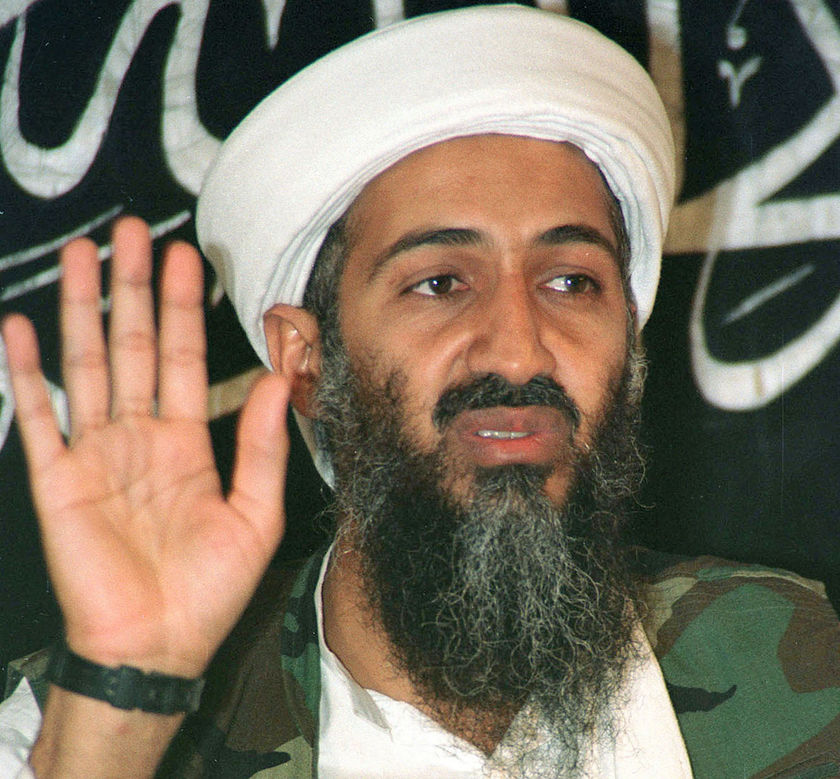
Bounty for Osama bin Laden goes to who?

bin-laden-poster.top.jpg

CNNMoney reported on May 2, 2011:

The photograph of Osama bin Laden on the FBI’s Most Wanted Terrorists list has a new caption: Deceased.

But it was unclear Monday how much, if any, of the up to $25 million in reward money offered on the terrorist leader has been granted.The man behind the worst terrorist attack in U.S. history was killed Sunday by American forces in Pakistan, in what President Barack Obama called “the most significant achievement to date in our nation’s effort to defeat al Qaeda.”

In the 10 years since the 9/11 attacks, the CIA, the FBI and other intelligence agencies have worked to locate bin Laden, who was found living in a compound outside of Islamabad.

The use of reward money has become an important asset in the government’s fight against global terrorism.

The Rewards for Justice program, run by the U.S. State Department’s Bureau of Diplomatic Security, has paid out more than $100 million to over 60 people since it was created in 1984.

The program grants money to people who provided “actionable information that put terrorists behind bars or prevented acts of international terrorism worldwide,” according to a statement on its website.

“The department does not generally discuss nominations for awards,” said Harry Edwards, a spokesman for the State Department. The offer, he added, is for a maximum of $25 million. “If it were paid, it could be less.”

It is possible that no reward money will be granted. According to Obama administration officials, unidentified detainees provided a key piece of information that helped investigators locate bin Laden.

But rewards have been granted for the capture of other international terrorists, including Ramzi Yousef, who was convicted in the 1993 bombing of the World Trade Center.

The largest reward ever paid under the program was $30 million to one person who provided information on Uday and Qusay Hussein, the sons of Iraqi dictator Saddam Hussein. In 2003, after an intense firefight with U.S. forces, both brothers were killed.

The government is currently offering up to $25 million for information on Ayman Al-Zawahiri, al Qaeda’s second-in-command, and an heir apparent to bin Laden.

The average reward offered for the 30 other terrorists on the most wanted list is $5 million.

In 2008, the maximum reward was raised to $50 million for any one target, but Secretary of State Hillary Clinton has not authorized that amount, according to Edwards.

For safety reasons, the State Department generally does not disclose details about the recipients of rewards. But officials may announce the amount rewarded in certain high-profile cases.

There have been four public award ceremonies in the Philippines, including one in 2007 where a total of $10 million was awarded.

In addition to the $25 million bounty offered by the government, the Airline Pilots Association and the Air Transport Association have offered a combined $2 million reward for information on bin Laden.

Steve Lott, a spokesman for the ATA, said the association has not received any formal request for supplemental reward money. But he said the ATA could grant up to $1 million in additional funds under a long-standing anti-terrorism program with the government.

The APA did not immediately respond to calls requesting information on the reward.  To top of page