The first GOP presidential debate for 2012 was held in South Carolina the evening of May 5, 2011. Participants were Rep. Ron Paul (R-TX), Minnesota Governor Tim Pawlenty, businessman Herman Cain, former Pennsylvania Senator Rick Santorum, and former New Mexico Governor Gary Johnson.
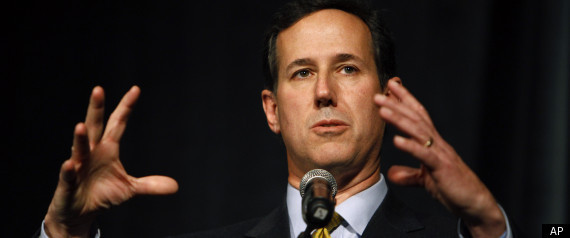
In an interview with CBN’s chief political correspondent, David Brody, Rick Santorum says that it’s “silly” to think that he can’t win the GOP nomination in 2012. That said, he thinks that “Obamacare is the most important domestic policy issue that we have to deal with,” which will probably come as something of a surprise to everyone who’s come up on the wrong end of the massive unemployment crisis the nation is currently undergoing. As you might expect, however, Santorum’s direct attack on the Affordable Care Act sends indirect fire in the direction of the presumed GOP frontrunner:
SANTORUM: I think Obamacare is the most important domestic policy issue that we have to deal with. It is bad policy, it is government control of health care, it’s the wrong approach and anybody that supports an approach similar to it, I think is on the wrong track. They [Massachusetts] certainly had the right to pass this. I will agree with that. Unlike the federal statute, the Obamacare statute, which I think is unconstitutional. Clearly Massachusetts had the right to pass an individual mandate, and to have a government basically exercise control over the health care system. The question is is it the right thing to do? Not whether they had the right to do it, was it right to do? And I think it was not right to do, I don’t think that’s the way that you control costs. I don’t think that’s the way that you improve quality of care, and I don’t think it’s the way that you make sure that patients earn control of the system.”
The first GOP presidential debate for 2012 was held in South Carolina the evening of May 5, 2011. Participants were Rep. Ron Paul (R-TX), Minnesota Governor Tim Pawlenty, businessman Herman Cain, former Pennsylvania Senator Rick Santorum, and former New Mexico Governor Gary Johnson.
After the Dec. 15 Red State poll that showed Atlanta businessman and talk-radio host Herman Cain topping even Sarah Palin as a favorite of the online conservative grassroots, I began blogging about the Cain phenomenon and did an interview with Cain for The American Spectator.
Yesterday a commenter at my blog chastised me, saying my “gushing over Herman Cain is starting to get embarrassing.” One of the knocks on Cain’s candidacy is that he has never held public office and, therefore, is presumably un-electable. That kind of pre-emptive discounting of an otherwise appealing candidate sticks in my craw, especially after a year in which voters elected so many Tea Party-backed Republican challengers who had also never held public office. So I replied today to the negativity:
In a David-vs.-Goliath situation, you don’t start by trying to calculate the odds of success, because the odds are liable to be so daunting as to inspire helpless despair. But let me ask you this: What were Herman Cain’s odds in 2006, when the doctors diagnosed him with Stage 4 cancer? Think about that before you say Cain can’t win. . .
The first GOP presidential debate for 2012 was held in South Carolina the evening of May 5, 2011. Participants were Rep. Ron Paul (R-TX), Minnesota Governor Tim Pawlenty, businessman Herman Cain, former Pennsylvania Senator Rick Santorum, and former New Mexico Governor Gary Johnson.
According to the Huffington Post Ron Paul “certainly has the most enthusiastic fan base.”
“Ron’s political base is fiscal conservatives, anti-tax citizens, anti-war Republicans, Democrats and Independents, constitutionalists, hard-money advocates, small business owners, civil libertarians, anti-universal healthcare physicians, pro-lifers, parents who home school, and anyone else who considers himself a real patriot. In other words, if Ron’s substantial base provides him with volunteers, contributions and votes, he would be a very competitive candidate.”
Most libertarians have prochoice views, but Ron Paul is pro-life. This is one of the reasons I really like Ron Paul.
Ron Paul, the conservative congressman from Texas known for his small-government beliefs rooted in Libertarianism, told an audience Monday in Iowa that government should dictate what happens in the womb of pregnant women.
Speaking at the Iowa Family Leader’s presidential lecture series in Sioux City, Paul, an obstetrician and a Christian, explained that he disagreed with the popular belief that to be a Libertarian means having a laissez faire attitude of “it’s the woman’s body; she can do whatever she wants.”
“Life comes from our creator, not our government,” Politico reported Paul as saying. “Liberty comes from our creator, not from government. Therefore, the purpose, if there is to be a purpose, for government is to protect life and liberty.”
Paul’s stance on abortion won him the endorsement in 2008 of none other than “Jane Roe” from the landmark Roe v. Wade legal case of the ’70s.
“Roe,” whose real name is Norma McCorvey, became a pro-life advocate a decade ago and supported Paul in the last presidential election specifically because of his views on abortion. “I support Ron Paul for president because we share the same goal, that of overturning Roe v. Wade,” McCorvey said. “He has never wavered … on the issue of being pro-life and has a voting record to prove it. He understands the importance of civil liberties for all, including the unborn.”
When Paul accepted the endorsement he said, “As much as I talk about economic liberties, and civil liberties and trying to avoid the killing overseas, I think the issue of life is paramount.”
In the typical presidential election, conservative Christians who have some understanding of the benefits of liberty and limited government and don’t blindly follow the Republican Party do one of three things: they don’t vote, they “waste” their vote on a third party, or else they hold their nose, close their eyes, stop their ears, and fight a gag reflex as they vote for the Republican candidate because they consider him to be the lesser of two evils. But most of these Christians have short memories, for when the lesser evil turns out to be just as evil as the greater evil, or sometimes even worse, they generally repeat the process all over again.
The newest individual to announce that he is seeking the Republican nomination for president is Ron Paul. He formally declared his candidacy for the Republican presidential nomination on March 12, 2007, when he appeared as a guest on C-SPAN.
Ron Paul is a veteran. He is a physician. He currently represents the 14th district in Texas (south of Houston) in the U.S. House of Representatives, a seat which he has held since 1997. He previously represented Texas’s 22nd district in 1976 and again from 1979 to 1985. Dr. Paul was the Libertarian Party nominee for president in 1988. He is the former honorary chair of the Republican Liberty Caucus. He consistently scores a perfect 100 on The New American magazine’s “Conservative Index.” He has received many awards and honors during his career in Congress from organizations such as the National Taxpayers Union, Citizens Against Government Waste, Council for a Competitive Economy, and Young Americans for Freedom.
But will he be the candidate of the Christian Right? By the Christian Right’s own criteria, their candidate ought to be Ron Paul.
Ron Paul is a man of faith. He is a Protestant Christian and a regular churchgoer.
Ron Paul is pro-life. As a specialist in obstetrics/gynecology, he has delivered more than 4,000 babies. Dr. Paul is not just an opponent of partial-birth abortion; he is an opponent of abortion itself. He is also opposed to federal funding of embryonic stem cell research.
Ron Paul is a believer in family values. Unlike many Christian “leaders” and Republican politicians who have admitted to adulterous affairs and/or been married multiple times, Dr. Paul has been married to the same woman for fifty years. He and his wife have been blessed with five children and seventeen grandchildren.
Ron Paul is opposed to same-sex marriage. Although he doesn’t want to strip homosexuals of their civil rights, he has voted to prohibit federal funding for the joint adoption of a child between individuals who are not related by blood or marriage.
Ron Paul is a patriot. He served as a flight surgeon in the U.S. Air Force from 1963 to 1967. He opposes federal court jurisdiction over the question of whether the phrase “under God” should be included in the pledge of allegiance.
Ron Paul is opposed to unrestricted immigration. Because he believes that true citizenship requires cultural connections and an allegiance to the United States, he favors an end to birthright citizenship. And because he believes that it insults legal immigrants, he does not favor amnesty for illegal immigrants in any form. He opposes welfare state subsidies for illegal immigrants that alienate taxpayers and breed suspicion of immigrants. Dr. Paul also believes that all federal government business should be conducted in English.
Ron Paul is opposed to gun control. Not only does he believe that gun control makes people demonstrably less safe, he also thinks it’s a myth that gun control reduces crime. Representative Paul introduced legislation in Congress that would have repealed waiting periods and instant background checks.
Ron Paul is a strict constitutionalist. He never votes for legislation unless the proposed measure is expressly authorized by the Constitution. He has consistently voted to lower or abolish federal taxes, spending, and regulation. Congressman Paul was recently recognized, for the tenth year in a row, as a “Taxpayer’s Friend” by the National Taxpayers Union.
Ron Paul is opposed to the United Nations. He has introduced legislation to withdraw the United States from the UN. Dr. Paul believes that the UN is rife with corruption. It serves as a forum for rampant anti-Americanism. Instead of being reformed, the UN needs to be renounced. Dr. Paul is against any kind of world government or new world order.
Ron Paul is the premier advocate for liberty in politics today. He believes in absolute religious and political liberty for all Americans. He strongly supports private property rights. He believes that government exists to protect the life, liberty, and property of its citizens.
But even though he appears to live up to the usual criteria of the Christian Right, the question still remains: Will Ron Paul be the candidate of the Christian Right?
As a Christian, I admire Dr. Paul’s principled stand on many issues, but I don’t believe the leadership of the Christian Right will embrace him. I think they love centralization more than federalism. I think they love political power more than liberty. I think they love war more than peace. I think they love politicians more than principles. I think they love faith-based socialism more than the free market. And I think they love the state more than God Almighty.
The Duke and Duchess of Cambridge approach the Queen Victoria Memorial outside Buckingham Palace, 29 April 2011.
The Royal Wedding Ceremony of William and Kate Live part 2/4
Prince William and Kate moved in together about a year ago. In this clip above the commentator suggested that maybe Prince Charles and Princess Diana would not have divorced if they had lived together before marriage. Actually Diana was a virgin, and it was Charles’ uncle (Louis Mountbatten) that gave him the advice that he should seek to marry a virgin.
I really do wish Kate and William success in their marriage. I hope they truly are committed to each other, and if they are then the result will be a marriage that lasts their whole lifetime. Nevertheless, I do not think it is best to live together before marriage like they did, and I writing this series to help couples see how best to prepare for marriage.
Derek and I signed a six-month lease on a two-bedroom apartment, but I didn’t trust Derek’s long-term commitment. I demanded separate closets and bathrooms. I didn’t want my dishes, pots and pans getting mixed up, so I shoved Derek’s stuff into different cabinets. Like a student practicing a fire drill, I mentally rehearsed my escape — just in case. I had one foot in the door and an eye on the exit.
All I had was six-months of security — a signed rental agreement. Even though I prepared for the day the fire alarm would sound, I constantly pushed for commitment. I wanted intimacy and a way out at the same time.
“Where’s our relationship going? Are we just going to live together? Do you see a future?” I complained.
“Sure I do. I want to marry you someday. But how can we? We don’t have the money,” Derek said. “I don’t know how else to prove to you I’m committed. I left my friends and moved in with you. I say I love you every day. I come home every night. What more do you want?”
Living together is too easy for you. How about marriage? An engagement ring would help.
The truth was, I hated the living arrangements. But it was my way of controlling something, since I couldn’t control our future.
Whenever Derek and I argued, I shut down, pouted and slept in the second bedroom. I waited in the dark for him to come and make up. Instead, Derek fell asleep. He wasn’t interested in knocking down my protective walls — at midnight. Great, Derek is probably getting sick of this. What’s going to happen when our lease expires? Will we stay together? He’s probably going to leave me.
Tim Hawkins – The Dog’s on Fire
Weekend to Remember Story – Dennis Rainey
Revelation (Biblical Numbers 3 of 4)-Dr Adrian Rogers
Eric Schurenberg is Editor-in-Chief of BNET.com and Editorial Director of CBS MoneyWatch.com. Previously, Eric was managing editor of MONEY. As managing editor, he expanded the editorial focus to new interests including real estate, family finance, health, retirement, and the workplace. Prior to MONEY, Eric was deputy editor of Business 2.0. He was also the managing editor of goldman.com, a Web site for Goldman Sachs Group’s personal wealth management business, and an assistant managing editor at Fortune magazine. Schurenberg has won a Gerald Loeb Award for distinguished business journalism, a National Magazine Award, and a Page One Award.
Social Security isn’t the only cause of America’s fiscal problems, but it is Exhibit A in why it is so hard to fix them. No serious solution to our debt can ignore a program that will tax and spend about 4.8% of GDP this year and account for about 20% of all federal spending-and that within a few decades will count almost a third of the population as beneficiaries. But whenever I write about Social Security here at CBS MoneyWatch, I’m always struck by how much disagreement there is about how the system really works.
A handful of misconceptions tend to crop up repeatedly-often having to do with that fiscal fun-house mirror, the Social Security trust fund. And despite the efforts of writers like Allan Sloan and experts like the Urban Institute’s Eugene Steuerle, the myths won’t die. This column won’t kill them either, but that doesn’t mean we shouldn’t take a whack. Here goes:
Myth: Social Security benefits are earned; reducing them amounts to confiscation
It’s not hard to see why this illusion exists, since Social Security’s own website refers to “earned credits” and sometimes refers to payroll taxes as contributions. But despite Social Security’s fetish for language that echoes private pensions, no one ever vests in Social Security. You don’t own your benefits until you cash the check.
It’s more accurate to say your benefits are an entitlement granted by act of Congress and subject to change at any time by another act of Congress. As long as voters consider benefits inviolate, they will be. When voters decide fiscal responsibility is more important, then Social Security benefits- “earned” or not-will be up for review.
__________________________________________
Professor Williams explains what’s ahead for Social Security
The train carrying vice-president Charles G. Dawes and Secretary of Commerce Herbert Hoover wrecked near Heads, Miss., on the Yazoo & Mississippi Valley railroad. The engine went into 40 feet of water, killing the engineer, during the flooding in the Mississippi Delta on July 29, 1927. (The Commercial Appeal files / Harmon Barlow Collection)
Photo by NOAA
The levee break at Mound Landing, near Greenville, April, 1927. (Courtesy:National Oceanic Atmospheric Administration)
Photo by Handout
The Mississippi River disaster of 1927, when levees broke and flood waters displaced 700,000 people. Greenville, Miss., was inundated by water 10 feet deep.
Red Cross camps for refugees, such as this one at Vicksburg, Miss., were established in dry areas in a number of towns and villages during the flood of 1927. (The Commercial Appeal files / copied from book, “The Flood of 1927”, published in 1927)
Barges loaded with refugees and everything they had been able to save were pushed toward Memphis in the great flood of 1927, which took more than 200 lives in the Mid-South. Photograph was made in late April or early May, probably near Greenville, Miss. (The Commercial Appeal files)
Many people think of former President Bill Clinton when they think of Arkansas, and they think of Elvis when they think of Memphis. However, the great Mississippi River separates both Arkansas and Tennessee. It’s history is worth looking into.
CNN’s David Mattingly describes how high and wide the Mississippi River is in Memphis, Tennessee.
Everybody is now educating themselves on the great flood of 1927. The 1927 Great Mississippi Flood was the most destructive river flood in the history of the United States, causing over $400million in damages and killing 246 people in seven states and displaced 700,000 people.
My grandfather moved to Memphis in 1927 and he told me about this flood. There was a lady named Memphis Minnie and she wrote about this flood. I always heard that there was lots of great blues music that had come out of Memphis, but I always thought that was overstated and that the Blues was not a significant form of music. (Live and learn, the Blues music out of Memphis had a GREAT AFFECT ON MUSIC WORLDWIDE!!!)
However, at the same time I was listening to groups like Led Zeppelin and the Rolling Stones, I had no idea that many of their songs were based on old Blues songs out of Memphis.
One of my favorite Led Zeppelin songs was “When the Levee breaks.” It was based on a song by Memphis Minnie.
MEMPHIS, Tenn. — Led Zeppelin frontman Robert Plant is being honored with a star in a music sidewalk in Memphis, Tenn.
Plant was presented Monday with a star that will be placed on the Orpheum Theater Sidewalk of Stars on Beale Street.
The Commercial Appeal reports that the award honors Plant for what are described as tireless efforts to preserve the blues.
During the presentation ceremony, Plant spoke of blues pioneers like Sonny Boy Williamson, Sleepy John Estes and W.C. Handy in acknowledging that a generation of British musicians owe a debt to early Southern blues artists.
Marooned: An aerial view of the town of Sledge, inundated to a depth of 17 feet, after Mississippi floods in 1927
Floods: Experts have warned that the Mississippi could rise to levels not seen in the country since the devastation on The Great Flood of 1927
_________________________
As the Mississippi River continues to rise to near-record cresting, residents in Memphis are paring for the worst. Randall Pinkston reports on the latest of the city’s flood alert.
Documentary about the Mississippi River Flood of 1927 and the flood control lakes built because of it. Produced by Katrina Kinder
Photo by U.S. Army Corps of Engineers
U.S. Corps of Engineers reservation at Memphis on February 14, 1937. Downtown can be seen at upper left. (Courtesy U.S. Army Corps of Engineers, Memphis District)
Photo by U.S. Army Corps of Engineers
A levee wall at Memphis during the flooding of 1937. (Courtesy U.S. Army Corps of Engineers, Memphis District)
The view upstream from the Columbia Mutual Tower in Memphis on Feb. 9, 1937. The swollen Mississippi River rose to a record 48.7 feet in 1937. Before it was confined by levees, the Mississippi overflow from the runoff of 31 states regularly created a lake almost as large as Ireland. (Courtesy U.S. Army Corps of Engineers, Memphis District)
The White House, May 1, 2011
Vice President Joe Biden and President Barack Obama, along with members of the national-security team, receive an update on the mission against Osama bin Laden in the Situation Room of the White House on May 1, 2011. Please note: a classified document seen in this photograph has been obscured.
The president also revealed that prior to issuing the order for the special operations to move on the bin Laden compound, his national security team was still uncertainty about whether to proceed with the military operation. “This was still a 55-45 situation,” Obama said. “I mean, we could not say definitively that bin Laden was there. Had he not been there, then there would have been some significant consequences.”
Obama also told Kroft that the safety of the individuals carrying out the mission was foremost on his mind.
He conceded that, given the risks some members of his team counseled against proceeding with the raid. Obama explained to Kroft that he made a point of taking these dissenting views into account as he approved the mission.
“The fact that there were some who voiced doubts about this approach was invaluable, because it meant the plan was sharper, it meant that we had thought through all of our options, it meant that when I finally did make the decision, I was making it based on the very best information.”
Ultimately, Obama said, “I concluded that it was worth it.”
“And the reason that I concluded it was worth it was that we have devoted enormous blood and treasure in fighting back against al Qaeda, ever since 2001. And even before, with the embassy bombing in Kenya … I said to myself that if we have a good chance of not completely defeating but badly disabling al Qaeda, then it was worth both the political risks as well as the risks to our men.”
Sunday’s interview also included now widely circulated comments from the president regarding photos of bin Laden’s corpse.
Obama explained why the administration is not planning to release the images:
It is important for us to make sure that very graphic photos of somebody who was shot in the head are not floating around as an incitement to additional violence– as a propaganda tool. You know, that’s not who we are. You know, we don’t trot out this stuff as trophies… we don’t need to spike the football. And I think that given the graphic nature of these photos, it would create some national security risk. And I’ve discussed this with Bob Gates and Hillary Clinton and my intelligence teams and they all agree.
He added that there is no question bin Laden is dead:Â “The fact of the matter is, you will not see bin Laden walking on this earth again.”
Inside the White House during bin Laden raid
Pete Souza / The White House
President Obama listens during one of a series of meetings in the Situation Room of the White House discussing the mission against bin Laden on May 1, 2011. For 40 minutes, the President and his senior aides could do nothing but watch the video screens and listen to the operation and ensuing firefight on the other side of the world.
The Laffer Curve, Part I: Understanding the Theory
The Laffer Curve charts a relationship between tax rates and tax revenue. While the theory behind the Laffer Curve is widely accepted, the concept has become very controversial because politicians on both sides of the debate exaggerate. This video shows the middle ground between those who claim “all tax cuts pay for themselves” and those who claim tax policy has no impact on economic performance. This video, focusing on the theory of the Laffer Curve, is Part I of a three-part series. Part II reviews evidence of Laffer-Curve responses. Part III discusses how the revenue-estimating process in Washington can be improved. For more information please visit the Center for Freedom and Prosperity’s web site: www.freedomandprosperity.org
Before coming to Heritage in 2001, Riedl worked for then-Gov. Tommy Thompson, former Rep. Mark Green (R-WI)., and the Speaker of the Wisconsin Assembly. Riedl holds a bachelor’s degree in economics and political science from the University of Wisconsin, and a master’s degree in public affairs from Princeton University..
Myth #2: Future deficits are “the result of not paying for two wars, two tax cuts, and an expensive prescription drug program.”
Fact: These policies play a relatively minor role in the growth of future deficits.
During his 2010 State of the Union Address, President Obama asserted:
At the beginning of the last decade, America had a budget surplus of over $200 billion. By the time I took office, we had a one-year deficit of over $1 trillion and projected deficits of $8 trillion over the next decade. Most of this was the result of not paying for two wars, two tax cuts, and an expensive prescription drug program.[7]
In other words, according to President Obama, the massive budget deficits are President Bush’s fault, but the data do not support this assertion. President Bush implemented the three policies mentioned by President Obama in the early 2000s. Yet by 2007—the last year before the recession— the budget deficit had stabilized at $161 billion. Since the combined annual cost of these three Bush-era policies is now relatively stable, they cannot have suddenly caused a trillion-dollar leap in budget deficits beginning in 2009.[8]
_________________________________________________
However, the larger problem is that the President’s entire methodology fails basic statistics. With Washington set to collect $33 trillion in taxes and spend $46 trillion over the next decade, how does one determine which spending programs “caused” the $13 trillion deficit? By the President’s methodology, one could blame any $13 trillion group of spending programs (or tax cuts) for the entire budget deficit. For example, the President could have blamed much of the 10-year budget deficit on Social Security (10-year cost of $9.2 trillion), antipoverty programs ($7 trillion), net interest on the debt ($6.1 trillion), or non-defense discretionary spending ($7.5 trillion).[12] (See Chart 3.) There is no legitimate, mathematical reason for President Obama to ignore all of these more expensive policies and single out the $4.7 trillion in tax cuts, the funding for the wars in Iraq and Afghanistan, and the Medicare drug entitlement. A better methodology would focus on which program costs are actually growing and pushing the deficit up.
Finally, there is some hypocrisy at work. President Obama criticizes President Bush for “not paying for two wars, two tax cuts, and an expensive prescription drug program.” Yet he would extend $4 trillion of these policies (while repealing $700 billion in tax cuts) without paying for them either. By his own faulty logic, he is almost as irresponsible as President Bush.
Can Washington Return to the 2001 Balanced Budget Levels?
Many lawmakers and commentators have stated that the budget was balanced as recently as 2001 and have asked why it cannot be brought back into balance at those levels. Of course, lawmakers are free to alter any policy to achieve such a budget, although significantly reducing net interest costs would require major deficit reduction.
Virtually all deficit reduction in the 1990s originated from just three sources:
Higher revenues, mostly from a temporary stock and economic bubble.
Lower defense spending following the end of the Cold War, and
Net interest savings resulting from less borrowing, a result of the other two factors.
The rest of the federal budget merely remained level as a share of the GDP throughout the decade, which itself may be considered an accomplishment for lawmakers.
Returning to those budget levels would not be easy. The stock market bubble is unlikely to return, nor would that be desirable. The 9/11 attacks ended the era of massive defense spending cuts, higher debt has brought higher net interest costs, and 10,000 baby boomers per day are retiring into Social Security and Medicare. Overall, the difference between 2001 and 2020 can be explained as follows:
The 2001 tax revenues were bubble-inflated (down 1.6 percent of GDP),
2001 defense spending was as at prewar levels (up 0.8 percent of GDP),
Social Security, Medicare, and Medicaid costs are growing (up 3.3 percent of GDP),
Presidents Bush and Obama hiked domestic discretionary spending (up 0.5 percent of GDP),
Other entitlement spending is rising (up 0.8 percent of GDP), and
Rising debt means rising net interest costs (up 2.6 percent of GDP).1.
As a result, a budget surplus of 1.3 percent of GDP in 2001 is set to become a deficit of 8.3 percent by 2020. (See Table 1.)
1.Historical data from Office of Management and Budget, Historical Tables,Budget of the United States Government, Fiscal Year 2011 (Washington, D.C.: U.S. Government Printing Office, 2010), pp. 24–25, Table 1.2, and p. 146, Table 8.4, at http://www.whitehouse.gov/omb/budget/fy2011/assets/hist.pdf (June 14, 2010). Current and future projections based on Heritage Foundation calculations of the current-policy budget baseline, using Congressional Budget Office data. See the Appendix for the calculations.
The Laffer Curve, Part II: Reviewing the Evidence
This video reviews real-world evidence showing that changes in marginal tax rates can have a significant impact on taxable income, thus leading to substantial amounts of revenue feedback. In a few cases, tax-rate reductions even “pay for themselves,” though the key lesson is the more modest point that pro-growth changes in tax policy will have a positive impact on economic performance and that good tax cuts therefore do not “cost” the government much in terms of foregone tax revenue.
This video is second installment of a three-part series. Part I reviews theoretical relationship between tax rates, taxable income, and tax revenue. Part III discusses how the revenue-estimating process in Washington can be improved. For more information please visit the Center for Freedom and Prosperity’s web site: www.freedomandprosperity.org.
The Laffer Curve, Part III: Dynamic Scoring
A video by CF&P Foundation that builds on the discussion of theory in Part I and evidence in Part II, this concluding video in the series on the Laffer Curve explains how the Joint Committee on Taxation’s revenue-estimating process is based on the absurd theory that changes in tax policy – even dramatic reforms such as a flat tax – do not effect economic growth. In other words, the current system assumes the Laffer Curve does not exist. Because of congressional budget rules, this leads to a bias for tax increases and against tax cuts. The video explains that “static scoring” should be replaced with “dynamic scoring” so that lawmakers will have more accurate information when making decisions about tax policy. For more information please visit the Center for Freedom and Prosperity’s web site: http://www.freedomandprosperity.org
_______________________________________
I am doing a series on famous Arkansans and today we come to Ronnie Hawkins.
(b. 1935) – Born in Huntsville and raised in Fayetteville, his mother was a teacher and his father a barber. After graduating from high school, he studied physical education at the University of Arkansas, where he formed his first band, The Hawks. Hawkins owned and operated the Rockwood Club in Fayetteville where some of rock music’s earliest pioneers came to play, including Jerry Lee Lewis, Carl Perkins, Roy Orbison and Conway Twitty. Upon the recommendation of Conway Twitty in 1958, who thought Canada to be the promised land for a rock n’ roll singer, Hawkins went to Hamilton, Ontario to play a club called The Grange and never left Canada. Over a period of time, the members of the The Hawks, except for Levon Helm, were replaced with Robbie Robertson, Rick Danko, Richard Manuel and Garth Hudson. This was the line-up that was to later become known as The Band. In 1989, Hawkins was reunited with The Band at the concert marking the destruction of the Berlin Wall, and in 1992 he performed at the inaugural party for President Bill Clinton. He has been known over the years as “Mr. Dynamo,” “Sir Ronnie,” “Rompin’ Ronnie” Hawkins or “The Hawk.” He was a key player in the 1960s rock scene and for over 40 years has performed all over North America, recording more than 25 albums. His best-known hits are “Forty Days” and “Mary Lou.”
40 Days, performed live on Lake Minnetonka with legendary Ronnie Hawkins & The Hawks
Eric Schurenberg is Editor-in-Chief of BNET.com and Editorial Director of CBS MoneyWatch.com. Previously, Eric was managing editor of MONEY. As managing editor, he expanded the editorial focus to new interests including real estate, family finance, health, retirement, and the workplace. Prior to MONEY, Eric was deputy editor of Business 2.0. He was also the managing editor of goldman.com, a Web site for Goldman Sachs Group’s personal wealth management business, and an assistant managing editor at Fortune magazine. Schurenberg has won a Gerald Loeb Award for distinguished business journalism, a National Magazine Award, and a Page One Award.
Social Security isn’t the only cause of America’s fiscal problems, but it is Exhibit A in why it is so hard to fix them. No serious solution to our debt can ignore a program that will tax and spend about 4.8% of GDP this year and account for about 20% of all federal spending-and that within a few decades will count almost a third of the population as beneficiaries. But whenever I write about Social Security here at CBS MoneyWatch, I’m always struck by how much disagreement there is about how the system really works.
A handful of misconceptions tend to crop up repeatedly-often having to do with that fiscal fun-house mirror, the Social Security trust fund. And despite the efforts of writers like Allan Sloan and experts like the Urban Institute’s Eugene Steuerle, the myths won’t die. This column won’t kill them either, but that doesn’t mean we shouldn’t take a whack. Here goes:
Myth: Social Security didn’t create the deficit and shouldn’t be cut to fix it
This is a much loved progressive slogan. “Blaming Social Security for the deficit is like blaming Iraq for 9/11,” writes Dave Johnson of OurFuture.org in one of the cleverer examples of the genre.
Technically, the first part of the myth is true-or rather, used to be true. From 1983 until last year, Social Security revenues actually lowered the Treasury’s need to borrow in the public markets, as excess payroll taxes collected under Social Security’s flag helped fund other government programs.
The surplus years are over, however. The Social Security trustees’ report estimates that last year payroll taxes fell short of the sums paid out to beneficiaries. Small surpluses will return for a few years; then the red ink will return for good in 2015. To make up the annual shortfall, Social Security will have to draw on revenues from the general budget. In other words, from here on out, year after year, Social Security only makes the deficit larger.
__________________________________________
Milton Friedman
Using Social Security as his prime example, Professor Friedman explodes the myth that the major expansions in government resulted from popular demand. In a speech delivered more than 30 years ago, he directly relates this dynamic to today’s health care debate.

 Written By : Robert Stacy McCain

 In the typical presidential election, conservative Christians who have some understanding of the benefits of liberty and limited government and don’t blindly follow the Republican Party do one of three things: they don’t vote, they “waste” their vote on a third party, or else they hold their nose, close their eyes, stop their ears, and fight a gag reflex as they vote for the Republican candidate because they consider him to be the lesser of two evils. But most of these Christians have short memories, for when the lesser evil turns out to be just as evil as the greater evil, or sometimes even worse, they generally repeat the process all over again.


 Marooned: An aerial view of the town of Sledge, inundated to a depth of 17 feet, after Mississippi floods in 1927
 Floods: Experts have warned that the Mississippi could rise to levels not seen in the country since the devastation on The Great Flood of 1927


