Characters referenced in Woody Allen’s movie “Midnight in Paris” (Part 35, Recap of historical figures, Notre Dame Cathedral and Cult of Reason)

I have really enjoyed doing this study and I am also including some additional posts concerning issues brought up by the movie. Below are the links to all the historical characters so far mentioned in the film “Midnight in Paris.” Below that I look at the history Notre Dame Cathedral and the “Cult of Reason” that was put in during the French Revolution.  Woody Allen believes that God is not in the picture and that man must use his reason to get to values and morality. However, that did not work well for those in the time of the French Revolution and it will not work out today.

The characters referenced in Woody Allen’s movie “Midnight in Paris” (Part 33,Cezanne) July 11, 2011 – 6:15 am

(Part 32, Jean-Paul Sartre)July 10, 2011 – 5:53 am

 (Part 29, Pablo Picasso) July 7, 2011 – 4:33 am

(Part 28,Van Gogh) July 6, 2011 – 4:03 am

(Part 27, Man Ray) July 5, 2011 – 4:49 am

(Part 26,James Joyce) July 4, 2011 – 5:55 am

(Part 25, T.S.Elliot) July 3, 2011 – 4:46 am

(Part 24, Djuna Barnes) July 2, 2011 – 7:28 am

(Part 23,Adriana, fictional mistress of Picasso) July 1, 2011 – 12:28 am

(Part 22, Silvia Beach and the Shakespeare and Company Bookstore) June 30, 2011 – 12:58 am

(Part 21,Versailles and the French Revolution) June 29, 2011 – 5:34 am

(Part 16, Josephine Baker) June 24, 2011 – 5:18 am

(Part 15, Luis Bunuel) June 23, 2011 – 5:37 am

(Part 1 William Faulkner) June 13, 2011 – 3:19 pm

I have been going through all the historical characters mentioned in Woody Allen’s latest movie “Midnight in Paris,” but today I am looking at the history of Notre Dame Cathedral and the cult of reason.

Notre-Dame Cathedral attracts 13 million visitors each year.

Notre Dame Cathedral (full name: Cathédrale Notre-Dame de Paris, “Our Lady of Paris”) is a beautiful cathedral on the the Île de la Cité in Paris. Begun in 1163 and mostly completed by 1250, Notre Dame is an important example of French Gothic architecture, sculpture and stained glass.

The Notre Dame is the most popular monument in Paris and in all of France, beating even the Eiffel Tower with 13 million visitors each year. But the famous cathedral is also an active Catholic church, a place of pilgrimage, and the focal point for Catholicism in France – religious events of national significance still take place here.

East View

Cathedral view from the southeast, on a bridge over the Seine.

History

The Notre Dame de Paris stands on the site of Paris’ first Christian church, Saint Etienne basilica, which was itself built on the site of a Roman temple to Jupiter.

Notre-Dame’s first version was a “magnificent church” built by Childebert I, the king of the Franks at the time, in 528, and was already the cathedral of the city of Paris in the 10th century. However, in 1160, having become the “parish church of the kings of Europe,” Bishop Maurice de Sully deemed the building unworthy of its lofty role, and had it demolished.

Construction on the current cathedral began in 1163, during the reign of Louis VII, and opinion differs as to whether Bishop Maurice de Sully or Pope Alexander III laid the foundation stone of the cathedral.

Construction of the west front, with its distinctive two towers, began in around 1200 before the nave had been completed. Over the construction period, numerous architects worked on the site, as is evidenced by the differing styles at different heights of the west front and towers.

Between 1210 and 1220, the fourth architect oversaw the construction of the level with the rose window and the great halls beneath the towers. The towers were finished around 1245 and the cathedral was finally completed around 1345.

During the reigns of Louis XIV and Louis XV at the end of the 17th century the cathedral underwent major alterations, during which many tombs and stained glass windows were destroyed.

In 1793, the cathedral fell victim to the French Revolution. Many sculptures and treasures were destroyed or plundered; the cathedral was rededicated to the Cult of Reason and later to the Cult of the Supreme Being. Lady Liberty replaced the Virgin Mary on several altars. The cathedral also came to be used as a warehouse for the storage of food.

Napoleon Bonaparte, who had declared the Empire on May 28, 1804, was crowned Emperor at Notre-Dame on December 2, 1804.

A restoration program was initiated in 1845, overseen by architects Jean-Baptiste-Antoine Lassus and Eugene Viollet-le-Duc. The restoration lasted 23 years, and included the construction of a spire.

In 1871, a civil uprising leading to the establishment of the short-lived Paris Commune nearly set fire to the cathedral, and some records suggest that a mount of chairs within the cathedral were set alight. In 1905, the law of separation of Church and State was passed; as all cathedrals, Notre-Dame remains state property, but its use is granted to the Roman Catholic Church.

The Te Deum Mass took place in the cathedral to celebrate the liberation of Paris in August 26, 1944. The Requiem Mass of General Charles de Gaulle took place in the cathedral on November 12, 1970.

In 1991, a major restoration program was undertaken. It was expected to last 10 years but continued well into the 21st century – the cleaning and restoration of the old sculptures was an exceedingly delicate job. But now the scaffolding is down and the result is spectacular: the stone architecture and sculptures gleam in their original honey-toned color instead of industrial black.

North Rose

The beautiful north rose window.

E P I S O D E 5

T h e

REVOLUTIONARY AGE

I. Bible as Absolute Base for Law

A. Paul Robert’s mural in Lausanne.

B. Rutherford’s Lex Rex  (Law Is King): Freedom without chaos; government by law rather than arbitrary government by men.

C. Impact of biblical political principles in America.

1. Rutherford’s influence on U.S. Constitution: directly through Witherspoon; indirectly through Locke’s secularized version of biblical politics.

2. Locke’s ideas inconsistent when divorced from Christianity.

3. One can be personally non-Christian, yet benefit from Christian foundations: e.g. Jefferson and other founders.

II. The Reformation and Checks and Balances

A. Humanist and Reformation views of politics contrasted.

B. Sin is reason for checks and balances in Reformed view: Calvin’s position at Geneva examined.

C. Checks and balances in Protestant lands prevented bloody resolution of tensions.

D. Elsewhere, without this biblically rooted principle, tensions had to be resolved violently.

III. Contrast Between English and French Political Experience

A. Voltaire’s admiration of English conditions.

B. Peaceful nature of the Bloodless Revolution of 1688 in England related to Reformation base.

C. Attempt to achieve political change in France on English lines, but on Enlightenment base, produced a bloodbath and a dictatorship.

1. Constructive change impossible on finite human base.

2. Declaration of Rights of Man, the rush to extremes, and the Goddess of Reason.

3. Anarchy or repression: massacres, Robespierre, the Terror.

4. Idea of perfectibility of Man maintained even during the Terror.

IV. Anglo-American Experience Versus Franco-Russian

A. Reformation experience of freedom without chaos contrasts with that of Marxist-Leninist Russia.

B. Logic of Marxist-Leninism.

1. Marxism not a source of freedom.

2. 1917 Revolution taken over, not begun, by Bolsheviks.

3. Logic of communism: elite dictatorship, suppression of freedoms, coercion of allies.

V. Reformation Christianity and Humanism: Fruits Compared

A. Reformation gave absolutes to counter injustices; where Christians failed they were untrue to their principles.

B. Humanism has no absolute way of determining values consistently.

C. Differences practical, not just theoretical: Christian absolutes give limited government; denial of absolutes gives arbitrary rule.

VI. Weaknesses Which Developed Later in Reformation Countries

A. Slavery and race prejudice.

1. Failure to live up to biblical belief produces cruelty.

2. Hypocritical exploitation of other races.

3. Church’s failure to speak out sufficiently against this hypocrisy.

B. Noncompassionate use of accumulated wealth.

1. Industrialism not evil in itself, but only through greed and lack of compassion.

2. Labor exploitation and gap in living standards.

3. Church’s failure to testify enough against abuses.

C. Positive face of Reformation Christianity toward social evil.

1. Christianity not the only influence on consensus.

a) Church’s silence betrayed; did not reflect what it said it believed.

b) Non-Christian influences also important at that time; and many so-called Christians were “social” Christians only.

2. Contributions of Christians to social reform.

a) Varied efforts in slave trade, prisons, factories.

(1) Wesley, Newton, Clarkson, Wilberforce, and abolition of slavery.

(2) Howard, Elizabeth Fry, and prison reforms.

(3) Lord Shaftesbury and reform in the factories.

b) Impact of Whitefield-Wesley revivals on society.

VII. Reformation Did Not Bring Perfection

But gradually on basis of biblical teaching there was a unique improvement.

A. With Bible the ordinary citizen could say that majority was wrong.

B. Tremendous freedom without chaos because Bible gives a base for law.

A Christian Manifesto Francis Schaeffer

Published on Dec 18, 2012

A video important to today. The man was very wise in the ways of God. And of government. Hope you enjoy a good solis teaching from the past. The truth never gets old.

The Roots of the Emergent Church by Francis Schaeffer

Francis Shaeffer – The early church (part1)

Francis Shaeffer – The early church (part 2)

Francis Shaeffer – The early church (part 3)

Francis Shaeffer – The early church (part 4)

Francis Shaeffer – The early church (part 5)

How Should We then Live Episode 7 small (Age of Nonreason)

#02 How Should We Then Live? (Promo Clip) Dr. Francis Schaeffer

10 Worldview and Truth

Two Minute Warning: How Then Should We Live?: Francis Schaeffer at 100

Francis Schaeffer Whatever Happened to the Human Race (Episode 1) ABORTION

Francis Schaeffer “BASIS FOR HUMAN DIGNITY” Whatever…HTTHR

Arkansas Democrat-Gazette review:

LITTLE ROCK — Midnight in Paris 88 Cast: Owen Wilson, Rachel McAdams, Marion Cotillard, Alison Pill, Kathy Bates, Michael Sheen, Adrien Brody Director: Woody Allen Rating: PG-13, for some sexual references and smoking Running time: 100 minutes

In Woody Allen’s Midnight in Paris, a 1920 Peugeot cruises down a narrow, cobbled street. Somewhere, a clock sounds midnight. The car comes to a stop in front of Gil.

Played by one of Allen’s best avatars, Owen Wilson, this American in Paris has joined his rather forceful fiancee, Inez (Rachel McAdams), and her underwhelmed parents in the City of Light.

“Take a cab,” Inez had told him earlier in the evening. “You’ll get lost.”

Now, he is. And Gil will be a great deal more turned around before he finds his soul’s bearings. That vintage sedan is the color of a bumblebee, and a festive buzzing emanates from within.

There’s heightened buzz around Allen’s comedy too, with some hailing it as his best work in 10 years. (It opened May’s Cannes Film Festival.)

Yet, as playfully inventive a jaunt as Midnight in Paris is, this assessment suffers from the very hankering that afflicts Gil: nostalgia for a bygone era at the risk of missing out on the present.

Midnight in Paris isn’t as telling about class as Allen’s Match Point, or as celebratory and vivid about being smitten by a European city as Vicky Cristina Barcelona.

It is a lyrically crafted fable about romance, creativity and the pleasures – and cautionary lessons – met when idealizing another artist’s era.

You see, Gil loves Paris, especially that burg of the 1920s when a whir of creativity put the likes of Er-nest Hemingway and F. Scott Fitzgerald in the company of artists Salvador Dali and Pablo Picasso. These are not the travelers who people the recently published tome, The Greater Journey: Americans in Paris, by David McCullough, but that vivid generation that came after.

That vintage convertible transports Gil, the successful screenwriter but full-of-doubt novelist, night after night to the Paris of the 1920s. As he moves back and forth between now and then, the beguiling, amber-hued nights of Scott (Tom Hiddleston) and Zelda (Alison Pill), Dali (Adrien Brody) and Hemingway (Corey Stoll)trump the present of Inez and her parents.

Kathy Bates has fun presiding over a salon as Gertrude Stein, or Gert to her friends and the authors who bring their manuscripts to her.

One night at Gert’s, Gil meets Adriana. With a face seemingly crafted by fate for the old-fashioned close-up, Marion Cotillard (those eyes!) portrays the woman who captures the fancy of Picasso, Hemingway and, yes, our shirt-tucked-intohis-chinos scribe.

Midnight in Paris is charming and clever, at times wickedly astute and hopeful.

But what stands between this movie and greatness is contempt. Not Gil’s – he’s a naif, an optimist. The current of dislike is Allen’s – for Inez and herugly American ilk.

The pseudo-cultured and glibly provincial are well-represented by Inez and her monied parents John and Helen. And actors Kurt Fuller and Mimi Kennedy make it so easy to bristle at these two. Inez’s friend Paul (Michael Sheen) is equally insufferable.

These people aren’t nice. But the deck feels a bit too stacked.

We’re led to ask – even as we root for Gil – how has hegotten this far in a relationship with this harridan – beautifully clad, shapely but a harpy just the same? What are we to make of that?

MovieStyle, Pages 31 on 06/10/2011

Brantley claims Barton is wrong about darwinism pt 8

On June 9th Max Brantley on the Arkansas Times Blog referred to a Mother Jones Article that noted:

On Wednesday, Right Wing Watch flagged a recent interview Barton gave with an evangelcial talk show, in which he argues that the Founding Fathers had explicitly rejected Charles Darwin’s theory of evolution. Yes, that Darwin. The one whose seminal work, On the Origin of Species, wasn’t even published until 1859. Barton declared, “As far as the Founding Fathers were concerned, they’d already had the entire debate over creation and evolution, and you get Thomas Paine, who is the least religious Founding Father, saying you’ve got to teach Creation science in the classroom. Scientific method demands that!” Paine died in 1809, the same year Darwin was born.

Here is the  fifth part of the series that I started a few days ago about the founding fathers’ views on the origin of man. Below is an portion of an article by David Barton, “The Founding Fathers on Creation and Evolution.” 

While uninformed laymen erroneously believe the theory of evolution to be a product of Charles Darwin in his first major work of 1859 (The Origin of Species), the historical records are exceedingly clear that the evolution-creation-intelligent design debate was largely formulated well before the birth of Christ. Numerous famous writings have appeared on the topic for almost two thousand years; in fact, our Founding Fathers were well-acquainted with these writings and therefore the principle theories and teachings of evolution – as well as the science and philosophy both for and against that thesis – well before Darwin synthesized those centuries-old teachings in his writings.

Nobel-Prize winner Bertrand Russell (1872-1970) explains: “The general idea of evolution is very old; it is already to be found in Anaximander (sixth century B.C.). . . . [and] Descartes [1596-1650], Kant [1724-1804], and Laplace [1749-1827] had advocated a gradual origin for the solar system in place of sudden creation.” 1  ( Bertrand Russell, Human Knowledge: Its Scope and Limits (New York: Simon and Schuster, 1948), pp. 33-34.)…

Thomas Jefferson 

[W]hen we take a view of the universe in its parts, general or particular, it is impossible for the human mind not to perceive and feel a conviction of design, consummate skill, and indefinite power in every atom of its composition. The movements of the heavenly bodies, so exactly held in their course by the balance of centrifugal and centripetal forces; the structure of our earth itself, with its distribution of lands, waters, and atmosphere; animal and vegetable bodies, examined in all their minutest particles; insects, mere atoms of life, yet as perfectly organized as man or mammoth; the mineral substances, their generation and uses – it is impossible, I say, for the human mind not to believe that there is, in all this, design, cause, and effect, up to an ultimate cause, a Fabricator of all things from matter and motion, their Preserver and Regulator while permitted to exist in their present forms, and their regeneration into new and other forms. We see, too, evident proofs of the necessity of a superintending power, to maintain the universe in its course and order. 26

(A longer and more extensive piece on the history of evolution and the Founding Fathers can be read in David Barton’s law review article published for Regent Lawschool on the 75th anniversary of the 1925 Scopes Monkey Trial. That piece, entitled “Evolution and the Law: A Death Struggle Between Two Civilizations,” is accessible at http://www.wallbuilders.com/LIBissuesArticles.asp?id=97.)

26. Thomas Jefferson, The Writings of Thomas Jefferson, Andrew A. Lipscomb, editor (Washington, D.C.: The Thomas Jefferson Memorial Association, 1904), Vol. XV, pp. 426-427, letter to John Adams, April 11, 1823.

Here are some other posts about David Barton’s word on the unconfirmed quotes that have been attributed to the Founding Father and Barton’s effort to stop the Righteous Right for using these quotes in the future:

Unconfirmed Quote attributed to Thomas Jefferson

HALT:HaltingArkansasLiberalswithTruth.com Part 6 David Barton:Were the Founding Fathers Deists? In 1988 only 25% of Christians voted but that doubled in 1994. Christians are the salt of the world. The last few days I have been  looking at this issue of unconfirmed quotes that people think that the Founding Fathers actually said and the historical evidence […]

Two Unconfirmed quotes attributed to Noah Webster

HALT:HaltingArkansasLiberalswithTruth.com Part 5 David Barton: Were the Founding Fathers Deists? First Bible printed in USA was printed by our founding fathers for use in the public schools. 20,000 Bibles. 10 commandments hanging in our courthouses. The last few days I have been  looking at this issue of unconfirmed quotes that people think that the Founding […]

Unconfirmed Quote attibuted to Patrick Henry

HALT:HaltingArkansasLiberalswithTruth.com Part 4 David Barton: Were Founding Fathers Deists? Only 5% of the original 250 founding fathers were not Christians (Ben Franklin, Thomas Jefferson, Aaron Burr, Thomas Paine, Ethan Allen, Joe Barlow, Charles Lee, Henry Dearborn, ect) In the next few weeks I will be looking at this issue of unconfirmed quotes that people think […]

Samuel Adams Unconfirmed Quote was Confirmed Eventually

HALT:HaltingArkansasLiberalswithTruth.com Part 3 David Barton: Were Founding Fathers Deists? American Bible Society filled with Founding Fathers Here is another in the series of  unconfirmed quotes that people think that the Founding Fathers actually said and the historical evidence concerning them. David Barton has collected these quotes and tried to confirm them over the last 20 […]

Unconfirmed Quote attributed to Ben Franklin

HALT:HaltingArkansasLiberalswithTruth.com Part 2 David Barton on Founding Fathers were they deists? Not James Wilson and William Samuel Johnson In the next few weeks I will be looking at this issue of unconfirmed quotes that people think that the Founding Fathers actually said and the historical evidence concerning them. David Barton has collected these quotes and […]

Unconfirmed Quote attributed to Alexis de Tocqueville

HALT: HaltingArkansasLiberalswithTruth.com Part 1 David Barton: Were the Founding Fathers Deists? Religious holidays, Court cases, punishing kids in school for praying in Jesus name In the next few weeks I will be looking at this issue of unconfirmed quotes that people think that the Founding Fathers actually said and the historical evidence concerning them. David […]

By Everette Hatcher III | Also posted in David Barton | Edit | Comments (0)

Supreme Court never said It.

Halting Arkansas Liberals with Truth David Barton goes through American History and looks at some of the obscure names in our history and how prayer and Bible Study affected some of our founding fathers In the next few weeks I will be looking at this issue of unconfirmed quotes that people think that the Founding […]

By Everette Hatcher III | Also posted in David Barton | Edit | Comments (0)

Lots of Fake Quotes of Founding Fathers in Circulation

HALT: Halting Arkansas Liberals with Truth   ___ I wanted to thank Gene Lyons for bringing this issue of fake quotes of the Founding Fathers to our attention because it should be addressed. In April 8, 2010 article “Facts Drowning in Disinformation,” he rightly notes that Thomas Jefferson never said, “The democracy will cease to

Senator Pryor asks for Spending Cut Suggestions! Here are a few!(Part 88)

Senator Mark Pryor wants our ideas on how to cut federal spending. Take a look at this video clip below:

Senator Pryor has asked us to send our ideas to him at cutspending@pryor.senate.gov and I have done so in the past and will continue to do so in the future.

On May 11, 2011,  I emailed to this above address and I got this email back from Senator Pryor’s office:

Please note, this is not a monitored email account. Due to the sheer volume of correspondence I receive, I ask that constituents please contact me via my website with any responses or additional concerns. If you would like a specific reply to your message, please visit http://pryor.senate.gov/contact. This system ensures that I will continue to keep Arkansas First by allowing me to better organize the thousands of emails I get from Arkansans each week and ensuring that I have all the information I need to respond to your particular communication in timely manner.  I appreciate you writing. I always welcome your input and suggestions. Please do not hesitate to contact me on any issue of concern to you in the future.

Here are a few more I just emailed to him myself:

The President should try to eliminate wasteful programs in his budget. Legislators should also examine every line item in the President’s budget appendix and terminate programs that lack sufficient explanations or justifications.
Conclusion
Difficult times present opportunities for leaders to chart a new course. During World War II, President Franklin Roosevelt reduced non-defense spending by 36 percent to save resources. Policymakers funded the Korean War by immediately reducing non-defense spending by 25 percent. Those spending cuts required difficult choices, and lawmakers rose to the challenge.
In 2004, bold steps are again needed to rein in spending. The choices will be as difficult as those of the past, but that is what budgets are about–setting priorities. Congress and the President should seize this opportunity to refocus the federal government on the programs that matter most. Otherwise, the American people will face higher taxes, fewer jobs, less economic growth, and less effective government.

Here are some more places to cut:

  • Washington spends $92 billionon corporate welfare (excluding TARP) versus $71 billion on homeland security.
  • Washington spends $25 billionannually maintaining unused or vacant federal properties.

__________________

What does the Heritage Foundation have to say about saving Medicare:Study released May 10, 2011 (Part 6)

Michael F. Cannon on Government Run Health Care

“Saving the American Dream: The Heritage Plan to Fix the Debt, Cut Spending, and Restore Prosperity,” Heritage Foundation, May 10, 2011 by  Stuart Butler, Ph.D. , Alison Acosta Fraser and William Beachis one of the finest papers I have ever read. Over the next few days I will post portions of this paper, but I will start off with the section on Medicare.

Brummett: Republicans don’t want to protect poor but take care of rich?

John Brummett is an excellent writer and I have always enjoyed his articles. He is a liberal and I am a conservative. Therefore, there are philosophical differences.

In his article, “Read their lips: No new taxes,” Arkansas News Bureau, July 12, 2011, he asserts:

I must rise today in newly invigorated resistance to this prevailing modern extremist Republican assault both on government and our time-honored principle by which the fortunate are taxed to help the less-fortunate.

At its benign best, this assault is based on a genuine conservative belief that we’ll all be better off if government is pared and people are left to the natural devices of a market economy. At its malignant worst, it is based on a conspiracy against the idea that we should seek a better society through government via progressive taxation to ensure that basic human needs never go unattended in such a wealthy, powerful and compassionate nation.

___________________________

When you start to talk about what this nation is all about then you must take a close look at what the founders have to say about all this spending. I think they would be shocked if they came back now and they would not be taking the position that Brummett is taking. Instead they would be wanting ALL OF THE WELFARE CUT OUT AND THAT RESPONSIBILITY GIVEN BACK TO THE CHURCHES!!!

Take a look at this article below.

Forty-four million Americans are on food stamps — up from 26 million in 2007. Spending on the program has more than doubled as well, to $77 million. Meanwhile, reports of abuse have skyrocketed.

It’s not the only anti-poverty program that seems to be growing like Topsy while accomplishing little. The federal government currently runs over 70 different means-tested programs providing cash, food, housing, medical care and social services to poor and low-income persons. They cost nearly $1 trillion per year — more than the 2009 stimulus package and no more successful.

Adjusted for inflation, welfare spending is 13 times higher today than it was in 1965, when Washington launched the War on Poverty. Yet the proportion of people living in poverty remains essentially unchanged.

In Vindicating the Founders, Thomas West notes that:

In 1947, the government reported that 32 percent of Americans were poor. By 1969 that figure had declined to 12 percent, where it remained for ten years. Since then, the percentage of poor Americans has increased to about 15 percent. In other words, before the huge growth in government spending on poverty programs, poverty was declining rapidly in America.

So what was driving down poverty rates before LBJ declared “war”? Let’s go back to the beginning.

Our nation’s founders recognized the need to take care of the sick and indigent who couldn’t help themselves. Quoting natural rights philosopher John Locke, West writes that “[T]he law of nature teaches not only self-preservation but also preservation of others, ‘when one’s own preservation comes into competition.’” In other words, society is organized for the security of its members as well as their liberty and property. A society that fails to respond to those in need jeopardizes its own preservation.

In the early days of the American experiment, local governments — not the feds — assumed this responsibility. But there was careful emphasis that “poor laws not go beyond a minimal safety net,” West notes, and that aid be provided only on the condition of labor. Only the truly helpless, those “who had no friends or family to help, were taken care of in idleness.”

The founders saw a great danger in overly generous welfare policy — that it would promote irresponsible behavior. That, in turn, would threaten the inherent natural right of every individual “to liberty, including the right to the free exercise of one’s industry and its fruits.”

Contrast that with today’s anti-poverty measures. Of 70 federal welfare programs, only one — Temporary Assistance for Needy Families (TANF) — actively encourages greater self-reliance. The remaining 69 encourage irresponsible behavior. Unsurprisingly, abuse of the system is rampant. Food stamp recipients sell benefit cards on Facebook, then falsely report lost cards. And recipients include prison inmates as well as millionaire lottery winners.

Our founders would not be surprised. While living in Europe in the 1760s, Franklin observed: “in different countries … the more public provisions were made for the poor, the less they provided for themselves, and of course became poorer. And, on the contrary, the less was done for them, the more they did for themselves, and became richer.”

Similarly, Jefferson argued that “to take from one … in order to spare to others, who, or whose fathers, have not exercised equal industry and skill, is to violate arbitrarily the first principle of association, the guarantee to everyone the free exercise of his industry and the fruits acquired by it.”

This is why the founders encouraged reliance upon family, private charity and community. This approach ensured that aid to the needy was provided as personally as possible. Family and community can make crucial distinctions between the deserving and undeserving poor, whereas government cannot. Many individuals, for example, need a government handout far less than they need moral guidance and correction, which church groups and family can provide.

Throughout the latter half of the 20th century, however, the War on Poverty turned these concepts on their head. Incentives for self-reliance, industry and hard work were reversed. Programs offering financial aid and child care to single women incentivized single-parent households while discouraging marriage. By 1995, a non-working, single mother of two was eligible for benefits equivalent to a job paying close to (and in some states, even more than) the average salary. Small wonder the decline in poverty rates was checked.

America needs to return to the principles that worked so successfully before Washington embraced the European welfare state model. As Benjamin Franklin wrote, with sound poverty policy, “industry will increase … circumstances [of the poor] will mend, and more will be done for their happiness by inuring them to provide for themselves.”

David Weinberger is communications coordinator at The Heritage Foundation

Social Security need a few tweaks or is it a ponzi scheme?

On the Arkansas Times Blog the person using the username “the outlier” noted:

Saline, leave SS out of the mix. It is solvent through 2037, and can be made solvent indefinitely with minor tweaks.

So many people think that the Social Security is a great investment plan and it may only need a few tweaks. However, when compared to current ponzi schemes it looks about the same.

If Social Security was so great then why do we get critical of other ponzi schemes? Actually I wrote about this earlier.  

The Biggest Ponzi Scheme on Earth

The conventional wisdom regarding Social Security is based on a fundamental misunderstanding of how the system does—and does not—work. Nobel laureate and Hoover fellow Milton Friedman explains why it is time to end Social Security as we know it.


The journalist Michael Barone recently summed up the conventional wisdom about reforming Social Security: “The content of the reform is fairly clear—individual investment accounts to replace part of the government benefits financed by the payroll tax, later retirement ages, adjusted cost of living increases,” he wrote. And, he added, “suddenly the money to pay for the costs of transition is at hand, in the form of a budget surplus.”

I have italicized “part” and “costs of transition” because they epitomize key defects in conventional wisdom.

Social Security has become less and less attractive as the number of current recipients has grown relative to the number of workers paying taxes, an imbalance that will only get bigger. That explains the widespread support for individual investment accounts. Younger workers, in particular, are skeptical that they will get anything like their money’s worth for the Social Security taxes that they and their employers pay. They believe they would do much better if they could invest the money in their own 401(k) or the equivalent.

But if that is so, why replace only part and not all of government benefits? The standard explanation is that this is not feasible because payroll taxes—or part of them—are needed to pay benefits already committed to present and future retirees. That is how they are now being used, but there is nothing in the nature of things that requires a particular tax to be linked to a particular expenditure.


In 1964, Barry Goldwater was much reviled for suggesting that participation in Social Security be voluntary. I thought it was a good idea then. I still think so.


The link between the payroll tax and benefit payments is part of a confidence game to convince the public that what the Social Security Administration calls a social insurance program is equivalent to private insurance, in that, in the Administration’s words, “the workers themselves contribute to their own future retirement benefit by making regular payments into a joint fund.”

Balderdash. Taxes paid by today’s workers are used to pay today’s retirees. If money is left over, it finances other government spending—though, to maintain the insurance fiction, paper entries are created in a “trust fund” that is simultaneously an asset and a liability of the government. When the benefits that are due exceed the proceeds from payroll taxes, as they will in the not very distant future, the difference will have to be financed by raising taxes, borrowing, creating money, or reducing other government spending. And that is true no matter how large the “trust fund.” The assurance that workers will receive benefits when they retire does not depend on the particular tax used to finance the benefits or on any “trust fund.” It depends solely on the expectation that future Congresses will honor promises made by earlier Congresses—what supporters call “a compact between the generations” and opponents call a Ponzi scheme.

The present discounted value of the promises embedded in the Social Security law greatly exceeds the present discounted value of the expected proceeds from the payroll tax. The difference is an unfunded liability variously estimated at from $4 trillion to $11 trillion—or from slightly larger than the funded federal debt that is in the hands of the public to three times as large. For perspective, the market value of all domestic corporations in the United States at the end of 1997 was roughly $13 trillion.

To see the phoniness of “transition costs” (the supposed net cost of privatizing the current Social Security system), consider the following thought experiment: As of January 1, 2000, the current Social Security system is repealed. To meet current commitments, every participant in the system will receive a government obligation equal to his or her actuarial share of the unfunded liability.

For those already retired, that would be an obligation—a Treasury bill or bond—with a market value equal to the present actuarial value of expected future benefits minus expected future payroll taxes, if any. For everyone else, it would be an obligation due when the individual would have been eligible to receive benefits under the current system. And the maturity value would equal the present value of the benefits the person would have been entitled to, less the present value of the person’s future tax liability, both adjusted for mortality.

The result would be a complete transition to a strictly private system, with every participant receiving what the current law promises. Yet, aside from the cost of distributing the new obligations, the total funded and unfunded debt of the United States would not change by a dollar. There are no “costs of transition.” The unfunded liability would simply have become funded. The compact between the generations would have left as a legacy the newly funded debt.

How would that funded debt be paid when it comes due? By taxing, borrowing, creating money, or reducing other government spending. There are no other ways. There is no more reason to finance the repayment of this part of the funded debt by a payroll tax than any other part. Yet that is the implicit assumption of those who argue that the “costs of transition” mean there can be only partial privatization.

The payroll tax is a bad tax: a regressive tax on productive activity. It should long since have been repealed. Privatizing Social Security would be a good occasion to do so. Should a privatized system be mandatory? The present system is; it is therefore generally taken for granted that a privatized system must or should be as well.

The economist Martin Feldstein, in a 1995 article in the Public Interest, argued that contributions must be mandatory for two reasons: “First, some individuals are too shortsighted to provide for their own retirement,” he wrote. “Second, the alternative of a means-tested program for the aged might encourage some lower-income individuals to make no provision for their old age deliberately, knowing that they would receive the means-tested amount.”

The paternalism of the first reason and the reliance on extreme cases of the second are equally unattractive. More important, Professor Feldstein does not even refer to the clear injustice of a mandatory plan.

The most obvious example is a person with AIDS, who has a short life expectancy and limited financial means, yet would be required to use a significant fraction of his or her earnings to accumulate what is almost certain to prove a worthless asset.

More generally, the fraction of a person’s income that it is reasonable for her or him to set aside for retirement depends on that person’s circumstances and values. It makes no more sense to specify a minimum fraction for all people than to mandate a minimum fraction of income that must be spent on housing or transportation. Our general presumption is that individuals can best judge for themselves how to use their resources. Mr. Feldstein simply asserts that in this particular case the government knows better.

In 1964, Barry Goldwater was much reviled for suggesting that participation in Social Security be voluntary. I thought that was a good idea then; I still think it is. I find it hard to justify requiring 100 percent of the people to adopt a government-prescribed straitjacket to avoid encouraging a few “lower-income individuals to make no provision for their old age deliberately, knowing that they would receive the means-tested amount.” I suspect that, in a voluntary system, many fewer elderly people would qualify for the means-tested amount from imprudence or deliberation than from misfortune.

I have no illusions about the political feasibility of moving to a strictly voluntary system. The tyranny of the status quo and the vested interests that have been created are too strong. I believe, however, that the ongoing discussion about privatizing Social Security would benefit from paying more attention to fundamentals rather than dwelling simply on the nuts and bolts of privatization.


Milton Friedman, recipient of the 1976 Nobel Memorial Prize for economic science, was a senior research fellow at the Hoover Institution from 1977 to 2006. He passed away on Nov. 16, 2006. He was also the Paul Snowden Russell Distinguished Service Professor Emeritus of Economics at the University of Chicago, where he taught from 1946 to 1976, and a member of the research staff of the National Bureau of Economic Research from 1937 to 1981.


Reprinted with minor editorial changes from the New York Times, January 11, 1999, from an article entitled “Social Security Chimeras.” Reprinted by permission.

Available from the Hoover Press is The Essence of Friedman, a volume of essays by the Nobel laureate economist. Also available is Facing the Age Wave, David Wise, editor. To order, call 800-935-2882.

The Stimulus Failed, (Part 5), Do you want your grandchildren to pay for your walking bridge?

Heritage Foundation: Stimulus Will Fail

TWO RIVERS BRIDGE: Opening nears.

People just don’t understand how wasteful government can be and how giving government more control of our lives destroys much of the freedom that we should have. This series on the stimulus demostrates these points. This whole series started because of a post I did on July 6, 2011 about an post in the Arkansas Times Blog.

On July 6, 2011 on the Arkansas Times Blog I posted concerning the walking bridge in Little Rock that stimulus funds help build:

Tim Griffin spoke in Central Arkansas recently at a townhall meeting and mentioned that a couple of million of stimulus money went to build the walking bridge in Little Rock that will be opening this summer. Then he went on to show how it was silly for our government to try to stimulate the economy with our national credit card.
Steve Chapman rightly noted in his article “Stimulus to Nowhere” noted:

The federal government took out loans that it will have to cover with future tax increases … so states don’t have to. It’s like paying your Visa bill with your MasterCard.

The person using the username “Arkansas Panic Fan” responded:

Bridge = good stuff for Central Arkansas. Not sure why it is a bad thing. It is your money at work here being used for your benefit. I applaud this type of government activity. This is the type of project and progress you can see, touch, smell, hear.

That being said, Saline Republican, is this a waste of your money? You can use it as you wish.

_________________________

I do not applaud this type of government activity because it is a waste of my tax dollars to pretend that you are creating employment that will get us out of a recession when in fact it was so simply then why don’t eliminate the private part of our society completely and allow us all to have public jobs. I understand Greece have over 50% of the people working for the government.

J.D. Foster’s testimony on Feb 16, 2011 before Congress shows how stupid the spending stimulus was:

My name is J.D. Foster. I am the Norman B. Ture Senior Fellow in the Economics of Fiscal Policy at The Heritage Foundation. The views I express in this testimony are my own, and should not be construed as representing any official position of The Heritage Foundation.

Signs of Taking the Wrong Road

The heart of the Administration’s approach to stimulus is the equivalent of fiscal alchemy. Alchemy, “the art of transmuting metals,” refers specifically to turning base metals like lead into gold. Fiscal alchemy is the attempt to turn government deficit spending—whenever, wherever, and on whatever—into jobs. Regarding near-term stimulus, it is not a matter of how wisely or foolishly the money is spent. It is not a matter of how quickly or slowly the money is spent. It is not a matter of whether some is saved or not—any more than the phase of the moon or adding a bit more wolfsbane or a stronger electric current enhances the prospects for lead to become the substance of an alchemist’s dreams.

The basic theory of demand-side stimulus is beguilingly simple. The theory observes that the economy is under performing and total demand is too low, and thus total supply needed to meet that demand is too low. It would appear obvious enough, then, that a solution is to increase demand by deficit spending and rising supply will naturally follow. The net of government spending over tax revenues adds to total demand. Increase the deficit and you increase demand, supply naturally follows, and voila: the economy is stronger and employment is up. One wonders then why government should not simply increase spending much, much more and create instant full employment.

Why, indeed. The answer, as is now obvious, is that this policy does not work for the simple reason that government must somehow fund this additional spending, and it does so by borrowing. Suppose you take a dollar from your right pocket and transfer it to your left pocket. Do you have a new dollar to spend? Of course not.

Or suppose you pour a bucket of water into a bathtub. You would expect the level of the water to rise. But where did the water in the bucket come from? It came from dipping it into the bathtub. You may make a splash, but when the water settles, in terms of the water level nothing will have changed.

An increase in government borrowing to finance an increase in deficit spending produces one of two ensuing events, either of which (or in combination) leaves total demand unchanged. First, the increase in government borrowing can mean a reduction in the amount of saving available for private consumption and private investment. Government demand goes up, private demand goes down, total demand is unchanged.

Alternatively, the increase in government borrowing may be financed not by reducing private borrowing but by an increase in net inflows of foreign saving—either a reduction in the gross outflows of U.S. saving or an increase in the gross inflows of foreign-sourced saving. Total demand remains unaffected, however, because the balance of payments still balances, and so the increase in net inflows of saving is matched by an increase in the net inflows of goods and services—the increase in the trade deficit offsets the increase in deficit spending.

Underlying this simple confusion surrounding demand-side stimulus is that the theory ignores the existence of a well-developed financial system, the job of which fundamentally is to direct private saving into private consumption, private investment, or government deficit spending. Even in the past few years, when the financial system has worked poorly in the sense that institutions have failed, markets struggled, and the direction of investment dollars has been less than stellar, the markets still managed to take every dollar of saving and direct it toward a borrower willing to take it and use it. Demand-side theory presumes the existence of financial markets, as government must rely on those markets to issue debt to finance deficit spending, but then ignores that absent the additional government borrowing, markets would have directed the saving to other purposes, which would have added to total demand in the same amount.

These economic relationships are analogous to the law of conservation of energy, which says that energy can be neither created nor destroyed in a closed system, but can only be transformed from one state to another. If we exclude the possibility of cross-border capital flows, then the closed system is the domestic economy and the energy conserved is the amount of saving available. If we allow for the possibility of cross-border capital flows, then the closed system is the global economy and the energy conserved is the amount of domestic saving augmented or diminished by the second closed system of the balance of payments.


The characters referenced in Woody Allen’s movie “Midnight in Paris” (Part 34, Simone de Beauvoir)

File:Castro-Beauvoir-Sartre-Che Guevara.jpg

Ernesto Che Guevara reunido con Simone de Beauvoir y Jean Paul Sartre, en Cuba. 1960

Recently I read a review of “Midnight in Paris” the latest Woody Allen movie that noted, “Many a writer or artist has longed to travel back in time to the sizzling Paris of the 1920’s to sip absinthe with Hemingway at Les Deux Magots ,” and that got me thinking. What other famous people were patrons of this famous restaurant through the years? Today I am discussing Simon de Beauvoir.

File:Lesdeuxmagots.jpg

I am really reaching at this point. Up until this point I have really been trying to only talk about the characters that Woody Allen referenced in his latest movie “Midnight in Paris.” However, now I am stepping over the line and talking about famous philosophers who ate regularly at Les Deux Magots which is featured in the movie. So be it.

Les Deux Magots (French pronunciation: [le dø maɡo]) is a famous[1] café in the Saint-Germain-des-Prés area of Paris, France. It once had a reputation as the rendezvous of the literary and intellectual élite of the city. It is now a popular tourist destination. Its historical reputation is derived from the patronage of Surrealist artists, intellectuals such as Simone de Beauvoir and Jean-Paul Sartre, and young writers, such as Ernest Hemingway. Other patrons included Albert Camus and Pablo Picasso.

The Deux Magots literary prize has been awarded to a French novel every year since 1933.

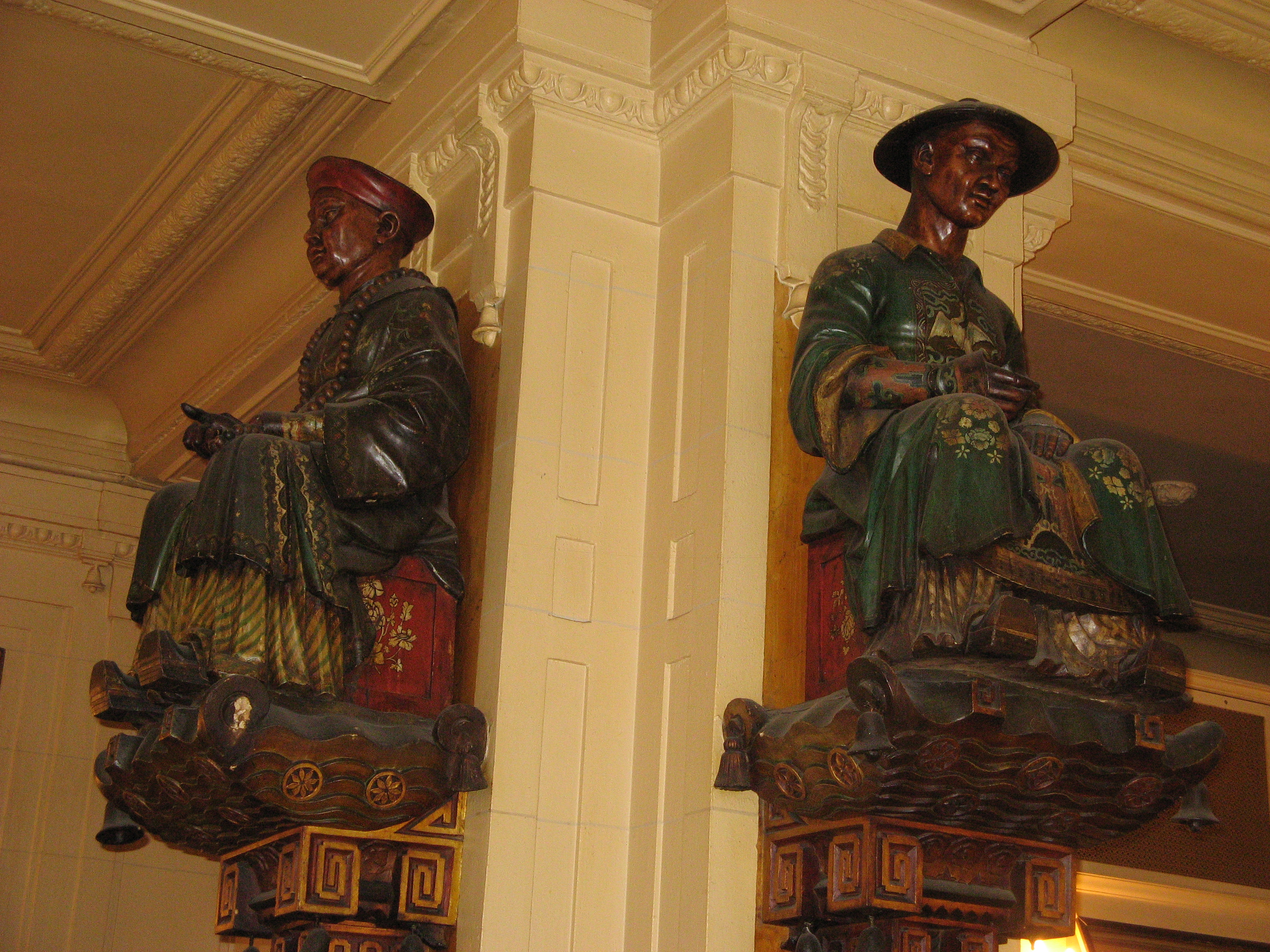
File:Statues, Les Deux Magots, Paris.JPG

The name originally belonged to a fabric and novelty shop at nearby 23 Rue de Buci. The shop sold silk lingerie and took its name from a popular play of the moment (1800s) entitled Les Deux Magots de la Chine (Two Figurines from China.)[2] In 1873 the business transferred to its current location in the Place Saint-Germain-des-Prés. In 1884 the business changed to a café and liquoriste, keeping the name.

Auguste Boulay bought the business in 1914, when it was on the brink of bankruptcy, for 400,000 francs (anciens). The present manager, Catherine Mathivat, is his great-great-granddaughter.

___________________________________


Picture of DeBeauvoirSimone De Beauvoir


French Existentialist, Writer, and Social Essayist

1908-1986


De Beauvoir grew up in a respected borgeois family, the eldest of two daughters. She adopted atheism while still an adolescent, and decided to devote her life to writing and studying.

She graduated from the Sorbonne in 1929, writing a thesis on Leibniz. Philosophy was, for her a discussion and study of the essentials of existence– though she was also fascinated by beauty and aesthetics.

De Beauvoir taught high school while developing the basis for her philosophical thought between 1931 and 1943. Following in the tradition of the 18th century ‘gadfly’ philosophe’s, De Beauvoir used her background in formal philosophy to voice her sentiments on feminism and existentialism.

Jean-Paul Sartre and De beauvoir met after her studies in the Sorbonne, the beginning of a friendship which lasted until his death in 1980. This period began what she described as a ‘moral’ phase of life; the culmination of which was her most important philosophical work, The Ethics of Ambiguity(1948). She began the phase with an essay entitled Pyrrhus et Cineas(1944), and the earlier novel called L’Envitee(1943).

No doubt born of the confusion and madness of WWII, De Beauvoir included in her Ethics Sartre’s ontology of being-for-itself and being-in-itself. She also draws heavily on his conception of human beings as creatures who are free. Freedom of choice, humanity’s utmost value, is the criterion for morality and immorality in one’s acts. Good acts increase one’s freedom, while bad ones limit that freedom.

No doubt, her linkage to Sartre was the reason that she received the unwanted title of existentialist. Among other things, she also was an anti-colonialist, publicly criticising France’s position in Algiers, a pro-abortionist and a socialist with Marxist sympathies.

Her major thrust into philosophical analysis was due to her life-long friendship with Sartre. Using some of the ideas she worked with in Ethics and a few of the underpinnings of existentialism as described by Sartre, she went on to produce her famous work, The Second Sex. Working with the idea that women are the “other,” and another statement: “that women is not born, but made,” De Beauvoir delves deep into the history of women’s oppression. This was the definitive declaration of woman’s independence.

Her other works include a four part autobiography, a prize winning novel called The Mandarins, and a novel condemning society for its treatment of the elderly, The Coming of Age. Writing on her mother’s death she produced A Very Easy Death. One of her final novels was a diary recording the slow lingering death of her friend Sartre, called Adieux: A Farewell to Sartre.

Her final words on Sartre’s death(and her own, in Adieux) were:

“My death will not bring us together again. This is how things are. It is in itself splendid that we were able to live our lives in harmony for so long.”

This is a great review of Midnight in Paris at this link. It has lots of historical references to characters mentioned in the film.


Senator Pryor asks for Spending Cut Suggestions! Here are a few!(Part 87)

Senator Mark Pryor wants our ideas on how to cut federal spending. Take a look at this video clip below:

Senator Pryor has asked us to send our ideas to him at cutspending@pryor.senate.gov and I have done so in the past and will continue to do so in the future.

On May 11, 2011,  I emailed to this above address and I got this email back from Senator Pryor’s office:

Please note, this is not a monitored email account. Due to the sheer volume of correspondence I receive, I ask that constituents please contact me via my website with any responses or additional concerns. If you would like a specific reply to your message, please visit http://pryor.senate.gov/contact. This system ensures that I will continue to keep Arkansas First by allowing me to better organize the thousands of emails I get from Arkansans each week and ensuring that I have all the information I need to respond to your particular communication in timely manner.  I appreciate you writing. I always welcome your input and suggestions. Please do not hesitate to contact me on any issue of concern to you in the future.

Here are a few more I just emailed to him myself:

GUIDELINE #10: Utilize the “ideas industry” for specific proposals.
Those seeking specific proposals to reduce wasteful spending have several options available:
  • The Congressional Budget Office (CBO) periodically releases a Budget Options book containing more than 200 specific reforms that would reduce more than $100 billion in wasteful spending, complete with justifications and savings estimates. (See Appendix 3.)
  • The General Accounting Office (GAO) conducts hundreds of studies each year on wasteful and underperforming federal programs. The GAO also often releases a Budgetary Implications of Selected GAO Work for the current fiscal year, which is a book similar to CBO’s Budget Options, detailing hundreds of specific, implementable ways to reduce waste.
  • The Government Performance and Results Act (GPRA) requires agencies to lay out specific multi-year goals to improve performance and reduce waste and report regularly on their progress toward these goals. Together with Inspector General (IG) reports, GPRA reports show which programs are failing in their missions.
  • Think tanks such as The Heritage Foundation, the Cato Institute, and Citizens Against Government Waste release hundreds of studies each year showing how to save taxpayer dollars.

Here are some more places to cut:

  • Immediately before the current recession, Washington spent $24,800 per household. Simply returning to that level (adjusted for inflation) would likely balance the budget by 2019without any tax hikes.
  • The federal government made at least $98 billionin improper payments in 2009.

What does the Heritage Foundation have to say about saving Medicare:Study released May 10, 2011 (Part 5)

Michael Cannon on Medicare and Healthcare

“Saving the American Dream: The Heritage Plan to Fix the Debt, Cut Spending, and Restore Prosperity,” Heritage Foundation, May 10, 2011 by  Stuart Butler, Ph.D. , Alison Acosta Fraser and William Beachis one of the finest papers I have ever read. Over the next few days I will post portions of this paper, but I will start off with the section on Medicare.

A Medicare Budget and Financing System. During the first five years of
the new Medicare program, the government’s annual contributions to enrollees’
plans are based on the weighted average premium of participating health plans’
bids on a regional basis. The plans bid to provide Medicare benefits plus
catastrophic coverage and, just like the FEHBP, are weighted on plan enrollment.
Thereafter, the government contribution is based on the premium bid of the
lowest-cost health plan that meets the required level of quality and provides an
adequate range of benefits. In both cases, the per capita government
contribution on the basis of the plan bidding is set at 88 percent of the bids.
By comparison, the FEHBP contribution is set at 72 percent of the national
average weighted premium, and the original Medicare Part B premium contribution
was set at 50 percent in 1965.

The Heritage plan also caps total Medicare spending. The spending cap is
indexed annually for inflation using the Consumer Price Index plus 1 percent and
Medicare population growth. If Medicare spending exceeds the cap, the
government’s contribution declines from 88 percent to the percentage that
complies with the Medicare spending cap, thereby pressuring the competing plans
and providers to control costs more tightly.

Additional Assistance for Dual-Eligibles. Medicaid, the federal–state
program for the poor and the indigent, provides supplemental coverage for about
8 million Medicare beneficiaries. These are poor people, and most qualify for
full Medicaid benefits, including long-term care services in nursing homes. They
receive subsidies for Medicare premiums and cost-sharing and for the Medicare
Part D drug coverage.

Beginning five years after enactment, states have the option to “top up” the
Medicare defined-contribution amount for dual-eligibles who choose to enroll in
a private health plan. Dual-eligible enrollees who stay with the revamped
Medicare FFS plan continue to receive Medicaid coverage as they do today.

Integrating Traditional Medicare into the System and Adding Catastrophic
Cost Protection.
Under the Heritage plan, all senior citizens have the
option of keeping their current health plans or choosing better health plans.
Five years after enactment, traditional Medicare FFS begins to compete
directly with private plans on a level playing field. Seniors can remain in
Medicare FFS if they wish. However, the previous organizational and benefit
distinctions within Medicare FFS (Medicare Parts A, B, C, and D) disappear
because Medicare becomes a single, unified program with a unified trust fund
that is financed by a defined contribution.

A single stated premium incorporates today’s multiple Medicare FFS premiums
plus the cost of a new catastrophic benefit. Cost-sharing parameters are
adjusted to ensure that the Medicare benefit package is actuarially equivalent
to the package provided under current law. In the first year of competition with
private health plans, the initial value of the catastrophic benefit will need to
equal the average of such benefits currently provided in the Medicare Advantage
program, but it may be adjusted thereafter by the Secretary of Health and Human
Services.