Christopher Hitchens’ debate with Douglas Wilson (Part 11)

Christopher Hitchens vs. Douglas Wilson Debate at Westminster Theological Seminary, Part 11 of 12

PART 5 

5/25/2007 08:49 AM

Christopher Hitchens

If you insist, I shall concede that the significance of the Samaritan lies in his ethnicity. It’s not a very impressive parable to begin with, though when I was taught it first in Sunday school, it was held up as an example of universal charity (with the added implication, not strange to us for some reason, that pious people are no more likely to behave with love and compassion than are others). Incidentally, what do we know about the ethnicity of the man who fell among thieves, or of the tribal character of those thieves if it comes to that? Surely you should be able to pronounce with authority on those details, too?

I agree that the origins of the cosmos are obscure—mysterious, if you like—to both of us. It’s still you who makes the mystery, though, by insisting that very recent developments on this tiny speck of a planet on the edge of a galaxy are what impart significance to the entire “Big Bang” or divine first cause. To ask what caused either is to invite, as you are aware, an infinite regression of questions about what caused either of those causes. In my book I cite the great [Pierre-Simon, Marquis de] LaPlace, who opened the modern era by saying that accounts of the cosmos and its workings were now complete, or incomplete, on their own terms. They did not require a “god.”

Belief in a deity has been optional ever since. Believe it if you choose, but be aware that it raises more questions than it answers (actually it doesn’t answer any important questions) and is thus highly vulnerable to Ockham’s trusty edge. Deists used to agree with you about a Creator but were not religious in that the assumption of such an entity did not license the further assumption that he or she desired to intervene in human affairs, let alone the assumption that the torture and death of a single individual in a backward part of the Middle East was the solution that we had been awaiting for tens of thousands of years of brutish Homo sapiens existence.

Apply something of the same reasoning to the origins of morality. I say that our “innate” predisposition to both good and wicked behavior is precisely what one would expect to find of a recently-evolved species that is (as we now know from the study of DNA) half a chromosome away from chimpanzees. By the way, do not take that as a denigration of humankind. Primate and elephant and even pig societies show considerable evidence of care for others, parent-child bonding, solidarity in the face of danger, and so on. As Darwin put it:

Any animal whatever, endowed with well-marked social instincts, the parental and filial affections being here included, would inevitably acquire a moral sense or conscience, as soon as its intellectual powers had become as well-developed, or nearly as well-developed, as in man.

We can now observe this to be the case. But animal and human “altruism” is contradicted by the way in which species are also designed to fight with, kill, dominate, and even consume each other. Humans are capable of even greater cruelty because only they have the imagination to inflict it. I do not think that this indicts the Creator who made them this way, because I long ago dispensed with the assumption that there is any such entity. Thus, it is you and not I who are left with the questions about God’s coexistence with evil. See where your talent for needless complexity has left you.

The fluctuations between social and anti-social conduct are fairly consistent across time and space: some societies have licensed cannibalism but they tend to die out, and others have licensed human sacrifice and infanticide (usually under the influence of some priesthood). But I answer your question by making the pragmatic observation that, if we surrendered to our lower instincts all the time, there would be no language in which to write this argument between us and no society in which we could find an audience. The struggle to assert what is positive in our human capacity—I don’t mind Lincoln’s metaphor of our “better angels” if you promise not to take it too

literally—is arduous enough. If I take myself, I find that I can derive pleasure from giving blood for free and also from contemplating the deaths of my clerical-fascist enemies in the ranks of Al Qaeda and even from the misfortunes of others who do not threaten me. I am sure you could give parallel examples of your own. But telling us that we are created sick and then ordered to be well is no help in clarifying this problem. And telling us that the solution to it only became available some two thousand years ago, according to some highly discrepant and selfcontradictory accounts, cannot strike me as anything but absurd. What on earth is proven— except your own vulnerability to making tautologous statements—by the claim that “Jesus Christ is good for the world because he came as the life of the world”? You cannot possibly “know” this. Nor can you present any evidence for it. And its corollary—that without Jesus we are abandoned to wickedness in all its forms—has the horrible implication that worthy actions are pointless unless accompanied by your own rather ill-grounded faith. As I say, believe it if it helps you. But do not insult the millions of people who have done the right thing without requiring any such supernatural authority. And do not tell me that I must be in love with death if I dissent from your view. That’s too much. Your Christianity, in case you have not noticed, has actually made you a less compassionate and thoughtful person than, without its exorbitant presumptions, you would otherwise be.

CH

Related posts: 

Christopher Hitchens’ view on abortion may surprise you

Christopher Hitchens – Against Abortion Uploaded by BritishNeoCon on Dec 2, 2010 An issue Christopher doesn’t seem to have addressed much in his life. He doesn’t explicitly say that he is against abortion in this segment, but that he does believe that the ‘unborn child’ is a real concept. ___________________________ I was suprised when I […]

Christopher Hitchens discusses Ron Paul in 3-2-11 inteview

Max Brantley in the Arkansas Times Blog reports that Ron Paul is leading in Iowa. Maybe it is time to take a closer look at his views. In the above clip you will see Chistopher Hitchens discuss Ron Paul’s views. In the clip below you will find Ron Paul’s latest commercial. Below is a short […]

Evangelicals react to Christopher Hitchens’ death plus video clips of Hitchens debate (part 3)

DEBATE William Lane Craig vs Christopher Hitchens Does God Exist 07 Below are some reactions of evangelical leaders to the news of Christopher Hitchens’ death:   Christian leaders react to Hitchens’ death Posted on Dec 16, 2011 | by Michael Foust   DEBATE William Lane Craig vs Christopher Hitchens Does God Exist 08 Author and […]

Evangelicals react to Christopher Hitchens’ death plus video clips of Hitchens debate (part 2)

DEBATE William Lane Craig vs Christopher Hitchens Does God Exist 04 Below are some reactions of evangelical leaders to the news of Christopher Hitchens’ death: Christian leaders react to Hitchens’ death Posted on Dec 16, 2011 | by Michael Foust DEBATE William Lane Craig vs Christopher Hitchens Does God Exist 05 Author and speaker Christopher […]

Evangelicals react to Christopher Hitchens’ death plus video clips of Hitchens debate (part 1)

DEBATE William Lane Craig vs Christopher Hitchens Does God Exist 01 Below are some reactions of evangelical leaders to the news of Christopher Hitchens’ death: Christian leaders react to Hitchens’ death Posted on Dec 16, 2011 | by Michael Foust Author and speaker Christopher Hitchens, a leader of an aggressive form of atheism that eventually […]

Surrealists Salvador Dali, Man Ray and Luis Bunuel provide funniest scene in “Midnight in Paris”

Adrien Brody 3

Associated Press

Dali and his surrealist friends provide the funniest scene of Woody Allen’s latest film “Midnight in Paris.” Here are links to what I have written about these gentlemen before:

(Part 27, Man Ray) July 5, 2011 – 4:49 am

(Part 15, Luis Bunuel) June 23, 2011 – 5:37 am

December 31, 2015

Hugh Hefner
Playboy Mansion  

Dear Mr. Hefner,

Every year people get out and celebrate New Years Eve and they toast the arrival of the new year at MIDNIGHT  and I am sure that a lot of babies are born about nine months later. That reminds me of one of my favorite Woody Allen movies MIDNIGHT IN PARIS. I know that you are a big Woody Allen fan so I wanted to discuss with you this movie.

Woody Allen believes that we live in a cold, violent and meaningless universe and it seems that his main character (Gil Pender, played by Owen Wilson) in the movie MIDNIGHT IN PARIS shares that view. Pender’s meeting with the Surrealists (Man Ray, Salvador Dali and Luis Bunuel) is by far the best scene in the movie because they are ones who can understand his predicament concerning the absurdity of life UNDER THE SUN (as Solomon used to phrase it.) If we are here as a result of chance then what lasting purpose can be found? The Surrealists truly grasped the problem and it seems that Gil does too realize the full weight of the predicament.

In the movie MIDNIGHT IN PARIS the main character Gil Pender gives his book to Gertrude Stein  and she commented to him:

Gil Pender realizes that it is difficult to come up with a meaning for life. At one point he tells Adriana concerning their mutual love of Paris:

You know, I sometimes think,”How’s anyone gonna come up with a book, or a painting, or a symphony or a sculpture that can compete with a great city?”You can’t, ’cause, like,you look around, every…every street, every boulevard is its own special art form.And when you think that in the cold,violent, meaningless universe,that Paris exists, these lights…I mean, come on, there’s nothing happening on Jupiter or Neptune,but from way out in space you can see these lights, the cafe’s, people drinking, and singing…I mean, for all we know, Paris is the hottest spot in the universe.-

This admiration of the city of Paris does not change Pender’s view that the universe brought to us by Darwinian chance plus time must be ultimately meaningless.

Let’s see what King Solomon had to say about that. Solomon said in Ecclesiastes 9:11-13 “I have seen something else UNDER THE SUN:  The race is not to the swift or the battle to the strong, nor does food come to the wise or wealth to the brilliant  or favor to the learned; but time and chance happen to them all.  Moreover, no one knows when their hour will come: As fish are caught in a cruel net, or birds are taken in a snare, so people are trapped by evil times  that fall unexpectedly upon them.”

WHY IS SOLOMON CAUGHT IN DESPAIR IN THE BOOK OF ECCLESIASTES?  Christian scholar Ravi Zacharias has noted, “The key to understanding the Book of Ecclesiastes is the term ‘UNDER THE SUN.’ What that literally means is you lock God out of a closed system, and you are left with only this world of time plus chance plus matter.” THIS IS EXACT POINT SCHAEFFER SAYS SECULAR ARTISTS ARE PAINTING FROM TODAY BECAUSE THEY BELIEVED ARE A RESULT OF MINDLESS CHANCE.

By the way, the final chapter of Ecclesiastes finishes with Solomon emphasizing that serving God is the only proper response of man. Solomon LOOKS ABOVE THE SUN AND BRINGS GOD BACK INTO THE PICTURE in the final chapter of the book in Ecclesiastes 12:13-14, “ Now all has been heard; here is the conclusion of the matter: Fear God and keep his commandments, for this is the whole duty of man.  For God will bring every deed into judgment, including every hidden thing, whether it is good or evil.”

WITHOUT GOD IN THE PICTURE WHERE DOES MODERN MAN TURN AND THE ANSWER IS YOU BRING CHANCE INTO YOUR ARTWORK!!! The SURREALISTS were the same men who started the “Dada Movement” and Francis Schaeffer noted concerning that movement: 

Dada was started in Zurich and came along in modern art. Dada means nothing. The word “Dada” means rocking horse, but it was chosen by chance. The whole concept of Dada is everything means nothing. [In this materialistic mindset Chance and Time have determined the past, and they will determine the future according to Solomon in life UNDER THE SUN]…  Dada carried to its logical conclusion the notion of all having come about by chance; the result was the final absurdity of everything, including humanity.

(Surrealists: Man Ray, Jean Arp, Yves Tanguy, André Breton; Tristan Tzara, Salvador Dalí, Paul Eluard, Max Ernst and Rene Clevel, 1930.)

_________

Art attack ... (l-r) tycoon Hefner, a Matisse and Lennon
Art attack … (l-r) tycoon Hefner, a Matisse and Lennon
Lennon picture: REX

___________

Henri Matisse, 1913, photograph by Alvin Langdon Coburn.jpg

__________

kimmelman_1-042612.jpgEstate of Daniel M. Stein

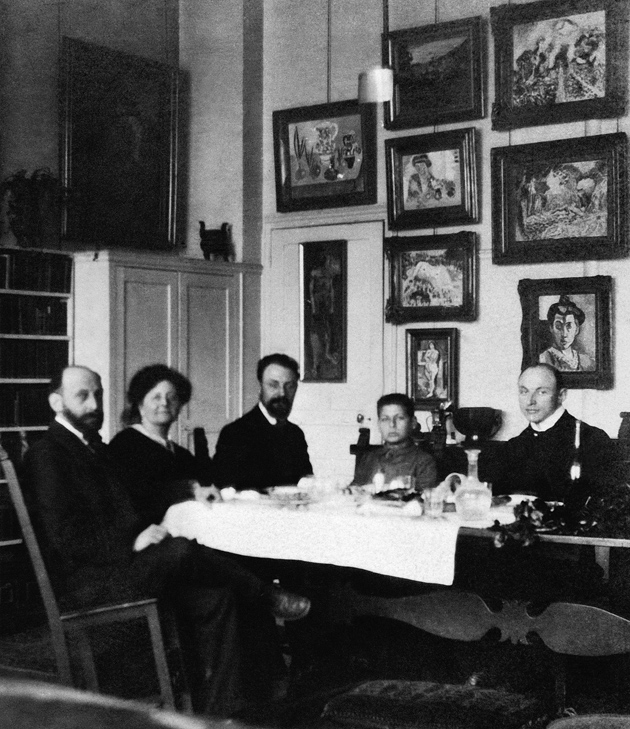
Henri Matisse (center) and Hans Purrmann (right) dining with Michael, Sarah, and Allan Stein at their apartment at 58 rue Madame, Paris, circa 1908. The paintings in the background, all by Matisse, are The Young Sailor I (far left); Pink Onions and Male Nude(left column); Fruit Trees in Blossom, Woman in a Kimono, Nude Reclining Woman, andNude before a Screen (center column);Madame Matisse in the Olive Grove, a sketch for Le Bonheur de Vivre, and Madame Matisse (The Green Line) (right column).

____

Paris: The Luminous Years

The sights and scenes of Paris from the eyes of Woody Allen

View from Northwest

Notre-Dame Cathedral attracts 13 million visitors each year.

The first 4 minutes of the movie “Midnight in Paris” by Woody Allen does the best job of capturing the sights of Paris. I have 40 posts concerning the movie “Midnight in Paris” by Woody Allen. Below are the links to all of the posts.

“Midnight in Paris” one of Woody Allen’s biggest movie hits in recent years July 18, 2011 – 6:00 am


(Part 32, Jean-Paul Sartre)July 10, 2011 – 5:53 am


 (Part 29, Pablo Picasso) July 7, 2011 – 4:33 am

(Part 28,Van Gogh) July 6, 2011 – 4:03 am

(Part 27, Man Ray) July 5, 2011 – 4:49 am

(Part 26,James Joyce) July 4, 2011 – 5:55 am

(Part 25, T.S.Elliot) July 3, 2011 – 4:46 am

(Part 24, Djuna Barnes) July 2, 2011 – 7:28 am

(Part 23,Adriana, fictional mistress of Picasso) July 1, 2011 – 12:28 am

(Part 22, Silvia Beach and the Shakespeare and Company Bookstore) June 30, 2011 – 12:58 am

(Part 21,Versailles and the French Revolution) June 29, 2011 – 5:34 am

(Part 16, Josephine Baker) June 24, 2011 – 5:18 am

(Part 15, Luis Bunuel) June 23, 2011 – 5:37 am

Did President Obama overreach?

An Abuse of Power: President Obama’s “Recess” Appointments

Uploaded by on Jan 7, 2012

President Obama’s stunning appointments of Richard Cordray to the Consumer Financial Protection Bureau and of three more bureaucrats to the National Labor Relations Board has been described by many observers as a serious blow to the Constitution and the separation of powers.

___________________

Did President Obama do something unlawful? (Another great article on this is linked here.)

  • JANUARY 10, 2012

Democrats and Executive Overreach

It’s a mistake to excuse Obama’s disregard for the Constitution. Precedents set now will be exploited by the next administration.

By MICHAEL MCCONNELL

One reason so many Americans entrusted Barack Obama with the presidency was his pledge to correct the prior administration’s tendency to push unilateral executive power beyond constitutional and customary limits.

Yet last week’s recess appointments of Richard Cordray as the first chief of the Consumer Financial Protection Bureau and three new members to the President’s National Labor Relations Board—taken together with other aggressive and probably unconstitutional executive actions—suggest that this president lacks a proper respect for constitutional checks and balances.

The Obama administration has offered no considered legal defense for the recess appointments. It even appears that it got no opinion from the Office of Legal Counsel in advance of the action—a sure sign the administration understood it was on shaky legal ground.

It is hard to imagine a plausible constitutional basis for the appointments. The president has power to make recess appointments only when the Senate is in recess. Several years ago—under the leadership of Harry Reid and with the vote of then-Sen. Obama—the Senate adopted a practice of holding pro forma sessions every three days during its holidays with the expressed purpose of preventing President George W. Bush from making recess appointments during intrasession adjournments. This administration must think the rules made to hamstring President Bush do not apply to President Obama. But an essential bedrock of any functioning democratic republic is that the same rules apply regardless of who holds office.

It does not matter, constitutionally, that congressional Republicans have abused their authority by refusing to confirm qualified nominees—just as congressional Democrats did in the previous administration. Governance in a divided system is by nature frustrating. But the president cannot use unconstitutional means to combat political shenanigans. If the filibuster is a problem, the Senate majority has power to eliminate or weaken it, by an amendment to Senate Rule 22. They just need to be aware that the same rules will apply to them if and when they return to minority status and wish to use the filibuster to obstruct Republican appointments and policies.

AFP/Getty ImagesPresident Obama alongside Richard Cordray, head of the Consumer Financial Protection Bureau, in Shaker Heights, Ohio, Jan. 4.

Moreover, in this case, two of the recess appointees to the National Labor Relations Board had just been nominated and sent to the Senate on Dec. 15—two days before the holiday. So it is simply not true that they were victims of Republican obstructionism, even if that mattered.

Some of the administration’s supporters have tried to argue that the pro forma sessions are a sham and thus that the Senate has been in recess since Dec. 17. Aside from the fact that these sessions are not, in fact, a sham—the Senate enacted the payroll tax holiday extension, President Obama’s leading legislative priority, on Dec. 23 during one of those pro forma sessions—the plain language of the Constitution precludes any such conclusion.

Article I, Section 5, Clause 4 requires the concurrence of the other house to any adjournment of more than three days. The Senate did not request, and the House did not agree to, any such adjournment. This means that the Senate was not in adjournment according to the Constitution (let alone in “recess,” which requires a longer break).

Others have argued that the president can make recess appointments during any adjournment, however brief, including the three days between pro forma sessions. That cannot be right, because it would allow the president free rein to avoid senatorial advice and consent, which is a major structural feature of the Constitution. He could, for example, make an appointment overnight, or during a lunch break. In a brief in the Supreme Court in 2004, Harvard law professor Laurence Tribe dismissed as “absurd” any suggestion that a period of “a fortnight, or a weekend, or overnight” is a “recess” for purposes of the Recess Appointments Clause.

This is not the first time this administration has asserted unilateral executive power beyond past presidential practice and the seeming letter of the Constitution. Its slender justification for going to war in Libya without a congressional declaration persuaded almost no one, and its evasion of the reporting requirements of the War Powers Resolution—over the legal objections of Justice Department lawyers—was even more brazen. According to the administration, not only was our involvement in Libya not a “war” for constitutional purposes; it did not even amount to “hostilities” that trigger a reporting requirement and a 60-day deadline for congressional authorization.

Indeed, the Obama administration has admitted to a strategy of governing by executive order when it cannot prevail through proper legislative channels. Rather than work with Congress to get reasonable changes to President Bush’s No Child Left Behind education law, it has used an aggressive interpretation of its waiver authority to substitute the president’s favored policies for the law passed by Congress. When the president’s preferred cap-and-trade legislation to limit carbon emissions failed in Congress, the Environmental Protection Agency announced it would proceed by regulation instead. And when Congress refused to enact “card check” legislation doing away with secret ballots in union elections, the president’s National Labor Relations Board announced plans to impose the change by administrative fiat—one of the reasons Senate Republicans have tried to block appointments.

The English philosopher John Locke, who so influenced our Founding Fathers, wrote that a “good prince” is more dangerous than a bad one because the people are less vigilant to protect against the aggrandizement of power when they perceive the ruler as beneficent.

I fear many Democrats are falling into this trap. They like President Obama and his policies, and they are willing to look the other way when it comes to constitutional niceties. The problem is that checks and balances are important, precedents created by one administration will be exploited by the next, and not all princes are good.

Mr. McConnell, a former federal judge, is a professor of law and director of the Constitutional Law Center at Stanford Law School, and a senior fellow at the Hoover Institution.

Atheists discuss Tim Tebow and Rodin’s “The Thinker”


Interesting article I wanted to pass on. I have written about Rodin’s “The Thinker” myself in the past.

It’s official: Everyone on the planet has an opinion on Tim Tebow. By now we’ve heard from everyone from Rick Perry to Bill Maher to the folks at Saturday Night Live. And of course those opinions result in even more opinions, so much so that Tim Tebow the human being is almost irrelevant next to Tim Tebow the idea. What Tebow represents can be almost anything to anyone, but the person we’re all talking about has faded away.

And that brings us to the atheist community.

They are certainly in the minority on Tim Tebow. In a recent nationwide poll, 43 percent of those who knew of Tebow said they believed divine intervention was at least partly responsible for his success. Atheists, obviously, disagree. They also dislike how Tebow is using his fame to promote Christianity. No surprise there.

But what is surprising is that one leading atheist makes an argument against Tebow that also serves as a roundabout defense of Tebow. And to illustrate that point, we begin with the president of American Atheists, Dave Silverman, Tebowing:

Silverman, 45, has added a clever twist to the fad. He is genuflecting like Tebow does when he prays, but he’s also mimicking Rodin’s The Thinker. This is a nod to the atheist or humanistic belief that it is man — not a higher power — who is purely in control of his fate. Silverman is Tebowing to his fellow man.

“The universe has a trillion stars,” he says. “Ninety five percent of it is dark matter. It’s hubris to think the Creator of all that wants the Broncos to win a football game.”

(Another atheist, Blair Scott, says if God wants Tebow to win, the quarterback would have a higher completion percentage. Scott, ironically, is a Saints fan.)

So Silverman calls Tebow a “victim” because of the quarterback’s belief that “he’s not doing it — God is doing it through him.” Therefore, according to Silverman, Tebow is “brainwashing himself.”

According to this line of reasoning, however, Tebow deserves more credit, not less. Silverman argues that the religious talk from and around Tebow is not only taking away from the performance of his Denver Broncos teammates, but also the quarterback’s own ability. From this perspective, the way Tebow has won games this season — through miraculous and seemingly predestined comebacks; what Chicago Bears general manager Jerry Angelo called “some divine intervention associated with what’s taking place” — undermines the true worth of Tebow the person.

He has a point. Tebow’s uniqueness is not in how frequently and openly he prays. Many athletes do that. And many quarterbacks lead amazing comebacks that strain reason and understanding. (Seen Matt Stafford this season?)

What Tebow does, better than just about any other quarterback, is approach danger. Embrace danger. Plenty of quarterbacks accept imminent danger, like Tom Brady waiting until the last possible moment to throw before getting decked. Plenty of quarterbacks deftly avoid danger, like Michael Vick.

Tebow seeks it. He plows right into the line, like a fullback, and he seems to cherish the role. In fact, he seems to miss doing it more. His rushes were unstoppable at Florida — so much so that his jump pass was a revelation because everyone in the stadium expected him to barrel into the end zone instead of leaping and tossing the ball to Aaron Hernandez or some other wide-open Gator.

The word “throwback” is used too often, but Tebow stands out in an era where quarterbacks are not to be touched and skill players are treated like china dolls. Some people shout that Tebow is beloved for his race, or for his religion, or even for his looks. Maybe so. But all those God-given — or DNA-given, depending on your perspective — factors can overshadow something he’s done on his own: train himself physically and mentally to seek and withstand some of the most terrifying physical contact known to man, the NFL gang-tackle.

ThePostGame brings you the most interesting sports stories on the web.
Follow us on Facebook and Twitter to read them first!

This is not to say other quarterbacks aren’t tough. Every NFL quarterback is tough. But the way Tebow plays is a special brand of tough, because he could easily shy away from brutality based on his name, his reputation, his income, or his position. Tebow does none of that.

Instead, Tebow displays that most human of attributes, the one at the core of pro football’s enduring appeal. Courage.

Is his courage bolstered by his faith? Probably so. Tebow would likely say the credit for his style of play goes to God, just like everything else. Fair enough.

But there is something distinctly human about a man’s willingness to risk pain. It’s been admirable as long as we’ve walked the Earth, really. Americans love football the most for the bravery and physicality of the players, and Tebow represents this well — even without a single mention of Jesus.

So although the atheists’ disdain for Tebow’s religiosity can be off-putting and offensive to people of faith, there’s something to their larger argument. When Marion Barber fumbles or when Matt Prater hits a long field goal, we all wonder (or joke or scoff) about divine intervention. Even Ravens defender Terrell Suggs ripped Tebow for needing God to bail him out. Is Jesus involved in the Broncos’ playoff run? That’s not for this site to discuss. But is Tebow involved in this improbable season-long journey? Absolutely. And that’s one thing everyone — Rick Perry and Bill Maher, believers and non-believers alike — can agree on. You don’t have to believe in God to believe in Tim Tebow.

Related posts:

Tim Tebow and John 3:16

Very interesting article below: The NFL bans eye-black messagers. Tebow’s numbers did the preaching on Sunday. (Lynn Sladky/AP)   You ever feel like there’s too much Tim Tebow news? Neither do I. Here’s a roundup of some of the most interesting Timbits from the aftermath of the Denver Broncos 29-23 overtime victory over the Pittsburgh […]

Barrett Jones and Tim Tebow are very similar

For   Barrett Jones is a Tim Tebow type of person and I am glad that people like Jones and Tebow are not ashamed of their Savior Jesus Christ. They don’t try to live two lives, one in church and one that is different in the lockerroom. Barrett Jones is the 2011 Outland Trophy winner […]

Tebow does it again

He did it again. Tebow does it again. It is simply amazing. With all the odds against him he comes through. I guess that will ruin Bill Maher’s jokes for the week. Can Tebow rally the team for another unlikely victory? The Steelers were 8 point favorites and I am sure the Patriots will be […]

Prolife quotes

Bill O’Reilly Interviews Jehmu Greene About Pro-Life Super Bowl Ad about Tim Tebow I got these quotes from someone off the internet that lives in England. The funny thing is the video is put to music and the song they picked won a grammy for an Arkansas band that lives in Little Rock. Here is […]

Max Brantley and Ark Times bloggers poke fun at Tebow after 3rd straight loss

Arkansas Times Blogger who goes by the name “Elwood” remarked (The New Year line | Arkansas Blog ): I tuned in late to the KC v Denver Bronco game, just the last few minutes to see CBS giving adequate coverage to Tebow on his knees at his team’s bench in deep prayer. He seemed so isolated. Other […]

Tim Tebow attacked by Bill Maher

  Tebow attacked by Bill Maher: Even in defeat, Tim Tebow creates controversy — this time in Tinseltown. HBO’s Bill Maher created a firestorm over the Christmas weekend with a scathing reaction to Tebow’s subpar performance in Buffalo. Shortly after Tebow threw four interceptions in the Broncos’ lopsided defeat to the Bills, Maher turned to […]

Why We Love Tim Tebow

I really enjoyed this article and wanted to share it with you. Why We Love Tim Tebow posted by Linda Mintle | 7:33am Wednesday December 14, 2011   Yesterday I was asked to do a TV interview on Tim Tebow. This time the focus was positive. Tebow is very polarizing. People either love or hate him […]

Tim Tebow: Bestselling religious author of 2011

Tim Tebow seems to win at everything he tries. The Good Book: Tim Tebow A No. 1 Author Monday, December 26, 2011 12:45 pm Written by: Ben Maller Sports experts go crazy debating whether Tim Tebow can win NFL games, but there’s no question he can win over readers. Tebow’s Christian life story, “Through My […]

10 Reasons for Tim Tebow Hate

I enjoyed this article below: 10 Reasons for Tim Tebow Hate posted by Linda Mintle | 7:25am Tuesday December 6, 2011   I walked in to a radio station focused on doing an interview totally unrelated to football and the producer starts ranting about how much he hates Tim Tebow. This was a day after Tebow […]

Dear Senator Pryor, why not pass the Balance Budget Amendment? ( “Thirsty Thursday”, Open letter to Senator Pryor)

Dear Senator Pryor,

Why not pass the Balanced  Budget amendment? As you know that federal deficit is at all time high (1.6 trillion deficit with revenues of 2.2 trillion and spending at 3.8 trillion).

On my blog www.HaltingArkansasLiberalswithTruth.com I took you at your word and sent you over 100 emails with specific spending cut ideas. However, I did not see any of them in the recent debt deal that Congress adopted. Now I am trying another approach. Every week from now on I will send you an email explaining different reasons why we need the Balanced Budget Amendment. It will appear on my blog on “Thirsty Thursday” because the government is always thirsty for more money to spend.

Marco Rubio is one of your fellow citizens and he noted:

A balanced budget amendment would be a necessary step in reversing Washington’s tax-borrow-spend mantra. It would force Congress to balance its budget each year – not allow it to pass our problems on to the next generation any longer.

The Balanced Budget Amendment is the only thing I can think of that would force Washington to cut spending. We have only a handful of balanced budgets in the last 60 years, so obviously what we are doing is not working. We are passing along this debt to the next generation.

Thank you for this opportunity to share my ideas with you.

Sincerely,

Everette Hatcher, lowcostsqueegees@yahoo.com

 In my two short months in office, it has become clear to me that the spending problem in Washington is far worse than many of us feared. For years, politicians have blindly poured more and more borrowed money into ineffective government programs, leaving us with trillion dollar deficits and a crippling debt burden that threatens prosperity and economic growth.

In the Florida House of Representatives, where a balanced budget is a requirement, we had to make the tough choices to cut spending where necessary because it was required by state law. By no means was this an easy process, but it was our duty as elected officials to be accountable to our constituents and to future generations of Floridians. In Washington, a balanced budget amendment is not just a fiscally-responsible proposal, it’s a necessary step to curb politicians’ decades-long penchant for overspending.

Several senators have proposed balanced budget amendments that ensure Congress will not spend a penny more than we take in, while setting a high hurdle for future tax hikes. I am a co-sponsor of two balanced budget amendments, since it is clear that these measures would go a long way to reversing the spending gusher we’ve seen from Washington in recent years.

During my Senate campaign, while surrounded by the employees of Jacksonville’s Meridian Technologies, I proposed 12 simple ways to cut spending in Washington. That company, founded 13 years ago, has grown into a 200-employee, high-tech business, and the ideas I proposed would help ensure that similar companies have the opportunity to start or expand just like Meridian did.

To be clear, our unsustainable debt and deficits are threatening companies like Meridian and impeding job creation. In addition to proposing a balanced budget amendment, I recommended canceling unspent “stimulus” funds, banning all earmarks and returning discretionary spending to 2008 levels.

Fortunately, some of my ideas have found their way to the Senate chamber. The first bill I co-sponsored in the Senate was to repeal ObamaCare, the costly overhaul of our nation’s health care system that destroys jobs and impedes our economic recovery. Democratic leaders in the Senate have expressed their willingness to ban earmarks for two years after the Senate Republican conference adopted a moratorium. I have also co-sponsored the REINS Act, a common-sense measure that would increase accountability and transparency in our outdated and burdensome regulatory process. These bills, along with a balanced budget amendment, would help get our country back on a sustainable path and provide certainty to job creators.

While Republicans are proposing a variety of ideas to rein in Washington’s out-of-control spending, unfortunately, President Obama’s budget for the upcoming fiscal year proposes to spend $46 trillion, and even in its best year, the deficit would remain above $600 billion. Worst of all, the President’s budget completely avoids addressing the biggest drivers of our long-term debt – Social Security, Medicare and Medicaid.

Rather than tackle these tough, serious issues, President Obama is proposing a litany of tax hikes on small businesses and entrepreneurs, to the tune of more than $1.6 trillion. These tax increases destroy jobs, make us less competitive internationally and hurt our efforts to grow the economy and get our fiscal house in order.

A balanced budget amendment would be a necessary step in reversing Washington’s tax-borrow-spend mantra. It would force Congress to balance its budget each year – not allow it to pass our problems on to the next generation any longer.

Marco Rubio

Marco Rubio, a Republican, is a U.S. senator from Florida and former speaker of the Florida House of Representatives.

A man of pro-life convictions: Bernard Nathanson (part 2)

“Jane Roe” or Roe v Wade is now a prolife Christian. She’s recently has done a commercial about it.

_______________________________

I have often wondered why we got to this point in our country’s life and we allow abortion. The answer is found in the words of Schaffer.
Philosopher and Theologian, Francis A. Schaeffer has argued, “If there are no absolutes by which to judge society, then society is absolute.” Francis Schaeffer, How Shall We Then Live? (Old Tappan NJ: Fleming H Revell Company, 1976), p. 224.

Below is a clip from the film series “How Then Shall We Live?”

The Hand of God-Selected Quotes from Bernard N. Nathanson, M.D.,

Reasoned Audacity

Bernard Nathanson, M.D.

Silent Scream, The Hand of God is “semi-autobiographical…for the study of…the…demise of one system of morality…and the painful acquisition of another more coherent, more reliable [morality]…[with] the backdrop …of abortion. p. 3.

“We live in an age of fulsome nihilism; an age of death; an age in which, as author Walker Percy (a fellow physician, a pathologist who specializes in autopsying Western civilization) argued, “compassion leads to the gas chamber,” or the abortion clinic, or the euthanist’s office.” p. 4.

“I worked hard to make abortion legal, affordable, and available on demand. In 1968, I was one of the three founders of the National Abortion Rights Action League. I ran the largest abortion clinic …and oversaw tens of thousands of abortions. I have performed thousands myself.” p. 5.

“The Hippocratic Oath states the following,

I will give no deadly medicine to anyone if asked, nor suggest any such counsel; and in like manner, I will not give to a woman a pessary [a device inserted in the vagina, thought erroneously to initiate an abortion] to produce an abortion.

The oath is unambiguous on these matters.” p. 48.

“The World Medical Association meeting at Geneva, in 1948, in the aftermath of the revelations of the Nazi medical experiments, revised the oath marginally to include the pledge, “I will retain the utmost respect for Human Life from conception.”…in 1964 restated the theme : “The health of my patient will be my first consideration.” p.50. The unborn baby in an abortion procedure is not considered a patient.

Bain Capital record of Romney is excellent

Here is an excellent article:

You can blame Mitt, but not for Bain
By: Steven Rattner
January 12, 2012 12:02 AM EST
I’m all in favor of piling on Mitt Romney for any number of reasons: his come lately embrace of hard right conservatism, his periodic malapropisms (“I like being able to fire people”) and above all, the nonchalance with which he displays a dazzling shortage of principles by incessantly flip-flopping on issues, sometimes the same day.

But these latest salvos being fired at his service as the founder and head of Bain Capital go too far. Having spent nearly three decades on Wall Street, when it comes to Bain Capital, I feel equipped — some might say too equipped — to parse fact from fiction. (Full disclosure: In the post-Romney era, I worked with Bain Capital on several projects.)

Most important, Bain Capital is not now, nor has it ever been, some kind of Gordon Gekko-like, fire-breathing corporate raider that slashed and burned companies, immolating jobs wherever they appear in its path

Wall Street has its share of the vulture capitalists that Texas Gov. Rick Perry enjoyed mocking in South Carolina earlier this week. But Romney was almost the furthest thing from Larry the Liquidator.

Instead, with modest exceptions (keep reading to learn more about these), Bain Capital was a thoroughly respectable – nay, eminent – investment manager that successfully discharged its responsibility of earning high returns for its investors by deploying capital in companies privately rather than by buying shares in the public market. (Hence the name, private equity.)

Over Bain Capital’s 27 years, its private investments generally fell into two buckets. The firm, particularly in its early years, made dozens of venture capital investments — taking stakes of a few million dollars or less in young companies, in hopes that they would grow and prosper. A good example: Its investment of $2.5 million in Staples in 1986.

As the years clicked along, Bain’s emphasis shifted toward what was then known as leveraged buyouts, and is now called private equity. Typically, those investments are larger, made in more developed companies and heavily financed with debt. In 1998, for example, Bain invested $189 million in the pizza chain Domino’s, from which it reportedly reaped a fivefold return.

Overall, Bain Capital’s record was extraordinary, among the best in the business. According to a Bain placement document, through the end of 1999 (effectively, when Romney left), the firm had achieved annual returns of 88 percent per year.

That is not only wildly more than the single digit returns most investors achieve by buying stocks or bonds, it is far higher than those of typical private equity or venture capital firms.

Of course, a number of its early stage investments failed. That is the nature of venture capital — an industry not unlike baseball in that a .300 batting average can be excellent performance. But who can quarrel with an investment firm trying to nurture and finance young companies?


The story of the private equity business is somewhat more complicated. Almost by definition, a private equity investment is made with the hope of improving the profitability of the “portfolio company,” as it is known in the parlance. Often, this means replacing management or reducing unnecessary headcount – firing people.

While no one likes seeing jobs disappear, eliminating unnecessary overhead and even entire divisions if they cannot be made sufficiently profitable is at the heart of a successful economy — the process Joseph Schumpeter famously described as “creative destruction.” How strange for conservatives like Newt Gingrich and Perry to be questioning the core of free market economics.

I have no idea whether Bain Capital created 100,000 net new jobs, and I think Romney was silly to even engage in that debate. What we know for certain is that Bain Capital more than fulfilled its responsibility to a gaggle of investors, who were mostly foundations, endowments, pension funds and the like.

So what are the question marks (promised above) around the story of Romney and Bain Capital? First, it’s fair game to question the amounts of debt that are sometimes used in leveraged buyouts. While higher debt usually means higher returns — because debt is cheaper than equity, thanks in part to its tax deductibility — it also means higher risk of bankruptcy.

Bain had less than its share of bankruptcies, but it had a few – it appears four – that are particularly troubling. In all those cases, when the portfolio companies initially showed signs of promise, Bain took advantage of their progress to borrow more money, which it took out as a dividend. Later, the fortunes of each company turned down, ultimately into insolvency.

When Bain “releveraged” those companies and took the cash out, the investment managers of course had no idea that the companies would later falter. But with the benefit of hindsight, taking a more conservative approach and refraining from squeezing these dividends out of the companies would certainly have been more prudent.

Let’s be sure to keep these few problem children in perspective. During the Romney years, Bain made 77 significant investments —and a number of smaller ones. It made billions for worthy investors and, yes, doubtless created some incalculable number of net new jobs for the U.S. economy.

That’s the story of Bain Capital. It’s certainly fair game for any candidate’s opponents to dig into his record. But in Romney’s case, focusing on questions about his principles — and his currently staunchly conservative principles — could be more productive than trying to rewrite the firm’s history.

Steven Rattner, who served as counselor to the Treasury secretary and lead auto adviser in the Obama administration, was previously managing principal of Quadrangle Group, a private equity firm. (@SteveRattner)

RC Sproul and Ben Stein discuss evolution

A very interesting discussion of Ben Stein’s movie “Expelled” and the issue of evolution.


Review by Movie Guide:

Content:

(BBB, CC, L, V) Very strong Judeo-Christian worldview with positive proof of God and refutation of Darwinism and atheism and the false philosophies of our age, with positive references to God and Jesus Christ, but more theistic from a Jewish perspective, making a clear link between National Socialism (Nazi), Communism and Darwinism; one “h” word and two references to butt; documentary footage of violence at the Berlin Wall, Nazi violence, concentration camps, piled up bodies, discussions of violence, movie vignettes with slapping, other minor violence, and recreating old 1950s educational instructional movies; no sex; no nudity; no drinking; no smoking; and, nothing else objectionable but the whole movie is eliciting cries of outrage from the pseudo-scientific Darwinian community.


Summary:

In the brilliant documentary EXPELLED, actor and pundit Ben Stein takes on the Darwinian scientists who have become oppressive totalitarians. EXPELLED wry, funny, well-crafted documentary that is also heart-rending, convincing and transformational.


Review:

EXPELLED is a wry, funny, well-crafted documentary. The juxtaposition of popular music, dramatic vignettes, documentary footage, and Ben Stein’s quest for truth is often laugh-out-loud funny. At the same time, it is heart-rending, convincing and transformational. Like any documentary, however, there are a few moments when the tension relaxes, but most of the movie, and especially the last third of the movie, is captivating because Ben Stein takes on the atheist Richard Dawkins.

Ben Stein starts out talking about the fact that the United States was built on freedom. He quotes the Founding Fathers and juxtaposes the freedom of the United States with the Communist Berlin Wall in Germany.

Carefully, Stein makes the case that the academic community has become as oppressive of freedom as that same community oppressed freedom in Nazi Germany and the Soviet Union. He interviews Prof. Richard Sternberg who lost his long-term job at the Smithsonian Institute because he dared to publish a peer-reviewed article with two or three references to Intelligent Design. The article did not endorse Intelligent Design, but the very mention of Intelligent Design brings severe repression from the pseudo-scientific academic community. He then talks to Dr. Caroline Crocker who lost her professorship at George Mason for having one reference to ID.

One by one, Stein introduces us to prestigious scientists at major universities who were expelled because they dared to mention Intelligent Design and open up the academic discussion to non-Darwinian viewpoints. He moves from there to questioning the institutions and the administrators who expelled these academics. The administrators squirm under his interrogation but eventually admit that the academic community has no room for freedom and intellectual inquiry.

Then, he visits France and Germany and shows the Darwinian roots of fascism, taking the audience through the famous mental institution of Germany where hundreds of infirm and mentally ill people were cruelly murdered. What is more frightening is his guide who says she cannot judge the doctor, who headed the institution that disposed of the infirm and the outcasts, and she seems to side with the Darwinian fascists. Ben even takes on Margaret Sanger, Planned Parenthood and the other proponents of eugenics who wanted to rid the world of the races that they thought were inferior.

Stein interviews scientists who say their Darwinian education converted them from Christianity to atheism. Several of them note that death is the end, there is no free will, life has no meaning, and none of them can explain the origin of life.

Finally, the famous self-promoter Prof. Richard Dawkins, when cornered in an interview, says life may have originated from aliens seeding the planet. Of course, everyone watching this interview realizes that the teleological argument should lead him to ask where did that alien life originate.

EXPELLED then takes us to discussion of the complex life of the cell. The Dawkins interview at the end presents an incredible villainous attack on the good, the true and the beautiful while at the same time showing that the smug Dawkins has no idea what he’s saying and is unable to answer the most basic questions.

This movie has leaked out into the atheist community and created a vicious outcry. Rather than expelling the movie, the professors and freedom of thought, it is clear that the successors of Darwinism, Hitler’s National Socialism and Communism would like to torture anyone who dares question, as real scientists should, the existing order of the academic community.

Atheists and Darwinists should make sure that people of faith and values and agnostics do not see this movie. It is so well crafted that it will completely expose the naked inconsistencies of the Darwinists. It will equip every person of faith and values with common sense to refute the arguments of the academic overlords. Atheists might want to go out of their way to stop this movie by buying up theaters and perhaps even buying out the distributorship itself because this movie will do more to undermine them and bring down the wall of the academic gulag. Perhaps, they should see it so they can figure out how to come up with viable arguments instead of the ones Ben Stein demolishes with such wry humor and careful questioning.

Ben by the way is not arguing for a particular point of view. He is arguing for academic freedom and rational scientific inquiry.


In Brief:

In the brilliant documentary EXPELLED, actor and pundit Ben Stein takes on the Darwinian scientists who have become oppressive totalitarians. One by one, Stein introduces us to prestigious scientists at major universities who were expelled because they dared to mention Intelligent Design and open up the academic discussion to non-Darwinian viewpoints. He moves from there to questioning the institutions and administrators who fired them unfairly. Then he visits France and Germany and shows the Darwinian roots of totalitarian fascism and Communism. Stein also discusses the complex life of the cell. Finally, he questions Darwinist Richard Dawkins, who comes across as a smug pseudo-scientist who can’t answer basic questions and doesn’t know what he’s saying.

EXPELLED is a wry, funny, well-crafted documentary. The juxtaposition of popular music, dramatic vignettes, documentary footage, and Ben Stein’s quest for truth is often laugh-out-loud funny. At the same time, it is heart-rending, convincing and transformational. Like any documentary, however, there are very few moments where the tension relaxes, but the last third of the movie is extraordinarily captivating because of Ben’s expose of the atheist Richard Dawkins. Dawkins points are easily refuted by rational scientific inquiry.

Related posts:

Carl Sagan versus RC Sproul

At the end of this post is a message by RC Sproul in which he discusses Sagan. Over the years I have confronted many atheists. Here is one story below: I really believe Hebrews 4:12 when it asserts: For the word of God is living and active and sharper than any two-edged sword, and piercing as far as the […]

Review of Carl Sagan book (Part 4 of series on Evolution)jh68

Review of Carl Sagan book (Part 4 of series on Evolution) The Long War against God-Henry Morris, part 5 of 6 Uploaded by FLIPWORLDUPSIDEDOWN3 on Aug 30, 2010 http://www.icr.org/ http://store.icr.org/prodinfo.asp?number=BLOWA2 http://store.icr.org/prodinfo.asp?number=BLOWASG http://www.fliptheworldupsidedown.com/blog _______________________ This is a review I did a few years ago. THE DEMON-HAUNTED WORLD: Science as a Candle in the Dark by Carl […]

Review of Carl Sagan book (Part 3 of series on Evolution)

Review of Carl Sagan book (Part 3 of series on Evolution) The Long War against God-Henry Morris, part 4 of 6 Uploaded by FLIPWORLDUPSIDEDOWN3 on Aug 30, 2010 http://www.icr.org/ http://store.icr.org/prodinfo.asp?number=BLOWA2 http://store.icr.org/prodinfo.asp?number=BLOWASG http://www.fliptheworldupsidedown.com/blog ______________________________________ I was really enjoyed this review of Carl Sagan’s book “Pale Blue Dot.” Carl Sagan’s Pale Blue Dot by Larry Vardiman, Ph.D. […]

Arkansas Times Blogger says Communists were not atheistic, but they were and they believed “might made right” jh48

Paul Kurtz pictured above. Norma Bates noted on the Arkansas Times Blog yesterday The most common justification throughout history – the elephant in everybody’s living room – is religion. “God is on our side.” “We are the chosen people.” “God gave us this land.” “God said to — .” Judaism, Christianity, or that relative Johnny-come-lately […]

Atheists confronted: How I confronted Carl Sagan the year before he died jh47

In today’s news you will read about Kirk Cameron taking on the atheist Stephen Hawking over some recent assertions he made concerning the existence of heaven. Back in December of 1995 I had the opportunity to correspond with Carl Sagan about a year before his untimely death. Sarah Anne Hughes in her article,”Kirk Cameron criticizes […]


Margaret Thatcher (Part 2)

Margaret Thatcher (Part 2)

Margaret Thatcher is one of my heroes and I have a three part series on her I am posting. “What We Can Learn from Margaret Thatcher,”By Sir Rhodes Boyson and Antonio Martino, Heritage Foundation, November 24, 1999, is an excellent article and here is a portion of it below:

Foreign Policy

Few politicians in history have the opportunity or ability to shine in domestic and foreign policy. Margaret did both. She was patriotic and had no compunction in unfurling that flag. Her patriotism was instinctive and struck a chord with the British people. They saw her as a powerful leader who stood up for Britain.

She didn’t pretend to be a diplomatist, and actually said of herself, “I know nothing about diplomacy, but I just know and believe I want certain things for Britain.” These were increased respect for Britain as a leading power, limitations on European pretensions, and a close alliance with the U.S.

This latter was the most important and productive, and was cemented by the mutual attraction and meeting of minds of President Reagan and Margaret Thatcher on most issues. It enabled her to fight a war 8,000 miles away in the Falklands. She had the backing of the British people, but she needed American help. It was given, and she never forgot this. Neither did she forget European procrastination and obstructiveness. Later, she was to use her prestige to nudge President Bush into the Gulf War.

Britain remained America’s strongest ally. She stood with America against terrorism in the Libyan crisis. Most important, she stood with President Reagan on the Strategic Defense Initiative but ensured that what was good for America did not undermine NATO, nor undermine the nuclear deterrent necessary for the rest of the West. It proved to be the final piece in the jigsaw that saw the end of the Evil Empire and the collapse of Russian Communism. The Iron Lady had played her part, and the chemistry that had worked with Reagan similarly worked with Gorbachev.

The repercussions of the changes that were pursued by the action of these three people were immense. The world was made a different place. As Margaret Thatcher herself said after leaving office, “The US and Britain have together been the greatest alliance in the defence of liberty and justice that the world has ever known.”

Margaret Thatcher’s part in the fall of Russian Communism bridged her American and European policies. She wanted the Eastern European countries free and absorbed into the European Community. This would dilute French and German dominance of Europe and make more likely a community of independent national states. From 1980 to 1988, she visited Eastern Europe as often as she could — Hungary, Czechoslovakia, Russia, and Poland. She was popular and was seen as the champion of the values they wanted — national determination, liberty, and the free market. She raised British prestige and gave the people of Eastern Europe hope.

The European Community

Her dealings with the European Community were a different matter. There was no meeting of minds with her European partners. The protectionist, bureaucratic structure was contrary to British tradition. The Foreign Office and the majority of her Cabinets were pro-Europe and believed in consensus. Margaret Thatcher didn’t, and in British interests managed to have the Common Agricultural Budget reduced and in 1980 handbagged the Commission into agreeing to a rebate for our contributions.

The price she paid was high. The economic recession in the late 1980s persuaded her into the single market. She saw it as beneficial for commerce and the extension of free trade. Her continental partners saw it not only as economic but political: the move to a single European state.

All three parties and the British public have moved their stance on Europe since 1970, when we first joined the Community. The present Conservative position of wanting to keep Sterling and against political integration fits the mood of the majority of the British people. The party should shout this loudly from the rooftops. It is a potential election winner. Europe however, was Margaret Thatcher’s nemesis. Perhaps it is fitting she was in Paris when her fate as Prime Minister was sealed.

A Remarkable Legacy

Margaret Thatcher was a conviction politician and left a remarkable legacy. Beware Mr. Blair: There is no third way. He has benefited from the sound economy he inherited. He also has the precious legacy of an electorate well-versed in monetarism during the 18 years of Conservative government. He has pledged to continue the fiscal policies for two years. They are now up, and the pressure is mounting within factions of his party for him to spend.

Significantly, the crude banners of a pressure group demonstrating outside the Labour Party conference last week read: “Stuff the market, tax the rich.” His continuation of the privatization policy is compromised by government private partnership. His rhetoric to keep the trade unions at arm’s length is already undermined by his actions. Privileges have already been introduced via the back door of the socialist-led European Community laws.

We should all remember that the three most successful Conservative leaders who won three successive elections were Lord Liverpool (early 19th century), Lord Salisbury (late 19th century), and Margaret Thatcher. They were all right-wing. They did not seek the center. When Margaret Thatcher was given the Winston Churchill Award by the U.S., the citation read: “Like Churchill she is known for her courage, conviction, determination and willpower. Like Churchill she thrives on adversity.” They were both loved and hated but left their mark.

— Sir Rhodes Boyson was one of the architects of the Thatcherite Revolution and served in several senior posts in the Thatcher government. He delivered these remarks at a meeting of The Heritage Foundation’s Windsor Society in Sea Island, Georgia, on October 3-6, 1999.

ECONOMIC LESSONS
Antonio Martino

What role did leadership play in making the last two decades of this century so radically different from the first eight decades? I shall argue that Margaret Thatcher’s and Ronald Reagan’s leadership has translated the revolution in economic thinking into actual policy changes.1 Also, by bringing those ideas out of the ivory tower and into the political arena, they have contributed in shifting the focus of political debate in a direction more favorable to a free society. If today’s political discourse is so radically different from what it has been for the greatest part of this century, this is certainly due to the intellectual giants that have prepared the revolution — Friedman, Hayek, Buchanan, Stigler, to name just a few — but also to a great extent to two world leaders — Reagan and Thatcher — who have allowed those ideas to be implemented and, by so doing, to be known to the masses.

An Epochal Change

It is gratifying to look back at the political climate which has prevailed for most of this century and compare it to the present one. The century that is coming to its end has been the century of the State, a century of dictators, the century of Hitler and Stalin, as well as the century of arbitrary government and of unprecedented intrusion of politics into our daily lives. It has produced the largest increase in the size of government in the history of mankind.2 Just to mention a single, but very significant, indicator: In 1900, the ratio of government spending to GDP in Italy was 10 percent; in the 1950s, 30 percent; and it is now roughly 60 percent. Similar considerations apply to most countries.

For the greatest part of the 20th century, the prevailing intellectual climate has been in favor of socialism in one form or another. The future of freedom, of a society based on voluntary cooperation, free markets, and the rule of law, appeared uncertain, to say the least.3 Many people had become convinced of the “inevitability of Socialism.”4 There is no need to insist on this point. We all remember how gloomy the political scenario was for freedom fighters until recently.

In the course of the 1970s, things started to change.5 Gradually, pessimism subsided and a new mood started to take hold. More and more people were expressing dissatisfaction with the old socialist prescriptions and indicating a preference for market mechanisms. Socialists of the old school became fewer and fewer. As a result, believers in a free society began to hope for the future of a liberal order.

A notable precursor of the change and a conspicuous exception to the then prevailing climate of pessimism was Arthur Seldon, co-founder of the Institute of Economic Affairs in London. In a letter to The Times on August 6, 1980, he went as far as to predict: “China will go capitalist. Soviet Russia will not survive the century. Labour as we know it will never rule again. socialism is an irrelevance.” At that time, this view was regarded as preposterous, an eccentric example of English witticism. Ten years later, it seemed prophetic if not obvious.

What brought about this radical change? Why has political rhetoric, and at times even actual policy, changed so much?

Related posts:

Margaret Thatcher (Part 2)

Margaret Thatcher (Part 2) Margaret Thatcher is one of my heroes and I have a three part series on her I am posting. “What We Can Learn from Margaret Thatcher,”By Sir Rhodes Boyson and Antonio Martino, Heritage Foundation, November 24, 1999, is an excellent article and here is a portion of it below: Foreign Policy […]

Margaret Thatcher (Part 1)

Margaret Thatcher (Part 1) Margaret Thatcher is one of my heroes and I have a three part series on her I am posting. “What We Can Learn from Margaret Thatcher,”By Sir Rhodes Boyson and Antonio Martino, Heritage Foundation, November 24, 1999, is an excellent article and here is a portion of it below: Margaret Thatcher […]

Does the movie “Iron Lady” do Margaret Thatcher justice?

Unfortunately Hollywood has their own agenda many times. Great article from the Heritage Foundation. Morning Bell: The Real ‘Iron Lady’ Theodore Bromund January 11, 2012 at 9:24 am Streep referred to the challenge of portraying Lady Thatcher as “daunting and exciting,” and as requiring “as much zeal, fervour and attention to detail as the real […]