Rare Marilyn Monroe pictures surface and another look at her spiritual search

Below you will find the rare pictures that surfaced and then there are links to previous posts that talked about Marilyn’s  spiritual search. Evidently she consulted the psychic Kenny Kingston on several occasions.

Rare Marilyn Monroe photos hit auction block

This image, taken in 1960, released by Julien’s Auctions, shows a black and white photograph of Allan “Whitey” Snyder applying Marilyn Monroe’s makeup on the set of “Lets Make Love.” This item is part of Julien’s Auctions Hollywood Legends being held on Saturday, March 31, 2012 and Sunday April 1 in Beverly Hills, Calif. (AP Photo/Julien’s Auctions)

LOS ANGELES — A collection of never-before-seen photos of Marilyn Monroe — and their accompanying copyrights — are going up for auction.

Celebrity auctioneer Darren Julien says more than 100 images of Monroe will be sold the highest bidders later this month.

The photos come from the estate of Allan “Whitey” Snyder, Monroe’s personal makeup artist for 15 years. One image shows Snyder applying makeup to a lingerie-wearing Monroe on the set of “Let’s Make Love” in 1960.

Letters, telegrams and a money clip from Monroe to Snyder are also among the lots set to be sold during Julien’s Auctions’ Hollywood Legends sale on March 31 and April 1. The auction also includes memorabilia from Frank Sinatra, James Dean, Charlie Chaplin and Sammy Davis, Jr.

Related posts:

Marilyn Monroe had fame, riches, the best wine and companionship, but she never found what she was looking for (Marilyn part 4)

Marilyn Monroe The Final Days (Part 7) John MacArthur delivered this message in 1975: Human Wisdom Disappoints The book of Ecclesiastes has some interesting things to say about human wisdom. This book was written by Solomon, and it chronicles human wisdom. The Lord put it in the Bible for a very special purpose: to show […]

A New Jersey man buys over 30 pictures of Marilyn Monroe (Marilyn part 3)

Marilyn Monroe The Final Days (Part 4) Fox News NY reported: OXNY.COM – A New Jersey man is getting a lot of attention for an item he picked up at a garage sale 30 years ago, but only recently rediscovered. Anton Fury, of Wayne, said he used to hit garage sales all the time in […]

Last hours of Marilyn Monroe’s life indicates she committed suicide because of unhappiness (Marilyn part 2)

 I Still Haven’t Found What Im Looking For Live From Milan Marilyn Monroe THE LAST INTERVIEW Part 1 Wikipedia notes:  Many questions remain unanswered regarding the circumstances and timeline of Monroe’s death after her body was found. 7-7:15p.m. Joe DiMaggio, after trying to get in touch with Monroe all day, speaks with Monroe about DiMaggio’s broken […]

Recently found Marilyn Monroe rare pictures from 1949 (Marilyn part 1)

Marilyn Monroe The Final Days (Part 1)   From Life Magazine:  nly. In the notes accompanying Eyerman’s pictures, LIFE Los Angeles correspondent Carlton McKinney describes the diligence of the young actress and the vets who helped her along: “The processes shot are not terribly complicated, showing as they do how Marilyn trains herself for hoped-for […]

Kurt Cobain’s spiritual search started in a Christian home but ended in Buddhism (Club 27 series part 2)jh41

The Rise And Rise Of Kurt Cobain part 1/3 Amy Winehouse joined the “Club 27 the other day with her early death. I am going through the others one by one. Today is Kurt Cobain.   7. Kurt Cobain very rarely does an artist come along and not just upset the “apple cart” but drops […]


Marilyn Monroe The Final Days (Part 7)

John MacArthur delivered this message in 1975:

Human Wisdom Disappoints

The book of Ecclesiastes has some interesting things to say about human wisdom. This book was written by Solomon, and it chronicles human wisdom. The Lord put it in the Bible for a very special purpose: to show us the frustrations and the inabilities of human wisdom. 

1. Solomon’s Fervent Search

Now Solomon, who was a very intelligent man, said in 1:13, “. . . I gave my heart to seek and search out by wisdom concerning all things that are done under heaven. . . . ” He’s saying, “I decided that I would apply wisdom and figure out all the answers. ” Continuing in verse 16, he said, “I spoke to mine own heart, saying, Lo, I am come to great estate, and have gotten more wisdom than all they that have been before me in Jerusalem; yea, my heart had great experience of wisdom and knowledge [I was so educated there wasn’t anybody as educated as I was]. And I gave my heart to know wisdom, and to know madness and folly [which was the opposite of wisdom]; I perceived that this also is vexation of spirit. For in much wisdom is much grief; and he that increaseth knowledge increaseth sorrow” (vv. 16-18). 

2. Solomon’s Futile Solution

Then, in 2:1 he said, “I said in mine heart, Come now, I will test thee with mirth; therefore enjoy pleasure. . . . ” In other words, “I looked for wisdom and I found it. When I summed up all my wisdom, I had nothing but a troubled spirit because the more I knew, the sadder I became. ” If you’re honest with yourself, you will find that the more you know, the less you really know. Solomon sought to cover up his troubled spirit by living it up:  “. . . I will test thee with mirth; therefore enjoy pleasure. . . . ” But then he said, “. . . this also is vanity” (v. 1b). In verse 3, we find Solomon seeking satisfaction from wine. That didn’t do him any good either. 

Read what else he did: “I made for myself great works; I built houses; I planted vineyards; I made gardens and orchards, and I planted trees in them of all kind of fruits; I made pools of water, to water therewith the wood that bringeth forth trees; I got servants and maidens, and had servants born in my house; also I had great possessions of herds and flocks above all that were in Jerusalem before me” (vv. 4-7). Those are the same things that the world does. The people of the world work hard for gain, possessions, and money. “I gathered also silver and gold, and the peculiar treasure of kings and of the provinces; I got men and women singers, and the delights of the sons of men, as musical instruments, and that of all sorts” (v. 8). Music is a pacifier for our world today, too. You can’t go anywhere without hearing music. People don’t want to live with their own thoughts. They’ve got to have somebody else putting other thoughts in their mind. 

Continuing in verse 9, he said, “So I was great, and increased more than all that were before me in Jerusalem; also my wisdom remained with me [whatever he learned, he remembered]. And whatsoever mine eyes desired, I kept not from them. I withheld not my heart from any joy; for my heart rejoiced in all my labor; and this was my portion of all my labor. Then I looked on all the works that my hands had wrought, and on the labor that I had labored to do; and, behold, all was vanity and vexation of spirit, and there was no profit under the sun. And I turned myself to behold wisdom, and madness, and folly; for what can the man do that cometh after the king? [What could I do now? I’ve done everything there is to do. ] . . . Then I saw that wisdom excelleth folly [It’s better to be smart than stupid. ]. . . . The wise man’s eyes are in his head, but the fool walketh in darkness; and I myself perceived also that one event happeneth to them all. Then said I in my heart, As it happeneth to the fool, so it happeneth even to me; and why was I then more wise?. . . ” (vv. 9-15a). 

Isn’t that amazing? When all that he did came to an end, the wisest man in the world said, “I was a fool. ” Human wisdom doesn’t have anything good to offer us.

Marilyn Monroe The Final Days (Part 8)

________________________________________

What is the answer to the spiritual search that we all have? I have found total satisfaction in my life through putting my faith alone in Christ.

Our views below (this material is from Campus Crusade for Christ) concerning how to go to heaven.

Just as there are physical laws that govern
the physical universe, so are there spiritual laws
that govern your relationship with God.

Law 1

God loves you and offers a wonderful plan for your life.

God’s Love
“God so loved the world that He gave His one and only Son, that whoever
believes in Him shall not perish but have eternal life” (John 3:16, NIV).

God’s Plan
[Christ speaking] “I came that they might have life, and might have it abundantly”
[that it might be full and meaningful] (John 10:10).

Why is it that most people are not experiencing that abundant life?

Because…

Law 2

Man is sinful and separated from God.
Therefore, he cannot know and experience
God’s love and plan for his life.

Man is Sinful
“All have sinned and fall short of the glory of God” (Romans 3:23).

Man was created to have fellowship with God; but, because of his own stubborn
self-will, he chose to go his own independent way and fellowship with God was broken.
This self-will, characterized by an attitude of active rebellion or passive indifference,
is an evidence of what the Bible calls sin.

Man Is Separated
“The wages of sin is death” [spiritual separation from God] (Romans 6:23).

Separation This diagram illustrates that God is holy and man is sinful. A great gulf separates the two. The arrows illustrate that man is continually trying to reach God and the abundant life through his own efforts, such as a good life, philosophy, or religion
-but he inevitably fails.The third law explains the only way to bridge this gulf…

Law 3

Jesus Christ is God’s only provision for man’s sin.
Through Him you can know and experience
God’s love and plan for your life.

He Died In Our Place
“God demonstrates His own love toward us, in that while we were yet sinners,
Christ died for us” (Romans 5:8).

He Rose from the Dead
“Christ died for our sins… He was buried… He was raised on the third day,
according to the Scriptures… He appeared to Peter, then to the twelve.
After that He appeared to more than five hundred…” (1 Corinthians 15:3-6).

He Is the Only Way to God
“Jesus said to him, ‘I am the way, and the truth, and the life, no one comes to
the Father but through Me’” (John 14:6).

Bridge The Gulf This diagram illustrates that God has bridged the gulf that separates us from Him by sending His Son, Jesus Christ, to die on the cross in our place to pay the penalty for our sins.It is not enough just to know these three laws…

Law 4

We must individually receive Jesus Christ as Savior and Lord;
then we can know and experience God’s love and plan for our lives.

We Must Receive Christ
“As many as received Him, to them He gave the right to become children
of God, even to those who believe in His name” (John 1:12).

We Receive Christ Through Faith
“By grace you have been saved through faith; and that not of yourselves,
it is the gift of God; not as result of works that no one should boast” (Ephesians 2:8,9).

When We Receive Christ, We Experience a New Birth
(Read John 3:1-8.)

We Receive Christ Through Personal Invitation
[Christ speaking] “Behold, I stand at the door and knock;
if any one hears My voice and opens the door, I will come in to him” (Revelation 3:20).

Receiving Christ involves turning to God from self (repentance) and trusting
Christ to come into our lives to forgive our sins and to make us what He wants us to be.
Just to agree intellectually that Jesus Christ is the Son of God and that He died on the cross
for our sins is not enough. Nor is it enough to have an emotional experience.
We receive Jesus Christ by faith, as an act of the will.

These two circles represent two kinds of lives:

Circles

Self-Directed Life
S-Self is on the throne
wpe463.jpg (790 bytes)-Christ is outside the life
wpe464.jpg (719 bytes)-Interests are directed by self, often
resulting in discord and frustration
Christ-Directed Life
wpe463.jpg (790 bytes)-Christ is in the life and on the throne
S-Self is yielding to Christ,
resulting in harmony with God’s plan
wpe464.jpg (719 bytes)-Interests are directed by Christ,
resulting in harmony with God’s plan

Which circle best represents your life?
Which circle would you like to have represent your life?


The following explains how you can receive Christ:

You Can Receive Christ Right Now by Faith Through Prayer
(Prayer is talking with God)

God knows your heart and is not so concerned with your words as He is with the attitude
of your heart. The following is a suggested prayer:

Lord Jesus, I need You. Thank You for dying on the cross for my sins. I open the door of my life and receive You as my Savior and Lord. Thank You for forgiving my sins and giving me eternal life.
Take control of the throne of my life. Make me the kind of person You want me to be.

Does this prayer express the desire of your heart? If it does, I invite you to pray this
prayer right now, and Christ will come into your life, as He promised.

Now that you have received Christ

On this web site:
Copyrighted 2007 by Bright Media Foundation and Campus Crusade for Christ.
All rights reserved. Used by permission.
Permission for use from the publisher,
Campus Crusade for Christ, 375 Highway 74 South, Suite A, Peachtree City, GA 30269

Marilyn Monroe The Final Days (Part 9)

“Friedman Friday” (“Free to Choose” episode 1 – Power of the Market. part 7 of 7)


Michael Harrington:  If you don’t have the expertise, the knowledge technology today, you’re out of the debate. And I think that we have to democratize information and government as well as the economy and society.

FRIEDMAN: I am sorry to say Michael Harrington’s solution is not a solution to it. He wants minority rule, I don’t. I want individual rule. I want human beings separately and individually to have control of their lives. I don’t believe that a minority that differs with me should have the right to take money out of my pocket to do research for them. They should go out and try to persuade people to contribute to them. I should be free to get people to contribute to me to present my ideas. But the idea of having some kind of an official government agency that is going to finance dissidents. In the first place, anybody who has any sense of realism about the way government operates at all will know that will end up in the hands of the majority and not the minority.

HARRINGTON: But can government in this extremely interdependent, complex world economy which is developing, can you have a mystical belief in the invisible hand of Adam Smith? I happen to think that Adam Smith was one of the greatest intellectual figures in the history of the world, and that capitalism was one of the greatest advances that humankind has ever made. But precisely because I put this in historical context; capitalism, as a friend of mine by the name of Karl Marx predicted some time ago, has developed tremendous tendencies towards monopoly, concentration, multinational corporations, money supplies that are not controlled by the Federal Reserve Bank or even the President of the United States anymore, and to think that you can respond to this radically new environment by an 18th century solution, I think really comes down to an intellectual exercise whose practical, political effect is to rationalize conservative power in America.

FRIEDMAN: This is a myth, a complete myth, that the development of an inner-developed country in a more complicated world necessitates greater government intervention. Government intervention has not grown in those areas which arise out of the complexity and interdependence of the world. It’s grown where? In taking money from some people and giving it to others. (Several talking at once.)

CONABLE: All I have to say is that government, Dr. Friedman, has to live in the 20th century __

FRIEDMAN: Of course.

CONABLE: __ much less the 19th or the 18th.

FRIEDMAN: Of course, but again __

CONABLE: And we have to take society as it exists today __

FRIEDMAN: Of course we do.

CONABLE: __ and build on that.

HARRINGTON: To me, the decisive thing at issue here is an essentially mythic, nonhistorical presentation of an abstract solution, taken out of time, which does not look to the tremendous evolution of capitalist society, the tremendous interdependence of the world, the fact that we now have not only national economic planning, but at the Tokyo summit we have institutionalized international economic planning of the major industrial capitalist powers. And under those circumstances, granted the enormous achievement of Adam Smith, granted the enormous achievement of the capitalist society, under this radically changed historical situation to propose those classical solutions, I think is to propose something nonserious which, however, does function seriously to rationalize conservative corporate economic and political power.

FRIEDMAN: The great achievements of the 19th century came from __ by departing from the kind of system you now want to reimpose. You want to take us back to the 18th and 17th century when we had a corporate society. When we had government controlling things. The whole issue is not what somebody is proposing in the 20th, or the 19th and the 18th, the whole issue is what is the right thing to do? What is the best way in which we can widen our opportunities, preserve our freedom, maintain our prosperity, and it seems to me the kind of solutions you would propose involve more of the same, more of the measures that have failed over and over again to achieve the objectives.

McKENZIE: Well, we leave the debate there this week and we hope you’ll join us again for the next edition of Free To Choose.


NCAA Bracket picks by Hatcher family part 4 (3-12-12)

UCLA vs. Kentucky 1975 NCAA Tournament

Jim Mone / Associated Press

No. 24: Duke’s monster rally

Final Four, March 31, 2001 — No lead is safe. The Blue Devils trailed ACC rival Maryland 39-17 with just under seven minutes remaining in the first half, but staged a comeback that you had to see to believe. Behind a flurry of 3-pointers and defensive pressure, the Devils trailed by two just minutes into the second half. They closed on a 19-7 run and claimed a 95-84 win. Yes, that’s 78 points in roughly 27 minutes. Loyola Marymount, eat your heart out.

______________

The time is here for the NCAA tournament to start and we have the picks of three members of the Hatcher family. Me, my son wilson and my brother-in-law and below are the links to our picks. May the best man win.

NCAA bracket picks by the Hatcher family 3-12-12

Kansas vs. Memphis – 2008 NCAA Title Game Highlights (HD) We are looking at the picks of the Hatcher family in the next four days leading up to the tip off of the big NCAA Tournament on Thursday March 15th. Wilson Hatcher’s bracket looks like this: Four play in games (which are called the First […]

NCAA Bracket picks by Hatcher family part 3 (3-12-12)

One Shining Moment 1994 – Arkansas vs. Duke These are my picks: 1st round winners: Here’s mine:   1st round winners   Ky UConn wsu Indiana UNLV Baylor xavier Duke Mich State Memphis New Mexico Louisville Murray State Marquette va Missouri Syracuse so miss harvard Wisc Cincy Fla State Gonzaga Ohio State UNC Creighton usf […]

NCAA Bracket picks by Hatcher family part 2 (3-12-12)

1973 NCAA Championship – UCLA vs Memphis State Here are the picks from my brother-in-law: Here’s mine:   1st round winners   Ky UConn VCU Indiana UNLV Baylor Norte Dame Duke Mich State Memphis New Mexico Louisville Murray State Marquette Florida Missouri Syracuse Kansas State Vandy Wisc Cincy Fla State Gonzaga Ohio State UNC Creighton […]

Related posts:

NCAA basketball tournament locations for 2012

I have March Madness fever this time every year and here are the locations and dates for the NCAA Tournament this year: March 15/17, 2012 Albuquerque, NM The Pit Arena University of New Mexico Louisville, KY KFC Yum! Arena University of Louisville Pittsburgh, PA Consol Energy Center Duquesne University Portland, OR Rose Garden Arena University […]

Razorbacks’ basketball season over

It was hard to listen to but the Razorbacks missed many layups on their way to a 70-54 loss to LSU in the SEC Basketball Tournament. ESPN reported: Arkansas 54 (18-14, 6-10 SEC) LSU 70 (18-13, 7-9 SEC)   1 2 T ARK 28 26 54 LSU 28 42 70 Top Performers Arkansas: B. Young […]

Arkansas ladybacks win first game ever in Knoxville

After getting beat at home by Florida by 30 points (the worst ever loss at Bud Walton) and then getting beat by Alabama at Bud Walton, it appears we have nothing to cheer about at Arkansas. However, hold the presses. The Arkansas ladybacks beat Tennessee for the first time ever in basketball last night. The […]

Who gets in NCAA Tournament from SEC, Calipari and Martin say 5, I say 4

Photo by Adam Brimer, copyright © 2012 Tennessee forward Jordan McRae (52), forward Jarnell Stokes (5) and guard Cameron Tatum (23) go up for a rebound during the first half against Arkansas at Thompson-Boling Arena Wednesday, Feb. 15, 2012. Tennessee won 77-58 over Arkansas. (ADAM BRIMER/NEWS SENTINEL) ______________________ I just don’t see 5 SEC schools […]

Who will get 4th place in SEC basketball race?

SEC Basketball race for 4th places heats up Does anyone want 4th place? It seems that everytime a team gets a few wins under their belt and it appears they are going to sew up 4th place then they lose. Look at Tennessee. The Vols played against a Bama team that had their two leading […]

Tea Party for real?

Uploaded by on Mar 5, 2012

If you listen to the media, conservatives are fading everywhere from Congress to the campaign trail. Nothing could be further from the truth; the strength of conservative principles continues to endure and thrive.

There is an awakening across the country, and the fight is on to return power to individuals and localities, empower individuals and unleash America’s entrepreneurial spirit.

Join the fight: http://heritageaction.com/join/fight-for-freedom/

______________________________

I really think the Tea Party movement is here to stay. They have a message of cutting back on the overreach of the federal government in our lives. I named my son Wilson after my hero Ronald Wilson Reagan and he said “It is time to check and reverse the growth of government, which shows signs of having grown beyond the consent of the governed.”

Ericka Andersen

March 10, 2012 at 8:15 am

Constitutional conservatism is alive and well in America today.

From conservatives in Congress working to roll back big government spending to the backlash over Obamacare’s anti-conscience mandate, it’s clear that Americans are clinging to the foundational principles of our country.

Two years ago, the Tea Party movement launched grassroots conservative activists to the forefront of political debate, giving big-government liberals a force to be reckoned with. Reinvigorated citizens began to fight for the constitutional cornerstones of limited government, free markets, and localized empowerment.

The fight to return to a constitutional government is still raging—and it isn’t going anywhere. As Ronald Reagan said, “It is time to check and reverse the growth of government, which shows signs of having grown beyond the consent of the governed.”

America is checking and reversing, President Reagan. The fight has only begun.

Please watch the video above from our sister organization, Heritage Action for America.

NCAA Bracket picks by Hatcher family part 3 (3-12-12)

One Shining Moment 1994 – Arkansas vs. Duke

These are my picks:

1st round winners:

Here’s mine:
 
1st round winners
 
Ky
UConn
wsu
Indiana
UNLV
Baylor
xavier
Duke
Mich State
Memphis
New Mexico
Louisville
Murray State
Marquette
va
Missouri
Syracuse
so miss
harvard
Wisc
Cincy
Fla State
Gonzaga
Ohio State
UNC
Creighton
usf
Michigan
Sdsu
belmont
purdue
Kansas
 
2nd round winners
 
Ky
wsu
Baylor
Duke
Mich State
Louisville
Murray State
Missouri
So miss
wisc
Fla State
Ohio State
UNC
Michigan
sdsu
Kansas
 
Elite 8
 
Ky
baylor
Louisville
Murray State
wisc
fsu
UNC
sdsu
 
Final 4
 
Ky
Louisville
fsu
unc
 
Champ game
 
Ky
unc
 
Winner
 
Ky

ASSOCIATED PRESS

No. 21: Indiana’s perfect finish

NCAA Championship game, March 29, 1976 — Bob Knight’s first NCAA title capped a 32-0 season, the last any men’s team has completed a season without a loss. Six teams had logged unbeaten season in 20 seasons before the Hoosiers did so. Yet in the more than 30 years since, only two teams even entered the NCAA tournament without a loss, let alone won the title. The Hoosiers may be the last of their kind.

Related posts:

NCAA bracket picks by the Hatcher family 3-12-12

Kansas vs. Memphis – 2008 NCAA Title Game Highlights (HD) We are looking at the picks of the Hatcher family in the next four days leading up to the tip off of the big NCAA Tournament on Thursday March 15th. Wilson Hatcher’s bracket looks like this: Four play in games (which are called the First […]

NCAA basketball tournament locations for 2012

I have March Madness fever this time every year and here are the locations and dates for the NCAA Tournament this year: March 15/17, 2012 Albuquerque, NM The Pit Arena University of New Mexico Louisville, KY KFC Yum! Arena University of Louisville Pittsburgh, PA Consol Energy Center Duquesne University Portland, OR Rose Garden Arena University […]

Razorbacks’ basketball season over

It was hard to listen to but the Razorbacks missed many layups on their way to a 70-54 loss to LSU in the SEC Basketball Tournament. ESPN reported: Arkansas 54 (18-14, 6-10 SEC) LSU 70 (18-13, 7-9 SEC)   1 2 T ARK 28 26 54 LSU 28 42 70 Top Performers Arkansas: B. Young […]

Arkansas ladybacks win first game ever in Knoxville

After getting beat at home by Florida by 30 points (the worst ever loss at Bud Walton) and then getting beat by Alabama at Bud Walton, it appears we have nothing to cheer about at Arkansas. However, hold the presses. The Arkansas ladybacks beat Tennessee for the first time ever in basketball last night. The […]

Who gets in NCAA Tournament from SEC, Calipari and Martin say 5, I say 4

Photo by Adam Brimer, copyright © 2012 Tennessee forward Jordan McRae (52), forward Jarnell Stokes (5) and guard Cameron Tatum (23) go up for a rebound during the first half against Arkansas at Thompson-Boling Arena Wednesday, Feb. 15, 2012. Tennessee won 77-58 over Arkansas. (ADAM BRIMER/NEWS SENTINEL) ______________________ I just don’t see 5 SEC schools […]

Who will get 4th place in SEC basketball race?

SEC Basketball race for 4th places heats up Does anyone want 4th place? It seems that everytime a team gets a few wins under their belt and it appears they are going to sew up 4th place then they lose. Look at Tennessee. The Vols played against a Bama team that had their two leading […]

Obama’s plan includes lots of tax increases

Rep Michael Burgess response

Uploaded by on Jan 25, 2012

Taxes are going to be higher under this proposal.

Obama’s Budget Badly Undercounts Tax Hikes

By
February 29, 2012

President Obama’s fiscal year 2013 budget proposal explicitly claims a $1.561 trillion tax hike over 10 years, as reported by the White House Office of Management and Budget (OMB).[1] This is a vast understatement, because that figure fails to account for all of the President’s tax increases and improperly claims credit for reducing tax receipts from tax cuts that are not new policies.

Numbers Do Not Match

The indication that something is amiss with the $1.561 trillion tax hike figure is that it is substantially smaller than the estimate in the Treasury Department’s “Green Book.” The Green Book provides an in-depth explanation of the President’s numerous tax policy changes in the budget. Treasury releases it separately when OMB releases the budget. The Green Book estimates that the President wants to raise taxes by $1.689 trillion.[2] That is $128 billion more than the OMB figure.

The OMB and Treasury estimates should match. The Treasury Department is responsible for estimating the revenue effects of the President’s tax policies for OMB, and OMB uses those estimates in its budget tables.

The reason for the difference is that OMB puts more than $154 billion of tax hikes the President wants outside the tax section of the table, where OMB lists the revenue effect of most of the President’s tax policy changes. This is also where OMB calculates the net revenue effect of the President’s tax hikes and cuts.[3] The Treasury estimate in the Green Book properly accounts for these tax hikes with the other tax changes in the budget.[4]

While OMB does account for these other tax hikes elsewhere in the table, putting them in areas other than the tax section misleads readers to believe that the President’s tax hikes are smaller than they are in reality. After all, it is sensible to find the line in the OMB table that states the net effect of the President’s tax policies and assume that it is the total amount.

The biggest missing tax hike from the tax section is the “Financial Crisis Responsibility Fee,” better known as the bank tax. OMB put this tax in the Treasury Department’s section of the table.[5] This tax hike adds another $61 billion to the President’s tax hike total. Also included in the Treasury Department’s section is a $44 billion tax hike from allowing the IRS to adjust a program integrity cap. OMB put a $48 billion increase of the unemployment tax in a footnote of the Labor Department’s section[6] and a $1 billion hike of user fees for commercial navigation of inland waterways in the Veterans Affairs’ section (Corps of Engineers).[7] These hidden tax hikes account for the missing $154 billion.

OMB also failed to account for a relatively small amount of tax cuts in its total tax hike figure. Those tax cuts total $26 billion. Subtracting that sum from the $154 billion missing tax hikes figure arrives at the missing $128 billion of net tax hikes OMB misclassified that should be included in President Obama’s total tax hike.

Credit Where Credit Is Not Due

Adding the missing tax hikes that OMB misplaced is necessary, but not sufficient, to arrive at the final tally of President Obama’s tax hikes. Both OMB and Treasury give the President credit for tax cuts that are not new policies and therefore wrongly reduce the amount he plans to increase revenue.

These policies include extending the payroll tax holiday ($31 billion), the American Opportunity Tax Credit ($137 billion), the Research and Experimentation Credit ($109 billion), the group of tax-reducing policies known as the “tax extenders” ($34 billion), and several other tax provisions that have long been part of the tax code ($6 billion).[8] These pre-existing tax cuts that President Obama does not deserve credit for equal $317 billion.

Properly remove that $317 billion of previous tax cuts from the President’s net tax hike as reported by OMB, add the missing $128 billion of tax hikes, and the President actually calls for raising taxes by more than $2 trillion over 10 years. That is 31 percent more than the OMB figure suggests the President wants to raise taxes.

Use the Correct Figure

Congress should disregard the misleading tax hike figure from OMB’s table and use the correct $2 trillion amount when referring to the total tax hikes in the President’s budget. Members of Congress should question OMB as to why they chose to mislead readers about the total tax hike that President Obama has called for on American taxpayers.

Curtis S. Dubay is a Senior Analyst in Tax Policy in the Thomas A. Roe Institute for Economic Policy Studies at The Heritage Foundation.

NCAA Bracket picks by Hatcher family part 2 (3-12-12)

1973 NCAA Championship – UCLA vs Memphis State

Here are the picks from my brother-in-law:

Here’s mine:
 
1st round winners
 
Ky
UConn
VCU
Indiana
UNLV
Baylor
Norte Dame
Duke
Mich State
Memphis
New Mexico
Louisville
Murray State
Marquette
Florida
Missouri
Syracuse
Kansas State
Vandy
Wisc
Cincy
Fla State
Gonzaga
Ohio State
UNC
Creighton
Temple
Michigan
Sdsu
Gtown
St Mary’s
Kansas
 
2nd round winners
 
Ky
Indiana
Baylor
Duke
Mich State
Louisville
Murray State
Missouri
Syracuse
Vandy
Fla State
Ohio State
UNC
Michigan
Gtown
Kansas
 
Elite 8
 
Ky
Duke
Mich State
Murray State
Vandy
Ohio State
UNC
Kansas
 
Final 4
 
Ky
Mich State
Ohio State
Kansas
 
Champ game
 
Ky
Ohio State
 
Winner
 
Ky

Douglas C. Pizac / Associated Press

No. 26: Bo Kimble shoots ‘em left-handed for Hank

March 16, 1990 — Hank Gathers, the nation’s leading scorer and rebounder as a junior, was part of Loyola Marymount’s 122 point-per-game offense when he collapsed during a conference tournament game and later died. His teammate, Bo Kimble, shot his first free throw during each of the Lions’ three NCAA tourney games left-handed in honor of Gathers. He made all three in a surpring run for the No. 11 seed.

Related posts:

NCAA bracket picks by the Hatcher family 3-12-12

Kansas vs. Memphis – 2008 NCAA Title Game Highlights (HD) We are looking at the picks of the Hatcher family in the next four days leading up to the tip off of the big NCAA Tournament on Thursday March 15th. Wilson Hatcher’s bracket looks like this: Four play in games (which are called the First […]

NCAA basketball tournament locations for 2012

I have March Madness fever this time every year and here are the locations and dates for the NCAA Tournament this year: March 15/17, 2012 Albuquerque, NM The Pit Arena University of New Mexico Louisville, KY KFC Yum! Arena University of Louisville Pittsburgh, PA Consol Energy Center Duquesne University Portland, OR Rose Garden Arena University […]

Razorbacks’ basketball season over

It was hard to listen to but the Razorbacks missed many layups on their way to a 70-54 loss to LSU in the SEC Basketball Tournament. ESPN reported: Arkansas 54 (18-14, 6-10 SEC) LSU 70 (18-13, 7-9 SEC)   1 2 T ARK 28 26 54 LSU 28 42 70 Top Performers Arkansas: B. Young […]

Arkansas ladybacks win first game ever in Knoxville

After getting beat at home by Florida by 30 points (the worst ever loss at Bud Walton) and then getting beat by Alabama at Bud Walton, it appears we have nothing to cheer about at Arkansas. However, hold the presses. The Arkansas ladybacks beat Tennessee for the first time ever in basketball last night. The […]

Who gets in NCAA Tournament from SEC, Calipari and Martin say 5, I say 4

Photo by Adam Brimer, copyright © 2012 Tennessee forward Jordan McRae (52), forward Jarnell Stokes (5) and guard Cameron Tatum (23) go up for a rebound during the first half against Arkansas at Thompson-Boling Arena Wednesday, Feb. 15, 2012. Tennessee won 77-58 over Arkansas. (ADAM BRIMER/NEWS SENTINEL) ______________________ I just don’t see 5 SEC schools […]

Who will get 4th place in SEC basketball race?

SEC Basketball race for 4th places heats up Does anyone want 4th place? It seems that everytime a team gets a few wins under their belt and it appears they are going to sew up 4th place then they lose. Look at Tennessee. The Vols played against a Bama team that had their two leading […]

Setting Biden Straight on Obamacare’s Anti-Conscience Mandate

Setting Biden Straight on Obamacare’s Anti-Conscience Mandate

Uploaded by on Mar 3, 2012

Vice President Biden didn’t get the story quite straight.

As the Obama Administration reels from the backlash for Obamacare’s anti-conscience mandate that forces religious employers to provide coverage and pay for abortion-inducing drugs, Biden yesterday set out to convince America that the Administration has a “new” version of the mandate that respects religion. The only problem is, the version is neither new nor respectful of religious liberty.

______________________

I just don’t see where there is an remedy that works for people of conscience concerning abortion and the healthcare plan proposed.

Sarah Torre and Brandon Stewart

March 3, 2012 at 1:52 pm

Vice President Biden didn’t get the story quite straight.

As the Obama Administration reels from the backlash for Obamacare’s anti-conscience mandate that forces religious employers to provide coverage and pay for abortion-inducing drugs, Biden yesterday set out to convince America that the Administration has a “new” version of the mandate that respects religion. The only problem is, the version is neither new nor respectful of religious liberty.

To set the record straight, we’ve put together a point-counterpoint response to the Vice President’s remarks. Simply put, the federal government should not be meddling with religious freedom, and the American people need to know the truth about Obamacare’s liberty-trampling dictates.

Watch the video above, and click here to learn more about the anti-conscience mandate.

We can do better than this recovery

Rick Santorum’s (entire) Speech at Chattanooga Tea Party’s Liberty Forum

Uploaded by on Feb 25, 2012

http://www.tinshipproductions.com Chattanooga Tea Party’s Liberty Forum Saturday, February 25, 2012
This speech is unedited and shown in it’s entire 55 minutes.

____________

This recovery is way too slow and too small.

Mike Brownfield

March 9, 2012 at 9:11 am

In the Super Tuesday primary, the economy was the number one issue on voters’ minds, be they in Massachusetts, Georgia, Ohio, or Virginia. And that wasn’t because they were happy about high unemployment and slow wage growth. Yet according to President Barack Obama, “the economy is getting stronger, and the recovery is speeding up.” Of course, these things are relative. A disappointing recovery is underway. It just hasn’t touched the millions of Americans who remain out of work, the millions more whose wages can’t keep up with inflation, and it doesn’t offset the effects of high gas prices on family budgets.

Voters’ old-fashioned common sense about the economy was backed up by the numbers in the February jobs report just released this morning. According to the Bureau of Labor Statistics, the U.S. economy added 227,000 jobs last month. That’s the good news, and it does evidence that the recovery continues, albeit slowly. And this slow-trot recovery is why the unemployment rate remains at 8.3 percent, while the number of long-term unemployed workers remained at 5.4 million, accounting for 42.6 percent of the unemployed.

What’s more, an extraordinarily high number of Americans have dropped out of the work force, either choosing not to work, losing heart and abandoning the hunt for jobs, or accepting disability benefits. Because of the meager recovery, very few potential workers have returned to the job market to find work. With fewer people in the work force, the unemployment rate appears lower than it should as a matter of simple arithmetic. But this artificially low rate does not disguise the fact that talented, experienced, discouraged workers are choosing to sit on the sidelines instead of participating in the economy. In short, though the labor market is improving, it’s nowhere near where it should be given America’s potential.

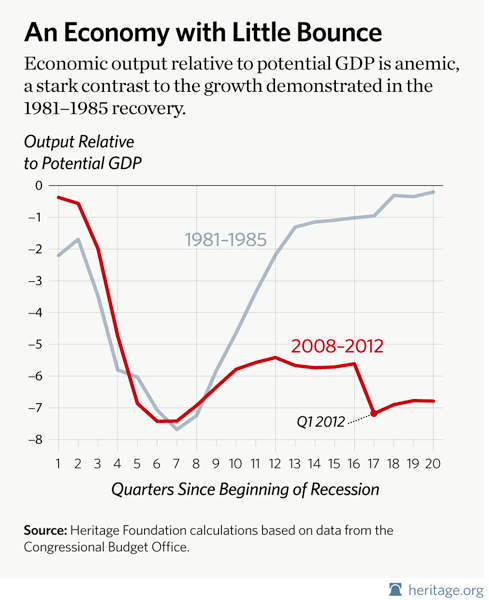
What should the economy’s recovery look like? Take a glance at history (and the chart below). Following the 1981-1982 recession — which looked a lot like the one America saw in 2008 in both depth and duration — the economy returned to near-full employment (which is around 5.5 percent) by 1984. Today, nearly three years after the most recent recession ended, the unemployment rate remains stuck well above 8 percent. So while the economy has grown for 10 straight quarters, it’s only done so at a measly 2.4 percent rate. In fact, it’s the slowest recovery America has seen in the post-war era. No wonder millions of Americans aren’t feeling the effects of the economic rebound and are voting their displeasure. (Article continued below chart.)

Even liberal economist / columnist Paul Krugman sees the economy for what it is. In a recent column in The New York Times, he wrote, “our economy remains deeply depressed” and that “every silver lining comes with a cloud.” So what’s bringing about that cloud? Why is this economy growing, and yet growing so slowly by comparison to the 1980s recovery?

While President Obama might like to take credit for the meager growth the economy is seeing, there’s an important fact to keep in mind. It’s the natural tendency for the economy to grow — and taking credit for its meager improvement is sort of like accepting kudos for the rising and setting of the sun. In fact, the President should of course (but never will) accept some blame for the fact that the economy isn’t growing faster. The policies Obama ushered in are markedly different from those that President Ronald Reagan adopted to unleash the economic recovery in the 1980s, and the results show the difference — a powerful recovery under Reagan, and weak recovery under Obama.

For starters, President Obama says he wants to encourage job creators to ramp up their economic engines, while at the same time he has proposed $2 trillion in higher taxes, much of which would fall on small businesses — the job creators. Add onto that a discouragingly successful policy of encouraging higher gas prices by opposing domestic energy production. This policy is so unpopular that eleven Democratic Senators voted with their Republican colleagues on Thursday to overturn the Obama decision to kill the Keystone XL pipeline. Proponents failed to get the 60 votes necessary to overturn the Keystone decision, but with Democratic support it came very close. Instead of tapping proven resources, Obama puts his faith in pie-in-the-sky renewable energy projects like Solyndra. No wonder Super Tuesday’s voters were worried about the economy.

On top of job-killing tax hikes and higher gas prices, President Obama continues to embrace the burden of untenably high spending and debt — which will of course motivate the left to call for even higher taxes — and you’re left with a mess of policies emanating from Washington signaling small businesses to hunker down instead of investing for the future. A better path for growth would be to enact a budget that curbs spending, reforms entitlements, and reforms the tax code to focus it on economic growth as proposed in Heritage’s Saving the American Dream plan — all of which would free the economy to grow at a faster rate than we’re witnessing today.

While any economic growth and job creation is welcome, a barely perceptible, incremental recovery doesn’t offer much hope for those Americans who can’t feel, see, or touch the fruits of recovery. Millions remain unemployed in the Obama economy, and Washington can and should do better for the American people.

Milton Friedman: Jewish tradition is so akin to capitalism but many Jews are socialists, what a paradox (Part 3)

Milton Friedman on the American Economy (5 of 6)

Uploaded by on Aug 9, 2009

THE OPEN MIND
Host: Richard D. Heffner
Guest: Milton Friedman
Title: A Nobel Laureate on the American Economy VTR: 5/31/77

__________________

Below is a part of the series on an article by Milton Friedman called “Capitalism and the Jews” published in 1972. 

Capitalism and the Jews

October 1988 • Volume: 38 • Issue: 10 • Print This Post • 11 comments

Milton Friedman, recipient of the 1976 Nobel Memorial Prize in Economic Science, is a Senior Research Fellow at the Hoover Institution. This article is reprinted with the permission of Encounter and The Fraser Institute.

“Capitalism and the Jews” was originally presented as a lecture before the Mont Pelerin Society in 1972. It subsequently was published in England and Canada and appears here without significant revision.

The Jews as an Example of the Paradox 

My aim here is not to give a ready answer—for I have none. My aim is rather to examine a particular case of paradox–the attitude of Jews toward capitalism. Two propositions can be readily demonstrated: first, the Jews owe an enormous debt to free enterprise and competitive capitalism; second, for at least the past century the Jews have been consistently opposed to capitalism and have done much on an ideological level to undermine it. How can these propositions be reconciled?

I was led to examine this paradox partly for obvious personal reasons. Some of us are accustomed to being members of an intellectual minority, to being accused by fellow intellectuals of being reactionaries or apologists or just plain nuts. But those of us who are also Jewish are even more embattled, being regarded not only as intellectual deviants but also as traitors to a supposed cultural and national tradition. 

This personal interest was reinforced by the hope that study of this special case might offer a clue to the general paradox—typified by West Germany where Jews play a minor role. Unfortunately, that hope has not been fulfilled. I believe that I can explain to a very large extent the anti-capitalist tendency among Jews, but the most important elements of the explanation are peculiar to the special case and cannot readily be generalized. I trust that others will be more successful. 

II. The Benefit Jews Have Derived from Capitalism 

An Anecdote and Some History 

Let me start by briefly documenting the first proposition: that the Jews owe an enormous debt to capitalism. The feature of capitalism that has benefited the Jews has, of course, been competition.[1] Wherever there is a monopoly, whether it be private or governmental, there is room for the application of arbitrary criteria in the selection of the beneficiaries of the monopoly—whether these criteria be color of skin, religion, national origin or what not. Where there is free competition, only performance counts. The market is color blind. No one who goes to the market to buy bread knows or cares whether the wheat was grown by a Jew, Catholic, Protestant, Muslim, or atheist; by whites or blacks. Any miller who wishes to express his personal prejudices by buying only from preferred groups is at a competitive disadvantage, since he is keeping himself from buying from the cheapest source. He can express his prejudice, but he will have to do so at his own expense, accepting a lower monetary income than he could otherwise earn. 

A recent personal experience illuminates sharply the importance of competition. Some years ago, I attended an International Monetary Conference held in Montreal. The persons there consisted, on the one hand, of members of the Conference, who include the two top executives of the major commercial banks throughout the world; on the other, of persons like myself invited as speakers or participants in panel discussions. A conversation with an American banker present who recounted a tale of anti-Semitism in American banking led me to estimate roughly the fraction of the two groups who were Jewish. Of the first group—the bankers proper—I estimated that about 1 per cent were Jewish. Of the much smaller second group, the invited participants in the program, roughly 25 per cent were Jewish.

Why the difference? Because banking today is everywhere monopolistic in the sense that there is no free entry. Government permission or a franchise is required. On the other hand, intellectual activity of the kind that would recommend persons for the program is a highly competitive industry with almost completely free entry. 

This example is particularly striking because banking is hardly a field, like, say, iron and steel, in which Jews have never played an important role. On the contrary, for centuries Jews were a major if not dominant element in banking and particularly in international banking. But when that was true, banking was an industry with rather free entry. Jews prospered in it for that reason and also because they had a comparative advantage arising from the Church’s views on usury, the dispersion of Jews throughout the world, and their usefulness to ruling monarchs precisely because of the isolation of the Jews from the rest of the community.[2] 

This anecdote illuminates much history. Throughout the nearly two thousand years of the Diaspora, Jews were repeatedly discriminated against, restricted in the activities they could undertake, on occasion expelled en masse, as in 1492 from Spain, and often the object of the extreme hostility of the peoples among whom they lived. They were able nonetheless to exist because of the absence of a totalitarian state, so that there were always some market elements, some activities open to them to enter. In particular, the fragmented political structure and the numerous separate sovereignties meant that international trade and finance in particular escaped close control, which is why Jews were so prominent in this area. It is no accident that Nazi Germany and Soviet Russia, the two most totalitarian societies in the past two thousand years (modern China perhaps excepted), also offer the most extreme examples of official and effective anti-Semitism. 

If we come to more recent time, Jews have flourished most in those countries in which competitive capitalism had the greatest scope: Holland in the sixteenth and seventeenth centuries, and Britain and the U.S. in the nineteenth and twentieth centuries, Germany in the late nineteenth and early twentieth century—a case that is particularly pertinent when that period is compared with the Hitler period.[3]

1.   The only other writer I have come across who explicitly stresses the benefits Jews have derived from capitalism is Ellis Rivkin, The Shaping of Jewish History (New York: Scribner’s, 1971). Unfortunately, Rivkin’s interesting analysis is marred by misconceptions about the nature and operation of capitalism. He takes the accumulation of capital rather than free entry as its distinguishing feature.

2.   See for example Hannah Arendt, The Origins of Totalitarianism (New York: Harcourt, Brace & Co., 1951), on “court Jews,” also Werner Sombart, The Jews and Modern Capitalism (London: T.Fisher Unwin, 1913) [translated from 1911 German original].

3.   Sombart argues that the relation is the reverse: that capitalism flourished where it did because Jews were given a considerable measure of freedom. But he would not have denied that the relation is reciprocal. And his version has been seriously questioned by economic historians. See Introduction by Bert F. Hoselitz to the American edition of Sombart’s book, Jewish Contributions to Civilization, 1919, chapter viia, pp. 247-267.