Taxed too much polls say

Sen. Paul Delivers State of the Union Response – Jan. 24, 2012

Uploaded by on Jan 24, 2012

Sen. Rand Paul delivered the following Republican response to President Barack Obama’s State of the Union Address this evening

The problem is not that government does not have enough money but that spends too much. What would the Founding Fathers think if they were alive today?

Mike Brownfield

March 9, 2012 at 1:00 pm

More bad news for those who want to raise taxes in order to pay for another boatload of government spending: The vast majority of Americans say that the country is taxed enough already.

According to a new Rasmussen poll, 56% of likely U.S. voters believe America is overtaxed. Those numbers follow a poll last week that shows that the vast majority of likely voters want individuals and businesses to pay lower rates.

Of course, to hear liberals tell the story, you’d think Americans are clamoring for paying even more money to Uncle Sam. Meanwhile, the President is looking to higher taxes as a way of tackling America’s debt crisis. Last summer, he traveled America campaigning for higher taxes as part of Congress’ debt deal, saying “We can’t just cut our way out of this hole.” And in his FY 2013 budget released last month, the President’s tax hike proposal topped out at a whopping $2 trillion.

More taxes are part and parcel with the President’s plans to expand the size and scope of government — more spending for infrastructure, Obamacare, and green energy boondoggles, among them — paired up with a refusal to undertake serious, much-needed reforms for entitlement programs.

With the debt threat and the calls for more taxes, it’s no wonder the economy is stuck in a pattern of slow-motion growth. Businesses are sitting on the side, not knowing what taxes, fees, and regulations the future will hold. Meanwhile, the American people are saying “enough is enough” — it’s time to lower the tax burden.

HERITAGE FOUNDATION VIDEO:1,000 Days Without A Budget

1,000 Days Without A Budget

Uploaded by on Jan 24, 2012

http://blog.heritage.org | Today marks the 1,000th day since the United States Senate has passed a budget. While the House has put forth (and passed) its own budget, the Senate has failed to do the same. To help illustrate how extraordinary this failure has been, our new video highlights a few of impressive feats in history that have been accomplished in less time.

Ryan’s plan better than Democrat’s plan but not as good as Rand Paul’s

Promote Federalism and Replicate the Success of Welfare Reform with Medicaid Block Grants

Uploaded by on Jun 26, 2011

The Medicaid program imposes high costs while generating poor results. This Center for Freedom and Prosperity Foundation video explains how block grants, such as the one proposed by Congressman Paul Ryan, will save money and improve healthcare by giving states the freedom to innovate and compete

__________

President Obama thinks the answer to our budget problem is to raise taxes. I disagree and think that we must restrain spending and reform entitlements.

Below is an article by Dan Mitchell of the Cato Institute on the Ryan plan.

The Chairman of the House Budget Committee has produced a new budget plan which contrasts very favorably with the tax-heavy, big-spending proposal submitted by the President last month.

Perhaps most important, Congressman Ryan’s plan restrains spending growth, allowing the private sector to grow faster than the burden of government, thus satisfying Mitchell’s Golden Rule so that spending falls as a share of GDP.

The most important detail in the proposal is that the federal budget, which currently consumes 24 percent of GDP, would fall to less than 20 percent of GDP beginning in 2016.

That’s the good news. There are three pieces of not-so-good news.

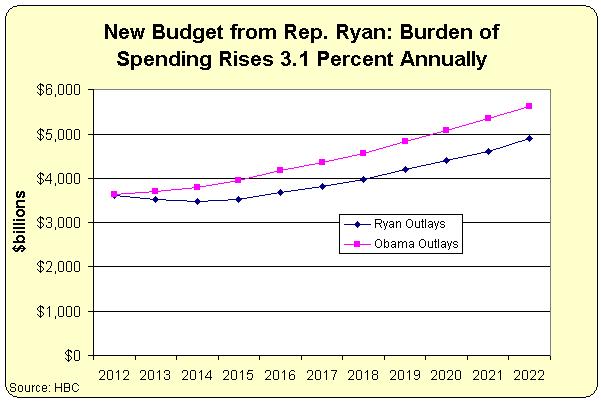
1. Ryan’s plan allows spending to grow by an average of 3.1 percent annually over the next 10 years, with is faster than the 2.8 percent average annual growth in last year’s budget.

2. His proposed Medicare reform, while far better than current law, also is not as good as what was proposed last year.

3. The federal budget would still consume a greater share of the economy’s output than it did when Bill Clinton left office.

I suppose it’s also worth mentioning that Ryan’s proposal isn’t as good as Rand Paul’s budget. Spending only climbs 2.2 percent yearly under the plan put together by the Kentucky Senator, and he also abolishes several useless cabinet-level departments.

But the very good shouldn’t be the enemy of the good. As noted already, Congressman Ryan’s plan meets the most important test, which is restraining spending so that the federal budget grows slower than the private economy. And, as the chart shows, he obviously imposes more fiscal restrain then President Obama.

Regular readers know that I generally show no mercy to jelly-spined Republicans, but I praised GOPers for approving last year’s Ryan budget. The same will be true if they approve this year’s version.

P.S. I am frustrated and nauseated by all the people who are fixating on whether Congressman Ryan’s plan balances the budget in 10 years, 20 years, or whenever. What matters is shrinking the burden of government. I hereby bestow the Bob Dole Award on all the people who are mistakenly focusing on the symptom of red ink rather than the underlying disease of bloated government.

P.P.S. I’m happy to report that there is no value-added tax in the revenue portion of Congressman Ryan’s budget. There is a VAT in his Roadmap plan, and I endlessly worry that this poison pill will re-emerge and ruin other good fiscal plans put forth by the Wisconsin lawmaker.

_______

Saving Medicare: Free Market Reforms Are Better than Bureaucratic Rationing

Uploaded by on May 17, 2011

This Center for Freedom and Prosperity Foundation video explains how a “premium-support” plan would solve Medicare’s fiscal crisis and improve the overall healthcare system. This voucher-based system also would protect seniors from bureaucratic rationing. http://www.freedomandprosperity.org


Dan Mitchell of the Cato Institute (Question and Answer Session)

Question and Answer Session: The Fight Against Big Government

Uploaded by on Oct 7, 2009

In the Q&A session following his speech at the Steamboat Institute conference, Dan Mitchell comments on the financial crisis, so-called stimulus, the rule of law, and tax competition and U.S. competitiveness. Steamboat Springs, Colorado, August 28, 2009. www.freedomandprosperity.org

Calipari’s been to 4 final fours and his record is 1-3 so far

> Kentucky Wildcats head coach John Calipari celebrated with the team after the University of Kentucky defeated Baylor University in the NCAA South Regional final played in the Georgia Dome in Atlanta, Ga., Sunday, March 25, 2012. This is second half action. UK won 82-70. Charles Bertram | Staff HERALD-LEADER Buy Photo

Calipari is going back to the Final Four!!!!!

Here is a look back at Calipari’s final fours:

1996 with UMass


Memphis over UCLA at final four 2008

Kansas over Memphis at final four finals 2008

Kentucky at final four 2011 against UConn

HERITAGE FOUNDATION INTERVIEW:Senator Blunt Vows to Keep Pressure on President Obama Over Contraceptive Mandate

Senator Blunt Vows to Keep Pressure on President Obama Over Contraceptive Mandate

Uploaded by on Feb 13, 2012

http://blog.heritage.org/2012/02/13/sen-blunt-vows-to-keep-pressure-on-obama-… | Sen. Roy Blunt (R-MO) introduced legislation to protect religious organizations from Obamacare’s overreach last summer. Now, as President Obama presses forward with his anti-conscience mandate, Blunt is prepared to keep the pressure on the White House.

“We want to be sure we’ve established the principle here that the Constitution establishes — that President Washington understood and President Jefferson understood, and my guess is, every president between them and right now understood — and that is respect for conscience is respect for religious freedom,” Blunt said.

SEC gets one in final four: Kentucky

We came close to get two in but only Kentucky got in.

Calipari’s wife and son can be seen in this picture below:
 
 
> Kentucky Wildcats head coach John Calipari hugged his son, Bradley, and his wife Ellen after the University of Kentucky defeated Baylor University in the NCAA South Regional final played in the Georgia Dome in Atlanta, Ga., Sunday, March 25, 2012. This is second half action. UK won 82-70. Charles Bertram | Staff HERALD-LEADER
> Kentucky Wildcats head coach John Calipari hugged his wife Ellen Calipari after the University of Kentucky defeated Baylor University in the NCAA South Regional final played in the Georgia Dome in Atlanta, Ga., Sunday, March 25, 2012. This is second half action. UK won 82-70. Charles Bertram | Staff HERALD-LEADER

> Kentucky Wildcats head coach John Calipari looked in on Anthony Davis after be went down in a collision as #1 Kentucky defeated Baylor 82-70 in the Elite 8 on Sunday March 25, 2012 in Atlanta, GA. Photo by Mark Cornelison | Staff HERALD-LEADER

> Kentucky Wildcats head coach John Calipari unhappy with a call as #1 Kentucky defeated Baylor 82-70 in the Elite 8 on Sunday March 25, 2012 in Atlanta, GA. Photo by Mark Cornelison | Staff HERALD-LEADER Buy Photo

> Kentucky Wildcats head coach John Calipari celebrated with the team after the University of Kentucky defeated Baylor University in the NCAA South Regional final played in the Georgia Dome in Atlanta, Ga., Sunday, March 25, 2012. This is second half action. UK won 82-70. Charles Bertram | Staff HERALD-LEADER Buy Photo

HERITAGE FOUNDATION INTERVIEW:Senator Lee Fights Back Against Obama’s Unconstitutional “Recess” Appointments

Senator Lee Fights Back Against Obama’s Unconstitutional “Recess” Appointments

Uploaded by on Feb 13, 2012

Few lawmakers have expressed as much outrage over President Obama’s unconstitutional “recess” appointments as Sen. Mike Lee (R-UT). He was among the first to warn about the consequences of the president’s unilateral action on Jan. 4.

More than a month later, a new director is running the Consumer Financial Protection Bureau and three members of National Labor Relations Board are conducting business—all in blatant violation of the U.S. Constitution, Lee said in an interview with The Heritage Foundation.

Senator Pryor asks for Spending Cut Suggestions! Here are a few!(Part 140)

Senator Mark Pryor wants our ideas on how to cut federal spending. Take a look at this video clip below:

Senator Pryor has asked us to send our ideas to him at cutspending@pryor.senate.gov and I have done so in the past and will continue to do so in the future.

On May 11, 2011,  I emailed to this above address and I got this email back from Senator Pryor’s office:

Please note, this is not a monitored email account. Due to the sheer volume of correspondence I receive, I ask that constituents please contact me via my website with any responses or additional concerns. If you would like a specific reply to your message, please visit http://pryor.senate.gov/contact. This system ensures that I will continue to keep Arkansas First by allowing me to better organize the thousands of emails I get from Arkansans each week and ensuring that I have all the information I need to respond to your particular communication in timely manner.  I appreciate you writing. I always welcome your input and suggestions. Please do not hesitate to contact me on any issue of concern to you in the future.

Here are a few more I just emailed to him myself:

GUIDELINE #7: Consolidate duplicative and contradictory programs.
Government’s layering of new programs on top of old ones inherently creates duplication. Having several agencies perform similar duties is wasteful and confuses program beneficiaries who must navigate each program’s distinct rules and requirements.
Some overlap is inevitable because some agencies are defined by whom they serve (e.g., veterans, Native Americans, urbanites, and rural families), while others are defined by what they provide (e.g., housing, education, health care, and economic development). When these agencies’ constituencies overlap, as in veterans housing or rural economic development, each relevant agency will often have its own program. With 342 separate economic development programs, the federal government needs to make consolidation a priority

This is how bad it is getting:

  • From 1989 through 2008, annual budget deficits averaged $210 billion (adjusted for inflation).
  • President Bush handed President Obama a $1.2 trillion deficit for 2009. Obama added more than $200 billion to it.
  • President Bush’s budget deficits averaged $447 billion. President Obama’s budget shows average deficits of $851 billion over the eight years he would serve if he wins a second term.
  • President Obama’s budget would double the publicly held national debt by 2020.

HERITAGE FOUNDATION INTERVIEW:Senator John Barrasso On the Fight Against Obamacare

Senator John Barrasso On the Fight Against Obamacare

Uploaded by on Mar 26, 2012

Sen. John Barrasso earned the nickname “Wyoming’s Doctor” after working for 24 years as an orthopedic surgeon in Casper. Today he represents the state in the U.S. Senate and is one of the leading critics of Obamacare.

More than two decades with patients gave Barrasso a firsthand glimpse of government’s involvement in medicine — at that was before President Obama signed his unpopular health care law in 2009. Last week Barrasso visited Heritage to share his concerns about the doctor-patient relationship and other side effects of Obamacare.