David Barton: America’s Religious Heritage as demonstrated in Presidential Inaugurations (part 1)

David Barton on Glenn Beck – Part 1 of 5

Uploaded by  on Apr 9, 2010

Wallbuilders’ Founder and President David Barton joins Glenn Beck on the Fox News Channel for the full hour to discuss our Godly heritage and how faith was the foundational principle upon which America was built.

___________

There have been many articles written by evangelicals like me who fear that our founding fathers would not recognize our country today because secular humanism has rid our nation of spiritual roots.

Lillian Kwon noted in her article, “Christianity losing out to Secular Humanism?” :

America once stood on the foundation of God’s Word. But that foundation is crumbling – even in the church – and being replaced by man’s word, observed one Christian apologist.

“Whatever we (America) once were, we are no longer. We have changed,” said Ken Ham, president of Answers in Genesis, in his second State of the Nation address on Tuesday.

The Young Earth creationist was citing President Obama’s well-known mantra that America is no longer just a Christian nation as he delivered an hour-long speech outlining where America and Christianity stand today – just weeks after Obama’s State of the Union address.

He sees Christianity being thrown out of the public sector and mocked and generations of Americans building their worldview on secular humanism.

“Most of the founding fathers of this nation … built the worldview of this nation on the authority of the Word of God,” he said. “Because of that, there have been reminders in this culture concerning God’s Word, the God of creation.”

David Barton did a great job with this article America’s Religious Heritage As Demonstrated in Presidential Inaugurations :

David Barton – 01/2009
America’s Religious Heritage

As Demonstrated in Presidential Inaugurations

Religious activities at presidential inaugurations have become the target of criticism in recent years, 1 with legal challenges being filed to halt activities as simple as inaugural prayers and the use of “so help me God” in the presidential oath. 2 These critics – evidently based on a deficient education – wrongly believe that the official governmental arena is to be aggressively secular and religion-free. The history of inaugurations provides some of the most authoritative proof of the fallacy of these modern arguments.

In fact, since America’s first inauguration in 1789 included seven distinct religious activities, that original inauguration is worthy of review. Every inauguration since 1789 has included numerous of those activities.

The First Inauguration

Constitutional experts abounded at America’s first inauguration. Not only was the first inauguree (George Washington) a signer of the Constitution but numerous drafters of the Constitution were serving in the Congress that organized and directed that first inauguration. In fact, just under one fourth of the members of the first Congress had been delegates to the Convention that wrote the Constitution. 3 Furthermore, the identical Congress that directed and oversaw these inaugural activities also penned the First Amendment. Having therefore produced both the Constitution and all of its clauses on religion, they clearly knew what types of religious activities were and were not constitutional. Clearly, then, the religious activities that occurred at the first inauguration may well be said to have the approval and imprimatur of the greatest collection of constitutional experts America has ever known. Therefore, a review of the religious activities acceptable in that first inauguration will provide guidance for citizens in general and critics in particular.

The first inauguration occurred in New York City. (New York City served as the nation’s capital for the first year of the new federal government; for the next ten, Philadelphia was the capital city; in 1800, the federal government moved to Washington, D. C. for its permanent home). George Washington had been at home at Mt. Vernon when Charles Thomson, Secretary of the Continental Congress, notified him that he had been unanimously elected as the nation’s first president.

On receiving this news, Washington departed from Mt. Vernon and began his trek toward New York City, stopping first at Fredericksburg, Virginia, to visit his mother, Mary¬ – the last time the two would see each other. Mary was eighty-two and suffering from incurable breast cancer. Mary parted with her son, giving him her blessings and offering him her prayers, telling him: “You will see me no more; my great age and the disease which is rapidly approaching my vitals, warn me that I shall not be long in this world. Go, George; fulfill the high destinies which Heaven appears to assign to you; go, my son, and may that Heaven’s and your mother’s blessing be with you always.” 4Washington did go, and he did indeed fulfill the high destinies assigned him by Heaven. A moving painting was made of her giving him her final charge; his mother passed away a few months after that final meeting.

Leaving his mother, Washington continued northward toward New York City. In town after town along the way, special dinners and celebrations were held – including in Alexandria, Georgetown, Baltimore, Philadelphia, Trenton, and other locations. Finally reaching Elizabethtown, New Jersey, Washington boarded a barge that carried him the rest of the way, where another celebration awaited him upon entering New York Harbor.

On April 30th, 1789, George Washington was to be inaugurated on the balcony outside Federal Hall. (Federal Hall was originally named Old Hall, but New York City – in an effort to convince the new federal government that the City was serious about becoming the national capital – remodeled the structure, renaming it Federal Hall. The House and Senate met in two chambers inside that Hall, and the inauguration took place on the remodeled building’s balcony.) Incidentally, religious activities had been planned to precede the inauguration, with the people of New York City being called to a time of prayer. The papers in the Capital City reported on that scheduled activity:

[O]n the morning of the day on which our illustrious President will be invested with his office, the bells will ring at nine o’clock, when the people may go up to the house of God and in a solemn manner commit the new government, with its important train of consequences, to the holy protection and blessing of the Most high. An early hour is prudently fixed for this peculiar act of devotion and . . . is designed wholly for prayer. 5

The preparations for the inauguration had been extensive; everything had been well planned; the event seemed to be proceeding smoothly. The parade carrying Washington by horse-drawn carriage to the swearing-in was nearing Federal Hall when it was realized that no Bible had been obtained for administering the oath. Parade Marshal Jacob Morton hurried to the nearby Masonic Lodge and grabbed its large 1767 King James Bible.

The Bible was laid upon a crimson velvet cushion (held by Samuel Otis, Secretary of the Senate) and, with a huge crowd gathered below watching the ceremony on the balcony, New York Chancellor Robert Livingston was to administer the oath of office. (Robert Livingston had been one of the five Founders who had drafted the Declaration of Independence; however, he was called back to New York to help his State through the Revolution before he could affix his signature to the very document he had helped write. As Chancellor, Livingston was the highest ranking judicial official in New York.) Beside Livingston and Washington stood several distinguished officials, including Vice President John Adams, original Supreme Court Chief Justice John Jay, Generals Henry Knox and Philip Schuyler, and a number of others. The Bible was opened at random to the latter part of Genesis; Washington placed his left hand upon the open Bible, raised his right, and then took the oath of office prescribed by the Constitution. Washington then bent over and kissed the Bible, reverently closed his eyes, and said, “So help me God!” Chancellor Livingston then proclaimed, “It is done!” Turning to the crowd assembled below, he shouted, “Long live George Washington – the first President of the United States!” That shout was echoed and re-echoed by the crowd below.

Critics today claim that George Washington never added “So help me God!” to his oath 6 – that associating religious intent with the oath is of recent origins. After all, the presidential oath of office as prescribed in Article II of the Constitution simply states:

I do solemnly swear (or affirm) that I will faithfully execute the office of President of the United States, and will to the best of my ability, preserve, protect and defend the Constitution of the United States.

But overlooked by many today is the fact that the Framers of our government considered an oath to be inherently religious – something George Washington affirmed when he appended the phrase “So help me God” to the end of the oath. In fact, it was universally acknowledged by every American legal scholar of that day that any legally-binding oath was overtly religious in nature. As signer of the Declaration John Witherspoon succinctly explained:

An oath is an appeal to God, the Searcher of Hearts, for the truth of what we say and always expresses or supposes an imprecation [a calling down] of His judgment upon us if we prevaricate [lie]. An oath, therefore, implies a belief in God and His Providence and indeed is an act of worship. . . . Persons entering on public offices are also often obliged to make oath that they will faithfully execute their trust. . . . In vows, there is no party but God and the person himself who makes the vow. 7  

1. A number of legal authorities, university professors, and news writers have criticized inaugural religious activities. See, for example, Alan M. Dershowitz, “Bush Starts Off by Defying the Constitution,” Los Angeles Times, Wednesday, January 24, 2001 Metro section, Part B, p. 9; Larry Judkins, Religion Page Editor, Sacramento Valley Mirror, “Dershowitz Piece Misleading: All Presidents Flaunt Constitution,” in Positive Atheism Magazine, Thursday, January 25, 2001 (at: http://www.positiveatheism.org); “President Bush Announces Religious Agenda on Inauguration Day,” Americans United for Separation of Church and State, January 20, 2001 (at:http://www.au.org/site/News2?abbr=pr&page=NewsArticle&id=6095); et. Al.(Return)

2. Noted atheist Michael Newdow filed suit in federal court to have prayers barred from the Presidential Inauguration of 2001, 2005, and in 2009 to have inaugural prayers halted and to prevent the Chief-Justice of the U. S. Supreme Court from saying “So help me God” when administering the oath of office to the president. (Return)

3. Significantly, many of the U. S. Senators at the first Inauguration had been delegates to the Constitutional Convention that framed the Constitution including William Samuel Johnson, Oliver Ellsworth, George Read, Richard Bassett, William Few, Caleb Strong, John Langdon, William Paterson, Robert Morris, and Pierce Butler; and many members of the House had been delegates to the Constitutional Convention, including Roger Sherman, Abraham Baldwin, Daniel Carroll, Elbridge Gerry, Nicholas Gilman, Hugh Williamson, George Clymer, Thomas Fitzsimmons, and James Madison.(Return)

4. Benson J. Lossing, Our Country: A Household History for All Readers (New York: Henry J. Johnson, 1877), Vol. IV, p. 1121. (Return)

5. The Daily Advertiser, New York, Thursday, April 23, 1789, p. 2. (Return)

6. See, for example, Newdow v. Roberts, complaint filed by Newdow on December 29, 2008, pp. 20-21, par. 103-104 of the complaint. See also Cathy Lynn Grossman, “No proof Washington said ‘so help me God’ – will Obama,”USA Today, January 9, 2009 (at:http://www.usatoday.com/news/religion/2009-01-07-washington-oath_N.htm). (Return)

7. John Witherspoon, The Works of John Witherspoon (Edinburgh: J. Ogle, 1815), Vol. VII, pp. 139-140, 142, from his “Lectures on Moral Philosophy,” Lecture 16 on Oaths and Vows. (Return)

President Obama biggest spender of all time?

Federal Spending by the Numbers
I wondered how much debt has been run up during the last 3 years. The democrats downplay our debt problem and maybe the republicans have been making it sound worse than it is. What is the real truth? Is the current adminstration running up our national debt faster than any previous administration?
 
 
Posted: April 15, 2012 – 12:25am  

By Carole Fader jacksonville.com April 15, 2012 – 12:25am

Fact Check: President Obama ‘undisputed debt king’ of last 5 presidents

Times-Union readers want to know:

Is it true that the national debt has increased more under President Barack Obama than all the previous 43 presidents combined?

Sarah Palin told this to Fox News last year and it has been repeated in viral emails since.

It wasn’t true when she said it in May 2011 and it still isn’t true today. But partisan comments about the debt are nothing new and, according to fact-finding organizations, there’s been a lot of “sugarcoating” going on by both parties.

House Democratic leader Nancy Pelosi, for example, said on her website in early May 2011 that the debt had increased only 16 percent since Obama took office. That number was bandied about for a while by Democrats but, despite being corrected later, it is still being used in various postings and emails.

On a Flickr page, Pelosi had listed the following debt-increase numbers for these presidents: Ronald Reagan, up 189 percent; George H.W. Bush, up 55 percent; Bill Clinton, up 37 percent; George W. Bush, up 115 percent; Obama, up 16 percent.

PolitiFact.com, a Pulitzer Prize-winning fact-finding project of the Tampa Bay Times, took a hard look at the chart and found that Obama’s number was based on him taking office on Jan. 20, 2010, a year later than his actual inauguration date.

Using the real time frame, PolitiFact.com found that as of May 2011, George W. Bush had an increase of $4.899 trillion, or 86 percent, not 115 percent, and debt under Obama had risen $3.661 trillion, or 34 percent — not 16 percent. Numbers for the elder Bush, Reagan and Clinton were essentially correct.

When pointed out by PolitiFact.com, Pelosi’s office acknowledged the calculation error and changed the information.

PolitiFact.com also went one step farther. It looked at the debt as a percentage of the gross domestic product because this factors out complications such as economic cycles and inflation. Using Office of Management and Budget statistics, here’s what PolitiFact found:

Reagan, up 14.9 percentage points; George H.W. Bush, up 7.1 percentage points; Clinton, down 13.4 percentage points; George W. Bush, up 5.6 percentage points; Obama, up 21.9 percentage points.

PolitiFact.com reported: “So by this measurement — potentially a more important one — Obama is the undisputed debt king of the last five presidents, rather than the guy who added a piddling amount to the debt, as Pelosi’s chart suggested.”

It also depends on what kind of debt you look at: public debt, which is debt held by the public, or gross federal debt, which combines that debt plus debt held by the government itself. The Washington Post also pointed out other ways to look at presidential debt in an article at tinyurl.com/79erqx7.

Another way of checking out the national debt is at the Treasury Department’s “debt to the penny” website at tinyurl.com/djlqmw.

That database shows that Palin’s statement about Obama’s debt increase surpassing all previous presidents combined is not factual. The nation’s total debt was $10.626 trillion on the day Obama took office and, as of Thursday, it had increased to $15.614 trillion — a rise of $4.988 trillion.

Actually, Obama’s debt-increase number overtook that of George W. Bush — which rose from $5.727 trillion to $10.626, or $4.899 trillion — last month.

So, yes, the debt increase has risen more during Obama’s almost three years and three months in office than it did during eight years of Bush’s presidency — but obviously not more than all presidents combined.

carole.fader@jacksonville.com, (904) 359-4635

How can the Federal Reserve buy trillions dollars of our national debt without any money?

Uploaded by on Jan 4, 2008

Thousands of media outlets descended on Iowa, erecting a powerful wall of TV cameras and reporters between the voters and candidates. Bill Moyers talks with Ron Paul who knows well the power of the press to set expectations and transform the agenda.

____________________________

We should not be running up our debt and I thought we would have to stop running up our debt if countries like China decided to stop buying most of our treasury bonds, but when that happened then the Federal Reserve stepped in.

I don’t understand how the Federal Reserve can buy trillion of dollars of our national debt but they don’t have any money in the budget to do so?

This article below does offer  a  few ideas on this.  Ron Paul’s Surprisingly Lucid Solution to the Debt Ceiling Impasse

 Representative Ron Paul has hit upon a remarkably creative way to deal with the impasse over the debt ceiling: have the Federal Reserve Board destroy the $1.6 trillion in government bonds it now holds. While at first blush this idea may seem crazy, on more careful thought it is actually a very reasonable way to deal with the crisis. Furthermore, it provides a way to have lasting savings to the budget.

The basic story is that the Fed has bought roughly $1.6 trillion in government bonds through its various quantitative easing programs over the last two and a half years. This money is part of the $14.3 trillion debt that is subject to the debt ceiling. However, the Fed is an agency of the government. Its assets are in fact assets of the government. Each year, the Fed refunds the interest earned on its assets in excess of the money needed to cover its operating expenses. Last year the Fed refunded almost $80 billion to the Treasury. In this sense, the bonds held by the Fed are literally money that the government owes to itself.

Unlike the debt held by Social Security, the debt held by the Fed is not tied to any specific obligations. The bonds held by the Fed are assets of the Fed. It has no obligations that it must use these assets to meet. There is no one who loses their retirement income if the Fed doesn’t have its bonds. In fact, there is no direct loss of income to anyone associated with the Fed’s destruction of its bonds. This means that if Congress told the Fed to burn the bonds, it would in effect just be destroying a liability that the government had to itself, but it would still reduce the debt subject to the debt ceiling by $1.6 trillion. This would buy the country considerable breathing room before the debt ceiling had to be raised again. President Obama and the Republican congressional leadership could have close to two years to talk about potential spending cuts or tax increases. Maybe they could even talk a little about jobs.

In addition, there’s a second reason why Representative Paul’s plan is such a good idea. As it stands now, the Fed plans to sell off its bond holdings over the next few years. This means that the interest paid on these bonds would go to banks, corporations, pension funds, and individual investors who purchase them from the Fed. In this case, the interest payments would be a burden to the Treasury since the Fed would no longer be collecting (and refunding) the interest.

To be sure, there would be consequences to the Fed destroying these bonds. The Fed had planned to sell off the bonds to absorb reserves that it had pumped into the banking system when it originally purchased the bonds. These reserves can be created by the Fed when it has need to do so, as was the case with the quantitative easing policy. Creating reserves is in effect a way of “printing money.” During a period of high unemployment, this can boost the economy with little fear of inflation, since there are many unemployed workers and excess capacity to keep downward pressure on wages and prices. However, at some point the economy will presumably recover and inflation will be a risk. This is why the Fed intends to sell off its bonds in future years. Doing so would reduce the reserves of the banking system, thereby limiting lending and preventing inflation. If the Fed doesn’t have the bonds, however, then it can’t sell them off to soak up reserves.

But as it turns out, there are other mechanisms for restricting lending, most obviously raising the reserve requirements for banks. If banks are forced to keep a larger share of their deposits on reserve (rather than lend them out), it has the same effect as reducing the amount of reserves. To take a simple arithmetic example, if the reserve requirement is 10 percent and banks have $1 trillion in reserves, the system will support the same amount of lending as when the reserve requirement is 20 percent and the banks have $2 trillion in reserves. In principle, the Fed can reach any target for lending limits by raising reserve requirements rather than reducing reserves.

As a practical matter, the Fed has rarely used changes in the reserve requirement as an instrument for adjusting the amount of lending in the system. Its main tool has been changing the amount of reserves in the system. However, these are not ordinary times. The Fed does not typically buy mortgage backed securities or long-term government bonds either. It has been doing both over the last two years precisely because this downturn is so extraordinary. And in extraordinary times, it is appropriate to take extraordinary measures—like the Fed destroying its $1.6 trillion in government bonds and using increases in reserve requirements to limit lending and prevent inflation.

In short, Representative Paul has produced a very creative plan that has two enormously helpful outcomes. The first one is that the destruction of the Fed’s $1.6 trillion in bond holdings immediately gives us plenty of borrowing capacity under the current debt ceiling. The second benefit is that it will substantially reduce the government’s interest burden over the coming decades. This is a proposal that deserves serious consideration, even from people who may not like its source.

Dean Baker is the co-director of the Center for Economic and Policy Research. His most recent book is False Profits: Recovering from the Bubble Economy.


Obama’s stimulus was a failure like Dan Mitchell of the Cato Institute predicted

The stimulus was a huge failure and I hope everyone who voted for it will be defeated in their re-election attempts. Dan Mitchell of the Cato Institute predicted it would be a failure back in January of 2009!!!!

President Obama imposed a big-spending faux stimulus program on the economy back in 2009, claiming that the government needed to squander about $800 billion to keep the unemployment rate from rising above 8 percent.

How did that work out? One possible description is that the so-called stimulus became a festering pile of manure. About three years have passed, and the joblessness rate hasn’t dropped below 8 percent. But the White House has been sprinkling perfume on that pile of you-know-what and claiming that the Keynesian spending binge was good policy.

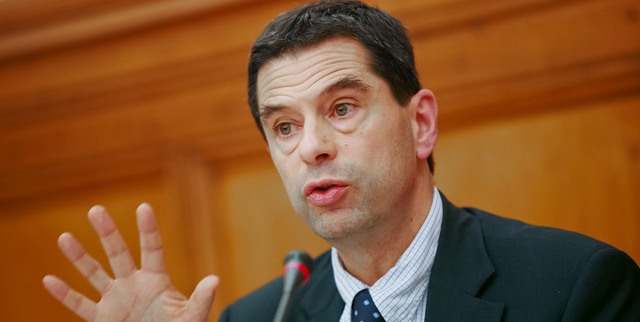
But not every politician is blindly ideological like Obama. Vitor Gaspar, Portugal’s Finance Minister, is willing to admit error. Here are some relevant excerpts from a New York Times report.

Unlike Obama, willing to admit mistakes

Mr. Gaspar, speaking to The New York Times last week, has a message for observers who say Europe needs to substantially relax its austerity approach: We tried stimulus and it backfired. Like some other European countries, Portugal tried what Mr. Gaspar called “a Keynesian style expansion” in 2008, referring to a theory by economist John Maynard Keynes. But it didn’t turn things around, and may have made things worse.

Why does the Portuguese Finance Minister have this view? Well, for the simple reason that the economy got worse and more spending put his country in a deeper fiscal ditch.

The yield on Portuguese government bonds – more than 11 percent on longer-term bonds — is substantially higher than the yields on debt issued by Ireland, Spain or Italy. …The main fear among investors is that Portugal is going to have to ask for a second bailout from the International Monetary Fund and the European Union, which committed $103 billion of financial aid in 2011.

Maybe the big spenders in Portugal should import some of the statist bureaucrats at Congressional Budget Office. The CBO folks could then regurgitate the moving-goalposts argument that they’ve used in the United States and claim that the economy would be even weaker if the government hadn’t wasted more money.

But perhaps the Portuguese left doesn’t think that will pass the laugh test.

Amazingly, the Germans, who have a disturbing affinity for powerful government, decided against Keynesianism and that’s paid dividends for their economy.

In any event, some of us can say we were right from the beginning about this issue.

_________________

Obama’s So-Called Stimulus: Good For Government, Bad For the Economy

Uploaded by on Jan 26, 2009

President Obama wants Congress to dramatically expand the burden of government spending. This CF&P Foundation mini-documentary explains why such a policy, based on the discredited Keynesian theory of economics, will not be successful. Indeed, the video demonstrates that Obama is proposing – for all intents and purposes – to repeat Bush’s mistakes. Government will be bigger, even though global evidence shows that nations with small governments are more prosperous.

_________________

Not that being right required any keen insight. Keynesian policies failed for Hoover and Roosevelt in the 1930s. So-called stimulus policies also failed for Japan in 1990s. And Keynesian proposals failed for Bush in 2001 and 2008.

Just in case any politicians are reading this post, I’ll make a point that normally goes without saying: Borrowing money from one group of people and giving it to another group of people does not increase prosperity.

But since politicians probably aren’t capable of dealing with a substantive argument, let’s keep it simple and offer three very insightful cartoons: here, here, and here.

In 2011 Social Security spent $45 billion more in benefits than it took in from its payroll tax

Uploaded by on Jun 21, 2011

Senator Kay Bailey Hutchison delivered remarks regarding her landmark proposal on entitlement reform, the Defend and Save Social Security Act at the Heritage Foundation’s “Saving Social Security” event. Sen. Hutchison announced that Senator Jon Kyl (R-AZ), member of Biden’s budget working group, has lent his support of her bill as the original cosponsor. At her press conference last week, Sen. Hutchison unveiled her Social Security proposal, and today she reiterated the urgency of putting Social Security on the table in the Biden budget group discussions. Sen. Hutchison sent a letter to Vice President Joe Biden last week urging him to incorporate Social Security reform in the ongoing deficit reduction debates that he is leading.

___________________

If you don’t think that Social Security is in trouble then just consider the fact that the first Baby Boomer just got their first Social Security check at age 65 in 2011 and now we have 19 more years of baby boomers retiring. Also in 2011 Social Security spent $45 billion more in benefits than it took in from its payroll tax.

Social Security Finances Significantly Worse, Says 2012 Trustees Report

By
April 23, 2012

“There are risks and costs to action. But they are far less than the long-range risks of comfortable inaction.”

—John F. Kennedy

“Lawmakers should not delay addressing the long-run financial challenges facing Social Security and Medicare,” the trustees wrote. “If they take action sooner rather than later, more options and more time will be available to phase in changes so that the public has adequate time to prepare.”

—2012 Social Security trustees report

Social Security’s finances significantly worsened last year, according to the new 2012 trustees report,[1] because of a weakened economy and structural problems with the program. The April 23 report shows that all people who receive Social Security benefits face about a 25 percent benefit cut as soon as 2033—three years earlier than predicted in last year’s report. The program’s long-term deficit is now larger than it was before the 1983 reforms. In order to pay all of its promised benefits, Social Security would require massive annual injections of general revenue tax money in addition to what the program receives from payroll taxes. These additional funds would be needed for the next 75 years and beyond.

Factors Dragging Down Social Security

The poor numbers come from a number of factors, including the continued weakness of the U.S. economy, high energy prices holding down wages, and a significant increase in the number of people who receive benefits from Social Security’s disability program (SSDI). SSDI has its own sub-trust fund that will be exhausted in 2016. While some SSDI costs will be paid from money that would have gone to pay retirement and survivors’ benefits, SSDI recipients face across-the-board benefit reductions in just four years. As this year’s report shows, the need to reform SSDI is as great as the need to fix the rest of the program.

Long-Term Financial Picture Worsens

In net-present-value terms, Social Security owes $11.3 trillion more in benefits than it will receive in taxes. This 2012 number consists of $2.7 trillion to repay the special-issue bonds in the trust fund and $6.5 trillion to pay benefits after the trust fund is exhausted in 2033. This is an increase of $2.2 trillion from last year’s report. This is the largest one-year drop in the program’s finances since 1994.

Net present value is the amount of money that would have to be invested today in order to have enough money on hand to pay deficits in the future. In other words, Congress would have to invest $11.3 trillion today in order to have enough money to pay all of Social Security’s promised benefits through 2086. This money would be in addition to what Social Security receives during those years from its payroll taxes.

The trustees report’s perpetual projection extends beyond the usual 75-year planning horizon. In net-present-value terms, the perpetual projection is $20.5 trillion, including money necessary to repay bonds in the trust fund. Last year’s number was $17.9 trillion.

This means that Social Security’s net-present-value deficit after 2086 is $9.2 trillion. These projections show that the program’s total deficit continues to grow well beyond the 75-year projection period. For that reason, a successful reform would need to eliminate the deficits over the 75-year window and address those that come after that period.

In actuarial terms, Social Security’s long-term financing declined sharply from a 75-year deficit of 2.22 percent of taxable payroll in last year’s report to a deficit of 2.67 percent. This 0.44 percent change resulted mainly from the economy’s continued weakness and the effects of high energy costs.

Social Security Ran Another Deficit Last Year

In 2011, the Old-Age and Survivors Trust Fund, which pays for retirement and survivors’ benefits, took in $698.8 billion, which includes $106.5 billion that came from a paper transaction that credited interest to the trust fund. Excluding the interest, the retirement and survivors program had income of $592.3 billion but paid out $603.8 billion in benefits, leaving a deficit for 2011 of $11.5 billion. Additional deficits were suffered by Social Security’s disability program.

Counting both programs together, in 2011, Social Security spent $45 billion more in benefits than it took in from its payroll tax. This deficit is in addition to a $49 billion gap in 2010 and an expected average annual gap of about $66 billion between 2012 and 2018. These deficits will quickly balloon to alarming proportions. After adjusting for inflation, annual deficits will reach $95 billion in 2020 and $318.7 billion in 2030 before the trust fund runs out in 2033. Now is the time to focus on solutions.

The immediate cash-flow deficits are largely due to the effects of the recession on the program’s finances. The recession increased the amount of benefits paid out by Social Security, as older workers who lost their jobs chose to file for benefits earlier than they might have otherwise. Meanwhile, younger unemployed workers did not pay Social Security taxes, while workers who suffered a drop in their incomes paid lower amounts. However, this year’s projections show that these effects will continue. Higher energy prices are expected to dampen income increases, while the longer-term effects of the recession are likely to hold down the number of hours individuals can work.

Moreover, the condition of Social Security continues to deteriorate in future years so that the overall estimate is further worsened in 2012, when the 75-year financial window shifts to include 2086—a year when Social Security is expected to run a very large deficit.

The Trust Fund Does Not Make Social Security Healthy

The existence of a trust fund does not make Social Security healthy. Although those assets are guaranteed by the full faith and credit of the United States, the bonds it contains must be repaid using general revenue that would otherwise go to other programs. Similarly, the interest that Social Security receives on existing trust fund balances is not spendable income. It merely inflates the numbers in the trust fund and increases the amount that Social Security will eventually receive from general revenue. The only part that counts today is the cash that Social Security receives from the Treasury to cover its annual operating losses.

Many opponents of reform claim that raising payroll taxes by about 2.7 percent (the average percentage difference between revenues and outlays over the 75-year period) would permanently solve Social Security’s problems. The reality, however, is that the program’s future deficits are projected to be both large and growing, so this tax increase would still leave a huge shortfall. Modest changes will not fix the current system.

Delay in Fixing Social Security Will Only Make Matters Even Worse

Congress could have fixed Social Security several years ago but delayed because it feared making the difficult decisions. A further delay in addressing Social Security’s financial problems will only make the situation even worse. The new trustees report is not based on conjecture; it is based on a firm understanding of the economy and the U.S. population. Almost every new taxpayer who will begin a career before 2033 is living today and can be counted. Similarly, all the people who will face approximately 25 percent across-the-board benefit cuts starting in the year 2033 if Congress does nothing to fix the program are alive now, and most of them are paying taxes.

Social Security’s problems are based on demographics that do not change from year to year. The people who will be hurt if nothing is done to fix Social Security are not unknown people of the future: They are the nation’s children and grandchildren of today.

David C. John is Senior Research Fellow in Retirement Security and Financial Institutions in the Thomas A. Roe Institute for Economic Policy Studies at The Heritage Foundation.

Dan Mitchell of the Cato Institute: How to balance the budget

It’s Simple to Balance The Budget Without Higher Taxes

Uploaded by on Oct 4, 2010

Politicians and interest groups claim higher taxes are necessary because it would be impossible to cut spending by enough to get rid of red ink. This Center for Freedom and Prosperity video shows that these assertions are nonsense. The budget can be balanced very quickly by simply limiting the annual growth of federal spending.

____________________

People are being told that radical spending cuts are a must if we are to balance the budget, but maybe that is not true.

Even though I favor radical reductions in the burden of government, I’ve made the point that good fiscal policy merely requires that government spending grow slower than the private sector – what I call Mitchell’s Golden Rule.

And if lawmakers simply cap the growth of spending, so that it grows by about 2 percent annually, the budget deficit disappears in a decade.

It’s even better to impose more restraint, of course, which is why I’ve said favorable things about Senator Rand Paul’s plan.

There’s also a “Penny Plan” that would reduce primary spending (non-interest spending) by 1 percent each year. As James Carter and Jason Fichtner explain, this degree of fiscal restraint would reduce the burden of government spending to about 18 percent of economic output.

Any viable solution must cut spending growth. Sen. Mike Enzi of Wyoming and Rep. Connie Mack of Florida have introduced legislation in their respective chambers to do just that. Their “Penny Plan” – recently updated to reflect the latest budget developments – calls for reducing federal spending (excluding interest payments) 1 percent a year for five years, balancing the budget in the fifth year. To maintain balance once it’s reached, Mr. Enzi and Mr. Mack would cap federal spending at 18 percent of GDP. By no small coincidence, 18 percent of GDP roughly matches the U.S. long-run average level of taxation since World War II. Is it realistic to think Congress could limit federal spending to 18 percent of GDP? Actually, there is precedent. Federal spending fell as a share of GDP for nine consecutive years before bottoming out at 18.2 percent of GDP in fiscal 2000 and 2001. The Penny Plan would return federal spending, expressed as a share of GDP, near the level achieved during the last two years of the Clinton administration.

The various interest groups that infest Washington would complain about this degree of spending discipline, but Carter and Fichtner make a good point when they say that this simply means the same size government – as a share of GDP – that we had when Bill Clinton left office.

I realize I’m getting old and my memory may not be what it used to be, but I don’t recall people starving in the streets and grannies being ejected from hospitals during the Clinton years. Am I missing something?

Max Brantley acts as if there is money in Social Security Fund

Max Brantley brags about the Social Security fund lasting till 2033, but here are the cold hard facts:

Sometimes, Governments Lie (6th Anniversary Ed.)

Posted by Michael F. Cannon

(This blog post first appeared at Cato@Liberty following the release of the 2006 Medicare and Social Security trustees’ reports. I repost it, with updated links and “exhaustion dates” because sadly nothing else has changed.)

Sometimes, Governments Lie

Year after year, federal officials speak of the Social Security and Medicare trust funds as if they were real.  Yesterday Today, the government announced that the Social Security trust fund will be exhausted in 2040 2033 and that the Medicare hospital insurance trust fund will be exhausted in 2018 2024— projections that the media dutifully reported.

But those dates are meaningless, because there are no assets for these “trust funds” to exhaust.  The Bush administration wrote in its FY2007 budget proposal:

These balances are available to finance future benefit payments and other trust fund expenditures—but only in a bookkeeping sense. These funds…are not assets…that can be drawn down in the future to fund benefits…When trust fund holdings are redeemed to pay benefits, Treasury will have to finance the expenditure in the same way as any other Federal expenditure: out of current receipts, by borrowing from the public, or by reducing benefits or other expenditures. The existence of large trust fund balances, therefore, does not, by itself, increase the Government’s ability to pay benefits.

This is similar to language in the Clinton administration’s FY2000 budget, which noted that the size of the trust fund “does not…have any impact on the Government’s ability to pay benefits” (emphasis added).

I offer the following proposition:

If the government knows that there are no assets in the Social Security and Medicare “trust funds,” and yet projects the interest earned on those non-assets and the date on which those non-assets will be exhausted, then the government is lying.

If that’s the case, then these annual trustees reports constitute an institutionalized, ritualistic lie.  Also ritualistic is the media’s uncritical repetition of the lie.

Quotes from Milton Friedman (part 1)

Milton Friedman  discusses collectivism

Uploaded by on Aug 20, 2010

Despite its dismal track record, collectivism continues to hold appeal for some. Professor Friedman discusses this dynamic.

____________

People should have more of their own money to spend than they do now. We have gone from the federal government spending less than 5% of our money 80 years ago to spending 24.8% of GDP today.

Here are some quotes from Milton Friedman that I thought you would enjoy:

  • I think the government solution to a problem is usually as bad as the problem and very often makes the problem worse.
    • An Economist’s Protest (1975), p. 6; often quoted as “The government solution to a problem is usually as bad as the problem.”
  • I want people to take thought about their condition and to recognize that the maintenance of a free society is a very difficult and complicated thing and it requires a self-denying ordinance of the most extreme kind.It requires a willingness to put up with temporary evils on the basis of the subtle and sophisticated understanding that if you step in to do something about them you not only may make them worse, you will spread your tentacles and get bad results elsewhere.
  • I say thank God for government waste. If government is doing bad things, it’s only the waste that prevents the harm from being greater.
    • Interview with Richard Heffner on The Open Mind (7 December 1975)
  • One of the great mistakes is to judge policies and programs by their intentions rather than their results.
    • Interview with Richard Heffner on The Open Mind (7 December 1975)
  • In this day and age, we need to revise the old saying to read, “Hell hath no fury like a bureaucrat scorned.”
    • “Bureaucracy Scorned” in Newsweek (29 December 1975), later published in Bright Promises, Dismal Performance : An Economist’s Protest (1983)
  • Industrial progress, mechanical improvement, all of the great wonders of the modern era have meant little to the wealthy. The rich in ancient Greece would have benefited hardly at all from modern plumbing — running servants replaced running water. Television and radio — the patricians of Rome could enjoy the leading musicians and actors in their home, could have the leading artists as domestic retainers. Ready-to-wear clothing, supermarkets — all these and many other modern developments would have added little to their life. They would have welcomed the improvements in transportation and in medicine, but for the rest, the great achievements of western capitalism have rebounded primarily to the benefit of the ordinary person. These achievements have made available to the masses conveniences and amenities that were previously the exclusive prerogative of the rich and powerful.
    • Free to Choose (1980) p.148

Open letters to President Obama displayed here on www.thedailyhatch.org

I have been writing letters to President Obama almost all of 2012. I have received several responses from the White House but none of the responses have been personal responses from the President.

Below is a letter I wrote to the President and a form letter response that I got followed by links to other letters I have written him.

KIreland.jpg 

Science Matters #2: Former supermodel Kathy Ireland tells Mike Huckabee about how she became pro-life after reading what the science books have to say.

President Obama c/o The White House
1600 Pennsylvania Avenue NW
Washington, DC 20500

Dear Mr. President,

I know that you receive 20,000 letters a day and that you actually read 10 of them every day. I really do respect you for trying to get a pulse on what is going on out here.

I wanted to talk to you today about your views on abortion. Everyone remembers Kathy Ireland from her Sports Illustrated days and actually she has became a very successful business person.  However, I wanted to talk about her pro-life views.

_____________

Back on April 27, 2009 Fox News ran a story by Hollie McKay(“Supermodel Kathy Ireland Lashes Out Against Pro Choice,”) on  Ireland.

It’s no secret that the majority of Hollywood stars are strong advocates for a woman’s right to choose whether or not she wants to terminate a pregnancy, however former “Sports Illustrated” supermodel-turned-entrepreneur-turned-author Kathy Ireland has gone against the grain of the glitterati and spoken out against abortion.

“My entire life I was pro-choice — who was I to tell another woman what she could or couldn’t do with her body? But when I was 18, I became a Christian and I dove into the medical books, I dove into science,” Ireland told Tarts while promoting her insightful new book “Real Solutions for Busy Mom: Your Guide to Success and Sanity.”

“What I read was astounding and I learned that at the moment of conception a new life comes into being. The complete genetic blueprint is there, the DNA is determined, the blood type is determined, the sex is determined, the unique set of fingerprints that nobody has had or ever will have is already there.”

However Ireland admitted that she did everything she could to avoid becoming a believer in pro-life.

“I called Planned Parenthood and begged them to give me their best argument and all they could come up with that it is really just a clump of cells and if you get it early enough it doesn’t even look like a baby. Well, we’re all clumps of cells and the unborn does not look like a baby the same way the baby does not look like a teenager, a teenager does not look like a senior citizen. That unborn baby looks exactly the way human beings are supposed to look at that stage of development. It doesn’t suddenly become a human being at a certain point in time,” Ireland argued. “I’ve also asked leading scientists across our country to please show me some shred of evidence that the unborn is not a human being. I didn’t want to be pro-life, but this is not a woman’s rights issue but a human rights issue.”

My good friend Dr. Kevin R. Henke is a scientist and also an atheistic evolutionist. I had a lot of discussions with Kevin over religious views. I remember going over John 7:17 with him one day. It says:

John 7:17 (Amplified Bible)

17If any man desires to do His will (God’s pleasure), he will know (have the needed illumination to recognize, and can tell for himself) whether the teaching is from God or whether I am speaking from Myself and of My own accord and on My own authority.

I challenged Kevin to read a chapter a day of the Book of John and pray to God and ask God, “Dear God, if you are there then reveal yourself to me, and I pledge to serve you the rest of my life.”

Kevin did that and he even wrote down the thoughts that came to his mind and sent it to me and these thoughts filled a notebook.

Kevin did not become a Christian, but I am still praying for him. I do respect Kevin because he is an honest man. Interestingly enough he  told me that he was pro-life because the unborn baby has all the genetic code at  the time of conception that they will have for the rest of their life. Below are some other comments by other scientists:

Dr. Hymie Gordon (Mayo Clinic): “By all criteria of modern molecular biology, life is present from the moment of conception.”

Dr. Micheline Matthews-Roth (Harvard University Medical School): “It is scientifically correct to say that an individual human life begins at conception.”

Dr. Alfred Bongioanni (University of Pennsylvania): “I have learned from my earliest medical education that human life begins at the time of conception.”

Dr. Jerome LeJeune, “the Father of Modern Genetics” (University of Descartes, Paris): “To accept the fact that after fertilization has taken place a new human has come into being is no longer a matter of taste or opinion . . . it is plain experimental evidence.”

__

Thank you so much for your time. I know how valuable it is. I also appreciate the fine family that you have and your committment as a father and a husband.

Sincerely,

Everette Hatcher III, 13900 Cottontail Lane, Alexander, AR 72002, ph 501-920-5733, lowcostsqueegees@yahoo.com

_______________

I actually mailed this to President Obama about a week ago and got this email back:

The White House, Washington


April 16, 2012

Dear Everette:

Thank you for taking the time to share your views on abortion.  This is a heart-wrenching issue, and I appreciate your input and thoughts.

I am committed to making my Administration the most open and transparent in history, and part of delivering on that promise is hearing from people like you.  I take seriously your opinions and respect your point of view on this issue.  Please know that your concerns will be on my mind in the days ahead.

Thank you, again, for writing.  I encourage you to visit www.WhiteHouse.gov to learn more about my Administration or to contact me in the future.

Sincerely,

Barack Obama

An open letter to President Obama (Part 65)

Leader Cantor On CNN Responding To President Obama’s State of the Union Address Uploaded by EricCantor on Jan 25, 2012 ______________ President Obama c/o The White House 1600 Pennsylvania Avenue NW Washington, DC 20500 Dear Mr. President, I know that you receive 20,000 letters a day and that you actually read 10 of them every day. I […]


“Feedback Friday” Letter to White House generated form letter response March 7, 2011 (part 3)

I have been writing President Obama letters and have not received a personal response yet.  (He reads 10 letters a day personally and responds to each of them.) However, I did receive a form letter in the form of an email on March 7, 2011. I don’t know which letter of mine generated this response so I have […]


An open letter to President Obama (Part 58) “Our national debt threatens our security”

Liam Fox Issues a Warning to America Uploaded by HeritageFoundation on Feb 28, 2012 Britain’s Liam Fox has a warning for America: Fix the debt problem now or suffer the consequences of less power on the world stage. The former U.K. secretary of state for defense visited Heritage to explain why the America’s debt is […]

“Feedback Friday” Letter to White House generated form letter response Jan 27, 2011 (part 2)

I have been writing President Obama letters and have not received a personal response yet.  (He reads 10 letters a day personally and responds to each of them.) However, I did receive a form letter in the form of an email on January 27, 2011. I don’t know which letter of mine generated this response so I have […]

“Feedback Friday” Letter to White House generated form letter response Jan 25, 2011 (part 1)

I have been writing President Obama letters and have not received a personal response yet.  (He reads 10 letters a day personally and responds to each of them.) However, I did receive a form letter in the form of an email on January 25, 2011. I don’t know which letter of mine generated this response so I have […]

An open letter to President Obama (Part 48 of my response to State of Union Speech 1-24-12)

An open letter to President Obama (Part 48 of my response to State of Union Speech 1-24-12) Rep Michael Burgess response Uploaded by MichaelCBurgessMD on Jan 25, 2012 This week Dr. Burgess provides an update from Washington and responds to President Obama’s State of the Union address. President Obama’s state of the union speech Jan 24, 2012 […]

An open letter to President Obama (Part 47, A response to your budget)

Corker Says President’s 2012 Budget Proposal Shows “Lack of Urgency” on Spending Uploaded by senatorcorker on Feb 14, 2011 In remarks on the Senate floor today, U.S. Senator Bob Corker, R-Tenn., expressed disappointment in President Obama’s 2012 budget proposal, saying it displayed a “lack of urgency” to get federal spending under control. Corker has introduced […]

An open letter to President Obama (Part 1 of State of Union Speech 1-24-12)

President Obama’s state of the union speech Jan 24, 2012 Feb 6, 2012 President Obama c/o The White House 1600 Pennsylvania Avenue NW Washington, DC 20500 Dear Mr. President, I know that you receive 20,000 letters a day and that you actually read 10 of them every day. I really do respect you for trying […]

An open letter to President Obama

  January 25, 2012 President Obama c/o The White House 1600 Pennsylvania Avenue NW Washington, DC 20500 Dear Mr. President, I know that you receive 20,000 letters a day and that you actually read 10 of them every day. I really do respect you for trying to get a pulse on what is going on […]


An open letter to President Obama (Part 65)

Leader Cantor On CNN Responding To President Obama’s State of the Union Address

Uploaded by on Jan 25, 2012

______________

President Obama c/o The White House
1600 Pennsylvania Avenue NW
Washington, DC 20500

Dear Mr. President,

I know that you receive 20,000 letters a day and that you actually read 10 of them every day. I really do respect you for trying to get a pulse on what is going on out here.

Here is an excellent piece from the Heritage Foundation with a reaction to the president’s proposed budget:

Spectrum Availability Is Crucial to Growth – James Gattuso

The President’s budget released today includes some $31 billion in revenue from the auction of spectrum licenses for mobile broadband use. Of this, $10 billion would be spent on a public safety broadband network, with the rest purported to reduce the deficit, although the amount received is far outweighed by new spending elsewhere in the budget and is only a one-time revenue infusion. But setting that aside, the auction of these frequencies, now used by broadcasters, deservedly has widespread support. The wireless industry is one of the few booming areas of the U.S. economy, but with demand skyrocketing, it is rapidly running out of spectrum to provide service. Making more spectrum available is crucial to maintaining that growth. Legislation is already moving in Congress to authorize such auctions. But there is a snag: The Obama Administration, as well as the Federal Communications Commission (FCC), whose chairman is an Obama appointee, is insisting that any legislation allow the FCC to exclude the two biggest current users of spectrum—Verizon and AT&T—from bidding. The result would be not only to reduce the revenue gained but to starve the two leading providers of wireless service from the resources they need. Rather than pre-select the winners and losers, regulators at the FCC should conduct an open process, letting all participate and letting the market decide how this valuable resource is allocated.

 _______________

The government is always looking ways to get more tax revenue and put in more regulation. I predict the government will probably mess this area up too. I wish more people were exposed to the simple wisdom that Milton Friedman’s film series “Free to Choose” gives us and that is we need less regulation and less taxes and not more.

Thank you so much for your time. I know how valuable it is. I also appreciate the fine family that you have and your committment as a father and a husband.

Sincerely,

Everette Hatcher III, 13900 Cottontail Lane, Alexander, AR 72002, ph 501-920-5733, lowcostsqueegees@yahoo.com