Senator Mark Pryor wants our ideas on how to cut federal spending. Take a look at this video clip below:
Senator Pryor has asked us to send our ideas to him at cutspending@pryor.senate.gov and I have done so in the past and will continue to do so in the future.
On May 11, 2011, I emailed to this above address and I got this email back from Senator Pryor’s office:
Please note, this is not a monitored email account. Due to the sheer volume of correspondence I receive, I ask that constituents please contact me via my website with any responses or additional concerns. If you would like a specific reply to your message, please visit http://pryor.senate.gov/contact. This system ensures that I will continue to keep Arkansas First by allowing me to better organize the thousands of emails I get from Arkansans each week and ensuring that I have all the information I need to respond to your particular communication in timely manner. I appreciate you writing. I always welcome your input and suggestions. Please do not hesitate to contact me on any issue of concern to you in the future.
Government auditors spent the past five years examining all federal programs and found that 22 percent of them—costing taxpayers a total of $123 billion annually—fail to show any positive impact on the populations they serve.
Over half of all farm subsidiesgo to commercial farms, which report average household incomes of $200,000.
A GAO audit found that 95 Pentagon weapons systems suffered from a combined $295 billionin cost overruns.
The refusal of many federal employees to fly coach costs taxpayers $146 millionannually in flight upgrades.
Washington spent $126 millionin 2009 on projects associated with the Kennedy family legacy in Massachusetts. Additionally, Senator John Kerry (D–MA) diverted $20 million from the 2010 defense budget to subsidize a new Edward M. Kennedy Institute.
The federal government owns more than 50,000 vacant homes.
The Federal Communications Commission spent $350,000to sponsor NASCAR driver David Gilliland.
Members of Congress have spent hundreds of thousands of taxpayer dollars supplying their offices with popcorn machines, plasma televisions, DVD equipment, ionic air fresheners, camcorders, and signature machines—plus $24,730 leasing a Lexus, $1,434 on a digital camera, and $84,000on personalized calendars.
Social Security is currently unsustainable. It began running deficits in 2010 and its trust fund will be exhausted by 2036, which is when seniors will see about a 25 percent cut in benefits. This is the scenario we face if Congress and the President fail to enact meaningful entitlement reform and continue reckless fiscal policies. This course is reversible, however.
At a recent House Budget Committee hearing on the fiscal facts concerning Medicare and Social Security, Members were divided on how to save Social Security. Despite hearing from Steve Goss, Social Security’s chief actuary, that raising taxes is not a necessity, tax hikes remained the leading option among certain lawmakers. Both parties agree that Social Security is insolvent, but they disagree on what to do about it.
Raising taxes, however, is not an option. Amidst the greatest recession in three decades, higher payroll taxes threaten to damage the American economy. Heritage has a new plan for Social Security, as presented in Saving the American Dream. It promises to restore fiscal responsibility and protect Americans from unneeded tax hikes.
At present, workers and their employers each pay 6.2 percent for Social Security retirement and disability benefits, adding up to a 12.4 percent payroll tax that is levied on every single worker’s income. If the government were to increase this tax to pay for Social Security’s deficits, every American worker and his boss would split an increase of at least 2.2 percent. Raising these taxes will discourage employers from hiring new workers and exacerbate unemployment.
Tax-loving lawmakers then turn to the tax cap. Social Security taxes are currently deducted only from the first $106,800 each worker earns. But some lawmakers suggest that any money Americans don’t “need” is fair game for tax hikes. President Obama most recently revealed this philosophy, fundamentally at odds with America’s job creators, during a press conference on the debt limit. Similarly, certain members at the recent House Budget Committee hearing suggested lifting the cap on the Social Security payroll tax to pay for the program’s shortfall. But taking more money out of the private economy limits entrepreneurial exercise—the true source of wealth in any free-market economy.
The Heritage Foundation plan does not call for unnecessary tax increases. Instead, it restores Social Security to its original purpose of being a safeguard against senior poverty. The plan includes both a transition into a flat benefit for those who work more than 35 years, as well as phasing out Social Security benefits for those who have significant non-Social Security retirement income. The plan also contains incentives to encourage Americans to work beyond the age at which they would normally receive benefits. Because Americans are living longer than ever before, they are spending more years in retirement. Therefore, Saving the American Dreamcalls for gradually increasing the retirement age and then indexing it to life expectancy.
Unemployment remains high, and Social Security faces serious fiscal challenges. It simply cannot afford to pay all of the future benefits it has promised. Elected leaders must realize that tax hikes are not the answer and that there are different ways to save both Social Security and the economy. Saving both requires our attention now, and as Heritage’s David John writes, “ [I]nstead of just blindly defending the current program, both Congress and the Obama Administration should propose comprehensive programs that permanently fix Social Security.”
Dr. Francis Schaeffer – The Naturalistic, Materialistic, World View
This year Francis Schaeffer would have turned 100 on Jan 30, 2012. I remember like yesterday when I first was introduced to his books. I was even more amazed when I first saw his films. I was so influenced by them that I bought every one of his 30 something books and his two film series. Here is an article that I got off the internet that quotes Schaeffer and it comes from Chuck Colson’s website www.breakpoint.org :
First published in February, 1998, this BreakPoint commentary reminds us of the utter necessity of confronting and dealing with sin.
How important is it to understand another person’s worldview—someone’s conception of the world, of human life, of reality? It took a former communist to remind me of the answer: It’s absolutely essential.
A few months ago I traveled to Eastern Europe to meet with Prison Fellowship volunteers in a number of countries. One stop was Bulgaria. At the prison in Sofia, we dedicated a prison hospital, provided by Prison Fellowship Holland, and a new prison chapel that had been built by Bulgarian Christians.
It was a glorious occasion. Bulgaria’s national press corps were in attendance, along with the minister of justice, a former Communist and an atheist.
During the dedication ceremonies I told the crowd that crime was a moral problem. Thus, the chapel was vital in dealing with crime, because it would address the restoration of souls.
The minister of justice, who had stood indifferently through most of the proceedings, now stared intently at me as I spoke. Later, he invited me to drop by his office. A remarkable conversation followed.
“Mr. Colson,” the justice minister said, “you speak of crime as a moral problem. What do you mean? Is that a sociological statement?”
I told him that crime was caused by sin—by people choosing to do wrong. He looked bewildered and shook his head. “Oh, no,” he said. “Crime is caused by economic factors.”
At that moment I realized I was face to face with an absolutely alien worldview. As a Communist, this man had been steeped in dialectical materialism—the philosophical underpinnings of Marxism. That is, that economics determines how we behave. That’s the way he saw reality and life.
I realized that before I could even begin to witness to this man, I would have to engage in what the late Francis Schaeffer called “pre-evangelism.” So during the next 90 minutes, I took apart this man’s most basic suppositions, piece by piece. I talked about human sin—the evidence of it in the tragedies of the twentieth century. I talked about the fact that people are motivated by spiritual forces, not by economics. I talked about the relationship of morality to crime.
It was fascinating to watch his expression change as I challenged his view of human nature and of reality. Finally-after an hour and 20 minutes—I was able to openly share what Jesus Christ had done in my life. At that point the minister could understand it; it was as if a dark cloud had lifted.
My experience in Bulgaria is a metaphor for what Christians face—not only in foreign lands but here at home, as well. You see, if people believe there is no such thing as sin, then talk of a Savior makes no sense. If they believe that man is in charge of his destiny—that he can create utopia—then to their minds they make the law, and there is no such thing as a law above the law.
That Bulgarian bureaucrat reminds us that what stands between many people and the Lord is a worldview that cannot accommodate the essential truths of the faith. Until Christians understand this, it will be next to impossible for us to communicate with the modern, secular mind.
Because the man, whether in Bulgaria or America, who does not believe in sin will not believe in a Savior.
You should get a copy of Cornelius Plantinga’s book, Not the Way It’s Supposed to Be, from our online store. Dr. Plantinga can help you to understand better the devastating effects of sin. You should also read the article, “Slaves to Sin,” by T. M. Moore.
President Obama and other politicians are advocating higher taxes, with a particular emphasis on class-warfare taxes targeting the so-called rich. This Center for Freedom and Prosperity Foundation video explains why fiscal policy based on hate and envy is fundamentally misguided. For more information please visit our web page: www.freedomandprosperity.org.
_________________
President Obama really does stick to his view that the wealthy need to rescue the rest of us on everything, but that view does not work. There are not enough rich people out there to solve our budget woes. Actually what has happened in the past when the government wants more money it starts off going after the rich, but when that does not bring in much money then the only alternative is to go after the rest of us.
Max Brantley argues on the Arkansas Times Blog that most of us are taxed too much so we must tax the rich more but that will not come close to bringing us to a balanced budget. However, it will destroy job creation.
Like the villain in a horror movie, the many-lived millionaire tax is once again back from the dead. Senate Majority Leader Harry Reid (D–NV) dusted off this economically frightening tax hike that has repeatedly failed to pass Congress to pay for President Obama’s jobs plan (American Jobs Act of 2011, S. 1660) after Senate Democrats rejected the tax hikes the President proposed to pay for his bill.
This is the third time in the past two years that congressional Democrats have proposed a millionaire tax. The first time it was a 5.4 percent surtax to pay for health care reform. The second time was in “the People’s Budget” released by the Congressional Progressive Caucus. It failed to garner much support either time.
If the third time is the charm for the millionaire tax to become law, the economy would suffer lasting damage and reduced international competitiveness. And American workers would bear the brunt of the pain.
Permanent Tax Hike on Job Creators
The millionaire’s tax would be a 5.6 percent surtax on incomes of married filers earning over $1 million starting on January 1, 2013. The surtax would kick in at $500,000 for individual filers, so it cannot be called a true millionaire tax. It would take the place of several tax hikes President Obama proposed to pay for his jobs plan, the biggest of which was capping the deductions of high-income earners.[1] It would raise approximately $450 billion over 10 years.
The millionaire surtax is contradictory to the stated aim of the President’s jobs plan, which is to create jobs. The tax hike would fall squarely on the very job creators that the President wants to add jobs and reduce their incentive to add new workers.
Taxpayers earning more than $1 million per year are investors and businesses that are directly responsible for creating jobs. Investors provide the capital to existing businesses and startups so they can expand and add new workers. Raising their taxes would deprive them of resources they could invest in promising businesses that are looking to add employees. Raising their tax rate would deter them from taking the risk to invest.
The President and his allies say often that only a few businesses would pay higher taxes under their soak-the-rich policies. But a recent study from President Obama’s own Treasury Department shows that 50 percent of the income earned by businesses that pay their taxes through the individual income tax code and employ workers would pay the millionaire tax.[2]
The millionaire tax is a direct blow to the pass-through businesses that employ the most workers. Higher taxes would deprive these important job creators of resources they could use to add new workers or pay their workers higher wages, and it would reduce their incentive for adding new workers. These impediments to economic growth and job creation would plague the economy permanently, while the questionable jobs policies the millionaire tax would pay for are temporary.
More Job Destruction
The millionaire surtax would also apply to capital gains and dividends. This would be yet another surtax on investment income, as Obamacare already applied an extra 3.8 percent tax. Combined with that surtax and the President’s policy of increasing the capital gains and dividends rate to 20 percent from the current 15 percent rate, the millionaire surtax would raise the total rate to 29.4 percent—a 96 percent increase over the current rate.
Higher capital gains taxes would further impede job creation because it would increase the cost of new capital for businesses looking to grow or replace worn-out capital. This would make it more expensive for businesses to buy the equipment, tools, and other things they need to employ more workers and make their current workers more productive. The end result would be fewer jobs and lower wages for American workers.
The President frequently calls his tax hike plans “tax reform.” But one of the goals of tax reform is to lower the cost of capital to improve economic growth and enhance job creation. Higher taxes on capital are opposed to the aims of true tax reform.
Highest Tax Rates in the World
The U.S. is generally regarded as a low-tax nation compared to other industrialized countries. This is one of the main factors that has allowed the U.S. economy to grow at a faster rate than other developed countries for decades and has made it the envy of the world. If the millionaire surtax becomes law, the U.S. would no longer enjoy the advantages of being a low-tax country.
After adding state and local income tax rates, the 39.6 percent top federal income tax rate long fought for by President Obama and his congressional allies, the higher Medicare surtax from Obamacare, and the new millionaire surtax, the average top marginal income tax rate in the U.S. would be 55 percent. A rate at that level would leave the average U.S. rate as the third highest among developed nations in the 30-member Organization for Economic Cooperation and Development (OECD). It would be behind only Sweden and Denmark.
Taxpayers in states with above-average top marginal income tax rates would compare even worse. In fact, taxpayers in Oregon, Hawaii, and New York would pay the highest tax rates in the developed world. Taxpayers in California, Iowa, New Jersey, Vermont, Maine, Maryland, Minnesota, Idaho, North Carolina, Wisconsin, and Ohio would pay higher rates than every developed country except Denmark.
Taxpayers in the nine states without state income taxes—and therefore with the lowest income tax rates in the U.S.—would still be taxed at a higher rate than in all but seven other developed countries. Their rates would be higher than traditional high-tax countries such as France, Germany, Italy, and Spain.
In the global race for investment and capital, the millionaire tax would make almost every other developed country more competitive than the U.S.
Real Reform
The millionaire tax would end up costing the U.S. economy more jobs than the President’s jobs plan it is supposed to pay for would ever create. It would ruin American competitiveness among other developed countries.
The President and his congressional allies are better off spending their time pursuing true tax reform, which would repair the tax base and lower marginal tax rates. That would mean dropping their class warfare policies for the good of the economy and the country.
Curtis S. Dubay is a Senior Analyst in Tax Policy in the Thomas A. Roe Institute for Economic Policy Studies at The Heritage Foundation.
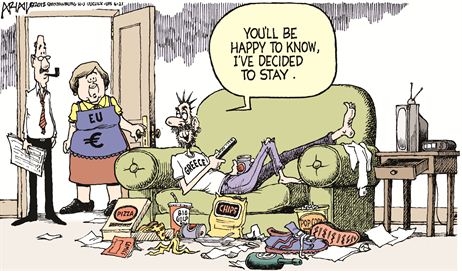
The President and his team have been blaming “European headwinds” for some of the U.S. economy’s woes. But the truth is that the policies pursued by Washington and Athens are frighteningly similar—and the outcomes are not good for either country. Both countries are in need of comprehensive fiscal reforms, yet their leaders have avoided the tough decisions in favor of bailouts and political posturing.
In yesterday’s election, political parties supporting Greece’s bailout secured a narrow victory, causing Europe and world markets to breathe a temporary sigh of relief. The parties must now form a coalition government, despite continued protests from the radical party that sought to throw out the terms of the bailout assistance—which could have led Greece out of the euro currency. At 22 percent unemployment, Greek voters expressed disappointment with their limited options.
The Greek crisis was foreshadowed in this year’s Heritage Foundation/Wall Street JournalIndex of Economic Freedom, with Greece registering the largest decline in economic freedom of any country in the world. Its economy is rated “mostly unfree,” and it has the fifth-lowest economic freedom score in Europe, beating only Russia and three former Soviet republics.
Why is it in such a state? The authors of the Index point to “decades of overspending, a lack of structural reform progress, and endemic corruption,” noting that Greece’s “lack of competitiveness and fading business confidence are serious impediments to economic revival. Adjustments in market conditions have been stifled or delayed by public unions.”
A few other points of comparison: The U.S. corporate tax rate is higher than Greece’s. The Index of Economic Freedom pegged America’s overall tax burden at 24 percent of total domestic income, while Greece’s overall tax burden was 30 percent of GDP. Government spending inAmerica—42 percent of GDP—approaches Greece’s government spending level, which exceeds 50 percent of its GDP.
Both countries have structural economic deficiencies—like tax rates and labor regulations—that are causing deeply rooted problems. And both countries have tried to solve their fiscal problems through bailouts, to no avail.
Though it goes back to the adoption of the euro in 1999, the European crisis first broke into the open some 10 years later. In April 2009, the European Union told France, Spain, Ireland, and Greece to reduce their budget deficits in the wake of the credit crisis. Since the crisis began, Europe has substantially weakened its banking system, which is propped up only by central bank cash and shaky bailouts.
Now, defaulting on loans is a real possibility for Greece and other European nations. They have too long dismissed the need for economic growth in favor of government intervention.
Going into the G20 summit today and tomorrow in Mexico, President Obama “has called on European leaders to recapitalize weak banks and to focus on economic growth and not just budget austerity,” reports Reuters. Basically, he has been urging European governments to spend more now, even as their borrowing costs and debt far exceed sustainable levels. One wonders how countries that have limited or no access to credit markets because of their dire fiscal situations are supposed to borrow the money for all this additional spending. There is only one substantive difference between Obama’s policies for Europe and his domestic policy, where he has urged expanding government jobs as a solution to U.S. unemployment: The U.S. government can still borrow to finance its deficits, because we’re only partway down the road the Greeks have already traveled.
The overspending, overtaxing, over-borrowing and over-regulating approach does not work for Europe any more than it works for America.
To deal with any European financial fallout that might affect the U.S., we have to stop embracing the same policies. Congress and the President should rein in federal spending immediately by choice rather than being eventually forced to do so, as countries across Europe have been. They should declare a regulatory cease-fire and disarm the Taxmageddon threat.
America is responsible for its own economic problems, regardless of the winds sweeping across the Atlantic.
INTERVIEW: Jesse Eisenberg on watching Woody Allen on set, on coming to Rome, on his favourite Italian dish, his favourite place in Rome and his future movie plans at the To Rome With Love World Premiere in Rome, Italy on April 13, 2012
Film Independent has announced that Woody Allen’s new film “To Rome, With Love” will open the L.A. Film Festival this year after premiering in Italy last week.
The film is made up of four adventures and misadventures and sees numerous A-list actors such as Penelope Cruz, Alec Baldwin, Judy Davis, Roberto Benigni, and Ellen Page, among others.
Ahead of the screening of the film during its premiere Friday, Allen expressed his positive outlook of the film’s setting, Italy, during a news conference.
“[Americans] have an enormously affectionate feeling about Italy,” he declared. They think of Italy as a country that is enormously warm … It’s a very strange place to live, a place that enjoys life and that stands for everything positive about life.”
Headquartered at downtown’s L.A. Live, the film festival will run from June 14-24. More than 200 feature films, shorts, and music videos will be presented from over 30 countries during the event.
Following Friday’s premiere of the film in the Eternal City, Italian critics voiced objections and deemed “To Rome, With Love” as being “superficial,” reported the Associated Press.
Despite its predicted success, Allen was forced to defend his new movie- calling it a tribute to old Italian films and not a means to foster old-fashioned Italian stereotypes. The acclaimed director responded to the critics by explaining his simple desire to entertain audiences with Rome as the film’s setting.
“When I come to a place to make a move, I give you my own impression of it,” said the legendary director. “The things that strike me as dramatic or comic, that would be fun to see. I have no great insights at all into Italian politics, Italian culture.”
The Letty Aronson and Stepehn Tenenbaum-produced film opens in U.S. theaters everywhere on June 22 via Sony Pictures Classics.
Earlier this year, Allen coveted an Academy Award for original screenplay with his hit film “Midnight in Paris.”
http://blog.heritage.org/2012/02/22/morning-bell-religious-liberty-under-attack/ | The controversy over the Obama Administration’s anti-conscience mandate and the fight for religious liberty only serves to highlight the inherent flaws in Obamacare. This conflict is a natural result of the centralization laid out under Obamacare and will only continue until the law is repealed in full.
___________________________
President Obama c/o The White House
1600 Pennsylvania Avenue NW
Washington, DC 20500
Congress recognizes more each day that the Patient Protection and Affordable Care Act, known widely as the Obamacare statute, interferes unconstitutionally with the liberty of Americans. From the Obamacare individual mandate to buy health insurance that awaits the action of the Supreme Court, to the Obamacare mandate that many religious hospitals, charities, and schools abandon the tenets of their faiths and include in their group health insurance for employees coverage of abortion-inducing drugs, contraception, and sterilization, Obamacare assaults the Constitution and American freedom.
Fortunately, Members of Congress and the American people are waking up to the need to repeal the Obamacare statute and move instead to market-based, patient-centered health care. Action in Congress this week to defend religious liberty continues to highlight the need to repeal the Obamacare statute.
The Obama Administration continues to trample on religious liberty by applying the Obamacare statute to mandate that many religious institutions’ group health insurance for employees cover abortion-inducing drugs, contraceptives, and sterilization. The Departments of Health and Human Services (HHS), the Treasury, and Labor published on February 15, 2012 final regulations that compel many religious hospitals, charities, and schools to abandon the tenets of their faiths and comply with that mandate beginning April 16, 2012, or pay fines for maintaining their religious faiths. The final regulations did not include any changes to respect religious liberty that President Obama had led people to expect.
Although Secretary of HHS Sebelius has said that, for one year, she will simply not perform her duty to enforce the final regulations, her decision not to enforce the regulations temporarily as a matter of grace does not eliminate the mandate’s interference with religious liberty. Indeed, her pronouncements reflect a failure to understand that religious liberty in America is an unalienable right with which our Creator has endowed us and a right that our Constitution’s First Amendment protects. Our religious liberty does not arise from the discretion of the Federal Government to do Americans a “favor” and tolerate their religions. Because President Obama and his agents continue to attack the constitutionally-guaranteed right of these religious institutions to free exercise of religion, Members of Congress are stepping forward to protect the Constitution.
Senator Roy Blunt (R-Missouri) has fought for religious liberty against the Obamacare assault. He plans to offer this week Senate Amendment No. 1520 to S. 1813, the highway authorization bill, to protect the right to religious liberty against the Obamacare mandate. The Blunt Amendment notes that, until the enactment of the Obamacare statute in 2010, “the Federal Government has not sought to impose specific coverage or care requirements that infringe on the rights of conscience . . . .” The Blunt Amendment would override the Obamacare mandate that religious institutions provide coverage for abortion-inducing drugs, contraceptives, and sterilization when it is contrary to their faiths, allowing them to keep their faiths and provide health care coverage for their employees.
Senate Majority Leader Harry Reid (D-Nevada) has announced his intention to keep the Senate from voting on the Blunt Amendment by making a motion to “table” — that is, to refuse to consider — the Blunt Amendment. Senator Reid said he considered the Blunt Amendment that protects religious liberty to be a “distracting proposal.” Senator Reid may treat legislation to protect religious liberty as a “distraction,” but hundreds of millions of Americans hold their right to free exercise of religion to be a precious freedom.
President Obama and Senator Reid can man the ramparts of Castle Obamacare against the people for only so long. The American people want their liberty and they shall have it. The Obamacare statute must go.
__________-
Thank you so much for your time. I know how valuable it is. I also appreciate the fine family that you have and your commitment as a father and a husband.
Sincerely,
Everette Hatcher III, 13900 Cottontail Lane, Alexander, AR 72002, ph 501-920-5733, lowcostsqueegees@yahoo.com
I have been writing President Obama letters and have not received a personal response yet. (He reads 10 letters a day personally and responds to each of them.) However, I did receive a form letter in the form of an email on June 15, 2012. I don’t know which letter of mine generated this response so I have linked several of the letters I sent to him below with the email that I received. (May have been these listed below 84.5, 84.8, 85, 85.2, 85.3, or 85.4) However, I think it was probably this one below:
President Obama c/o The White House
1600 Pennsylvania Avenue NW
Washington, DC 20500
I see a few problems with Obamacare. Although you promised that it would cover everyone, Obamacare will not give everyone coverage!!! Also there are religious values that Obamacare would trangress. For instance, you promised Ben Nelson and other prolife members of Congress that these healthcare plans would not cover abortion.
I also anticipate a drop in quality we will be seeing and it seems stupid to shove millions into an already bankrupt Medicaid system that will bankrupt Arkansas’ state government.
The real question is how efficient is the government versus the private market. Take your $50 lightbulb.
But even I’m shocked the federal government gave an affordability award for a light bulb that costs $50. I’m not making this up. Here’s a blurb from ABC News.
The U.S. government has awarded appliance-maker Philips $10 million for devising an “affordable” alternative to today’s standard 60-watt incandescent bulb. That standard bulb sells for around $1. The Philips alternative sells for $50. Of course, the award-winner is no ordinary bulb. It uses only one-sixth the energy of an incandescent. And it lasts 30,000 hours–about 30 times as long. In fact, if you don’t drop it, it may last 10 years or more. But only the U.S. Government (in this case, the Department of Energy) could view a $50 bulb as cheap.
Isn’t that wonderful? My tax dollars were used to reward a company that produced a light bulb I can’t afford.
Michael Tanner is a senior fellow at the Cato Institute and author of Leviathan on the Right: How Big-Government Conservatism Brought Down the Republican Revolution.
This week marks two years since of the passage of the Patient Protection and Affordable Care Act, and if the Obama administration has chosen to all but ignore the second anniversary of Obamacare, the rest of us should pause and reflect on just what a monumental failure of policy the health-care-reform law has been.
What’s more, it has been a failure on its own terms. After all, when health-care reform was passed, we were promised that it would do three things: 1) provide health-insurance coverage for all Americans; 2) reduce insurance costs for individuals, businesses, and government; and 3) increase the quality of health care and the value received for each dollar of health-care spending. At the same time, the president and the law’s supporters in Congress promised that the legislation would not increase the federal-budget deficit or unduly burden the economy. And it would do all these things while letting those of us who were happy with our current health insurance keep it unchanged. Two years in, we can see that none of these things is true.
Obamacare is a costly and dangerous failure.
For example, we now know that, contrary to claims made when the bill passed, the law will not come close to achieving universal coverage. In fact, as time goes by, it looks as if the bill will cover fewer and fewer people than advertised. According to a report from the Congressional Budget Office released last week, Obamacare will leave 27 million Americans uninsured by 2022. This represents an increase of 2–4 million uninsured over previous reports. Moreover, it should be noted that, of the 23 million Americans who will gain coverage under Obamacare, 17 million will not be covered by real insurance, but will simply be dumped into the Medicaid system, with all its problems of access and quality. Thus, only about 20 million Americans will receive actual insurance coverage under Obamacare. That’s certainly an improvement over the status quo, but it’s also a far cry from universal coverage — and not much bang for the buck, given Obamacare’s ever-rising cost.
At the same time, the legislation is a major failure when it comes to controlling costs. While we were once told that health-care reform would “bend the cost curve down,” we now know that Obamacare will actually increase U.S. health-care spending. This should come as no surprise: If you are going to provide more benefits to more people, it is going to cost you more money. The law contained few efforts to actually contain health-care costs, and the CBO now reports that many of the programs it did contain, such as disease management and care coordination, will not actually reduce costs. As the CBO noted, “in nearly every program involving disease management and care coordination, spending was either unchanged or increased relative to the spending that would have occurred in the absence of the program, when the fees paid to the participating organization were considered.”
This failure to control costs means that the law will add significantly to the already-crushing burden of government spending, taxes, and debt. According to the CBO, Obamacare will cost $1.76 trillion by 2022. To be fair, some media outlets misreported this new estimate as a doubling of the law’s originally estimated cost of $940 billion. In reality, most of the increased cost estimate is the result, not of increased programmatic costs, but of an extra two years of implementation. Still, many observers warned at the time that the original $940 million estimate was misleading because it included only six years of actual expenditures, with the ten-year budget window. The new estimate is, therefore, a more accurate measure of how expensive this law will be. Yet even this estimate covers only eight years of implementation. And it leaves out more than $115 billion in important implementation costs, as well as costs of the so-called doc fix. It also double-counts Social Security taxes and Medicare savings. Some studies suggest a better estimate of Obamacare’s real ten-year cost could run as high as $2.7–3 trillion. And this does not even include the over $4.3 trillion in costs shifted to businesses, individuals, and state governments.
All this spending means that we will pay much more in debt and taxes. But we will also pay more in insurance premiums. Once upon a time, the president promised us that health-care reform would lower our insurance premiums by $2,500 per year. That claim has long since been abandoned. Insurance premiums are continuing to rise at record rates. And, while there are many factors driving premiums up, Obamacare itself is one of them. According to the Kaiser Family Foundation, insurance premiums had been rising at roughly 5 percent per year pre-Obamacare. That jumped to 9 percent last year. And roughly half that four-percentage-point increase can be directly attributed to Obamacare. Even Jonathan Gruber of MIT, one of the architects of both Obamacare and Romneycare, now admits that many individuals will end up paying more for insurance than they would have without the reform — even after taking into account government subsidies — and that those increases will be substantial. According to Gruber, “after the application of tax subsidies, 59 percent of the individual market will experience an average premium increase of 31 percent.”
Finally, if the past two years should have taught us anything, it is that we may not be able to keep our current insurance, even if we are happy with it. The CBO suggests that as many as 20 million workers could lose their employer-provided health insurance as a result of Obamacare. Instead, they will be dumped into government-run insurance exchanges. And, the recent dust-up over insurance coverage for contraceptives is a clear illustration of how the government will now be designing insurance plans for all of us. Regardless of how one feels about the contraceptive mandate itself, it is just the tip of the iceberg as government mandates tell employers what insurance they must provide, and tell us what insurance we must buy, even if that insurance is more expensive, contains benefits we don’t want, or violates our consciences.
Next week, Obamacare will slouch its way to the Supreme Court. How the justices decide will be based on questions of constitutional law. Their decision will set a crucial precedent in setting the boundaries between government power and individual rights. But regardless of whether the Court upholds Obamacare or strikes it down, in whole or in part, we should understand that, simply as a matter of health-care reform, Obamacare is a costly and dangerous failure.
____________
Thank you so much for your time. I know how valuable it is. I also appreciate the fine family that you have and your commitment as a father and a husband.
Sincerely,
Everette Hatcher III, 13900 Cottontail Lane, Alexander, AR 72002, ph 501-920-5733, lowcostsqueegees@yahoo.com
Michael Cannon on Medicare and Healthcare
__________
June 15, 2012
Dear Everette:
Thank you for writing. I have heard from many Americans regarding our health care system and the Affordable Care Act, and I appreciate your perspective.
The Affordable Care Act gives hard-working, middle-class families the security they deserve with more control over their health care than ever before. Today, over 2 years after we passed this historic legislation, more young adults have insurance, more seniors are saving money on their prescription drugs, and more Americans can rest easy knowing they will not be dropped from their insurance plans if they get sick. This legislation forces insurance companies to play by the rules, offers increased consumer protection and choice, keeps our promises to seniors on Medicare, strengthens small businesses, and cuts the deficit to help secure a brighter future for our children and grandchildren.
The law has already made a difference for millions of Americans. Because of the Affordable Care Act, 2.5 million more young people up to age 26 now have health insurance because they can stay on their parents’ insurance policies. And 54 million additional Americans now receive recommended preventive services like wellness visits, cancer screenings, and other crucial care without co-pays or deductibles.
These reforms strengthen Medicare by not only preserving but also expanding benefits for Americans who depend on Medicare every day. In 2010 and 2011, over 5.1 million seniors and people with disabilities on Medicare saved over $3.2 billion on prescription drugs thanks to the law. These savings include a one-time $250 rebate check to eligible seniors who fell into the prescription drug coverage gap known as the “donut hole” in 2010. And more than 32 million seniors have already received one or more free preventive services, including the new Annual Wellness Visit. To learn about help available through the Center for Medicare and Medicaid Services, visit www.CMS.gov.
The Affordable Care Act also ends some of the worst abuses of the health insurance industry, and it will continue to hold insurance companies accountable in the future. Insurance companies can no longer deny coverage to more than 17.6 million children with pre-existing conditions, including everything from asthma to high blood pressure to cancer. In 2014, insurance companies will be banned from denying coverage to anyone because of pre-existing conditions. To protect Americans now, the Affordable Care Act includes the temporary Pre-Existing Condition Insurance Plan, which has helped more than 50,000 uninsured Americans with a pre-existing condition gain affordable coverage. Insurance companies can no longer place lifetime or restrictive annual limits on the amount of care patients receive—helping 105 million Americans who no longer have a lifetime dollar limit on their insurance policies.
Because of the new 80/20 rule, insurance companies must spend at least 80 percent of your premium dollars on your health care or improvements to care rather than excessive marketing costs or CEO bonuses. If they fail to do so, they are required to provide a rebate to their customers. And, for the first time ever, insurance companies must publicly justify rate increases of 10 percent or more.
To help America’s small businesses, who have long paid a higher price for health insurance—often 18 percent more than larger employers—the Affordable Care Act provides tax credits for small businesses to help pay for their employees’ health insurance. An estimated 2 million workers get their insurance from the 360,000 small employers that will receive the credit for 2011. In 2014, small business owners will get more relief with tax credits and affordable insurance choices in the new Affordable Insurance Exchanges in every state. For the first time, they will have a marketplace where they can see and compare their health plan options in one place, and insurers will have to actively compete for their business.
Thanks to the new health care law, American workers and families can feel more secure knowing that neither illness nor accident will endanger their pursuit of the American dream. To learn more about the content of this legislation and how it affects you, visit www.HealthCare.gov or www.WhiteHouse.gov/HealthReform. For more information on resources that may be available to you, please visit www.HealthFinder.gov/FindServices.
Randy Barnett Discusses ObamaCare at the Supreme Court Uploaded by catoinstitutevideo on Mar 26, 2012 http://www.cato.org/event.php?eventid=9074 Cato Institute Senior Fellow and Georgetown University law professor Randy E. Barnett discusses the arguments to be presented to the Supreme Court beginning March 26. __________ President Obama c/o The White House 1600 Pennsylvania Avenue NW Washington, DC 20500 […]
Cato’s Michael F. Cannon Discusses ObamaCare’s Individual Mandate Uploaded by catoinstitutevideo on Mar 26, 2012 http://www.cato.org/event.php?eventid=9074 The individual mandate to purchase health insurance is the linchpin of the Patient Protection and Affordable Care Act. It is among the issues to be handled by the Supreme Court beginning March 26, 2012. Michael F. Cannon is the […]
Tim Sandefur Discusses ObamaCare’s Medicaid Expansion Uploaded by catoinstitutevideo on Mar 26, 2012 http://www.cato.org/event.php?eventid=9074 Tim Sandefur of the Pacific Legal Foundation explains some of the implications of the Affordable Care Act’s Medicaid expansion. ___________________ President Obama c/o The White House 1600 Pennsylvania Avenue NW Washington, DC 20500 Dear Mr. President, I know that you receive […]
President Obama c/o The White House 1600 Pennsylvania Avenue NW Washington, DC 20500 Dear Mr. President, I know that you receive 20,000 letters a day and that you actually read 10 of them every day. I really do respect you for trying to get a pulse on what is going on out here. It seems […]
Dear Senator Pryor, Why not pass the Balanced Budget amendment? As you know that federal deficit is at all time high (1.6 trillion deficit with revenues of 2.2 trillion and spending at 3.8 trillion). On my blog http://www.HaltingArkansasLiberalswithTruth.com I took you at your word and sent you over 100 emails with specific spending cut ideas. However, […]
Tim Sandefur Discusses ObamaCare’s Medicaid Expansion Uploaded by catoinstitutevideo on Mar 26, 2012 http://www.cato.org/event.php?eventid=9074 Tim Sandefur of the Pacific Legal Foundation explains some of the implications of the Affordable Care Act’s Medicaid expansion. _________________________ President Obama c/o The White House 1600 Pennsylvania Avenue NW Washington, DC 20500 Dear Mr. President, I know that you receive 20,000 […]
President Obama c/o The White House 1600 Pennsylvania Avenue NW Washington, DC 20500 Dear Mr. President, I know that you receive 20,000 letters a day and that you actually read 10 of them every day. I really do respect you for trying to get a pulse on what is going on out here. That is […]
Francis Schaeffer February 21, 1982 (Part 1) Uploaded by DeBunker7 on Feb 21, 2008 READ THIS FIRST: In decline of all civilizations we first see a war against the freedom of ideas. Discussion is limited or prohibited. Speakers at universities are shouted down. Corruption takes over city governments and towns as dishonesty and corruption expands. […]
Milton Friedman – Socialized Medicine at Mayo Clinic in 1978 President Obama c/o The White House 1600 Pennsylvania Avenue NW Washington, DC 20500 Dear Mr. President, I know that you receive 20,000 letters a day and that you actually read 10 of them every day. I really do respect you for trying to get a […]
Milton Friedman – Socialized Medicine at Mayo Clinic in 1978 President Obama c/o The White House 1600 Pennsylvania Avenue NW Washington, DC 20500 Dear Mr. President, I know that you receive 20,000 letters a day and that you actually read 10 of them every day. I really do respect you for trying to get a […]
Cato’s Michael F. Cannon Discusses ObamaCare’s Individual Mandate Uploaded by catoinstitutevideo on Mar 26, 2012 http://www.cato.org/event.php?eventid=9074 The individual mandate to purchase health insurance is the linchpin of the Patient Protection and Affordable Care Act. It is among the issues to be handled by the Supreme Court beginning March 26, 2012. Michael F. Cannon is the […]
I have been writing President Obama letters and have not received a personal response yet. (He reads 10 letters a day personally and responds to each of them.) However, I did receive a form letter in the form of an email on May 23, 2012. I don’t know which letter of mine generated this response so I have […]
President Obama c/o The White House 1600 Pennsylvania Avenue NW Washington, DC 20500 Dear Mr. President, I know that you receive 20,000 letters a day and that you actually read 10 of them every day. I really do respect you for trying to get a pulse on what is going on out here. Great post […]
__________ Milton Friedman – Socialized Medicine at Mayo Clinic in 1978 President Obama c/o The White House 1600 Pennsylvania Avenue NW Washington, DC 20500 Dear Mr. President, I know that you receive 20,000 letters a day and that you actually read 10 of them every day. I really do respect you for trying to get […]
Dear Senator Pryor, Why not pass the Balanced Budget Amendment? As you know that federal deficit is at all time high (1.6 trillion deficit with revenues of 2.2 trillion and spending at 3.8 trillion). On my blog www.HaltingArkansasLiberalswithTruth.com I took you at your word and sent you over 100 emails with specific spending cut ideas. However, I did […]
President Obama c/o The White House 1600 Pennsylvania Avenue NW Washington, DC 20500 Dear Mr. President, I know that you receive 20,000 letters a day and that you actually read 10 of them every day. I really do respect you for trying to get a pulse on what is going on out here. It seems […]
1,000 Days Without A Budget Uploaded by HeritageFoundation on Jan 24, 2012 http://blog.heritage.org | Today marks the 1,000th day since the United States Senate has passed a budget. While the House has put forth (and passed) its own budget, the Senate has failed to do the same. To help illustrate how extraordinary this failure has […]
Congressman Rick Crawford State of the Union Response 2012 Uploaded by RepRickCrawford on Jan 24, 2012 Rep. Rick Crawford responds to the State of the Union address January 24, 2012 __________ President Obama c/o The White House 1600 Pennsylvania Avenue NW Washington, DC 20500 Dear Mr. President, I know that you receive 20,000 letters a day […]
Sen Obama in 2006 Against Raising Debt Ceiling Uploaded by RepCliffStearns on Jun 20, 2011 Rep. Stearns on the House Floor cites Sen. Obama’s opposition in 2006 to increasing the debt ceiling, 6-14-11 ________________________ President Obama c/o The White House 1600 Pennsylvania Avenue NW Washington, DC 20500 Dear Mr. President, I know that you receive […]
President Obama c/o The White House 1600 Pennsylvania Avenue NW Washington, DC 20500 Dear Mr. President, I know that you receive 20,000 letters a day and that you actually read 10 of them every day. I really do respect you for trying to get a pulse on what is going on out here. Here is […]
President Obama c/o The White House 1600 Pennsylvania Avenue NW Washington, DC 20500 Dear Mr. President, I know that you receive 20,000 letters a day and that you actually read 10 of them every day. I really do respect you for trying to get a pulse on what is going on out here. It seems […]
In your earlier debate with Hillary Clinton during the 2008 primary you answered the question concerning the drop in the capital tax by Bill Clinton and the resulting increase in revenues by saying that you would still would raise the capital gains tax on the 100,000 million Americans that owned stock because of the issue of fairness. That is counterproductive.
The corporate tax in the USA is almost double the world average and it should be reduced. In fact, Canada reduced theirs dramatically and still brought in about the same revenue. Take a look at this fine article below from the Cato Institute:
Chris Edwards is the director of tax policy studies at the Cato Institute and the editor of Downsizing Government.org.
Added to cato.org on March 13, 2012
This article appeared in Daily Caller on March 13, 2012.
The President Obama and most members of Congress agree that the U.S. corporate tax rate should be cut. Thankfully, it is finally sinking in that having a 40 percent corporate tax rate when the world average is just 23 percent is suicide in a globalized economy.
The sticking point on slashing the corporate tax rate has been the fear that the federal government might lose revenues under such a reform. To prevent an expected revenue loss, policymakers have searched for tax loopholes to close in order to “pay for” a corporate rate cut. The problem is that members never find any loophole closings that they can agree on.
I’ve concluded that the effort to close corporate loopholes is a big waste of time. It is simply blocking desperately needed reforms to the tax rate. If I was drafting a corporate tax reform bill, I’d match a tax rate cut with federal spending cuts, but that idea hasn’t caught on either.
The good news is that a corporate tax rate cut without any changes to the tax base probably wouldn’t lose the government any money over the long term. Good evidence comes from Canada’s corporate tax cuts of the 1980s and 2000s.
The chart shows Canada’s federal corporate tax revenues as a share of gross domestic product (GDP) and the federal corporate tax rate. The tax rate plunged from 38 percent in 1980 to just 15 percent by 2012. Amazingly, there has been no obvious drop in tax revenues over the period.
Canadian corporate tax revenues have fluctuated, but the changes are correlated with economic growth, not the tax rate. In the late 1980s, a tax rate cut was followed by three years of stable revenues. In the early 1990s, a plunge in revenues was caused by a recession, and then in the late 1990s revenues soared as the economy grew.
In 2000, Canadian policymakers enacted another round of corporate tax rate cuts, which were phased in gradually. Corporate tax revenues initially dipped, but then they rebounded strongly in the late 2000s.
The rate cuts enacted in 2000 were projected to cause substantial revenue losses to the Canadian government. That projection indicates that the reform didn’t have much in the way of legislated loophole closing. But the chart shows that the positive taxpayer response to the rate cut was apparently so large that the government did not lose much, if any, revenue at all.
In 2009, Canada was dragged into a recession by the elephant economy next door, and that knocked the wind out of corporate tax revenues. However, it is remarkable that even with a recession and a tax rate under 20 percent, tax revenues as a share of GDP have been roughly as high in recent years as they were during the 1980s, when there was a much higher rate. Jason Clemens of the Macdonald-Laurier Institute notes that Canadian corporate tax revenues have been correlated with corporate profits, not the tax rate.
If a corporate tax rate is high, there is a “Laffer effect” when the rate is cut, meaning that the tax base expands so much that the government doesn’t lose any money. Estimates from Jack Mintz and other tax experts show that cutting corporate tax rates when they are above about 25 percent won’t lose governments any revenues over the long run.
The overall Canadian rate this year is about 27 percent when the average provincial rate is included. By contrast, the average federal-state rate in the United States is 40 percent, which is roughly 15 points above the revenue-maximizing rate. That means that Congress can proceed with a corporate rate cut and everyone would win — taxpayers, the economy and even the government.
Corporate tax reform with loophole closing is a wild-goose chase. Congress never seems to agree on which loopholes to close, with the result that our economy continues to suffer under a super-high rate. If we matched Canada by cutting our federal corporate rate from 35 percent to 15 percent, it would generate a large increase in reported income as corporate investment boomed and tax avoidance fell. The tax base would automatically expand without Congress even legislating reductions to deductions, credits or other loopholes.
In 2012, Canada will collect about 1.9 percent of GDP in federal corporate income tax revenues with a 15 percent tax rate. The United States will collect about 1.6 percent of GDP with a 35 percent tax rate. Do we need any more evidence that our high corporate tax rate makes no sense?
____________
Thank you so much for your time. I know how valuable it is. I also appreciate the fine family that you have and your commitment as a father and a husband.
Sincerely,
Everette Hatcher III, 13900 Cottontail Lane, Alexander, AR 72002, ph 501-920-5733, lowcostsqueegees@yahoo.com




 Canadian corporate tax revenues have fluctuated, but the changes are correlated with economic growth, not the tax rate. In the late 1980s, a tax rate cut was followed by three years of stable revenues. In the early 1990s, a plunge in revenues was caused by a recession, and then in the late 1990s revenues soared as the economy grew.


