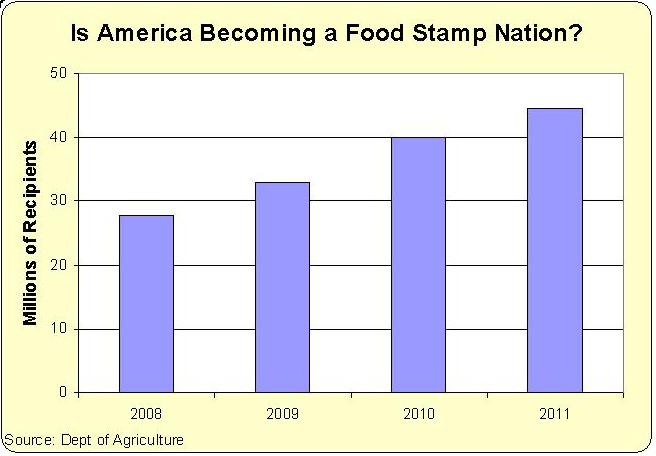
Newt Gingrich had fun calling President Obama the “food stamp president,” but many Republicans are just as responsible for the exploding costs of this welfare state program.
The chart shows that federal outlays for food stamps (officially the Supplemental Nutrition Assistance Program) roughly doubled under President Bush and then doubled again under President Obama.
In this 1968 interview, Milton Friedman explained the negative income tax, a proposal that at minimum would save taxpayers the 72 percent of our current welfare budget spent on administration. http://www.LibertyPen.com
There is some uncertainty whether Dick Burnett himself wrote the song. One claim is that it was sung by the Mackin clan in 1888 in Ireland and that Cameron O’Mackin emigrated to Tennessee, brought the song with him, and performed it. In an interview he gave toward the end of his life, Burnett himself indicated that he could not remember:
Charles Wolfe: “What about this “Farewell Song” – ‘I am a man of constant sorrow’ – did you write it?”
Richard Burnett: “No, I think I got the ballad from somebody – I dunno. It may be my song…”[1]
If Burnett wrote the song, the date of its composition, or at least of the editing of certain lyrics by Burnett, can be fixed at about 1913. Since it is known that Burnett was born in 1883, married in 1905, and blinded in 1907, the dating of two of these texts can be made on the basis of internal evidence. The second stanza of “Farewell Song” mentions that the singer has been blind six years, which put the date at 1913. According to the Country Music Annual, Burnett “probably tailored a pre-existing song to fit his blindness” and may have adapted a hymn. Charles Wolfe argues that “Burnett probably based his melody on an old Baptisthymn called “Wandering Boy”.[2]
During 1918, Cecil Sharp collected the song and published it as “In Old Virginny” (Sharp II, 233).
Sarah Ogan Gunning’s re-writing of the traditional “Man” into a more personal “Girl” took place about 1936 in New York, where her first husband, Andrew Ogan, was fatally ill. The text was descriptive of loneliness away from home and anticipated her bereavement; the melody she remembered from a 78 rpm hillbilly record (Emry Arthur, probably Vocalion Vo 5208, 1928) she had heard some years before in the mountains.
“Man of Constant Sorrow” is probably two or three hundred years old. But the first time I heard it when I was y’know, like a small boy, my daddy – my father – he had some of the words to it, and I heard him sing it, and we – my brother and me – we put a few more words to it, and brought it back in existence. I guess if it hadn’t been for that it’d have been gone forever. I’m proud to be the one that brought that song back, because I think it’s wonderful.”
Stanley’s autobiography is titled Man of Constant Sorrow.[4]
The embedded lists in this article may contain items that are not encyclopedic. Please help out by removing such elements and incorporating appropriate items into the main body of the article. (January 2011)
1928 – The song was recorded in 1928 by Emry Arthur.
1951 – It was popularized by the Stanley Brothers, on Columbia 20816, Recorded: Nov. 3, 1950, Released: May 1951.
1959 – The Stanley Brothers re-recorded it on King Records 45-5269, Recorded: Sep. 15, 1959, Released: Oct. 1959. This version is probably the first with a very similar vocal arrangement as the one used in the movie O Brother, Where Art Thou?, where it is performed by the fictitious group Soggy Bottom Boys (recorded by Dan Tyminski, Harley Allen, and Pat Enright).
1960 – A version of the song, “Girl of Constant Sorrow”, is included on the remastered version of the album Joan Baez, first released in 1960 on the Vanguard label.[5]
1961 – Recorded by Roscoe Holcomb (Daisy Kentucky) in 1961–1962 with an arrangement more like Dylan’s than that of the Stanleys.(Music of Roscoe Holcomb and Wade Ward,Smithsonian Folkways, Smithsonian Center for Folklife and Cultural Heritage.)
1970 – It was also recorded by Ginger Baker’s Air Force on their eponymous debut album in 1970, sung by Air Force guitarist and vocalist (and former Moody Blues, future Wings member) Denny Laine. The band used the same melody, and for the most part the same lyrics (but substituted ‘Birmingham’ for ‘Colorado’). The arrangement differed, though, as this was a loosely improvised live version, with violin and saxophones, that stays very much in the major scales of A, D and E, unlike its future bluesier brethren. It was the only band single; it charted #36 on the U.S. country charts and #86 in UK.
1972 – Some of the lyrics were used verbatim in the Rolling Stones song “Let It Loose” from the 1972 LP Exile on Main St.
1993 – “Man of Constant Sorrow” was one of many songs recorded by Jerry Garcia, David Grisman, and Tony Rice one weekend in February 1993. Jerry’s taped copy of the session was later stolen by his pizza delivery man, eventually became an underground classic, and finally edited and released in 2000 as The Pizza Tapes.[citation needed] Jerry Garcia also sang an a cappella version on June 11, 1962, at the Jewish Community Center in San Carlos, California, with the Sleepy Hollow Hog Stompers.[citation needed] Though unreleased, it has been widely circulated among traders at least since the 1980s.[citation needed]
2000 – Jackson Browne and Irish accordionist Sharon Shannon recorded their version of the song in 2000. It also appeared in Shannon’s album The Diamond Mountain Sessions.
2000 – The song appears in the 2000 film O Brother, Where Art Thou?, under the title “I Am a Man of Constant Sorrow.” Performed by the fictitious Soggy Bottom Boys in the movie, it was recorded by Dan Tyminski, Harley Allen, and Pat Enright. It was a hit in the movie for the Soggy Bottom Boys and later became a hit single in real life. It received a CMA for “Single of the Year” and a Grammy for “Best Country Collaboration with Vocals” and it peaked at #35 on Billboard’s Hot Country Songs chart. Dan Tyminski performed this song at the Crossroads Guitar Festival with Ron Block and live with Alison Krauss. The version used in the film is closest in lyrics and singing style to Ralph Stanley’s.
2000– The folk group Donna the Buffalo did a reggae-influenced cover on their album Positive Friction.
2001 – A version entitled “Soul of Constant Sorrow” appears on the 2001 album Mountain Soul by country singer Patty Loveless.
2003 – In 2003, musicians Skeewiff remixed “Man of Constant Sorrow.” The song was so popular in Australia that it featured at #96 in the Triple J’s hottest 100 songs of 2003. That same year, the O Brother Where Art Thou? version of the song ranked #20 in CMT’s 100 Greatest Songs in Country Music.
2012 – The hard-rock band Charm City Devils released a video of their cover of the song on their YouTube channel.[7] The lyric video video was a montage of images and footage from old black and white movies over which were superimposed the song’s lyrics in an ornate but damaged font consistent with the band’s branding.
2012 – The poet and rapper George Watsky released a cover/remix of the song on his YouTube channel.[8] The video shows similar themes to the film O Brother, Where Art Thou?. This version of the song adds hip-hop elements (such as Watsky’s rapping for the verse).
Tom Landry’s faith in Christ was the most important thing in the world to him.
I got to ask Pat Summerall a question at the Little Rock Touchdown Club meeting back in October of 2010. Summerall had pointed out that Tom Landry was the defensive coordinator and Vince Lombardi was the offensive backfield coach when he played for the Giants. Summerall had shared how he had recovered from his drinking habit and put his faith in Christ and was baptized.
I simply asked him if he had a chance to interact with any Christian Coaches like Tony Dungy or Tom Landry about his conversion. He said that he told Landry about his conversion and that was the only time he ever saw Landry smile. Walt Garrison told Summerall that he never saw Landry smile but he only played for him for 9 years.
NFL Hall of Fame, 20 consecutive winning seasons, 13 division championships, five trips to the Super Bowl, two world championship titles: he went to the top and always wore his trademark hat.
Tom Landry was one of the most easily recognized men in the USA: a man so identified with his job that he was usually called “Coach Tom Landry”. As head coach of the Dallas Cowboys football team for nearly thirty years, Coach Landry compiled a winning record that few professional coaches have since matched. But that success did not come easily. Beginning with the expansion team in 1960, Landry and the Cowboys suffered through five straight losing seasons. Their ledger during those first five years reads only 18 wins, 46 losses and 4 ties. Not exactly the kind of record a dynasty is built on!
“People were wondering whether or not we were going to make it,” Landry once remarked. Of course, the Cowboys did make it! In 1965 they broke even, and in the years that followed they compiled one of the best records in NFL history.
Running a professional football team can be a hectic job, but Coach Landry completed the task successfully because his priorities were in order. “Winning a football game isn’t the end of all things,” he once said. “It’s got a priority, but it’s not number one in my life. This creates for me a certain amount of calmness, even though I’m human enough to suffer when we lose.”
Landry’s greatest legacy – and his highest priority in life – was his Christian faith. “This is really the most important factor in my life, my faith in Jesus Christ.” Landry continued, “When you accept Christ, He becomes first in your life. It’s this priority that gives me peace.”
Peace was something Coach Landry did not always enjoy, however. For a long time he sought fulfillment in his own achievements: “I had a very restless feeling inside me that I wanted to accomplish something, but I really didn’t know what it was.” As a boy in the small town of Mission, Texas, Tom Landry was a regular attendee of Sunday school and church, but thought that football seemed more important. So young Tom began to set goals – specific goals for his budding football career. In high school he told himself, “If I could just be part of a championship team, be an all-district halfback, then I would have everything I wanted.” In his senior year Landry saw that dream fulfilled, but, in his own words, the thrill “wore off quickly.”
Next it was college, but even his success at the prestigious University of Texas and trips to the Sugar Bowl and Orange Bowl were not enough to satisfy him. Even professional football didn’t do it. Landry discovered that his restlessness had followed him even to the NFL. Although Landry didn’t know it, he was experiencing the reality of Luke 12:15. “A man’s life does not consist in the abundance of his possessions” (or achievements!). Landry never imagined that his problem was basically a spiritual one. After all, he had been going to church all his life. He already WAS a Christian, wasn’t he?
An invitation to a Bible discussion group in 1958 changed his thinking and gave him an answer to his quest for peace. God began to open Coach Landry’s eyes to the difference between a mere churchgoer – a “good” person – and a true Christian. As he related, “I committed my life to Christ and discovered what Jesus meant when He said, ‘I have come that they may have life, and have it to the full'” (John 10:10). What was it that Coach Landry discovered? He found the source of his restlessness: separation from God. “For all have sinned and fall short of the glory of God” (Romans 3:23). Then he realized the discomforting truth that he was a sinner, and sin was causing his alienation from God. In fact, because we all have sinned, each one of us has experienced this same separation from God.
But Landry also discovered some good news! Romans 6:23 says it best: “For the wages of sin is death, but the gift of God is eternal life in Christ Jesus our Lord.” As the coach said, “All we have to do is recognize that Jesus did die on the cross for our sins, that we are sinners, and that it’s only through Jesus Christ that we can have our sins forgiven.” For Coach Tom Landry, placing his faith in Christ brought an end to his restless search for life’s meaning.
President Reagan, Nancy Reagan, Bill Clinton and Hillary Clinton attending the Dinner Honoring the Nation’s Governors. 2/22/87.
Ronald Reagan is my favorite president and I have devoted several hundred looking at his ideas. Take a look at these links below:
President Reagan and Nancy Reagan attending “All Star Tribute to Dutch Reagan” at NBC Studios(from left to right sitting) Colleen Reagan, Neil Reagan, Maureen Reagan, President, Nancy Reagan, Dennis Revell. (From left to right standing) Emmanuel Lewis, Charlton Heston, Ben Vereen, Monty Hall, Frank Sinatra, Burt Reynolds, Dean Martin, Eydie Gorme, Vin Scully, Steve Lawrence, last 2 unidentified. Burbank, California 12/1/85.
Above you will see the picture of Charlton Heston. My wife actually got her picture taken with Heston in 1992 when he came in to try to jump start Mike Huckabee’s effort to beat Senator Dale Bumpers.
My favorite president is Ronald Wilson Reagan. President Reagan with Nancy Reagan, William Wilson, Betty Wilson, Walter Annenberg, Leonore Annenberg, Earle Jorgensen, Marion Jorgensen, Harriet Deutsch and Armand Deutschat at a private birthday party in honor of President Reagan’s 75th Birthday in the White House Residence. 2/7/86. Milton Friedman’s book “Free to Choose” did influence […]
Government Spending Doesn’t Create Jobs Uploaded by catoinstitutevideo on Sep 7, 2011 Share this on Facebook: http://on.fb.me/qnjkn9 Tweet it: http://tiny.cc/o9v9t In the debate of job creation and how best to pursue it as a policy goal, one point is forgotten: Government doesn’t create jobs. Government only diverts resources from one use to another, which doesn’t […]
Uploaded by HeritageFoundation on Dec 16, 2010 http://blog.heritage.org/2010/12/16/new-video-pork-filled-spending-bill-just-… Despite promises from President Obama last year and again last month that he opposed reckless omnibus spending bills and earmarks, the White House and members of Congress are now supporting a reckless $1.1 trillion spending bill reportedly stuffed with roughly 6,500 earmarks. ________________________ Below you see an […]
Uploaded by YAFTV on Aug 19, 2009 Nobel Laureate Dr. Milton Friedman discusses the principles of Ronald Reagan during this talk for students at Young America’s Foundation’s 25th annual National Conservative Student Conference MILTON FRIEDMAN ON RONALD REAGAN In Friday’s WSJ, Milton Friedman reflectedon Ronald Reagan’s legacy. (The link should work for a few more […]
Washington Could Learn a Lot from a Drug Addict Concerning spending cuts Reagan believed, that members of Congress “wouldn’t lie to him when he should have known better.” However, can you believe a drug addict when he tells you he is not ever going to do his habit again? Congress is addicted to spending too […]
A Ronald Reagan radio address from 1975 addresses the topics of abortion and adoption. This comes from a collection of audio commentaries titled “Reagan in His Own Voice.” I just wanted to share with you one of the finest prolife papers I have ever read, and it is by President Ronald Wilson Reagan. I have […]
Princess Diana dancing with John Travolta in the entrance hall at the White House. 11/9/85. From November of 1980, here is CBS’s coverage of Election Night. Taped from WJKW-TV8, Cleveland. This is part 3 of 3. Lee Edwards of the Heritage Foundation wrote an excellent article on Ronald Reagan and the events that transpired during the […]
The Reagans have tea with Prince Charles and Princess Diana in the White House residence. 11/9/85 . I remember when I visited London in July of 1981 and the whole town was getting ready for the big royal wedding between Prince Charles and Princess Diana. Above you will see them pictured with President Reagan. From […]
Senator Mark Pryor wants our ideas on how to cut federal spending. Take a look at this video clip below:
Senator Pryor has asked us to send our ideas to him at cutspending@pryor.senate.gov and I have done so in the past and will continue to do so in the future.
On May 11, 2011, I emailed to this above address and I got this email back from Senator Pryor’s office:
Please note, this is not a monitored email account. Due to the sheer volume of correspondence I receive, I ask that constituents please contact me via my website with any responses or additional concerns. If you would like a specific reply to your message, please visit http://pryor.senate.gov/contact. This system ensures that I will continue to keep Arkansas First by allowing me to better organize the thousands of emails I get from Arkansans each week and ensuring that I have all the information I need to respond to your particular communication in timely manner. I appreciate you writing. I always welcome your input and suggestions. Please do not hesitate to contact me on any issue of concern to you in the future.
Government auditors spent the past five years examining all federal programs and found that 22 percent of them—costing taxpayers a total of $123 billion annually—fail to show any positive impact on the populations they serve.
Congress has ignored efficiency recommendations from the Department of Health and Human Services that would save $9 billionannually.
Taxpayers are funding paintings of high-ranking government officials at a cost of up to $50,000 apiece.
The state of Washington sent $1 food stamp checks to 250,000 households in order to raise state caseload figures and trigger $43 millionin additional federal funds.
Suburban families are receiving large farm subsidies for the grass in their backyards—subsidies that many of these families never requested and do not want.
Homeland Security employee purchases include 63-inch plasma TVs, iPods, and $230for a beer brewing kit.
The National Institutes of Health spends $1.3 millionper month to rent a lab that it cannot use.
Congress recently spent $2.4 billionon 10 new jets that the Pentagon insists it does not need and will not use.
Defense Spending Has Declined While Entitlement Spending Has Increased
Everyone wants to know more about the budget and here is some key information with a chart from the Heritage Foundation and a video from the Cato Institute.
Spending on national defense, a core constitutional function of government, has declined significantly over time, despite wars in Iraq and Afghanistan. Spending on the three major entitlements—Social Security, Medicare, and Medicaid—has more than tripled.
PERCENTAGE OF GDP
Download
Source: White House Office of Management and Budget.
The charts in this book are based primarily on data available as of March 2011 from the Office of Management and Budget (OMB) and the Congressional Budget Office (CBO). The charts using OMB data display the historical growth of the federal government to 2010 while the charts using CBO data display both historical and projected growth from as early as 1940 to 2084. Projections based on OMB data are taken from the White House Fiscal Year 2012 budget. The charts provide data on an annual basis except… Read More
Authors
Emily GoffResearch Assistant
Thomas A. Roe Institute for Economic Policy StudiesKathryn NixPolicy Analyst
Center for Health Policy StudiesJohn FlemingSenior Data Graphics Edito
Milton Friedman’s negative income tax explained by Friedman in 1968:
We need to cut back on the Food Stamp program and not try to increase it. What really upsets me is that when the government gets involved in welfare there is a welfare trap created for those who become dependent on the program. Once they go out and get a job then they are stripped away from the welfare program and that encourages them to avoid working and sit on the couch. (Milton Friedman’s negative income tax is a good solution.)
Now we have the government running ads trying to get people to join this type of lifestyle. I think it is the most cruel thing you can do to a struggling poor person. Working is the only way a person can climb up the ladder and falling in the welfare trap hurts the poor’s chance of succeeding in the future.
More than one in seven Americans are on food stamps, but the federal government wants even more people to sign up for the safety net program. The U.S. Department of Agriculture has been running radio ads for the past four months encouraging those eligible to enroll. …The department is spending between $2.5 million and $3 million on paid spots, and free public service announcements are also airing. The campaign can be heard in California, Texas, North Carolina, South Carolina, Ohio, and the New York metro area. …President Bush launched a recruitment campaign, which pushed average participation up by 63% during his eight years in office. The USDA began airing paid radio spots in 2004. President Obama’s stimulus act made it easier for childless, jobless adults to qualify for the program and increased the monthly benefit by about 15% through 2013.
Last year, I semi-defended Newt Gingrich when he was attacked for calling Obama the “Food Stamp” President. Citing this chart, I wrote that, “It certainly looks like America is becoming a food stamp nation.”
But my bigger point is that welfare is bad for both taxpayers and the people who get trapped into relying on big government.
The ideal approach, as explained in this video, is to get the federal government out of the business of redistributing income. We are far more likely to get better results if we let states experiment with different approaches.
House Republicans, to their credit, already want to do this with Medicaid. So why not block grant all social welfare programs?
Ep. 4 – From Cradle to Grave [7/7]. Milton Friedman’s Free to Choose (1980) With the national debt increasing faster than ever we must make the hard decisions to balance the budget now. If we wait another decade to balance the budget then we will surely risk our economic collapse. The first step is to […]
Ep. 4 – From Cradle to Grave [6/7]. Milton Friedman’s Free to Choose (1980) With the national debt increasing faster than ever we must make the hard decisions to balance the budget now. If we wait another decade to balance the budget then we will surely risk our economic collapse. The first step is to […]
Ep. 4 – From Cradle to Grave [5/7]. Milton Friedman’s Free to Choose (1980) With the national debt increasing faster than ever we must make the hard decisions to balance the budget now. If we wait another decade to balance the budget then we will surely risk our economic collapse. The first step is to […]
Ep. 4 – From Cradle to Grave [4/7]. Milton Friedman’s Free to Choose (1980) With the national debt increasing faster than ever we must make the hard decisions to balance the budget now. If we wait another decade to balance the budget then we will surely risk our economic collapse. The first step is to […]
Ep. 4 – From Cradle to Grave [3/7]. Milton Friedman’s Free to Choose (1980) With the national debt increasing faster than ever we must make the hard decisions to balance the budget now. If we wait another decade to balance the budget then we will surely risk our economic collapse. The first step is to […]
With the national debt increasing faster than ever we must make the hard decisions to balance the budget now. If we wait another decade to balance the budget then we will surely risk our economic collapse. The first step is to remove all welfare programs and replace them with the negative income tax program that […]
Milton Friedman – The Negative Income Tax Published on May 11, 2012 by LibertyPen In this 1968 interview, Milton Friedman explained the negative income tax, a proposal that at minimum would save taxpayers the 72 percent of our current welfare budget spent on administration. http://www.LibertyPen.com Source: Firing Line with William F Buckley Jr. ________________ Milton […]
Government spending can promote economic growth if money is used for core “public goods” such as rule of law and property rights. But the burden of government spending in the United States and other industrialized nations is far higher than needed to finance such activities. Citing scholarly studies, this CF&P Foundation video examines the Rahn Curve, which graphically illustrates the negative impact of excessive government spending. www.freedomandprosperity.org
___________
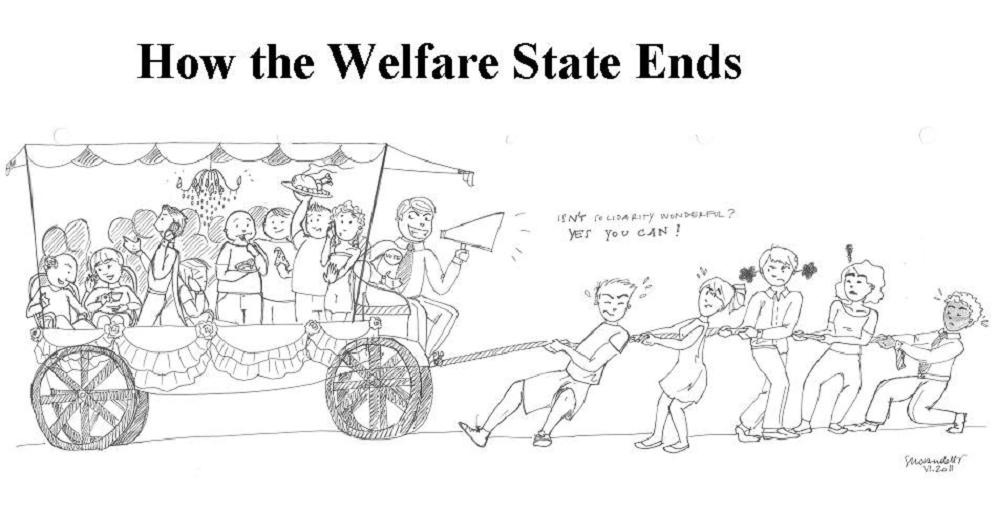
These images are remarkably accurate. The welfare state starts with small programs targeted at a handful of genuinely needy people. But as politicians figure out the electoral benefits of expanding programs and people figure out the that they can let others work on their behalf, the ratio of producers to consumers begins to worsen.
_________
President Obama c/o The White House
1600 Pennsylvania Avenue NW
Washington, DC 20500
When the government gets so big that it distorts the behavior of the private market then it is too big. The federal government is now spending 24.8% of GDP and traditionally for the first 150 years of our nation’s history we spent under 5% unless in wartime. This massive spending now by the federal encourages people to lie in order to get money for the government too instead of trying to work hard to earn money in the private market.
Why is big government bad for an economy? The easy answer is that big government usually means high tax rates, and this penalizes work, saving, investment, and entrepreneurship. And perhaps some of the spending is financed by borrowing, and this diverts money from private investment.
That’s a correct answer, but it’s only part of the story. In most cases, there is added damage because politicians spend money in ways that further undermine incentives to produce.
For instance, let’s assume a government spends $1 billion on some sort of redistribution program. Extracting that money from the productive sector of the economy obviously will cause some damage, but it’s also important to estimate how the supposed beneficiaries of the money will react. What if they decide to earn less income in order to be eligible for the handouts, as even the statists at the OECD have recognized?
In other words, it hurts the economy when government collects money, and it often hurts the economy when government spends money. Sort of a perverse 2-for-1 special (though “Rahn Curve” analysis does show that some types of spending – on core public goods – is correlated with better economic performance)
Let’s look at an example from Greece, showing how handouts distort behavior and corrupt people. Here are some remarkable tidbits from a Wall Street Journal story.
The Greek health ministry is investigating on Zakynthos after local officials flagged records showing what they said is an implausibly high number of disability claims for blindness. About 1.8% of the island’s population of 39,000 claimed the benefit last year, according to the health ministry. That is around nine times the prevalence of blindness estimated for many European countries in a 2004 study published in a World Health Organization journal. Among those who put in for the blindness benefit on Zakynthos, a local official said, were a taxi driver and a bird hunter. …But the island is hardly alone, according to health ministry officials, who say fraudulent disability claims are a problem across the nation… Zakynthos Mayor Stelios Bozikis on a Greek television talk show said residents angry about the benefits crackdown and other financial overhauls pelted him with yogurt at a recent event.
Let’s go back to the story and look at a rough estimate of how much fraud exists.
In an attempt to root out fraud, the Greek health ministry recently required disability claimants nationwide to register in a centralized database, appearing in person or sending a representative. The registration resulted in 36,000 fewer disability claims than in 2011, the health ministry said. The ministry alleges these dropped claims were fraudulent, in many cases reflecting multiple claims for the same disability or payments in the name of dead beneficiaries. It also alleges that some doctors accepted money for false diagnoses and some local politicians signed off on the benefits to win support, and said it is giving public prosecutors information about areas where it suspects a high level of fraud. Only 190 of the nearly 700 people it says had been collecting the blindness benefit on Zakynthos participated in the registration, the ministry said.
I have no idea if Zakynthos is representative, but that’s an incredibly high fraud rate. And this is just a glimpse at the workings of one government program. Now multiply that by some large number and you’ll begin to understand the damage caused by government.
And America is not immune. When politicians make it easier to ride in the wagon than to pull the wagon (as this cartoon illustrates), society sooner or later gets in trouble.
____________
Thank you so much for your time. I know how valuable it is. I also appreciate the fine family that you have and your commitment as a father and a husband.
Sincerely,
Everette Hatcher III, 13900 Cottontail Lane, Alexander, AR 72002, ph 501-920-5733, lowcostsqueegees@yahoo.com
Below is a speech by George W. Bush honoring Milton Friedman:
Milton Friedman Honored for Lifetime Achievements 2002/5/9
Milton Friedman said that getting George Bush I to be his vice president was his biggest mistake because he knew that Bush was not a true conservative and sure enough George Bush did raise taxes when he later became President. I wonder if Jeb Bush has the same genes as his father.
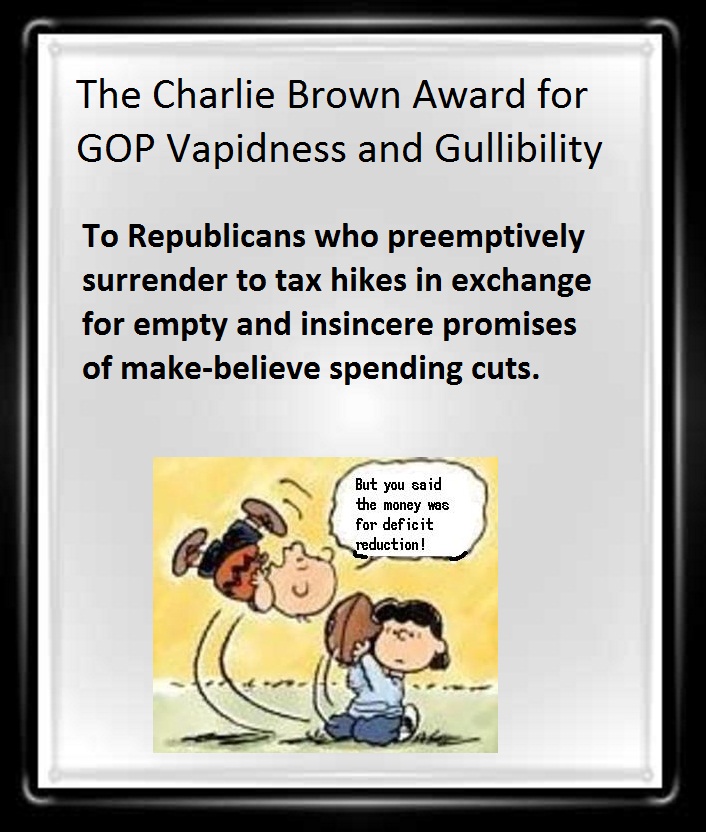
What we need is some people in Washington that are brave enough to say that we have taken too much of the american people’s money and we have to make the painful spending cuts in order to balance the budget and not ask for any more tax increases!!!! Arkansas’ congressman Rick Crawford has also made the Charlie Brown mistake.
But I then pointed out that all of those scenarios were total fantasies and that it would be more realistic to envision me playing center field for the New York Yankees.
That’s why I like the anti-tax pledge of Americans for Tax Reform. You don’t solve America’s fiscal problems by saying no to all tax increases, but at least you don’t move in the wrong direction at a faster rate.
Notwithstanding the principled and pragmatic arguments against putting tax increases on the table, some Republicans – in a triumph of hope over experience – are preemptively acquiescing to tax hikes.
Jeb Bush, the former Florida governor, said Friday that he could back a broad deficit plan that increased taxes, a stance that puts him at odds with other prominent Republicans. Bush told a House panel he could get behind a plan that combined 10 dollars in spending cuts for every dollar of new revenue… “The problem is the 10 never materializes,” [Congressman Paul] Ryan said after Bush said he could support a revenue-increasing deficit deal. Norquist also has criticized deficit deals crafted in 1982 and 1990 – the latter agreed to by then-President George H.W. Bush, Jeb’s father – for failing to deliver on the spending side.
Kudos to Paul Ryan for making the obvious point about make-believe spending cuts. And Grover is correct about the failure of previous budget deals.
Indeed, I cited a New York Times column that inadvertently revealed that the only budget deal that worked was the 1997 pact that cut taxes rather than raised them.
Sen. Lindsey Graham (R-S.C.) said Tuesday he believed Republicans should consider eliminating loopholes in the tax code even if they aren’t replaced by additional tax cuts, a move that would break with an anti-tax pledge many GOP lawmakers have signed with activist Grover Norquist. “When you eliminate a deduction, it’s OK with me to use some of that money to get us out of debt. That’s where I disagree with the pledge,” Graham told ABC News. …”I’m willing to move my party, or try to, on the tax issue. I need someone on the Democratic side being willing to move their party on structural changes to entitlements.” Graham said, for instance, he would support a plan that included $4 in spending cuts for every $1 in tax increases. During a Republican debate last August, all eight Republican candidates in attendance said they would reject a proposal to trade $10 in spending cuts for even $1 in tax increases.
In some sense, Senator Graham’s comments are reasonable. With real spending cuts and less-damaging forms of tax hikes, an acceptable deal is possible. But only in Fantasia, not in Washington.
In the real world, all that Senator Graham has done is to move the debate slightly to the left.
But I do have nightmares about government getting even bigger, and that’s why I don’t want tax increases on the table. I don’t even want them in the room. Or the house. Or the neighborhood.
That’s why Jeb Bush and Lindsey Graham are the newest winners of the Charlie Brown Award. They’ve put blood in the water. I wonder if they’ll act surprised when hungry sharks show up looking for a meal?


 Mandatory Spending Has Increased Five Times Faster Than Discretionary Spending
 Obama’s Budget Would Reduce National Defense Spending