Eight Reasons Why Big Government Hurts Economic Growth
We got to cut these welfare programs before everyone stops working and wants to get the free stuff. The Bible says if you don’t work then you should not eat. It also says that churches should help the poor but it doesn’t say that the government should step in and do that.
How many Americans depend on a government program for a basic (or not so basic) need? According to recently released Census Bureau data and Heritage Foundation calculations, the number is 128.8 million. That is the number of individuals directly receiving aid that they depend on for their daily consumption of things such as rent, prescription drugs, and higher education.
That is 41.3 percent of theU.S.population as of July 2011.
TheWall Street Journal puts the number of people living in a household where at least one member receives help at an even higher 49.1 percent.
The 41.3 percent number is surely undercounting. It is based on survey responses to the Census Bureau’s Current Population Survey (CPS) of March 2011. These responses are well known to undercount the number of people receiving Medicaid, Medicare, Social Security, State Children’s Health Insurance, and Temporary Assistance to Needy Families. Heritage research shows that the undercount in higher education subsidies may be the most dramatic.
The calculations that Heritage ran on the Census Bureau data do not, however, double-count individuals. So if someone receives Medicare and Social Security, he is counted only once. Therefore, the dramatic undercounting in higher education subsidy beneficiaries makes the biggest difference, because recipients of education subsidies are generally younger and not likely to be on other dependency-creating programs.
Those subsidized by the government for their higher education are generally dependent only on that government program. Heritage research shows that of the small number of people in the March CPS survey who admitted that they received higher education subsidies—about 2 million—less than one-half of 1 percent relied on Social Security retirement income; only 1.5 percent were on Medicare in 2011; and only 16 percent were on food stamps. The 2 million admitting they received higher education subsidies is assuredly a vast undercount, because the number of people receiving Pell grants in 2011 was 9.7 million, according to the Department of Education.
Just counting true Pell grant recipients would add millions to the lowball estimate of 128.8 million government dependents.
Sixteen years after President Bill Clinton erroneously declared “the era of big government” over, it’s not over; it’s still with us and growing. Unless something is done,Americaas we have known it will cease to exist.
There is a way out of the dependence-on-government trap. Steps are laid out in Heritage’s Saving the American Dream plan. If this plan were implemented, the economy would grow, government expenses would be held in check, and more Americans would support themselves. Some of the good results for individuals and the country would be:
More Americans climbing the prosperity ladder.
Fewer Americans stuck in the rut of “just getting by.”
Those who currently receive more from the government than they pay in taxes could become contributing taxpayers.
Catastrophe averted by shrinking the runaway national debt.
More happiness as the intergenerational cycle of government dependence would be shattered and replaced by an intergenerational cycle of self-reliance and private-sector opportunities for all.
In this 1968 interview, Milton Friedman explained the negative income tax, a proposal that at minimum would save taxpayers the 72 percent of our current welfare budget spent on administration. http://www.LibertyPen.com
In 1980 economist and Nobel laureate Milton Friedman inspired market reform in the West and revolutions in the East with his celebrated television series “Free To Choose.”
Thirty years later, in this one-hour documentary, the young Swedish writer, analyst and Cato Institute Fellow Johan Norberg travels in Friedman’s footsteps to see what has
actually happened in the places Friedman’s ideas helped transform. In location after location Norberg examines the contemporary relevance of Friedman’s ideas in the 2011 world of globalization and financial crisis. Central to his examination are the perennial questions concerning power and prosperity, and the trade-offs between individual liberty and income equality.
___________
I have enjoyed reading this series of reviews by T. Kurt Jaros on Milton and Rose Friedman’s book “Free to Choose.” I hope you enjoy it as much as I did.
T. Kurt Jaros is currently a Master’s student studying Systematic Theology at King’s College in London. He holds a B.A. in Philosophy and Political Science cum laude and an M.A. in Christian Apologetics high honors from Biola University, an evangelical Christian university outside of Los Angeles.
He enjoys learning and thinking about theology, specifically historical theology, philosophical theology and philosophy of religion, and issues pertaining to monergism and synergism. Additionally, he enjoys learning and thinking about political philosophy, economics, American political history, and campaigns.
This is part of a series on Milton Friedman’s “Free to Choose.”
A couple weeks ago I wrote about the introduction to Free to Choose by Milton and Rose Friedman. In this post, I will explore some of the points from the first chapter, “The Power of the Market.”
Friedman begins the chapter by explaining the difference between a command and a voluntary economy. Like a military, there is a chain of commands that take place. Yet the general cannot be entirely accountable for everything that a private does. That is why “commands must be supplemented by voluntary cooperation,” which is a more fundamental technique of coordinating activities. Friedman argues that there is no society that operates entirely on the command method or the voluntary method. Even in the Soviet Union there were moonlighters who would take extra pay to fix a household problem same day than for the homeowner to wait months for the government.
The market functions in not-so-obvious ways. Leonard E. Read wrote a story about how a pencil is made, from the forests of northwestern America to the factories in Indonesia. Yet at the store, we exchange some of our money for some pencils. Astoundingly, “no one sitting in a central office gave orders to these thousands of people” and “no military police enforced the orders that were not given.” How could this be? Adam Smith understood this clearly: “if an exchange between two parties is voluntary, it will not take place unless both believe they will benefit from it.” Smith observed that in a free market, buyers and sellers would coordinate together voluntarily to make everyone better off. Economic order emerges from individuals seeking their own interest.
The price system that forms helps to naturally regulate the market in three ways: transmits information, incentivizes price efficiency and distributes income.
1. Transmits information: Only necessary information is transmitted between buyer and sellers. This includes information of changes in demand and supply but not causes of the changes. “A major problem in transmitting information efficiently is to make sure that everyone who can use the information gets it without clogging the ‘in’ baskets of those who have no use for it.” The price system naturally solves the problem because the people who are looking for the information search it out to better their situation. From the consumer’s perspective, this explains why I spend so much time looking for good deals between different grocery stores! However, the government can also me a major source of interference with the natural market when it sets tariffs on international trade, fixes wages and prices, regulates certain industries, and produces erratic inflation.
2. Incentivizes price efficiency: Understanding incentives was the easiest of the three natural regulations for me to grasp. As consumers, if there is a high price for an item, we tend to economize as much as we can to get our money’s worth. My wife is always getting on to me for trying to penny-pinch, and that’s more true for the larger purchases we make. But producers also have incentives when it comes to running a business. They want to run a business as cheaply as possible to maximize their profit. Additionally, workers consider incentives. “Satisfaction in a job may compensate for low wages. On the other hand, higher wages may compensate for a disagreeable job.”
3. Distributes income: Lastly, the market redistributes wealth in a natural way. Some people are unhappy with the distribution of wealth and so look to where they think the grass is greener. “In a command system envy and dissatisfaction are directed at the rulers. In a free market system they are directed at the markets.” However, “fixing” the free market causes disincentives and leads to inefficiencies of wealth growth. The command system is worse. Workers are unhappy when bureaucracies tell them what to do and when the government builds things, nobody takes responsibility for them: “when everybody owns something, nobody owns it, and nobody has a direct interest in maintaining or improving its condition.” The command system does not transmit information or incentivize as efficiently as the free market, and it distorts the incentives for various income distributions.
Next time I’ll explain the role of a government in a free market.
Johan Norberg vs. Naomi Klein and The Shock Doctrine
Swedish author Johan Norberg sits down with reason.tv’s Michael C. Moynihan to discuss Naomi Klein’s diastrous yet popular polemic against the great free market economist Milton Friedman.
I must say that I have lots of respect for Reason Magazine and for their admiration of Milton Friedman. However, I do disagree with one phrase below. At the end of this post I will tell you what sentence it is. Uploaded by ReasonTV on Jul 28, 2011 There’s no way to appreciate fully the […]
Milton Friedman on Hayek’s “Road to Serfdom” 1994 Interview 1 of 2 Uploaded by PenguinProseMedia on Oct 25, 2011 Says Federal Reserve should be abolished, criticizes Keynes. One of Friedman’s best interviews, discussion spans Friedman’s career and his view of numerous political figures and public policy issues. ___________________ Two Lucky People by Milton and Rose Friedman […]
What a great man Milton Friedman was. The Legacy of Milton Friedman November 18, 2006 Alexander Tabarrok Great economist by day and crusading public intellectual by night, Milton Friedman was my hero. Friedman’s contributions to economics are profound, the permanent income hypothesis, the resurrection of the quantity theory of money, and his magnum opus with […]
Milton Friedman videos and transcripts Part 7 On my blog http://www.thedailyhatch.org I have an extensive list of posts that have both videos and transcripts of MiltonFriedman’s interviews and speeches. Here below is just small list of those and more can be accessed by clicking on “Milton Friedman” on the side of this page or searching […]
Milton Friedman at Hillsdale College 2006 July 2006 Free to Choose: A Conversation with Milton Friedman Milton Friedman Economist Milton Friedman is a senior research fellow at the Hoover Institution at Stanford University and a professor emeritus of economics at the University of Chicago, where he taught from 1946-1976. Dr. Friedman received the Nobel Memorial […]
Milton Friedman said that getting George Bush I to be his vice president was his biggest mistake because he knew that Bush was not a true conservative and sure enough George Bush did raise taxes when he later became President. Below is a speech by George W. Bush honoring Milton Friedman: Milton Friedman Honored for […]
Below is a discussion from Milton Friedman on Bill Clinton and Ronald Reagan. February 10, 1999 | Recorded on February 10, 1999 audio, video, and blogs » uncommon knowledge PRESIDENTIAL REPORT CARD: Milton Friedman on the State of the Union with guest Milton Friedman Milton Friedman, Senior Research Fellow, Hoover Institution and Nobel Laureate in […]
Milton Friedman and Chile – The Power of Choice Uploaded by FreeToChooseNetwork on May 13, 2011 In this excerpt from Free To Choose Network’s “The Power of Choice (2006)”, we set the record straight on Milton Friedman’s dealings with Chile — including training the Chicago Boys and his meeting with Augusto Pinochet. Was the tremendous […]
Milton Friedman’s negative income tax explained by Friedman in 1968: President Obama c/o The White House 1600 Pennsylvania Avenue NW Washington, DC 20500 Dear Mr. President, I know that you receive 20,000 letters a day and that you actually read 10 of them every day. I really do respect you for trying to get a […]
Milton Friedman on the American Economy (5 of 6) Uploaded by donotswallow on Aug 9, 2009 THE OPEN MIND Host: Richard D. Heffner Guest: Milton Friedman Title: A Nobel Laureate on the American Economy VTR: 5/31/77 _____________________________________ Below is a transcipt from a portion of an interview that Milton Friedman gave on 5-31-77: Friedman: […]
Milton Friedman is a superb economist. There are not, and never have been, many.— William R. Allen, Professor of Economics, UCLA
The true test of a scholar’s work is the judgment that is made, not at the time his work is being done, but twenty-five or fifty years later. — Milton Friedman on ‘Meet the Press’ in October, 1976
Today is the centenary anniversary of the birth of Milton Friedman. Born of humble origin in Brooklyn, New York to two Carpatho-Ruthenian (Hungarian/Ukrainian) immigrants on July 31, 1912, Friedman would go on to become a world-famous economist, the 1976 Nobel Laureate, and perhaps second only to John Maynard Keynes in global influence during the 20th century. Like Keynes, Friedman was famous for being a public intellectual as much as he was technical economist, and in fact with his prodigious output across an active career spanning six decades, he far surpassed the master in the latter capacity. As the 20th century economist most associated with notions of free enterprise, classical liberalism, and limited government, Friedman’s life is worth remembering today for whom he was, what he accomplished, and how he might regard the present challenges in the global economy.
As a testament to the broad-based research agenda that undergirded his prolific writings, Friedman’s technical work was as impressive as it was wide-ranging; he made notable contributions in monetary theory and policy, price theory, the consumption function and permanent-income hypothesis, Friedman-Phelps Phillips Curve-related macro-policy theorizing and findings, international finance and exchange rate policy, empirical methodology, and statistical theory and its applications. As a policy intellectual, he made his mark as a founder of the Mont Pelerin Society, with time spent at the American Enterprise Institute, the Hoover Institution at Stanford, associations with the Cato Institute and Heritage Foundation, and as a key advisor to President Reagan for all eight years of Reagan’s term of office. And as a writer and speaker in the popular literature and media, Friedman’s considerable influence stemmed from his 17-year stint as a columnist for Newsweek (often opposite Paul Samuelson), as the author, creator, and narrator of the wildly successful PBS TV-documentary series known as Free to Choose, and as author of several books and monographs written for popular consumption (his two most popular books, Capitalism and Freedom and Free to Choose, were best-sellers and remain in print and widely read).
Among the many policy changes his positions influenced were those pertaining to lower marginal taxation on capital and income, the military draft, flexible exchange rates, monetary policy rules and Federal Reserve behavior, federal spending trajectory, and educational choice (much to his later regret, Friedman also played an important part in the wartime shift of health care delivery to its centering in the tax-advantaged employer-based insurance scheme that became embedded in the U.S. economy after 1943).
At the University of Chicago, Friedman was an inheritor and then keeper of the long tradition in economic theory of what has come to be known as the Chicago School, built by the likes of Frank Knight, Lloyd Mints, Henry Simons, Ronald Coase, and more recently in addition to Friedman, George Stigler, Gary Becker, and Robert Lucas. The Chicago School is notable for rigorous “neoclassical price theory” (which is a fancy way of saying how supply and demand affect prices and output in individual markets) and its policy concomitant, a commitment to a laissez-faire regime and minimal government interference in markets. While Friedman eschewed intellectual or partisan labels, famously saying once that there was only “good” economics and “bad” economics, he nonetheless was, as an outgrowth of his Chicago association and opposition to Keynesian policies, grouped together with those who adhered to the monetarist label.
The monetarists were key figures on the scene in 20th century economics, as they were the first group of researchers to systematically oppose what became the dominant orthodoxy in theory and policy, Keynesianism. In the landmark Monetary History of the United States: 1867-1960, written with his longtime collaborator Anna Schwartz, Friedman showed conclusively that changes in the quantity of money led to shifts in nominal income, and at least in the short run, often in real incomes and output as well. That the line of causality runs from the money stock to impacting nominal GDP – and not the other way around – is now conventional wisdom in economics, but it had enormous policy implications at the time, in the 1960s and ‘70s.
At the time, Keynesian policy-makers felt that shifts in aggregate spending drove changes in the money stock, monetary policy was often ineffective as a policy tool and neutral even in the short run, and that therefore activist fiscal policy should be the predominant tool to use in “managing” the market economy through slumps. Indeed, this view was precursory to the core paradigm of Keynes’ instability thesis regarding the market economy: wild shifts in business investment, driven by changing whims as manifested in investor sentiment, caused the boom-bust business cycle that seemed to be an inherent feature of a modern capitalist economy. Keynesian theory of course borrows the capitalist instability hypothesis directly from Marx, and prior to Friedman there had been no effective post-war rebuttal of its logic.
This gets to the heart of the contributions Friedman made as a public intellectual and highly influential policy advocate. By showing the nature of monetary/output causality in a conclusive way, Friedman not only proved that inflation was a monetary phenomenon, “anywhere and everywhere,” but more broadly he showed that monetary instability, and not the crazy whims of investors and their animal spirits, was the main source of economic downturns and depressions. As such, Friedman advocated a “rules-based” Federal Reserve for much of his career, in which increases in the quantity of money would be pre-set at a certain growth level (say, 3-5% per year, in line with income and output growth), as opposed to a Fed which engaged in discretionary activism.
This debate about “rules versus discretion” in turn permeated most all else about his pursuits in public policy, and Friedman was in the end so successful because his policy prescriptions were rooted in both rigorous theory as well as significant empirical observations. That a capitalist economy was inherently unstable and in need of activist (viz., discretionary) government intervention was disproven by neoclassical price theory, in which prices shift to clear markets and quickly move resources to their highest and best use, based on changing consumer preferences and production technologies. And one of Friedman’s great talents was to so cogently explain this in an extemporaneous and audience-friendly way, often mixing in “empirical observations” to confirm his point, that his ideas about the superiority of markets and limits of activist government – indeed, to the point where he was able to illustrate the harm caused by government intervention – were manifestly influential in the rise of Reaganism after 1980.
That is to say, in the years running up to the advent of Mr. Reagan, Friedman had a material impact in changing the climate of opinion in the United States in favor of market-oriented solutions to policy challenges (or to say it differently, Friedman was able to show that it was government failure that led to an unstable economy, not market failure). In the dominating era of Keynes, Friedman’s ability to articulate clear explanations of market phenomena, often on the fly in public forums, and in a way “common men” could apprehend his thinking and logic, was instrumental in paving the way for Reagan. Would there have been a Reagan in 1980, and eventual recovery and prosperity, if there had been no Friedman? Probably, but to apprehend the necessity of considering the question is to understand how important Friedman’s impact was on recent U.S. history.
What would Friedman make of the present global torpor? He would of course have been saddened by the debacle led by Fannie and Freddie, both of which he long railed against as corrupt government-sponsored enterprises, and how it was fueled by a hyper-activist Federal Reserve, which poured gas on a global fire. For him the Great Recession would have been confirmation of many of the sub-texts of all his work: the folly of government interventionism in the face of insoluble problems with information and incentives; the waste and corruption endemic to big government programs, even those with the most charitable of intentions; the critical importance of a dependably-valued currency that does not distort asset prices in financial markets any more than it does consumer prices; and the importance of avoiding burdensome government spending and regulations that strangle entrepreneurial initiative and “crowd out” productive private investment.
Professor Friedman would likely approach the challenge of convincing the American public of the folly of current policy in the same manner as he did in so many other policy controversies: paint a convincing picture grounded in both theory and empirical reality – but happily, in a way most people would easily understand. He was fond of pointing out “natural experiments” in public policy, for example, such as the different outcomes in economic performance between East and West Germany, the People’s Republic of China and Taiwan, or North and South Korea, where “all else” could be held constant except the political regime and the associated policy mix. His central point was always the same: the larger the government’s activist footprint in the economy, the smaller is the capacity of the economy to grow, and hence the slower the standard of living can progress. In spite of government’s best intentions, this is an ironclad law of economics, bearing repeating in the current moment.
Mr. Friedman was not perfectly consistent in his advocacy of laissez-faire: for most of his career he was in favor of central banks running fiat currencies, mediated by international freely-floating exchange rates. And he agreed with Keynes’ critique of gold as a “relic.” But even here, at the end of his life, he questioned the efficacy of central banking and any sort of activist monetary policy, and spoke not unfavorably of a role for gold or return to some form of commodity money. And he had great respect for the emerging Austrian school of economists, notably Lawrence White of George Mason University and George Selgin of the University of Georgia, both of whom argue in favor of the abolition of both the Fed and deposit insurance, and a return to commodity money as it arises in a system of freely competitive banking firms. He clearly had come to recognize the folly of too-big-to-fail moral hazard wrought by the Fed and modern policy, and was sympathetic to White’s and Selgin’s scheme to eliminate this with market-generated monetary and banking institutions.
All in all, however, the venerable philosophy that underlies the free market economy has never had a better friend or more articulate spokesman than Milton Friedman. One hopes that the great cause to which he devoted his life, the liberalism of the 19th century, is not yet an historical artifact. RIP at age 100.
John Chapman is an economist with Alhambra Partners, a Miami-based investment management firm, and an analyst at Hill & Cutler Co., an economic research firm based in Washington, D.C. He can be reached at john.chapman@hill-cutler.com.
They’re right, though they probably don’t realize the seriousness of that looming crisis.
Here’s what you need to know: America’s fiscal crisis is actually a spending crisis, and that spending crisis is driven by entitlements.
More specifically, the vast majority of the problem is the result of Medicaid, Medicare, and Social Security, programs that are poorly designed and unsustainable.
The Medicaid program imposes high costs while generating poor results. This Center for Freedom and Prosperity Foundation video explains how block grants, such as the one proposed by Congressman Paul Ryan, will save money and improve healthcare by giving states the freedom to innovate and compete.
This Center for Freedom and Prosperity Foundation video explains how a “premium-support” plan would solve Medicare’s fiscal crisis and improve the overall healthcare system. This voucher-based system also would protect seniors from bureaucratic rationing. http://www.freedomandprosperity.org
There are two crises facing Social Security. First the program has a gigantic unfunded liability, largely thanks to demographics. Second, the program is a very bad deal for younger workers, making them pay record amounts of tax in exchange for comparatively meager benefits. This video explains how personal accounts can solve both problems, and also notes that nations as varied as Australia, Chile, Sweden, and Hong Kong have implemented this pro-growth reform. www.freedomandprosperity.org
_______________________
Regular readers know I’m fairly gloomy about the future of liberty, but this is one area where there is a glimmer of hope.
The Chairman of the House Budget Committee actually put together a plan that addresses the two biggest problems (Medicare and Medicaid) and the House of Representatives actually adopted the proposal.
The Senate didn’t act, of course, and Obama would veto any good legislation anyhow, so I don’t want to be crazy optimistic. Depending on how things play out politically in the next six years, I’ll say there’s actually a 20 percent chance to save America.
Milton Friedman in his series “Free to Choose” used a pencil as a simple example to should have the “invisible hand” of the freemarket works (phrase originally used by Adam Smith)
On July 31, 2012 I will post only articles involving Milton Friedmon.
“Milton Friedman is a scholar of first rank whose original contributions to economic science have made him one of the greatest thinkers in modern history.” —President Ronald Reagan
“How grateful I have been over the years for the cogency of Friedman’s ideas which have influenced me. Cherishers of freedom will be indebted to him for generations to come.” —Alan Greenspan, former Chairman, Federal Reserve System
“Right at this moment there are people all over the land, I could put dots on the map, who are trying to prove Milton wrong. At some point, somebody else is trying to prove he’s right That’s what I call influence.” —Paul Samuelson, Nobel Laureate in Economic Science
“Friedman’s influence reaches far beyond the academic community and the world of economics. Rather than lock himself in an ivory tower, he has joined the fray to fight for the survival of this great country of ours.” —William E. Simon, former Secretary of the Treasury
“Milton Friedman is the most original social thinker of the era.” —John Kenneth Galbraith, former Professor of Economics, Harvard University
Perhaps Friedman’s greatest success began in 1979 when he and his wife Rose authored the book, Free to Choose, based on the famous ten-part TV series for PBS by the same title. Both the TV program and the book were drawn from an earlier series of lectures presented by Friedman. Because it aired during a period of critical economic distress during the Carter Administration and in the aftermath of the Vietnam War, Watergate scandal, and Richard Nixon’s resignation as President, the program is widely regarded as being a major factor in shifting American public opinion toward appreciating the need to dismantle government largess. The series was shown in England, Japan, Italy, Australia, Germany, Canada, and many other countries, and the book was translated for distribution around the world, selling more than one million copies.
__________
No other issue is more misunderstood today than equality. President Obama has used class warfare over and over the last few months and according to him equality at the finish line is the equality that we should all be talking about. However, socialism has never worked and it has always killed incentive to produce more. Milton Friedman expressed the conversative’s best and I am glad that I had the chance to be studying his work for over 30 years now.
In 1980 when I first sat down and read the book “Free to Choose” I was involved in Ronald Reagan’s campaign for president and excited about the race. Milton Friedman’s books and film series really helped form my conservative views. Take a look at one of my favorite films of his:
Created Equal [1/7]. Milton Friedman’s Free to Choose (1980)
In this program, Milton Friedman visits India, the U.S., and Britain, examining the question of equality. He points out that our society traditionally has embraced two kinds of equality: equality before God and equality of opportunity. The first of these implies that human beings enjoy a certain dignity simply because they are members of the human community. The second suggests societies should allow the talents and inclinations of individuals to unfold, free from arbitrary barriers. Both of these concepts of equality are consistent with the goal of personal freedom.
In recent years, there has been growing support for a third type of equality, which Dr. Friedman calls “equality of outcome.” This concept of equality assumes that justice demands a more equal distribution of the economic fruits of society. While admitting the good intentions of those supporting the idea of equality of outcome, Dr. Friedman points out that government policies undertaken in support of this objective are inconsistent with the ideal of personal freedom. Advocates of equality of outcome typically argue that consumers must be protected by government from the insensitivities of the free market place.
Dr. Friedman demonstrates that in countries where governments have pursued the goal of equality of outcome, the differences in wealth and well being between the top and the bottom are actually much greater than in countries that have relied on free markets to coordinate economic activity. Indeed, says Dr. Friedman, it is the ordinary citizen who benefits most from the free market system. Dr. Friedman concludes that any society that puts equality ahead of freedom will end up with neither. But the society that puts freedom before equality will end up with both greater freedom and great equality.
Friedman: From the Victorian novelists to modern reformers, a favorite device to stir our emotions is to contrast extremes of wealth and of poverty. We are expected to conclude that the rich are responsible for the deprivations of the poor __ that they are rich at the expense of the poor.
Whether it is in the slums of New Delhi or in the affluence of Las Vegas, it simply isn’t fair that there should be any losers. Life is unfair __ there is nothing fair about one man being born blind and another man being born with sight. There is nothing fair about one man being born of a wealthy parent and one of an indigenous parent. There is nothing fair about Mohammed Ali having been born with a skill that enables him to make millions of dollars one night. There is nothing fair about Marleena Detrich having great legs that we all want to watch. There is nothing fair about any of that. But on the other hand, don’t you think a lot of people who like to look at Marleena Detrich’s legs benefited from nature’s unfairness in producing a Marleena Detrich. What kind of a world would it be if everybody was an absolute identical duplicate of anybody else. You might as well destroy the whole world and just keep one specimen left for a museum. In the same way, it’s unfair that Muhammed Ali should be a great fighter and should be able to earn millions. But would it not be even more unfair to the people who like to watch him if you said that in the pursuit of some abstract idea of equality we’re not going to let Muhammed Ali get more for one nights fight than the lowest man on the totem pole can get for a days unskilled work on the docks. You can do that but the result of that would be to deny people the opportunity to watch Mohammad Ali. I doubt very much he would be willing to subject himself to the kind of fights he’s gone through if he were to get the pay of an unskilled docker.
This beautiful estate, its manicured lawns, its trees, its shrubs, was built by men and women who were taken by force in Africa and sold as slaves in America. These kitchen gardens were planted and tended by them to furnish food for themselves and their master, Thomas Jefferson, the Squire of Monticello. It was Jefferson who wrote these words: We hold these truths to be self-evident that all men are created equal. That they are endowed by their creator with certain inalienable rights, that among these are life, liberty and the pursuit of happiness. These words penned by Thomas Jefferson at the age of 33 when he wrote the Declaration of Independence, have served to define a basic ideal of the United States throughout its history.
Much of our history has revolved about the definition and redefinition of the concept of equality, about the intent to translate it into practice. What did Thomas Jefferson mean by the words all men are created equal? He surely did not mean that they were equal and/or identical in what they could do and what they believed. After all, he was himself a most remarkable person. At the age of 26, he designed this beautiful house of Monticello, supervised its construction and indeed is said to have worked on it with his own hands. He was an inventor, a scholar, an author, a statesman, governor of Virginia, President of the United States, minister to France, he helped shape and create the United States. What he meant by the word “equal” can be seen in the phrase “endowed by their creator”. To Thomas Jefferson, all men are equal in the eyes of God. They all must be treated as individuals who have each separately a right to life, liberty and the pursuit of happiness.
Of course, practice did not conform to the ideals. In Jefferson’s life or in ours as a nation, he agonized repeatedly during his lifetime about the conflict between the institution of slavery and the fine words of the declaration. Yet, during his whole life, he was a slave owner.
This is the City Palace in Jaipur, the capitol of the Indian state of Rajasthan, is just one of the elegant houses that were built here 150 years ago by the prince who ruled this land. There are no more princes, no more Maharajas in India today. All titles were swept away by the government of India in its quest for equality. But as you can see, there are still some people here who live a very privileged life. The descendants of the Maharajas financed this kind of life partly by using other palaces as hotels for tourists __ tourists who come to India to see how the other half lives. This side of India, the exotic glamorous side, is still very real. Everywhere in the world there are gross inequalities of income and wealth. They offend most of us.
A myth has grown up that free market capitalism increases such inequalities, that the rich benefit at the expense of the poor. Nothing could be further from the truth. Wherever the free market has been permitted to operate, the ordinary man has been able to attain levels of living never dreamed of before. Nowhere is the gap between rich and poor. Nowhere are the rich richer and the poor poorer than in those societies that do not permit the free market to operate, whether they be feudal societies where status determines position, or modern, centrally-planned economies where access to government determines position.
Central planning was introduced in India in considerable part in the name of equality. The tragedy is that after 30 years, it is hard to see any significant improvement in the lot of the ordinary person.
Liberals like President Obama want to shoot for an equality of outcome. That system does not work. In fact, our free society allows for the closest gap between the wealthy and the poor. Unlike other countries where free enterprise and other freedoms are not present. This is a seven part series. Created Equal [7/7]. Milton Friedman’s Free to Choose […]
Milton Friedman’s solution to limiting poverty Liberals like Michael Cook just don’t get it. They should listen to Milton Friedman (who is quoted in this video below concerning the best way to limit poverty). New Video Shows the War on Poverty Is a Failure Posted by Daniel J. Mitchell The Center for Freedom and Prosperity has […]
Liberals like President Obama want to shoot for an equality of outcome. That system does not work. In fact, our free society allows for the closest gap between the wealthy and the poor. Unlike other countries where free enterprise and other freedoms are not present. This is a seven part series. Created Equal [6/7]. Milton Friedman’s Free to Choose […]
Liberals like President Obama want to shoot for an equality of outcome. That system does not work. In fact, our free society allows for the closest gap between the wealthy and the poor. Unlike other countries where free enterprise and other freedoms are not present. This is a seven part series. Created Equal [5/7]. Milton Friedman’s Free to Choose […]
Republican debate Oct 18, 2011 (last part) with video clips and transcript Below are video clips and the transcript. pt 5 pt 6 pt 7 COOPER: We’re going to move on to an issue very important here in the state of Nevada and throughout the West. We have a question from the hall. QUESTION: Yeah, […]
Uploaded by YAFTV on Aug 19, 2009 Nobel Laureate Dr. Milton Friedman discusses the principles of Ronald Reagan during this talk for students at Young America’s Foundation’s 25th annual National Conservative Student Conference MILTON FRIEDMAN ON RONALD REAGAN In Friday’s WSJ, Milton Friedman reflectedon Ronald Reagan’s legacy. (The link should work for a few more […]
Liberals like President Obama want to shoot for an equality of outcome. That system does not work. In fact, our free society allows for the closest gap between the wealthy and the poor. Unlike other countries where free enterprise and other freedoms are not present. This is a seven part series. Created Equal [4/7]. Milton Friedman’s Free to Choose […]
Friedman Friday” Free to Choose by Milton Friedman: Episode “Created Equal” (Part 3 of transcript and video) Liberals like President Obama want to shoot for an equality of outcome. That system does not work. In fact, our free society allows for the closest gap between the wealthy and the poor. Unlike other countries where free enterprise and other […]
Free to Choose by Milton Friedman: Episode “Created Equal” (Part 2 of transcript and video) Liberals like President Obama want to shoot for an equality of outcome. That system does not work. In fact, our free society allows for the closest gap between the wealthy and the poor. Unlike other countries where free enterprise and other freedoms are […]
Milton Friedman and Ronald Reagan Liberals like President Obama (and John Brummett) want to shoot for an equality of outcome. That system does not work. In fact, our free society allows for the closest gap between the wealthy and the poor. Unlike other countries where free enterprise and other freedoms are not present. This is a seven part series. […]
Everywhere school vouchers have been tried they have been met with great success. Why do you think President Obama got rid of them in Washington D.C.? It was a political disaster for him because the school unions had always opposed them and their success made Obama’s allies look bad.
In 1980 when I first sat down and read the book “Free to Choose” I was involved in Ronald Reagan’s campaign for president and excited about the race. Milton Friedman’s books and film series really helped form my conservative views. Take a look at one of my favorite films of his and this one deals with school vouchers:
Here is the video clip and transcript of the film series FREE TO CHOOSE episode “What is wrong with our schools?” Part 1 of 6.
Volume 6 – What’s Wrong with our Schools
Transcript:
Friedman: These youngsters are beginning another day at one of America’s public schools, Hyde Park High School in Boston. What happens when they pass through those doors is a vivid illustration of some of the problems facing America’s schools.
They have to pass through metal detectors. They are faced by security guards looking for hidden weapons. They are watched over by armed police. Isn’t that awful. What a way for kids to have to go to school, through metal detectors and to be searched. What can they conceivably learn under such circumstances. Nobody is happy with this kind of education. The taxpayers surely aren’t. This isn’t cheap education. After all, those uniformed policemen, those metal detectors have to be paid for.
What about the broken windows, the torn school books, and the smashed school equipment. The teachers who teach here don’t like this kind of situation. The students don’t like to come here to go to school, and most of all, the parents __ they are the ones who get the worst deal __ they pay taxes like the rest of us and they are just as concerned about the kind of education that their kids get as the rest of us are. They know their kids are getting a bad education but they feel trapped. Many of them can see no alternative but to continue sending their kids to schools like this.
To go back to the beginning, it all started with the fine idea that every child should have a chance to learn his three R’s. Sometimes in June when it gets hot, the kids come out in the yard to do their lessons, all 15 of them, ages 5 to 13, along with their teacher. This is the last one-room schoolhouse still operating in the state of Vermont. That is the way it used to be. Parental control, parents choosing the teacher, parents monitoring the schooling, parents even getting together and chipping in to paint the schoolhouse as they did here just a few weeks ago. Parental concern is still here as much in the slums of the big cities as in Bucolic, Vermont. But control by parents over the schooling of their children is today the exception, not the rule.
Increasingly, schools have come under the control of centralized administration, professional educators deciding what shall be taught, who shall do the teaching, and even what children shall go to what school. The people who lose most from this system are the poor and the disadvantaged in the large cities. They are simply stuck. They have no alternative.
Of course, if you are well off you do have a choice. You can send your child to a private school or you can move to an area where the public schools are excellent, as the parents of many of these students have done. These students are graduating from Weston High School in one of Boston’s wealthier suburbs. Their parents pay taxes instead of tuition and they certainly get better value for their money than do the parents in Hyde Park. That is partly because they have kept a good deal of control over the local schools, and in the process, they have managed to retain many of the virtues of the one-room schoolhouse.
Students here, like Barbara King, get the equivalent of a private education. They have excellent recreational facilities. They have a teaching staff that is dedicated and responsive to parents and students. There is an atmosphere which encourages learning, yet the cost per pupil here is no higher than in many of our inner city schools. The difference is that at Weston, it all goes for education that the parents still retain a good deal of control.
Unfortunately, most parents have lost control over how their tax money in spent. Avabelle goes to Hyde Park High. Her parents too want her to have a good education, but many of the students here are not interested in schooling, and the teachers, however dedicated, soon lose heart in an atmosphere like this. Avabelle’s parents are certainly not getting value for their tax money.
Caroline Bell, Parent: I think it is a shame, really, that parents are being ripped off like we are. I am talking about parents like me that work every day, scuffle to try to make ends meet. We send our kids to school hoping that they will receive something that will benefit them in the future for when they go out here and compete in the job market. Unfortunately, none of that is taking place at Hyde Park.
Friedman: Children like Ava are being shortchanged by a system that was designed to help. But there are ways to help give parents more say over their children’s schooling.
This is a fundraising evening for a school supported by a voluntary organization, New York’s Inner City Scholarship Fund. The prints that have brought people here have been loaned by wealthy Japanese industrialist. Events like this have helped raise two million dollars to finance Catholic parochial schools in New York. The people here are part of a long American tradition. The results of their private voluntary activities have been remarkable.
This is one of the poorest neighborhoods in New York City: the Bronx. Yet this parochial school, supported by the fund, is a joy to visit. The youngsters here from poor families are at Saint John Christians because their parents have picked this school and their parents are paying some of the costs from their own pockets. The children are well behaved, eager to learn, the teachers are dedicated. The cost per pupil here is far less than in the public schools, yet on the average the children are two grades ahead. That is because teachers and parents are free to choose how the children shall be taught. Private money has replaced the tax money and so control has been taken away from the bureaucrats and put back where it belongs.
This doesn’t work just for younger children. In the 60’s, Harlem was devastated by riots. It was a hot bed of trouble. Many teenagers dropped out of school.
“Milton Friedman is a scholar of first rank whose original contributions to economic science have made him one of the greatest thinkers in modern history.” —President Ronald Reagan
“How grateful I have been over the years for the cogency of Friedman’s ideas which have influenced me. Cherishers of freedom will be indebted to him for generations to come.” —Alan Greenspan, former Chairman, Federal Reserve System
“Right at this moment there are people all over the land, I could put dots on the map, who are trying to prove Milton wrong. At some point, somebody else is trying to prove he’s right That’s what I call influence.” —Paul Samuelson, Nobel Laureate in Economic Science
“Friedman’s influence reaches far beyond the academic community and the world of economics. Rather than lock himself in an ivory tower, he has joined the fray to fight for the survival of this great country of ours.” —William E. Simon, former Secretary of the Treasury
“Milton Friedman is the most original social thinker of the era.” —John Kenneth Galbraith, former Professor of Economics, Harvard University
Here is the video clip and transcript of the film series FREE TO CHOOSE episode “What is wrong with our schools?” Part 6 of 6. Volume 6 – What’s Wrong with our Schools Transcript: FRIEDMAN: But I personally think it’s a good thing. But I don’t see that any reason whatsoever why I shouldn’t have been required […]
Here is the video clip and transcript of the film series FREE TO CHOOSE episode “What is wrong with our schools?” Part 5 of 6. Volume 6 – What’s Wrong with our Schools Transcript: Are your voucher schools going to accept these tough children? COONS: You bet they are. (Several talking at once.) COONS: May I answer […]
Friedman Friday” Free to Choose by Milton Friedman: Episode “What is wrong with our schools?” (Part 3 of transcript and video) Here is the video clip and transcript of the film series FREE TO CHOOSE episode “What is wrong with our schools?” Part 3 of 6. Volume 6 – What’s Wrong with our Schools Transcript: If it […]
Here is the video clip and transcript of the film series FREE TO CHOOSE episode “What is wrong with our schools?” Part 2 of 6. Volume 6 – What’s Wrong with our Schools Transcript: Groups of concerned parents and teachers decided to do something about it. They used private funds to take over empty stores and they […]
Here is the video clip and transcript of the film series FREE TO CHOOSE episode “What is wrong with our schools?” Part 1 of 6. Volume 6 – What’s Wrong with our Schools Transcript: Friedman: These youngsters are beginning another day at one of America’s public schools, Hyde Park High School in Boston. What happens when […]
It’s not much of an exaggeration to say that John Lott has changed the national debate on gun control. His rigorous research and prolific pen have exposed the slip-shod analysis of anti-Constitution advocates.
Responding to some of the demagoguery after the Colorado killings, here’s some of what he wrote for National Review.
…the M&P 15 and the AK-47 are “military-style weapons.” But the key word is “style” — they are similar to military guns in their aesthetics, not in the way they actually operate. The guns covered by the federal assault-weapons ban (which was enacted in 1994 and expired ten year later) were not the fully automatic machine guns used by the military but semi-automatic versions of those guns. The civilian version of the AK-47 uses essentially the same sorts of bullets as deer-hunting rifles, fires at the same rapidity (one bullet per pull of the trigger), and does the same damage.
This is a key point. I suspect most journalists (and far too many people who get their news from these clowns) genuinely think an “assault weapon” is akin to a machine gun.
Lott also shows that there is nothing about “military-style” weapons that enables a bigger magazine.
The Aurora killer’s large-capacity ammunition magazines are also misunderstood. The common perception that so-called “assault weapons” can hold larger magazines than hunting rifles is simply wrong. Any gun that can hold a magazine can hold one of any size. That is true for handguns as well as rifles. A magazine, which is basically a metal box with a spring, is also trivially easy to make and virtually impossible to stop criminals from obtaining.
Lott then discusses some of the research showing that Clinton’s assault-weapons ban didn’t reduce crime.
…despite Obama’s frightening image of military weapons on America’s streets, it is pretty hard to seriously argue that a new ban on “assault weapons” would reduce crime in the United States. Even research done for the Clinton administration didn’t find that the federal assault-weapons ban reduced crime. Indeed, banning guns on the basis of how they look, and not how they operate, shouldn’t be expected to make any difference. And there are no published academic studies by economists or criminologists that find the original federal assault-weapons ban to have reduced murder or violent crime generally. There is no evidence that the state assault-weapons bans reduced murder or violent-crime rates either.
Indeed, it appears that crime has dropped because the ban no longer exists.
Since the federal ban expired in September 2004, murder and overall violent-crime rates have actually fallen. In 2003, the last full year before the law expired, the U.S. murder rate was 5.7 per 100,000 people. Preliminary numbers for 2011 show that the murder rate has fallen to 4.7 per 100,000 people. In fact, murder rates fell immediately after September 2004, and they fell more in the states without assault-weapons bans than in the states with them.
Correlation is not causation, of course, but these results also are consistent with logic and intuition. If law-abiding people have more access to guns, it makes sense that this makes life more difficult for criminals.
P.S. For fans of the Second Amendment, you’ll enjoy these gun control posters (here, here, here, here, and here). And here are some amusing images of t-shirts and bumper stickers on gun control (here, here, and here). In addition, I’ve posted four different videos on gun control (here, here, here, and here). And here’s my interview on NRA-TV.
Friedman: Market offers poor better learningBy Tamara Henry, USA TODAY
By Doug Mills, AP
President Bush honors influential economist Milton Friedman for his 90th birthday earlier this month.
About an economist
Name:Milton FriedmanAge: 90Background: Winner of the 1976 Nobel Prize for economic science; senior research fellow, Hoover Institution at Stanford University since 1977; adviser to presidents Richard Nixon and Ronald Reagan; awarded the Presidential Medal of Freedom and the National Medal of Science in 1988.He’s in the news because an idea Friedman proposed in 1955 is the subject of a pending U.S. Supreme Court ruling. Friedman’s idea: to give low-income parents tax money, in the form of vouchers, so they have the option of sending their children to private or religious schools.Education: B.A. in 1932, Rutgers University; M.A. in 1933, University of Chicago; Ph.D. in 1946, Columbia University.
WASHINGTON — Milton Friedman is a Nobel Prize-winning economist who rubs elbows with the rich and powerful and was recently feted on his 90th birthday by President Bush. But few people know that Friedman is also a champion of poor families who want a better education for their kids.
Friedman is considered “the father of vouchers,” the controversial idea that low-income parents should get tax-supported vouchers to send their kids to private and religious schools.
“Look, what is this all about? Who is it that suffers most from our present school system?” he asks. “It’s the low-income, particularly the blacks. There’s no doubt they’re the great victims. Here’s a program that will help them tremendously.”
Friedman proposed the idea 47 years ago and says he never imagined that the debate would become so intense that the U.S. Supreme Court would have to offer a definitive ruling on the issue. A high court decision is expected soon on the constitutionality of a program in Cleveland, where the majority of the students getting $2,250 a year in vouchers use the funds to attend religious schools. Opponents say this violates the constitutionally mandated separation of church and state. But Friedman says most parents will have limited school choices as long as the government controls public education.
Private-school vouchers were “such a profoundly insightful idea that it stunned me with its clarity and how sensible it was, but yet how radical it was,” says William “Chip” Mellor, president of the Institute for Justice, a libertarian public-interest law firm that favors vouchers. He first read about the idea while in law school and says he’s known Friedman more than 15 years and considers him “a hero.”
Friedman’s slight, 5-foot frame belies his stature. He was a member of President Reagan’s Economic Policy Advisory board, and even now, when his pal Alan Greenspan and the U.S. Federal Reserve Board adjust interest rates, experts look for Friedman’s reaction. His memoirs, written with his wife, Rose, in 1998, recall how in Europe in 1950, he wrote the draft for his classic essay, “The Case for Flexible Exchange Rates,” as part of his contribution to the rehabilitation of Germany after World War II.
Five years later, education hit Friedman’s radar screen.
In 1955, he wrote a paper on the role the federal government should play in various areas: monetary matters, international trade and education. A professor at the University of Chicago at the time, Friedman published a separate article questioning why government wanted to run schools. He proposed vouchers as a way to separate government financing of education from government administration of schools.
Now, nearly a half-century later, he remains just as energetic about his idea — although no program has come close to what he first proposed.
Vouchers are not just an academic interest. Friedman and his wife, a constant companion for 63 years, created the Milton & Rose D. Friedman Foundation to fund research and support the voucher issue. “We set up the foundation because we were getting to an age in which we weren’t going to be able to do very much ourselves,” he says.
The spry nonagenarian lives in San Francisco and still works as a senior researcher at the conservative Hoover Institution, a position he has held since 1977.
Why would a wealthy economist focus so much effort on black kids from the inner city? Friedman bows his head and knits his fingers together. “What are we here for?” he asks. “We’re here to try to make the world a little better than we found it.”
He appears ill at ease with any compliment. Asked about the “father of vouchers” title, he flicks his hand and says, “Movements have lots of fathers.” He cites writings of Adam Smith and Thomas Paine in 1776 as hinting at the idea of competition and choice in education.
“Yes, it was a radical idea in its day,” Friedman says. But he frowns at today’s view of radicals as rabble-rousers who lead marches and protests. Friedman’s radicalism focuses mainly on voicing unorthodox views.
“I was not unaccustomed to having people disagree with me. To begin with, (the voucher idea) took up very rapidly. But every time people would gather strongly in favor of it, they would come up against the teachers’ unions and the educational bureaucracy, the government civil service.”
New Hampshire was the first state to express an interest in the 1970s, and five of its cities were willing to try an experiment drafted by a group at Dartmouth College, Friedman says. But he notes the teachers unions worked diligently to kill the plan before it got off the ground. A similar situation occurred in Connecticut. Milwaukee was the first city to try a voucher experiment in 1990, followed by Cleveland in 1995. Florida has the nation’s first statewide program, enacted in 1999.
Friedman says the key flaw with all the programs is that government continues to call the shots. Also, he says, voucher amounts are too low to interest entrepreneurs in opening new schools.
Friedman gives unfavorable reviews even to President Bush’s new, highly touted education law, allowing children in failing schools to receive vouchers. The problem: The bureaucracy is allowed to set the definition of a failing school.
Refundable tax credits, viewed by many as a back-door voucher, are not popular with Friedman, either. He sees them as a political game.
“Why fool around? I’d prefer to do it straightforwardly, as a voucher. We want competition. We want diversity, variety. But we want it free, not controlled or directed by any third party.”
However, Bob Chase, president of the National Education Association, the nation’s largest teachers’ union, says Friedman’s theories counter America’s concept of public education.
“When Americans first developed the concept of public education, it was conceived as a community effort — supported by taxpayers, governed by local citizens, and involving parents and others in nurturing children.
“Milton Friedman would turn this long-standing American success story on its head, creating a system that is essentially ‘every man for himself.’ ”
Chase says the “most significant obstacle” to vouchers is “parents who have clearly said, in polls and at the ballot box, that they would prefer to see improvements in existing schools.”
Friedman, who attended public schools in Rahway, N.J., remains undaunted in his mission and only chuckles when asked why his influence in economics doesn’t extend to education. “It’s hard to sell any idea. That’s not a bad thing. It’s a good thing that it’s hard to sell ideas. The government does enough harm as it is.”
True market-driven education will come, he says. “It will be by accident, absolutely. Somewhere everything will fit together. It will be a place where teachers unions aren’t very strong or have fallen out of favor, where both the governor and legislature are in sync.”
Will Friedman, who admits he’s a quintessential optimist, live to see the day? “I would hope so, but I don’t have that much optimism, no.”
Milton Friedman on the American Economy (4 of 6) Uploaded by donotswallow on Aug 9, 2009 THE OPEN MIND Host: Richard D. Heffner Guest: Milton Friedman Title: A Nobel Laureate on the American Economy VTR: 5/31/77 _____________________________________ Below is a transcipt from a portion of an interview that Milton Friedman gave on 5-31-77: Friedman: […]
Milton Friedman’s negative income tax explained by Friedman in 1968: We need to cut back on the Food Stamp program and not try to increase it. What really upsets me is that when the government gets involved in welfare there is a welfare trap created for those who become dependent on the program. Once they […]
Milton Friedman on the American Economy (3 of 6) Uploaded by donotswallow on Aug 9, 2009 THE OPEN MIND Host: Richard D. Heffner Guest: Milton Friedman Title: A Nobel Laureate on the American Economy VTR: 5/31/77 _____________________________________ Below is a transcipt from a portion of an interview that Milton Friedman gave on 5-31-77: Friedman: Now […]
Milton Friedman The Power of the Market 5-5 How can we have personal freedom without economic freedom? That is why I don’t understand why socialists who value individual freedoms want to take away our economic freedoms. I wanted to share this info below with you from Milton Friedman who has influenced me greatly over the […]
Milton Friedman The Power of the Market 4-5 How can we have personal freedom without economic freedom? That is why I don’t understand why socialists who value individual freedoms want to take away our economic freedoms. I wanted to share this info below with you from Milton Friedman who has influenced me greatly over the […]
Milton Friedman on the American Economy (2 of 6) Uploaded by donotswallow on Aug 9, 2009 THE OPEN MIND Host: Richard D. Heffner Guest: Milton Friedman Title: A Nobel Laureate on the American Economy VTR: 5/31/77 _____________________________________ Below is a transcipt from a portion of an interview that Milton Friedman gave on 5-31-77: Friedman: General […]
Milton Friedman The Power of the Market 3-5 How can we have personal freedom without economic freedom? That is why I don’t understand why socialists who value individual freedoms want to take away our economic freedoms. I wanted to share this info below with you from Milton Friedman who has influenced me greatly over the […]
Milton Friedman The Power of the Market 2-5 How can we have personal freedom without economic freedom? That is why I don’t understand why socialists who value individual freedoms want to take away our economic freedoms. I wanted to share this info below with you from Milton Friedman who has influenced me greatly over the […]
Milton Friedman on the American Economy (1 of 6) Uploaded by donotswallow on Aug 9, 2009 THE OPEN MIND Host: Richard D. Heffner Guest: Milton Friedman Title: A Nobel Laureate on the American Economy VTR: 5/31/77 _____________________________________ Below is a transcipt from a portion of an interview that Milton Friedman gave on 5-31-77: THE OPEN […]
Milton Friedman The Power of the Market 1-5 How can we have personal freedom without economic freedom? That is why I don’t understand why socialists who value individual freedoms want to take away our economic freedoms. I wanted to share this info below with you from Milton Friedman who has influenced me greatly over the […]
Milton Friedman – Public Housing Uploaded by LibertyPen on May 6, 2011 Professor Friedman looks at the destination of another road paved with good intentions. _______________ 10 great quotes from Milton Friedman below: Nov 29, 2011 10 Of The Best Economics Quotes From Milton Friedman John Hawkins John Hawkins is a professional blogger who runs […]
Myth:Conservative Herbert Hoover responsible for Depression When I grew up I always heard that the conservative Herbert Hoover was responsible for the depression. Is that true? The Hoover Myth Marches On Posted by David Boaz In the New York Times today, columnist Joseph Nocera quotes a book published in 1940 on Herbert Hoover and the Great Depression: […]
Milton Friedman: Free To Choose – The Failure Of Socialism With Ronald Reagan (Full) Published on Mar 19, 2012 by NoNationalityNeeded Milton Friedman’s writings affected me greatly when I first discovered them and I wanted to share with you. Abstract: Ronald Reagan introduces this program, and traces a line from Adam Smith’s “The Wealth of […]
Milton Friedman – Redistribution of Wealth Uploaded by LibertyPen on Feb 12, 2010 Milton Friedman clears up misconceptions about wealth redistribution, in general, and inheritance tax, in particular. http://www.LibertyPen.com _______________________________ Many times in the past our government has tried to even the playing field but the rich and poor will always be with us as […]
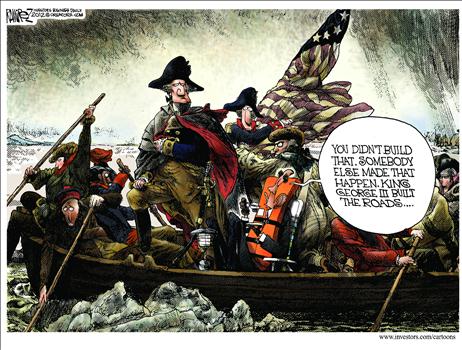
The federal government spends about 10% on roads and public goods but with the other money in the budget a lot of harm is done including excessive regulations on business. That makes Obama’s comment the other day look very silly.
But since I was talking about the staggering burden of red tape and regulation, I wasn’t being very supportive of the President’s assertion that government deserves a big chunk of the credit when a business is successful.
This cartoon makes the same point, but adds taxation to the mix.
As far as I recall (I sound like a politician under oath when I write something like that), this is the first Branco cartoon I’ve used, but I think it’s the best one in this post, so I’m looking forward to more of his (her?) work.
Regular readers know about Michael Ramirez, of course, and he has an amusing take on the you-didn’t-build-that controversy.
Last but not least, we have another Allie cartoon. I think this is the first time I’ve used two cartoons by the same person, but I think you’ll agree they’re worth sharing.
This gives me an opportunity to end on a serious note. The Obama campaign is asserting that the President was simply stating that private sector prosperity is made possible by the provision of “public goods” such as roads and bridges.
Which is why the second Allie cartoon is so good. Even when government does something that is theoretically good, it causes a lot of collateral damage because of the excessive size and scope of the welfare state.
Today House Republican leaders, joined by Senate Republican Leader Mitch McConnell, discussed the importance of preventing any tax increase to provide certainty to America’s job creators. Even President Bill Clinton and Larry Summers agree — taxes should not be raised on anyone in the Obama economy. House Republicans continue to work to cut spending, reduce regulations, and provide an environment for small businesses to hire and grow.
__________
President Obama c/o The White House
1600 Pennsylvania Avenue NW
Washington, DC 20500
In the USA we need to learn some lessons from the European financial crisis and avoid their fate. We must rein in our entitlement spending and cut welfare programs and balance our budget or we too will have a financial crisis.
Three years on, through half measures and a fantastical faith in their own abilities, Europe’s leaders have led the continent into an extended economic crisis. Indeed, by delaying decisive action for so long, Europe has managed to make matters substantially worse for the continent first, and for the rest of the global economy.
While the U.S. economy could never entirely avoid the distresses emanating from Europe, the magnitude of the domestic injury early on appeared modest. The U.S. response was correspondingly muted, with expressions of concern, sympathy, and a desire to help except by contributing to further bailouts. As the European crisis deepens, the U.S. should acknowledge the growing threat and respond accordingly.
First, America’s national leaders, beginning with President Obama, need to set aside their political agendas and act to strengthen America’s economy for whatever shocks come from Europe. Second, it is time the U.S. demanded that Europe cease temporizing and take decisive, conclusive action to restore Europe’s economy and finances. This will likely require that Europe take painful and unpleasant steps.
Europe Goes from Bad to Worse
With roots going back to the adoption of the euro in 1999, the European crisis first broke into the open some 10 years later. In April 2009, the European Union told France, Spain, Ireland, and Greece to reduce their budget deficits in the wake of the credit crisis. What has since followed has been a steady stream of summits, conferences, grand announcements, protests, denials, finance mechanisms, and bailouts.
In short, what has followed has been damage control. The latest example is the drama surrounding the Spanish banking system. The cycle was a familiar one. First, the Spanish government insisted that its banks were fine and that it would never ask for nor accept a bailout. Then, the government acknowledged that some banks might need just a little help for a little while and tried to arrange to provide capital to Spanish banks through Spanish government borrowing.
That flopped. Then the government acknowledged that it would need a real bailout, and Europe responded with about 100 billion euros ($125 billion) cash. But some reports suggest that this is less than half of what will be needed to stabilize the Spanish banking system.[1]
Nor was the drama over with the announcement of the bailout. No doubt worried about Spanish sensibilities, Spanish Prime Minister Mariano Rajoy insisted that the bailout had “nothing to do” with the procedures imposed on Greece, Ireland, and Portugal when they were bailed out.
“Nicht wahr,” insisted Germany and the European Union (EU), who confirmed that the “troika” of the International Monetary Fund, the European Commission, and the European Central Bank would oversee the funds. “Of course there will be conditions” was the EU response. German Finance Minister Wolfgang Schaeuble pointed out, “The Spanish state is taking the loans, Spain will be responsible for them.… There will likewise be a troika.”[2]
The Spanish example of too-late half measures is, unfortunately, not unique. Consequently, since the crisis began Europe has clearly and substantially weakened its banking system, which is propped up only by the ephemeral elixirs of central bank cash and shaky bailouts. The periphery has sent their economies into a deflationary spiral. Many have paved a fiscal path of ever-higher debt to the point where default on sovereigns is a distinct possibility. And having long dismissed the need for fast growth in favor of public-sector intervention and distribution, governments have now discovered the need for fast growth, but they conveniently again see public-sector spending as the means.
The Threat to the U.S. from Europe
The obvious threat to the U.S. from Europe’s many crises is from a reduction in U.S. exports. According to the Department of Commerce, U.S. exports to Europe may have begun to slide as early as October 2011, as the widespread slowdown in Europe was only beginning to take hold.[3] In 2011, U.S. exports to Europe totaled $329 billion, representing about 22 percent of all U.S. exports.[4] While substantial, in a $15 trillion economy even a collapse in U.S. exports to Europe would have limited direct consequences.
The greater issue involves the effect of a deep recession and financial crisis in Europe on U.S. financial firms and markets. The 2008–2009 global financial crisis taught many important lessons about the state of modern finance. One lesson is that the global and interconnected nature of financial markets and firms means that financial shocks of a critical mass will spread far and wide.
This interconnectedness is made even more relevant because of a second lesson: No one—not the regulators, not the policymakers, and not those who run the firms themselves—fully knows the extent of the exposures and especially the structural weaknesses until the shockwave hits. In short, no one knows what no one knows—or how expensive that lack of knowledge will prove to be. Given the magnitude of the crisis in Europe, the potential threat to the U.S. is cause for real concern.
The U.S. Domestic Response: Politics Must Give Way to Growth
The U.S. domestic policy response to the building threat from Europe should be to make every possible effort to strengthen the U.S. economy and financial system in anticipation of whatever shockwaves may come from across the Atlantic.
To strengthen the economy, Congress and the President should immediately stop their posturing and politicking and disarm Taxmageddon. The threat of massively higher taxes in 2013 is already depressing economic activity and job growth. Facing the greater uncertainty about their own tax liability and about the state of the economy in 2013 if Taxmageddon strikes, firms are prudently holding back on the investments and other actions needed to propel the economy forward.[5]
The U.S. budget deficit is projected to exceed $1 trillion for the fourth straight year, adding to economic uncertainty. Congress and President Obama should defy conventional wisdom, set aside their political differences, and rein in federal spending immediately by choice rather than being eventually forced to do so, as countries across Europe have been.
Even more important, policymakers should adopt some common-sense steps that are necessary to rein in entitlement spending for the medium to long term.[6] The basic policies needed to stabilize the finances in the Medicare and Social Security programs in particular are well-understood, in many cases already tested in law, and entirely evolutionary.[7]
Finally, the uncertainty plaguing the U.S. economy is also due in part to the flood of regulations pouring or about to pour out of Washington from, among other causes, Obamacare and the Dodd–Frank financial market reforms. Even the threat of new regulations causes businesses to hesitate to make new investments, because those investments may be made obsolete or unprofitable by an unfavorable regulation.[8] Congress and President Obama should declare a regulatory cease-fire, at least until the European crisis passes and the U.S. unemployment rate approaches full employment.
The U.S. External Response: Europe Needs Credible Reform Now
Externally, the U.S. needs to change the tone and content of its message to Europe. President Obama has been urging European governments to spend more now, even as their borrowing costs and debt far exceed sustainable levels. That might save one of the continent’s tottering governments in the short run, but it would only exacerbate the economic crisis.
Europe needs structural reforms—most acutely in its labor markets—and credible plans to restore fiscal discipline. Past U.S. expressions of sympathy and goodwill should, in light of the continued, unaddressed economic threat, grow into strong urgings and demands that Europe undertake the fundamental reforms needed to restore confidence that growth can again be sustained.
Europe faces choices that are economically complex and politically difficult. It has for a decade operated under an unstable hybrid system whereby some economic and political elements have been unified across the continent, such as the euro, while others have not, such as fiscal and banking policy in addition to a patchwork political structure. This cannot continue, as European officials have come to recognize. As Europe considers its options, it is important for the U.S. to support national sovereignty and economic freedom in Europe, as these principles are ultimately in the best interests of Europe and the U.S.[9]
It is not for the U.S. to tell Europe what path to take. The people of Europe themselves, and not unelected technocrats, must decide their future. However, it is incumbent on America’s leaders to take the steps at home that are necessary to ensure that America is in as strong a position as possible to withstand any coming storm and to demand that Europe act decisively to put itself back on a path of sustainable economic growth.
J. D. Foster, PhD, is Norman B. Ture Senior Fellow in the Economics of Fiscal Policy in the Thomas A. Roe Institute for Economic Policy Studies, and Derek Scissors, PhD, is Senior Research Fellow in Asia Economic Policy in the Asian Studies Center at The Heritage Foundation.
Send this report to a friend
Your Information Yes, I’d like to receive news about Heritage via email Your Friend’s Information
Thank you so much for your time. I know how valuable it is. I also appreciate the fine family that you have and your commitment as a father and a husband.
Sincerely,
Everette Hatcher III, 13900 Cottontail Lane, Alexander, AR 72002, ph 501-920-5733, lowcostsqueegees@yahoo.com