Category Archives: Vouchers

Liberals idea of equality

Instead of moving to school choice and vouchers the liberals in France have come up with a better idea. Conservatives have a better grip on the issue of equality.

France to Ban School Homework

Posted by Marian L. Tupy

Let’s say that you are a newly-elected French president and you have a lot on your plate. The unemployment rate is 10.2 percent and youth unemployment hovers around 23 percent. The budget deficit is 4.5 percent of the GDP and the explicit national debt 90 percent of the GDP. Your economy is at a standstill and your currency is on the verge of collapse. Many of your most productive people wonder if they should pack up and leave, because you have just asked them to fork over 75 percent of their earnings to the taxman. Your popularity is shrinking faster than you can say sacre bleu! So, what do you do?

Easy. You switch the subject and start talking about something completely different …  even if it is, well, a little crazy.

Thus, “French President François Hollande has said he will end homework as part of a series of reforms to overhaul the country’s education system. He doesn’t think it is fair that some kids get help from their parents at home while children who come from disadvantaged families don’t.”

Better that all children suffer, so long as they suffer equally. Equality of misery—that pretty much sums up socialist mentality everywhere.

Do we need more education spending? No we don’t!!!

The Machine: The Truth Behind Teachers Unions

Published on Sep 4, 2012 by

America’s public education system is failing. We’re spending more money on education but not getting better results for our children.

That’s because the machine that runs the K-12 education system isn’t designed to produce better schools. It’s designed to produce more money for unions and more donations for politicians.

For decades, teachers’ unions have been among our nation’s largest political donors. As Reason Foundation’s Lisa Snell has noted, the National Education Association (NEA) alone spent $40 million on the 2010 election cycle (source: http://reason.org/news/printer/big-education-and-big-labor-electio). As the country’s largest teachers union, the NEA is only one cog in the infernal machine that robs parents of their tax dollars and students of their futures.

Students, teachers, parents, and hardworking Americans are all victims of this political machine–a system that takes money out of taxpayers’ wallets and gives it to union bosses, who put it in the pockets of politicians.

Our kids deserve better.

“The Machine” is 4:17 minutes.

Written and narrated by Evan Coyne Maloney. Produced by the Moving Picture Institute in partnership with Reason TV.

Visit http://www.MovingPictureInstitute.org to learn more.

________________

After looking at these charts below it seems that money is not our problem.

Public School Spending. There’s a Chart for That!

Posted by Andrew J. Coulson

What better time than back-to-school season to revisit the trends in U.S. student achievement and public school spending? With that thought in mind, I present a newly updated version of my chart showing the total amount spent over the course of a single student’s k-12 career, along with student achievement trends for 17-year-olds. The achievement data come from the Department of Education’s own National Assessment of Educational Progress “Long Term Trends” series, which regularly tests nationally representative samples of U.S. students, drawing from the same pool of questions in use since the tests were first administered around 1970. These are the best data we have on what our kids know by the end of high school and how much it has cost to get them there.

In the past, some readers have wondered if the use of two separate scales ($ on the left and % on the right) might skew the way we perceive these numbers, making the public school productivity collapse look worse than it really is. To allay that concern, I present an alternate version of the chart that places all the data on the same percentage scale. Alas, the second picture is no less bleak than the first.

If music players had suffered the same cost/performance trends we’d all still be lugging around cassette boom boxes, but they’d now cost almost $1,800…. Aren’t you glad we didn’t give tax-funded state monopolies to 19th century Victrola manufacturers?

Milton Friedman discusses Voucher System

The Machine: The Truth Behind Teachers Unions

Published on Sep 4, 2012 by

America’s public education system is failing. We’re spending more money on education but not getting better results for our children.

That’s because the machine that runs the K-12 education system isn’t designed to produce better schools. It’s designed to produce more money for unions and more donations for politicians.

For decades, teachers’ unions have been among our nation’s largest political donors. As Reason Foundation’s Lisa Snell has noted, the National Education Association (NEA) alone spent $40 million on the 2010 election cycle (source: http://reason.org/news/printer/big-education-and-big-labor-electio). As the country’s largest teachers union, the NEA is only one cog in the infernal machine that robs parents of their tax dollars and students of their futures.

Students, teachers, parents, and hardworking Americans are all victims of this political machine–a system that takes money out of taxpayers’ wallets and gives it to union bosses, who put it in the pockets of politicians.

Our kids deserve better.

“The Machine” is 4:17 minutes.

Written and narrated by Evan Coyne Maloney. Produced by the Moving Picture Institute in partnership with Reason TV.

Visit http://www.MovingPictureInstitute.org to learn more.

________________

Milton Friedman: Education (Part One)

If you want to change this nation in a big way then you will at the fact that in the last 40 years we have increased our educational spending every year and our test scores have dropped. The problem is not money but education competition. We don’t need to spend over $29,000 per kid in the Washington D.C. district when we could give vouchers out (under $9000 per kid) and have better results. Take a look at this article from Milton Friedman.

Milton Friedman on Vouchers

CNBC interview, March 24, 2003.

Michelle: you are the grandfather of school vouchers do you feel victorious?

Mr. Friedman: Far from victorious, but very optimistic and hopeful. We are at the beginning of the task because as of the moment vouchers are available to only a very small amount of children. Our goal is to have a system in which every family in the U.S. will be able to choose for itself the school to which its children go we are far from that ultimate result. If we had that a system of free choice we would also have a system of competition, innovation which would change the character of education. You know our educational system is one of the most backwards things in our society in the may we teach people they did 200 years ago there is a person in the front of the room there are children sitting down at the bottom and they are being talked to can you name any other industry in the U.S. which is as technologically backward I can name one and only one..the legislature for the same reason. Both are monopolies the elementary and secondary school system is the single most Socialist industry in the U.S. leaving aside the military, but aside from the military its a major socialist industry, it is centralized and the control comes from the center and the difficulty of having a monopoly in which people cannot choose has been exacerbated by the fact that it has been largely taken over by teachers unions, the national education association and the american federation of teachers and the unions. Understandably I do not blame them but they are interested in the welfare of their members not the welfare of the children and the result is they have introduced a degree of rigidity which makes it impossible to reform the public school system from within. Reform has to come through competition from the outside and the only way you can get competition is by making it possible for parents to have the ability to choose.

Michelle: Give to me a model, an example of how it would work

Mr. Friedman: Very simple, take the extreme the government says we are willing to finance schooling for every child. The government compels children. If you look at the role of government in education there are 3 different levels there is a level of compulsory the government says every child must go to school until such and such and age. That is the equivalent of saying if you are going to drive a car you must have a license. The second stage is funding not only do we require you to have an education but the government is willing to pay for that schooling. That would be equivalent to saying the government is willing to pay for your car that you drive. The third level is running the educational industry that would be the equivalent of the government manufacturing the automobile or to put it in a different image consider food stamps today. Food stamps are funds provided by the government but if that were to be runned like the schools they would say everybody has to use these food stamps at a government grocery and each person with food stamps is assigned to a particular government grocers so the only way you can get your food stamps is by going to that grocer do you think those groceries would be very good? We know what the situation is in schooling people say why now and not 50-75 years ago? Well, when I went to high school t hat was a long time ago in the 1920s there were a 150,000 school districts in the U.S and the population was half what it is now. Today, there are fewer than 15,000 school districts. So it used to be that you really did have competition cause you had small school districts and parents had a good deal of control over those school districts, but increasingly we have shifted to very large school districts, to centralized control, to a system in which the governmental officials in which the educational professionals control it and like every socialist industry it produces a product that is very expensive and of very low quality. Of course it is not uniform there are some very good schools do not misunderstand me, but there are also some very bad ones.

Michelle: I interviewed some folks who are against school vouchers and they say that if you really want to help out a school what you should do is provide high quality early childhood education, small classes, small schools, summer school available to children who want it. Put money to those items which they claim would work.

Mr. Friedman: They don’t, we have been doing that. The amount of money spent per child adjusted for inflation has something like doubled or tripled over the last 20 years. Twenty years ago we had this report A Nation at Risk that pointed out all of the difficulties I just referred to and which pointed out this was a first generation that was going to be less schooled then its parents. We are now in the next generation and will be even less well schooled. We have had every possible effort you could have from reform from within. It is not just in schools it is in any area reform has to come from outside it has to come from competition. Let me illustrate that from within the school system. the united states from all accounts ranks #1 in higher education people from all over the world regard the United States colleges and universities the best and most varied. On the other hand in every other international comparison we rank near the bottom in elementary and secondary education why the difference?…one word..choice. The elementary and secondary education the school picks the child it picks its customer. In higher education the customer picks its school, you have choice that makes all the difference in the world. It means competition forces product. Look over the rest of the economy is there any area in the u.s. in which progress has not required progress from the outside. Look at the telephone industry when it was broken down into the little bells and opened up the competition it started a period of rapid innovation and development the key word is competition and the question is how can you get competition. only by having the customer choosing.

Michelle: There is concern that money is going to religious schools. That the majority of the students in voucher programs that exist use them to attend schools with religious affiliation?

Mr. Friedman: Why? Because the vouchers are so small in some cases. It is true that of the private schools in the u.s the great bulk of them are religious. that is for one simple reason here is someone selling something for nothing somebody down the street is giving away chocolate and you want to get into the business of selling chocolate that is kind of tough isn’t it here at schools children can attend them they are not free they are paying for it in the form of taxes but there is no specific charge for going to that school somebody else is going to offer it. The churches, the religious organizations have had a real advantage in that they were the only ones around who were in a position to subsidize the education and keep the fees down low. If you open it wide the most recent case was Ohio, cleveland case. The voucher that they had had a max value of $2,500 now it is not easy to provide a decent education at $2,500 and make money at it make it pay at the same time the state of Ohio was spending something like over $7,000 per child on schooling if that voucher had been $7,000 instead of $2,500 I have no doubt that there would have been a whole raft of new private, non-profit both profit and non-profit schools. That is what has happened in Milwaukee. Milwaukee has a voucher system and today the fraction of the voucher users in Milwaukee going to religious schools is less than the fraction going to religious schools was before this system started because there have been new schools developed and some of them have been religious but many of them are not. In any event, the Supreme Court has settled that issue they have said that if it is the choice of the parent if there are alternatives available there are government schools, charter schools, private non-denominational schools, private denominational schools so long as the choice is in the hands of the parent that is not a violation of the 1st amendment.

Michelle: You have a friend and an ally in the White House when it comes to vouchers

Mr. Friedman: I should say. Mr. Bush has always been in favor. He is in favor of free choice. Remember vouchers are a means not an end the purpose of vouchers is to enable parents to have free choice and the purpose of having free choice is to provide competition and allow the educational industry to get out of the 17th century and get into the 21st century and have more innovation and more evolvement. There is no reason why you cannot have the same kind of change in the provision of education as you have had in industries like the computer industry, the television industry and other things.

Michelle: Is it refreshing to have a President that, Bill Clinton was firmly against vouchers.

Mr. Friedman: No, it is a case of circumstances when he was Governor of Arkansas he was not against vouchers. He was in favor, but when he became President he came out against vouchers. I should say he did not oppose vouchers as Governor and he did as President and that was for political reasons. People don’t recognize how powerful politically the teachers unions are. Something like a quarter of all the delegates at the democratic national convention are from the teachers union. They are probably the most powerful pressure group in the U.S… very large funds, very large number of people and very active politically.

Michelle: We talk in the office about how President Bush has some very Friedmanesq ideas.

Mr. Friedman: They are not freidmanesq they are just good ideas. I hope that is true anyway. I think very highly of President Bush and I think in these areas don’t misunderstand me that is not a blanket statement there are some things he has done that I disagree with, but taken as a whole he has been moving in the right direction of trying to move toward a smaller more limited government trying to provide more freedom and more initiative in all areas. His philosophy on Medicare is the same as his philosophy in schools.

Michelle: Is that refreshing?

Mr. Friedman: It is an interesting thing, if you look at the facts the one area the area in which the low income people of this country, the blacks and the minority are most disadvantaged is with respect with the kinds of schools they can send their children to. The people who live in Harlem or the slums or the corresponding areas in LA or San Francisco they can go to the same stores, shop in the same stores everybody else can, they can buy the same automobiles, they can go to supermarket but they have very limited choice of schools everybody agrees that the schools in those areas are the worst they are poor. Yet, here you have a Democrat who allege their interest is to help the poor and the low income people here you have to take a different point every poll has shown that the strongest supporters of vouchers are the low income blacks and yet hardly a single black leader has been willing to come out for vouchers there were some exceptions Paul Williams in Milwaukee who was responsible for that…and a few others

Michelle: Why do you think that is?

Mr. Friedman: For obvious reasons, political. It has been to the self interest to the leaders the school system as long as its governmental its a source of power and jobs to hand around and funds to dispose of. If it is privatized that disappears and the other aspect of it is the power of the teachers unions. Right now those of us that are in the upper income classes have freedom of choice for our children in various ways we can decide where to live and we can choose places to live that have good schools or we can afford to pay twice for schooling once by taxes and once by paying tuition at a private school. It seems to me utterly unfair that those opportunities should not be open to everybody at all levels of income. If you had a system the kind I would like to see the government would say we require every child to get a certain number of years of schooling and in order to make that possible we are going to provide for every parent a voucher equal to a certain number of dollars which they can use only for schooling can’t use it for anything else. They can add to it, but they cannot subtract from it. Those will be those can be used in government schools let the government run the school but force them to be in competition so that all government schools charge tuition, but can be paid for by that voucher but that same voucher can also be used in private schools of all kinds and then you would have an open the teachers union complained and they insist they are doing a good job. if they are doing a good job then why are they so afraid of some competition?

Copyright: MSNBC, Inc. 2003

Milton Friedman On Education (Part Six)

Uploaded by on Sep 2, 2007

Milton Friedman on education.
freetochoose.com

Related posts:

Milton Friedman’s passion was to make a difference in the lives of young people

No one did more to advance the cause of school vouchers than Milton and Rose Friedman. Friedman made it clear in his film series “Free to Choose” how sad he was that young people who live in the inner cities did not have good education opportunities available to them. Remembering Milton Friedman’s School Choice Legacy […]

Listing of transcripts and videos of Free to Choose by Milton Friedman: Episode “What is wrong with our schools?” on www.theDailyHatch.org

Everywhere school vouchers have been tried they have been met with great success. Why do you think President Obama got rid of them in Washington D.C.? It was a political disaster for him because the school unions had always opposed them and their success made Obama’s allies look bad. In 1980 when I first sat […]

Milton Friedman remembered at 100 years from his birth (Part 4)

I ran across this very interesting article about Milton Friedman from 2002: Friedman: Market offers poor better learningBy Tamara Henry, USA TODAY By Doug Mills, AP President Bush honors influential economist Milton Friedman for his 90th birthday earlier this month. About an economist Name:Milton FriedmanAge: 90Background: Winner of the 1976 Nobel Prize for economic science; […]

Open letter to President Obama (Part 117.3)

A Taxing Distinction for ObamaCare Published on Jun 28, 2012 by catoinstitutevideo http://www.cato.org/publications/commentary/it-now-falls-congress http://www.cato.org/publications/commentary/taxing-decision http://www.cato-at-liberty.org/supreme-court-unlawfully-rewrites-obamacare-to… http://www.cato-at-liberty.org/congress-its-not-a-tax-scotus-yes-it-is/ The Cato Institute’s Roger Pilon, Ilya Shapiro, Michael F. Cannon, Michael D. Tanner and Trevor Burrus evaluate today’s ruling on ObamaCare at the Supreme Court. Video produced by Caleb O. Brown and Austin Bragg. ____________ President Obama c/o The […]

Dan Mitchell’s article on Chili and video clip on Milton Friedman’s influence

Milton Friedman and Chile – The Power of Choice Uploaded by FreeToChooseNetwork on May 13, 2011 In this excerpt from Free To Choose Network’s “The Power of Choice (2006)”, we set the record straight on Milton Friedman’s dealings with Chile — including training the Chicago Boys and his meeting with Augusto Pinochet. Was the tremendous […]

Lack of Confidence in Public Schools at an All-Time High

The True Cost of Public Education Uploaded by catoinstitutevideo on Mar 5, 2010 What is the true cost of public education? According to a new study by the Cato Institute, some of the nation’s largest public school districts are underreporting the true cost of government-run education programs. http://www.cato.org/pub_display.php?pub_id=11432 Cato Education Analyst Adam B. Schaeffer explains […]

Obama’s solution to our healthcare problems: MORE FEDERAL OVERSIGHT!!!

A Taxing Distinction for ObamaCare Published on Jun 28, 2012 by catoinstitutevideo http://www.cato.org/publications/commentary/it-now-falls-congress http://www.cato.org/publications/commentary/taxing-decision http://www.cato-at-liberty.org/supreme-court-unlawfully-rewrites-obamacare-to… http://www.cato-at-liberty.org/congress-its-not-a-tax-scotus-yes-it-is/ The Cato Institute’s Roger Pilon, Ilya Shapiro, Michael F. Cannon, Michael D. Tanner and Trevor Burrus evaluate today’s ruling on ObamaCare at the Supreme Court. Video produced by Caleb O. Brown and Austin Bragg. ____________ When I think about […]

Milton Friedman on school voucher system

Max Brantley of the Arkansas Times Blog reports today that Mitt Romney is for school vouchers. I am glad to hear that. Over and over we hear that the reason private schools are better is because they don’t have to keep the troubling making kids. It reminds me of this short film that I saw many […]

Brummett wants Charter schools to show public schools how to do it”Friedman Friday”

John Brummett (10-26-11, Arkansas Democrat-Gazette online edition) does not want charter schools to put public schools out of business but he wants them to show public schools how to do it. (Paywall) I seek in these matters a kind of Clintonian third-way finesse: I support charter schools only to the extent that they should be […]

Listing of transcripts and videos of Free to Choose by Milton Friedman: Episode “What is wrong with our schools?” on www.theDailyHatch.org

Everywhere school vouchers have been tried they have been met with great success. Why do you think President Obama got rid of them in Washington D.C.? It was a political disaster for him because the school unions had always opposed them and their success made Obama’s allies look bad.

In 1980 when I first sat down and read the book “Free to Choose” I was involved in Ronald Reagan’s campaign for president and excited about the race. Milton Friedman’s books and film series really helped form my conservative views. Take a look at one of my favorite films of his and this one deals with school vouchers:

Here is the video clip and transcript of the film series FREE TO CHOOSE episode “What is wrong with our schools?” Part 1 of 6.

 
Volume 6 – What’s Wrong with our Schools
Transcript:
Friedman: These youngsters are beginning another day at one of America’s public schools, Hyde Park High School in Boston. What happens when they pass through those doors is a vivid illustration of some of the problems facing America’s schools.
They have to pass through metal detectors. They are faced by security guards looking for hidden weapons. They are watched over by armed police. Isn’t that awful. What a way for kids to have to go to school, through metal detectors and to be searched. What can they conceivably learn under such circumstances. Nobody is happy with this kind of education. The taxpayers surely aren’t. This isn’t cheap education. After all, those uniformed policemen, those metal detectors have to be paid for.
What about the broken windows, the torn school books, and the smashed school equipment. The teachers who teach here don’t like this kind of situation. The students don’t like to come here to go to school, and most of all, the parents __ they are the ones who get the worst deal __ they pay taxes like the rest of us and they are just as concerned about the kind of education that their kids get as the rest of us are. They know their kids are getting a bad education but they feel trapped. Many of them can see no alternative but to continue sending their kids to schools like this.
To go back to the beginning, it all started with the fine idea that every child should have a chance to learn his three R’s. Sometimes in June when it gets hot, the kids come out in the yard to do their lessons, all 15 of them, ages 5 to 13, along with their teacher. This is the last one-room schoolhouse still operating in the state of Vermont. That is the way it used to be. Parental control, parents choosing the teacher, parents monitoring the schooling, parents even getting together and chipping in to paint the schoolhouse as they did here just a few weeks ago. Parental concern is still here as much in the slums of the big cities as in Bucolic, Vermont. But control by parents over the schooling of their children is today the exception, not the rule.
Increasingly, schools have come under the control of centralized administration, professional educators deciding what shall be taught, who shall do the teaching, and even what children shall go to what school. The people who lose most from this system are the poor and the disadvantaged in the large cities. They are simply stuck. They have no alternative.
Of course, if you are well off you do have a choice. You can send your child to a private school or you can move to an area where the public schools are excellent, as the parents of many of these students have done. These students are graduating from Weston High School in one of Boston’s wealthier suburbs. Their parents pay taxes instead of tuition and they certainly get better value for their money than do the parents in Hyde Park. That is partly because they have kept a good deal of control over the local schools, and in the process, they have managed to retain many of the virtues of the one-room schoolhouse.
Students here, like Barbara King, get the equivalent of a private education. They have excellent recreational facilities. They have a teaching staff that is dedicated and responsive to parents and students. There is an atmosphere which encourages learning, yet the cost per pupil here is no higher than in many of our inner city schools. The difference is that at Weston, it all goes for education that the parents still retain a good deal of control.
Unfortunately, most parents have lost control over how their tax money in spent. Avabelle goes to Hyde Park High. Her parents too want her to have a good education, but many of the students here are not interested in schooling, and the teachers, however dedicated, soon lose heart in an atmosphere like this. Avabelle’s parents are certainly not getting value for their tax money.
Caroline Bell, Parent: I think it is a shame, really, that parents are being ripped off like we are. I am talking about parents like me that work every day, scuffle to try to make ends meet. We send our kids to school hoping that they will receive something that will benefit them in the future for when they go out here and compete in the job market. Unfortunately, none of that is taking place at Hyde Park.
Friedman: Children like Ava are being shortchanged by a system that was designed to help. But there are ways to help give parents more say over their children’s schooling.
This is a fundraising evening for a school supported by a voluntary organization, New York’s Inner City Scholarship Fund. The prints that have brought people here have been loaned by wealthy Japanese industrialist. Events like this have helped raise two million dollars to finance Catholic parochial schools in New York. The people here are part of a long American tradition. The results of their private voluntary activities have been remarkable.
This is one of the poorest neighborhoods in New York City: the Bronx. Yet this parochial school, supported by the fund, is a joy to visit. The youngsters here from poor families are at Saint John Christians because their parents have picked this school and their parents are paying some of the costs from their own pockets. The children are well behaved, eager to learn, the teachers are dedicated. The cost per pupil here is far less than in the public schools, yet on the average the children are two grades ahead. That is because teachers and parents are free to choose how the children shall be taught. Private money has replaced the tax money and so control has been taken away from the bureaucrats and put back where it belongs.
This doesn’t work just for younger children. In the 60’s, Harlem was devastated by riots. It was a hot bed of trouble. Many teenagers dropped out of school.
_____
 
 
Milton Friedman congratulated by President Ronald Reagan. © 2008 Free To Choose Media, courtesy of the Power of Choice press kit

Here are some great jobs about Milton Friedman:

“Milton Friedman is a scholar of first rank whose original contributions to economic science have made him one of the greatest thinkers in modern history.”
President Ronald Reagan

“How grateful I have been over the years for the cogency of Friedman’s ideas which have influenced me. Cherishers of freedom will be indebted to him for generations to come.”
Alan Greenspan, former Chairman, Federal Reserve System

“Right at this moment there are people all over the land, I could put dots on the map, who are trying to prove Milton wrong. At some point, somebody else is trying to prove he’s right That’s what I call influence.”
Paul Samuelson, Nobel Laureate in Economic Science

“Friedman’s influence reaches far beyond the academic community and the world of economics. Rather than lock himself in an ivory tower, he has joined the fray to fight for the survival of this great country of ours.”
William E. Simon, former Secretary of the Treasury

“Milton Friedman is the most original social thinker of the era.”
John Kenneth Galbraith, former Professor of Economics, Harvard University

Other segments: 

Friedman Friday” Free to Choose by Milton Friedman: Episode “What is wrong with our schools?” (Part 6 of transcript and video)

Here is the video clip and transcript of the film series FREE TO CHOOSE episode “What is wrong with our schools?” Part 6 of 6.   Volume 6 – What’s Wrong with our Schools Transcript: FRIEDMAN: But I personally think it’s a good thing. But I don’t see that any reason whatsoever why I shouldn’t have been required […]

Friedman Friday” Free to Choose by Milton Friedman: Episode “What is wrong with our schools?” (Part 5 of transcript and video)

Here is the video clip and transcript of the film series FREE TO CHOOSE episode “What is wrong with our schools?” Part 5 of 6.   Volume 6 – What’s Wrong with our Schools Transcript: Are your voucher schools  going to accept these tough children? COONS: You bet they are. (Several talking at once.) COONS: May I answer […]


Friedman Friday” Free to Choose by Milton Friedman: Episode “What is wrong with our schools?” (Part 3 of transcript and video)

Friedman Friday” Free to Choose by Milton Friedman: Episode “What is wrong with our schools?” (Part 3 of transcript and video) Here is the video clip and transcript of the film series FREE TO CHOOSE episode “What is wrong with our schools?” Part 3 of 6.   Volume 6 – What’s Wrong with our Schools Transcript: If it […]

Friedman Friday” Free to Choose by Milton Friedman: Episode “What is wrong with our schools?” (Part 2 of transcript and video)

Here is the video clip and transcript of the film series FREE TO CHOOSE episode “What is wrong with our schools?” Part 2 of 6.   Volume 6 – What’s Wrong with our Schools Transcript: Groups of concerned parents and teachers decided to do something about it. They used private funds to take over empty stores and they […]

Friedman Friday” Free to Choose by Milton Friedman: Episode “What is wrong with our schools?” (Part 1 of transcript and video)

Here is the video clip and transcript of the film series FREE TO CHOOSE episode “What is wrong with our schools?” Part 1 of 6.   Volume 6 – What’s Wrong with our Schools Transcript: Friedman: These youngsters are beginning another day at one of America’s public schools, Hyde Park High School in Boston. What happens when […]

Milton Friedman’s passion was to make a difference in the lives of young people

The Machine: The Truth Behind Teachers Unions

Published on Sep 4, 2012 by

America’s public education system is failing. We’re spending more money on education but not getting better results for our children.

That’s because the machine that runs the K-12 education system isn’t designed to produce better schools. It’s designed to produce more money for unions and more donations for politicians.

For decades, teachers’ unions have been among our nation’s largest political donors. As Reason Foundation’s Lisa Snell has noted, the National Education Association (NEA) alone spent $40 million on the 2010 election cycle (source: http://reason.org/news/printer/big-education-and-big-labor-electio). As the country’s largest teachers union, the NEA is only one cog in the infernal machine that robs parents of their tax dollars and students of their futures.

Students, teachers, parents, and hardworking Americans are all victims of this political machine–a system that takes money out of taxpayers’ wallets and gives it to union bosses, who put it in the pockets of politicians.

Our kids deserve better.

“The Machine” is 4:17 minutes.

Written and narrated by Evan Coyne Maloney. Produced by the Moving Picture Institute in partnership with Reason TV.

Visit http://www.MovingPictureInstitute.org to learn more.

No one did more to advance the cause of school vouchers than Milton and Rose Friedman. Friedman made it clear in his film series “Free to Choose” how sad he was that young people who live in the inner cities did not have good education opportunities available to them.

Lindsey Burke

July 30, 2012 at 12:22 pm

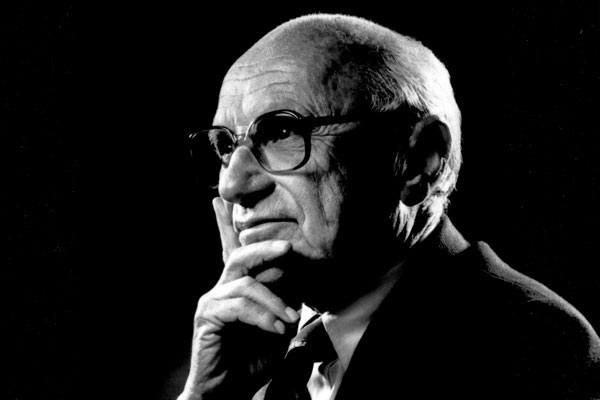
Let us imagine we have the power to rebuild our education system from the ground up—an appropriate mental exercise as we remember the late Nobel Prize–winning economist Milton Friedman on his 100th birthday tomorrow.

If we could rebuild our education system from scratch, it’s unlikely we would create a system that assigns children to government-run schools based on their parents’ zip codes. After all, geography and income shouldn’t determine a child’s educational opportunity. If we rebuilt our education system to reflect Friedman’s philosophy, parents would be free to choose an education that best met their children’s needs, with money following the children to any schools of their choice: public, private, charter, virtual, or home school.

Friedman pioneered the idea of educational vouchers, and more than a half century later, that vision is taking hold at a rapid pace. State leaders across the country are making school choice a reality for hundreds of thousands of American families. In 2011 alone, 13 states enacted or expanded school choice programs, prompting The Wall Street Journalto deem 2011 “The Year of School Choice.”

Arizona enacted groundbreaking education savings accounts, Indiana created the largest voucher program in the country, and the highly success D.C. Opportunity Scholarship Program was reauthorized.

While school choice momentum has been building dramatically in the last two years, most children still attend assigned public schools. For too many families, school choice remains out of reach.

Poor families are most affected by this lack of choice. As Friedman noted, “There is no respect in which inhabitants of a low-income neighborhood are so disadvantaged as in the kind of schooling they can get for their children.” It is a sad statement quantified by data on low levels of academic achievement and attainment.

In Denver, just 44 percent of students graduate. In Philadelphia, a mere 46 percent of students complete high school. And in Detroit, just 33 percent of children graduate.

And if they are persistent enough to graduate, what have they learned? Nine percent of Baltimore fourth-graders are proficient in reading. Just 11 percent of their eighth-grade peers can read proficiently. A devastating 7 percent of Cleveland fourth-graders are proficient in reading. In Detroit, just 6 percent can read proficiently.

These low levels of academic achievement and attainment aren’t confined to low-income students or urban school districts. Across the country, for all children, just one-third can read proficiently. Graduation rates have hovered around 74 percent since the 1970s, and math and reading achievement has been virtually flat over the same time period. On international assessments, American students rank in the middle of the pack, outperformed in math by the Czech Republic, Slovakia, and Estonia.

Friedman had a strong belief in the power of markets to improve education, and he didn’t mince words about school choice: We will only see improvements in education, he said, “by privatizing a major segment of the educational system—i.e., by enabling a private, for-profit industry to develop that will provide a wide variety of learning opportunities and offer effective competition to public schools.”

That’s certainly going big on school choice. But what exactly did Friedman mean by “privatizing a major segment of the educational system”? Just because we have agreed to the public financing of education does not mean government should be the sole provider of that education and dictate where children go to school.

As we remember Friedman on his 100th birthday, we need to rethink what “public” education means, thinking instead in terms of educating the public, not in terms of government-run schools—that is, as publicly financed but operated by many different providers. If we consider public education in those terms, we can start to think through funding mechanisms at the state level that will bring about widespread school choice.

Today, we have a growing number of innovative school choice options—charters, vouchers, tax credits, online learning, and education savings accounts, to name a few. These options were conceived in the mind of Friedman and are being brought to life by reform-oriented governors and legislators across the country.

While these reforms have been a long time in the making, Friedman would no doubt be proud of the progress that has been made on school choice over the past few years. And thanks to his formational work, children across the country are increasingly gaining access to customized education that meets their unique needs.

Related posts:

Milton Friedman remembered at 100 years from his birth (Part 4)

I ran across this very interesting article about Milton Friedman from 2002: Friedman: Market offers poor better learningBy Tamara Henry, USA TODAY By Doug Mills, AP President Bush honors influential economist Milton Friedman for his 90th birthday earlier this month. About an economist Name:Milton FriedmanAge: 90Background: Winner of the 1976 Nobel Prize for economic science; […]

Milton Friedman videos and transcripts Part 11

Milton Friedman videos and transcripts Part 11 On my blog http://www.thedailyhatch.org I have an extensive list of posts that have both videos and transcripts of MiltonFriedman’s interviews and speeches. Here below is just small list of those and more can be accessed by clicking on “Milton Friedman” on the side of this page or searching […]

Open letter to President Obama (Part 117.3)

A Taxing Distinction for ObamaCare Published on Jun 28, 2012 by catoinstitutevideo http://www.cato.org/publications/commentary/it-now-falls-congress http://www.cato.org/publications/commentary/taxing-decision http://www.cato-at-liberty.org/supreme-court-unlawfully-rewrites-obamacare-to… http://www.cato-at-liberty.org/congress-its-not-a-tax-scotus-yes-it-is/ The Cato Institute’s Roger Pilon, Ilya Shapiro, Michael F. Cannon, Michael D. Tanner and Trevor Burrus evaluate today’s ruling on ObamaCare at the Supreme Court. Video produced by Caleb O. Brown and Austin Bragg. ____________ President Obama c/o The […]

Milton Friedman videos and transcripts Part 10

Milton Friedman videos and transcripts Part 10 On my blog http://www.thedailyhatch.org I have an extensive list of posts that have both videos and transcripts of MiltonFriedman’s interviews and speeches. Here below is just small list of those and more can be accessed by clicking on “Milton Friedman” on the side of this page or searching […]

Milton Friedman videos and transcripts Part 9

Milton Friedman videos and transcripts Part 9 On my blog http://www.thedailyhatch.org I have an extensive list of posts that have both videos and transcripts of MiltonFriedman’s interviews and speeches. Here below is just small list of those and more can be accessed by clicking on “Milton Friedman” on the side of this page or searching […]

Milton Friedman’s biography (Part 2)(Interview by Charlie Rose of Milton Friedman part 3)

Biography Part 2 In 1977, when I reached the age of 65, I retired from teaching at the University of Chicago. At the invitation of Glenn Campbell, Director of the Hoover Institution at Stanford University, I shifted my scholarly work to Hoover where I remain a Senior Research Fellow. We moved to San Francisco, purchasing […]

Milton Friedman at Hillsdale College 2006 (part 2)

Milton Friedman at Hillsdale College 2006 July 2006 Free to Choose: A Conversation with Milton Friedman Milton Friedman Economist Milton Friedman is a senior research fellow at the Hoover Institution at Stanford University and a professor emeritus of economics at the University of Chicago, where he taught from 1946-1976. Dr. Friedman received the Nobel Memorial […]

Milton Friedman videos and transcripts Part 8

Milton Friedman videos and transcripts Part 8 On my blog http://www.thedailyhatch.org I have an extensive list of posts that have both videos and transcripts of MiltonFriedman’s interviews and speeches. Here below is just small list of those and more can be accessed by clicking on “Milton Friedman” on the side of this page or searching […]

Milton Friedman remembered at 100 years from his birth (Part 2)

Testing Milton Friedman – Preview Uploaded by FreeToChooseNetwork on Feb 21, 2012 2012 is the 100th anniversary of Milton Friedman’s birth. His work and ideas continue to make the world a better place. As part of Milton Friedman’s Century, a revival of the ideas featured in the landmark television series Free To Choose are being […]

Milton Friedman believed in liberty (Interview by Charlie Rose of Milton Friedman part 1)

Charlie Rose interview of Milton Friedman My favorite economist: Milton Friedman : A Great Champion of Liberty  by V. Sundaram   Milton Friedman, the Nobel Prize-winning economist who advocated an unfettered free market and had the ear of three US Presidents – Nixon, Ford and Reagan – died last Thursday (16 November, 2006 ) in San Francisco […]

Free or equal? 30 years after Milton Friedman’s Free to Choose (Part 1)

Free or Equal?: Johan Norberg Updates Milton & Rose Friedman’s Free to Choose I got this below from Reason Magazine: Swedish economist Johan Norberg is the host of the new documentary Free or Equal, which retraces and updates the 1980 classic Free to Choose, featuring Milton and Rose Friedman. Like the Friedmans, Norberg travels the globe […]

Reason Magazine’s rightly praises Milton Friedman but makes foolish claim along the way

I must say that I have lots of respect for Reason Magazine and for their admiration of Milton Friedman. However, I do disagree with one phrase below. At the end of this post I will tell you what sentence it is. Uploaded by ReasonTV on Jul 28, 2011 There’s no way to appreciate fully the […]

Video clip:Milton Friedman discusses his view of numerous political figures and policy issues in (Part 1)

Milton Friedman on Hayek’s “Road to Serfdom” 1994 Interview 1 of 2 Uploaded by PenguinProseMedia on Oct 25, 2011 Says Federal Reserve should be abolished, criticizes Keynes. One of Friedman’s best interviews, discussion spans Friedman’s career and his view of numerous political figures and public policy issues. ___________________ Two Lucky People by Milton and Rose Friedman […]

Milton Friedman remembered at 100 years from his birth (Part 1)

What a great man Milton Friedman was. The Legacy of Milton Friedman November 18, 2006 Alexander Tabarrok Great economist by day and crusading public intellectual by night, Milton Friedman was my hero. Friedman’s contributions to economics are profound, the permanent income hypothesis, the resurrection of the quantity theory of money, and his magnum opus with […]

Milton Friedman videos and transcripts Part 7

Milton Friedman videos and transcripts Part 7 On my blog http://www.thedailyhatch.org I have an extensive list of posts that have both videos and transcripts of MiltonFriedman’s interviews and speeches. Here below is just small list of those and more can be accessed by clicking on “Milton Friedman” on the side of this page or searching […]

Transcript and video of Milton Friedman on Bill Clinton and Ronald Reagan (Part 1)

Below is a discussion from Milton Friedman on Bill Clinton and Ronald Reagan. February 10, 1999 | Recorded on February 10, 1999 audio, video, and blogs » uncommon knowledge PRESIDENTIAL REPORT CARD: Milton Friedman on the State of the Union with guest Milton Friedman Milton Friedman, Senior Research Fellow, Hoover Institution and Nobel Laureate in […]

Dan Mitchell’s article on Chili and video clip on Milton Friedman’s influence

Milton Friedman and Chile – The Power of Choice Uploaded by FreeToChooseNetwork on May 13, 2011 In this excerpt from Free To Choose Network’s “The Power of Choice (2006)”, we set the record straight on Milton Friedman’s dealings with Chile — including training the Chicago Boys and his meeting with Augusto Pinochet. Was the tremendous […]


Listing of transcripts and videos of Free to Choose by Milton Friedman: Episode “What is wrong with our schools?” on www.theDailyHatch.org

Everywhere school vouchers have been tried they have been met with great success. Why do you think President Obama got rid of them in Washington D.C.? It was a political disaster for him because the school unions had always opposed them and their success made Obama’s allies look bad.

In 1980 when I first sat down and read the book “Free to Choose” I was involved in Ronald Reagan’s campaign for president and excited about the race. Milton Friedman’s books and film series really helped form my conservative views. Take a look at one of my favorite films of his and this one deals with school vouchers:

Here is the video clip and transcript of the film series FREE TO CHOOSE episode “What is wrong with our schools?” Part 1 of 6.

Volume 6 – What’s Wrong with our Schools
Transcript:
Friedman: These youngsters are beginning another day at one of America’s public schools, Hyde Park High School in Boston. What happens when they pass through those doors is a vivid illustration of some of the problems facing America’s schools.
They have to pass through metal detectors. They are faced by security guards looking for hidden weapons. They are watched over by armed police. Isn’t that awful. What a way for kids to have to go to school, through metal detectors and to be searched. What can they conceivably learn under such circumstances. Nobody is happy with this kind of education. The taxpayers surely aren’t. This isn’t cheap education. After all, those uniformed policemen, those metal detectors have to be paid for.
What about the broken windows, the torn school books, and the smashed school equipment. The teachers who teach here don’t like this kind of situation. The students don’t like to come here to go to school, and most of all, the parents __ they are the ones who get the worst deal __ they pay taxes like the rest of us and they are just as concerned about the kind of education that their kids get as the rest of us are. They know their kids are getting a bad education but they feel trapped. Many of them can see no alternative but to continue sending their kids to schools like this.
To go back to the beginning, it all started with the fine idea that every child should have a chance to learn his three R’s. Sometimes in June when it gets hot, the kids come out in the yard to do their lessons, all 15 of them, ages 5 to 13, along with their teacher. This is the last one-room schoolhouse still operating in the state of Vermont. That is the way it used to be. Parental control, parents choosing the teacher, parents monitoring the schooling, parents even getting together and chipping in to paint the schoolhouse as they did here just a few weeks ago. Parental concern is still here as much in the slums of the big cities as in Bucolic, Vermont. But control by parents over the schooling of their children is today the exception, not the rule.
Increasingly, schools have come under the control of centralized administration, professional educators deciding what shall be taught, who shall do the teaching, and even what children shall go to what school. The people who lose most from this system are the poor and the disadvantaged in the large cities. They are simply stuck. They have no alternative.
Of course, if you are well off you do have a choice. You can send your child to a private school or you can move to an area where the public schools are excellent, as the parents of many of these students have done. These students are graduating from Weston High School in one of Boston’s wealthier suburbs. Their parents pay taxes instead of tuition and they certainly get better value for their money than do the parents in Hyde Park. That is partly because they have kept a good deal of control over the local schools, and in the process, they have managed to retain many of the virtues of the one-room schoolhouse.
Students here, like Barbara King, get the equivalent of a private education. They have excellent recreational facilities. They have a teaching staff that is dedicated and responsive to parents and students. There is an atmosphere which encourages learning, yet the cost per pupil here is no higher than in many of our inner city schools. The difference is that at Weston, it all goes for education that the parents still retain a good deal of control.
Unfortunately, most parents have lost control over how their tax money in spent. Avabelle goes to Hyde Park High. Her parents too want her to have a good education, but many of the students here are not interested in schooling, and the teachers, however dedicated, soon lose heart in an atmosphere like this. Avabelle’s parents are certainly not getting value for their tax money.
Caroline Bell, Parent: I think it is a shame, really, that parents are being ripped off like we are. I am talking about parents like me that work every day, scuffle to try to make ends meet. We send our kids to school hoping that they will receive something that will benefit them in the future for when they go out here and compete in the job market. Unfortunately, none of that is taking place at Hyde Park.
Friedman: Children like Ava are being shortchanged by a system that was designed to help. But there are ways to help give parents more say over their children’s schooling.
This is a fundraising evening for a school supported by a voluntary organization, New York’s Inner City Scholarship Fund. The prints that have brought people here have been loaned by wealthy Japanese industrialist. Events like this have helped raise two million dollars to finance Catholic parochial schools in New York. The people here are part of a long American tradition. The results of their private voluntary activities have been remarkable.
This is one of the poorest neighborhoods in New York City: the Bronx. Yet this parochial school, supported by the fund, is a joy to visit. The youngsters here from poor families are at Saint John Christians because their parents have picked this school and their parents are paying some of the costs from their own pockets. The children are well behaved, eager to learn, the teachers are dedicated. The cost per pupil here is far less than in the public schools, yet on the average the children are two grades ahead. That is because teachers and parents are free to choose how the children shall be taught. Private money has replaced the tax money and so control has been taken away from the bureaucrats and put back where it belongs.
This doesn’t work just for younger children. In the 60’s, Harlem was devastated by riots. It was a hot bed of trouble. Many teenagers dropped out of school.
_____
Milton Friedman congratulated by President Ronald Reagan. © 2008 Free To Choose Media, courtesy of the Power of Choice press kit

Here are some great jobs about Milton Friedman:

“Milton Friedman is a scholar of first rank whose original contributions to economic science have made him one of the greatest thinkers in modern history.”
President Ronald Reagan

“How grateful I have been over the years for the cogency of Friedman’s ideas which have influenced me. Cherishers of freedom will be indebted to him for generations to come.”
Alan Greenspan, former Chairman, Federal Reserve System

“Right at this moment there are people all over the land, I could put dots on the map, who are trying to prove Milton wrong. At some point, somebody else is trying to prove he’s right That’s what I call influence.”
Paul Samuelson, Nobel Laureate in Economic Science

“Friedman’s influence reaches far beyond the academic community and the world of economics. Rather than lock himself in an ivory tower, he has joined the fray to fight for the survival of this great country of ours.”
William E. Simon, former Secretary of the Treasury

“Milton Friedman is the most original social thinker of the era.”
John Kenneth Galbraith, former Professor of Economics, Harvard University

Other segments:

Friedman Friday” Free to Choose by Milton Friedman: Episode “What is wrong with our schools?” (Part 6 of transcript and video)

Here is the video clip and transcript of the film series FREE TO CHOOSE episode “What is wrong with our schools?” Part 6 of 6.   Volume 6 – What’s Wrong with our Schools Transcript: FRIEDMAN: But I personally think it’s a good thing. But I don’t see that any reason whatsoever why I shouldn’t have been required […]

Friedman Friday” Free to Choose by Milton Friedman: Episode “What is wrong with our schools?” (Part 5 of transcript and video)

Here is the video clip and transcript of the film series FREE TO CHOOSE episode “What is wrong with our schools?” Part 5 of 6.   Volume 6 – What’s Wrong with our Schools Transcript: Are your voucher schools  going to accept these tough children? COONS: You bet they are. (Several talking at once.) COONS: May I answer […]

Friedman Friday” Free to Choose by Milton Friedman: Episode “What is wrong with our schools?” (Part 3 of transcript and video)

Friedman Friday” Free to Choose by Milton Friedman: Episode “What is wrong with our schools?” (Part 3 of transcript and video) Here is the video clip and transcript of the film series FREE TO CHOOSE episode “What is wrong with our schools?” Part 3 of 6.   Volume 6 – What’s Wrong with our Schools Transcript: If it […]

Friedman Friday” Free to Choose by Milton Friedman: Episode “What is wrong with our schools?” (Part 2 of transcript and video)

Here is the video clip and transcript of the film series FREE TO CHOOSE episode “What is wrong with our schools?” Part 2 of 6.   Volume 6 – What’s Wrong with our Schools Transcript: Groups of concerned parents and teachers decided to do something about it. They used private funds to take over empty stores and they […]

Friedman Friday” Free to Choose by Milton Friedman: Episode “What is wrong with our schools?” (Part 1 of transcript and video)

Here is the video clip and transcript of the film series FREE TO CHOOSE episode “What is wrong with our schools?” Part 1 of 6.   Volume 6 – What’s Wrong with our Schools Transcript: Friedman: These youngsters are beginning another day at one of America’s public schools, Hyde Park High School in Boston. What happens when […]

Milton Friedman remembered at 100 years from his birth (Part 4)

I ran across this very interesting article about Milton Friedman from 2002:

Friedman: Market offers poor better learningBy Tamara Henry, USA TODAY

By Doug Mills, AP
President Bush honors influential economist Milton Friedman for his 90th birthday earlier this month.
About an economist
Name:Milton FriedmanAge: 90Background: Winner of the 1976 Nobel Prize for economic science; senior research fellow, Hoover Institution at Stanford University since 1977; adviser to presidents Richard Nixon and Ronald Reagan; awarded the Presidential Medal of Freedom and the National Medal of Science in 1988.He’s in the news because an idea Friedman proposed in 1955 is the subject of a pending U.S. Supreme Court ruling. Friedman’s idea: to give low-income parents tax money, in the form of vouchers, so they have the option of sending their children to private or religious schools.Education: B.A. in 1932, Rutgers University; M.A. in 1933, University of Chicago; Ph.D. in 1946, Columbia University.

WASHINGTON — Milton Friedman is a Nobel Prize-winning economist who rubs elbows with the rich and powerful and was recently feted on his 90th birthday by President Bush. But few people know that Friedman is also a champion of poor families who want a better education for their kids.

Friedman is considered “the father of vouchers,” the controversial idea that low-income parents should get tax-supported vouchers to send their kids to private and religious schools.

“Look, what is this all about? Who is it that suffers most from our present school system?” he asks. “It’s the low-income, particularly the blacks. There’s no doubt they’re the great victims. Here’s a program that will help them tremendously.”

Friedman proposed the idea 47 years ago and says he never imagined that the debate would become so intense that the U.S. Supreme Court would have to offer a definitive ruling on the issue. A high court decision is expected soon on the constitutionality of a program in Cleveland, where the majority of the students getting $2,250 a year in vouchers use the funds to attend religious schools. Opponents say this violates the constitutionally mandated separation of church and state. But Friedman says most parents will have limited school choices as long as the government controls public education.

Private-school vouchers were “such a profoundly insightful idea that it stunned me with its clarity and how sensible it was, but yet how radical it was,” says William “Chip” Mellor, president of the Institute for Justice, a libertarian public-interest law firm that favors vouchers. He first read about the idea while in law school and says he’s known Friedman more than 15 years and considers him “a hero.”

Friedman’s slight, 5-foot frame belies his stature. He was a member of President Reagan’s Economic Policy Advisory board, and even now, when his pal Alan Greenspan and the U.S. Federal Reserve Board adjust interest rates, experts look for Friedman’s reaction. His memoirs, written with his wife, Rose, in 1998, recall how in Europe in 1950, he wrote the draft for his classic essay, “The Case for Flexible Exchange Rates,” as part of his contribution to the rehabilitation of Germany after World War II.

Five years later, education hit Friedman’s radar screen.

In 1955, he wrote a paper on the role the federal government should play in various areas: monetary matters, international trade and education. A professor at the University of Chicago at the time, Friedman published a separate article questioning why government wanted to run schools. He proposed vouchers as a way to separate government financing of education from government administration of schools.

Now, nearly a half-century later, he remains just as energetic about his idea — although no program has come close to what he first proposed.

Vouchers are not just an academic interest. Friedman and his wife, a constant companion for 63 years, created the Milton & Rose D. Friedman Foundation to fund research and support the voucher issue. “We set up the foundation because we were getting to an age in which we weren’t going to be able to do very much ourselves,” he says.

The spry nonagenarian lives in San Francisco and still works as a senior researcher at the conservative Hoover Institution, a position he has held since 1977.

Why would a wealthy economist focus so much effort on black kids from the inner city? Friedman bows his head and knits his fingers together. “What are we here for?” he asks. “We’re here to try to make the world a little better than we found it.”

He appears ill at ease with any compliment. Asked about the “father of vouchers” title, he flicks his hand and says, “Movements have lots of fathers.” He cites writings of Adam Smith and Thomas Paine in 1776 as hinting at the idea of competition and choice in education.

“Yes, it was a radical idea in its day,” Friedman says. But he frowns at today’s view of radicals as rabble-rousers who lead marches and protests. Friedman’s radicalism focuses mainly on voicing unorthodox views.

“I was not unaccustomed to having people disagree with me. To begin with, (the voucher idea) took up very rapidly. But every time people would gather strongly in favor of it, they would come up against the teachers’ unions and the educational bureaucracy, the government civil service.”

New Hampshire was the first state to express an interest in the 1970s, and five of its cities were willing to try an experiment drafted by a group at Dartmouth College, Friedman says. But he notes the teachers unions worked diligently to kill the plan before it got off the ground. A similar situation occurred in Connecticut. Milwaukee was the first city to try a voucher experiment in 1990, followed by Cleveland in 1995. Florida has the nation’s first statewide program, enacted in 1999.

Friedman says the key flaw with all the programs is that government continues to call the shots. Also, he says, voucher amounts are too low to interest entrepreneurs in opening new schools.

Friedman gives unfavorable reviews even to President Bush’s new, highly touted education law, allowing children in failing schools to receive vouchers. The problem: The bureaucracy is allowed to set the definition of a failing school.

Refundable tax credits, viewed by many as a back-door voucher, are not popular with Friedman, either. He sees them as a political game.

“Why fool around? I’d prefer to do it straightforwardly, as a voucher. We want competition. We want diversity, variety. But we want it free, not controlled or directed by any third party.”

However, Bob Chase, president of the National Education Association, the nation’s largest teachers’ union, says Friedman’s theories counter America’s concept of public education.

“When Americans first developed the concept of public education, it was conceived as a community effort — supported by taxpayers, governed by local citizens, and involving parents and others in nurturing children.

“Milton Friedman would turn this long-standing American success story on its head, creating a system that is essentially ‘every man for himself.’ ”

Chase says the “most significant obstacle” to vouchers is “parents who have clearly said, in polls and at the ballot box, that they would prefer to see improvements in existing schools.”

Friedman, who attended public schools in Rahway, N.J., remains undaunted in his mission and only chuckles when asked why his influence in economics doesn’t extend to education. “It’s hard to sell any idea. That’s not a bad thing. It’s a good thing that it’s hard to sell ideas. The government does enough harm as it is.”

True market-driven education will come, he says. “It will be by accident, absolutely. Somewhere everything will fit together. It will be a place where teachers unions aren’t very strong or have fallen out of favor, where both the governor and legislature are in sync.”

Will Friedman, who admits he’s a quintessential optimist, live to see the day? “I would hope so, but I don’t have that much optimism, no.”

Related posts:

“Friedman Friday” :“A Nobel Laureate on the American Economy” VTR: 5/31/77 Transcript and video clip (Part 4)

Milton Friedman on the American Economy (4 of 6)   Uploaded by donotswallow on Aug 9, 2009 THE OPEN MIND Host: Richard D. Heffner Guest: Milton Friedman Title: A Nobel Laureate on the American Economy VTR: 5/31/77 _____________________________________ Below is a transcipt from a portion of an interview that Milton Friedman gave on 5-31-77: Friedman: […]

Obama promotes food stamps but Milton Friedman had a better suggestion

Milton Friedman’s negative income tax explained by Friedman in 1968: We need to cut back on the Food Stamp program and not try to increase it. What really upsets me is that when the government gets involved in welfare there is a welfare trap created for those who become dependent on the program. Once they […]

“Friedman Friday” :“A Nobel Laureate on the American Economy” VTR: 5/31/77 Transcript and video clip (Part 3)

Milton Friedman on the American Economy (3 of 6) Uploaded by donotswallow on Aug 9, 2009 THE OPEN MIND Host: Richard D. Heffner Guest: Milton Friedman Title: A Nobel Laureate on the American Economy VTR: 5/31/77 _____________________________________ Below is a transcipt from a portion of an interview that Milton Friedman gave on 5-31-77: Friedman: Now […]

“The Power of the Market” episode of Free to Choose in 1990 by Milton Friedman (Part 5)

Milton Friedman The Power of the Market 5-5 How can we have personal freedom without economic freedom? That is why I don’t understand why socialists who value individual freedoms want to take away our economic freedoms.  I wanted to share this info below with you from Milton Friedman who has influenced me greatly over the […]

“The Power of the Market” episode of Free to Choose in 1990 by Milton Friedman (Part 4)

Milton Friedman The Power of the Market 4-5 How can we have personal freedom without economic freedom? That is why I don’t understand why socialists who value individual freedoms want to take away our economic freedoms.  I wanted to share this info below with you from Milton Friedman who has influenced me greatly over the […]

Obama’s solution to our healthcare problems: MORE FEDERAL OVERSIGHT!!!

A Taxing Distinction for ObamaCare Published on Jun 28, 2012 by catoinstitutevideo http://www.cato.org/publications/commentary/it-now-falls-congress http://www.cato.org/publications/commentary/taxing-decision http://www.cato-at-liberty.org/supreme-court-unlawfully-rewrites-obamacare-to… http://www.cato-at-liberty.org/congress-its-not-a-tax-scotus-yes-it-is/ The Cato Institute’s Roger Pilon, Ilya Shapiro, Michael F. Cannon, Michael D. Tanner and Trevor Burrus evaluate today’s ruling on ObamaCare at the Supreme Court. Video produced by Caleb O. Brown and Austin Bragg. ____________ When I think about […]

“Friedman Friday”:“A Nobel Laureate on the American Economy” VTR: 5/31/77 Transcript and video clip (Part 2)

Milton Friedman on the American Economy (2 of 6) Uploaded by donotswallow on Aug 9, 2009 THE OPEN MIND Host: Richard D. Heffner Guest: Milton Friedman Title: A Nobel Laureate on the American Economy VTR: 5/31/77 _____________________________________ Below is a transcipt from a portion of an interview that Milton Friedman gave on 5-31-77: Friedman: General […]

“The Power of the Market” episode of Free to Choose in 1990 by Milton Friedman (Part 3)

Milton Friedman The Power of the Market 3-5 How can we have personal freedom without economic freedom? That is why I don’t understand why socialists who value individual freedoms want to take away our economic freedoms.  I wanted to share this info below with you from Milton Friedman who has influenced me greatly over the […]

“The Power of the Market” episode of Free to Choose in 1990 by Milton Friedman (Part 2)

Milton Friedman The Power of the Market 2-5 How can we have personal freedom without economic freedom? That is why I don’t understand why socialists who value individual freedoms want to take away our economic freedoms.  I wanted to share this info below with you from Milton Friedman who has influenced me greatly over the […]

“Friedman Friday” :“A Nobel Laureate on the American Economy” VTR: 5/31/77 Transcript and video clip (Part 1)

Milton Friedman on the American Economy (1 of 6) Uploaded by donotswallow on Aug 9, 2009 THE OPEN MIND Host: Richard D. Heffner Guest: Milton Friedman Title: A Nobel Laureate on the American Economy VTR: 5/31/77 _____________________________________ Below is a transcipt from a portion of an interview that Milton Friedman gave on 5-31-77: THE OPEN […]

“The Power of the Market” episode of Free to Choose in 1990 by Milton Friedman (Part 1)

Milton Friedman The Power of the Market 1-5 How can we have personal freedom without economic freedom? That is why I don’t understand why socialists who value individual freedoms want to take away our economic freedoms.  I wanted to share this info below with you from Milton Friedman who has influenced me greatly over the […]

Milton Friedman’s best 10 quotes

Milton Friedman – Public Housing Uploaded by LibertyPen on May 6, 2011 Professor Friedman looks at the destination of another road paved with good intentions. _______________ 10 great quotes from Milton Friedman below: Nov 29, 2011 10 Of The Best Economics Quotes From Milton Friedman John Hawkins John Hawkins is a professional blogger who runs […]

Myth:Conservative Herbert Hoover responsible for Depression?

Myth:Conservative Herbert Hoover responsible for Depression When I grew up I always heard that the conservative Herbert Hoover was responsible for the depression. Is that true? The Hoover Myth Marches On Posted by David Boaz In the New York Times today,  columnist Joseph Nocera quotes a book published in 1940 on Herbert Hoover and the Great Depression: […]

“The Failure of Socialism” episode of Free to Choose in 1990 by Milton Friedman (Part 5)

Milton Friedman: Free To Choose – The Failure Of Socialism With Ronald Reagan (Full) Published on Mar 19, 2012 by NoNationalityNeeded Milton Friedman’s writings affected me greatly when I first discovered them and I wanted to share with you. Abstract: Ronald Reagan introduces this program, and traces a line from Adam Smith’s “The Wealth of […]

Case Study on Chelsea Clinton:Can equality of results be acheived best by punishing those who were born rich? “Friedman Friday”

Milton Friedman – Redistribution of Wealth Uploaded by LibertyPen on Feb 12, 2010 Milton Friedman clears up misconceptions about wealth redistribution, in general, and inheritance tax, in particular. http://www.LibertyPen.com _______________________________ Many times in the past our government has tried to even the playing field but the rich and poor will always be with us as […]


Open letter to President Obama (Part 117.3)

A Taxing Distinction for ObamaCare

Published on Jun 28, 2012 by

http://www.cato.org/publications/commentary/it-now-falls-congress
http://www.cato.org/publications/commentary/taxing-decision
http://www.cato-at-liberty.org/supreme-court-unlawfully-rewrites-obamacare-to…
http://www.cato-at-liberty.org/congress-its-not-a-tax-scotus-yes-it-is/

The Cato Institute’s Roger Pilon, Ilya Shapiro, Michael F. Cannon, Michael D. Tanner and Trevor Burrus evaluate today’s ruling on ObamaCare at the Supreme Court.

Video produced by Caleb O. Brown and Austin Bragg.

____________

President Obama c/o The White House
1600 Pennsylvania Avenue NW
Washington, DC 20500

Dear Mr. President,

I know that you receive 20,000 letters a day and that you actually read 10 of them every day. I really do respect you for trying to get a pulse on what is going on out here.

When I think about how Obamacare would work it turns my attention to how our federal government has run other things so far. When I think of an inner city youth and the opportunities he or her has at our fine public schools today it makes me proud of how our federal government has made such a great educational experience possible for this younger generation. (I guess you have picked up on how I am being very silly and trying to make you laugh.)

The sad truth is that a private voucher program would bring in competition and generate these results but the federal government would rather that does not happen because they want to keep their hand in everything.

We got to get a voucher system in place so inner city youth can have the educational opportunities they deserve.

What DC Schools Can Teach Us about Obamacare

Posted by Andrew J. Coulson

Thanks to today’s Supreme Court ruling, the federal government has gained broad new powers to control the nation’s health care system. This, we are told by the President and his fellow travelers, will save money, expand access, and improve quality. One way to gauge the chances of that is to see what benefits federal oversight has brought to education in the one district in the nation over which Congress has ultimate authority: the District of Columbia public schools.

As I wrote earlier this week, the Census Bureau has now confirmed my finding that DC public schools spend about $30,000 / pupil annually. That is more than double the national average of public schools. Access to schooling may be universal in the District, but access to a quality education is not. As Economist Mark Perry writes, despite its stratospheric spending, DC’s graduation rate of 58.6% is far lower than the national average of 75.5%. The academic performance of its students is also significantly below the national average, and also below the average for other big city districts–in both reading and mathematics. Its achievement gaps by race and socio-economic status are also larger than in other public school districts.

That is how the only public school district in the nation under the control of Congress performs. Nor have nationwide federal education programs shown promise, as the chart below illustrates.

If our experience with education is any guide, a bigger federal role in health care does not bode well.

Milton Friedman on school voucher system

Max Brantley of the Arkansas Times Blog reports today that Mitt Romney is for school vouchers. I am glad to hear that. Over and over we hear that the reason private schools are better is because they don’t have to keep the troubling making kids. It reminds me of this short film that I saw many […]

Thank you so much for your time. I know how valuable it is. I also appreciate the fine family that you have and your commitment as a father and a husband.

Sincerely,

Everette Hatcher III, 13900 Cottontail Lane, Alexander, AR 72002, ph 501-920-5733, lowcostsqueegees@yahoo.com

Brummett wants Charter schools to show public schools how to do it”Friedman Friday”

John Brummett (10-26-11, Arkansas Democrat-Gazette online edition) does not want charter schools to put public schools out of business but he wants them to show public schools how to do it. (Paywall) I seek in these matters a kind of Clintonian third-way finesse: I support charter schools only to the extent that they should be […]

Obama rule apply to vouchers?

Introducing the ‘Obama Rule’ Posted by Neal McCluskey In his latest weekly radio address, President Obama featured what will no doubt be a mainstay of his reelection campaign: the “Buffett Rule,” which says that rich people should pay at least the same tax rate as middle-class folks. It’s named after mega-investor Warren Buffett, who famously declared […]

Listing of transcripts and videos of Free to Choose by Milton Friedman: Episode “What is wrong with our schools?” on www.theDailyHatch.org

Everywhere school vouchers have been tried they have been met with great success. Why do you think President Obama got rid of them in Washington D.C.? It was a political disaster for him because the school unions had always opposed them and their success made Obama’s allies look bad. In 1980 when I first sat […]

HERITAGE FOUNDATION VIDEO:What is School Choice?

What is School Choice? Uploaded by HeritageFoundation on Aug 2, 2011 School choice offers families the opportunity to select schools that meet their child’s needs. Watch the video from Heritage Foundation explaining school choice, how it benefits parents and children and why school choice is needed.

Girl Likens Public School Failure to Ban on Teaching Slaves to Read

  Why have blacks that live in bad areas been condemned to inferior schools? A young lady floated an idea out there and was severly punished for her thoughts: Girl Likens Public School Failure to Ban on Teaching Slaves to Read Posted by Andrew J. Coulson A 13-year-old black girl from Rochester likens the pedagogical […]

Friedman Friday” Free to Choose by Milton Friedman: Episode “What is wrong with our schools?” (Part 6 of transcript and video)

Here is the video clip and transcript of the film series FREE TO CHOOSE episode “What is wrong with our schools?” Part 6 of 6.   Volume 6 – What’s Wrong with our Schools Transcript: FRIEDMAN: But I personally think it’s a good thing. But I don’t see that any reason whatsoever why I shouldn’t have been required […]

Friedman Friday” Free to Choose by Milton Friedman: Episode “What is wrong with our schools?” (Part 5 of transcript and video)

Here is the video clip and transcript of the film series FREE TO CHOOSE episode “What is wrong with our schools?” Part 5 of 6.   Volume 6 – What’s Wrong with our Schools Transcript: Are your voucher schools  going to accept these tough children? COONS: You bet they are. (Several talking at once.) COONS: May I answer […]

Free to Choose by Milton Friedman: Episode “What is wrong with our schools?” (Part 4 of transcript and video)

Here is the video clip and transcript of the film series FREE TO CHOOSE episode “What is wrong with our schools?” Part 4 of 6.   Volume 6 – What’s Wrong with our Schools Transcript: It seems to me that if one is truly interested in liberty, which I think is the ultimate value that Milton Friedman talks […]

Friedman Friday” Free to Choose by Milton Friedman: Episode “What is wrong with our schools?” (Part 3 of transcript and video)

Friedman Friday” Free to Choose by Milton Friedman: Episode “What is wrong with our schools?” (Part 3 of transcript and video) Here is the video clip and transcript of the film series FREE TO CHOOSE episode “What is wrong with our schools?” Part 3 of 6.   Volume 6 – What’s Wrong with our Schools Transcript: If it […]

Dan Mitchell’s article on Chili and video clip on Milton Friedman’s influence

Milton Friedman and Chile – The Power of Choice

Uploaded by on May 13, 2011

In this excerpt from Free To Choose Network’s “The Power of Choice (2006)”, we set the record straight on Milton Friedman’s dealings with Chile — including training the Chicago Boys and his meeting with Augusto Pinochet. Was the tremendous prosperity unleashed after the Chicago Boys reforms worth the free-market therapy Friedman suggested? You be the judge. But when doing so, just remember the policies leading up to liberalization (land seizures, industry nationalizations and price controls).

________________

Milton Friedman got the ball rolling in Chili a long time ago. Take a look at the video above.

One of the reasons why this blog is called International Liberty is that the world is a laboratory, with some nations (such as France) showing why statism is a mistake, other jurisdictions (such as Hong Kong) showing that freedom is a key to prosperity, and other countries (such as Sweden) having good and bad features.

It’s time to include Chile in the list of nations with generally good policies. That nation’s transition from statism and dictatorship to freedom and prosperity must rank as one of the most positive developments over the past 30 years.

Here’s some of what I wrote with Julia Morriss for the Daily Caller. Let’s start with the bad news.

Thirty years ago, Chile was a basket case. A socialist government in the 1970s had crippled the economy and destabilized society, leading to civil unrest and a military coup. Given the dismal situation, it’s no surprise that Chile’s economy was moribund and other Latin American countries, such as Mexico, Venezuela, and Argentina, had about twice as much per-capita economic output.

Realizing that change was necessary, the nation began to adopt pro-market reforms. Many people in the policy world are at least vaguely familiar with the system of personal retirement accounts that was introduced in the early 1980s, but we explain in the article that pension reform was just the beginning.

Let’s look at how Chile became the Latin Tiger. Pension reform is the best-known economic reform in Chile. Ever since the early 1980s, workers have been allowed to put 10 percent of their income into a personal retirement account. This system, implemented by José Piñera, has been remarkably successful, reducing the burden of taxes and spending and increasing saving and investment, while also producing a 50-100 percent increase in retirement benefits. Chile is now a nation of capitalists. But it takes a lot more than entitlement reform, however impressive, to turn a nation into an economic success story. What made Chile special was across-the-board economic liberalization.

We then show the data (on a scale of 1-10) from the Fraser Institute’s Economic Freedom of the World, which confirm significant pro-market reforms in just about all facets of economic policy over the past three decades.

But have these reforms made a difference for the Chilean people? The answer seems to be a firm yes.

This has meant good things for all segments of the population. The number of people below the poverty line dropped from 40 percent to 20 percent between 1985 and 1997 and then to 15.1 percent in 2009. Public debt is now under 10 percent of GDP and after 1983 GDP grew an average of 4.6 percent per year. But growth isn’t a random event. Chile has prospered because the burden of government has declined. Chile is now ranked number one for freedom in its region and number seven in the world, even ahead of the United States.

But I think the most important piece of evidence (building on the powerful comparison in this chart) is in the second table we included with the article.

Chile’s per-capita GDP has increased by about 130 percent, while other major Latin American nations have experienced much more modest growth (or, in the tragic case of Venezuela, almost no growth).

Perhaps not as impressive as the performance of Hong Kong and Singapore, but that’s to be expected since they regularly rank as the world’s two most pro-market jurisdictions.

But that’s not to take the limelight away from Chile. That nation’s reforms are impressive – particularly considering the grim developments of the 1970s. So our takeaway is rather obvious.

The lesson from Chile is that free markets and small government are a recipe for prosperity. The key for other developing nations is to figure out how to achieve these benefits without first suffering through a period of socialist tyranny and military dictatorship.

Heck, if other developing nations learn the right lessons from Chile, maybe we can even educate policy makers in America about the benefits of restraining Leviathan.

P.S. One thing that Julia and I forgot to include in the article is that Chile has reformed its education system with vouchers, similar to the good reforms in Sweden and the Netherlands.

Dan Mitchell’s video on Social Security mentions Chili:

Uploaded by on Jan 10, 2011

There are two crises facing Social Security. First the program has a gigantic unfunded liability, largely thanks to demographics. Second, the program is a very bad deal for younger workers, making them pay record amounts of tax in exchange for comparatively meager benefits. This video explains how personal accounts can solve both problems, and also notes that nations as varied as Australia, Chile, Sweden, and Hong Kong have implemented this pro-growth reform. http://www.freedomandprosperity.org

Lack of Confidence in Public Schools at an All-Time High

The True Cost of Public Education

Uploaded by on Mar 5, 2010

What is the true cost of public education? According to a new study by the Cato Institute, some of the nation’s largest public school districts are underreporting the true cost of government-run education programs.

http://www.cato.org/pub_display.php?pub_id=11432

Cato Education Analyst Adam B. Schaeffer explains that the nations five largest metro areas and the District of Columbia are blurring the numbers on education costs. On average, per-pupil spending in these areas is 44 percent higher than officially reported. Districts on average spent nearly $18,000 per student and yet claimed to spend just $12,500 last year.

It is impossible to have a public debate about education policy if public schools can’t be straight forward about their spending. The voucher system would be so much cheaper than what we have now and the kids would learn more too.

Lindsey Burke

June 21, 2012 at 4:00 pm

Gallup has just released its annual “Confidence in American Institutions” poll, which the company has conducted since 1973. This year’s results revealed that just 29 percent of Americans have confidence in our nation’s public schools.

That number has declined from 33 percent since 2008 and is down from 58 percent in 1973. But does our lack of confidence in public schools make us un-American?

Americans have always strived for the best. Our public schools are far from it. Across the country, just one-third of children are proficient in reading. In the urban centers, that number is tragically lower. In Chicago—where public school teachers, at the behest of the government unions, are set to strike in order to demand a 30 percent pay raise—just 15 percent of children are proficient in reading.

Americans by and large also believe that individuals are better equipped than government to innovate and produce greatness and that markets work to lift everyone’s standard of living. Our monopolistic public school system fails that test, too.

Because of pervasive assignment-by-zip code policies, students are “zoned” to their closet public schools regardless of whether they meets the students’ needs. As a result, public schools get a steady stream of students—and dollars—no matter how poorly they serve the public.

And those dollars are considerable. Per-pupil expenditures in government schools have more than doubled in the years since Gallup began surveying public institutions. Yet quality remains low.

So it’s no surprise that Americans increasingly seem to be looking to educational innovation outside the public school system as it sprouts up all over the country. Charter schools are now mainstream, state after state is implementing school choice options, and online learning is proliferating.

Parents know they have an increasing number of quality education options for their children that extend beyond the hallways of public schools. The lack of confidence in public schools does not mean we have lost faith in the importance of education to improve outcomes or economic mobility.

Instead, Gallup’s poll shows that Americans are increasingly gravitating toward Milton Friedman’s belief that public education doesn’t have to mean government-run schools.