What is the true cost of public education? According to a new study by the Cato Institute, some of the nation’s largest public school districts are underreporting the true cost of government-run education programs.
Cato Education Analyst Adam B. Schaeffer explains that the nations five largest metro areas and the District of Columbia are blurring the numbers on education costs. On average, per-pupil spending in these areas is 44 percent higher than officially reported. Districts on average spent nearly $18,000 per student and yet claimed to spend just $12,500 last year.
__________
President Obama c/o The White House
1600 Pennsylvania Avenue NW
Washington, DC 20500
It is impossible to have a public debate about education policy if public schools can’t be straight forward about their spending. The voucher system would be so much cheaper than what we have now and the kids would learn more too.
Gallup has just released its annual “Confidence in American Institutions” poll, which the company has conducted since 1973. This year’s results revealed that just 29 percent of Americans have confidence in our nation’s public schools.
That number has declined from 33 percent since 2008 and is down from 58 percent in 1973. But does our lack of confidence in public schools make us un-American?
Americans have always strived for the best. Our public schools are far from it. Across the country, just one-third of children are proficient in reading. In the urban centers, that number is tragically lower. In Chicago—where public school teachers, at the behest of the government unions, are set to strike in order to demand a 30 percent pay raise—just 15 percent of children are proficient in reading.
Americans by and large also believe that individuals are better equipped than government to innovate and produce greatness and that markets work to lift everyone’s standard of living. Our monopolistic public school system fails that test, too.
Because of pervasive assignment-by-zip code policies, students are “zoned” to their closet public schools regardless of whether they meets the students’ needs. As a result, public schools get a steady stream of students—and dollars—no matter how poorly they serve the public.
And those dollars are considerable. Per-pupil expenditures in government schools have more than doubled in the years since Gallup began surveying public institutions. Yet quality remains low.
So it’s no surprise that Americans increasingly seem to be looking to educational innovation outside the public school system as it sprouts up all over the country. Charter schools are now mainstream, state after state is implementing school choice options, and online learning is proliferating.
Parents know they have an increasing number of quality education options for their children that extend beyond the hallways of public schools. The lack of confidence in public schools does not mean we have lost faith in the importance of education to improve outcomes or economic mobility.
Instead, Gallup’s poll shows that Americans are increasingly gravitating toward Milton Friedman’s belief that public education doesn’t have to mean government-run schools.
_______________
Thank you so much for your time. I know how valuable it is. I also appreciate the fine family that you have and your commitment as a father and a husband.
Sincerely,
Everette Hatcher III, 13900 Cottontail Lane, Alexander, AR 72002, ph 501-920-5733, lowcostsqueegees@yahoo.com
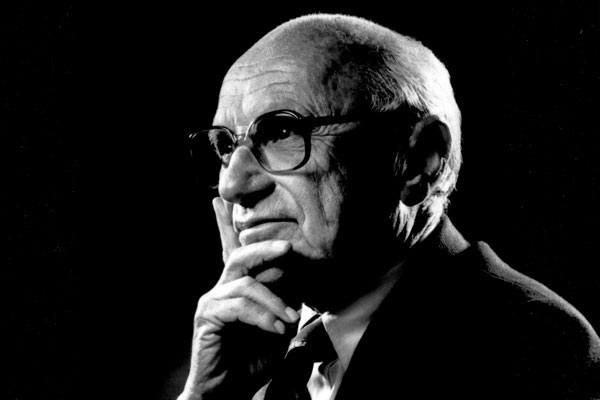
On the late, great, Nobel Prize–winning economist Milton Friedman’s 101st birthday, it is fitting to remember his legacy of school choice and continue the fight for educational opportunity he left for us.
“A stable and democratic society is impossible without widespread acceptance of some common set of values and without a minimum degree of literacy and knowledge on the part of most citizens. Education contributes to both,” Friedman once remarked.
Friedman knew that education is essential for a free society to flourish, but he understood that government-administered schooling is not the way to achieve quality educational options for all children.
Friedman was the father of the educational choice movement, which he first conceived through the idea of school vouchers. The Friedman philosophy of education promotes educational opportunity where parents are free to choose an education that best meets the needs of their children, with money following the children to any schools of their choice: public, private, charter, virtual, or home school.
Choice releases children from government-run schools assigned to them based on their parents’ zip codes. Options such as vouchers empower parents to choose better alternatives for their children’s education. Choice improves the amount of educational options available to families and promotes competition, applying economic pressure that can lead to better performance in the public system as well.
Friedman knew that educational choice is a win-win solution for everyone.
Friedman’s legacy of educational choice continues to expand. Several states now have a plethora of educational options: school vouchers, tax credits, charter schools, online learning, and education savings accounts (ESAs).
ESAs have especially refined Friedman’s original concept of a school voucher. A family with an ESA can use 90 percent of the per-child amount of state funds that would have gone to the child’s assigned public schools to instead be deposited directly into an ESA in the child’s name. The money in the savings account follows the child and can be used by parents to finance a variety of education-related services and providers. They can, for example, use their ESA funds to pay for private school tuition, online learning, special education services, and educational therapies—all while saving taxpayer money. It is an educational option that would have made Friedman proud.
Although educational freedom continues to grow, there are still millions of children around America stuck in low-performing schools.
Friedman understood that vouchers are only a means to educational freedom:
The purpose of vouchers is to enable parents to have free choice, and the purpose of having free choice is to provide competition and allow the educational industry to get out of the 17th century and get into the 21st century and have more innovation and more evolvement.
In 2013, America faces a fork in the road: One direction is toward educational freedom; the other is toward increased centralization through one-size-fits-all efforts such as the Common Core national standards.
In honor of Friedman’s birthday, we must rededicate ourselves to the unfinished task remaining before us, the true end of his philosophy of educational choice: educational freedom in America.
On the Arkansas Times Blog the person using the username “Jake da Snake” noted, “Friedman also railed long and hard for school vouchers to be adopted, to little avail…” (June 11, 2011). Milton Friedman firmly believed, “competition is a way in which both public and private schools can be required to satisfy their customers.” Here […]
Johan Norberg – Free or Equal – Free to Choose 30 years later 4/5 Published on Jun 10, 2012 by BasicEconomics In 1980 economist and Nobel laureate Milton Friedman inspired market reform in the West and revolutions in the East with his celebrated television series “Free To Choose.” Thirty years later, in this one-hour documentary, […]
Johan Norberg – Free or Equal – Free to Choose 30 years later 3/5 Published on Jun 10, 2012 by BasicEconomics In 1980 economist and Nobel laureate Milton Friedman inspired market reform in the West and revolutions in the East with his celebrated television series “Free To Choose.” Thirty years later, in this one-hour documentary, […]
Johan Norberg – Free or Equal – Free to Choose 30 years later 2/5 Published on Jun 10, 2012 by BasicEconomics In 1980 economist and Nobel laureate Milton Friedman inspired market reform in the West and revolutions in the East with his celebrated television series “Free To Choose.” Thirty years later, in this one-hour documentary, […]
_____________________________________ Milton Friedman On Charlie Rose (Part One) The late Milton Friedman discusses economics and otherwise with Charlie Rose. _________________________________________ Milton Friedman: Life and ideas – Part 01 Milton Friedman: Life and ideas A brief biography of Milton Friedman _____________________________________ Stossel – “Free to Choose” (Milton Friedman) 1/6 6-10-10. pt.1 of 6. Stossel discusses Milton […]
Free or Equal?: Johan Norberg Updates Milton & Rose Friedman’s Free to Choose I got this below from Reason Magazine: Swedish economist Johan Norberg is the host of the new documentary Free or Equal, which retraces and updates the 1980 classic Free to Choose, featuring Milton and Rose Friedman. Like the Friedmans, Norberg travels the globe […]
______________________________________ Milton Friedman On Charlie Rose (Part One) The late Milton Friedman discusses economics and otherwise with Charlie Rose. _________________________________________ Milton Friedman: Life and ideas – Part 01 Milton Friedman: Life and ideas A brief biography of Milton Friedman _____________________________________ Stossel – “Free to Choose” (Milton Friedman) 1/6 6-10-10. pt.1 of 6. Stossel discusses Milton […]
Milton Friedman and Chile – The Power of Choice Uploaded on May 13, 2011 In this excerpt from Free To Choose Network’s “The Power of Choice (2006)”, we set the record straight on Milton Friedman’s dealings with Chile — including training the Chicago Boys and his meeting with Augusto Pinochet. Was the tremendous prosperity unleashed […]
Milton Friedman was a great economist and a fine speaker. ___________________ I have written before about Milton Friedman’s influence on the economy of Chile. Now I saw this fine article below from http://www.heritage.org and below that article I have included an article from the Wall Street Journal that talks about Milton Friedman’s influence on Chile. I […]
Biography Part 2 In 1977, when I reached the age of 65, I retired from teaching at the University of Chicago. At the invitation of Glenn Campbell, Director of the Hoover Institution at Stanford University, I shifted my scholarly work to Hoover where I remain a Senior Research Fellow. We moved to San Francisco, purchasing […]
What is the true cost of public education? According to a new study by the Cato Institute, some of the nation’s largest public school districts are underreporting the true cost of government-run education programs.
Cato Education Analyst Adam B. Schaeffer explains that the nations five largest metro areas and the District of Columbia are blurring the numbers on education costs. On average, per-pupil spending in these areas is 44 percent higher than officially reported. Districts on average spent nearly $18,000 per student and yet claimed to spend just $12,500 last year.
It is impossible to have a public debate about education policy if public schools can’t be straight forward about their spending.
______________
President Obama c/o The White House
1600 Pennsylvania Avenue NW
Washington, DC 20500
I watched the video by the Democrat National Convention on 9-6-12 that showed your beautiful wife saying about your family: “We sit around the dinner table (with our kids) and he is he last to be asked, ‘Oh yeah, how was your day Dad?’ You know really he is an afterthought.”
As a father and a husband I want to thank you for demonstrating to others that men need to keep their priorities straight.
If we want the best education possible at the lowest cost for the inner city youth then we need to install the voucher system.
Four years ago, I wrote an op-ed for the Washington Post revealing that DC spent nearly $25,000 per pupil during the 2007-08 school year. I calculated this figure from the public budget documents of the District of Columbia, which I subsequently summarized and linked on this blog.
No education reporter followed up on my findings, and much lower per pupil figures continue to be reported to this day. My $25,000 figure was even greeted with skepticism by analysts at free market think tanks. One state education policy analyst wrote to say that my figure was “out of line with credible information,” and that I gave my critics “too much ammunition with this clearly questionable set of statistics.”
Indeed, the Census Bureau figures for DC’s total K-12 expenditures were substantially lower than mine. I made a note to track down the discrepancy, but other projects intervened. When I updated my calculation to use DC budget estimates for the 2008-09 school year, I found that District spending had risen to over $28,000 / pupil. The comparable number for that year reported by the Bureau of the Census was just $18,181 (which you get by dividing the total expenditure figure in Table 1 by the enrollment figure in Table 15).
So you can see why most folks were skeptical. Skeptical, but wrong.
Back in March of this year I asked my then research intern to contact the Census Bureau and ask where they got their total spending data. It turns out, they got them from a DCPS official. We presented evidence to the Bureau that that DCPS official had missed a few line items when completing the Census Bureau’s forms—to the tune of about $400 million. The Census Bureau agreed and is in the process of obtaining corrected data for the 2008-09 year. In the meantime, they made sure to ask DC officials to include all relevant items when filling out their forms for the 2009-10 school year. The result: Census Bureau data now show DC spent a total of $29,409 per pupil (obtained by dividing total expenditures in Table 1 by enrollment in Table 15). This is just a bit higher than my calculation for the preceding year.
Kudos to the Census Bureau for taking the initiative and getting DC to accurately report its public school expenditures. Now that education reporters can simply open a Census Bureau .pdf file and divide one number by another, I wonder if any will report what DC really spends per pupil? I suspect that they still will not, continuing to mislead the general public, but I would be delighted to be proven wrong.
Oh, and, BTW, this spending figure is about triple what the DC voucher program spends per pupil—and the voucher students have a much higher graduation rate and perform as well or better academically.
Thank you so much for your time. I know how valuable it is. I also appreciate the fine family that you have and your commitment as a father and a husband.
Sincerely,
Everette Hatcher III, 13900 Cottontail Lane, Alexander, AR 72002, ph 501-920-5733, lowcostsqueegees@yahoo.com
Should there be a separation of school and profit? Many opponents of education reform seem to think so.
Case in point, a blog post at the Washington Post yesterday decried “outside forces that want to make big profits on the backs of our nation’s most vulnerable children.” Setting aside that the vast majority of private schools are nonprofit, the author apparently misses the fact that parents choose to send their kids to these schools. (Does it make sense to complain that other businesses are profiting “on the backs” of their paying customers?) In order to persuade parents to switch to private schools, they must offer parents something that the free-to-attend government schools do not. Even when a school choice program covers the full cost of private school tuition, the parents would merely be financially indifferent. To motivate parents to choose something other than the default government school option, private schools still must offer something better.
Moreover, it is absurd to think that profit—in the sense of financial gain—is limited only to the for-profit sector. Do teachers, principals, and other school staff from janitors to bus drivers “profit” from their salaries or wages? What of the profits made by the corporations that publish the textbooks that students read? Or construct school buildings? Or manufacture desks, whiteboards, pens, pencils, and playgrounds? Whether government- or privately-run, nearly every adult involved in the formal education process is earning a “profit” short of the parents who volunteer to chaperone the high school dance.
Those who denounce “profits” in education simply don’t understand the role of profits in a market. Perhaps they are confused because in the government-run education system with which they are familiar, there is little connection between financial gain and meeting the needs of students. In a competitive market, by contrast, profits (and, just as importantly, losses) provide valuable information. As explained in Herbert Walberg and Joseph Bast’s excellent book, Education and Capitalism: How Overcoming Our Fear of Markets and Economics Can Improve America’s Schools (which is celebrating its 10th anniversary):
In a capitalist economy, profits are the reward earned by firms that maximize the quality of services and goods, minimize overhead and bureaucracy, motivate their workers to achieve high and consistent levels of productivity, and avoid unnecessary expenditures. Successful firms sell better, cheaper, or better and cheaper products and services than do other firms. Customers notice, and business gradually shifts from inefficient to efficient firms. […]
Low-performing government schools don’t gradually lose customers and face the threat of closure, the way an inefficiently run business does. As a result, there is little urgency for reform. Their assets do not move from the control of those who have misused them into the hands of others who could do a better job. (Pages 98-9)
In our existing education system, only the financially well-off can afford to live in the expensive districts with high-performing government schools or to pay for private schooling. Without school choice programs, low-income families are locked out of these markets. Instead, their only option is the local, assigned, government school. If I blogged for WaPo, I might say that these underperforming schools are built on “the backs of our nation’s most vulnerable children.”
The Machine: The Truth Behind Teachers Unions Published on Sep 4, 2012 by ReasonTV America’s public education system is failing. We’re spending more money on education but not getting better results for our children. That’s because the machine that runs the K-12 education system isn’t designed to produce better schools. It’s designed to produce more […]
Public schools need more competition and vouchers is the answer. Related posts: Powerful Evidence for School Choice April 22, 2013 by Dan Mitchell I expressed pessimism a few days ago about the possibility of replacing the corrupt internal revenue code with a flat tax. Either now or in the future. But that’s an exception to my […]
John Brummett in his article, “A new civil rights struggle in Little Rock?” Arkansas News Burea, August 25, 2011, asserted the main role vouchers should have is “providing new models for regular public schools to emulate, not about replacing regular public schools.” The Heritage Foundation cares nothing about saving the public schools. If the public […]
Milton Friedman on School Vouchers _______________ Just the facts Mam. APRIL 18, 2013 5:17PM School Choice Works By JASON BEDRICK SHARE The evidence is in: school choice works. Yesterday, the Friedman Foundation for Educational Choice released their third edition of their report “A Win-Win Solution: The Empirical Evidence on School Choice.” The report provides a literature […]
Milton Friedman – Public Schools / Voucher System Published on May 9, 2012 by BasicEconomics The Machine: The Truth Behind Teachers Unions Published on Sep 4, 2012 by ReasonTV America’s public education system is failing. We’re spending more money on education but not getting better results for our children. That’s because the machine that runs […]
(This letter was mailed before Oct 25, 2012.) President Obama c/o The White House 1600 Pennsylvania Avenue NW Washington, DC 20500 Dear Mr. President, I know that you receive 20,000 letters a day and that you actually read 10 of them every day. I really do respect you for trying to get a pulse on […]
The Machine: The Truth Behind Teachers Unions Published on Sep 4, 2012 by ReasonTV America’s public education system is failing. We’re spending more money on education but not getting better results for our children. That’s because the machine that runs the K-12 education system isn’t designed to produce better schools. It’s designed to produce more […]
Everywhere school vouchers have been tried they have been met with great success. Why do you think President Obama got rid of them in Washington D.C.? It was a political disaster for him because the school unions had always opposed them and their success made Obama’s allies look bad. In 1980 when I first sat […]
Milton Friedman – Public Schools / Voucher System (Q&A) Part 2 Published on May 7, 2012 by BasicEconomics __________ Max Brantley of the Arkansas Times Blog is always critical of the voucher system but has he taken a closer look at what has been going on in the public schools the last few decades with […]
Everywhere school vouchers have been tried they have been met with great success. Why do you think President Obama got rid of them in Washington D.C.? It was a political disaster for him because the school unions had always opposed them and their success made Obama’s allies look bad. In 1980 when I first sat […]
Since 1950 the staffing of public schools has skyrocketed but we are getting a good return on our money. We need to turn to the voucher system that Milton Friedman proposed.
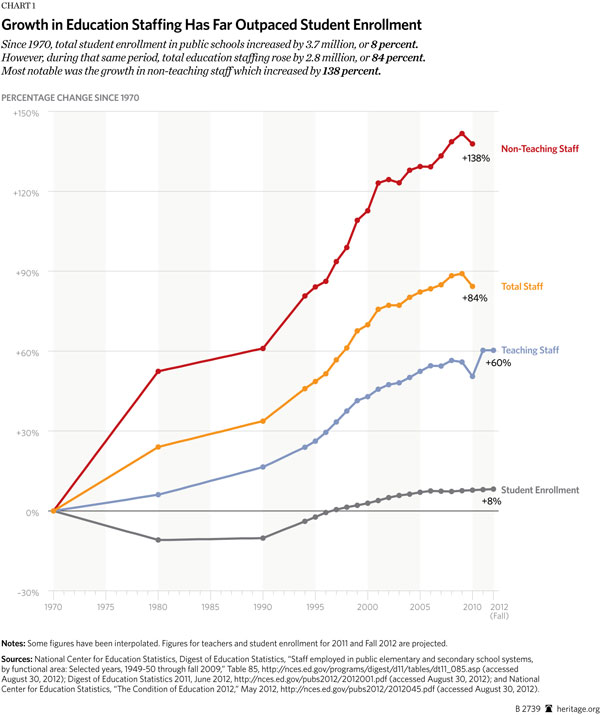
The Friedman Foundation has published an excellent report detailing the administrative bloat plaguing our nation’s public schools. The School Staffing Surge: Decades of Employment Growth in America’s Public Schoolsshows dramatic increases in teaching and non-teaching staff over the past five decades despite modest increases in student enrollment.
As we detailed in a recent report on growth in non-teaching positions in public schools across the country, student enrollment has increased just 8 percent since 1970, while the number of teachers has increased 60 percent, and the number of non-teaching administrative and other staff has increased 138 percent. (continues below chart)
The Friedman report, authored by Ben Scafidi, PhD, takes an even longer look, demonstrating that since 1950, public school enrollment has increased 96 percent, while the number of teachers has increased 252 percent and the number of non-teaching personnel (administrators and other staff) has increased an astonishing 702 percent. “Put differently,” Scafidi notes, “the rise in non-teaching staff was more than seven times faster than the increase in students”:
Between 1950 and 2009, the pupil-staff ratio declined to 7.8 students per public school employee from 19.3 students per public school employee. By 2009, there were fewer than eight public school students per adult employed in the public school system. The drop in the pupil-teacher ratio also was large—the pupil-teacher ratio was 27.5 students per teacher in 1950 and only 15.4 in 2009.
Scafidi also shows how this administrative bloat has affected schools on a state-by-state basis (and uses an interactive map to make the point). Of note: “Nine states with declining student populations had significant increases in public school personnel—D.C., Iowa, Louisiana, Maine, Mississippi, North Dakota, South Dakota, Wyoming, and Vermont.”
The Friedman report notes that the dramatic reduction in class size over the decades has not led to increases in student achievement. Why? As Scafidi reports, an increase in teacher quantity has not produced an increase in teacher quality:
As public schools have reduced class sizes continually since at least 1950, they have had to hire more teachers. And, the evidence is in—the disparity in effectiveness across teachers is considerable. Accordingly, state governments and local public school boards should have been more concerned with improving teacher effectiveness than lowering class sizes.
Continuing a trend of growing staff positions in our nation’s public schools won’t create the types of improvements that the system so desperately needs.
Instead, public school districts should trim bureaucracy and work on long-term reform options for better targeting of taxpayer resources. And decision making should be decentralized, placing staffing and other decisions in the hands of principals, teachers, and parents.
Finally, parents—and teachers—should have options. We’ll never see improvement in our nation’s education system without providing students with a choice about which schools—public, private, virtual, or homeschooling—will best meet their unique learning needs.
___________
Thank you so much for your time. I know how valuable it is. I also appreciate the fine family that you have and your commitment as a father and a husband.
Sincerely,
Everette Hatcher III, 13900 Cottontail Lane, Alexander, AR 72002, ph 501-920-5733, lowcostsqueegees@yahoo.com
Max Brantley of the Arkansas Times Blog reports today that Mitt Romney is for school vouchers. I am glad to hear that. Over and over we hear that the reason private schools are better is because they don’t have to keep the troubling making kids. It reminds me of this short film that I saw many […]
Milton Friedman – Public Schools / Voucher System (Q&A) Part 2 Published on May 7, 2012 by BasicEconomics __________ We need to get competition back again among schools and the voucher system is the best way to do that. D.C. Public Schools Spend Almost $30,000 Per Student Ericka Andersen July 25, 2012 at 10:00 am […]
Milton Friedman – Public Schools / Voucher System (Q&A) Part 1 Published on May 7, 2012 by BasicEconomics ___________ We have to turn to the school voucher system if we want competition between schools and want to lower the cost of education. Chile’s Amazing School Choice Revolution September 29, 2012 by Dan Mitchell I wrote back […]
Johan Norberg – Free or Equal – Free to Choose 30 years later 5/5 Published on Jun 10, 2012 by BasicEconomics In 1980 economist and Nobel laureate Milton Friedman inspired market reform in the West and revolutions in the East with his celebrated television series “Free To Choose.” Thirty years later, in this one-hour documentary, […]
Everywhere school vouchers have been tried they have been met with great success. Why do you think President Obama got rid of them in Washington D.C.? It was a political disaster for him because the school unions had always opposed them and their success made Obama’s allies look bad. In 1980 when I first sat […]
Johan Norberg – Free or Equal – Free to Choose 30 years later 4/5 Published on Jun 10, 2012 by BasicEconomics In 1980 economist and Nobel laureate Milton Friedman inspired market reform in the West and revolutions in the East with his celebrated television series “Free To Choose.” Thirty years later, in this one-hour documentary, […]
Johan Norberg – Free or Equal – Free to Choose 30 years later 3/5 Published on Jun 10, 2012 by BasicEconomics In 1980 economist and Nobel laureate Milton Friedman inspired market reform in the West and revolutions in the East with his celebrated television series “Free To Choose.” Thirty years later, in this one-hour documentary, […]
The Machine: The Truth Behind Teachers Unions Published on Sep 4, 2012 by ReasonTV America’s public education system is failing. We’re spending more money on education but not getting better results for our children. That’s because the machine that runs the K-12 education system isn’t designed to produce better schools. It’s designed to produce more […]
Milton Friedman on Hayek’s “Road to Serfdom” 1994 Interview 2 of 2 Uploaded by PenguinProseMedia on Oct 26, 2011 2nd half of 1994 interview. ________________ I have a lot of respect for the Friedmans.Two Lucky People by Milton and Rose Friedman reviewed by David Frum — October 1998. However, I liked this review below better. It […]
Johan Norberg – Free or Equal – Free to Choose 30 years later 2/5 Published on Jun 10, 2012 by BasicEconomics In 1980 economist and Nobel laureate Milton Friedman inspired market reform in the West and revolutions in the East with his celebrated television series “Free To Choose.” Thirty years later, in this one-hour documentary, […]
But that’s an exception to my general feeling that we’re moving in the right direction on public policy. I’ve shared a list of reasons to be optimistic, even on issues such as Obamacare and the Laffer Curve.
Education is another area where we should be hopeful. Simply stated, it’s increasingly difficult for defenders of the status quo to rationalize pouring more money into the failed government education monopoly. To paraphrase Winston Churchill, never has so much been spent so recklessly with such meager results.
Fortunately, a growing number of people are realizing that the answer is markets and competition. That’s one of the reasons why we’re seeing progress all over the country. Policy makers have implemented varying degrees of school choice in states such as Indiana, Louisiana, Wisconsin, Colorado, Florida, Arizona, and even California.
Is this having a positive impact on educational outcomes and other key variables? The answer, not surprisingly, is yes.
Here are some of the details from a new study published by the Friedman Foundation for Educational Choice.
This report surveys the empirical research on school choice. …the empirical evidence consistently shows that choice improves academic outcomes for participants and public schools, saves taxpayer money, moves students into more integrated classrooms, and strengthens the shared civic values and practices essential to American democracy.
The data on academic outcomes surely is the most important bit of information, so let’s specifically review those findings.
Twelve empirical studies have examined academic outcomes for school choice participants using random assignment, the “gold standard” of social science. Of these, 11 find that choice improves student outcomes—six that all students benefit and five that some benefit and some are not affected. One study finds no visible impact. No empirical study has found a negative impact.
And since I want to reduce the burden of government spending, let’s see whether school choice is good news for taxpayers.
Six empirical studies have examined school choice’s fiscal impact on taxpayers. All six find that school choice saves money for taxpayers. No empirical study has found a negative fiscal impact.
Here’s the breakdown of the studies for all the variables.
Some of the tax research was inconclusive, but not a single study supported the notion that higher tax rates are good for growth, much as this new research from the Friedman Foundation didn’t uncover a single study that found negative results from school choice.
So with lots of positive research and no negative research, why would anybody oppose school choice? Unfortunately, politicians like Barack Obama and groups such as the NAACP side with teacher unions, putting political power ahead of progress and opportunity for kids.
P.S. Here’s a video explaining why school choice is better than a government-run monopoly.
P.P.S. There’s also strong evidence for school choice from nations such as Sweden, Chile, and the Netherlands.
The Machine: The Truth Behind Teachers Unions Published on Sep 4, 2012 by ReasonTV America’s public education system is failing. We’re spending more money on education but not getting better results for our children. That’s because the machine that runs the K-12 education system isn’t designed to produce better schools. It’s designed to produce more […]
John Brummett in his article, “A new civil rights struggle in Little Rock?” Arkansas News Burea, August 25, 2011, asserted the main role vouchers should have is “providing new models for regular public schools to emulate, not about replacing regular public schools.” The Heritage Foundation cares nothing about saving the public schools. If the public […]
Milton Friedman on School Vouchers _______________ Just the facts Mam. APRIL 18, 2013 5:17PM School Choice Works By JASON BEDRICK SHARE The evidence is in: school choice works. Yesterday, the Friedman Foundation for Educational Choice released their third edition of their report “A Win-Win Solution: The Empirical Evidence on School Choice.” The report provides a literature […]
Milton Friedman – Public Schools / Voucher System Published on May 9, 2012 by BasicEconomics The Machine: The Truth Behind Teachers Unions Published on Sep 4, 2012 by ReasonTV America’s public education system is failing. We’re spending more money on education but not getting better results for our children. That’s because the machine that runs […]
(This letter was mailed before Oct 25, 2012.) President Obama c/o The White House 1600 Pennsylvania Avenue NW Washington, DC 20500 Dear Mr. President, I know that you receive 20,000 letters a day and that you actually read 10 of them every day. I really do respect you for trying to get a pulse on […]
The Machine: The Truth Behind Teachers Unions Published on Sep 4, 2012 by ReasonTV America’s public education system is failing. We’re spending more money on education but not getting better results for our children. That’s because the machine that runs the K-12 education system isn’t designed to produce better schools. It’s designed to produce more […]
Everywhere school vouchers have been tried they have been met with great success. Why do you think President Obama got rid of them in Washington D.C.? It was a political disaster for him because the school unions had always opposed them and their success made Obama’s allies look bad. In 1980 when I first sat […]
Milton Friedman – Public Schools / Voucher System (Q&A) Part 2 Published on May 7, 2012 by BasicEconomics __________ Max Brantley of the Arkansas Times Blog is always critical of the voucher system but has he taken a closer look at what has been going on in the public schools the last few decades with […]
The evidence is in: school choice works. Yesterday, the Friedman Foundation for Educational Choice released their third edition of their report “A Win-Win Solution: The Empirical Evidence on School Choice.” The report provides a literature review of dozens of high-quality studies of school choice programs around the country, including studies from scholars at Harvard University, Stanford University, Cornell University, the University of Arkansas, the Brookings Institution, and the Federal Reserve Bank. The studies examine the impact of school choice programs on the academic performance of participants and public school students, the fiscal impact on taxpayers, racial segregation, and civic values.
The report’s key findings included the following:
Twelve empirical studies have examined academic outcomes for school choice participants using random assignment, the “gold standard” of social science. Of these, 11 find that choice improves student outcomes—six that all students benefit and five that some benefit and some are not affected. One study finds no visible impact. No empirical study has found a negative impact.
Twenty-three empirical studies (including all methods) have examined school choice’s impact on academic outcomes in public schools. Of these, 22 find that choice improves public schools and one finds no visible impact. No empirical study has found that choice harms public schools.
Six empirical studies have examined school choice’s fiscal impact on taxpayers. All six find that school choice saves money for taxpayers. No empirical study has found a negative fiscal impact.
Eight empirical studies have examined school choice and racial segregation in schools. Of these, seven find that school choice moves students from more segregated schools into less segregated schools. One finds no net effect on segregation from school choice. No empirical study has found that choice increases racial segregation.
Seven empirical studies have examined school choice’s impact on civic values and practices such as respect for the rights of others and civic knowledge. Of these, five find that school choice improves civic values and practices. Two find no visible impact from school choice. No empirical study has found that school choice has a negative impact on civic values and practices.
On the same day, anew studyfrom researchers at Harvard University and the Brookings Institution found that a school choice program boosted college enrollment among African-American participants by 24 percent.
While many of the findings show only modest improvement, they consistently show that school choice programs produce the same or superior results across a gamut of measures. Moreover, not all the benefits of choice are easily measurable. Some families are looking for a school that better meets a student’s special needs, instills the parents’ values, inspires a lifelong love of learning, or where a student issafe from bullying. These outcomes are sometimes difficult if not impossible to measure in the aggregate, but parents are in the best position to tell the difference for their own children.
The Machine: The Truth Behind Teachers Unions Published on Sep 4, 2012 by ReasonTV America’s public education system is failing. We’re spending more money on education but not getting better results for our children. That’s because the machine that runs the K-12 education system isn’t designed to produce better schools. It’s designed to produce more […]
John Brummett in his article, “A new civil rights struggle in Little Rock?” Arkansas News Burea, August 25, 2011, asserted the main role vouchers should have is “providing new models for regular public schools to emulate, not about replacing regular public schools.” The Heritage Foundation cares nothing about saving the public schools. If the public […]
Milton Friedman – Public Schools / Voucher System Published on May 9, 2012 by BasicEconomics The Machine: The Truth Behind Teachers Unions Published on Sep 4, 2012 by ReasonTV America’s public education system is failing. We’re spending more money on education but not getting better results for our children. That’s because the machine that runs […]
(This letter was mailed before Oct 25, 2012.) President Obama c/o The White House 1600 Pennsylvania Avenue NW Washington, DC 20500 Dear Mr. President, I know that you receive 20,000 letters a day and that you actually read 10 of them every day. I really do respect you for trying to get a pulse on […]
The Machine: The Truth Behind Teachers Unions Published on Sep 4, 2012 by ReasonTV America’s public education system is failing. We’re spending more money on education but not getting better results for our children. That’s because the machine that runs the K-12 education system isn’t designed to produce better schools. It’s designed to produce more […]
Everywhere school vouchers have been tried they have been met with great success. Why do you think President Obama got rid of them in Washington D.C.? It was a political disaster for him because the school unions had always opposed them and their success made Obama’s allies look bad. In 1980 when I first sat […]
Milton Friedman – Public Schools / Voucher System (Q&A) Part 2 Published on May 7, 2012 by BasicEconomics __________ Max Brantley of the Arkansas Times Blog is always critical of the voucher system but has he taken a closer look at what has been going on in the public schools the last few decades with […]
Everywhere school vouchers have been tried they have been met with great success. Why do you think President Obama got rid of them in Washington D.C.? It was a political disaster for him because the school unions had always opposed them and their success made Obama’s allies look bad. In 1980 when I first sat […]
You would think $30,000 a year would get you a decent education. For just a few thousand more, you could cover the cost of Harvard’s yearly undergraduate tuition or send your child to the prestigious Sidwell Friends School, which the Obama daughters attend.
But spending $30,000 to cover the cost of a child’s education in a district that has one of the lowest graduation rates in the nation and produces some of the country’s lowest achievement scores? Seems a bit steep. But this is the hefty per-pupil bill taxpayers are made to foot for D.C. public schools every year.
Andrew Coulson of the Cato Institute, who calculated D.C.’s per-pupil cost, explains that the first time he revealed D.C.’s high per-pupil spending a few years ago, he received considerable pushback. Critics claimed his estimate was too high and was inconsistent with the Census Bureau’s numbers.
“Indeed, the Census Bureau figures for DC’s total K-12 expenditures were substantially lower than mine,” he explains.
Why the inconsistency?
“It turns out, [Census] got [D.C. spending data] from a DCPS [D.C. Public Schools] official,” notes Coulson. “We presented evidence to the Bureau that that DCPS official had missed a few line items when completing the Census Bureau’s forms—to the tune of about $400 million.” Census agreed, and their “data now show DC spent a total of $29,409 per pupil.”
On the other hand, the D.C. Opportunity Scholarship Program (DCOSP), which provides scholarships to low-income students in the nation’s capital to attend private schools of their choice, not only produces significantly higher graduation rates than D.C. public schools but costs significantly less. A DCOSP scholarship stands at just $8,000 for a K-8 student or $12,000 for a 9-12 grade student.
Children in D.C. and around the nation deserve the best opportunity for academic success, and taxpayers deserve that their dollars be used effectively. Rather than investing more in the same failed approaches, policymakers and local leaders should look to innovative reforms, including school choice, to improve education and give students the brightest hope for a promising future.
________________
Thank you so much for your time. I know how valuable it is. I also appreciate the fine family that you have and your commitment as a father and a husband.
Sincerely,
Everette Hatcher III, 13900 Cottontail Lane, Alexander, AR 72002, ph 501-920-5733, lowcostsqueegees@yahoo.com
In that post, I noted that Chile was a pioneer in the shift from unsustainable tax-and-transfer entitlement schemes to savings-based personal retirement accounts. And with good reason. That system, which has been in place for more than three decades, is hugely successful.
But Chile’s success is driven by more than just pension reform. And I want to mention something remarkable about what’s happening with school choice in that country.
Jose Pinera – Freedom Fighter
First, some background. I’m currently at a Cato Institute donor retreat, where I had the chance to talk to Jose Pinera, who is now the Co-chairman of Cato’s Project on Social Security Choice, but who also was the person who implemented the pension reforms in his home country of Chile.
Jose thinks that it is just a matter of time before more than 80 percent of Chilean kids are in private schools. Why? Because people like freedom and choice.
He often brags – and rightly so – that more than 95 percent of workers chose personal retirement accounts when given the option of staying with the old government-run pension system. So it shouldn’t be a surprise that parents also choose wisely when deciding how to get the best possible education option for their kids.
Thank you so much for your time. I know how valuable it is. I also appreciate the fine family that you have and your commitment as a father and a husband.
Sincerely,
Everette Hatcher III, 13900 Cottontail Lane, Alexander, AR 72002, ph 501-920-5733, lowcostsqueegees@yahoo.com
America’s public education system is failing. We’re spending more money on education but not getting better results for our children.
That’s because the machine that runs the K-12 education system isn’t designed to produce better schools. It’s designed to produce more money for unions and more donations for politicians.
For decades, teachers’ unions have been among our nation’s largest political donors. As Reason Foundation’s Lisa Snell has noted, the National Education Association (NEA) alone spent $40 million on the 2010 election cycle (source: http://reason.org/news/printer/big-education-and-big-labor-electio). As the country’s largest teachers union, the NEA is only one cog in the infernal machine that robs parents of their tax dollars and students of their futures.
Students, teachers, parents, and hardworking Americans are all victims of this political machine–a system that takes money out of taxpayers’ wallets and gives it to union bosses, who put it in the pockets of politicians.
No one did more to advance the cause of school vouchers than Milton and Rose Friedman. Friedman made it clear in his film series “Free to Choose” how sad he was that young people who live in the inner cities did not have good education opportunities available to them.
President Obama c/o The White House
1600 Pennsylvania Avenue NW
Washington, DC 20500
I have posted often about the voucher system and how it would solve our education problems. What we are doing now is not working. Milton Friedman’s idea of implementing school vouchers was hatched about 50 years ago.
Poor families are most affected by this lack of choice. As Friedman noted, “There is no respect in which inhabitants of a low-income neighborhood are so disadvantaged as in the kind of schooling they can get for their children.” It is a sad statement quantified by data on low levels of academic achievement and attainment. Take a look at this article below.
Reading scores on the SAT for the high school class of 2012 reached a four-decade low, putting a punctuation mark on a gradual decline in the ability of college-bound teens to read passages and answer questions about sentence structure, vocabulary and meaning on the college entrance exam.
The decline over the decades has been significant. The average reading (verbal) score is down 34 points since 1972. Sadly, the historically low SAT scores are only the latest marker of decline. Graduation rates have been stagnant since the 1970s, reading and math achievement has been virtually flat over the same time period, and American students still rank in the middle of the pack compared to their international peers.
On the heels of the news about the SAT score decline, President Obama filmed a segment with NBC’s Education Nation earlier today. The President notably praised the concept of charter schools and pay for performance for teachers.
But those grains of reform were dwarfed by his support of the status quo. During the course of the interview, President Obama suggested hiring 100,000 new math and science teachers and spending more money on preschool. He also stated that No Child Left Behind had good intentions but was “under-resourced.”
Efforts by the federal government to intervene in preschool, most notably through Head Start, have failed—despite a $160 billion in spending on the program since 1965. And No Child Left Behind is far from “under-resourced.” The $25 billion, 600-page law has been on the receiving end of significant new spending every decade since the original law was first passed nearly half a century ago.
President Obama was also pressed on the issue of education unions by host Savannah Guthrie:
Some people think, President Obama gets so much support from the teachers’ unions, he can’t possibly have an honest conversation about what they’re doing right or wrong. Can you really say that teachers’ unions aren’t slowing the pace of reform?
President Obama responded: “You know, I just really get frustrated when I hear teacher-bashing as evidence of reform.”
Criticizing education unions for standing in the way of reform should not be conflated with criticizing teachers, as the President does in the interview. The unions have blocked reforms such as performance pay and charter schools (which the President supports), have opposed alternative teacher certification that would help mid-career professionals enter the classroom, and have consistently fought the implementation of school choice options for children.
If we ever hope to move the needle on student achievement—or see SAT scores turn in the right direction again—we’ll need to implement many of those exact reforms, particularly school choice.
And as he has in the past, President Obama stated that his Administration wants to “use evidenced-based approaches and find out what works.” We know what works: giving families choices when it comes to finding schools that best meet their children’s needs. Instead of continuing to call for more spending and more Washington intervention in education, let’s try something new: choice and freedom.
_________
Thank you so much for your time. I know how valuable it is. I also appreciate the fine family that you have and your commitment as a father and a husband.
Sincerely,
Everette Hatcher III, 13900 Cottontail Lane, Alexander, AR 72002, ph 501-920-5733, lowcostsqueegees@yahoo.com
I ran across this very interesting article about Milton Friedman from 2002: Friedman: Market offers poor better learningBy Tamara Henry, USA TODAY By Doug Mills, AP President Bush honors influential economist Milton Friedman for his 90th birthday earlier this month. About an economist Name:Milton FriedmanAge: 90Background: Winner of the 1976 Nobel Prize for economic science; […]
Milton Friedman videos and transcripts Part 11 On my blog http://www.thedailyhatch.org I have an extensive list of posts that have both videos and transcripts of MiltonFriedman’s interviews and speeches. Here below is just small list of those and more can be accessed by clicking on “Milton Friedman” on the side of this page or searching […]
Milton Friedman videos and transcripts Part 10 On my blog http://www.thedailyhatch.org I have an extensive list of posts that have both videos and transcripts of MiltonFriedman’s interviews and speeches. Here below is just small list of those and more can be accessed by clicking on “Milton Friedman” on the side of this page or searching […]
Milton Friedman videos and transcripts Part 9 On my blog http://www.thedailyhatch.org I have an extensive list of posts that have both videos and transcripts of MiltonFriedman’s interviews and speeches. Here below is just small list of those and more can be accessed by clicking on “Milton Friedman” on the side of this page or searching […]
Biography Part 2 In 1977, when I reached the age of 65, I retired from teaching at the University of Chicago. At the invitation of Glenn Campbell, Director of the Hoover Institution at Stanford University, I shifted my scholarly work to Hoover where I remain a Senior Research Fellow. We moved to San Francisco, purchasing […]
Milton Friedman at Hillsdale College 2006 July 2006 Free to Choose: A Conversation with Milton Friedman Milton Friedman Economist Milton Friedman is a senior research fellow at the Hoover Institution at Stanford University and a professor emeritus of economics at the University of Chicago, where he taught from 1946-1976. Dr. Friedman received the Nobel Memorial […]
Milton Friedman videos and transcripts Part 8 On my blog http://www.thedailyhatch.org I have an extensive list of posts that have both videos and transcripts of MiltonFriedman’s interviews and speeches. Here below is just small list of those and more can be accessed by clicking on “Milton Friedman” on the side of this page or searching […]
Testing Milton Friedman – Preview Uploaded by FreeToChooseNetwork on Feb 21, 2012 2012 is the 100th anniversary of Milton Friedman’s birth. His work and ideas continue to make the world a better place. As part of Milton Friedman’s Century, a revival of the ideas featured in the landmark television series Free To Choose are being […]
Charlie Rose interview of Milton Friedman My favorite economist: Milton Friedman : A Great Champion of Liberty by V. Sundaram Milton Friedman, the Nobel Prize-winning economist who advocated an unfettered free market and had the ear of three US Presidents – Nixon, Ford and Reagan – died last Thursday (16 November, 2006 ) in San Francisco […]
Free or Equal?: Johan Norberg Updates Milton & Rose Friedman’s Free to Choose I got this below from Reason Magazine: Swedish economist Johan Norberg is the host of the new documentary Free or Equal, which retraces and updates the 1980 classic Free to Choose, featuring Milton and Rose Friedman. Like the Friedmans, Norberg travels the globe […]
I must say that I have lots of respect for Reason Magazine and for their admiration of Milton Friedman. However, I do disagree with one phrase below. At the end of this post I will tell you what sentence it is. Uploaded by ReasonTV on Jul 28, 2011 There’s no way to appreciate fully the […]
Milton Friedman on Hayek’s “Road to Serfdom” 1994 Interview 1 of 2 Uploaded by PenguinProseMedia on Oct 25, 2011 Says Federal Reserve should be abolished, criticizes Keynes. One of Friedman’s best interviews, discussion spans Friedman’s career and his view of numerous political figures and public policy issues. ___________________ Two Lucky People by Milton and Rose Friedman […]
What a great man Milton Friedman was. The Legacy of Milton Friedman November 18, 2006 Alexander Tabarrok Great economist by day and crusading public intellectual by night, Milton Friedman was my hero. Friedman’s contributions to economics are profound, the permanent income hypothesis, the resurrection of the quantity theory of money, and his magnum opus with […]
Milton Friedman videos and transcripts Part 7 On my blog http://www.thedailyhatch.org I have an extensive list of posts that have both videos and transcripts of MiltonFriedman’s interviews and speeches. Here below is just small list of those and more can be accessed by clicking on “Milton Friedman” on the side of this page or searching […]
Below is a discussion from Milton Friedman on Bill Clinton and Ronald Reagan. February 10, 1999 | Recorded on February 10, 1999 audio, video, and blogs » uncommon knowledge PRESIDENTIAL REPORT CARD: Milton Friedman on the State of the Union with guest Milton Friedman Milton Friedman, Senior Research Fellow, Hoover Institution and Nobel Laureate in […]
Milton Friedman and Chile – The Power of Choice Uploaded by FreeToChooseNetwork on May 13, 2011 In this excerpt from Free To Choose Network’s “The Power of Choice (2006)”, we set the record straight on Milton Friedman’s dealings with Chile — including training the Chicago Boys and his meeting with Augusto Pinochet. Was the tremendous […]








 The Daily Hatch