I have a real problem with the “Occupy Wall Street” protesters. Do the liberal protesters that attack the greed of capitalism ever take the time to look at what the world would look like without capitalism?
Part of my job at the Cato Institute is to educate people about free markets and fiscal policy.
In some cases, that means providing information and analysis to those already sympathetic to limited government. There are many people who like the idea of lower tax burdens, for instance, but they may not have given much thought to the interaction of tax rates, taxable income, and tax revenue, so that’s why I put together my Laffer Curve tutorial and why I wrote about this amazing data from the Reagan tax cuts.
Ever wonder what life would be like without capitalism? Join The Fund for American Studies on a journey to an alternate universe — one where capitalism no longer exists. You may find it’s not quite what you expected.
____________
P.S. Here’s another video from TFAS that uses an unusual tactic to get people to think about the value of capitalism and free markets.
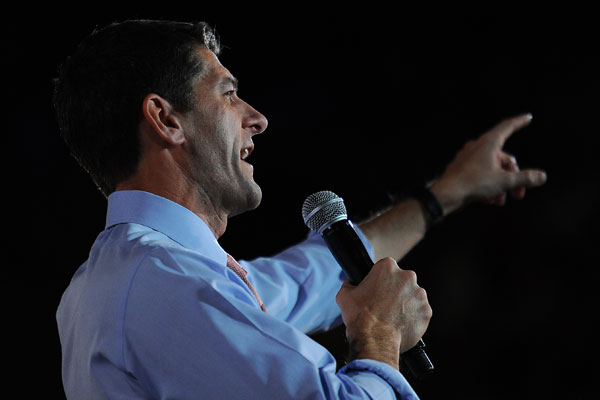
House Budget Committee chairman Paul Ryan (R–WI) made a strong case yesterday for the need to ensure that every child in America has the opportunity to attend a school of choice. “If we want to restore the promise of America,” Ryan stated, “then we must reform our broken public-school system.”
Ryan is right.
Millions of children pass through our nation’s broken public schools year after year. Too many of those children have no other choice. Confined by their parent’s zip codes and economic means, they are assigned to government schools, where, in some of our nation’s largest cities, they are just as likely to drop out as they are to graduate.
Providing those children with a choice isn’t a radical idea: School choice means funding children instead of institutions and allowing dollars to follow them to educational options that best meet their unique learning needs. But no matter how common-sense school choice might seem, the usual suspects—special interest groups concerned with maintaining a self-serving status quo—will try to stand in the way. As Ryan noted:
The special interests that dominate this system always seem to have their own futures lined up pretty nicely. But when you think about the future of the young adults that the system has failed, many will face a lot of grief and disappointment—and their country owes them better than that.
School choice places the interests of children (and parents, teachers, and taxpayers) before the interests of the adults in the antiquated assignment-by-zip-code public education system. Above all, school choice creates freedom in a moribund system stifled by government regulation and based on a monopolistic design that is alien to nearly every other aspect of American life. To improve American education, that has to change. As Ryan concluded:
When you set aside all the obstacles to education reform, you are left with one obvious fact: Every child in America should have this kind of opportunity. Sending your child to a great school should not be a privilege of the well-to-do.… I believe that choice should be available to every parent in our country, wherever they live. Education reform is urgent, and freedom is the key.
1980 Presidential Candidate Debate: Governor Ronald Reagan and President Jimmy Carter – 10/28/80
Above is the video of the complete debate. Below is the sixth part of the transcript that deals with the issue of oil dependency among other things. This segment begins at 57 minute mark.
MR. SMITH: We have to go to another question now, from Harry Ellis to President Carter.
HARRY ELLIS: Mr. President, as you have said, Americans, through conservation, are importing much less oil today than we were even a year ago. Yet U.S. dependence on Arab oil as a percentage of total imports is today much higher than it was at the time of the 1973 Arab oil embargo, and for some time to came, the loss of substantial amounts of Arab oil could plunge the U.S. into depression. This means that a bridge must be built out of this dependence. Can the United States develop synthetic fuels and other alternative energy sources without damage to the environment, and will this process mean steadily higher fuel bills for American families?
MR. CARTER: I don’t think there’s any doubt that, in the future, the cost of oil is going to go up. What I’ve had as a basic commitment since I’ve been President is to reduce our dependence on foreign oil. It can only be done in two ways: one, to conserve energy – to stop the waste of energy – and, secondly, to produce more American energy. We’ve been very successful in both cases. We’ve now reduced the importing of foreign oil in the last year alone by one-third. We imported today 2 million barrels of oil less than we did the same date just a year ago. This commitment has been opening up a very bright vista for our nation in the future, because with the windfall profits tax as a base, we now have an opportunity to use American technology and American ability and American natural resources to expand rapidly the production of synthetic fuels, yes; to expand rapidly the production of solar energy, yes; and also to produce the traditional kinds of American energy. We will drill more oil and gas wells this year than any year in history. We’ll produce more coal this year than any year in history. We are exporting more coal this year than any year in history. And we have an opportunity now with improved transportation systems and improved loading facilities in our ports, to see a very good opportunity on a world international market, to replace OPEC oil with American coal as a basic energy source. This exciting future will not only give us more energy security, but will also open up vast opportunities for Americans to live a better life and to have millions of new jobs associated with this new and very dynamic industry now in prospect because of the new energy policy that we’ve put into effect.
MR. SMITH: Would you repeat the question now for Governor Reagan?
MR. ELLIS: Governor Reagan, Americans, through conservation, are importing much less oil today than we were even a year ago. And yet, U.S. reliance on Arab oil as a percentage of total imports is much higher today than it was during the 1973 Arab oil embargo. And the substantial loss of Arab oil could plunge the United States into depression. The question is whether the development of alternative energy sources, in order to reduce this dependence, can be done without damaging the environment, and will it mean for American families steadily higher fuel bills?
MR. REAGAN: I’m not so sure that it means steadily higher fuel costs, but I do believe that this nation has been portrayed for too long a time to the people as being energy-poor when it is energy-rich. The coal that the President mentioned – yes, we have it – and yet one-eighth of our total coal resources is not being utilized at all right now. The mines are closed down; there are 22000 miners out of work. Most of this is due to regulations which either interfere with the mining of it or prevent the burning of it:. With our modern technology, yes, we can burn our coal within the limits of the Clean Air Act. I think, as technology improves, we’ll be able to do even better with that. The other thing is that we have only leased out – begun to explore – 2% of our outer continental shelf for oil, where it is believed, by everyone familiar with that fuel and that source of energy, that there are vast supplies yet to be found. Our Government has, in the last year or so, taken out of multiple use millions of acres of public lands that once were – well, they were public lands subject to multiple use – exploration for minerals and so forth. It is believed that probably 70% of the potential oil in the United States is probably hidden in those lands, and no one is allowed to even go and explore to find out if it is there. This is particularly true of the recent efforts to shut down part of Alaska. Nuclear power: There were 36 power plants planned in this country. And let me add the word safety; it must be done with the utmost of safety. But 32 of those have given up and canceled their plans to build, and again, because Government regulations and permits, and so forth, take – make it take – more than twice as long to build a nuclear plant in the United States as it does to build one in Japan or in Western Europe. We have the sources here. We are energy rich, and coal is one of the great potentials we have.
MR. SMITH: President Carter, your comment?
MR. CARTER: To repeat myself, we have this year the opportunity, which we’ll realize, to produce 800 million tons of coal – an unequaled record in the history of our country. Governor Reagan says that this is not a good achievement, and he blames restraints on coal production on regulations – regulations that affect the life and the health and safety of miners, and also regulations that protect the purity of our air and the quality our water and our land. We cannot cast aside these regulations. We have a chance in the next 15 years, insisting upon the health and safety of workers in the mines, and also preserving the same high air and water pollution standards, to triple the amount of coal we produce. Governor Reagan’s approach to our energy policy, which has already proven its effectiveness, is to repeal, or to change substantially, the windfall profits tax – to return a major portion of $227 billion back to the oil companies; to do away with the Department of Energy; to short-circuit our synthetic fuels program; to put a minimal emphasis on solar power; to emphasize strongly nuclear power plants as a major source of energy in the future. He wants to put all our eggs in one basket and give that basket to the major oil companies.
MR. SMITH: Governor Reagan.
MR. REAGAN: That is a misstatement, of course, of my position. I just happen to believe that free enterprise can do a better job of producing the things that people need than government can. The Department of Energy has a multi-billion-dollar budget in excess of $10 billion. It hasn’t produced a quart of oil or a lump of coal, or anything else in the line of energy. And for Mr. Carter to suggest that I want to do away with the safety laws and with the laws that pertain to clean water and clean air, and so forth. As Governor of California, I took charge of passing the strictest air pollution laws in the United States – the strictest air quality law that has even been adopted in the United States. And we created an OSHA – an Occupational Safety and Health Agency – for the protection of employees before the Federal Government had one in place. And to this day, not one of its decisions or rulings has ever been challenged. So, I think some of those charges are missing the point. I am suggesting that there are literally thousands of unnecessary regulations that invade every facet of business, and indeed, very much of our personal lives, that are unnecessary; that Government can do without; that have added $130 billion to the cost of production in this country; and that are contributing their part to inflation. And I would like to see us a little more free, as we once were.
MR. SMITH: President Carter, another crack at that?
MR. CARTER: Sure. As a matter of fact,. the air pollution standard laws that were passed in California were passed over the objections of Governor Reagan, and this is a very well-known fact. Also, recently, when someone suggested that the Occupational Safety and Health Act should be abolished, Governor Reagan responded, amen. The offshore drilling rights is a question that Governor Reagan raises often. As a matter of fact, in the proposal for the Alaska lands legislation, 100% of all the offshore lands would be open for exploration, and 95% of all the Alaska lands, where it is suspected or believed that minerals might exist. We have, with our five-year plan for the leasing of offshore lands, proposed more land to be drilled than has been opened up for drilling since this program first started in 1954. So we’re not putting restraints on American exploration, we’re encouraging it in every way we can.
MR. SMITH: Governor Reagan, you have the last word on this question.
MR. REAGAN: Yes. If it is a well-known fact that I opposed air pollution laws in California, the only thing I can possibly think of is that the President must be suggesting the law that the Federal Government tried to impose on the State of California – not a law, but regulations – that would have made it impossible to drive an automobile within the city limits of any California city, or to have a place to put it if you did drive it against their regulations. It would have destroyed the economy of California, and, I must say, we had the support of Congress when we pointed out how ridiculous this attempt was by the Environmental Protection Agency. We still have the strictest air control, or air pollution laws in the country. As for offshore oiling, only 2% now is so leased and is producing oil. The rest, as to whether the lands are going to be opened in the next five years or so – we’re already five years behind in what we should be doing. There is more oil now, in the wells that have been drilled, than has been taken out in 121 years that they’ve been drilled.
Simply stated, people won’t be smart consumers and providers won’t compete to keep costs low when the vast majority of expenses are paid for either by government programs or by insurance companies.
That’s why I want to see reforms to Medicare and Medicaid, not only to save money for taxpayers, but also because that’s one of the steps that is needed if we want market forces to bring down the cost of healthcare.
And I want to see a flat tax, not only for the pro-growth impact of lower tax rates, but also because it gets rid of the internal revenue code’s healthcare exclusion, thus ending the distortion that encourages over-insurance.
With all that in mind, I’m obviously a big fan of this new video from the Center for Freedom and Prosperity.
__________
Third-Party Payer is the Biggest Economic Problem With America’s Health Care System
This mini-documentary from the Center for Freedom and Prosperity Foundation explains that “third-party payer” is the main problem with America’s health care system. This is why undoing Obamacare, while desirable, is just a small first step if we want to reduce costs and boost efficiency
_____________–
Narrated by Julie Borowski from FreedomWorks, the video explains that third-party payer has been a growing problem for decades and that it would have required fixing even if the Supreme Court hadn’t botched the Obamacare decision.
And now that we’re stuck with Obamacare, at least temporarily, it’s more important than ever to deal with this underlying problem.
P.S. This new video expands upon the analysis provided in a previous CF&P video.
Sadly, “The U.S. is now on the verge of a symbolic threshold: the point at which more than half of all American households receive and accept transfer benefits from the government.” I really do hate it because it affects so many people’s attitudes towards hard work and government dependency. However, after reading this article below I am very aware of that sad fact.
I wrote a celebratory post last November about the dramatic difference between Americans and Europeans. There truly is American exceptionalism in that Europeans are much more likely to think it is government’s responsibility to provide the basics of life.
Another poll in 2010 showed Americans, by a 20-percentage point margin, want smaller government and lower taxes. A 2011 poll revealed negative views, by an almost 2-1 margin, of the federal government. And it’s not scientific, or even a poll, but I also enjoyed this Mark Steyn column describing how Americans were the only people in the world to protest for less government when the financial crisis hit.
Based on what’s already happened, Nicholas Eberstadt of the American Enterprise Institute is worried that the narcotic of dependency may be diluting American exceptionalism.
From the founding of our nation until quite recently, the U.S. and its citizens were regarded, at home and abroad, as exceptional in a number of deep and important respects. One of these was their fierce and principled independence, which informed not only the design of the political experiment that is the U.S. Constitution but also their approach to everyday affairs. The proud self-reliance that struck Alexis de Tocqueville in his visit to the U.S. in the early 1830s extended to personal finances. The American “individualism” about which he wrote did not exclude social cooperation—the young nation was a hotbed of civic associations and voluntary organizations. But in an environment bursting with opportunity, American men and women viewed themselves as accountable for their own situation through their own achievements—a novel outlook at that time, markedly different from the prevailing attitudes of the Old World (or at least the Continent). The corollaries of this American ethos were, on the one hand, an affinity for personal enterprise and industry and, on the other, a horror of dependency and contempt for anything that smacked of a mendicant mentality. Although many Americans in earlier times were poor, even people in fairly desperate circumstances were known to refuse help or handouts as an affront to their dignity and independence. People who subsisted on public resources were known as “paupers,” and provision for them was a local undertaking. Neither beneficiaries nor recipients held the condition of pauperism in high regard.
That’s the good news. Now for the bad news.
The U.S. is now on the verge of a symbolic threshold: the point at which more than half of all American households receive and accept transfer benefits from the government. From cradle to grave, a treasure chest of government-supplied benefits is there for the taking for every American citizen—and exercising one’s legal rights to these many blandishments is now part of the American way of life. …Citizens have become ever more broad-minded about the propriety of tapping new sources of finance for supporting their appetite for more entitlements. The taker mentality has thus ineluctably gravitated toward taking from a pool of citizens who can offer no resistance to such schemes: the unborn descendants of today’s entitlement-seeking population. …The U.S. is a very wealthy society. If it so chooses, it has vast resources to squander. And internationally, the dollar is still the world’s reserve currency; there remains great scope for financial abuse of that privilege. Such devices might well postpone the day of fiscal judgment: not so the day of reckoning for American character, which may be sacrificed long before the credibility of the U.S. economy. Some would argue that it is an asset already wasting away before our very eyes.
If you think Eberstadt is being needlessly pessimistic, you may change your mind if you read this and this.
To be sure, it’s possible to reverse this trend if we implement entitlement reform. But how likely is that given the short-sighted outlook and self-interested attitude of the political class.
P.P.S. Redistribution is bad for prosperity because you’re paying some people not to produce and you’re penalizing some people who do produce. To get a better idea of how the former kills incentives, look at this amazing chart.
Cato senior fellow Tom G. Palmer, who is lecturing about freedom in Slovenia and Tbilisi this week, asked me to post this announcement of his new book, After the Welfare State, published through the efforts of Students for Liberty and the Atlas Economic Research Foundation. Check out this 57-second video introduction:
The book is directed at young people, and Students for Liberty is distributing 125,000 copies on college campuses. Tom’s introduction begins:
Young people today are being robbed. Of their rights. Of their freedom. Of their dignity. Of their futures. The culprits? My generation and our predecessors, who either created or failed to stop the world-straddling engine of theft, degradation, manipulation, and social control we call the welfare state.
Contributors to the volume include experts from Great Britain, Sweden, Italy, and Greece, as well as Cato’s own Palmer and Michael Tanner.
Learn more about After the Welfare State—and download a free PDF immediately–here.
Dan Mitchell of the Cato Institute wrote a very good article and I agree with most of it. However, I do take exception to just one part. He is right to get on to USA Today for calling this current Congress the most unproductive since they only passed 61 bills. Dan rightly pointed out that in the first two years of Obama’s term the Democratically controlled Congress turned out lots of law but they included some very bad laws like Obamacare.
How I differ with Mitchell on this one point. In 2011 the Republicans in Congress failed to block the debt ceiling proposal and only 66 brave Republicans in the House voted against it. As a result we have continued to run trillion dollar deficits which in my view (and Dan’s too) makes this Congress the dumbest and most unproductive ever. Dan has actually shown how government involvement in deficit spending can actually hinder economic growth. and Dan did an excellent video series on restraining spending in government and I have included the You Tube clips of those in this post.
Here below is a list of those 66 brave Republicans that voted against the debt ceiling increase listed below in August of 2011.
Although this line is attributed to many people, Wikiquote says that Gideon Tucker was the first to warn us that “No man’s life, liberty, or property are safe while the legislature is in session.”
But that’s not the point of this post. Instead, I want to focus on this grossly misleading headline in USA Today: “This Congress could be least productive since 1947.”
But it does blindly assume that it is productive to impose more laws. Was it productive to enact Obamacare? What about the faux stimulus? Or the Dodd-Frank bailout bill?
Wouldn’t the headline be more accurate if it read, “This Congress could be least destructive since 1947″?
Congress is on pace to make history with the least productive legislative year in the post World War II era. Just 61 bills have become law to date in 2012 out of 3,914 bills that have been introduced by lawmakers, or less than 2% of all proposed laws, according to a USA TODAY analysis of records since 1947 kept by the U.S. House Clerk’s office. In 2011, after Republicans took control of the U.S. House, Congress passed just 90 bills into law. The only other year in which Congress failed to pass at least 125 laws was 1995. …When Democrats controlled both chambers during the 111th Congress, 258 laws were enacted in 2010 and 125 in 2009, including President Obama’s health care law.
Great economist by day and crusading public intellectual by night, Milton Friedman was my hero. Friedman’s contributions to economics are profound, the permanent income hypothesis, the resurrection of the quantity theory of money, and his magnum opus with Anna Schwartz, A Monetary History of the United States, 1867-1960, all stand as great achievements.
It’s true that in the pantheon of great twentieth century economists others hold their rightful place, Keynes was more revolutionary, Arrow more innovative and Samuelson more prolific but more than any other economist of the twentieth century Friedman was right. Inflation is always and everywhere a monetary phenomena? Obvious now but in Friedman’s time this was a battle cry. It was a battle Friedman won. Central bankers today are punished for high inflation rates and as a result inflation has disappeared as an economic problem in advanced economies. Fine tuning of the economy? Friedman was skeptical and while short-term monetary and fiscal policy have not been abandoned there is a much greater appreciation today that these tools are limited and error-prone. Moreover, Friedman’s focus on monetary rules and monetary stability, echoed by Nobelist James Buchanan’s focus on fiscal rules and fiscal stability, are now seen as important foundations for long-run economic growth not to be sacrificed at a moment’s notice.
On the biggest question of all, free markets or a command economy Friedman was of course resoundingly correct. Obvious? Not to as great an economist as Paul Samuelson who in his textbook repeatedly predicted that the Soviet Union would outgrow the United States!
But Friedman did not restrict his genius to the academy or even to his field of monetary economics, he used economics to forcefully argue for a better world. Friedman was a key player in ending the draft, he used the power of the Nobel prize to champion unpopular causes like drug legalization. He not only wrote about floating exchange rates he helped to bring them into being. The end of welfare as we know it? Friedman’s negative income tax was an inspiration.
To those of us who admired Friedman, we mark his death not simply to praise his past accomplishments but because we have lost a leader. Even at 94, Friedman was sharp, active and crusading. In his last decade he devoted considerable efforts to promoting school choice. In this respect, I think Friedman’s influence has not peaked and on that day when every child in the United States has a voucher good at any school, anywhere, when schools compete for students, and a thriving and innovative market in education is born then too we will praise Milton Friedman.
Milton Friedman loved liberty. Even today, chills run down my spine whenever I read the slashing opening to Capitalism and Freedom:
President Kennedy said, “Ask not what your country can do for you—ask what you can do for your country….” Neither half of that statement expresses a relation between the citizen and his government that is worthy of the ideals of free men in a free society.
Damn right.
On a personal note, Friedman inspired my book, Entrepreneurial Economics: Bright Ideas from the Dismal Science, in which I said Milton Friedman was the greatest entrepreneurial economist of the twentieth century. It was thus a real thrill for me and a bringing around of the circle when I sent him a draft and he wrote back praising the book (see the back cover!).
Alexander Tabarrok is Research Director for The Independent Institute, Assistant Editor of The Independent Review, and Associate Professor of Economics at George Mason University. He received his Ph.D. in economics from George Mason University, and he has taught at the University of Virginia and Ball State University. Dr. Tabarrok is the editor of The Independent Institute books, Entrepreneurial Economics (Oxford University Press), The Voluntary City (with David Beito and Peter Gordon, University of Michigan Press), and Changing the Guard: Private Prisons and the Control of Crime.
Milton Friedman on the American Economy (4 of 6) Uploaded by donotswallow on Aug 9, 2009 THE OPEN MIND Host: Richard D. Heffner Guest: Milton Friedman Title: A Nobel Laureate on the American Economy VTR: 5/31/77 _____________________________________ Below is a transcipt from a portion of an interview that Milton Friedman gave on 5-31-77: Friedman: […]
Milton Friedman’s negative income tax explained by Friedman in 1968: We need to cut back on the Food Stamp program and not try to increase it. What really upsets me is that when the government gets involved in welfare there is a welfare trap created for those who become dependent on the program. Once they […]
Milton Friedman on the American Economy (3 of 6) Uploaded by donotswallow on Aug 9, 2009 THE OPEN MIND Host: Richard D. Heffner Guest: Milton Friedman Title: A Nobel Laureate on the American Economy VTR: 5/31/77 _____________________________________ Below is a transcipt from a portion of an interview that Milton Friedman gave on 5-31-77: Friedman: Now […]
Milton Friedman The Power of the Market 5-5 How can we have personal freedom without economic freedom? That is why I don’t understand why socialists who value individual freedoms want to take away our economic freedoms. I wanted to share this info below with you from Milton Friedman who has influenced me greatly over the […]
Milton Friedman The Power of the Market 4-5 How can we have personal freedom without economic freedom? That is why I don’t understand why socialists who value individual freedoms want to take away our economic freedoms. I wanted to share this info below with you from Milton Friedman who has influenced me greatly over the […]
Milton Friedman on the American Economy (2 of 6) Uploaded by donotswallow on Aug 9, 2009 THE OPEN MIND Host: Richard D. Heffner Guest: Milton Friedman Title: A Nobel Laureate on the American Economy VTR: 5/31/77 _____________________________________ Below is a transcipt from a portion of an interview that Milton Friedman gave on 5-31-77: Friedman: General […]
Milton Friedman The Power of the Market 3-5 How can we have personal freedom without economic freedom? That is why I don’t understand why socialists who value individual freedoms want to take away our economic freedoms. I wanted to share this info below with you from Milton Friedman who has influenced me greatly over the […]
Milton Friedman The Power of the Market 2-5 How can we have personal freedom without economic freedom? That is why I don’t understand why socialists who value individual freedoms want to take away our economic freedoms. I wanted to share this info below with you from Milton Friedman who has influenced me greatly over the […]
Milton Friedman on the American Economy (1 of 6) Uploaded by donotswallow on Aug 9, 2009 THE OPEN MIND Host: Richard D. Heffner Guest: Milton Friedman Title: A Nobel Laureate on the American Economy VTR: 5/31/77 _____________________________________ Below is a transcipt from a portion of an interview that Milton Friedman gave on 5-31-77: THE OPEN […]
Milton Friedman The Power of the Market 1-5 How can we have personal freedom without economic freedom? That is why I don’t understand why socialists who value individual freedoms want to take away our economic freedoms. I wanted to share this info below with you from Milton Friedman who has influenced me greatly over the […]
Milton Friedman – Public Housing Uploaded by LibertyPen on May 6, 2011 Professor Friedman looks at the destination of another road paved with good intentions. _______________ 10 great quotes from Milton Friedman below: Nov 29, 2011 10 Of The Best Economics Quotes From Milton Friedman John Hawkins John Hawkins is a professional blogger who runs […]
Myth:Conservative Herbert Hoover responsible for Depression When I grew up I always heard that the conservative Herbert Hoover was responsible for the depression. Is that true? The Hoover Myth Marches On Posted by David Boaz In the New York Times today, columnist Joseph Nocera quotes a book published in 1940 on Herbert Hoover and the Great Depression: […]
Milton Friedman: Free To Choose – The Failure Of Socialism With Ronald Reagan (Full) Published on Mar 19, 2012 by NoNationalityNeeded Milton Friedman’s writings affected me greatly when I first discovered them and I wanted to share with you. Abstract: Ronald Reagan introduces this program, and traces a line from Adam Smith’s “The Wealth of […]
Milton Friedman – Redistribution of Wealth Uploaded by LibertyPen on Feb 12, 2010 Milton Friedman clears up misconceptions about wealth redistribution, in general, and inheritance tax, in particular. http://www.LibertyPen.com _______________________________ Many times in the past our government has tried to even the playing field but the rich and poor will always be with us as […]
Everyone has an opportunity to influence others. We all need to lo0k at what kind of impact we are having on those closest to us.(My father got his picture taken with Tony Dungy and Ken Whitten at a golf tournament in Memphis when Dungy spoke to a group at Bellevue Baptist a few years ago.)
WISDOM Tony Dungy, host of NBC’s “Football Night in America,” and member of Central Baptist Church in Tampa, joins Ken Whitten, senior pastor of Idlewild Baptist Church in Tampa, where he was formerly a member, and Mac Brunsoon, senior pastor of First Baptist Church in Jacksonville, for an Impact for Living men’s conference at First Baptist April 20-21. Photo courtesy Sarah Orgunov/FBC
JACKSONVILLE (FBW)—More than 2,000 men gathered at Jacksonville’s First Baptist Church April 20-21 to hear football coaching legend Tony Dungy and host of “The NFL Today” James Brown talk about how they hope to finish strong—“Living a Legacy of Eternal Impact.”
Another local sport’s personality Tony Boselli, former NFL Jaguar and broadcast analyst, joined the church’s senior pastor, Mac Brunson; Ken Whitten senior pastor of Idlewild Baptist Church in Lutz; Daniel Crews, popular vocalist in residence from First Baptist Church in Atlanta; and others for the two-day Impact for Living conference.
Dungy, a member of Central Tampa Baptist Church and host of NBC’s “Football Night in America,” asked participants, “What is your platform?”
While it might be tempting to wish for a large platform like those of megachurch pastors like Brunson or Whitten, or to be on television like James Brown—or to have a voice like Daniel Crews—Dungy told the men each has a platform.
“Your platform may not be like theirs, but you certainly have one already,” Dungy said, asking who has family, job or friends. “God has given you one.”
Figuring out your own platform is important, he said, as is asking yourself whom you impact and how you impact them. If you are a Christian, your platform is “huge,” he said.
“It really is—God expects big things,” Dungy said.
Quoting from Acts 1:8, Dungy said Jesus was telling the disciples what would happen once He left the earth. “You will receive power when the Holy Spirit comes on you. You will be my witnesses,” Dungy quoted.
The disciples’ platform can be referenced by a modern day comparison to Jerusalem, Judea, Samaria, and the ends of the earth, Dungy said.
Jerusalem for Dungy was his like home. “My father made a tremendous impact on me,” he recalled, describing the older Dungy as an example of James 1. He was slow to get angry and he advised his son to not complain, but instead to solve problems. Dungy said he didn’t know his father was a Tuskeegee Airman until his funeral. “He has a Ph.D in biology, but he seldom talked.”
Dungy said words matter, and told of getting into a debate with a colleague a few years ago who uses profanity. “I agree to disagree on this point,” Dungy said. “When I get mad, I say, ‘You got to be kidding.’”
Dungy recalled an incident when his 11-year-old son was upset about a Hot Wheel car and sputtered, “You’ve GOT to be kidding!”
“I was so pleased. Why did he say that? He thinks that’s what you are supposed to say when you get mad,” Dungy laughed.
Reminiscing about another sweet family moment, Dungy said one of his biggest thrills came after watching his son Eric throw a touchdown pass at the University of Oregon last year. Responding to a newspaper reporter for this school who asked him what was the best thing his dad ever told him about football, Dungy said Eric told the reporter, “What does it profit a man to gain the whole world and forfeit his soul.”
“How well are you doing in Jerusalem, in your home? You have a platform. What will your kids say 40 years from now?” Dungy asked.
Judea is your surrounding area, your neighborhood, Dungy told the men. Naming people in his life who encouraged him when he was raising young children, Dungy said he was too focused on himself earlier in his life, but has since begun teaching a Bible study for couples in his home. “I feel better about what I am doing in Judea right now.”
Everybody admits that Bobby Petrino was a great coach. Take a look at this comment from Chris Smith of Forbes:
Petrino has plenty of time to find a new job, and he is likely to receive several offers. Morally repugnant as he might be, Petrino’s on-field performance has been stellar. Through eight seasons as head coach of Louisville and Arkansas, Petrino has amassed a 75-26 record and failed to qualify for a bowl game just once. Many schools will undoubtedly take a pass because of the coach’s character flaws, but at least a few teams will gladly overlook Petrino’s off-field incidents in order to secure his services.
Bobby Petrino was a great babysitter according to my friend in Louisville. He said when Petrino left then all these players got thrown in jail and off the team. Sure enough we have had very few problems at Arkansas during Petrino’s time as Arkansas coach but when he left we had 6 players in trouble with the law in the last few months.
Max Brantley of the Arkansas Times has rightly pointed out that there have been many mistakes made by the Razorbacks in the last few decades. However, nobody has been able to manage their players better than Petrino in my view.
Everybody admits that Bobby Petrino was a great coach. Take a look at this comment from Chris Smith of Forbes: Petrino has plenty of time to find a new job, and he is likely to receive several offers. Morally repugnant as he might be, Petrino’s on-field performance has been stellar. Through eight seasons as head […]
I am a little confused about these rankings below. I don’t know why Auburn slipped in before Tennessee. I understand why the recruiting base put some of the schools in the leader position but I think the tradition should have been weighed more. ESPN’s website had this article below: Ranking the SEC coaching jobs July, 10, […]
Kentucky had some great games against Arkansas in the past. Of course, the 7 overtime game is still an NCAA record. This year I think the Razorbacks should prevail against the Wildcats and even this reviewer from Kentucky below agrees. He has his hopes up that they will win against Georgia and Tennessee and I […]
I think Tyler Wilson is the best quarterback in the SEC but here is what others think: The Southeastern Conference possesses some of college football’s best quarterbacks, and plenty of youngsters ready to emerge. Here are my rankings of the signal callers headed into the season: 1. A.J. McCarron, Alabama, Jr. McCarron tops the list, […]
I think Tyler Wilson is the best quarterback in the SEC, but what do others think? 247 sports notes: First in a series that goes position by position to rate the best players and units in the Southeastern Conference. Today: the quarterbacks. Georgia’s Aaron Murray will be the top rated quarterback in the SEC heading […]
Who is the best qb in the SEC? I think it is Tyler Wilson!!! Below are what some others think. PREV 12 of 14 NEXT Year: Junior 2011 Stats: 238-376 (63.3%) 21 TD, 11 INT It was a promising sophomore season for Franklin, who added 981 yards and 15 touchdowns on the ground to his […]
I was enjoying my lunch at an extended family lunch that included about two dozen relatives from several states. Several of mine relatives have been dating Tennessee fans!!! Can you believe it? I must confess that my relatives themselves are fans of several different teams. Two of my sisters graduated from Ole Miss and one […]
Low blow from CBS on John L. Smith. I think it is probably right to say that Derek Dooley is on the hot seat at Tennessee but to say that John L. Smith is on the hot seat at Arkansas is really silly. John L. Smith is in a great situation because he only has […]
Bobby Petrino and Jessica Dorrell Bobby Petrino always had plans to live in Fayetteville the rest of his life. Why else would he have committed to the 18 million dollar buyout in his contract. He also showed that he had longterm plans to stay in Arkansas because he invested 2.5 million in a home here. […]
Bobby Petrino and Jessica Dorrell I was so happy a few months ago with the Razorbacks’ football future firmly in Bobby Petrino’s hands. Things were going so well. I mentioned to a friend that I was 16 back in 1977 when Lou Holtz led the Razorbacks that season to a 11-1 record and a third […]



 The Daily Hatch