Category Archives: Uncategorized

Our financial future is not looking too good (House of cards on building govt on more debt)

Our financial future is not looking too good.

I’ve seen a couple of jokes connecting the earthquake to what’s happening in Washington, but none of them have been overly funny (i.e., the “earthquake was caused by all the Founding  Fathers rolling over in their graves”).

But maybe it’s not easy to find humor in things such as earthquakes and hurricanes. Indeed, my only attempt at disaster humor was to mock Paul Krugman for claiming the threat of an attack by space aliens would stimulate the economy.

So I definitely need to give Mike Ramirez credit for this cartoon from Investor’s Business Daily.

Sad but true.

“Friedman Friday”Free or equal? 30 years after Milton Friedman’s Free to Choose (Part 3)

Johan Norberg – Free or Equal – Free to Choose 30 years later 3/5

Published on Jun 10, 2012 by

In 1980 economist and Nobel laureate Milton Friedman inspired market reform in the West and revolutions in the East with his celebrated television series “Free To Choose.”
Thirty years later, in this one-hour documentary, the young Swedish writer, analyst and Cato Institute Fellow Johan Norberg travels in Friedman’s footsteps to see what has
actually happened in the places Friedman’s ideas helped transform. In location after location Norberg examines the contemporary relevance of Friedman’s ideas in the 2011 world of globalization and financial crisis. Central to his examination are the perennial questions concerning power and prosperity, and the trade-offs between individual liberty and income equality.

___________

I have enjoyed reading this series of reviews by T. Kurt Jaros on Milton and Rose Friedman’s book “Free to Choose.” I hope you enjoy it as much as I did.

I have posted several transcripts and videos of the FREE TO CHOOSE film series on my blog. My favorite episodes are the “Failure of Socialism” and  “Power of the Market.” (This is the 1990 version but the 1980 version is good too.) Today with the increase of the welfare state maybe people should take a long look again at the episode “From Cradle to Grave.” 

Milton Friedman’s  view on vouchers for the schools needs to be heeded now more than ever too. “Created Equal” is probably the episode that I wanted President Obama to see the most and I wrote several letters to him suggesting that.

T. Kurt Jaros is currently a Master’s student studying Systematic Theology at King’s College in London.  He holds a B.A. in Philosophy and Political Science cum laude and an M.A. in Christian Apologetics high honors from Biola University, an evangelical Christian university outside of Los Angeles.

He enjoys learning and thinking about theology, specifically historical theology, philosophical theology and philosophy of religion, and issues pertaining to monergism and synergism.  Additionally, he enjoys learning and thinking about political philosophy, economics, American political history, and campaigns.

The Power of the Market: Part 2

T. Kurt Jaros on Economics
5 comments

This is part of a series on Milton Friedman’s “Free to Choose.”

In my previous post I explained the three ways a market economy naturally regulates prices in a way that is more efficient than a command economy. This is part three of a book series on Free to Choose by Milton Friedman.

Some people think the free market is full of greedy men who respond to monetary stimuli. But this isn’t the essence of a market (despite some types of those men acting within the free market). Rather, self-interest is “whatever it is that interests the participants, whatever they value, whatever goals they pursue.” This is why an economy is very much like any industry: science, linguistics, theology, etc. In each industry there is the attempt to build and grow the knowledge within the field, so that the bad ideas will dissolve over time and the good ideas succeed and live on.

So what is the role of the government in all of this? In a way, the government is like a market because people voluntarily choose what they believe is the most effective way of achieving something (like universal healthcare). Friedman points to local governments as entities where we can object to what the government does because we can move. And yet government is more than a voluntary cooperation of individuals because “it is also the agency that is widely regarded as having a monopoly on the legitimate use of force or the threat of force as the means through which some of us can legitimately imposes restraints through force upon others.”

Friedman cites three points from Adam Smith. First, a government has a duty to protect its people from violence and invasion from other societies. Second, a government has a duty to protect its people from people within the society (and to set up a system that administers justice). Third, a government should erect and maintain certain public works and institutions. This third point has been grossly misused to defend all sorts of government programs. “In our view it describes a valid duty of a government directed to preserving and strengthening a free society; but it can also be interpreted to justify unlimited extensions of government power.”

Consider the example of road building. The costs may be too high for any one organization to build roads and then collect tolls to cover their costs. Therefore we give this task to the government to handle. However, despite the benefits there are also costs, and often, unforeseen costs. Aside from poorly budgeted projects, delays and unions to work with, there are third parties that are affected. Parties that do not use the roads and would otherwise never have paid to use such a government program or institution. Friedman writes, “as a result a government attempt to rectify the situation may very well end up making matters worse rather than better—imposing costs on innocent third parties or conferring benefits on lucky bystanders.” Moreover, there is a greater risk with power for some of the citizens to take advantage of others. This is seen on the low-income end where people may abuse the system or on the high-income end where the crony capitalism takes place.

The lesson to be learned is that there ought to be a very clear cost-benefit analysis where the burden of proof is on the bureaucrats before any plan is implemented. Even still, “experience shows that once government undertakes an activity, it is seldom terminated.” Rather than its abolition, a license for more power and more money is granted. Today we are suffering under the size and power of the federal government. Some of us are suffering from the size of our state governments, too! We need to elect wise individuals who have a basic knowledge of economics and markets, who can understand that the government is not the solution to our problems, but the cause.

Related posts:

Reason Magazine’s rightly praises Milton Friedman but makes foolish claim along the way

I must say that I have lots of respect for Reason Magazine and for their admiration of Milton Friedman. However, I do disagree with one phrase below. At the end of this post I will tell you what sentence it is. Uploaded by ReasonTV on Jul 28, 2011 There’s no way to appreciate fully the […]

Video clip:Milton Friedman discusses his view of numerous political figures and policy issues in (Part 1)

Milton Friedman on Hayek’s “Road to Serfdom” 1994 Interview 1 of 2 Uploaded by PenguinProseMedia on Oct 25, 2011 Says Federal Reserve should be abolished, criticizes Keynes. One of Friedman’s best interviews, discussion spans Friedman’s career and his view of numerous political figures and public policy issues. ___________________ Two Lucky People by Milton and Rose Friedman […]

Milton Friedman remembered at 100 years from his birth (Part 1)

What a great man Milton Friedman was. The Legacy of Milton Friedman November 18, 2006 Alexander Tabarrok Great economist by day and crusading public intellectual by night, Milton Friedman was my hero. Friedman’s contributions to economics are profound, the permanent income hypothesis, the resurrection of the quantity theory of money, and his magnum opus with […]

Milton Friedman videos and transcripts Part 7

Milton Friedman videos and transcripts Part 7 On my blog http://www.thedailyhatch.org I have an extensive list of posts that have both videos and transcripts of MiltonFriedman’s interviews and speeches. Here below is just small list of those and more can be accessed by clicking on “Milton Friedman” on the side of this page or searching […]

Milton Friedman at Hillsdale College 2006 (part 1)

Milton Friedman at Hillsdale College 2006 July 2006 Free to Choose: A Conversation with Milton Friedman Milton Friedman Economist Milton Friedman is a senior research fellow at the Hoover Institution at Stanford University and a professor emeritus of economics at the University of Chicago, where he taught from 1946-1976. Dr. Friedman received the Nobel Memorial […]

Open letter to President Obama (Part 116.6)

Milton Friedman said that getting George Bush I to be his vice president was his biggest mistake because he knew that Bush was not a true conservative and sure enough George Bush did raise taxes when he later became President. Below is a speech by George W. Bush honoring Milton Friedman: Milton Friedman Honored for […]

Transcript and video of Milton Friedman on Bill Clinton and Ronald Reagan (Part 1)

Below is a discussion from Milton Friedman on Bill Clinton and Ronald Reagan. February 10, 1999 | Recorded on February 10, 1999 audio, video, and blogs » uncommon knowledge PRESIDENTIAL REPORT CARD: Milton Friedman on the State of the Union with guest Milton Friedman Milton Friedman, Senior Research Fellow, Hoover Institution and Nobel Laureate in […]

Dan Mitchell’s article on Chili and video clip on Milton Friedman’s influence

Milton Friedman and Chile – The Power of Choice Uploaded by FreeToChooseNetwork on May 13, 2011 In this excerpt from Free To Choose Network’s “The Power of Choice (2006)”, we set the record straight on Milton Friedman’s dealings with Chile — including training the Chicago Boys and his meeting with Augusto Pinochet. Was the tremendous […]

Open letter to President Obama (Part 116.5)

Milton Friedman’s negative income tax explained by Friedman in 1968: President Obama c/o The White House 1600 Pennsylvania Avenue NW Washington, DC 20500 Dear Mr. President, I know that you receive 20,000 letters a day and that you actually read 10 of them every day. I really do respect you for trying to get a […]

“Friedman Friday” :“A Nobel Laureate on the American Economy” VTR: 5/31/77 Transcript and video clip (Part 5)

Milton Friedman on the American Economy (5 of 6)   Uploaded by donotswallow on Aug 9, 2009 THE OPEN MIND Host: Richard D. Heffner Guest: Milton Friedman Title: A Nobel Laureate on the American Economy VTR: 5/31/77 _____________________________________ Below is a transcipt from a portion of an interview that Milton Friedman gave on 5-31-77: Friedman: […]

So many tragic things happen in this world and many ask ” How can a good God allow evil and suffering?”

So many tragic things happen in this world and many ask ” How can a good God allow evil and suffering?”

Their thinking is that either God is not powerful enough to prevent evil or else God is not good. He is often blamed for tragedy. “Where was God when I went through this, or when that happened.”  God is blamed for natural disasters, Even my insurance company describes them as “acts of God.” How to handle this one-  (O.N.E.)
a. Origin of evil— man’s choice- God created a perfect world…
b. Nature of God—He forgives, I John 1:9—He uses tragedy to bring us to Himself, C.S. Lewis, “God whispers to us in our pleasures, speaks in our conscience, but shouts in our pains:  it is His megaphone to arouse a deaf world.”
c. End of it all—Bible teaches that God will one day put an end to all evil, and pain and death. “God will wipe away every tear from their eyes; there shall be no more death, nor sorrow, nor crying.  There shall be no more pain, for the former things have passed away” (Rev. 21:4).As Christians we have this hope of Heaven and eternity. Share how it has made a tremendous difference in your life and that you know for sure that when you die you are going to spend eternity in Heaven. Ask the person, “May I ask you a question? Do you have this hope? Do you know for certain that when you die you are going to Heaven, or is that something you would say you’re still working on?”How could a loving God send people to Hell?
(O.N.E.)
a. Origin of hell—never intended for people. Created for Satan and his demons. Jesus said, “Depart from Me, you cursed, into everlasting fire prepared for the devil and his angels” (Matt 25:41). Man chooses to sin and ignore God. The penalty is death (eternal separation from God) and, yes, Hell. But God doesn’t send anyone to Hell, we choose it by refusing or ignoring God in attitude and action. b. Nature of God—“ God is not willing that any should perish, but that all should come to repentance” (2 Peter 3:9). He is so loving that He sent His own Son to die and pay the penalty for our sin so that we could avoid Hell and have the assurance of Heaven. No one in Hell will be able to blame God. He doesn’t send people there, it’s our own choice. We must choose to repent, to stop ignoring God in attitude and action, accepting His salvation and yielding to His leadership.c. End of it all—Bible teaches that God will one day put an end to all evil, pain, death, and penalty of Hell. “God will wipe away every tear from their eyes; there shall be no more death, nor sorrow, nor crying.  There shall be no more pain, for the former things have passed away” (Rev. 21:4).As Christians , we need not worry about Hell. The Bible says, “these things have been written . . . so that you may know you have eternal life” (1 John 5:13).  I have complete confidence that when I die, I’m going to Heaven.  May I ask you a question?___________________________-

Print E-mail

Answers the problem of evil and a good God… puts the issue squarely in the lap of the skeptic asking the question (where it belongs).

_________________________________________

In his article “A Conversation with an Atheist,” Rick Wade notes:

The problem of evil is a significant moral issue in the atheist’s arsenal. We talk about a God of goodness, but what we see around us is suffering, and a lot of it apparently unjustifiable. Stephanie said, “Disbelief in a personal, loving God as an explanation of the way the world works is reasonable–especially when one considers natural disasters that can’t be blamed on free will and sin.”{17}

One response to the problem of evil is that God sees our freedom to choose as a higher value than protecting people from harm; this is the freewill defense. Stephanie said, however, that natural disasters can’t be blamed on free will and sin. What about this? Is it true that natural disasters can’t be blamed on sin? I replied that they did come into existence because of sin (Genesis 3). We’re told in Romans 8 that creation will one day “be set free from its slavery to corruption,” that it “groans and suffers the pains of childbirth together until now.” The Fall caused the problem, and, in the consummation of the ages, the problem will be fixed.

Second, I noted that on a naturalistic basis, it’s hard to even know what evil is. But the reality of God explains it. As theologian Henri Blocher said,

The sense of evil requires the God of the Bible. In a novel by Joseph Heller, “While rejecting belief in God, the characters in the story find themselves compelled to postulate his existence in order to have an adequate object for their moral indignation.” . . . When you raise this standard objection against God, to whom do you say it, other than this God? Without this God who is sovereign and good, what is the rationale of our complaints? Can we even tell what is evil? Perhaps the late John Lennon understood: “God is a concept by which we measure our pain,” he sang. Might we be coming to the point where the sense of evil is a proof of the existence of God?{18}

So,… if there is no God, there really is no problem of evil. Does the atheist ever find herself shaking her fist at the sky after some catastrophe and demanding an explanation? If there is no God, no one is listening.

__________________

We don’t need to recruit people to be on food stamps but kick people off!!!

We don’t need to recruit people to be on food stamps but kick people off!!!

Seven Reasons to Reform Food Stamps

July 4, 2013 at 12:00 pm

Newscom

Newscom

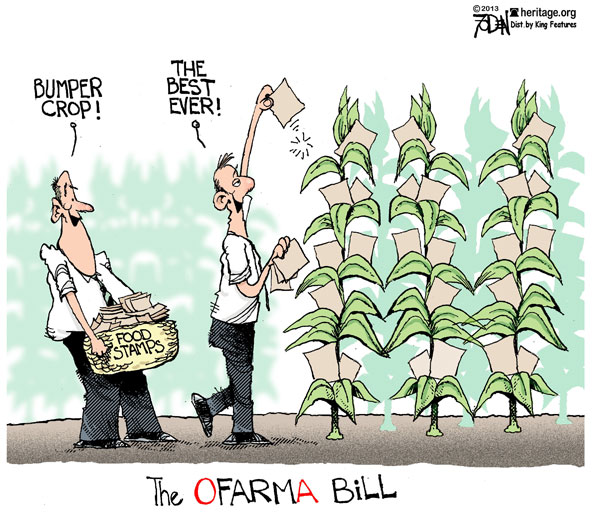
Food stamps were a popular topic of conversation last month as Congress debated the farm bill. This decades-old Great Society program is in much need of reform for at least seven reasons:

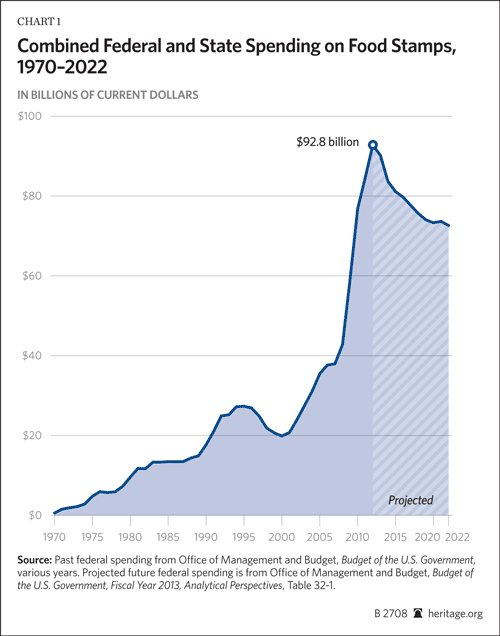
  1. Food stamp spending has surged. Costs have been climbing since the program began in the 1960s, recession or not. Over roughly the past decade, food stamp spending jumped from $19.8 billion in 2000 to $84.6 billion in 2011.
  2. Food stamp rolls have also been climbing for decades, regardless of the economic situation. Today, food stamp use is at an all-time high, with the most recent data showing that about one in seven people participate in the program. This is a 140 percent increase since 1990.
  3. Government has vastly expanded food stamp eligibility. “Broad-based categorical eligibility,” put in place under the Clinton Administration and heavily pushed by the Obama Administration, loosens income and asset limits. That the number of households receiving food stamps has increased faster than households near the poverty line indicates that changes in food stamp policy helped boost the rolls.
  4. States are spending taxpayer money to “recruit” food stamp participants who might not otherwise choose to use them. From advertisements, aggressive tactics, and enrollment quotas used by recruitment agents, it seems like Uncle Sam wants you on food stamps.
  5. Despite what the left claims, food stamps don’t stimulate the economy. Every dollar spent on food stamps is a dollar that would otherwise be spent elsewhere. Therefore, it simply shuffles resources rather than adding economic growth.
  6. Even in good economic times, many food stamp recipients don’t work. In 2010, among the roughly 10.5 million households receiving food stamps that contained an able-bodied, non-elderly adult, 5.5 million did not perform any work. Of those who did work, 1.5 million to 2 million worked less than 30 hours per week.
  7. Food stamps discourage work and self-sufficiency. “The more income that a person receives when not working, the less is the reward to working,” University of Chicago Professor Casey Mulligan testified before Congress earlier this year. “In such cases, a person might have more resources available to use or save as a consequence of working less.” Because food stamp benefits are reduced by 30 cents for each dollar of net income a recipient earns, the program behaves like an income tax paid by recipients via reduced benefits. Thus, food stamps can often act as a disincentive to work. Mulligan estimates that this disincentive has actually prolonged the weak labor market recovery.

Policymakers should reform food stamps to promote self-sufficiency through work and roll back food stamp spending when employment rates improve. These changes would promote not only fiscal responsibility but, more importantly, personal responsibility and human dignity.

Related posts:

If increase in food stamps was just because of recession then why spending go from $19.8 billion in 2000 to $37.9 billion in 2007?

If the increase in food stamps was just because of the recession then why did the spending go from $19.8 billion in 2000 to $37.9 billion in 2007? The Facts about Food Stamps Everyone Should Hear Rachel Sheffield and T. Elliot Gaiser May 27, 2013 at 12:00 pm (7) Newscom A recent US News & […]

Tell the 48 million food stamps users to eat more broccoli!!!!

Welfare Can And Must Be Reformed             Uploaded on Jun 29, 2010 If America does not get welfare reform under control, it will bankrupt America. But the Heritage Foundation’s Robert Rector has a five-step plan to reform welfare while protecting our most vulnerable. __________________________ We got to slow down the growth of Food Stamps. One […]

Republicans for more food stamps?

Eight Reasons Why Big Government Hurts Economic Growth __________________ We got to cut spending and we must first start with food stamp program and we need some Senators that are willing to make the tough cuts. Food Stamp Republicans Posted by Chris Edwards Newt Gingrich had fun calling President Obama the “food stamp president,” but […]

Obama promotes food stamps but Milton Friedman had a better suggestion

Milton Friedman’s negative income tax explained by Friedman in 1968: We need to cut back on the Food Stamp program and not try to increase it. What really upsets me is that when the government gets involved in welfare there is a welfare trap created for those who become dependent on the program. Once they […]

400% increase in food stamps since 2000

Welfare Can And Must Be Reformed Uploaded by HeritageFoundation on Jun 29, 2010 If America does not get welfare reform under control, it will bankrupt America. But the Heritage Foundation’s Robert Rector has a five-step plan to reform welfare while protecting our most vulnerable. __________________________ If welfare increases as much as it has in the […]

Why can’t we cut the Food Stamp budget?

Why can’t we cut the Food Stamp budget? Should Food Stamps Be in Farm Bill? Congressman Seeks to Split Legislation Kelsey Harris June 17, 2013 at 10:38 pm Bill Clark/Roll Call Photos/Newscom Representative Marlin Stutzman (R-IN), a fourth-generation farmer, is asking his House colleagues to separate the food stamp program from the “farm” bill. Stutzman […]

Food stamp spending has doubled under the Obama Administration

The sad fact is that Food stamp spending has doubled under the Obama Administration. A Bumper Crop of Food Stamps Amy Payne May 21, 2013 at 7:01 am Tweet this Where do food stamps come from? They come from taxpayers—certainly not from family farms. Yet the “farm” bill, a recurring subsidy-fest in Congress, is actually […]

Which states are the leaders in food stamp consumption?

I am glad that my state of Arkansas is not the leader in food stamps!!! Mirror, Mirror, on the Wall, Which State Has the Highest Food Stamp Usage of All? March 19, 2013 by Dan Mitchell The food stamp program seems to be a breeding ground of waste, fraud, and abuse. Some of the horror stories […]

Why not cancel the foodstamp program and let the churches step in?

Government Must Cut Spending Uploaded by HeritageFoundation on Dec 2, 2010 The government can cut roughly $343 billion from the federal budget and they can do so immediately. __________ We are becoming a country filled with people that dependent on the federal government when we should be growing our economy by lowering taxes and putting […]

Food Stamp Program is constantly ripped off and should be discontinued

Uploaded by oversightandreform on Mar 6, 2012 Learn More at http://oversight.house.gov The Oversight Committee is examining reports of food stamp merchants previously disqualified who continue to defraud the program. According to a Scripps Howard News Service report, food stamp fraud costs taxpayers hundreds of millions every year. Watch the Oversight hearing live tomorrow at 930 […]

The Infinite-Personal God: Thoughts from Francis Schaeffer’s Escape from Reason by Mark Peach

____________

_

_

The Infinite-Personal God: Thoughts from Francis Schaeffer’s Escape from Reason by Mark Peach

_______________

Episode VII – The Age of Non Reason

____________________

Dr. Schaeffer’s sweeping epic on the rise and decline of Western thought and Culture

_______________________

I love the works of Francis Schaeffer and I have been on the internet reading several blogs that talk about Schaeffer’s work and the work below by Mark Peach was really helpful. Schaeffer’s film series “How should we then live?  Wikipedia notes, “According to Schaeffer, How Should We Then Live traces Western history from Ancient Rome until the time of writing (1976) along three lines: the philosophic, scientific, and religious.[3] He also makes extensive references to art and architecture as a means of showing how these movements reflected changing patterns of thought through time. Schaeffer’s central premise is: when we base society on the Bible, on the infinite-personal God who is there and has spoken,[4] this provides an absolute by which we can conduct our lives and by which we can judge society.  Here are some posts I have done on this series: Francis Schaeffer’s “How should we then live?” Video and outline of episode 10 “Final Choices” episode 9 “The Age of Personal Peace and Affluence”episode 8 “The Age of Fragmentation”episode 7 “The Age of Non-Reason” episode 6 “The Scientific Age”  episode 5 “The Revolutionary Age” episode 4 “The Reformation” episode 3 “The Renaissance”episode 2 “The Middle Ages,”, and  episode 1 “The Roman Age,” .

In the film series “WHATEVER HAPPENED TO THE HUMAN RACE?” the arguments are presented  against abortion (Episode 1),  infanticide (Episode 2),   euthanasia (Episode 3), and then there is a discussion of the Christian versus Humanist worldview concerning the issue of “the basis for human dignity” in Episode 4 and then in the last episode a close look at the truth claims of the Bible.

Francis Schaeffer

__________________________

Tuesday, July 01, 2008

The Infinite-Personal God: Thoughts from Francis Schaeffer’s Escape from Reason


Perhaps you are familiar with the indie band Arcade Fire. Their most recent album is entitled Neon Bible. The songs on Neon Bible certainly reflect something of the Bible itself in so far as it raises some of life’s biggest questions. Some of these questions are about fear, faith, love and disappointment. On the album is an update version of their song “No Cars Go” in which we hear the eerie tone of the line “Don’t know where we are goin.’ The line gives the listener the sense that there is no certainty to what our end is. This captures much of what I think indie music captures about our fragmented culture where the greatest questions are asked, but with very few answers.Because we live in a postmodern culture where many are not afraid to ask honest questions about life, the concept of faith is quite popular. Francis Schaeffer’s work and his book Escape from Reason have made a tremendous contribution to an understanding of Christian faith in this type of cultural context. In Escape from Reason, Schaeffer is clear in pointing out that the Bible reveals that God is both infinite and personal. He is the infinite-personal God whom created all things out of nothing and therefore the creation is finite or limited. Only God alone is the infinite Creator, the Creator without limitations. On the side of infinity, Schaeffer points out that, humans are “as separated from God as is the machine.” (pg. 26)On the side of human personality, Schaeffer is clear that humans, being made in the image of God, were made to have a personal relationship with God. Schaeffer states, “On the side of personality you are related to God. You are not infinite but finite; nevertheless, you are truly personal; you are created in the image of the personal God who exists.” (pg. 26-27)As Schaeffer fleshes this idea out in Escape from Reason, he presents a clear Biblical view of human persons. About the Biblical view of the whole of a human being, Schaeffer states,

“It is not a Platonic view. The soul is not more important than the body. God made the whole man and the whole man is important. The doctrine of the biblical resurrection of the dead is not an old-fashioned thing. It tells us that God loves the whole man and the whole man is important. The biblical teaching, therefore, opposes the Platonic, which makes the soul (“the upper”) very important and leaves the body (“the lower”) with little importance at all. The biblical view opposes the humanistic position where the body and autonomous mind of man become important, and grace becomes very unimportant.”(pg. 28)

God made the whole human being and cares about the whole human being.

Schaeffer goes on to point out the importance of understanding historically the philosophical schools that have help to shape where we are today. He points out that in Western philosophy, from the rise of Greek philosophy until now, the commonly held belief that the hope of finding complete answers which would encompass all of thought and life would come through rationalism plus rationality rather than rationality and faith in the God of the Bible. In his book Death in the City Schaeffer states,

The Bible puts its religious teaching in a historic setting. It is quite the opposite of the new theology and existential thought, quite the opposite of the twentieth century’s reduction of religion to the “spiritual” and the subjective. Scripture relates true religion to space-time history which may be expressed in normal literary form. And that is important, because our generation takes the word religion and everything religious and turns it into something psychological or sociological…a holy and loving God really exists, and He works into the significant history which exists” (Death in the City, pg. 17)

The philosophical thought during the time of Kant and Rousseau in the late 1700’s was a time of fighting for freedom. The freedom that was sought after was an autonomous freedom in which human freedom would have no restraint or limitations. The quest for this kind of freedom took place during a time when Western philosophy was rationalistic, rational, and sought to find a unified field of knowledge.

Rationalism as Schaeffer puts it in Escape from Reason is “man begins absolutely and totally from himself, gathers the information concerning the particulars and formulates the universals.” (pg. 34) The term “rational” on the other hand has no relationship to “rationalism.” This term “rational” is the act in which “man’s aspirations for the validity of reason are well founded.” In other words, if something is true the opposite is not true. Schaeffer states,

The basic position of man in rebellion against God is that man is at the centre of the universe, that he is autonomous – here lies his rebellion. Man will keep his rationalism and his rebellion, his insistence on total autonomy or partially autonomous areas, even if it means he must give up his rationality.”(pg. 42)

With this quest for autonomy, humans began to view reality in which there is a large gap between nature and universals. Schaeffer states,

“The hope of a connecting link between two spheres has completely disappeared. There is a complete dichotomy between the upper and lower storeys. The line between the upper and lower storeys has become a concrete horizontal, ten thousand feet thick, with highly-charged barbed-wire fixed in the concrete…Below the line there is rationality and logic. The upper storey becomes the non-logical and the non-rational.”(pg. 46)

With this dichotomy, on the basis of reason human have no meaning, purpose, or significance. On the basis of the non-rational and non-reasonable humans obtain a sense of optimism. But from this worldview humans are left with the need to take a leap of faith because they cannot rationally search for God.

The search for significance is intrinsic to who we are as people made in the image of God. Humans made in the image of God cannot live as though they are insignificant. But humans cannot live in the lower storey and find adequate answers concerning meaning, purpose, and significance. Yet as Schaeffer states, “in our day, the sphere of faith is placed in the non-rational and non-logical as opposed to the rational and logical.” (pg. 75)

Schaeffer points out some consequences of pitting faith against rationality. First, if we separate the upper storey or the world of universals from nature there is no way of establishing a relationship between the upper storey and everyday life in regard to morality. Schaeffer states, “You cannot have real morals in the real world after you have made this separation.” (pg. 80) The second consequence is that the separation creates no adequate basis for law. God revealed something real in the common world of life. Third, the separation, “throws away the answer to the problem of evil.” Schaeffer states,

“the True Christian position is that, in space and time and history, there was an unprogrammed man who made a choice, and actually rebelled against God…without Christianity’s answer that God made a significant man in a significant history with evil being the result of Satan’s and then man’s historic space-time revolt, there is no answer but to accept Baudelaire’s answer [‘If there is a God, He is the devil’] with tears. Once the historic Christian answer is put away, all we can do is to leap upstairs and say that against all reason God is good.”(pg. 81)

Without Christianity’s answer to the problem of evil what we have left is an irrational leap of faith.

Christianity thoroughly provides an answer, but rationalism must be renounced and rationality embraced. Christianity provides a world and life view with a unified answer. Schaeffer states,

“On the side of infinity…we are separated from God entirely, but on the side of personality we are made in the image of God. So God can speak and tell us about Himself—not exhaustively, but truly. (We could not, after all, know anything exhaustively as finite creatures.) Then He has told us about things in the finite created realm, too. He has told us true things about the cosmos and history. Thus, we are not adrift.” (pg. 83)

I do recognize now that doubt is real and that doubt’s role is significant in our lives and yet at a fundamental level we have answers to our cry, “Don’t know where were goin.” Although we cannot have ultimate answers without something revealed about God and God indeed is made known in the person of Jesus Christ. The person and work of Christ is communicated to us in the story that the Bible tells. It is the story of the infinite-personal God drawing near because he cares. God cares about the whole of a human being. There is not an area of our life that he does not care about and there is not an area of our life that is autonomous. The Bible says first that there is an infinite-personal God who created all things. Because he created all things the universe begins as personal. Because it is personal the longings of love and communication are intrinsic to all of humanity.

God has also always existed and has created all things. Not only has God created all things, but created them outside of himself. Because he created all things outside of himself the world is objectively real and therefore there is a true history and a true me. Schaeffer states,

“If the intrinsically personal origin of the universe is rejected, what alternative outlook can anyone have? It must be said emphatically that there is no final answer except that man is a product of the impersonal, plus time, plus chance.” (pg. 87)

Humanism or rationalism says that humans can built bridges to ultimate answers apart from anyone else, apart from an infinite-personal God. But this is impossible given that humans are finite. Humans cannot point to anything with ultimate certainty. Regarding human quests for answers Schaeffer states,

“beginning only from himself autonomously, it is quite obvious that, being finite, he can never reach any absolute answer. This would be true if only on the basis of the fact that he is finite; but to this must be added the Fall, the fact of his rebellion.” (pg. 89)

We are not only finite and limited, but by nature our own quest for true significance and meaning takes place in autonomous rebellion against the God who is there.

But we have hope. The Bible states clearly that humans are made in the image of this infinite-personal God and this gives us a starting point at which to seek for ultimate answers. The Bible says even as lost and broken as we are, seeking to live life apart from the life source, the image of God is still exhibited in humans. We are not like from machines or plants as beautiful as they might be, because we are personal. But how can we seek the infinite-personal God if we ourselves are finite humans?

We cannot possess ultimate answers apart from the reference point of the infinite God himself. The humanist or rationalist puts himself at the center of the universe in order to seek ultimate meaning and answers. Schaeffer says this persons “insists on being autonomous with only the knowledge he can gather, and has ended up finding himself quite meaningless.” (pg. 90) The knowledge we can gather is limited and if it comes only from within we have no hope for ultimate answers regarding meaning and life.

Christianity does provide a worldview in which to wrestle with ultimate questions in not simply a theoretical way, but in a personal way. Schaeffer states,

“Christianity is a system which is composed of a set of ideas which can be discussed. By ‘system’ we do not mean a scholastic abstraction, nevertheless we do not shrink from using the word. The Bible does not set out unrelated thoughts. The system it sets forth has a beginning and moves from that beginning in a non-contradictory way. The beginning is the existence of the infinite-personal God as Creator of all else. Christianity is not just a vague set of incommunicable experiences, based on a totally unverifiable ‘leap in the dark.’ Neither conversion (the beginning of the Christian life) nor spirituality (the growth) should be such a leap. Both are firmly related to the God who is there and the knowledge He has given us – and both involve the whole man.”

I would add that the Bible is not just a system, but also a story. It is a story where God is the ultimate actor and also the one who has written the script. It is a story that reveals that the infinite-personal God is there and has drawn near to his people with a passionate pursuit. He is infinite and he is personal. As finite persons we can have hope that God has drawn personally near in the person of Jesus in whom the whole story points to.

Jesus is also the one who grants us the privilege of being included in this great story as well. Jesus through his death and resurrection from death provides a way to live personally with this infinite-personal God. Our response to his grace in drawing near ought to be acknowledging our rebellion as we have insistence on being autonomous. The meaningful life comes through acknowledging our dependence on the God who is there and in Jesus Christ as The Way, The Truth, and The Life.

The story continues to move forward unfolding toward a day when lost people from all nations will have their story included in the great story of God’s personal restoration of his people and the world. The story unfolds until one day we will know fully the God who is there. No longer must we live out our own story without a script. No longer must we live out our own story by the line, “Don’t no where were goin!”

Posted by at 10:31 AM 

Labels: 

Related posts:

Taking on Ark Times Bloggers on various issues Part A “The Pro-life Issue” (Francis Schaeffer Quotes Part 1 includes the film SLAUGHTER OF THE INNOCENTS) (editorial cartoon)

I have gone back and forth and back and forth with many liberals on the Arkansas Times Blog on many issues such as abortion, human rights, welfare, poverty, gun control  and issues dealing with popular culture. Here is another exchange I had with them a while back. My username at the Ark Times Blog is Saline […]

“Schaeffer Sunday” Francis Schaeffer: “Whatever Happened to the Human Race” (Episode 1) ABORTION OF THE HUMAN RACE

It is not possible to know where the pro-life evangelicals are coming from unless you look at the work of the person who inspired them the most. That person was Francis Schaeffer.  I do care about economic issues but the pro-life issue is the most important to me. Several years ago Adrian Rogers (past president of […]

The movie “Les Miserables” and Francis Schaeffer

I got this off a Christian blog spot. This person makes some good points and quotes my favorite Christian philosopher Francis Schaeffer too. Prostitution, Chaos, and Christian Art The newest theatrical release of Victor Hugo’s 1862 novel “Les Miserables” was released on Christmas, but many Christians are refusing to see the movie. The reason simple — […]

“Schaeffer Sunday” Francis Schaeffer is one of the great evangelical theologians of our modern day

Francis Schaeffer was truly a great man and I enjoyed reading his books. A theologian #2: Rev. Francis Schaeffer Duriez, Colin. Francis Schaeffer: An Authentic Life. Wheaton, IL: Crossway Books, 2008. Pp. 240. Francis Schaeffer is one of the great evangelical theologians of our modern day. I was already familiar with some of his books and his […]

“Schaeffer Sundays” Francis Schaeffer’s own words concerning infanticide and youth enthansia

Francis Schaeffer: “Whatever Happened to the Human Race?” (Episode 2) SLAUGHTER OF THE INNOCENTS Published on Oct 6, 2012 by AdamMetropolis ___________ The 45 minute video above is from the film series created from Francis Schaeffer’s book “Whatever Happened to the Human Race?” with Dr. C. Everett Koop. This book  really helped develop my political views […]

Francis Schaeffer’s wife Edith passes away on Easter weekend 2013 Part 7 (includes pro-life editorial cartoon)

The Francis and Edith Schaeffer Story Pt.1 – Today’s Christian Videos The Francis and Edith Schaeffer Story – Part 3 of 3 Francis Schaeffer: “Whatever Happened to the Human Race” (Episode 1) ABORTION OF THE HUMAN RACE Published on Oct 6, 2012 by AdamMetropolis ________________ Picture of Francis Schaeffer and his wife Edith from the […]

The Mark of the Christian by Francis Schaeffer Part 1

  THE MARK OF A CHRISTIAN – CLASS 1 – Introduction Published on Mar 7, 2012 This is the introductory class on “The Mark Of A Christian” by Francis Schaeffer. The class was originally taught at Redeemer Presbyterian Church in Overland Park, KS by Dan Guinn from FrancisSchaefferStudies.org as part of the adult Sunday School hour […]

“Schaeffer Sundays” Francis Schaeffer’s own words concerning humanist dominated public schools in USA even though country was founded on a Christian base

Francis Schaeffer: “Whatever Happened to the Human Race?” (Episode 2) SLAUGHTER OF THE INNOCENTS Published on Oct 6, 2012 by AdamMetropolis The 45 minute video above is from the film series created from Francis Schaeffer’s book “Whatever Happened to the Human Race?” with Dr. C. Everett Koop. This book  really helped develop my political views concerning […]

“Schaeffer Sundays” Francis Schaeffer’s own words concerning where the Bible-believing Christians been the last few decades

Francis Schaeffer: “Whatever Happened to the Human Race” (Episode 1) ABORTION OF THE HUMAN RACE Published on Oct 6, 2012 by AdamMetropolis The 45 minute video above is from the film series created from Francis Schaeffer’s book “Whatever Happened to the Human Race?” with Dr. C. Everett Koop. This book  really helped develop my political views […]

Taking on Ark Times Bloggers on various issues Part E “Moral absolutes and abortion” Francis Schaeffer Quotes part 5(includes the film SLAUGHTER OF THE INNOCENTS) (editorial cartoon)

I have gone back and forth and back and forth with many liberals on the Arkansas Times Blog on many issues such as abortion, human rights, welfare, poverty, gun control  and issues dealing with popular culture. Here is another exchange I had with them a while back. My username at the Ark Times Blog is Saline […]

“Schaeffer Sundays” Francis Schaeffer’s own words concerning religious liberals and humanists

Francis Schaeffer: “Whatever Happened to the Human Race” (Episode 5) TRUTH AND HISTORY Published on Oct 7, 2012 by AdamMetropolis The 45 minute video above is from the film series created from Francis Schaeffer’s book “Whatever Happened to the Human Race?” with Dr. C. Everett Koop. This book  really helped develop my political views concerning abortion, […]

I hope we get the bottom of this mess at the IRS!!!

I hope we get the bottom of this mess at the IRS!!!

Cleta Mitchell: How to Investigate the IRS

Cleta Mitchell, the attorney who helped expose the tax agency’s abuses, has a road map for identifying the culprits. It doesn’t stop in Cincinnati.

Washington

The woman who helped expose IRS abuse of conservative activists has more news to share: The abuse continues, and she sees no evidence that the White House, the IRS or the Justice Department is doing anything to end it. “This is not in the past tense. This is still going on,” says Cleta Mitchell, perhaps the country’s pre-eminent expert on campaign-finance and political tax law.

In 2012, Ms. Mitchell worked to persuade members of Congress that reports of IRS harassment of conservative groups were credible. GOP lawmakers demanded information from the IRS and triggered the internal audit that finally forced the agency last month to acknowledge abuses it had previously denied. Now Ms. Mitchell is determined to end the abuse and identify the culprits.

Don’t bet against her. A partner at elite international law firm Foley and Lardner, Ms. Mitchell is sketching out a road map to uncover the truth and force reform—whether or not the Obama administration cooperates.

So far it looks like the administration will not. Ms. Mitchell represents nine conservative organizations that, beginning around 2010, were subjected to unusual delays, in many cases unlawful demands for information, and in some cases unlawful releases of their confidential data. But she reports that despite filling out the paperwork required by law and regulation, only one of the nine has received the customary IRS approval letter to operate as a tax-exempt group. She says another client received a new letter from the IRS with “very bizarre questions” as recently as three weeks ago.

The Justice Department is allegedly conducting a criminal investigation of the IRS abuse. Has anyone from Justice contacted her or her clients to gather evidence? “Not about this. The FBI’s contacted some tea party leaders about their meetings and who comes to their meetings,” she says. “I guess they viewed the tea party as domestic terrorists.” She is puzzled that the feds aren’t asking about IRS targeting: “You’d think that they would, wouldn’t you?”

Terry Shoffner

They should, and perhaps the Securities and Exchange Commission ought to start a case file as well. Ms. Mitchell says she learned this week that the IRS even intervened in the business dealings of a donor to conservative causes. “There were two public companies that were in the process of trying to do a merger and somehow the IRS stepped in and demanded all this information and said, ‘If you don’t give it to us we’ll stop this merger,’ ” she says. “But I cannot get [the donor] to come forward . . . ‘Look I’ve been through this hassle with the IRS. I don’t need any more.’ People are really afraid and the donors are the most afraid.”

She has heard “a number of reports” of conservative donors “having been audited or hassled,” but she doesn’t have a sense of how many cases there might be. “I hear about them all the time, but so far they’ve been the most reluctant of all to talk.”

Ms. Mitchell, on the other hand, shows no fear as she talks strategy in Foley’s Georgetown office overlooking the Potomac River. Maybe that’s because this Oklahoma native has already overcome her share of daunting challenges.

“I was raised by a single mom. My dad was kind of a no-account,” she says with a chuckle. “But my mother made up for it. She was a very strong woman. Raised six kids.” And she demanded excellence from all of them. After Ms. Mitchell’s first term at the University of Oklahoma, “I made one B and my mother went around telling everyone that I hadn’t done very well but she hoped I’d do better the next semester.” She graduated with high honors and a Phi Beta Kappa key.

Like many of her classmates, she also developed a love for the school’s famed football team and proved to be as demanding about the Sooners as her mother had been about grades. Shortly after the team’s current coach, Bob Stoops, was hired in 1999, she met him at a Washington reception. “You know, coach,” she recalls telling him, “the good thing for you is you only need to win three games a year”—against powerhouses Nebraska, Oklahoma State and Texas. When Mr. Stoops responded that Nebraska wasn’t on the schedule that year, she replied: “Well, lucky you, you only have to win two games.”

These days, winning for her clients doesn’t necessarily mean collecting big damage awards. She says the harassed conservative groups are more focused on getting the truth out and ensuring that the IRS’s appalling conduct is stopped and never repeated. But the lever of potential monetary penalties could be useful in persuading senior government officials to come clean. Ms. Mitchell is hopeful that, even if the Justice Department sits on its hands, a combination of private lawsuits and congressional investigations can help ascertain who gave the order to target conservatives.

She has filed a lawsuit in federal court on behalf of an organization called True the Vote that names the IRS as well as previous and current IRS officials as defendants. She promises more lawsuits, including one on behalf of the National Organization for Marriage that had its documents leaked to its antagonists at the Human Rights Campaign.

Ms. Mitchell credits attorney Jay Sekulow for his suit on behalf of other conservative organizations and is encouraged by the work of lawmakers like Sen. Orrin Hatch (R., Utah) and Rep. Darrell Issa (R., Calif.). “They’re just getting started to get to the answers. The first round is the IRS dissembling, denying, deflecting. And now hopefully we’re beginning to get to some real information,” she says.

Thus far, senior IRS officials in office when the abuses began have often provided untruthful answers, first by telling Congress in 2012 that the IRS wasn’t targeting President Obama’s ideological opponents and more recently by suggesting that low-level employees were to blame. Sometimes they’ve been unwilling to provide any answers at all, such as when Lois Lerner, the head of the IRS unit overseeing tax-exempt organizations, asserted her Fifth Amendment privilege to avoid self-incrimination, but not before proclaiming her innocence at a congressional hearing.

In the civil lawsuits, government defendants will still enjoy their Fifth Amendment rights, but the truth may come out anyway. Ms. Mitchell notes that “civil discovery is much broader and doesn’t allow for as much opportunity to refuse to answer. There’s a magistrate who is appointed to oversee” and resolve disputes on specific questions. And if a person is forced to answer a question during a deposition, “the perjury statutes apply.”

But even if officials find ways to remain silent, they might not be able to contain the relevant information. Ms. Mitchell adds that “we are most interested in seeing documents,” and that includes emails. Such documents have hardly been examined, because while the IRS’s internal audit recently forced the agency to acknowledge abuses it had previously denied, the inquiry consisted mainly of interviews of staff with a supervisor present.

After denying for a year that IRS employees were targeting conservatives, IRS brass were forced by the imminent release of the audit last month to change their story. But they settled on another inaccurate claim: that the problems centered on a few misguided employees in a Cincinnati office. This was contradicted by a Wall Street Journal report this week that Cincinnati workers were being directed and even “micromanaged” by Washington, according to what one IRS employee told congressional investigators.

“I think the press has done a good job of exposing that it wasn’t just in Cincinnati,” Ms. Mitchell says. “I knew it wasn’t.” One of her clients has been waiting for approval for nonprofit status since 2009, she says, and for all that time the application was being considered in Washington. “I was told by the agent in Cincinnati, ‘Oh well, you send this stuff to us, but we have to send it all to Washington.’ ” She says that some unusual information requests to conservative groups have also come from the IRS office in Ogden, Utah.

She adds: “I just want to know who did what and when, and I want them to issue the letters and I want them to stop targeting and go back to the process” that prevailed before the current era of abuse.

This current era appears to have begun sometime after the 2008 election of Barack Obama as president, though the Obama campaign itself offered something of a preview. As the Journal’s Kimberley A. Strassel has noted, in the summer of 2008 Obama campaign General Counsel Bob Bauer urged the Justice Department’s criminal division to investigate the officers and donors of a group called the American Issues Project after it ran a negative ad about Mr. Obama.

The organization was a client of Ms. Mitchell’s, so she learned firsthand about the tactics of the Obama campaign and Mr. Bauer: “He would send a letter to the Justice Department demanding that my clients be criminally prosecuted for exercising their First Amendment rights. And then I would write a response, and then he’d write another letter, and I’d immediately write a response.”

Mr. Bauer was named White House counsel in late 2009, shortly before the IRS appears to have begun its harassment of conservatives. Now in private practice, he seems like the kind of former official that conservatives might want to question under oath. Could it happen?

“We’d have to find that there was some communication between him and the IRS or something like that,” says Ms. Mitchell. Though much may remain to be discovered, she says, the targeting of conservatives in recent years has been remarkably open: “The communications were all pretty public. That’s one of the things that I don’t think has gotten enough attention, is the use of the IRS as a political tool. There are 17 Democratic senators who will literally sign anything put in front of them going after conservative organizations.”

She is referring to letters sent during the last election cycle by various Democrats urging IRS investigations, some of the letters even referencing specific conservative organizations. But Ms. Mitchell might just as easily mention the many speeches in which Mr. Obama has vilified groups opposing his policies and denounced them as threats to democracy or foreign-backed front groups.

All of this history inspires skepticism that the Obama Justice Department will make the abuse of conservatives a high priority for prosecution. So the job may fall to private attorneys like Cleta Mitchell. If she is intimidated at the prospect of taking on the IRS, she is showing no signs of it. “Where I come from in Oklahoma,” she says, “the wide open spaces are not just geography. It’s a mentality. You can be whatever you’re hoss enough to be.”

Maybe it’s the IRS’s turn to worry.

Mr. Freeman is assistant editor of the Journal’s editorial page.

A version of this article appeared June 8, 2013, on page A13 in the U.S. edition of The Wall Street Journal, with the headline: How to Investigate the IRS.

Related posts:

Updated version:Rick Crawford falls for Democrats’ trick:raise taxes first and we will cut spending later

RAISE TAXES: Report says Rick Crawford will break from GOP and back millionaires’ tax. The Arkansas Times reported that Congressman Rick Crawford has a plan that includes raising taxes for 5 years if there is an agreement to pass the Balanced Budget Amendment. However, if after 5 years the Balanced Budget Amendment does not get […]

The result of having lots of taxes is the mean IRS.

The result of having lots of taxes is the mean IRS. The IRS: Even Worse Than You Think Posted by Daniel J. Mitchell Since it is tax-filing season and we all want to honor our wonderful tax system, let’sgo into the archives and show this video from last year about the onerous compliance costs of the internal […]

The result of having lots of taxes is the mean IRS.

The result of having lots of taxes is the mean IRS. The IRS: Even Worse Than You Think Posted by Daniel J. Mitchell Since it is tax-filing season and we all want to honor our wonderful tax system, let’s go into the archives and show this video from last year about the onerous compliance costs […]

Lowering top tax rate from 70% to 28% from 1980 to 1988 and those earning over $200,000 paid 99 billion in taxes instead of 19 billion!!!!

What did we learn from the Laffer Curve in the 1980′s? Lowering top tax rate from 70% to 28% from 1980 to 1988 and those earning over $200,000 paid 99 billion in taxes instead of 19 billion!!!! A Lesson on the Laffer Curve for Barack Obama November 6, 2011 by Dan Mitchell One of my frustrating missions […]

Dear Senator Pryor, why not pass the Balanced Budget Amendment? (“Thirsty Thursday”, Open letter to Senator Pryor)

Better Published on May 28, 2013 No description available. “Better” – TV:30 DALE CUSTER (Little Rock): “These politicians in Washington…they just don’t get it.” NIC HORTON (Searcy): “Mark Pryor just really doesn’t get it.” JANET CROW (Conway): “Pryor votes like a liberal.” DR. EARL PEEPLES (Little Rock): “He is a liberal.” NIC HORTON (Searcy): “He […]

We can fix the IRS problem by going to the flat tax and lowering the size of government

We can fix the IRS problem by going to the flat tax and lowering the size of government. Why the IRS Persecuted the Tea Party and How to Fix the Problem May 27, 2013 by Dan Mitchell Did President Obama and his team of Chicago cronies deliberately target the Tea Party in hopes of thwarting free speech […]

We know the IRS commissioner wasn’t telling the truth in March 2012, when he testified: “There’s absolutely no targeting.”

We know the IRS commissioner wasn’t telling the truth in March 2012, when he testified: “There’s absolutely no targeting.”However, Lois Lerner knew different when she misled people with those words. Two important points made by Noonan in the Wall Street Journal in the article below: First, only conservative groups were targeted in this scandal by […]

A great cartoonist takes on the IRS!!!!

Ohio Liberty Coalition versus the I.R.S. (Tom Zawistowski) Published on May 20, 2013 The Ohio Liberty Coalition was among tea party groups that received special scrutiny from the I.R.S. Tom Zawistowski says his story is not unique. He argues the kinds of questions the I.R.S. asked his group amounts to little more than “opposition research.” Video […]

Cartoonists show how stupid the IRS is acting!!!

We got to lower the size of government so we don’t have these abuses like this in the IRS. Cartoonists v. the IRS May 23, 2013 by Dan Mitchell Call me perverse, but I’m enjoying this IRS scandal. It’s good to see them suffer a tiny fraction of the agony they impose on the American people. I’ve already […]

Video from Cato Institute on IRS Scandal

Is the irs out of control? Here is the link from cato: MAY 22, 2013 8:47AM Can You Vague That Up for Me? By TREVOR BURRUS SHARE As the IRS scandal thickens, targeted groups are coming out to describe their ordeals in dealing with that most-reviled of government agencies. The Ohio Liberty Coalition was one of […]

Where does Mark Pryor stand on gun control?

Where does Senator Mark Pryor stand on gun control?

Mark Pryor: Liberal When No One’s Looking


Related posts:

Gun control can cost lives!!!!!

Gun control can cost lives!!!!! Virtue Is Its Own Reward, but Using a Gun to Save a Child’s Life in DC Will Get You a $1,000 Fine May 21, 2013 by Dan Mitchell This story belongs in my “Great Moments in Local Government” series, which features examples of bureaucratic and political stupidity (see here, here, here,here, here, here, here, here, here, here, here, and here) that will make […]

Gun control arguments just don’t make any sense, but President Obama still supports gun control

Gun control arguments just don’t make any sense, but President Obama still supports gun control. Laughing at Obama’s Belly Flop on Gun Control April 23, 2013 by Dan Mitchell I’ve shared serious articles on gun control, featuring scholars such as John Lott and David Kopel. I also posted testimonials from gun experts and an honest liberal. […]

My favorite 10 videos on gun rights and gun control

Gun Control explained Merry Christmas  from the 2nd Amendment Buy a Shotgun Joe Biden Lying AR-15 Make your own Gun Free Zone PRK Arms on CBS 47 news,  Fresno Suzanna Gratia Hupp explains meaning of 2nd Amendment! Penn and Teller – Gun Control and Columbine Somebody Picked the Wrong Girl 5 Facts About Guns, Schools, […]

The United Nations is full of gun control nuts (includes gun poster)

  The United Nations is full of gun control nuts.   The United Nations and Gun Control: Two Negatives Don’t Make a Positive April 15, 2013 by Dan Mitchell Citing the analysis of America’s former Ambassador to the United Nations, I wrote last year about a treaty being concocted at the United Nations that would threaten […]

Comparison of crime data and concealed carry gun laws between Houston and Chicago (includes funny gun control posters)

Sometimes you just have to look at the facts!!! An Inside Look at Left-Wing Social Science Gun Research March 20, 2013 by Dan Mitchell In a presumably futile effort to change their minds by learning how they think, I periodically try to figure out the left-wing mind. Why, for instance, do some people believe in Keynesian […]

Michael Moore’s idea that pictures from Sandy Hook will help gun control argument (includes editorial picture)

I do love Michael Moore’s movie “Canadian Bacon” and I have blogged about it before. However, I am not a big Michael Moore fan. Take a look at this excellent article by Trevor Burrus of the Cato Institute on Moore’s latest stupid claim. March 15, 2013 3:50PM Some Pictures for Michael Moore By Trevor Burrus […]

Open letter to President Obama (Part 256) (on gun control)

(This letter was mailed before October 1, 2012) President Obama c/o The White House 1600 Pennsylvania Avenue NW Washington, DC 20500 Dear Mr. President, I know that you receive 20,000 letters a day and that you actually read 10 of them every day. I really do respect you for trying to get a pulse on what […]

Letter from David Kopel of Cato Institute to Senator Cruz on constitutional issues in federal gun control proposals (Great yardsign on gun control)

  Great yardsign on gun control from Dan Mitchell’s blog. Here’s a quiz. What do you do after seeing this sign? Letter to Senator Cruz on constitutional issues in federal gun control proposals David Kopel • February 11, 2013 2:25 pm On Tuesday, the U.S. Senate Judiciary Committee Subcommittee on the Constitution, Civil Rights and Human […]

Gun control posters from Dan Mitchell’s blog Part 5

The rear of the Bath School after the May 18, 1927 bombing. Wikimedia Commons ___________ I have put up lots of cartoons and posters from Dan Mitchell’s blog before and they have got lots of hits before. Many of them have dealt with the economy, eternal unemployment benefits, socialism,  Greece,  welfare state or on gun control. Did […]

Gun control posters from Dan Mitchell’s blog Part 4

I have put up lots of cartons and posters from Dan Mitchell’s blog before and they have got lots of hits before. Many of them have dealt with the economy, eternal unemployment benefits, socialism,  Greece,  welfare state or on gun control. There is no doubt that Hitler took away guns from those he wanted to persecute and […]

“Without God in the picture is there any relief for those who have been oppressed?”

“Without God in the picture is there any relief for those who have been oppressed?”

I have enjoyed going back and forth with the Arkansas Times Bloggers on many subjects over the years. Now I have discussed the subject of “The Meaning of Life” with them recently and I wanted to share some of this with you.

I have written on the Book of Ecclesiastes and the subject of the meaning of our lives on several occasions on this blog. In this series on Ecclesiastes I hope to show how secular humanist man can not hope to find a lasting meaning to his life in a closed system without bringing God back into the picture. This is the same exact case with Solomon in the Book of Ecclesiastes. Three thousand years ago, Solomon took a look at life “under the sun” in his book of Ecclesiastes. Christian scholar Ravi Zacharias has noted, “The key to understanding the Book of Ecclesiastes is the term ‘under the sun.’ What that literally means is you lock God out of a closed system, and you are left with only this world of time plus chance plus matter.”

On May 28, 2013 on the Arkansas Times Blog I posted the following:

Chris Martin of Coldplay revealed in his interview with Howard Stern that he was raised an evangelical Christian but he has left the church. I believe that many words that he puts in his songs today are generated from the deep seated Christian beliefs from his childhood that find their way out in his songs. The fact Coldplay’s songs deal so much with death and the search for meaning and purpose of life (similar to Solomon’s search in Ecclesiastes), and that our actions are being watched, and Chris describes different ways God tries to reveal himself to us, and many songs deal with trying to find a way to an afterlife and heaven, and he stills uses Christian terms like being “blessed” and “grateful.”

People are looking for a purpose for their lives even if they have millions in the bank and have the world at their finger tips.

https://thedailyhatch.org/2013/05/28/the-mo…

My usual opponent who I do respect goes by the username “NeverVoteRepublican” and he or her responded on May 28, 2013:

Saline–I don’t know what the heck Chris Martin’s religious beliefs have to do with anything but you sure know how to copy and paste. Do you even know who Chris Martin is or  anything about his music?

Later  “NeverVoteRepublican” went on to say:

All you have proven again Saline is that you can copy and paste from the “Daily Hatch”. I bet you have never even listened to Coldplay or formed your own ideas of what the lyrics mean. And again I ask, what do Chris Martin’s beliefs and how he got them have to do with anything?

On May 29, 2013 on the Arkansas Times Blog I responded with the following:

Here is my answer:

I guess that Chris Martin’s views matter because we can see how closely then compared to Solomon’s 3000 years ago when he wrote the book of Ecclesiastes. When Solomon looked at life “under the sun” without God in the picture he concluded in Ecclesiastes 4:1 “Again I looked and saw all the oppression that was taking place under the sun:I saw the tears of the oppressed—
    and they have no comforter; power was on the side of their oppressors—     and they have no comforter.” IN OTHER WORDS WITHOUT GOD IN THE PICTURE THE WICKED GET OF SCOTT FREE!!!!

Chris Martin was raised as an evangelical but he left the faith in his teenage years and he writes all of the songs for the rock band Coldplay and he does write a bunch of lyrics dealing with various subjects that suggest that he is searching for a lasting meaing to his life. It is my belief that he just can’t get away from his deep seated childhood religious beliefs that he keeps coming back to. Let me give you a great example.

If you do not believe in God and in the afterlife, then you have a big problem with the issue of how you live without an enforcement factor. My favorite example is Adolf Hitler.  Hitler was probably the most evil man who ever lived. Our society is still talking about Hitler today and it seems that a month doesn’t go by without reading another story in the news about Hitler. On May 28th many observers on the Internet felt that a picture of a tea kettle in a JC Penny ad on a bill board in Culvert City, California looked like Adolf Hitler and that made national news!!!!!

Drivers See Adolf Hitler in Teapot Billboard

Here is the paradox you will find in Chris Martin’s life concerning the issue of hell because he told Howard Stern  on November 9, 2011 that he left Christianity because of their belief in hell and then he sends the evil king in his #1 hit song “Viva La Vida” to an everlasting hell.

In this song, Martin is discussing an evil king that has been disposed. “I used to rule the world…Feel the fear in my enemy’s eyes…there was never an honest word and that was when I ruled the world, It was the wicked and wild wind, Blew down the doors to let me in, Shattered windows and the sound of drums, People couldn’t believe what I’d become…For some reason I can’t explain, I know Saint Peter won’t call my name,  Never an honest word, But that was when I ruled the world.”
Q Magazine asked Chris Martin about the lyric in this song “I know Saint Peter won’t call my name.” Martin replied, “It’s about…You’re not on the list. I was a naughty boy. Its always fascinated me that idea of finishing your life and then being analyzed on it…That is the most frightening thing you could possibly say to somebody. Eternal damnation. I know about this stuff because I studied it. I was into it all. I know it. It’s mildly terrifying to me. And this is serious.”
CHRIS MARTIN SEES THAT HE CAN NOT BELIEVE IN A SYSTEM THAT LETS HITLER OFF SCOTT FREE, AND THAT IS WHY HE CAME BACK TO HIS CHILDHOOD CHRISTIAN BELIEFS AND SENT THE EVIL KING TO HELL IN HIS BEST SELLING #1 HIT SONG “VIVA LA VIDA.”

_____________

Viva La Vida

Published on Jun 23, 2012 by

Coldplay’s Viva La Vida at American Airlines Center in Dallas on June 22, 2012

__________

Coldplay brought confetti, lights and thousands of fans to the American Airlines Center; see photos from their colorful show


5/11

Chris Martin was brought up as an evangelical Christian but he left the faith once he left his childhood home. However, there are been some actions in his life in the last few years that demonstrate that he still is grappling with his childhood Chistian beliefs. This is the third part of a series I am starting on this subject. Today we will look at how the Bible has influenced the lyrics of Viva La Vida. (There are many interpretations of this song on the web.)

On June 23, 2012 my son Wilson and I got to attend a Coldplay Concert in Dallas. It was great. We drove down from our home in Little Rock, Arkansas earlier in the day. Viva La Vida was one of our favorite songs that did that night.

Here is an article I wrote a couple of years ago about Chris Martin’s view of hell. He says he does not believe in it but for some reason he writes a song that teaches that it exists:
Belief of Eternal Punishment in Grammy Winning Song
By Everette Hatcher
Chris Martin of the rock group Coldplay wrote the song Viva La Vida, and the song just won both the grammy for the “Song of the Year” and “Best Pop Performance by a duo or Group with Vocals.”
In this song, Martin is discussing an evil king that has been disposed. “I used to rule the world…Feel the fear in my enemy’s eyes…there was never an honest word and that was when I ruled the world, It was the wicked and wild wind, Blew down the doors to let me in, Shattered windows and the sound of drums, People couldn’t believe what I’d become…For some reason I can’t explain, I know Saint Peter won’t call my name,  Never an honest word, But that was when I ruled the world.”
Q Magazine asked Chris Martin about the lyric in this song “I know Saint Peter won’t call my name.” Martin replied, “It’s about…You’re not on the list. I was a naughty boy. Its always fascinated me that idea of finishing your life and then being analyzed on it…That is the most frightening thing you could possibly say to somebody. Eternal damnation. I know about this stuff because I studied it. I was into it all. I know it. It’s mildly terrifying to me. And this is serious.”
I have been following the career of Chris Martin for the last decade. He grew up in a Christian home that believed in Heaven and Hell, but made it clear several years ago that he actually resents those who hold to those same religious dogmatic views he did as a youth. Yet it seems his view on the possibility of an afterlife has changed again.
Chris Martin is a big Woody Allen movie fan like I am and no other movie better demonstrates the need for an afterlife than Allen’s 1989 film  Crimes and Misdemeanors.  It is  about a eye doctor who hires a killer to murder his mistress because she continually threatens to blow the whistle on his past questionable, probably illegal, business activities. Afterward he is haunted by guilt. His Jewish father had taught him that God sees all and will surely punish the evildoer.

But the doctor’s crime is never discovered. Later in the film, Judah reflects on the conversation his father had with Judah’s unbelieving Aunt May during a Jewish Sedar dinner  many years ago:

“Come on Sol, open your eyes. Six million Jews burned to death by the Nazi’s, and they got away with it because might makes right,” says Aunt May.

Sol replies, “May, how did they get away with it?”

Judah asks, “If a man kills, then what?”

Sol responds to his son, “Then in one way or another he will be punished.”

Aunt May comments, “I say if he can do it and get away with it and he chooses not to be bothered by the ethics, then he is home free.”

Judah’s final conclusion was that might did make right. He observed that one day, because of this conclusion, he woke up and the cloud of guilt was gone. He was, as his aunt said, “home free.”

The basic question Woody Allen is presenting to his own agnostic humanistic worldview is: If you really believe there is no God there to punish you in an afterlife, then why not murder if you can get away with it?  The secular humanist worldview that modern man has adopted does not work in the real world that God has created. God “has planted eternity in the human heart…” (Ecclesiastes 3:11). This is a direct result of our God-given conscience. The apostle Paul said it best in Romans 1:19, “For that which is known about God is evident to them and made plain in their inner consciousness, because God  has shown it to them” (Amplified Version).

It’s no wonder, then, that one of Allen’s fellow humanists would comment, “Certain moral truths — such as do not kill, do not steal, and do not lie — do have a special status of being not just ‘mere opinion’ but bulwarks of humanitarian action. I have no intention of saying, ‘I think Hitler was wrong.’ Hitler WAS wrong.” (Gloria Leitner, “A Perspective on Belief,” The Humanist, May/June 1997, pp.38-39). Here Leitner is reasoning from her God-givne conscience and not from humanist philosophy. It wasn’t long before she received criticism. Humanist Abigail Ann Martin responded, “Neither am I an advocate of Hitler; however, by whose criteria is he evil?” (The Humanist, September/October 1997, p. 2.). Humanists don’t really have an intellectual basis for saying that Hitler was wrong, but their God-given conscience tells them that they are wrong on this issue.

Evidently  Chris Martin who said he resented dogmatic religious views a few years ago, has now written a grammy winning song that pictures an evil king being punished in an afterlife. Could it be that his God-given conscience prompted him to put that line in? Or do men like Hitler get off home free as Woody Allen suggested in Crimes and Misdemeanors?

________

Even though Chris Martin says he does not believe in hell in this discussion below with Howard Stern he writes Viva La Vida (seen in clip at beginning of this post) where the bad king goes to hell. Again his childhood biblical views are coming out again.

On the Howard Stern Show Chris Martin was questioned about his religious beliefs on November 9, 2011:

CM: I was raised very religious.

HS: I know that. What religion?

CM: I am not really sure. People kept asking me that.

HS: You were studying religion but you don’t know what it was.

CM: It was Christian, but there are so many branches of that now. I don’t know which branch we were on.

HS: Are you a religious man?

CM: Not any more religious. I believe I am a spiritual guy I guess.

HS: Do you believe there is a heaven and a hell.

CM:There definately is not a hell. That is what made me stop being religious.

HS: Would you take your children to church or do you want them to get religious training?

CM: No. I think it is important to show that there is all these kinds of religions and this person believes that and you can believe whatever you want.

HS: What do you do if you want your children to get religious training and you want them to embrace all religions and get the concept of God? Where would take your kids to learn that?

CM:That is a good question. I have been doing it in the nihilist approach and I haven’t been taking them anywhere.

HS: So they are not going to be raised in any religious way.

CM: Not in any strict religious way, no…. Religion is not the same as having faith is it. Faith is different right. I am not saying I don’t believe in anything. I not saying that it has to be this and if you believe something else then the other person is going to hell and all that crap.

HS: I am with you on that.

Related posts:

Ecclesiastes chapter 1 and the humanist outlook on life

Ecclesiastes 1 Published on Sep 4, 2012 Calvary Chapel Spring Valley | Sunday Evening | September 2, 2012 | Pastor Derek Neider _____________________ I have written on the Book of Ecclesiastes and the subject of the meaning of our lives on several occasions on this blog. In this series on Ecclesiastes I hope to show how […]

Ecclesiastes “Life under the sun”

Ecclesiastes 6-8 | Solomon Turns Over a New Leaf Published on Oct 2, 2012 Calvary Chapel Spring Valley | Sunday Evening | September 30, 2012 | Pastor Derek Neider _____________________ I have written on the Book of Ecclesiastes and the subject of the meaning of our lives on several occasions on this blog. In this series […]

Does Ecclesiastes teach there is an afterlife?

Ecclesiastes 4-6 | Solomon’s Dissatisfaction Published on Sep 24, 2012 Calvary Chapel Spring Valley | Sunday Evening | September 23, 2012 | Pastor Derek Neider ___________________ Ecclesiastes 6-8 | Solomon Turns Over a New Leaf Published on Oct 2, 2012 Calvary Chapel Spring Valley | Sunday Evening | September 30, 2012 | Pastor Derek Neider _____________________ I […]

Finding Meaning in Life: A Pessimistic, Humanistic, and Atheistic Look Through the Book of Ecclesiastes

Ecclesiastes 1 Published on Sep 4, 2012 Calvary Chapel Spring Valley | Sunday Evening | September 2, 2012 | Pastor Derek Neider _____________________ Ecclesiastes 2-3 Published on Sep 19, 2012 Calvary Chapel Spring Valley | Sunday Evening | September 16, 2012 | Derek Neider _____________________________ I have written on the Book of Ecclesiastes and the subject of […]

Ecclesiastes: Nothing New Under the Sun

Ecclesiastes 8-10 | Still Searching After All These Years Published on Oct 9, 2012 Calvary Chapel Spring Valley | Sunday Evening | October 7, 2012 | Pastor Derek Neider _______________________ Ecclesiastes 11-12 | Solomon Finds His Way Published on Oct 30, 2012 Calvary Chapel Spring Valley | Sunday Evening | October 28, 2012 | Pastor Derek Neider […]

Ecclesiastes Chapter 4: Order in a Fallen World

Ecclesiastes 8-10 | Still Searching After All These Years Published on Oct 9, 2012 Calvary Chapel Spring Valley | Sunday Evening | October 7, 2012 | Pastor Derek Neider _______________________ Ecclesiastes 11-12 | Solomon Finds His Way Published on Oct 30, 2012 Calvary Chapel Spring Valley | Sunday Evening | October 28, 2012 | Pastor Derek Neider […]

The Humanist takes on Solomon and the Book of Ecclesiastes

Ecclesiastes 8-10 | Still Searching After All These Years Published on Oct 9, 2012 Calvary Chapel Spring Valley | Sunday Evening | October 7, 2012 | Pastor Derek Neider _______________________ Ecclesiastes 11-12 | Solomon Finds His Way Published on Oct 30, 2012 Calvary Chapel Spring Valley | Sunday Evening | October 28, 2012 | Pastor Derek Neider […]

Avril Lavigne commits “the fool’s sin” in front of family crowd in Tampa (Avril and the Book of Ecclesiastes Part 1)

Tampa Bay Rays apologize for Avril Lavigne TMZ reported: According to local reports, Avril’s mic didn’t work at the start of her show … and she responded to the cavalcade of boos by yelling obscenities at crowd. Rays rep Rick Vaughn tells TMZ, “The Rays demand profanity-free performances from all of our concert performers and […]

The most popular posts in the last 30 days about the spiritual quest of Chris Martin of Coldplay that can be found on www.thedailyhatch.org

These are some of the most popular posts in the last 30 days about the spiritual quest of Chris Martin of Coldplay that can be found on http://www.thedailyhatch.org: Chris Martin of Coldplay unknowingly lives out his childhood Christian beliefs (Part 3 of notes from June 23, 2012 Dallas Coldplay Concert, Martin left Christianity because of […]

By Everette Hatcher III | Posted in Current Events | Tagged , , , | Edit | Comments (0)

If increase in food stamps was just because of recession then why spending go from $19.8 billion in 2000 to $37.9 billion in 2007?

If the increase in food stamps was just because of the recession then why did the spending go from $19.8 billion in 2000 to $37.9 billion in 2007?

and

May 27, 2013 at 12:00 pm

(7)

Newscom

Newscom

A recent US News & World Report article set out to unveil the “facts” about food stamps.

What are the so-called “facts”?

For one, the article claims that the food stamps program is not “bloated,” but rather, the surge in participation and spending is a result of the program “doing what it’s supposed to do.”

But what is it “supposed to do”?

Food stamps (or the Supplemental Nutrition Assistance Program (SNAP), as it is now called) were designed to ensure that Americans without the ability to provide for themselves are able to receive basic nutrition. However, application loopholes and policy changes over the past decade or so have allowed recipients to bypass income and asset tests, meaning many people are receiving food stamps who would not have been eligible under the program’s original purposes.

One of the changes in eligibility requirements is “broad-based categorical eligibility.” This type of eligibility means that an individual who receives any service under another welfare program, such as Temporary Assistance for Needy Families (TANF)—even something as small as a TANF brochure—can be deemed eligible for food stamps. A full 50 percent of all food stamp recipients now enroll in the program through this broad-based categorical eligibility procedure. As Heritage welfare experts Robert Rector and Kiki Bradley write:

In states using this loophole, a middle-class family with one earner who becomes unemployed for one or two months can receive $668 per month in food stamps even if the family has $20,000 in cash sitting in the bank. Because of this, food stamps has been transformed from a program for the truly needy to a routine bonus payment stacked on top of conventional unemployment benefits.

In addition, the U.S. Department of Agriculture (USDA) has operated substantial outreach programs to pull more people onto the food stamp rolls. Some states have gone so far as to hire food stamp recruiters, tasked with filling a monthly quota of new food stamp enrollees.

Another “fact,” according to the author, is that much of the growth in food stamp costs is due to the recession and is temporary.

That’s partially true. Food stamp spending has roughly doubled in the past four years, and part of this is clearly due to the recession. However, food stamp spending has been on an upward climb since the program began back in the 1960s. In the decade prior to the recession, total government food stamp spending nearly doubled, from $19.8 billion in 2000 to $37.9 trillion in 2007.

Bfoodstampreform2012chart1

Moreover, according to Obama’s budget plans, food stamp spending will not return to pre-recession levels when the economy improves. “For most of the next decade, food stamp spending, adjusted for inflation and population growth, would remain at nearly twice the levels seen during the non-recessionary periods under President Bill Clinton,” note Rector and Bradley.

What’s more, food stamps are just one of roughly 80 federally funded means-tested welfare programs. The total cost of government welfare spending has been on a nearly continual climb over the past five decades and has increased 16-fold, to nearly $1 trillion annually, since the 1960s. Welfare is the fastest growing part of government spending, and under Obama’s fiscal year 2013 budget, total welfare spending will permanently increase from 4.5 percent of gross domestic product (GDP) to 6 percent of GDP.

US News & World Report also suggests as a “fact” that most food stamp recipients work.

However, a significant portion of able-bodied recipients of food stamps perform little to no work. Of the roughly 10.5 million households receiving food stamps containing an able-bodied, non-elderly adult (there are approximately 20 million households receiving food stamps total), more than half—5.5 million—performed no work during a given month in 2010. Another 1.5 million to 2 million performed fewer than 30 hours of work per week. This isn’t unique to the recession, but is typical even during good economic times.

The food stamp program is just one of dozens that comprise the complex system of federal means-tested welfare programs. Instead of continuing to pour more dollars into these programs, which have failed to promote self-sufficiency, policymakers should roll back aggregate spending on means-tested welfare to pre-recession levels when employment recovers. Likewise, programs like food stamps should be reformed to promote self-reliance through work, empowering individuals and families to become free from government dependence.

Related posts:

Tell the 48 million food stamps users to eat more broccoli!!!!

Welfare Can And Must Be Reformed             Uploaded on Jun 29, 2010 If America does not get welfare reform under control, it will bankrupt America. But the Heritage Foundation’s Robert Rector has a five-step plan to reform welfare while protecting our most vulnerable. __________________________ We got to slow down the growth of Food Stamps. One […]

Republicans for more food stamps?

Eight Reasons Why Big Government Hurts Economic Growth __________________ We got to cut spending and we must first start with food stamp program and we need some Senators that are willing to make the tough cuts. Food Stamp Republicans Posted by Chris Edwards Newt Gingrich had fun calling President Obama the “food stamp president,” but […]

Obama promotes food stamps but Milton Friedman had a better suggestion

Milton Friedman’s negative income tax explained by Friedman in 1968: We need to cut back on the Food Stamp program and not try to increase it. What really upsets me is that when the government gets involved in welfare there is a welfare trap created for those who become dependent on the program. Once they […]

400% increase in food stamps since 2000

Welfare Can And Must Be Reformed Uploaded by HeritageFoundation on Jun 29, 2010 If America does not get welfare reform under control, it will bankrupt America. But the Heritage Foundation’s Robert Rector has a five-step plan to reform welfare while protecting our most vulnerable. __________________________ If welfare increases as much as it has in the […]

Food stamp spending has doubled under the Obama Administration

The sad fact is that Food stamp spending has doubled under the Obama Administration. A Bumper Crop of Food Stamps Amy Payne May 21, 2013 at 7:01 am Tweet this Where do food stamps come from? They come from taxpayers—certainly not from family farms. Yet the “farm” bill, a recurring subsidy-fest in Congress, is actually […]

Which states are the leaders in food stamp consumption?

I am glad that my state of Arkansas is not the leader in food stamps!!! Mirror, Mirror, on the Wall, Which State Has the Highest Food Stamp Usage of All? March 19, 2013 by Dan Mitchell The food stamp program seems to be a breeding ground of waste, fraud, and abuse. Some of the horror stories […]

Why not cancel the foodstamp program and let the churches step in?

Government Must Cut Spending Uploaded by HeritageFoundation on Dec 2, 2010 The government can cut roughly $343 billion from the federal budget and they can do so immediately. __________ We are becoming a country filled with people that dependent on the federal government when we should be growing our economy by lowering taxes and putting […]

Food Stamp Program is constantly ripped off and should be discontinued

Uploaded by oversightandreform on Mar 6, 2012 Learn More athttp://oversight.house.gov The Oversight Committee is examining reports of food stamp merchants previously disqualified who continue to defraud the program. According to a Scripps Howard News Service report, food stamp fraud costs taxpayers hundreds of millions every year. Watch the Oversight hearing live tomorrow at 930 […]

Open letter to President Obama (Part 326)

(This letter was emailed to White House on 11-21-11.) President Obama c/o The White House 1600 Pennsylvania Avenue NW Washington, DC 20500 Dear Mr. President, I know that you receive 20,000 letters a day and that you actually read 10 of them every day. I really do respect you for trying to get a pulse […]

Welfare state may drag England down the tubes!!!!

Welfare state may drag England down the tubes!!!! Very Funny but Very Un-PC British Video on Welfare and Immigration May 19, 2013 by Dan Mitchell I’ve shared this bit of political incorrect terrorism humor from England, as well asthis somewhat un-PC bit of tax humor. But perhaps motivated by the scandal of giving welfare to terrorists, this new video is […]

Food stamp spending has doubled under the Obama Administration

The sad fact is that Food stamp spending has doubled under the Obama Administration.

May 21, 2013 at 7:01 am

Cartoon by Glenn Foden

Tweet this

Where do food stamps come from?

They come from taxpayers—certainly not from family farms. Yet the “farm” bill, a recurring subsidy-fest in Congress, is actually 80 percent food stamps and other government nutrition programs.

The food stamps sweeten the farm deal for lawmakers, who admit that the combination works for their political purposes. As Heritage experts Daren Bakst and Diane Katz explain:

The food stamp portion creates a reason for urban representatives to support farm subsidies, and for farm-state lawmakers to support food stamps.

Talk of de-politicizing agriculture programs and welfare policy is met with stiff resistance. For example, Senator Thad Cochran (R–MS), ranking Republican on the Senate Agriculture Committee, recently told the North American Agricultural Journalists group that food stamps should continue to be included in the farm bill “purely from a political perspective. It helps get the farm bill passed.”

Food stamps are there to help “get the farm bill passed.” And the relation of the rest of the farm bill to farming is also questionable. Bakst and Katz note that “Congress has expanded the farm bill over time into a costly compilation of disparate programs. Along with agriculture and food stamps, the legislation includes dozens of forestry, conservation, energy, and rural development programs.”

It has become the norm that Congress lumps billions—even trillions—of dollars in taxpayer-funded programs together into huge bills. This allows them to sneak in plenty of special-interest pork.

Each of these programs deserves to be evaluated on its own, and taxpayers deserve transparency from Congress about how it plans to spend our money.

For example, food stamps are a massive program that needs a careful look. Food stamp spending has doubled under the Obama Administration, and participation is at historic highs. Recruiters hold bingo games and other “parties” to try to get more people on the food stamp rolls.

Farm commodity programs are also a major concern and in dire need of reform. Congress may eliminate the egregious direct payment program, which pays farmers for doing nothing. However, instead of stopping there, both the House and Senate farm bills would replace direct payments with programs that could wind up being even costlier.

Food stamps and farming ultimately have to do with food, but that’s about all they have in common. Making the farm bill 80 percent food stamps just doesn’t make sense.

Related posts:


Tell the 48 million food stamps users to eat more broccoli!!!!

Welfare Can And Must Be Reformed             Uploaded on Jun 29, 2010 If America does not get welfare reform under control, it will bankrupt America. But the Heritage Foundation’s Robert Rector has a five-step plan to reform welfare while protecting our most vulnerable. __________________________ We got to slow down the growth of Food Stamps. One […]

Republicans for more food stamps?

Eight Reasons Why Big Government Hurts Economic Growth __________________ We got to cut spending and we must first start with food stamp program and we need some Senators that are willing to make the tough cuts. Food Stamp Republicans Posted by Chris Edwards Newt Gingrich had fun calling President Obama the “food stamp president,” but […]

Obama promotes food stamps but Milton Friedman had a better suggestion

Milton Friedman’s negative income tax explained by Friedman in 1968: We need to cut back on the Food Stamp program and not try to increase it. What really upsets me is that when the government gets involved in welfare there is a welfare trap created for those who become dependent on the program. Once they […]

400% increase in food stamps since 2000

Welfare Can And Must Be Reformed Uploaded by HeritageFoundation on Jun 29, 2010 If America does not get welfare reform under control, it will bankrupt America. But the Heritage Foundation’s Robert Rector has a five-step plan to reform welfare while protecting our most vulnerable. __________________________ If welfare increases as much as it has in the […]

Which states are the leaders in food stamp consumption?

I am glad that my state of Arkansas is not the leader in food stamps!!! Mirror, Mirror, on the Wall, Which State Has the Highest Food Stamp Usage of All? March 19, 2013 by Dan Mitchell The food stamp program seems to be a breeding ground of waste, fraud, and abuse. Some of the horror stories […]

Why not cancel the foodstamp program and let the churches step in?

Government Must Cut Spending Uploaded by HeritageFoundation on Dec 2, 2010 The government can cut roughly $343 billion from the federal budget and they can do so immediately. __________ We are becoming a country filled with people that dependent on the federal government when we should be growing our economy by lowering taxes and putting […]

Food Stamp Program is constantly ripped off and should be discontinued

Uploaded by oversightandreform on Mar 6, 2012 Learn More at http://oversight.house.gov The Oversight Committee is examining reports of food stamp merchants previously disqualified who continue to defraud the program. According to a Scripps Howard News Service report, food stamp fraud costs taxpayers hundreds of millions every year. Watch the Oversight hearing live tomorrow at 930 […]

Welfare state may drag England down the tubes!!!!

Welfare state may drag England down the tubes!!!! Very Funny but Very Un-PC British Video on Welfare and Immigration May 19, 2013 by Dan Mitchell I’ve shared this bit of political incorrect terrorism humor from England, as well asthis somewhat un-PC bit of tax humor. But perhaps motivated by the scandal of giving welfare to terrorists, this new video is […]

Open letter to President Obama (Part 321)

Government Must Cut Spending Uploaded by HeritageFoundation on Dec 2, 2010 The government can cut roughly $343 billion from the federal budget and they can do so immediately. __________   President Obama c/o The White House 1600 Pennsylvania Avenue NW Washington, DC 20500 Dear Mr. President, I know that you receive 20,000 letters a day […]

Agriculture Dept is bloated

Agriculture: Downsizing The Federal Government Uploaded on Dec 19, 2008 Agriculture is easily the most distorted sector, with high tariffs and, in developed countries at least, large amounts of government subsidies through price supports and direct payments. On the other hand, developing countries, who have a comparative advantage in these products, cannot afford to subsidize […]