Great quote from How Should we then live?: “The [1st century] Christians not only had knowledge about the universe and mankind that people cannot find out by themselves, but they had absolute, universal values by which to live and by which to judge the society and the political state in which they lived.”
It is important to realize what a difference a people’s world view makes in their strength as they are exposed to the pressure of life. That it was the Christians who were able to resist religious mixtures, syncretism, and the effects of the weaknesses of Roman culture speaks of the strength of the Christian world view. This strength rested on God’s being an infinite-personal God and his speaking in the Old Testament, in the life and teaching of Jesus Christ, and in the gradually growing New Testament. He had spoken in ways people could understand. Thus the Christians not only had knowledge about the universe and mankind that people cannot find out by themselves, but they had absolute, universal values by which to live and by which to judge the society and the political state in which they lived. And they had grounds for the basic dignity and value of the individual as unique in being made in the image of God…
…A culture or an individual with a weak base can stand only when the pressure on it is not too great.
This blog serves to provide the intellectual tools to educate, equip and encourage fellow Christians so that they have the confidence to face the challenges to their faith. This blog stands to build a strong foundation on the case for faith. John 16:1, 1 Corinthians 1:19, 2 Corinthians 10:5, Philippians 3:1, 1 Peter 3:15, Jude 1:3
I used to believe that I was a product of mere chance. Anyone could have taken my place at birth, but I happened to be the autonomous one conceived by my parents. This is the view I had on life. One based in a universe that happened by time plus chance. Christianity rejects this. It insists that each individual person exists as a being created in the image of God, and that therefore each person is an ongoing entity with dignity. With Christianity there is purpose and meaning in life. Without God there is no purpose or stature on which an individual can find meaning.
Fredrich Nietzsche, German philosopher who said ‘God is Dead’, said “But all pleasure seeks eternity – a deep and profound eternity.”
Francis A. Schaeffer replied to this by saying, “With no personal God, all is dead. Yet man, being truly man (no matter what he says he is), cries out for a meaning that can only be found in the existence of the infinite-personal God.”
Aldous Huxley’s “drug soma” suggests that we should give healthy people drugs and they can then find truth inside their own heads; for that final experience that would give one meaning to life, in the next trip trying to find truth in one’s own head but left in despair with no way to be sure, trying to find meaning without reason through a blind leap of faith in non-reason.
American journalist Lee Strobel said, “You don’t have to commit intellectual suicide to come to the conclusion that there is an intelligent designer because today science is pointing more directly and more powerfully toward a Creator than any other time in the history of the world.”
First of all, we must be very careful to define what we mean by humanism. By humanism we are not talking about humanitarianism. Humanitarianism means being kind to people, and as Christians we should be humanitarian even more than anyone else. We must be equally careful not to bring into confusion the difference between humanism and the Humanities. A study of the Humanities is the study of human creativity – often related to classical learning, but also to the whole of human creativeness. And as such Christians above everyone should be interested in the Humanities. Many of my books, films, etc. deal with a Christian consideration of the Humanities – being thankful for the creativity which is a natural part of Man because people are made in the image of God.
Then we must ask what humanism is, which we must contrast with great clarity to the Christian world view. We must realize that the contrast goes back to two different views of final reality. What is final reality? In the Judeo- Christian world view, the final reality is the infinite-personal God who truly is there objectively whether we think He is there or not. He is not there just because we think He is there. He is there objectively. And He is the Creator. He is the Creator of everything else. And we must never forget that one of the distinguishing marks of the Judeo-Christian God is that not everything is the same to Him. He has a character, and some things agree to His character and some things conflict with that character. To this God (in contrast to Buddhism and Hinduism for example) not everything is the same, and, therefore, there are absolutes, right and wrong, in the world.
As we come on the humanist side – to the final reality which is being taught in our schools and which is much of the framework of the thinking and writing of our day – the final reality is thought of as material or energy which has existed in some form forever and which has its present configuration by pure chance.
The real issue is the question of final reality. The difference lies in what the final reality is: Either the infinite-personal God to whom not everything is the same, or merely material or energy which is impersonal, totally neutral to any value system or any interest in man as man. In this view, the final reality gives no value system, no basis for law, and no basis for man as unique and important.
Beginning about eighty years ago, we began to move from a Judeo-Christian consensus in this country to a humanist consensus, and it has come to a special climax in the last forty years… And today… the consensus in our country and the western world, is no longer Judeo-Christian, but the general consensus is humanist.
All the things that have come into our country which have troubled us are only the inevitable results of this world view. If you hold this world view, you must realize there is no source of knowledge except what man can find for himselt all revelation is ruled out. Knowledge never can be certain; and there can be no value system except that which is totally arbitrary.
And more serious than the personal arbitrary value systems is the fact that it leaves us only with arbitrary law. There is no basis for law. Law becomes only the decision of a small group of people, and what they decide at a given moment is for the good of society. And that is all because the final reality gives no clue as to what law should be, and it is left up to a group of people, the Supreme Court, or whoever they are, to make their own decision as to what is good for society at the moment. So you have relative personal values and arbitrary law, and you will also have the loss of any intrinsic value of the individual person. This is the reason that today in this country we accept what would have been an abomination just ten years ago, and that is abortion growing on into infanticide, the killing of babies after they are born if they do not come up to someone’s standard of value, and on into the drift toward euthanasia of the aged. This is all a natural result of the accendance of this other view concerning final reality and the lowering, therefore, of any view of human life. In their view, the final reality has nothing to say about any real value, any unique value to human life. In our country, this shows itself in many ways, but it most clearly shows itself in the syndrome of abortion leading to infanticide, leading to the euthanasia of the aged. .
The First Amendment, of course, has been stood on its head. The First Amendment was that there should be no national state church for the thirteen colonies, and that the federal government should never interfere with the free expression of religion. Today it has been turned over by the humanistic society, the American Civil Liberties Union, and so on, and the First Amendment is made to say the very opposite, that Christian values are not allowed to be brought into contact with the governmental process.
The terror is, that in the last forty years, civil government and especially the courts, has increasingly been the vehicle to force this other world view on the total population. It is government that has done it by its laws and court rulings…
And then, we must say with sobriety that the United States does not have an autonomous “manifest destiny.” Consequently. if we continue to insist in walking down this road, at some point, as God is God and not all things are the same to God, we who have trampled so completely on all those amazing things that God has given us in this country, can we expect that God does not care? So we must not feel that we are only playing intellectual and political games. lfthis God exists and not all things are the same to Him we must realize as we read through the Scriptures that those who trample upon the great gifts of God one day will know His judgment.
Editor’s Note: This is the first of two parts of Dr. Schaeffer’s address. Part II, dealing withthe biblical perspectives on military preparedness (disarmament and pacifism) willappear in the next issue of the CSSH Quarterly. v06n4p17.htm
The Biblical Perspective on Military Preparedness Francis A. SchaefferCopyright by Francis A. Schaeffer, 1982, “The Secular Humanistic World View versusthe Christian World View and The Biblical Perspectives on Military Preparedness” Aspeech given at the Mayflower Hotel, Washington, D.C., June 22,1982. Reprinted withpermission. *
The first part of our topic was the secular humanistic world view versus the Christian world view, and I have dealt largely with our own country. The second half is “The Biblical Perspective on Military Preparedness.” This is related to what I have lust been speaking about; they are really not two divergent subjects at all. You must realize that the Soviet Union and the Soviet bloc and all of the Marx-Engels-Lenin Communism all of it also has at its base that the final reality is only material, or energy shaped by pure chance. This is the central thing. The economics of Marxianism really 15 not that which is central. It is a dialectical materialism -you have heard the term all your life, I am sure. “Dialectical,” and then comes the word “materialism.” In other words, the final reality is only material, or energy shaped by chance, exactly the same idea that is a plague in our own country under the term of humanism. It leads in the Marxist bloc inevitably to a devaluation of human life. As in our country, humanism leads to abortion, infanticide, euthanasia, and a loss of compassion; this view of final reality does so more totally in the Communist bloc because it is totally committed to this view. There is a total emphasis that there are no fixed values. Therefore, there is a total emphasis that there is only arbitrary law.
You will notice that we have a parallel here to what is happening in our country where this ideology and its effects are not total. In Communist countries it has become total. This idea of the final reality has come to its total conclusion, so there is no fixed value; there is totally arbitrary law, and there is the total loss of the value of the individual person, and only the State has come to matter. There is an elite which sets the laws, which says arbitrarily what the laws are, and which sets forth these things as arbitrary absolutes. So we find in the Soviet bloc a natural direction toward an elite that has more total power in an arbitrary fashion than any of the old kings.
We find that on the basis of their world view, they have a low view of human life concerning the individual person. This takes two forms: First, domestic oppression, from Lenin onward… You must understand that oppression is not an incidental thing in their system. From Lenin onward, oppression was logical on their own population, as an integral part of their system.
The second result is external and that is international expansion and oppression. But I beg you to understand that this is not a fluke of one moment of their history. It is also a part of the integral system which they hold. As naturally as humanism in our country leads to abortion, infanticide, and euthanasia, in the more total expression in the Soviet system humanism leads to internal oppression and external expansion and oppression.
In the light of this natural expansion and oppression wherever they go, what should be our Biblical perspectives on military preparedness? That is the second half of our talk for tonight. I would say that from my study of the Scripture, not to do what can be done for those in the power of those who automatically and logically oppress is nothing less than lack of Christian love. This is why lam not a pacifist.l am not a pacifist, because pacifism in this poor world in which we live, this lost world, means that we desert the people who need our greatest help. As an illustration: lam walking down the street. I see a great big burly man that is beating a little tiny tot to death beating this little girl, beating her, beating her. I come up and I plead with him to stop. If he won’t stop, what does love mean? Love means I stop him in any way I can including. quite frankly, hitting him, and to me this is necessary Christian love in a fallen world. What about the little girl? If I desert the little girl to the bully, I have deserted the true meaning of Christian love. and responsibility to my neighbor.
And we have in the last war the clearest illustration you could have with Hitler’s terrorism. That is, there was no possible way to stop that awful terror that was occurring in Hitler’s Germany except by the use of force. There was no way. As far as I’m concerned, this is the necessary outworking of Christian love. The world is an abnormal world, because of the Fall it is not the way God meant it to be. There are lots of things in this world which grieve us, and yet we must face them…
Unilateral disarmament in this fallen world, and with the Soviet’s materialistic, anti-God base, would be totally utopian and romantic and lead, as utopianisms always do in a fallen world, to disaster. Further, it may sound reasonable to talk of a freeze at the present level or “we won’t ever use atomic weapons first,” but thinking it through, either of these equals practical unilateral disarmament. The atomic deterrent is removed and Europe stands at the absolute mercy of the overwhelmingly superior Soviet forces.
The world quite properly looks back to the church in Germany during the early days of Hitler’s rise and curses it for not doing something when something could have been done… I do not always agree with the French theologian-philosopher. Jacques Ellul, but he certainly is correct when he writes in his book, False Presence of the Kingdom.-
It was in 1934 (the occupation of the Ruhr) or in 1935 (the war in Abyssinial, that Christians should have foretold the inevitable war against Nazism. That was when clarity of vision was essential. After 1937 it was too late. The fate of the world was already sealed for thirty years or more. But in those years the Christians, full of good intentions. were thinking only of peace and loudly proclaiming pacifism. In matters of that kind, Christians’ good intentions are often disastrous.
I am convinced that if the Bible-believing people now go along with the concept of “peace in our time” under the plausible concern and fear of atomic warfare (which we all certainly feel). our children and grandchildren will curse us quite properly for not doing something at this moment to restrain the drift toward the loss of Western Europe and other places to the Soviet expansion. It is not a bare theoretical concept. It means more of the world living in the horrible conditions of our brothers and Sisters under the Soviet Union. with their not only lack of general freedom, but lack of freedom to teach their own children about truth and about Christ. I do not want that for my children and my grandchildren..
In conclusion then… The question comes down to who really is for peace and who really is for war. And the conclusion on the base of the Bible’s realism and in the light of even recent history, is that those who say they are not for unilateral disarmament, but whose position equals unilateral disarmament, are those who, like Chamberlain (at Munich), will bring war.
Editor’s Note:Part I of this address, v06n3p11.htm “The Secular Humanistic World View versus theChristian World View” appeared in VoL VI, No. 3. (Spring 1984) of the CSSHQuarterly.
I was excited to read about a Van Gogh being found recently. Vincent Van Gogh was broke his whole life and then after he died his paintings sold very well. I love the movie “The Art of Love” which stars: James Garner, Dick Van Dyke and Elke Sommer from July of 1965 and it is about a struggling artist that fakes his own death so his works will increase in value. Today I am posting links to all the posts I have done on Van Gogh and posting clips both from the movie “Art of Love” and the film series HOW SHOULD WE THEN LIVE? from Francis Schaeffer that discusses Van Gogh and the other impressionist painters.
Museum identifies long-lost Van Gogh painting that lingered in Norwegian attic for decades
Like
Dislike
.
View gallery
“Sunset at Montmajour” by Dutch painter Vincent van Gogh is seen during a press conference at the Van Gogh Museum in Amsterdam, Netherlands, Monday Sept. 9, 2013. The museum has identified the long-lost painting which was painted by the Dutch mater in 1888, the discovery is the first full size canvas that has been found since 1928 and will be on display from Sept. 24. (AP Photo/Peter Dejong)
Toby Sterling, Associated Press 21 hours ago
AMSTERDAM (AP) — The first full-size Vincent Van Gogh painting to be discovered in 85 years has been authenticated as a genuine long-lost work of the Dutch master after an odyssey that included lingering for six decades in the attic of a Norwegian industrialist who had been told it was a fake.
“Sunset at Montmajour” depicts a dry landscape of twisting oak trees, bushes and sky, and it was done during the period when Van Gogh was increasingly adopting the thick brush strokes that became typical of his work in the final years of his short life, experts at the Van Gogh Museum in Amsterdam said Monday.
It can be dated to the exact day it was painted because Vincent described it in a letter to his brother, Theo, and said he had painted it the previous day — July 4, 1888.
“At sunset I was on a stony heath where very small, twisted oaks grow, in the background a ruin on the hill and wheat fields in the valley,” Van Gogh wrote.
“It was romantic…the sun was pouring its very yellow rays over the bushes and the ground, absolutely a shower of gold.”
But then Vincent confessed that the painting was “well below what I’d wished to do,” and later he sent it to Theo to keep.
Museum director Axel Rueger, at an unveiling ceremony in the museum, described the discovery as a “once-in-a-lifetime experience”.
“This is a great painting from what many see as the high point of his artistic achievement, his period in Arles, in southern France,” he said. “In the same period he painted works such as ‘Sunflowers,’ ‘The Yellow House’ and ‘The Bedroom’.”
Van Gogh struggled with bouts of mental distress throughout his life, and died of a self-inflicted gun wound in 1890. He sold only one painting while he was alive, though his work was just beginning to win acclaim when he died.
According to a reconstruction published in The Burlington Magazine by three researchers, the painting was recorded as number 180 in Theo’s collection, and given the title “Sun Setting at Arles.” It was sold to French art dealer Maurice Fabre in 1901.
Fabre never recorded selling the work, and the painting disappeared from history until it reappeared in 1970 in the estate of Norwegian industrialist Christian Nicolai Mustad.
The Mustad family said that Christian had purchased the work in 1908 as a young man in one of his first forays into art collecting, but he had soon after been told by the French ambassador to Sweden that it was a fake. Embarrassed, Mustad banished it to the attic.
After Mustad’s death in 1970, art dealer Daniel Wildenstein said he thought the painting was either a fake Van Gogh or possibly the work of a less-known German painter, and the painting was sold to a collector. The museum said it will not disclose who purchased it, or whether it has been resold since then.
In 1991 the museum itself declined to authenticate the painting.
“That may be a painful admission, given that the same museum is now attributing it to Van Gogh, but it is understandable” as experts had no information about what the painting depicted, the Burlington Magazine article said.
Teio Meedendorp, one of three experts who worked on the project, said his predecessors might also have been confused because the painting was done at a “transitional” moment in Van Gogh’s style.
“From then on, Van Gogh increasingly felt the need to paint with more and more impasto (thick strokes using lots of paint) and more and more layers,” he said.
The painting was unsigned. Some parts of the foreground were not “as well-observed as usual.” And part of the right side of the painting used a different style of brush strokes — possibly the same reasons Van Gogh himself considered the painting a failure.
But when the museum took a fresh look at the work in 2011, they had the advantage of a newly edited and published compendium of all Van Gogh’s letters, and were able for the first time to identify the exact location “Sunset” depicts: Monmajour hill, near Arles, France. The ruins of Monmajour abbey can be seen in the background on the left side of the painting.
Van Gogh mentioned the painting in two other letters the same summer.
The number 180 on the back of the canvas was an important clue, and new techniques of chemical analysis of the pigments showing they were identical to others Van Gogh used on his palette at Arles — including typical discolorations.
Meanwhile, an X-ray examination of the canvas showed it was of the same type Van Gogh used on other paintings from the period, such as “The Rocks,” which hangs in Houston’s Museum of Fine Arts.
Rueger described “Sunset” as ambitious, because the canvas is relatively large, at 93.3 by 73.3 centimeters (36.7 by 28.9 inches) — and because Van Gogh himself felt the result didn’t live up to his imagination of what it was meant to be.
The artist made similar remarks about some of his most famous paintings, including the 1889 “Starry Night” that hangs in the Museum of Modern Art in New York.
Meedendorp said that “Sunset” belongs “to a special group of experimental works that Van Gogh at times esteemed of lesser value than we tend to do nowadays.”
Meedendorp said it’s not impossible that another unknown or lost Van Gogh could be found someday. The artist destroyed some works himself when he wasn’t satisfied with the results, but others that are mentioned in his letters or early collection of his work have since disappeared. He is believed to have completed more than 800 works, painting at an accelerating pace before his death aged 37.
The Van Gogh Museum, which houses 140 paintings, receives more than a million visitors annually. Van Gogh paintings are among the most valuable in the world, selling for tens of millions of dollars on the rare occasions one is sold at an auction.
Here below is episode 8 called “The Age of Fragmentation” from Francis Schaeffer’s film series HOW SHOULD WE THEN LIVE? and it talks about the impressionist painters at the beginning of the episode.
How Should We Then Live? Episode 8: The Age Of Fragmentation
Published on Jul 24, 2012
Dr. Schaeffer’s sweeping epic on the rise and decline of Western thought and Culture
__________
I saw this film series in 1979 and it had a major impact on me.
T h e Age of FRAGMENTATION
I. Art As a Vehicle Of Modern Thought
A. Impressionism (Monet, Renoir, Pissarro, Sisley, Degas) and Post-Impressionism (Cézanne, Van Gogh, Gauguin, Seurat): appearance and reality.
1. Problem of reality in Impressionism: no universal.
2. Post-Impression seeks the universal behind appearances.
3. Painting expresses an idea in its own terms as a work of art; to discuss the idea in a painting is not to intellectualize art.
4. Parallel search for universal in art and philosophy; Cézanne.
B. Fragmentation.
1. Extremes of ultra-naturalism or abstraction: Wassily Kandinsky.
2. Picasso leads choice for abstraction: relevance of this choice.
3. Failure of Picasso (like Sartre, and for similar reasons) to be fully consistent with his choice.
C. Retreat to absurdity.
1. Dada , and Marcel Duchamp: art as absurd.
2. Art followed philosophy but came sooner to logical end.
3. Chance in his art technique as an art theory impossible to practice: Pollock.
II. Music As a Vehicle of Modern Thought
A. Non-resolution and fragmentation: German and French streams.
1. Influence of Beethoven’s last Quartets.
2. Direction and influence of Debussy.
3. Schoenberg’s non-resolution; contrast with Bach.
4. Stockhausen: electronic music and concern with the element of change.
B. Cage: a case study in confusion.
1. Deliberate chance and confusion in Cage’s music.
2. Cage’s inability to live the philosophy of his music.
C. Contrast of music-by-chance and the world around us.
1. Inconsistency of indulging in expression of chaos when we acknowledge order for practical matters like airplane design.
2. Art as anti-art when it is mere intellectual statement, divorced from reality of who people are and the fullness of what the universe is.
III. General Culture As the Vehicle of Modern Thought
A. Propagation of idea of fragmentation in literature.
1. Effect of Eliot’s Wasteland and Picasso’s Demoiselles d’ Avignon
compared; the drift of general culture.
2. Eliot’s change in his form of writing when he became a Christian.
3. Philosophic popularization by novel: Sartre, Camus, de Beauvoir.
B. Cinema as advanced medium of philosophy.
1. Cinema in the 1960s used to express Man’s destruction: e.g. Blow-up.
2. Cinema and the leap into fantasy:
The Hour of the Wolf, Belle de Jour, Juliet of the Spirits, The Last Year at Marienbad.
3. Bergman’s inability to live out his philosophy (see Cage): Silence and The Hour of the Wolf.
IV. Only on Christian Base Can Reality Be Faced Squarely
Questions
1. Explain what “fragmentation” means, as discussed by Dr. Schaeffer. What does it result from? Give examples of it.
2. Apart from the fact that modern printing and recording processes made the art and music of the past more accessible than ever before, do you think that the preference of many people for the art and music of the past is related to the matters discussed by Dr. Schaeffer? If so, how?
3. “A foolish consistency is the hobgoblin of little minds… With consistency a great soul has simply nothing to do.” Emerson wrote this over a century ago. Debate.
4. How far do you think that the opinion of some Christians that one should have nothing to do with philosophy, art and novels is a manifestation of the very fragmentation which is characteristic of modern secular thought? Discuss.
Key Events and Persons
Beethoven’s last Quartets: 1825-26
Claude Monet: 1840-1926
Poplars at Giverny, Sunrise: 1885
Paul Cézanne: 1839-1906
The Bathers: c.1905
Claude Debussy: 1862-1918
Wassily Kandinsky: 1866-1944
Arnold Schoenberg: 1874-1951
Picasso: 1881-1973
Les Demoiselles d’Avignon: 1906-7
Marcel Duchamp: 1887-1969
Nude Descending a Staircase: 1912
T.S. Eliot: 1888-1965
The Wasteland: 1922
John Cage: 1912-1992
Music for Marcel Duchamp: 1947
Jackson Pollock: 1912-1956
Karlheinz Stockhausen: 1928-
Sartre’s Nausea: 1938
Beauvoir’s L’Invitée: 1943
Camus’ The Stranger: 1942
Camus’ The Plague: 1947
Resnais’ The Last Year at Marienbad: 1961
Bergman’s The Silence: 1963
Fellini’s Juliet of the Spirits: 1965
Antonioni’s Blow-Up: 1966
Bergman’s The Hour of the Wolf: 1967
Buñel’s Belle de Jour: 1967
Further Study
Perhaps you have seen some of the films mentioned. You should try to see them if you haven’t.Watch for them in local art-film festivals, on TV, or in campus film series. They rarely return nowadays to the commercial circuit. The sex and violence which they treated philosophically have now taken over the screen in a more popular and crude form! Easier of access are the philosophic novels of Sartre, Camus and de Beauvoir. Read the titles Dr. Schaeffer mentions. Again, for the artwork and music mentioned, consult libraries and record shops. But spend time here—let the visual images and the musical sounds sink in.
Listening patiently to Cage and Webern, for example, will tell you more than volumes of musicology.
T.S. Eliot, The Wasteland (many editions, usually in collections of his verse).
Joseph Machlis, Introduction to Contemporary Music (1961).
H.R. Rookmaaker, Modern Art and the Death of a Culture (1970).
Van Gogh Portrait Purchased for a Mere $3,000 The art world is buzzing after news broke that a British couple reportedly purchased the only full-length Vincent Van Gogh portrait in existence for a mere 1,500 pounds ($3,000). The potentially priceless picture was originally listed on an auction website as simply ‘portrait of a man,’ but after […]
I have been going through the characters referenced in Woody Allen’s latest film “Midnight in Paris.” I only have a few characters left. Today is Vincent van Gogh who actually is not mentioned but his painting “The Starry Night” is featured in the poster to promote the movie. The Starry Night Vincent van Gogh (Dutch, […]
Season 32, episode of Saturday Night Live, December 9th, 2006, Justin Timberlake hosting. During the news segment: Seth Meyers: Elizabeth “Lizzie” Bolden, the world’s oldest person, died Monday in a Memphis nursing home at the age of 116. Man, it’s like that title, “World’s Oldest Person”, is cursed or something. _____________________________________ Jeanne Calment was not […]
You can’t get more American than Kirk Douglas who turns 95 on Dec 9, 2011. President Reagan posing with Kirk Douglas and his wife Anne Buydens at a private dinner at Eldorado Country Club in Rancho Mirage, California. 12/30/87. I have a story to tell about Kirk Douglas. A good friend of mine was the […]
I read lots of Francis Schaeffer and Dr. C. Everett Koop’s books and watched their films in the late 1970’s and early 1980’s as did Keith and Melody Green. Below Melody Green quotes some of this same material that was used by Schaeffer and Koop in their film series WHATEVER HAPPENED TO HUMAN RACE?
Dr. Francis schaeffer – The flow of Materialism(from Part 4 of Whatever happened to human race?)
Dr. Francis Schaeffer – The Biblical flow of Truth & History (intro)
Francis Schaeffer – The Biblical Flow of History & Truth (1)
Dr. Francis Schaeffer – The Biblical Flow of Truth & History (part 2)
Hopefully this list of things you can do will be a real help as you seek the Lord about how you can stand with Him against abortion. If you haven’t already read “Abortion: Attitudes For Action”, please read it. It’s not only important to find out what to do, but also the attitude of heart in which to do it.
“Sometimes the intensity of God’s truth revealed through the Newsletter is difficult for us to hear, and such is the case with your past and present stand on abortion. Up until this point, all we’ve done is sit back and complain. This just doesn’t cut it any more. We know the Lord would have us do something, but we’ve never had the guts. We just can’t sit idly by. Babies are dying NOW!!
“Please send whatever information you have on anti-abortion strategy. We want to be involved as those who love the Lord Jesus and, like Him, are grieved by the effects of sin on the innocent gifts of His love.”
-Michael Henry, Reynoldsburg, OH
Pray
Your first impulse might be to skip over this one and get to the reallypractical things you can do, but you’ll be making a big mistake. Any good done in the name of the Lord must be done in the strength and the absolute direction of the Spirit of God. God honors the prayers of the saints today as He has from the very beginning. Only eternity will tell what humble and earnest prayer has done to rock kingdoms. Make it a point to intercede for the innocent babies and the young women considering abortion. Pray for all in authority – and that men and women of God will be elected at all levels of leadership. Also, pray that any godless officials in public leadership will either have a change of heart or that God will remove them from their positions.
Offer Practical Assistance
“If a brother or sister is without clothing and in need of daily food, and one of you says to them, ‘Go in peace, be warmed and be filled,’ and yet you do not give them what is necessary for their body, what use is that?” (James 2:15-16. NASB)
Just telling a girl not to abort her baby isn’t enough. You need to give her an alternative. Check with your local problem pregnancy center and see what you can do to help. There are always basic things needed such as housing for the girls, finances, maternity and baby clothes, electrical, carpentry, or maintenance work, etc. Volunteer some time to their Hot-Line or do some office work. Donate your services. You may be able to offer valuable assistance through your business or profession – you’d be surprised how many different needs there are!
“I’ve always been concerned about the issue of abortion, but I never got involved. Then I got a copy of your tract. Nothing, but nothing could have prepared me for the picture inside. I cried, l got angry, and I resolved then and there to get involved and help in whatever way I could.
“My husband is supporting me and we’re preparing to take one or two unwed mothers into our home. Thank you! If it wasn’t for you, I may never have gotten involved.”
-Katrine DeFever, Santa Rosa, CA
Inform Other Christians
If your church or fellowship isn’t already involved, approach your pastor about some sort of awareness program. You can use literature, video tapes, slides, or invite speakers in. You’d be amazed how many church kids wind up in abortion clinics, and sometimes it’s their pastor or parents who actually send them there. See if you can give a presentation to your church or Sunday School class. Ask God for the opportunity and He will open the doors.
Every church or fellowship should have homes and people available to help unwed mothers.
Inform the General Public
Ask the Lord for some creative ways to open people’s eyes to the realities of abortion, and the alternatives available. Buy billboard space, run newspaper ads, write articles or “letters to the editor,” give speeches, write songs, inform your school.
“Just a note to thank you for your abortion tracts! When my Health Education professor announced a debate on abortion, a friend gave me the tracts to use. And use them I did! I was the only one able to give names, numbers, dates and stick to them!” -Lisa Silver, Winchester, VA
Distribute Literature
“We were able to distribute approximately 18,000 tracts on abortion in two days, through picket lines at abortion clinics and at road-blocks at major intersections of our city. Our greatest blessing was seeing 20-30 girls change their minds about getting an abortion, some even received the Lord!! -Teresa Everett, Pensacola, FL
You can distribute tracts at clinics, hospitals, doctors’ offices, schools, and libraries. You can even leave them in public restrooms! The idea is to get the word out.
You can blitz your city! You can organize your friends or fellowship to place one or both of our tracts on abortion into every home in your area. We helped distribute the tract “Children – Things We Throw Away?” to almost every home in Tyler, Texas, population 70,000. It was done in one full day with about 250 volunteers. The city was divided into sections and each section leader had group leaders under him. The section leaders provided transportation and patrolled their areas while the tracts were being distributed. The group leaders had a map of the city with their area clearly designated. The streets in each section were divided among those in his group and they went out in two’s. It’s not legal to put tracts in mail boxes, but it’s okay to slip them under a door, affix them to a doorknob, or slide them between the door and a screen door. Since the main purpose is getting information into each home, this doesn’t involve sharing personally with individuals (except as the Lord leads), since this can be quite time consuming. The response to this action has been tremendous and we really feel it is a worthwhile endeavor. Other groups have done this in their cities as well.
Write Letters
Let your representatives in Congress know how you feel. This is something anyone can do and it’s very important. For every letter received inWashington, DC, they figure thousands of people feel the same way. If there’s one thing that most politicians really stand up and notice, it’s votes.
Sidewalk Assistance
“Thank you so much for sending the tracts `Children – Things We Throw Away?’ We’ve been doing street counseling in front of an abortion clinic downtown. In six weeks, 16 girls have changed their minds. We only go on Saturday as that’s the heaviest day at the clinic, but hopefully we’ll be able to free up some more people to go more often.” -Debbie Strahan, Chicago, IL
Sidewalk counseling is talking with the girls as they are going in and out of the abortion clinics. This can be very effective, and we’ve heard many great reports about women changing their minds.
When you’re speaking with a girl, it’s important that you gain her trust. It’s best not to carry signs or wear buttons, etc., since this may scare her away. Don’t walk up and tell her you are “pro-life,” because that could mean to her that you’re only interested in her baby, and not her problem. The only way you’re going to save the child is through the mother. She probably feels frightened, confused, and backed into a corner, and the reason she’s come to the clinic in the first place is because of her problem. She needs to know you care about her, and are there to help her. (And you need to be sure you do love and care about her!) Many women aren’t really sure abortion is the right thing, but most of them don’t know the other options available.
So how do you start? Arm yourself with the love of Jesus and the holiness of the Holy Spirit, and walk up to the girl and start talking with her in a loving, non-condemning way. Ask her if she’s going to the clinic, if she’s just getting a pregnancy test, or is scheduled for an abortion. Remember that most clinics never inform girls about the baby’s development, and she probably thinks her baby is just “a wad of tissue.” You can show her some photos of what her baby looks like in the womb, and let her know the child inside her is just that – a child. Be friendly, and be yourself. Don’t fall into the trap of using a bunch of pat phrases or nice “Christian clichés.” Let her know you understand she’s in a tight spot, but having an abortion will only make things worse.
See if you can get her to put off going to the clinic… maybe ask her to go have a soda or something, so you can discuss her problems. What you need is love, concern, some knowledge of the facts, some good material with you and a “stick in there” attitude. Speak gently, ask questions, and show an interest in her as a whole person. If there’s a local problem pregnancy center in your area, suggestthat she call there, or take her there yourself.
If a girl does go into the clinic, that doesn’t mean it’s all over. Often she’ll go in and read the material, and think over what you’ve said. So when she comes out, ask her what happened, and if she made a decision. Be sure you get her phone number, and contact her the very next day.
See if there’s any sort of help she needs. Offer her specific assistance, because she might not know what to ask for, or might be too embarrassed to ask. You should have a loving home available where a girl, who may have other problems, could stay. Open your home or find someone else to open theirs.
Even if she does have the abortion, she needs to know you still care for her. Some sidewalk counselors will tell the girl that she’ll probably need counseling after her abortion, and ask if they could please be the ones to counsel her. Now more than ever she needs a friend, and she’s in desperate need of the Lord Jesus in her life. Welcome her to your local fellowship, and offer her a ride.
Talk To Your Doctor
See what kind of stand your physician takes on abortion – if he’s in favor of it, ask the Lord to give you the right words to minister truth. Women, ask your gynecologist if he does abortions or refers patients to abortion clinics. Many women quit patronizing those doctors who support abortion if, after talking to them, they’re unwilling to change their views. If you do change doctors, be sure to tell him exactly why you’re doing so. However, don’t forget your attitude of love in this.
If your doctor is against abortion, encourage him to get involved – doctors can have a powerful influence on other physicians and the community in general. He may also be willing to donate some of his services to a pregnant girl, or help out at a pro-life center.
Reach Out To the Abortion Doctors
People are not our enemies. God loves the doctors who perform abortions just as much as He loves the tiny babies they kill. The Scriptures command us that if a man is caught in any trespass, we are to restore him in a spirit of gentleness. (Gal. 6:1) Pray about how you can minister to these men and women. They are hurting, too. Of the thousands of letters we’ve received and hundreds of articles we’ve read, we’ve only heard of one abortion doctor ever getting saved. Now, maybe there have been others, but we haven’t heard of any. Perhaps you can meet with them, take them out to lunch, show them that you care.
Ask God for creative ways to reach out. Pray that the Holy Spirit will continue to work on their hearts and consciences. Remember – murder is not “the unpardonable sin.” Although the doctors, nurses, and clinic staff do bear an incredible weight of responsibility, their involvement with abortions isn’t what will send them to hell – it’s whether or not they yield their hearts to the love of Jesus. Let God use you to show them that love.
Picketing
Picketing is an area where the attitude of the heart is of utmost importance. It can be done in an effective way, or it can be something that is destructive to the cause of Christ. If you feel led in this area, seek the Lord as to exactly what He’d have you do. Remember, we do not fight against flesh and blood, and we cannot overcome the enemy in a spirit of bitterness, arrogance, or self-righteousness
Picketing serves two important purposes 1) It brings the whole issue of abortion to the attention of the public 2) It’s a definite deterrent to abortion doctors – economically, because it cuts down their business, and personally, because most doctors don’t want their other patients to know they perform abortions. We have heard of clinics that were shut down and doctors who stopped doing abortions because of picketing.
Count the cost before you begin. If you start out with brash statements of what you are going to accomplish, but within a week all your volunteers have given up, you may find that you have actually weakened the cause you were working for. (Luke 14:28-30)
You also need to be ready for the opposition you will most likely encounter. Picketing is bad for the abortion clinic’s business, and the owner will probably do all he can to have you stopped. However, as long as you picket legally, and avoid slander or libel, your rights to picket are protected by the First Amendment.
We suggest that you try to make a personal appointment to talk with the doctor before you begin to take action against his clinic. Share your heart with him or her in a loving, humble way. Let him know that you don’t hate him, and aren’t “out to get him.” Explain why you feel abortion is wrong, and why you are willing to take whatever action is necessary to see it stopped.
Basic Picketing Guidelines
Don’t picket alone.
Be sure you understand the laws of your city regarding trespassing and private vs. public property. Never trespass on clinic property, or picket in front of other people’s property. Stay on the sidewalk, and don’t step on the curb.
Don’t block the driveway. Never attempt to physically stop someone from entering a clinic. Never block pedestrians on the sidewalk.
Don’t lay picket signs on clinic property or nearby property. Don’t litter.
Don’t engage in conversation with any heckler or counter-picketer. Under no circumstances touch or threaten to touch any heckler or counter-picketer.
If the police should come by, please be courteous and follow their instructions to the letter.
Be sure to carry some good literature to pass out.
Be thoughtful about what you write on your signs. Think back to before you knew the Lord. How would you have felt if someone walked up and down in front of your house with a sign saying, “Susan is a fornicator” or “John is an adulterer”? It would have let your neighbors know what you were doing, but it probably only would have made you angry – we doubt it would have changed your heart. So before you put your signs together, seek God about what they should say.
If you should run into any legal problems, you can contact The Rutherford Institute, Box 510, Manassis, VA 22110, (703)396-0100. This is a group of attorneys committed to give free legal defense to picketers and others involved in abortion action.
Get Into the Schools
“I’m an eighth grade student, and in science class we read a pamphlet called `Children-Things We Throw Away?’ As we read about the five commonly used techniques I started to cry and didn’t stop until we left for another class. One boy laughed at me, and kept laughing all through the period. Every time I see a picture of an aborted baby I cry. To just think that the babies have no defense to fight against it. “Tell me, what I can do to help because I can’t stand it any more. There should be a law against abortion and make the abortion clinics illegal. All my friends are behind me and we’ll do what we can.” -Rosemarie Trausch, Parma, OH
One of our staff members recently had an opportunity to talk about abortion in a local high school health class. To her amazement, there was almost no understanding among the students as to what an abortion really involved, what an unborn child was like, or how many abortions are performed each year. These young people are the potential abortion customers of tomorrow – and many of them are current customers today! Much of our efforts need to be directed towards educating them about the realities of abortion.
In order to be able to speak or bring a presentation to a class or a whole assembly, try to have a Christian teacher or student bring you onto campus. One ministry we know of has different students approach their health teachers and ask if they can bring someone in to talk about abortion. Many times you can get directly into class that way, avoiding a bunch of red tape. You will have a much better chance of getting into the schools through students or teachers than if you just come on your own from the outside.
Take along some good literature to pass out to the students and teachers, so that they have something to take home with them. Ask the kids questions, and get them involved in the discussion. Let them know the alternatives to abortion. Be sure to leave your name and address, or the name of your local problem pregnancy center.
Start A Problem Pregnancy Center – You Don’t Need To Be A Doctor!!
If you don’t know of a local problem pregnancy center, we encourage you to consider starting one! Believe it or not, it isn’t a difficult thing to organize. There are many young women who find themselves in a situation where they don’t know if they’re pregnant or not. Right now the majority of free pregnancy tests are offered at abortion clinics. This is because once the girls are in there, it’s not hard to convince them to pay for an abortion. The abortion clinics make it sound as if it’s just an easy thing – no more difficult than having a tooth pulled. But we know that many of these young women are scarred for life, both physically and emotionally, after having an abortion.
A Christian-based problem pregnancy center can offer free early pregnancy tests, and then have wonderful opportunities to talk with the girls. Tests can be purchased for about 60 cents or less each, and a center can be started in a couple of rooms in an office building or in a home where there is a private entrance. Advertising is done in local papers, phone books, etc., but without stating the “pro-life” thrust of the center. The girl who is coming for her free test can be reached with an alternative to abortion if she finds the test is positive.
“Living Alternatives” is one ministry that approaches this whole area from an entirely Christian perspective. They are working in several cities around the country, and their strategy includes problem pregnancy centers, homes for unwed mothers, and education programs for both the Christian and secular community. The strength of their work is that they seek to minister to each individual as a whole person, and their primary focus is on winning them with the loving kindness of Jesus. If you are interested in beginning a problem pregnancy center or an unwed mothers’ home, we highly recommend that you contact them. They are in the process of compiling an extensive manual on the “how to’s” of crisis centers. They also run training schools specifically for anyone wanting to get involved in this area. (On some occasions, they’ve even flown out to a city to help a group get started.) For more information you can write directly to them: Living Alternatives, Box 4600, Tyler, TX75712, (903) 581-2891.
Tools To Help You Reach Out
Books
The Least of These by CurtYoung, Moody Press, Chicago
Justice For The Unborn by Judge Randall Hekman, Servant Books, Box 8617, Ann Arbor, MI 48107
Whatever Happened to the Human Race? by C. Everett Koop, MD, and Francis A. Schaeffer, Fleming H. Revell Co.
Abortion and the Conscience of the Nation by Ronald Reagan, Thomas Nelson Publishers
Abortion – Questions & Answers by Dr. & Mrs. J. C. Willke, Hayes Publishing Co., Inc., 6304 Hamilton Ave., Cincinnati, OH 45224
Abortion: The American Holocaust by Kent Kelly, Calvary Press, 400 S. Bennett St., Southern Pines, NC 28387
A Child Is Born by Lennart Nilsson, Dell Publishing Co.
When You Were Formed In Secret/Abortion In America (Booklet with photos, very helpful in counseling, first copy is free, quantities at 60¢ & lower; also in Spanish) Intercessors for America, Box 1289, Elyria, OH 44036
Who Broke The Baby by Jean Staker Gorton, Bethany Press, 6820 Auto Club, Minneapolis, MN 55438
Film and Video
Silent Scream by Dr. Bernard Nathanson, American Portrait Films, 1695 W. Crescent Ave., Suite 500, Anaheim, CA 92801
“All that is necessary for the triumph of evil is for good men to do nothing.” -Edmond Burke
I’ve been a Christian for several years now, yet I still come across attitudes or ways of thinking that need a renewing touch from God. Voting was one of those areas. My thoughts on voting have always been apathetic at best, and becoming a Christian didn’t make them any better. In the not-so-distant past I’ve thought things like, “Well, I’ll just trust the Lord to put His people into office. What difference will only one vote make anyway?” I see now that thoughts like this are not only apathetic… they are dangerous.
Jesus told us we are to be the salt (preservative) of the earth. Have we become content to just sit in our comfortable little “shakers” instead of flowing freely to influence society around us? We need to be involved. Not only for the sake of the Lord, but for the sake of our nation as well. “The good influence of godly citizens causes a city to prosper.” (Proverbs 11:11)
Voting is a privilege that is taken very lightly by many people in this nation. If you think that the decisions in this country are being made by the majority of the people, you’re wrong. The decisions are made by the majority of the people who TAKE THE TIME TO VOTE!
I believe God wants all of us to take part in the continual shaping of this country. As citizens, our failure to vote cancels out our voice, and therefore, our choice. To give up our freedom to have a godly influence is a grave mistake. One day we may wake up to find that many freedoms we’ve taken for granted are gone… and that is not an irrational or unfounded statement.
The issues facing our nation today are the most crucial in history since slavery: abortion, homosexual rights, family and parental rights, pornography, and Christian educational freedom, to name a few. Watch the news, read the newspapers and magazines, and above all, pray. Find out all you can about the issues and how everyone involved feels about them. Ask God for wisdom. “Find some capable, godly, honest men who hate bribes, and… let these men be responsible to serve the people with justice at all times.” (Exodus 18:21-22)
Register And Vote!!
If you aren’t registered, do so. Encourage your Christian friends to register and challenge them to fulfill their voting responsibility. It’s possible in many areas to obtain mail-in voter registration cards. You can pass these out at church, school, or work. Then get out there and VOTE! Many people register with good intentions, but never make it to the polls. This nation was first declared to be “One nation under God.” Let’s do all that we can to see that it is. “For the wicked shall not rule the godly, lest the godly be forced to do wrong.” (Psalm 125:3)
Except where otherwise noted, all Scriptures are quoted from the Living Bible, 1971 Tyndale House Publishers. Scripture quotations marked NASB are from the New American Standard Bible, The Lockman Foundation, 1977.
The Presidential Biblical Scorecard is a non-partisan magazine that documents the major presidential and vice-presidential candidates’ stands on biblical, family, and moral issues, as well as the stands of congressman, governors, and their challengers. Write: Scorecard, 214 Massachusetts Avenue N. E., suite 120, Washington, DC 20002, (202) 543-4220. $2.95 each, (postage and handling included). Available at all times, updated and published every two years.
I have debated with Ark Times Bloggers many times in the past on many different subjects. Abortion is probably the most often debated subject and I have noticed that many pro-life individuals are now surfacing on the Arkansas Times Blog. Here are some examples. Arhogfan501 asserted: This is the beginning of the end for recreational abortion […]
I have debated with Ark Times Bloggers many times in the past on many different subjects. Abortion is probably the most often debated subject and I have noticed that many pro-life individuals are now surfacing on the Arkansas Times Blog. Here are some examples. Arhogfan501 asserted: This is the beginning of the end for recreational abortion […]
I have debated with Ark Times Bloggers many times in the past on many different subjects. Abortion is probably the most often debated subject and I have noticed that many pro-life individuals are now surfacing on the Arkansas Times Blog. Here are some examples. Arhogfan501 asserted: This is the beginning of the end for recreational […]
I have debated with Ark Times Bloggers many times in the past on many different subjects. Abortion is probably the most often debated subject and I have noticed that many pro-life individuals are now surfacing on the Arkansas Times Blog. Here are some examples. Arhogfan501 asserted: This is the beginning of the end for recreational abortion […]
In the film series “WHATEVER HAPPENED TO THE HUMAN RACE?” the arguments are presented against abortion (Episode 1), infanticide (Episode 2), euthenasia (Episode 3), and then there is a discussion of the Christian versus Humanist worldview concerning the issue of “the basis for human dignity” in Episode 4 and then in the last episode a close […]
I have debated with Ark Times Bloggers many times in the past on many different subjects. Abortion is probably the most often debated subject and I have noticed that many pro-life individuals are now surfacing on the Arkansas Times Blog. Here are some examples. Arhogfan501 asserted: This is the beginning of the end for recreational abortion […]
I have debated with Ark Times Bloggers many times in the past on many different subjects. Abortion is probably the most often debated subject and I have noticed that many pro-life individuals are now surfacing on the Arkansas Times Blog. Here are some examples. Arhogfan501 asserted: This is the beginning of the end for recreational abortion […]
In the sermon ‘THE PLAYBOY’S PAYDAY” in 1984 Adrian Rogers discussed Proverbs 5. In that message he gave an example about a man who loved oranges and he compared that love of oranges to the way some men treat women sexually.
(Adrian Rogers at White House with Ronald Reagan)
I remember a visit in 1976 that Adrian Rogers made to our Junior High Chapel service at EVANGELICAL CHRISTIAN SCHOOL. He gave a message on Solomon’s search for satisfaction
He was searching for meaning and satisfaction in life in what I call
the 6 big L words in the Book of Ecclesiastes. He looked into Learning
(1:16-18), Laughter, Ladies, Luxuries, and Liquor (2:1-3, 8, 10, 11), and Labor (2:4-6, 18-20).
When he got to the issue of LADIES he gave the same example concerning oranges and here it is:
Solomon happens to be talking to his son; that’s why he’s talking to his son about the girls. But
I just want to say a word to some of you girls, also, about some of
these guys. You know what a man will do? He’ll come to a girl and date a
girl and take her out and wine her and dine her and then he’ll begin to
say to her, I love you. I really love you. He’ll tell
her that several times. He’ll just pour the sugar in her ear, and then
he’ll say to her, Do you love me? And if she says, Yes, then he’ll
say, Prove it. And what he means by that is he wants
her to show her love, to prove her love by sexual immorality. If
there’s one thing that doesn’t prove love, it’s that.
Do you know what proves love? Do you know what really proves love? You are able to appreciate and enjoy a person and that person’s character without having to sully their purity by doing it.
This guy says to this gal, Oh, I just can’t wait. I just can’t wait! I just can’t wait! The Bible says Jacob waited for Rachel seven years because of the love that he had for her, and it seemed as a few days. You see, lust can’t wait. Love can wait. Lust wants to get. Love wants to give.
And when that guy says, I love you, I love you, I love you, what he
really means is I love me, I love me, I love me. Oh, he loves you, but
not with Bible love.
A man goes out here in an orange grove. He gets one of those big
succulent oranges. He takes his pin knife and cuts a plug out of it,
puts it up to his mouth, and squeezes all of the juice out of it.
Then he throws it on the ground like a piece of garbage, wipes his mouth
and says, Man, I just love oranges. Young lady, that’s the way he loves
you! And when you’re left like a piece of garbage, he says, Boy, that
was wonderful. Aren’t oranges good! But what he really means is, I love
me.
____________
Ecclesiastes 2:8-10The Message (MSG)
I piled up silver and gold,
loot from kings and kingdoms.
I gathered a chorus of singers to entertain me with song,
and—most exquisite of all pleasures— voluptuous maidens for my bed.
9-10 Oh,
how I prospered! I left all my predecessors in Jerusalem far behind,
left them behind in the dust. What’s more, I kept a clear head through
it all. Everything I wanted I took—I never said no to myself. I gave in
to every impulse, held back nothing. I sucked the marrow of pleasure out
of every task—my reward to myself for a hard day’s work!
1 Kings 11:1-3 English Standard Version (ESV)
11 Now
King Solomon loved many foreign women, along with the daughter of
Pharaoh: Moabite, Ammonite, Edomite, Sidonian, and Hittite women, 2 from the nations concerning which the Lord
had said to the people of Israel, “You shall not enter into marriage
with them, neither shall they with you, for surely they will turn away
your heart after their gods.” Solomon clung to these in love. 3 He had 700 wives, who were princesses, and 300 concubines. And his wives turned away his heart.
Francis Schaeffer observed concerning Solomon, “You can not know woman but knowing 1000 women.”
King Solomon in Ecclesiastes 2:11 sums up his search for meaning in the area of the Sexual Revolution with these words, “…behold, all was vanity and a striving after wind, and there was nothing to be gained under the sun.”
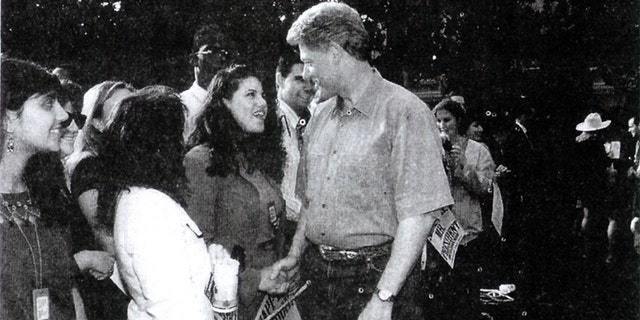
Monica Lewinsky is telling all in a new interview that details her affair with former President Bill Clinton and how the scandal forever changed her life, Fox News has learned.
A&E
confirmed the 45-year-old provided an in-depth reflection about the
shocking events in a six-part docu-series titled “The Clinton Affair”
from Academy Award and Emmy-winning producer Alex Gibney’s Jigsaw
Productions, as well as Emmy-winning director Blair Foster.
A photograph showing former White House intern Monica Lewinsky
meeting President Bill Clinton at a White House function submitted as
evidence in documents by the Starr investigation and released by the
House Judiciary committee September 21, 1998.
(Courtesy of A&E)
The
special aims to examine the jaw-dropping events that led to the
now-72-year-old’s impeachment, which occurred on December 19, 1998.
Lewinsky
and her parents, as well as those close to Clinton, including former
senior advisor Sidney Blumenthal and former lawyer Bob Bennett,
participated in the documentary. Foster previously told The Hollywood Reporter that while the Clintons are aware of the project, they themselves are not involved with the series.
“I don’t talk about this very often and I still feel uncomfortable talking about it because I think it’s one of those things where it’s not as if it didn’t register with me that he was the president,” Lewinsky reflected in the documentary. “Obviously it did. But I think in one way, the moment we were in the back office [of the White House] for the first time, the truth is that I think it meant more to me that someone who other people desired had desired me. However wrong it was. However misguided. For who I was at that very moment at 22-years-old, that’s how I felt.”
Lewinsky was a 21-year-old recent college graduate from
Los Angeles when she began working at the White House as an unpaid
intern in July 1995. It didn’t take long for her to have “strange
encounters” with other interns.
“One in particular [was] this girl
gushing over about the president,” she recalled. “Talking about how
handsome he was. And I just remember thinking to myself, ‘Ew! This is an
old guy with wiry grey hair. How could she find him attractive?’ I
didn’t get it until the first time I was really in his presence.”
Lewinsky said her feelings changed when she saw Clinton at an event.
(Courtesy of A&E)
“I
was struck in a way that he had this ability to hold everybody that was
there,” she said. “… Everybody is sort of starry-eyed in his presence. I
kind of have to laugh at my younger self. But that was when my crush
started.”
Lewinsky revealed that between August to October, the
pair shared a number of “flirtatious encounters.” However, things
escalated in November 1995 during the federal government shutdown.
Interns had taken on roles of furloughed federal employees. Lewinsky
described that at one point there was a small staff birthday party with
Clinton present.
“I realized that the top… of my underwear had
been showing, my thong underwear,” she said. “And I thought, ‘Well, I’ll
up the game. I knew he was walking out of a room. And instead of
putting my trousers up, like I would have done in any other incidence, I
didn’t. It was unnoticeable to everybody else in the room, but he
noticed… I just remember him asking me questions… Where did I go to
college, things like that. I don’t think at that point in my life my
heart had ever beat as fast. I blurted out, ‘You know, I have a crush on
you.’ And he laughed and smiled and asked me if I wanted to go to the
back office. And I did.
“It was dark and he eventually asked me if
he could kiss me and I said yes. After a little time, I went back to my
desk. And at some point later in the evening, I was the only person in
the office. And he came back in and he said, ‘If you want to meet me in
the back study in 10 minutes you can.’ So I did. And it became more
intimate from there.”
(Courtesy of AP)
Lewinsky claimed Clinton would find excuses to see her and the two would plan on how they could accidentally bump into each other.
“He
had a private personal office,” she said. “… That’s where every
intimate encounter took place. The encounters blossomed into a
relationship. [But] no monkey business happened inside the Oval Office
proper. We would talk and maybe flirt here and there, but no sexual
activity happened in the Oval Office.”
“At that point, he was in
touch or I saw him almost weekly,” Lewinsky added, stressing that not
every time she spent with him was sexual.
Still, the relationship appeared to be on Clinton’s terms.
“I
had no way to reach him,” she said. “If he called me, I couldn’t call
him back. I was completely at his mercy in that way. But it’s really sad
to me when I look back on it. I was this 22-year-old girl working in
the White House… I should have been out on the weekends, meeting people
my own age and enjoying myself. And instead, I very often stayed in my
office on Saturdays and Sundays, hoping he would call.”
Bill and Hillary Clinton.
(Courtesy of A&E)
However,
Lewinsky was shocked when in April 1996, she was transferred from the
White House to the Pentagon. This was around the same time Clinton was
campaigning for a second term.
“I was distraught,” said Lewinsky. “I thought I would never see Bill again.”
Lewinsky felt she also wasn’t the right fit for a role at the Pentagon.
“My experience with that was I had a military-style jacket,” she joked.
President Clinton greets Monica Lewinsky (L) at a Washington fundraising event in October 1996.
(Reuters)
However,
Lewinsky received phone calls from Clinton during the late hours and
promised her she would return to the White House if he won the election.
“He
would say he missed me, he’d wear the neckties I had given him,” she
said. “So the relationship was ongoing, but just in different ways… I
was waiting for the election to be over. Waiting for him to fulfill his
promise to bring me back… For the last two weeks leading up to the
election, I didn’t hear from him at all. I had naively invested in his
promise… I felt so deflated and so desperate. And those were the
conditions, along with some other things, that led me in confiding to
Linda Tripp… I just broke emotionally.”
However, Lewinsky’s
insecurities vanished in early 1997 when Clinton gave her a hat pin and
Walt Whitman’s “Leaves of Grass” after a taping of his radio show.
“This
was the first time we had been alone since I had been banished to the
Pentagon,” said Lewinsky. “And so we moved to the bathroom and we were
more intimate. There was some attention paid on me and then I was
reciprocating where up until that point he had always stopped before
completion on his part. I sort of stood up and said I wanted to move
past that stage. And he finally said OK. So that finished. And then I
hugged him after. And he hugged me. And off I went. I didn’t notice that
the dress was soiled… I went to dinner that night. None of these people
said to me, ‘Hey, you gotta go to the bathroom. You have stuff all over
your dress.”
Bill Clinton and Monica Lewinsky.
(Getty)
Lewinsky
admitted that while Clinton at times was warm and affectionate, he also
gave her a lot of mixed messages. In May of that same year, he wanted to
end the relationship because he was struggling to step outside his
marriage and leading a secret life. Lewinsky was also waiting to get a
job back at the White House.
“I was really angry,” she admitted. “Obviously underneath that anger was the deep hurt.”
In
July, Lewinsky sent Clinton a letter and instead of referring to him as
“handsome,” she described her frustrations about working at the
Pentagon and how she would ultimately have to tell her parents why she
leaving behind a well-paying job.
“I ended up seeing him on July
4th,” said Lewinsky. “He was angry… We were in the back study and he
started yelling at me, like ‘It is illegal to threaten the president of
the United States of America.’ He was so angry. And I started to cry. I
never threatened to go public. I threatened to tell my parents. He
immediately softened and he was affectionate… It was a roller coaster of
a relationship [that] led to a slow emotional unraveling on my part.”
(Courtesy of A&E)
That
breakdown would occur in January 1998 when Tripp called the Office of
the Independent Counsel and revealed she knew about the affair, offering
them taped conversations. The OIC then made Tripp set up a meeting with
Lewinsky at the Ritz-Carlton. There, Lewinsky is ambushed by FBI agents
and taken to a hotel room where she is held by waiting prosecutors from
the OIC until late in the night.
“I felt so much guilt,” said
Lewinsky. “And I was terrified. There was a point for me… where I would
be hysterically crying and then I would just shut down. And in the
shut-down period, I remember looking out the window and thinking that
the only way to fix this was to kill myself… I was scared. I was
mortified and afraid of what this was going to do to my family. And I
still was in love with Bill at the time. So I felt really responsible.”
Lewinsky, who for years kept quiet about the relationship, came forward in February for a Vanity Fair
essay in which she described her ordeal as “a living hell,” adding that
the experience of being publicly outed and ostracized back them
resulted in her being diagnosed with post-traumatic stress disorder. She
now serves as an anti-bullying advocate.
Monica Lewinsky in 2016.
(Reuters)
“The Clinton Affair” premieres Sunday, November 18 on A&E.
Conservatives agree the government should be smaller and spend less. The question is how to get there–how hard and how fast to cut?
No one knows better about it than the greatest economic adviser that conservative hero Ronald Reagan ever had: Milton Friedman. Friedman refused to work in Reagan’s White House so as not to lose his ability to speak out independently, but he was a key advisor to Ronald Reagan, especially in his presidential campaign.
Conservatives should listen to Friedman for a few important reasons:
Friedman was one of the very greatest economists of the 20th century. Even among Nobel Prize Winners, he stands head and shoulders above almost anyone else.
Friedman couldn’t be intellectually dishonest even if he’d tried. He didn’t dissemble about what he believed, and only went where the facts led him. And he certainly didn’t play politics. So when he said something, you could be sure he meant it, and that was his carefully considered view.
Friedman was no squish. No one believed in small government more than Milton Friedman. He is rightfully seen as a hero by small government conservatives. He believed in freedom with every fiber of his being.
Given Friedman’s tremendous talent as an economist, honesty and unquestionable small government bona fides, we should pay attention to what he says.
So, Milton Friedman was asked about it, and he gave an answer, on the Donahue Show in 1979. Here’s a link to the clip, which starts at the right point, 33:10.
Friedman is asked what he would do to put the economy back on track. He says the number one thing is to cut government spending.Today In: Business
But how? This is the crucial part. Here’s the quote: “Cut down government spending–to hold down the rate of growth of government spending in dollars and to cut it in terms of purchasing power.”
This is absolutely crucial. Friedman says the right way to shrink government is NOT immediate spending cuts. The right way to shrink government is to hold down the rate of growth of government so that it shrinks in real terms, over time.
It’s important to keep in mind the context. This is 1979. Ronald Reagan was already running for President, and Milton Friedman was one of his key economic advisers. Right before answering on government spending, he noted that he wanted to stay out of government to keep being able to say what he honestly meant–in other words, what he’s saying is not “shrinking the growth rate is the politically more convenient way” to cut government, he is saying “shrinking the growth rate is the right way” to cut government.
It’s also important that he’s saying this in 1979 because this was before the IMF-imposed austerity programs of the 1990s which weakened the case for austerity even further among academic economists. Friedman would have been well within the libertarian and conservative mainstream AND the academic economist mainstream if he’d called for deep immediate spending cuts. And yet that’s not what he called for. Because he thought it was wrong–not wrong politically, but wrong on the merits.
Why, because like it or not, deep immediate spending cuts are bad for the economy. For the exact same reason that tax cuts are good for the economy. (Here’s Friedman in 1999: “I am in favor of reducing taxes under any circumstances, for any excuse, for any reason whatsoever.”) No one believed in small government more than Milton Friedman, and yet he couldn’t endorse austerity and immediate spending cuts.
We’ve seen this all over the world. Governments that implement austerity tank their economy, become unpopular and are voted out. In the US, even if a pro-austerity majority could be elected (very tall order) and actually followed through on its promise, it would very quickly lose the future elections, because the economy would tank and the economy drives elections. The cause of small government would be discredited for a long time. And a lot of unnecessary human suffering would occur as people lose their jobs.
Milton Friedman understood this. He loved small government, but he wouldn’t endorse austerity.
Milton Friedman was perhaps the greatest small government thinker of the 20th century, and he understood economics better than anyone. Conservatives and libertarians should see Friedman as their lodestar and remember his views on austerity. If we actually want to shrink government instead of just posturing, we have to reject austerity and take the longer view.
Michael Harrington: If you don’t have the expertise, the knowledge technology today, you’re out of the debate. And I think that we have to democratize information and government as well as the economy and society. FRIEDMAN: I am sorry to say Michael Harrington’s solution is not a solution to it. He wants minority rule, I […]
By Everette Hatcher III | Posted in Current Events, Milton Friedman | Edit | Comments (0)
PETERSON: Well, let me ask you how you would cope with this problem, Dr. Friedman. The people decided that they wanted cool air, and there was tremendous need, and so we built a huge industry, the air conditioning industry, hundreds of thousands of jobs, tremendous earnings opportunities and nearly all of us now have air […]
By Everette Hatcher III | Posted in Current Events, Milton Friedman | Edit | Comments (0)
Part 5 Milton Friedman: I do not believe it’s proper to put the situation in terms of industrialist versus government. On the contrary, one of the reasons why I am in favor of less government is because when you have more government industrialists take it over, and the two together form a coalition against the ordinary […]
By Everette Hatcher III | Posted in Current Events, Milton Friedman | Edit | Comments (0)
The fundamental principal of the free society is voluntary cooperation. The economic market, buying and selling, is one example. But it’s only one example. Voluntary cooperation is far broader than that. To take an example that at first sight seems about as far away as you can get __ the language we speak; the words […]
By Everette Hatcher III | Posted in Current Events, Milton Friedman | Edit | Comments (0)
_________________________ Pt3 Nowadays there’s a considerable amount of traffic at this border. People cross a little more freely than they use to. Many people from Hong Kong trade in China and the market has helped bring the two countries closer together, but the barriers between them are still very real. On this side […]
By Everette Hatcher III | Posted in Current Events, Milton Friedman | Edit | Comments (0)
Aside from its harbor, the only other important resource of Hong Kong is people __ over 4_ million of them. Like America a century ago, Hong Kong in the past few decades has been a haven for people who sought the freedom to make the most of their own abilities. Many of them are […]
By Everette Hatcher III | Posted in Current Events, Milton Friedman | Edit | Comments (0)
“FREE TO CHOOSE” 1: The Power of the Market (Milton Friedman) Free to Choose ^ | 1980 | Milton Friedman Posted on Monday, July 17, 2006 4:20:46 PM by Choose Ye This Day FREE TO CHOOSE: The Power of the Market Friedman: Once all of this was a swamp, covered with forest. The Canarce Indians […]
If you would like to see the first three episodes on inflation in Milton Friedman’s film series “Free to Choose” then go to a previous post I did. Ep. 9 – How to Cure Inflation [4/7]. Milton Friedman’s Free to Choose (1980) Uploaded by investbligurucom on Jun 16, 2010 While many people have a fairly […]
Charlie Rose interview of Milton Friedman My favorite economist: Milton Friedman : A Great Champion of Liberty by V. Sundaram Milton Friedman, the Nobel Prize-winning economist who advocated an unfettered free market and had the ear of three US Presidents – Nixon, Ford and Reagan – died last Thursday (16 November, 2006 ) in San Francisco […]
By Everette Hatcher III | Posted in Milton Friedman | Edit | Comments (0)
Stearns Speaks on House Floor in Support of Balanced Budget Amendment Uploaded by RepCliffStearns on Nov 18, 2011 Speaking on House floor in support of Balanced Budget Resolution, 11/18/2011 ___________ Below are some of the main proposals of Milton Friedman. I highly respected his work. David J. Theroux said this about Milton Friedman’s view concerning […]
By Everette Hatcher III | Posted in Milton Friedman | Edit | Comments (0)
Milton Friedman: Free To Choose – The Failure Of Socialism With Ronald Reagan (Full) Published on Mar 19, 2012 by NoNationalityNeeded Milton Friedman’s writings affected me greatly when I first discovered them and I wanted to share with you. We must not head down the path of socialism like Greece has done. Abstract: Ronald Reagan […]
By Everette Hatcher III | Posted in Milton Friedman, President Obama | Edit | Comments (1)
What a great defense of Milton Friedman!!!! Defaming Milton Friedman by Johan Norberg This article appeared in Reason Online on September 26, 2008 PRINT PAGE CITE THIS Sans Serif Serif Share with your friends: ShareThis In the future, if you tell a student or a journalist that you favor free markets and limited government, there is […]
Office of Barack and Michelle Obama P.O. Box 91000 Washington, DC 20066
Dear President Obama,
I wrote you over 700 letters while you were President and I mailed them to the White House and also published them on my blog http://www.thedailyhatch.org .I received several letters back from your staff and I wanted to thank you for those letters.
There are several issues raised in your book that I would like to discuss with you such as the minimum wage law, the liberal press, the cause of 2007 financial meltdown, and especially your pro-choice (what I call pro-abortion) view which I strongly object to on both religious and scientific grounds, Two of the most impressive things in your book were your dedication to both the National Prayer Breakfast (which spoke at 8 times and your many visits to the sides of wounded warriors!!
I have been reading your autobiography A PROMISED LAND and I have been enjoying it.
Let me make a few comments on it, and here is the first quote of yours I want to comment on:
WHEN IT CAME to immigration, everyone agreed that the system was broken. The process of immigrating legally to the United States could take a decade or longer, often depending on what country you were coming from and how much money you had.Meanwhile, the economic gulf between us and our southern neighbors drove hundreds of thousands of people to illegally cross the 1,933-mile U.S.-Mexico border each year, searching for work and a better life. Congress had spent billions to harden the border, with fencing, cameras, drones, and an expanded and increasingly militarized border patrol. But rather than stop the flow of immigrants, these steps had spurred an industry of smugglers—coyotes—who made big money transporting human cargo in barbaric and sometimes deadly fashion. And although border crossings by poor Mexican and Central American migrants received most of the attention from politicians and the press, about 40 percent of America’s unauthorized immigrants arrived through airports or other legal ports of entry and then overstayed their visas. By 2010, an estimated eleven million undocumented persons were living in the United States, in large part thoroughly woven into the fabric of American life.Many were longtime residents, with children who either were U.S. citizens by virtue of having been born on American soil or had been brought to the United States at such an early age that they were American in every respect except for a piece of paper. Entire sectors of the U.S. economy relied on their labor, as undocumented immigrants were often willing to do the toughest, dirtiest work for meager pay—picking the fruits and vegetables that stocked our grocery stores, mopping the floors of offices, washing dishes at restaurants, and providing care to the elderly. But although American consumers benefited from this invisible workforce, many feared that immigrants were taking jobs from citizens, burdening social services programs, and changing the nation’s racial and cultural makeup, which led to demands for the government to crack down on illegal immigration. This sentiment was strongest among Republican constituencies, egged on by an increasingly nativist right-wing press. However, the politics didn’t fall neatly along partisan lines: The traditionally Democratic trade union rank and file, for example, saw the growing presence of undocumented workers on co nstruction sites as threatening their livelihoods, while Republican-leaning business groups interested in maintaining a steady supply of cheap labor (or, in the case of Silicon Valley, foreign-born computer programmers and engineers) often took pro-immigration positions. Back in 2007, the maverick version of John McCain, along with his sidekick Lindsey Graham, had actually joined Ted Kennedy to put together a comprehensive reform bill that offered citizenship to millions of undocumented immigrants while more tightly securing our borders. Despite strong support from President Bush, it had failed to clear the Senate. The bill did, however, receive twelve Republican votes, indicating the real possibility of a future bipartisan accord. I’d pledged during the campaign to resurrect similar legislation once elected, and I’d appointed former Arizona governor Janet Napolitano as head of the Department of Homeland Security—the agency that oversaw U.S. Immigration and Customs Enforcement (ICE) and U.S. Customs and Border Protection—partly because of her knowledge of border issues and her reputation for having previously managed immigration in a way that was both compassionate and tough. My hopes for a bill had thus far been dashed. With the economy in crisis and Americans losing jobs,few in Congress had any appetite to take on a hot-button issue like immigration. Kennedy was gone. McCain, having been criticized by the right flank for his relatively moderate immigration stance, showed little interest in taking up the banner again. Worse yet, my administration was deporting undocumented workers at an accelerating rate. This wasn’t a result of any directive from me, but rather it stemmed from a 2008 congressional mandate that both expanded ICE’s budget and increased collaboration between ICE and local law enforcement departments in an effort to deport more undocumented immigrants with criminal records. My team and I had made a strategic choice not to immediately try to reverse the policies we’d inherited in large part because we didn’t want to provide ammunition to critics who claimed that Democrats weren’t willing to enforce existing immigration laws—a perception that we thought could torpedo our chances of passing a future reform bill. But by 2010, immigrant-rights and Latino advocacy groups were criticizing our lack of progress..And although I continued to urge Congress to pass immigration reform, I had no realistic path for delivering a new comprehensive law before the midterms.
Milton Friedmanwisely noted, “It’s just obvious you can’t have free immigration and a welfare state,” Is it prudent to allow illegal immigrants (60 percent of whom are high-school dropouts) access to Social Security, Medicare, and, over time, to 60 federal means-tested welfare programs? I don’t think so either!
My previous post dealing with whether citizenship should be automatic for babies born to illegals generated a lot of commentary, so it is with some trepidation that I wade back into the issue. But the Wall Street Journal column excerpted below seems to strike exactly the right chord and should (at least I think!) meet with approval from both sides of the immigration debate. And by “both sides,” I’m referring to the debate on the right (with some conservatives and libertarians on both sides of the issue) regarding the benefits of immigration generally and the treatment of illegals specifically.
…a larger welfare state is not conducive to comprehensive immigration reform. If foreigners start coming for handouts instead of economic opportunity, tighter restrictions will be justified. … A 2005 World Values Survey found that 71% of Americans see poverty as a condition that can be overcome by dint of hard work, while only 40% of Europeans share that viewpoint. …Belief in social mobility has informed welfare and immigration policy from colonial times. In 1645 the Massachusetts Bay colony was already barring paupers. And in 1882, when Congress finally passed the country’s first major piece of immigration legislation, it specifically prohibited entry to “any person unable to take care of himself or herself without becoming a public charge.” A problem that immigration reformers face is the public perception—fed by restrictionists and exacerbated during economic downturns—that the U.S. welfare state is already a magnet for poor immigrants in search of government assistance. It’s true that the U.S. attracts poor people, but it’s also true that they come here to work, not to go on the dole. We know this because the data consistently show that foreign nationals in the U.S. are more likely than natives to be employed and less likely than low-income natives to be receiving public benefits. …While there’s no evidence that immigrants come here for public assistance, that could change as the U.S. welfare state grows. And one consequence could be less-welcoming immigration policies. The European experience is instructive. In countries such as France, Italy and the Netherlands, excessively generous public benefits have lured poor migrants who tend to be heavy users of welfare and less likely than natives to join the work force. Milton Friedman famously remarked, “you can’t have free immigration and a welfare state.” There is a tipping point, even if the U.S. has yet to reach it.
Sincerely,
Everette Hatcher III, 13900 Cottontail Lane, Alexander, AR 72002, ph 501-920-5733 everettehatcher@gmail.com
President Obama c/o The White House 1600 Pennsylvania Avenue NW Washington, DC 20500 Dear Mr. President, I know that you receive 20,000 letters a day and that you actually read 10 of them every day. I really do respect you for trying to get a pulse on what is going on out here. There have […]By Everette Hatcher III | Posted in David Barton, Founding Fathers, President Obama | Edit |Comments (0)
There have been many articles written by evangelicals like me who fear that our founding fathers would not recognize our country today because secular humanism has rid our nation of spiritual roots. I am deeply troubled by the secular agenda of those who are at war with religion in our public life. Lillian Kwon quoted somebody […]By Everette Hatcher III | Posted in David Barton, Founding Fathers | Edit | Comments (0)
There have been many articles written by evangelicals like me who fear that our founding fathers would not recognize our country today because secular humanism has rid our nation of spiritual roots. I am deeply troubled by the secular agenda of those who are at war with religion in our public life. Lillian Kwon quoted somebody […]By Everette Hatcher III | Posted in David Barton, Founding Fathers | Edit | Comments (0)
There have been many articles written by evangelicals like me who fear that our founding fathers would not recognize our country today because secular humanism has rid our nation of spiritual roots. I am deeply troubled by the secular agenda of those who are at war with religion in our public life. Lillian Kwon quoted somebody […]By Everette Hatcher III | Posted in David Barton, Founding Fathers | Edit | Comments (0)
There have been many articles written by evangelicals like me who fear that our founding fathers would not recognize our country today because secular humanism has rid our nation of spiritual roots. I am deeply troubled by the secular agenda of those who are at war with religion in our public life. Lillian Kwon quoted somebody […]By Everette Hatcher III | Posted in David Barton, Founding Fathers | Edit | Comments (0)
There have been many articles written by evangelicals like me who fear that our founding fathers would not recognize our country today because secular humanism has rid our nation of spiritual roots. I am deeply troubled by the secular agenda of those who are at war with religion in our public life. Lillian Kwon quoted somebody […]By Everette Hatcher III | Posted in Founding Fathers | Edit | Comments (0)
President Obama Speaks at The Ohio State University Commencement Ceremony Published on May 5, 2013 President Obama delivers the commencement address at The Ohio State University. May 5, 2013. You can learn a lot about what President Obama thinks the founding fathers were all about from his recent speech at Ohio State. May 7, 2013, […]By Everette Hatcher III | Posted in Founding Fathers, President Obama | Edit | Comments (0)
Dr. C. Everett Koop with Bill Graham. Francis Schaeffer: “Whatever Happened to the Human Race” (Episode 4) THE BASIS FOR HUMAN DIGNITY Published on Oct 7, 2012 by AdamMetropolis The 45 minute video above is from the film series created from Francis Schaeffer’s book “Whatever Happened to the Human Race?” with Dr. C. Everett Koop. This […]By Everette Hatcher III | Posted in Founding Fathers, Francis Schaeffer, Prolife | Edit |Comments (1)
America’s Founding Fathers Deist or Christian? – David Barton 4/6 There have been many articles written by evangelicals like me who fear that our founding fathers would not recognize our country today because secular humanism has rid our nation of spiritual roots. I am deeply troubled by the secular agenda of those who are at […]By Everette Hatcher III | Posted in David Barton, Founding Fathers | Tagged governor of connecticut, john witherspoon, jonathan trumbull | Edit | Comments (1)
3 Of 5 / The Bible’s Influence In America / American Heritage Series / David Barton There were 55 gentlemen who put together the constitution and their church affliation is of public record. Greg Koukl notes: Members of the Constitutional Convention, the most influential group of men shaping the political foundations of our nation, were […]By Everette Hatcher III | Posted in Founding Fathers | Edit | Comments (0)
I do not think that John Quincy Adams was a founding father in the same sense that his father was. However, I do think he was involved in the early days of our government working with many of the founding fathers. Michele Bachmann got into another history-related tussle on ABC’s “Good Morning America” today, standing […]By Everette Hatcher III | Posted in David Barton, Founding Fathers | Edit | Comments (0)
I have gone back and forth and back and forth with many liberals on the Arkansas Times Blog on many issues such as abortion, human rights, welfare, poverty, gun control and issues dealing with popular culture. Here is another exchange I had with them a while back. My username at the Ark Times Blog is Saline […]By Everette Hatcher III | Posted in Arkansas Times, Francis Schaeffer, Prolife | Edit |Comments (0)
I truly believe that many of the problems we have today in the USA are due to the advancement of humanism in the last few decades in our society. Ronald Reagan appointed the evangelical Dr. C. Everett Koop to the position of Surgeon General in his administration. He partnered with Dr. Francis Schaeffer in making the […]By Everette Hatcher III | Posted in Adrian Rogers, Francis Schaeffer | Edit | Comments (0)
Francis Schaeffer: “Whatever Happened to the Human Race” (Episode 4) THE BASIS FOR HUMAN DIGNITY Published on Oct 7, 2012 by AdamMetropolis ____________ The 45 minute video above is from the film series created from Francis Schaeffer’s book “Whatever Happened to the Human Race?” with Dr. C. Everett Koop. This book really helped develop my political […]By Everette Hatcher III | Posted in Francis Schaeffer | Edit | Comments (0)
Office of Barack and Michelle Obama P.O. Box 91000 Washington, DC 20066
Dear President Obama,
I wrote you over 700 letters while you were President and I mailed them to the White House and also published them on my blog http://www.thedailyhatch.org .I received several letters back from your staff and I wanted to thank you for those letters.
I have been reading your autobiography A PROMISED LAND and I have been enjoying it.
Let me make a few comments on it, and here is the first quote of yours I want to comment on:
I can provide the exact quote here, because in the audience that night was a freelance writer who was recording me. To her mind, my answer risked reinforcing negative stereotypes some Californians already had about working-class white voters and was therefore worth blogging about on Huffington Post. (It’s a decision I respect, by the way, though I wish she had talked to me about it before writing the story. This is what separates even the most liberal writers from their conservative counterparts—the willingness to flay politicians on their own side.)
Francis Schaeffer in his 1983 book A CHRISTIAN MANIFESTO discusses the problem of liberal bias in the media:
The First Track is the fact of the conservative swing in the United States in the 1980 election. With this there is at this moment a unique window open in the United States. It is unique because it is a long, long time since that window has been open as it is now. And let us hope that the window stays open, and not on just one issue, even one as important as human life—though certainly every Christian ought to be praying and working to nullify the abominable abortion law. But as we work and pray, we should have in mind not only this important issue as though it stood alone. Rather, we should be struggling and praying that this whole other total entity—the material-energy, chance world view—can be rolled back with all its results across all of life. I work, I pray that indeed the window does stay open. I hope that will be the case.
Now the window is open and we must take advantage of it in every way we can as citizens, as Christian citizens of the democracy in which we still have freedom. We must try to roll back the other total entity. It will not be easy to roll it back because those who hold the other total world view of reality have no intention that it will be rolled back. Those who hold this view are deeply entrenched, they have had their own way without opposition for a long time, and they will use every means to see that the momentum they have achieved, and the results they have brought forth in all fields, will be retained and enlarged.
For example, all you have to do is to consider the way the media treated Dr. C. Everett Koop. Dr. Koop is one of the foremost pediatric surgeons in the United States, and among other honors, he was given the highest honor of the French government for his pioneering work in pediatric surgery. But when he was nominated for the position of Surgeon General, he was attacked by the secular media with total disregard for objective reporting—and with total disregard for his brilliant humanitarian record as a surgeon. Those in the media holding the humanist world view could not tolerate Dr. Koop’s voice to be heard—they could not tolerate his articulate defense of the sanctity of human life to be expressed.
—
The press is not balanced but is left leaning in the biggest way because of secular humanism!!!
Sincerely,
Everette Hatcher III, 13900 Cottontail Lane, Alexander, AR 72002, ph 501-920-5733 everettehatcher@gmail.com
President Obama c/o The White House 1600 Pennsylvania Avenue NW Washington, DC 20500 Dear Mr. President, I know that you receive 20,000 letters a day and that you actually read 10 of them every day. I really do respect you for trying to get a pulse on what is going on out here. There have […]By Everette Hatcher III | Posted in David Barton, Founding Fathers, President Obama | Edit |Comments (0)
There have been many articles written by evangelicals like me who fear that our founding fathers would not recognize our country today because secular humanism has rid our nation of spiritual roots. I am deeply troubled by the secular agenda of those who are at war with religion in our public life. Lillian Kwon quoted somebody […]By Everette Hatcher III | Posted in David Barton, Founding Fathers | Edit | Comments (0)
There have been many articles written by evangelicals like me who fear that our founding fathers would not recognize our country today because secular humanism has rid our nation of spiritual roots. I am deeply troubled by the secular agenda of those who are at war with religion in our public life. Lillian Kwon quoted somebody […]By Everette Hatcher III | Posted in David Barton, Founding Fathers | Edit | Comments (0)
There have been many articles written by evangelicals like me who fear that our founding fathers would not recognize our country today because secular humanism has rid our nation of spiritual roots. I am deeply troubled by the secular agenda of those who are at war with religion in our public life. Lillian Kwon quoted somebody […]By Everette Hatcher III | Posted in David Barton, Founding Fathers | Edit | Comments (0)
There have been many articles written by evangelicals like me who fear that our founding fathers would not recognize our country today because secular humanism has rid our nation of spiritual roots. I am deeply troubled by the secular agenda of those who are at war with religion in our public life. Lillian Kwon quoted somebody […]By Everette Hatcher III | Posted in David Barton, Founding Fathers | Edit | Comments (0)
There have been many articles written by evangelicals like me who fear that our founding fathers would not recognize our country today because secular humanism has rid our nation of spiritual roots. I am deeply troubled by the secular agenda of those who are at war with religion in our public life. Lillian Kwon quoted somebody […]By Everette Hatcher III | Posted in Founding Fathers | Edit | Comments (0)
President Obama Speaks at The Ohio State University Commencement Ceremony Published on May 5, 2013 President Obama delivers the commencement address at The Ohio State University. May 5, 2013. You can learn a lot about what President Obama thinks the founding fathers were all about from his recent speech at Ohio State. May 7, 2013, […]By Everette Hatcher III | Posted in Founding Fathers, President Obama | Edit | Comments (0)
Dr. C. Everett Koop with Bill Graham. Francis Schaeffer: “Whatever Happened to the Human Race” (Episode 4) THE BASIS FOR HUMAN DIGNITY Published on Oct 7, 2012 by AdamMetropolis The 45 minute video above is from the film series created from Francis Schaeffer’s book “Whatever Happened to the Human Race?” with Dr. C. Everett Koop. This […]By Everette Hatcher III | Posted in Founding Fathers, Francis Schaeffer, Prolife | Edit |Comments (1)
America’s Founding Fathers Deist or Christian? – David Barton 4/6 There have been many articles written by evangelicals like me who fear that our founding fathers would not recognize our country today because secular humanism has rid our nation of spiritual roots. I am deeply troubled by the secular agenda of those who are at […]By Everette Hatcher III | Posted in David Barton, Founding Fathers | Tagged governor of connecticut, john witherspoon, jonathan trumbull | Edit | Comments (1)
3 Of 5 / The Bible’s Influence In America / American Heritage Series / David Barton There were 55 gentlemen who put together the constitution and their church affliation is of public record. Greg Koukl notes: Members of the Constitutional Convention, the most influential group of men shaping the political foundations of our nation, were […]By Everette Hatcher III | Posted in Founding Fathers | Edit | Comments (0)
I do not think that John Quincy Adams was a founding father in the same sense that his father was. However, I do think he was involved in the early days of our government working with many of the founding fathers. Michele Bachmann got into another history-related tussle on ABC’s “Good Morning America” today, standing […]By Everette Hatcher III | Posted in David Barton, Founding Fathers | Edit | Comments (0)
I have gone back and forth and back and forth with many liberals on the Arkansas Times Blog on many issues such as abortion, human rights, welfare, poverty, gun control and issues dealing with popular culture. Here is another exchange I had with them a while back. My username at the Ark Times Blog is Saline […]By Everette Hatcher III | Posted in Arkansas Times, Francis Schaeffer, Prolife | Edit |Comments (0)
I truly believe that many of the problems we have today in the USA are due to the advancement of humanism in the last few decades in our society. Ronald Reagan appointed the evangelical Dr. C. Everett Koop to the position of Surgeon General in his administration. He partnered with Dr. Francis Schaeffer in making the […]By Everette Hatcher III | Posted in Adrian Rogers, Francis Schaeffer | Edit | Comments (0)
Francis Schaeffer: “Whatever Happened to the Human Race” (Episode 4) THE BASIS FOR HUMAN DIGNITY Published on Oct 7, 2012 by AdamMetropolis ____________ The 45 minute video above is from the film series created from Francis Schaeffer’s book “Whatever Happened to the Human Race?” with Dr. C. Everett Koop. This book really helped develop my political […]By Everette Hatcher III | Posted in Francis Schaeffer | Edit | Comments (0)
This one sentence summed up Michael Hutchence’s life: We are always wanting Things we cannot find!
I will believe you
If you say it’s true
Girl you know I need you
More than any word spoken
I’ve seen you before
Turn and walk away
You say you won’t come back
It’s a game anyway
We are hoping, yes and we’re praying
This time will be the last time
That we will fight like this
This time will be the last time
That we will fight like this…hey!
We are always wanting Things we cannot find
You know that we are always wasting time
We are hoping, yes and we’re praying
This time will be the last time
That we will fight like this
This time will be the last time
That we will fight like this
You know I can forget
We have fought before
I’ve seen inside your heart
And I know it’s breaking
We are hoping, yeah and we’re praying
Maybe this time will be the last time
That we will fight like this
This time will be the last time
That we will fight like this
This time will be the last time
INXS frontman Michael Hutchence lived a rock ’n’ roll lifestyle. He dated famous models and pop stars, and accounts of his drug and alcohol use are widespread. According to friends and bandmates, the singer found the dark allure of rock star excess irresistible.
“I’m surprised I’ve survived and so are a lot of my friends,” Hutchence said in 1995. “I’m sure some of them are pissed off, because one thing about me is that I always manage to have my cake and eat it, too, whereas people love to see f–k-ups. That’s the industry. Welcome to the party. Jimi Hendrix is upstairs. But coming through it is fantastic.”
Hutchence might have survived numerous wild nights, but he wouldn’t outlive the passionate, but rocky, relationship he began in the mid-’90s with TV host Paula Yates. As a music star, Hutchence had known the British presenter since the ’80s. Yates also had a foot in the rock world, as the wife of Boomtown Rats singer and Live Aid organizer Bob Geldof. She was married to Geldof, with three daughters, when she began an affair with the Australian rocker, following a particularly flirtatious television interview.
Not long after she divorced Geldof in 1996, Yates gave birth to Hutchence’s child, a daughter that they named Heavenly Hiraani Tiger Lily (in keeping with her mother’s propensity for outlandish names). Although the couple were building a family of their own, all was not well. While friends said that Geldof kept Yates’s addiction problems in check, Hutchence was often ready to indulge. In the meantime, the three members of this love triangle squared off in a battle over custody of Yates and Geldof’s daughters.
During this tumultuous period, Hutchence reportedly began treatment for depression. Perhaps it didn’t help that INXS were no longer the global superstars they had been in the late ’80s. After a hiatus, the Aussie rockers reconvened to make a new album in 1997, titled Elegantly Wasted. The band toured overseas, then planned a 20th anniversary trek in Australia in late November and December.
Hutchence, who had been spending the bulk of his time in England with Yates and daughter Tiger, returned to his hometown of Sydney to rehearsewith his bandmates for the tour, set to begin on November 25. Yates was expecting to visit Australia with Tiger and the three daughters from her marriage when Geldof got a court injunction to prevent his daughters from traveling. In the early morning hours of November 22, 1997, Yates called her boyfriend to tell him that the custody hearing had been pushed back to December 17, and so she could no longer bring the kids.
The singer had been awake all night in his Ritz Carlton hotel room, reportedly drinking with friends and doing a little cocaine, in anticipation of receiving news about his lover and the children. When it turned out to be bad news, he phoned Geldof, in a manner that Bob characterized as“hectoring and abusive and threatening.” A woman staying in the next room heard yelling and swearing coming through the walls in the early morning hours.
A few hours later, Hutchence made a few more phone calls, to a former girlfriend Michelle Bennett and to business manager Martha Troup. The two said that the musician sounded like he was in a dark place. He left a voicemail for Troup, saying, “I’ve f–king had enough” and had a conversation with Bennett that startled her into coming to check on him at the hotel. She knocked on his door, but there was no answer.
Hutchence’s body would be discovered by a maid at 11:50 a.m. He was found naked and in a kneeling position behind the door, after a belt around his neck (and attached to the door-closing mechanism) had broken. He had choked to death in a case of apparent suicide. Hutchence was 37 years old.
“Bob Geldof murdered Michael Hutchence,” Yates told The Daily Express upon her arrival in Sydney. “That bastard killed Michael. He is called Saint Bob. That makes me sick. He killed my baby. We have had three years of this.”
A little while later, Paula Yates began suggesting that Hutchence’s death might not have been a suicide. Yates, and others, thought it must have been an accident because he left no note or any last words for his daughter. A rumor began to circulate that this was the tragic result of auto-erotic asphyxiation (or the practice of depriving the brain of oxygen to heighten orgasm). Yates backed the theory in interviews.
“Such was her determination to make her point about this to police that when she arrived in Australia following his death she shouted at the detectives in a restaurant while giving graphic details of the sex games she and Hutchence played,” former Detective Inspector Michael Gerondis told The Daily Mail. “‘He would strangle me during sex,’ she told them.”
Although Michael’s brother, his friends and former lovers had given credence to the possibility that Hutchence died from risky sexual behavior, there was no evidence to support such claims. The Australian authorities continue to reject the theory.
Hutchence received a funeral in the days following his death, with his INXS bandmates and brother Rhett as pallbearers. Michael’s family was in attendance, along with Yates, former girlfriend Kylie Minogue and other famous friends from Diana Ross to Tom Jones. Nick Cave sang “Into My Arms” as a tribute to Hutchence. A few years later, Bono wrote U2’s “Stuck in a Moment You Can’t Get Out Of” as an imaginary conversation he wished he’d had with his friend and fellow rock star.
Following Hutchence’s death, Yates went into a tailspin of distress and drug addiction. She lost custody of her children to Geldof and succumbed to an accidental heroin overdose in 2000. She was 41. Her ex-husband then took custody of Tiger Lily, and began raising the four-year-old as his own daughter. He has since lost one of his and Yates’s children, Peaches, to another heroin overdose in 2014.
“It’s all awful. It’s all awful,” Geldof told 60 Minutesyears later. “And there’s nothing good came out of it. Nothing. Where’s the upside?”
——
This post includes a lot of material that is very depressing, but don’t stop reading until you get to the end of this long post. There is hope.
Nihilism is the only conclusion when you have no hope of an afterlife. Many have turned to drugs, alcoholism or even suicide. (Don’t stop reading until you get to the end of the post and read the uplifting story of Kerry Livgren!!!)
Solomon was searching for meaning in life in what I call the 6 big L words in the Book of Ecclesiastes. He looked into learning (1:16-18), laughter, ladies, luxuries, and liquor (2:1-3, 8, 10, 11), and labor (2:4-6, 18-20). After searching in area of luxuries Solomon found them to be “vanity and a striving after the wind.”
Ecclesiastes 2:7-11 English Standard Version (ESV)
7I had also great possessions of herds and flocks, more than any who had been before me in Jerusalem. 8I also gathered for myself silver and gold and the treasure of kings and provinces. 9 So I became great and surpassed all who were before me in Jerusalem…10 And whatever my eyes desired I did not keep from them.11 Then I considered all that my hands had done and the toil I had expended in doing it, and behold, all was vanity and a striving after wind, and there was nothing to be gained UNDER THE SUN.
“For what does it profit a man to gain the whole world and forfeit his soul?” Mark 8:36 (Christ’s words)
God put Solomon’s story in Ecclesiastes in the Bible with the sole purpose of telling people like you that without God in the picture you will find out the emptiness one feels when possessions are trying to fill the void that God can only fill.
Then in the last chapter of Ecclesiastes Solomon returns to looking above the sun and he says that obeying the Lord is the proper way to live your life. The answer to find meaning in life is found in putting your faith and trust in Jesus Christ. The Bible is true from cover to cover and can be trusted. If you need more evidence then go to You Tube and watch the short videos “Francis Schaeffer – The Biblical Flow of History & Truth (1),“(3 min, 5 sec) and “Dr. Francis Schaeffer – The Biblical Flow of Truth & History (part 2),” (10 min, 46 sec
Francis Schaeffer noted:
I have lots of young people and older ones come to us from the ends of the earth. And as they come to us, they have gone to the end of this logically and they are not living in a romantic setting. They realize what the situation is. They can’t find any meaning to life. It’s the meaning to the black poetry. It’s the meaning of the black plays. It’s the meaning of all this. It’s the meaning of the words “punk rock.”
__
Francis Schaeffer pictured below in 1971 at L Abri
_
–
Francis Schaeffer noted:
I have lots of young people and older ones come to us from the ends of the earth. And as they come to us, they have gone to the end of this logically and they are not living in a romantic setting. They realize what the situation is. They can’t find any meaning to life. It’s the meaning to the black poetry. It’s the meaning of the black plays. It’s the meaning of all this. It’s the meaning of the words “punk rock.”
–
“They are the natural outcome of a change from a Christian World View to a Humanistic one…
The result is a relativistic value system. A lack of a final meaning to life — that’s first. Why does human life have any value at all, if that is all that reality is? Not only are you going to die individually, but the whole human race is going to die, someday. It may not take the falling of the atom bombs, but someday the world will grow too hot, too cold. That’s what we are told on this other final reality, and someday all you people not only will be individually dead, but the whole conscious life on this world will be dead, and nobody will see the birds fly. And there’s no meaning to life.
As you know, I don’t speak academically, shut off in some scholastic cubicle, as it were. I have lots of young people and older ones come to us from the ends of the earth. And as they come to us, they have gone to the end of this logically and they are not living in a romantic setting. They realize what the situation is. They can’t find any meaning to life. It’s the meaning to the black poetry. It’s the meaning of the black plays. It’s the meaning of all this. It’s the meaning of the words “punk rock.” And I must say, that on the basis of what they are being taught in school, that the final reality is only this material thing, they are not wrong. They’re right! On this other basis there is no meaning to life and not only is there no meaning to life, but there is no value system that is fixed, and we find that the law is based then only on a relativistic basis and that law becomes purely arbitrary.
—
OUTLINE OF ECCLESIATES BY SCHAEFFER
_______
William Lane Craig on Man’s predicament if God doesn’t exist
Read Waiting for Godot by Samuel Beckett. During this entire play two men carry on trivial conversation while waiting for a third man to arrive, who never does. Our lives are like that, Beckett is saying; we just kill time waiting—for what, we don’t know.
Thus, if there is no God, then life itself becomes meaningless. Man and the universe are without ultimate significance.
Francis Schaeffer looks at Nihilism of Solomon and the causes of it!!!
Notes on Ecclesiastes by Francis Schaeffer
Solomon is the author of Ecclesiastes and he is truly an universal man like Leonardo da Vinci.
Two men of the Renaissance stand above all others –Michelangelo and Leonardo da Vinci and it is in them that one can perhaps grasp a view of the ultimate conclusion of humanism for man. Michelangelo was unequaled as a sculptor in the Renaissance and arguably no one has ever matched his talents.
The other giant of the Renaissance period was Leonardo da Vinci – the perfect Renaissance Man, the man who could do almost anything and does it better than most anyone else. As an inventor, an engineer, an anatomist, an architect, an artist, a chemist, a mathematician, he was almost without equal. It was perhaps his mathematics that lead da Vinci to come to his understanding of the ultimate meaning of Humanism. Leonardo is generally accepted as the first modern mathematician. He not only knew mathematics abstractly but applied it in his Notebooks to all manner of engineering problems. He was one of the unique geniuses of history, and in his brilliance he perceived that beginning humanistically with mathematics one only had particulars. He understood that man beginning from himself would never be able to come to meaning on the basis of mathematics. And he knew that having only individual things, particulars, one never could come to universals or meaning and thus one only ends with mechanics. In this he saw ahead to where our generation has come: everything, including man, is the machine.
Leonardo da Vinci compares well to Solomon and they both were universal men searching for the meaning in life. Solomon was searching for a meaning in the midst of the details of life.His struggle was to find the meaning of life. Not just plans in life.Anybody can find plans in life. A child can fill up his time with plans of building tomorrow’s sand castle when today’s has been washed away. There is a difference between finding plans in life and purpose in life. Humanism since the Renaissance and onward has never found it and it has never found it since. Modern man has not found it and it has always got worse and darker in a very real way.
We have here the declaration of Solomon’s universality:
1 Kings 4:30-34
English Standard Version (ESV)
30 so that Solomon’s wisdom surpassed the wisdom of all the people of the east and all the wisdom of Egypt.31 For he was wiser than all other men, wiser than Ethan the Ezrahite, and Heman, Calcol, and Darda, the sons of Mahol, and his fame was in all the surrounding nations.32 He also spoke 3,000 proverbs, and his songs were 1,005.33 He spoke of trees, from the cedar that is in Lebanon to the hyssop that grows out of the wall. He spoke also of beasts, and of birds, and of reptiles, and of fish.34 And people of all nations came to hear the wisdom of Solomon, and from all the kings of the earth, who had heard of his wisdom.
_________________________
Here is the universal man and his genius. Solomon is the universal man with a empire at his disposal. Solomon had it all.
Ecclesiastes 1:3
English Standard Version (ESV)
3 What does man gain by all the toil at which he toils under the sun?
Schaeffer noted that Solomon took a look at the meaning of life on the basis of human life standing alone between birth and death “under the sun.” This phrase UNDER THE SUN appears over and over in Ecclesiastes.
(Added by me:The Christian Scholar Ravi Zacharias noted, “The key to understanding the Book of Ecclesiastes is the term UNDER THE SUN — What that literally means is you lock God out of a closed system and you are left with only this world of Time plus Chance plus matter.” )
Man is caught in the cycle
Ecclesiastes 1:1-7
English Standard Version (ESV)
All Is Vanity
1 The words of the Preacher, the son of David, king in Jerusalem.
2 Vanity of vanities, says the Preacher, vanity of vanities! All is vanity. 3 What does man gain by all the toil at which he toils under the sun? 4 A generation goes, and a generation comes, but the earth remains forever. 5 The sun rises, and the sun goes down, and hastens to the place where it rises. 6 The wind blows to the south and goes around to the north; around and around goes the wind, and on its circuits the wind returns. 7 All streams run to the sea, but the sea is not full; to the place where the streams flow, there they flow again.
8 All things are full of weariness; a man cannot utter it; the eye is not satisfied with seeing, nor the ear filled with hearing. 9 What has been is what will be, and what has been done is what will be done, and there is nothing new under the sun. 10 Is there a thing of which it is said, “See, this is new”? It has been already in the ages before us.
_____________
Solomon is showing a high degree of comprehension of evaporation and the results of it. Seeing also in reality nothing changes. There is change but always in a set framework and that is cycle. You can relate this to the concepts of modern man. Ecclesiastes is the only pessimistic book in the Bible and that is because of the place where Solomon limits himself. He limits himself to the question of human life, life under the sun between birth and death and the answers this would give.
Ecclesiastes 1:4
English Standard Version (ESV)
4 A generation goes, and a generation comes, but the earth remains forever.
___________________
Ecclesiastes 4:16
English Standard Version (ESV)
16 There was no end of all the people, all of whom he led. Yet those who come later will not rejoice in him. Surely this also is vanity and a striving after wind.
__________________________
In verses 1:4 and 4:16 Solomon places man in the cycle. He doesn’t place man outside of the cycle. Man doesn’t escape the cycle. Man is only cycle. Birth and death and youth and old age. With this in mind Solomon makes this statement.
Ecclesiastes 6:12
12 For who knows what is good for a man during his lifetime, during the few years of his futile life? He will spend them like a shadow. For who can tell a man what will be after him under the sun?
____________________
There is no doubt in my mind that Solomon had the same experience in his life that I had as a younger man. I remember standing by the sea and the moon arose and it was copper and beauty. Then the moon did not look like a flat dish but a globe or a sphere since it was close to the horizon. One could feel the global shape of the earth too. Then it occurred to me that I could contemplate the interplay of the spheres and I was exalted because I thought I can look upon them with all their power, might, and size, but they could contempt nothing and I felt as man as God. Then came upon me a horror of great darkness because it suddenly occurred to me that although I could contemplate them and they could contemplate nothing yet they would continue to turn in ongoing cycles when I saw no more forever and I was crushed.
THIS IS SOLOMON’S FEELING TOO. The universal man, Solomon, beyond our intelligence with an empire at his disposal with the opportunity of observation so he could recite these words here in Ecclesiastes 6:12, “For who knows what is good for a man during his lifetime, during the few years of his futile life? He will spend them like a shadow. For who can tell a man what will be after him under the sun?”
Lack of Satisfaction in life
In Ecclesiastes 1:8 he drives this home when he states, “All things are wearisome; Man is not able to tell it. The eye is not satisfied with seeing, Nor is the ear filled with hearing.” Solomon is stating here the fact that there is no final satisfaction because you don’t get to the end of the thing. THERE IS NO FINAL SATISFACTION. This is related to Leonardo da Vinci’s similar search for universals and then meaning in life.
In Ecclesiastes 5:11 Solomon again pursues this theme, “When good things increase, those who consume them increase. So what is the advantage to their owners except to look on?” Doesn’t that sound modern? It is as modern as this evening. Solomon here is stating the fact there is no reaching completion in anything and this is the reason there is no final satisfaction. There is simply no place to stop. It is impossible when laying up wealth for oneself when to stop. It is impossible to have the satisfaction of completion.
Pursuing Learning
Now let us look down the details of his searching.
In Ecclesiastes 1: 13a we have the details of the universal man’s procedure. “And I set my mind to seek and explore by wisdom concerning all that has been done under heaven.”
So like any sensible man the instrument that is used is INTELLECT, and RAITIONALITY, and LOGIC. It is to be noted that even men who despise these in their theories begin and use them or they could not speak. There is no other way to begin except in the way they which man is and that is rational and intellectual with movements of that is logical within him. As a Christian I must say gently in passing that is the way God made him.
So we find first of all Solomon turned to WISDOM and logic. Wisdom is not to be confused with knowledge. A man may have great knowledge and no wisdom. Wisdom is the use of rationality and logic. A man can be very wise and have limited knowledge. Here he turns to wisdom in all that implies and the total rationality of man.
Works of Men done Under the Sun
After wisdom Solomon comes to the great WORKS of men. Ecclesiastes 1:14, “I have seen all the works which have been done under the sun, and behold, all is [p]vanity and striving after wind.” Solomon is the man with an empire at this disposal that speaks. This is the man who has the copper refineries in Ezion-geber. This is the man who made the stables across his empire. This is the man who built the temple in Jerusalem. This is the man who stands on the world trade routes. He is not a provincial. He knew what was happening on the Phonetician coast and he knew what was happening in Egypt. There is no doubt he already knew something of building. This is Solomon and he pursues the greatness of his own construction and his conclusion is VANITY AND VEXATION OF SPIRIT.
Ecclesiastes 2:18-20
18 Thus I hated all the fruit of my labor for which I had labored under the sun, for I must leave it to the man who will come after me.19 And who knows whether he will be a wise man or a fool? Yet he will have control over all the fruit of my labor for which I have labored by acting wisely under the sun. This too is vanity.20 Therefore I completely despaired of all the fruit of my labor for which I had labored under the sun.
He looked at the works of his hands, great and multiplied by his wealth and his position and he shrugged his shoulders.
Ecclesiastes 2:22-23
22 For what does a man get in all his labor and in his striving with which he labors under the sun?23 Because all his days his task is painful and grievous; even at night his mind does not rest. This too is vanity.
Man can not rest and yet he is never done and yet the things which he builds will out live him. If one wants an ironical three phrases these are they. There is a Dutch saying, “The tailor makes many suits but one day he will make a suit that will outlast the tailor.”
God has put eternity in our hearts but we can not know the beginning or the end of the thing from a vantage point of UNDER THE SUN
Ecclesiastes 1:16-18
16 I said to myself, “Behold, I have magnified and increased wisdom more than all who were over Jerusalem before me; and my mind has observed a wealth of wisdom and knowledge.”17 And I set my mind to know wisdom and to know madness and folly; I realized that this also is striving after wind.18 Because in much wisdom there is much grief, and increasing knowledge results in increasing pain.
Solomon points out that you can not know the beginnings or what follows:
Ecclesiastes 3:11
11 He has made everything appropriate in its time. He has also set eternity in their heart, yet so that man will not find out the work which God has done from the beginning even to the end.
Ecclesiastes 1:11
11 There is no remembrance of earlier things; And also of the later things which will occur, There will be for them no remembrance among those who will come later still.
Ecclesiastes 2:16
16 For there is no lasting remembrance of the wise man as with the fool, inasmuch as in the coming days all will be forgotten. And how the wise man and the fool alike die!
You bring together here the factor of the beginning and you can’t know what immediately follows after your death and of course you can’t know the final ends. What do you do and the answer is to get drunk and this was not thought of in the RUBAIYAT OF OMAR KAHAYYAM:
Ecclesiastes 2:1-3
I said to myself, “Come now, I will test you with pleasure. So enjoy yourself.” And behold, it too was futility.2 I said of laughter, “It is madness,” and of pleasure, “What does it accomplish?”3 I explored with my mind how to stimulate my body with wine while my mind was guiding me wisely, and how to take hold of folly, until I could see what good there is for the sons of men to do under heaven the few years of their lives.
You know, my Friends, with what a brave Carouse
I made a Second Marriage in my house;
Divorced old barren Reason from my Bed,
And took the Daughter of the Vine to Spouse.
from the Rubaiyat of Omar Khayyam (Translation by Edward Fitzgerald)
A perfectly good philosophy coming out of Islam, but Solomon is not the first man that thought of it nor the last. In light of what has been presented by Solomon is the solution just to get intoxicated and black the think out? So many people have taken to alcohol and the dope which so often follows in our day. This approach is incomplete, temporary and immature. Papa Hemingway can find the champagne of Paris sufficient for a time, but one he left his youth he never found it sufficient again. He had a lifetime spent looking back to Paris and that champagne and never finding it enough. It is no solution and Solomon says so too.
Ecclesiastes 2:4-11
4 I enlarged my works: I built houses for myself, I planted vineyards for myself;5 I made gardens and parks for myself and I planted in them all kinds of fruit trees;6 I made ponds of water for myself from which to irrigate a forest of growing trees.7 I bought male and female slaves and I had homeborn slaves. Also I possessed flocks and herds larger than all who preceded me in Jerusalem.8 Also, I collected for myself silver and gold and the treasure of kings and provinces. I provided for myself MALE AND FEMALE SINGERS AND THE PLEASURES OF MEN–MANY CONCUBINES.
9 Then I became great and increased more than all who preceded me in Jerusalem. My wisdom also stood by me.10 All that my eyes desired I did not refuse them. I did not withhold my heart from any pleasure, for my heart was pleased because of all my labor and this was my reward for all my labor.11 Thus I considered all my activities which my hands had done and the labor which I had exerted, and behold all was vanity and striving after wind and there was no profit under the sun.
He doesn’t mean there is no temporary profit but there is no real profit. Nothing that lasts. The walls crumble if they are as old as the Pyramids. You only see a shell of the Pyramids and not the glory that they were. This is what Solomon is saying. Look upon Solomon’s wonder and consider the Cedars of Lebanon which were not in his domain but at his disposal.
Ecclesiastes 6:2
2 a man to whom God has given riches and wealth and honor so that his soul lacks nothing of all that he desires; yet God has not empowered him to eat from them, for a foreigner enjoys them. This is vanity and a severe affliction.
Can someone stuff himself with food he can’t digest? Solomon came to this place of strife and confusion when he went on in his search for meaning.
Oppressed have no comforter
Ecclesiastes 4:1
Then I looked again at all the acts of oppression which were being done under the sun. And behold I saw the tears of the oppressed and that they had no one to comfort them; and on the side of their oppressors was power, but they had no one to comfort them.
Between birth and death power rules. Solomon looked over his kingdom and also around the world and proclaimed that right does not rule but power rules.
Ecclesiastes 7:14-15
14 In the day of prosperity be happy, but in the day of adversity consider—God has made the one as well as the other so that man will not discover anything that will be after him.
15 I have seen everything during my lifetime of futility; there is a righteous man who perishes in his righteousness and there is a wicked man who prolongs his life in his wickedness.
Ecclesiastes 8:14
14 There is futility which is done on the earth, that is, there are righteous men to whom it happens according to the deeds of the wicked. On the other hand, there are evil men to whom it happens according to the deeds of the righteous. I say that this too is futility.
We could say it in 20th century language, “The books are not balanced in this life.”
Pursuing Ladies
If one would flee to alcohol, then surely one may choose sexual pursuits to flee to. Solomon looks in this area too.
Ecclesiastes 7:25-28
25 I directed my mind to know, to investigate and to seek wisdom and an explanation, and to know the evil of folly and the foolishness of madness.26 And I discovered more bitter than death the woman whose heart is snares and nets, whose hands are chains. One who is pleasing to God will escape from her, but the sinner will be captured by her.
27 “Behold, I have discovered this,” says the Preacher, “adding one thing to another to find an explanation,28 I have looked for other answers but have found none. I found one man in a thousand that I could respect, but not one woman. (Good News Translation on verse 28)
One can understand both Solomon’s expertness in this field and his bitterness.
I Kings 11:1-3 (New American Standard Bible)
11 Now King Solomon loved many foreign women along with the daughter of Pharaoh: Moabite, Ammonite, Edomite, Sidonian, and Hittite women,2 from the nations concerning which the Lord had said to the sons of Israel, “You shall not associate with them, nor shall they associate with you, for they will surely turn your heart away after their gods.” Solomon held fast to these in love.3 He had seven hundred wives, princesses, and three hundred concubines, and his wives turned his heart away.
An expert but also the reason for his bitterness. Certainly there have been many men over the centuries who have daydreamed of Solomon’s wealth in this area [of women], but at the end it was sorry, not only sorry but nothing and less than nothing. The simple fact is that one can not know woman in the real sense by pursuing 1000 women. It is not possible. Woman is not found this way. All that is left in this setting if one were to pursue the meaning of life in this direction is this most bitter word found in Ecclesiastes 7:28, “I have looked for other answers but have found none. I found one man in a thousand that I could respect, but not one woman.” (Good News Translation on verse 28) He was searching in the wrong way. He was searching for the answer to life in the limited circle of that which is beautiful in itself but not an answer finally in sexual life. More than that he finally tried to find it in variety and he didn’t even touch one woman at the end.
Relative truth/ Chance and time/ death comes to fool and wiseman/ tried pagan religions
He plunged in such a scientific procedure finally into the thought of final relative truth.
Ecclesiastes 8:6-7
6 For there is a time and a way for everything, although man’s trouble lies heavy on him.7 For he does not know what is to be, for who can tell him how it will be?
In such a setting he is led into misery. Relative truth is also expressed in Ecclesiastes 3:1, “For everything there is a season, and a time for every matter under heaven…” He is not saying this in a positive sense, but it is in a negative sense here. Relative truth in light of Ecclesiastes 8:6-7. When you come to the concept of relative truth only one more step remains and that is that chance rules. Chance is king.
__
Ecclesiastes 9:11
11 Again I saw that under the sun the race is not to the swift, nor the battle to the strong, nor bread to the wise, nor riches to the intelligent, nor favor to those with knowledge, but time and chance happen to them all.
Chance rules. If a man starts out only from himself and works outward it must eventually if he is consistent seem so that only chance rules and naturally in such a setting you can not expect him to have anything else but finally a hate of life.
Ecclesiastes 2:17-18a
17 So I hated life, because what is done under the sun was grievous to me, for all is vanity and a striving after wind. 18 I hated all my toil in which I toil under the sun…
That first great cry “So I hated life.” Naturally if you hate life you long for death and you find him saying this in Ecclesiastes 4:2-3:
2 And I thought the dead who are already dead more fortunate than the living who are still alive.3 But better than both is he who has not yet been and has not seen the evil deeds that are done under the sun.
He lays down an order. It is best never have to been. It is better to be dead, and worse to be alive. But like all men and one could think of the face of Vincent Van Gogh in his final paintings as he came to hate life and you watch something die in his self portraits, the dilemma is double because as one is consistent and one sees life as a game of chance, one must come in a way to hate life. Yet at the same time men never get beyond the fear to die. Solomon didn’t either. So you find him in saying this.
Ecclesiastes 2:14-15
14 The wise person has his eyes in his head, but the fool walks in darkness. And yet I perceived that the same event happens to all of them.15 Then I said in my heart, “What happens to the fool will happen to me also. Why then have I been so very wise?” And I said in my heart that this also is vanity.
The Hebrew is stronger than this and it says “it happens EVEN TO ME,” Solomon on the throne, Solomon the universal man. EVEN TO ME, even to Solomon.
Ecclesiastes 3:18-21
18 I said in my heart with regard to the children of man that God is testing them that they may see that they themselves are but beasts.19 For what happens to the children of man and what happens to the beasts is the same; as one dies, so dies the other. They all have the same breath, and man has no advantage over the beasts, for all is vanity.[n]20 All go to one place. All are from the dust, and to dust all return.21 Who knows whether the spirit of man goes upward and the spirit of the beast goes down into the earth?
What he is saying is as far as the eyes are concerned everything grinds to a stop at death.
Ecclesiastes 4:16
16 There was no end of all the people, all of whom he led. Yet those who come later will not rejoice in him. Surely this also is vanity and a striving after wind.
That is true. There is no place better to feel this than here in Switzerland. You can walk over these hills and men have walked over these hills for at least 4000 years and when do you know when you have passed their graves or who cares? It doesn’t have to be 4000 years ago. Visit a cemetery and look at the tombstones from 40 years ago. Just feel it. IS THIS ALL THERE IS? You can almost see Solomon shrugging his shoulders.
Ecclesiastes 8:8
8 There is no man that hath power over the spirit to retain the spirit; neither hath he power in the day of death: and there is no discharge in that war; neither shall wickedness deliver those that are given to it. (King James Version)
A remarkable two phrase. THERE IS NO DISCHARGE IN THAT WAR or you can translate it “no casting of weapons in that war.” Some wars they come to the end. Even the THIRTY YEARS WAR (1618-1648) finally finished, but this is a war where there is no casting of weapons and putting down the shield because all men fight this battle and one day lose. But more than this he adds, WICKEDNESS WON’T DELIVER YOU FROM THAT FIGHT. Wickedness delivers men from many things, from tedium in a strange city for example. But wickedness won’t deliver you from this war. It isn’t that kind of war. More than this he finally casts death in the world of chance.
Ecclesiastes 9:12
12 For man does not know his time. Like fish that are taken in an evil net, and like birds that are caught in a snare, so the children of man are snared at an evil time, when it suddenly falls upon them.
Death can come at anytime. Death seen merely by the eye of man between birth and death and UNDER THE SUN. Death too is a thing of chance. Albert Camus speeding in a car with a pretty girl at his side and then Camus dead. Lawrence of Arabia coming up over a crest of a hill 100 miles per hour on his motorcycle and some boys are standing in the road and Lawrence turns aside and dies..
————
–
Woody Allen has embraced NIHILISM but he continues marching on.
In the movie MIDNIGHT IN PARIS the idea of nihilism is clearly taught.
(Disclaimer: I am friends with atheists who live very good lives and have embraced life. I am not accusing all atheists of embracing nihilism, but just that some like Woody Allen have nihilistic tendencies. However, a few have taken the logic of NIHILISM a step further and that could possibly lead to SUICIDE.)
Adriana and Gil Pender in MIDNIGHT IN PARIS
In the movie Gertrude Stein says to Gil, “Now, about your book,it’s very unusual, indeed.I mean, in a way, it’s almost like science fiction….The artist’s job is not to succumb to DESPAIR,but to find an antidote for the emptiness of existence.You have a clear and lively voice. Don’t be such a defeatist.”
Also in the film we find this exchange:
ADRIANA: I can never decide whether Paris is more beautiful by day or by night.
GIL PENDER: No, you can’t. You couldn’t pick one. I mean,I can give you a checkmate argument for each side.You know, I sometimes think,”How’s anyone gonna come up with a book, or a painting, or a symphony or a sculpture that can compete with a great city?”You can’t, ’cause, like,you look around, every…every street, every boulevard is its own special art form.And when you think that in the cold,violent, meaningless universe,that Paris exists, these lights…I mean, come on, there’s nothing happening on Jupiter or Neptune,but from way out in space you can see these lights, the cafe’s, people drinking, and singing…I mean, for all we know, Paris is the hottest spot in the universe.
Annie Hall – The Opening Scene [HD]
Manhattan
Francis Schaeffer two months before he died said if he was talking to a gentleman he was sitting next to on an airplane about Christ he wouldn’t start off quoting Bible verses. Schaeffer asserted:
I would go back rather to their dilemma if they hold the modern worldview of the final reality only being energy, etc., I would start with that. I would begin as I stress in the book THE GOD WHO IS THERE about their own [humanist] prophets who really show where their view goes. For instance, Jacques Monod, Nobel Prize winner from France, in his book NECESSITY AND CHANCE said there is no way to tell the OUGHT from the IS. In other words, you live in a totally silent universe.
The men like Monod and Sartre or whoever the man might know that is his [humanist] prophet and they point out quite properly and conclusively what life is like, not just that there is no meaningfulness in life but everyone according to modern man is just living out some kind of game plan. It may be knocking 1/10th of a second off a downhill ski run or making one more million dollars. But all you are doing is making a game plan within the mix of a meaningless situation. WOODY ALLEN exploits this very strongly in his films. He really lives it. I feel for that man, and he has expressed it so thoroughly in ANNIE HALL and MANHATTAN and so on.
Francis Schaeffer is correct about Woody Allen and that Allen has embraced nihilism. I hope that many will read below at the bottom of this post about the men Dave Hope and Kerry Livgren of the rock group KANSAS who also came to the end of themselves but they turned away from nihilism and found meaning to their lives.
.
_
_
A suicide attempt appears in MIDNIGHT IN PARIS when Zelda Fitzgerald goes to the Seine River with the intention of jumping and Gil Pender stops her. It seems the nihilist worldview of Woody Allen keeps him putting suicides into his films.
Remember Professor Levy from the movie CRIMES AND MISDEMEANOR? After addressing the question IS IT POSSIBLE TO BE AN OPTIMISTIC SECULAR HUMANIST THAT DOES NOT BELIEVE IN GOD OR AN AFTERLIFE? Levy jumps out a window!!!
After Levy committed suicide, Cliff reviewed a clip from the documentary footage in which Levy states: “But we must always remember that when we are born we need a great deal of love to persuade us to stay in life. Once we get that love, it usually lasts us. But the universe is a pretty cold place. It’s we who invest it with our feelings. And under certain conditions, we feel that the thing isn’t worth it anymore.”
Hearing the news of Levy’s death, Halley says, “No matter how elaborate a philosophical system you work out, in the end it’s got to be incomplete.”
So some humanists act as if they have a great advantage over Christians. They act as if the advance of science and technology and a better understanding of history (through such concepts as the evolutionary theory) have all made the idea of God and Creation quite ridiculous.
This superior attitude, however, is strange because one of the most striking developments in the last half-century is the growth of a profound pessimism among both the well-educated and less-educated people. The thinkers in our society have been admitting for a long time that they have no final answers at all.
Take Woody Allen, for example. Most people know his as a comedian, but he has thought through where mankind stands after the “religious answers” have been abandoned. In an article in Esquire (May 1977), he says that man is left with:
… alienation, loneliness [and] emptiness verging on madness…. The fundamental thing behind all motivation and all activity is the constant struggle against annihilation and against death. It’s absolutely stupefying in its terror, and it renders anyone’s accomplishments meaningless. As Camus wrote, it’s not only that he (the individual) dies, or that man (as a whole) dies, but that you struggle to do a work of art that will last and then you realize that the universe itself is not going to exist after a period of time. Until those issues are resolved within each person – religiously or psychologically or existentially – the social and political issues will never be resolved, except in a slapdash way.
Allen sums up his view in his film Annie Hall with these words: “Life is divided into the horrible and the miserable.”
However, our intention here is neither to go into the history of irrationalism, nor to examine the proponents of existentialism in our own century, but rather to concentrate on its main thesis. It is this that confronts us on all sides today, and it is impossible to understand modern man without understanding this concept.
Because we shall be using several terms a great deal now, we would ask the reader to attend carefully. When we speak of irrationalism or existentialism or the existential methodology, we are pointing to a quite simple idea. It may have been expressed in a variety of complicated ways by philosophers, but it is not a difficult concept.
Imagine that you are at the movies watching a suspense film. As the story unfolds, the tension increases until finally the hero is trapped in some impossible situation and everyone is groaning inwardly, wondering how he is going to get out of the mess. The suspense is heightened by the knowledge (of the audience, not the hero) that help is on the way in the form of the good guys. The only question is: will the good guys arrive in time?
Now imagine for a moment that the audience is slipped the information that there are no good guys, that the situation of the hero is not just desperate, but completely hopeless. Obviously, the first thing that would happen is that the suspense would be gone. You and the entire audience would simply be waiting for the axe to fall.
If the hero faced the end with courage, this would be morally edifying, but the situation itself would be tragic. If, however, the hero acted as if help were around the corner and kept buoying himself up with this thought (“Someone is on the way!” – “Help is at hand!”), all you could feel for him would be pity. It would be a means to keep hope alive within a hopeless situation. The hero’s hope would change nothing on the outside; it would be unable to manufacture, out of nothing, good guys coming to the rescue. All it would achieve would the hero’s own mental state of hopefulness rather than hopelessness.
The hopefulness itself would rest on a lie or an illusion and thus, viewed objectively, would be finally absurd. And if the hero really knew what the situation was, but consciously used the falsehood to buoy up his feelings and go whistling along, we would either say, “Poor guy!” or “He’s a fool.” It is this kind of conscious deceit that someone like Woody Allen has looked full in the face and will have none of.
Now this is what the existential methodology is about. If the universe we are living in is what the materialistic humanists say it is, then with our reason (when we stop to think about it) we could find absolutely no way to have meaning or morality or hope or beauty. This would plunge us into despair. We would have to take seriously the challenge of Albert Camus (1913-1960) in the first sentence of The Myth of Sisyphus: “There is but one truly serious philosophical problem, and that is suicide.”92 Why stay alive in an absurd universe? Ah! But that is not where we stop. We say to ourselves – “There is hope!” (even though there is no help). “We shall overcome!” (even though nothing is more certain than that we shall be destroyed, both individually at death and cosmically with the end of all conscious life). This is what confronts us on all sides today: the modern irrational-ism.
(Scott and Zelda pictured below)
Dr. Francis Schaeffer – The Biblical flow of Truth & History (intro)
Francis Schaeffer – The Biblical Flow of History & Truth (1)
Dr. Francis Schaeffer – The Biblical Flow of Truth & History (part 2)
Ernest Hemingway and both his good friend Scott Fitzgerald and Scott’s wife Zelda tried to blot it all out with alcohol and later in the film MIDNIGHT IN PARIS we see Zelda trying to commit suicide. She actually was in different stages of mental distress the last 15 years of her life which ended at age 48 when a fire killed 9 people at Highland Hospital in Asheville, North Carolina (according to Wikipedia). Unfortunately her husband F. Scott Fitzgerald died 8 years earlier in 1940 from alcoholism. Ernest Hemingway ended his life on July 2, 1961 by shooting himself with his favorite shotgun.
(An older Zelda in 1942 seen below)
__
(Francis Scott Key Fitzgerald with friend Ernest Hemingway, left)
midnight in paris – Fitzgeralds and Hemingway
______________
ZELDA FITZGERALD: You look lost!-
GIL PENDER: Oh, yeah!- You’re an American?-
ZELDA FITZGERALD: If you count Alabama as America, which I do.I miss the bathtub gin. What do you do?-
GIL PENDER: Me? I’m a writer.-
ZELDA FITZGERALD: Who do you write?-
GIL PENDER: Oh, right now I’m working on a novel.- Oh, yes?
ZELDA FITZGERALD: I’m Zelda, by the way. Oh, Scott! Scott!- Yes, what it is, sweetheart?- Here’s a writer, from, um… where?-
GIL PENDER: California.–
SCOTT FITZGERALD: Scott Fitzgerald, and who are you, old sport?
GIL PENDER: Gil…the… You havethe same names as…As what? Scott Fitzgerald and…Scott and Zelda Fitzgerald.
SCOTT FITZGERALD:The Fitzgeralds. Isn’t she beautiful?
GIL PENDER: Yes. Yes! Yeah, that’s… that’sa coincidence…like….uh…
ZELDA FITZGERALD: You have a glazed look in your eye. Stunned.Stupefied. Anesthetized. Lobotomized
GIL PENDER: I…I…keep looking at the man playing piano, and I believe it or not, recognize hisface from some old sheet music.
ZELDA FITZGERALD: I know I can be one of the great writers of musical lyrics- not that I can write melodies, and I try,and then I hear the songs he writes, and then I realize: I’ll never write a great lyric,- and MY TALENT REALLY LIES IN DRINKING.-
SCOTT FITZGERALD: Sure does.
Later in MIDNIGHT IN PARIS we find Zelda attempting to jump in the Seine river and end her life.
GIL PENDER:God, is that who I think it is?
ADRIANA: What is she doing here,staring into the water?Oh my God! Zelda, what are you doing?!- Please?
ZELDA: I don’t want to live!-
ADRIANA: Stop!- What is it?-
ZELDA: Scott and that beautiful countess.They were– It was so obvious they were whispering about me,and the more they drank, the more he fell in love with her!
GIL PENDER: He…Scott loves only you.- I can tell you that with absolute certainty.-
ZELDA: No.- He’s tired of me!-
GIL PENDER: You’re wrong. You’re wrong. I know.-
ZELDA: How?-
GIL PENDER: Trust me. I know.- Sometimes you get a feel for people, and I get…-
ZELDA: My skin hurts!-
ADRIANA: What do you mean?-
ZELDA: I don’t wanna…I hate the way I look!
ADRIANA:Don’t do that!-
GIL PENDER: Here. Take this.-
ZELDA:What is this?
GIL PENDER: It’s a Valium. It’llmake you feel better.-
ADRIANA:You carry medicine?-
GIL PENDER: No, not normally.It’s just since I’vebeen engaged to Inez,I’ve been having panic attacks, but I’msure they’ll subside after the wedding.
ADRIANA: I’ve never heard of Valium. What is this?
GIL PENDER:It’s the…pill of the future.
__
I have posted this article below earlier but I wanted to include a portion of it today.
People interested in truth often look to philosophy for answers. However, atheist philosophies offer more questions than answers, and this has serious consequences. Statistics show that atheists end up more prone to suicide than people who have a spiritual foundation.[1] One woman, Sharon Rocha, ended up committing suicide after reading an article at the Raving Atheists blog. In her suicide note, Rocha stated “I have been stripped of my delusions… The universe is a cold, uncaring place in which life is short, meaningless and full of suffering.”[2] If you are an atheist thinking of suicide or just seriously interested in the meaning of life, I recommend reading Solomon’s book Ecclesiastes. The book outlines the deceptions of a false perception of reality and the delight of knowing the God who created the universe for a good purpose.
The name Ecclesiastes is translated from Latin into The Preacher. So what exactly is the connection between philosophy and a preacher preaching the gospel? Well, as I’ve written various articles on Christianity, I’ve found that few atheists are interested in reading them. However, when I’ve pointedly challenged the philosophical roots of atheism, I’ve found some atheists eager to step up and defend their beliefs through dialogue and debate. Philosophical questions and challenges are at the core of the book of Ecclesiastes and there is an undertone of evangelism. There’s a saying “You can attract more bees with honey than with vinegar.” But, as we’ll see in Ecclesiastes, you can attract even more bees by prodding the beehive. But you’d better be prepared for what you’re getting into.
Ecclesiastes 12.11 states: “The words of the wise are like goads, their collected sayings like firmly embedded nails–given by one Shepherd.” (NIV)
Goads are pointed prods that are used to help direct cattle and sheep. Words of truth prick the conscience and help to guide people towards moral and ethical reason. The firmly embedded nails signify the fixed principles of logic and the reality of absolute truth. Words of logic help to pin down people who have developed a false paradigm and a false view of reality. Logic helps people to see that their beliefs are not in harmony with reality.
Dr. Francis schaeffer – The flow of Materialism(from Part 4 of Whatever happened to human race?)
Meaninglessness and Materialism
There is a wealth of insight in the book of Ecclesiastes, but you can break down the main philosophical aspects into three main points:
1. The Emptiness of Worldly Pre-occupations – Eccl. 2:1-11
2. The Brevity of Life – Eccl. 12:1-8
3. The Only Logical Purpose in Life – Eccl. 12:13-14[9]
Solomon begins Ecclesiastes 1.2-3 announcing “‘Meaningless! Meaningless!’ says the Teacher. ‘Utterly meaningless! Everything is meaningless.’ What do people gain from all their labors at which they toil under the sun?” How discouraging can you get? The key to understanding the book of Ecclesiastes is to understand that he makes many false statements based upon a materialist perspective, in viewing everything “under the sun” as meaningless. Solomon addresses common materialist idols in society and shows why these are meaningless and empty pursuits. Solomon tries learning, laughter an liquor in an attempt to find satisfaction, but he’s left empty.
Solomon was the perfect candidate to dispel the illusion that wealth and physical pleasure can bring the kind of deep fulfillment we’re searching for in life. As the wealthiest man in history he had everything available at his fingertips. Whatever he desired, he could have. But time after time he was struck by the emptiness of all these material allurements.
Common folks don’t have the money to be able to fulfill whatever whim we may have. In society we are led to believe that if we just had a bigger house, a better job, a more pleasant husband or wife, or whatever it may be, then we would be happy. For us common folks, happiness may seem as though it’s always just around the corner. If only… then I’d be happy. But Solomon became the ultimate object lesson in this regard because he was able to try anything and everything he wanted and he finding out first-hand that materialism represents a sad and vacuous existence compared to theism.
King Solomon of Israel wrote the book of Ecclesiastes after he had backslidden to a certain degree. He had known what was right, but disobeyed God in his life and took on many wives, horse stables and wealth, though these things were forbidden for a king of Israel. Deuteronomy 17:16-17 outlines:
“Only he shall not multiply horses to himself, nor cause the people to return to Egypt, to the end that he may multiply horses; because Yahweh has said to you, You shall henceforth return no more that way. Neither shall he multiply wives to himself, that his heart not turn away: neither shall he greatly multiply to himself silver and gold.”
It seems Solomon allowed his great wisdom get to his head, so to speak, and to fill him with pride. His heart gradually became dulled to God’s presence and purpose. But, nevertheless, God disciplined him and allowed him to see his folly. Though he had made mistakes, Solomon offers that truth is still truth and a person should continue to teach the truth as God guides:
“And moreover, because the preacher was wise, he still taught the people knowledge; yea, he gave good heed, and sought out, and set in order many proverbs.”[10]
Though he learned lessons the hard way, Solomon gave “good heed” to present the truths that he learned and to help teach people his wisdom. It seems he may have been the first “life coach.” In the United States the “pursuit of happiness” is considered a fundamental right from the Declaration of Independence. But this pursuit, in and of itself, can become destructive when relativism rules. A 2011 study shows the 10 countries with the highest suicide rates tend to be countries where atheism has predominated. Most on the list are countries of the former Soviet Union where atheism was enforced by the state for over 70 years.[11] Other statistics bear out the fact that atheists are more prone to suicide than theists. The American Journal of Psychiatry published an article December 2004, Religious Affiliation and Suicide Attempt, with some basic conclusions:
“CONCLUSIONS: Religious affiliation is associated with less suicidal behavior in depressed inpatients. After other factors were controlled, it was found that greater moral objections to suicide and lower aggression level in religiously affiliated subjects may function as protective factors against suicide attempts. Further study about the influence of religious affiliation on aggressive behavior and how moral objections can reduce the probability of acting on suicidal thoughts may offer new therapeutic strategies in suicide prevention.”[12]
Two key aspects were cited in the AJP article: less aggressive behavior and a moral objection to suicide. The decrease of aggression in spiritual people may have to do with the knowledge that there is in-fact deep meaning in life. Sometimes intellectuals are prone to suicide. Solomon confirmed that materialist knowledge without spiritual truth brings grief: “For with much wisdom comes much sorrow; the more knowledge, the more grief.”[13]
(Alan Sandage below)
Like Solomon, people who have large IQs can tend to have inflated egos. In 2010, in an exclusive interview with the Guardian, Stephen Hawking declared that heaven is a “fairy tale” for fearful people.[14] He is correct in one sense that Christians are fearful in that we fear God with a sense of awe and wonder at his majestic wisdom and power. In contrast to Hawking, the Jewish physicist Alan Sandage was an atheist most of his life but simply could not dispel all the evidence he had seen in the cosmos pointing to God’s necessary existence. He became a Christian at age 60, explaining, “I could not live a life full of cynicism. I chose to believe, and a peace of mind came over me.”[15] One of the reasons Sandage believed was the complexity of the universe: “The world is too complicated in all its parts and interconnections to be due to chance alone.”[16]
(Stephen Hawking below in black and white and then a picture from recent movie about Hawking)
It doesn’t take a great mind to understand what Solomon and Sandage knew, it only takes an open mind. Three decades ago, Stephen Hawking declared humanity was on the verge of discovering the “theory of everything”with a 50 per cent chance of knowing it by 2000. But by 2010 Hawking had given up hope.[17] If only Hawking had read the book of Ecclesiastes, he could have saved a lot of wasted time: “He has also set eternity in the hearts of men; yet they cannot fathom what God has done from beginning to end.”[18] Hawking is a good example showing that intelligence and wisdom are two very distinct things.
(King Solomon author of Ecclesiastes below
The “one shepherd” mentioned in Ecclesiastes 12.9 seems to portray Jesus. In John 10.11, Jesus is quoted as saying “I am the good shepherd. The good shepherd lays down his life for the sheep.” NIV Jesus is also referred to as the “word made flesh.” In this sense Jesus is the source of all truth and spiritual satisfaction, as implied by Psalm 81:16. “I would satisfy you with wild honey from the rock”, Jesus being the rock of our salvation.The Logical Conclusions One of the conclusions of Ecclesiastes is that we can live a live of true joy when God is the foundation of our lives:“It is good and fitting for one to eat and drink, and to enjoy the good of all his labor in which he toils under the sun all the days of his life which God gives him; for it is his heritage. As for every man to whom God has given riches and wealth, and given him power to eat of it, to receive his heritage and rejoice in his labor—this is the gift of God. For he will not dwell unduly on the days of his life, because God keeps him busy with the joy of his heart.”[19]Another conclusion is that there is ultimate justice in the world and this knowledge has ramifications for a healthy personal life and for a healthy society:
“Now all has been heard; here is the conclusion of the matter: Fear God and keep his commandments, for this is the duty of all mankind. For God will bring every deed into judgment, including every hidden thing, whether it is good or evil.”[20]
We will be less prone to bitterness when we realize God will address all injustice in the future. And we understand why corruption is rampant today in society because many people do not believe there is any kind of accountability to our Creator. People assume that they can do anything they can get away with. Hopefully more people will recognize that atheism neither works as a personal philosophy nor as a good basis for society.
Even Communist China sees that theism is pragmatically more effective and beneficial than an atheistic model of society: “The officially atheist Chinese government is surprisingly open to Christianity, at least partially, because it sees a link between the faith and economic success, said a sought after scholar who has relations with governments in Asia.”[21] Dr. William Jeynes, senior fellow of The Witherspoon Institute in Princeton, N.J., outlined this fact. But the truth is a dangerous thing and has a way of shaking up deceptive paradigms: “Jeynes concluded by saying that the key message he wants to convey is that China is both open to Christianity and nervous about the religion because of the potential problems it could bring to the communist government.”[22]
If we are left with only time and chance and the view of the UNIFORMITY OF NATURAL CAUSES in a closed system then our only choice is NIHILISM. TWO OTHER ALSO HELD THIS SAME view of uniformity of natural causes in a closed system in 1978 when their hit song DUST IN THE WIND rose to the top 10 in the music charts.
_______________________________________
IF WE ARE LEFT WITH JUST THE MACHINE THEN WHAT IS THE FINAL CONCLUSION IF THERE WAS NO PERSONAL GOD THAT CREATED US? Examine the song DUST IN THE WIND by Kerry Livgren of the group KANSAS which was a hit song in 1978 when it rose to #6 on the charts because so many people connected with the message of the song. It included these words, “All we do, crumbles to the ground though we refuse to see, Dust in the Wind, All we are is dust in the wind, Don’t hang on, Nothing lasts forever but the Earth and Sky, It slips away, And all your money won’t another minute buy.”
Kerry Livgren himself said that he wrote the song because he saw where man was without a personal God in the picture. Solomon pointed out in the Book of Ecclesiastes that those who believe that God doesn’t exist must accept three things. FIRST, death is the end and SECOND, chance and time are the only guiding forces in this life. FINALLY, power reigns in this life and the scales are never balanced. The Christian can face death and also confront the world knowing that it is not determined by chance and time alone and finally there is a judge who will balance the scales.
Both Kerry Livgren and the bass player Dave Hope of Kansas became Christians eventually. Kerry Livgren first tried Eastern Religions and Dave Hope had to come out of a heavy drug addiction. I was shocked and elated to see their personal testimony on The 700 Club in 1981 and that same interview can be seen on You Tube today. Livgren lives in Topeka, Kansas today where he teaches “Diggers,” a Sunday school class at Topeka Bible Church. DAVE HOPE is the head of Worship, Evangelism and Outreach at Immanuel Anglican Church in Destin, Florida.
(Kerry Livgren in front and Dave Hope in background)
About the film:
In 1973, six guys in a local band from America’s heartland began a journey that surpassed even their own wildest expectations, by achieving worldwide superstardom… watch the story unfold as the incredible story of the band KANSAS is told for the first time in the DVD Miracles Out of Nowhere.
_____________________________
Let me close by talking to you about the ROMAN ROAD TO CHRIST.
Rom. 3:10, “As it is written, ‘There is none righteous, not even one . . . “
Rom. 3:23, “For all have sinned and fall short of the glory of God.”
Rom. 5:12, “Therefore, just as through one man sin entered into the world, and death through sin, and so death spread to all men, because all sinned.”
Rom. 6:23, “For the wages of sin is death, but the free gift of God is eternal life in Christ Jesus our Lord.”
Rom. 5:8, “But God demonstrates His own love toward us, in that while we were yet sinners, Christ died for us.”
Rom. 10:9-10, “if you confess with your mouth Jesus as Lord, and believe in your heart that God raised Him from the dead, you shall be saved; for with the heart man believes, resulting in righteousness, and with the mouth he confesses, resulting in salvation.”
Rom. 10:13, “For whoever will call upon the name of the Lord will be saved.”
Woody Allen believes that we live in a cold, violent and meaningless universe and it seems that his main character (Gil Pender, played by Owen Wilson) in the movie MIDNIGHT IN PARIS shares that view. Pender’s meeting with the Surrealists is by far the best scene in the movie because they are ones who can […]
In the last post I pointed out how King Solomon in Ecclesiastes painted a dismal situation for modern man in life UNDER THE SUN and that Bertrand Russell, and T.S. Eliot and other modern writers had agreed with Solomon’s view. However, T.S. Eliot had found a solution to this problem and put his faith in […]
In MIDNIGHT IN PARIS Gil Pender ponders the advice he gets from his literary heroes from the 1920’s. King Solomon in Ecclesiastes painted a dismal situation for modern man in life UNDER THE SUN and many modern artists, poets, and philosophers have agreed. In the 1920’s T.S.Eliot and his house guest Bertrand Russell were two of […]
Ernest Hemingway and Scott Fitzgerald left the prohibitionist America for wet Paris in the 1920’s and they both drank a lot. WINE, WOMEN AND SONG was their motto and I am afraid ultimately wine got the best of Fitzgerald and shortened his career. Woody Allen pictures this culture in the first few clips in the […]
In the film MIDNIGHT IN PARIS Woody Allen the best scene of the movie is when Gil Pender encounters the SURREALISTS!!! This series deals with the Book of Ecclesiastes and Woody Allen films. The first post dealt with MAGIC IN THE MOONLIGHT and it dealt with the fact that in the Book of Ecclesiastes Solomon does contend […]
In the film MIDNIGHT IN PARIS Woody Allen is really looking at one main question through the pursuits of his main character GIL PENDER. That question is WAS THERE EVER A GOLDEN AGE AND DID THE MOST TALENTED UNIVERSAL MEN OF THAT TIME FIND TRUE SATISFACTION DURING IT? This is the second post I have […]
I am starting a series of posts called ECCLESIASTES AND WOODY ALLEN’S FILMS: SOLOMON “WOULD GOT ALONG WELL WITH WOODY!” The quote from the title is actually taken from the film MAGIC IN THE MOONLIGHT where Stanley derides the belief that life has meaning, saying it’s instead “nasty, brutish, and short. Is that Hobbes? I would have […]
Bright Lights, Brilliant Minds A Tale of Three Cities Episode:2 Paris 1928 BBC Documentary 2014
Published on Aug 28, 2014
Bright Lights, Brilliant Minds A Tale of Three Cities Episode:2 Paris 1928 BBC Documentary 2014
Dr James Fox tells the story of Paris in 1928. It was a city that attracted people dreaming of a better world after World War I. This was the year when the surrealists Magritte, Dali and Bunuel brought their bizarre new vision to the people, and when emigre writers and musicians such as Ernest Hemingway and George Gershwin came looking for inspiration.
Paris in 1928 was where black musicians and dancers like Josephine Baker found adulation, where Cole Porter took time off from partying to write Let’s Do it, and where radical architect Le Corbusier planned a modernist utopia that involved pulling down much of Paris itself.
Gil, who once lived in Paris briefly, longs for the era of great writing that was the 1920s, when the city was populated by great artists intermingling and collaborating and drinking, like Hemingway, Picasso, Fitzgerald, Dali, and so on. One night after having suffered through another one of Inez’s pseudo-intellectual friend Paul’s (a squirmingly awkward and hilarious turn by Michael Sheen) speeches about art, instead of going dancing with the group, Gil decides to walk back to the hotel and wander the streets at night, gathering some fresh and air and inspiration. He gets lost during this sojourn, and picked up, half drunk, by a couple in an old Peugeot. The people are Zelda and F. Scott Fitzgerald, and soon Gil is hobnobbing with everyone from Ernest Hemingway and Pablo Picasso to Salvador Dali and Luis Bunuel, and having his novel read and critiqued by Gertrude Stein.
Gil Pender (Owen Wilson) is a successful screenwriter who wants more from life. While on holiday in Paris with his fiancée Inez (Rachel McAdams) and her stuffy, conservative parents, Gil’s finds himself at a creative impasse, working on his novel about nostalgia. Goaded by Inez to stick to money-making movies, Gil separates himself from the group one night – lost and drunk – and at the stroke of twelve, finds himself back in 1920′s Paris. There, he runs into all the greats including Cole Porter, F. Scott Fitzgerald, Ernest Hemingway, Gertrude Stein and Alice B. Toklas. When he meets Picasso’s girlfriend Adriana (Marion Cotillard), Gil’s got to choose between the past and present.
___
——
Kansas – Dust In The Wind
Ecclesiastes 1
Published on Sep 4, 2012
Calvary Chapel Spring Valley | Sunday Evening | September 2, 2012 | Pastor Derek Neider




 Hopefully this list of things you can do will be a real help as you seek the Lord about how you can stand with Him against abortion. If you haven’t already read “Abortion: Attitudes For Action”, please read it. It’s not only important to find out what to do, but also the attitude of heart in which to do it.
:max_bytes(150000):strip_icc()/King-Solomon-GettyImages-537859698-57cd84f13df78c71b62edb3b.jpg)