Category Archives: Taxes

Brantley: Republicans will pay for opposing tax increases

Today on the Arkansas Times Blog Max Brantley asserted:

 A growing number of polls show Republican voters think their representatives in Congress are too extreme — opposing any tax increases — and have not done enough to work out the debt ceiling problem.

Tim Griffin, Rick Crawford and Steve Womack don’t need no stinkin’ polls.

I do not think that the American people want their taxes raised right now. That may be contrary to what President Obama thinks though. In the article, “Myths of Tax Cuts for Rich, Spending Cuts for Poor,” published on May 3, 2011 by Brian Riedl, the case is made that the rich pay a higher percentage of the total taxes than they have in a long time. He notes, “The nonpartisan Congressional Budget Office reports that the richest 20 percent of taxpayers now shoulder a record 86 percent of the federal income tax burden. By comparison in 1981 it was 64 percent and in 2001 it was 81 percent.

Below is the complete article:

Conventional wisdom becomes dangerous when it contradicts analysis and evidence. On the federal budget, for example, we’re told that the rich are evading their fair share of the tax burden while the poor are seeing their spending slashed.

These assumptions have consequences. The president’s deficit commission — which maintains that everything is on the table — left the $638 billion federal anti-poverty budget virtually untouched. Others assert that finally soaking the rich will close the budget deficit.

Basic government data reveal this conventional wisdom to be flat wrong: Anti-poverty spending is at record levels. The rich are shouldering more of the tax burden than ever. The federal budget is more redistributive than ever.

First, let’s examine taxes. The nonpartisan Congressional Budget Office reports that the richest 20 percent of taxpayers now shoulder a record 86 percent of the federal income tax burden. This is substantially higher than when Ronald Reagan took office (64 percent) and even higher than when George W. Bush took office (81 percent).

How could the tax code become even more progressive after President Bush’s tax cuts? Imagine an income tax cut that reduces Montgomery Burns’ tax from $95,000 to $85,000 and Homer Simpson’s tax from $5,000 to $0. Mr. Burns saves more dollars, but the Simpsons see a larger percentage reduction in their taxes. As a result, Mr. Burns goes from paying 95 percent of the combined tax burden up to 100 percent.

This happened with the 2001 and 2003 tax cuts. Although Mr. Bush reduced taxes for wealthy individuals, he also cut the lowest income tax bracket by one-third and doubled the refundable child tax credit — taking 10 million low-income families off the income tax rolls. In fact, the poorest 40 percent of households now pay zero income taxes, and many actually receive checks from Washington on April 15.

Examining all federal taxes — including corporate, payroll and excise taxes — doesn’t significantly change the story. In 1980, the richest 20 percent financed 55 percent of all federal revenue. Today, they finance a record 69 percent. In that time, the portion of all taxes paid by the top 1 percent has doubled. The portion paid by the bottom 40 percent has dropped nearly in half.

The data are clear. Nearly every year, the federal tax burden tilts even further toward upper-income taxpayers. Seekers of a more progressive tax policy should answer two questions: If 86 percent of the income tax burden is not enough, how much should the top 20 percent of taxpayers pay? And if the bottom 40 percent paying no income taxes is not sufficient, what is?

The flip side of the “tax cuts for the rich” mantra has been “spending cuts for the poor.” Again, the official government data flatly contradict the conventional wisdom.

According to the White House’s Office of Management and Budget, federal anti-poverty spending has soared from $190 billion in 1990 to $348 billion in 2000, and to a staggering $638 billion this year (all adjusted for inflation). The growth since 2000 has been particularly remarkable in the Children’s Health Insurance Program (470 percent), food stamps (229 percent), energy assistance (163 percent), child care assistance (89 percent) and Medicaid (80 percent).

These expansions have been bipartisan: Mr. Bush — unfairly derided as bad for poor people — became the first president to spend more than 3 percent of the nation’s income on anti-poverty programs. President Obama then pushed it above 4 percent. In fact, since 1990, anti-poverty spending as a share of national income has expanded as fast as Social Security, Medicare, defense and education — combined.

So why the perceived “spending cuts for the poor”? Because anti-poverty spending increases (as large as $60 billion annually) occur automatically, and therefore go largely unnoticed. Yet any lawmaker proposing to shave even $1 billion off that growth is loudly attacked for “declaring war” on the safety net.

Missing is any broader context. Also missing is serious engagement with Robert Rector’s research displaying the ineffectiveness of much of this spending.

Washington faces enormous budgetary problems, including trillion-dollar deficits and the exploding costs of Social Security and Medicare. A lack of redistribution of wealth from the rich to the poor is not one of those problems.

Brian Riedl is the Grover M. Hermann fellow in federal budgetary affairs at the Heritage Foundation

Senator Jim DeMint critical of fellow Senator Mitch Mcconnell

Uploaded by on Jul 19, 2011

Sen. Jim DeMint (R-SC) is no stranger to fights with party leadership. And he’s not holding back in his criticism of the so-called “Plan B” that’s being developed by Senate Minority Leader Mitch McConnell (R-KY) and Senate Majority Leader Harry Reid (D-NV).

“It seems to be a cover-up,” DeMint said this afternoon in an exclusive interview with Heritage. “It’s like leaving the door to the federal vault open and looking the other way and saying we had nothing to do with the robbery.”

It seems to me that the Democrats are in calling the shots. Take a look at the points that Mike Brownfield makes today:

All of the clever rhetoric and recasting of history is designed to distract from the reality on the ground. The U.S. government has racked up $14 trillion in debt. For more than 800 days, the U.S. Senate has failed to pass a budget. President Obama continues his calls for “compromise” and “shared sacrifice,” all while insisting on tax increases to fund spending—a philosophy that was roundly rejected at the polls last November. That is not a manner of governance that President Reagan would have endorsed.

It’s also a line of argument that has no grounding in reality. Last night, the U.S. House passed the Cut, Cap, and Balance plan, which would impose a cap on federal spending and allows for an increase in the debt ceiling by $2.4 trillion on the condition that the House and Senate approve a balanced budget amendment. To date, it is the only plan to raise the debt limit that has passed either chamber, and it is the only plan whose details can be seen in the light of day.

But amid the good news last night, another plan emerged from the shadows promising to answer the nation’s budget woes. Its authors are a group of U.S. Senators known as the Gang of Six, and their plan offers to 1) make unspecified spending cuts and unspecified tax increases to yield a $500 billion reduction in the federal deficit and 2) impose spending caps on discretionary spending but not on Social Security, Medicare, Medicaid, and welfare programs that are the main cause of out-of-control spending.

The Heritage Foundation’s David Addington explains how the back-room strategy behind the Gang of Six plan paves the way for a debt limit hike and why the American people lose out:

Under the Gang of Six Plan, Congress will pass some easy stuff now, but punt the hard stuff to the future, promising that Congress will pass it some time within the next six months. There’s plenty in the Gang of Six Plan for President Obama — he gets his tax hikes and, in reality, he gets to borrow lots more money. But the American people don’t really get much of anything, except the usual empty promise of action in the future.

That’s not the only plan floating around Washington this week, though. There’s the McConnell Plan and the McConnell-Reid “just borrow more” plan, neither of which does the work that the American people have elected Congress to do—get spending under control right now without raising taxes, without raising spending, and without punting tough decisions on spending down the road for future Congresses and Presidents to cope with.

That path should be one in which Congress doesn’t raise taxes, preserves our ability to protect America, and gets spending and borrowing under control before raising the debt limit. Getting there will take strong leadership and an ability to clearly communicate a message to the American people—both of which are lacking among the left in the debt limit debate today. No wonder they’re looking to Reagan for help.

Social Security Privatization would grow economy (Social Security part 6)

HALT:HaltingArkansasLiberalswithTruth.com

There are two crises facing Social Security. First the program has a gigantic unfunded liability, largely thanks to demographics. Second, the program is a very bad deal for younger workers, making them pay record amounts of tax in exchange for comparatively meager benefits. This video explains how personal accounts can solve both problems, and also notes that nations as varied as Australia, Chile, Sweden, and Hong Kong have implemented this pro-growth reform.


Social Security Series Part 6

Personal accounts would cause the economy to grow.

Dan Mitchell of the Cato Institute has asserted that three things would happen if Social Security was privatized.

1. Lower tax rate on work, encouraging job creation.

2. Less government spending, leaving more resources in productive sector.

3. More private savings, fueling investment.

Dan Mitchell goes on to say that this “is exactly what you would expect if you replace a tax and transfer entitlement scheme with private savings and wealth accumulation.”

José Piñera discusses privatizing social security on FBN


Brummett: Republicans don’t want to protect poor but take care of rich?

John Brummett is an excellent writer and I have always enjoyed his articles. He is a liberal and I am a conservative. Therefore, there are philosophical differences.

In his article, “Read their lips: No new taxes,” Arkansas News Bureau, July 12, 2011, he asserts:

I must rise today in newly invigorated resistance to this prevailing modern extremist Republican assault both on government and our time-honored principle by which the fortunate are taxed to help the less-fortunate.

At its benign best, this assault is based on a genuine conservative belief that we’ll all be better off if government is pared and people are left to the natural devices of a market economy. At its malignant worst, it is based on a conspiracy against the idea that we should seek a better society through government via progressive taxation to ensure that basic human needs never go unattended in such a wealthy, powerful and compassionate nation.

___________________________

When you start to talk about what this nation is all about then you must take a close look at what the founders have to say about all this spending. I think they would be shocked if they came back now and they would not be taking the position that Brummett is taking. Instead they would be wanting ALL OF THE WELFARE CUT OUT AND THAT RESPONSIBILITY GIVEN BACK TO THE CHURCHES!!!

Take a look at this article below.

Forty-four million Americans are on food stamps — up from 26 million in 2007. Spending on the program has more than doubled as well, to $77 million. Meanwhile, reports of abuse have skyrocketed.

It’s not the only anti-poverty program that seems to be growing like Topsy while accomplishing little. The federal government currently runs over 70 different means-tested programs providing cash, food, housing, medical care and social services to poor and low-income persons. They cost nearly $1 trillion per year — more than the 2009 stimulus package and no more successful.

Adjusted for inflation, welfare spending is 13 times higher today than it was in 1965, when Washington launched the War on Poverty. Yet the proportion of people living in poverty remains essentially unchanged.

In Vindicating the Founders, Thomas West notes that:

In 1947, the government reported that 32 percent of Americans were poor. By 1969 that figure had declined to 12 percent, where it remained for ten years. Since then, the percentage of poor Americans has increased to about 15 percent. In other words, before the huge growth in government spending on poverty programs, poverty was declining rapidly in America.

So what was driving down poverty rates before LBJ declared “war”? Let’s go back to the beginning.

Our nation’s founders recognized the need to take care of the sick and indigent who couldn’t help themselves. Quoting natural rights philosopher John Locke, West writes that “[T]he law of nature teaches not only self-preservation but also preservation of others, ‘when one’s own preservation comes into competition.’” In other words, society is organized for the security of its members as well as their liberty and property. A society that fails to respond to those in need jeopardizes its own preservation.

In the early days of the American experiment, local governments — not the feds — assumed this responsibility. But there was careful emphasis that “poor laws not go beyond a minimal safety net,” West notes, and that aid be provided only on the condition of labor. Only the truly helpless, those “who had no friends or family to help, were taken care of in idleness.”

The founders saw a great danger in overly generous welfare policy — that it would promote irresponsible behavior. That, in turn, would threaten the inherent natural right of every individual “to liberty, including the right to the free exercise of one’s industry and its fruits.”

Contrast that with today’s anti-poverty measures. Of 70 federal welfare programs, only one — Temporary Assistance for Needy Families (TANF) — actively encourages greater self-reliance. The remaining 69 encourage irresponsible behavior. Unsurprisingly, abuse of the system is rampant. Food stamp recipients sell benefit cards on Facebook, then falsely report lost cards. And recipients include prison inmates as well as millionaire lottery winners.

Our founders would not be surprised. While living in Europe in the 1760s, Franklin observed: “in different countries … the more public provisions were made for the poor, the less they provided for themselves, and of course became poorer. And, on the contrary, the less was done for them, the more they did for themselves, and became richer.”

Similarly, Jefferson argued that “to take from one … in order to spare to others, who, or whose fathers, have not exercised equal industry and skill, is to violate arbitrarily the first principle of association, the guarantee to everyone the free exercise of his industry and the fruits acquired by it.”

This is why the founders encouraged reliance upon family, private charity and community. This approach ensured that aid to the needy was provided as personally as possible. Family and community can make crucial distinctions between the deserving and undeserving poor, whereas government cannot. Many individuals, for example, need a government handout far less than they need moral guidance and correction, which church groups and family can provide.

Throughout the latter half of the 20th century, however, the War on Poverty turned these concepts on their head. Incentives for self-reliance, industry and hard work were reversed. Programs offering financial aid and child care to single women incentivized single-parent households while discouraging marriage. By 1995, a non-working, single mother of two was eligible for benefits equivalent to a job paying close to (and in some states, even more than) the average salary. Small wonder the decline in poverty rates was checked.

America needs to return to the principles that worked so successfully before Washington embraced the European welfare state model. As Benjamin Franklin wrote, with sound poverty policy, “industry will increase … circumstances [of the poor] will mend, and more will be done for their happiness by inuring them to provide for themselves.”

David Weinberger is communications coordinator at The Heritage Foundation

The Stimulus Failed, (Part 5), Do you want your grandchildren to pay for your walking bridge?

Heritage Foundation: Stimulus Will Fail

TWO RIVERS BRIDGE: Opening nears.

People just don’t understand how wasteful government can be and how giving government more control of our lives destroys much of the freedom that we should have. This series on the stimulus demostrates these points. This whole series started because of a post I did on July 6, 2011 about an post in the Arkansas Times Blog.

On July 6, 2011 on the Arkansas Times Blog I posted concerning the walking bridge in Little Rock that stimulus funds help build:

Tim Griffin spoke in Central Arkansas recently at a townhall meeting and mentioned that a couple of million of stimulus money went to build the walking bridge in Little Rock that will be opening this summer. Then he went on to show how it was silly for our government to try to stimulate the economy with our national credit card.
Steve Chapman rightly noted in his article “Stimulus to Nowhere” noted:

The federal government took out loans that it will have to cover with future tax increases … so states don’t have to. It’s like paying your Visa bill with your MasterCard.

The person using the username “Arkansas Panic Fan” responded:

Bridge = good stuff for Central Arkansas. Not sure why it is a bad thing. It is your money at work here being used for your benefit. I applaud this type of government activity. This is the type of project and progress you can see, touch, smell, hear.

That being said, Saline Republican, is this a waste of your money? You can use it as you wish.

_________________________

I do not applaud this type of government activity because it is a waste of my tax dollars to pretend that you are creating employment that will get us out of a recession when in fact it was so simply then why don’t eliminate the private part of our society completely and allow us all to have public jobs. I understand Greece have over 50% of the people working for the government.

J.D. Foster’s testimony on Feb 16, 2011 before Congress shows how stupid the spending stimulus was:

My name is J.D. Foster. I am the Norman B. Ture Senior Fellow in the Economics of Fiscal Policy at The Heritage Foundation. The views I express in this testimony are my own, and should not be construed as representing any official position of The Heritage Foundation.

Signs of Taking the Wrong Road

The heart of the Administration’s approach to stimulus is the equivalent of fiscal alchemy. Alchemy, “the art of transmuting metals,” refers specifically to turning base metals like lead into gold. Fiscal alchemy is the attempt to turn government deficit spending—whenever, wherever, and on whatever—into jobs. Regarding near-term stimulus, it is not a matter of how wisely or foolishly the money is spent. It is not a matter of how quickly or slowly the money is spent. It is not a matter of whether some is saved or not—any more than the phase of the moon or adding a bit more wolfsbane or a stronger electric current enhances the prospects for lead to become the substance of an alchemist’s dreams.

The basic theory of demand-side stimulus is beguilingly simple. The theory observes that the economy is under performing and total demand is too low, and thus total supply needed to meet that demand is too low. It would appear obvious enough, then, that a solution is to increase demand by deficit spending and rising supply will naturally follow. The net of government spending over tax revenues adds to total demand. Increase the deficit and you increase demand, supply naturally follows, and voila: the economy is stronger and employment is up. One wonders then why government should not simply increase spending much, much more and create instant full employment.

Why, indeed. The answer, as is now obvious, is that this policy does not work for the simple reason that government must somehow fund this additional spending, and it does so by borrowing. Suppose you take a dollar from your right pocket and transfer it to your left pocket. Do you have a new dollar to spend? Of course not.

Or suppose you pour a bucket of water into a bathtub. You would expect the level of the water to rise. But where did the water in the bucket come from? It came from dipping it into the bathtub. You may make a splash, but when the water settles, in terms of the water level nothing will have changed.

An increase in government borrowing to finance an increase in deficit spending produces one of two ensuing events, either of which (or in combination) leaves total demand unchanged. First, the increase in government borrowing can mean a reduction in the amount of saving available for private consumption and private investment. Government demand goes up, private demand goes down, total demand is unchanged.

Alternatively, the increase in government borrowing may be financed not by reducing private borrowing but by an increase in net inflows of foreign saving—either a reduction in the gross outflows of U.S. saving or an increase in the gross inflows of foreign-sourced saving. Total demand remains unaffected, however, because the balance of payments still balances, and so the increase in net inflows of saving is matched by an increase in the net inflows of goods and services—the increase in the trade deficit offsets the increase in deficit spending.

Underlying this simple confusion surrounding demand-side stimulus is that the theory ignores the existence of a well-developed financial system, the job of which fundamentally is to direct private saving into private consumption, private investment, or government deficit spending. Even in the past few years, when the financial system has worked poorly in the sense that institutions have failed, markets struggled, and the direction of investment dollars has been less than stellar, the markets still managed to take every dollar of saving and direct it toward a borrower willing to take it and use it. Demand-side theory presumes the existence of financial markets, as government must rely on those markets to issue debt to finance deficit spending, but then ignores that absent the additional government borrowing, markets would have directed the saving to other purposes, which would have added to total demand in the same amount.

These economic relationships are analogous to the law of conservation of energy, which says that energy can be neither created nor destroyed in a closed system, but can only be transformed from one state to another. If we exclude the possibility of cross-border capital flows, then the closed system is the domestic economy and the energy conserved is the amount of saving available. If we allow for the possibility of cross-border capital flows, then the closed system is the global economy and the energy conserved is the amount of domestic saving augmented or diminished by the second closed system of the balance of payments.


Debt Ceiling problem solved by taxing rich more?

President Obama is constantly saying that the rich are not paying their fair share. However, the  figures actually show something else. Take a look at this article by Patrick Tyrrell of the Heritage Foundation. 

Soaking the Rich to Raise the Debt Ceiling Won’t Solve Spending Problem

July 7, 2011 at 4:57 pm

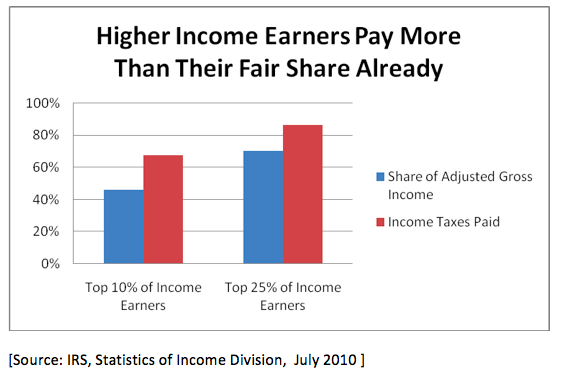
In the debate about raising the debt ceiling, the reality is often lost that the top 10 percent of income earners—those making more than $113,799 in 2008 (the latest year available from the IRS)—already pay 69.9 percent of the income taxes. The same top 10 percent, however, earn only 45.8 percent of the income.

The IRS also reports that in 2008, the top 25 percent of income earners—those earning $67,280 or more—pay 86.34 percent of the income taxes, yet earn only 67.38 percent of all income in the U.S. (See chart below)

In addition to their large and some would say “unfair” share of income taxes paid, the “rich” also are scheduled to pay more taxes starting in 2013 as a result of changes to Medicare made in the Patient Protection and Affordable Care Act (PPACA). This change will add an additional .9 percent tax on incomes above $200,000 for an unmarried person and $250,000 for a couple. People making under those limits already pay 1.45 percent of their wages for the Medicare tax, and their employers pay another 1.45 percent, which in effect is a tax on their income of 2.9 percent for Medicare. Those who have to pay the added .9 percent of income tax will be paying 3.8 percent of their income for Medicare beginning in 2013.

So taxes on the “rich” are already scheduled to go up under PPACA in 2013, which translates into less money available for new hires and less business growth. Those are businesses that would make investments in capital and people, likely boosting economic performance and helping everyone.

The bottom line is that the next time President Obama or someone in Washington says, “We just want the rich to pay their fair share,” he should think about how much the top 25 percent of income earners already pay. Making them pay more to increase the debt ceiling won’t control Washington’s spending problem, but it will translate into fewer jobs, lower wages, and diminished opportunities for all.

Posted in Entitlements
 

The Stimulus Failed, (Part 1), Do you want your grandchildren to pay for your walking bridge?

TWO RIVERS BRIDGE: Opening nears.

People just don’t understand how wasteful government can be and how giving government more control of our lives destroys much of the freedom that we should have. This series on the stimulus demostrates these points. This whole series started because of a post I did on July 6, 2011 about an post in the Arkansas Times Blog.

On July 6, 2011 on the Arkansas Times Blog I posted concerning the walking bridge in Little Rock that stimulus funds help build:

Tim Griffin spoke in Central Arkansas recently at a townhall meeting and mentioned that a couple of million of stimulus money went to build the walking bridge in Little Rock that will be opening this summer. Then he went on to show how it was silly for our government to try to stimulate the economy with our national credit card.
Steve Chapman rightly noted in his article “Stimulus to Nowhere” noted:

The federal government took out loans that it will have to cover with future tax increases … so states don’t have to. It’s like paying your Visa bill with your MasterCard.

The person using the username “Arkansas Panic Fan” responded:

Bridge = good stuff for Central Arkansas. Not sure why it is a bad thing. It is your money at work here being used for your benefit. I applaud this type of government activity. This is the type of project and progress you can see, touch, smell, hear.

That being said, Saline Republican, is this a waste of your money? You can use it as you wish.

________________________________

Let me respond with several points:

1. If the bridge is such a good thing then why can’t those who are excited about it get the funds to build it?

2. If you applaud the government for spending money for every good idea out there, ultimately where does all the money come from? Our grandchildren will be paying off this bridge in about 50 years if our country survives.

3. Building things with the government involvement is the most wasteful thing that you can do. How long does it take them to get the highway work done?  Turn the highways over to private enterprise and things would change radically for the good. Do you get great service from Fed Ex or the U.S.Post Office? I had two relatives tell me stories of working part time at the post office and each time they were told to “slow down or you will get us all fired.”

4. The stimulus approach taken by President Obama has been to blow up our deficit when he should have sought to cut spending because the signs were there at the end of the Bush era that the recession was deepening. Instead, he decided to increase the spending even more than Bush had.

J.D. Foster’s testimony on Feb 16, 2011 before Congress shows how stupid the spending stimulus was:

My name is J.D. Foster. I am the Norman B. Ture Senior Fellow in the Economics of Fiscal Policy at The Heritage Foundation. The views I express in this testimony are my own, and should not be construed as representing any official position of The Heritage Foundation.

At best, stimulus efforts based on government spending and tax cuts with little or no incentive effects have done no harm. At best. It is quite possible most of these efforts over the past couple of years have slowed the recovery while adding hundreds of billions of dollars to the national debt.

The record is all the more unfortunate because it is possible for a President and Congress to work together to stimulate the economy to faster growth during and after a recession. They can do so by improving incentives to produce and to work: for example, by reducing regulations and tax distortions. They can do so by reducing the uncertainties surrounding future policy. They can do so by expanding foreign markets for domestic goods and services. Recent efforts to stimulate the economy have been unsuccessful because they did little or none of these things. Regulations have increased. Uncertainty has increased. Tax distortions have been left in place or even increased in some areas. And efforts toward free trade have been anemic, at best.

Stimulus can work, but it has not worked because the Administration took another approach, emphasizing tax relief with little or no incentive effects combined with massive increases in spending. The President inherited a ballooning budget deficit and opted to grow it further. At best, this would be expected to be ineffectual. At best, because the resulting increased deficits infused economic decision-making with even more uncertainty about the consequences of massive deficit spending and how and when government will act to restore fiscal sanity.

Fortunately, the economy is showing clear signs of sustained recovery; uneven recovery to be sure, stronger in some areas than others both geographically and by industry, but recovery nonetheless. Despite the tremendous blows from the financial crisis and all that it entailed, the underlying strengths of our free market system once again are at work, giving expression to the vitality, energy, and innovation of the American people. Make no mistake: Our economy is recovering despite—not because of—the actions taken in Washington to grow it.

What does the Heritage Foundation have to say about potential tax reform:Study released May 10, 2011 (Part 3)

Heritage Foundation Responds to White House’s Austan Goolsbee

“Saving the American Dream: The Heritage Plan to Fix the Debt, Cut Spending, and Restore Prosperity,” Heritage Foundation, May 10, 2011 by  Stuart Butler, Ph.D. , Alison Acosta Fraser and William Beachis one of the finest papers I have ever read. Over the next few days I will post portions of this paper, but I will start off with the section on tax reform.

Thus, this tax plan includes three important senior-specific features:

  • During the transition to the new Social Security and Medicare
    systems, all seniors have a “senior’s standard exclusion” amount equal to the
    sum of the flat Social Security benefit amount plus the value of the Medicare
    defined contribution. This exemption amount will be approximately $22,500 per
    senior in 2015. This provision ensures that seniors protected from poverty by
    the Social Security and Medicare reforms are not again placed at risk by losing
    some benefits through taxation. As explained earlier, when the benefits reforms
    are fully implemented, the amount received by a senior will not be taxed.
  • Encouraging seniors to stay in the workforce longer is
    important both for their own financial security and for the health of the
    economy. To achieve this, the first $10,000 of a senior’s wages and salary is
    excluded from tax. This provision is especially important for low-income and
    middle-income seniors.
  • Because they are on Medicare and have the seniors’ standard
    exclusion to protect low-income seniors from tax, seniors do not qualify for the
    health insurance tax credit described above.

Protection for the Social Security and Medicare Trust Funds. The tax
system leaves in place the existing wage income reporting systems. Even though
the existing payroll taxes are eliminated, the revenues they would have raised
are credited appropriately to the Social Security and Medicare trust funds as
per current law.

Taxation of Businesses. The tax on businesses is a simple levy on
domestic net cash flow so that all compensation provided to employees and all
purchases from other businesses are deducted from gross domestic receipts. In
addition to its great simplification compared to the current income tax, this
means that businesses can immediately deduct purchases of new productive
equipment, thus eliminating a tax bias against business investment.

All other special provisions and credits in existing law are repealed except
for the Alternative Simplified R&D tax credit, which is retained in its
current form.

Family businesses in particular are able to grow without the uncertainty or
burden of dealing with the death tax, which is repealed.

After a brief transition period, the tax rate on businesses matches the rate
for individuals. During the transition period, the tax rate on businesses
declines from current law, 35 percent, a percentage point per year until the
business tax rate matches the individual rate. From that point forward,
individual and business rates will be the same

The business tax base includes only income generated by domestic sales of
goods and services. It excludes all foreign-source income, which is taxed in the
foreign jurisdictions according to their laws and systems. The tax is also
border-adjustable, which means that the federal taxation of exports and imports
is adjusted to level the playing field between foreign and domestically produced
goods and services. Specifically, the domestic tax is lifted from exports and
levied on imports, normalizing tax levels between countries much as a series of
locks on a canal raises or lowers boats so they can travel from point to
point.

Transition Arrangements. Special care is needed in transitioning
taxpayers from the old tax system to this Heritage tax plan. For example, it is
important that taxpayers are not subject to an extra tax burden solely because
of the transition. This would amount to retroactive taxation because the higher
tax burden would arise from actions taken before tax reform. Thus, all
current-law accrued tax “assets”—such as interest on pre–tax reform debt,
including existing home mortgages, depreciation, and accrued tax credits—are
applicable to taxable income or tax liability under the new tax system until the
tax assets are exhausted. As noted above there will be a period over which the
business tax rate declines until it matches the individual rate.

The shift to taxing only what businesses earn domestically is an important
simplification and an important step toward improving international
competitiveness. However, many businesses have accrued foreign tax credits under
current law that would be inapplicable under the new tax system. To provide
adequate time to adjust, businesses will have the option of being taxed under
the current system of worldwide taxation for up to 10 years after the enactment
of tax reform.

It is important to avoid retroactive taxation, but it is equally important to
avoid creating tax windfalls caused merely by transitioning from one tax system
to another. This would occur especially with respect to savings prior to tax
reform (“old savings”), which are invested in various assets generating income
streams and capital gains that are subject to immediate taxation at current
rates. These tax windfalls, which would be similar to winning a tax lottery,
would tend to benefit the wealthiest taxpayers and erode the tax base, thus
necessitating a higher tax rate. Thus, a transition system is provided to
prevent tax windfalls by ensuring that old savings remain subject to current
levels of taxation.

In the transition to the new tax system, employers will furnish their
employees with a statement on how they will handle that part of the employee’s
compensation that currently takes the form of the “employer’s share” of payroll
taxes paid to the Treasury. The options in the statement could include, among
others, an adjustment in the employee’s cash compensation, a contribution to the
employee’s savings or retirement account, or an allocation of the money to the
employee’s income tax withholdings. The Department of Labor would make template
forms available on its Web site for employers to use. After the transition, when
compensation and tax withholdings are fully adjusted, no further statements
would be necessary.

The Bottom Line

Economic growth is one of the fundamental underpinnings of fixing America’s
budget problems, so any changes in the tax system must ensure that growth is a
primary objective.

The Heritage tax plan fixes the labyrinth of complexities and inequities that
taxpayers must endure in today’s system by replacing it with a new system that
is flat, simple, and transparent. It encourages far greater economic growth by
lowering rates and removing multiple layers of taxation on the same income. One
low rate replaces today’s array of income and payroll tax rates, treats all
businesses the same, and allows them to compete better globally. We end today’s
disincentives to build savings—whether for retirement or for buying a house—by
taxing only income that is spent on consumption, so Americans can build better
economic security for themselves and their families. And we do all this without
raising taxes by injecting every dollar saved back into lower rates, not
so-called deficit reduction.

The Heritage plan will raise no more than the level of taxes Americans
historically have been willing to pay: 18.5 percent of the economy. Under our
tax plan, Americans will have far greater economic freedom, more opportunities,
more jobs, and higher wages.

What does the Heritage Foundation have to say about potential tax reform:Study released May 10, 2011 (Part 2)

Obama’s Tax Hike: The Movie

“Saving the American Dream: The Heritage Plan to Fix the Debt, Cut Spending, and Restore Prosperity,” Heritage Foundation, May 10, 2011 by  Stuart Butler, Ph.D. , Alison Acosta Fraser and William Beachis one of the finest papers I have ever read. Over the next few days I will post portions of this paper, but I will start off with the section on tax reform.

The Details

A Unified Single Tax Rate. The Heritage tax reform plan is far more
comprehensive than previous well-known tax reform proposals. Typical of many tax
reform proposals, our plan replaces today’s individual and corporate income tax
systems and eliminates the death tax. In lieu of the current motley collection
of taxes, this plan institutes a simple, single-rate tax on individuals and
businesses. It also folds today’s federal payroll taxes financing Social
Security and Medicare into the new system, establishing a single tax rate for
all taxpayers. In addition, it replaces all federal excise taxes except those
dedicated to specific trust funds, such as the gasoline tax, which would be
retained until that tax and its associated highway program are devolved to the
states.

Tax Rate. The tax system is designed to raise a permanent revenue
stream of up to 18.5 percent of the economy as measured by GDP. With the design
characteristics of this new tax system, we estimate that the statutory
individual and business tax rate will likely eventually be between 25 percent
and about 28 percent under traditional scoring methods. This is comparable to or
significantly below the typical rate facing an individual or family today. Most
working families today are subject to a 15.3 percent payroll tax rate on wages
and salaries plus a 10 percent, 15 percent, 25 percent, or 28 percent individual
income tax rate for a combined rate of 25.3 percent, 30.3 percent, 40.3 percent,
or 43.3 percent.

A Simplified System. The basic structure of this tax plan is simple.
With its single rate, it taxes uniformly all income sources that are spent on
consumption. This means that taxable income includes all labor compensation and
all net borrowings. The net amount put aside in savings is then subtracted to
determine net taxable income. Thus, the more individuals or families save, the
lower their taxes; they pay tax on savings only when savings are used to pay for
goods and services.

However, the new tax system does not tax government transfers explicitly
associated with low-income citizens, such as welfare, health care assistance,
and similar programs. Ultimately, when the Social Security and Medicare programs
are fully reformed, the Social Security checks and premium support that seniors
receive will not be taxed either. In the Social Security and Medicare transition
periods, a portion of the benefits of some seniors will be taxed if their income
is above a certain amount, just as many seniors’ Social Security is taxed
today.

Thus, the new tax system offers individuals and families a comparable or
lower tax rate and vastly improves their savings incentives to build wealth and
ensure their own financial security. It simultaneously improves the ability of
the economy to raise wages and provide more job opportunities. And filling out
tax forms will be a lot simpler.

An Alternative Option for Savings. For some purposes, many taxpayers
today prefer to save after-tax dollars as permitted through the current-law Roth
IRA rather than paying tax when funds are withdrawn as under today’s traditional
IRA. This Roth-style alternative maintains the principle of a single incidence
of taxation but may result in further increased saving by giving savers an
additional option. To allow such accounts for those who feel they need them, the
plan permits taxpayers to contribute after-tax dollars to an account,
contributing as they choose until the account balance reaches $100,000, with a
limit of one account per adult taxpayer. The income earned on the account is
tax-free, and disbursements from the account are tax-free for any purpose.

Few Deductions or Credits. Under the Heritage tax plan, the individual
income tax has only three deductions instead of the legion of deductions under
current law:

  • Higher education. Recognizing the role of higher
    education as a form of saving and investment in human capital, a deduction is
    allowed for tuition and expenses for higher education up to the average annual
    cost at a four-year public college or university.
  • Charitable donations and other gifts. Since the tax is
    levied on consumption, gifts are not taxable until they are spent by the
    recipient. Thus, per current law, gifts to nonprofit organizations are tax
    deductible if the organization is recognized as tax-exempt for tax purposes.
    Gifts to individuals and transfers through inheritance are deductible and become
    taxable to the recipient only when spent on consumption. And there is no death
    tax.
  • Mortgage interest. As under current law, homeowners can
    deduct mortgage interest while the lender continues to be taxed on mortgage
    interest income. Homeowners are also given the option of forgoing the deduction,
    in which case the lender is not taxed on mortgage interest income and market
    pressure would encourage the lender to offer a lower mortgage interest rate.

Protections for Low-Income Working Households. Current law hits
low-income workers and others with the full weight of today’s payroll taxes,
whatever their wage and salary income may be. The Heritage tax plan folds all
payroll taxes—or FICA—into the single tax system. It then eliminates all income
tax on low-income workers through the health insurance tax credit described
above (a $3,500 nonrefundable tax credit for families and $2,000 credit for
individuals). In addition, the Earned Income Credit is retained as part of the
overall system of financial support for low-income Americans. Further, the
calculation of taxable income excludes all other cash and noncash benefits
provided by the federal government through its anti-poverty programs, such as
food stamps. The net effect is that, compared to current law, this plan provides
substantial tax relief to low-income workers and families.

Protecting Low-Income Seniors. For Medicare-eligible senior citizens,
the measure of taxable income is modified to ensure that the flat benefit
amounts for Social Security and the Medicare defined contribution are tax-free.
Thus, lower-income seniors will not be pushed back into poverty by the tax
system after Social Security and Medicare have lifted them out of poverty. As
noted earlier, during the lengthy transition period for the Heritage plan’s
Social Security reform, some seniors above certain incomes with relatively high
benefits will pay tax on part of those benefits, but they will pay less than
many do today.

How should Congress address Debt Ceiling?

The United States Debt Limit Explained – (CR) Heritage Foundation

Michael A. Needham has the best answer that I have heard so far:

Heritage Action is a “no” and will remain a “no” unless a deal rises to the level of the substantial fiscal challenges which face our nation.

Debt negotiations are intensifying and conservatives are growing increasingly skeptical that the Obama administration and Democrats in Congress are willing to do what it takes to put America back on a path to prosperity. On Wednesday, Heritage Action’s CEO Michael A. Needham sent a letter to Congress outlining our position on the debt ceiling.

The text of the full letter is below:

June 29, 2011

Dear Congressman,

Over the next month, you will face tremendous pressure to accept a deal to raise our nation’s debt ceiling. Heritage Action for America will key vote the deal to raise the ceiling.

Heritage Action is a “no” and will remain a “no” unless a deal rises to the level of the substantial fiscal challenges which face our nation. A deal to raise our debt ceiling must include historic reforms that will save the American dream for our children and grandchildren. The Heritage Foundation laid out what such a package might look like: 1) cut current spending; 2) restrict future spending; and, 3) fix the budget process. Currently, there is only one plan on the table that meets this test and that is the plan embodied in the Cut, Cap and Balance Pledge. This is an example of a plan that matches the historical moment that we currently face as a nation.

In order to achieve reforms of this magnitude, Congress must do everything possible to eliminate the uncertainty surrounding Treasury Secretary Timothy Geithner’s August 2 deadline. Congress cannot negotiate with a clear mind if the administration is constantly invoking the specter of default. As Heritage Foundation economist J.D. Foster, Ph.D. points out:

Both immediately and long after it reaches the debt limit, the government would have far more than enough revenue coming in that the Secretary of the Treasury could use to pay interest on the debt. Nor would preserving the current debt limit put at risk the full faith and credit of the United States government, as the President’s chief economic adviser has claimed. The government would continue to pay net interest as it comes due.

In the event that liberals will not allow us to raise the debt ceiling because they cannot stomach substantive, systemic changes to put the country back on sound footing, conservatives must develop a responsible plan. Congress must exercise their constitutional power of the purse, building upon the framework of the Toomey-McClintock legislation, and prioritize federal spending.

Finally, Heritage Action will require at least 72 hours to review the details of any deal to increase our nation’s debt ceiling. The Washington inclination to go behind closed doors and strike a grand deal is unacceptable. Heritage Action, and the hundreds of thousands of Americans we represent, demand transparency and accountability. Americans must feel confident their Members of Congress understand what they are voting on. There must not be another “pass the bill so that we can find out what is in it” moment. We will reserve the right to score retroactively any vote if we are given less than 72 hours to review the details.

Our nation’s problems have grown so large they are impossible to ignore. If we allow the status quo to persist, or move forward with half–measures and gimmicks, we will be sentencing our children and grandchildren to permanent economic malaise while at the same time condemning this current generation to the same fate. Indeed, the crisis is not on the distant horizon. It is here now.

We have a unique opportunity and singular responsibility before us to change course. We must rise to the challenge of the moment.

Sincerely,

Michael A. Needham
Chief Executive Officer