Category Archives: Taxes

Three points where Brummett misses the boat in discussion versus Charlie Collins

Five Key Reasons to Reject Class-Warfare Tax Policy

Uploaded by on Jun 15, 2009

President Obama and other politicians are advocating higher taxes, with a particular emphasis on class-warfare taxes targeting the so-called rich. This Center for Freedom and Prosperity Foundation video explains why fiscal policy based on hate and envy is fundamentally misguided. For more information please visit our web page: www.freedomandprosperity.org.

_______________________________

I was glad to hear that John Brummett was going to take place in a discussion with Charlie Collins in Fayetteville last Saturday. Sounds like some good points came out of it.

John Brummett in his recent article noted:

This forum lasted maybe 90 minutes. I can summarize as follows:

—The two of us varyingly left of center, an economics professor and labor historian named Michael Pierce and I, believe government has the responsibility and right to tax the top margins of high incomes at a higher rate and to spend for stimulus on the demand side to prime the pump of what is an otherwise dangerously idling economy. We find alarming and unsustainable the growing gap between the few rich and the many poor.

—The two wrong of center (or right, if you insist), Charlie Collins and affable local pizza mogul Rolf Wilkin, believe the economy will get better from the supply side. They believe it will do so by its own devices through the glories and innovations of the great American marketplace, but only if the government will cut taxes and reduce regulation. They believe the nation can best address the wealth gap by letting the marketplace work its natural and uninhibited magic.

 Let me address a few points where Brummett misses the boat.

 1. No where in the world is the wealth gap smaller than in the USA. It is true that our form of government has allowed even the poorest of our citizens the opportunity to advance in the income to the top. Countries that have limited freedoms have the poorest people for the most part and the largest wealth gap.

2. Cutting down on regulations is the way to go. Need I say more on this. Go into business for yourself and then write a paper on it.

3. Soaking the rich is really saying something else: “We need more tax revenue for the government to spend and we think the government can spend your money more wisely than you.” Taking all the money the rich have will not even come close to solving our budget woes. Lowering the taxes on job creators is the way to go. Why else do wealthy job creators leave Arkansas to go live in other states that do not have state income tax like us?

Let me submit this article below as further evidence.

Soak-the-Rich Taxes Soak Everyone

by Jim Powell

Jim Powell, a senior fellow at the Cato Institute, is the author of FDR’s Folly, Wilson’s War, Bully Boy, The Triumph of Liberty and other books.

Added to cato.org on September 9, 2011

This article appeared on Forbes.com on September 8, 2011.

Soak-the-rich taxes have a way of becoming people’s taxes, soaking those who never expected to pay.

This has been true from the very beginning. The first U.S. income tax was passed in 1861 to help pay the Union’s Civil War costs. Western farmers had little cash, so they favored an income tax that wouldn’t affect them. Initially the Civil War income tax was 3 percent of income over $800. Since there weren’t enough people making over $800 to finance war spending, the income tax was revised to include everyone making as little as $600, and the rate was nearly doubled.

This income tax ended in 1872, but farmers hoped to revive it so they could push the cost of government on somebody else. Another income tax was passed in 1894, and 99-9/10ths percent of the 65 million people in the United States paid nothing. A lyrical Missouri congressman exulted: “passage of the bill will mark the dawn of a brighter day, with more sunshine, more of the songs of birds, more of the sweetest music, the laughter of children well fed, well clothed, well housed.” Jubilation was short-lived, when the income tax was struck down by the U.S. Supreme Court.

Jim Powell, a senior fellow at the Cato Institute, is the author of FDR’s Folly, Wilson’s War, Bully Boy, The Triumph of Liberty and other books.


More by Jim Powell

The Spanish-American War (1898) spurred federal officials to scramble for more revenue. Progressives began dreaming about how to revive the income tax. Eventually, they decided their best option was the long process of amending the Constitution. In December 1906, President Theodore Roosevelt cheered them on, declaring that “there is every reason why, when next our system of taxation is revised, the National Government should impose a graduated inheritance tax, and, if possible, a graduated income tax.” It wasn’t clear what would be done with revenue generated by an income tax, since no country posed a military threat to the United States, and big-time social spending was many years away.

Following ratification by three-quarters of the states, Congress passed an income tax bill, and in 1913, President Woodrow Wilson signed it. Initially, the rates were low, and a reported 99 percent of the U.S. population paid nothing, presumably a key reason why people clamored for it.

But as Wilson maneuvered the United States into World War I, there were higher taxes for everyone. By 1918, the top rate hit 77 percent. “Never before, in the annals of civilization,” noted Columbia historian Edwin Seligman, “has any attempt been made to take that much of a man’s income by taxation.” A lot of ordinary folks found they were subject to the income tax, too.

Ordinary folks were soaked again during the New Deal years (1933-1940) when federal spending doubled. True, President Franklin Delano Roosevelt seemed to be soaking-the-rich when he raised income tax rates on job creators whom he denounced as “economic royalists.”

Yet only about 5 percent of the population paid federal income taxes. The biggest source of federal revenue throughout the New Deal was the excise tax on beer, cigarettes, soft drinks, chewing gum, radios and other cheap pleasures enjoyed disproportionately by middle class and poor people. Until 1936, the federal excise tax generated more revenue than the federal personal income tax and the federal corporate income tax combined. Moreover, New Deal subsidies for big farmers were financed by forcing the three quarters of Americans who weren’t farmers to pay higher food prices. The New Deal was mainly paid for by the middle class and the poor.

The Revenue Act of 1942, amidst World War II, doubled the tax base and clearly made the personal income tax a people’s tax — the biggest source of federal revenue. Although the income tax had been sold to soak-the-rich and give everyone else something for nothing, ordinary folks faced a 23 percent rate on income up to $2,000, plus the headache of maintaining detailed records, filling out forms, dealing with inquisitorial audits and possible seizures.

Soak-the-rich taxes are for suckers. President Obama, like so many politicians who came before, is singing the happy song that only millionaires and billionaires will have to pay. But runaway spending — whether because of war or entitlement programs — drives government to extract revenue from people with much lower incomes, like the nearly half the population that pays no federal income tax now. The violence in Europe suggests they will be shocked and outraged when that happens.

__
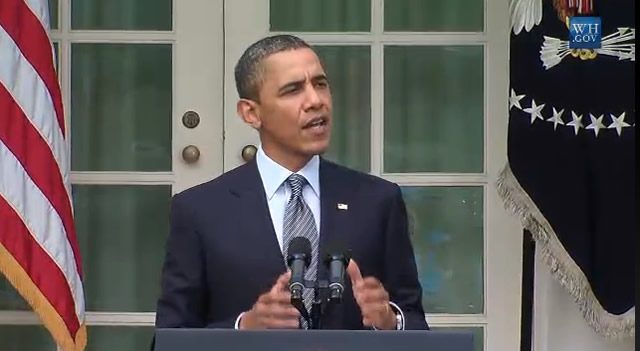
Heritage Foundation Scholars respond to Obama debt reduction proposal (Part 1)

I love going to the Heritage Foundation website for articles like this:

Obama’s Debt Reduction and Tax Proposal

Heritage Responds to Obama’s Debt Reduction and Tax Proposal

Mike Brownfield

September 19, 2011 at 11:16 am

Heritage’s experts watched President Barack Obama’s debt reduction and tax increase proposal. Here are their immediate reactions:

_______________

Obama’s Plan Is More Bad News for Defense

President Obama’s approach to deficit reduction, which he outlined in a Rose Garden statement today, means additional bad news for the defense budget and the nation’s security.  According to the fact sheet provided by the White House, accompanying his statement from the Rose Garden, the deficit reduction plan sees the continued application of $1.2 trillion in discretionary spending cuts already included in debt ceiling law that was enacted recently.  Office of Management and Budget Director, Jack Lew, released a blog on August 4th that estimated that this provision will cut roughly $350 billion from the defense budget over ten years.  The new deficit reduction plan would add $1.1 trillion in cuts from defense to come from funding for the military operations in Afghanistan and Iraq.  Finally, it would impose an unspecified level of spending reductions in benefits for military personnel.

Today’s statement, however, ignores the fact that President Obama had already proposed an inadequate five-year (FY 2012 through FY 2016) defense budget in February.  The news in this latest statement is the recommended cut in funding for the overseas operations.  While it is unclear what baseline the White House is using in advancing this proposal, the President’s own budget estimates spending only a bit more than half the amount of proposed cuts to the budget for such operations over a similar timeframe.  This not only repudiates a provision in the debt ceiling law to protect these operations through a special instrument for adjustments in the applicable spending ceiling, it implies that the President will apply additional cuts to the budget for the core defense program.

The greatest disappointment, however, is that the President’s deficit reduction proposal sidesteps the kind of structural reforms in the major entitlement programs that are necessary to avoid draconian cuts to the budget for the federal government’s most important constitutional obligation, which is to defend the nation and its vital interests.

Baker Spring

The President’s Disappointing Retreat on Medicare

During the Debt Ceiling negotiations, President Obama tentatively joined the large and growing consensus that the age of eligibility for Medicare enrollment should be raised from 65 to 67. Among serious advocates of entitlement reform, raising the age of normal eligibility has emerged as one of the few precious areas where there has been a   broad consensus. It was a position endorsed by analysts at both the American Enterprise Institute and the New America Foundation, and by former Democratic CBO Director Alice Rivlin and Republican Budget Chairman Paul Ryan. It would also result in significant savings. The Congressional Budget Office (CBO) projected that budget savings from the proposal would amount to $124 billion over the period 2012 to 2021.

The Medicare age of eligibility change is long overdue.  When Congress and the Johnson Administration enacted the Medicare program in 1965, the average life span had increased to 70.2 years. They made the decision to retain the normal retirement age at 65, which was enacted for enrollment in Social Security back in 1935. By 2009, the average life span had reached 78.2 years, and by 2030, when the Medicare population is projected to jump to approximately 80 million enrollees, the average life span is projected to top 80 years of age. At that time, there will be roughly 2 younger workers supporting each retiree. We’re doing it to the kids.

The President’s retreat is a disappointment. He must know that long-range structural reform of the Medicare program is necessary, since, in the estimate of the Medicare Actuary, it faces a long term unfunded liability of almost $37 trillion. In his deficit reduction program, he is proposing savings of $248 billion over ten years, and 90 percent of these savings will come from reducing “overpayments” in Medicare.  These include a number of “cats and dogs” in Medicare’s complex payment system, relating to such items as changes in payments to rural providers, payments for post acute care, payments for advanced imaging, earmarking penalties ($500 million)  for non-compliance to deficit reduction, applying the Medicaid rebate (kick-back, price control system) for drug payments to Medicare Part D (a terrible idea); and the old crackdown on Medicare waste, fraud and abuse, which is expected to save $5 billion over ten years. (According to a July 28, 2011 GAO report, there are estimated $48 billion in annual Medicare “improper” payments, representing about 38 percent of the total $125.4 billion estimate for the entire federal government.) The President wants to toughen Medicare payment caps to be enforced by the Independent Payment Advisory Board (IPAB), reducing the target from GDP plus 1 percent to GDP plus 0.5 percent.

The President is also proposing to increase Part B and D premiums for upper income retirees; increase the Part B deductible by $25 for new retirees; introduce a Part B “surcharge” for enrollees who buy Medigap coverage that provides “near first dollar” coverage. While these ideas have merit, they are substantially modest and don’t even kick in until 2017. In other words, the reform falls far short of what is needed, as embodied in Heritage’s Saving The American Dream, which delivers a balanced budget within ten years and guarantees the solvency of the Medicare program.

Robert Moffit

President Obama and Alternative Minimum Tax

President Obama and Alternative Minimum Tax

Dan Mitchell does it again. He is always right on the mark.

CPAs Celebrate as Obama Proposes to Create a Turbo-Charged Alternative Minimum Tax

Posted by Daniel J. Mitchell

Wow, this is remarkable. The alternative minimum tax (AMT) is one of the most-hated features of the tax code. It is such a nightmare of complexity that even Democrats routinely have supported “patches” and “band-aids” to protect millions of additional households from getting trapped in this surreal parallel tax universe – one that requires taxpayers to calculate their taxes two different ways, with the IRS getting the maximum amount of money from the two returns. (Hong Kong, by contrast, give taxpayers the option of calculating their taxes two different ways, but they’re allowed to pay the smaller of the two amounts.)

Notwithstanding the AMT’s status as arguably the worst feature of the internal revenue code, President Obama apparently wants to double down on this horrific policy by creating a new version of this nightmarish provision.

Here are some excerpts from the Wall Street Journal‘s coverage, including a key observation that Obama’s scheme is just another version of the AMT.

The administration’s principle resembles the Alternative Minimum Tax, which was first adopted in 1969 and was intended to hit the superwealthy. The AMT has been hitting an increasing number of the middle class because it wasn’t indexed for inflation, and Congress has continually wrestled with how to get rid of it.

The WSJ article also notes that a glaring inconsistency in the White House’s rhetoric. the plan is supposed to be a “very significant” tax hike, but doubling the tax burden on millionaires would only raise $19 billion per year. In other words, the Administration’s class-warfare rhetoric is probably just cover for a tax hike that actually will hit a lot of people with far more modest incomes.

The proposal also could apply to a broader selection of taxpayers—all households with incomes of more than $1 million. Those earners are expected to pay an average of $845,000 this year, according to the nonpartisan Tax Policy Center. Assuming the households in the group of 22,000 pay that amount, even doubling their tax burden would raise just $19 billion a year at a time when deficit reduction is being measured in trillions of dollars. That doesn’t take into effect any change in taxpayer behavior prompted by a new tax regime. A senior administration official said that depending on where the minimum rate is set, the plan could be a “very significant” revenue raiser. The official wouldn’t provide details. …Some conservative economists say such a proposal could put a drag on capital markets and ignores the fact that many companies have already paid tax on the income before it is distributed to owners as dividends or capital gains.

The New York Times, to its credit, provides a fair description of the issue (including a much-needed acknowledgement that Warren Buffett may not have been honest and/or accurate), and also suggests that Obama may be proposing to replace the existing AMT with this new version (though that presumably would negate its impact as a revenue-raiser).

Mr. Obama will not specify a rate or other details, and it is unclear how much revenue his plan would raise. But his idea of a millionaires’ minimum tax will be prominent in the broad plan for long-term deficit reduction that he will outline at the White House on Monday. Mr. Obama’s proposal is certain to draw opposition from Republicans, who have staunchly opposed raising taxes on the affluent because, they say, it would discourage investment. It could also invite scrutiny from some economists who have disputed Mr. Buffett’s assertion that the megarich pay a lower tax rate over all. Mr. Buffett’s critics say many of the rich actually make more from wages than from investments. …The administration wants such a tax to replace the alternative minimum tax, which was created decades ago to make sure the richest taxpayers with plentiful deductions and credits did not avoid income taxes, but which now hits millions of Americans who are considered upper middle class.

Actually, the AMT also hits lots of middle-class families since having kids is considered a “preference” for tax purposes.

But that’s just an insult layered on top of injury. What makes Obama’s new scheme so destructive is that it would (though the White House has not explained the details) somehow classify dividends and capital gains as “preference” items – even though everyone acknowledges that such income already is double taxed!

In other words, Obama claims to be concerned about jobs, but he is proposing a big tax hike on the saving and investment that is necessary to create jobs. Amazing.

Regular readers will recognize this video about Obama’s class-warfare tax policy. But if you haven’t seen it, five reasons are presented to explain why it will backfire.

But look at the bright side. At least accountants and tax lawyers (and don’t forget bankruptcy specialists) will get more business if Obama’s plan is implemented.

Ernest Istook of the Heritage Foundation speaks in Little Rock on 6-22-11 (Part 2)

The third monthly luncheon with featured speaker Ernest Istook was excellent. First, we got to hear from Dave Elswick of KARN   who came up with the idea of this luncheon, and then from Teresa Crossland of Americans for Prosperity.

Below is a portion of Istook’s biography from the Heritage Foundation:

Ernest Istook

Ernest Istook

  • Distinguished Fellow

Ernest J. Istook Jr. brings extensive congressional experience to bear on public policy issues as a Distinguished Fellow at The Heritage Foundation.

Istook served 14 years in the U.S. House of Representatives before joining Heritage in 2007.

In Congress, representing Oklahoma’s 5th District, he engaged in a wide and robust range of issues as a member of the Appropriations Committee –where he chaired multiple subcommittees– and the Homeland Security Committee.

Istook delved into budget and spending issues in general as well as subjects such as transportation, trade, defense, health care, education, labor, financial services, homeland security and religious liberty. He was a founder of the re-established Republican Study Committee, the principal conservative caucus in the House.

In 2010, Istook was selected as a Fellow for the Institute of Politics at Harvard University’s Kennedy School of Government.

________________________________________

In his talk on June 22, 2011 in Little Rock, he spent some time talking about how excited he was about the Tea Party. One person asked him what we should think about the Republicans that just want to make their total goal keeping the majority and not try to rock the boat. Istook said that the Tea Party was going to make sure that did not happen.

Here is another article by Istook that discusses some of these same issues:

The biggest foreclosure yet may begin on November 2nd, as voters start foreclosure proceedings against big government.  It’s run up more debt than we can afford to pay.

The paperwork has been validated.  It’s found in the Declaration of Independence and the U.S. Constitution, duly approved and signed by our Founding Fathers.

Previous proceedings went awry.  President Bill Clinton’s 1996 pronouncement that “The era of big government is over” proved to be empty words, as demonstrated by the subsequent free spending of Congress and Presidents George W. Bush and Barack Obama.

So what’s different about today?  The Tea Party movement, for one thing.  It’s here to stay, as noted in an approving op-ed by Heritage Foundation President Ed Feulner and U.S. Senator Jim DeMint, and documented in the  new best-seller by Scott Rasmussen and Doug Schoen

Below is the article that Istook referenced:

Tea partiers won’t go when fun ends
By: Ed Feulner and Sen. Jim DeMint
October 14, 2010 04:46 AM EDT
In only 21 months, the tea party has exploded from a handful of scattered, spontaneous rallies into a full-fledged national movement capable of throwing out incumbents. Challenging entrenched Washington habits, it is a force both parties must reckon with.Skeptics and opponents, however, continue to ask two basic questions. First, does the tea party have any real philosophical depth, a historical pedigree? Second, will its force dissipate after the elections?In short, critics accept that the tea party has a present — but they question whether it has a past and a future.Yes and yes. Yes, the tea party has a pedigree as old as our nation, and yes, we think it is likely to continue to play a significant role in politics after Nov. 2. People in both parties who hope to wish it away and continue business as usual had better think twice.Americans have been disappointed by leaders in both parties who campaigned to right past wrongs and then, after getting to Washington, cared more about power than promises. Tea party supporters care more about principle than party labels or politics.Tea party members voice the kinds of concerns that even some of President Barack Obama’s former supporters are beginning to raise. As one Obama voter asked the president at a recent town hall, “Is the American dream dead for me?”

These are the questions Americans are asking nationwide — in their kitchens, church halls and ballparks. These are the concerns expressed at tea party rallies everywhere.

The tea party seeks answers to such questions not in the dictates of Washington today but in our country’s founding principles. There, it finds a prescription for constitutional, limited government based on God-given rights — not a Utopian blueprint for bureaucratic-managed change.

The tea party, in other words, is that inner voice that speaks to us when things go wrong — the conscience of the nation at a crucial point in our history.

What has gone wrong is clear. The “stimulus” package has failed to get this country back on its feet. The latest unemployment figures show that we still have anemic growth and nearly 10 percent unemployment. As Americans suffered, Washington wasted its time on a gargantuan, unmanageable and unaffordable health care package. No wonder many Americans feel frustrated.

But underneath the frustration, the tea party has roots that are deeper and aim higher. Deeper because it is within the best tradition of popular movements in our history — from the Great Awakening that gave rise to the American Revolution to the conservative revival that helped elect Ronald Reagan. Higher because it aims to recover our moral compass, bequeathed by our Founders and preserved ever since.

The tea party also symbolizes Americans’ indomitable desire for a better life. It reminds us that we’re a country of free people who understand that liberty is fragile and must be vigilantly defended.

Some past grass-roots movements have succeeded, and others have failed. Success comes because the energy of the moment is translated into a lasting, governing philosophy consistent with the settled opinions of the American people.

On this score, prospects look good. The tea party isn’t about to go away after the November elections. Its powerful message of limited government is likely to remain a sharp thorn in the side of those in both parties who want to continue politics as usual.

Take Obama’s health care package, which tea partiers have labeled “Obamacare.” Obama and Democrats rammed this through Congress, against the wishes of a majority of the American people.

But the repealing legislation should not itself contain some new massive health care plan. Even if the legislation offers good policy, the tea party is here to remind Republicans that pushing large, unexamined bills through Congress is wrong. We need to repeal Obamacare immediately, then openly debate and pass conservative-drawn, sensible and broadly supported health care reform.

It’s no surprise that pollsters Scott Rasmussen and Doug Schoen found that more than “half of the electorate now say they favor the tea party movement, around 35 percent say they support the movement, 20 [percent] to 25 percent self-identify as members of the movement and 2 [percent] to 7 percent say they are activists.”

This means that all those protesters with their Constitutions at tea party rallies nationwide represent millions of fellow Americans. The answers they seek won’t be found in the thousands of pages of new legislation coming out of Washington.

They are in those documents that first defined this nation and provide the most just framework for a free people to work hard, play by the rules and succeed.

Ed Feulner is president of The Heritage Foundation. Sen. Jim DeMint is a Republican from South Carolina.

____________________________________

Other posts about Heritage Foundation:

Brummett: We need to tax the rich more (Real Cause of Deficit Pt 12)

John Brummett asserts that liberals are right about the cause of the deficit. He asserts in his article “Harry let us down,” Arkansas News Bureau, April 4, 2011: He is right that the actual deficit is caused by direct government spending exceeding income, an imbalance mostly caused, he will tell you with some justification, by […]

Ernest Istook: “it’s time to put away childish things” and tackle deficit, will Senator Mark Pryor do it?

U.S. Sen. Mark Pryor at the 2009 DPA J-J Dinner U.S. Sen. Mark Pryor at the 2009 Democratic Party Jefferson Jackson Dinner, Arkansas’s largest annual political event. (Did you notice that besides Mike Ross, EVERY OTHER DEMOCRAT THAT PRYOR MENTIONS DOING SUCH A GREAT JOB IN WASHINGTON IS NO LONGER IN OFFICE, SNYDER, LINCOLN, and BERRY)

What does the Heritage Foundation have to say about saving Social Security:Study released May 10, 2011 (Part 4)

“Saving the American Dream: The Heritage Plan to Fix the Debt, Cut Spending, and Restore Prosperity,” Heritage Foundation, May 10, 2011 by  Stuart Butler, Ph.D. , Alison Acosta Fraser and William Beach is one of the finest papers I have ever read. Over the next few days I will post portions of this paper, but […]

What does the Heritage Foundation have to say about saving Social Security:Study released May 10, 2011 (Part 3)

The problem with social security   David John, a Senior research Fellow at the Heritage Foundation, explains his position on Social Security as it relates to taxes and health care. He suggests it would be a good solution for the government to raise the age of retirement. “Saving the American Dream: The Heritage Plan to […]

Who was Milton Friedman and what did he say about Social Security Reform? (Part 4)

Arnold Schwarzenegger did  the opening introduction to the film series “Free to Choose” by Milton Friedman, but then  Arnold abandoned the principles of Friedman!!!! Ep. 4 – From Cradle to Grave [4/7]. Milton Friedman’s Free to Choose (1980) Many people want the government to protect the consumer. A much more urgent problem is to protect […]

What does the Heritage Foundation have to say about saving Social Security:Study released May 10, 2011 (Part 1)

What is the future of Social Security and Medicare?  Congresswoman Virginia Foxx talks with Alison Fraser of the Heritage Foundation about the state of Social Security and Medicare. “Saving the American Dream: The Heritage Plan to Fix the Debt, Cut Spending, and Restore Prosperity,” Heritage Foundation, May 10, 2011 by  Stuart Butler, Ph.D. , Alison […]

Max Brantley thinks there are three reasons we have huge debt: 1. Bush Tax cuts for rich 2. Bush’s wars 3. Recession (Real Cause of Deficit Pt 11)

The Laffer Curve, Part I: Understanding the Theory The Laffer Curve charts a relationship between tax rates and tax revenue. While the theory behind the Laffer Curve is widely accepted, the concept has become very controversial because politicians on both sides of the debate exaggerate. This video shows the middle ground between those who claim […]

Pat Lynch: We need to bring tax rates back up for Rich (Real Cause of Deficit Pt 10)(If you love Milton Friedman then you will love this post)

The liberal Pat Lynch in his article “Worry Inc.” Arkansas Democrat- Gazette, April 4, 2011 commented: While the budget cutters are busy going after programs that help mere citizens, any notion of bringing taxrates for the wealthy back to the levels of the Clinton era, when there was a federal surplus, is off the table. […]

John Brummett:Cause of deficit is we don’t tax rich enough (Real Cause of Deficit Pt 9)(Famous Arkansan Wayne Jackson)

John Brummett asserts that liberals are right about the cause of the deficit. He asserts in his article “Harry let us down,” Arkansas News Bureau, April 4, 2011: He is right that the actual deficit is caused by direct government spending exceeding income, an imbalance mostly caused, he will tell you with some justification, by […]

Obama wants to raise taxes on job creators

Uploaded by on Aug 6, 2010

Cenk Uygur (host of The Young Turks) filling in for Chris Jansing on MSNBC talks to Dan Mitchell of the Cato institute to compare Reaganomics to Obamanomics.

__________________________

What should we do when we are caught in a slow economy? What did Reagan do in 1981? He lowered taxes to stimulate the economy. However, President Obama wants to raise taxes.

Obama’s Jobs Plan: Permanent Tax Hikes on Job Creators

By Curtis Dubay
September 15, 2011

When President Obama unveiled his much-hyped American Jobs Act to a joint session of Congress last week, he promised that the increased spending and temporary tax cuts the plan entails would be fully “paid for.” He did not specify in that speech the details of how he would offset the costs of his plan other than he would charge the “super committee” with this responsibility.

This week, he released his own proposals to pay for the plan. To no one’s surprise, the plan would offset the costs of its jobs policies solely with tax hikes and not one penny of spending reductions.

The tax increases the President proposes are the same old hodgepodge of tax hikes he has proposed often since taking office, and they have been rejected by Democratic and Republican Congresses alike each time he’s pushed for them. In the end, the tax hikes would be permanent while the jobs policies temporary; thus, the proposal is really a tax hike plan rather than a jobs plan.

Tax Hike on Job Creators

Almost all of the $447 billion in increased revenue called for by President Obama would come from raising taxes on job creators,[1] the same job creators whom President Obama wants to hire more workers to reduce the unemployment rate.

The plan would raise taxes on job creators by capping the deductions that families and businesses earning more than $250,000 a year could claim. It would reduce the deductions of these families and businesses to the amount they could claim had they only earned enough to qualify for the 28 percent tax bracket instead of the higher tax brackets (33 percent and 35 percent) they face now.

For example, under the current tax code, $100,000 of deductions for a family that pays the 35 percent rate reduces its tax bill by $35,000. Under the plan’s tax hike, this family’s deductions could only reduce its tax bill by $28,000, or what it would have been under the 28 percent rate. The tax hike would be bigger as the family’s deductions increase.

This tax hike would be on top of the 3.8 percent surtax on investment income (passed as part of Obamacare) that these same families and businesses will pay beginning in 2013 and the higher marginal income tax rates they will pay if President Obama gets his way and the Bush tax cuts expire at the end of 2012. If marginal income tax rates rise, the tax increase from limiting deductions would increase as well.

The families that would pay these higher taxes are the investors that the economy needs to provide capital to businesses and entrepreneurs so they can expand and start new operations that would employ new workers. A recent study from President Obama’s own Treasury Department shows that 90 percent of businesses that pay their taxes through the individual income tax code and employ workers would pay the higher taxes under the President’s plan.[2]

This tax hike would negate any benefits of the President’s jobs policies. Capping deductions as President Obama’s plan does would raise the marginal effective tax rate of these important job creators and therefore reduce their incentives to invest and take on new risk—permanently. Less investment and less risk-taking means fewer new jobs created.

Since it is likely President Obama’s job proposals would create few, if any permanent, positions, taken together with the tax hike on job creators, his plan would likely reduce employment in the long term.[3]

Industry Specific Tax Hikes

The rest of the tax hikes in President Obama’s plan specifically target the oil industry and jet manufacturers. He would mostly raise their taxes by limiting their ability to “expense” (or deduct at the time of acquisition) their purchases of capital equipment.

The President’s desire to strip these targeted industries of the ability to deduct their capital purchases faster than current depreciation schedules allow is at odds with his own position on expensing. The President insisted that the 2010 tax deal to extend the Bush tax cuts include 100 percent expensing for all capital purchases for all businesses for one year. This latest jobs bill—which oil and jet tax hikes are supposed to help pay for—includes an extension of that expensing policy.

More troubling is the President’s apparent lack of understanding of the actual impact that his policies would have. He frames the jet tax hike as a hike on the owners of corporate jets, but the burden of his policy would fall on the workers that manufacture the jets. The tax hike would raise the cost of jets, which would reduce the demand for them. Reduced demand would ultimately result in fewer jobs for the blue-collar workers who manufacture the planes.

This is not just theory. In 1990, a 10 percent tax on luxury yachts went into effect. Congress passed the measure assuming that the rich buyers of yachts would pay the burden. But when the price of yachts rose, orders dried up and the yacht-building industry dried up as well. As The New York Times chronicled then, it was the blue-collar workers who lost their jobs and ended up bearing the pain of the tax.[4] The situation was dire enough that Congress repealed the devastating tax in 1993.

Stop Digging

In the Administration’s poorly crafted and contradictory jobs package, the American people get permanent tax hikes that would enlarge the federal government to offset the cost of temporary jobs policies that would not create any jobs. In the long run, the tax hikes in this plan are more likely to destroy more jobs than the jobs policies create.

Unfortunately, President Obama will not consider policies that would actually create jobs by reducing the high level of uncertainty that persists in the economy today. This would include doing things such as:

  • Fundamental revenue-neutral tax reform that repairs the tax base and lowers marginal tax rates to improve the incentives for income production;
  • Reducing the crushing amount of regulations coming from various federal government agencies;
  • Repealing Obamacare and its onerous regulations and taxes;
  • Repealing the Dodd–Frank financial reform legislation; and
  • Stopping incessant calls for higher taxes.

American workers do not need policies that will further inhibit job creation and dig deeper the already-deep jobs hole that the President’s policies have created.

Curtis S. Dubay is a Senior Analyst in Tax Policy in the Thomas A. Roe Institute for Economic Policy Studies at The Heritage Foundation.

Pryor voted for Stimulus earlier but now he is concerned about our deficit

David Pryor praises Obama

_________________________

Thanks to the Arkansas Times Blog and to Arkansas Media Watch for pointing out what Senator Pryor said in his recent visit to Rogers, Arkansas:

Getting the economy on track will require deep cuts to the federal budget and a fairer tax system, Sen. Mark Pryor, D-Ark., said Tuesday.

National defense, Social Security and Medicare and Medicaid will account for more than 60 percent of federal spending in 2012, according to pie charts he displayed. Spending in those areas will have to be reduced along with cuts to other programs if Congress hopes to get the budget under control, he said.

“Everybody’s going to get cut,” Pryor said. “We’ve been living beyond our means.”

The two-term senator spoke at a Rogers Rotary Club luncheon in the John Q. Hammons Center.

Pryor said various tax breaks have created a system in which 45 percent of Americans don’t pay taxes.

“It’s hard to have a fair tax system where only about half the people are paying,” he said.

It is funny to me that Mark Pryor has been one of the biggest spenders in the U.S. Senate history with all his votes with Obama in favor of an almost 800 billion stimulus and a government overall of our healthcare system, but Pryor now wants to talk like a conservative.

I read this letter below from the Arkansas Democrat Gazette on August 13,  2011:

Time to stop insanity

The president has told us for 2 1/2 years that he is focusing “like a laser” on jobs. Well, looks like it’s time to replace this “Jobs Guy” with someone who has actually had some experience running something. We have given him a chance. Yes, he reads a pretty mean TelePrompTer, but his cockamamie Keynesian economic theory that only works in the ivory towers of academia has proved itself wrong again. We have lost a net 2.5 million jobs since his inauguration, and the few jobs the Obama administration has created have cost the American taxpayer about $250,000 each, according to the Congressional Budget Office. And how about his explodingthe national debt? To all the happy parents who have just welcomed their new baby into our world, here is the bad news: Your baby’s share of the national debt is $46,156.05 as of August 2 and is still climbing. Both Republican and Democratic politicians are responsible for our national debt, which now tops $14.3 trillion.

In the recent debate regarding raising the debt ceiling, the only grownups in the room were the Tea Party congressmen who tried to force a vote on a constitutional amendment to require the federal government to balance its budget like every state and city in the land is required to do. In the 2012 election, I suspect the Tea Party of Republicans, independents and Democrats will finally demand that politicians stop this insanity. God help us if they don’t.

RALPH C. PATTERSON Bella Vista

Mark Pryor has supported about every bill that President Obama has pushed. The stimulus was probably the biggest budget busting bill so far. Did that help get our economy going? Not according to Kathy Fettke:

President Obama is urging Congress to raise the $14.3T debt ceiling or else, he warns, the U.S. would be forced to default. Perhaps our representatives need a little lesson on good debt vs. bad debt.

Good debt gives the borrower the potential to create more money. Bad debt gives the borrower something he can’t afford but wants anyway.

In real estate, for example, good debt might be a loan used to purchase an investment property. The borrower acquires an asset that creates income. That income is used to pay off the debt. The borrower then owns an asset free & clear that continues to produce income, long after the original debt is gone.

Bad debt serves a need for instant gratification by borrowing income from the future.

An example of bad debt is getting a loan to purchase a new car. The car is worth less the moment it’s driven off the lot. From day 1, the borrower owes more than the car is worth, and the “asset” doesn’t create monthly income. It becomes a liability, unless it is used as a rental, trucking or any other profitable business use.

Is Obama asking for more good debt or more bad debt?

Politicians are expert wordsmiths who can spin facts into a slick campaigns designed for getting what they want. That’s why President Obama and the money magicians at the Federal Reserve are preaching that more debt would help the economy.

Has their plan worked so far? Let’s take a look:

During the past 5 years, the federal government has borrowed 4.5 trillion dollars to stimulate the economy. That’s a 40% increase in government debt! 

Did the stimulus work?

Political spin doctors say it did, claiming that US GDP climbed 1.9% in Q1 of 2011. But how much did that increase cost us?

We spent $4.5 Trillion over 5 years to create $690 Billion in GDP growth.  Doing the math, that means the US will receive 14 cents for every dollar of debt incurred to stimulate the economy.

With losses like this, the “stimulus” plan is really a bad debt deal – one in which borrowing results in more liabilities, not assets. And now our leaders are trying to talk us into more of it.

Just say “NO!” to raising the debt ceiling! It’s not just bad debt, it’s ugly debt.

The cure for bad debt is pretty simple and boring: cut spending and increase income. If you can’t do either, you default.

Borrowing just to keep up with interest payments and avoid default is reckless and only exacerbates the problem. It does not fix it.

Politicians must agree to cut spending. And they must avoid increasing income through taxation. As much as the general population would love to rob the rich, that method doesn’t work. Business owners who get punished for making money will stop producing and hiring.

Instead of taxing productive businesses to extended ugly government debt, offer businesses good debt so they can continue to grow.

Members of our society with solid business plans should be the ones borrowing – not the government.

Kathy Fettke is CEO of www.RealWealthNetwork.com, an educational resource for new and experienced real estate investors.

Dustin McDaniel praises Obama (says Bill Clinton knew what hard decisions had to be made to balance the budget)

The Tea Party is watching the votes of this Congress

Ernest Istook, US Congressman, Heritage Foundation, http://www.heritage.org, spoke at the Saint Paul Tea Party Rally 4/16/2011. Hosted by North Star Tea Party Patriots, and Sue Jeffers.

_____________________________

Being in Boston this week and walking the Freedom Trail  was a great experience. Lots of the information the tour guides gave was about Samuel Adams and the Sons of Liberty that put together the Boston Tea Party. What would they think of this congress today?

File:J S Copley - Samuel Adams.jpg

Here is list of the notable members of the Sons of Liberty according to Wikipedia:

I got to hear Ernest Istook of the Heritage Foundation speak in Little Rock a while back and I wrote about it on this blog. Mr. Istook is a Tea Party favorite speaker and the Heritage Foundation website (www.Heritage.org) is one of my favorite website. I am so glad that Heritage Action is grading the members of Congress on their votes. See below this article that came out today:

Mike Needham

Sneak Peak: A Tough Conservative Scorecard

Mike Needham

With every vote cast in Congress, freedom either advances or recedes. From reckless spending and stifling regulations to Obamacare, Americans see their freedoms – and those of their children and grandchildren – slipping away. We went to the polls last November to turn the tide. And while conservatives are winning the day on the message, the policy is lagging.

Later this week, Heritage Action will release our first legislative scorecard, which will show which Members of Congress are saying the right things AND doing the right things. Conversely, those who say one thing and do another will no longer be able to hide. This will be a revealing barometer of a lawmaker’s willingness to fight for principled conservative policies in Congress.

Allow me to pull back the curtain just a bit.

No single Senator or Representative achieved a perfect score – something that is practically unheard of in the world of Congressional scorecards, but reflects the fact that there is no perfect politician in Washington. The average in the Democrat-controlled Senate was 39%. Liberal politicians in the House bring the average down to 42% in the GOP-controlled chamber.

While the House has done many big things right this year – the bold House budget, the Cut, Cap and Balance Act, and Obamacare repeal, for example – conservatives still had too many losses with moderate Republicans teaming up with Democrats to defeat good legislation. As a result, the GOP average in the House is only 67%. Senate Republicans did better with a 76% average, though they have not yet voted on the often revealing appropriations bills. In all, 13 Senators and 27 Representatives scored an 85% or higher.

Like I told the crowd at the RedState.com Gathering a couple weeks ago, we are tough graders and don’t apologize for it. After all, we are conservatives, not tenured university professors.

And if there is one thing conservatives need, especially in Washington, it is unapologetic champions. South Carolina Governor Nikki Haley, one such champion, is “thrilled” about the scorecard. She said, “it is time now that we look at the spending habits of our legislators. It’s time that we look at what they’re doing with debt. It’s time that we look at how they’re spending taxpayer money.”

When the federal government engages in the sort of reckless spending that has come to define the previous decade, freedom recedes as the power and scope of the federal government expands. America’s future – and the economic freedom of our children and grandchildren – diminishes.

Heritage Action’s scorecard encompasses 30 votes and five co-sponsorship scores in the House and 19 votes and four co-sponsorship scores in the Senate. The votes cover the full spectrum of conservatism, and include legislative action on issues both large and small.

There is a tendency among some lawmakers to do the right thing on the big issues – repeal of Obamacare, for example – and then revert to “big government conservatism” on the small issues when they think no one is looking.

For example, 105 House Republicans joined every Democrat in voting against an amendment by Rep. Tim Huelskamp (R-KS) which would have cut $3 billion from Interior-Environment appropriations. In the Senate, 15 Republicans joined every Democrat in killing an amendment that would have repealed the non-essential Essential Air Services. These two votes are illustrative of the challenges conservatives face in Congress.

Our task is daunting, but not impossible. After a long hard fight, conservatives won the day on earmarks. Now, we must lead the fight against small bills that expand the size and scope of government. Legislation like the NAT GAS Act (HR1380) and extension of trade adjustment assistance’s welfare-style benefits must be made as politically toxic as earmarks.

Highlighting these small votes, as well as holding the line on contentious issues like the near-blank check debt ceiling increase, has ruffled some Establishment feathers. According to the Weekly Standard, Members of Congress are taking note:

[Heritage Action’s] newfound influence in politics—not just policy—has rankled a few Republicans otherwise in good conservative standing, especially since Heritage Action announced it would be scoring certain votes.

Heritage Action does not do electoral politics, but we certainly do policy politics. With all the economic indicators pointing towards anemic economic growth, if not another recession, Americans are looking for principled leadership that can steer our country off the path of slow decline and towards actual economic growth. The next 15 months are an opportunity to define the future of America – prosperity, or slow decline.

If we’re going to save the American dream for our children and grandchildren, we cannot pull punches or engage in partisan “rah-rah” type actions. Heritage Action’s scorecard will be revealing – and a tool for conservatives outside the beltway to hold their Members of Congress accountable and get America back on track.

Mike Needham

Mike Needham

Mike Needham is the Chief Executive Officer of Heritage Action for America, a grassroots advocacy organization dedicated to advancing legislation that promotes freedom, opportunity and prosperity for all Americans
Related posts:

Ernest Istook of the Heritage Foundation speaks in Little Rock on 6-22-11 (Part 1)

The third monthly luncheon with featured speaker Ernest Istook was excellent. First, we got to hear from Dave Elswick of KARN   who came up with the idea of this luncheon, and then from Teresa Crossland of Americans for Prosperity. Below is a portion of Istook’s biography from the Heritage Foundation:   Ernest Istook Distinguished Fellow Government Studies Ernest […]

Ernest Istook: “it’s time to put away childish things” and tackle deficit, will Senator Mark Pryor do it?

U.S. Sen. Mark Pryor at the 2009 DPA J-J Dinner U.S. Sen. Mark Pryor at the 2009 Democratic Party Jefferson Jackson Dinner, Arkansas’s largest annual political event. (Did you notice that besides Mike Ross, EVERY OTHER DEMOCRAT THAT PRYOR MENTIONS DOING SUCH A GREAT JOB IN WASHINGTON IS NO LONGER IN OFFICE, SNYDER, LINCOLN, and BERRY)

Obama’s double taxation policy

Dan Mitchell wrote an excellent article yesterday on President Obama’s policy of double taxation on US firms who have operations in other countries. They are taxed by their host countries and then taxed again by the US.

When an American Company Redomiciles to the Cayman Islands, What Lesson Should We Learn?

Posted by Daniel J. Mitchell

Another American company has decided to expatriate for tax reasons. This process has been going on for decades, with companies giving up their U.S. charters (a form of business citizenship) and redomiciling in low-tax jurisdictions such as Bermuda, Ireland, Switzerland, Panama, Hong Kong, and the Cayman Islands.

The companies that choose to expatriate usually fit a certain profile (this applies to individuals as well). They earn a substantial share of their income in other countries and they are put at a competitive disadvantage because of America’s “worldwide” tax system.

More specifically, worldwide taxation requires firms to not only pay tax to foreign governments on their foreign-source income, but they are also supposed to pay additional tax on this income to the IRS — even though the money was not earned in America and even though their foreign-based competitors rarely are subject to this type of double taxation.

In this most recent example, an energy company with substantial operations in Asia moved its charter to the Cayman Islands, as reported by digitaljournal.com:

Greenfields Petroleum Corporation…, an independent exploration and production company with assets in Azerbaijan, is pleased to announce that the previously announced corporate redomestication … from Delaware to the Cayman Islands has been successfully completed.

Because it is a small firm, the move by GPC probably won’t attract much attention from the politicians. But “corporate expatriation” has generated considerable controversy in recent years when involving big companies such as Ingersoll-Rand, Transocean, and Stanley Works (now Stanley Black & Decker).

Statists argue that it is unpatriotic for companies to redomicile, and they changed the law last decade to make it more difficult for companies to escape the clutches of the IRS. In addition to blaming “Benedict Arnold” corporations, leftists also attack low-tax jurisdictions for “poaching” companies.

Libertarians and conservatives, by contrast, explain that expatriation is the result of an onerous tax system that imposes high tax rates and requires the double taxation of foreign-source income. Expatriation is the only logical approach if companies want a level playing field when competing in global markets.

I cover this issue (and also explain that the Obama administration is trying to make a bad system even worse) in the video below.

My recommendation, not surprisingly, is that politicians fix the tax code. Unfortunately, politicians prefer the blame-the-victim game, so they attack the companies instead of solving the underlying problem (and then they wonder why job creation is anemic).

Buffett wants the rich soaked but that will not solve our problem in the budget

Max Brantley on the Arkansas Times Blog, August 15, 2011, asserted:

Billionaire Warren Buffett laments, again, in a New York Times op-ed how the rich don’t share the sacrifices made by others in the U.S.. He notes his effectiie tax rate of 17 percent is lower than that of many of the working people in his office on account of preferences for investment income. Candidates such as U.S. Rep. Tim Griffin believe — with election results to support them — that Americans support such a tax system.

In the article below, Jeffrey Miron gives figures that show that Buffett is wrong about soaking the rich to solve our budget problem. However, he also shows how the federal government has acted in such a way

Why Warren Buffett Is Wrong

by Jeffrey A. Miron

This article appeared on CNN.com on August 16, 2011.

In a recent New York Times op-ed article, Warren Buffett asserts that the super-rich do not pay enough taxes. He suggests that any new budget deal should raise rates on the super-rich, especially on their “unearned” income from interest, dividends and capital gains.

Buffett is wrong. Bad government policies play a major role in generating inappropriately high incomes, but singling out the super-rich is misguided. And the policy Buffett criticizes most — low tax rates on capital income — should be expanded, not eliminated.

The first problem with Buffett’s view is that the number of super-rich is too small for higher rates to make much difference to our budget problems.

In 2009, the income earned by the 236,833 taxpayers with more than $1 million in adjusted gross income was about $727 billion. Imposing a 10% surcharge on this income would generate at most $73 billion in new revenue — only about 2% of federal spending. And $73 billion is optimistic; the super-rich will avoid or evade much of the surcharge, significantly lowering its yield.

Bad government policies play a major role in generating inappropriately high incomes, but singling out the super-rich is misguided.

Focusing on the super-rich also fosters a counterproductive attitude toward material success. The way to promote a hard-working, entrepreneurial and innovative society is to celebrate great wealth so long as it has been earned by legitimate means. When this is not the case, policy should target the wrongdoing directly, not demonize everyone who hits it big.

Most importantly, singling out the super-rich distracts from the real problem: the myriad policies that make no sense in the first place because they inhibit economic growth and that simultaneously redistribute from low-income households to the middle and upper classes.

The deductibility of home mortgage interest encourages excess investment in housing. High-income taxpayers get the benefits, since low-income taxpayers own little or no housing and do not itemize deductions in any case.

The favorable tax treatment of employer-paid health insurance generates overconsumption of health care and contributes to rising health care costs. The benefits go mainly to middle- and upper-income households, since those without jobs get no employer-provided benefits.

Numerous loopholes for favored industries in the corporate tax code distort the market’s investment decisions and reward the well-funded and politically connected.

And it is not just the tax code that harms the economy while favoring the better off.

Excessive licensing requirements, permitting fees, restrictive examinations and other barriers to entry into medicine, law, plumbing, hair styling and many other professions are bad for economic productivity because they artificially restrict the supply of these services. And these barriers redistribute income perversely by raising incomes for those protected and raising prices for everyone.

Crony capitalism — the special treatment of favored industries like autos — runs counter to economic efficiency because it protects businesses that would otherwise fail, and it maintains high incomes for executives and shareholders.

The too-big-to-fail doctrine, exhibited most recently in the TARP bailout of Wall Street banks, distorts efficiency by encouraging excess risk-taking. Meanwhile, bailouts generate huge incomes for the lucky few who keep gains in good times and pass losses to taxpayers in bad times.

In contrast to these and other policies, the one Buffett criticizes — low tax rates on capital income — is beneficial for the economy, including lower-income households.

Jeffrey Miron is senior lecturer and director of undergraduate studies at Harvard University and Senior Fellow at the Cato Institute. He is the author ofLibertarianism, from A to Z.

More by Jeffrey A. Miron

Economists agree broadly that an efficient tax system should avoid taxing income, dividends and capital gains to promote savings, investment and growth. Tax rates on capital income should therefore be low or even zero. The U.S. is far from this ideal, especially given the high tax rate on corporate income and the additional taxation at the personal level.

Buffet asserts that taxing capital income has never deterred anyone from investing. Well, then he has never discussed the issue with me or many of my friends.

More importantly, taxing investment returns plays a huge role in what kinds of investments occur, and where, even if it has minor effects on the amounts. These tax-induced distortions in investment choices then reduce economic growth. High U.S. taxation on capital income drives investment overseas.

So raising capital tax rates will not make the super-rich pay their “fair” share; it will encourage capital flight, driving factories and innovation abroad. The rich will still get their high returns, but U.S. workers will have fewer jobs and lower wages.

Buffett errs, most fundamentally, by focusing on outcomes rather than policies. The right question is which policies promote differences in incomes that reflect hard work, energy, innovation and creativity, rather than reward the unethical, the politically connected and the tax-savvy.

In economics, as in sports, we should adopt good rules and insist that everyone play by them. Then we should stand back and applaud the winners.

Five Key Reasons to Reject Class-Warfare Tax Policy

Brummett touts Buffett’s math, but it is wrong

Five Key Reasons to Reject Class-Warfare Tax Policy

Max Brantley on the Arkansas Times Blog, August 15, 2011, asserted:  

Billionaire Warren Buffett laments, again, in a New York Times op-ed how the rich don’t share the sacrifices made by others in the U.S.. He notes his effectiie tax rate of 17 percent is lower than that of many of the working people in his office on account of preferences for investment income. Candidates such as U.S. Rep. Tim Griffin believe — with election results to support them — that Americans support such a tax system.

There is one huge problem with this math. Taxes on dividends and corporate taxes and the death tax are all DOUBLE TAXATION.

Warren Buffett’s Fiscal Innumeracy

Posted by Daniel J. Mitchell

Warren Buffett’s at it again. He has a column in the New York Times complaining that he has been coddled by the tax code and that “rich” people should pay higher taxes.

My first instinct is to send Buffett the website where people can voluntarily pay extra money to the federal government. I’ve made this suggestion to guilt-ridden rich people in the past.

But I no longer give that advice. I’m worried he might actually do it. And even though Buffett is wildly misguided about fiscal policy, I know he will invest his money much more wisely than Barack Obama will spend it.

But Buffett goes beyond guilt-ridden rants in favor of higher taxes. He makes specific assertions that are inaccurate.

Last year my federal tax bill — the income tax I paid, as well as payroll taxes paid by me and on my behalf — was $6,938,744. That sounds like a lot of money. But what I paid was only 17.4 percent of my taxable income — and that’s actually a lower percentage than was paid by any of the other 20 people in our office. Their tax burdens ranged from 33 percent to 41 percent and averaged 36 percent.

His numbers are flawed in two important ways.

  1. When Buffett receives dividends and capital gains, it is true that he pays “only” 15 percent of that money on his tax return. But dividends and capital gains are both forms of double taxation. So if he wants honest effective tax rate numbers, he needs to show the 35 percent corporate tax rate.Moreover, as I noted in a previous post, Buffett completely ignores the impact of the death tax, which will result in the federal government seizing 45 percent of his assets. To be sure, Buffett may be engaging in clever tax planning, so it is hard to know the impact on his effective tax rate, but it will be significant.
  2. Buffett also mischaracterizes the impact of the Social Security payroll tax, which is dedicated for a specific purpose. The law only imposes that tax on income up to about $107,000 per year because the tax is designed so that people “earn” a corresponding  retirement benefit (which actually is tilted in favor of low-income workers).Imposing the tax on multi-millionaire income, however, would mean sending rich people giant checks from Social Security when they retire. But nobody thinks that’s a good idea. Or you could apply the payroll tax to all income and not pay any additional benefits. But this would turn Social Security from an “earned benefit” to a redistribution program, which also is widely rejected (though the left has been warming to the idea in recent years because their hunger for more tax revenue is greater than their support for Social Security).

If we consider these two factors, Buffett’s effective tax rate almost surely is much higher than the burden on any of the people who work for him.

But this entire discussion is a good example of why we should junk the corrupt, punitive, and unfair tax code and replace it with a simple flat tax. With no double taxation and a single, low tax rate, we would know that rich people were paying the right amount, neither too much based on class-warfare tax rates nor too little based on loopholes, deduction, preferences, exemptions, shelters, and credits.

So why doesn’t Buffett endorse this approach? Tim Carney offers a very plausible answer.