Social Security is currently unsustainable. It began running deficits in 2010 and its trust fund will be exhausted by 2036, which is when seniors will see about a 25 percent cut in benefits. This is the scenario we face if Congress and the President fail to enact meaningful entitlement reform and continue reckless fiscal policies. This course is reversible, however.
At a recent House Budget Committee hearing on the fiscal facts concerning Medicare and Social Security, Members were divided on how to save Social Security. Despite hearing from Steve Goss, Social Security’s chief actuary, that raising taxes is not a necessity, tax hikes remained the leading option among certain lawmakers. Both parties agree that Social Security is insolvent, but they disagree on what to do about it.
Raising taxes, however, is not an option. Amidst the greatest recession in three decades, higher payroll taxes threaten to damage the American economy. Heritage has a new plan for Social Security, as presented in Saving the American Dream. It promises to restore fiscal responsibility and protect Americans from unneeded tax hikes.
At present, workers and their employers each pay 6.2 percent for Social Security retirement and disability benefits, adding up to a 12.4 percent payroll tax that is levied on every single worker’s income. If the government were to increase this tax to pay for Social Security’s deficits, every American worker and his boss would split an increase of at least 2.2 percent. Raising these taxes will discourage employers from hiring new workers and exacerbate unemployment.
Tax-loving lawmakers then turn to the tax cap. Social Security taxes are currently deducted only from the first $106,800 each worker earns. But some lawmakers suggest that any money Americans don’t “need” is fair game for tax hikes. President Obama most recently revealed this philosophy, fundamentally at odds with America’s job creators, during a press conference on the debt limit. Similarly, certain members at the recent House Budget Committee hearing suggested lifting the cap on the Social Security payroll tax to pay for the program’s shortfall. But taking more money out of the private economy limits entrepreneurial exercise—the true source of wealth in any free-market economy.
The Heritage Foundation plan does not call for unnecessary tax increases. Instead, it restores Social Security to its original purpose of being a safeguard against senior poverty. The plan includes both a transition into a flat benefit for those who work more than 35 years, as well as phasing out Social Security benefits for those who have significant non-Social Security retirement income. The plan also contains incentives to encourage Americans to work beyond the age at which they would normally receive benefits. Because Americans are living longer than ever before, they are spending more years in retirement. Therefore, Saving the American Dreamcalls for gradually increasing the retirement age and then indexing it to life expectancy.
Unemployment remains high, and Social Security faces serious fiscal challenges. It simply cannot afford to pay all of the future benefits it has promised. Elected leaders must realize that tax hikes are not the answer and that there are different ways to save both Social Security and the economy. Saving both requires our attention now, and as Heritage’s David John writes, “ [I]nstead of just blindly defending the current program, both Congress and the Obama Administration should propose comprehensive programs that permanently fix Social Security.”
In last week’s campaign speech disguised as an address to Congress, President Obama said, “Warren Buffett pays a lower tax rate than his secretary — an outrage he has asked us to fix.”
Writing recently in The New York Times, the famed chairman of Berkshire Hathaway complained that his federal income tax last year was “only 17.4% of my taxable income” — less than $7 million on a taxable income of about $40 million.
Buffett claimed that, like himself, other “mega-rich pay income taxes at a rate of 15% on most of their earnings,” but that is not at all common. The average income-tax rate of those earning between $1 million and $10 million was 29.5% in 2009.
Obama used Buffett’s uniquely low 17.4% tax as proof that “a few of the most affluent citizens and most profitable corporations enjoy tax breaks and loopholes that nobody else gets.” That is not true.
To hold out the tax policies of 1977 or 1992 as examples of effective ways to raise more revenue is ludicrous.
Anyone whose income is almost entirely composed of realized capital gains or dividends would “pay income taxes at a rate of 15% on most of their earning.” Investors with modest incomes also pay a tax rate of 15% on dividends and capital gains, although that rate is scheduled to rise to 18.8% under the Obama health law (and much higher if Congress enacted the “reforms” Obama will propose next Monday).
Before 2003, when the tax on dividends was made the same as the tax on capital gains, Berkshire Hathaway was a handy tax dodge — a way to own dividend-paying stocks without paying taxes on the dividends. Buffett is famous for collecting stocks with a generous dividend yield without Berkshire itself paying any dividend.
The dividends Berkshire receives are reinvested in buying more stocks, so the holding company ends up with more assets per share which results in capital gains that would be taxable only if the shares are sold.
Warren Buffett is the second wealthiest person in America, but he reports surprisingly little taxable income for someone who owns more than $50 billion of Berkshire shares. Increasing the tax rate on salaries and interest income would barely affect him.
He pays himself a salary of just $100,000, which explains how he pays less than his employees do in payroll taxes. He dodged the estate tax by donating his wealth to the Bill and Melinda Gates Foundation. He doubtless reduces his taxable income with other donations to charity, which explains why he repeatedly refers to taxable income rather than adjusted gross income.
Mr. Buffett ends by appointing himself tax czar and declares he “would raise rates immediately on taxable income in excess of $1 million, including, of course, dividends and capital gains. And for those who make $10 million or more … (he) would suggest an additional increase in rate.”
Since he only reports $100,000 of salary, he has nothing to lose by advocating a higher tax rate on salaries. Nearly all of his income in 2010 consisted of capital gains on sales of Berkshire shares, because those shares pay no dividends. But Buffett could just as easily hang onto appreciated shares rather than selling them, or he could donate them to charity.
Raising tax rates on dividends and capital gains sounds easier than it is. Nobody with substantial wealth can be forced to realize taxable gains by selling appreciated assets. A realized gain is no more valuable than an unrealized gain. On the contrary, it is less valuable by the amount of the tax.
Nobody can be forced to hold dividend-paying stocks either. They can instead buy Berkshire Hathaway shares if the tax on dividends goes up, as Buffett understands.
Despite his personal and professional dependence on capital gains, Buffett nevertheless feigns total ignorance of who pays the capital gains tax and why. He says, “I have worked with investors for 60 years and I have yet to see anyone — not even when capital gains rates were 39.9% in 1976-77 — shy away from a sensible investment because of the tax rate on the potential gain.”
Well, the Dow Jones industrial average was 831 at the end of 1977 — down from 969 at the end of 1965 — so somebody was having trouble finding investments that would still look sensible after paying a 39.9% tax.
In any case, for Buffett to focus on the act of buying stocks or property is all wrong. The capital gains tax is not a tax on buying assets. It is a tax on selling assets. If you don’t sell, there is no tax. And when the capital gains tax is high, very few people are willing to sell.
In 1977, when the capital gains tax was 39.9%, realized gains amounted to less than 1.57% of GDP. From 1987 to 1996, when the capital gains tax was 28%, realized gains rose to 2.3% of GDP. Since 28% of 2.3 is larger than 39.9% of 1.57, the lower tax rate clearly raised more tax revenue.
From 2004 to 2007, when the capital gains tax was 15%, realized gains amounted to 5.2% of GDP. Since 15% of 5.2 is larger than 28% of 2.3, the lower tax rate again raised more tax revenue. The government cannot afford to raise this tax, particularly on those most likely to pay it.
Buffett focuses on the 400 tax returns with the highest reported incomes, which are often one-time capital gains from the sale of a business or real estate.
“In 1992,” he writes, “the top 400 had aggregate taxable income of $16.9 billion and paid federal taxes of 29.2% on that sum. In 2008, the aggregate income of the highest 400 had soared to $90.9 billion — a staggering $227.4 million on average — but the rate paid had fallen to 21.5%.”
In 1992 only 39% of reported income of the top 400 came from capital gains and dividends because those tax rates were so high. With most reported income coming from salaries, the average tax rate was high.
By 2008, 67% of reported income of the top 400 came from capital gains and dividends because both were taxed at 15%. That diluted the average tax rate, yet nevertheless resulted in much more taxes paid because the amount of reported income was so much larger.
The big change was not in actual income, but merely in what the IRS counts as income. People were hiding more of their wealth in 1992 than they did in 2006-2008, and they were hiding even more in 1977.
It is easy to advocate a higher tax rate on capital gains, but it is even easier to avoid paying that higher tax rate. Simply hold onto assets that went up and sell those that went down, and never realize gains until you have offsetting losses.
The evidence is undeniable that affluent investors and property owners report far fewer gains whenever the capital gains tax goes up. Choosing to pay tax on capital gains and dividends is usually voluntary, and when the rate gets too high we run short of volunteers.
With the super-high 1977 tax rates of 39.9% on capital gains and 70% on dividends and salaries, federal revenues were 18% of GDP. In 1992, revenues were only 17.5% of GDP. In 2007, thanks in large part to a 15% tax rate on capital gains and dividends, revenues were 18.5% of GDP.
To hold out the tax policies of 1977 or 1992 as examples of effective ways to raise more revenue is ludicrous. It didn’t work then, and it wouldn’t work now.
A video by CF&P Foundation that builds on the discussion of theory in Part I and evidence in Part II, this concluding video in the series on the Laffer Curve explains how the Joint Committee on Taxation’s revenue-estimating process is based on the absurd theory that changes in tax policy – even dramatic reforms such as a flat tax – do not effect economic growth. In other words, the current system assumes the Laffer Curve does not exist. Because of congressional budget rules, this leads to a bias for tax increases and against tax cuts. The video explains that “static scoring” should be replaced with “dynamic scoring” so that lawmakers will have more accurate information when making decisions about tax policy. For more information please visit the Center for Freedom and Prosperity’s web site: http://www.freedomandprosperity.org.
http://blog.heritage.org/2010/12/16/new-video-pork-filled-spending-bill-just-… Despite promises from President Obama last year and again last month that he opposed reckless omnibus spending bills and earmarks, the White House and members of Congress are now supporting a reckless $1.1 trillion spending bill reportedly stuffed with roughly 6,500 earmarks.
________________________
Below you see an article and videos by Dan Mitchell of the Cato Institute concerning Reagan and Clinton. First lets look at where we are now with Obama.
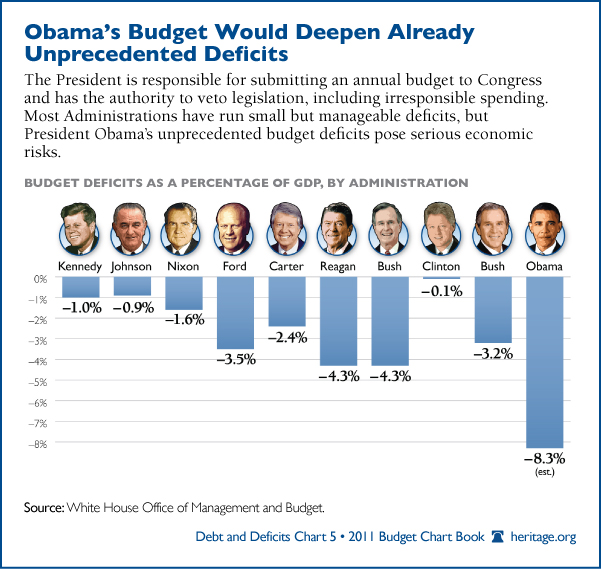
Over the last 10 presidents was have had 16.9% of GDP of deficits total from five Republican presidents and 12.7% total from Democratic presidents. However, what is most disturbing is that 8.3% of the 12.7% comes from the Obama administration who is currently in power and we are no longer in the cold war era. That is almost double the total of all the other four Democratic presidents combined under just one president. Take a look at the chart below from the Heritage Foundation:
Over the past 50 years, 10 U.S. presidents have made annual budget requests to Congress, projecting deficits both big and small. But no other president compares to Barack Obama when it comes to the size and scale of the current budget deficit facing the United States.
The country is facing an 8.3 percent estimated average national deficit of a two-term Obama administration — the biggest of the past 50 years. By comparison, the current estimate for Obama is nearly double the percentage under Presidents Ronald Reagan and George H.W. Bush — and they were fighting the Cold War.
Political party doesn’t tell the whole story, however. President Bill Clinton leads the pack of presidents since 1961, according to data from the White House Office of Management and Budget. Heritage put together this graphic as part of our Budget Chart Book.
So what does the current trajectory mean for the United States? We’re certainly no longer looking at a continuation of manageable deficits in the years to come. This is a dramatic change in the magnitude of annual shortfalls at the federal level. That’s one reason Heritage came up with a plan to fix the debt crisis.
If you have a suggestion for a chart we should feature in the future, please post a comment below, email us at scribe@heritage.org, or send me at tweet @RobertBluey.
President Obama unveiled his fiscal year 2012 budget today, and there’s good news and bad news. The good news is that there’s no major initiative such as the so-called stimulus scheme or the government-run healthcare proposal. The bad news, though, is that government is far too big and Obama’s budget does nothing to address this problem.
Actual spending cuts would be the best option, of course, but limiting the growth of spending is all that’s needed to slowly shrink the burden of government spending relative to gross domestic product.
Fortunately, we have two role models from recent history that show it is possible to control the federal budget. This video from the Center for Freedom and Prosperity uses data from the Historical Tables of the Budget to demonstrate the fiscal policy achievements of both Ronald Reagan and Bill Clinton.
Spending Restraint, Part I: Lessons from Ronald Reagan and Bill Clinton
Ronald Reagan and Bill Clinton both reduced the relative burden of government, largely because they were able to restrain the growth of domestic spending. The mini-documentary from the Center for Freedom and Prosperity uses data from the Historical Tables of the Budget to show how Reagan and Clinton succeeded and compares their record to the fiscal profligacy of the Bush-Obama years.
_____________________
Some people will want to argue about who gets credit for the good fiscal policy of the 1980s and 1990s.
Bill Clinton’s performance, for instance, may not have been so impressive if he had succeeded in pushing through his version of government-run healthcare or if he didn’t have to deal with a Republican Congress after the 1994 elections. But that’s a debate for partisans. All that matters is that the burden of government spending fell during Bill Clinton’s reign, and that was good for the budget and good for the economy. And there’s no question he did a much better job than George W. Bush.
Indeed, a major theme in this new video is that the past 10 years have been a fiscal disaster. Both Bush and Obama have dramatically boosted the burden of government spending — largely because of rapid increases in domestic spending.
Last but not least, this video reviews the theory and evidence for the “Rahn Curve,” which is the notion that there is a growth-maximizing level of government outlays. The bad news is that government already is far too big in the United States. This is undermining prosperity and reducing competitiveness.
Nations can make remarkable fiscal progress if policy makers simply limit the growth of government spending. This video, which is Part II of a series, uses examples from recent history in Canada, Ireland, Slovakia, and New Zealand to demonstrate how it is possible to achieve rapid improvements in fiscal policy by restraining the burden of government spending. Part I of the series examined how Ronald Reagan and Bill Clinton were successful in controlling government outlays — particularly the burden of domestic spending programs. http://www.freedomandprosperity.org
Paul Krugman should make teabaggers’ heads explode today — and by ‘baggers I mean Arkanas’s Republican delegation in Congress. It’s another explanation about why, in a tenuous recovery, the government needs to put job stimulus, not debt reduction, at the forefront. We need more government spending, he writes.
Now, the fact that federal debt isn’t at all like a mortgage on America’s future doesn’t mean that the debt is harmless. Taxes must be levied to pay the interest, and you don’t have to be a right-wing ideologue to concede that taxes impose some cost on the economy, if nothing else by causing a diversion of resources away from productive activities into tax avoidance and evasion. But these costs are a lot less dramatic than the analogy with an overindebted family might suggest.
And that’s why nations with stable, responsible governments — that is, governments that are willing to impose modestly higher taxes when the situation warrants it — have historically been able to live with much higher levels of debt than today’s conventional wisdom would lead you to believe.
It is obvious to me that the stimulus in 2009 failed. However, the liberals keep saying that we must spend more. Where will that take us? It will take us to Greece.
Too many riding in the wagon and not enough pulling the wagon. Is the USA heading down the same path as Greece?
Our long-run outlook is grim, but at least we still have time to reform the entitlement programs and save America from Greek-style fiscal collapse.
The conventional wisdom among economists is that a nation gets in deep trouble when government debt reaches 90 percent of GDP. That’s generally true, but it would be much more accurate to say that a nation gets in deep trouble when debt approaches 90 percent of GDP and the fiscal outlook shows even more red ink.
But this distinction doesn’t really matter much for the United States and Europe. Thanks to a combination of entitlement programs and aging populations, both face a bleak fiscal future. A 2010 study from the Bank for International Settlement shows that government debt in most industrialized nations will soar above 200 percent of GDP (in some cases, much higher) within the next few decades.
At some point, investors are going to realize that the United States is on an unsustainable path.
The only major difference is that European nations are farther down the path to fiscal collapse. The welfare state was adopted earlier in Europe and government spending among euro nations now consumes a staggering 49 percent of economic output. This heavy fiscal burden, especially when combined with onerous tax systems, helps explain why growth is anemic.
But the United States is only a couple of decades behind. According to long-run forecasts from the Congressional Budget Office, the burden of federal spending will reach European levels as the baby boom generation retires.
At some point, investors are going to realize that the United States is on an unsustainable path. Whether that’s 10 years from now or 20 years from now is anybody’s guess.
Daniel J. Mitchell is a top expert on tax reform and supply-side tax policy at the Cato Institute.
What we do know, however, is that Greece, Portugal, and Ireland already have stuck their snouts in the bailout trough, and it’s probably just a matter of time before Italy, Spain, and Belgium are in the same category. Heck, they’re already receiving indirect bailouts from the European Central Bank, which is buying up their dodgy debt in hopes of postponing the day of reckoning.
The one silver lining to this dark cloud is that the United States still can turn things around. Greece, Italy, and other welfare states have probably passed the point of no return, but it’s still possible for American lawmakers to fix the entitlement crisis by turning Medicaid over to the states , modernizing Medicare into a premium-support system, and transitioning to a system of personal retirement accounts for younger workers.
If those reforms don’t take place, the consequences won’t be pleasant. To be blunt, there won’t be an IMF to bail out the United States.
Max Brantley noted today: Paul Krugman should make teabaggers’ heads explode today — and by ‘baggers I mean Arkanas’s Republican delegation in Congress. It’s another explanation about why, in a tenuous recovery, the government needs to put job stimulus, not debt reduction, at the forefront. We need more government spending, he writes. Now, the fact […]
It is apparent from this statement below that Senator Mark Pryor is against the Balanced Budget Amendment. He has voted against it over and over like his father did and now I will give reasons in this series why Senator Pryor will be defeated in his re-election bid in 2014. However, first I wanted to […]
I have talked a lot about spending cuts on this blog. Here is a great article on this very subject: A Guide to the Presidential Candidates’ Proposals to Cut Spending Posted by Tad DeHaven Over at Downsizing the Federal Government, Chris Edwards and I have regularly complained that most policymakers have been insufficiently specific when it comes […]
Liberals want to spend our money and they think that government should get more of our money. Rep. Jan Schakowsky: “You Don’t Deserve To Keep All Your Money” Brandon Stewart September 14, 2011 at 11:16 am In a interview with Chicago’s Don Wade & Roma radio show this morning, Congresswoman Jan Schakowsky claimed that Americans […]
Government Spending Doesn’t Create Jobs Uploaded by catoinstitutevideo on Sep 7, 2011 Share this on Facebook: http://on.fb.me/qnjkn9 Tweet it: http://tiny.cc/o9v9t In the debate of job creation and how best to pursue it as a policy goal, one point is forgotten: Government doesn’t create jobs. Government only diverts resources from one use to another, which doesn’t […]
Dan Mitchell discusses the effectiveness of the stimulus Uploaded by catoinstitutevideo on Nov 3, 2009 11-2-09 When I think of all our hard earned money that has been wasted on stimulus programs it makes me sad. It has never worked and will not in the future too. Take a look at a few thoughts from […]
Government Spending Doesn’t Create Jobs Uploaded by catoinstitutevideo on Sep 7, 2011 Share this on Facebook: http://on.fb.me/qnjkn9 Tweet it: http://tiny.cc/o9v9t In the debate of job creation and how best to pursue it as a policy goal, one point is forgotten: Government doesn’t create jobs. Government only diverts resources from one use to another, which doesn’t […]
Dear Senator Pryor, why not pass the Balanced Budget Amendment? (Part 13 Thirsty Thursday, Open letter to Senator Pryor) Office of the Majority Whip | Balanced Budget Amendment Video In 1995, Congress nearly passed a constitutional amendment mandating a balanced budget. The Balanced Budget Amendment would have forced the federal government to live within its […]
Cato Institute:Spending is our problem Part 4 Should we spend more federal money to help the poor? Uploaded by CFPEcon101 on Oct 3, 2011 The so-called War on Poverty has failed. Making government bigger and creating more federal redistribution programs has been bad news for taxpayers. But the welfare state also has been a disaster […]
Cato Institute:Spending is our problem Part 4 Should we spend more federal money to help the poor? Uploaded by CFPEcon101 on Oct 3, 2011 The so-called War on Poverty has failed. Making government bigger and creating more federal redistribution programs has been bad news for taxpayers. But the welfare state also has been a disaster […]
Senator Mark Pryor wants our ideas on how to cut federal spending. Take a look at this video clip below:
Senator Pryor has asked us to send our ideas to him at cutspending@pryor.senate.gov and I have done so in the past and will continue to do so in the future.
On May 11, 2011, I emailed to this above address and I got this email back from Senator Pryor’s office:
Please note, this is not a monitored email account. Due to the sheer volume of correspondence I receive, I ask that constituents please contact me via my website with any responses or additional concerns. If you would like a specific reply to your message, please visit http://pryor.senate.gov/contact. This system ensures that I will continue to keep Arkansas First by allowing me to better organize the thousands of emails I get from Arkansans each week and ensuring that I have all the information I need to respond to your particular communication in timely manner. I appreciate you writing. I always welcome your input and suggestions. Please do not hesitate to contact me on any issue of concern to you in the future.
Following several “expansion budgets,” President Bush has moved the debate in a more responsible direction by proposing a “belt-tightening budget” that asks most agencies to accept a near-freeze in discretionary spending. But would most families trying to cut costs simply freeze each expenditure equally? Or would they fully fund priorities like food, the mortgage payment, and insurance while completely eliminating unaffordable luxuries such as vacations and entertainment?
Most families would choose this “priority budget” over a “belt-tightening budget,” and so should government. A priority budget would ask lawmakers to fully fund a few top priorities, such as defense, homeland security, and a few domestic programs, and then terminate such unaffordable luxuries as the approximately $60 billion in corporate welfare spending; the $20 billion pork-project budget; $100 billion (at least) in waste, fraud, and abuse; and hundreds of ineffective, outdated, and unnecessary programs.
Belt-tightening budgets are certainly preferable to the expansion budgets of the past few years. However, reducing a program’s funding without correspondingly adjusting its structure, goals, and duties can lead to ineffective government. Better a few vital activities performed well than a multitude of activities performed poorly.
President Bush proposes terminating 65 programs at a savings of $4.9 billion. (See Appendix 1.) Although a step in the right direction, these low-priority terminations represent only 0.2 percent of all federal spending. By contrast, a priority budget would:
Fully fund a limited number of high-priority spending categories, such as defense and homeland security;
Terminate entire categories of lower-priority programs, such as corporate welfare;
Institute a moratorium on pork projects;
Limit non-security spending increases to programs that pass their audits; and
Substantially reform programs growing at unsustainable rates, such as Social Security and Medicare.
Time to be Bold
Congress last attempted to enact a priority budget in 1995 and 1996, when the 104th Congress terminated several programs whose irrelevance was proven by how quickly they were forgotten. But Congress then committed several strategic errors, such as overreaching and shutting down the federal government in 1995. After President Bill Clinton deftly exploited these mistakes, budget cutters overreacted to Clinton’s tactics by completely abandoning the mission of smaller government. By 1998, federal spending was growing once again as a paralyzed Congress decided that budget confrontations with the Clinton White House could never be won and should be avoided at all costs.
In 2004, national defense, homeland security, and entitlement challenges make spending reform more important than ever. It is time to step back and think about the role of government, the obligations of the private sector, and the delineation between federal and state responsibilities. For those interested in lean, effective government with low taxes, the following are 10 guidelines for getting spending under control.
I love the Cato Institute because they give us the facts that liberals just can’t refute. Instead of trying to raise our taxes, President Obama should be cutting spending.
Kathy says that recent U.S. spending data is “exaggerated” because of the recession, and indeed, spending has soared not only here, but in most major countries because of the unfortunate popularity of Keynesian pump-priming theories. My point was that the American smaller-government advantage eroded both during the Bush growth years and during the Obama recession years, as seen in Figure 2 of my testimony.
Kathy noted that the OECD data I used are different than U.S. national income accounts data published by the Bureau of Economic Analysis. Well, that’s right. Every country has quirks in the way they do their national income data. The advantage of using OECD data is that the economists at the OECD adjust for these quirks and create spending data that is comparable across countries. If Kathy has more accurate international comparisons, I’d love to see them.
Finally, Kathy says that just because American government spending divided by GDP is about 40 percent, that “doesn’t mean that government controls about 40 percent of the U.S.economy.” I don’t agree. She means that government does not produce 40 percent of gross domestic product, which is true. The broader figure of 40 or 41 percent includes not just government production but government transfers. And transfers do entail government control over resources because both the taxing and spending activities involved in transfer programs distort private sector behavior. Thus, the government misallocates resources both when it “produces” useless solar power activities in its own labs and when it subsidizes failed private solar companies.
Anyway, thanks to Kathy for raising the important issue of the overall size of government because it is something that the policy community should focus more attention on. For data geeks, the OECD has all kinds of cross-country comparison data here. Government spending is Table 25.
Everyone wants to know more about the budget and here is some key information with a chart from the Heritage Foundation and a video from the Cato Institute.
The federal government is spending more per household than ever before. Since 1965, spending per household has grown by nearly 162 percent, from $11,431 in 1965 to $29,401 in 2010. From 2010 to 2021, it is projected to rise to $35,773, a 22 percent increase.
INFLATION-ADJUSTED DOLLARS (2010)
Download
Source: U.S. Census Bureau, White House Office of Management and Budget, and Congressional Budget Office.
The charts in this book are based primarily on data available as of March 2011 from the Office of Management and Budget (OMB) and the Congressional Budget Office (CBO). The charts using OMB data display the historical growth of the federal government to 2010 while the charts using CBO data display both historical and projected growth from as early as 1940 to 2084. Projections based on OMB data are taken from the White House Fiscal Year 2012 budget. The charts provide data on an annual basis except… Read More
Authors
Emily GoffResearch Assistant
Thomas A. Roe Institute for Economic Policy StudiesKathryn NixPolicy Analyst
Center for Health Policy StudiesJohn FlemingSenior Data Graphics Editor
As President, Ron Paul will lead the way out of this crisis by:
* Vetoing any unbalanced budget Congress sends to his desk.
* Refusing to further raise the debt ceiling so politicians can no longer spend recklessly.
* Fighting to fully audit (and then end) the Federal Reserve System, which has enabled the over 95% reduction of what our dollar can buy and continues to create money out of thin air to finance future debt.
* Legalizing sound money, so the government is forced to get serious about the dollar’s value.
* Ending the corporate stranglehold on the White House.
* Driving down gas prices by allowing offshore drilling, abolishing highway motor fuel taxes, increasing the mileage reimbursement rates, and offering tax credits to individuals and businesses for the use and production of natural gas vehicles.
* Eliminating the income, capital gains, and death taxes to ensure you keep more of your hard-earned money and are able to pass on your legacy to your family without government interference.
* Opposing all unfunded mandates and unnecessary regulations on small businesses and entrepreneurs.
These are just a few of the steps we can take to put America back in place as the world’s leading economy. Taking a stand for these principles has often been a lonely fight in Congress for Ron Paul, but, now more than ever, our nation needs a President who will champion sound money, responsible spending, lower taxes, and free market enterprise.
But not everybody is learning the right lessons from California’s fiscal and economic mess.
There’s a group of crazies who want to increase the top tax rate by five percentage points, an increase of about 50 percent. And they have made Kim Kardashian the poster child for their proposed ballot initiative.
I’m relatively clueless about popular culture, but even I’m aware that there is a group of people know as the Kardashian sisters. I don’t know who they are or what they do, but I gather they are famous in sort of the same way Paris Hilton was briefly famous.
And they have cashed in on their popularity, which may not reflect well on the tastes of the American people, but it’s not my job to tell other people how to spend their money.
But not everybody share this live-and-let-live attitude, which is why the pro-tax crowd in California produced this video.
I suppose I could criticize the petty dishonesty of the proponents, since they deliberately blurred of the difference between “tax rates” and “taxes paid.”
But I won’t do those things. Instead, like the Nevada Realtors Association and Arizona Business Relocation Department, I’m going to support this ballot initiative.
Not because I overdid the rum and eggnog at Christmas, but because it’s good to have negative role models, whether they are countries like Greece, cities such as Detroit, or states like California.
So here’s my challenge to the looters and moochers of the Golden State. Don’t just boost the top tax rate by five-percentage points. That’s not nearly enough. Go for a 20 percent top tax rate. Or 25 percent. After all, think of all the special interests that could use the money more than Ms. Kardashian.
And if somebody tells you that she will move to South Beach or Las Vegas, or that the other rich people will move to Texas, Wyoming, or Tennessee, just ignore them. Remember, it’s good intentions that count.
In closing, I apologize to the dwindling crowd of productive people in California. It’s rather unfortunate that you’re part of this statist experiment. But you know what they say about eggs and omelets.
Social Security is currently unsustainable. It began running deficits in 2010 and its trust fund will be exhausted by 2036, which is when seniors will see about a 25 percent cut in benefits. This is the scenario we face if Congress and the President fail to enact meaningful entitlement reform and continue reckless fiscal policies. This course is reversible, however.
At a recent House Budget Committee hearing on the fiscal facts concerning Medicare and Social Security, Members were divided on how to save Social Security. Despite hearing from Steve Goss, Social Security’s chief actuary, that raising taxes is not a necessity, tax hikes remained the leading option among certain lawmakers. Both parties agree that Social Security is insolvent, but they disagree on what to do about it.
Raising taxes, however, is not an option. Amidst the greatest recession in three decades, higher payroll taxes threaten to damage the American economy. Heritage has a new plan for Social Security, as presented in Saving the American Dream. It promises to restore fiscal responsibility and protect Americans from unneeded tax hikes.
At present, workers and their employers each pay 6.2 percent for Social Security retirement and disability benefits, adding up to a 12.4 percent payroll tax that is levied on every single worker’s income. If the government were to increase this tax to pay for Social Security’s deficits, every American worker and his boss would split an increase of at least 2.2 percent. Raising these taxes will discourage employers from hiring new workers and exacerbate unemployment.
Tax-loving lawmakers then turn to the tax cap. Social Security taxes are currently deducted only from the first $106,800 each worker earns. But some lawmakers suggest that any money Americans don’t “need” is fair game for tax hikes. President Obama most recently revealed this philosophy, fundamentally at odds with America’s job creators, during a press conference on the debt limit. Similarly, certain members at the recent House Budget Committee hearing suggested lifting the cap on the Social Security payroll tax to pay for the program’s shortfall. But taking more money out of the private economy limits entrepreneurial exercise—the true source of wealth in any free-market economy.
The Heritage Foundation plan does not call for unnecessary tax increases. Instead, it restores Social Security to its original purpose of being a safeguard against senior poverty. The plan includes both a transition into a flat benefit for those who work more than 35 years, as well as phasing out Social Security benefits for those who have significant non-Social Security retirement income. The plan also contains incentives to encourage Americans to work beyond the age at which they would normally receive benefits. Because Americans are living longer than ever before, they are spending more years in retirement. Therefore, Saving the American Dreamcalls for gradually increasing the retirement age and then indexing it to life expectancy.
Unemployment remains high, and Social Security faces serious fiscal challenges. It simply cannot afford to pay all of the future benefits it has promised. Elected leaders must realize that tax hikes are not the answer and that there are different ways to save both Social Security and the economy. Saving both requires our attention now, and as Heritage’s David John writes, “ [I]nstead of just blindly defending the current program, both Congress and the Obama Administration should propose comprehensive programs that permanently fix Social Security.”
[John Boozman] says that Buffett is being hypocritical to support Obama’s proposed tax increases because they wouldn’t solve the problem and wouldn’t affect him. In fact, he says, Obama’s bill might raise the secretary’s taxes if she and her husband make $250,000 while Buffett continues benefiting from those loopholes.
“It’s just class warfare,” he says. “It’s a simplistic solution that, like I say, it directs off the real issue of why we’re not creating jobs, why we’re having the increase in the discrepancy between the rich and our middle class, lower middle class.”
Sept. 9 (Bloomberg) — David Addington, vice president at the Heritage Foundation, and Ryan McConaghy, economic director at Third Way, discuss President Barack Obama’s $447 billion jobs plan. They speak with Deirdre Bolton and Erik Schatzker on Bloomberg Television’s “InsideTrack.” (Source: Bloomberg)
__________________
Is Buffett getting misquoted by the Obama administration?
Republicans are getting a great deal of mileage out of an interview investor Warren Buffett gave Friday morning, contending that the billionaire failed to endorse President Obama’s jobs plan or the proposed tax hike that bears his name.The Republican National Committee, for example, e-blasted a mailer that claimed Buffett had disagreed in a CNBC interview with Andrew Ross Sorkin with Obama’s plan to raise taxes on America’s top earners.
But did Buffett actually say that? More than anything, while interviewed on the floor of the New York Stock Exchange, he took a pass on commenting on Obama’s plan at all. As they used to say in the 20th century, let’s go to the videotape:
Andrew Ross Sorkin: “Let’s talk about the Buffett Rule for a moment. Talk to me about how it came about in terms of the White House getting in touch with you and you putting your name to this?”
Warren Buffett: “Well, [National Economic Council Director] Gene Sperling called and said, ’Can we use your name?’ And I said, yes.”
Sorkin: “Are you happy you said yes?”
Buffett: “Sure, I mean I wrote about it.”
Sorkin: “Are you happy with the way it’s been described? Is the program that the White House has presented — a million dollars and over — your program?”
Buffett: “Well, the precise program, I don’t know what their program will be. My program would be on the very high incomes that are taxed very low — not just high incomes. Some guy making $50 million playing baseball, his taxes won’t change. If you make 50 million dollars a year appearing on television, his income won’t change, but if they make a lot of money and they pay a very low tax rate, like me, it would be changed by a minimum tax that would only bring them up to what the other people pay .”
Sorkin: “Does that mean you disagree with the president’s new jobs proposal, which would be paid for by raising taxes on households with incomes of over $250,000?”
Buffett: “That’s another program that I won’t be discussing, but my program is to have a tax on ultra-rich people who are paying very low tax rates. Not just all the rich people. It probably would apply to 50,000 people in a population of 310 million.”
Sorkin: “That means you disagree with the president on the 250,000?”
Buffett: “No, no, you may disagree –“
Sorkin: “I’m asking, you agree that 250,000 is the right number?”
Buffett: “I will look at the overall plan that gets submitted to Congress, which they are voting on, and decide, net, do I like it or do I not like it? There’s no question there will be parts I’ll disagree with.” (Watch the video of the interview at the end of this article.)
Part of the confusion stems from Obama’s use of Buffett’s name in recent speeches as promoting the idea the rich “pay their fair share.” The Buffett Rule, as Buffett described in the interview and as he has proposed elsewhere, would affect a small percentage (less than 1) of America’s wealthiest citizens and would elevate the rate they pay on capital gains to be comparable to middle-class tax rates.
Essentially, the proposal was boiled down to a metaphor that has billionaires such as Buffett paying taxes at a lower rate than their “secretaries.”
When Obama rolled out his version of the rule, it was described as a tax on millionaires, but in truth, it wouldn’t affect most people who earn more than $1 million a year unless they derived most of their income from investments.
Along with that proposal, Obama has advocated letting the George W. Bush-era tax cuts expire for families making more than $250,000 a year—something which has nothing to do with Warren Buffett or the “Buffett Rule.”
Here’s what Buffett told the Fox Business Network Friday:
“I didn’t say the wealthy should pay more. I said the ultra-wealthy who are paying very low tax rates should pay more and the figures show that the 400 top tax payers who earned an average of almost $230 million apiece were paying 21% in a combined payroll tax and income tax, which is well below what all the people in my office pay now. What I’m talking about would not apply to someone that made $5 million a year as a baseball player or $10 million a year on media. It would apply only to probably 50,000 people out of 309 million who have huge incomes pay very low taxes. If you have a country with a deficit of over a trillion dollars and you think it can be solved by voluntary tax payments then you believe in the tooth fairy. There should be a policy that applies to people with money who earn lots of money and pay very low rates. If they earn it by normal jobs what I say would not hit them at all.”
Dan Mitchell on Taxing the Rich Max Brantley this morning on the Arkansas Times Blog, August 15, 2011, asserted: Billionaire Warren Buffett laments, again, in a New York Times op-ed how the rich don’t share the sacrifices made by others in the U.S.. He notes his effectiie tax rate of 17 percent is lower than […]
I loved reading this article below. (Take a look at the link to other posts I have done on Steve Jobs.) David Boaz makes some great observations: How much value is the Post Office creating this year? Or Amtrak? Or Solyndra? And if you point out that the Post Office does create value for its […]
(If you want to check out other posts I have done about about Steve Jobs:Some say Steve Jobs was an atheist , Steve Jobs and Adoption , What is the eternal impact of Steve Jobs’ life? ,Steve Jobs versus President Obama: Who created more jobs? ,Steve Jobs’ view of death and what the Bible has to say about it ,8 things you might not know about Steve Jobs ,Steve […]
(If you want to check out other posts I have done about about Steve Jobs:Some say Steve Jobs was an atheist , Steve Jobs and Adoption , What is the eternal impact of Steve Jobs’ life? ,Steve Jobs versus President Obama: Who created more jobs? ,Steve Jobs’ view of death and what the Bible has to say about it ,8 things you might not know about Steve Jobs ,Steve […]
Did Steve Jobs help people even though he did not give away a lot of money? (I just finished a post concerning Steve’s religious beliefs and a post about 8 things you may not know about Steve Jobs) Uploaded by UM0kusha0kusha on Sep 16, 2010 clip from The First Round Up *1934* ~~enjoy!! ______________________________________________ In the short film […]
Addington, McConaghy Debate Obama’s Jobs Plan Published on Sep 9, 2011 by Bloomberg Sept. 9 (Bloomberg) — David Addington, vice president at the Heritage Foundation, and Ryan McConaghy, economic director at Third Way, discuss President Barack Obama’s $447 billion jobs plan. They speak with Deirdre Bolton and Erik Schatzker on Bloomberg Television’s “InsideTrack.” (Source: Bloomberg) […]
Do the rich avoid the taxes that we all pay? Do the Rich Avoid Taxes? Posted by David Boaz President Obama says the rich should pay higher tax rates, citing billionaire Warren Buffett, who says he pays a lower tax rate than his secretary. Various analysts have pointed out that Buffett takes very little salary […]
President Obama and Alternative Minimum Tax Dan Mitchell does it again. He is always right on the mark. CPAs Celebrate as Obama Proposes to Create a Turbo-Charged Alternative Minimum Tax Posted by Daniel J. Mitchell Wow, this is remarkable. The alternative minimum tax (AMT) is one of the most-hated features of the tax code. It […]
Brantley, Buffett and Obama: “Stop coddling the rich” The Laffer Curve, Part I: Understanding the Theory Max Brantley is fond of accusing Republicans of coddling the rich and here comes Warren Buffett and validates both what President Obama and Brantley have been saying. However, will the increase in taxes have the desired result that they […]
Max Brantley on the Arkansas Times Blog, August 15, 2011, asserted: Billionaire Warren Buffett laments, again, in a New York Times op-ed how the rich don’t share the sacrifices made by others in the U.S.. He notes his effectiie tax rate of 17 percent is lower than that of many of the working people in his office on account of preferences for […]
Five Key Reasons to Reject Class-Warfare Tax Policy Max Brantley on the Arkansas Times Blog, August 15, 2011, asserted: Billionaire Warren Buffett laments, again, in a New York Times op-ed how the rich don’t share the sacrifices made by others in the U.S.. He notes his effectiie tax rate of 17 percent is lower than […]




 Federal Spending Is Growing Faster Than Federal Revenue


 The Daily Hatch