The gang loves Grandma, but her slimy son-in-law loves her money.When Dirty Dan tries to take away her retirement fortune, it’s the kids (and Pete the Pup) to the resue! Soon, the chase is on and Dan is caught faster than you can say “Granny get your gun”!
__________________________________
I enjoyed seeing that “Dirty Dan” got what was coming to him at the end of the episode below. If you listen to President Obama, and other liberals like John Brummett and Max Brantley then would get the impression that the mean rich folks don’t need to be so selfish and hand over the money to run the government for the rest of us.
Liberals just don’t get it. They should listen to Milton Friedman (who is quoted in this video below concerning the best way to limit poverty). New Video Shows the War on Poverty Is a Failure Posted by Daniel J. Mitchell The Center for Freedom and Prosperity has released another “Economics 101″ video, and this one […]
It is truly said how far to the left our country has gone. Happy Fiscal New Year (with an Unhappy Obama Hangover) Posted by Daniel J. Mitchell Today, October 1, is the first day of the 2012 fiscal year. And if you’re wondering why America’s economy seems to have a hangover (this cartoon is a perfect illustration), it’s because […]
Is soaking the rich fair? Five Key Reasons to Reject Class-Warfare Tax Policy Uploaded by afq2007 on Jun 15, 2009 President Obama and other politicians are advocating higher taxes, with a particular emphasis on class-warfare taxes targeting the so-called rich. This Center for Freedom and Prosperity Foundation video explains why fiscal policy based on hate […]
Do you think protectionism would help, in the long run, if we don’t implement pro-growth reforms? Sometimes I wonder what are the motives of those who oppose free trade. Eight Questions for Protectionists Posted by Daniel J. Mitchell When asked to pick my most frustrating issue, I could list things from my policy field such as […]
Five Key Reasons to Reject Class-Warfare Tax Policy Uploaded by afq2007 on Jun 15, 2009 President Obama and other politicians are advocating higher taxes, with a particular emphasis on class-warfare taxes targeting the so-called rich. This Center for Freedom and Prosperity Foundation video explains why fiscal policy based on hate and envy is fundamentally misguided. […]
Uploaded by TheYoungTurks on Aug 6, 2010 Cenk Uygur (host of The Young Turks) filling in for Chris Jansing on MSNBC talks to Dan Mitchell of the Cato institute to compare Reaganomics to Obamanomics. __________________________ What should we do when we are caught in a slow economy? What did Reagan do in 1981? He lowered […]
Maybe the tide is turning. Americans do not hate the rich like liberals would have us believe. Take a look at this article: Soaking the Rich Is Not Fair by Jeffrey A. Miron This article appeared on The Huffington Post on September 2, 2011. What is the “fair” amount of taxation on high-income taxpayers? To liberals, the […]
This Economics 101 video from the Center for Freedom and Prosperity gives seven reasons why the political elite are wrong to push for more taxes. If allowed to succeed, the hopelessly misguided pushing to raise taxes would only worsen our fiscal mess while harming the economy.
The seven reasons provided by the video against this approach are as follows:
1) Tax increases are not needed;
2) Tax increases encourage more spending;
3) Tax increases harm economic performance;
4) Tax increases foment social discord;
5) Tax increases almost never raise as much revenue as projected;
6) Tax increases encourage more loopholes; and,
7) Tax increases undermine competitiveness
_____________________
Raising the taxes on the rich may sound good in a class warfare strategy but it doesn’t work out like people would think. Here goes France again.
Francois Hollande is a man on a mission—to increase the top rate of tax on income to 75 percent. The Socialist candidate, who is poised to beat Nicolas Sarkozy in the French presidential election, said, “Above 1m euros [£847,000; $1.3m], the tax rate should be 75% because it’s not possible to have that level of income.”
Hollande’s “unassailable” logic aside, the measure would remind those who are too young to remember the 1970s of what happens when the rapacious state makes work really unprofitable. I can just see the Whitehall mandarins wring their hands with joy as thousands of French high-earners, from actors to businessmen, pour across the English Channel to London. If anything, the disastrous effect of the French tax will be greater than four decades ago—the world, after all, has become even more competitive and the cost of relocation has fallen appreciably. Karl Marx is supposed to have said that “history repeats itself, first as tragedy, second as farce.” Hollande may well prove him right.
Sept. 9 (Bloomberg) — David Addington, vice president at the Heritage Foundation, and Ryan McConaghy, economic director at Third Way, discuss President Barack Obama’s $447 billion jobs plan. They speak with Deirdre Bolton and Erik Schatzker on Bloomberg Television’s “InsideTrack.” (Source: Bloomberg)
__________________
Is Buffet getting misquoted by the Obama administration?
Republicans are getting a great deal of mileage out of an interview investor Warren Buffett gave Friday morning, contending that the billionaire failed to endorse President Obama’s jobs plan or the proposed tax hike that bears his name.The Republican National Committee, for example, e-blasted a mailer that claimed Buffett had disagreed in a CNBC interview with Andrew Ross Sorkin with Obama’s plan to raise taxes on America’s top earners.
But did Buffett actually say that? More than anything, while interviewed on the floor of the New York Stock Exchange, he took a pass on commenting on Obama’s plan at all. As they used to say in the 20th century, let’s go to the videotape:
Andrew Ross Sorkin: “Let’s talk about the Buffett Rule for a moment. Talk to me about how it came about in terms of the White House getting in touch with you and you putting your name to this?”
Warren Buffett: “Well, [National Economic Council Director] Gene Sperling called and said, ’Can we use your name?’ And I said, yes.”
Sorkin: “Are you happy you said yes?”
Buffett: “Sure, I mean I wrote about it.”
Sorkin: “Are you happy with the way it’s been described? Is the program that the White House has presented — a million dollars and over — your program?”
Buffett: “Well, the precise program, I don’t know what their program will be. My program would be on the very high incomes that are taxed very low — not just high incomes. Some guy making $50 million playing baseball, his taxes won’t change. If you make 50 million dollars a year appearing on television, his income won’t change, but if they make a lot of money and they pay a very low tax rate, like me, it would be changed by a minimum tax that would only bring them up to what the other people pay .”
Sorkin: “Does that mean you disagree with the president’s new jobs proposal, which would be paid for by raising taxes on households with incomes of over $250,000?”
Buffett: “That’s another program that I won’t be discussing, but my program is to have a tax on ultra-rich people who are paying very low tax rates. Not just all the rich people. It probably would apply to 50,000 people in a population of 310 million.”
Sorkin: “That means you disagree with the president on the 250,000?”
Buffett: “No, no, you may disagree –“
Sorkin: “I’m asking, you agree that 250,000 is the right number?”
Buffett: “I will look at the overall plan that gets submitted to Congress, which they are voting on, and decide, net, do I like it or do I not like it? There’s no question there will be parts I’ll disagree with.” (Watch the video of the interview at the end of this article.)
Part of the confusion stems from Obama’s use of Buffett’s name in recent speeches as promoting the idea the rich “pay their fair share.” The Buffett Rule, as Buffett described in the interview and as he has proposed elsewhere, would affect a small percentage (less than 1) of America’s wealthiest citizens and would elevate the rate they pay on capital gains to be comparable to middle-class tax rates.
Essentially, the proposal was boiled down to a metaphor that has billionaires such as Buffett paying taxes at a lower rate than their “secretaries.”
When Obama rolled out his version of the rule, it was described as a tax on millionaires, but in truth, it wouldn’t affect most people who earn more than $1 million a year unless they derived most of their income from investments.
Along with that proposal, Obama has advocated letting the George W. Bush-era tax cuts expire for families making more than $250,000 a year—something which has nothing to do with Warren Buffett or the “Buffett Rule.”
Here’s what Buffett told the Fox Business Network Friday:
“I didn’t say the wealthy should pay more. I said the ultra-wealthy who are paying very low tax rates should pay more and the figures show that the 400 top tax payers who earned an average of almost $230 million apiece were paying 21% in a combined payroll tax and income tax, which is well below what all the people in my office pay now. What I’m talking about would not apply to someone that made $5 million a year as a baseball player or $10 million a year on media. It would apply only to probably 50,000 people out of 309 million who have huge incomes pay very low taxes. If you have a country with a deficit of over a trillion dollars and you think it can be solved by voluntary tax payments then you believe in the tooth fairy. There should be a policy that applies to people with money who earn lots of money and pay very low rates. If they earn it by normal jobs what I say would not hit them at all.”
Do the rich avoid the taxes that we all pay? Do the Rich Avoid Taxes? Posted by David Boaz President Obama says the rich should pay higher tax rates, citing billionaire Warren Buffett, who says he pays a lower tax rate than his secretary. Various analysts have pointed out that Buffett takes very little salary […]
Addington, McConaghy Debate Obama’s Jobs Plan Published on Sep 9, 2011 by Bloomberg Sept. 9 (Bloomberg) — David Addington, vice president at the Heritage Foundation, and Ryan McConaghy, economic director at Third Way, discuss President Barack Obama’s $447 billion jobs plan. They speak with Deirdre Bolton and Erik Schatzker on Bloomberg Television’s “InsideTrack.” (Source: Bloomberg) […]
President Obama and Alternative Minimum Tax Dan Mitchell does it again. He is always right on the mark. CPAs Celebrate as Obama Proposes to Create a Turbo-Charged Alternative Minimum Tax Posted by Daniel J. Mitchell Wow, this is remarkable. The alternative minimum tax (AMT) is one of the most-hated features of the tax code. It […]
Brantley, Buffett and Obama: “Stop coddling the rich” The Laffer Curve, Part I: Understanding the Theory Max Brantley is fond of accusing Republicans of coddling the rich and here comes Warren Buffett and validates both what President Obama and Brantley have been saying. However, will the increase in taxes have the desired result that they […]
Max Brantley on the Arkansas Times Blog, August 15, 2011, asserted: Billionaire Warren Buffett laments, again, in a New York Times op-ed how the rich don’t share the sacrifices made by others in the U.S.. He notes his effectiie tax rate of 17 percent is lower than that of many of the working people in his office on account of preferences for […]
Five Key Reasons to Reject Class-Warfare Tax Policy Max Brantley on the Arkansas Times Blog, August 15, 2011, asserted: Billionaire Warren Buffett laments, again, in a New York Times op-ed how the rich don’t share the sacrifices made by others in the U.S.. He notes his effectiie tax rate of 17 percent is lower than […]
Dan Mitchell on Taxing the Rich Max Brantley this morning on the Arkansas Times Blog, August 15, 2011, asserted: Billionaire Warren Buffett laments, again, in a New York Times op-ed how the rich don’t share the sacrifices made by others in the U.S.. He notes his effectiie tax rate of 17 percent is lower than […]
With his corporate tax reform “framework,” President Obama today added another element to his ultimately harmful economic agenda.
Previously announced anti-growth policies include massive budget deficits, a huge tax hike on individuals and small businesses in 2013, and his proposal to nearly triple the dividend tax rate.
His new proposal starts strong by reducing the federal corporate income tax rate to 28 percent from the current 35 percent. This is a good and long-overdue policy change. Regrettably, he marries rate reduction to a net corporate tax hike based in part on extending his policy to hammer and ultimately deconstruct U.S. multinational companies. The net effect is that his corporate tax reform would do more harm than good, representing yet another missed opportunity to help American workers.
The U.S. corporate tax rate is the world’s second highest—and soon to be highest in the world by far. The average of the OECD nations (nations considered to have developed economies) excluding the U.S. is just over 25 percent. The combined state and federal U.S. rate is nearly 40 percent. It is miraculous that U.S. companies can compete at all in the global economy with such a tremendous handicap.
At the same time, economists and policymakers increasingly understand that while the tax is paid almost exclusively out of profits that would otherwise go to the shareholders, the true economic burden falls primarily on workers. The reason is simply that the higher the effective corporate tax burden, the higher the hurdle rate on corporate investment. (The hurdle rate is the minimum rate a business must earn on investment to make the investment.) The higher the hurdle rate, the less investment takes place. The less investment takes place, the slower labor productivity grows, and the slower labor productivity grows, the slower wages grow.
This may seem a long chain of events, but every link in the chain is solid steel. In the end, it means the higher the corporate tax is, the lower workers’ wages are. This is why Democrats like President Obama and Senator Ron Wyden (D–OR) are now joining with Republicans anxious to see a lower corporate income tax rate. It’s certainly not to reward corporate executives or shareholders but to protect workers from further degradation of their wages.
Unfortunately, President Obama marries this extremely important policy to two very bad policies. He calls this corporate tax reform. But tax reform is revenue neutral. His policy is to expand the tax base—the measure of income subject to tax—by closing “loopholes and subsidies” so that the net effect is to increase corporate taxes substantially. That’s not tax reform. That’s just another tax hike in disguise. So Obama argues that we need corporate tax reform for economic growth and then proposes corporate tax hikes that would inhibit growth. Go figure.
There’s no doubt the corporate income tax code is laden with loopholes and subsidies, just as there is no doubt the President’s recently released budget adds to the list some of his own. His framework lists a handful of minor proposals carried over from his budget and then references three areas for reform without providing any details. Specifically, he references depreciation schedules, suggesting significantly higher taxes on business investment. He suggests paring back the deduction for interest expense, again raising the hurdle rate on business investment. And he suggests “establishing greater parity between large corporations and large non-corporate counterparts,” which is generally assumed to be code for levying a dividend tax on distributed profits of these non-corporate businesses.
Debating tax deductions is a Washington parlor game. However, suppose Obama chose wisely and that every such subsidy or loophole mentioned is a valid target for repeal. Rather than raising tax burdens, he should then cut the corporate tax rate further. Recall that the average of the OECD (excluding the U.S.) is just over 25 percent. At a 28 percent federal rate, the combined federal and state tax rate would then be nearly 33 percent, still well above that of the nation’s competitors. The U.S. federal rate needs to come down further, and Obama’s additional base broadening would permit it. But instead, Obama takes a pass on further rate reduction in favor of taking the cash for the federal government.
Raising corporate taxes is his first big mistake. Targeting U.S. multinationals specifically for higher taxes is his second. The issue is complicated, but it boils down to some simple points. U.S. multinationals compete on a global stage, earning income at home and abroad. Income earned abroad is taxed by the foreign government. The U.S. also taxes income earned abroad and employs some complex rules to prevent double taxation. In contrast, most of the rest of the world now recognizes the folly of adding domestic tax to the tax their companies pay overseas. This would just make their companies and their workers less competitive at home and abroad, as it does for U.S. companies today.
President Obama, however, wants to make an economically harmful policy worse by taxing U.S. companies’ foreign earnings even more heavily. The vision Obama outlines is to punish firms that outsource jobs and incentivize “insourcing.” The net effect, however, would be quite different. The net effect is to put a “for sale” sign on every profitable U.S. multinational company. The buyers, however, won’t be U.S. companies. The buyers will all be foreign companies.
The reason for this tax-induced fire sale is fairly simple: The reach of U.S. tax policy into income earned overseas extends only when it applies to U.S. companies. The U.S. has no taxing jurisdiction when it comes to the foreign earnings of foreign companies. For example, the U.S. taxes Toyota on what Toyota earns in the U.S. But the U.S. does not tax Toyota on what Toyota earns in Japan.
Suppose a U.S. company like HP earned all of its foreign income through a single foreign subsidiary called Globalsub. Now suppose Globalsub were taxed under Obama’s plan. Globalsub’s foreign profits would then be subject to foreign tax and an even more punitive U.S. tax.
If a foreign company like Sony were to buy HP, shifting Globalsub out of HP into its own foreign operations, then all of Globalsub’s profits would immediately be exempt from U.S. taxes. This sort of tax arbitrage would be very big business. It would also substantially reduce U.S. tax revenues.
Sound far-fetched? It isn’t. Remember when Mercedes-Benz bought Chrysler in 1998? Had Chrysler bought Mercedes instead, all of the German company’s profits would have been subject to U.S. tax, rendering the entire operation uncompetitive. This was all laid bare by John Loffredo, then the tax counsel for Chrysler, in testimony before the House Ways and Means Committee.
Another high-profile example occurred when the Belgian company InBev bought Anheuser-Busch in 2008 for $52 billion. The more U.S. tax policy in this area gets out of step with worldwide norms, the more U.S. companies become natural targets for foreign acquirers. President Obama’s tax policies would make matters much, much worse.
The right solution is to pursue a revenue-neutral corporate tax reform, reducing the corporate tax rate as far as sound base broadening will allow. At the same time, in international matters the U.S. should move in exactly the opposite direction from what President Obama proposes so that U.S. companies can compete globally and not become tax-induced targets for foreign acquirers
This Economics 101 video from the Center for Freedom and Prosperity gives seven reasons why the political elite are wrong to push for more taxes. If allowed to succeed, the hopelessly misguided pushing to raise taxes would only worsen our fiscal mess while harming the economy.
The seven reasons provided by the video against this approach are as follows:
1) Tax increases are not needed;
2) Tax increases encourage more spending;
3) Tax increases harm economic performance;
4) Tax increases foment social discord;
5) Tax increases almost never raise as much revenue as projected;
6) Tax increases encourage more loopholes; and,
7) Tax increases undermine competitiveness
President Obama is insistent that taxes must go up to close the deficit. He says it’s just common sense that taxes must go up, because the math says so. But if he gets his way, the numbers won’t add up the way he says they will.
President Obama wants to raise taxes on “the rich.” But the Treasury will never collect the revenue he says will come from such hikes, because the rich will change their behavior to escape the punitive levies.
The Treasury received £10.35 billion in income tax payments from those paying by self-assessment last month, a drop of £509 million compared with January 2011. Most other taxes produced higher revenues over the same period. Senior sources said that the first official figures indicated that there had been “manoeuvring” by well-off Britons to avoid the new higher rate. The figures will add to pressure on the Coalition to drop the levy amid fears it is forcing entrepreneurs to relocate abroad.
This should be no surprise. When governments raise taxes on the rich, the rich change their behavior to avoid the higher taxes. Liberals understand this phenomenon when they raise taxes on cigarettes to discourage smoking, but they never seem to apply the same principle to income. If you tax income more heavily, you’ll end up with less income to tax, just like if you raise taxes on cigarettes, smokers purchase fewer packs.
Work less. They can work less, thereby earning less income to tax. This makes sense for high earners when their rate hits or exceeds 50 percent. Who wants to work when you take home half or less of the additional money you earn?
Earn differently. They can also change the composition of their income. In the U.S., capital gains and dividends are properly taxed at a lower rate than wage and salary income (ideally, they wouldn’t be taxed at all). Since the rich are often business owners, they can shift their compensation from wages and salaries to these less-taxed forms. They can also take compensation in forms that are excluded from taxation, like more comprehensive health insurance plans.
Seek shelter. Lastly, when the IRS comes calling for more, the rich can pay high-priced lawyers and accountants to scrounge the tax code for every last deduction, credit, and exemption to minimize their tax liability. This diverts resources that could’ve gone into creating jobs in other areas of the economy.
Taxing the rich more heavily distracts from the real cause of our debt and deficit woes: entitlements like Social Security and Medicare driving overspending. Washington has an overspending problem, not an under-taxing one. It would be better for Congress and the President to focus on the true cause of the problem than to waste time on counterproductive tax hikes that would never raise the expected revenue and would slow the already stagnant economy to boot.
As discussed yesterday, the most important number in Obama’s budget is that the burden of government spending will be at least $2 trillion higher in 10 years if the President’s plan is enacted.
But there are also some very unsightly warts in the revenue portion of the President’s budget. Americans for Tax Reform has a good summary of the various tax hikes, most of which are based on punitive, class-warfare ideology.
In this post, I want to focus on the President’s proposals to increase both the capital gains tax rate and the tax rate on dividends.
Most of the discussion is focusing on the big increase in tax rates for 2013, particularly when you include the 3.8 tax on investment income that was part of Obamacare. If the President is successful, the tax on capital gains will climb from 15 percent this year to 23.8 percent next year, and the tax on dividends will skyrocket from 15 percent to 43.4 percent.
But these numbers understate the true burden because they don’t include the impact of double taxation, which exists when the government cycles some income through the tax code more than one time. As this chart illustrates, this means a much higher tax burden on income that is saved and invested.
The accounting firm of Ernst and Young just produced a report looking at actual tax rates on capital gains and dividends, once other layers of tax are included. The results are very sobering. The United States already has one of the most punitive tax regimes for saving and investment.
Looking at this first chart, it seems quite certain that we would have the worst system for dividends if Obama’s budget is enacted.
The good news, so to speak, is that we probably wouldn’t have the worst capital gains tax system if the President’s plan is enacted. I’m just guessing, but it looks like Italy (gee, what a role model) would still be higher.
Let’s now contemplate the potential impact of the President’s tax plan. I am dumbfounded that anybody could look at these charts and decide that America will be in better shape with higher tax rates on dividends and capital gains.
This isn’t just some abstract issue about competitiveness. As I explain in this video, every single economic theory — even Marxism and socialism — agrees that saving and investment are key for long-run growth and higher living standards.
_________
Six Reasons Why the Capital Gains Tax Should Be Abolished
The correct capital gains tax rate is zero because there should be no double taxation of income that is saved and invested. This is why all pro-growth tax reform plans, such as the flat tax and national sales tax, eliminate the capital gains tax. Unfortunately, the President wants to boost the official capital gains tax rate to 20 percent, and that is in addition to the higher tax rate on capital gains included in the government-run healthcare legislation. www.freedomandprosperity.org
_________
So why is he doing this? I periodically run into people who are convinced that the President is deliberately trying to ruin the nation. I tell them this is nonsense and that there’s no reason to believe elaborate conspiracies.
President Obama is simply doing the same thing that President Bush did: Making bad decisions because of perceived short-run political advantage.
Sooner or later, there will be a giant battle in Washington over the value-added tax. The people who want bigger government (and the people who are willing to surrender to big government) understand that a new source of tax revenue is needed to turn the United States into a European-style social welfare state. But that’s exactly why the VAT is a terrible idea.
I explain why in a column for Reuters. The entire thing is worth reading, but here’s an excerpt of some key points.
Many Washington insiders are claiming that America needs a value-added tax (VAT) to get rid of red ink. …And President Obama says that a VAT is “something that has worked for other countries.” Every single one of these assertions is demonstrably false. …One of the many problems with a VAT is that it is a hidden levy. …VATs are imposed at each stage of the production process and thus get embedded in the price of goods. And because the VAT is hidden from consumers, politicians find they are an easy source of new revenue – which is one reason why the average VAT rate in Europe is now more than 20 percent! …Western European nations first began imposing VATs about 40 years ago, and the result has been bigger government, permanent deficits and more debt. According to the Economist Intelligence Unit, public debt is equal to 74 percent of GDP in Western Europe, compared to 64 percent of GDP in the United States (and the gap was much bigger before the Bush-Obama spending spree doubled America’s debt burden). The most important comparison is not debt, but rather the burden of government spending. …you don’t cure an alcoholic by giving him keys to a liquor store, you don’t promote fiscal responsibility by giving government a new source of revenue. …To be sure, we would have a better tax system if proponents got rid of the income tax and replaced it with a VAT. But that’s not what’s being discussed. At best, some proponents claim we could reduce other taxes in exchange for a VAT. Once again, though, the evidence from Europe shows this is a naive hope. The tax burden on personal and corporate income is much higher today than it was in the pre-VAT era. …When President Obama said the VAT is “something that has worked for other countries,” he should have specified that the tax is good for the politicians of those nations, but not for the people. The political elite got more money that they use to buy votes, and they got a new tax code, enabling them to auction off loopholes to special interest groups.
You can see some amusing — but also painfully accurate — cartoons about the VAT by clicking here, here, and here.
For further information on why the VAT is a horrible proposal, including lots of specific numbers and comparisons between the United States and Western Europe, here’s a video from the Center for Freedom and Prosperity.
The way to grow the economy is to cut taxes. Last night in the State of the Union address President Obama said he wanted to close tax loopholes which is another way of saying that he is not through raising taxes yet.
Not that it makes any difference. I’m slowly coming the conclusion that my friends on the left will never learn – in large part because they’re more interested in punishing success with class warfare tax policy than they are in collecting extra revenue for government.
But surely there are some statists who are motivated by emotions other than spite, so I refuse to give up. Let’s look at some evidence from Spain to further confirm that high tax rates aren’t necessarily the way to maximize tax revenue (this also is a story showing that tax competition between nations is a good way of disciplining governments that are too greedy, but that’s another issue).
Spain’s corporate tax take has tumbled by almost two thirds from pre-crisis levels as small businesses fail and a growing number of big corporations seek profits abroad to compensate for the prolonged downturn at home. …Spain has a headline corporate tax rate of 30 percent, broadly in line with other large European economies. Switzerland, however, has a headline rate of 8.5 percent, and lawyers say deductions can be made to reduce this further. “A fundamental right of EU law is the freedom of establishment. All companies and taxpayers look after their tax affairs, and if they can pay a lower rate somewhere else, it’s better for their business and natural that they would do so,” a global tax lawyer based in Spain said. …Rajoy did eliminate some corporate tax breaks in 2012, a policy he will continue in 2013, and has also brought forward some tax payments, though that could be storing up problems.
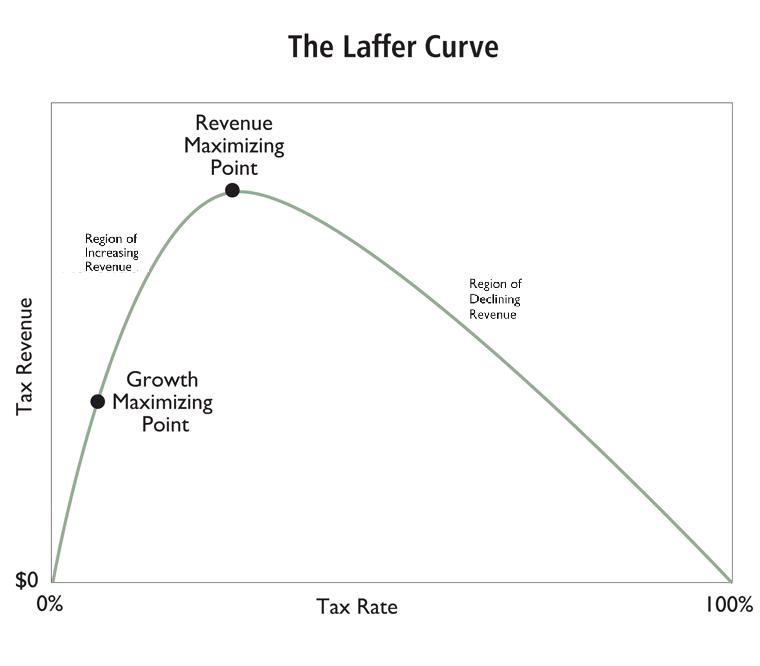
The one tax rate that hasn’t been increased, though, is the top rate of corporate tax. So how can this be a story about the Laffer Curve?
Well, sometimes standing still is a recipe for defeat. And sometimes moving in the right direction isn’t enough when everybody else is going in the right direction at a faster rate.
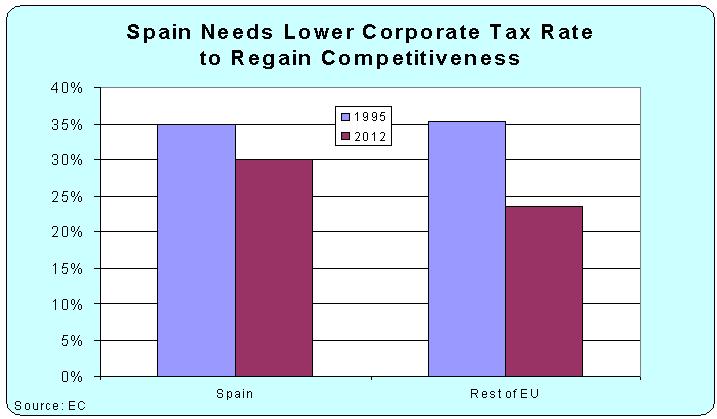
Here’s a chart showing changes in the average EU corporate tax rate compared to Spain’s corporate tax rate.
Spain’s corporate tax rate has dropped by five percentage points. That’s progress, but other nations have moved more rapidly in the right direction. Back in 1995, the Spanish corporate rate was slightly lower than the EU average. Now it’s noticeably higher.
And as the excerpt above notes, there are nations such as Switzerland that have far lower tax rates and much better fiscal policy.
To be sure, Spain’s main challenge is the need to dramatically reduce the burden of government spending. That will help long-run growth because more resources will be allocated by private markets.
But Spain also should seek an immediate boost to growth by reducing tax rates on productive behavior. A lower corporate tax rate should be part of the answer.
I got to hear Arthur Laffer speak back in 1981 and he predicted what would happen in the next few years with the Reagan tax cuts and he was right with every prediction. The Laffer Curve Wreaks Havoc in the United Kingdom July 1, 2012 by Dan Mitchell Back in 2010, I excoriated the new […]
Raising taxes will not work. Liberals act like the Laffer Curve does not exist. The Laffer Curve Shows that Tax Increases Are a Very Bad Idea – even if They Generate More Tax Revenue April 10, 2012 by Dan Mitchell The Laffer Curve is a graphical representation of the relationship between tax rates, tax revenue, and […]
The Laffer Curve, Part I: Understanding the Theory Uploaded by afq2007 on Jan 28, 2008 The Laffer Curve charts a relationship between tax rates and tax revenue. While the theory behind the Laffer Curve is widely accepted, the concept has become very controversial because politicians on both sides of the debate exaggerate. This video shows […]
If we want the economy to grow then we should look closely at a flat tax. A Primer on the Flat Tax and Fundamental Tax Reform August 11, 2012 by Dan Mitchell In previous posts, I put together tutorials on the Laffer Curve, tax competition, and the economics of government spending. Today, we’re going to look […]
President Obama c/o The White House 1600 Pennsylvania Avenue NW Washington, DC 20500 Dear Mr. President, I know that you receive 20,000 letters a day and that you actually read 10 of them every day. I really do respect you for trying to get a pulse on what is going on out here. I got […]
I have written a lot about this in the past and sometimes you just have to sit back and laugh. Laughing at Obama’s Bumbling Class Warfare Agenda July 13, 2012 by Dan Mitchell We know that President Obama’s class-warfare agenda is bad economic policy. We know high tax rates undermine competitiveness. And we know tax increases […]
President Obama c/o The White House 1600 Pennsylvania Avenue NW Washington, DC 20500 Dear Mr. President, I know that you receive 20,000 letters a day and that you actually read 10 of them every day. I really do respect you for trying to get a pulse on what is going on out here. If our […]
It is amazing to me that Reagan put in only 3 levels of taxation before he left office but now we have made it complicated again. Take a look at this video from the Cato Institute.
This video was produced by Caleb Brown ( http://www.twitter.com/cobrown ) and Austin Bragg ( http://www.twitter.com/habragg ).
The U.S. tax code gets more complex every year. It violates civil liberties and, left unchanged, will leave the United States at a powerful competitive disadvantage in years to come. Chris Edwards, Director of Tax Policy Studies, Senior Fellow Daniel J. Mitchell and Director of Information Policy Studies Jim Harper dissect the troubling aspects of our tax system.
The Heritage Plan Keeps Spending Low and Ends Deficits Without Raising Taxes
Everyone wants to know more about the budget and here is some key information with a chart from the Heritage Foundation and a video from the Cato Institute.
Bold, transformational reforms are needed to solve America’s spending crisis. The Heritage Plan achieves this through spending, entitlement, and tax reforms. It reduces the size of government, encourages personal fiscal responsibility, and fosters economic growth. It balances the federal budget by 2021 and keeps revenue at 18.5 percent of the economy.
REVENUE AND SPENDING AS A PERCENTAGE OF GDP
Download
Source: Current projections: Congressional Budget Office (Alternative Fiscal Scenario). Heritage Plan: Calculations by the Center for Data Analysis based on data provided by the Peter G. Peterson Foundation. For more information, go to savingthedream.org.
The charts in this book are based primarily on data available as of March 2011 from the Office of Management and Budget (OMB) and the Congressional Budget Office (CBO). The charts using OMB data display the historical growth of the federal government to 2010 while the charts using CBO data display both historical and projected growth from as early as 1940 to 2084. Projections based on OMB data are taken from the White House Fiscal Year 2012 budget. The charts provide data on an annual basis except… Read More
Authors
Emily GoffResearch Assistant
Thomas A. Roe Institute for Economic Policy StudiesKathryn NixPolicy Analyst
Center for Health Policy StudiesJohn FlemingSenior Data Graphics Editor



 The Heritage Plan Would Reverse Trajectory of Unsustainable Debt


 The Daily Hatch