Unfortunately, it turns out the President was speaking to the Parliament of Ghana and apparently his recommendation for good policy didn’t apply inside the United States.
With this in mind, I’m not sure whether I should get too excited about his remarks yesterday that it is better to “let the market work on its own.”
Here are a few reasons why I am less than enthusiastic about this remarkable statement.
Instead, when he said that we should “let the market work on its own,” he was referring to the very narrow issue of China’s production and distribution of certain minerals.
In other words, if presidential statements came with asterisks, the fine print at the bottom of the page would read “offer good in China only.”
However, a journey of a thousand miles begins with a first step. So if he thinks it’s a good idea to reduce government intervention in China, maybe someday he will apply the same wisdom to the American economy.
My question to Crawford would be this: “Would the tax money collected during that 5 year period be refunded?”
In 1982 the Democrats promised future spending cuts if Ronald Reagan would agree to a tax increase, but you guessed it, the taxes were increased and the spending cuts never came. THE REAL PROBLEM IS NOT THAT WE DON’T HAVE ENOUGH TAXES BUT WE DON’T WANT TO CUT SPENDING!!!
Washington Could Learn a Lot from a Drug Addict
Concerning spending cuts Reagan believed, that members of Congress “wouldn’t lie to him when he should have known better.” However, can you believe a drug addict when he tells you he is not ever going to do his habit again? Congress is addicted to spending too much money. Lee Edwards wrote in his article “Golden Years” about Ronald Reagan:
Sometimes Reagan went along with a pragamatist like chief of staff James Baker, who persuaded the president to accept the Tax Equity and Fiscal Responsibility Act of 1982 (TEFRA), which turned out to be the great tax increase of 1982 — $98 billion over the next three years. That was too much for eighty-nine House Republicans (including second-term Congressman Newt Gingrich of Georgia) or for prominent conservative organizations from the American Conservative Union like the Conservative Caucus and the U.S. Chamber of Commerce, which all opposed the measure.
Baker assured his boss that Congress would approve three dollars in spending cuts for every dollar of tax increase. To Reagan, TEFRA looked like a pretty good “70 percent” deal. But Congress wound up cutting less than twenty-seven cents for every new tax dollar. What had seemed to be an acceptable 70-30 compromise turned out to be a 30-70 surrender. Ed Meese described TEFRA as “the greatest domestic error of the Reagan administration,” although it did leave untouched the individual tax rate reductions approved the previous year. (TEFRA was built on a series of business and excise taxes plus the removal of business tax deductions.)[xxx]
The basic problem was that Reagan believed, as Lyn Nofziger put it, that members of Congress “wouldn’t lie to him when he should have known better.”[xxxi] As a result of TEFRA, Reagan learned to “trust but verify,” whether he was dealing with a Speaker of the House or a president of the Soviet Union.
I’ve remarked before that Democrats are the evil party and Republicans are the stupid party. Well, if anyone needs additional proof about GOPers being clueless and tone deaf, exhibit A is Congressman Rick Crawford of Arkansas, who has decided to preemptively capitulate in favor of higher tax rates.
Freshman Republican Rep. Rick Crawford will propose a surtax on millionaires Thursday morning, a crack in the steadfast GOP opposition to extracting more money from the nation’s top earners. The Arkansas Republican will unveil the plan during a local television interview Thursday morning, and plans to introduce legislation when the House returns next week, according to sources familiar with his thinking. Crawford will propose the additional tax— expected to be north of 2.5 percent — on individual income over $1 million as part of a broader fiscal responsibility package.
I have no idea if Congressman Crawford is simply naive, unaware that tax-increase deals inevitably lead to higher spending and more red ink. Or perhaps he’s trying to become the kind of Republican who thinks he can advance his career by saying things that will earn him pats on the head from the establishment media.
But I do know that America’s fiscal problem is a government that is far too big. You don’t solve the problem with more taxes, just as you don’t cure alcoholics by giving them more to drink.
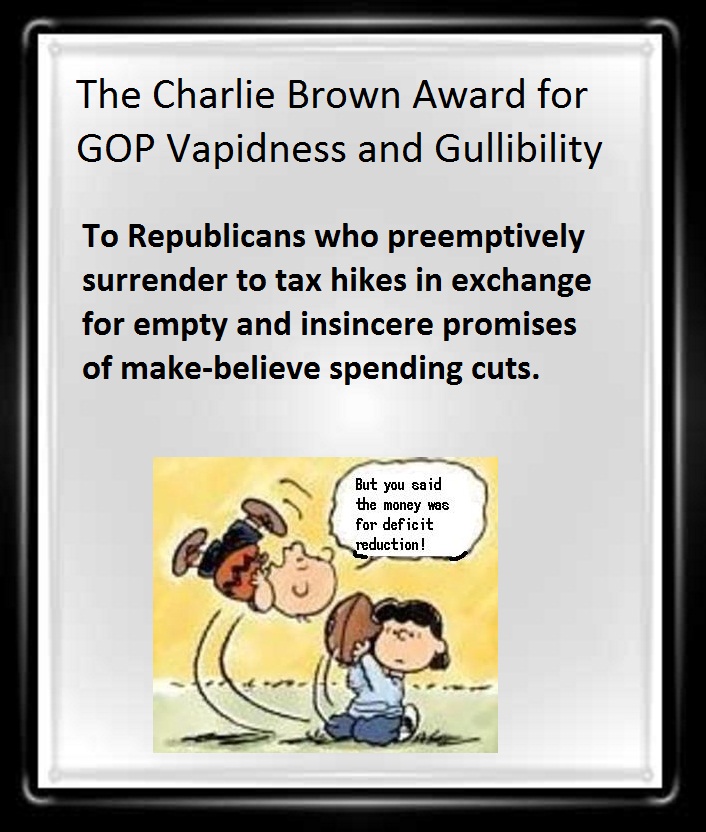
Congressman Crawford, though, wants to give away the keys to a liquor store without even asking for an insincere commitment for future sobriety in exchange. Indeed, the Congressman’s naiveté is so impressive that he is the first winner of the Charlie Brown Award for Vapidness and Gullibility.
There’s a rumor that he is sending former President George H.W. “read my lips” Bush to collect his award, but I’m unable to confirm at this point.
This new award is part of a series, with the “Bob Dole Award” having been announced earlier this year.
Crawford’s Democrat opponents have called him opportunist and they are right. People go into the booth to vote for the welfare party or the conservative job creating party and they can tell when someone is talking out of both sides of their mouth. It is sad when a newbie don’t talk to someone who has been in the conservative trenches for years fighting the good fight.
In the debate of job creation and how best to pursue it as a policy goal, one point is forgotten: Government doesn’t create jobs. Government only diverts resources from one use to another, which doesn’t create new employment.
Video produced by Caleb Brown and Austin Bragg.
___________________________
I have a son named Wilson Daniel Hatcher and he is named after two of the most respected men I have ever read about : Daniel from the Old Testament and Ronald Wilson Reagan.
One of the thrills of my life was getting to hear President Reagan speak in the beginning of November of 1984 at the State House Convention Center in Little Rock. Immediately after that program I was standing outside on Markham with my girlfriend Jill Sawyer (now wife of 25 years) and we were alone on a corner and the President was driven by and he waved at us and we waved back.
My former pastor from Memphis, Adrian Rogers, got the opportunity to visit with President Ronald Reagan on several occasions and my St Senator Jeremy Hutchinson got to meet him too. I am very jealous.
Today we are going to compare Reagan’s record to that of Obama:
Those two charts showed that the current recovery was very weak compared to the boom of the early 1980s.
But perhaps that was an unfair comparison. Maybe the Reagan recovery started strong and then hit a wall. Or maybe the Obama recovery was the economic equivalent of a late bloomer.
So let’s look at the same charts, but add an extra year of data. Does it make a difference?
Meh…not so much.
Let’s start with the GDP data. The comparison is striking. Under Reagan’s policies, the economy skyrocketed. Heck, the chart prepared by the Minneapolis Fed doesn’t even go high enough to show how well the economy performed during the 1980s.
Under Obama’s policies, by contrast, we’ve just barely gotten back to where we were when the recession began. Unlike past recessions, we haven’t enjoyed a strong bounce. And this means we haven’t recovered the output that was lost during the downturn.
Unfortunately, the jobs chart is probably even more discouraging. As you can see, employment is still far below where it started.
This is in stark contrast to the jobs boom during the Reagan years.
So what does this mean? How do we measure the human cost of the foregone growth and jobs that haven’t been created?
Writing in today’s Wall Street Journal, former Senator Phil Gramm and budgetary expert Mike Solon compare the current recovery to the post-war average as well as to what happened under Reagan.
If in this “recovery” our economy had grown and generated jobs at the average rate achieved following the 10 previous postwar recessions, GDP per person would be $4,528 higher and 13.7 million more Americans would be working today. …President Ronald Reagan’s policies ignited a recovery so powerful that if it were being repeated today, real per capita GDP would be $5,694 higher than it is now—an extra $22,776 for a family of four. Some 16.9 million more Americans would have jobs.
By the way, the Gramm-Solon column also addresses the argument that this recovery is anemic because the downturn was caused by a financial crisis. That’s certainly a reasonable argument, but they point out that Reagan had to deal with the damage caused by high inflation, which certainly wreaked havoc with parts of the financial system. They also compare today’s weak recovery to the boom that followed the financial crisis of 1907.
But I want to make a different point. As I’ve written before, Obama is not responsible for the current downturn. Yes, he was a Senator and he was part of the bipartisan consensus for easy money, Fannie/Freddie subsidies, bailout-fueled moral hazard, and a playing field tilted in favor of debt, but his share of the blame wouldn’t even merit an asterisk.
My problem with Obama is that he hasn’t fixed any of the problems. Instead, he has kept in place all of the bad policies – and in some cases made them worse. Indeed, I challenge anyone to identify a meaningful difference between the economic policy of Obama and the economic policy of Bush.
Bush increased government spending. Obama has been increasing government spending.
Bush adopted Keynesian “stimulus” policies. Obama adopted Keynesian “stimulus” policies.
Bush bailed out politically connected companies. Obama has been bailing out politically connected companies.
Bush supported the Fed’s easy-money policy. Obama has been supporting the Fed’s easy-money policy.
Bush created a new healthcare entitlement. Obama created a new healthcare entitlement.
Bush imposed costly new regulations on the financial sector. Obama imposed costly new regulations on the financial sector.
I could continue, but you probably get the point. On economic issues, the only real difference is that Bush cut taxes and Obama is in favor of higher taxes. Though even that difference is somewhat overblown since Obama’s tax policies – up to this point – haven’t had a big impact on the overall tax burden (though that could change if his plans for higher tax rates ever go into effect).
This is why I always tell people not to pay attention to party labels. Bigger government doesn’t work, regardless of whether a politician is a Republican or Democrat. The problem isn’t Obamanomics, it’s Bushobamanomics. But since that’s a bit awkward, let’s just call it statism.
President Obama’s fiscal year 2013 budget proposal explicitly claims a $1.561 trillion tax hike over 10 years, as reported by the White House Office of Management and Budget (OMB).[1] This is a vast understatement, because that figure fails to account for all of the President’s tax increases and improperly claims credit for reducing tax receipts from tax cuts that are not new policies.
Numbers Do Not Match
The indication that something is amiss with the $1.561 trillion tax hike figure is that it is substantially smaller than the estimate in the Treasury Department’s “Green Book.” The Green Book provides an in-depth explanation of the President’s numerous tax policy changes in the budget. Treasury releases it separately when OMB releases the budget. The Green Book estimates that the President wants to raise taxes by $1.689 trillion.[2] That is $128 billion more than the OMB figure.
The OMB and Treasury estimates should match. The Treasury Department is responsible for estimating the revenue effects of the President’s tax policies for OMB, and OMB uses those estimates in its budget tables.
The reason for the difference is that OMB puts more than $154 billion of tax hikes the President wants outside the tax section of the table, where OMB lists the revenue effect of most of the President’s tax policy changes. This is also where OMB calculates the net revenue effect of the President’s tax hikes and cuts.[3] The Treasury estimate in the Green Book properly accounts for these tax hikes with the other tax changes in the budget.[4]
While OMB does account for these other tax hikes elsewhere in the table, putting them in areas other than the tax section misleads readers to believe that the President’s tax hikes are smaller than they are in reality. After all, it is sensible to find the line in the OMB table that states the net effect of the President’s tax policies and assume that it is the total amount.
The biggest missing tax hike from the tax section is the “Financial Crisis Responsibility Fee,” better known as the bank tax. OMB put this tax in the Treasury Department’s section of the table.[5] This tax hike adds another $61 billion to the President’s tax hike total. Also included in the Treasury Department’s section is a $44 billion tax hike from allowing the IRS to adjust a program integrity cap. OMB put a $48 billion increase of the unemployment tax in a footnote of the Labor Department’s section[6] and a $1 billion hike of user fees for commercial navigation of inland waterways in the Veterans Affairs’ section (Corps of Engineers).[7] These hidden tax hikes account for the missing $154 billion.
OMB also failed to account for a relatively small amount of tax cuts in its total tax hike figure. Those tax cuts total $26 billion. Subtracting that sum from the $154 billion missing tax hikes figure arrives at the missing $128 billion of net tax hikes OMB misclassified that should be included in President Obama’s total tax hike.
Credit Where Credit Is Not Due
Adding the missing tax hikes that OMB misplaced is necessary, but not sufficient, to arrive at the final tally of President Obama’s tax hikes. Both OMB and Treasury give the President credit for tax cuts that are not new policies and therefore wrongly reduce the amount he plans to increase revenue.
These policies include extending the payroll tax holiday ($31 billion), the American Opportunity Tax Credit ($137 billion), the Research and Experimentation Credit ($109 billion), the group of tax-reducing policies known as the “tax extenders” ($34 billion), and several other tax provisions that have long been part of the tax code ($6 billion).[8] These pre-existing tax cuts that President Obama does not deserve credit for equal $317 billion.
Properly remove that $317 billion of previous tax cuts from the President’s net tax hike as reported by OMB, add the missing $128 billion of tax hikes, and the President actually calls for raising taxes by more than $2 trillion over 10 years. That is 31 percent more than the OMB figure suggests the President wants to raise taxes.
Use the Correct Figure
Congress should disregard the misleading tax hike figure from OMB’s table and use the correct $2 trillion amount when referring to the total tax hikes in the President’s budget. Members of Congress should question OMB as to why they chose to mislead readers about the total tax hike that President Obama has called for on American taxpayers.
Curtis S. Dubay is a Senior Analyst in Tax Policy in the Thomas A. Roe Institute for Economic Policy Studies at The Heritage Foundation.
Terry Rice quoted my political hero Ronald Wilson Reagan in his speech last week. I have a son named Wilson Daniel Hatcher and he is named after two of the most respected men I have ever read about : Daniel from the Old Testament and Ronald Wilson Reagan.
One of the thrills of my life was getting to hear President Reagan speak in the beginning of November of 1984 at the State House Convention Center in Little Rock. Immediately after that program I was standing outside on Markham with my girlfriend Jill Sawyer (now wife of 25 years) and we were alone on a corner and the President was driven by and he waved at us and we waved back.
My former pastor from Memphis, Adrian Rogers, got the opportunity to visit with President Ronald Reagan on several occasions and my St Senator Jeremy Hutchinson got to meet him too. I am very jealous.
Then the Republican candidate for speaker of the House, Rep. Terry Rice, made this pitch last week for his election—next year if his party wins enough House races: He and his party will see to it that the state income tax is cut so that the “depopulation of Arkansas” will end and the state can start to grow.
Depopulation? The state has been gaining population for 50 years and grew by 9.1 percent over the past decade. He said people were fleeing across the border to Texas and Tennessee to live to escape Arkansas’s income tax (and to live in communities with higher property and excise taxes). Texas does not have a personal income tax and Tennessee’s only applies to investment income. Arkansas lost population back in the days when its state and local taxes were the lowest in the United States.
That tax-and-growth record under Reagan and Bush? It was like that in Arkansas, too. When the current income tax rates were set, in 1971, and other taxes raised as well, the state set records for job growth the next three years. When Bill Clinton raised taxes in 1983 and 1987, we led the nation in manufacturing job growth. When Mike Huckabee cut capital gains taxes, the economy and the treasury fell into a slump…
Here is my response to these key points.
Ernie Dumas has beat on this drum over and over in the past, but the facts don’t support this view that Arkansas has benefited from having the high state income tax while bordering states like Tennessee and Texas do not have one. There is an effort to move from Arkansas to states that don’t have a state income tax.
Milton Friedman served as economic advisor for two American Presidents – Richard Nixon and Ronald Reagan. Although Friedman was inevitably drawn into the national political spotlight, he never held public office. I am going to post some clips from his film series that demonstrate how powerful the private market is if you just get out-of-the-way and let it work.
Milton Friedman’s Free to Choose (1980), episode 1 – Power of the Market. part 1
Mike Huckabee moved last year to Florida? Why? The answer is easy. Huckabee wants to avoid Arkansas’ high state income tax. Max Brantley of the Arkansas Times wants to call Huckabee a tax fugitive, but who can blame him.
Liberals like Brantley and Ernie Dumas want to praise former Arkansas governor Dale Bumpers for raising the state income tax to 7%, but that is the reason our state has the highest state income tax in the area (all bordering states have either lower state income taxes or no state income tax).
Is it any surprise that during the last census that the seven states that do not have an income tax grew in population? Arkansas has suffered from bracket creep and in 1929 you had to make 5 times the average wage to pay any state income tax at all, but now over 66% of tax payers in Arkansas pay at least some of their income at the 7% level.
Take a look at all the Milton Friedman clips that I have posted today. These liberals I mentioned above have truly forgotten how powerful the market is if not interfered with by the government.
Milton Friedman’s Free to Choose (1980), episode 1 – Power of the Market. part 2
Until Gov. Dale Bumpers raised income-tax rates and other taxes in 1971, Arkansas had by far the lowest per-capita state and local taxes in the United States. Afterward, we were still 50th but within shouting distance of 49th.
(June 2006) Democratic Gov. Dale Bumpers and the General Assembly raised Arkansas’ top income tax rate to “broaden the tax base” in 1971(1). Yet Arkansas’ per capita income, expressed as a percentage of the U.S. total, has barely improved, moving from 71 (1971) to 77.7 percent (2005) over the 34-year period, according to data from the U.S. Bureau of Economic Analysis. The 1971 income tax increase reversed a decades-long strong growth trend and left Arkansas with the highest income tax rate among bordering states (Mississippi, Missouri, Louisiana, Oklahoma, Tennessee and Texas).
Income Stagnation: The 1930s
One has to turn to the 1930s-the decade of the Great Depression-to find weaker income growth than in recent years.
Arkansas per capita personal income was 44 percent of the U.S. in 1929, the first year data was compiled in the BEA time series. The Great Depression started that year, and by the time it ended in 1933 Arkansas per capita income had fallen to 41 percent of the U.S. By decade’s end (1939) it had returned to 44 percent.
Growth Decades: The 1940s, 1950s & 1960s
Arkansas per capita income increased as a percentage of the U.S. in the next three decades.
In 1941, at the onset of World War II, Arkansas per capita income was 47 percent of the U.S. It was 59 percent at war’s end in 1945 and again in 1949. It was 56 percent in 1950, 62 percent a decade later in 1960, and 68 percent in 1969. If this growth rate had continued Arkansas would have exceeded 100 percent of the U.S. average in the current decade (2000-2009).
To summarize, Arkansas per capita income increased from 44 to 71 percent of the U.S. total between 1939 and 1971.
Anemic Income Growth (1971-2005)
The trend in recent decades is anemic growth in Arkansas per capita personal income. Fiscal policy changes effect economic behavior with a time lag. Arkansas per capita income was 71 percent of the U.S. in 1971 and 76 percent in 1973. Income growth stagnated for the rest of the decade, reaching 77 percent of the U.S. in 1979. It fell to 75 percent in 1989, and was 76 percent in 1999. Today, Arkansas per capita income, at 77.7 percent of the U.S., is barely above its high point of the 1970s.
Milton Friedman’s Free to Choose (1980), episode 1 – Power of the Market. part 3
Since its introduction in 1929, Arkansas‘ statutory incometax structure has changed very little. However, due to changes in the economy and in inflation, the real effects of that tax structure has changed substantially. This report looks at the effects that rising incomes and inflation have had on the Arkansasincometax structure. In addition, the report looks at the changing profile of Arkansas taxpayers in recent years, and provides a brief comparison of Arkansas taxes in relation to other states and the federal tax system.
Arkansas‘ IncomeTax Structure: Original and Revised
In 1929 Arkansas became 12th among the states to adopt an individual incometax. The structure contained five rates and net income brackets with a top rate of five percent applying to net income over $25,000. That original structure remained in place until 1971 when a new middle income bracket was added and the rate on net income over $25,000 was increased to 7.0 percent. The rates and brackets revised in 1971 remain in place today. The 1929 original and the revised current tax structure are shown in Table 1.
Table 1 Arkansas Individual IncomeTax Structure
 1929 Original Net Income Rate first $3,000 1.0%
next$3,001 to $6,000  2.0%
next$6,001 to $11,000 3.0%
next $11,001 to $25,000  4.0%
over $25,000 5.0%
1971 Revision (Current)
Net Income Rate first $2,999 1.0%
 next$3,000 to $5,999 2.5%
next$6,000 to $8,999 3.5%
next$9,000 to $14,999 4.5%
next $15,000 to $24,999 6.0%
 over $25,000 7.0%
Source: Arkansas Legislative Tax Handbook, 1992, Bureau of Legislative Research.
In 1975, the earliest year for which records on income tax collections by income group is available, only the top 4.0 percent of Arkansas taxpayers would have had any of their income subjected to the top 7.0 percent rate. By 1991, around 66.0 percent of the state’s taxpayers would have had some of their income subjected to this top rate–a rate once reserved for only the highest income earners.
The 1929 tax structure provided for exemptions of $1,500 for a single person and $2,500 for married individuals. In 1947 the state raised the exemption to $2,500 for singles and $3,500 for married persons. In 1957 the personal exemption was converted to a credit of $17.50 for singles and $35.00 for married persons. In 1987 the credits were increased to $20 per person. Finally, in 1991, low income Arkansans were exempted from paying incometax if their gross income did not exceed $5,500 for an individual or $10,000 for a married couple. For most taxpayers, the $20.00 credit remains in effect today.
The Value of Exemptions as a Share of Per Capita Income
Table 2 shows how the value of the personal tax exemption or credit has diminished over time. The figures shown represent the personal exemption or credit for a single individual as a ratio of the per capita personal income in the year in which the credit was first enacted. In 1929, for instance, an individual would have been exempted from any tax until their income reached a level which was equal to 490 percent of the Arkansas per capita income for that year. In 1947 with the first statutory change in the exemption, that individual would have still been exempted up to an amount equal to 340 percent of the per capita income level. By 1957 the value of the exemption (which was changed to a tax credit that year) had declined substantially, falling to 130 percent of per capita income. At the time of the next change in the personal credit (1987), the value of that credit was only 17 percent of the per capita income level. For most taxpayers (all those not officially classified as low income) in 1992, the value of the personal credit was only 13 percent of per capita income.
Table 2 Personal Exemptions and Credits As a Percent of Per Capita Income
Arkansas Year of Value of Per Capita Enactment ExemptionIncome Ratio 1929 $1,500 $ 308 490% 19472,500 737 340% 19571,6001,247 130% 19872,000 11,980 17% 19922,000 15,439 13%
Source: Arkansas Legislative Tax Handbook, 1992, Bureau of Legislative Research; Per capita personal income data is from the Bureau of Economic Analysis, unpublished data, April, 1993.
In other words, whereas in the first year of enactment of the incometax, the personal exemption would have allowed an Arkansan to earn almost five times the average per capita income before paying any tax.
Milton Friedman’s Free to Choose (1980), episode 1 – Power of the Market. part 4
For those of us who are demographic buffs, Christmas came four days early when Census Bureau director Robert Groves announced on Tuesday the first results of the 2010 census and the reapportionment of House seats (and therefore electoral votes) among the states.
The resident population of the United States, he told us in a webcast, was 308,745,538. That’s an increase of 9.7 percent from the 281,421,906 in the 2000 census — the smallest proportional increase than in any decade other than the Depression 1930s but a pretty robust increase for an advanced nation. It’s hard to get a grasp on such large numbers. So let me share a few observations on what they mean.
First, the great engine of growth in America is not the Northeast Megalopolis, which was growing faster than average in the mid-20th century, or California, which grew lustily in the succeeding half-century. It is Texas.
Its population grew 21 percent in the past decade, from nearly 21 million to more than 25 million. That was more rapid growth than in any states except for four much smaller ones (Nevada, Arizona, Utah and Idaho).
Texas’ diversified economy, business-friendly regulations and low taxes have attracted not only immigrants but substantial inflow from the other 49 states. As a result, the 2010 reapportionment gives Texas four additional House seats. In contrast, California gets no new House seats, for the first time since it was admitted to the Union in 1850.
There’s a similar lesson in the fact that Florida gains two seats in the reapportionment and New York loses two.
This leads to a second point, which is that growth tends to be stronger where taxes are lower. Seven of the nine states that do not levy an income tax grew faster than the national average. The other two, South Dakota and New Hampshire, had the fastest growth in their regions, the Midwest and New England.
Altogether, 35 percent of the nation’s total population growth occurred in these nine non-taxing states, which accounted for just 19 percent of total population at the beginning of the decade.
Milton Friedman’s Free to Choose (1980), episode 1 – Power of the Market. part 5
In the debate of job creation and how best to pursue it as a policy goal, one point is forgotten: Government doesn’t create jobs. Government only diverts resources from one use to another, which doesn’t create new employment.
Video produced by Caleb Brown and Austin Bragg.
___________________________
Keynesian Catastrophe: Big Money, Big Government & Big Lies
Based on a theory known as Keynesianism, politicians are resuscitating the notion that more government spending can stimulate an economy. This mini-documentary produced by the Center for Freedom and Prosperity Foundation examines both theory and evidence and finds that allowing politicians to spend more money is not a recipe for better economic performance.
___________________
Obama’s So-Called Stimulus: Good For Government, Bad For the Economy
President Obama wants Congress to dramatically expand the burden of government spending. This CF&P Foundation mini-documentary explains why such a policy, based on the discredited Keynesian theory of economics, will not be successful. Indeed, the video demonstrates that Obama is proposing – for all intents and purposes – to repeat Bush’s mistakes. Government will be bigger, even though global evidence shows that nations with small governments are more prosperous.
____________
Big Government Is Not Stimulus: Why Keynes Was Wrong (The Condensed Version)
The CF&P Foundation has released a condensed version of our successful mini-documentary explaining why so-called stimulus schemes do not work. Based on a theory known as Keynesianism, politicians are resuscitating the notion that more government spending can stimulate an economy. This mini-documentary produced by the Center for Freedom and Prosperity Foundation examines both theory and evidence and finds that allowing politicians to spend more money is not a recipe for better economic performance.
_________________
Eight Reasons Why Big Government Hurts Economic Growth
This Center for Freedom and Prosperity Foundation video analyzes how excessive government spending undermines economic performance. While acknowledging that a very modest level of government spending on things such as “public goods” can facilitate growth, the video outlines eight different ways that that big government hinders prosperity. This video focuses on theory and will be augmented by a second video looking at the empirical evidence favoring smaller government.
___________________
Keynesian Economics Is Wrong: Economic Growth Causes Consumer Spending, Not the Other Way
Politicians and journalists who fixate on consumer spending are putting the cart before the horse. Consumer spending generally is a consequence of growth, not the cause of growth. This Center for Freedom and Prosperity video helps explain how to achieve more prosperity by looking at the differences between gross domestic product and gross domestic income. www.freedomandprosperity.org
_____________
Deficits, Debts and Unfunded Liabilities: The Consequences of Excessive Government Spending
Huge budget deficits and record levels of national debt are getting a lot of attention, but this video explains that unfunded liabilities for entitlement programs are Americas real red-ink challenge. More important, this CF&P mini-documentary reveals that deficits and debt are symptoms of the real problem of an excessive burden of government spending. www.freedomandprosperity.org
___________
Now that I have been critical of the Democrat President, I wanted to show that I am not concerned about taking up for Republicans but looking at the facts. President Clinton did increase government spending at a slower rate than many other presidents. Here are two videos that praise both Reagan and Clinton for both accomplished this feat.
Spending Restraint, Part I: Lessons from Ronald Reagan and Bill Clinton
Ronald Reagan and Bill Clinton both reduced the relative burden of government, largely because they were able to restrain the growth of domestic spending. The mini-documentary from the Center for Freedom and Prosperity uses data from the Historical Tables of the Budget to show how Reagan and Clinton succeeded and compares their record to the fiscal profligacy of the Bush-Obama years.
______________
Spending Restraint, Part II: Lessons from Canada, Ireland, Slovakia, and New Zealand
Nations can make remarkable fiscal progress if policy makers simply limit the growth of government spending. This video, which is Part II of a series, uses examples from recent history in Canada, Ireland, Slovakia, and New Zealand to demonstrate how it is possible to achieve rapid improvements in fiscal policy by restraining the burden of government spending. Part I of the series examined how Ronald Reagan and Bill Clinton were successful in controlling government outlays — particularly the burden of domestic spending programs. www.freedomandprosperity.org
Lawmakers are considering extending temporary payroll tax cuts. But the policy is based on faulty Keynesian theories and misplaced confidence in the government’s ability to micromanage short-run growth.
In textbook Keynesian terms, federal deficits stimulate growth by goosing “aggregate demand,” or consumer spending. Since the recession began, we’ve had a lot of goosing — deficits were $459 billion in 2008, $1.4 trillion in 2009, $1.3 trillion in 2010, and $1.3 trillion in 2011. Despite that huge supposed stimulus, unemployment remains remarkably high and the recovery has been the slowest since World War II.
Policymakers should ignore the Keynesians and their faulty models, and instead focus on reforms to aid long-run growth…
Yet supporters of extending payroll tax cuts think that adding another $265 billion to the deficit next year will somehow spur growth. That “stimulus” would be on top of the $1 trillion in deficit spending that is already expected in 2012. Far from helping the economy, all this deficit spending is destabilizing financial markets, scaring businesses away from investing, and imposing crushing debt burdens on young people.
For three years, policymakers have tried to manipulate short-run economic growth, and they have failed. They have put too much trust in macroeconomists, who are frankly lousy at modeling the complex workings of the short-run economy. In early 2008, the Congressional Budget Office projected that economic growth would strengthen in subsequent years, and thus completely missed the deep recession that had already begun. And then there was the infamously bad projection by Obama’s macroeconomists that unemployment would peak at 8 percent and then fall steadily if the 2009 stimulus plan was passed.
Some of the same Keynesian macroeconomists who got it wrong on the recession and stimulus are now claiming that a temporary payroll tax break would boost growth. But as Stanford University economist John Taylor has argued, the supposed benefits of government stimulus have been “built in” or predetermined by the underlying assumptions of the Keynesian models.
Policymakers should ignore the Keynesians and their faulty models, and instead focus on reforms to aid long-run growth, which economists know a lot more about. Cutting the corporate tax rate, for example, is an overdue reform with bipartisan support that would enhance America’s long-run productivity and competitiveness.
If Congress is intent on cutting payroll taxes, it should do so within the context of long-run fiscal reforms. One idea is to allow workers to steer a portion of their payroll taxes into personal retirement accounts, as Chile and other nations have done. That reform would feel like a tax cut to workers because they would retain ownership of the funds, and it would begin solving the long-term budget crisis that looms over the economy.
Dan Mitchell discusses the effectiveness of the stimulus Uploaded by catoinstitutevideo on Nov 3, 2009 11-2-09 When I think of all our hard earned money that has been wasted on stimulus programs it makes me sad. It has never worked and will not in the future too. Take a look at a few thoughts from […]
Government Spending Doesn’t Create Jobs Uploaded by catoinstitutevideo on Sep 7, 2011 Share this on Facebook: http://on.fb.me/qnjkn9 Tweet it: http://tiny.cc/o9v9t In the debate of job creation and how best to pursue it as a policy goal, one point is forgotten: Government doesn’t create jobs. Government only diverts resources from one use to another, which doesn’t […]
In his recent article Ernie Dumas sticks to his guns that we should balance the budget without being forced to with a “Balanced Budget Amendment,” but I wonder how well that has worked so far? I have made this a key issue for this blog in the past as you can tell below: Dear Senator […]
(Picture from Arkansas Times Blog) When I think about all the anger and hate coming from the Occupy Wall Street crowd, I wonder if they have read this story below? Solyndra: Crooked Politics or Just Bad Economics? Posted by David Boaz Amy Harder has a good take on the Solyndra issue in National Journal Daily […]
Dear Senator Pryor, why not pass the Balanced Budget Amendment? (Part 13 Thirsty Thursday, Open letter to Senator Pryor) Office of the Majority Whip | Balanced Budget Amendment Video In 1995, Congress nearly passed a constitutional amendment mandating a balanced budget. The Balanced Budget Amendment would have forced the federal government to live within its […]
Andrew Demillo pointed this out and also Jason Tolbert noted: PRYOR OPPOSES THE OBAMA JOBS BILL THAT HE VOTED TO ADVANCE Sen. Mark Pryor has been traveling around the state touting a six-part jobs plan that he says “includes a number of bipartisan initiatives, is aimed at creating jobs by setting the table for growth, encouraging new […]
Is a lack of money the problem for our public schools? Everything You Need to Know About Public School Spending in Less Than 2½ Minutes Posted by Adam Schaeffer Neal McCluskey gutted the President’s new “Save the Teachers” American Jobs Act sales pitch a good while back, as did Andrew Coulson here. Thankfully, it seems […]
Obama’s Budget: A Barrage of Economy-Slowing Tax Hikes – Curtis Dubay To no one’s surprise, President Obama’s budget contains a multitude of tax increases. In total they add up to $1.8 trillion in new levies over 10 years. This is a net total after subtracting for the roughly $88 billion in new tax cuts the President proposes. Many of the tax increases are recycled policies from previous budgets that Congress has repeatedly rejected. The small amount of tax cuts the President offers are mostly incentives for engaging in behaviors (including “green activities”) that the President favors. These are the type of economy-distorting tax policies that tax reform would wipe out, the exception being auto-enrollment in IRA plans. The average revenue collected by the federal government since World War II is around 18 percent of GDP. President Obama’s budget would blow past this upper bound on what Americans will tolerate their government taking from them. Under his budget, revenues would surpass the average revenue mark in 2014. By the end of the 10-year window, revenue would be 20.1 percent of GDP—well above the historical marker and almost equal to the all-time high revenue number set in 2000. Included in the President’s tax hikes are his old favorites, such as raising tax rates on families making more than $250,000 a year back to their level prior to the 2001 and 2003 Bush tax cuts. President Obama would also curtail their deductions and personal exemptions, hike the capital gains tax to 20 percent (23.8 percent when including the new Obamacare surtax), and raise the death tax. Tax hikes on oil and coal companies are back again, as are higher taxes on U.S. multinational companies, which would only increase these businesses’ incentives to locate jobs in more competitive countries. More in-depth analysis of these tax hikes can be found here. The biggest new tax is President Obama’s proposal to tax dividends at the same rate as regular income: 43.4 percent after accounting for the top income tax rate rising to 39.6 percent and the 3.8 percent Obamacare surcharge. Of course, the dividends tax is a double tax, since the corporate income that dividends come from are already taxed 35 percent at the business level. The effective rate on dividends would stand at more than 63 percent if President Obama’s misguided policy became law. This would significantly curtail investment and slow economic growth. The President’s much-touted Buffett tax is not a fleshed out policy in the budget but is paid lip service in a half-hearted outline for tax reform. The President envisions his misguided rule as replacing the Alternative Minimum Tax as part of a broader redo of the tax code. Another policy the President hints at in his tax reform outline is eliminating deductions for families earning more than $1 million a year. Such a policy would eliminate their deductions for mortgage interest, saving for retirement, and health care expenses. The still frail economy cannot withstand the barrage of tax hikes the President calls for. Nor would it benefit from his vision of tax reform. Tax reform first and foremost is revenue neutral. The President’s outline calls for it to raise another $1.5 trillion for the government to spend. Congress should disregard the President’s tax proposals, as it wisely has in previous years, and focus on true tax reform like the plan laid out in The Heritage Foundation’s New Flat Tax.
___________________________________
I am glad that JFK and Ronald Reagan saw the wisdom of cutting taxes and these moves by them resulted in two of the biggest times of economic expansion by the US economy. However, this budget proposal for 2012 tries to take us back to some of the highest tax rates we have seen in over 30 years. Why would we want to go back to those levels again?
In this speech in Little Rock on October 1, 2011 former President Bill Clinton noted:
There is no example of a country in the fix we are in that can balance the budget without a combination of spending cuts, the people who can afford it paying more and growing the economy.
What was the secret of the Clinton Presidency? Clinton tells us in the same speech:
We decided to stop the politics of pitting one American against another by race…income, by anything else.
_________-
President Obama and other politicians are advocating higher taxes, with a particular emphasis on class-warfare taxes targeting the so-called rich. This Center for Freedom and Prosperity Foundation video explains why fiscal policy based on hate and envy is fundamentally misguided. For more information please visit our web page: www.freedomandprosperity.org.
I just don’t understand how a politician can say two things in the same speech that cancel each other out? John Brummett and Max Brantley love to try to act like all of our problems would be solved if we could take the money from the rich guy. Below is an article that makes some great points concerning class-warfare:
Jeffrey A. Miron is Senior Lecturer and Director of Undergraduate Studies at Harvard University and Senior Fellow at the Cato Institute. Miron blogs at JeffreyMiron.com and is the author of Libertarianism, from A to Z.
What is the “fair” amount of taxation on high-income taxpayers?
To liberals, the answer is always “more.” Liberals view high income — meaning any income that exceeds their own — as the result of luck or anti-social behavior. Hence liberals believe “fairness” justifies government-imposed transfers from the rich to everyone else. Many conservatives accept this view implicitly. They oppose soak-the-rich policies because of concern over growth, but they do not dispute whether such policies are fair.
But high tax rates on the rich are not fair or desirable for any other reason; they are an expression of America’s worst instincts, and their adverse consequences go beyond their negatives for economic growth.
The liberal hatred of the rich is a minority view, not a widely shared American value.
Consider first the view that differences in income result from luck rather than hard work: some people are born with big trust funds or innate skill and talent, and these fortuitous differences explain much of why some people have higher incomes than others.
Never mind that such a characterization is grossly incomplete. Luck undoubtedly explains some income differences, but this is not the whole story. Many trust fund babies have squandered their wealth, and inborn skill or talent means little unless combined with hard work.
But even if all income differences reflect luck, why are government-imposed “corrections” fair? The fact that liberals assert this does not make it true, any more than assertions to the contrary make it false. Fairness is an ill-defined, infinitely malleable concept, readily tailored to suit the ends of those asserting fairness, independent of facts or reason.
Worse, if liberals can assert a right to the wealth of the rich, why cannot others assert the right to similar transfers, such as from blacks to whites, Catholics to Protestants, or Sunni to Shia? Government coercion based on one group’s view of fairness is a first step toward arbitrary transfers of all kinds.
Now consider the claim that income differences result from illegal, unethical, or otherwise inappropriate behavior. This claim has an element of truth: some wealth results from illegal acts, and policies that punish such acts are appropriate.
But most inappropriate wealth accumulations results from bad government policies: those that restrict competition, enable crony capitalism, and hand large tax breaks to politically connected interest groups. These differences in wealth are a social ill, but the right response is removing the policies that promote them, not targeting everyone with high income.
The claim that soaking the rich is fair, therefore, has no basis in logic or in generating desirable outcomes; instead, it represents envy and hatred.
Why do liberals hate the rich? Perhaps because liberals were the “smart” but nerdy and socially awkward kids in high school, the ones who aced the SATs but did not excel at sports and rarely got asked to the prom. Some of their “dumber” classmates, meanwhile, went on to make more money, marry better-looking spouses, and have more fun.
Liberals find all this unjust because it rekindles their emotional insecurities from long ago. They do not have the honesty to accept that those with less SAT smarts might have other skills that the marketplace values. Instead, they resent wealth and convince themselves that large financial gains are ill-gotten.
Jeffrey A. Miron is Senior Lecturer and Director of Undergraduate Studies at Harvard University and Senior Fellow at the Cato Institute. Miron blogs at JeffreyMiron.com and is the author of Libertarianism, from A to Z.
The liberal views on fairness and redistribution are far more defensible, of course, when it comes to providing for the truly needy. Reasonable people can criticize the structure of current anti-poverty programs, or argue that the system is overly generous, or suggest that private charity would be more effective at caring for the least vulnerable.
The desire to help the poor, however, represents a generous instinct: giving to those in desperate situations, where bad luck undoubtedly plays a major role. Soaking the rich is a selfish instinct, one that undermines good will generally.
And most Americans share this perspective. They are enthusiastic about public and private attempt to help the poor, but they do not agree that soaking the rich is fair. That is why U.S. policy has rarely embraced punitive income taxation or an aggressive estate tax. Instead, Americans are happy to celebrate well-earned success. The liberal hatred of the rich is a minority view, not a widely shared American value.
For America to restore its economic greatness, it must put aside the liberal hatred of the rich and embrace anew its deeply held respect for success. If it does, America will have enough for everyone.
Addington, McConaghy Debate Obama’s Jobs Plan Published on Sep 9, 2011 by Bloomberg Sept. 9 (Bloomberg) — David Addington, vice president at the Heritage Foundation, and Ryan McConaghy, economic director at Third Way, discuss President Barack Obama’s $447 billion jobs plan. They speak with Deirdre Bolton and Erik Schatzker on Bloomberg Television’s “InsideTrack.” (Source: Bloomberg) […]
Is soaking the rich fair? Five Key Reasons to Reject Class-Warfare Tax Policy Uploaded by afq2007 on Jun 15, 2009 President Obama and other politicians are advocating higher taxes, with a particular emphasis on class-warfare taxes targeting the so-called rich. This Center for Freedom and Prosperity Foundation video explains why fiscal policy based on hate […]
Take a look above at this clip. In his article “Class Warfare versus Pay it forward,” Sept 26, 2011, Arkansas News Bureau, John Brummett tries to make the case that Obama is not involved in class warefare. He quotes Elizabeth Warren to prove his point. Unfortunately, logically this argument fails because although we all benefit […]
The Flat Tax: How it Works and Why it is Good for America Uploaded by afq2007 on Mar 29, 2010 This Center for Freedom and Prosperity Foundation video shows how the flat tax would benefit families and businesses, and also explains how this simple and fair system would boost economic growth and eliminate the special-interest […]
Five Key Reasons to Reject Class-Warfare Tax Policy Uploaded by afq2007 on Jun 15, 2009 President Obama and other politicians are advocating higher taxes, with a particular emphasis on class-warfare taxes targeting the so-called rich. This Center for Freedom and Prosperity Foundation video explains why fiscal policy based on hate and envy is fundamentally misguided. […]
President Obama and Alternative Minimum Tax Dan Mitchell does it again. He is always right on the mark. CPAs Celebrate as Obama Proposes to Create a Turbo-Charged Alternative Minimum Tax Posted by Daniel J. Mitchell Wow, this is remarkable. The alternative minimum tax (AMT) is one of the most-hated features of the tax code. It […]
Max Brantley on the Arkansas Times Blog, August 15, 2011, asserted: Billionaire Warren Buffett laments, again, in a New York Times op-ed how the rich don’t share the sacrifices made by others in the U.S.. He notes his effectiie tax rate of 17 percent is lower than that of many of the working people in his office on account of preferences for […]
Five Key Reasons to Reject Class-Warfare Tax Policy Max Brantley on the Arkansas Times Blog, August 15, 2011, asserted: Billionaire Warren Buffett laments, again, in a New York Times op-ed how the rich don’t share the sacrifices made by others in the U.S.. He notes his effectiie tax rate of 17 percent is lower than […]
I am an avid reader of the National Review and I remember watching those famous debates at Harvard between John Kenneth Galbraith and William Buckley. You probably were at some of those debates. Below is a portion of an article that talks about your recent State of the Union address:
WILLIAM W. BEACH
The president wants an economy that’s built to last, as he said repeatedly in tonight’s State of the Union speech. However, among the litany of programs he announced, he promised little action on the driver of economic decay: the blooming debt of governments at all levels, but particularly the government that President Obama runs. Total government debt is chewing away at innovation and economic growth by squeezing credit markets for private borrowers; it is spreading fear and uncertainty among investors about this country’s future; and it is condemning an entire generation to an economic life well below their potential.
If you are under 30 years of age, you belong to the Debt-Paying Generation. This enormous, growing federal debt will have to be repaid across your lifetime. Higher taxes will almost certainly be imposed to pay down this debt, thus reducing your income and increasing your cost of living. You are likely to marry later, as you will have trouble saving up to start a family. If you marry later, you are likely to have fewer children, which further hurts the economy by reducing the future labor force. Higher interest rates from higher federal debt will mean that the Debt-Paying Generation will start their home mortgages later in life, which may mean that they will never own a home. A slower economy means not only slower income growth for the Debt-Paying Generation, but also less savings for retirement, education, and health care.
The real tragedy of the president’s litany of economic-policy changes is its failure to address federal debt. Why? Simple: The failure to reduce debt condemns an entire generation to the least prosperous life in U.S. history relative to the generation that preceded it. That’s not the way to build an economy that lasts.
― William W. Beach is director of the Center for Data Analysis at the Heritage Foundation.
____________________
We have got to lower the federal spending or else this country will go bankrupt.
Thank you so much for your time. I know how valuable it is. I also appreciate the fine family that you have and your committment as a father and a husband.
Sincerely,
Everette Hatcher III, 13900 Cottontail Lane, Alexander, AR 72002, ph 501-920-5733, lowcostsqueegees@yahoo.com
American companies are hindered by what is arguably the world’s most punitive corporate tax system. The federal corporate rate is 35 percent, which climbs to more than 39 percent when you add state corporate taxes. Among developed nations, only Japan is in the same ballpark, and that country is hardly a role model of economic dynamism.
On the other hand, if the government forces companies to overstate their income with policies such as worldwide taxation and depreciation, then the statutory tax rate understates the actual tax burden.
The U.S. tax system, as the chart suggests, is riddled with both types of provisions.
This information is important because there are good and not-so-good ways of lowering tax rates as part of corporate tax reform. If politicians decide to “pay for” lower rates by eliminating loopholes, that creates a win-win situation for the economy since the penalty on productive behavior is reduced and a tax preference that distorts economic choices is removed.
The good news is that he reduces the tax rate on companies from 35 percent to 28 percent (still more than 32 percent when state corporate taxes are added to the mix).
The bad news is that he exacerbates the tax burden on new investment and increases the second layer of taxation imposed on American companies competing for market share overseas.
In other words, to paraphrase the Bible, the President giveth and the President taketh away.
This doesn’t mean the proposal would be a step in the wrong direction. There are some loopholes, properly understood, that are scaled back.
But when you add up all the pieces, it is largely a kiss-your-sister package. Some companies would come out ahead and others would lose.
Unfortunately, that’s not enough to measurably improve incomes for American workers. In a competitive global economy, where even Europe’s welfare states recognize reality and have lowered their corporate tax rates, on average, to 23 percent, the President’s proposal at best is a tiny step in the right direction.

 “Free market for thee, not for me”


 The U.S. tax system, as the chart suggests, is riddled with both types of provisions.


 The Daily Hatch