Sen. Marco Rubio (R-FL), born to Cuban immigrants, told us in an exclusive interview Wednesday that the pope should make time to see dissidents. Rubio was at Heritage to promote freedom in Cuba, particularly as it relates to technology and Internet access.
“We don’t have the money” to continue the subsidies, Alexander told Heritage in our latest segment of In the Green Room. “It’s a puny amount of electricity,” he added, “and it’s destroying the environment in the name of saving the environment.”
Alexander agreed that subsidies for other energy sectors should also be eliminated, but he stressed that renewable energy gets far more taxpayer support than its competitors in the fossil fuel and nuclear energy industries.
“I think most people would be surprised to learn that Big Wind subsidies are even bigger than the subsidies that benefit oil directly,” Alexander said, echoing a point that Heritage has repeatedly stressed
Rep. Paul Ryan (R-WI) is mighty disappointed with President Obama. The chairman of the House Budget Committee, who has bested Obama in head-to-head policy showdowns, blames the president for failing to outline a solution to the debt crisis while dividing America with talk of class warfare.
Ryan’s speech at Heritage yesterday made news for its strong critique of Obama. He sat down for an interview afterward to outline why he’s so disheartened by Obama. Ryan also redefined how Americans should look at class warfare, taking aim at crony capitalism and the politically connected who drive American further into debt.
Despite the monumental challenges facing America, Ryan said he remains an optimist. He’s hopeful the Joint Select Committee on Deficit Reduction will include some of the House-passed budget reforms in its final report.
The interview runs 5 minutes. Hosted by Rob Bluey and produced by Kyle Tuckness with the help of Hannah Sternberg. For more videos from Heritage, subscribe to our YouTube channel.
According to the 2012 Index of Economic Freedom, a joint publication of The Heritage Foundation and The Wall Street Journal, global economic freedom has declined over the past year. But what does this mean for America and the world?
Economic freedom empowers ordinary people with greater opportunity and individual choice, and it lets people decide for themselves how best to achieve their highest aspirations. From the amount a government spends, to the individual property rights extended to its citizens, a nation’s economic freedom is closely tied to key values like the elimination of poverty and freedom from corruption.
To learn more about economic freedom and view the 2012 Index country rankings, visit us online at heritage.org/Index
In the debate of job creation and how best to pursue it as a policy goal, one point is forgotten: Government doesn’t create jobs. Government only diverts resources from one use to another, which doesn’t create new employment.
Video produced by Caleb Brown and Austin Bragg.
______________
I really think that Dan Mitchell of the Cato Institute is one of the best of explaining conservative economic policies and how they would benefit us all. Here he takes a look at Obama’s economic policies.
* The unemployment rate is still above 8 percent, even though the White House promised it would drop to about 6 percent today if the stimulus was enacted.
* Several million fewer Americans have jobs today than five years ago.
* The poverty rate has jumped to more than 15 percent, with a record number of Americans living below the poverty level of income.
* According to the most recent data, median household income is lower than when the recession began.
* The burden of government spending remains high, and record levels of red ink are a symptom of that bloat in Washington.
* The threat of higher taxes is omnipresent, serving as a Sword of Damocles over the economy’s neck.
* Continued weakness in the housing and financial sectors reminds people that bailouts and intervention have left lots of problems unsolved.
I also explain that some of the recent good news is in spite of the President’s statist policies.
* The recovery began just as Obama’s stimulus spending ended, thus confirming suspicions that lots of money was wasted as part of a process that hindered the economy’s growth.
* The job numbers only began to improve at the end of 2010, right as Republicans took control of the House and presumably ended Obama’s ability to further shift the nation’s course.
The final point is one deserving of elaboration. People in the private sector necessarily have to make educated guesses about the future economic environment. With this in mind, I think it’s quite reasonable – as I commented last month – to argue that the GOP takeover on Capitol Hill boosted the economy since entrepreneurs could feel more comfortable that the federal government wasn’t going to be imposing additional burdens.
This indictment of Obama’s dismal economic track record does not suggest, I should hasten to add, that Mitt Romney or Rick Santorum would be any better. Both of them seem closer to Bush than Reagan, so it’s not clear they would make any substantive changes in the burden of the federal government.
Washington Could Learn a Lot from a Drug Addict The problem with Washington is they are addicted to overspending our money and the problem is not that the government needs more money to waste. They survived on less than 4% of GDP the first 150 years that our nation existed (except in wartimes), but this […]
Dan Mitchell is right about the “Occupy Wall St crowd” The Arkansas Times Blog reported: Occupy Little Rock occupies Clinton Library parking lot Gabe Gentry Members of the Occupy Little Rock group have set up camp outside the Clinton Library, video contributor Gabe Gentry reports. Around 65 are gathered currently with chimineas and grills and pizzas. Thirty […]
The Cato Institute videos are always good and these are no different. New Video Has Important Message: Freedom and Prosperity vs. Big Government and Stagnation Posted by Daniel J. Mitchell The folks from the Koch Institute put together a great video a couple of months ago looking at why some nations are rich and others […]
Uploaded by WSJDigitalNetwork on Feb 23, 2012 Editorial board member Steve Moore breaks down Mitt Romney’s and President Obama’s tax plans. _____________________ Here is an excellent article by Dan Mitchell of the Cato Institute concerning President Obama great advice for another country. When Obama Rejects Government Intervention and Says It Is Better to “Let the […]
RAISE TAXES: Report says Rick Crawford will break from GOP and back millionaires’ tax. The Arkansas Times reported that Congressman Rick Crawford has a plan that includes raising taxes for 5 years if there is an agreement to pass the Balanced Budget Amendment. However, if after 5 years the Balanced Budget Amendment does not get […]
Government Spending Doesn’t Create Jobs Uploaded by catoinstitutevideo on Sep 7, 2011 Share this on Facebook: http://on.fb.me/qnjkn9 Tweet it: http://tiny.cc/o9v9t In the debate of job creation and how best to pursue it as a policy goal, one point is forgotten: Government doesn’t create jobs. Government only diverts resources from one use to another, which doesn’t […]
But we also know that it is difficult to convince politicians to do what’s right for the nation. And if they don’t change the course of fiscal policy, and we leave the federal government on autopilot, then America is doomed to become another Greece. The combination of poorly designed entitlement programs (mostly Medicare and Medicaid) and an aging population […]
Uploaded by NatlTaxpayersUnion on Feb 15, 2011 Dan Mitchell, Senior Fellow at the Cato Institute, speaks at Moving Forward on Entitlements: Practical Steps to Reform, NTUF’s entitlement reform event at CPAC, on Feb. 11, 2011. People think that we need to raise more revenue but I say we need to cut spending. Take a look […]
Uploaded by NatlTaxpayersUnion on Feb 15, 2011 Dan Mitchell, Senior Fellow at the Cato Institute, speaks at Moving Forward on Entitlements: Practical Steps to Reform, NTUF’s entitlement reform event at CPAC, on Feb. 11, 2011. ____________________ People think that we need to raise more revenue but I say we need to cut spending. Take a […]
In this post I have gathered several videos from the Cato Institute concerning the subject of failed stimulus plans. _____ Government Spending Doesn’t Create Jobs Uploaded by catoinstitutevideo on Sep 7, 2011 Share this on Facebook: http://on.fb.me/qnjkn9 Tweet it: http://tiny.cc/o9v9t In the debate of job creation and how best to pursue it as a policy […]
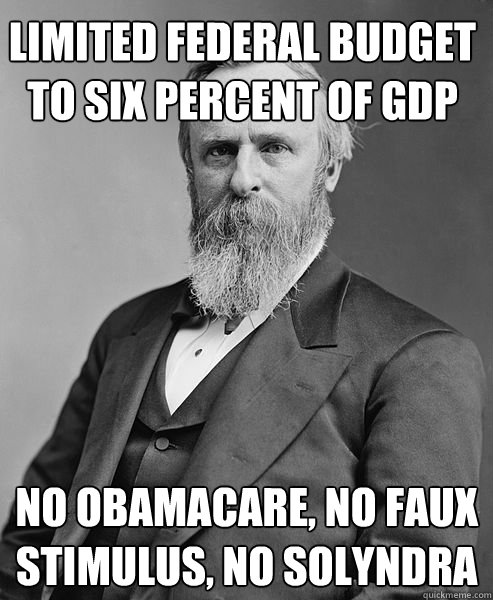
I wonder what the people would have said if Rutherford Hayes had spent 24.7% of GDP a year? Obama laughs at the thought of Rutherford on Mount Rushmore, but with the economic mess we have now I don’t there is much of a chance that President Obama will end up on there either. Here is an excellent article by Dan Mitchell of the Cato Institute:
But I feel the need to rise to the defense of Rutherford B. Hayes, who was mocked recently by the current President. This Mark Steyn column is a deliciously vicious commentary on Obama’s speech, so no need for me to delve into the details.
Instead, I want to jump on the bandwagon and produce some posters comparing the 19th President and the 44th President (if you’re not aware, posters of Pres. Hayes with self-created captions have been all over the Internet).
You won’t be surprised to learn that I’m focused on the policy differences between Hayes and Obama.
Most important, Hayes largely was true to the Founding Fathers’ vision of a limited central government. Government spending averaged only about 6 percent of economic output during his tenure (probably less, the data are not very robust, so I took the worst-case numbers) and America was blessedly free of the income tax.
I am an avid reader of the National Review and I remember watching those famous debates at Harvard between John Kenneth Galbraith and William Buckley. You probably were at some of those debates. Below is a portion of an article that talks about your recent State of the Union address:
RICHARD VEDDER
While it took President Obama only five minutes into the State of the Union address before he started bashing the rich, Wall Street, and the Chinese, he actually muted his confrontational approach as compared with other recent efforts. Still, it was a typical overlong speech, overstating accomplishments and ignoring negatives. Five examples of the latter: he misstated and dramatically downplayed his failure to stimulate the economy, claiming 3 million new jobs when in fact employment is lower than when he took office.
Second, there was hardly a word about health care, given fierce public opposition to Obamacare.
Third, he spoke about student-loan debt before even mentioning the national debt, where he renewed his tired and empirically indefensible solution of taxing the rich.
Fourth, he announced the Defense Department would push clean energy and somehow we would produce lots of clean energy on federal lands, but ignored the damage created by bowing to environmental Know-Nothing policies that have nixed the Keystone pipeline project and other energy initiatives.
Lastly, he uttered not a word about the huge long-term unfunded liabilities arising from unsustainable entitlement commitments like Social Security and Medicare. In short, it was a tale full of sound and fury, signifying nothing.
— Richard Vedder directs the Center for College Affordability and Productivity, is an adjunct scholar at the American Enterprise Institute, and teaches at Ohio University
Thank you so much for your time. I know how valuable it is. I also appreciate the fine family that you have and your committment as a father and a husband.
Sincerely,
Everette Hatcher III, 13900 Cottontail Lane, Alexander, AR 72002, ph 501-920-5733, lowcostsqueegees@yahoo.com
That video looked at the relationship between economic freedom and various indices that measure quality of life. Not surprisingly, free markets and small government lead to better results.
For years the United States has been a world leader in economic freedom. But runaway government spending and burdensome regulations have caused a decline in economic freedom in the United States. If our economic freedom continues to fall, how will it affect our quality of life?
_________
The entire video is superb, but there are two things that merit special praise, one because of intellectual honesty and the other because of intellectual effectiveness.
1. The refreshingly honest aspect of the video is its non-partisan tone. It explains, in a neutral fashion, that Bush undermined prosperity by making government bigger and that Obama is undermining prosperity by increasing the burden of government.
It’s also worth pointing out that there are several policies that impact on economic performance. The Koch Institute video focuses primarily on the key issues of fiscal policy and regulation, but trade, monetary policy, property rights, and rule of law are examples of other policies that also are very important.
This video, narrated by yours truly, looks at economic growth from this more comprehensive perspective.
Now that the so-called stimulus has been enacted, hopefully policy makers will turn their attention to policies that actually improve economic performance. This Center for Freedom and Prosperity Foundation video reviews the key finding in the Fraser Institute’s Economic Freedom of the World and explains that, contrary to the policies of Presidents Bush and Obama, smaller government and free markets are the way to boost economic growth. For more information: http://www.freedomandprosperity.org
________
The moral of the story from both videos is very straightforward. If the answer is bigger government, you’ve asked a very strange question.
In a night of disappointments, the complete lack of any mention of Social Security other than as an excuse to raise taxes was one of the greatest. Although the Social Security trustees, several of whom are members of the President’s cabinet, has warned that the program faces perpetual deficits, the President evidently has no plan to protect the retirement security of millions of Americans who face a 25% benefit cut in less than 25 years. Most officeholders join the President in treating Social Security as an issue that can be discussed later – much later, but the reality is that just like a leaky roof, the longer that the President and Congress waits to fix the program, the more expensive the reforms will be.
Tax Reform? It’s Needed, but There’s A Better Way to Go – Emily Goff
President Obama says he is ready and willing to embark on tax reform. This is a welcome statement, as our current tax system is ripe for overhaul. However, instead of piecemeal approaches or solutions that give preferences to one industry or company over another, the President should look to the fundamental reforms that the New Flat Tax, as part of The Heritage Foundation’s Saving the American Dream, would bring.
Obama Doubles Down on the Worst U.S. Tax Policy – J.D. Foster
One of the universally acknowledged banes of the federal income tax has for years been the individual Alternative Minimum Tax. Borne in its current form in the 1986 tax reform act, this parallel system which runs in parallel to the regular income tax forces taxpayers to calculate their taxes twice and pay the larger of the two.
Today, this tax makes no sense, and most tax reform proposals of sufficient heft seek as a primary goal the repeal of the AMT. Tonight, President Obama proposed not merely to embrace the AMT in principle, but to extend the principle robustly to the business income tax – to create a new basic minimum tax for businesses. Once again, when it comes to tax policy, President Obama sees what needs to be done – and does the exact opposite.
___________________
Got to tackle entitlement reform but your speech did not mention that once.
Thank you so much for your time. I know how valuable it is. I also appreciate the fine family that you have and your committment as a father and a husband.
Sincerely,
Everette Hatcher III, 13900 Cottontail Lane, Alexander, AR 72002, ph 501-920-5733, lowcostsqueegees@yahoo.com
In the clip above we see President Obama in his earlier debate with Hillary Clinton and he answered the question concerning the drop in the capital tax by Bill Clinton and the resulting increase in revenues, that he still would raise the capital gains tax on the 100,000 million Americans that owned stock because of the issue of fairness.
It seems that the corporate tax in the USA is almost double the world average and it should be reduced. In fact, Canada reduced theirs dramatically and still brought in about the same revenue.
Chris Edwards is the director of tax policy studies at the Cato Institute and the editor of Downsizing Government.org.
Added to cato.org on March 13, 2012
This article appeared in Daily Caller on March 13, 2012.
The President Obama and most members of Congress agree that the U.S. corporate tax rate should be cut. Thankfully, it is finally sinking in that having a 40 percent corporate tax rate when the world average is just 23 percent is suicide in a globalized economy.
The sticking point on slashing the corporate tax rate has been the fear that the federal government might lose revenues under such a reform. To prevent an expected revenue loss, policymakers have searched for tax loopholes to close in order to “pay for” a corporate rate cut. The problem is that members never find any loophole closings that they can agree on.
I’ve concluded that the effort to close corporate loopholes is a big waste of time. It is simply blocking desperately needed reforms to the tax rate. If I was drafting a corporate tax reform bill, I’d match a tax rate cut with federal spending cuts, but that idea hasn’t caught on either.
The good news is that a corporate tax rate cut without any changes to the tax base probably wouldn’t lose the government any money over the long term. Good evidence comes from Canada’s corporate tax cuts of the 1980s and 2000s.
The chart shows Canada’s federal corporate tax revenues as a share of gross domestic product (GDP) and the federal corporate tax rate. The tax rate plunged from 38 percent in 1980 to just 15 percent by 2012. Amazingly, there has been no obvious drop in tax revenues over the period.
Canadian corporate tax revenues have fluctuated, but the changes are correlated with economic growth, not the tax rate. In the late 1980s, a tax rate cut was followed by three years of stable revenues. In the early 1990s, a plunge in revenues was caused by a recession, and then in the late 1990s revenues soared as the economy grew.
In 2000, Canadian policymakers enacted another round of corporate tax rate cuts, which were phased in gradually. Corporate tax revenues initially dipped, but then they rebounded strongly in the late 2000s.
The rate cuts enacted in 2000 were projected to cause substantial revenue losses to the Canadian government. That projection indicates that the reform didn’t have much in the way of legislated loophole closing. But the chart shows that the positive taxpayer response to the rate cut was apparently so large that the government did not lose much, if any, revenue at all.
In 2009, Canada was dragged into a recession by the elephant economy next door, and that knocked the wind out of corporate tax revenues. However, it is remarkable that even with a recession and a tax rate under 20 percent, tax revenues as a share of GDP have been roughly as high in recent years as they were during the 1980s, when there was a much higher rate. Jason Clemens of the Macdonald-Laurier Institute notes that Canadian corporate tax revenues have been correlated with corporate profits, not the tax rate.
If a corporate tax rate is high, there is a “Laffer effect” when the rate is cut, meaning that the tax base expands so much that the government doesn’t lose any money. Estimates from Jack Mintz and other tax experts show that cutting corporate tax rates when they are above about 25 percent won’t lose governments any revenues over the long run.
The overall Canadian rate this year is about 27 percent when the average provincial rate is included. By contrast, the average federal-state rate in the United States is 40 percent, which is roughly 15 points above the revenue-maximizing rate. That means that Congress can proceed with a corporate rate cut and everyone would win — taxpayers, the economy and even the government.
Corporate tax reform with loophole closing is a wild-goose chase. Congress never seems to agree on which loopholes to close, with the result that our economy continues to suffer under a super-high rate. If we matched Canada by cutting our federal corporate rate from 35 percent to 15 percent, it would generate a large increase in reported income as corporate investment boomed and tax avoidance fell. The tax base would automatically expand without Congress even legislating reductions to deductions, credits or other loopholes.
In 2012, Canada will collect about 1.9 percent of GDP in federal corporate income tax revenues with a 15 percent tax rate. The United States will collect about 1.6 percent of GDP with a 35 percent tax rate. Do we need any more evidence that our high corporate tax rate makes no sense?




 Canadian corporate tax revenues have fluctuated, but the changes are correlated with economic growth, not the tax rate. In the late 1980s, a tax rate cut was followed by three years of stable revenues. In the early 1990s, a plunge in revenues was caused by a recession, and then in the late 1990s revenues soared as the economy grew.


 The Daily Hatch