Category Archives: Taxes

Reagan and Clinton had good fiscal policies according to Cato Institute

Uploaded by on Dec 16, 2010

http://blog.heritage.org/2010/12/16/new-video-pork-filled-spending-bill-just-… Despite promises from President Obama last year and again last month that he opposed reckless omnibus spending bills and earmarks, the White House and members of Congress are now supporting a reckless $1.1 trillion spending bill reportedly stuffed with roughly 6,500 earmarks.

________________________

Below you see an article and videos by Dan Mitchell of the Cato Institute concerning Reagan and Clinton. First lets look at where we are now with Obama.

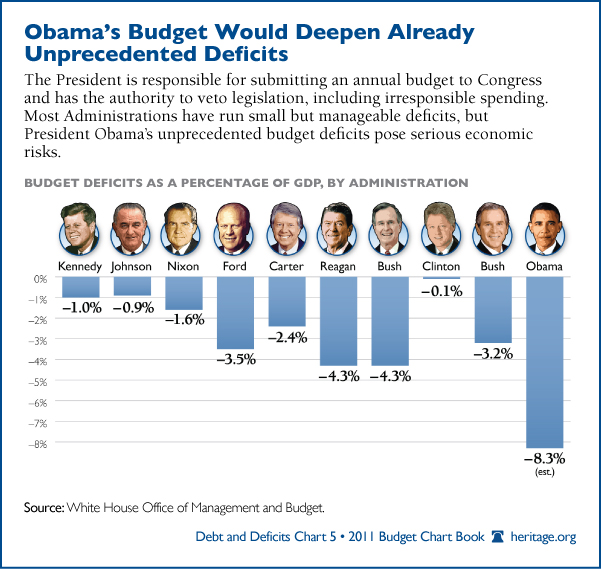
Over the last 10 presidents was have had 16.9% of GDP of deficits total from five Republican presidents and 12.7% total from Democratic presidents. However, what is most disturbing is that 8.3% of the 12.7% comes from the Obama administration who is currently in power and we are no longer in the cold war era. That is almost double the total of all the other four Democratic presidents combined under just one president. Take a look at the chart below from the Heritage Foundation:

Rob Bluey

January 1, 2012 at 9:56 am

Over the past 50 years, 10 U.S. presidents have made annual budget requests to Congress, projecting deficits both big and small. But no other president compares to Barack Obama when it comes to the size and scale of the current budget deficit facing the United States.

The country is facing an 8.3 percent estimated average national deficit of a two-term Obama administration — the biggest of the past 50 years. By comparison, the current estimate for Obama is nearly double the percentage under Presidents Ronald Reagan and George H.W. Bush — and they were fighting the Cold War.

Political party doesn’t tell the whole story, however. President Bill Clinton leads the pack of presidents since 1961, according to data from the White House Office of Management and Budget. Heritage put together this graphic as part of our Budget Chart Book.

So what does the current trajectory mean for the United States? We’re certainly no longer looking at a continuation of manageable deficits in the years to come. This is a dramatic change in the magnitude of annual shortfalls at the federal level. That’s one reason Heritage came up with a plan to fix the debt crisis.

If you have a suggestion for a chart we should feature in the future, please post a comment below, email us at scribe@heritage.org, or send me at tweet @RobertBluey.

_______________________
Here is a perspective from Dan Mitchell of the Cato Institute:

To Fix the Budget, Bring Back Reagan…or Even Clinton

Posted by Daniel J. Mitchell

President Obama unveiled his fiscal year 2012 budget today, and there’s good news and bad news. The good news is that there’s no major initiative such as the so-called stimulus scheme or the government-run healthcare proposal. The bad news, though, is that government is far too big and Obama’s budget does nothing to address this problem.

But perhaps the folks on Capitol Hill will be more responsible and actually try to save America from becoming a big-government, European-style welfare state. The solution may not be easy, but it is simple. Lawmakers merely need to restrain the growth of government spending so that it grows slower than the private economy.

Actual spending cuts would be the best option, of course, but limiting the growth of spending is all that’s needed to slowly shrink the burden of government spending relative to gross domestic product.

Fortunately, we have two role models from recent history that show it is possible to control the federal budget. This video from the Center for Freedom and Prosperity uses data from the Historical Tables of the Budget to demonstrate the fiscal policy achievements of both Ronald Reagan and Bill Clinton.

Spending Restraint, Part I: Lessons from Ronald Reagan and Bill Clinton

Uploaded by on Feb 14, 2011

Ronald Reagan and Bill Clinton both reduced the relative burden of government, largely because they were able to restrain the growth of domestic spending. The mini-documentary from the Center for Freedom and Prosperity uses data from the Historical Tables of the Budget to show how Reagan and Clinton succeeded and compares their record to the fiscal profligacy of the Bush-Obama years.

_____________________


Some people will want to argue about who gets credit for the good fiscal policy of the 1980s and 1990s.

Bill Clinton’s performance, for instance, may not have been so impressive if he had succeeded in pushing through his version of government-run healthcare or if he didn’t have to deal with a Republican Congress after the 1994 elections. But that’s a debate for partisans. All that matters is that the burden of government spending fell during Bill Clinton’s reign, and that was good for the budget and good for the economy. And there’s no question he did a much better job than George W. Bush.

Indeed, a major theme in this new video is that the past 10 years have been a fiscal disaster. Both Bush and Obama have dramatically boosted the burden of government spending — largely because of rapid increases in domestic spending.

This is one of the reasons why the economy is weak. For further information, this video looks at the theoretical case for small government and this video examines the empirical evidence against big government.

Another problem is that many people in Washington are fixated on deficits and debt, but that’s akin to focusing on symptoms and ignoring the underlying disease. To elaborate, this video explains that America’s fiscal problem is too much spending rather than too much debt.

Last but not least, this video reviews the theory and evidence for the “Rahn Curve,” which is the notion that there is a growth-maximizing level of government outlays. The bad news is that government already is far too big in the United States. This is undermining prosperity and reducing competitiveness.

Spending Restraint, Part II: Lessons from Canada, Ireland, Slovakia, and New Zealand

Uploaded by on Feb 22, 2011

Nations can make remarkable fiscal progress if policy makers simply limit the growth of government spending. This video, which is Part II of a series, uses examples from recent history in Canada, Ireland, Slovakia, and New Zealand to demonstrate how it is possible to achieve rapid improvements in fiscal policy by restraining the burden of government spending. Part I of the series examined how Ronald Reagan and Bill Clinton were successful in controlling government outlays — particularly the burden of domestic spending programs. http://www.freedomandprosperity.org


In 2011 Social Security spent $45 billion more in benefits than it took in from its payroll tax

Uploaded by on Jun 21, 2011

Senator Kay Bailey Hutchison delivered remarks regarding her landmark proposal on entitlement reform, the Defend and Save Social Security Act at the Heritage Foundation’s “Saving Social Security” event. Sen. Hutchison announced that Senator Jon Kyl (R-AZ), member of Biden’s budget working group, has lent his support of her bill as the original cosponsor. At her press conference last week, Sen. Hutchison unveiled her Social Security proposal, and today she reiterated the urgency of putting Social Security on the table in the Biden budget group discussions. Sen. Hutchison sent a letter to Vice President Joe Biden last week urging him to incorporate Social Security reform in the ongoing deficit reduction debates that he is leading.

___________________

If you don’t think that Social Security is in trouble then just consider the fact that the first Baby Boomer just got their first Social Security check at age 65 in 2011 and now we have 19 more years of baby boomers retiring. Also in 2011 Social Security spent $45 billion more in benefits than it took in from its payroll tax.

Social Security Finances Significantly Worse, Says 2012 Trustees Report

By
April 23, 2012

“There are risks and costs to action. But they are far less than the long-range risks of comfortable inaction.”

—John F. Kennedy

“Lawmakers should not delay addressing the long-run financial challenges facing Social Security and Medicare,” the trustees wrote. “If they take action sooner rather than later, more options and more time will be available to phase in changes so that the public has adequate time to prepare.”

—2012 Social Security trustees report

Social Security’s finances significantly worsened last year, according to the new 2012 trustees report,[1] because of a weakened economy and structural problems with the program. The April 23 report shows that all people who receive Social Security benefits face about a 25 percent benefit cut as soon as 2033—three years earlier than predicted in last year’s report. The program’s long-term deficit is now larger than it was before the 1983 reforms. In order to pay all of its promised benefits, Social Security would require massive annual injections of general revenue tax money in addition to what the program receives from payroll taxes. These additional funds would be needed for the next 75 years and beyond.

Factors Dragging Down Social Security

The poor numbers come from a number of factors, including the continued weakness of the U.S. economy, high energy prices holding down wages, and a significant increase in the number of people who receive benefits from Social Security’s disability program (SSDI). SSDI has its own sub-trust fund that will be exhausted in 2016. While some SSDI costs will be paid from money that would have gone to pay retirement and survivors’ benefits, SSDI recipients face across-the-board benefit reductions in just four years. As this year’s report shows, the need to reform SSDI is as great as the need to fix the rest of the program.

Long-Term Financial Picture Worsens

In net-present-value terms, Social Security owes $11.3 trillion more in benefits than it will receive in taxes. This 2012 number consists of $2.7 trillion to repay the special-issue bonds in the trust fund and $6.5 trillion to pay benefits after the trust fund is exhausted in 2033. This is an increase of $2.2 trillion from last year’s report. This is the largest one-year drop in the program’s finances since 1994.

Net present value is the amount of money that would have to be invested today in order to have enough money on hand to pay deficits in the future. In other words, Congress would have to invest $11.3 trillion today in order to have enough money to pay all of Social Security’s promised benefits through 2086. This money would be in addition to what Social Security receives during those years from its payroll taxes.

The trustees report’s perpetual projection extends beyond the usual 75-year planning horizon. In net-present-value terms, the perpetual projection is $20.5 trillion, including money necessary to repay bonds in the trust fund. Last year’s number was $17.9 trillion.

This means that Social Security’s net-present-value deficit after 2086 is $9.2 trillion. These projections show that the program’s total deficit continues to grow well beyond the 75-year projection period. For that reason, a successful reform would need to eliminate the deficits over the 75-year window and address those that come after that period.

In actuarial terms, Social Security’s long-term financing declined sharply from a 75-year deficit of 2.22 percent of taxable payroll in last year’s report to a deficit of 2.67 percent. This 0.44 percent change resulted mainly from the economy’s continued weakness and the effects of high energy costs.

Social Security Ran Another Deficit Last Year

In 2011, the Old-Age and Survivors Trust Fund, which pays for retirement and survivors’ benefits, took in $698.8 billion, which includes $106.5 billion that came from a paper transaction that credited interest to the trust fund. Excluding the interest, the retirement and survivors program had income of $592.3 billion but paid out $603.8 billion in benefits, leaving a deficit for 2011 of $11.5 billion. Additional deficits were suffered by Social Security’s disability program.

Counting both programs together, in 2011, Social Security spent $45 billion more in benefits than it took in from its payroll tax. This deficit is in addition to a $49 billion gap in 2010 and an expected average annual gap of about $66 billion between 2012 and 2018. These deficits will quickly balloon to alarming proportions. After adjusting for inflation, annual deficits will reach $95 billion in 2020 and $318.7 billion in 2030 before the trust fund runs out in 2033. Now is the time to focus on solutions.

The immediate cash-flow deficits are largely due to the effects of the recession on the program’s finances. The recession increased the amount of benefits paid out by Social Security, as older workers who lost their jobs chose to file for benefits earlier than they might have otherwise. Meanwhile, younger unemployed workers did not pay Social Security taxes, while workers who suffered a drop in their incomes paid lower amounts. However, this year’s projections show that these effects will continue. Higher energy prices are expected to dampen income increases, while the longer-term effects of the recession are likely to hold down the number of hours individuals can work.

Moreover, the condition of Social Security continues to deteriorate in future years so that the overall estimate is further worsened in 2012, when the 75-year financial window shifts to include 2086—a year when Social Security is expected to run a very large deficit.

The Trust Fund Does Not Make Social Security Healthy

The existence of a trust fund does not make Social Security healthy. Although those assets are guaranteed by the full faith and credit of the United States, the bonds it contains must be repaid using general revenue that would otherwise go to other programs. Similarly, the interest that Social Security receives on existing trust fund balances is not spendable income. It merely inflates the numbers in the trust fund and increases the amount that Social Security will eventually receive from general revenue. The only part that counts today is the cash that Social Security receives from the Treasury to cover its annual operating losses.

Many opponents of reform claim that raising payroll taxes by about 2.7 percent (the average percentage difference between revenues and outlays over the 75-year period) would permanently solve Social Security’s problems. The reality, however, is that the program’s future deficits are projected to be both large and growing, so this tax increase would still leave a huge shortfall. Modest changes will not fix the current system.

Delay in Fixing Social Security Will Only Make Matters Even Worse

Congress could have fixed Social Security several years ago but delayed because it feared making the difficult decisions. A further delay in addressing Social Security’s financial problems will only make the situation even worse. The new trustees report is not based on conjecture; it is based on a firm understanding of the economy and the U.S. population. Almost every new taxpayer who will begin a career before 2033 is living today and can be counted. Similarly, all the people who will face approximately 25 percent across-the-board benefit cuts starting in the year 2033 if Congress does nothing to fix the program are alive now, and most of them are paying taxes.

Social Security’s problems are based on demographics that do not change from year to year. The people who will be hurt if nothing is done to fix Social Security are not unknown people of the future: They are the nation’s children and grandchildren of today.

David C. John is Senior Research Fellow in Retirement Security and Financial Institutions in the Thomas A. Roe Institute for Economic Policy Studies at The Heritage Foundation.

Dan Mitchell of the Cato Institute: How to balance the budget

It’s Simple to Balance The Budget Without Higher Taxes

Uploaded by on Oct 4, 2010

Politicians and interest groups claim higher taxes are necessary because it would be impossible to cut spending by enough to get rid of red ink. This Center for Freedom and Prosperity video shows that these assertions are nonsense. The budget can be balanced very quickly by simply limiting the annual growth of federal spending.

____________________

People are being told that radical spending cuts are a must if we are to balance the budget, but maybe that is not true.

Even though I favor radical reductions in the burden of government, I’ve made the point that good fiscal policy merely requires that government spending grow slower than the private sector – what I call Mitchell’s Golden Rule.

And if lawmakers simply cap the growth of spending, so that it grows by about 2 percent annually, the budget deficit disappears in a decade.

It’s even better to impose more restraint, of course, which is why I’ve said favorable things about Senator Rand Paul’s plan.

There’s also a “Penny Plan” that would reduce primary spending (non-interest spending) by 1 percent each year. As James Carter and Jason Fichtner explain, this degree of fiscal restraint would reduce the burden of government spending to about 18 percent of economic output.

Any viable solution must cut spending growth. Sen. Mike Enzi of Wyoming and Rep. Connie Mack of Florida have introduced legislation in their respective chambers to do just that. Their “Penny Plan” – recently updated to reflect the latest budget developments – calls for reducing federal spending (excluding interest payments) 1 percent a year for five years, balancing the budget in the fifth year. To maintain balance once it’s reached, Mr. Enzi and Mr. Mack would cap federal spending at 18 percent of GDP. By no small coincidence, 18 percent of GDP roughly matches the U.S. long-run average level of taxation since World War II. Is it realistic to think Congress could limit federal spending to 18 percent of GDP? Actually, there is precedent. Federal spending fell as a share of GDP for nine consecutive years before bottoming out at 18.2 percent of GDP in fiscal 2000 and 2001. The Penny Plan would return federal spending, expressed as a share of GDP, near the level achieved during the last two years of the Clinton administration.

The various interest groups that infest Washington would complain about this degree of spending discipline, but Carter and Fichtner make a good point when they say that this simply means the same size government – as a share of GDP – that we had when Bill Clinton left office.

I realize I’m getting old and my memory may not be what it used to be, but I don’t recall people starving in the streets and grannies being ejected from hospitals during the Clinton years. Am I missing something?

Open letters to President Obama displayed here on www.thedailyhatch.org

I have been writing letters to President Obama almost all of 2012. I have received several responses from the White House but none of the responses have been personal responses from the President.

Below is a letter I wrote to the President and a form letter response that I got followed by links to other letters I have written him.

KIreland.jpg 

Science Matters #2: Former supermodel Kathy Ireland tells Mike Huckabee about how she became pro-life after reading what the science books have to say.

President Obama c/o The White House
1600 Pennsylvania Avenue NW
Washington, DC 20500

Dear Mr. President,

I know that you receive 20,000 letters a day and that you actually read 10 of them every day. I really do respect you for trying to get a pulse on what is going on out here.

I wanted to talk to you today about your views on abortion. Everyone remembers Kathy Ireland from her Sports Illustrated days and actually she has became a very successful business person.  However, I wanted to talk about her pro-life views.

_____________

Back on April 27, 2009 Fox News ran a story by Hollie McKay(Supermodel Kathy Ireland Lashes Out Against Pro Choice,”) on  Ireland.

It’s no secret that the majority of Hollywood stars are strong advocates for a woman’s right to choose whether or not she wants to terminate a pregnancy, however former “Sports Illustrated” supermodel-turned-entrepreneur-turned-author Kathy Ireland has gone against the grain of the glitterati and spoken out against abortion.

“My entire life I was pro-choice — who was I to tell another woman what she could or couldn’t do with her body? But when I was 18, I became a Christian and I dove into the medical books, I dove into science,” Ireland told Tarts while promoting her insightful new book “Real Solutions for Busy Mom: Your Guide to Success and Sanity.”

“What I read was astounding and I learned that at the moment of conception a new life comes into being. The complete genetic blueprint is there, the DNA is determined, the blood type is determined, the sex is determined, the unique set of fingerprints that nobody has had or ever will have is already there.”

However Ireland admitted that she did everything she could to avoid becoming a believer in pro-life.

“I called Planned Parenthood and begged them to give me their best argument and all they could come up with that it is really just a clump of cells and if you get it early enough it doesn’t even look like a baby. Well, we’re all clumps of cells and the unborn does not look like a baby the same way the baby does not look like a teenager, a teenager does not look like a senior citizen. That unborn baby looks exactly the way human beings are supposed to look at that stage of development. It doesn’t suddenly become a human being at a certain point in time,” Ireland argued. “I’ve also asked leading scientists across our country to please show me some shred of evidence that the unborn is not a human being. I didn’t want to be pro-life, but this is not a woman’s rights issue but a human rights issue.”

My good friend Dr. Kevin R. Henke is a scientist and also an atheistic evolutionist. I had a lot of discussions with Kevin over religious views. I remember going over John 7:17 with him one day. It says:

John 7:17 (Amplified Bible)

17If any man desires to do His will (God’s pleasure), he will know (have the needed illumination to recognize, and can tell for himself) whether the teaching is from God or whether I am speaking from Myself and of My own accord and on My own authority.

I challenged Kevin to read a chapter a day of the Book of John and pray to God and ask God, “Dear God, if you are there then reveal yourself to me, and I pledge to serve you the rest of my life.”

Kevin did that and he even wrote down the thoughts that came to his mind and sent it to me and these thoughts filled a notebook.

Kevin did not become a Christian, but I am still praying for him. I do respect Kevin because he is an honest man. Interestingly enough he  told me that he was pro-life because the unborn baby has all the genetic code at  the time of conception that they will have for the rest of their life. Below are some other comments by other scientists:

Dr. Hymie Gordon (Mayo Clinic): “By all criteria of modern molecular biology, life is present from the moment of conception.”

Dr. Micheline Matthews-Roth (Harvard University Medical School): “It is scientifically correct to say that an individual human life begins at conception.”

Dr. Alfred Bongioanni (University of Pennsylvania): “I have learned from my earliest medical education that human life begins at the time of conception.”

Dr. Jerome LeJeune, “the Father of Modern Genetics” (University of Descartes, Paris): “To accept the fact that after fertilization has taken place a new human has come into being is no longer a matter of taste or opinion . . . it is plain experimental evidence.”

__

Thank you so much for your time. I know how valuable it is. I also appreciate the fine family that you have and your committment as a father and a husband.

Sincerely,

Everette Hatcher III, 13900 Cottontail Lane, Alexander, AR 72002, ph 501-920-5733, lowcostsqueegees@yahoo.com

_______________

I actually mailed this to President Obama about a week ago and got this email back:

The White House, Washington


April 16, 2012

Dear Everette:

Thank you for taking the time to share your views on abortion.  This is a heart-wrenching issue, and I appreciate your input and thoughts.

I am committed to making my Administration the most open and transparent in history, and part of delivering on that promise is hearing from people like you.  I take seriously your opinions and respect your point of view on this issue.  Please know that your concerns will be on my mind in the days ahead.

Thank you, again, for writing.  I encourage you to visit www.WhiteHouse.gov to learn more about my Administration or to contact me in the future.

Sincerely,

Barack Obama

An open letter to President Obama (Part 65)

Leader Cantor On CNN Responding To President Obama’s State of the Union Address Uploaded by EricCantor on Jan 25, 2012 ______________ President Obama c/o The White House 1600 Pennsylvania Avenue NW Washington, DC 20500 Dear Mr. President, I know that you receive 20,000 letters a day and that you actually read 10 of them every day. I […]


“Feedback Friday” Letter to White House generated form letter response March 7, 2011 (part 3)

I have been writing President Obama letters and have not received a personal response yet.  (He reads 10 letters a day personally and responds to each of them.) However, I did receive a form letter in the form of an email on March 7, 2011. I don’t know which letter of mine generated this response so I have […]


An open letter to President Obama (Part 58) “Our national debt threatens our security”

Liam Fox Issues a Warning to America Uploaded by HeritageFoundation on Feb 28, 2012 Britain’s Liam Fox has a warning for America: Fix the debt problem now or suffer the consequences of less power on the world stage. The former U.K. secretary of state for defense visited Heritage to explain why the America’s debt is […]

“Feedback Friday” Letter to White House generated form letter response Jan 27, 2011 (part 2)

I have been writing President Obama letters and have not received a personal response yet.  (He reads 10 letters a day personally and responds to each of them.) However, I did receive a form letter in the form of an email on January 27, 2011. I don’t know which letter of mine generated this response so I have […]

“Feedback Friday” Letter to White House generated form letter response Jan 25, 2011 (part 1)

I have been writing President Obama letters and have not received a personal response yet.  (He reads 10 letters a day personally and responds to each of them.) However, I did receive a form letter in the form of an email on January 25, 2011. I don’t know which letter of mine generated this response so I have […]

An open letter to President Obama (Part 48 of my response to State of Union Speech 1-24-12)

An open letter to President Obama (Part 48 of my response to State of Union Speech 1-24-12) Rep Michael Burgess response Uploaded by MichaelCBurgessMD on Jan 25, 2012 This week Dr. Burgess provides an update from Washington and responds to President Obama’s State of the Union address. President Obama’s state of the union speech Jan 24, 2012 […]

An open letter to President Obama (Part 47, A response to your budget)

Corker Says President’s 2012 Budget Proposal Shows “Lack of Urgency” on Spending Uploaded by senatorcorker on Feb 14, 2011 In remarks on the Senate floor today, U.S. Senator Bob Corker, R-Tenn., expressed disappointment in President Obama’s 2012 budget proposal, saying it displayed a “lack of urgency” to get federal spending under control. Corker has introduced […]

An open letter to President Obama (Part 1 of State of Union Speech 1-24-12)

President Obama’s state of the union speech Jan 24, 2012 Feb 6, 2012 President Obama c/o The White House 1600 Pennsylvania Avenue NW Washington, DC 20500 Dear Mr. President, I know that you receive 20,000 letters a day and that you actually read 10 of them every day. I really do respect you for trying […]

An open letter to President Obama

  January 25, 2012 President Obama c/o The White House 1600 Pennsylvania Avenue NW Washington, DC 20500 Dear Mr. President, I know that you receive 20,000 letters a day and that you actually read 10 of them every day. I really do respect you for trying to get a pulse on what is going on […]


Lessons to Obama on how to prosper from selected states

https://i0.wp.com/www.freetochoosemedia.org/production/POC/presskit2/milton-president-reagan.jpg

Milton Friedman served as economic advisor for two American Presidents – Richard Nixon and Ronald Reagan. Although Friedman was inevitably drawn into the national political spotlight, he never held public office.

Milton Friedman’s Free to Choose (1980), episode 1 – Power of the Market. part 1

Today President Obama is telling us that we must raise taxes in order for us to prosper and grow our economy. I have heard that before and it has never worked!!!!

Liberals like Ernie Dumas and Max Brantley who write for the Arkansas Times have always bragged on the 7% state income tax that Dale Bumpers raised in 1971 and how Arkansas has grown economically since then. However, the facts are quite different.

Ernie Dumas in his article “Arkansas” A tax myth-maker too,” Arkansas Times, April 13, 2011 asserts:

Until Gov. Dale Bumpers raised income-tax rates and other taxes in 1971, Arkansas had by far the lowest per-capita state and local taxes in the United States. Afterward, we were still 50th but within shouting distance of 49th.

Here are the real facts  according to Greg Kaza of the Arkansas Policy Foundation:

(June 2006) Democratic Gov. Dale Bumpers and the General Assembly raised Arkansas’ top income tax rate to “broaden the tax base” in 1971(1). Yet Arkansas’ per capita income, expressed as a percentage of the U.S. total, has barely improved, moving from 71 (1971) to 77.7 percent (2005) over the 34-year period, according to data from the U.S. Bureau of Economic Analysis. The 1971 income tax increase reversed a decades-long strong growth trend and left Arkansas with the highest income tax rate among bordering states (Mississippi, Missouri, Louisiana, Oklahoma, Tennessee and Texas).

Income Stagnation: The 1930s

One has to turn to the 1930s-the decade of the Great Depression-to find weaker income growth than in recent years.

Arkansas per capita personal income was 44 percent of the U.S. in 1929, the first year data was compiled in the BEA time series. The Great Depression started that year, and by the time it ended in 1933 Arkansas per capita income had fallen to 41 percent of the U.S. By decade’s end (1939) it had returned to 44 percent.

Growth Decades: The 1940s, 1950s & 1960s
Arkansas per capita income increased as a percentage of the U.S. in the next three decades.
In 1941, at the onset of World War II, Arkansas per capita income was 47 percent of the U.S. It was 59 percent at war’s end in 1945 and again in 1949. It was 56 percent in 1950, 62 percent a decade later in 1960, and 68 percent in 1969. If this growth rate had continued Arkansas would have exceeded 100 percent of the U.S. average in the current decade (2000-2009).

To summarize, Arkansas per capita income increased from 44 to 71 percent of the U.S. total between 1939 and 1971.

Anemic Income Growth (1971-2005)

The trend in recent decades is anemic growth in Arkansas per capita personal income. Fiscal policy changes effect economic behavior with a time lag. Arkansas per capita income was 71 percent of the U.S. in 1971 and 76 percent in 1973. Income growth stagnated for the rest of the decade, reaching 77 percent of the U.S. in 1979. It fell to 75 percent in 1989, and was 76 percent in 1999. Today, Arkansas per capita income, at 77.7 percent of the U.S., is barely above its high point of the 1970s.

_____________

We can look at other states and see what their experience is too.

I’ve done a couple of posts comparing Reaganomics and Obamanomics, mostly based on data from the Minneapolis Federal Reserve on employment and economic output.

I even did a TV interview on the subject, which generated some comments on my taste in clothing, and also cited a Richard Rahn column that got Paul Krugman and Ezra Klein upset.

Some of the best evidence about high tax rates vs. low tax rates comes from inside America. Art Laffer (yes, that Art Laffer) and Steve Moore have a great column in today’s Wall Street Journal. It’s sort of Reaganomics vs. Obamanomics, looking at evidence from the states.

Barack Obama is asking Americans to gamble that the U.S. economy can be taxed into prosperity. …Mr. Obama needs a refresher course on the 1920s, 1960s, 1980s and even the 1990s, when government spending and taxes fell and employment and incomes grew rapidly. But if the president wants to see fresher evidence of how taxes matter, he can look to what’s happening in the 50 states. In our new report “Rich States, Poor States,” prepared for the American Legislative Exchange Council, we compare the economic performance of states with no income tax to that of states with high rates. It’s like comparing Hong Kong with Greece… Every year for the past 40, the states without income taxes had faster output growth (measured on a decadal basis) than the states with the highest income taxes. In 1980, for example, there were 10 zero-income-tax states. Over the decade leading up to 1980, those states grew 32.3 percentage points faster than the 10 states with the highest tax rates. Job growth was also much higher in the zero-tax states. The states with the nine highest income tax rates had no net job growth at all, and seven of those nine managed to lose jobs.

Tax rates also lead people to “vote with their feet.” Laffer and Moore look at migration patterns.

Over the past decade, states without an income tax have seen 58% higher population growth than the national average, and more than double the growth of states with the highest income tax rates. …Illinois, Oregon and California are state practitioners of Obamanomics. All have passed soak-the-rich laws like the Buffett Rule (plus economically harmful regulations, like California’s cap-and-trade scheme), and all face big deficits because their economies continue to sink. Illinois has lost one resident every 10 minutes since hiking tax rates in January. California has 10.9% unemployment, having lost 4.8% of its jobs over the past decade. …Every time California, Illinois or New York raises taxes on millionaires, Florida, Texas and Tennessee see an influx of rich people who buy homes, start businesses and shop in the local economy.

Competition among the states is leading some states to make further improvements. Some are even trying to get rid of their income taxes.

Republican governors in Florida, Georgia, Idaho, North Dakota, South Carolina, Ohio, Tennessee, Wisconsin and even Michigan and New Jersey are cutting taxes to lure new businesses and jobs. Asked why he wants to reduce the cost of doing business in Wisconsin, Gov. Scott Walker replies: “I’ve never seen a store get more customers by raising its prices, but I’ve seen customers knock down the doors when they cut prices.” Georgia, Kansas, Missouri and Oklahoma are now racing to become America’s 10th state without an income tax.

I like the quote from Governor Walker. He seems to know what he’s talking about, so it will be interesting to see whether he survives the upcoming recall election. I guess it depends whether voters understand that big government and high tax rates is a recipe for continued decline.

Some states, such as Illinois and California, are filled with voters who refuse to recognize reality. Think of them as the Greece and Spain of America, perhaps because the number of tax-consumers is greater than the number of tax-producers.

And even though parasites should understand it doesn’t make sense to kill their host animals, this cartoon illustrates how the welfare states lures a growing number of people to ride in the wagon. And this cartoon shows the consequences of too many moochers and not enough producers.

______________

Take a look at all the Milton Friedman clips that I have posted today. These liberals I mentioned above have truly forgotten how powerful the market is if not interferred with by the government.

Milton Friedman’s Free to Choose (1980), episode 1 – Power of the Market. part 2

Related posts:


Why do people move to other states to avoid Arkansas’ high state income tax? (If you love Milton Friedman then you will love this post)

Milton Friedman served as economic advisor for two American Presidents – Richard Nixon and Ronald Reagan. Although Friedman was inevitably drawn into the national political spotlight, he never held public office. Milton Friedman’s Free to Choose (1980), episode 1 – Power of the Market. part 1 Mike Huckabee recently moved to Florida? Why? The answer […]

Milton Friedman’s Free to Choose (1980), episode 1 – Power of the Market. part 3

Dan Mitchell of the Cato Institute takes on liberals on PBS

You want the rich to pay more? Dan Mitchell observed:I explained that “rich” taxpayers declared much more income and paid much higher taxes after Reagan reduced the top tax rate from 70 percent to 28 percent.

Liberals don’t understand good tax policies.

With the clock ticking ever closer to the tax-filing deadline, this is the time of year we should be especially cognizant of America’s awful tax system.

Disdain for the corrupt tax code certainly motivates me. As such, even though the panel was stacked against me with three proponents of Obama’s class warfare approach, I hope I did a decent job of defending good tax policy against the statists in this debate on government-subsidized TV.

___________

Dan Mitchell Battling against Tax Hikes and Class Warfare on PBS

Published on Apr 12, 2012 by

No description available.

____________

My most effective moment (I think) was when I explained that “rich” taxpayers declared much more income and paid much higher taxes after Reagan reduced the top tax rate from 70 percent to 28 percent.

I also had a couple of good lines when discussing the value-added tax.

Nonetheless, I think I was disadvantaged by the editing process since many of my comments from our hour-long taping got cut out. If you are sufficiently masochistic, you can listen to the entire program at this link.

I’ll close with an observation. If you support freedom and liberty and work in public policy, you better get used to being outnumbered. When I testified to the Ways & Means Committee about the VAT, I was a lone voice against this pernicious tax while the other four witnesses supported making America more like Greece.

And when I appeared on an English-language French TV program to debate tax havens, I had to battle three statists.

But at least I have truth on my side, so that compensates.

Milton Friedman on tax freedom day

Why does the federal government have to take so much control of our lives? Back in 1929 the federal government spent 3% of GDP and now it spends 24.8%. Back then in 1929 there was 8.9% by State and local governments for a total of 11.9% and our freedom day was February 12th when we turn our attention to spending our money on the things we need. Now the government spends over 50% of our money and we don’t get our freedom day until sometime in July!!!

Milton Friedman on Tax Freedom Day

Posted by Chris Edwards

The Tax Foundation reported that Tuesday was Tax Freedom Day (TFD), which is the day that Americans stop “working for the government” through their tax payments and start working for themselves.

TFD is calculated by taking total federal, state, and local taxes and dividing by national income to get a ratio representing the share of income that the average person pays in all taxes. That ratio is applied to the 365-day calendar. This year the ratio is 29.2 percent, which translates into April 17 for TFD. Time to party!

But maybe not quite yet…

When I worked at Tax Foundation in 1993, I mailed a letter to Milton Friedman asking about his view on TFD. He kindly responded with a letter and a 1974 Newsweek article in which he proposed a “Personal Independence Day.” That day would be based on total government spending, which is larger than total taxes, and thus our day to celebrate freedom from the government hasn’t yet arrived this year.

In his letter to me, Friedman stressed that total spending is the important variable in assessing the burden of government: “If government spends an amount equal to 50 percent of the national income, only 50 percent is left to be available for private purposes, and that is true however the 50 percent that government spends is financed.” And while some economists focus on how government borrowing may “crowd out” private investment, Friedman said, “What does the crowding out is government spending, however financed, not government deficits.”

In its TFD report, Tax Foundation includes a supplemental calculation looking at spending. The thinktank figures that Americans will work until May 14 this year to be free from the burden of federal, state, and local spending. The Foundation is lacking a snappy name for that important day, but now we are reminded that Friedman has already suggested one.  

Friedman hoped that “Personal Independence Day” would complement our national Independence Day of July 4. The latter is the day we celebrate independence from the “Royal Brute of Britain,” as Tom Paine called him in Common Sense. But for Paine and the other Founders, the deeper goal of July 4, 1776 was to create a limited government to ensure the maximum space for the exercise of individual freedom. As Paine noted, private “society in every state is a blessing, but government, even in its best state, is but a necessary evil.”

So Milton Friedman’s Personal Independence Day can be our annual reminder that while our forefathers gave the boot to the “crowned ruffians” of Old Europe, we’ve still got work to do in limiting the power grabbing of our own elected ruffians in Washington.

____________

Obama is wrong about about Buffett Rule

Matt Welch Discusses the Buffett Rule and His Favorite Beatles Songs on Varney & Co.

Here he goes again with the class warfare.

NPR, Obama, and the Misleading ‘Buffett Rule’

Posted by David Boaz

NPR says that President Obama will propose that millionaires pay income taxes “at the same rates as average working Americans.” On the 9:00 a.m. hourly news.)

That would be good news for most millionaires:

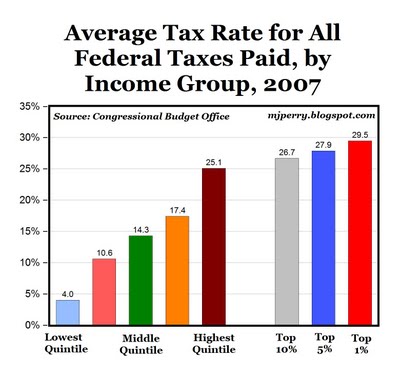
To be sure, NPR’s longer stories on Obama and the “Buffett rule” are more precise, as in Tuesday’s story that said the proposed law “would require anyone making a million dollars a year or more to pay at least 30 percent in taxes.” Even there, though, the sentence went on to say “- about twice what some millionaires pay now.” And as the charts above show, that’s quite misleading. The Congressional Budget Office reported in 2010,

The overall federal tax system is progressive—that is, average tax rates generally rise with income. Households in the bottom quintile (fifth) of the income distribution paid 4 percent of their income in federal taxes, while the middle quintile paid 14 percent, and the highest quintile paid 25 percent. Average rates continued to rise within the top quintile, with the top 1 percent facing an average rate of close to 30 percent.

An open letter to President Obama (Part 59)


President Obama c/o The White House
1600 Pennsylvania Avenue NW
Washington, DC 20500

Dear Mr. President,

I know that you receive 20,000 letters a day and that you actually read 10 of them every day. I really do respect you for trying to get a pulse on what is going on out here.

Dan Mitchell of the Cato Institute shows why your plan to tax the rich will not solve our deficit problem.  

Explaining in the New York Post Why Obama’s Soak-the-Rich Tax Policy Is Doomed to Failure

April 17, 2012 by Dan Mitchell

I think high tax rates on certain classes of citizens are immoral and discriminatory. If the government is going to collect revenue, all taxpayers should be treated equally, with something akin to a simple flat tax.

But most people don’t seem to care about having the law apply the same to all people, so I make a strictly utilitarian case for low tax rates in today’s New York Post. Here some of what I wrote.

Whether it’s through the Buffett Rule, higher income-tax rates or double taxation of dividends and capital gains, President Obama often demands that “rich” taxpayers and big corporations send more money to Washington. But…trying to get more money from upper-income taxpayers is like playing whack-a-mole. So long as tax rates are high, rich people will figure out ways to protect their income.It doesn’t take a tax genius; any rich person can make a phone call or hit a few computer keys and shift his or her investments to tax-free municipal bonds. It’s not good for the economy when capital gets diverted to help finance the excess spending of Detroit or California, but it’s an effective way of stiff-arming the IRS. Or the rich can play the green-energy scam, getting all sorts of credits to offset their tax liabilities. …Even if lawmakers abolished the various tax-code distortions, they might still be disappointed. The one sure way for rich people to lower their tax bills is by generating less income. …This isn’t some sort of modern-day revelation. Andrew Mellon, a Treasury secretary during the 1920s, noted that “the history of taxation shows that taxes which are inherently excessive are not paid. The high rates inevitably put pressure upon the taxpayer to withdraw his capital from productive business.”

I then provide a specific example, looking at how Reagan’s lower tax rates resulted in a lot more revenue from the rich.

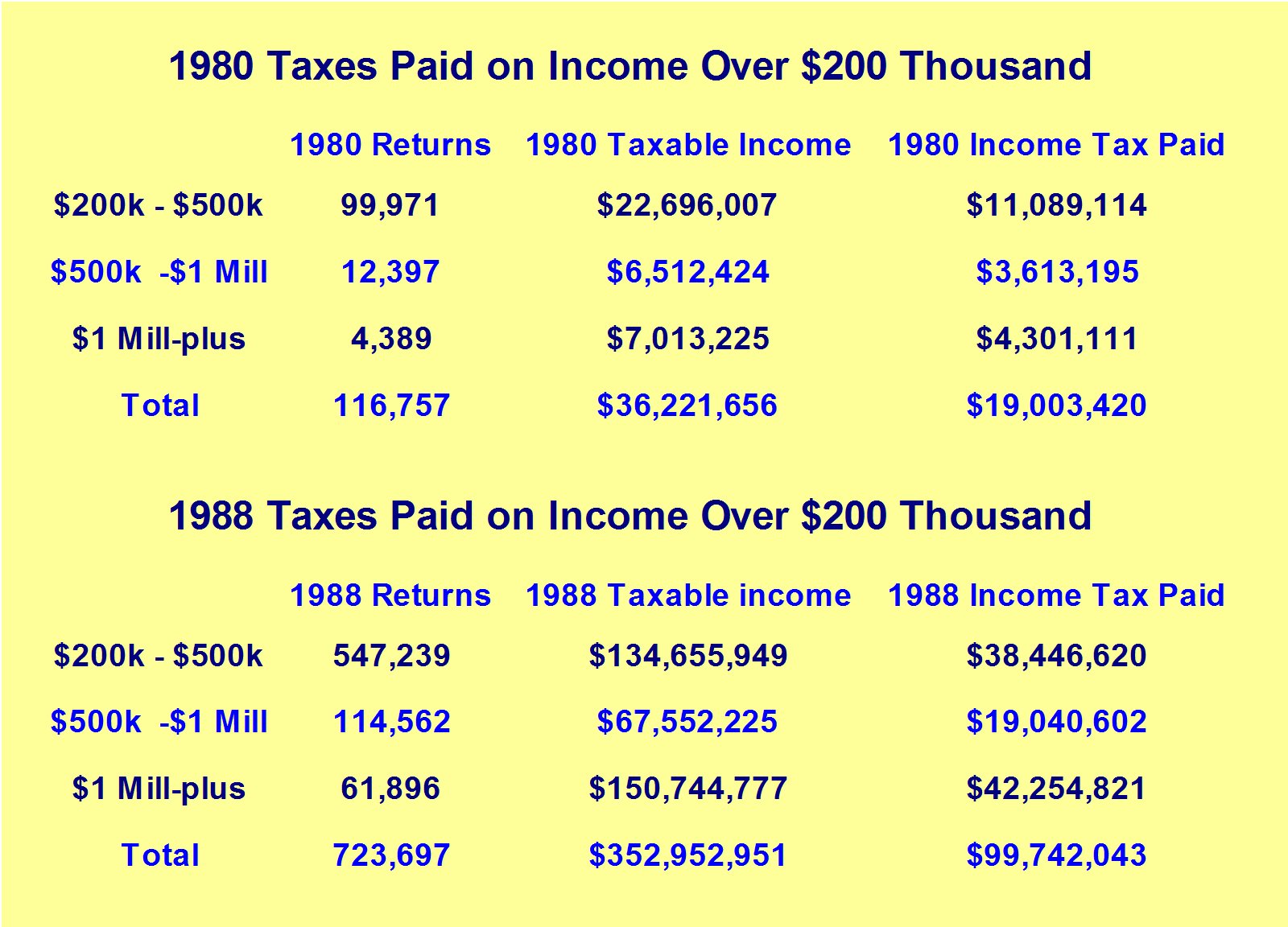
Unlike the rest of us, the rich have a great ability to alter the timing, amount and composition of their income. That’s because, according to IRS data, those with more than $1 million of adjusted gross income get only 33 percent of it from wages and salaries. The super-rich (those with income above $10 million) rely on wages and salaries for only 19 percent of their income. In 1980, when the top tax rate was 70 percent, rich people (those with incomes of more than $200,000) reported about $36 billion of income; the IRS collected about $19 billion of that amount. So what happened when President Ronald Reagan lowered the top tax rate to 28 percent by 1988? Did revenue fall proportionately, to about $8 billion? Folks on the left thought that would happen, complaining that Reagan’s “tax cuts for the rich” would starve the government of revenue and give upper-income taxpayers a free ride. But if we look at the 1988 IRS data, rich people paid more than $99 billion to Uncle Sam. That is, because rich taxpayers were willing to earn and report much more income, the government collected five times as much revenue with a lower rate.

I also included above, for readers of this blog, a table with the raw numbers from the IRS. Feel free to click for a larger image and see how the “rich” responded to better tax policy.

I then close with a warning about Obama’s class warfare policy.

Obama wants to run the experiment in reverse. He hasn’t proposed to push the top tax rate up to 70 percent, thank goodness, but the combined effect of his class-warfare policies would mean a big increase in marginal tax rates. That might be good for workers in China, India or Ireland, because American jobs and investment would migrate to those places. But it’s not the right policy for the United States.

In other words, even if you’re a leftist and your main goal is giving the government more revenue, higher tax rates are a bad idea. The rich will simply figure out ways to protect their earnings while the rest of us suffer because the economy loses some of its dynamism.

______________

Thank you so much for your time. I know how valuable it is. I also appreciate the fine family that you have and your committment as a father and a husband.

Sincerely,

Everette Hatcher III, 13900 Cottontail Lane, Alexander, AR 72002, ph 501-920-5733, lowcostsqueegees@yahoo.com

Interview with Paul Ryan

Rep. Paul Ryan’s Budget Problem – CBN.com

A biblical justification for getting our spending in order.

Ryan Messmore

April 16, 2012 at 1:00 pm

How should one’s faith shape his or her engagement in the policy arena?

Political Correspondent David Brody recently asked that question of House Budget Committee Chairman Paul Ryan (R–WI) concerning the Republican budget plan. In a taped interview for the Christian Broadcasting Network (CBN), Ryan, a Roman Catholic, identified care for the poor as a fundamental tenet in the social teachings of his Church.

For Ryan, that teaching means: “Don’t keep people poor, don’t make people dependent on government so that they stay stuck at their station in life. Help people get out of poverty.”

Ryan believes his federal budget plan helps accomplish that goal. In a letter last year to then-Archbishop (now Cardinal) Timothy Dolan of New York, Ryan stated that his proposed budget better targets assistance to those in need, repairs the social safety net, and fulfills the mission of health and retirement security for all Americans. Furthermore, if the U.S. government continues to drive up the deficit through reckless spending, Ryan wrote that “the weakest will be hit three times over: by rising costs, by drastic cuts to programs they rely on, and by the collapse of individual support for charities that help the hungry, the homeless, the sick, refugees and others in need.”

In the CBN interview that aired last week, Ryan highlighted an additional principle of Catholic social teaching that informs his engagement in public policy: the principle of subsidiarity.

Subsidiarity holds that decisions are best made at the most local level available. As Ryan noted, when applied to political authority, this means federalism. Subsidiarity also holds that larger, more powerful institutions should refrain from undermining the freedom and integrity of smaller, less powerful ones. This is the aspect of the principle that Ryan picked up on most pointedly:

[Subsidiarity means] not having big government crowd out civic society, but…having     enough space in our communities so that we can interact with each other, and take care of    people who are down and out in our communities.

This principle arises out of a larger vision of social flourishing, one in which the common good is advanced “through our civic organizations, through our churches, through our charities, through all of our different groups where we interact with people as a community.”

Ryan has been attacked by those who hold a different view of government’s relationship to social well-being. His critics, including President Obama, seem to prefer that Washington, D.C., play a more direct and comprehensive role in pursuing the common good, even at the expense of civil society organizations that are often better equipped to serve people in need.

Some have tried to make the budget debate a conflict between those who do or do not care about the poor. But at its heart, this debate is about two contrasting visions of government’s proper role—in relation to prosperity, the common good, and to other institutions in society.

Ryan has reminded Americans in general—and people of faith in particular—of a principle that deserves more attention in budget discussions. The morality of a budget cannot be evaluated solely in terms of government welfare spending; it must also consider effects to the long-term well-being of the poor, the financial viability of the nation, and the freedom of other social institutions.

These criteria inform The Heritage Foundation’s own proposal for addressing the debt crises, called Saving the American Dream.

A federal budget that continues to promote the same unsatisfactory programs and accumulate unsustainable debt—while crowding out smaller institutions of society—is neither moral nor helpful to the poor.

Subsidiary and federalism are important principles that can help drive America’s budget debate in a better direction.