Category Archives: Taxes

Some Tea Party heroes (Part 1)

DEBT LIMIT – A GUIDE TO AMERICAN FEDERAL DEBT MADE EASY.

Uploaded by on Nov 4, 2011

A satirical short film taking a look at the national debt and how it applies to just one family. Watch the guy from the Ferris Bueller Superbowl Spot! Produced by Seth William Meier, DP/Edited by Craig Evans, 1st AC Brian Andrews, Sound Mixer Gus Salazar, Written and Directed by Brian Stepanek. Help us spread the word by clicking ads or at www.debtlimitusa.org

_________________

I read some wise words by Rep. Justin Amash (R-MI) and I wanted to pass them on. He sees how dangerous it is to keep kicking the can down the street: “The Budget Control Act trades $21 billion in cuts next year for a debt ceiling increase of $2.1 trillion. That’s one penny in cuts for each dollar of new debt. The bill does not seriously address the drivers of the federal government’s fiscal crisis. It does not improve entitlement programs. It does not include a balanced budget amendment to the Constitution.”

Michael Tanner of the Cato Institute in his article, “Hitting the Ceiling,” National Review Online, March 7, 2012 noted:

After all, despite all the sturm und drang about spending cuts as part of last year’s debt-ceiling deal, federal spending not only increased from 2011 to 2012, it rose faster than inflation and population growth combined.

We need some national statesmen (and ladies) who are willing to stop running up the nation’s credit card.

Ted DeHaven noted his his article, “Freshman Republicans switch from Tea to Kool-Aid,”  Cato Institute Blog, May 17, 2012:

This week the Club for Growth released a study of votes cast in 2011 by the 87 Republicans elected to the House in November 2010. The Club found that “In many cases, the rhetoric of the so-called “Tea Party” freshmen simply didn’t match their records.” Particularly disconcerting is the fact that so many GOP newcomers cast votes against spending cuts.

The study comes on the heels of three telling votes taken last week in the House that should have been slam-dunks for members who possess the slightest regard for limited government and free markets. Alas, only 26 of the 87 members of the “Tea Party class” voted to defund both the Economic Development Administration and the president’s new Advanced Manufacturing Technology Consortia program (see my previous discussion of these votes here) and against reauthorizing the Export-Import Bank (see my colleague Sallie James’s excoriation of that vote here).

One of those Tea Party heroes was Justin Amash of Michigan. Last year I posted this below concerning his conservative views and his willingness to vote against the debt ceiling increase:

Amash Issues Statement After Debt Ceiling Vote

Representative Votes Against Budget Control Act
Aug 1, 2011 Issues: Spending and Debt


FOR IMMEDIATE RELEASE                                                      
August 1, 2011     
 
CONTACT
Will Adams
202.731.2294
will.adams@mail.house.gov                                                                         


Amash Issues Statement After Debt Ceiling Vote

Representative Votes Against Budget Control Act

Washington, D.C. – Rep. Justin Amash (R-MI) issued the following statement after the vote on the Budget Control Act of 2011:

“The Budget Control Act trades $21 billion in cuts next year for a debt ceiling increase of $2.1 trillion. That’s one penny in cuts for each dollar of new debt. The bill does not seriously address the drivers of the federal government’s fiscal crisis. It does not improve entitlement programs. It does not include a balanced budget amendment to the Constitution. I cannot in good conscience vote for so little reform when so much is at stake.

“I had hoped that Democrats and Republicans would work together to develop a reasonable compromise that is fiscally responsible. I would favor a package that combines eliminating special tax breaks and subsidies with a well-structured balanced budget amendment. I believe that type of package would have broad-based support from the American people. Instead, Congress continues to kick the can down the road.

“We can do better. I look forward to working with my colleagues on both sides of the aisle over the next several months to adopt structural reforms that will put the government back on a sustainable path.”
Bush tax cuts work? Is Clinton’s approach better? (Part 3)

The Laffer Curve, Part III: Dynamic Scoring

A video by CF&P Foundation that builds on the discussion of theory in Part I and evidence in Part II, this concluding video in the series on the Laffer Curve explains how the Joint Committee on Taxation’s revenue-estimating process is based on the absurd theory that changes in tax policy – even dramatic reforms such as a flat tax – do not effect economic growth. In other words, the current system assumes the Laffer Curve does not exist. Because of congressional budget rules, this leads to a bias for tax increases and against tax cuts. The video explains that “static scoring” should be replaced with “dynamic scoring” so that lawmakers will have more accurate information when making decisions about tax policy. For more information please visit the Center for Freedom and Prosperity’s web site: http://www.freedomandprosperity.org

_____________________________

Bush tax cuts work? This is a series of posts aimed at answering that question.

Setting the Tax Record Straight: Clinton Hikes Slowed Growth, Bush Cuts Promoted Recovery

By Curtis Dubay
September 6, 2011

Abstract: Despite evidence to the contrary, President Obama and his supporters insist that a tax increase will not impede economic recovery. They claim that the Clinton tax hikes spurred the boom of the 1990s and that the subsequent Bush tax cuts hurt the economy. Members of Congress must reject this faulty notion—and reject the President’s call for burdening Americans with higher taxes and an even slower economy.

President Barack Obama and his allies in Congress and elsewhere continue to press for tax increases, whether as part of a deal to raise the government’s debt ceiling, or for any other reason. Even though common sense would dictate not raising taxes in the face of a badly weakened economy and almost non-existent job growth, the President and his supporters argue that tax hikes will not imperil the still-nascent recovery because the economy grew during the 1990s after President Bill Clinton raised taxes. The inference being that today’s economy could also absorb the blow of tax hikes and grow despite them. They also argue the converse: that the tax cuts passed during President George W. Bush’s tenure slowed growth and cost jobs.

This cursory and errant analysis of recent history has serious implications for policymaking today. If Congress raises taxes based on the faulty notion that tax hikes have no ill effects on economic growth, it will impede the still-struggling recovery and keep millions of Americans on the unemployment rolls far too long.

Lessons for Today

It is vitally important for the millions of Americans looking for work today that Congress and President Obama learn and accept what really happened when President Clinton raised taxes and President Bush lowered them. The evidence is clear that the Clinton tax hikes stifled what should have been remarkable economic growth and the Bush tax cuts cleared the way for the economy to grow despite growing obstacles in its way.

President Obama insists that tax hikes must be part of a “balanced” approach to reducing the deficit. He defends his tax hike desires by pointing to the Clinton tax hikes as evidence that the economy can withstand higher taxes.

But if the Clinton tax hikes were powerful enough to slow an economy that had everything going in its favor, what would tax hikes today do to an economy that has everything working against it? The unemployment rate remains stuck over 9 percent and there appears to be little hope for it to fall in the near future.[10] The President should not be looking for policies the economy can withstand, but for policies that will encourage it to grow.

At best, tax increases would slow the already stalled recovery, and at worst, would reverse it altogether. A slowed recovery or double-dip recession would further reduce the chances that the more than 14 million Americans currently looking for work would find a job in the near future.[11]

The best way to grow revenues is to promote faster economic growth, which will increase the number of taxpayers and taxable income more rapidly. Tax hikes—whether through higher tax rates or slashing credits, deductions, and exemptions without offsetting reductions elsewhere—will not do the job. Under President Obama’s current policies, spending will continue to grow at a faster rate than can be paid for by tax hikes—even assuming the huge tax increases the President insists upon. To add insult to injury, as history has shown, tax hikes would slow economic growth and make it even harder for unemployed Americans to find a job.

—Curtis S. Dubay is a Senior Analyst in Tax Policy in the Thomas A. Roe Institute for Economic Policy Studies at The Heritage Foundation.

Dan Mitchell shows why soak-the-rich tax policy does not work

Dan Mitchell of the Cato Institute shows why Obama’s plan to tax the rich will not solve our deficit problem.  

Explaining in the New York Post Why Obama’s Soak-the-Rich Tax Policy Is Doomed to Failure

April 17, 2012 by Dan Mitchell

I think high tax rates on certain classes of citizens are immoral and discriminatory. If the government is going to collect revenue, all taxpayers should be treated equally, with something akin to a simple flat tax.

But most people don’t seem to care about having the law apply the same to all people, so I make a strictly utilitarian case for low tax rates in today’s New York Post. Here some of what I wrote.

Whether it’s through the Buffett Rule, higher income-tax rates or double taxation of dividends and capital gains, President Obama often demands that “rich” taxpayers and big corporations send more money to Washington. But…trying to get more money from upper-income taxpayers is like playing whack-a-mole. So long as tax rates are high, rich people will figure out ways to protect their income.It doesn’t take a tax genius; any rich person can make a phone call or hit a few computer keys and shift his or her investments to tax-free municipal bonds. It’s not good for the economy when capital gets diverted to help finance the excess spending of Detroit or California, but it’s an effective way of stiff-arming the IRS. Or the rich can play the green-energy scam, getting all sorts of credits to offset their tax liabilities. …Even if lawmakers abolished the various tax-code distortions, they might still be disappointed. The one sure way for rich people to lower their tax bills is by generating less income. …This isn’t some sort of modern-day revelation. Andrew Mellon, a Treasury secretary during the 1920s, noted that “the history of taxation shows that taxes which are inherently excessive are not paid. The high rates inevitably put pressure upon the taxpayer to withdraw his capital from productive business.”

I then provide a specific example, looking at how Reagan’s lower tax rates resulted in a lot more revenue from the rich.

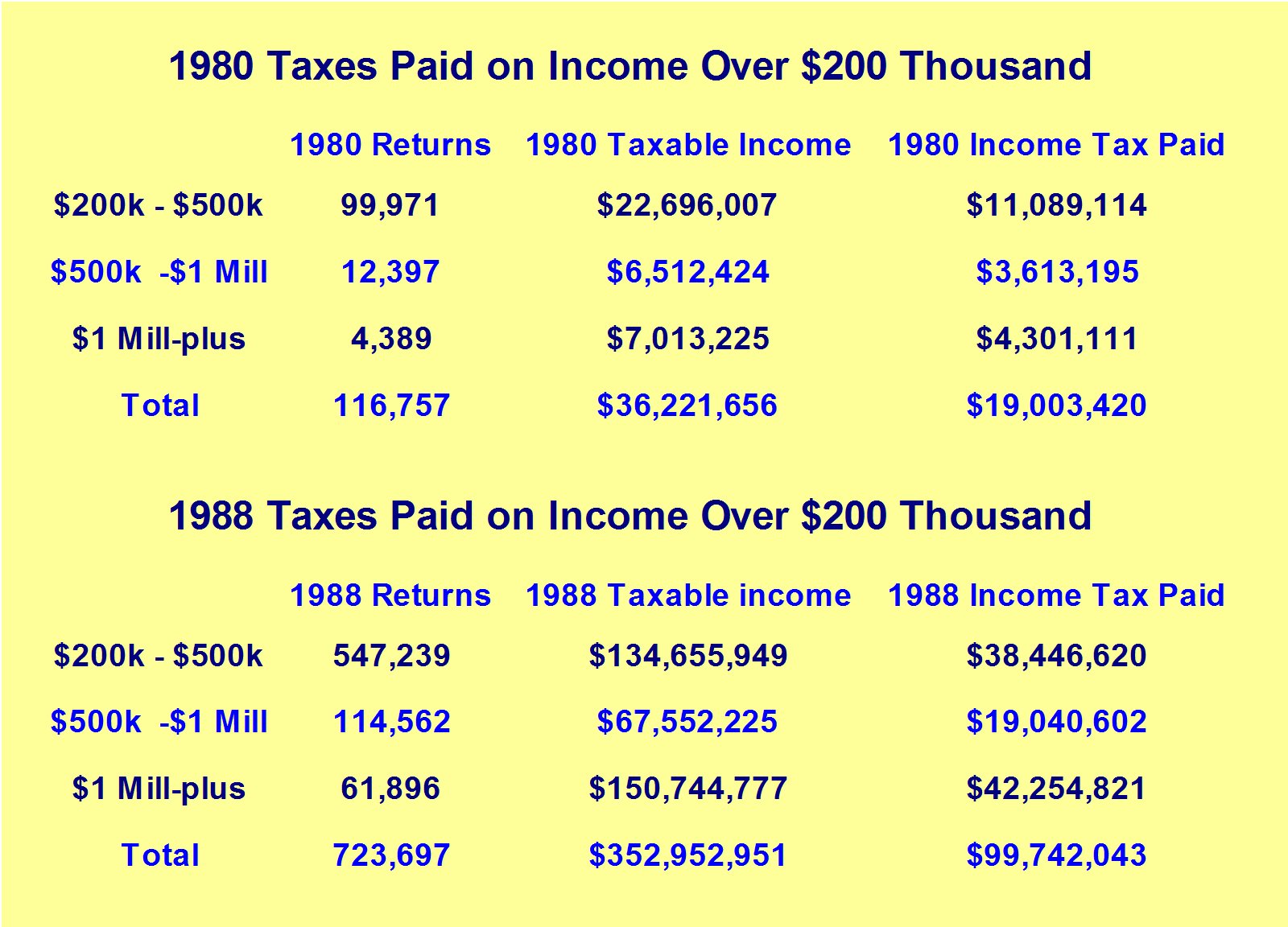
Unlike the rest of us, the rich have a great ability to alter the timing, amount and composition of their income. That’s because, according to IRS data, those with more than $1 million of adjusted gross income get only 33 percent of it from wages and salaries. The super-rich (those with income above $10 million) rely on wages and salaries for only 19 percent of their income. In 1980, when the top tax rate was 70 percent, rich people (those with incomes of more than $200,000) reported about $36 billion of income; the IRS collected about $19 billion of that amount. So what happened when President Ronald Reagan lowered the top tax rate to 28 percent by 1988? Did revenue fall proportionately, to about $8 billion? Folks on the left thought that would happen, complaining that Reagan’s “tax cuts for the rich” would starve the government of revenue and give upper-income taxpayers a free ride. But if we look at the 1988 IRS data, rich people paid more than $99 billion to Uncle Sam. That is, because rich taxpayers were willing to earn and report much more income, the government collected five times as much revenue with a lower rate.

I also included above, for readers of this blog, a table with the raw numbers from the IRS. Feel free to click for a larger image and see how the “rich” responded to better tax policy.

I then close with a warning about Obama’s class warfare policy.

Obama wants to run the experiment in reverse. He hasn’t proposed to push the top tax rate up to 70 percent, thank goodness, but the combined effect of his class-warfare policies would mean a big increase in marginal tax rates. That might be good for workers in China, India or Ireland, because American jobs and investment would migrate to those places. But it’s not the right policy for the United States.

In other words, even if you’re a leftist and your main goal is giving the government more revenue, higher tax rates are a bad idea. The rich will simply figure out ways to protect their earnings while the rest of us suffer because the economy loses some of its dynamism.

______________

Bush tax cuts work? Is Clinton’s approach better? (Part 2)

The Laffer Curve, Part II: Reviewing the Evidence

This video reviews real-world evidence showing that changes in marginal tax rates can have a significant impact on taxable income, thus leading to substantial amounts of revenue feedback. In a few cases, tax-rate reductions even “pay for themselves,” though the key lesson is the more modest point that pro-growth changes in tax policy will have a positive impact on economic performance and that good tax cuts therefore do not “cost” the government much in terms of foregone tax revenue.

This video is second installment of a three-part series. Part I reviews theoretical relationship between tax rates, taxable income, and tax revenue. Part III discusses how the revenue-estimating process in Washington can be improved. For more information please visit the Center for Freedom and Prosperity’s web site: www.freedomandprosperity.org.

_________________

On the Arkansas Times Blog the person using the username “Couldn’t be better” commented on what I said by responding, “Saline, where are all the jobs that Bush promised in 2001 and 2003. Still waiting for the trinkle down…”

Bush tax cuts work? This is a series of posts aimed at answering that question.

Setting the Tax Record Straight: Clinton Hikes Slowed Growth, Bush Cuts Promoted Recovery

By Curtis Dubay
September 6, 2011

Abstract: Despite evidence to the contrary, President Obama and his supporters insist that a tax increase will not impede economic recovery. They claim that the Clinton tax hikes spurred the boom of the 1990s and that the subsequent Bush tax cuts hurt the economy. Members of Congress must reject this faulty notion—and reject the President’s call for burdening Americans with higher taxes and an even slower economy.

President Barack Obama and his allies in Congress and elsewhere continue to press for tax increases, whether as part of a deal to raise the government’s debt ceiling, or for any other reason. Even though common sense would dictate not raising taxes in the face of a badly weakened economy and almost non-existent job growth, the President and his supporters argue that tax hikes will not imperil the still-nascent recovery because the economy grew during the 1990s after President Bill Clinton raised taxes. The inference being that today’s economy could also absorb the blow of tax hikes and grow despite them. They also argue the converse: that the tax cuts passed during President George W. Bush’s tenure slowed growth and cost jobs.

This cursory and errant analysis of recent history has serious implications for policymaking today. If Congress raises taxes based on the faulty notion that tax hikes have no ill effects on economic growth, it will impede the still-struggling recovery and keep millions of Americans on the unemployment rolls far too long.

Bush Tax Cuts Promoted Strong Growth

Liberals also like to argue that the Bush tax relief hurt the economy and cost jobs. Again, the evidence runs to the contrary.

Unlike President Clinton, who entered office with a strong economic wind at his back, President Bush came into office on the precipice of a recession caused by the bursting of the “dot-com” bubble. President Bush entered office in January 2001; the recession began in March.

In addition to the recession, the peaceful conditions President Clinton enjoyed reversed course. The terrorist attacks of 9/11 brought on the beginning of the war on terrorism. There was no growth-enhancing advancement comparable to the tech boom to further boost the economy; energy prices were creeping up. Instead of swimming with the current, the economy was now fighting squarely against it to achieve even modest growth.

Faced with this new reality, President Bush pushed for tax cuts to revive the economy and set it on a stronger foundation for economic growth.

In June 2001, President Bush signed into law the first wave of tax cuts. The relief included reductions of marginal income tax rates and tax relief for families, for example, doubling the child tax credit from $500 to $1,000. To reduce the budgetary impact, Congress phased in the tax cuts over several years.

Since the tax cuts were slow to go into effect, they were slow to help the economy. In fact, the economy continued to lose jobs after the tax cuts even though the recession officially ended in November 2001.

Realizing the error of its ways, in May 2003 Congress accelerated the tax cuts to make them effective immediately. In addition to reducing marginal income tax rates, Congress also lowered the tax rates on capital gains and dividends.

It was at this point that economic growth took off. From May 2003 until December 2007 (when the recession caused by the global financial meltdown occurred) the economy created 8.1 million jobs, or 145,000 a month. By comparison, after the beginning of the 2001 recession and before the 2003 tax cuts, the economy was losing 103,000 jobs a month.[7]

2003 Bush Tax Cuts Prompted Surge in Employment

Those opposed to the tax relief argue that it blew a hole in the budget and dramatically increased deficits. Again, a look at the numbers disproves that argument. While receipts were below the historical level of 18 percent of GDP in 2003 as a result of the sluggish economy, they rebounded to above their historical norm by 2006 and grew further above their historical level in 2007.[8] They clearly would have continued growing thereafter had it not been for the housing bust and global recession.

Tax revenue rebounded quickly because the tax cuts encouraged economic growth by increasing the incentives to work, save, invest, and take on new risk. These are the basic elements of economic growth. When those activities increase, tax revenues increase because more Americans work and earn more money. From 2003 to 2007, the number of tax filers rose by 9.6 percent, and taxable income, by 44 percent. By contrast, in the last four years of the previous expansion, from 1997 to 2001, these numbers grew by 6.4 percent and 23.6 percent, respectively.[9] With income and taxpayers growing at such a fast clip it is not hard to see why tax revenue did not suffer from the tax cuts.

Number of Taxpayers and Taxable Income Grew Faster During Bush's Expansion than Clinton's

To be clear: The Bush tax cuts did not pay for themselves. Revenues, on balance, are lower as a result of the Bush tax relief. However, the Bush tax cuts did accelerate the recovery markedly, and they did, and still do, create the possibility of a permanently stronger economy which, in turn, means the net revenue cost of the Bush tax cuts is far less than the traditional static score implies.

In 2008, the last full year of the Bush presidency, the economy entered a severe recession brought on by the global financial meltdown. The 2001 and 2003 tax relief packages had made the economy more resilient against economic shocks, but no tax policy can protect an economy against the storm that struck that year. The tax cuts certainly did not contribute in any way to recession, nor can anyone credibly claim that these policies had something to do with the financial implosion that was global in origin and impact.

Even with a recession at the beginning of his presidency and another severe recession at the end, the economy still created more than 1 million net jobs during President Bush’s tenure. The tax cuts he pushed Congress to pass are a major reason for that job growth.

—Curtis S. Dubay is a Senior Analyst in Tax Policy in the Thomas A. Roe Institute for Economic Policy Studies at The Heritage Foundation.

France today: government spending is at 55 percent of GDP

The liberals in France do not want austerity but more spending but who will pay for their party?

Mike Brownfield

May 8, 2012 at 8:55 am

Last weekend, the people of France took a sharp turn to the left, and the rest of Europe may be on the brink of rebuking its recent tack toward fiscal responsibility. With Sunday’s election of French Socialist leader Francois Hollande, France has leapt backward toward the policies that have helped sink the continent in a sovereign debt crisis. Disturbingly, the big government platform Hollande campaigned on is all too familiar to the American people, and if the United States is not careful, it could suffer the same fate as its European allies.

Hollande sailed to victory by appealing to an electorate dissatisfied with having to face necessary cutbacks, proclaiming that he is “proud to have been capable of giving people hope again.” That brand of hope called for a change from President Nicolas Sarkozy’s relatively conservative policies — in his first term, Sarkozy worked to reduce the number of public sector employees, eliminate the 35-hour work week, reform the university system and cut taxes.

Hollande, by contrast, promised to raise taxes on big corporations and wealthy individuals, implement a top rate tax of 75 percent, increase public spending by 20 billion euros, raise the minimum wage, hire 60,000 more teachers, and lower the retirement age from 62 to 60 for some workers. He says he is “president of the youth of France” and believes that government stimulus, not cutting spending, is the right way to achieve economic growth.

If you’ve been a student of President Obama’s presidency, much of this should sound familiar. President Obama came into office on a promise of hope and change, appealed to young Americans and promised renewed prosperity. His solution was more government spending to the tune of a near-trillion-dollar stimulus, a government-run health care plan, a bailout of government unions, and a call for higher taxes on wealthy Americans and corporations.

The difference between the United States and France is that the latter is much further down the path of a social welfare state. Hollande’s proposals are not a new direction, they’re merely a return to form. France is notoriously emblematic of the European way of life. As Daniel Hannan, a member of the European Parliament, describes in Why America Must Not Follow Europe, “Long vacations, paternity leave, a higher minimum wage, a short working week: What’s not to like? The trouble is that eventually the money runs out.”

In France, the money has indeed run out. The country’s public debt now stands at more than 80 percent of GDP, government spending is at 55 percent of GDP, the tax burden is equivalent to 42 percent of total domestic income, and it hasn’t balanced its budget since 1974.

The United States, unfortunately, is headed in much the same direction. As Heritage’s Federal Budget in Pictures shows, U.S. debt stood at 67 percent of GDP in 2011, but unless the United States controls its spending, its debt will surpass that of France, Italy and even Greece, hitting 187 percent of GDP by 2035. Spending on Medicare, Medicaid, the Obamacare subsidies, and Social Security will devour all revenues by 2045, and taxes are soaring past their highest levels ever. And as for the budget, the U.S. Senate hasn’t passed one in three years — let alone brought it to balance.

The world has seen what lies at the end of this road to perdition. Though France is a prime example of a country that is spending itself into crisis, Greece has already gone beyond that tipping point. The country’s debt has exploded, 21.8 percent of its people are unemployed, and among the youth, more are out of work than have jobs. In the face of belt-tightening measures that came as a condition of an EU/IMF bailout — which include public sector pay cuts and pension reductions — the country turned to open political revolt with violent riots in the streets. In elections this week, Greek voters rejected the political parties that support fiscal responsibility and instead turned toward the Radical Left.

If there is any bright spot in Europe’s far left turn, it came Friday in the re-election of Boris Johnson, the Conservative mayor of London. Johnson campaigned for tax cuts and eliminating public sector waste in the hopes of spurring job growth. But alas, France’s return to the deeply entrenched socialist policies could signal an end to the fiscally responsible measures that German Chancellor Angela Merkel has championed, leading to economic disaster.

Though Europe is an ocean away, the policies that are sinking the continent could have the same impact in the United States if replicated here. Endless spending has dire consequences, and if America is not careful, it could follow Europe’s path to economic ruin.

Bush tax cuts work? Is Clinton’s approach better? (Part 1)

The Laffer Curve, Part I: Understanding the Theory

The Laffer Curve charts a relationship between tax rates and tax revenue. While the theory behind the Laffer Curve is widely accepted, the concept has become very controversial because politicians on both sides of the debate exaggerate. This video shows the middle ground between those who claim “all tax cuts pay for themselves” and those who claim tax policy has no impact on economic performance. This video, focusing on the theory of the Laffer Curve, is Part I of a three-part series. Part II reviews evidence of Laffer-Curve responses. Part III discusses how the revenue-estimating process in Washington can be improved. For more information please visit the Center for Freedom and Prosperity’s web site:www.freedomandprosperity.org

In his post on May 17, 2012 Max Brantley of the Arkansas Times mocks President Bush for wanting to write a book on economic growth.

Bush tax cuts work? This is a series of posts aimed at answering that question.

Setting the Tax Record Straight: Clinton Hikes Slowed Growth, Bush Cuts Promoted Recovery

By Curtis Dubay
September 6, 2011

Abstract: Despite evidence to the contrary, President Obama and his supporters insist that a tax increase will not impede economic recovery. They claim that the Clinton tax hikes spurred the boom of the 1990s and that the subsequent Bush tax cuts hurt the economy. Members of Congress must reject this faulty notion—and reject the President’s call for burdening Americans with higher taxes and an even slower economy.

President Barack Obama and his allies in Congress and elsewhere continue to press for tax increases, whether as part of a deal to raise the government’s debt ceiling, or for any other reason. Even though common sense would dictate not raising taxes in the face of a badly weakened economy and almost non-existent job growth, the President and his supporters argue that tax hikes will not imperil the still-nascent recovery because the economy grew during the 1990s after President Bill Clinton raised taxes. The inference being that today’s economy could also absorb the blow of tax hikes and grow despite them. They also argue the converse: that the tax cuts passed during President George W. Bush’s tenure slowed growth and cost jobs.

This cursory and errant analysis of recent history has serious implications for policymaking today. If Congress raises taxes based on the faulty notion that tax hikes have no ill effects on economic growth, it will impede the still-struggling recovery and keep millions of Americans on the unemployment rolls far too long.

Clinton Tax Hikes Slowed Growth

A favorite liberal argument is to attribute the economy’s strong performance during the 1990s to President Clinton’s economic policies, chief among which was a huge tax increase. Clinton signed his tax hike into law in September 1993, the same year he took office. It included an increase of the top marginal tax rate from 31 percent to 39.6 percent; repeal of the cap on the 2.9 percent Medicare tax, applying it to every dollar of income instead of being capped to levels of income like the Social Security tax; a 4.3-cent increase in the gas tax; an increase in the taxable portion of Social Security benefits; and a hike of the corporate income tax rate from 34 percent to 35 percent, among other tax increases.[1]

The economic defense of the Clinton tax hikes does not hold up against the historical facts. The economy did exhibit strong economic growth during the 1990s, but rapid growth did not occur soon after the tax hike—it came much later in the decade, when Congress cut taxes. After the 1993 tax hike, the economy actually slowed to a point below what one would expect, considering the once-in-a-generation favorable economic climate that existed at the time.

As for the overall economic recovery—that started well before President Clinton took office. In January 1993the economy was in the 22nd month of expansion following the recession from July 1990 to March 1991.

In addition to coming into office in the midst of an economic expansion, Clinton also benefited from a very unusual confluence of events that created a remarkably favorable environment for rapid economic growth:

  • The end of the Cold War brought a sigh of relief to the world and a powerful dose of growth-enhancing certainty to the global economy.
  • The price of energy was astoundingly low, with oil prices dropping below $11 per barrel and averaging under $20 per barrel, versus $100 per barrel today.[2]
  • The Federal Reserve had tamed inflation to an extent previously thought impossible, with inflation averaging 2 percent during the Clinton Administration.[3]
  • The biggest wind at the economy’s back was, of course, a tremendous set of new productivity-enhancing information technologies and the explosion of the Internet as a powerful tool for commerce and communication, further increasing productivity.

With these factors clearing the way, the economy should have displayed spectacular and accelerating growth in the years immediately after Clinton entered the White House, but growth of that magnitude did not materialize until later in the decade.

From 1993 until 1997, the economy grew at a pedestrian 3.3 percent per year.[4] While solid, this growth was certainly not exceptional. During that same time, real wages declined, despite the perception that the 1990s were an era of unmitigated abundance.[5]

Tax Hikes Dampened Economy in the 1990s, While Tax Cuts Spurred Growth

It was not until after a 1997 tax cut, passed by the Republican-led Congress—a tax cut President Clinton resisted but ultimately signed—that the spectacular growth kicked in. While small in revenue impact, the 1997 cuts included a reduction of the capital gains rate from 28 percent to 20 percent. This opened the capital floodgates necessary for entrepreneurs to develop, harness, and bring to market the wonders of the new information technologies.

Business investment skyrocketed after the tax cut,[6] and the economy grew at an annualized rate of 4.4 percent (33 percent faster than after the Clinton tax hike) from 1997 through the end of the Clinton presidency. Real wages reversed their downward trend and grew 1.7 percent per year during the same time.

Altogether, how much worse did the economy perform because of the Clinton tax hike? The data from the period do not provide a clear answer. What is clear is that the economy performed well below reasonable expectations given the favorable conditions existing in the years after the tax hike—and took off after the often-forgotten tax cut.

—Curtis S. Dubay is a Senior Analyst in Tax Policy in the Thomas A. Roe Institute for Economic Policy Studies at The Heritage Foundation.

Sweden is finally heading the right direction politically

Sweden produced ABBA in the 1970’s, but now they are producing some pretty good economic policies.

One of my favorite groups growing up was ABBA. Here are some of my favorite songs:

_______________

Sweden has a very large and expensive welfare state, but it’s actually becoming a bit of a role model for economic reform. I’ve already commented on the country’s impressive school choice system and noted that the Swedes have partially privatized their Social Security system.

I even wrote a Cato study looking at the good and bad features of economic policy in the Nordic nations, and cited a Swedish parliamentarian who explained that his nation became rich because of small government and free markets and how he is hopeful his country is returning to its libertarian roots.

Notwithstanding the many admirable features of Sweden, I never thought they would be moving in the right direction on fiscal policy while the United States was heading in the opposite direction.

Yet that’s the case. We all know that America has had made many mistakes during the Bush-Obama years, particularly with failed stimulus schemes in 2008 and 2009.

Sweden, by contrast, has put in place pro-growth reforms. Here’s what Fraser Nelson wrote for the UK-based Spectator.

Can we trade Geithner for Borg?

When Europe’s finance ministers meet for a group photo, it’s easy to spot the rebel — Anders Borg has a ponytail and earring. What actually marks him out, though, is how he responded to the crash. While most countries in Europe borrowed massively, Borg did not. Since becoming Sweden’s finance minister, his mission has been to pare back government. His ‘stimulus’ was a permanent tax cut. …Three years on, it’s pretty clear who was right. ‘Look at Spain, Portugal or the UK, whose governments were arguing for large temporary stimulus,’ he says. ‘Well, we can see that very little of the stimulus went to the economy. But they are stuck with the debt.’ Tax-cutting Sweden, by contrast, had the fastest growth in Europe last year, when it also celebrated the abolition of its deficit. …‘Everybody was told “stimulus, stimulus, stimulus”,’ he says — referring to the EU, IMF and the alphabet soup of agencies urging a global, debt-fuelled spending splurge. Borg, an economist, couldn’t work out how this would help. ‘It was surprising that Europe, given what we experienced in the 1970s and 80s with structural unemployment, believed that short-term Keynesianism could solve the problem.’ …He continued to cut taxes and cut welfare-spending to pay for it; he even cut property taxes for the rich to lure entrepreneurs back to Sweden. The last bit was the most unpopular, but for Borg, economic recovery starts with entrepreneurs. If cutting taxes for the rich encouraged risk-taking, then it had to be done.

The article notes that government is still far too large in Sweden, but it’s also clear that moving in the right direction generates immediate benefits.

I posted a video back in 2010, narrated by a Swedish economics student, and asked a rhetorical question of why Obama wants to make America more like Sweden when the Swedes are moving in the other direction.

Unfortunately, there was no good answer then and there’s no good answer now.

Let’s close with some irony. Last year, I cited a study showing how large public sectors undermine economic performance. The study was written by two Swedish economists. In addition to trading Geithner for Borg, perhaps we can ship Krugman to Stockholm and bring those economists to America.

F.A. Hayek part 2

Glenn Beck Presents: F.A. Hayek’s “The Road to Serfdom” (Part 2)

You can see how wise this man was.

Happy Birthday, F. A. Hayek

Posted by David Boaz

Today is the 113th anniversary of the birth of F. A. Hayek, perhaps the most subtle social thinker of the 20th century.

He was awarded the Nobel Prize in Economics in 1974. He met with President Reagan at the White House, and Margaret Thatcher banged The Constitution of Liberty on the table at Conservative headquarters and declared “This is what we believe.” Milton Friedman described him as “the most important social thinker of the 20th century,” and Lawrence H. Summers called him the author of “the single most important thing to learn from an economics course today.”

He is the hero of The Commanding Heights, the book and PBS series by Daniel Yergin and Joseph Stanislaw. His most popular book, The Road to Serfdom, has never gone out of print and sold 125,000 copies last year. John Cassidy wrote in the New Yorker that “on the biggest issue of all, the vitality of capitalism, he was vindicated to such an extent that it is hardly an exaggeration to refer to the 20th century as the Hayek century.”

Last year the Cato Institute invited Bruce Caldwell, Richard Epstein, and George Soros to discuss the new edition of The Constitution of Liberty, edited by Ronald Hamowy. In a report on that session, I concluded:

Hayek was not just an economist. He also published impressive works on political theory and psychology.

He’s like Marx, only right.

Cato published two original interviews with Hayek, in 1983 and 1984.

Find more on Hayek, including an original video lecture, at Libertarianism.org.


Europe has a bleak future because they don’t want austerity

The medicine for the sickness of spending is real budget cuts but no one in liberal europe wants to hear that. Sadly we are on the same road in the USA.

Liberals (like my blogger opponent “the Outlier” and others) love to say that austerity has been tried in Europe and it doesn’t work but the truth is that tax increases have been put in place but very few real cuts in spending.

I wrote a detailed blog post yesterday, showing that European governments have been very reluctant to restrain the burden of government spending.

Part of the problem is that the debate in Europe is a no-win exercise, pitting proponents of higher taxes (which is largely how Europe’s political elite defines “austerity”) against proponents of higher spending (notwithstanding a long track record of failure, the Keynesians have come out of woodwork and are claiming that bigger government stimulates “growth”).

With these terrible choices, no wonder the continent has such a bleak future.

Here’s a recent appearance on Fox Business News, where I discuss these topics.

I explain that Europe can grow and prosper, but only if politicians are willing to reduce the burden of government spending and lower tax rates.

But don’t hold your breath waiting for that to happen.

P.S. Americans shouldn’t get cocky. Our long-term fiscal outlook is equally grim. We can avoid a crisis if entitlement programs are reformed, but that obviously isn’t going to happen anytime soon.

F.A. Hayek part 1

Hayek on Socialism

Uploaded by on Aug 21, 2009

Friedrich Hayek talks about socialism.

________________

Socialism tries to plan out everything and it hurts the free market. We can see how this has played out especially in the last four years in the USA.

Glenn Beck Presents F A Hayek’s “The Road to Serfdom” Part 1

Uploaded by on Jun 13, 2010

This video via user TheConservatube; thank you!

What F.A. Hayek saw, and what most all his contemporaries missed, was that every step away from the free market and toward government planning represented a compromise of human freedom generally and a step toward a form of dictatorship–and this is true in all times and places. He demonstrated this against every claim that government control was really only a means of increasing social well-being. Hayek said that government planning would make society less liveable, more brutal, more despotic. Socialism in all its forms is contrary to freedom.

Nazism, he wrote, is not different in kind from Communism. Further, he showed that the very forms of government that England and America were supposedly fighting abroad were being enacted at home, if under a different guise. Further steps down this road, he said, can only end in the abolition of effective liberty for everyone.

Capitalism, he wrote, is the only system of economics compatible with human dignity, prosperity, and liberty. To the extent we move away from that system, we empower the worst people in society to manage what they do not understand.

_______________