There he goes again. It seems that President Obama just can’t help himself. He keeps pushing Congress to pass policies it has rejected in the past or has foolishly passed to little beneficial effect.
The latest recycling of policies comes from the President’s Post-It note to-do list for Congress. If only Congress’s actual to-do list was so small.
Besides leaving out the most pressing issues facing the country—reforming entitlement programs and full-scale tax reform—the President’s to-do list for Congress curiously leaves off the most urgent issue it needs to tackle right now. That would be Taxmageddon and the $494 billion tax hike that will slam the economy on January 1, 2013, unless Congress and President Obama act soon to stop it.
In addition to calling for an extension of the Wind Production Tax Credit and an expansion of the 30 percent tax credit for investments in clean energy manufacturing, the tax polices the to-do list contains are a credit for small businesses that hire new workers and the President’s misguided “insourcing” agenda.
Really? Again with this hiring tax credit stuff? We’ve been there, done that, and have no jobs to show for it. In 2010, Congress passed and President Obama signed into law a tax credit for businesses that added new workers. It failed to create jobs then, and repeating it will fail to create jobs now.
Hiring tax credits do not work, because businesses add new workers when those additional employees will increase profitability over the duration of their tenure. A temporary one-year credit does little to tip this basic calculation in favor of adding new positions, because most businesses expect to retain workers for longer than a year.
The President first proposed his insourcing plan earlier this year. It would take away tax deductions for businesses that supposedly move jobs overseas and reward businesses that move jobs here. The whole premise of the idea is fatally flawed, and his pushing this plan shows that President Obama fundamentally misunderstands how the global economy works.
U.S. businesses rarely pack up their operations here and move them overseas. Instead, they open new operations in other countries as a way to chase growing demand for their goods or services in new, emerging markets. This is nothing but good news for the U.S. An American business finding a new market for its product means more jobs created at the business’s U.S. headquarters and more income flowing back to America. Why would President Obama want to discourage this?
By punishing companies that seek opportunity abroad and rewarding those that happen to bring jobs back, Obama assumes that those businesses doing the latter are better for the economy and are creating more jobs. But he cannot possibly know which businesses are better or which create more jobs.
The government can never know which businesses are better at creating jobs, because it does not have access to the broad range of information available to the diffuse network of individuals and businesses that comprise the free market.
It is time for President Obama to stop rehashing and recycling old, failed tax policies for perceived narrow political benefit and focus on the tax policies that would be broadly beneficial to the economy. First, stop Taxmageddon right now. Second, implement fundamental tax reform along the lines of the New Flat Tax.
http://www.tinshipproductions.com Chattanooga Tea Party’s Liberty Forum Saturday, February 25, 2012
This speech is unedited and shown in it’s entire 55 minutes.
____________
President Obama c/o The White House
1600 Pennsylvania Avenue NW
Washington, DC 20500
In the Super Tuesday primary, the economy was the number one issue on voters’ minds, be they in Massachusetts, Georgia, Ohio, or Virginia. And that wasn’t because they were happy about high unemployment and slow wage growth. Yet according to President Barack Obama, “the economy is getting stronger, and the recovery is speeding up.” Of course, these things are relative. A disappointing recovery is underway. It just hasn’t touched the millions of Americans who remain out of work, the millions more whose wages can’t keep up with inflation, and it doesn’t offset the effects of high gas prices on family budgets.
Voters’ old-fashioned common sense about the economy was backed up by the numbers in the February jobs report just released this morning. According to the Bureau of Labor Statistics, the U.S. economy added 227,000 jobs last month. That’s the good news, and it does evidence that the recovery continues, albeit slowly. And this slow-trot recovery is why the unemployment rate remains at 8.3 percent, while the number of long-term unemployed workers remained at 5.4 million, accounting for 42.6 percent of the unemployed.
What’s more, an extraordinarily high number of Americans have dropped out of the work force, either choosing not to work, losing heart and abandoning the hunt for jobs, or accepting disability benefits. Because of the meager recovery, very few potential workers have returned to the job market to find work. With fewer people in the work force, the unemployment rate appears lower than it should as a matter of simple arithmetic. But this artificially low rate does not disguise the fact that talented, experienced, discouraged workers are choosing to sit on the sidelines instead of participating in the economy. In short, though the labor market is improving, it’s nowhere near where it should be given America’s potential.
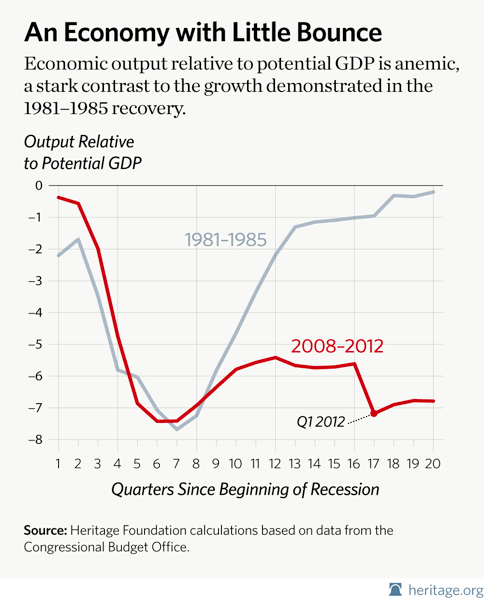
What should the economy’s recovery look like? Take a glance at history (and the chart below). Following the 1981-1982 recession — which looked a lot like the one America saw in 2008 in both depth and duration — the economy returned to near-full employment (which is around 5.5 percent) by 1984. Today, nearly three years after the most recent recession ended, the unemployment rate remains stuck well above 8 percent. So while the economy has grown for 10 straight quarters, it’s only done so at a measly 2.4 percent rate. In fact, it’s the slowest recovery America has seen in the post-war era. No wonder millions of Americans aren’t feeling the effects of the economic rebound and are voting their displeasure. (Article continued below chart.)
Even liberal economist / columnist Paul Krugman sees the economy for what it is. In a recent column in The New York Times, he wrote, “our economy remains deeply depressed” and that “every silver lining comes with a cloud.” So what’s bringing about that cloud? Why is this economy growing, and yet growing so slowly by comparison to the 1980s recovery?
While President Obama might like to take credit for the meager growth the economy is seeing, there’s an important fact to keep in mind. It’s the natural tendency for the economy to grow — and taking credit for its meager improvement is sort of like accepting kudos for the rising and setting of the sun. In fact, the President should of course (but never will) accept some blame for the fact that the economy isn’t growing faster. The policies Obama ushered in are markedly different from those that President Ronald Reagan adopted to unleash the economic recovery in the 1980s, and the results show the difference — a powerful recovery under Reagan, and weak recovery under Obama.
For starters, President Obama says he wants to encourage job creators to ramp up their economic engines, while at the same time he has proposed $2 trillion in higher taxes, much of which would fall on small businesses — the job creators. Add onto that a discouragingly successful policy of encouraging higher gas prices by opposing domestic energy production. This policy is so unpopular that eleven Democratic Senators voted with their Republican colleagues on Thursday to overturn the Obama decision to kill the Keystone XL pipeline. Proponents failed to get the 60 votes necessary to overturn the Keystone decision, but with Democratic support it came very close. Instead of tapping proven resources, Obama puts his faith in pie-in-the-sky renewable energy projects like Solyndra. No wonder Super Tuesday’s voters were worried about the economy.
On top of job-killing tax hikes and higher gas prices, President Obama continues to embrace the burden of untenably high spending and debt — which will of course motivate the left to call for even higher taxes — and you’re left with a mess of policies emanating from Washington signaling small businesses to hunker down instead of investing for the future. A better path for growth would be to enact a budget that curbs spending, reforms entitlements, and reforms the tax code to focus it on economic growth as proposed in Heritage’s Saving the American Dream plan — all of which would free the economy to grow at a faster rate than we’re witnessing today.
While any economic growth and job creation is welcome, a barely perceptible, incremental recovery doesn’t offer much hope for those Americans who can’t feel, see, or touch the fruits of recovery. Millions remain unemployed in the Obama economy, and Washington can and should do better for the American people.
__________
Thank you so much for your time. I know how valuable it is. I also appreciate the fine family that you have and your commitment as a father and a husband.
Sincerely,
Everette Hatcher III, 13900 Cottontail Lane, Alexander, AR 72002, ph 501-920-5733, lowcostsqueegees@yahoo.com
Milton Friedman clears up misconceptions about wealth redistribution, in general, and inheritance tax, in particular. http://www.LibertyPen.com
_______________________________
Many times in the past our government has tried to even the playing field but the rich and poor will always be with us as Christ reminded us so long ago. Providing people a chance is fine but trying to punish others is not and it does not work.
She’s joined a corporate board, gotten a job as a correspondent for NBC and has her pick of gatherings of the mighty or simply important just about anywhere on the globe.
Reactions tended to fall along partisan lines. Fans of Bill and/or Hillary Clinton were happy for their 31-year-old daughter. Non-fans weren’t impressed. She’d done nothing to deserve her good fortune except choose good parents, they said. The really ugly ones criticized everything from her hairstyle to her speech.
I’m not impartial on the subject. I’ve known Chelsea since she was an infant, though most of my exposure came before her move to Washington in junior high. She’s remained friendly with my daughter and has been good to her. That’s enough for me.
But Chelsea is smart and poised. She’s worked hard at demanding schools and jobs. Would she be precisely where she is today without her famous parents? Of course not. She hasn’t claimed otherwise. (I do like how often she credits her Grandmother Rodham for sage advice.)
But she now has made the important decision to accept inheritance of her parents’ considerable public franchise. If nothing else, her growth in the larger public world might position her to someday take leadership of the Clinton Foundation. If she’s lucky — if we’re all lucky — she will continue to amass the resources her father has raised for fighting significant global problems. If she should decide to try politics, she’s been homeschooled by the best and brightest.
Make no mistake. Chelsea Clinton is a one percenter, if not precisely in the net worth category, close enough. She is also, if you prefer, a lucky sperm club member. But she manages to send a signal that she understands how much of her stature is owed to her parents. She signals a generosity of spirit about her good fortune that is more reminiscent of a Buffett than a Koch.
We will always have the 1 percent. There’s nothing inherently evil about being in that small number. The question is how much the 1 percent is willing to allow the 99 percent to share.
____________________________
Milton Friedman discusses the inheritance of talent on “Free to Choose”
“The inheritance of talent is no different (from an ethical point of view) from the inheritance of other forms of property– of bonds, of stocks, of houses, or of factories. Yet many people resent the one, but not the other.”
From “Free to Choose” (1980), Part V: “Created Equal.”
______________________________
Burton Folsom, Jr. is a professor of history at Hillsdale College and author of New Deal or Raw Deal?, to be published by Simon & Schuster this year.
The subject of “equality” is the source of much political debate. Ever since the founding era, free-market thinkers have argued for equality of opportunity in the economic order. Equality, in other words, is a framework, not a result. In modern terms the goal is a level playing field. Government is a referee that enforces property rights, laws, and contracts equally for all individuals.
What the free-market view means in policy terms is no (or few) tariffs for business, no subsidies for farmers, and no racism written into law. Also, successful businessmen will not be subject to special taxes or the seizure of property.
In America this view of equality is enshrined in the Declaration of Independence (“all men are created equal and are endowed by their creator with certain inalienable rights”) and the Constitution (“imposts and excises shall be uniform throughout the United States” and “equal protection of the laws”). Much of America’s first century as a nation was devoted to ending slavery, extending voting rights, and securing property and inheritance rights for women—fulfilling the Founders’ goal of equal opportunity for all citizens.
Progressives and modern critics of equality of opportunity have launched two significant criticisms against the Founders’ view. First, that equality of opportunity is impossible to achieve. Second, to the extent that equality of opportunity has been tried, it has resulted in a gigantic inequality of outcomes. Equality of outcome, in the Progressive view, is desirable and can only be achieved by massive government intervention. Let’s study both of these objections.
To some extent, of course, the Progressives have a valid point—equality of opportunity is, at an individual level (as opposed to an institutional level) hard to achieve. We are all born with different family advantages (or disadvantages), with different abilities, and in different neighborhoods with varying levels of opportunity. As socialist playwright George Bernard Shaw said on the subject, “Give your son a fountain pen and a ream of paper and tell him that he now has an equal opportunity with me of writing plays and see what he says to you.”
What the Progressives miss is that their cure is worse than the illness. Any attempt to correct imbalances in family, ability, and neighborhood will produce other inequalities that may be worse than the original ones. Thomas Sowell writes, “[A]ttempts to equalize economic results lead to greater—and more dangerous—inequality in political power.” Or, as Milton Friedman concluded, “A society that puts equality—in the sense of equality of outcome—ahead of freedom will end up with neither equality nor freedom. The use of force to achieve equality will destroy freedom, and the force, introduced for good purposes, will end up in the hands of people who use it to promote their own interests.”
Failure During the New Deal
Sowell’s and Friedman’s point is illuminated by the failed efforts of the federal government to reduce inequalities during the New Deal. In the early 1930s the United States had massive unemployment (sometimes over 20 percent). In 1932 President Herbert Hoover supported the nation’s first relief program: $300 million was distributed to states. This was not a transfer from richer states to poorer states but a political grab by most state governors to secure all they could. Illinois played this game well and secured over $55 million, more than New York, California, and Texas combined.
Massachusetts, with almost as many people as Illinois, received zero federal money. Massachusetts had much poverty and distress, but Governor Joseph Ely believed states should try to supply their own needs and not rush to Washington to gain funds at someone else’s expense. Ely therefore promoted a variety of fundraising events throughout his state to help those in need. “Whatever the justification for [federal] relief,” Ely noted, “the fact remains that the way in which it has been used makes it the greatest political asset on the practical side of party politics ever held by any administration.”
In 1935 President Franklin Roosevelt confirmed Ely’s beliefs by turning the Works Progress Administration (WPA), which he had established, into a gigantic political machine to transfer money to key states and congressional districts to secure votes. Roosevelt and his cohorts used the rhetoric of removing inequalities as a political cover to gain power. Reporter Thomas Stokes won a Pulitzer Prize for his investigative research that exposed the WPA for using federal funds to buy votes.
The use of tax dollars, then, to mitigate inequality failed because—whatever the good intentions—the funds quickly became politicized.
Presidential (and congressional) authority to tax and to transfer funds from one group to another also proved to be a dangerous centralization of power. Taxation increased both in size and complexity. The IRS thus became a weapon a president could use against those who resisted him. “My father,” Elliott Roosevelt observed of his famous parent, “may have been the originator of the concept of employing the IRS as a weapon of political retribution.”
Sowell and Friedman indeed recognized that efforts to remove inequalities would create new inequalities, perhaps just as severe, and would also dangerously concentrate power in the hands of politicians and bureaucrats. But Sowell and Friedman have readily conceded that when markets are left free, the inequality of outcomes is not necessarily morally justified. In other words, some people—through luck or inheritance—become incredibly rich and others, who may have worked harder and more diligently, end up barely earning a living. Rewards, as F. A. Hayek, among others, has noted, are “based only partly on achievements and partly on mere chance.” Societies are more prosperous under free markets, but individual success and failure can occur independently of ability and hard work.
Progressive Claims in Light of History
What the historical record does seem to demonstrate is that the richest men in American history have been creative entrepreneurs who have improved the lives of millions of Americans and have achieved remarkable upward mobility doing so. For example, the first American to be worth $10 million was John Jacob Astor, a German immigrant and a son of a butcher. Astor founded the largest fur company in the United States, transforming tastes and lowering costs in clothing for people all over the world.
John D. Rockefeller, the first American to be worth $1 billion, was the son of an itinerant peddler. Yet Rockefeller, with little education or training, went into the business of refining oil and did it better than anyone in the world. As a result, he sold the affordable kerosene that lit up most homes in the world. (He had a 60 percent world market share in the late 1800s.)
Henry Ford, the son of a struggling farmer, was the second American billionaire. He used the cheap oil sold by Rockefeller and cheap steel that was introduced by immigrant Andrew Carnegie to make cars affordable for most American families. The most recent wealthiest men in the United States—Sam Walton and Bill Gates—both came from middle-class households and both added much value for most American consumers.
Free markets may yield odd results and certainly unequal outcomes, but the greater opportunities and prosperity have made the tradeoff worthwhile for American society.
With the failure of the super committee to recommend at least $1.2 trillion in deficit reduction, Congress’s latest attempt at budget control has collapsed. There will be many analyses of why the process did not work, but it’s worth stepping back to recall what generated the need for this extraordinary procedure and what the exercise actually produced.
From early in the year, it was generally accepted that the divided Congress would be unable to agree on a budget through regular procedures. Republicans chose to use a necessary vote on the debt limit to force the Administration to face the need for spending reductions. After a summer-long debate, rife with hyperbole about a potential government “default,” the Budget Control Act of 2011 (BCA) was born, crafted in a way that at face value expressed the goal of fiscal prudence.
The BCA both imposed a set of discretionary spending caps to limit annually appropriated spending and established the super committee to recommend policies that would reduce the deficit by at least an additional $1.2 trillion through 2021. In return, the BCA included debt limit increases in three tranches: $400 billion, $500 billion, and then $1.2 trillion, as the chart below illustrates.
The debt limit hikes were ostensibly contingent on deficit reduction and a vote on a balanced budget amendment to the Constitution. But in fact, under the language of the BCA legislation, they could be blocked only if Congress passed a joint resolution of disapproval. If passed, such a resolution would be subject to a presidential veto, requiring the usual two-thirds vote of both houses to override. Thus these debt ceiling increases up to $2.1 trillion were all but assured from the beginning. (Article continued below chart)
The first two increases totaling $900 billion have already occurred, and the debt limit now stands at an astounding $15.124 trillion. It is up from the $14.29 trillion limit set in early 2010 and follows a history of frequent and growing debt limit increases, as shown in this Heritage Budget Chart Book chart. (Article continued below chart)
The third increase of $1.2 trillion—projected to occur early in 2012 when the debt begins to again encroach upon the limit—would raise the debt limit to an unprecedented $16.324 trillion, or over 100 percent of GDP.
Thus, the debt limit will climb ever higher, accommodating the profligate spending of the President and Congress. As Heritage’s J. D. Foster wrote in January: “The need to raise the debt limit reflects an intention to continue deficit financing” and should signal to Congress that it should urgently reexamine its current policy decisions.
Policies that promote reckless spending—forcing the government to borrow about 40 cents of every dollar it spends, while pushing total debt past 100 percent of gross domestic product (GDP)—are flat-out irresponsible. This upward trajectory makes it crystal clear that the government’s spending priorities have deviated severely from what the Founders laid out in the Constitution.
Equally disappointing, both the existing spending caps and the automatic enforcement in the BCA are less than advertised. The caps contain flaws that may make them all but meaningless. The “sequester” mechanism that would impose spending cuts will not be triggered until January 2013, giving Congress plenty of time to rewrite or abandon it.
As The Heritage Foundation’s David Addington writes, “The overspending problem is still here. Congress must still act to get the federal spending under control, in a thoughtful, intelligent manner that meets the needs of the American people.” It should do this without succumbing to pressure to hike taxes on Americans and further weigh down an already struggling economy. Remember, the problem is Washington’s spending.
Congress should demonstrate that it is serious about tackling the problems of rising spending, debt, and deficits. That means reforms to Medicare, Medicaid, and Social Security; transforming the maddeningly complicated tax system; and reducing the size and scope of government. In Saving the American Dream, The Heritage Foundation offers the kinds of bold solutions needed to put America back on a path toward fiscal sustainability and economic prosperity.
They’re right, though they probably don’t realize the seriousness of that looming crisis.
Here’s what you need to know: America’s fiscal crisis is actually a spending crisis, and that spending crisis is driven by entitlements.
More specifically, the vast majority of the problem is the result of Medicaid, Medicare, and Social Security, programs that are poorly designed and unsustainable.
The Medicaid program imposes high costs while generating poor results. This Center for Freedom and Prosperity Foundation video explains how block grants, such as the one proposed by Congressman Paul Ryan, will save money and improve healthcare by giving states the freedom to innovate and compete.
This Center for Freedom and Prosperity Foundation video explains how a “premium-support” plan would solve Medicare’s fiscal crisis and improve the overall healthcare system. This voucher-based system also would protect seniors from bureaucratic rationing. http://www.freedomandprosperity.org
There are two crises facing Social Security. First the program has a gigantic unfunded liability, largely thanks to demographics. Second, the program is a very bad deal for younger workers, making them pay record amounts of tax in exchange for comparatively meager benefits. This video explains how personal accounts can solve both problems, and also notes that nations as varied as Australia, Chile, Sweden, and Hong Kong have implemented this pro-growth reform. www.freedomandprosperity.org
_______________________
Regular readers know I’m fairly gloomy about the future of liberty, but this is one area where there is a glimmer of hope.
The Chairman of the House Budget Committee actually put together a plan that addresses the two biggest problems (Medicare and Medicaid) and the House of Representatives actually adopted the proposal.
The Senate didn’t act, of course, and Obama would veto any good legislation anyhow, so I don’t want to be crazy optimistic. Depending on how things play out politically in the next six years, I’ll say there’s actually a 20 percent chance to save America.
As an author who has just published a book on the crisis of Western civilization, I couldn’t really have asked for more: simultaneous crises in Athens and Rome, the cradles of the West’s law, languages, politics, and philosophy.
So why should Americans care about any of this? The first reason is that, with American consumers still in the doldrums of deleveraging, the United States badly needs buoyant exports if its economy is to grow at anything other than a miserably low rate. And despite all the hype about trade with the Chinese, U.S. exports to the European Union are nearly three times larger than to China.
Until March, it seemed as if exports to Europe were on an upward trajectory. But the euro-zone crisis has stopped that. Governments that ran up excessive debts have seen their borrowing costs explode. Unable to devalue their currencies, they’ve been forced to adopt austerity measures—cutting spending or hiking taxes—in a vain effort to reduce their deficits. The result has been Depression economics: shrinking economies and unemployment rates approaching 20 percent.
As a result, according to the new president of the European Central Bank, Mario Draghi, a “double dip” recession in Europe is now all but inevitable. And that’s lousy news for U.S. exporters targeting the EU market.
But there’s more. Europe’s problem is not just that governments are overborrowed. There are an unknown number of European banks that are effectively insolvent if their holdings of government bonds are “marked to market”—in other words, valued at their current rock-bottom market prices. In our interconnected financial world, it would be very odd indeed if no U.S. institutions were affected by this. Just as European institutions once loaded up on assets backed with subprime U.S. mortgages, so most big U.S. banks have at least some exposure to euro-zone bonds or banks. One institution—MF Global, run by former Goldman Sachs CEO Jon Corzine—just blew up because of its highly levered euro bets. Others are biting their fingernails because it is suddenly far from clear that the credit-default swaps they have bought as insurance against, say, a Greek default are worth the paper they are written on.
But the third reason Americans should care about Europe is more important even than the risk of a renewed financial crisis. It is the danger that what is happening in Europe today could ultimately happen here. Just a few months ago, almost nobody was worried about Italy’s vast debt, which amounts to 121 percent of GDP. Then suddenly panic set in, and Italy’s borrowing costs exploded from 3.5 percent to 7.5 percent.
Today the U.S. gross federal debt stands at around 100 percent of GDP. Four years ago it was 62 percent. By 2016 the International Monetary Fund forecasts it will be 115 percent. Economists who should know better insist that this is not a problem because, unlike Italy, the United States can print its own money at will. All that means is that the U.S. reserves the right to inflate or depreciate away its debt. If I were a foreign investor—and half the debt in public hands is held by foreigners—I would not find that terribly reassuring. At some point I might demand some compensation for that risk in the form of … higher rates.
Athens, Rome, Washington … The shortest route from imperial capital to tourist destination is precisely this death spiral of debt.
Niall Ferguson is a professor of history at Harvard University and a professor of business administration at Harvard Business School. He is also a senior research fellow at Jesus College, Oxford University, and a senior fellow at the Hoover Institution, Stanford University. His Latest book, Civilization: The West and the Rest, will be published in November.
I feel so strongly about the evil practice of running up our national debt. I was so proud of Rep. Todd Rokita who voted against the Budget Control Act of 2011 on August 11, 2011. He made this comment:
For decades now, we have spent too much money on ourselves and have intentionally allowed our kids and grandkids to pay for it. It is intergenerational theft—literally stealing from our best asset, our posterity. The correct course of action, as I have said from the beginning, is to enact permanent and structural reform as the price for raising the debt ceiling. Today’s bill does not do that.
This week the Club for Growth released a study of votes cast in 2011 by the 87 Republicans elected to the House in November 2010. The Club found that “In many cases, the rhetoric of the so-called “Tea Party” freshmen simply didn’t match their records.” Particularly disconcerting is the fact that so many GOP newcomers cast votes against spending cuts.
The study comes on the heels of three telling votes taken last week in the House that should have been slam-dunks for members who possess the slightest regard for limited government and free markets. Alas, only 26 of the 87 members of the “Tea Party class” voted to defund both the Economic Development Administration and the president’s new Advanced Manufacturing Technology Consortia program (see my previous discussion of these votes here) and against reauthorizing the Export-Import Bank (see my colleague Sallie James’s excoriation of that vote here).
One of those Tea Party heroes was Congressman Todd Rokita of Indiana. Last year I posted this below concerning his conservative views and his willingness to vote against the debt ceiling increase:
Rep. Todd Rokita voted against the Budget Control Act of 2011 because it fails to implement the long-term permanent and structural reforms necessary to put the nation back on a fiscally sustainable trajectory:
“I have heard a couple different definitions of leadership today. Let me add mine: leadership is effectively persuading others of the proper course of action. It is also about standing up for those who have no voice. For decades now, we have spent too much money on ourselves and have intentionally allowed our kids and grandkids to pay for it. It is intergenerational theft—literally stealing from our best asset, our posterity. The correct course of action, as I have said from the beginning, is to enact permanent and structural reform as the price for raising the debt ceiling. Today’s bill does not do that.
This legislation is a Washington deal, and it barely begins to address our long-term spending problem. Our debt crisis is driven by mandatory spending on entitlement programs and this plan fails to address such spending. Also, this plan only reduces the future debt we will pile on the backs of our kids from $10 trillion to around $7 trillion over the next decade. It does not begin to reduce our $14 trillion in current debt.
However, this legislation could eventually lead to the best permanent solution, a balanced budget amendment. This is certainly worth fighting for and I will lead on that front. But a vote alone is not worth the $2.5 trillion price tag, again to be paid by future generations. For that price, we should have required passage of a balanced budget amendment for state ratification.
I will continue to fight for a balanced budget amendment, lead our nation to live within its means and tackle out-of-control entitlement spending. It will be a long fight, but the enactment of a balanced budget amendment is the only way to fix the broken system that created this mess, both addressing our long-term fiscal health and giving Americans long-term peace of mind.”
The Heritage Plan Keeps Spending Low and Ends Deficits Without Raising Taxes
Everyone wants to know more about the budget and here is some key information with a chart from the Heritage Foundation and a video from the Cato Institute.
Bold, transformational reforms are needed to solve America’s spending crisis. The Heritage Plan achieves this through spending, entitlement, and tax reforms. It reduces the size of government, encourages personal fiscal responsibility, and fosters economic growth. It balances the federal budget by 2021 and keeps revenue at 18.5 percent of the economy.
REVENUE AND SPENDING AS A PERCENTAGE OF GDP
Download
Source: Current projections: Congressional Budget Office (Alternative Fiscal Scenario). Heritage Plan: Calculations by the Center for Data Analysis based on data provided by the Peter G. Peterson Foundation. For more information, go to savingthedream.org.
The charts in this book are based primarily on data available as of March 2011 from the Office of Management and Budget (OMB) and the Congressional Budget Office (CBO). The charts using OMB data display the historical growth of the federal government to 2010 while the charts using CBO data display both historical and projected growth from as early as 1940 to 2084. Projections based on OMB data are taken from the White House Fiscal Year 2012 budget. The charts provide data on an annual basis except… Read More
Authors
Emily GoffResearch Assistant
Thomas A. Roe Institute for Economic Policy StudiesKathryn NixPolicy Analyst
Center for Health Policy StudiesJohn FlemingSenior Data Graphics Editor
States that are cutting taxes are getting a lot of population growth because people will seek to open up their businesses in low tax states versus high ones. Why can’t the federal government learn from this states and lower federal taxes in order to encourage business creation?
The fiscal nightmare in Europe should be all the proof that’s needed about the dangers of wasteful spending and punitive tax rates. Unfortunately, if his proposals for bigger government and class-warfare tax policy are any indication, President Obama still seems to think those policies would be good for America.
“Let’s mimic California and France!”
American states also are a laboratory, showing that states with better tax policy create more jobs and grow much faster. And many state policy makers have learned the right lesson.
Last week Governor Sam Brownback continued the post-2010 reform trend among GOP Governors by signing the biggest tax cut in Kansas history. The plan chops the state income tax rate to 4.9% from 6.45% and eliminates income taxes on about 190,000 Kansas small businesses. …Mr. Brownback says the income tax cut will put Kansas “on a road to faster growth.” Although no one in Europe or the White House agrees with the philosophy, tax-cut initiatives have been spreading in the states. Already this year Tennessee has eliminated its gift and estate tax, Arizona has cut its capital gains tax (to 3.4% from 4.54%), and Idaho and Nebraska have cut income tax rates. Oklahoma is expected to cut tax rates. The tax cutting Governors all say they hope to be more like no-income-tax Texas, which has far outpaced other states in job creation.
Sadly, the folks in the White House aren’t hopping on the tax cut bandwagon.
Instead, they want America to be more like the President’s home state of Illinois, a fiscal basket case. But it’s not just Illinois that’s in trouble because of a bloated and expensive public sector.
It turns out that millions of Americans are voting with their feet to escape states with excessive taxes.
New York State accounted for the biggest migration exodus of any state in the nation between 2000 and 2010, with 3.4 million residents leaving over that period, according to the Tax Foundation. Over that decade the state gained 2.1 million, so net migration amounted to 1.3 million, representing a loss of $45.6 billion in income. Where are they escaping to? The Tax Foundation found that more than 600,000 New York residents moved to Florida over the decade – opting perhaps for the Sunshine State’s more lenient tax system – taking nearly $20 billion in adjusted gross income with them. Over that same time period, 208,794 Pennsylvanians moved to Florida, taking $8 billion in income. …California is also known for more onerous taxes and regulations, and the foundation shows similar trends of migration from there to other states like Texas and Arizona. The Tax Foundation ranked the Golden State sixth highest in the nation for state and local tax burden in 2009. Between 2000 and 2010, the most recent data available, 551,914 people left California for Texas, taking $14.3 billion in income. Texas has no state income tax or estate tax. …Another 28,088 from California relocated to Nevada and 30,663 to Arizona, a loss of $699.1 million and $707.8 million in income respectively.
While these are remarkable numbers, they shouldn’t be a surprise. I’ve written about the failures of New York and California, and I’ve also commented on the success of Texas.
This doesn’t mean that fiscal policy is a silver bullet. There are reasonably successful nations with big governments, but they compensate with ultra-free markets in other areas. And there are also low-tax nations that languish because of mistakes such as excessive regulation and failure to protect property rights.
But all other things being equal, big government and high tax rates are a recipe for decline. Yet that’s the only item on the White House menu.
P.S. If you think people should have the right to lower their tax burdens by moving from California to Nevada, shouldn’t they also have the right to do the same thing by moving from the United States to Singapore?
We have to get people realize that the most important issue is the debt!!! Recently I read a comment by Congressman Ben Quayle (R-AZ) made after voting against the amended Budget Control Act on August 1, 2011. He said it was important to compel “Congressional Democrats and the Obama Administration to finally recognize how central America’s debt problem truly is.”
I can not agree more. I am glad that Rep. Quayle was brave enough to vote against this bill and I wish more were brave like him.
After all, despite all the sturm und drang about spending cuts as part of last year’s debt-ceiling deal, federal spending not only increased from 2011 to 2012, it rose faster than inflation and population growth combined.
We need some national statesmen (and ladies) who are willing to stop running up the nation’s credit card.
This week the Club for Growth released a study of votes cast in 2011 by the 87 Republicans elected to the House in November 2010. The Club found that “In many cases, the rhetoric of the so-called “Tea Party” freshmen simply didn’t match their records.” Particularly disconcerting is the fact that so many GOP newcomers cast votes against spending cuts.
The study comes on the heels of three telling votes taken last week in the House that should have been slam-dunks for members who possess the slightest regard for limited government and free markets. Alas, only 26 of the 87 members of the “Tea Party class” voted to defund both the Economic Development Administration and the president’s new Advanced Manufacturing Technology Consortia program (see my previous discussion of these votes here) and against reauthorizing the Export-Import Bank (see my colleague Sallie James’s excoriation of that vote here).
One of those Tea Party heroes was Congressman Ben Quayle of Arizona. Last year I posted this below concerning his conservative views and his willingness to vote against the debt ceiling increase:
WASHINGTON (DC) Congressman Ben Quayle (R-AZ) released the following statement Monday after voting against the amended Budget Control Act:
“Last week I voted for the Boehner plan because— while imperfect—it made adequate strides to get our fiscal House in order. The final debt-ceiling bill, however, goes in a direction that I cannot support. Due to the design of the bill’s trigger mechanism, I am concerned that President Obama will be able to use the threat of tax hikes and drastic defense cuts to continue to amass record levels of spending.
“Though I didn’t support today’s bill, I want to commend Speaker Boehner and the House Republican Leadership for changing the culture in Washington and compelling Congressional Democrats and the Obama Administration to finally recognize how central America’s debt problem truly is.
“On another note, it was a very special moment seeing Congresswoman Gabby Giffords cast her vote on the House Floor tonight. Both sides of the aisle greeted her with a loud standing ovation. It was a nice way to end what has been a very tense few days in the House.”



 The Heritage Plan Would Reverse Trajectory of Unsustainable Debt


 The Daily Hatch