Category Archives: Taxes

Tax increases are not the way to go

Tax increases are not the way to go

President Obama just does not get it.

Liberals love tax increases.

Seven Reasons Why Tax Increases Are the Wrong Approach

Uploaded by on May 3, 2011

This Economics 101 video from the Center for Freedom and Prosperity gives seven reasons why the political elite are wrong to push for more taxes. If allowed to succeed, the hopelessly misguided pushing to raise taxes would only worsen our fiscal mess while harming the economy.

The seven reasons provided by the video against this approach are as follows:

1) Tax increases are not needed;
2) Tax increases encourage more spending;
3) Tax increases harm economic performance;
4) Tax increases foment social discord;
5) Tax increases almost never raise as much revenue as projected;
6) Tax increases encourage more loopholes; and,
7) Tax increases undermine competitiveness

________________________

The Real Budget Problem

by Michael D. Tanner

Michael Tanner is a senior fellow at the Cato Institute and coauthor of Leviathan on the Right: How Big-Government Conservatism Brought Down the Republican Revolution.

Added to cato.org on June 15, 2011

This article appeared on National Review (Online) on June 15, 2011.

If you listen to the discussion of the deficit in the mainstream media or the talking points from leading Democrats on the Hill (but I repeat myself), the refrain is that tax increases must be part of any deficit fix.

There is a superficial moderation to that appeal, a sort of splitting the difference between Republicans who want to cut spending and Democrats who want to pay for popular programs. And, frankly, some tax breaks and loopholes should be eliminated — ethanol subsidies, for example — not as revenue raisers, but because they are such bad economic policies.

But raising taxes to reduce the deficit would be bad policy for several reasons:

There’s not really a revenue problem. Democrats correctly point out that federal tax revenues are now just 16.5 percent of GDP, well below the post–World War II average of roughly 18 percent. This would have meant a bigger budget deficit than usual even if spending hadn’t exploded in recent years. But much of that decline is due to the economic slowdown, not to the Bush tax cuts or other policy changes. In fact, the Congressional Budget Office predicts that as economic growth returns, federal tax revenues will grow by an average of 7.3 percent annually over the next ten years. By the end of the decade, taxes will have pushed back through the 18 percent level, and be headed toward 20 percent — all without any changes in tax policy.

Government is too big, too intrusive, and too expensive. It doesn’t take more taxes to fix that.

There is a spending problem. Focusing on taxes implies that the problem is how to pay for spending — taxes or debt — not the spending itself. But, as Milton Friedman constantly pointed out, the real cost of government is the size of government. According to the CBO, the federal government is on track to consume 42 percent of GDP by 2050. (State and local governments will consume another 10 to 15 percent of GDP.) Would we really be better off if we raised taxes enough to pay for all that spending?

You can’t tax enough. The president keeps talking about solving our deficit problems by taxing millionaires and billionaires. Congressional Democrats throw in oil companies. But you could confiscate — not tax, confiscate — every penny belonging to every millionaire in America and cover barely one-tenth of our government’s total indebtedness (including the unfunded liabilities of Social Security and Medicare). Meanwhile the tax breaks for oil and gas companies amount to about $1.4 billion annually. Those tax breaks may or may not be defensible, but they amount to less than 1 percent of this year’s budget deficit.

Bait and switch.  If you look at most of the deficit-cutting proposals, including the president’s, they call for tax increases today in exchange for spending cuts somewhere in the future. I think we’ve seen that movie before. In fact, the president’s proposal actually makes the bait-and-switch game worse. His proposal says that if Congress didn’t actually make those spending cuts, there would be additional tax increases. So Republicans would be agreeing to tax increases today in exchange for . . . more tax increases tomorrow.

Tax hikes are bad for the economy and for freedom. Of course it’s an exaggeration to suggest that all tax cuts pay for themselves, but there is no doubt that high taxes discourage the type of investment and risk-taking necessary to grow the economy and create jobs. Every dollar that the federal government takes in taxes is one less dollar that the private sector can save, invest, or spend as it sees fit. Unless you believe that the government knows better than the private sector what to do with that money, this exchange hurts the economy. And unless you believe that our money really belongs to the government, it means we are less free to make use of the fruits of our labor as we see fit.

Republicans should not fall into the trap of reflexively defending every special-interest loophole in the tax code. But neither should they be seduced by the argument that we need a “balanced” approach to deficit reduction that includes tax increases. Government is too big, too intrusive, and too expensive. It doesn’t take more taxes to fix that.

Open letter to President Obama (Part 116.7)

Hayek on Socialism

Uploaded by on Aug 21, 2009

Friedrich Hayek talks about socialism.

________________

President Obama c/o The White House
1600 Pennsylvania Avenue NW
Washington, DC 20500

Dear Mr. President,

I know that you receive 20,000 letters a day and that you actually read 10 of them every day. I really do respect you for trying to get a pulse on what is going on out here. 

Socialism tries to plan out everything and it hurts the free market. We can see how this has played out especially in the last four years in the USA.

Glenn Beck Presents F A Hayek’s “The Road to Serfdom” Part 1

Uploaded by on Jun 13, 2010

This video via user TheConservatube; thank you!

What F.A. Hayek saw, and what most all his contemporaries missed, was that every step away from the free market and toward government planning represented a compromise of human freedom generally and a step toward a form of dictatorship–and this is true in all times and places. He demonstrated this against every claim that government control was really only a means of increasing social well-being. Hayek said that government planning would make society less liveable, more brutal, more despotic. Socialism in all its forms is contrary to freedom.

Nazism, he wrote, is not different in kind from Communism. Further, he showed that the very forms of government that England and America were supposedly fighting abroad were being enacted at home, if under a different guise. Further steps down this road, he said, can only end in the abolition of effective liberty for everyone.

Capitalism, he wrote, is the only system of economics compatible with human dignity, prosperity, and liberty. To the extent we move away from that system, we empower the worst people in society to manage what they do not understand.

__________

Thank you so much for your time. I know how valuable it is. I also appreciate the fine family that you have and your commitment as a father and a husband.

Sincerely,

Everette Hatcher III, 13900 Cottontail Lane, Alexander, AR 72002, ph 501-920-5733, lowcostsqueegees@yahoo.com

_______________

The Heritage Plan Would Reverse Trajectory of Unsustainable Debt

The Heritage Plan Would Reverse Trajectory of Unsustainable Debt

Everyone wants to know more about the budget and here is some key information with a chart from the Heritage Foundation and a video from the Cato Institute.

Without significant spending reforms, the national debt is projected to reach 185 percent of GDP by 2035. Under the Heritage plan, federal spending would be reduced by about half, which would dramatically lower the debt to 30 percent.

PUBLICLY HELD DEBT AS A PERCENTAGE OF GDP

Dan Mitchell’s article on Chili and video clip on Milton Friedman’s influence

Milton Friedman and Chile – The Power of Choice

Uploaded by on May 13, 2011

In this excerpt from Free To Choose Network’s “The Power of Choice (2006)”, we set the record straight on Milton Friedman’s dealings with Chile — including training the Chicago Boys and his meeting with Augusto Pinochet. Was the tremendous prosperity unleashed after the Chicago Boys reforms worth the free-market therapy Friedman suggested? You be the judge. But when doing so, just remember the policies leading up to liberalization (land seizures, industry nationalizations and price controls).

________________

Milton Friedman got the ball rolling in Chili a long time ago. Take a look at the video above.

One of the reasons why this blog is called International Liberty is that the world is a laboratory, with some nations (such as France) showing why statism is a mistake, other jurisdictions (such as Hong Kong) showing that freedom is a key to prosperity, and other countries (such as Sweden) having good and bad features.

It’s time to include Chile in the list of nations with generally good policies. That nation’s transition from statism and dictatorship to freedom and prosperity must rank as one of the most positive developments over the past 30 years.

Here’s some of what I wrote with Julia Morriss for the Daily Caller. Let’s start with the bad news.

Thirty years ago, Chile was a basket case. A socialist government in the 1970s had crippled the economy and destabilized society, leading to civil unrest and a military coup. Given the dismal situation, it’s no surprise that Chile’s economy was moribund and other Latin American countries, such as Mexico, Venezuela, and Argentina, had about twice as much per-capita economic output.

Realizing that change was necessary, the nation began to adopt pro-market reforms. Many people in the policy world are at least vaguely familiar with the system of personal retirement accounts that was introduced in the early 1980s, but we explain in the article that pension reform was just the beginning.

Let’s look at how Chile became the Latin Tiger. Pension reform is the best-known economic reform in Chile. Ever since the early 1980s, workers have been allowed to put 10 percent of their income into a personal retirement account. This system, implemented by José Piñera, has been remarkably successful, reducing the burden of taxes and spending and increasing saving and investment, while also producing a 50-100 percent increase in retirement benefits. Chile is now a nation of capitalists. But it takes a lot more than entitlement reform, however impressive, to turn a nation into an economic success story. What made Chile special was across-the-board economic liberalization.

We then show the data (on a scale of 1-10) from the Fraser Institute’s Economic Freedom of the World, which confirm significant pro-market reforms in just about all facets of economic policy over the past three decades.

But have these reforms made a difference for the Chilean people? The answer seems to be a firm yes.

This has meant good things for all segments of the population. The number of people below the poverty line dropped from 40 percent to 20 percent between 1985 and 1997 and then to 15.1 percent in 2009. Public debt is now under 10 percent of GDP and after 1983 GDP grew an average of 4.6 percent per year. But growth isn’t a random event. Chile has prospered because the burden of government has declined. Chile is now ranked number one for freedom in its region and number seven in the world, even ahead of the United States.

But I think the most important piece of evidence (building on the powerful comparison in this chart) is in the second table we included with the article.

Chile’s per-capita GDP has increased by about 130 percent, while other major Latin American nations have experienced much more modest growth (or, in the tragic case of Venezuela, almost no growth).

Perhaps not as impressive as the performance of Hong Kong and Singapore, but that’s to be expected since they regularly rank as the world’s two most pro-market jurisdictions.

But that’s not to take the limelight away from Chile. That nation’s reforms are impressive – particularly considering the grim developments of the 1970s. So our takeaway is rather obvious.

The lesson from Chile is that free markets and small government are a recipe for prosperity. The key for other developing nations is to figure out how to achieve these benefits without first suffering through a period of socialist tyranny and military dictatorship.

Heck, if other developing nations learn the right lessons from Chile, maybe we can even educate policy makers in America about the benefits of restraining Leviathan.

P.S. One thing that Julia and I forgot to include in the article is that Chile has reformed its education system with vouchers, similar to the good reforms in Sweden and the Netherlands.

Dan Mitchell’s video on Social Security mentions Chili:

Uploaded by on Jan 10, 2011

There are two crises facing Social Security. First the program has a gigantic unfunded liability, largely thanks to demographics. Second, the program is a very bad deal for younger workers, making them pay record amounts of tax in exchange for comparatively meager benefits. This video explains how personal accounts can solve both problems, and also notes that nations as varied as Australia, Chile, Sweden, and Hong Kong have implemented this pro-growth reform. http://www.freedomandprosperity.org

Democrats’ strategy on taxes going to backfire?

Democrats are playing with fire on this one.

Democrats have openly admitted that their top political objective is to get Republicans to give up their no-tax-hike position.

You would think, therefore, that Republicans would instinctively recognize that they should hold firm. After all, when your enemy wants you to do something, it’s not because he has your best interests at heart.

But there’s a reason that the GOP is known as the “stupid party” and this year’s tax fight may give them an opportunity to further demonstrate their ineptitude. Especially because Democrats have launched a two-pronged attack in hopes of bullying Republicans into surrender.

  1. Democrats are saying that there will be automatic cuts to the defense budget (sequestration) unless Republicans agree to raise taxes.
  2. Democrats are saying that they’ll let all the Bush tax cuts expire at the end of the year – thus screwing all taxpayers – unless Republicans agree to Obama’s class-warfare proposals to soak the rich.

I’ve already dealt with the first threat, pointing out that the defense budget still grows by 17 percent over the next 10 years with a sequester, so there’s no need to surrender to a tax hike (especially since the Pentagon accounts for 45 percent of global military spending).

As such, let’s deal with the second threat, which is actually a repeat of the fight we had back in 2010. Back then, Republicans said that extending the 2001 and 2003 tax cuts was an all-or-nothing proposition, while Democrats issued their own ultimatum and said that the rich should be hit with higher tax rates.

Republicans won that fight, even though they were heavily outnumbered in both the House and Senate. So why, given that they control the House and have many more seats in the Senate, isn’t this year’s fight an easy win for the GOP?

Beats me, but the Democrats are playing hardball, perhaps because they think a fight over class warfare is a good way of distracting voters from the weak economy.

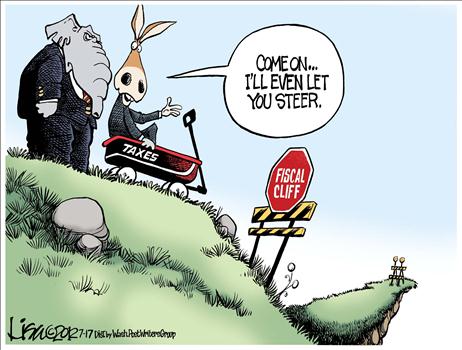
One of the Senate’s top Democrats, Patty Murray of Washington, has thrown down the gauntlet and stated that her colleagues are willing to push all taxpayers off the fiscal cliff. Here’s some of what the Wall Street Journal opined about her remarks.

Democrats must feel really good about their election chances, because their latest campaign strategy is to say how willing and eager they are to leap off the January tax cliff. They’re all but daring Republicans to make the Democrats’ day by refusing to raise taxes before the election. …In a speech at the Brookings Institution, she declared that if Republicans won’t raise taxes on income above $250,000 before November, Democrats will gladly let all of the Bush tax rates expire at the end of the year—even on the middle class, and no matter the economic consequences.

The editors at the WSJ are mystified as to why Democrats are willing to undermine an already weak economy with an election just a few months away.

The Murray Democrats are the ones holding the middle-class rates hostage to a GOP vote to raise taxes on the affluent. …Mrs. Murray may think she’s putting Republicans on the political spot, but her real hostage is the already weak economy. Growth in the first quarter was a mere 1.9%, and economists have steadily downgraded their expectations for the second. As the tax cliff approaches, the policy uncertainty is already causing businesses to hold off on hiring and investment. Even the Keynesians at the Congressional Budget Office say that if all of the Bush tax rates expire, growth will fall close to recession territory.

Since the Democrats aren’t coming to me for advice, I’m not sure about their motives. Are they so wedded to class-warfare tax policy that they’re willing to sacrifice other goals in hopes of penalizing success?

Or are they playing a clever political game, figuring that a GOP surrender on taxes will generate so much discord on the right that it will more than offset any electoral downside of a weaker economy?

I suspect the answer to both questions is “yes,” but mostly to the second question. Which is why this Lisa Benson cartoon is an appropriate way to conclude this post.

P.S. You can find more Lisa Benson cartoons here, herehere, here, here, herehere, and here.

P.P.S. If you somehow think that higher taxes are necessary because it’s impossible to otherwise balance the budget, I hope you’ll change your mind when you learn we can balance the budget in just 10 years if politicians merely limit spending increases to 2 percent annually.

Open letter to President Obama (Part 116.2)

Uploaded by on Feb 26, 2012

_________

President Obama c/o The White House
1600 Pennsylvania Avenue NW
Washington, DC 20500

Dear Mr. President,

I know that you receive 20,000 letters a day and that you actually read 10 of them every day. I really do respect you for trying to get a pulse on what is going on out here. 

I wish we would put in real spending cuts in the USA instead of fake ones like the ones in the United Kingdom.

Looking at ‘Austerity’ in Britain

Posted by Juan Carlos Hidalgo

I’m going to jump into the debate about austerity in Europe because it is being closely followed in Latin America, and many people are drawing the wrong conclusions about how austerity is strangling the European economies. But first, we have to be clear about what we mean by “austerity.”

As the debate between Veronique de Rugy of the Mercatus Center and Ryan Avent at The Economist shows, there are different definitions of austerity. The term could mean fiscal consolidation only by spending cuts. It could mean a mixture of spending cuts and tax increases (the so called “balanced approach”), and it could even be just tax increases. So when people blame “austerity” for Europe’s economic malaise, we could be talking about a very different set of policies in each country.

Let’s look at Britain, which just entered into a double dip recession because of, according to Paul Krugman, “the evident failure” of austerity policies. If we look at spending levels in the UK both in nominal and real terms, we can clearly see that despite the announcement of deep cuts, government spending continues to rise:


Source: European Commission, Economic and Financial Affairs.

It’s clear that, at least in nominal terms, the rate of growth of spending has declined, but that hardly constitutes brutal cuts as Krugman and others want us to believe. If we look at total government spending as a percentage of the economy, Britain reached a peak in 2009 at 51.5%, and that came down to 49.9% in 2011. Can anyone seriously argue that Britain is in a recession because of that tiny drop in spending as a share of the economy?

Now, let’s remember that the Conservative-Liberal Democrat coalition government that came to power in May 2010 adopted what The Economist hailed as a balanced approach of fiscal consolidation based on £1 of tax increases for £3 of spending cuts. To be fair, the British magazine also said that if economic recovery proved hard to achieve, the government should consider a reprieve in tax increases, but not on spending cuts. We all know that the tax increases already took place (the VAT rate went up from 17.5% to 20%, for example). But as we can see, spending cuts haven’t taken place at all. Thus, austerity in Britain consists only of tax increases.

It’s hard to estimate the impact of tax increases on the British economy. Certainly the economic turmoil in Continental Europe has played a role in taking the U.K. into a second recession. But those who claim that “austerity” is responsible for Britain’s economic malaise should be honest and acknowledge that by austerity they mean only tax increases, not spending cuts.

____________

Thank you so much for your time. I know how valuable it is. I also appreciate the fine family that you have and your commitment as a father and a husband.

Sincerely,

Everette Hatcher III, 13900 Cottontail Lane, Alexander, AR 72002, ph 501-920-5733, lowcostsqueegees@yahoo.com

Is it class warfare? Brummett says no, I say yes

Take a look above at this clip.

In his article “Class Warfare versus Pay it forward,” Sept 26, 2011, Arkansas News Bureau, John Brummett tries to make the case that Obama is not involved in class warefare. He quotes Elizabeth Warren to prove his point.

Unfortunately, logically this argument fails because although we all benefit from roads, police, fire departments and education, it is not clear that the rich benefit from all the social welfare programs that Warren wants to keep running. Also how does the rich benefit from Social Security?

Elizabeth Warren, Fair Play, and Soaking the Rich

Posted by Aaron Ross Powell

Elizabeth Warren’s recent remarks on class warfare, made during a campaign stop in her quest for a Massachusetts U.S. Senate seat, provide a nice microcosm of the broader philosophical views behind much contemporary political debate.

The relevant bit that has her supporters so fired up goes like this:

I hear all this, oh this is class warfare, no! There is nobody in this country who got rich on his own. Nobody. You built a factory out there–good for you.

But I want to be clear. You moved your goods to market on the roads the rest of us paid for. You hired workers the rest of us paid to educate. You were safe in your factory because of police forces and fire forces that the rest of us paid for. You didn’t have to worry that marauding bands would come and seize everything at your factory.

Now look. You built a factory and it turned into something terrific or a great idea–God Bless! Keep a Big Hunk of it. But part of the underlying social contract is you take a hunk of that and pay forward for the next kid who comes along.

Fully exploring the thinking behind Warren’s remarks would demand a book at least. We might point out that most of the rich got that way by creating value for others, meaning they gave back in the process of getting rich. Or we might wonder if her thinking implies that, because the state is responsible in part for the environment in which all of us earned what we have, the state is the actual owner of what we have.

To spare you having to read that book, however, I’m going to instead address just two points I find particularly interesting. First, we can tease out the theory of political obligation Warren advances and see if it holds up to scrutiny. Second, we can ask whether her argument, even if we accept it on its own terms, supports a tax increase on high income earners.

In a 1955 essay, H. L. A. Hart articulated what’s come to be known as the “fair play” principle of political obligation.

When a number of persons conduct any joint enterprise according to rules and thus restrict their liberty, those who have submitted to those restrictions when required have a right to a similar submission from those who have benefited by their submission.

Framed in Warren’s language, “the rest of us” restricted our liberty by paying taxes for the creation of roads, the formation of police forces, the funding of fire departments, and so on. And the rich benefited from our submission to taxes by getting rich (in part) because of the existence of roads, police, and fire departments. Therefore, we have a right to a similar submission from the rich in the form of them paying an increased amount in taxes to fund roads, police, and fire departments, too.

So by her account, this can’t be class warfare because it’s a simple matter of obligation. But is that true? Does the so-called “fair play” account of political obligation work?

Not really. Robert Nozick famously knocked it down in Anarchy, State, and Utopia with a thought experiment about a neighborhood public address system. And A. John Simmons went even further—and did so more persuasively—in his 1979 classic, Moral Principles and Political Obligations.

But the basic response to “fair play” is pretty simple: It seems awfully weird to demand that we repay benefits we never had a choice about accepting in the first place.

Nobody approached the rich before they were rich and said, “Hey, we’re all pitching in to pay for roads and police, which we all think are pretty valuable. If you’d like to benefit from those things like we would, we ask that you pay for them. Are you up for that?” A (pre-)rich person might very well say, “Yes, I’m game.” In that case the principle of fair play would apply. But it would only apply if he had a meaningful choice about the matter. On the other hand, he might say, “Yes, I think we do need roads and police, but I also think they’d be better provided by an alternative cooperative scheme (the market, a different government, a different voluntary group, etc.) to the one you’re offering.”

Simmons calls this the distinction between “receiving” benefits and “accepting” them. The fair play principle creates obligations when benefits are accepted, but not when merely received.

With that in mind, Warren would have a difficult time arguing that any of us genuinely accepted the particular roads and police provided by the particular scheme she supports. We’ve received them, yes, and may rather like what we received—but we were never presented with an actual choice.

There may, of course, be plenty of other good reasons to feel obligated to pay our taxes—or to even pay more taxes than our neighbors—but fair play, at least in the form Warren presents it, doesn’t quite get us there.

Still, let’s set such concerns aside and grant to Warren that, if the rich did benefit from the particular services paid for by the rest of us, they have a duty to pay (more) for them. Would that allow us to justify asking the rich to pay more taxes today?

Again, probably not. Just look at the beneficial services Warren draws our attention to.

  1. Roads
  2. Police
  3. Fire departments
  4. Education

She tacks an “and so on” to the list, but there’s something striking about the concrete examples she does give. Namely, they’re all the kinds of things you’d expect even from a much smaller state than the one we have today.

In other words, the need to raise taxes at the present moment (if such a need exists) is precisely not to pay for roads, police, fire departments, and education. We had those—and they were functioning quite nicely—for a good while before the explosion of federal spending under the last two administrations.

If Warren’s claim is that the rich got rich because of certain benefits they received from government and so should pay more to provide those benefits to others, then the overwhelming bulk of government spending is completely outside the scope of her argument.

It’s not obvious that many rich people got to be rich because of Medicare, Medicaid, Social Security, or military expenses. (Those who got rich because of subsidies are another matter, but she doesn’t draw that distinction, nor is she calling for an end to government handouts to the wealthy and politically connected.) But those are where we’ve seen so much of the spending increases that now demand, according to Warren and her peers, that all of us pony up more cash to the federal government.

This means that an easy response to Warren is to grant her general philosophical point but then add that what it leads to is not increased taxes but cutting government back to those programs that do make people rich and only then worry about how much of what remains the rich should pay for.

Of course we might also point out that, even with the bloated leviathan we have in Washington—one that does far more than provide roads, police, fire departments, and schools (which are, after all, chiefly state and local matters)—the rich still pay for most of it. Certainly more than “the rest of us” pay. As the Wall Street Journal pointed out back in May, “the highest-earning 10% of the U.S. population paid the largest share among 24 countries examined, even after adjusting for their relatively higher incomes.” The top 20% of American income earners pay over half the federal taxes. Which means that “the next kid who comes along” already is getting his federal benefits from the rich. To Warren and her supporters, I ask, “How much is enough?”

If Warren’s moral case for increasing the tax burden of the rich doesn’t hold up, can she still maintain her claim that this isn’t class warfare? Probably not. By her arguments, the rich are not obligated to pay more than they already are. Nor will their paying more do much of anything to ameliorate America’s fiscal woes. That means it’s rather difficult to see her speech as anything but a ploy to fire up her base by attacking a disfavored minority.

If that’s not class warfare, I don’t know what is.

Update: I just finished a podcast on the subject of this post with Caleb Brown.

Open letter to President Obama (Part 113)

President Obama c/o The White House
1600 Pennsylvania Avenue NW
Washington, DC 20500

Dear Mr. President,

I know that you receive 20,000 letters a day and that you actually read 10 of them every day. I really do respect you for trying to get a pulse on what is going on out here.

I really don’t think that socialism works in the real world because it destroys the motivation to work hard. How you respond to these facts below?

Another great article from Dan Mitchell (an updated version is also posted).

I posted a video making this point earlier in the year, and I also posted a version of this joke back in 2010, but here’s another version that’s worth sharing because of the five lessons to be learned at the conclusion.

=================================

An economics professor at a local college made a statement that he had never failed a single student before, but had recently failed an entire class. That class had insisted that Obama’s socialism worked and that no one would be poor and no one would be rich, a great equalizer.

The professor then said, “OK, we will have an experiment in this class on Obama’s plan”. All grades will be averaged and everyone will receive the same grade so no one will fail and no one will receive an A…. (substituting grades for dollars – something closer to home and more readily understood by all).

After the first test, the grades were averaged and everyone got a B. The students who studied hard were upset and the students who studied little were happy. As the second test rolled around, the students who studied little had studied even less and the ones who studied hard decided they wanted a free ride too so they studied little.

The second test average was a D! No one was happy.

When the 3rd test rolled around, the average was an F.

As the tests proceeded, the scores never increased as bickering, blame and name-calling all resulted in hard feelings and no one would study for the benefit of anyone else.

To their great surprise, ALL FAILED and the professor told them that socialism would also ultimately fail because when the reward is great, the effort to succeed is great, but when government takes all the reward away, no one will try or want to succeed.
It could not be any simpler than that.

There are five morals to this story:

1. You cannot legislate the poor into prosperity by legislating the wealthy out of prosperity.

2. What one person receives without working for, another person must work for without receiving.

3. The government cannot give to anybody anything that the government does not first take from somebody else.

4. You cannot multiply wealth by dividing it!

5. When half of the people get the idea that they do not have to work because the other half is going to take care of them, and when the other half gets the idea that it does no good to work because somebody else is going to get what they work for, that is the beginning of the end of any nation.

=================================

I’ll make one final point. There are five morals to the story, but there are dozens of nations giving us real-world examples every day.

Sort of makes you wonder why some people still believe this nonsense?

__________________

Thank you so much for your time. I know how valuable it is. I also appreciate the fine family that you have and your commitment as a father and a husband.

Sincerely,

Everette Hatcher III, 13900 Cottontail Lane, Alexander, AR 72002, ph 501-920-5733, lowcostsqueegees@yahoo.com

Open letter to President Obama (Part 112)

Dan Mitchell on Austerity in Europe 2012

President Obama c/o The White House
1600 Pennsylvania Avenue NW
Washington, DC 20500

Dear Mr. President,

I know that you receive 20,000 letters a day and that you actually read 10 of them every day. I really do respect you for trying to get a pulse on what is going on out here.

In order to balance the budget we must make deep cuts. Take a look at the study refers to below by Dan Mitchell of the Cato Institute in his fine article on the French mess. Raising taxes has not worked in the thirty countries studied. As President it is your job to make sure we don’t continue to head down this pass of trying to raise taxes on the job creators.

Having written several times about crazy French statism, you will understand why I like this cartoon.

Though, to be fair, France hasn’t gotten to the point where it’s being bailed out (it’s probably just a matter of time).

If you want some good analysis of the situation in Europe, Veronique de Rugy of the Mercatus Center hits the nail on the head in her column in today’s Washington Examiner.

France has yet to cut spending. In fact, to the extent that the French are frustrated with “budget cuts,” it’s only because the increase in future spending won’t be as large as they had planned. The same can be said about the United Kingdom. Spain, Italy and Greece have had no choice to cut some spending. However, in the case of these particular countries, the cuts were implemented alongside large tax increases. …This approach to austerity, also known in the United States as the “balanced approach,” has unfortunately proven a recipe for disaster. In a 2009 paper, Harvard University’s Alberto Alesina and Silvia Ardagna looked at 107 attempts to reduce the ratio of debt to gross domestic product over 30 years in countries in the Organisation for Economic Co-operation and Development. They found fiscal adjustments consisting of both tax increases and spending cuts generally failed to stabilize the debt and were also more likely to cause economic contractions. On the other hand, successful austerity packages resulted from making spending cuts without tax increases. They also found this form of austerity is more likely associated with economic expansion rather than with recession. …While the debate over austerity continues, the evidence seems to point to the conclusion that austerity can be successful, if it isn’t modeled after the “balanced approach.” It’s a lesson for the French and other European countries, as well as for American lawmakers who often seem tempted by the lure of closing budget gaps with higher taxes.

This is similar to my recent analysis, and Veronique also is kind enough to cite my analysis of how the Baltic nations have done the right thing and cut spending.

There are obvious lessons from Europe for the United States. If politicians don’t reform entitlement programs, we’re doomed to have our own fiscal crisis at some point in the not-too-distant future.

Only there won’t be anybody there to bail us out.

_____________

Thank you so much for your time. I know how valuable it is. I also appreciate the fine family that you have and your commitment as a father and a husband.

Sincerely,

Everette Hatcher III, 13900 Cottontail Lane, Alexander, AR 72002, ph 501-920-5733, lowcostsqueegees@yahoo.com

Open letter to President Obama (Part 111)

President Obama c/o The White House
1600 Pennsylvania Avenue NW
Washington, DC 20500

Dear Mr. President,

I know that you receive 20,000 letters a day and that you actually read 10 of them every day. I really do respect you for trying to get a pulse on what is going on out here.

If our country is the grow the economy and get our budget balanced it will not be by raising taxes!!! The recipe for success was followed by Ronald Reagan in the 1980’s when he cut taxes and limited spending. As far as limiting spending goes only Bill Clinton (with his Republican Congress) were ability to control the growth of government better than Reagan.

I had the pleasure of hearing Arthur Laffer speak in 1981 and he predicted all the economic growth that we would see because of the Reagan tax cuts and he was right. Unfortunately in California today they have forgotten all of those lessons!!!

President Obama’s fiscal policy is a dismal mixture. On spending, he wants a European-style welfare state. On taxes, he is fixated on class-warfare tax policy.

If we want to know the consequences of that approach, we can look at the ongoing collapse of Greece. Or, if we don’t like overseas examples, we can look at California.

If the (formerly) Golden State is any example, it turns out that having high tax rates doesn’t necessarily translate into high tax revenues. Here’s a blurb from an editorial in today’s Wall Street Journal.

California Controller John Chiang reported last week that April tax collections were a gigantic 20.2%, or $2.44 billion, below 2012-13 budget projections. …Among the biggest surprises is a 21.5% or nearly $2 billion decline in personal income tax payments from what Governor Jerry Brown had anticipated. This reinforces the point that when states rely too heavily on the top 1% of taxpayers to pay the bills, fiscal policy is a roller coaster ride. California is suffering this tax drought even as most other states enjoy a revenue rebound. State tax collections were up nationally by 8.9% last year, according to the Census Bureau, and this year revenues are up by double digits in many states. The state comptroller reports that Texas is enjoying 10.9% growth in its sales taxes (it has no income tax), while California can’t seem to keep up despite one of the highest tax rates in the land.

The WSJ editorial suggests a supply-side response, but you won’t be surprised to learn that the state’s kleptomaniac governor is pushing an Obama-style soak-the-rich tax hike.

This would seem to suggest that California should try cutting tax rates to keep more people and business in the state, but Sacramento is intent on raising them again. Governor Brown and the public-employee unions are sponsoring a ballot initiative in November to raise the state sales tax by a quarter point to 7.5% and to raise the top marginal income-tax rate to 13.3% from 10.3%. This will make the state even more reliant on the fickle revenue streams provided by the rich. Meanwhile, an analysis by Joseph Vranich, who studies migration of businesses from one state to another, finds that since 2009 the flight of businesses out of California “has increased fivefold due to high taxes and regulatory costs.”

I’ll be very curious to see what happens this November when the people of California vote in the referendum. Will they be like the morons in Oregon, who approved a class-warfare tax hike? Or will they be like the voters of Switzerland and reject class warfare?

Sadly, I suspect Oregon will be their role model – even though that decision hurt the Beaver State’s economy.

But while voters can impose higher taxes, they can’t repeal the laws of economics. So if California voters do the wrong thing, they will learn a hard lesson about the Laffer Curve.

And then, as this cartoon demonstrates, they’ll learn the ultimate lesson about not biting the hand that you mooch from.

___________

Thank you so much for your time. I know how valuable it is. I also appreciate the fine family that you have and your commitment as a father and a husband.

Sincerely,

Everette Hatcher III, 13900 Cottontail Lane, Alexander, AR 72002, ph 501-920-5733, lowcostsqueegees@yahoo.com

The Laffer Curve, Part III: Dynamic Scoring