Category Archives: Taxes

Open letter to Speaker of the House John Boehner (Part 2 on raising taxes)

 Open letter to Speaker of the House John Boehner (Part 2 on raising taxes)

John Boehner, Speaker of the House

H-232, The Capital, Washington, DC 20515

Dear Mr. Speaker,

I know that you will have to meet with newly re-elected President Obama soon and he will probably be anxious for you to raise taxes and  federal spending, but he will want you to leave runaway entitlement programs alone. DON’T RAISE TAXES BECAUSE THE DEMOCRATS WILL JUST SPEND MORE.

Below is a speech by George W. Bush honoring Milton Friedman:

Milton Friedman Honored for Lifetime Achievements 2002/5/9

Milton Friedman said that getting George Bush I to be his vice president was his biggest mistake because he knew that Bush was not a true conservative and sure enough George Bush did raise taxes when he later became President. I wonder if Jeb Bush has the same genes as his father.

What we need is some people in Washington that are brave enough to say that we have taken too much of the american people’s money and we have to make the painful spending cuts in order to balance the budget and not ask for any more tax increases!!!! Arkansas’ congressman Rick Crawford has also made the Charlie Brown mistake.

Even though America’s fiscal problem is entirely the result of too much government spending, I wrote earlier this year that there were all sorts of scenarios where I would agree to a tax increase.

But I then pointed out that all of those scenarios were total fantasies and that it would be more realistic to envision me playing center field for the New York Yankees.

The fundamental problem is that politicians never follow through on promises to reduce spending – even if you use the dishonest Washington definition that a spending cut occurs whenever the budget doesn’t rise as fast as previously planned.

And to make matters worse, they always seem to want class-warfare tax hikes that do heavy economic damage rather than the loophole closers that at least get rid of some of the inefficient corruption in the tax code.

That’s why I like the anti-tax pledge of Americans for Tax Reform. You don’t solve America’s fiscal problems by saying no to all tax increases, but at least you don’t move in the wrong direction at a faster rate.

Notwithstanding the principled and pragmatic arguments against putting tax increases on the table, some Republicans – in a triumph of hope over experience – are preemptively acquiescing to tax hikes.

Here’s what Jeb Bush said.

Jeb Bush, the former Florida governor, said Friday that he could back a broad deficit plan that increased taxes, a stance that puts him at odds with other prominent Republicans. Bush told a House panel he could get behind a plan that combined 10 dollars in spending cuts for every dollar of new revenue… “The problem is the 10 never materializes,” [Congressman Paul] Ryan said after Bush said he could support a revenue-increasing deficit deal. Norquist also has criticized deficit deals crafted in 1982 and 1990 – the latter agreed to by then-President George H.W. Bush, Jeb’s father – for failing to deliver on the spending side.

Kudos to Paul Ryan for making the obvious point about make-believe spending cuts. And Grover is correct about the failure of previous budget deals.

Indeed, I cited a New York Times column that inadvertently revealed that the only budget deal that worked was the 1997 pact that cut taxes rather than raised them.

Jeb Bush isn’t the only apostate. Here’s what Senator Graham had to say.

Sen. Lindsey Graham (R-S.C.) said Tuesday he believed Republicans should consider eliminating loopholes in the tax code even if they aren’t replaced by additional tax cuts, a move that would break with an anti-tax pledge many GOP lawmakers have signed with activist Grover Norquist. “When you eliminate a deduction, it’s OK with me to use some of that money to get us out of debt. That’s where I disagree with the pledge,” Graham told ABC News. …”I’m willing to move my party, or try to, on the tax issue. I need someone on the Democratic side being willing to move their party on structural changes to entitlements.” Graham said, for instance, he would support a plan that included $4 in spending cuts for every $1 in tax increases. During a Republican debate last August, all eight Republican candidates in attendance said they would reject a proposal to trade $10 in spending cuts for even $1 in tax increases.

In some sense, Senator Graham’s comments are reasonable. With real spending cuts and less-damaging forms of tax hikes, an acceptable deal is possible. But only in Fantasia, not in Washington.

In the real world, all that Senator Graham has done is to move the debate slightly to the left.
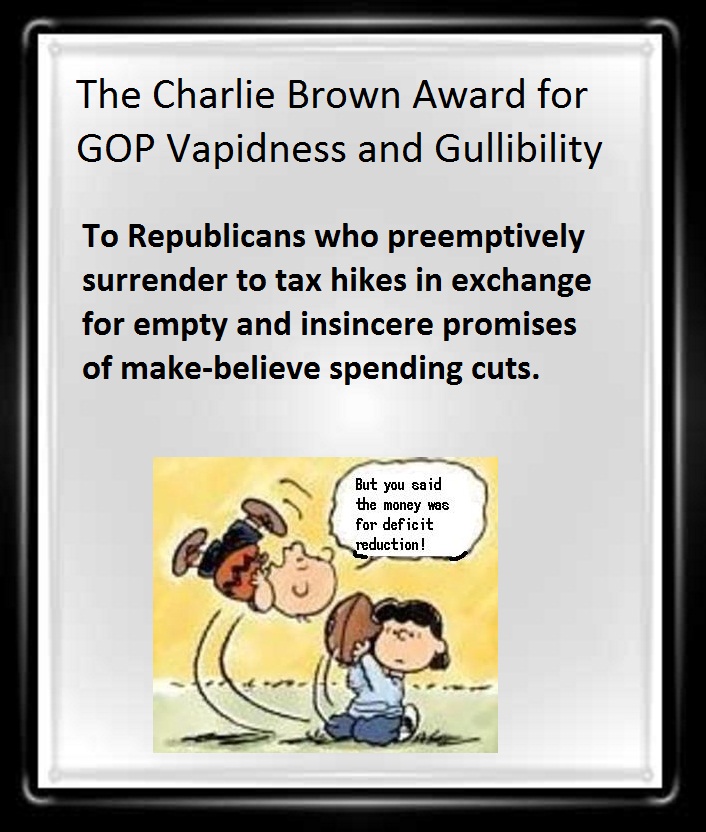
I’ve noted that tax increases are political poison for the Republican Party, but I don’t lose sleep worrying about the GOP.

But I do have nightmares about government getting even bigger, and that’s why I don’t want tax increases on the table. I don’t even want them in the room. Or the house. Or the neighborhood.

That’s why Jeb Bush and Lindsey Graham are the newest winners of the Charlie Brown Award. They’ve put blood in the water. I wonder if they’ll act surprised when hungry sharks show up looking for a meal?

Sincerely,

Everette Hatcher, 13900 Cottontail Lane, Alexander, AR 72002, lowcostsqueegees@yahoo.com, www.thedailyhatch.org, ph 501-920-5733

Related posts:

Government shutdown coming, will there be any tea party heroes available to stand up to Obama?

DEBT LIMIT – A GUIDE TO AMERICAN FEDERAL DEBT MADE EASY. Uploaded by debtlimitusa on Nov 4, 2011 A satirical short film taking a look at the national debt and how it applies to just one family. Watch the guy from the Ferris Bueller Superbowl Spot! Produced by Seth William Meier, DP/Edited by Craig Evans, […]

Some Tea Party heroes (Part 1)

DEBT LIMIT – A GUIDE TO AMERICAN FEDERAL DEBT MADE EASY. Uploaded by debtlimitusa on Nov 4, 2011 A satirical short film taking a look at the national debt and how it applies to just one family. Watch the guy from the Ferris Bueller Superbowl Spot! Produced by Seth William Meier, DP/Edited by Craig Evans, […]

Some Tea Party heroes (Part 8)

Rep Himes and Rep Schweikert Discuss the Debt and Budget Deal Michael Tanner of the Cato Institute in his article, “Hitting the Ceiling,” National Review Online, March 7, 2012 noted: After all, despite all the sturm und drang about spending cuts as part of last year’s debt-ceiling deal, federal spending not only increased from 2011 […]

Some Tea Party heroes (Part 7)

Michael Tanner of the Cato Institute in his article, “Hitting the Ceiling,” National Review Online, March 7, 2012 noted: After all, despite all the sturm und drang about spending cuts as part of last year’s debt-ceiling deal, federal spending not only increased from 2011 to 2012, it rose faster than inflation and population growth combined. […]

Who are the Tea Party Heroes from the 87 Freshmen Republicans?

Here is a study done on the votes of the 87 incoming freshman republicans frm the Club for Growth. Freshman Vote Study In the 2010 election, 87 freshmen House Republicans came to Washington pledging fealty to the Tea Party movement and the ideals of limited government and economic freedom. The mainstream media likes to say […]

Tea Party Conservative Senator Mike Lee interview

Tea Party Conservative Senator Mike Lee interview Here is an excellent interview above with Senator Lee with a fine article below from the Heritage Foundation. Sen. Mike Lee (R-UT) came to Washington as the a tea-party conservative with the goal of fixing the economy, addressing the debt crisis and curbing the growth of the federal […]

Some Tea Party heroes (Part 6)

I feel so strongly about the evil practice of running up our national debt. I was so proud of Rep. Todd Rokita who voted against the Budget Control Act of 2011 on August 11, 2011. He made this comment:   For decades now, we have spent too much money on ourselves and have intentionally allowed our […]

Some Tea Party heroes (Part 5)

Rep. Quayle on Fox News with Neil Cavuto __________________ We have to get people realize that the most important issue is the debt!!! Recently I read a comment by Congressman Ben Quayle (R-AZ) made  after voting against the amended Budget Control Act on August 1, 2011. He said it was important to compel “Congressional Democrats and […]

Some Tea Party heroes (Part 4)

What future does our country have if we never even attempt to balance our budget. I read some wise words by Congressman Jeff Landry (R, LA-03) regarding the  debt ceiling deal that was passed on August 1, 2011:”Throughout this debate, the American people have demanded a real cure to America’s spending addiction – a Balanced Budget […]

Some Tea Party heroes (Part 3)

I read some wise comments by Idaho First District Congressman Raúl R. Labrador concerning the passage of the Budget Control Act on August 1, 2011 and I wanted to point them out: “The legislation  lacks a rock solid commitment to passage of a balanced budget amendment, which I believe is necessary to saving our nation.” I just […]

Some Tea Party heroes (Part 2)

Congressmen Tim Huelskamp on the debt ceiling I just don’t understand why people think we can go on and act like everything is okay when we have a trillion dollar deficit. Sometimes you run across some very wise words like I did the other day. Kansas Congressman Tim Huelskamp made the following comment on the […]

Open letter to President Obama (Part 168)


President Obama c/o The White House
1600 Pennsylvania Avenue NW
Washington, DC 20500

Dear Mr. President,

I know that you receive 20,000 letters a day and that you actually read 10 of them every day. I really do respect you for trying to get a pulse on what is going on out here.

Steve Jobs did not give away a lot of money to charity, but he did help many to go up the economic ladder. Henry Ford did the same thing. I was curious about your comments that you made about Henry Ford!!! Read below.

Mike Kelsey

April 17, 2012 at 1:15 pm

President Obama has a new role model for his Buffett Rule tax—Henry Ford. It’s an odd choice considering that Ford advocated free-market capitalism and opposed redistributive policies.

Despite the lucrative government contracts, Henry Ford refused to participate in FDR’s 1933 National Recovery Act. (Let’s not forget that Ford Motors was the only “big-three” automaker to decline the recent government bailout.)

So why cite Ford as support for a redistributive “fairness tax”—especially one that discourages investment in the sort of successful companies that Ford worked to create?

In his stump speech for the Buffett Rule, Obama argues that Ford was a progressive who understood that “prosperity has never trickled down from the wealthy few.” Accordingly, Ford paid high wages to redistribute his unwarranted profits to the middle class.

Yes, Ford’s $5-a-day wage in 1914 (a little over $100 by today’s measure) was more than double the average autoworker’s pay. And yes, Ford felt a personal moral obligation to pay his workers well and help reduce poverty (what he called “welfare capitalism”). But paying high wages to valuable employees wasn’t a redistributive plan—it was good business.

We were not distributing anything,” he explained in his autobiography. “We were building a future. A low wage business is always insecure.” Ford needed the $5-a-day wage to attract and retain skilled workers and stay ahead of his competitors. He estimated that the high wage reduced the number of new employees he had to hire and train by 200,000 people per year.

Henry Ford was the Steve Jobs of his day, and cars were iPods of the 1920s. Just as Apple pays high wages to engineers to produce cutting-edge gadgets, so Ford paid high wages to retain skilled labor to build cars. Ford paid these wages because the market allowed—nay, demanded—them. Far from driving a top-down progressive policy, Ford was effectively responding to the needs of the market.

And how did Ford react to blatantly redistributive policies? “I do not think that this country is ready to be treated like Russia for a while,” Ford said of the New Deal. “There is a lot of the pioneer spirit here yet.”

That sentiment applies to the Buffett Rule. The rule would impose a 30 percent alternative minimum tax rate on all income (now defined to include wages, capital gains, and dividends) above $1 million. The Buffett Rule would stifle American industriousness and weaken the economy by discouraging investment, all while reducing the deficit by a mere 0.5 percent. Worse than the policy outcome is the destructive hubris underlying the proposal: the Buffett Rule assumes that only government redistribution can help the middle class.

Obama learned the wrong lesson from Ford’s $5-a-day wage. Ford created remunerative jobs for the middle class not because of stringent progressive regulations and redistributive programs but because his company had the freedom and the flexibility to respond to the needs of market.

_______________

Thank you so much for your time. I know how valuable it is. I also appreciate the fine family that you have and your commitment as a father and a husband.

Sincerely,

Everette Hatcher III, 13900 Cottontail Lane, Alexander, AR 72002, ph 501-920-5733, lowcostsqueegees@yahoo.com

Related posts:

Should Steve Jobs have been ashamed of the sweatshops he used in China? (Part 2)

In the first post I included the liberal case against Steve Jobs concerning the “sweat shop” he used. Here I am just going to show the conservative view.  It is best done by this 9 minute video clip and transcript. “FREE TO CHOOSE” 1: The Power of the Market (Milton Friedman) Free to Choose ^ […]

Should Steve Jobs been ashamed of the sweat shops he used in China? (Part 1)

This is a very easy issue for me. Milton Friedman noted in 1973:  Sweatshops and child labor were conditions that resulted more from poverty than from laissez-faire economics. Wretched working conditions still exist in nations with all sorts of enlightened social legislation but where poverty is still extreme. We in the United States no longer […]

Steve Jobs to the President: “You’re headed for a one-term presidency,”

I have posted a lot about Steve Jobs and I have the links below after this fine aricle: Steve Jobs to Obama in 2010: ‘You’re Headed for a One-Term Presidency’ Lachlan Markay October 21, 2011 at 12:04 pm Steve Jobs, the late Apple founder and digital pioneer, told President Obama in a 2010 meeting that […]

Did Steve Jobs help people even though he did not give away a lot of money?

Did Steve Jobs help people even though he did not give away a lot of money? Uploaded by UM0kusha0kusha on Sep 16, 2010 clip from The First Round Up *1934* ~~enjoy!! ______________________________________________ In the short film above you can see that it was the kindness of the two “haves” to the other “havenots” that allowed everyone to eat. […]

The many sides of Steve Jobs

Another look at Steve Jobs. Best Bits From the Steve Jobs Bio By Sadie Bass | The Daily Beast – 1 hr 0 mins ago The Profound Effect of Being Adopted What’s the key to understanding Steve Jobs? According to his biographer, Walter Isaacson, it starts at the beginning—literally. Jobs was born to unwed parents and placed […]

Steve Jobs’ last words and his spiritual views

Steve Jobs’ 2005 Stanford Commencement Address Uploaded by StanfordUniversity on Mar 7, 2008 Drawing from some of the most pivotal points in his life, Steve Jobs, chief executive officer and co-founder of Apple Computer and of Pixar Animation Studios, urged graduates to pursue their dreams and see the opportunities in life’s setbacks — including death […]

If you want to check out other posts I have done about about Steve Jobs:Some say Steve Jobs was an atheist , Steve Jobs and Adoption , What is the eternal impact of Steve Jobs’ life? ,Steve Jobs versus President Obama: Who created more jobs? ,Steve Jobs’ view of death and what the Bible has to say about it ,8 things you might not know about Steve Jobs ,Steve Jobs was a Buddhist: What is Buddhism? ,Did Steve Jobs help people even though he did not give away a lot of money?

Apple CEO Steve Jobs  (AP Photo/Paul Sakuma)

Some Tea Party heroes (Part 8)

Rep Himes and Rep Schweikert Discuss the Debt and Budget Deal

Michael Tanner of the Cato Institute in his article, “Hitting the Ceiling,” National Review Online, March 7, 2012 noted:

After all, despite all the sturm und drang about spending cuts as part of last year’s debt-ceiling deal, federal spending not only increased from 2011 to 2012, it rose faster than inflation and population growth combined.

We need some national statesmen (and ladies) who are willing to stop running up the nation’s credit card.

Ted DeHaven noted his his article, “Freshman Republicans switch from Tea to Kool-Aid,”  Cato Institute Blog, May 17, 2012:

This week the Club for Growth released a study of votes cast in 2011 by the 87 Republicans elected to the House in November 2010. The Club found that “In many cases, the rhetoric of the so-called “Tea Party” freshmen simply didn’t match their records.” Particularly disconcerting is the fact that so many GOP newcomers cast votes against spending cuts.

The study comes on the heels of three telling votes taken last week in the House that should have been slam-dunks for members who possess the slightest regard for limited government and free markets. Alas, only 26 of the 87 members of the “Tea Party class” voted to defund both the Economic Development Administration and the president’s new Advanced Manufacturing Technology Consortia program (see my previous discussion of these votes here) and against reauthorizing the Export-Import Bank (see my colleague Sallie James’s excoriation of that vote here).

One of those Tea Party heroes was Congressman David Schweikert of Arizona. Last year I posted this below concerning his conservative views and his willingness to vote against the debt ceiling increase:

August 1, 2011 | FOR IMMEDIATE RELEASE
CONTACT: Rachel Semmel | 202-226-2298

Washington, D.C. – Rep. David Schweikert (R-AZ) made the following statement after he voted against the Budget Control Act of 2011:

“While this deal was well-intended and skillfully negotiated, I cannot in good faith vote for a bill I know does not do enough to bend the curve of our rapidly escalating debt.“When looking solely at the numbers, the amount of cuts in the 2012 and 2013 budget cycles are not nearly enough, and these are the only two cycles under the control of this Congress. I remain concerned about holding future Congresses accountable to cap spending at our requested levels.“Though I feel this measure is inadequate, I am proud of House Republicans for shifting the conversation from spending and borrowing to reducing the size and cost of government.  It is a positive sign, and slowly but surely Washington is waking up to how massive our debt really is.“I was sent here to grow the economy, stand up to the president’s tax-and-borrow bailouts, and stop the avalanche of debt. However, we simply must do more.”
Related posts:

Some Tea Party heroes (Part 6)

I feel so strongly about the evil practice of running up our national debt. I was so proud of Rep. Todd Rokita who voted against the Budget Control Act of 2011 on August 11, 2011. He made this comment:   For decades now, we have spent too much money on ourselves and have intentionally allowed our […]

Some Tea Party heroes (Part 5)

Rep. Quayle on Fox News with Neil Cavuto __________________ We have to get people realize that the most important issue is the debt!!! Recently I read a comment by Congressman Ben Quayle (R-AZ) made  after voting against the amended Budget Control Act on August 1, 2011. He said it was important to compel “Congressional Democrats and […]

Some Tea Party heroes (Part 4)

What future does our country have if we never even attempt to balance our budget. I read some wise words by Congressman Jeff Landry (R, LA-03) regarding the  debt ceiling deal that was passed on August 1, 2011:”Throughout this debate, the American people have demanded a real cure to America’s spending addiction – a Balanced Budget […]

Some Tea Party heroes (Part 3)

I read some wise comments by Idaho First District Congressman Raúl R. Labrador concerning the passage of the Budget Control Act on August 1, 2011 and I wanted to point them out: “The legislation  lacks a rock solid commitment to passage of a balanced budget amendment, which I believe is necessary to saving our nation.” I just […]

Some Tea Party heroes (Part 2)

Congressmen Tim Huelskamp on the debt ceiling I just don’t understand why people think we can go on and act like everything is okay when we have a trillion dollar deficit. Sometimes you run across some very wise words like I did the other day. Kansas Congressman Tim Huelskamp made the following comment on the […]

Some Tea Party heroes (Part 1)

DEBT LIMIT – A GUIDE TO AMERICAN FEDERAL DEBT MADE EASY. Uploaded by debtlimitusa on Nov 4, 2011 A satirical short film taking a look at the national debt and how it applies to just one family. Watch the guy from the Ferris Bueller Superbowl Spot! Produced by Seth William Meier, DP/Edited by Craig Evans, […]

Who are the Tea Party Heroes from the 87 Freshmen Republicans?

Here is a study done on the votes of the 87 incoming freshman republicans frm the Club for Growth. Freshman Vote Study In the 2010 election, 87 freshmen House Republicans came to Washington pledging fealty to the Tea Party movement and the ideals of limited government and economic freedom. The mainstream media likes to say […]

Government shutdown coming, will there be any tea party heroes available to stand up to Obama?

DEBT LIMIT – A GUIDE TO AMERICAN FEDERAL DEBT MADE EASY. Uploaded by debtlimitusa on Nov 4, 2011 A satirical short film taking a look at the national debt and how it applies to just one family. Watch the guy from the Ferris Bueller Superbowl Spot! Produced by Seth William Meier, DP/Edited by Craig Evans, […]

Open letter to President Obama (Part 167)

One of my favorite groups growing up was ABBA. Here are some of my favorite songs:

_______________

President Obama c/o The White House
1600 Pennsylvania Avenue NW
Washington, DC 20500

Dear Mr. President,

I know that you receive 20,000 letters a day and that you actually read 10 of them every day. I really do respect you for trying to get a pulse on what is going on out here.

It is sad that we are heading to where Sweden used to be and they are heading to where we used to be. Here is a great article from the Heritage Foundation:

Anthony B. Kim

April 16, 2012 at 5:30 pm

Sweden is known for, among other things, Swedish meatballs, the pop group ABBA, and IKEA.

Well, here is another thing that Sweden should be recognized for: tax cuts. Yes, you heard right: tax cuts.

Sweden used to tax corporations at a 60 percent rate. Now that has come down to 26.3 percent. As noted in a recent article by the U.K.-based Spectator magazine, Sweden’s finance minister, Anders Borg, who was named the most effective finance minister in Europe by the Financial Times, got something awfully right.

Since becoming Sweden’s finance minister, [Borg’s] mission has been to pare back government. His “stimulus” was a permanent tax cut. To critics, this was fiscal lunacy—the so-called “punk tax cutting” agenda. Borg, on the other hand, thought lunacy meant repeating the economics of the 1970s and expecting a different result.… Three years on, it’s pretty clear who was right. “Look at Spain, Portugal or the UK, whose governments were arguing for large temporary stimulus,” he says. “Well, we can see that very little of the stimulus went to the economy. But they are stuck with the debt.” Tax-cutting Sweden, by contrast, had the fastest growth in Europe last year, when it also celebrated the abolition of its deficit.… He continued to cut taxes and cut welfare-spending to pay for it; he even cut property taxes for the rich to lure entrepreneurs back to Sweden. The last bit was the most unpopular, but for Borg, economic recovery starts with entrepreneurs.

The tax cuts, combined with Sweden’s highly efficient regulatory system, have raised the Swedish economy to 21st place in the 2012 Index of Economic Freedom. By sharp contrast, the regulation-loving “Yes, We Can” U.S. Administration has driven down our economic freedom ranking over the past three years and is steering our economy into “Taxmageddon.

Maybe it is time for President Obama to sit down with Sweden’s finance minister for a lesson on how to achieve economic recovery.

____________

Thank you so much for your time. I know how valuable it is. I also appreciate the fine family that you have and your commitment as a father and a husband.

Sincerely,

Everette Hatcher III, 13900 Cottontail Lane, Alexander, AR 72002, ph 501-920-5733, lowcostsqueegees@yahoo.com

Obama’s method: Higher Taxes on the Rich Are a Precursor to Higher Taxes on the Rest of Us

Over and over you read that President Obama just wants to raise taxes on the rich. Is that true? Raising taxes on the rich will not balance the budget. What is he really after?

Higher Taxes on the Rich Are a Precursor to Higher Taxes on the Rest of Us

October 29, 2012 by Dan Mitchell

President Obama repeatedly assures us that he only wants higher taxes on the rich as part of his class-warfare agenda.

But I don’t trust him. In part because he’s a politician, but also because there aren’t enough rich people to finance big government (not to mention that the rich easily can alter their financial affairs to avoid higher tax rates).

Honest leftists are beginning to admit that their real target is the middle class. Here are a few examples.

In other words, politicians often say they want to tax the rich, but the real target is the middle class. Indeed, this is the history of tax policy. In a post earlier this year, warning the folks in the Cayman Islands not to impose an income tax, I noted how the U.S. income tax began small and then swallowed up more and more people.

…the U.S. income tax began in 1913 with a top rate of only 7 percent and it affected less than 1 percent of the population. But that supposedly benign tax has since become a monstrous internal revenue code that plagues the nation today.

The same thing is true elsewhere in the world.

Allister Heath explains for London’s City A.M. newspaper.

The introduction of income taxes around the world have tended to follow a very similar pattern over the past couple of centuries. First, we get generally low income tax rates, with most people exempt and with the highest rate only affecting a few people relatively lightly. Eventually, tax rates shoot up for everybody – including to crippling levels for top earners – and millions more are caught by income tax. The next stage is that the ultra-high tax rates for top earners are reduced to manageable levels – but ever more people are brought into the tax system, with the higher brackets also catching vastly more folk.

By the way, you can see that Allister makes a reference to tax rates being reduced for top earners. That’s largely because many politicians learned an important lesson about the Laffer Curve. Sometimes, the best way to “soak the rich” is by lowering their tax rates. Unfortunately, President Obama still needs some remedial education on this topic.

Allister then looks at some specific U.K. data revealing how more and more middle class people are now subject to higher tax rates.

The biggest change in the UK has been the number of people paying what is now the 40p tax rate: up six-fold in thirty years, from 674,000 in 1979-80, 2.5m in 1999-2000 to 4.048m in 2011-12. This number will jump again to around 5m in 2014, according to the Institute for Fiscal Studies. When Margaret Thatcher came to power, just 2.6 per cent of taxpayers paid the top rate; by the time of the next election, 16.7 per cent will.

If Obama and other statists get their way, we’ll see similar statistic in the United States. Higher income tax rates for the rich will mean higher income tax rates for the rest of us. Though I’m even more worried about a value-added tax, which would be a huge burden on ordinary people and a revenue machine for greedy politicians.

It’s worth noting, by the way, that the American tax code actually is more “progressive” than the tax codes of Europe’s welfare states. This is largely because we don’t screw over poor and middle-class taxpayers with a VAT.

P.S. Since I mentioned the Laffer Curve above, I should emphasize that the goal of good tax policy should be to maximize growth, not to maximize tax revenue.

P.P.S. And don’t forget that poor and middle-income taxpayers also will be hurt because slower growth is an inevitable consequence when tax rates climb and the burden of government spending increases.

Some Tea Party heroes (Part 7)

Michael Tanner of the Cato Institute in his article, “Hitting the Ceiling,” National Review Online, March 7, 2012 noted:

After all, despite all the sturm und drang about spending cuts as part of last year’s debt-ceiling deal, federal spending not only increased from 2011 to 2012, it rose faster than inflation and population growth combined.

We need some national statesmen (and ladies) who are willing to stop running up the nation’s credit card.

Ted DeHaven noted his his article, “Freshman Republicans switch from Tea to Kool-Aid,”  Cato Institute Blog, May 17, 2012:

This week the Club for Growth released a study of votes cast in 2011 by the 87 Republicans elected to the House in November 2010. The Club found that “In many cases, the rhetoric of the so-called “Tea Party” freshmen simply didn’t match their records.” Particularly disconcerting is the fact that so many GOP newcomers cast votes against spending cuts.

The study comes on the heels of three telling votes taken last week in the House that should have been slam-dunks for members who possess the slightest regard for limited government and free markets. Alas, only 26 of the 87 members of the “Tea Party class” voted to defund both the Economic Development Administration and the president’s new Advanced Manufacturing Technology Consortia program (see my previous discussion of these votes here) and against reauthorizing the Export-Import Bank (see my colleague Sallie James’s excoriation of that vote here).

One of those Tea Party heroes was Congressman Dennis Ross of Florida. Last year I posted this below concerning his conservative views and his willingness to vote against the debt ceiling increase:

Press Release: Dennis Ross Statement on Debt Deal Vote
Solving our Long Term Debt Crisis Will Require a Balanced Budget Amendment, Tax Reform, and a National Discussion on the Role of the Federal Government


Jobs – June Job Fair 26
Jobs – June Job Fair 27
Jobs – June Job Fair 28
Jobs – June Job Fair 30
Jobs – June Job Fair 31
Jobs – June Job Fair 32
Jobs – June Job Fair 33


Jobs – June Job Fair 34

Related Documents

Zero Based Budget Bill

Budget – GOP Budget Plan

Oversight – AmericanJobCreators.com Radio Actuality


Washington, Aug 1 

Washington, DC – Congressman Dennis A. Ross (R-FL) released the following statement announcing his intention to vote NO on the “Debt Deal.”   Congressman Ross released the following statement,

“America is nearly upside down on the national mortgage and this legislation is not a viable long term solution to put our fiscal house in order.  No responsible bank would lend to a family in the financial condition our nation is in without a realistic and enforceable plan to get their spending under control.  Without a Balanced Budget Amendment in place, this deal, as with dozens of others, will barely last through this election, let alone ten years.  My kids and grandkids cannot afford trillions more in debt and I was not sent here to heel like a good puppy when the President or the Treasury Secretary says so.  I was sent here to do what is right for my constituents and the nation, even if that makes me unpopular or costs me my seat.”

Congressman Ross continued, “The Speaker is up against the most liberal President since Jimmy Carter and a Senate that spends more time bloviating than legislating.  I do not envy him that task.  No one should mistake my differences with this legislation as an indication of any problem with my Speaker.  Those of us who vote no on today’s legislation will send a message to the President that 75% of the American people want to tie Washington’s hands when it comes to spending with a Balanced Budget Amendment and we know our Speaker will be there when it happens.”

Dennis Ross, son of Bill and Loyola Ross, was born in 1959 and raised in Lakeland, Florida.   He graduated from Auburn University and the Cumberland School of Law at Sanford University.  He has served as in-house counsel to the Walt Disney Company and as an associate of the law firm of Holland & Knight.  He previously served in the Florida Legislature from 2000 until being term limited in 2008.  Dennis and his wife, Cindy Hartley, were married in 1983 and have two sons, Shane and Travis.

Who are the Tea Party Heroes from the 87 Freshmen Republicans?

Here is a study done on the votes of the 87 incoming freshman republicans frm the Club for Growth.

Freshman Vote Study

In the 2010 election, 87 freshmen House Republicans came to Washington pledging fealty to the Tea Party movement and the ideals of limited government and economic freedom. The mainstream media likes to say that the freshman class is the most uncompromising group of fiscal conservatives in history…but just how Tea Party are they? Did all 87 freshmen always vote to cut spending and limit the size of government, or did some of them vote like the big-spending R.I.N.Os of the past?

This study was compiled from the Club for Growth’s Congressional Scorecard, which evaluates lawmakers based upon their commitment to limited government and pro-growth policies. What we found was that while some freshmen have lived up to the promises they made to the tea party movement, dozens of them are big-spenders and are no different from many of the veteran Republicans they serve with.

While the rhetoric of the freshmen may be loud, the Club for Growth strives to hold lawmakers accountable by examining how they actually voted once they got to Congress. In many cases, the rhetoric of the so-called “Tea Party” freshmen simply didn’t match their records.Please select a freshman

Solyndra, oil company tax deductions, etc

Obamanomics: A Legacy of Wasteful Spending

Published on Aug 12, 2012 by

This mini-documentary from the Center for Freedom and Prosperity Foundation highlights egregious examples of wasteful spending from the so-called stimulus legislation and explains why government spending hurts economic performance.

**Links to additional reading material**

Thomas Sowell, “Stimulus or Sedative?”
http://www.realclearpolitics.com/articles/2010/03/09/stimulus_or_sedative_104…

Veronique de Rugy, “Green Energy Loans: Beyond the Solyndra Drama,”
http://www.nationalreview.com/corner/303787/green-energy-loans-beyond-solyndr…

CF&P Economic Lessons Video, “Keynesian Economics is Wrong: Bigger Gov’t Is Not Stimulus,”
http://freedomandprosperity.org/2008/videos/keynesian-economics-is-wrong-bigg…

Doug Bandow, “Federal Spending: Killing the Economy with Government Stimulus,”
http://www.cato.org/publications/commentary/federal-spending-killing-economy-…

Dan Mitchell, “Spending Is Not Stimulus: Bigger Government Did Not Work for bush, and It Will Not Work for Obama,”
http://www.cato.org/pubs/tbb/tbb_0209-53.pdf

CF&P Economic Lessons Video, “Obamas So-Called Stimulus: Good For Government, Bad For the Economy,”
http://freedomandprosperity.org/2009/videos/obamas-so-called-stimulus-good-fo…

Nicolas Loris, “Department of Energy Budget Cuts: Time to End the Hidden Green Stimulus,”
http://www.heritage.org/research/reports/2012/03/department-of-energy-budget-…

Jim Powell, “How Obama’s Last Stimulus Bill Became a Comedy of Errors,”
http://www.cato.org/publications/commentary/how-obamas-last-stimulus-bill-bec…

__________

Double taxation is just morally wrong and it should be stopped.

In a violation of the 8th Amendment’s prohibition against cruel and unusual punishment, my brutal overseers at the Cato Institute required me to watch last night’s debate (you can see what Cato scholars said by clicking here).

Tweedle Dee and Tweedle Dum

But I will admit that it was good to see Obama finally put on the defensive, something that almost never happens since the press protects him (with one key exception, as shown in this cartoon).

This doesn’t mean I like Romney, who would probably be another Bush if he got to the White House.

On the specifics, I obviously didn’t like Obama’s predictable push for class warfare tax policy, but I’ve addressed that issue often enough that I don’t have anything new to add.

I was irked, though, by Obama’s illiteracy on the matter of business deductions for corporate jets, oil companies, and firms that “ship jobs overseas.”

Let’s start by reiterating what I wrote last year about how to define corporate income: At the risk of stating the obvious, profit is total revenues minus total costs. Unfortunately, that’s not how the corporate tax system works.

Sometimes the government allows a company to have special tax breaks that reduce tax liabilities (such as the ethanol credit) and sometimes the government makes a company overstate its profits by not allowing it to fully deduct costs.

During the debate, Obama was endorsing policies that would prevent companies from doing the latter.

The irreplaceable Tim Carney explains in today’s Washington Examiner. Let’s start with what he wrote about oil companies.

…the “oil subsidies” Obama points to are broad-based tax deductions that oil companies also happen to get. I wrote last year about Democratic rhetoric on this issue: “tax provisions that treat oil companies like other companies become a ‘giveaway,’…”

I thought Romney’s response about corrupt Solyndra-type preferences was quite strong.

Here’s what Tim wrote about corporate jets.

…there’s no big giveaway to corporate jets. Instead, some jets are depreciated over five years and others are depreciated over seven years. I explained it last year. When it comes to actual corporate welfare for corporate jets, the Obama administration wants to ramp it up — his Export-Import Bank chief has explicitly stated he wants to subsidize more corporate-jet sales.

By the way, depreciation is a penalty against companies, not a preference, since it means they can’t fully deduct costs in the year they are incurred.

On another matter, kudos to Tim for mentioning corrupt Export-Import Bank subsidies. Too bad Romney, like Obama, isn’t on the right side of that issue.

And here’s what Tim wrote about “shipping jobs overseas.”

Obama rolled out the canard about tax breaks for “companies that ship jobs overseas.” Romney was right to fire back that this tax break doesn’t exist. Instead, all ordinary business expenses are deductible — that is, you are only taxed on profits, which are revenues minus expenses.

Tim’s actually too generous in his analysis of this issue, which deals with Obama’s proposal to end “deferral.” I explain in this post how the President’s policy would undermine the ability of American companies to earn market share when competing abroad – and how this would harm American exports and reduce American jobs.

To close on a broader point, I’ve written before about the principles of tax reform and explained that it’s important to have a low tax rate.

But I’ve also noted that it’s equally important to have a non-distortionary tax code so that taxpayers aren’t lured into making economically inefficient choices solely for tax reasons.

That’s why there shouldn’t be double taxation of income that is saved and invested, and it’s also why there shouldn’t be loopholes that favor some forms of economic activity.

Too bad the folks in government have such a hard time even measuring what’s a loophole and what isn’t.

Videos by Cato Institute on failed stimulus plans

In this post I have gathered several videos from the Cato Institute concerning the subject of failed stimulus plans.

_____

Government Spending Doesn’t Create Jobs

Uploaded by on Sep 7, 2011

Share this on Facebook: http://on.fb.me/qnjkn9 Tweet it: http://tiny.cc/o9v9t

In the debate of job creation and how best to pursue it as a policy goal, one point is forgotten: Government doesn’t create jobs. Government only diverts resources from one use to another, which doesn’t create new employment.

Video produced by Caleb Brown and Austin Bragg.

___________________________

Keynesian Catastrophe: Big Money, Big Government & Big Lies

Uploaded by on Jan 19, 2012

The Cato Institute’s Dan Mitchell explains why Obama’s stimulus was a flop! With Glenn Reynolds.

See more at http://www.pjtv.com and http://www.cato.org

___________________

Keynesian Economics Is Wrong: Bigger Gov’t Is Not Stimulus

Uploaded by on Dec 15, 2008

Based on a theory known as Keynesianism, politicians are resuscitating the notion that more government spending can stimulate an economy. This mini-documentary produced by the Center for Freedom and Prosperity Foundation examines both theory and evidence and finds that allowing politicians to spend more money is not a recipe for better economic performance.

___________________

Obama’s So-Called Stimulus: Good For Government, Bad For the Economy

Uploaded by on Jan 26, 2009

President Obama wants Congress to dramatically expand the burden of government spending. This CF&P Foundation mini-documentary explains why such a policy, based on the discredited Keynesian theory of economics, will not be successful. Indeed, the video demonstrates that Obama is proposing – for all intents and purposes – to repeat Bush’s mistakes. Government will be bigger, even though global evidence shows that nations with small governments are more prosperous.

____________

Big Government Is Not Stimulus: Why Keynes Was Wrong (The Condensed Version)

Uploaded by on Jan 13, 2009

The CF&P Foundation has released a condensed version of our successful mini-documentary explaining why so-called stimulus schemes do not work. Based on a theory known as Keynesianism, politicians are resuscitating the notion that more government spending can stimulate an economy. This mini-documentary produced by the Center for Freedom and Prosperity Foundation examines both theory and evidence and finds that allowing politicians to spend more money is not a recipe for better economic performance.

_________________

Eight Reasons Why Big Government Hurts Economic Growth

Uploaded by on Aug 17, 2009

This Center for Freedom and Prosperity Foundation video analyzes how excessive government spending undermines economic performance. While acknowledging that a very modest level of government spending on things such as “public goods” can facilitate growth, the video outlines eight different ways that that big government hinders prosperity. This video focuses on theory and will be augmented by a second video looking at the empirical evidence favoring smaller government.

___________________

Keynesian Economics Is Wrong: Economic Growth Causes Consumer Spending, Not the Other Way

Uploaded by on Nov 29, 2010

Politicians and journalists who fixate on consumer spending are putting the cart before the horse. Consumer spending generally is a consequence of growth, not the cause of growth. This Center for Freedom and Prosperity video helps explain how to achieve more prosperity by looking at the differences between gross domestic product and gross domestic income. www.freedomandprosperity.org

_____________

Deficits, Debts and Unfunded Liabilities: The Consequences of Excessive Government Spending

Uploaded by on May 10, 2010

Huge budget deficits and record levels of national debt are getting a lot of attention, but this video explains that unfunded liabilities for entitlement programs are Americas real red-ink challenge. More important, this CF&P mini-documentary reveals that deficits and debt are symptoms of the real problem of an excessive burden of government spending. www.freedomandprosperity.org

___________

Now that I have been critical of the Democrat President, I wanted to show that I am not concerned about taking up for Republicans but looking at the facts. President Clinton did increase government spending at a slower rate than many other presidents. Here are two  videos that praise both Reagan and Clinton for both accomplished this feat.

Spending Restraint, Part I: Lessons from Ronald Reagan and Bill Clinton

Uploaded by on Feb 14, 2011

Ronald Reagan and Bill Clinton both reduced the relative burden of government, largely because they were able to restrain the growth of domestic spending. The mini-documentary from the Center for Freedom and Prosperity uses data from the Historical Tables of the Budget to show how Reagan and Clinton succeeded and compares their record to the fiscal profligacy of the Bush-Obama years.

______________

Spending Restraint, Part II: Lessons from Canada, Ireland, Slovakia, and New Zealand

Uploaded by on Feb 22, 2011

Nations can make remarkable fiscal progress if policy makers simply limit the growth of government spending. This video, which is Part II of a series, uses examples from recent history in Canada, Ireland, Slovakia, and New Zealand to demonstrate how it is possible to achieve rapid improvements in fiscal policy by restraining the burden of government spending. Part I of the series examined how Ronald Reagan and Bill Clinton were successful in controlling government outlays — particularly the burden of domestic spending programs. www.freedomandprosperity.org

______________

It seems that liberals will never wake up. On 3-8-12 a Arkansas Times blogger pointed out that Obama’s stimulus in 2009 was not made up of just increased but also tax cuts. That is true but the real truth is that there have been about 1/2 dozen stimulus efforts by President Obama and all of them have failed.  Over and over they have tried stimulus plans but they don’t work. Take a look at this excellent article from the Cato Institute:

Keynesian Policies Have Failed

by Chris Edwards

Chris Edwards is the director of tax policy studies at the Cato Institute and the editor of Downsizing Government.org.

Added to cato.org on December 2, 2011

This article appeared on U.S. News & World Report Online on December 2, 2011

Lawmakers are considering extending temporary payroll tax cuts. But the policy is based on faulty Keynesian theories and misplaced confidence in the government’s ability to micromanage short-run growth.

In textbook Keynesian terms, federal deficits stimulate growth by goosing “aggregate demand,” or consumer spending. Since the recession began, we’ve had a lot of goosing — deficits were $459 billion in 2008, $1.4 trillion in 2009, $1.3 trillion in 2010, and $1.3 trillion in 2011. Despite that huge supposed stimulus, unemployment remains remarkably high and the recovery has been the slowest since World War II.

Policymakers should ignore the Keynesians and their faulty models, and instead focus on reforms to aid long-run growth…

Yet supporters of extending payroll tax cuts think that adding another $265 billion to the deficit next year will somehow spur growth. That “stimulus” would be on top of the $1 trillion in deficit spending that is already expected in 2012. Far from helping the economy, all this deficit spending is destabilizing financial markets, scaring businesses away from investing, and imposing crushing debt burdens on young people.

For three years, policymakers have tried to manipulate short-run economic growth, and they have failed. They have put too much trust in macroeconomists, who are frankly lousy at modeling the complex workings of the short-run economy. In early 2008, the Congressional Budget Office projected that economic growth would strengthen in subsequent years, and thus completely missed the deep recession that had already begun. And then there was the infamously bad projection by Obama’s macroeconomists that unemployment would peak at 8 percent and then fall steadily if the 2009 stimulus plan was passed.

Chris Edwards is the director of tax policy studies at the Cato Institute and the editor of Downsizing Government.org.


More by Chris Edwards

Some of the same Keynesian macroeconomists who got it wrong on the recession and stimulus are now claiming that a temporary payroll tax break would boost growth. But as Stanford University economist John Taylor has argued, the supposed benefits of government stimulus have been “built in” or predetermined by the underlying assumptions of the Keynesian models.

Policymakers should ignore the Keynesians and their faulty models, and instead focus on reforms to aid long-run growth, which economists know a lot more about. Cutting the corporate tax rate, for example, is an overdue reform with bipartisan support that would enhance America’s long-run productivity and competitiveness.

If Congress is intent on cutting payroll taxes, it should do so within the context of long-run fiscal reforms. One idea is to allow workers to steer a portion of their payroll taxes into personal retirement accounts, as Chile and other nations have done. That reform would feel like a tax cut to workers because they would retain ownership of the funds, and it would begin solving the long-term budget crisis that looms over the economy.

Related posts:

Stimulus plans do not work (part 2)

Dan Mitchell discusses the effectiveness of the stimulus Uploaded by catoinstitutevideo on Nov 3, 2009 11-2-09 When I think of all our hard earned money that has been wasted on stimulus programs it makes me sad. It has never worked and will not in the future too. Take a look at a few thoughts from […]

Stimulus plans do not work (Part 1)

Government Spending Doesn’t Create Jobs Uploaded by catoinstitutevideo on Sep 7, 2011 Share this on Facebook: http://on.fb.me/qnjkn9 Tweet it: http://tiny.cc/o9v9t In the debate of job creation and how best to pursue it as a policy goal, one point is forgotten: Government doesn’t create jobs. Government only diverts resources from one use to another, which doesn’t […]

Dumas thinks we don’t need Balanced Budget Amendment but should balance it on our own

In his recent article Ernie Dumas sticks to his guns that we should balance the budget without being forced to with a “Balanced Budget Amendment,” but I wonder how well that has worked so far? I have made this a key issue for this blog in the past as you can tell below: Dear Senator […]

Maybe the “Occupy Wall Street” crowd should be angry at Obama

(Picture from Arkansas Times Blog) When I think about all the anger and hate coming from the Occupy Wall Street crowd, I wonder if they have read this story below? Solyndra: Crooked Politics or Just Bad Economics? Posted by David Boaz Amy Harder has a good take on the Solyndra issue in National Journal Daily […]

Dear Senator Pryor, why not pass the Balanced Budget Amendment? (Part 13 Thirsty Thursday, Open letter to Senator Pryor)

Dear Senator Pryor, why not pass the Balanced Budget Amendment? (Part 13 Thirsty Thursday, Open letter to Senator Pryor) Office of the Majority Whip | Balanced Budget Amendment Video In 1995, Congress nearly passed a constitutional amendment mandating a balanced budget. The Balanced Budget Amendment would have forced the federal government to live within its […]

Mark Pryor not for President’s job bill even though he voted for it

Andrew Demillo pointed this out  and also Jason Tolbert noted: PRYOR OPPOSES THE OBAMA JOBS BILL THAT HE VOTED TO ADVANCE  Sen. Mark Pryor has been traveling around the state touting a six-part jobs plan that he says “includes a number of bipartisan initiatives, is aimed at creating jobs by setting the table for growth, encouraging new […]

Is a lack of money the problem for our public schools?

Is a lack of money the problem for our public schools? Everything You Need to Know About Public School Spending in Less Than 2½ Minutes Posted by Adam Schaeffer Neal McCluskey gutted the President’s new “Save the Teachers” American Jobs Act sales pitch a good while back, as did Andrew Coulson here. Thankfully, it seems […]

Dear Senator Pryor, why not pass the Balanced Budget Amendment? (“Thirsty Thursday”, Open letter to Senator Pryor)

Friedman on Reagan

Uploaded by on Aug 19, 2009

Nobel Laureate Dr. Milton Friedman discusses the principles of Ronald Reagan during this talk for students at Young America’s Foundation’s 25th annual National Conservative Student Conference

_______________

Dear Senator Pryor,

Why not pass the Balanced  Budget Amendment? As you know that federal deficit is at all time high (1.6 trillion deficit with revenues of 2.2 trillion and spending at 3.8 trillion).

On my blog www.HaltingArkansasLiberalswithTruth.com I took you at your word and sent you over 100 emails with specific spending cut ideas. However, I did not see any of them in the recent debt deal that Congress adopted. Now I am trying another approach. Every week from now on I will send you an email explaining different reasons why we need the Balanced Budget Amendment. It will appear on my blog on “Thirsty Thursday” because the government is always thirsty for more money to spend.

Passing the Balanced Budget Amendment would be what the founding fathers would have wanted. Look at what my favorite economist once said.

“The amendment is very much in the spirit of the first 10 amendments — the Bill of Rights. Their purpose was to limit the government in order to free the people. Similarly, the purpose of the balanced-budget-and-tax-limitation amendment is to limit the government in order to free the people — this time from excessive taxation.”

The Return of the Balanced Budget Amendment

By: jmattera
3/7/2011 03:01 AM

“The balanced budget amendment has good aspects, but it is simply not good enough in dealing with fundamental constitutional change for our country.” And thus with that 23-word statement in 1997, Democrat Sen. Robert Torricelli of New Jersey sunk conservative spirits. No longer did the U.S. Senate have the two-thirds it needed to enshrine a fundamental principle of governing into the highest law of the land: that politicians should pay for what they spend.

Controversial, I know. Pfft.

Due to Democrat Torricelli’s jellyfish backbone, the 1997 Balanced Budget Amendment fell one vote short of hitting the needed threshold, which was the same margin of failure as just one year before. And liberals couldnt have been happier. Their penchant for obligating the taxpayers of tomorrow to pay for the spending binges of today remained unbroken.

Not that the dissenting senators worded their objections that way. Nope. To Vermont’s incorrigible leftist Sen. Patrick Leahy, inserting a mechanism into the Constitution that would enable our government’s books to mirror the realities American businesses and families face daily was “bumper sticker politics” and “sloganeering.” The way toward rectifying Uncle Sam’s balance sheet was, according to Leahy, “political courage,” not tinkering with the Constitution. Thirty-three of Leahy’s Democratic colleagues agreed.

Mind-Boggling Debt

Of course, by “political courage,” Leahy didnt mean reforming our insolvent entitlement systems or abolishing many of the improvident, senseless, and unconstitutional government bureaucracies and programs in existence. Nah. He meant tax increases on the rich. You know the drill, people.

Prescience, however, is not a valued commodity in Washington, D.C., as lawmakers pursue policies that are in the best interest of their reelection, not of the republic.

When the balanced budget amendment failed in 1997, the federal deficit stood at just $22 billion and the national debt hovered around 5.5 trillion — meager compared with today’s obscene figures, where we have a deficit topping $1.6 trillion this year alone accompanied by a mind-boggling debt of $14 trillion and growing.

To put our debt in perspective, Kobe Bryant makes $25 million playing for the Los Angeles Lakers. Any guesses on how many seasons Kobe would have to play in order to pay off today’s national debt? How about a whopping 560,000. That’s chilling, and quite frankly, incomprehensible.

Heck, we’ve run deficits in 54 of the last 60 years, as the National Taxpayer Union points out. That’s a figure that would make Keynes himself blink.

Ironically, Leahy was on the right track when he spoke of the need for political courage. This country desperately needs it, but it must manifest itself in the form of politicians who will defend the property rights of all Americans as opposed to the current lawmaking that treats this nation’s treasury as a personal ATM card.

The brute political courage we need is for politicians to plug Congress’s desire to ransack the appropriations process to engineer winners and losers in the marketplace and thus perpetuate a class of constituents whose inspiration to vote is driven by keeping the government gravy train on a track straight to their bank accounts.

Thanks to the midterm elections, the time for real political courage is now: The balanced budget amendment is making a comeback thanks to one veteran and one freshman senator.

“The people are calling for it. They are clamoring for it. They’re demanding it,” said newly elected Utah Sen. Mike Lee, who has 19 of his colleagues, including Jim DeMint and Rand Paul, rallying in support of his balanced budget amendment. “The American people overwhelmingly demand it, and if members of Congress value their jobs, they are going to vote for it,” he told Human Events in an exclusive interview.

Lee’s a Tea Party faithful who believes his job boils down to this bare-bones task: produce a government in the original mold of the Constitution, which is to say, one whose legislative reach is restricted and clearly defined. In other words, a federal government that looks absolutely nothing like what we have today.

Opportune Time Needed

Lee is so intent on getting a vote on his balanced budget amendment that he’s ready to filibuster the vote on whether or not to raise the debt ceiling as a tactical move.

“I can tell you that there are a lot of people who will not even consider it [a vote on the debt limit] without a balanced budget amendment first being proposed by Congress,” he said emphatically.

That’s certainly one approach — to hold the Senate hostage until real, austere statutory spending limits are adopted.

Utah’s senior Sen. Orrin Hatch doesnt see it that way. He’s looking for a vote on his balanced budget amendment too, but at a time believed to be the most opportune for passage. He hasn’t set firm timetables or made any strict demands.

“You have to have a bipartisan vote. You have to have a President that does care, and you have to have a setting in time where people can’t do anything but vote for it,” Hatch explained. “Right now, I don’t think we have that.”

If youre keeping score, the two senators from Utah both have competing balanced budget amendments floating around the Senate. In some ways, these jockeying amendments are a reflection of the Tea Party being a big kid on the block within the GOP.

Hatch, though, has been in the Senate for more than three decades, and is confident that he can get a balanced budget amendment through, which is why he’s taking a softer tone and insisting on waiting for the best moment to accomplish that.

And there’s something to be said for Hatch’s, well, “political,” approach. He’s shepherded the balanced budget amendment since 1982, when it was approved in the Senate, but torpedoed in the House by then-Speaker Tip O’Neill. And, as noted above, Hatch came painstakingly close twice in the Senate, both in 1996 and 1997.

“It’s every bit as difficult now, but it’s important that we bring it up and that we make all the strides we can,” he said.

The long-serving senator has 32 co-sponsors for his bill, including Chuck Grassley of Iowa, who is the ranking member on the Judiciary Committee.

When it comes down to it, both Hatch and Lee’s amendments have the same goal: ending profligate spending. In fact, as Nobel Laureate James Buchanan said, “The balanced budget norm is ultimately based on the acceptance of the classic principles of public finance, meaning that politicians shouldn’t spend more than they are willing to generate in tax revenues, except during periods of extreme and temporary emergency.”

Wait, why is this concept controversial again? Because it handcuffs Big Government believers from exerting influence over our personal decision making, thats why.


Courts Involved

There are notable differences between the balanced budget amendments of Hatch and Lee, which we lay out in detail in the accompanying chart. While Mike Lee would restrict government spending to 18% of the gross domestic product (GDP), Hatch’s limits the figure to 20%. The 40-year average of tax receipts to GDP is around 18%, and Hatch knows this to be the case, but, to quote him, “If you get it too low, then you lose any chance with the Democrats.” And that, right there, encapsulates the internal friction the GOP will face with this budding Tea Party caucus going head-to-head with those who are willing to work with Democrats to deliver a final product.

But there’s more: Hatch’s proposal allows a simple majority vote to waive the balanced budget requirement when there’s a declaration of war or a designated military conflict, whereas Lee’s amendment provides no such exception. His threshold is much higher — a two-thirds vote.

When aren’t we in a military conflict? Lee quips.

There are also differences in the enforcement mechanism. Lee would grant standing in federal court to members of Congress if flagrant violations of the amendment occur. Hatch doesnt want the courts anywhere near enforcement, believing that public pressure placed on politicians instead provides the best form of accountability. Plus, “Who wants the courts doing it?” asked Hatch, alluding to their predilection toward activism.

Lee himself acknowledges that court intervention would be rare, but that the mere possibility that it could occur would add some additional incentive to Congress to make sure that it stays within their restrictions.

So far, so good.

But procedurally, how would our gargantuan budget ever get balanced? We’re dealing with trillions of dollars here, after all, a highly complex web of arithmetic. Congress must make a good-faith effort, say Hatch and Lee, to use the best possible projections of spending and receipts. Even with the accurate projections, economic conditions change throughout the year that may inhibit the Feds’ budget from being balanced, such as underestimating costs, which happens more frequently than not these days. If such a scenario plays out, and a fiscal year does end with a deficit, such spending cuts can be incorporated into the next fiscal year’s budget and make up the difference on the back end. Under both plans, by the way, two-thirds of Congress would be needed to raise taxes, so it would be more likely than not that the budget would be balanced by spending cuts, not tax increases.

Hey, were all game for that.

Naturally, getting a balanced budget amendment adopted as part of the Constitution will not be an easy feat. And not because of the numerical hurdles and multiple steps needed to get any amendment through the Constitution (the process should be difficult). It’s because Democrats will kick and scream over the severe cuts to spending that would ensue after the adoption of a balanced budget amendment.

Heck, Senate Majority Leader Harry Reid and his left-wing posse went apoplectic at a proposed spending reduction of $61 billion over the next seven months, calling it “extreme” and “draconian.” Just $61 billion. Thats it. To realize just how absurd such objections were, $61 billion is only a one-third of the money needed to cover the interest payments for U.S. bondholders this year alone.

Imagine when formal debate begins on the need to cut trillions in spending to rein in our deficit? Democrats may cut off their right arms in protest.

“This is exhibit A for why we need a balanced budget amendment,” responded Lee. “Politicians have reached the conclusion that they are the bad guys unless they say ‘yes’ to more spending, and it’s in light of that aspect of human nature that particularly tends to affect politicians, and that’s why we need a constitutional amendment.”

Unified GOP Caucus

“If this is going to get passed in the next two years,” says Hatch, “President Obama will have to step to the plate. Ultimately you’ll need presidential leadership because everybody knows that you’re not going to get spending under control until we take on entitlements as well. You cannot do it without presidential leadership.”

Remider: There’s always new presidential leadership come 2012. Well, we hope so anyway.

In the end, expect the GOP to have a unified caucus on a merger of the Hatch and Lee balanced budget amendments. It’s hard enough (almost impossible) to get one through when Democrats are in control of the Senate and the presidency, so the Republicans will need a unified front like they’ve had in the past.

A balanced budget amendment restricts the power of lawmakers, and that’s why the left despises it, and will work vigorously to defeat it. Get ready.

In the end, it is exactly what the Constitution needs. And esteemed economist Milton Friedman identified why two decades ago.

Said Friedman: “The amendment is very much in the spirit of the first 10 amendments — the Bill of Rights. Their purpose was to limit the government in order to free the people. Similarly, the purpose of the balanced-budget-and-tax-limitation amendment is to limit the government in order to free the people — this time from excessive taxation.”

If we cannot cut the Welfare State under these distressing economic conditions, then we’ll never do it. Now’s the time.