Category Archives: Taxes

Dan Mitchell: Mirror, Mirror, on the Wall, Which Nation Punishes Success Most of All?

Mirror, Mirror, on the Wall, Which Nation Punishes Success Most of All?

Marginal tax rates (how much you are taxed for earning additional money) have a big impact on incentives to engage in productive activity such as work, saving, investment, and entrepreneurship.

This is why governments should keep tax rates at modest levels.

But as you can see from this map from the Tax Foundation, European governments generally cannot resist the temptation to impose onerous top tax rates on investors, entrepreneurs, business owners, and other successful taxpayers.
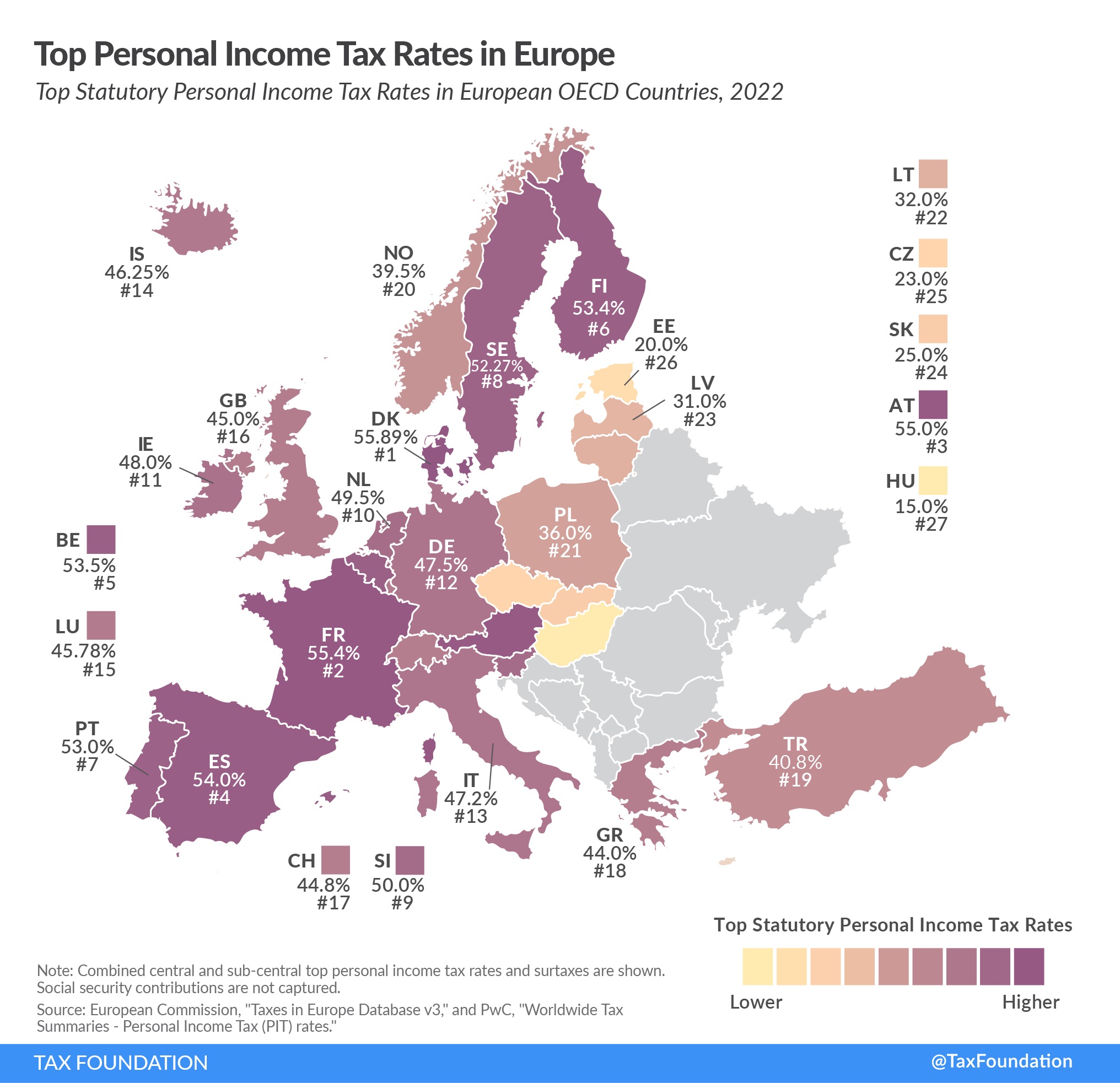
Congratulations to Hungary for having the lowest rate, followed by Estonia, the Czech Republic, and Slovakia.

And “congratulations” to Denmark for having the highest top tax rate, followed by France, Austria, and Spain.

At this point, a few caveats are necessary. A nation’s top income tax rate is important, but it’s not the only thing that matters for tax policy.

  • It’s also important to look at social insurance(payroll) taxes, particularly if they apply to all income.
  • It’s also important to look at the level of “double taxation” on income that is saved and invested.
  • It’s also important to look at VATs, which increase the wedge between pre-tax income and post-tax consumption.

Needless to say, other economic policies also matter. A nation might have a good tax system but very dirigiste policies in other areas. Or vice-versa.

For instance, even though Hungary has the lowest top tax rate on personal income and Denmark has the highest, there’s actually more overall economic liberty in Denmark.

Some readers may be wondering how the United States compares to the European nations shown in the above map.

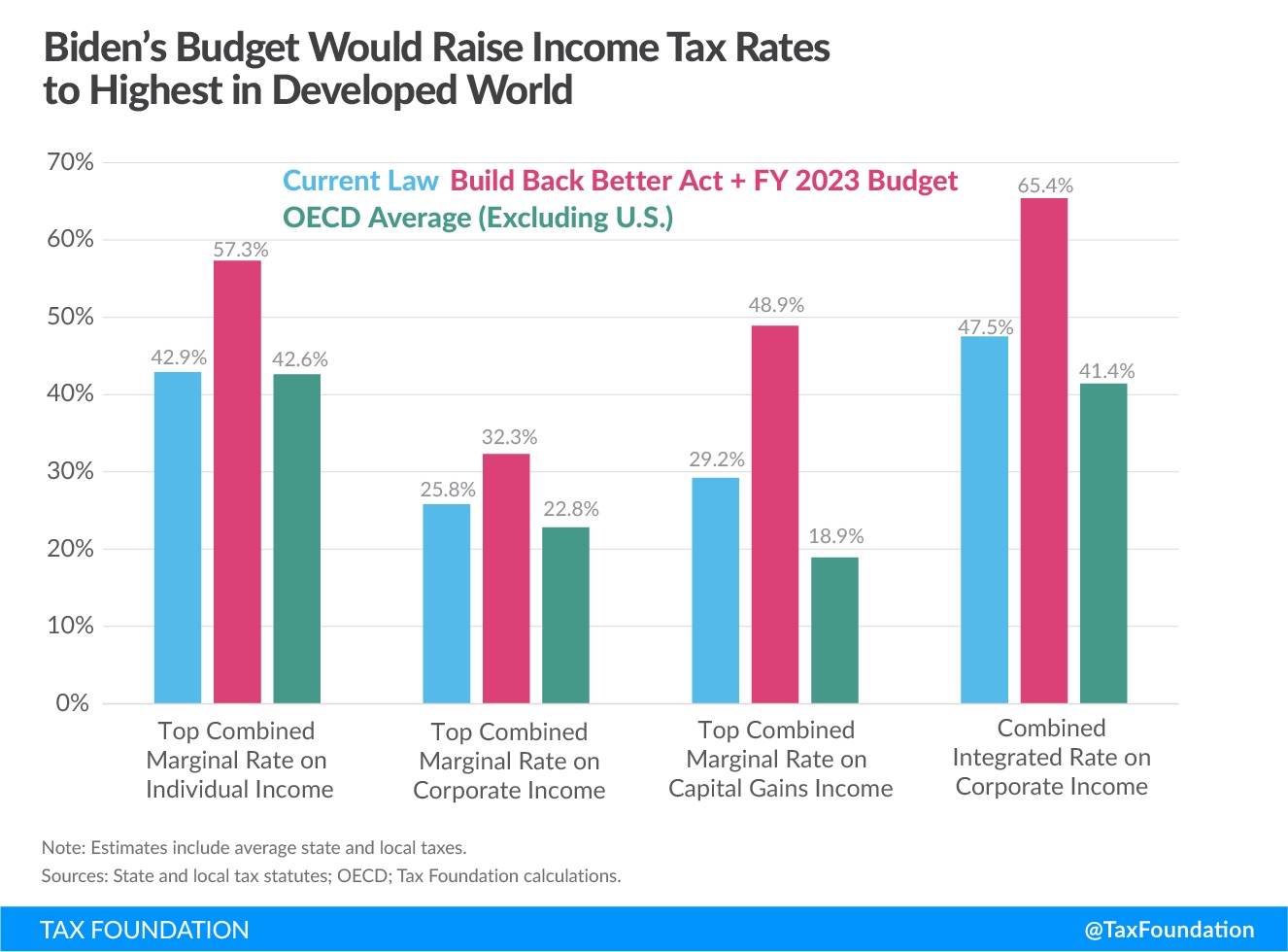
The good news (relatively speaking) is that the top tax rate in the United States is 42.9 percent, so that’s lower than the average in Europe.

The bad news is that the US would have the highest tax rate if Biden’s budget was approved.
However, the top income tax rate in the United States can vary substantially depending on state.

A resident of New York or California, for instance, will face a much higher top tax rate than a resident of a zero-income-tax state such as Texas or Florida.

The same thing is even more true in Switzerland, where top tax rates vary substantially.

A successful taxpayer in Zug pays a top tax rate of 22.22 percent, less than half as much as a similar taxpayer in Geneva.
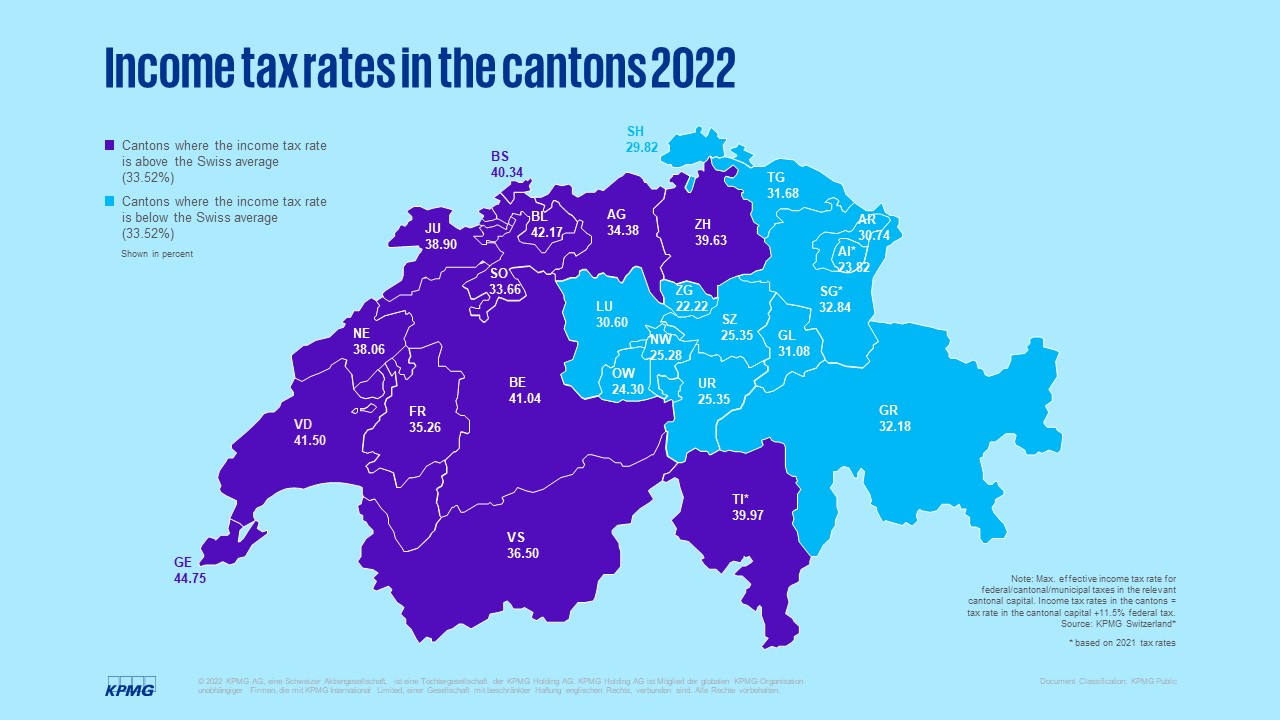
I’ll close by noting that this map is another example of the advantages of genuine federalism.

When the central government is small and most government takes place at the state and local level (or, in the case of Switzerland, at the cantonal and municipal level), there is more diversity, choice, and jurisdictional competition.

That type of federalism still exists in Switzerland, but unfortunately is eroding in the United States.

The Big Question for Tories (and Republicans): What’s the Alternative to “Free-Market Fundamentalism”?

Because of her support for lower tax rates, I was excited when Liz Truss became Prime Minister of the United Kingdom.
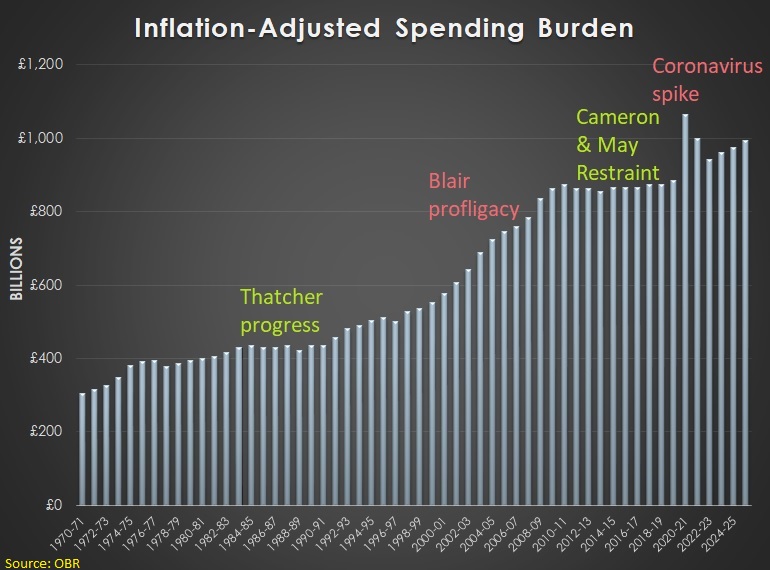
Especially since her predecessor, Boris Johnson, turned out to be an empty-suit populist who supported higher taxes and a bigger burden of government spending.

But I’m not excited anymore.

Indeed, it’s more accurate to say that I’m despondent since the Prime Minister is abandoning (or is being pressured to abandon) key parts of her pro-growth agenda.

For details, check out this Bloomberg report, written by Julian Harris, about the (rapidly disappearing) tax-cutting agenda of the new British Prime Minister.

Westminster’s most hard-line advocates of free markets and lower taxes are looking on in despair as their agenda crumbles… When Liz Truss became prime minister just over five weeks ago, she promised to deliver a radical set of policies rooted in laissez-faire economics — an attempt to boost the UK‘s sluggish rate of growth. Yet her chancellor of the exchequer, Kwasi Kwarteng, faced a quick reality check when his mini-budget, packed with unfunded tax cuts and unaccompanied by independent forecasts, …triggered mayhem… Truss fired Kwarteng and replaced him with Jeremy Hunt as she was forced into a dramatic u-turn over her tax plans. …Truss conceded…and dropped her plan to freeze corporation tax. …Still, some believers are sticking by “Trussonomics”…Patrick Minford,..a professor at Cardiff University, said..“Liz Truss’s policies for growth are absolutely right, and to be thrown off them by a bit of market turbulence is insane.” …Eamonn Butler, co-founder of the Adam Smith Institute, similarly insisted that Truss “is not the source of the problem — she’s trying to cure the problem.”

Eamonn is right.

The United Kingdom faces serious economic challenges. But the problems are the result of bad government policies that already exist rather than the possibility of some future tax cuts.

In a column for the Telegraph, Allister Heath says the U.K.’s central bank deserves a big chunk of the blame.

Liz Truss and Kwasi Kwarteng have been doubly unlucky. While almost everybody else in Britain remained in denial, they correctly identified this absurd game for the con-trick that it truly was, warned that it was about to implode and pledged to replace it with a more honest system. Instead of a zombie economy based on rising asset prices and fake, debt-fuelled growth, their mission was to encourage Britain to produce more real goods and services, to work harder and invest more by reforming taxes and regulation.What happened next is dispiriting in the extreme. …Truss and her Chancellor moved too quickly and, paradoxically, given their warnings about the rottenness of the system, ended up pulling out the last block from the Jenga tower, sending all of the pieces tumbling down. …they didn’t crash the economy – it was about to come tumbling down anyway – but they had the misfortune of precipitating and accelerating the day of reckoning. …Andrew Bailey, the Governor of the Bank of England…, has been deeply unimpressive in all of this, helping to keep interest rates too low… The idea, now accepted so widely, that the price of money must be kept extremely low and quantitative easing deployed at every opportunity has undermined every aspect of the economy and society. …Too few people realise how terribly the easy money, high tax, high regulation orthodoxy has failed.

Allister closes with some speculation about possible alternatives. If the Tories in the U.K. decide to reject so-called “free-market fundamentalism,” what’s their alternative?

He thinks the Labour Party will take control, and with very bad results. Jeremy Corbyn will not be in charge, but his economic policies will get enacted.

If Truss is destroyed, the alternative won’t even be social democracy: it will be Labour, the hard Left, the full gamut of punitive taxation, including of wealth and housing, and even more spending, culminating rapidly in economic oblivion.

That is an awful scenario. Basically turning the United Kingdom into Greece.

I want to take a different approach, though, and contemplate what will happen if the Conservative Party rejects the Truss approach and embraces big-government conservatism.

Here are some questions I’d like them to answer:

  • Do you want improved competitiveness and more economic growth?
  • If you want more growth, which of your spending increases will lead to those outcomes?
  • Which of your tax increases will lead to more competitiveness or more prosperity?
  • Will you reform benefit programs to avert built-in spending increases caused by an aging population?
  • If you won’t reform entitlements, which taxes will you increase to keep debt under control?
  • If you don’t plan major tax increases, do you think the economy can absorb endless debt?

I’m asking these questions for two reasons. First, there are no good answers and I’d like to shame big-government Tories into doing the right thing.

Second, these questions are also very relevant in the United States. Even since the Reagan years, opponents of libertarian economic policies have flitted from one trendy idea to another (national conservatism, compassionate conservatism, kinder-and-gentler conservatismcommon-good capitalism, reform conservatism, etc).
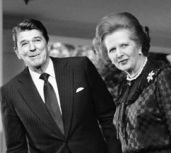
To be fair, they usually don’t try to claim their dirigiste policies will produce higher living standards. Instead, they blindly assert that it will be easier to win elections if Republicans abandon Reaganism.

So I’ll close by observing that Ronald Reagan won two landslide elections and his legacy was strong enough that voters then elected another Republican (the same can’t be said for big-government GOPers like Nixon, Bush, Bush, or Trump).

Switching back to the United Kingdom, Margaret Thatcher repeatedly won election and her legacy was strong enough that voters then elected another Conservative.

The bottom line is that good policy can lead to good political outcomes, whereas bad policy generally leads to bad political outcomes.

P.S. To be sure, there were times when Reagan’s poll numbers were very bad. And the same is true for Thatcher. But because they pursued good policies, economic growth returned and they reaped political benefits. Sadly, it appears that Truss won’t have a chance to adopt good policy, so we will never know if she also would have benefited from a similar economic renaissance.

Tax Cartels Mean Ever-Higher Tax Rates

When President Biden proposed a “global minimum tax” for businesses, I immediately warned that would lead to ever-increasing tax rates.

Ross Kaminsky of KHOW and I discussed how this is already happening.

I hate being right, but it’s always safe to predict that politicians and bureaucrats will embrace policies that give more power to government.

Especially when they are very anxious to stifle tax competition.

For decades, people in government have been upset that the tax cuts implemented by Ronald Reagan and Margaret Thatchertriggered a four-decade trend of lower tax rates and pro-growth tax reform.

That’s the reason Biden and his Treasury Secretary proposed a 15 percent minimum tax rate for businesses.

And it’s the reason they now want the rate to be even higher.

Though even I’m surprised that they’re already pushing for that outcome when the original pact hasn’t even been approved or implemented.

Here are some passages from a report by Reuters.

Treasury Secretary Janet Yellen will press G20 counterparts this week for a global minimum corporate tax rate above the 15% floor agreed by 130 countries last week…the global minimum tax rate…is tied to the outcome of legislation to raise the U.S. minimum tax rate, a Treasury official said.The Biden administration has proposed doubling the U.S. minimum tax on corporations overseas intangible income to 21% along with a new companion “enforcement” tax that would deny deductions to companies for tax payments to countries that fail to adopt the new global minimum rate. The officials said several countries were pushing for a rate above 15%, along with the United States.

Other kleptocratic governments naturally want the same thing.

A G7 proposal for a global minimum tax rate of 15% is too low and a rate of at least 21% is needed, Argentina’s finance minister said on Monday, leading a push by some developing countries… “The 15% rate is way too low,” Argentine Finance Minister Martin Guzman told an online panel hosted by the Independent Commission for the Reform of International Corporate Taxation. …”The minimum rate being proposed would not do much to countries in Africa…,” Mathew Gbonjubola, Nigeria’s tax policy director, told the same conference.

Needless to say, I’m not surprised that Argentina is on the wrong side.

And supporters of class warfare also are agitating for a higher minimum rate. Here are some excerpts from a column in the New York Times by Gabriel Zucman and Gus Wezerek.

In the decades after World War II, close to 50 percent of American companies’ earnings went to state and federal taxes. …it was a golden period. …President Biden should be applauded for trying to end the race to the bottom on corporate tax rates. But even if Congress approves the 15 percent global minimum corporate tax, it won’t be enough. …the Biden administration to give working families a real leg up, it should push Congress to enact a 25 percent minimum tax, which would bring in about $200 billion in additional revenue each year. …With a 25 percent minimum corporate tax, the Biden administration would begin to reverse decades of growing inequality. And it would encourage other countries to do the same, replacing a race to the bottom with a sprint to the top.

I can’t resist making two observations about this ideological screed.

  1. Even the IMF and OECD agree that the so-called race to the bottom has not led to a decline in corporate tax revenues, even when measured as a share of economic output.
  2. Since companies legally avoid rather than illegally evade taxes, the headline of the column is utterly dishonest – but it’s what we’ve learned to expect from the New York Times.

The only good thing about the Zucman-Wezerek column is that it includes this chart showing how corporate tax rates have dramatically declined since 1980.
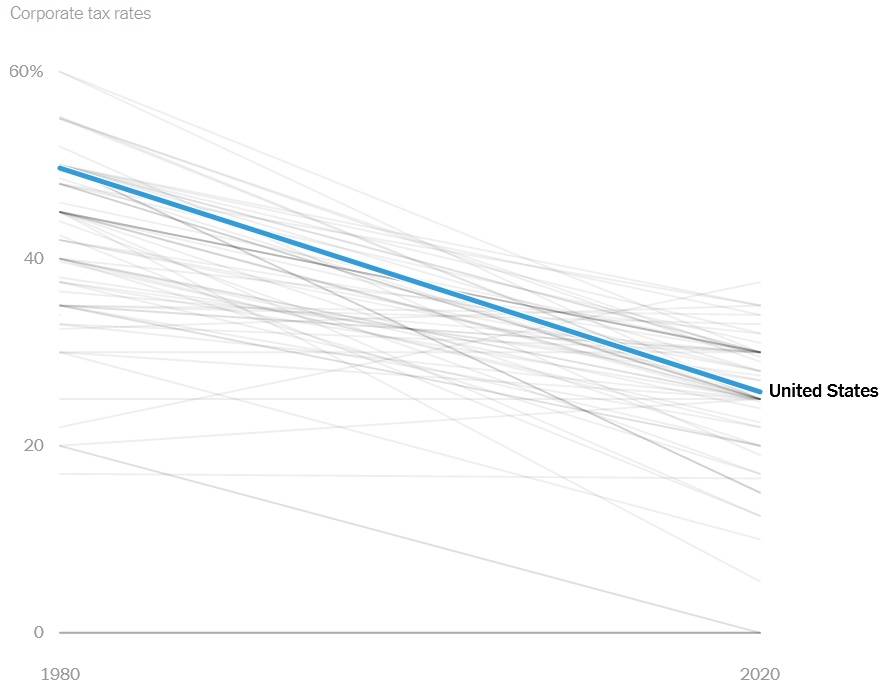
P.S. For those interested, the horizontal line at the bottom is for Bermuda, though other jurisdictions (such as Monaco and the Cayman Islands) also deserve credit for having no corporate income taxes.

P.P.S. If you want to know why high corporate tax rates are misguided, click here. And if you want to know why Biden’s plan to raise the U.S. corporate tax rate is misguided, click here. Or here. Or here.

P.P.P.S. And if you want more information about why Biden’s global tax cartel is bad, click here, here, and here.

I enjoyed this article below because it demonstrates that the Laffer Curve has been working for almost 100 years now when it is put to the test in the USA. I actually got to hear Arthur Laffer speak in person in 1981 and he told us in advance what was going to happen the 1980’s and it all came about as he said it would when Ronald Reagan’s tax cuts took place. I wish we would lower taxes now instead of looking for more revenue through raised taxes. We have to grow the economy:

What Mitt Romney Said Last Night About Tax Cuts And The Deficit Was Absolutely Right. And What Obama Said Was Absolutely Wrong.

Mitt Romney repeatedly said last night that he would not allow tax cuts to add to the deficit.  He repeatedly said it because over and over again Obama blathered the liberal talking point that cutting taxes necessarily increased deficits.

Romney’s exact words: “I want to underline that — no tax cut that adds to the deficit.”

Meanwhile, Obama has promised to cut the deficit in half during his first four years – but instead gave America the highest deficits in the history of the entire human race.

I’ve written about this before.  Let’s replay what has happened every single time we’ve ever cut the income tax rate.

The fact of the matter is that we can go back to Calvin Coolidge who said very nearly THE EXACT SAME THING to his treasury secretary: he too would not allow any tax cuts that added to the debt.  Andrew Mellon – quite possibly the most brilliant economic mind of his day – did a great deal of research and determined what he believed was the best tax rate.  And the Coolidge administration DID cut income taxes and MASSIVELY increased revenues.  Coolidge and Mellon cut the income tax rate 67.12 percent (from 73 to 24 percent); and revenues not only did not go down, but they went UP by at least 42.86 percent (from $700 billion to over $1 billion).

That’s something called a documented fact.  But that wasn’t all that happened: another incredible thing was that the taxes and percentage of taxes paid actually went UP for the rich.  Because as they were allowed to keep more of the profits that they earned by investing in successful business, they significantly increased their investments and therefore paid more in taxes than they otherwise would have had they continued sheltering their money to protect themselves from the higher tax rates.  Liberals ignore reality, but it is simply true.  It is a fact.  It happened.

Then FDR came along and raised the tax rates again and the opposite happened: we collected less and less revenue while the burden of taxation fell increasingly on the poor and middle class again.  Which is exactly what Obama wants to do.

People don’t realize that John F. Kennedy, one of the greatest Democrat presidents, was a TAX CUTTER who believed the conservative economic philosophy that cutting tax rates would in fact increase tax revenues.  He too cut taxes, and he too increased tax revenues.

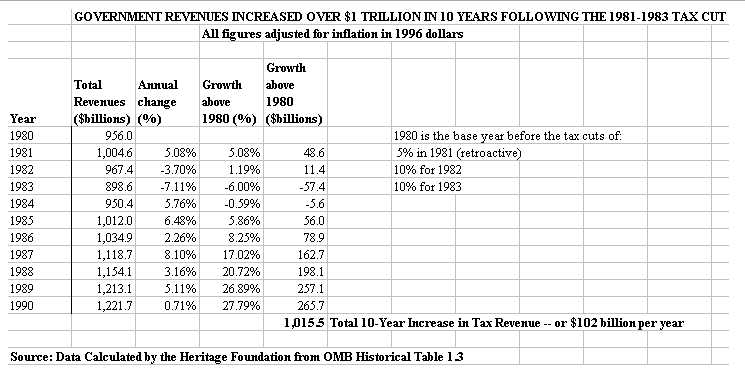
So we get to Ronald Reagan, who famously cut taxes.  And again, we find that Reagan cut that godawful liberal tax rate during an incredibly godawful liberal-caused economic recession, and he increased tax revenue by 20.71 percent (with revenues increasing from $956 billion to $1.154 trillion).  And again, the taxes were paid primarily by the rich:

“The share of the income tax burden borne by the top 10 percent of taxpayers increased from 48.0 percent in 1981 to 57.2 percent in 1988. Meanwhile, the share of income taxes paid by the bottom 50 percent of taxpayers dropped from 7.5 percent in 1981 to 5.7 percent in 1988.”

So we get to George Bush and the Bush tax cuts that liberals and in particular Obama have just demonized up one side and demagogued down the other.  And I can simply quote the New York Times AT the time:

Sharp Rise in Tax Revenue to Pare U.S. Deficit By EDMUND L. ANDREWS Published: July 13, 2005

WASHINGTON, July 12 – For the first time since President Bush took office, an unexpected leap in tax revenue is about to shrink the federal budget deficit this year, by nearly $100 billion.

A Jump in Corporate Payments On Wednesday, White House officials plan to announce that the deficit for the 2005 fiscal year, which ends in September, will be far smaller than the $427 billion they estimated in February.

Mr. Bush plans to hail the improvement at a cabinet meeting and to cite it as validation of his argument that tax cuts would stimulate the economy and ultimately help pay for themselves.

Based on revenue and spending data through June, the budget deficit for the first nine months of the fiscal year was $251 billion, $76 billion lower than the $327 billion gap recorded at the corresponding point a year earlier.

The Congressional Budget Office estimated last week that the deficit for the full fiscal year, which reached $412 billion in 2004, could be “significantly less than $350 billion, perhaps below $325 billion.”

The big surprise has been in tax revenue, which is running nearly 15 percent higher than in 2004. Corporate tax revenue has soared about 40 percent, after languishing for four years, and individual tax revenue is up as well
.

And of course the New York Times, as reliable liberals, use the adjective whenever something good happens under conservative policies and whenever something bad happens under liberal policies: ”unexpected.”   But it WASN’T ”unexpected.”  It was EXACTLY what Republicans had said would happen and in fact it was exactly what HAD IN FACT HAPPENED every single time we’ve EVER cut income tax rates.

The truth is that conservative tax policy has a perfect track record: every single time it has ever been tried, we have INCREASED tax revenues while not only exploding economic activity and creating more jobs, but encouraging the wealthy to pay more in taxes as well.  And liberals simply dishonestly refuse to acknowledge documented history.

Meanwhile, liberals also have a perfect record … of FAILUREThey keep raising taxes and keep not understanding why they don’t get the revenues they predicted.

The following is a section from my article, “Tax Cuts INCREASE Revenues; They Have ALWAYS Increased Revenues“, where I document every single thing I said above:

The Falsehood That Tax Cuts Increase The Deficit

Now let’s take a look at the utterly fallacious view that tax cuts in general create higher deficits.

Let’s take a trip back in time, starting with the 1920s.  From Burton Folsom’s book, New Deal or Raw Deal?:

In 1921, President Harding asked the sixty-five-year-old [Andrew] Mellon to be secretary of the treasury; the national debt [resulting from WWI] had surpassed $20 billion and unemployment had reached 11.7 percent, one of the highest rates in U.S. history.  Harding invited Mellon to tinker with tax rates to encourage investment without incurring more debt. Mellon studied the problem carefully; his solution was what is today called “supply side economics,” the idea of cutting taxes to stimulate investment.  High income tax rates, Mellon argued, “inevitably put pressure upon the taxpayer to withdraw this capital from productive business and invest it in tax-exempt securities. . . . The result is that the sources of taxation are drying up, wealth is failing to carry its share of the tax burden; and capital is being diverted into channels which yield neither revenue to the Government nor profit to the people” (page 128).

Mellon wrote, “It seems difficult for some to understand that high rates of taxation do not necessarily mean large revenue to the Government, and that more revenue may often be obtained by lower taxes.”  And he compared the government setting tax rates on incomes to a businessman setting prices on products: “If a price is fixed too high, sales drop off and with them profits.”

And what happened?

“As secretary of the treasury, Mellon promoted, and Harding and Coolidge backed, a plan that eventually cut taxes on large incomes from 73 to 24 percent and on smaller incomes from 4 to 1/2 of 1 percent.  These tax cuts helped produce an outpouring of economic development – from air conditioning to refrigerators to zippers, Scotch tape to radios and talking movies.  Investors took more risks when they were allowed to keep more of their gains.  President Coolidge, during his six years in office, averaged only 3.3 percent unemployment and 1 percent inflation – the lowest misery index of any president in the twentieth century.

Furthermore, Mellon was also vindicated in his astonishing predictions that cutting taxes across the board would generate more revenue.  In the early 1920s, when the highest tax rate was 73 percent, the total income tax revenue to the U.S. government was a little over $700 million.  In 1928 and 1929, when the top tax rate was slashed to 25 and 24 percent, the total revenue topped the $1 billion mark.  Also remarkable, as Table 3 indicates, is that the burden of paying these taxes fell increasingly upon the wealthy” (page 129-130).

Now, that is incredible upon its face, but it becomes even more incredible when contrasted with FDR’s antibusiness and confiscatory tax policies, which both dramatically shrunk in terms of actual income tax revenues (from $1.096 billion in 1929 to $527 million in 1935), and dramatically shifted the tax burden to the backs of the poor by imposing huge new excise taxes (from $540 million in 1929 to $1.364 billion in 1935).  See Table 1 on page 125 of New Deal or Raw Deal for that information.

FDR both collected far less taxes from the rich, while imposing a far more onerous tax burden upon the poor.

It is simply a matter of empirical fact that tax cuts create increased revenue, and that those [Democrats] who have refused to pay attention to that fact have ended up reducing government revenues even as they increased the burdens on the poorest whom they falsely claim to help.

Let’s move on to John F. Kennedy, one of the most popular Democrat presidents ever.  Few realize that he was also a supply-side tax cutter.

Kennedy said:

“It is a paradoxical truth that tax rates are too high and tax revenues are too low and the soundest way to raise the revenues in the long run is to cut the rates now … Cutting taxes now is not to incur a budget deficit, but to achieve the more prosperous, expanding economy which can bring a budget surplus.”

– John F. Kennedy, Nov. 20, 1962, president’s news conference


“Lower rates of taxation will stimulate economic activity and so raise the levels of personal and corporate income as to yield within a few years an increased – not a reduced – flow of revenues to the federal government.”

– John F. Kennedy, Jan. 17, 1963, annual budget message to the Congress, fiscal year 1964

“In today’s economy, fiscal prudence and responsibility call for tax reduction even if it temporarily enlarges the federal deficit – why reducing taxes is the best way open to us to increase revenues.”

– John F. Kennedy, Jan. 21, 1963, annual message to the Congress: “The Economic Report Of The President”


“It is no contradiction – the most important single thing we can do to stimulate investment in today’s economy is to raise consumption by major reduction of individual income tax rates.”

– John F. Kennedy, Jan. 21, 1963, annual message to the Congress: “The Economic Report Of The President”


“Our tax system still siphons out of the private economy too large a share of personal and business purchasing power and reduces the incentive for risk, investment and effort – thereby aborting our recoveries and stifling our national growth rate.”

– John F. Kennedy, Jan. 24, 1963, message to Congress on tax reduction and reform, House Doc. 43, 88th Congress, 1st Session.


“A tax cut means higher family income and higher business profits and a balanced federal budget. Every taxpayer and his family will have more money left over after taxes for a new car, a new home, new conveniences, education and investment. Every businessman can keep a higher percentage of his profits in his cash register or put it to work expanding or improving his business, and as the national income grows, the federal government will ultimately end up with more revenues.”

– John F. Kennedy, Sept. 18, 1963, radio and television address to the nation on tax-reduction bill

Which is to say that modern Democrats are essentially calling one of their greatest presidents a liar when they demonize tax cuts as a means of increasing government revenues.

So let’s move on to Ronald Reagan.  Reagan had two major tax cutting policies implemented: the Economic Recovery Tax Act (ERTA) of 1981, which was retroactive to 1981, and the Tax Reform Act of 1986.

Did Reagan’s tax cuts decrease federal revenues?  Hardly:

We find that 8 of the following 10 years there was a surplus of revenue from 1980, prior to the Reagan tax cuts.  And, following the Tax Reform Act of 1986, there was a MASSIVE INCREASEof revenue.

So Reagan’s tax cuts increased revenue.  But who paid the increased tax revenue?  The poor?  Opponents of the Reagan tax cuts argued that his policy was a giveaway to the rich (ever heard that one before?) because their tax payments would fall.  But that was exactly wrong.  In reality:

“The share of the income tax burden borne by the top 10 percent of taxpayers increased from 48.0 percent in 1981 to 57.2 percent in 1988. Meanwhile, the share of income taxes paid by the bottom 50 percent of taxpayers dropped from 7.5 percent in 1981 to 5.7 percent in 1988.”

So Ronald Reagan a) collected more total revenue, b) collected more revenue from the rich, while c) reducing revenue collected by the bottom half of taxpayers, and d) generated an economic powerhouse that lasted – with only minor hiccups – for nearly three decades.  Pretty good achievement considering that his predecessor was forced to describe his own economy as a “malaise,” suffering due to a “crisis of confidence.” Pretty good considering that President Jimmy Carter responded to a reporter’s question as to what he would do about the problem of inflation by answering, “It would be misleading for me to tell any of you that there is a solution to it.”

Reagan whipped inflation.  Just as he whipped that malaise and that crisis of confidence.

________

The Laffer Curve, Part III: Dynamic Scoring

DAN MITCHELL: “Texas lawmakers have been more fiscally responsible than California lawmakers over the past couple of years!”

_____

____

Lessons from the Texas Budget

I shared some data last month from the National Association of State Budget Officers to show that Texas lawmakers have been more fiscally responsible than California lawmakers over the past couple of years.

California politicians were more profligate in 2021 when politicians in Washington were sending lots of money to states because of the pandemic.

And California politicians also increased spending faster in 2022 when conditions (sort of) returned to normal.

These results are not a surprise given California’s reputation for profligacy.

What may be a surprise, however, is that (relative) frugality in Texas has only existed for a handful of years. Here are some excerpts from a report written for the Texas Public Policy Foundation by Vance Ginn and Daniel Sánchez-Piñol.

Over the last two decades, Texas’ total state biennial budget growth has had two different phases. The first phase had budget growth above the rate of population growth plus inflation for five of the six budgets from 2004–05 to 2014–15. The second phase…had budget growth below this rate… Figure 1 shows the average biennial growth rates for the six state budgets passed before 2015 and for the four since then.The average biennial budget growth rate in the former period was 12% compared with the rate of population growth plus inflation of 7.4%. In the latter period, the average biennial growth rate of the budget was cut by more than half to 5.2%, which was well below the estimated rate of population growth plus inflation of 9.4%. This improved budget picture must be maintained to correct for the excessive budget growth in the earlier period. …there could be a $27 billion GR surplus at the end of the current 2022–23 biennium. …the priority should be to effectively limit or, even better, freeze the state budget. Texas should use most, if not all, of the resulting surplus to reduce…property tax collections…these taxes could be cut substantially by restraining spending and using the surplus to reduce school district M&O property taxes to ultimately eliminate them over time.

The article has this chart, which is a good illustration of the shift to fiscal restraint in Texas.

For all intents and purposes, Texas in 2016 started abiding by fiscal policy’s Golden Rule.

And this means the burden of government is slowly but surely shrinking compared to the private sector.

That approach is paying big dividends. Spending restraint means there is now a big budget surplus, which is enabling a discussion of how to reduce property taxes (Texas has no income tax).

P.S. I shared data back in 2020 looking at the fiscal performance of Texas and Florida compared to New York and California.

Texas vs. California, Part VII

To begin the seventh edition of our series comparing policy in Texas and California (previous entries in March 2010, February 2013, April 2013, October 2018, June 2019, and December 2020), here’s a video from Prager University.

There will be a lot of information in today’s column, so if you’re pressed for time, here are three sentences that tell you what you need to know.

California has all sorts of natural advantages over Texas, especially endless sunshine and beautiful topography.

Texas has better government policy than California, most notably in areas such as taxation and regulation.

Since people are moving from the Golden State to the Lone Star State, public policy seems to matter more than natural beauty.

Now let’s look at a bunch of evidence to support those three sentences.

We’ll start with an article by Joel Kotkin of Chapman University.

If one were to explore the most blessed places on earth, California, my home for a half century, would surely be up there. …its salubrious climate, spectacular scenery, vast natural resources… President Biden recently suggested that he wants to “make America California again”. Yet…he should consider whether the California model may be better seen as a cautionary tale than a roadmap to a better future… California now suffers the highest cost-adjusted poverty rate in the country, and the widest gap between middle and upper-middle income earners. …the state has slowly morphed into a low wage economy. Over the past decade, 80% of the state’s jobs have paid under the median wage — half of which are paid less than $40,000…minorities do better today outside of California, enjoying far higher adjusted incomes and rates of homeownership in places like Atlanta and Dallas than in San Francisco and Los Angeles. Almost one-third of Hispanics, the state’s largest ethnic group, subsist below the poverty line, compared with 21% outside the state. …progressive…policies have not brought about greater racial harmony, enhanced upward mobility and widely based economic growth.

Next we have some business news from the San Francisco Chronicle.

Business leaders fear tech giant Oracle’s recent announcement that it is leaving the Bay Area for Austin, Texas, will lead to more exits unless some fundamental political and economic changes are made to keep the region attractive and competitive. “This is something that we have been warning people about for several years. California is not business friendly, we should be honest about it,” said Kenneth Rosen, chairman of the UC Berkeley Fisher Center for Real Estate and Urban Economics.Bay Area Council President Jim Wunderman said… “From consulting companies to tax lawyers to bankers and commercial real estate firms, every person I talk with who provides services to big Bay Area corporations are telling me that their clients are strategizing about leaving…” Charles Schwab, McKesson and Hewlett Packard Enterprise have all exited the high-cost, high-tax, high-regulation Bay Area for a less-expensive, less-regulated and business-friendlier political climate. All of them rode off to Texas. …the pace of the departures appears to be increasing. …A recent online survey of 2,325 California residents, taken between Nov. 4 and Nov. 23 by the Public Policy Institute of California, found 26% of residents have seriously considered moving out of state and that 58% say that the American Dream is harder to achieve in California than elsewhere.

Are California politicians trying to make things better, in hopes of stopping out-migration to places such as Texas?

Not according to this column by Hank Adler in the Wall Street Journal.

California’s Legislature is considering a wealth tax on residents, part-year residents, and any person who spends more than 60 days inside the state’s borders in a single year. Even those who move out of state would continue to be subject to the tax for a decade… Assembly Bill 2088 proposes calculating the wealth tax based on current world-wide net worth each Dec. 31. For part-year and temporary residents, the tax would be proportionate based on their number of days in California. The annual tax would be on current net worth and therefore would include wealth earned, inherited or obtained through gifts or estates long before and long after leaving the state. …The authors of the bill estimate the wealth tax will provide Sacramento $7.5 billion in additional revenue every year. Another proposal—to increase the top state income-tax rate to 16.8%—would annually raise another $6.8 billion. Today, California’s wealthiest 1% pay approximately 46% of total state income taxes. …the Legislature looks to the wealthiest Californians to fill funding gaps without considering the constitutionality of the proposals and the ability of people and companies to pick up and leave the state, which news reports suggest they are doing in large numbers. …As of this moment, there are no police roadblocks on the freeways trying to keep moving trucks from leaving California. If A.B. 2088 becomes law, the state may need to consider placing some.

The late (and great) Walter Williams actually joked back in 2012that California might set up East German-style border checkpoints. Let’s hope satire doesn’t become reality.

But what isn’t satire is that people are fleeing the state (along with other poorly governed jurisdictions).

Simply state, the blue state model of high taxes and big government is not working (just as it isn’t working in countries with high taxes and big government).

Interestingly, even the New York Times recognizes that there is a problem in the state that used to be a role model for folks on the left.

Opining for that outlet at the start of the month, Brett Stephens raised concerns about the Golden State.

…today’s Democratic leaders might look to the very Democratic state of California as a model for America’s future. You remember California: People used to want to move there, start businesses, raise families, live their American dream. These days, not so much. Between July 2019 and July 2020, more people — 135,400 to be precise — left the state than moved in… No. 1 destination: Texas, followed by Arizona, Nevada and Washington. Three of those states have no state income tax.

California, by contrast, has very high taxes. Not just an onerous income tax, but high taxes across the board.

Californians also pay some of the nation’s highest sales tax rates (8.66 percent) and corporate tax rates (8.84 percent), as well as the highest taxes on gasoline (63 cents on a gallon as of January, as compared with 20 cents in Texas).

Sadly, these high taxes don’t translate into good services from government.

The state ranks 21st in the country in terms of spending per public school pupil, but 27th in its K-12 educational outcomes. It ties Oregon for third place among states in terms of its per capita homeless rate. Infrastructure? As of 2019, the state had an estimated $70 billion in deferred maintenance backlog. Debt? The state’s unfunded pension liabilities in 2019 ran north of $1.1 trillion, …or $81,300 per household.

Makes you wonder whether the rest of the nation should copy that model?

Democrats hold both U.S. Senate seats, 42 of its 53 seats in the House, have lopsided majorities in the State Assembly and Senate, run nearly every big city and have controlled the governor’s mansion for a decade. If ever there was a perfect laboratory for liberal governance, this is it. So how do you explain these results? …If California is a vision of the sort of future the Biden administration wants for Americans, expect Americans to demur.

Some might be tempted to dismiss Stephens’ column because he is considered the token conservative at the New York Times.

But Ezra Klein also acknowledges that California has a problem, and nobody will accuse him of being on the right side of the spectrum.

Here’s some of what he wrote in his column earlier this month for the New York Times.

I love California. I was born and raised in Orange County. I was educated in the state’s public schools and graduated from the University of California system… But for that very reason, our failures of governance worry me. California has the highest poverty rate in the nation,when you factor in housing costs, and vies for the top spot in income inequality, too. …but there’s a reason 130,000 more people leave than enter each year. California is dominated by Democrats, but many of the people Democrats claim to care about most can’t afford to live there. …California, as the biggest state in the nation, and one where Democrats hold total control of the government, carries a special burden. If progressivism cannot work here, why should the country believe it can work anywhere else?

Kudos to Klein for admitting problems on his side (just like I praise the few GOPers who criticized Trump’s big-government policies).

But his column definitely had some quirky parts, such as when he wrote that, “There are bright spots in recent years…a deeply progressive plan to tax the wealthy.”

That’s actually a big reason for the state’s decline, not a “bright spot.”

I’m not the only one to recognize the limitations of his column.

Kevin Williamson wrote an entire rebuttal for National Review.

Who but Ezra Klein could survey the wreck left-wing Democrats have made of California and conclude that the state’s problem is its excessive conservatism? …Klein the rhetorician anticipates objections on this front and writes that he is not speaking of “the political conservatism that privatizes Medicare, but the temperamental conservatism that” — see if this formulation sounds at all familiar — “stands athwart change and yells ‘Stop!’”…California progressives have progressive policies and progressive power, and they like it that way. That is the substance of their conservatism. …Klein and others of his ilk like to present themselves as dispassionate pragmatists, enlightened empiricists who only want to do “what works.” …Klein mocks San Francisco for renaming schools (Begone, Abraham Lincoln!) while it has no plan to reopen them, but he cannot quite see that these are two aspects of a single phenomenon. …Klein…must eventually understand that the troubles he identifies in California are baked into the progressive cake. …That has real-world consequences, currently on display in California to such a spectacular degree that even Ezra Klein is able dimly to perceive them. Maybe he’ll learn something.

I especially appreciate this passage since it excoriates rich leftists for putting teacher unions ahead of disadvantaged children.

Intentions do not matter very much, and mere stated intentions matter even less. Klein is blind to that, which is why he is able to write, as though there were something unusual on display: “For all the city’s vaunted progressivism, [San Francisco] has some of the highest private school enrollment numbers in the country.” Rich progressives have always been in favor of school choice and private schools — for themselves. They only oppose choice for poor people, whose interests must for political reasons be subordinated to those of the public-sector unions from which Democrats in cities such as San Francisco derive their power.

Let’s conclude with some levity.

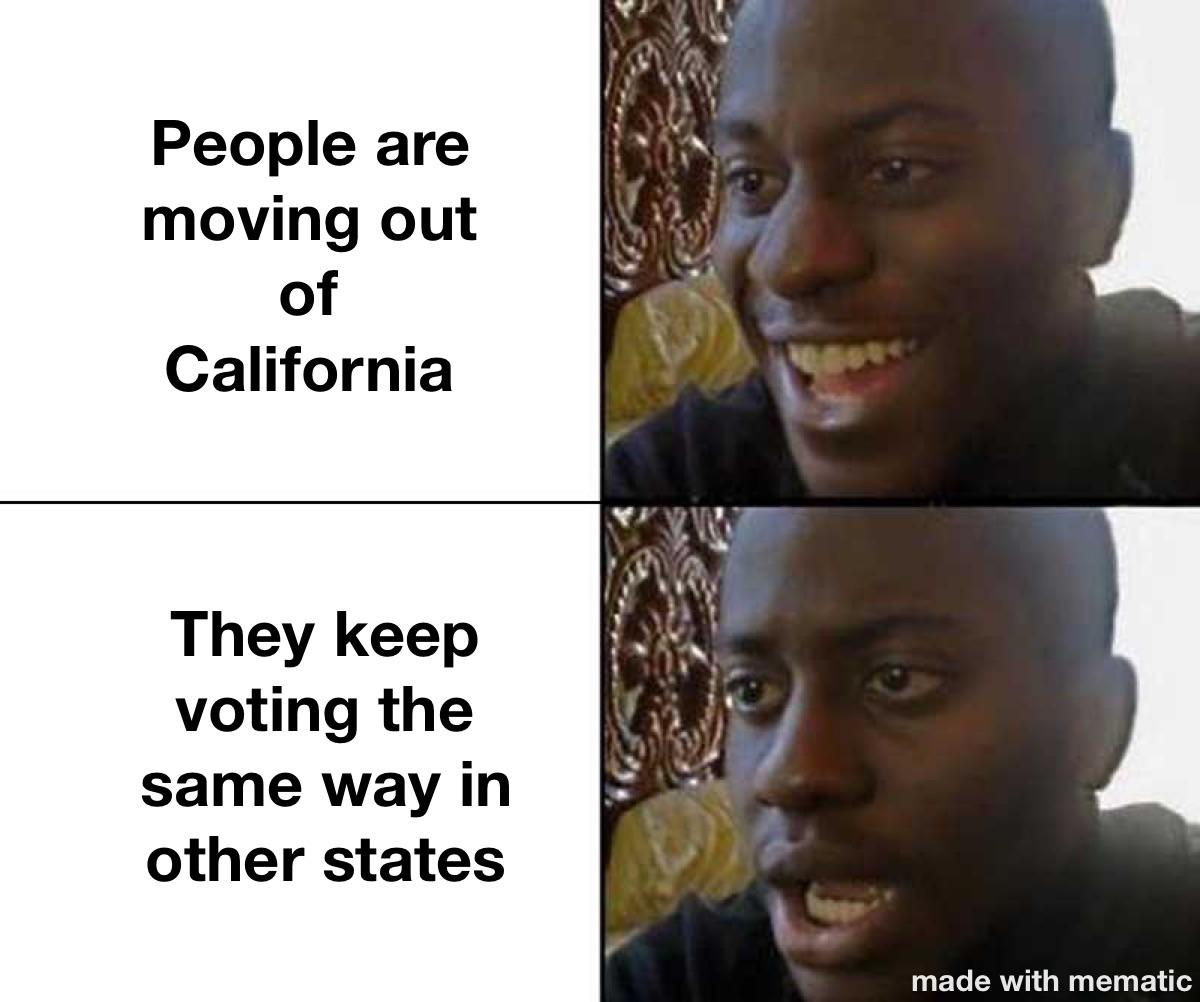
Here’s a meme that contemplates whether California emigrants bring bad voting habits with them.

Though that’s apparently more of a problem in Colorado rather than in Texas.

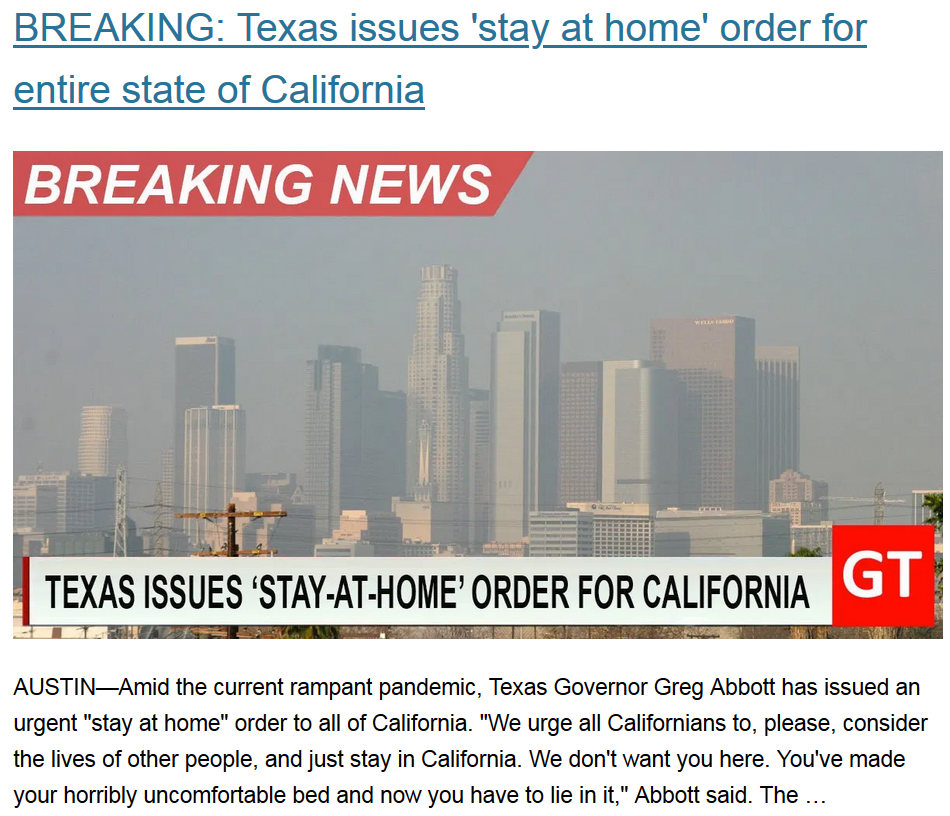
And here’s some clever humor from Genesius Times.

P.S. My favorite California-themed humor (not counting the state’s elected officials) can be found here, hereherehere, and here.

High-tax states are languishing but  zero-income-tax states such as Texas are growing rapidly!!!!

Much of my writing is focused on the real-world impact of government policy, and this is why I repeatedly look at the relative economic performance of big government jurisdictions and small government jurisdictions.

But I don’t just highlight differences between nations. Yes, it’s educational to look at North Korea vs. South Korea or Chile vs. Venezuela vs. Argentina, but I also think you can learn a lot by looking at what’s happening with different states in America.

So we’ve looked at high-tax states that are languishing, such as California and Illinois, and compared them to zero-income-tax states such as Texas.

With this in mind, you can understand that I was intrigued to see that even the establishment media is noticing that Texas is out-pacing the rest of the nation.

Here are some excerpts from a report by CNN Money on rapid population growth in Texas.

More Americans moved to Texas in recent years than any other state: A net gain of more than 387,000 in the latest Census for 2013. …Five Texas cities — Austin, Houston, San Antonio, Dallas and Fort Worth — were among the top 20 fastest growing large metro areas. Some smaller Texas metro areas grew even faster. In oil-rich Odessa, the population grew 3.3% and nearby Midland recorded a 3% gain.

But why is the population growing?

Well, CNN Money points out that low housing prices and jobs are big reasons.

And on the issue of housing, the article does acknowledge the role of “easy regulations” that enable new home construction.

But on the topic of jobs, the piece contains some good data on employment growth, but no mention of policy.

Jobs is the No. 1 reason for population moves, with affordable housing a close second. …Jobs are plentiful in Austin, where the unemployment rate is just 4.6%. Moody’s Analytics projects job growth to average 4% a year through 2015. Just as important, many jobs there are well paid: The median income of more than $75,000 is nearly 20% higher than the national median.

That’s it. Read the entire article if you don’t believe me, but the reporter was able to write a complete article about the booming economy in Texas without mentioning – not even once – that there’s no state income tax.

But that wasn’t the only omission.

The article doesn’t mention that Texas is the 4th-best state in the Tax Foundation’s ranking of state and local tax burdens.

The article doesn’t mention that Texas was the least oppressive state in the Texas Public Policy Foundation’s Soft Tyranny Index.

The article doesn’t mention that Texas was ranked #20 in a study of the overall fiscal condition of the 50 states.

The article doesn’t mention that Texas is in 4th place in a combined ranking of economic freedom in U.S. state and Canadian provinces.

The article doesn’t mention that Texas was ranked #11 in the Tax Foundation’s State Business Tax Climate Index.

The article doesn’t mention that Texas is in 14th place in the Mercatus ranking of overall freedom for the 50 states (and in 10th place for fiscal freedom).

By the way, I’m not trying to argue that Texas is the best state.

Indeed, it only got the top ranking in one of the measures cited above.

My point, instead, is simply to note that it takes willful blindness to write about the strong population growth and job performance of Texas without making at least a passing reference to the fact that it is a low-tax, pro-market state.

At least compared to other states. And especially compared to the high-tax states that are stagnating.

Such as California, as illustrated by this data and this data, as well as this Lisa Benson cartoon.

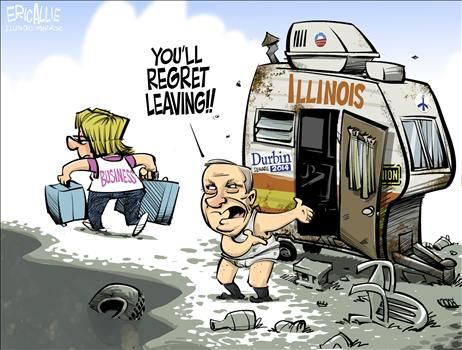
Such as Illinois, as illustrated by this data and this Eric Allie cartoon.

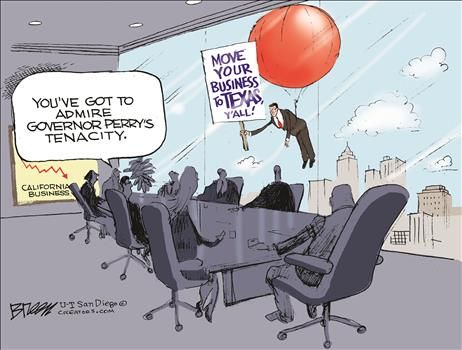
And I can’t resist adding this Steve Breen cartoon, if for no other reason that it reminds me of another one of his cartoons that I shared last year.

Speaking of humor, this Chuck Asay cartoon speculates on how future archaeologists will view California. And this joke about Texas, California, and a coyote is among my most-viewed blog posts.

All jokes aside, I want to reiterate what I wrote above. Texas is far from perfect. There’s too much government in the Lone Star state. It’s only a success story when compared to California.

P.S. Paul Krugman has tried to defend California, which has made him an easy target. I debunked him earlier this year, and I also linked to a superb Kevin Williamson takedown of Krugman at the bottom of this post.

P.P.S. Once again, I repeat the two-part challenge I’ve issued to the left. I’ll be happy if any statists can successfully respond to just one of the two questions I posed.

Related posts:

California is the Greece of the USA, but Texas is not perfect either!!!

California is the Greece of the USA, but Texas is not perfect either!!! Just Because California Is Terrible, that Doesn’t Mean Texas Is Perfect January 21, 2013 by Dan Mitchell Texas is in much better shape than California. Taxes are lower, in part because Texas has no state income tax. No wonder the Lone Star State […]

Dan Mitchell on Texas v. California (includes editorial cartoon)

We should lower federal taxes because jobs are going to states like Texas that have low taxes. (We should lower state taxes too!!) What Can We Learn by Comparing the Employment Situation in Texas vs. California? April 3, 2013 by Dan Mitchell One of the great things about federalism, above and beyond the fact that it […]

Ark Times blogger claims California is better than Texas but facts don’t bear that out (3 great political cartoons)

I got on the Arkansas Times Blog and noticed that a person on there was bragging about the high minimum wage law in San Francisco and how everything was going so well there. On 2-15-13 on the Arkansas Times Blog I posted: Couldn’t be better (the person using the username “Couldn’t be better)  is bragging […]

California burdensome government causing some of business community to leave for Texas

Does Government Have a Revenue or Spending Problem? People say the government has a debt problem. Debt is caused by deficits, which is the difference between what the government collects in tax revenue and the amount of government spending. Every time the government runs a deficit, the government debt increases. So what’s to blame: too […]

Arkansas Times blogger picks California business environment over Texas, proves liberals don’t live in real world(Part 2)

       Former California Governor Arnold Schwarzenegger with his family   I posted a portion of an article by John Fund of the Wall Street Journal that pointed out that many businesses are leaving California because of all of their government red tape and moving to Texas. My username is SalineRepublican and this is […]

John Fund’s talk in Little Rock 4-27-11(Part 4):Responding to liberals who criticize states like Texas that don’t have the red tape that California has

John Fund at Chamber Day, Part 1 Last week I got to attend the first ever “Conservative Lunch Series” presented by  KARN and Americans for Prosperity Foundation at the Little Rock Hilton on University Avenue. This monthly luncheon will be held the fourth Wednesday of every month. The speaker for today’s luncheon was John Fund. John […]

California and France have raised taxes so much that it has hurt economic growth!!!

___________ California and France have raised taxes so much that it has hurt economic growth!!! Mirror, Mirror, on the Wall, which Nation and State Punish Success Most of All? September 25, 2014 by Dan Mitchell I’ve shared some interested rankings on tax policy, including a map from the Tax Foundation showing which states have the earliest […]

Jerry Brown raised taxes in California and a rise in the minimum wage, but it won’t work like Krugman thinks!!!

___________   Jerry Brown raised taxes in California and a rise in the minimum wage, but it won’t work like Krugman thinks!!!! This cartoon below shows what will eventually happen to California and any other state that keeps raising taxes higher and higher.   Krugman’s “Gotcha” Moment Leaves Something to Be Desired July 25, 2014 by […]

Open letter to President Obama (Part 573) Are the states of Illinois and California going to join Detroit in Bankruptcy one day?

Open letter to President Obama (Part 573) (Emailed to White House on 7-29-13.) President Obama c/o The White House 1600 Pennsylvania Avenue NW Washington, DC 20500 Dear Mr. President, I know that you receive 20,000 letters a day and that you actually read 10 of them every day. I really do respect you for trying to get […]

Open letter to President Obama (Part 561) We should lower federal taxes because jobs are going to states like Texas that have low taxes

Open letter to President Obama (Part 561) (Emailed to White House on 6-25-13.) President Obama c/o The White House 1600 Pennsylvania Avenue NW Washington, DC 20500 Dear Mr. President, I know that you receive 20,000 letters a day and that you actually read 10 of them every day. I really do respect you for trying to get […]

Dan Mitchell: The Simple (but Definitely not Easy) Way to Avert America’s Fiscal Crisis


The Simple (but Definitely not Easy) Way to Avert America’s Fiscal Crisis

Every six months or so, the Congressional Budget Office produces a 10-year forecast and most fiscal experts focus on the projections for deficit and debt.

Those are important (and worrisome) numbers, but I first look at the data showing what will happen to taxes and spending.

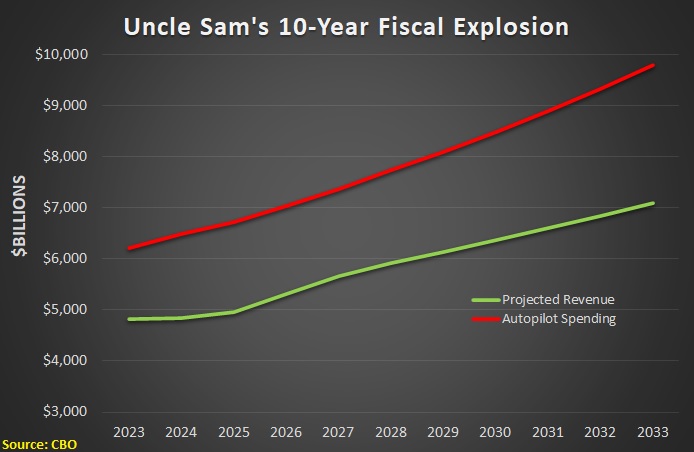
And you can see from this chart that the fiscal burden of the federal government is projected to grow at a very rapid pace over the next decade.

Other fiscal experts fret that deficits and debt are increasing between now and 2033, but the above chart shows that the real problem is that the spending burden is rising faster than the tax burden.

The real fiscal fight in Washington is how to close the gap between the red spending line and the green revenue line (supporters of Modern Monetary Theory say we can just print money to finance big government, but let’s ignore them for purposes of today’s column).

Since I think Washington is spending far too much, I want to close the gap by restraining the growth of government.

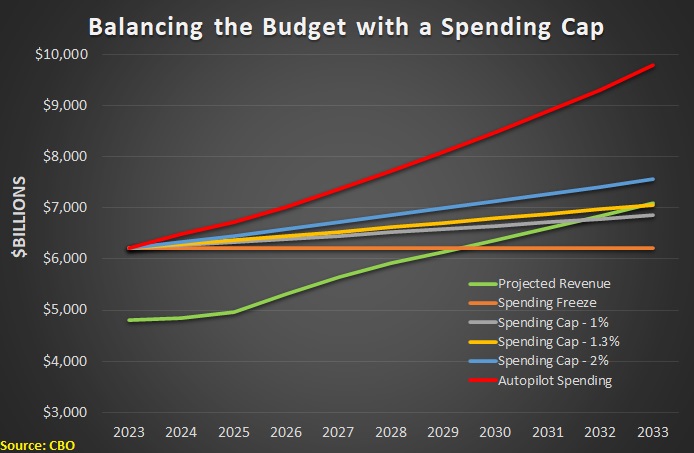
So here’s a second chart illustrating what would happen if there was some sort of spending cap. As you can see, a spending freeze (like we had from 2009-2014) would balance the budget by 2030.

And spending would have to be limited to 1.3 percent annual growth if the goal is to balance the budget within 10 years,

We can solve the problem. That’s the good news.

The bad news is that politicians don’t want to restrain spending.

And, even if they did want to do the right thing, adhering to a 1.3 percent spending cap would require serious entitlement reform. So don’t hold your breath hoping for immediate progress.

P.S. The numbers are out of date, but here’s a videothat explains how spending restraint is the key to fiscal balance. And here’s a video on how some other nations made enormous progress with multi-year spending restraint.


The Simple (but Definitely not Easy) Way to Avert America’s Fiscal Crisis

Every six months or so, the Congressional Budget Office produces a 10-year forecast and most fiscal experts focus on the projections for deficit and debt.

Those are important (and worrisome) numbers, but I first look at the data showing what will happen to taxes and spending.

And you can see from this chart that the fiscal burden of the federal government is projected to grow at a very rapid pace over the next decade.

Other fiscal experts fret that deficits and debt are increasing between now and 2033, but the above chart shows that the real problem is that the spending burden is rising faster than the tax burden.

The real fiscal fight in Washington is how to close the gap between the red spending line and the green revenue line (supporters of Modern Monetary Theory say we can just print money to finance big government, but let’s ignore them for purposes of today’s column).

Since I think Washington is spending far too much, I want to close the gap by restraining the growth of government.

So here’s a second chart illustrating what would happen if there was some sort of spending cap. As you can see, a spending freeze (like we had from 2009-2014) would balance the budget by 2030.

And spending would have to be limited to 1.3 percent annual growth if the goal is to balance the budget within 10 years,

We can solve the problem. That’s the good news.

The bad news is that politicians don’t want to restrain spending.

And, even if they did want to do the right thing, adhering to a 1.3 percent spending cap would require serious entitlement reform. So don’t hold your breath hoping for immediate progress.

P.S. The numbers are out of date, but here’s a videothat explains how spending restraint is the key to fiscal balance. And here’s a video on how some other nations made enormous progress with multi-year spending restraint.

An Overdue Wake-Up Call for New York Democrats?

The economic outlook in New York (both the stateand the city) has been very depressing in recent years.

  • New York is ranked #50 in the Economic Freedom of North America.
  • New York is ranked #48 in the State Business Tax Climate Index.
  • New York is ranked #50 in the Freedom in the 50 States.
  • New York is next-to-last in measures of inbound migration.
  • New York is ranked #50 in the State Soft Tyranny Index.

That’s a very depressing list. New York’s low rankings are rivaled only by a few other outlier states such as California and New Jersey.

But maybe a turnaround is possible.

There are two recent signs of rationality, one in New York City and one in Albany (the state’s capital).

Let’s start with this tweet from Phil Kerpen, which features some comments from Mayor Adams of New York City.

Remarkably, the Mayor understands it is not a good idea if the geese with the golden eggs fly away.

“To continually attack high income earners when 51% of our taxes are paid by 2% of New Yorkers — this blows my mind when I hear people say ‘so what if they leave.’ No you leave! I want my high income earners right here in this city!”

I don’t know if the Mayor’s comments will actually translate into better policy, but it certainly seems like he has a better understanding of reality than his predecessor.

Now let’s shift to the state level.

The Wall Street Journal opines about a potential outbreak of rationality by the state’s governor.

’Tis the season for epiphanies, and what do you know? It’s finally dawning on some New York Democrats that the state’s steep income tax rates are driving away top earners who fund essential public services. …miracles of miracles, Gov. Kathy Hochul last week ruled out tax increases and said she planned to hold the line on spending next year. “I don’t believe that raising taxes…makes sense,” she said. …A New York City Independent Budget Office report this month showed that the number of taxpayers who earned between $1 million and $5 million plunged 11% in 2020 from the prior year. …The culprits are high taxes and Covid lockdowns. According to IRS data, New York County lost $14.5 billion in adjusted gross income from out-migration between 2019 and 2020. And this was before Democrats in Albany last spring raised income taxes on individuals making more than $1 million, jacking up the combined state and New York City top rate to 14.8% from 12.7%. Even New York Comptroller Thomas DiNapoli, who is no moderate, told Bloomberg News last week that the exodus of taxpayers at the upper end “should be a concern for everybody.” He added that “we might be getting near that tipping point where we do make it economically unsustainable for enough of those folks to stay here.”

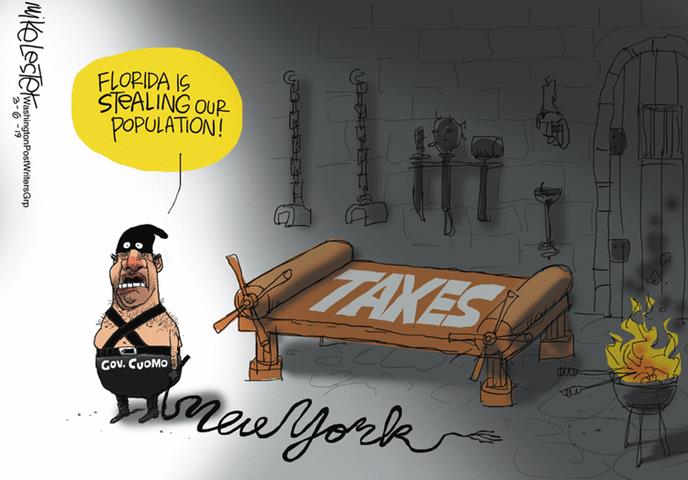
For what it’s worth, I think New York already passed the tipping point. Thousand and thousands of well-to-do taxpayers have already escaped and moved to zero-income-tax Florida.

That means New York’s parasitical politicians have lost billions and billions of tax revenue. And I suspect that’s why we are seeing some semi-sensible comments from the Mayor and the Governor.

Let’s close with a depressing observation. The reason the comments from the Mayor and Governor are “semi-sensible” is that they are only saying there should be no more tax increases.

That’s not the same as saying that there should be tax cuts. Or TABOR-style spending caps.

In other words, the “good news” from New York is that politicians want to freeze the current (very bad) policy in place. That’s better than galloping faster in the wrong direction, of course, but a far cry from what’s needed.

Especially when many other states are seizing opportunities to become more competitive.


Dan Mitchell does a great job explaining the Laffer Curve

Free-market economics meets free-market policies at The Heritage Foundation’s Tenth Anniversary dinner in 1983. Nobel Laureate Milton Friedman and his wife Rose with President Ronald Reagan and Heritage President Ed Feulner.

Free-market economics meets free-market policies at The Heritage Foundation’s Tenth Anniversary dinner in 1983. Nobel Laureate Milton Friedman and his wife Rose with President Ronald Reagan and Heritage President Ed Feulner.

Since the passing of Milton Friedman who was my favorite economist, I have been reading the works of Daniel Mitchell and he quotes Milton Friedman a lot, and you can reach Dan’s website here.

Mitchell in February 2011.
Wikipedia noted concerning Dan:


Mitchell’s career as an economist began in the United States Senate, working for Oregon Senator Bob Packwood and the Senate Finance Committee. He also served on the transition team of President-Elect Bush and Vice President-Elect Quayle in 1988. In 1990, he began work at the Heritage Foundation. At Heritage, Mitchell worked on tax policy issues and began advocating for income tax reform.[1]

In 2007, Mitchell left the Heritage Foundation, and joined the Cato Institute as a Senior Fellow. Mitchell continues to work in tax policy, and deals with issues such as the flat tax and international tax competition.[2]

In addition to his Cato Institute responsibilities, Mitchell co-founded the Center for Freedom and Prosperity, an organization formed to protect international tax competition.[1]

President Biden c/o The White House
1600 Pennsylvania Avenue NW
Washington, DC 20500

Dear Mr. President,

I enjoyed this article below because it demonstrates that the Laffer Curve has been working for almost 100 years now when it is put to the test in the USA. I actually got to hear Arthur Laffer speak in person in 1981 and he told us in advance what was going to happen the 1980’s and it all came about as he said it would when Ronald Reagan’s tax cuts took place. I wish we would lower taxes now instead of looking for more revenue through raised taxes. We have to grow the economy:

What Mitt Romney Said Last Night About Tax Cuts And The Deficit Was Absolutely Right. And What Obama Said Was Absolutely Wrong.

Mitt Romney repeatedly said last night that he would not allow tax cuts to add to the deficit.  He repeatedly said it because over and over again Obama blathered the liberal talking point that cutting taxes necessarily increased deficits.

Romney’s exact words: “I want to underline that — no tax cut that adds to the deficit.”

Meanwhile, Obama has promised to cut the deficit in half during his first four years – but instead gave America the highest deficits in the history of the entire human race.

I’ve written about this before.  Let’s replay what has happened every single time we’ve ever cut the income tax rate.

The fact of the matter is that we can go back to Calvin Coolidge who said very nearly THE EXACT SAME THING to his treasury secretary: he too would not allow any tax cuts that added to the debt.  Andrew Mellon – quite possibly the most brilliant economic mind of his day – did a great deal of research and determined what he believed was the best tax rate.  And the Coolidge administration DID cut income taxes and MASSIVELY increased revenues.  Coolidge and Mellon cut the income tax rate 67.12 percent (from 73 to 24 percent); and revenues not only did not go down, but they went UP by at least 42.86 percent (from $700 billion to over $1 billion).

That’s something called a documented fact.  But that wasn’t all that happened: another incredible thing was that the taxes and percentage of taxes paid actually went UP for the rich.  Because as they were allowed to keep more of the profits that they earned by investing in successful business, they significantly increased their investments and therefore paid more in taxes than they otherwise would have had they continued sheltering their money to protect themselves from the higher tax rates.  Liberals ignore reality, but it is simply true.  It is a fact.  It happened.

Then FDR came along and raised the tax rates again and the opposite happened: we collected less and less revenue while the burden of taxation fell increasingly on the poor and middle class again.  Which is exactly what Obama wants to do.

People don’t realize that John F. Kennedy, one of the greatest Democrat presidents, was a TAX CUTTER who believed the conservative economic philosophy that cutting tax rates would in fact increase tax revenues.  He too cut taxes, and he too increased tax revenues.

So we get to Ronald Reagan, who famously cut taxes.  And again, we find that Reagan cut that godawful liberal tax rate during an incredibly godawful liberal-caused economic recession, and he increased tax revenue by 20.71 percent (with revenues increasing from $956 billion to $1.154 trillion).  And again, the taxes were paid primarily by the rich:

“The share of the income tax burden borne by the top 10 percent of taxpayers increased from 48.0 percent in 1981 to 57.2 percent in 1988. Meanwhile, the share of income taxes paid by the bottom 50 percent of taxpayers dropped from 7.5 percent in 1981 to 5.7 percent in 1988.”

So we get to George Bush and the Bush tax cuts that liberals and in particular Obama have just demonized up one side and demagogued down the other.  And I can simply quote the New York Times AT the time:

Sharp Rise in Tax Revenue to Pare U.S. Deficit By EDMUND L. ANDREWS Published: July 13, 2005

WASHINGTON, July 12 – For the first time since President Bush took office, an unexpected leap in tax revenue is about to shrink the federal budget deficit this year, by nearly $100 billion.

A Jump in Corporate Payments On Wednesday, White House officials plan to announce that the deficit for the 2005 fiscal year, which ends in September, will be far smaller than the $427 billion they estimated in February.

Mr. Bush plans to hail the improvement at a cabinet meeting and to cite it as validation of his argument that tax cuts would stimulate the economy and ultimately help pay for themselves.

Based on revenue and spending data through June, the budget deficit for the first nine months of the fiscal year was $251 billion, $76 billion lower than the $327 billion gap recorded at the corresponding point a year earlier.

The Congressional Budget Office estimated last week that the deficit for the full fiscal year, which reached $412 billion in 2004, could be “significantly less than $350 billion, perhaps below $325 billion.”

The big surprise has been in tax revenue, which is running nearly 15 percent higher than in 2004. Corporate tax revenue has soared about 40 percent, after languishing for four years, and individual tax revenue is up as well
.

And of course the New York Times, as reliable liberals, use the adjective whenever something good happens under conservative policies and whenever something bad happens under liberal policies: ”unexpected.”   But it WASN’T ”unexpected.”  It was EXACTLY what Republicans had said would happen and in fact it was exactly what HAD IN FACT HAPPENED every single time we’ve EVER cut income tax rates.

The truth is that conservative tax policy has a perfect track record: every single time it has ever been tried, we have INCREASED tax revenues while not only exploding economic activity and creating more jobs, but encouraging the wealthy to pay more in taxes as well.  And liberals simply dishonestly refuse to acknowledge documented history.

Meanwhile, liberals also have a perfect record … of FAILUREThey keep raising taxes and keep not understanding why they don’t get the revenues they predicted.

The following is a section from my article, “Tax Cuts INCREASE Revenues; They Have ALWAYS Increased Revenues“, where I document every single thing I said above:

The Falsehood That Tax Cuts Increase The Deficit

Now let’s take a look at the utterly fallacious view that tax cuts in general create higher deficits.

Let’s take a trip back in time, starting with the 1920s.  From Burton Folsom’s book, New Deal or Raw Deal?:

In 1921, President Harding asked the sixty-five-year-old [Andrew] Mellon to be secretary of the treasury; the national debt [resulting from WWI] had surpassed $20 billion and unemployment had reached 11.7 percent, one of the highest rates in U.S. history.  Harding invited Mellon to tinker with tax rates to encourage investment without incurring more debt. Mellon studied the problem carefully; his solution was what is today called “supply side economics,” the idea of cutting taxes to stimulate investment.  High income tax rates, Mellon argued, “inevitably put pressure upon the taxpayer to withdraw this capital from productive business and invest it in tax-exempt securities. . . . The result is that the sources of taxation are drying up, wealth is failing to carry its share of the tax burden; and capital is being diverted into channels which yield neither revenue to the Government nor profit to the people” (page 128).

Mellon wrote, “It seems difficult for some to understand that high rates of taxation do not necessarily mean large revenue to the Government, and that more revenue may often be obtained by lower taxes.”  And he compared the government setting tax rates on incomes to a businessman setting prices on products: “If a price is fixed too high, sales drop off and with them profits.”

And what happened?

“As secretary of the treasury, Mellon promoted, and Harding and Coolidge backed, a plan that eventually cut taxes on large incomes from 73 to 24 percent and on smaller incomes from 4 to 1/2 of 1 percent.  These tax cuts helped produce an outpouring of economic development – from air conditioning to refrigerators to zippers, Scotch tape to radios and talking movies.  Investors took more risks when they were allowed to keep more of their gains.  President Coolidge, during his six years in office, averaged only 3.3 percent unemployment and 1 percent inflation – the lowest misery index of any president in the twentieth century.

Furthermore, Mellon was also vindicated in his astonishing predictions that cutting taxes across the board would generate more revenue.  In the early 1920s, when the highest tax rate was 73 percent, the total income tax revenue to the U.S. government was a little over $700 million.  In 1928 and 1929, when the top tax rate was slashed to 25 and 24 percent, the total revenue topped the $1 billion mark.  Also remarkable, as Table 3 indicates, is that the burden of paying these taxes fell increasingly upon the wealthy” (page 129-130).

Now, that is incredible upon its face, but it becomes even more incredible when contrasted with FDR’s antibusiness and confiscatory tax policies, which both dramatically shrunk in terms of actual income tax revenues (from $1.096 billion in 1929 to $527 million in 1935), and dramatically shifted the tax burden to the backs of the poor by imposing huge new excise taxes (from $540 million in 1929 to $1.364 billion in 1935).  See Table 1 on page 125 of New Deal or Raw Deal for that information.

FDR both collected far less taxes from the rich, while imposing a far more onerous tax burden upon the poor.

It is simply a matter of empirical fact that tax cuts create increased revenue, and that those [Democrats] who have refused to pay attention to that fact have ended up reducing government revenues even as they increased the burdens on the poorest whom they falsely claim to help.

Let’s move on to John F. Kennedy, one of the most popular Democrat presidents ever.  Few realize that he was also a supply-side tax cutter.

Kennedy said:

“It is a paradoxical truth that tax rates are too high and tax revenues are too low and the soundest way to raise the revenues in the long run is to cut the rates now … Cutting taxes now is not to incur a budget deficit, but to achieve the more prosperous, expanding economy which can bring a budget surplus.”

– John F. Kennedy, Nov. 20, 1962, president’s news conference


“Lower rates of taxation will stimulate economic activity and so raise the levels of personal and corporate income as to yield within a few years an increased – not a reduced – flow of revenues to the federal government.”

– John F. Kennedy, Jan. 17, 1963, annual budget message to the Congress, fiscal year 1964

“In today’s economy, fiscal prudence and responsibility call for tax reduction even if it temporarily enlarges the federal deficit – why reducing taxes is the best way open to us to increase revenues.”

– John F. Kennedy, Jan. 21, 1963, annual message to the Congress: “The Economic Report Of The President”


“It is no contradiction – the most important single thing we can do to stimulate investment in today’s economy is to raise consumption by major reduction of individual income tax rates.”

– John F. Kennedy, Jan. 21, 1963, annual message to the Congress: “The Economic Report Of The President”


“Our tax system still siphons out of the private economy too large a share of personal and business purchasing power and reduces the incentive for risk, investment and effort – thereby aborting our recoveries and stifling our national growth rate.”

– John F. Kennedy, Jan. 24, 1963, message to Congress on tax reduction and reform, House Doc. 43, 88th Congress, 1st Session.


“A tax cut means higher family income and higher business profits and a balanced federal budget. Every taxpayer and his family will have more money left over after taxes for a new car, a new home, new conveniences, education and investment. Every businessman can keep a higher percentage of his profits in his cash register or put it to work expanding or improving his business, and as the national income grows, the federal government will ultimately end up with more revenues.”

– John F. Kennedy, Sept. 18, 1963, radio and television address to the nation on tax-reduction bill

Which is to say that modern Democrats are essentially calling one of their greatest presidents a liar when they demonize tax cuts as a means of increasing government revenues.

So let’s move on to Ronald Reagan.  Reagan had two major tax cutting policies implemented: the Economic Recovery Tax Act (ERTA) of 1981, which was retroactive to 1981, and the Tax Reform Act of 1986.

Did Reagan’s tax cuts decrease federal revenues?  Hardly:

We find that 8 of the following 10 years there was a surplus of revenue from 1980, prior to the Reagan tax cuts.  And, following the Tax Reform Act of 1986, there was a MASSIVE INCREASEof revenue.

So Reagan’s tax cuts increased revenue.  But who paid the increased tax revenue?  The poor?  Opponents of the Reagan tax cuts argued that his policy was a giveaway to the rich (ever heard that one before?) because their tax payments would fall.  But that was exactly wrong.  In reality:

“The share of the income tax burden borne by the top 10 percent of taxpayers increased from 48.0 percent in 1981 to 57.2 percent in 1988. Meanwhile, the share of income taxes paid by the bottom 50 percent of taxpayers dropped from 7.5 percent in 1981 to 5.7 percent in 1988.”

So Ronald Reagan a) collected more total revenue, b) collected more revenue from the rich, while c) reducing revenue collected by the bottom half of taxpayers, and d) generated an economic powerhouse that lasted – with only minor hiccups – for nearly three decades.  Pretty good achievement considering that his predecessor was forced to describe his own economy as a “malaise,” suffering due to a “crisis of confidence.” Pretty good considering that President Jimmy Carter responded to a reporter’s question as to what he would do about the problem of inflation by answering, “It would be misleading for me to tell any of you that there is a solution to it.”

Reagan whipped inflation.  Just as he whipped that malaise and that crisis of confidence.

________

Thank you so much for your time. I know how valuable it is. I also appreciate the fine family that you have and your commitment as a father and a husband.

Sincerely,

Everette Hatcher III, 13900 Cottontail Lane, Alexander, AR 72002, ph 501-920-5733

________

The Laffer Curve, Part III: Dynamic Scoring

Related posts:

Milton Friedman’s Free to Choose (1980), episode 3 – Anatomy of a Crisis. part 1

“The Power of the Market” episode of Free to Choose in 1990 by Milton Friedman (Part 5)

Milton Friedman The Power of the Market 5-5 How can we have personal freedom without economic freedom? That is why I don’t understand why socialists who value individual freedoms want to take away our economic freedoms.  I wanted to share this info below with you from Milton Friedman who has influenced me greatly over the […]

“The Power of the Market” episode of Free to Choose in 1990 by Milton Friedman (Part 4)

Milton Friedman The Power of the Market 4-5 How can we have personal freedom without economic freedom? That is why I don’t understand why socialists who value individual freedoms want to take away our economic freedoms.  I wanted to share this info below with you from Milton Friedman who has influenced me greatly over the […]

“The Power of the Market” episode of Free to Choose in 1990 by Milton Friedman (Part 3)

Milton Friedman The Power of the Market 3-5 How can we have personal freedom without economic freedom? That is why I don’t understand why socialists who value individual freedoms want to take away our economic freedoms.  I wanted to share this info below with you from Milton Friedman who has influenced me greatly over the […]

“The Power of the Market” episode of Free to Choose in 1990 by Milton Friedman (Part 2)

Milton Friedman The Power of the Market 2-5 How can we have personal freedom without economic freedom? That is why I don’t understand why socialists who value individual freedoms want to take away our economic freedoms.  I wanted to share this info below with you from Milton Friedman who has influenced me greatly over the […]

“The Power of the Market” episode of Free to Choose in 1990 by Milton Friedman (Part 1)

Milton Friedman The Power of the Market 1-5 How can we have personal freedom without economic freedom? That is why I don’t understand why socialists who value individual freedoms want to take away our economic freedoms.  I wanted to share this info below with you from Milton Friedman who has influenced me greatly over the […]

Open letter to President Obama (Part 282, How the Laffer Curve worked in the 20th century over and over again!!!)

Dan Mitchell does a great job explaining the Laffer Curve President Obama c/o The White House 1600 Pennsylvania Avenue NW Washington, DC 20500 Dear Mr. President, I know that you receive 20,000 letters a day and that you actually read 10 of them every day. I really do respect you for trying to get a […]

President Obama ignores warnings about Laffer Curve

The Laffer Curve – Explained Uploaded by Eddie Stannard on Nov 14, 2011 This video explains the relationship between tax rates, taxable income, and tax revenue. The key lesson is that the Laffer Curve is not an all-or-nothing proposition, where we have to choose between the exaggerated claim that “all tax cuts pay for themselves” […]

The Laffer Curve Wreaks Havoc in the United Kingdom

I got to hear Arthur Laffer speak back in 1981 and he predicted what would happen in the next few years with the Reagan tax cuts and he was right with every prediction. The Laffer Curve Wreaks Havoc in the United Kingdom July 1, 2012 by Dan Mitchell Back in 2010, I excoriated the new […]

Open letter to President Obama (Part 197)

  President Obama c/o The White House 1600 Pennsylvania Avenue NW Washington, DC 20500 Dear Mr. President, I know that you receive 20,000 letters a day and that you actually read 10 of them every day. I really do respect you for trying to get a pulse on what is going on out here. David […]

Open letter to President Obama (Part 123)

President Obama c/o The White House 1600 Pennsylvania Avenue NW Washington, DC 20500 Dear Mr. President, I know that you receive 20,000 letters a day and that you actually read 10 of them every day. I really do respect you for trying to get a pulse on what is going on out here. I got […]

Open letter to President Obama (Part 111)

President Obama c/o The White House 1600 Pennsylvania Avenue NW Washington, DC 20500 Dear Mr. President, I know that you receive 20,000 letters a day and that you actually read 10 of them every day. I really do respect you for trying to get a pulse on what is going on out here. If our […]

Open letter to President Obama (Part 103)

President Obama c/o The White House 1600 Pennsylvania Avenue NW Washington, DC 20500 Dear Mr. President, I know that you receive 20,000 letters a day and that you actually read 10 of them every day. I really do respect you for trying to get a pulse on what is going on out here. I personally […]

High taxes are self-defeating

We got to lower taxes in order to encourage job growth and if we go down the road of higher taxes then we will go further into a recession. Debating Whether States Should Impose Class-Warfare Tax Policy June 4, 2012 by Dan Mitchell I wrote last week about the destructive and self-defeating impact of high state […]

California has forgotten the lessons of Ronald Reagan

If our country is the grow the economy and get our budget balanced it will not be by raising taxes!!! The recipe for success was followed by Ronald Reagan in the 1980′s when he cut taxes and limited spending. As far as limiting spending goes only Bill Clinton (with his Republican Congress) were ability to […]

Some liberal economics want top tax rate above 70% but economy would be crushed

I got to see Arthur Laffer speak in 1981 in Memphis and he predicted what would happen the next few years with tax revenue as a result of the Reagan Tax Cuts and he was right on every prediction. Alan Reynolds Dismantles the Silly Claim that Top Tax Rates Should be 70 Percent (or Higher!) May […]

Spain raises tax rates and revenues fall!!!!

The way to grow the economy is to cut taxes. Last night in the State of the Union address President Obama said he wanted to close tax loopholes which is another way of saying that he is not through raising taxes yet. The Laffer Curve Strikes Again: Revenues Falling in Spite of (or Perhaps Because […]

Ronald Wilson Reagan Part 13

President Reagan and Nancy Reagan greeting Billy Graham at the National Prayer Breakfast held at the Washington Hilton Hotel. 2/5/81. HALT:HaltingArkansasLiberalswithTruth.com Recently on my series on Ronald Reagan (part 10), a gentleman by the name of Elwood who a regular on the Ark Times Blog site, rightly noted, “Ray-gun created the highest unemployment rate we […]

DAN Mitchell: A Case Study on Corporate Tax and Competitiveness

A Case Study on Corporate Tax and Competitiveness

Last year’s three-part series on corporate tax rates (here, here, and here) primarily focused on the case for low rates in the United States.

Today, we’re going to look at why the United Kingdom should have a low corporate tax rate.

Though the arguments don’t change simply because we cross the Atlantic Ocean.

A low corporate tax rate is a good idea because it means more investment, higher productivity, and better wages.

That’s true in the U.S., it’s true in the U.K., and its true in every other nation.

If you want evidence, Phil Radford’s article for CapXexplains why the U.K.’s pharmaceutical industry has contracted while Ireland’s has expanded.

AstraZeneca’s plan to build a $350m pharmaceuticals factory in Ireland rather than the UK was 100% predictable. …the long-term failure of UK pharma highlights how UK policy discussion is light years behind our competitors when it comes to understanding what drives prosperity. …The trend kicked off back in 2011, when US-based Pfizer shifted its Viagra-making plant from Sandwich in Kent to Ringaskiddy, near Cork. This event marked the start of a five-year plunge in UK pharma manufacturing and exports…According to ONS, output in UK pharma manufacturing declined by roughly one-third from 2010 to 2015. Gross value added actually halved. Where did the manufacturing go? Ireland… What’s caused this malady? In a word: taxation. …corporate taxation levels appear to exert a dominating effect on where pharmaceuticals companies locate their factories. …Ireland’s corporate tax rate fell from 40% in 1996 to 12.5%n 2003, and it has stayed at that level for the past 19 years. Meanwhile, the UK’s corporate taxation rate was 30% 20 years ago, and from 2008 it began a gentle drift downwards to 19% where it will remain until April this year, when it will increase to 25%. This means, from AstraZeneca’s point of view, the investment equation is a no-brainer. Even if Ireland is forced to raise its rate to 15%, the country will shortly regain its general comparative level of between one-half and two-thirds the UK rate.

The data in Radford’s article is a damning indictment of the supposedly conservative government in the United Kingdom.

A few years ago, the corporate tax rate was 19 percent and expected to drop to 17 percent. Now, thanks to an unwillingness to control spending, the rate is jumping to 25 percent.

And, as noted in the article, the U.K. lost a $350 million factory. As well as all the jobs and taxable income that it would have generated.

Politicians are winning and people are losing.

P.S. Biden wants to make the same mistake.

The Unavoidable Choice: Entitlement Reform or Massive Middle-Class Tax Increases

I worry about big tax increases because of America’s grim long-run fiscal outlook.

The video clip is less than two minutes (taken from this longer discussion with Fergus Hodgson), but I can summarize my key point in just one very important sentence

Anybody who opposes entitlement reform is unavoidably in favor of big tax increases on lower-income and middle-class Americans.

There are three reasons for this bold (and bolded) statement.

  1. The burden of spending in the United States is going to dramatically expand in coming decades because of demographic change combined with poorly designed entitlement programs.
  2. There presumably is a limit to how much of this future spending burden can be financed by borrowing from the private sector (or with printing money by the Federal Reserve).
  3. Many politicians claim that future spending on entitlements (as well spending on new entitlements!) can be financed with class-warfare taxes, but there are not enough rich people.

My left-leaning friends almost surely would agree with the first two points. But some of them (particularly the ones who don’t understand budget numbers) might argue with the third point.

To confirm the accuracy of the argument, let’s look at this chart from Brian Riedl’s famous Chartbook.

As you can see, even confiscatory 100-percent taxes on the rich (which obviously would cripple the economy) would not be nearly enough to eliminate America’s medium-term fiscal gap.

Heck, even if we look at just the next 10 years and include every possible tax hike, it’s obvious that a class-warfare agenda (which also would have negative economic effects) would not be enough to finance all the spending that is currently in the pipeline.

Here’s another Riedl chart (which even includes some proposals that would hit the middle class).

I’ll conclude with two further observations.

  • First, there are plenty of honest leftists (the ones who understand budget numbers, including Paul Krugman) who openly admit that big tax increases will be needed if the burden of government spending is allowed to increase.
  • Second, there are plenty of disingenuous (or perhaps naive) folks on the right who oppose entitlement reform while not admitting that their approach means massive tax increases on lower-income and middle-class taxpayers.

Needless to say, genuine entitlement reform would be far preferable to any type of tax increase.

P.S. In the absence of entitlement reform, politicians will first choose class warfare taxes, of course, but that simply will be a precursor to higher taxes on the rest of us.

P.P.S. The bottom line is that you can’t have European-sized government without European-style taxes. Including a money-siphoning value-added tax.

If our country is the grow the economy and get our budget balanced it will not be by raising taxes!!! The recipe for success was followed by Ronald Reagan in the 1980’s when he cut taxes and limited spending. As far as limiting spending goes only Bill Clinton (with his Republican Congress) were ability to control the growth of government better than Reagan.

I had the pleasure of hearing Arthur Laffer speak in 1981 and he predicted all the economic growth that we would see because of the Reagan tax cuts and he was right. Unfortunately in California today they have forgotten all of those lessons!!!

President Obama’s fiscal policy is a dismal mixture. On spending, he wants a European-style welfare state. On taxes, he is fixated on class-warfare tax policy.

If we want to know the consequences of that approach, we can look at the ongoing collapse of Greece. Or, if we don’t like overseas examples, we can look at California.

If the (formerly) Golden State is any example, it turns out that having high tax rates doesn’t necessarily translate into high tax revenues. Here’s a blurb from an editorial in today’s Wall Street Journal.

California Controller John Chiang reported last week that April tax collections were a gigantic 20.2%, or $2.44 billion, below 2012-13 budget projections. …Among the biggest surprises is a 21.5% or nearly $2 billion decline in personal income tax payments from what Governor Jerry Brown had anticipated. This reinforces the point that when states rely too heavily on the top 1% of taxpayers to pay the bills, fiscal policy is a roller coaster ride. California is suffering this tax drought even as most other states enjoy a revenue rebound. State tax collections were up nationally by 8.9% last year, according to the Census Bureau, and this year revenues are up by double digits in many states. The state comptroller reports that Texas is enjoying 10.9% growth in its sales taxes (it has no income tax), while California can’t seem to keep up despite one of the highest tax rates in the land.

The WSJ editorial suggests a supply-side response, but you won’t be surprised to learn that the state’s kleptomaniac governor is pushing an Obama-style soak-the-rich tax hike.

This would seem to suggest that California should try cutting tax rates to keep more people and business in the state, but Sacramento is intent on raising them again. Governor Brown and the public-employee unions are sponsoring a ballot initiative in November to raise the state sales tax by a quarter point to 7.5% and to raise the top marginal income-tax rate to 13.3% from 10.3%. This will make the state even more reliant on the fickle revenue streams provided by the rich. Meanwhile, an analysis by Joseph Vranich, who studies migration of businesses from one state to another, finds that since 2009 the flight of businesses out of California “has increased fivefold due to high taxes and regulatory costs.”

I’ll be very curious to see what happens this November when the people of California vote in the referendum. Will they be like the morons in Oregon, who approved a class-warfare tax hike? Or will they be like the voters of Switzerland and reject class warfare?

Sadly, I suspect Oregon will be their role model – even though that decision hurt the Beaver State’s economy.

But while voters can impose higher taxes, they can’t repeal the laws of economics. So if California voters do the wrong thing, they will learn a hard lesson about the Laffer Curve.

And then, as this cartoon demonstrates, they’ll learn the ultimate lesson about not biting the hand that you mooch from.

The Laffer Curve, Part III: Dynamic Scoring

Dan Mitchell: A New Member for the Bureaucrat Hall of Fame

A New Member for the Bureaucrat Hall of Fame

My primary problem with bureaucrats is that they often work for agencies and departments that should not exist.

My secondary problem is that they generally get overcompensated compared to workers in the economy’s productive sector.

And my tertiary problem with government employees is that they have job protections that encourage bad behavior – everything from sloth to crime.

When selecting new members for the Bureaucrat Hall of Fame, I usually pick from that final group.

And that’s the purpose of today’s column. We have a bureaucrat from Washington, DC, who deserves to be honored.

But he’s not a federal bureaucrat. He’s a cop with the DC metropolitan police. Here are some details of his misdeeds, as reported by Amanda Michelle Gomez.

The former vice chair of D.C. Police Union, Medgar Webster Sr., was arrested on Saturday for allegedly defrauding the D.C. government by working a second job at Whole Foods Market while reporting as on duty for the Metropolitan Police Department.…MPD paid Webster $33,845, including overtime and holiday pay, for hours he was simultaneously on the clock at Whole Foods, according to an arrest affidavit. Webster allegedly worked at two locations for the grocery chain between January 2021 and April 2022, and earned $45,946 at one of those stores along H Street Southeast. …Webster earned an hourly rate of $53.11 as an officer, which was adjusted to $79.67 for overtime work, per the affidavit.

If nothing else, I guess we can say he’s not lazy. I imagine other cops don’t bother doing any work, but they’re probably home napping instead of working a second job.

So congratulations…sort of.

But here’s the part of the story that definitely makes Mr. Webster a Hall of Famer.

He was caught double-dipping only because he got in trouble for sexual harassment at his second job.

The police spokesperson says agents discovered Webster was allegedly working a second job while on the clock at MPD during an “unrelated [Internal Affairs Division] investigation.” Webster was being investigated for engaging in an “unwanted sexual contact” with an individual at the Whole Foods.

Apparently he was trying to double-dip in more than one way.

Seems like he has something in common with Mr. Geary.

P.S. My all-time favorite example of anti-bureaucrat satire is this video, though this top-10 list from David Letterman is a close second.

P.P.S. Since we’re making fun of bureaucrats, here’s a good jab at the Post Office from Jimmy Kimmel and a clever one-liner from Craig Ferguson. And to see how government operates, we have the Fable of the Ant. But this Pearls before Swine cartoon strip is very clever. Also, here’s a new element discovered inside the bureaucracy, and a letter to the bureaucracy from someone renewing a passport.

Protecting Individual Savings from Double Taxation

While speaking last year in Hawaii on the topic of good tax policy, I explained why it is misguided to impose extra layers of tax on saving and investment.

Regarding the problem of double taxation, I’ve addressed how various features of the tax code need to be fixed.

Today, we’re going to focus on the fixing the tax treatment of household savings. And the problem that needs fixing is that the federal government taxes you when you earn money and also taxes any interest you earn if you decide to save some of your after-tax income.

As you can see from the chart, this creates a tax wedge.

And that tax wedge distorts people’s decisions and makes them more likely to choose immediate consumption rather than savings (which can be viewed as deferred consumption).

As mentioned in the video, every economic theoryrecognizes that saving and investment (again, just another way of saying deferred consumption) are critical to future growth and rising living standards. So there are good reasons to fix the tax code.

The good news is that there are two ways to fix this problem.

  1. Tax income only one time when it is first earned.
  2. Tax income only one time when it is consumed.

In practical terms, the first option treats all savings like a “Roth IRA,”, which means you pay tax the year you earn your income, but the IRS does not get another bit at the apple if you save some of your after-tax income and it earns interest or otherwise grows in value.

The second option treats all savings like a 401(k), which means you are not taxed on any income that you place in a savings vehicle, but you are taxed on any money (including any interest or other returns) that you withdraw from the account.

As shown by Adam Michel of the Heritage Foundation, both of these approaches lead to the same long-run result (and thus are superior to what happens when people save without being protected from double taxation).

The good news is that Americans can protect their savings from double taxation by using either individual retirement accounts (IRAs) or 401(k)s.

The bad news is that those “qualified accounts” are restricted. Only people who are saving for retirement can protect themselves from double taxation.

That needs to change.

Here’s what I wrote back in 2012 and I think it’s reasonably succinct and accurate.

…all saving and investment should be treated the way we currently treat individual retirement accounts. If you have a traditional IRA (or “front-ended” IRA), you get a deduction for any money you put in a retirement account, but then you pay tax on the money – including any earnings – when the money is withdrawn. If you have a Roth IRA (or “back-ended” IRA), you pay tax on your income in the year that it is earned, but if you put the money in a retirement account, there is no additional tax on withdrawals or the subsequent earnings. From an economic perspective, front-ended IRAs and back-ended IRAs generate the same result. Income that is saved and invested is treated the same as income that is immediately consumed. From a present-value perspective, front-ended IRAs and back-ended IRAs produce the same outcome. All that changes is the point at which the government imposes the single layer of tax.

The key takeaways are in the first and last sentences. All savings should be protected from double taxation, not just what you set aside for retirement. And that means government can tax you one time, either when you first earn the income or when you consume the income.

This means we need universal savings accounts, sort of like they have in Canada.

Here’s what Robert Bellafiore of the Tax Foundation wrote about the idea back in 2019.

USAs do not penalize withdrawals on account of their purpose or timing. In contrast, some types of existing savings accounts are not neutral, penalizing people who withdraw their money for anything but approved purposes at approved times. For example, withdrawals from 529 accounts can only be made without penalty if they are used to fund education.If a parent has a 529 account for a child but must make a withdrawal to cover emergency expenses, he or she must pay income taxes on the earnings, plus a 10 percent penalty. Withdrawals from 401(k)s before the age of 59½ incur the same penalty, though there are certain exceptions. USAs’ neutrality would likely boost saving, for two reasons. First, when savings are not hit by multiple layers of taxation, savers can expect a higher return and are therefore likely to save more. Both IRAs and 401(k)s tax savings only once, and studies have estimated that roughly half of 401(k) balances, and roughly a quarter of all IRA contributions, constitute new saving—in other words, dollars that would have been spent are saved instead.

The bottom line is that we need to copy jurisdictions such as Hong Kong and Singapore that have little or no double taxation of any kind.

Especially since we now live in a world where inflation has become an issue, which acts as a hidden tax on saving and investment.

I’ll close with this chart from the OECD. It’s a few years old, so I’m sure some nations have changed their policies, but it gives one a good idea of how savings is treated around the world.

The bottom line is that it’s good to avoid Norway and the United States is unimpressive.

I’m very surprised to see that Argentina and Germany have good policy.

P.S. For some of our friends on the left, policies that protect from double taxation are akin to an entitlement.

I enjoyed this article below because it demonstrates that the Laffer Curve has been working for almost 100 years now when it is put to the test in the USA. I actually got to hear Arthur Laffer speak in person in 1981 and he told us in advance what was going to happen the 1980’s and it all came about as he said it would when Ronald Reagan’s tax cuts took place. I wish we would lower taxes now instead of looking for more revenue through raised taxes. We have to grow the economy:

What Mitt Romney Said Last Night About Tax Cuts And The Deficit Was Absolutely Right. And What Obama Said Was Absolutely Wrong.

Mitt Romney repeatedly said last night that he would not allow tax cuts to add to the deficit.  He repeatedly said it because over and over again Obama blathered the liberal talking point that cutting taxes necessarily increased deficits.

Romney’s exact words: “I want to underline that — no tax cut that adds to the deficit.”

Meanwhile, Obama has promised to cut the deficit in half during his first four years – but instead gave America the highest deficits in the history of the entire human race.

I’ve written about this before.  Let’s replay what has happened every single time we’ve ever cut the income tax rate.

The fact of the matter is that we can go back to Calvin Coolidge who said very nearly THE EXACT SAME THING to his treasury secretary: he too would not allow any tax cuts that added to the debt.  Andrew Mellon – quite possibly the most brilliant economic mind of his day – did a great deal of research and determined what he believed was the best tax rate.  And the Coolidge administration DID cut income taxes and MASSIVELY increased revenues.  Coolidge and Mellon cut the income tax rate 67.12 percent (from 73 to 24 percent); and revenues not only did not go down, but they went UP by at least 42.86 percent (from $700 billion to over $1 billion).

That’s something called a documented fact.  But that wasn’t all that happened: another incredible thing was that the taxes and percentage of taxes paid actually went UP for the rich.  Because as they were allowed to keep more of the profits that they earned by investing in successful business, they significantly increased their investments and therefore paid more in taxes than they otherwise would have had they continued sheltering their money to protect themselves from the higher tax rates.  Liberals ignore reality, but it is simply true.  It is a fact.  It happened.

Then FDR came along and raised the tax rates again and the opposite happened: we collected less and less revenue while the burden of taxation fell increasingly on the poor and middle class again.  Which is exactly what Obama wants to do.

People don’t realize that John F. Kennedy, one of the greatest Democrat presidents, was a TAX CUTTER who believed the conservative economic philosophy that cutting tax rates would in fact increase tax revenues.  He too cut taxes, and he too increased tax revenues.

So we get to Ronald Reagan, who famously cut taxes.  And again, we find that Reagan cut that godawful liberal tax rate during an incredibly godawful liberal-caused economic recession, and he increased tax revenue by 20.71 percent (with revenues increasing from $956 billion to $1.154 trillion).  And again, the taxes were paid primarily by the rich:

“The share of the income tax burden borne by the top 10 percent of taxpayers increased from 48.0 percent in 1981 to 57.2 percent in 1988. Meanwhile, the share of income taxes paid by the bottom 50 percent of taxpayers dropped from 7.5 percent in 1981 to 5.7 percent in 1988.”

So we get to George Bush and the Bush tax cuts that liberals and in particular Obama have just demonized up one side and demagogued down the other.  And I can simply quote the New York Times AT the time:

Sharp Rise in Tax Revenue to Pare U.S. Deficit By EDMUND L. ANDREWS Published: July 13, 2005

WASHINGTON, July 12 – For the first time since President Bush took office, an unexpected leap in tax revenue is about to shrink the federal budget deficit this year, by nearly $100 billion.

A Jump in Corporate Payments On Wednesday, White House officials plan to announce that the deficit for the 2005 fiscal year, which ends in September, will be far smaller than the $427 billion they estimated in February.

Mr. Bush plans to hail the improvement at a cabinet meeting and to cite it as validation of his argument that tax cuts would stimulate the economy and ultimately help pay for themselves.

Based on revenue and spending data through June, the budget deficit for the first nine months of the fiscal year was $251 billion, $76 billion lower than the $327 billion gap recorded at the corresponding point a year earlier.

The Congressional Budget Office estimated last week that the deficit for the full fiscal year, which reached $412 billion in 2004, could be “significantly less than $350 billion, perhaps below $325 billion.”

The big surprise has been in tax revenue, which is running nearly 15 percent higher than in 2004. Corporate tax revenue has soared about 40 percent, after languishing for four years, and individual tax revenue is up as well
.

And of course the New York Times, as reliable liberals, use the adjective whenever something good happens under conservative policies and whenever something bad happens under liberal policies: ”unexpected.”   But it WASN’T ”unexpected.”  It was EXACTLY what Republicans had said would happen and in fact it was exactly what HAD IN FACT HAPPENED every single time we’ve EVER cut income tax rates.

The truth is that conservative tax policy has a perfect track record: every single time it has ever been tried, we have INCREASED tax revenues while not only exploding economic activity and creating more jobs, but encouraging the wealthy to pay more in taxes as well.  And liberals simply dishonestly refuse to acknowledge documented history.

Meanwhile, liberals also have a perfect record … of FAILUREThey keep raising taxes and keep not understanding why they don’t get the revenues they predicted.

The following is a section from my article, “Tax Cuts INCREASE Revenues; They Have ALWAYS Increased Revenues“, where I document every single thing I said above:

The Falsehood That Tax Cuts Increase The Deficit

Now let’s take a look at the utterly fallacious view that tax cuts in general create higher deficits.

Let’s take a trip back in time, starting with the 1920s.  From Burton Folsom’s book, New Deal or Raw Deal?:

In 1921, President Harding asked the sixty-five-year-old [Andrew] Mellon to be secretary of the treasury; the national debt [resulting from WWI] had surpassed $20 billion and unemployment had reached 11.7 percent, one of the highest rates in U.S. history.  Harding invited Mellon to tinker with tax rates to encourage investment without incurring more debt. Mellon studied the problem carefully; his solution was what is today called “supply side economics,” the idea of cutting taxes to stimulate investment.  High income tax rates, Mellon argued, “inevitably put pressure upon the taxpayer to withdraw this capital from productive business and invest it in tax-exempt securities. . . . The result is that the sources of taxation are drying up, wealth is failing to carry its share of the tax burden; and capital is being diverted into channels which yield neither revenue to the Government nor profit to the people” (page 128).

Mellon wrote, “It seems difficult for some to understand that high rates of taxation do not necessarily mean large revenue to the Government, and that more revenue may often be obtained by lower taxes.”  And he compared the government setting tax rates on incomes to a businessman setting prices on products: “If a price is fixed too high, sales drop off and with them profits.”

And what happened?

“As secretary of the treasury, Mellon promoted, and Harding and Coolidge backed, a plan that eventually cut taxes on large incomes from 73 to 24 percent and on smaller incomes from 4 to 1/2 of 1 percent.  These tax cuts helped produce an outpouring of economic development – from air conditioning to refrigerators to zippers, Scotch tape to radios and talking movies.  Investors took more risks when they were allowed to keep more of their gains.  President Coolidge, during his six years in office, averaged only 3.3 percent unemployment and 1 percent inflation – the lowest misery index of any president in the twentieth century.

Furthermore, Mellon was also vindicated in his astonishing predictions that cutting taxes across the board would generate more revenue.  In the early 1920s, when the highest tax rate was 73 percent, the total income tax revenue to the U.S. government was a little over $700 million.  In 1928 and 1929, when the top tax rate was slashed to 25 and 24 percent, the total revenue topped the $1 billion mark.  Also remarkable, as Table 3 indicates, is that the burden of paying these taxes fell increasingly upon the wealthy” (page 129-130).

Now, that is incredible upon its face, but it becomes even more incredible when contrasted with FDR’s antibusiness and confiscatory tax policies, which both dramatically shrunk in terms of actual income tax revenues (from $1.096 billion in 1929 to $527 million in 1935), and dramatically shifted the tax burden to the backs of the poor by imposing huge new excise taxes (from $540 million in 1929 to $1.364 billion in 1935).  See Table 1 on page 125 of New Deal or Raw Deal for that information.

FDR both collected far less taxes from the rich, while imposing a far more onerous tax burden upon the poor.

It is simply a matter of empirical fact that tax cuts create increased revenue, and that those [Democrats] who have refused to pay attention to that fact have ended up reducing government revenues even as they increased the burdens on the poorest whom they falsely claim to help.

Let’s move on to John F. Kennedy, one of the most popular Democrat presidents ever.  Few realize that he was also a supply-side tax cutter.

Kennedy said:

“It is a paradoxical truth that tax rates are too high and tax revenues are too low and the soundest way to raise the revenues in the long run is to cut the rates now … Cutting taxes now is not to incur a budget deficit, but to achieve the more prosperous, expanding economy which can bring a budget surplus.”

– John F. Kennedy, Nov. 20, 1962, president’s news conference


“Lower rates of taxation will stimulate economic activity and so raise the levels of personal and corporate income as to yield within a few years an increased – not a reduced – flow of revenues to the federal government.”

– John F. Kennedy, Jan. 17, 1963, annual budget message to the Congress, fiscal year 1964

“In today’s economy, fiscal prudence and responsibility call for tax reduction even if it temporarily enlarges the federal deficit – why reducing taxes is the best way open to us to increase revenues.”

– John F. Kennedy, Jan. 21, 1963, annual message to the Congress: “The Economic Report Of The President”


“It is no contradiction – the most important single thing we can do to stimulate investment in today’s economy is to raise consumption by major reduction of individual income tax rates.”

– John F. Kennedy, Jan. 21, 1963, annual message to the Congress: “The Economic Report Of The President”


“Our tax system still siphons out of the private economy too large a share of personal and business purchasing power and reduces the incentive for risk, investment and effort – thereby aborting our recoveries and stifling our national growth rate.”

– John F. Kennedy, Jan. 24, 1963, message to Congress on tax reduction and reform, House Doc. 43, 88th Congress, 1st Session.


“A tax cut means higher family income and higher business profits and a balanced federal budget. Every taxpayer and his family will have more money left over after taxes for a new car, a new home, new conveniences, education and investment. Every businessman can keep a higher percentage of his profits in his cash register or put it to work expanding or improving his business, and as the national income grows, the federal government will ultimately end up with more revenues.”

– John F. Kennedy, Sept. 18, 1963, radio and television address to the nation on tax-reduction bill

Which is to say that modern Democrats are essentially calling one of their greatest presidents a liar when they demonize tax cuts as a means of increasing government revenues.

So let’s move on to Ronald Reagan.  Reagan had two major tax cutting policies implemented: the Economic Recovery Tax Act (ERTA) of 1981, which was retroactive to 1981, and the Tax Reform Act of 1986.

Did Reagan’s tax cuts decrease federal revenues?  Hardly:

We find that 8 of the following 10 years there was a surplus of revenue from 1980, prior to the Reagan tax cuts.  And, following the Tax Reform Act of 1986, there was a MASSIVE INCREASEof revenue.

So Reagan’s tax cuts increased revenue.  But who paid the increased tax revenue?  The poor?  Opponents of the Reagan tax cuts argued that his policy was a giveaway to the rich (ever heard that one before?) because their tax payments would fall.  But that was exactly wrong.  In reality:

“The share of the income tax burden borne by the top 10 percent of taxpayers increased from 48.0 percent in 1981 to 57.2 percent in 1988. Meanwhile, the share of income taxes paid by the bottom 50 percent of taxpayers dropped from 7.5 percent in 1981 to 5.7 percent in 1988.”

So Ronald Reagan a) collected more total revenue, b) collected more revenue from the rich, while c) reducing revenue collected by the bottom half of taxpayers, and d) generated an economic powerhouse that lasted – with only minor hiccups – for nearly three decades.  Pretty good achievement considering that his predecessor was forced to describe his own economy as a “malaise,” suffering due to a “crisis of confidence.” Pretty good considering that President Jimmy Carter responded to a reporter’s question as to what he would do about the problem of inflation by answering, “It would be misleading for me to tell any of you that there is a solution to it.”

Reagan whipped inflation.  Just as he whipped that malaise and that crisis of confidence.

________

The Laffer Curve, Part III: Dynamic Scoring
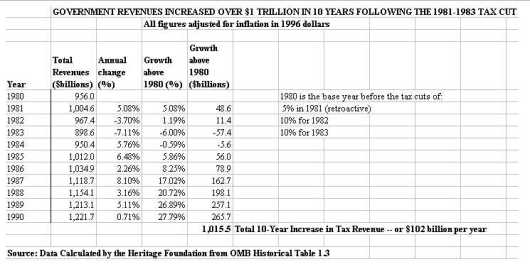
Dan Mitchell: Government vs. Poor People

I

Government vs. Poor People

My Fourteenth Theorem of Government explains that when government intervenes for the ostensible purpose of providing help to poor people in the short run,it is all but inevitable that such policies will hurt poor people in the long run.

It is hardly a revelation that bigger government causes problems, but it is particularly discouraging when such policies victimize the least fortunate members of society.

I’m discussing this issue today because I recently discovered a 2018 article by Brian Balfour.

Published by the Foundation for Economic Education, the article lists seven ways that government traps people in poverty.

At the risk of over-simplifying, four of those policies directly hurt poor people.

  1. The “quicksand effect” of the welfare state, which discourages self-advancement.
  2. Minimum wage laws that remove the bottom rungs of the economic ladder.
  3. Green energy policies that make basic utilities needlessly expensive.
  4. Protectionist trade policies that increase the price of essential products.

And three of those policies indirectly hurt poor people.

  1. Punitive tax policies that discourage job creation and productivity advances.
  2. Regulatory policies that impose high costs and cause inefficiency.
  3. Inflationary monetary policies by central banks that cause higher prices.

There’s nothing in the article that’s wrong, but I’m going to conclude today’s column by pointing out a big sin of omission.

The author’s list should have included the government education monopoly. Especially since poor families tend to live in the areas with the worst-performing government schools.

Failing government schools have a very direct and very negative impact on the life prospects of low-income kids.

So I’ll end by noting that I’m very excited that school choice is beginning to sweep the nation.

P.S. There are many other government policies that have a disproportionately negative impact on poor people. Everything from Social Security to revenuepolicing, but don’t forget government lotteries, licensing laws, and nanny state protections (all of which may help to explain why poor people are skeptical about the supposed benefits of bigger government).

The Adverse Economic Consequences of Busting Social Security’s Wage Base Cap

Today we are going to look at proposals to expandthe burden of Social Security payroll taxes, and let’s start by recycling this 2008 video.

All of the analysis in the video is still accurate, but two of the numbers need to be updated.

  • Social Security’s long-run deficit is now $56 trillion rather than $24.9 trillion as was the case back in 2008.
  • Social Security payroll taxes now apply to income up to $162K rather than $102K as was the case back in 2008.

If you don’t have time to watch a 9-minute video, I can summarize the issue by noting that Social Security was designed as an “earned benefit,” which means workers contribute to the system in exchange for future benefits. The more you earn, the more you pay, and the more benefits you receive.

But because Social Security is supposed to be akin to an insurance program, there’s a limit on both the amount of benefits any retiree can receive and the amount of taxes that any worker must pay (the same principle applies in many other nations).

Some politicians want to get rid of the limit (the “wage base cap”) on the amount of taxes workers must pay. Instead of applying the 12.4 percent Social Security payroll tax on the first $162,000 of income, they want to impose the tax on all income.

In some cases, they want this big increase in marginal tax rates in order to prop up the Social Security system while in other cases they actually want to expand the program.

In either case, the economic consequences would be very bad.

In today’s Wall Street Journal, Travis Nix explainswhy this would be counterproductive.

…lawmakers in both parties are mulling the idea of lifting the payroll tax cap. The resulting increase in revenue would do little more than delay the inevitable by extending the program’s life a few more years. …European countries cap payroll taxes at much lower incomes than the U.S. does. Germany caps payroll taxes for health insurance at about $62,000 and the Netherlands caps theirs for social security at $40,370.Uncapping the payroll tax in the U.S. would only widen the disparity and make America a less attractive country in which to work and invest. …Uncapping the payroll tax would raise the top tax rate on Americans’ labor income—income and employee payroll tax combined—to as high as 43.2%. This excludes state taxes and the employer payroll tax, which make the rate even higher. The U.S. hasn’t seen labor tax rates that high since before Ronald Reagan. …European countries that cap their payroll taxes at relatively low incomes understand that you can’t fund a social-safety net without providing an incentive to work. The U.S. should too.

Let’s also look at what Mark Warshawsky of the American Enterprise Institute wrote last year.

…imposing a massive tax increase — 12.4 percentage points — on the earnings of about 10 million highly productive, mostly middle-class workers earning more than $160,200 would have several notable consequences. It would reduce their support for the program,severely discourage their labor market participation, and encourage payroll tax avoidance through converting earnings to incentive stock options and other forms of employee stock ownership. …In many instances, these workers would have their wages taxed at federal, state and local levels at rates exceeding 70 percent. …almost 20 percent of current and future covered workers are projected to earn above the taxable maximum in any one year.

And here is some of Allison Schrager’s analysis from 2020.

When it comes to financing the future of Social Security, many Democrats have a simple and wrong solution: lift the cap on earnings subject to the payroll tax. …there are costs to these plans. A 12.4% marginal tax increase is significant.If the cap is eliminated, an individual who makes $250,000 a year would see their Social Security tax liability increase by 88%. …many households—especially those in states with high state taxes—will be paying more than 60% in federal, state, and local income and payroll taxes… only 6% of the population earns more than the cap. But income varies over people’s lives: 36% of Americans will be in the top 5% of earners at least one year of their career.

I’ll close by observing that it we’ve had big fights under Bush, Obama, Trump, and Biden about whether the top personal income tax rate should go up by about 3 percentage points or down by 3 percentage points.

Since keeping marginal tax rates low helps encourage productive behavior, those were important fights.

Now we face a fight that should be far more important since some politicians want to raise the marginal tax rate by 12.4 percentage points.

It is true that Social Security is in deep financial trouble, but propping up (or expanding) the current system would be bad news for the economy and it would produce a bleaker future for young people.

It would be far better to begin a transition to personal retirement accounts.

P.S. Chile and Australia have created personal retirement accounts. You can also learn about reforms in SwitzerlandHong KongNetherlands, the Faroe IslandsDenmarkIsrael, and Sweden.

I enjoyed this article below because it demonstrates that the Laffer Curve has been working for almost 100 years now when it is put to the test in the USA. I actually got to hear Arthur Laffer speak in person in 1981 and he told us in advance what was going to happen the 1980’s and it all came about as he said it would when Ronald Reagan’s tax cuts took place. I wish we would lower taxes now instead of looking for more revenue through raised taxes. We have to grow the economy:

What Mitt Romney Said Last Night About Tax Cuts And The Deficit Was Absolutely Right. And What Obama Said Was Absolutely Wrong.

Mitt Romney repeatedly said last night that he would not allow tax cuts to add to the deficit.  He repeatedly said it because over and over again Obama blathered the liberal talking point that cutting taxes necessarily increased deficits.

Romney’s exact words: “I want to underline that — no tax cut that adds to the deficit.”

Meanwhile, Obama has promised to cut the deficit in half during his first four years – but instead gave America the highest deficits in the history of the entire human race.

I’ve written about this before.  Let’s replay what has happened every single time we’ve ever cut the income tax rate.

The fact of the matter is that we can go back to Calvin Coolidge who said very nearly THE EXACT SAME THING to his treasury secretary: he too would not allow any tax cuts that added to the debt.  Andrew Mellon – quite possibly the most brilliant economic mind of his day – did a great deal of research and determined what he believed was the best tax rate.  And the Coolidge administration DID cut income taxes and MASSIVELY increased revenues.  Coolidge and Mellon cut the income tax rate 67.12 percent (from 73 to 24 percent); and revenues not only did not go down, but they went UP by at least 42.86 percent (from $700 billion to over $1 billion).

That’s something called a documented fact.  But that wasn’t all that happened: another incredible thing was that the taxes and percentage of taxes paid actually went UP for the rich.  Because as they were allowed to keep more of the profits that they earned by investing in successful business, they significantly increased their investments and therefore paid more in taxes than they otherwise would have had they continued sheltering their money to protect themselves from the higher tax rates.  Liberals ignore reality, but it is simply true.  It is a fact.  It happened.

Then FDR came along and raised the tax rates again and the opposite happened: we collected less and less revenue while the burden of taxation fell increasingly on the poor and middle class again.  Which is exactly what Obama wants to do.

People don’t realize that John F. Kennedy, one of the greatest Democrat presidents, was a TAX CUTTER who believed the conservative economic philosophy that cutting tax rates would in fact increase tax revenues.  He too cut taxes, and he too increased tax revenues.

So we get to Ronald Reagan, who famously cut taxes.  And again, we find that Reagan cut that godawful liberal tax rate during an incredibly godawful liberal-caused economic recession, and he increased tax revenue by 20.71 percent (with revenues increasing from $956 billion to $1.154 trillion).  And again, the taxes were paid primarily by the rich:

“The share of the income tax burden borne by the top 10 percent of taxpayers increased from 48.0 percent in 1981 to 57.2 percent in 1988. Meanwhile, the share of income taxes paid by the bottom 50 percent of taxpayers dropped from 7.5 percent in 1981 to 5.7 percent in 1988.”

So we get to George Bush and the Bush tax cuts that liberals and in particular Obama have just demonized up one side and demagogued down the other.  And I can simply quote the New York Times AT the time:

Sharp Rise in Tax Revenue to Pare U.S. Deficit By EDMUND L. ANDREWS Published: July 13, 2005

WASHINGTON, July 12 – For the first time since President Bush took office, an unexpected leap in tax revenue is about to shrink the federal budget deficit this year, by nearly $100 billion.

A Jump in Corporate Payments On Wednesday, White House officials plan to announce that the deficit for the 2005 fiscal year, which ends in September, will be far smaller than the $427 billion they estimated in February.

Mr. Bush plans to hail the improvement at a cabinet meeting and to cite it as validation of his argument that tax cuts would stimulate the economy and ultimately help pay for themselves.

Based on revenue and spending data through June, the budget deficit for the first nine months of the fiscal year was $251 billion, $76 billion lower than the $327 billion gap recorded at the corresponding point a year earlier.

The Congressional Budget Office estimated last week that the deficit for the full fiscal year, which reached $412 billion in 2004, could be “significantly less than $350 billion, perhaps below $325 billion.”

The big surprise has been in tax revenue, which is running nearly 15 percent higher than in 2004. Corporate tax revenue has soared about 40 percent, after languishing for four years, and individual tax revenue is up as well
.

And of course the New York Times, as reliable liberals, use the adjective whenever something good happens under conservative policies and whenever something bad happens under liberal policies: ”unexpected.”   But it WASN’T ”unexpected.”  It was EXACTLY what Republicans had said would happen and in fact it was exactly what HAD IN FACT HAPPENED every single time we’ve EVER cut income tax rates.

The truth is that conservative tax policy has a perfect track record: every single time it has ever been tried, we have INCREASED tax revenues while not only exploding economic activity and creating more jobs, but encouraging the wealthy to pay more in taxes as well.  And liberals simply dishonestly refuse to acknowledge documented history.

Meanwhile, liberals also have a perfect record … of FAILUREThey keep raising taxes and keep not understanding why they don’t get the revenues they predicted.

The following is a section from my article, “Tax Cuts INCREASE Revenues; They Have ALWAYS Increased Revenues“, where I document every single thing I said above:

The Falsehood That Tax Cuts Increase The Deficit

Now let’s take a look at the utterly fallacious view that tax cuts in general create higher deficits.

Let’s take a trip back in time, starting with the 1920s.  From Burton Folsom’s book, New Deal or Raw Deal?:

In 1921, President Harding asked the sixty-five-year-old [Andrew] Mellon to be secretary of the treasury; the national debt [resulting from WWI] had surpassed $20 billion and unemployment had reached 11.7 percent, one of the highest rates in U.S. history.  Harding invited Mellon to tinker with tax rates to encourage investment without incurring more debt. Mellon studied the problem carefully; his solution was what is today called “supply side economics,” the idea of cutting taxes to stimulate investment.  High income tax rates, Mellon argued, “inevitably put pressure upon the taxpayer to withdraw this capital from productive business and invest it in tax-exempt securities. . . . The result is that the sources of taxation are drying up, wealth is failing to carry its share of the tax burden; and capital is being diverted into channels which yield neither revenue to the Government nor profit to the people” (page 128).

Mellon wrote, “It seems difficult for some to understand that high rates of taxation do not necessarily mean large revenue to the Government, and that more revenue may often be obtained by lower taxes.”  And he compared the government setting tax rates on incomes to a businessman setting prices on products: “If a price is fixed too high, sales drop off and with them profits.”

And what happened?

“As secretary of the treasury, Mellon promoted, and Harding and Coolidge backed, a plan that eventually cut taxes on large incomes from 73 to 24 percent and on smaller incomes from 4 to 1/2 of 1 percent.  These tax cuts helped produce an outpouring of economic development – from air conditioning to refrigerators to zippers, Scotch tape to radios and talking movies.  Investors took more risks when they were allowed to keep more of their gains.  President Coolidge, during his six years in office, averaged only 3.3 percent unemployment and 1 percent inflation – the lowest misery index of any president in the twentieth century.

Furthermore, Mellon was also vindicated in his astonishing predictions that cutting taxes across the board would generate more revenue.  In the early 1920s, when the highest tax rate was 73 percent, the total income tax revenue to the U.S. government was a little over $700 million.  In 1928 and 1929, when the top tax rate was slashed to 25 and 24 percent, the total revenue topped the $1 billion mark.  Also remarkable, as Table 3 indicates, is that the burden of paying these taxes fell increasingly upon the wealthy” (page 129-130).

Now, that is incredible upon its face, but it becomes even more incredible when contrasted with FDR’s antibusiness and confiscatory tax policies, which both dramatically shrunk in terms of actual income tax revenues (from $1.096 billion in 1929 to $527 million in 1935), and dramatically shifted the tax burden to the backs of the poor by imposing huge new excise taxes (from $540 million in 1929 to $1.364 billion in 1935).  See Table 1 on page 125 of New Deal or Raw Deal for that information.

FDR both collected far less taxes from the rich, while imposing a far more onerous tax burden upon the poor.

It is simply a matter of empirical fact that tax cuts create increased revenue, and that those [Democrats] who have refused to pay attention to that fact have ended up reducing government revenues even as they increased the burdens on the poorest whom they falsely claim to help.

Let’s move on to John F. Kennedy, one of the most popular Democrat presidents ever.  Few realize that he was also a supply-side tax cutter.

Kennedy said:

“It is a paradoxical truth that tax rates are too high and tax revenues are too low and the soundest way to raise the revenues in the long run is to cut the rates now … Cutting taxes now is not to incur a budget deficit, but to achieve the more prosperous, expanding economy which can bring a budget surplus.”

– John F. Kennedy, Nov. 20, 1962, president’s news conference


“Lower rates of taxation will stimulate economic activity and so raise the levels of personal and corporate income as to yield within a few years an increased – not a reduced – flow of revenues to the federal government.”

– John F. Kennedy, Jan. 17, 1963, annual budget message to the Congress, fiscal year 1964

“In today’s economy, fiscal prudence and responsibility call for tax reduction even if it temporarily enlarges the federal deficit – why reducing taxes is the best way open to us to increase revenues.”

– John F. Kennedy, Jan. 21, 1963, annual message to the Congress: “The Economic Report Of The President”


“It is no contradiction – the most important single thing we can do to stimulate investment in today’s economy is to raise consumption by major reduction of individual income tax rates.”

– John F. Kennedy, Jan. 21, 1963, annual message to the Congress: “The Economic Report Of The President”


“Our tax system still siphons out of the private economy too large a share of personal and business purchasing power and reduces the incentive for risk, investment and effort – thereby aborting our recoveries and stifling our national growth rate.”

– John F. Kennedy, Jan. 24, 1963, message to Congress on tax reduction and reform, House Doc. 43, 88th Congress, 1st Session.


“A tax cut means higher family income and higher business profits and a balanced federal budget. Every taxpayer and his family will have more money left over after taxes for a new car, a new home, new conveniences, education and investment. Every businessman can keep a higher percentage of his profits in his cash register or put it to work expanding or improving his business, and as the national income grows, the federal government will ultimately end up with more revenues.”

– John F. Kennedy, Sept. 18, 1963, radio and television address to the nation on tax-reduction bill

Which is to say that modern Democrats are essentially calling one of their greatest presidents a liar when they demonize tax cuts as a means of increasing government revenues.

So let’s move on to Ronald Reagan.  Reagan had two major tax cutting policies implemented: the Economic Recovery Tax Act (ERTA) of 1981, which was retroactive to 1981, and the Tax Reform Act of 1986.

Did Reagan’s tax cuts decrease federal revenues?  Hardly:

We find that 8 of the following 10 years there was a surplus of revenue from 1980, prior to the Reagan tax cuts.  And, following the Tax Reform Act of 1986, there was a MASSIVE INCREASEof revenue.

So Reagan’s tax cuts increased revenue.  But who paid the increased tax revenue?  The poor?  Opponents of the Reagan tax cuts argued that his policy was a giveaway to the rich (ever heard that one before?) because their tax payments would fall.  But that was exactly wrong.  In reality:

“The share of the income tax burden borne by the top 10 percent of taxpayers increased from 48.0 percent in 1981 to 57.2 percent in 1988. Meanwhile, the share of income taxes paid by the bottom 50 percent of taxpayers dropped from 7.5 percent in 1981 to 5.7 percent in 1988.”

So Ronald Reagan a) collected more total revenue, b) collected more revenue from the rich, while c) reducing revenue collected by the bottom half of taxpayers, and d) generated an economic powerhouse that lasted – with only minor hiccups – for nearly three decades.  Pretty good achievement considering that his predecessor was forced to describe his own economy as a “malaise,” suffering due to a “crisis of confidence.” Pretty good considering that President Jimmy Carter responded to a reporter’s question as to what he would do about the problem of inflation by answering, “It would be misleading for me to tell any of you that there is a solution to it.”

Reagan whipped inflation.  Just as he whipped that malaise and that crisis of confidence.

________

The Laffer Curve, Part III: Dynamic Scoring
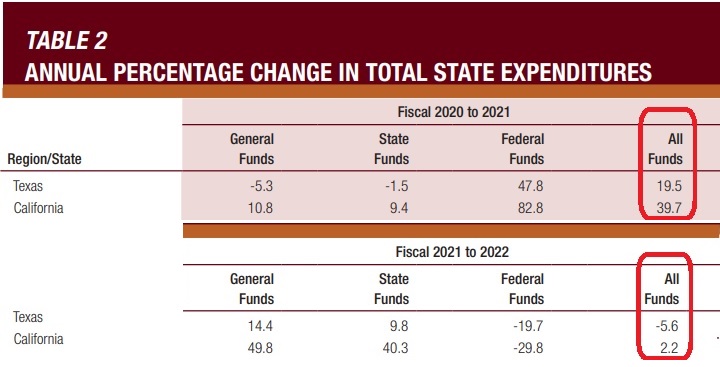
Dan Mitchell: The Case Against Biden’s Class-Warfare Tax Policy, Part V

I

The Case Against Biden’s Class-Warfare Tax Policy, Part V

In 2020 and 2021, I wrote a four-part series (here, here, here, and here) about Biden’s class-warfare tax agenda.

And I also wrote a series of columns about some of his worst ideas.

He even proposed taxes that don’t exist anywhere else in the world.

The main purpose of those columns was to explain why it would be economically harmful to impose punitive tax rates on productive behaviors such as work, saving, investment, and entrepreneurship.

Unsurprisingly, Biden still wants all these tax increases, even though Democrats lost control of the House of Representatives.

Today, let’s look at his awful proposal to tax unrealized capital gains (an idea so absurd that no other nation has enacted this destructive levy).

Eric Boehm’s article in Reason debunks Biden’s proposal (the president calls it a billionaire’s tax).

Say what you will about the Biden administration’s approach to tax-the-rich populism: It’s creative. …Taxpayers with net wealth above $100 million would have to pay a minimum effective tax rate of 20 percent on an expanded measure of income that adds unrealized capital gains to more conventional sources of income, like wages, business income, and investment income. …By raising the effective tax rate on capital gains, the proposal would reduce U.S. saving, discourage entrepreneurship, and decrease economic output. …An annual tax on paper gains would be conspicuously complex. The largest administrative problems relate to valuing non-tradable assets like privately held businesses and taxing illiquid taxpayers with large gains on paper but little cash on hand to pay a minimum tax bill. …Given these problems, it’s unsurprising the idea hasn’t caught on around the world.

And the Wall Street Journal has an editorial about this class-warfare scheme.

After the November midterm election, President Biden was asked what he would change in his last two years. “Nothing,” he said, and…he proved it by reproposing…enormous tax increases that he couldn’t get through even a Democratic Congress. Start with a reprise of his “billionaire minimum tax.” …For starters, it isn’t a billionaire tax and it isn’t an income tax. It would apply to households worth more than $100 million in accumulated assets, and its target is wealth. …if your assets rise in value during a year, you will pay taxes on that increase even if you realized no actual gains through a sale. …If your assets fell in value, you would not be able to deduct the full loss from your overall income. Heads the government wins, tails you lose.

The bottom line is that the capital gains tax is an awful levy.

But rather than abolishing the tax to boost American competitiveness, Biden has latched on to an idea to make a bad tax even worse.

And that’s in addition to his other proposals to make the capital gains tax more burdensome!

P.S. I guess we shouldn’t be surprised at bad ideas since the president is infamous for economically illiterate tax tweets.

The Adverse Economic Consequences of Busting Social Security’s Wage Base Cap

Today we are going to look at proposals to expandthe burden of Social Security payroll taxes, and let’s start by recycling this 2008 video.

All of the analysis in the video is still accurate, but two of the numbers need to be updated.

  • Social Security’s long-run deficit is now $56 trillion rather than $24.9 trillion as was the case back in 2008.
  • Social Security payroll taxes now apply to income up to $162K rather than $102K as was the case back in 2008.

If you don’t have time to watch a 9-minute video, I can summarize the issue by noting that Social Security was designed as an “earned benefit,” which means workers contribute to the system in exchange for future benefits. The more you earn, the more you pay, and the more benefits you receive.

But because Social Security is supposed to be akin to an insurance program, there’s a limit on both the amount of benefits any retiree can receive and the amount of taxes that any worker must pay (the same principle applies in many other nations).

Some politicians want to get rid of the limit (the “wage base cap”) on the amount of taxes workers must pay. Instead of applying the 12.4 percent Social Security payroll tax on the first $162,000 of income, they want to impose the tax on all income.

In some cases, they want this big increase in marginal tax rates in order to prop up the Social Security system while in other cases they actually want to expand the program.

In either case, the economic consequences would be very bad.

In today’s Wall Street Journal, Travis Nix explainswhy this would be counterproductive.

…lawmakers in both parties are mulling the idea of lifting the payroll tax cap. The resulting increase in revenue would do little more than delay the inevitable by extending the program’s life a few more years. …European countries cap payroll taxes at much lower incomes than the U.S. does. Germany caps payroll taxes for health insurance at about $62,000 and the Netherlands caps theirs for social security at $40,370.Uncapping the payroll tax in the U.S. would only widen the disparity and make America a less attractive country in which to work and invest. …Uncapping the payroll tax would raise the top tax rate on Americans’ labor income—income and employee payroll tax combined—to as high as 43.2%. This excludes state taxes and the employer payroll tax, which make the rate even higher. The U.S. hasn’t seen labor tax rates that high since before Ronald Reagan. …European countries that cap their payroll taxes at relatively low incomes understand that you can’t fund a social-safety net without providing an incentive to work. The U.S. should too.

Let’s also look at what Mark Warshawsky of the American Enterprise Institute wrote last year.

…imposing a massive tax increase — 12.4 percentage points — on the earnings of about 10 million highly productive, mostly middle-class workers earning more than $160,200 would have several notable consequences. It would reduce their support for the program,severely discourage their labor market participation, and encourage payroll tax avoidance through converting earnings to incentive stock options and other forms of employee stock ownership. …In many instances, these workers would have their wages taxed at federal, state and local levels at rates exceeding 70 percent. …almost 20 percent of current and future covered workers are projected to earn above the taxable maximum in any one year.

And here is some of Allison Schrager’s analysis from 2020.

When it comes to financing the future of Social Security, many Democrats have a simple and wrong solution: lift the cap on earnings subject to the payroll tax. …there are costs to these plans. A 12.4% marginal tax increase is significant.If the cap is eliminated, an individual who makes $250,000 a year would see their Social Security tax liability increase by 88%. …many households—especially those in states with high state taxes—will be paying more than 60% in federal, state, and local income and payroll taxes… only 6% of the population earns more than the cap. But income varies over people’s lives: 36% of Americans will be in the top 5% of earners at least one year of their career.

I’ll close by observing that it we’ve had big fights under Bush, Obama, Trump, and Biden about whether the top personal income tax rate should go up by about 3 percentage points or down by 3 percentage points.

Since keeping marginal tax rates low helps encourage productive behavior, those were important fights.

Now we face a fight that should be far more important since some politicians want to raise the marginal tax rate by 12.4 percentage points.

It is true that Social Security is in deep financial trouble, but propping up (or expanding) the current system would be bad news for the economy and it would produce a bleaker future for young people.

It would be far better to begin a transition to personal retirement accounts.

P.S. Chile and Australia have created personal retirement accounts. You can also learn about reforms in SwitzerlandHong KongNetherlands, the Faroe IslandsDenmarkIsrael, and Sweden.

I enjoyed this article below because it demonstrates that the Laffer Curve has been working for almost 100 years now when it is put to the test in the USA. I actually got to hear Arthur Laffer speak in person in 1981 and he told us in advance what was going to happen the 1980’s and it all came about as he said it would when Ronald Reagan’s tax cuts took place. I wish we would lower taxes now instead of looking for more revenue through raised taxes. We have to grow the economy:

What Mitt Romney Said Last Night About Tax Cuts And The Deficit Was Absolutely Right. And What Obama Said Was Absolutely Wrong.

Mitt Romney repeatedly said last night that he would not allow tax cuts to add to the deficit.  He repeatedly said it because over and over again Obama blathered the liberal talking point that cutting taxes necessarily increased deficits.

Romney’s exact words: “I want to underline that — no tax cut that adds to the deficit.”

Meanwhile, Obama has promised to cut the deficit in half during his first four years – but instead gave America the highest deficits in the history of the entire human race.

I’ve written about this before.  Let’s replay what has happened every single time we’ve ever cut the income tax rate.

The fact of the matter is that we can go back to Calvin Coolidge who said very nearly THE EXACT SAME THING to his treasury secretary: he too would not allow any tax cuts that added to the debt.  Andrew Mellon – quite possibly the most brilliant economic mind of his day – did a great deal of research and determined what he believed was the best tax rate.  And the Coolidge administration DID cut income taxes and MASSIVELY increased revenues.  Coolidge and Mellon cut the income tax rate 67.12 percent (from 73 to 24 percent); and revenues not only did not go down, but they went UP by at least 42.86 percent (from $700 billion to over $1 billion).

That’s something called a documented fact.  But that wasn’t all that happened: another incredible thing was that the taxes and percentage of taxes paid actually went UP for the rich.  Because as they were allowed to keep more of the profits that they earned by investing in successful business, they significantly increased their investments and therefore paid more in taxes than they otherwise would have had they continued sheltering their money to protect themselves from the higher tax rates.  Liberals ignore reality, but it is simply true.  It is a fact.  It happened.

Then FDR came along and raised the tax rates again and the opposite happened: we collected less and less revenue while the burden of taxation fell increasingly on the poor and middle class again.  Which is exactly what Obama wants to do.

People don’t realize that John F. Kennedy, one of the greatest Democrat presidents, was a TAX CUTTER who believed the conservative economic philosophy that cutting tax rates would in fact increase tax revenues.  He too cut taxes, and he too increased tax revenues.

So we get to Ronald Reagan, who famously cut taxes.  And again, we find that Reagan cut that godawful liberal tax rate during an incredibly godawful liberal-caused economic recession, and he increased tax revenue by 20.71 percent (with revenues increasing from $956 billion to $1.154 trillion).  And again, the taxes were paid primarily by the rich:

“The share of the income tax burden borne by the top 10 percent of taxpayers increased from 48.0 percent in 1981 to 57.2 percent in 1988. Meanwhile, the share of income taxes paid by the bottom 50 percent of taxpayers dropped from 7.5 percent in 1981 to 5.7 percent in 1988.”

So we get to George Bush and the Bush tax cuts that liberals and in particular Obama have just demonized up one side and demagogued down the other.  And I can simply quote the New York Times AT the time:

Sharp Rise in Tax Revenue to Pare U.S. Deficit By EDMUND L. ANDREWS Published: July 13, 2005

WASHINGTON, July 12 – For the first time since President Bush took office, an unexpected leap in tax revenue is about to shrink the federal budget deficit this year, by nearly $100 billion.

A Jump in Corporate Payments On Wednesday, White House officials plan to announce that the deficit for the 2005 fiscal year, which ends in September, will be far smaller than the $427 billion they estimated in February.

Mr. Bush plans to hail the improvement at a cabinet meeting and to cite it as validation of his argument that tax cuts would stimulate the economy and ultimately help pay for themselves.

Based on revenue and spending data through June, the budget deficit for the first nine months of the fiscal year was $251 billion, $76 billion lower than the $327 billion gap recorded at the corresponding point a year earlier.

The Congressional Budget Office estimated last week that the deficit for the full fiscal year, which reached $412 billion in 2004, could be “significantly less than $350 billion, perhaps below $325 billion.”

The big surprise has been in tax revenue, which is running nearly 15 percent higher than in 2004. Corporate tax revenue has soared about 40 percent, after languishing for four years, and individual tax revenue is up as well
.

And of course the New York Times, as reliable liberals, use the adjective whenever something good happens under conservative policies and whenever something bad happens under liberal policies: ”unexpected.”   But it WASN’T ”unexpected.”  It was EXACTLY what Republicans had said would happen and in fact it was exactly what HAD IN FACT HAPPENED every single time we’ve EVER cut income tax rates.

The truth is that conservative tax policy has a perfect track record: every single time it has ever been tried, we have INCREASED tax revenues while not only exploding economic activity and creating more jobs, but encouraging the wealthy to pay more in taxes as well.  And liberals simply dishonestly refuse to acknowledge documented history.

Meanwhile, liberals also have a perfect record … of FAILUREThey keep raising taxes and keep not understanding why they don’t get the revenues they predicted.

The following is a section from my article, “Tax Cuts INCREASE Revenues; They Have ALWAYS Increased Revenues“, where I document every single thing I said above:

The Falsehood That Tax Cuts Increase The Deficit

Now let’s take a look at the utterly fallacious view that tax cuts in general create higher deficits.

Let’s take a trip back in time, starting with the 1920s.  From Burton Folsom’s book, New Deal or Raw Deal?:

In 1921, President Harding asked the sixty-five-year-old [Andrew] Mellon to be secretary of the treasury; the national debt [resulting from WWI] had surpassed $20 billion and unemployment had reached 11.7 percent, one of the highest rates in U.S. history.  Harding invited Mellon to tinker with tax rates to encourage investment without incurring more debt. Mellon studied the problem carefully; his solution was what is today called “supply side economics,” the idea of cutting taxes to stimulate investment.  High income tax rates, Mellon argued, “inevitably put pressure upon the taxpayer to withdraw this capital from productive business and invest it in tax-exempt securities. . . . The result is that the sources of taxation are drying up, wealth is failing to carry its share of the tax burden; and capital is being diverted into channels which yield neither revenue to the Government nor profit to the people” (page 128).

Mellon wrote, “It seems difficult for some to understand that high rates of taxation do not necessarily mean large revenue to the Government, and that more revenue may often be obtained by lower taxes.”  And he compared the government setting tax rates on incomes to a businessman setting prices on products: “If a price is fixed too high, sales drop off and with them profits.”

And what happened?

“As secretary of the treasury, Mellon promoted, and Harding and Coolidge backed, a plan that eventually cut taxes on large incomes from 73 to 24 percent and on smaller incomes from 4 to 1/2 of 1 percent.  These tax cuts helped produce an outpouring of economic development – from air conditioning to refrigerators to zippers, Scotch tape to radios and talking movies.  Investors took more risks when they were allowed to keep more of their gains.  President Coolidge, during his six years in office, averaged only 3.3 percent unemployment and 1 percent inflation – the lowest misery index of any president in the twentieth century.

Furthermore, Mellon was also vindicated in his astonishing predictions that cutting taxes across the board would generate more revenue.  In the early 1920s, when the highest tax rate was 73 percent, the total income tax revenue to the U.S. government was a little over $700 million.  In 1928 and 1929, when the top tax rate was slashed to 25 and 24 percent, the total revenue topped the $1 billion mark.  Also remarkable, as Table 3 indicates, is that the burden of paying these taxes fell increasingly upon the wealthy” (page 129-130).

Now, that is incredible upon its face, but it becomes even more incredible when contrasted with FDR’s antibusiness and confiscatory tax policies, which both dramatically shrunk in terms of actual income tax revenues (from $1.096 billion in 1929 to $527 million in 1935), and dramatically shifted the tax burden to the backs of the poor by imposing huge new excise taxes (from $540 million in 1929 to $1.364 billion in 1935).  See Table 1 on page 125 of New Deal or Raw Deal for that information.

FDR both collected far less taxes from the rich, while imposing a far more onerous tax burden upon the poor.

It is simply a matter of empirical fact that tax cuts create increased revenue, and that those [Democrats] who have refused to pay attention to that fact have ended up reducing government revenues even as they increased the burdens on the poorest whom they falsely claim to help.

Let’s move on to John F. Kennedy, one of the most popular Democrat presidents ever.  Few realize that he was also a supply-side tax cutter.

Kennedy said:

“It is a paradoxical truth that tax rates are too high and tax revenues are too low and the soundest way to raise the revenues in the long run is to cut the rates now … Cutting taxes now is not to incur a budget deficit, but to achieve the more prosperous, expanding economy which can bring a budget surplus.”

– John F. Kennedy, Nov. 20, 1962, president’s news conference


“Lower rates of taxation will stimulate economic activity and so raise the levels of personal and corporate income as to yield within a few years an increased – not a reduced – flow of revenues to the federal government.”

– John F. Kennedy, Jan. 17, 1963, annual budget message to the Congress, fiscal year 1964

“In today’s economy, fiscal prudence and responsibility call for tax reduction even if it temporarily enlarges the federal deficit – why reducing taxes is the best way open to us to increase revenues.”

– John F. Kennedy, Jan. 21, 1963, annual message to the Congress: “The Economic Report Of The President”


“It is no contradiction – the most important single thing we can do to stimulate investment in today’s economy is to raise consumption by major reduction of individual income tax rates.”

– John F. Kennedy, Jan. 21, 1963, annual message to the Congress: “The Economic Report Of The President”


“Our tax system still siphons out of the private economy too large a share of personal and business purchasing power and reduces the incentive for risk, investment and effort – thereby aborting our recoveries and stifling our national growth rate.”

– John F. Kennedy, Jan. 24, 1963, message to Congress on tax reduction and reform, House Doc. 43, 88th Congress, 1st Session.


“A tax cut means higher family income and higher business profits and a balanced federal budget. Every taxpayer and his family will have more money left over after taxes for a new car, a new home, new conveniences, education and investment. Every businessman can keep a higher percentage of his profits in his cash register or put it to work expanding or improving his business, and as the national income grows, the federal government will ultimately end up with more revenues.”

– John F. Kennedy, Sept. 18, 1963, radio and television address to the nation on tax-reduction bill

Which is to say that modern Democrats are essentially calling one of their greatest presidents a liar when they demonize tax cuts as a means of increasing government revenues.

So let’s move on to Ronald Reagan.  Reagan had two major tax cutting policies implemented: the Economic Recovery Tax Act (ERTA) of 1981, which was retroactive to 1981, and the Tax Reform Act of 1986.

Did Reagan’s tax cuts decrease federal revenues?  Hardly:

We find that 8 of the following 10 years there was a surplus of revenue from 1980, prior to the Reagan tax cuts.  And, following the Tax Reform Act of 1986, there was a MASSIVE INCREASEof revenue.

So Reagan’s tax cuts increased revenue.  But who paid the increased tax revenue?  The poor?  Opponents of the Reagan tax cuts argued that his policy was a giveaway to the rich (ever heard that one before?) because their tax payments would fall.  But that was exactly wrong.  In reality:

“The share of the income tax burden borne by the top 10 percent of taxpayers increased from 48.0 percent in 1981 to 57.2 percent in 1988. Meanwhile, the share of income taxes paid by the bottom 50 percent of taxpayers dropped from 7.5 percent in 1981 to 5.7 percent in 1988.”

So Ronald Reagan a) collected more total revenue, b) collected more revenue from the rich, while c) reducing revenue collected by the bottom half of taxpayers, and d) generated an economic powerhouse that lasted – with only minor hiccups – for nearly three decades.  Pretty good achievement considering that his predecessor was forced to describe his own economy as a “malaise,” suffering due to a “crisis of confidence.” Pretty good considering that President Jimmy Carter responded to a reporter’s question as to what he would do about the problem of inflation by answering, “It would be misleading for me to tell any of you that there is a solution to it.”

Reagan whipped inflation.  Just as he whipped that malaise and that crisis of confidence.

________

The Laffer Curve, Part III: Dynamic Scoring
US Debt by President: By Dollar and Percentage

——

Milton Friedman – Deficits and Government Spending

————-

A.F. Branco for Oct 21, 2021

US Debt by President: By Dollar and Percentage

Who increased the U.S. debt the most? That depends on how you measure it.

US President Barack Obama (L) former President Bill Clinton (C) and former President George W. Bush (R) walk to the Rose Garden
PHOTO:MARK WILSON/STAFF/GETTY IMAGES

What’s the best way to determine how much each president has contributed to our nation’s $31 trillion in U.S. debt? The most popular ways to measure involve comparing the debt level from when a president enters office to the debt level when they leave. It’s also good to compare the debt as a percentage of economic output, which takes into account the size of the economy at the time the administration accumulated the debt.1

Drawback of Measuring Debt by President

Neither of the techniques mentioned above is a very accurate way to measure each president’s impact on the national debtbecause the president doesn’t have much control over the national debt during their first year in office.

For example, President Donald Trump took office in January 2017. He submitted his first budget in May. It covered the 2018 fiscal year, which didn’t begin until October 1, 2017. Trump operated the first part of his term under President Barack Obama’s budget for fiscal year 2017, which ended on Sept. 30, 2017.2

fusing, Congress intentionally sets it up this way. An advantage of the federal fiscal year is that it gives the new president time to put together their budget during their first months in office.

The Best Way to Measure Debt by President

The best way to measure a president’s debt is to add up their budget deficits and compare that total to the debt level when they took office. A president’s budget reveals their administration’s priorities.

Note

Though they sound similar, deficit and debt are two different things. A deficit is a budget shortfall, whereas debt is the running total of all deficits and surpluses. Deficits add to the debt, while surpluses reduce it.

Top 5 Presidents Who Contributed to the Debt by Percentage

Franklin D. Roosevelt (1933-1945)

President Roosevelt added the largest percentage increase to the national debt. Although he only added $236 billion, this was an increase of about 1,048% from the $22.5 billion debt level left by President Herbert Hoover before him. The Great Depression and the New Deal contributed to FDR’s yearly deficits, but the biggest cost was World War II—it added $186.3 billion to the debt between 1942 and 1945.3

Woodrow Wilson (1913-1921)

President Wilson was the second-largest contributor to the debt, percentage-wise. He added about $21 billion, which was a 723% increase over the $2.9 billion debt of his predecessor. World War I contributed to the deficits that raised the national debt.3

Ronald Reagan (1981-1989)

President Reagan increased the debt by $1.86 trillion, or by 186%. Reagan’s supply-side economics didn’t grow the economy enough to offset the lost revenue from its tax cuts. Reagan also increased the defense budget by 35%.4

George W. Bush (2001-2009)

President Bush added $5.85 trillion to the national debt. That’s a 101% increase, putting him in fourth. Bush launched the War on Terror in response to the 9/11 attacks, which led to multi-trillion-dollar spending on the War in Afghanistan and the War in Iraq. Bush also dealt with the 2001 recession and the 2008 financial crisis.5

Barack Obama (2009-2017)

Under President Obama, the national debt grew the most in dollar terms ($8.6 trillion) and was fifth by percentage at 74%. Obama fought the Great Recession with an $831 billion economic stimulus package and added $858 billion through tax cuts. Even though the fiscal year 2009 budget was set by President Bush, Obama added to it with the Economic Stimulus Act in 2009.657

US Debt Increase by President Per Fiscal Year

The U.S. Treasury Department has historical tables that report the annual U.S. debt for each fiscal year (FY) since 1790. We’ve compiled this data from that source to create the figures used below.81

Joe Biden

In January 2023, the nation hit the $31.4 trillion debt limit Congress passed in 2021.9Republican lawmakers control the House of Representatives and said they won’t raise the debt limit unless Democrats, who control the Senate, agree to budget cuts.

On Oct. 1, 2021, at the end of fiscal year 2021, the national debt was $28.4 trillion. Between the end of fiscal year 2020 and the end of fiscal year 2021, the national debt grew $1.5 trillion, a 5.6% increase year over year. For fiscal year 2022, President Joe Biden’s budget included a deficit of $1.84 trillion, and by August 2022, the national debt had grown to $30.8 trillion.110

When Biden took office, the economy and household finances were still reeling from the pandemic, and Biden continued his predecessor’s policy of spending heavily to keep households afloat. In March 2021, Biden signed the American Rescue Plan, which showered taxpayers with pandemic relief cash in the form of stimulus checks and extra unemployment payments, and temporarily expanded child tax credits, plus other help. It all came with a cost to future budgets: The bill would add $1.9 trillion to the national debt by 2031, the Congressional Budget Office estimated.11

The bipartisan infrastructure bill, signed by Biden in November 2021, which provided new funding for highways, railways, broadband Internet expansion and other projects, added to the debt too, with estimates on its 10-year impact ranging from $374 billion to $400 billion, depending on how it’s calculated.1213

Some of Biden’s actions cut the other way. In August 2022, Biden signed the Inflation Reduction Act, an anti-climate change bill that spent money on new green energy programs and tax credits as well as to make drugs cheaper for patients, and paid for it by raising taxes on corporations and the ultra-wealthy. The bill should reduce the national debt by $102 billion by 2031, the CBO estimated.14

Biden followed up this bill with an executive action that forgave up to $10,000 of federal student loan debt per borrower, and $20,000 for those who received Pell Grants. He also proposed a new, cheaper income-driven student loan repayment program for future borrowers. However, he also announced that student loan interest and required payments, both of which had been frozen since the pandemic hit, would resume in January 2023.15

In August 2022, the government did not have an official estimate for how these measures would impact the national debt. One piece of it—forgiving $10,000 of debt per student loan borrower—would cost $329.7 billion over 10 years, according to an estimate by the Wharton School of Business.16

Donald Trump

At the end of fiscal year 2020, the debt was $26.9 trillion. Trump added $6.7 trillion to the debt between fiscal year 2017 and fiscal year 2020, a 33.1% increase, largely due to the effects of the coronavirus pandemic and 2020 recession.

In his FY 2021 budget, Trump’s budget included a $966 billion deficit.17 However, the national debt actually grew by $1.5 trillion between October 1, 2020, and October 1, 2021.

  • FY 2021: $1.5 trillion
  • FY 2020: $4.2 trillion
  • FY 2019: $1.2 trillion
  • FY 2018: $1.3 trillion

Barack Obama

President Obama added about $8.6 trillion, about a 74% increase, to the national debt at the end of President Bush’s last budget in 2009.

  • FY 2017: $671 billion
  • FY 2016: $1.42 trillion
  • FY 2015: $326 billion
  • FY 2014: $1.09 trillion
  • FY 2013: $672 billion
  • FY 2012: $1.28 trillion
  • FY 2011: $1.23 trillion
  • FY 2010: $1.65 trillion
  • FY 2009: $253 billion (Congress passed the Economic Stimulus Act, which spent $253 billion)18

George W. Bush

President Bush added $5.85 trillion to the national debt, a 101% increase from the $5.8 trillion debt at the end of Clinton’s last budget for fiscal year 2001.

  • FY 2009: $1.63 trillion (this was Bush’s deficit without the impact of the Economic Stimulus Act)
  • FY 2008: $1.02 trillion
  • FY 2007: $501 billion
  • FY 2006: $574 billion
  • FY 2005: $553 billion
  • FY 2004: $596 billion
  • FY 2003: $555 billion
  • FY 2002: $421 billion

Bill Clinton

President Clinton increased the national debt by almost $1.4 trillion, almost a 32% increase from the $4.4 trillion debt at the end of President H.W. Bush’s last budget.54

  • FY 2001: $133 billion
  • FY 2000: $18 billion
  • FY 1999: $130 billion
  • FY 1998: $113 billion
  • FY 1997: $189 billion
  • FY 1996: $251 billion
  • FY 1995: $281 billion
  • FY 1994: $281 billion

George H.W. Bush

President H.W. Bush added $1.55 trillion to the debt, a 54% increase from the $2.857 trillion debt at the end of Reagan’s last budget.4

  • FY 1993: $347 billion
  • FY 1992: $399 billion
  • FY 1991: $432 billion
  • FY 1990: $376 billion

Ronald Reagan

President Regan added $1.86 trillion to the national debt, a 186% increase from the $997.8 billion debt at the end of Carter’s last budget.4

  • FY 1989: $255 billion
  • FY 1988: $252 billion
  • FY 1987: $225 billion
  • FY 1986: $302 billion
  • FY 1985: $251 billion
  • FY 1984: $195 billion
  • FY 1983: $235 billion
  • FY 1982: $145 billion

Jimmy Carter

President Carter added $299 billion to the debt, a 42.7% increase from the $698.8 billion debt at the end of Ford’s last budget.4

  • FY 1981: $90.1 billion
  • FY 1980: $81.1 billion
  • FY 1979: $54.9 billion
  • FY 1978: $72.7 billion

Gerald Ford

President Ford added $223.7 billion to the debt.4

  • FY 1977: $78.4 billion
  • FY 1976: $87.2 billion
  • FY 1975: $58.1 billion

Richard Nixon

President Nixon added $121.1 billion to the national debt, a 34% increase from the $353.7 billion debt at the end of President Johnson’s last budget.4

  • FY 1974: $16.9 billion
  • FY 1973: $30.8 billion
  • FY 1972: $29.1 billion
  • FY 1971: $27.2 billion
  • FY 1970: $17.1 billion

Lyndon B. Johnson

President Johnson added $41.8 billion to the national debt, just a small 13% increase from the $312 billion debt at the end of President Kennedy’s time in office in 1964.4

  • FY 1969: $6.1 billion
  • FY 1968: $21.3 billion
  • FY 1967: $6.3 billion
  • FY 1966: $2.6 billion
  • FY 1965: $5.5 billion

John F. Kennedy

President Kennedy added $22.6 billion to the national debt.4

  • FY 1964: $5.8 billion
  • FY 1963: $7.6 billion
  • FY 1962: $9.2 billion

Dwight Eisenhower

President Eisenhower added $22.8 billion to the national debt.4

  • FY 1961: $2.6 billion
  • FY 1960: $1.6 billion
  • FY 1959: $8.3 billion
  • FY 1958: $5.8 billion
  • FY 1957: $2.2 billion surplus
  • FY 1956: $1.6 billion surplus
  • FY 1955: $3.1 billion
  • FY 1954: $5.1 billion

Harry Truman

President Truman added $7.3 billion to the national debt.43

  • FY 1953: $6.9 billion
  • FY 1952: $3.8 billion
  • FY 1951: $2.1 billion surplus
  • FY 1950: $4.5 billion
  • FY 1949: $478 million surplus
  • FY 1948: $6 billion surplus
  • FY 1947: $11 billion surplus
  • FY 1946: $10.7 billion

Franklin D. Roosevelt

President Roosevelt increased the national debt by $236 billion, a 1,048% increase from the $22.5 billion debt at the end of Hoover’s last budget.3

  • FY 1945: $57.7 billion
  • FY 1944: $64.3 billion
  • FY 1943: $64.2 billion
  • FY 1942: $23.5 billion
  • FY 1941: $6 billion
  • FY 1940: $2.5 billion
  • FY 1939: $3.2 billion
  • FY 1938: $740 million
  • FY 1937: $2.6 billion
  • FY 1936: $5 billion
  • FY 1935: $1.6 billion
  • FY 1934: $4.5 billion

Herbert Hoover

President Hoover added about $5.7 billion to the national debt.3

  • FY 1933: $3 billion
  • FY 1932: $2.8 billion
  • FY 1931: $616 million
  • FY 1930: $746 million surplus

Calvin Coolidge

President Coolidge reduced the national debt by about $5.3 billion.3

  • FY 1929: $673 million surplus
  • FY 1928: $907 million surplus
  • FY 1927: $1.1 billion surplus
  • FY 1926: $873 million surplus
  • FY 1925: $734.6 million surplus
  • FY 1924: $1 billion surplus

Warren G. Harding

President Harding reduced the national debt by about $1.6 billion thanks to budget surpluses.3

  • FY 1923: $614 million surplus
  • FY 1922: $1 billion surplus

Woodrow Wilson

President Wilson added about $21 billion to the national debt, a 723% increase from the $2.9 billion debt at the end of Taft’s last budget for fiscal year 1913.3

  • FY 1921: $1.9 billion surplus
  • FY 1920: $1.4 billion surplus
  • FY 1919: $12.8 billion
  • FY 1918: $9.8 billion
  • FY 1917: $2.1 billion
  • FY 1916: $551 million
  • FY 1915: $146 million
  • FY 1914: $0 (slight surplus)

Note

All presidents from 1790 to 1913 added a total of $2.8 billion to the national debt.8

Frequently Asked Questions (FAQ)

Which president has put the United States the most in debt?

President Joe Biden is on track to add the most to the budget deficit, largely due to the costs associated with continuing to battle the coronavirus pandemic. In late 2021, Congress voted to raise the debt ceiling.

Why does the United States owe so much debt?

Continued decreases in the amount of taxes paid by corporations and the wealthiest Americans have resulted in less money coming in. At the same time, spending on pandemic relief and the military continues to increase.

March 31, 2021

President Biden  c/o The White House
1600 Pennsylvania Avenue NW
Washington, DC 20500

Dear Mr. President,

Please explain to me if you ever do plan to balance the budget while you are President? I have written these things below about you and I really do think that you don’t want to cut spending in order to balance the budget. It seems you ever are daring the Congress to stop you from spending more.

President Barack Obama speaks about the debt limit in the East Room of the White House in Washington. | AP Photo

“The credit of the United States ‘is not a bargaining chip,’ Obama said on 1-14-13. However, President Obama keeps getting our country’s credit rating downgraded as he raises the debt ceiling higher and higher!!!!

Washington Could Learn a Lot from a Drug Addict

Just spend more, don’t know how to cut!!! Really!!! That is not living in the real world is it?

Making more dependent on government is not the way to go!!

Why is our government in over 16 trillion dollars in debt? There are many reasons for this but the biggest reason is people say “Let’s spend someone else’s money to solve our problems.” Liberals like Max Brantley have talked this way for years. Brantley will say that conservatives are being harsh when they don’t want the government out encouraging people to be dependent on the government. The Obama adminstration has even promoted a plan for young people to follow like Julia the Moocher.  

David Ramsey demonstrates in his Arkansas Times Blog post of 1-14-13 that very point:

Arkansas Politics / Health Care Arkansas’s share of Medicaid expansion and the national debt

Posted by on Mon, Jan 14, 2013 at 1:02 PM

Baby carrot Arkansas Medicaid expansion image

Imagine standing a baby carrot up next to the 25-story Stephens building in Little Rock. That gives you a picture of the impact on the national debt that federal spending in Arkansas on Medicaid expansion would have, while here at home expansion would give coverage to more than 200,000 of our neediest citizens, create jobs, and save money for the state.

Here’s the thing: while more than a billion dollars a year in federal spending would represent a big-time stimulus for Arkansas, it’s not even a drop in the bucket when it comes to the national debt.

Currently, the national debt is around $16.4 trillion. In fiscal year 2015, the federal government would spend somewhere in the neighborhood of $1.2 billion to fund Medicaid expansion in Arkansas if we say yes. That’s about 1/13,700th of the debt.

It’s hard to get a handle on numbers that big, so to put that in perspective, let’s get back to the baby carrot. Imagine that the height of the Stephens building (365 feet) is the $16 trillion national debt. That $1.2 billion would be the length of a ladybug. Of course, we’re not just talking about one year if we expand. Between now and 2021, the federal government projects to contribute around $10 billion. The federal debt is projected to be around $25 trillion by then, so we’re talking about 1/2,500th of the debt. Compared to the Stephens building? That’s a baby carrot.

______________

Here is how it will all end if everyone feels they should be allowed to have their “baby carrot.”

How sad it is that liberals just don’t get this reality.

Here is what the Founding Fathers had to say about welfare. David Weinberger noted:

While living in Europe in the 1760s, Franklin observed: “in different countries … the more public provisions were made for the poor, the less they provided for themselves, and of course became poorer. And, on the contrary, the less was done for them, the more they did for themselves, and became richer.”

Alexander Fraser Tytler, Lord Woodhouselee (15 October 1747 – 5 January 1813) was a Scottish lawyer, writer, and professor. Tytler was also a historian, and he noted, “A democracy cannot exist as a permanent form of government. It can only exist until the majority discovers it can vote itself largess out of the public treasury. After that, the majority always votes for the candidate promising the most benefits with the result the democracy collapses because of the loose fiscal policy ensuing, always to be followed by a dictatorship, then a monarchy.”

Thomas Jefferson to Joseph Milligan

April 6, 1816

[Jefferson affirms that the main purpose of society is to enable human beings to keep the fruits of their labor. — TGW]

To take from one, because it is thought that his own industry and that of his fathers has acquired too much, in order to spare to others, who, or whose fathers have not exercised equal industry and skill, is to violate arbitrarily the first principle of association, “the guarantee to every one of a free exercise of his industry, and the fruits acquired by it.” If the overgrown wealth of an individual be deemed dangerous to the State, the best corrective is the law of equal inheritance to all in equal degree; and the better, as this enforces a law of nature, while extra taxation violates it.

[From Writings of Thomas Jefferson, ed. Albert E. Bergh (Washington: Thomas Jefferson Memorial Association, 1904), 14:466.]

_______

Jefferson pointed out that to take from the rich and give to the poor through government is just wrong. Franklin knew the poor would have a better path upward without government welfare coming their way. Milton Friedman’s negative income tax is the best method for doing that and by taking away all welfare programs and letting them go to the churches for charity.

_____________

_________

Thank you so much for your time. I know how valuable it is. I also appreciate the fine family that you have and your commitment as a father and a husband.

Sincerely,

Everette Hatcher III, 13900 Cottontail Lane, Alexander, AR 72002, ph 501-920-5733

Williams with Sowell – Minimum Wage

Thomas Sowell

Thomas Sowell – Reducing Black Unemployment

By WALTER WILLIAMS

—-

Ronald Reagan with Milton Friedman
Milton Friedman The Power of the Market 2-5

Related posts:

Welfare Spending Shattering All-Time Highs

  We got to act fast and get off this path of socialism. Morning Bell: Welfare Spending Shattering All-Time Highs Robert Rector and Amy Payne October 18, 2012 at 9:03 am It’s been a pretty big year for welfare—and a new report shows welfare is bigger than ever. The Obama Administration turned a giant spotlight […]

We need more brave souls that will vote against Washington welfare programs

We need to cut Food Stamp program and not extend it. However, it seems that people tell the taxpayers back home they are going to Washington and cut government spending but once they get up there they just fall in line with  everyone else that keeps spending our money. I am glad that at least […]

Welfare programs are not the answer for the poor

Government Must Cut Spending Uploaded by HeritageFoundation on Dec 2, 2010 The government can cut roughly $343 billion from the federal budget and they can do so immediately. __________ Liberals argue that the poor need more welfare programs, but I have always argued that these programs enslave the poor to the government. Food Stamps Growth […]

Private charities are best solution and not government welfare

Milton Friedman – The Negative Income Tax Published on May 11, 2012 by LibertyPen In this 1968 interview, Milton Friedman explained the negative income tax, a proposal that at minimum would save taxpayers the 72 percent of our current welfare budget spent on administration. http://www.LibertyPen.com Source: Firing Line with William F Buckley Jr. ________________ Milton […]

The book “After the Welfare State”

Dan Mitchell Commenting on Obama’s Failure to Propose a Fiscal Plan Published on Aug 16, 2012 by danmitchellcato No description available. ___________ After the Welfare State Posted by David Boaz Cato senior fellow Tom G. Palmer, who is lecturing about freedom in Slovenia and Tbilisi this week, asked me to post this announcement of his […]

President Obama responds to Heritage Foundation critics on welfare reform waivers

Is President Obama gutting the welfare reform that Bill Clinton signed into law? Morning Bell: Obama Denies Gutting Welfare Reform Amy Payne August 8, 2012 at 9:15 am The Obama Administration came out swinging against its critics on welfare reform yesterday, with Press Secretary Jay Carney saying the charge that the Administration gutted the successful […]

Welfare reform part 3

Thomas Sowell – Welfare Welfare reform was working so good. Why did we have to abandon it? Look at this article from 2003. The Continuing Good News About Welfare Reform By Robert Rector and Patrick Fagan, Ph.D. February 6, 2003 Six years ago, President Bill Clinton signed legislation overhauling part of the nation’s welfare system. […]

Welfare reform part 2

Uploaded by ForaTv on May 29, 2009 Complete video at: http://fora.tv/2009/05/18/James_Bartholomew_The_Welfare_State_Were_In Author James Bartholomew argues that welfare benefits actually increase government handouts by ‘ruining’ ambition. He compares welfare to a humane mousetrap. —– Welfare reform was working so good. Why did we have to abandon it? Look at this article from 2003. In the controversial […]

Why did Obama stop the Welfare Reform that Clinton put in?

Thomas Sowell If the welfare reform law was successful then why change it? Wasn’t Bill Clinton the president that signed into law? Obama Guts Welfare Reform Robert Rector and Kiki Bradley July 12, 2012 at 4:10 pm Today, the Obama Department of Health and Human Services (HHS) released an official policy directive rewriting the welfare […]

“Feedback Friday” Letter to White House generated form letter response July 10,2012 on welfare, etc (part 14)

I have been writing President Obama letters and have not received a personal response yet.  (He reads 10 letters a day personally and responds to each of them.) However, I did receive a form letter in the form of an email on July 10, 2012. I don’t know which letter of mine generated this response so I have […]

Dan Mitchell: The Adverse Economic Consequences of Busting Social Security’s Wage Base Cap

I

The Adverse Economic Consequences of Busting Social Security’s Wage Base Cap

Today we are going to look at proposals to expandthe burden of Social Security payroll taxes, and let’s start by recycling this 2008 video.

All of the analysis in the video is still accurate, but two of the numbers need to be updated.

  • Social Security’s long-run deficit is now $56 trillion rather than $24.9 trillion as was the case back in 2008.
  • Social Security payroll taxes now apply to income up to $162K rather than $102K as was the case back in 2008.

If you don’t have time to watch a 9-minute video, I can summarize the issue by noting that Social Security was designed as an “earned benefit,” which means workers contribute to the system in exchange for future benefits. The more you earn, the more you pay, and the more benefits you receive.

But because Social Security is supposed to be akin to an insurance program, there’s a limit on both the amount of benefits any retiree can receive and the amount of taxes that any worker must pay (the same principle applies in many other nations).

Some politicians want to get rid of the limit (the “wage base cap”) on the amount of taxes workers must pay. Instead of applying the 12.4 percent Social Security payroll tax on the first $162,000 of income, they want to impose the tax on all income.

In some cases, they want this big increase in marginal tax rates in order to prop up the Social Security system while in other cases they actually want to expand the program.

In either case, the economic consequences would be very bad.

In today’s Wall Street Journal, Travis Nix explainswhy this would be counterproductive.

…lawmakers in both parties are mulling the idea of lifting the payroll tax cap. The resulting increase in revenue would do little more than delay the inevitable by extending the program’s life a few more years. …European countries cap payroll taxes at much lower incomes than the U.S. does. Germany caps payroll taxes for health insurance at about $62,000 and the Netherlands caps theirs for social security at $40,370.Uncapping the payroll tax in the U.S. would only widen the disparity and make America a less attractive country in which to work and invest. …Uncapping the payroll tax would raise the top tax rate on Americans’ labor income—income and employee payroll tax combined—to as high as 43.2%. This excludes state taxes and the employer payroll tax, which make the rate even higher. The U.S. hasn’t seen labor tax rates that high since before Ronald Reagan. …European countries that cap their payroll taxes at relatively low incomes understand that you can’t fund a social-safety net without providing an incentive to work. The U.S. should too.

Let’s also look at what Mark Warshawsky of the American Enterprise Institute wrote last year.

…imposing a massive tax increase — 12.4 percentage points — on the earnings of about 10 million highly productive, mostly middle-class workers earning more than $160,200 would have several notable consequences. It would reduce their support for the program,severely discourage their labor market participation, and encourage payroll tax avoidance through converting earnings to incentive stock options and other forms of employee stock ownership. …In many instances, these workers would have their wages taxed at federal, state and local levels at rates exceeding 70 percent. …almost 20 percent of current and future covered workers are projected to earn above the taxable maximum in any one year.

And here is some of Allison Schrager’s analysis from 2020.

When it comes to financing the future of Social Security, many Democrats have a simple and wrong solution: lift the cap on earnings subject to the payroll tax. …there are costs to these plans. A 12.4% marginal tax increase is significant.If the cap is eliminated, an individual who makes $250,000 a year would see their Social Security tax liability increase by 88%. …many households—especially those in states with high state taxes—will be paying more than 60% in federal, state, and local income and payroll taxes… only 6% of the population earns more than the cap. But income varies over people’s lives: 36% of Americans will be in the top 5% of earners at least one year of their career.

I’ll close by observing that it we’ve had big fights under Bush, Obama, Trump, and Biden about whether the top personal income tax rate should go up by about 3 percentage points or down by 3 percentage points.

Since keeping marginal tax rates low helps encourage productive behavior, those were important fights.

Now we face a fight that should be far more important since some politicians want to raise the marginal tax rate by 12.4 percentage points.

It is true that Social Security is in deep financial trouble, but propping up (or expanding) the current system would be bad news for the economy and it would produce a bleaker future for young people.

It would be far better to begin a transition to personal retirement accounts.

P.S. Chile and Australia have created personal retirement accounts. You can also learn about reforms in SwitzerlandHong KongNetherlands, the Faroe IslandsDenmarkIsrael, and Sweden.

I enjoyed this article below because it demonstrates that the Laffer Curve has been working for almost 100 years now when it is put to the test in the USA. I actually got to hear Arthur Laffer speak in person in 1981 and he told us in advance what was going to happen the 1980’s and it all came about as he said it would when Ronald Reagan’s tax cuts took place. I wish we would lower taxes now instead of looking for more revenue through raised taxes. We have to grow the economy:

What Mitt Romney Said Last Night About Tax Cuts And The Deficit Was Absolutely Right. And What Obama Said Was Absolutely Wrong.

Mitt Romney repeatedly said last night that he would not allow tax cuts to add to the deficit.  He repeatedly said it because over and over again Obama blathered the liberal talking point that cutting taxes necessarily increased deficits.

Romney’s exact words: “I want to underline that — no tax cut that adds to the deficit.”

Meanwhile, Obama has promised to cut the deficit in half during his first four years – but instead gave America the highest deficits in the history of the entire human race.

I’ve written about this before.  Let’s replay what has happened every single time we’ve ever cut the income tax rate.

The fact of the matter is that we can go back to Calvin Coolidge who said very nearly THE EXACT SAME THING to his treasury secretary: he too would not allow any tax cuts that added to the debt.  Andrew Mellon – quite possibly the most brilliant economic mind of his day – did a great deal of research and determined what he believed was the best tax rate.  And the Coolidge administration DID cut income taxes and MASSIVELY increased revenues.  Coolidge and Mellon cut the income tax rate 67.12 percent (from 73 to 24 percent); and revenues not only did not go down, but they went UP by at least 42.86 percent (from $700 billion to over $1 billion).

That’s something called a documented fact.  But that wasn’t all that happened: another incredible thing was that the taxes and percentage of taxes paid actually went UP for the rich.  Because as they were allowed to keep more of the profits that they earned by investing in successful business, they significantly increased their investments and therefore paid more in taxes than they otherwise would have had they continued sheltering their money to protect themselves from the higher tax rates.  Liberals ignore reality, but it is simply true.  It is a fact.  It happened.

Then FDR came along and raised the tax rates again and the opposite happened: we collected less and less revenue while the burden of taxation fell increasingly on the poor and middle class again.  Which is exactly what Obama wants to do.

People don’t realize that John F. Kennedy, one of the greatest Democrat presidents, was a TAX CUTTER who believed the conservative economic philosophy that cutting tax rates would in fact increase tax revenues.  He too cut taxes, and he too increased tax revenues.

So we get to Ronald Reagan, who famously cut taxes.  And again, we find that Reagan cut that godawful liberal tax rate during an incredibly godawful liberal-caused economic recession, and he increased tax revenue by 20.71 percent (with revenues increasing from $956 billion to $1.154 trillion).  And again, the taxes were paid primarily by the rich:

“The share of the income tax burden borne by the top 10 percent of taxpayers increased from 48.0 percent in 1981 to 57.2 percent in 1988. Meanwhile, the share of income taxes paid by the bottom 50 percent of taxpayers dropped from 7.5 percent in 1981 to 5.7 percent in 1988.”

So we get to George Bush and the Bush tax cuts that liberals and in particular Obama have just demonized up one side and demagogued down the other.  And I can simply quote the New York Times AT the time:

Sharp Rise in Tax Revenue to Pare U.S. Deficit By EDMUND L. ANDREWS Published: July 13, 2005

WASHINGTON, July 12 – For the first time since President Bush took office, an unexpected leap in tax revenue is about to shrink the federal budget deficit this year, by nearly $100 billion.

A Jump in Corporate Payments On Wednesday, White House officials plan to announce that the deficit for the 2005 fiscal year, which ends in September, will be far smaller than the $427 billion they estimated in February.

Mr. Bush plans to hail the improvement at a cabinet meeting and to cite it as validation of his argument that tax cuts would stimulate the economy and ultimately help pay for themselves.

Based on revenue and spending data through June, the budget deficit for the first nine months of the fiscal year was $251 billion, $76 billion lower than the $327 billion gap recorded at the corresponding point a year earlier.

The Congressional Budget Office estimated last week that the deficit for the full fiscal year, which reached $412 billion in 2004, could be “significantly less than $350 billion, perhaps below $325 billion.”

The big surprise has been in tax revenue, which is running nearly 15 percent higher than in 2004. Corporate tax revenue has soared about 40 percent, after languishing for four years, and individual tax revenue is up as well
.

And of course the New York Times, as reliable liberals, use the adjective whenever something good happens under conservative policies and whenever something bad happens under liberal policies: ”unexpected.”   But it WASN’T ”unexpected.”  It was EXACTLY what Republicans had said would happen and in fact it was exactly what HAD IN FACT HAPPENED every single time we’ve EVER cut income tax rates.

The truth is that conservative tax policy has a perfect track record: every single time it has ever been tried, we have INCREASED tax revenues while not only exploding economic activity and creating more jobs, but encouraging the wealthy to pay more in taxes as well.  And liberals simply dishonestly refuse to acknowledge documented history.

Meanwhile, liberals also have a perfect record … of FAILUREThey keep raising taxes and keep not understanding why they don’t get the revenues they predicted.

The following is a section from my article, “Tax Cuts INCREASE Revenues; They Have ALWAYS Increased Revenues“, where I document every single thing I said above:

The Falsehood That Tax Cuts Increase The Deficit

Now let’s take a look at the utterly fallacious view that tax cuts in general create higher deficits.

Let’s take a trip back in time, starting with the 1920s.  From Burton Folsom’s book, New Deal or Raw Deal?:

In 1921, President Harding asked the sixty-five-year-old [Andrew] Mellon to be secretary of the treasury; the national debt [resulting from WWI] had surpassed $20 billion and unemployment had reached 11.7 percent, one of the highest rates in U.S. history.  Harding invited Mellon to tinker with tax rates to encourage investment without incurring more debt. Mellon studied the problem carefully; his solution was what is today called “supply side economics,” the idea of cutting taxes to stimulate investment.  High income tax rates, Mellon argued, “inevitably put pressure upon the taxpayer to withdraw this capital from productive business and invest it in tax-exempt securities. . . . The result is that the sources of taxation are drying up, wealth is failing to carry its share of the tax burden; and capital is being diverted into channels which yield neither revenue to the Government nor profit to the people” (page 128).

Mellon wrote, “It seems difficult for some to understand that high rates of taxation do not necessarily mean large revenue to the Government, and that more revenue may often be obtained by lower taxes.”  And he compared the government setting tax rates on incomes to a businessman setting prices on products: “If a price is fixed too high, sales drop off and with them profits.”

And what happened?

“As secretary of the treasury, Mellon promoted, and Harding and Coolidge backed, a plan that eventually cut taxes on large incomes from 73 to 24 percent and on smaller incomes from 4 to 1/2 of 1 percent.  These tax cuts helped produce an outpouring of economic development – from air conditioning to refrigerators to zippers, Scotch tape to radios and talking movies.  Investors took more risks when they were allowed to keep more of their gains.  President Coolidge, during his six years in office, averaged only 3.3 percent unemployment and 1 percent inflation – the lowest misery index of any president in the twentieth century.

Furthermore, Mellon was also vindicated in his astonishing predictions that cutting taxes across the board would generate more revenue.  In the early 1920s, when the highest tax rate was 73 percent, the total income tax revenue to the U.S. government was a little over $700 million.  In 1928 and 1929, when the top tax rate was slashed to 25 and 24 percent, the total revenue topped the $1 billion mark.  Also remarkable, as Table 3 indicates, is that the burden of paying these taxes fell increasingly upon the wealthy” (page 129-130).

Now, that is incredible upon its face, but it becomes even more incredible when contrasted with FDR’s antibusiness and confiscatory tax policies, which both dramatically shrunk in terms of actual income tax revenues (from $1.096 billion in 1929 to $527 million in 1935), and dramatically shifted the tax burden to the backs of the poor by imposing huge new excise taxes (from $540 million in 1929 to $1.364 billion in 1935).  See Table 1 on page 125 of New Deal or Raw Deal for that information.

FDR both collected far less taxes from the rich, while imposing a far more onerous tax burden upon the poor.

It is simply a matter of empirical fact that tax cuts create increased revenue, and that those [Democrats] who have refused to pay attention to that fact have ended up reducing government revenues even as they increased the burdens on the poorest whom they falsely claim to help.

Let’s move on to John F. Kennedy, one of the most popular Democrat presidents ever.  Few realize that he was also a supply-side tax cutter.

Kennedy said:

“It is a paradoxical truth that tax rates are too high and tax revenues are too low and the soundest way to raise the revenues in the long run is to cut the rates now … Cutting taxes now is not to incur a budget deficit, but to achieve the more prosperous, expanding economy which can bring a budget surplus.”

– John F. Kennedy, Nov. 20, 1962, president’s news conference


“Lower rates of taxation will stimulate economic activity and so raise the levels of personal and corporate income as to yield within a few years an increased – not a reduced – flow of revenues to the federal government.”

– John F. Kennedy, Jan. 17, 1963, annual budget message to the Congress, fiscal year 1964

“In today’s economy, fiscal prudence and responsibility call for tax reduction even if it temporarily enlarges the federal deficit – why reducing taxes is the best way open to us to increase revenues.”

– John F. Kennedy, Jan. 21, 1963, annual message to the Congress: “The Economic Report Of The President”


“It is no contradiction – the most important single thing we can do to stimulate investment in today’s economy is to raise consumption by major reduction of individual income tax rates.”

– John F. Kennedy, Jan. 21, 1963, annual message to the Congress: “The Economic Report Of The President”


“Our tax system still siphons out of the private economy too large a share of personal and business purchasing power and reduces the incentive for risk, investment and effort – thereby aborting our recoveries and stifling our national growth rate.”

– John F. Kennedy, Jan. 24, 1963, message to Congress on tax reduction and reform, House Doc. 43, 88th Congress, 1st Session.


“A tax cut means higher family income and higher business profits and a balanced federal budget. Every taxpayer and his family will have more money left over after taxes for a new car, a new home, new conveniences, education and investment. Every businessman can keep a higher percentage of his profits in his cash register or put it to work expanding or improving his business, and as the national income grows, the federal government will ultimately end up with more revenues.”

– John F. Kennedy, Sept. 18, 1963, radio and television address to the nation on tax-reduction bill

Which is to say that modern Democrats are essentially calling one of their greatest presidents a liar when they demonize tax cuts as a means of increasing government revenues.

So let’s move on to Ronald Reagan.  Reagan had two major tax cutting policies implemented: the Economic Recovery Tax Act (ERTA) of 1981, which was retroactive to 1981, and the Tax Reform Act of 1986.

Did Reagan’s tax cuts decrease federal revenues?  Hardly:

We find that 8 of the following 10 years there was a surplus of revenue from 1980, prior to the Reagan tax cuts.  And, following the Tax Reform Act of 1986, there was a MASSIVE INCREASEof revenue.

So Reagan’s tax cuts increased revenue.  But who paid the increased tax revenue?  The poor?  Opponents of the Reagan tax cuts argued that his policy was a giveaway to the rich (ever heard that one before?) because their tax payments would fall.  But that was exactly wrong.  In reality:

“The share of the income tax burden borne by the top 10 percent of taxpayers increased from 48.0 percent in 1981 to 57.2 percent in 1988. Meanwhile, the share of income taxes paid by the bottom 50 percent of taxpayers dropped from 7.5 percent in 1981 to 5.7 percent in 1988.”

So Ronald Reagan a) collected more total revenue, b) collected more revenue from the rich, while c) reducing revenue collected by the bottom half of taxpayers, and d) generated an economic powerhouse that lasted – with only minor hiccups – for nearly three decades.  Pretty good achievement considering that his predecessor was forced to describe his own economy as a “malaise,” suffering due to a “crisis of confidence.” Pretty good considering that President Jimmy Carter responded to a reporter’s question as to what he would do about the problem of inflation by answering, “It would be misleading for me to tell any of you that there is a solution to it.”

Reagan whipped inflation.  Just as he whipped that malaise and that crisis of confidence.

________

The Laffer Curve, Part III: Dynamic Scoring
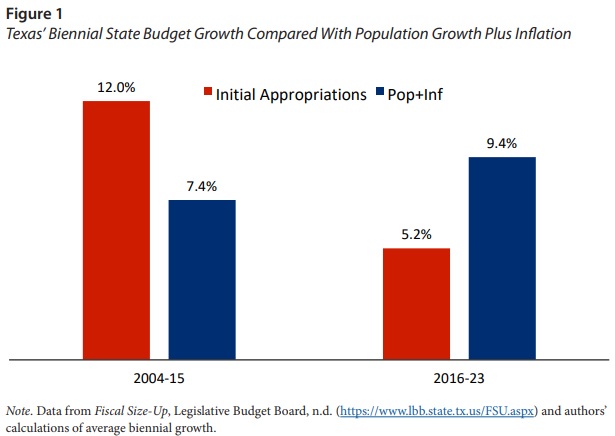
Dan Mitchell: All savings should be protected from double taxation, not just what you set aside for retirement. And that means government can tax you one time, either when you first earn the income or when you consume the income!

Protecting Individual Savings from Double Taxation

While speaking last year in Hawaii on the topic of good tax policy, I explained why it is misguided to impose extra layers of tax on saving and investment.

Regarding the problem of double taxation, I’ve addressed how various features of the tax code need to be fixed.

Today, we’re going to focus on the fixing the tax treatment of household savings. And the problem that needs fixing is that the federal government taxes you when you earn money and also taxes any interest you earn if you decide to save some of your after-tax income.

As you can see from the chart, this creates a tax wedge.

And that tax wedge distorts people’s decisions and makes them more likely to choose immediate consumption rather than savings (which can be viewed as deferred consumption).

As mentioned in the video, every economic theoryrecognizes that saving and investment (again, just another way of saying deferred consumption) are critical to future growth and rising living standards. So there are good reasons to fix the tax code.

The good news is that there are two ways to fix this problem.

  1. Tax income only one time when it is first earned.
  2. Tax income only one time when it is consumed.

In practical terms, the first option treats all savings like a “Roth IRA,”, which means you pay tax the year you earn your income, but the IRS does not get another bit at the apple if you save some of your after-tax income and it earns interest or otherwise grows in value.

The second option treats all savings like a 401(k), which means you are not taxed on any income that you place in a savings vehicle, but you are taxed on any money (including any interest or other returns) that you withdraw from the account.

As shown by Adam Michel of the Heritage Foundation, both of these approaches lead to the same long-run result (and thus are superior to what happens when people save without being protected from double taxation).

The good news is that Americans can protect their savings from double taxation by using either individual retirement accounts (IRAs) or 401(k)s.

The bad news is that those “qualified accounts” are restricted. Only people who are saving for retirement can protect themselves from double taxation.

That needs to change.

Here’s what I wrote back in 2012 and I think it’s reasonably succinct and accurate.

…all saving and investment should be treated the way we currently treat individual retirement accounts. If you have a traditional IRA (or “front-ended” IRA), you get a deduction for any money you put in a retirement account, but then you pay tax on the money – including any earnings – when the money is withdrawn. If you have a Roth IRA (or “back-ended” IRA), you pay tax on your income in the year that it is earned, but if you put the money in a retirement account, there is no additional tax on withdrawals or the subsequent earnings. From an economic perspective, front-ended IRAs and back-ended IRAs generate the same result. Income that is saved and invested is treated the same as income that is immediately consumed. From a present-value perspective, front-ended IRAs and back-ended IRAs produce the same outcome. All that changes is the point at which the government imposes the single layer of tax.

The key takeaways are in the first and last sentences. All savings should be protected from double taxation, not just what you set aside for retirement. And that means government can tax you one time, either when you first earn the income or when you consume the income.

This means we need universal savings accounts, sort of like they have in Canada.

Here’s what Robert Bellafiore of the Tax Foundation wrote about the idea back in 2019.

USAs do not penalize withdrawals on account of their purpose or timing. In contrast, some types of existing savings accounts are not neutral, penalizing people who withdraw their money for anything but approved purposes at approved times. For example, withdrawals from 529 accounts can only be made without penalty if they are used to fund education.If a parent has a 529 account for a child but must make a withdrawal to cover emergency expenses, he or she must pay income taxes on the earnings, plus a 10 percent penalty. Withdrawals from 401(k)s before the age of 59½ incur the same penalty, though there are certain exceptions. USAs’ neutrality would likely boost saving, for two reasons. First, when savings are not hit by multiple layers of taxation, savers can expect a higher return and are therefore likely to save more. Both IRAs and 401(k)s tax savings only once, and studies have estimated that roughly half of 401(k) balances, and roughly a quarter of all IRA contributions, constitute new saving—in other words, dollars that would have been spent are saved instead.

The bottom line is that we need to copy jurisdictions such as Hong Kong and Singapore that have little or no double taxation of any kind.

Especially since we now live in a world where inflation has become an issue, which acts as a hidden tax on saving and investment.

I’ll close with this chart from the OECD. It’s a few years old, so I’m sure some nations have changed their policies, but it gives one a good idea of how savings is treated around the world.

The bottom line is that it’s good to avoid Norway and the United States is unimpressive.

I’m very surprised to see that Argentina and Germany have good policy.

P.S. For some of our friends on the left, policies that protect from double taxation are akin to an entitlement.

I enjoyed this article below because it demonstrates that the Laffer Curve has been working for almost 100 years now when it is put to the test in the USA. I actually got to hear Arthur Laffer speak in person in 1981 and he told us in advance what was going to happen the 1980’s and it all came about as he said it would when Ronald Reagan’s tax cuts took place. I wish we would lower taxes now instead of looking for more revenue through raised taxes. We have to grow the economy:

What Mitt Romney Said Last Night About Tax Cuts And The Deficit Was Absolutely Right. And What Obama Said Was Absolutely Wrong.

Mitt Romney repeatedly said last night that he would not allow tax cuts to add to the deficit.  He repeatedly said it because over and over again Obama blathered the liberal talking point that cutting taxes necessarily increased deficits.

Romney’s exact words: “I want to underline that — no tax cut that adds to the deficit.”

Meanwhile, Obama has promised to cut the deficit in half during his first four years – but instead gave America the highest deficits in the history of the entire human race.
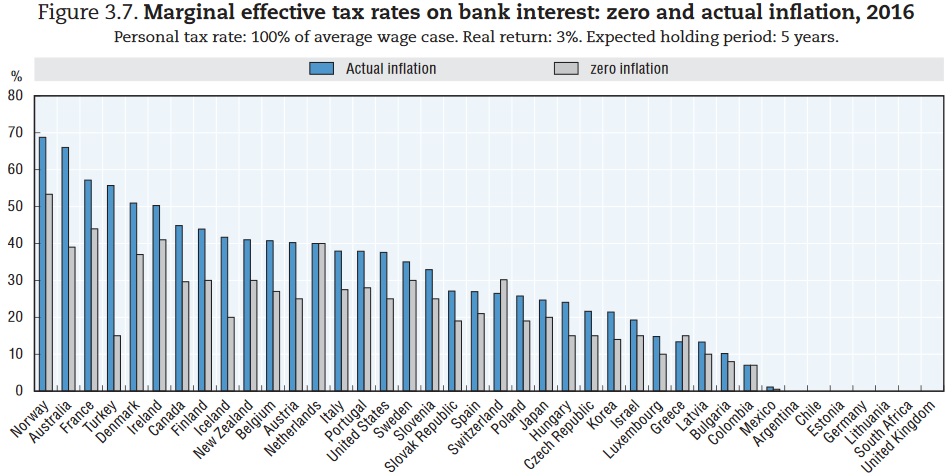
I’ve written about this before.  Let’s replay what has happened every single time we’ve ever cut the income tax rate.

The fact of the matter is that we can go back to Calvin Coolidge who said very nearly THE EXACT SAME THING to his treasury secretary: he too would not allow any tax cuts that added to the debt.  Andrew Mellon – quite possibly the most brilliant economic mind of his day – did a great deal of research and determined what he believed was the best tax rate.  And the Coolidge administration DID cut income taxes and MASSIVELY increased revenues.  Coolidge and Mellon cut the income tax rate 67.12 percent (from 73 to 24 percent); and revenues not only did not go down, but they went UP by at least 42.86 percent (from $700 billion to over $1 billion).

That’s something called a documented fact.  But that wasn’t all that happened: another incredible thing was that the taxes and percentage of taxes paid actually went UP for the rich.  Because as they were allowed to keep more of the profits that they earned by investing in successful business, they significantly increased their investments and therefore paid more in taxes than they otherwise would have had they continued sheltering their money to protect themselves from the higher tax rates.  Liberals ignore reality, but it is simply true.  It is a fact.  It happened.
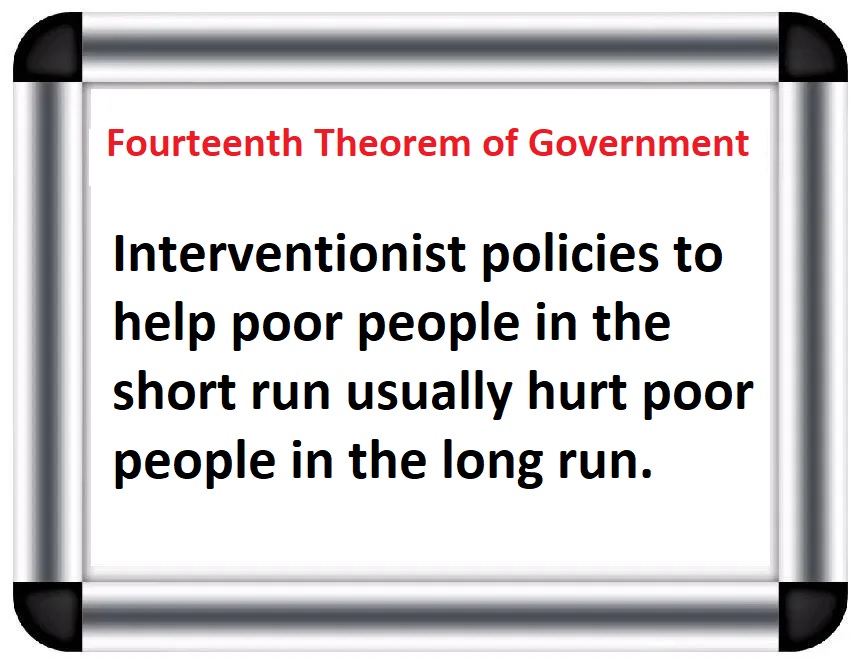
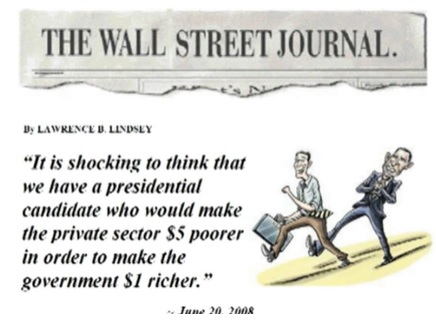
Then FDR came along and raised the tax rates again and the opposite happened: we collected less and less revenue while the burden of taxation fell increasingly on the poor and middle class again.  Which is exactly what Obama wants to do.

People don’t realize that John F. Kennedy, one of the greatest Democrat presidents, was a TAX CUTTER who believed the conservative economic philosophy that cutting tax rates would in fact increase tax revenues.  He too cut taxes, and he too increased tax revenues.

So we get to Ronald Reagan, who famously cut taxes.  And again, we find that Reagan cut that godawful liberal tax rate during an incredibly godawful liberal-caused economic recession, and he increased tax revenue by 20.71 percent (with revenues increasing from $956 billion to $1.154 trillion).  And again, the taxes were paid primarily by the rich:

“The share of the income tax burden borne by the top 10 percent of taxpayers increased from 48.0 percent in 1981 to 57.2 percent in 1988. Meanwhile, the share of income taxes paid by the bottom 50 percent of taxpayers dropped from 7.5 percent in 1981 to 5.7 percent in 1988.”

So we get to George Bush and the Bush tax cuts that liberals and in particular Obama have just demonized up one side and demagogued down the other.  And I can simply quote the New York Times AT the time:

Sharp Rise in Tax Revenue to Pare U.S. Deficit By EDMUND L. ANDREWS Published: July 13, 2005

WASHINGTON, July 12 – For the first time since President Bush took office, an unexpected leap in tax revenue is about to shrink the federal budget deficit this year, by nearly $100 billion.

A Jump in Corporate Payments On Wednesday, White House officials plan to announce that the deficit for the 2005 fiscal year, which ends in September, will be far smaller than the $427 billion they estimated in February.

Mr. Bush plans to hail the improvement at a cabinet meeting and to cite it as validation of his argument that tax cuts would stimulate the economy and ultimately help pay for themselves.

Based on revenue and spending data through June, the budget deficit for the first nine months of the fiscal year was $251 billion, $76 billion lower than the $327 billion gap recorded at the corresponding point a year earlier.

The Congressional Budget Office estimated last week that the deficit for the full fiscal year, which reached $412 billion in 2004, could be “significantly less than $350 billion, perhaps below $325 billion.”

The big surprise has been in tax revenue, which is running nearly 15 percent higher than in 2004. Corporate tax revenue has soared about 40 percent, after languishing for four years, and individual tax revenue is up as well
.

And of course the New York Times, as reliable liberals, use the adjective whenever something good happens under conservative policies and whenever something bad happens under liberal policies: ”unexpected.”   But it WASN’T ”unexpected.”  It was EXACTLY what Republicans had said would happen and in fact it was exactly what HAD IN FACT HAPPENED every single time we’ve EVER cut income tax rates.

The truth is that conservative tax policy has a perfect track record: every single time it has ever been tried, we have INCREASED tax revenues while not only exploding economic activity and creating more jobs, but encouraging the wealthy to pay more in taxes as well.  And liberals simply dishonestly refuse to acknowledge documented history.

Meanwhile, liberals also have a perfect record … of FAILUREThey keep raising taxes and keep not understanding why they don’t get the revenues they predicted.

The following is a section from my article, “Tax Cuts INCREASE Revenues; They Have ALWAYS Increased Revenues“, where I document every single thing I said above:

The Falsehood That Tax Cuts Increase The Deficit

Now let’s take a look at the utterly fallacious view that tax cuts in general create higher deficits.

Let’s take a trip back in time, starting with the 1920s.  From Burton Folsom’s book, New Deal or Raw Deal?:

In 1921, President Harding asked the sixty-five-year-old [Andrew] Mellon to be secretary of the treasury; the national debt [resulting from WWI] had surpassed $20 billion and unemployment had reached 11.7 percent, one of the highest rates in U.S. history.  Harding invited Mellon to tinker with tax rates to encourage investment without incurring more debt. Mellon studied the problem carefully; his solution was what is today called “supply side economics,” the idea of cutting taxes to stimulate investment.  High income tax rates, Mellon argued, “inevitably put pressure upon the taxpayer to withdraw this capital from productive business and invest it in tax-exempt securities. . . . The result is that the sources of taxation are drying up, wealth is failing to carry its share of the tax burden; and capital is being diverted into channels which yield neither revenue to the Government nor profit to the people” (page 128).

Mellon wrote, “It seems difficult for some to understand that high rates of taxation do not necessarily mean large revenue to the Government, and that more revenue may often be obtained by lower taxes.”  And he compared the government setting tax rates on incomes to a businessman setting prices on products: “If a price is fixed too high, sales drop off and with them profits.”

And what happened?

“As secretary of the treasury, Mellon promoted, and Harding and Coolidge backed, a plan that eventually cut taxes on large incomes from 73 to 24 percent and on smaller incomes from 4 to 1/2 of 1 percent.  These tax cuts helped produce an outpouring of economic development – from air conditioning to refrigerators to zippers, Scotch tape to radios and talking movies.  Investors took more risks when they were allowed to keep more of their gains.  President Coolidge, during his six years in office, averaged only 3.3 percent unemployment and 1 percent inflation – the lowest misery index of any president in the twentieth century.

Furthermore, Mellon was also vindicated in his astonishing predictions that cutting taxes across the board would generate more revenue.  In the early 1920s, when the highest tax rate was 73 percent, the total income tax revenue to the U.S. government was a little over $700 million.  In 1928 and 1929, when the top tax rate was slashed to 25 and 24 percent, the total revenue topped the $1 billion mark.  Also remarkable, as Table 3 indicates, is that the burden of paying these taxes fell increasingly upon the wealthy” (page 129-130).

Now, that is incredible upon its face, but it becomes even more incredible when contrasted with FDR’s antibusiness and confiscatory tax policies, which both dramatically shrunk in terms of actual income tax revenues (from $1.096 billion in 1929 to $527 million in 1935), and dramatically shifted the tax burden to the backs of the poor by imposing huge new excise taxes (from $540 million in 1929 to $1.364 billion in 1935).  See Table 1 on page 125 of New Deal or Raw Deal for that information.

FDR both collected far less taxes from the rich, while imposing a far more onerous tax burden upon the poor.

It is simply a matter of empirical fact that tax cuts create increased revenue, and that those [Democrats] who have refused to pay attention to that fact have ended up reducing government revenues even as they increased the burdens on the poorest whom they falsely claim to help.

Let’s move on to John F. Kennedy, one of the most popular Democrat presidents ever.  Few realize that he was also a supply-side tax cutter.

Kennedy said:

“It is a paradoxical truth that tax rates are too high and tax revenues are too low and the soundest way to raise the revenues in the long run is to cut the rates now … Cutting taxes now is not to incur a budget deficit, but to achieve the more prosperous, expanding economy which can bring a budget surplus.”

– John F. Kennedy, Nov. 20, 1962, president’s news conference


“Lower rates of taxation will stimulate economic activity and so raise the levels of personal and corporate income as to yield within a few years an increased – not a reduced – flow of revenues to the federal government.”

– John F. Kennedy, Jan. 17, 1963, annual budget message to the Congress, fiscal year 1964

“In today’s economy, fiscal prudence and responsibility call for tax reduction even if it temporarily enlarges the federal deficit – why reducing taxes is the best way open to us to increase revenues.”

– John F. Kennedy, Jan. 21, 1963, annual message to the Congress: “The Economic Report Of The President”


“It is no contradiction – the most important single thing we can do to stimulate investment in today’s economy is to raise consumption by major reduction of individual income tax rates.”

– John F. Kennedy, Jan. 21, 1963, annual message to the Congress: “The Economic Report Of The President”


“Our tax system still siphons out of the private economy too large a share of personal and business purchasing power and reduces the incentive for risk, investment and effort – thereby aborting our recoveries and stifling our national growth rate.”

– John F. Kennedy, Jan. 24, 1963, message to Congress on tax reduction and reform, House Doc. 43, 88th Congress, 1st Session.


“A tax cut means higher family income and higher business profits and a balanced federal budget. Every taxpayer and his family will have more money left over after taxes for a new car, a new home, new conveniences, education and investment. Every businessman can keep a higher percentage of his profits in his cash register or put it to work expanding or improving his business, and as the national income grows, the federal government will ultimately end up with more revenues.”

– John F. Kennedy, Sept. 18, 1963, radio and television address to the nation on tax-reduction bill

Which is to say that modern Democrats are essentially calling one of their greatest presidents a liar when they demonize tax cuts as a means of increasing government revenues.

So let’s move on to Ronald Reagan.  Reagan had two major tax cutting policies implemented: the Economic Recovery Tax Act (ERTA) of 1981, which was retroactive to 1981, and the Tax Reform Act of 1986.

Did Reagan’s tax cuts decrease federal revenues?  Hardly:

We find that 8 of the following 10 years there was a surplus of revenue from 1980, prior to the Reagan tax cuts.  And, following the Tax Reform Act of 1986, there was a MASSIVE INCREASEof revenue.

So Reagan’s tax cuts increased revenue.  But who paid the increased tax revenue?  The poor?  Opponents of the Reagan tax cuts argued that his policy was a giveaway to the rich (ever heard that one before?) because their tax payments would fall.  But that was exactly wrong.  In reality:

“The share of the income tax burden borne by the top 10 percent of taxpayers increased from 48.0 percent in 1981 to 57.2 percent in 1988. Meanwhile, the share of income taxes paid by the bottom 50 percent of taxpayers dropped from 7.5 percent in 1981 to 5.7 percent in 1988.”

So Ronald Reagan a) collected more total revenue, b) collected more revenue from the rich, while c) reducing revenue collected by the bottom half of taxpayers, and d) generated an economic powerhouse that lasted – with only minor hiccups – for nearly three decades.  Pretty good achievement considering that his predecessor was forced to describe his own economy as a “malaise,” suffering due to a “crisis of confidence.” Pretty good considering that President Jimmy Carter responded to a reporter’s question as to what he would do about the problem of inflation by answering, “It would be misleading for me to tell any of you that there is a solution to it.”

Reagan whipped inflation.  Just as he whipped that malaise and that crisis of confidence.

________

The Laffer Curve, Part III: Dynamic Scoring