The Laffer Curve charts a relationship between tax rates and tax revenue. While the theory behind the Laffer Curve is widely accepted, the concept has become very controversial because politicians on both sides of the debate exaggerate. This video shows the middle ground between those who claim “all tax cuts pay for themselves” and those who claim tax policy has no impact on economic performance. This video, focusing on the theory of the Laffer Curve, is Part I of a three-part series. Part II reviews evidence of Laffer-Curve responses. Part III discusses how the revenue-estimating process in Washington can be improved. For more information please visit the Center for Freedom and Prosperity’s web site: http://www.freedomandprosperity.org
________
President Obama c/o The White House
1600 Pennsylvania Avenue NW
Washington, DC 20500
The left has been loudly asserting that the middle class would lose under Mitt Romney’s plan to cut tax rates by 20 percent and finance those reductions by closing loopholes.
That class-warfare accusation struck me as a bit sketchy because when I looked at the data a couple of years ago, I put together this chart showing that rich people, on average, enjoyed deductions that were seven times as large as the deductions of middle-income taxpayers.
And the chart includes only the big itemized deductions. There are dozens of other special tax preferences, as shown in this depressing image, and you can be sure that rich people are far more likely to have the lawyers, lobbyists, and accountants needed to exploit those provisions.
But this chart doesn’t disprove the leftist talking point, so I’m glad that Martin Feldstein addressed the issue in today’s Wall Street Journal. Here’s some of what he wrote.
The IRS data show that taxpayers with adjusted gross incomes over $100,000 (the top 21% of all taxpayers) made itemized deductions totaling $636 billion in 2009. Those high-income taxpayers paid marginal tax rates of 25% to 35%, with most $200,000-plus earners paying marginal rates of 33% or 35%. And what do we get when we apply a 30% marginal tax rate to the $636 billion in itemized deductions? Extra revenue of $191 billion—more than enough to offset the revenue losses from the individual income tax cuts proposed by Gov. Romney. …Additional revenue could be raised from high-income taxpayers by limiting the use of the “preferences” identified for the Alternative Minimum Tax (such as excess oil depletion allowances) or the broader list of all official individual “tax expenditures” (such as tax credits for energy efficiency improvements in homes), among other credits and exclusions. None of this base-broadening would require taxing capital gains or making other changes that would reduce the incentives for saving and investment. …Since broadening the tax base would produce enough revenue to pay for cutting everyone’s tax rates, it is clear that the proposed Romney cuts wouldn’t require any middle-class tax increase, nor would they produce a net windfall for high-income taxpayers. The Tax Policy Center and others are wrong to claim otherwise.
In other words, even with a very modest assumption about the Laffer Curve, it would be quite possible to implement something akin to what Romney’s proposing and not “lose” tax revenue.
This doesn’t mean, of course, that Romney seriously intends to push for good policy. I’m much more concerned, for instance, that he’ll wander in the wrong direction and propose something very bad such as a value-added tax.
But Romney certainly can do the right thing if he wins. Assuming that’s what he wants to do.
Thank you so much for your time. I know how valuable it is. I also appreciate the fine family that you have and your commitment as a father and a husband.
Sincerely,
Everette Hatcher III, 13900 Cottontail Lane, Alexander, AR 72002, ph 501-920-5733, lowcostsqueegees@yahoo.com
______
The Laffer Curve, Part II: Reviewing the Evidence
This video is second installment of a three-part series. Part I reviews theoretical relationship between tax rates, taxable income, and tax revenue. Part III discusses how the revenue-estimating process in Washington can be improved. For more information please visit the Center for Freedom and Prosperity’s web site: http://www.freedomandprosperity.org.
Ronald Reagan and Bill Clinton both reduced the relative burden of government, largely because they were able to restrain the growth of domestic spending. The mini-documentary from the Center for Freedom and Prosperity uses data from the Historical Tables of the Budget to show how Reagan and Clinton succeeded and compares their record to the fiscal profligacy of the Bush-Obama years.
________________
If we want to get on the right track again in this country then we must lower taxes for the job creators. Dan Mitchell points out that tax policy is not the only policy you need to pay attention to:
There are five major policy areas, each of which counts for 20 percent of a nation’s grade.
They attract jobs and investment from other nations.
As you can see, there’s nothing surprising or unusual on my list. Just basic microeconomic analysis.
Yet some people argue that lower tax rates don’t make a difference. And if lower tax rates don’t help an economy, then presumably there is no downside if Obama’s class-warfare tax policy is implemented.
Many of these people are citing David Leonhardt’s column in Saturday’s New York Times. The basic argument is that Bush cut tax rates, but the economy stunk, while Clinton increased tax rates and the economy did well.
The defining economic policy of the last decade, of course, was the Bush tax cuts. President George W. Bush and Congress, including Mr. Ryan, passed a large tax cut in 2001, sped up its implementation in 2003 and predicted that prosperity would follow. The economic growth that actually followed — indeed, the whole history of the last 20 years — offers one of the most serious challenges to modern conservatism. Bill Clinton and the elder George Bush both raised taxes in the early 1990s, and conservatives predicted disaster. Instead, the economy boomed, and incomes grew at their fastest pace since the 1960s. Then came the younger Mr. Bush, the tax cuts, the disappointing expansion and the worst downturn since the Depression. Today, Mitt Romney and Mr. Ryan are promising another cut in tax rates and again predicting that good times will follow. …Mr. Romney and Mr. Ryan would do voters a service by explaining why a cut in tax rates would work better this time than last time.
While I’ll explain below why I think he’s wrong, Leonhardt’s column is reasonably fair. He gives some space to both Glenn Hubbard and Phil Swagel, both of whom make good points.
“To me, the Bush tax cuts get too much attention,” said R. Glenn Hubbard, who helped design them as the chairman of Mr. Bush’s Council of Economic Advisers and is now a Romney adviser. “The pro-growth elements of the tax cuts were fairly modest in size,” he added, because they also included politically minded cuts like the child tax credit. Phillip L. Swagel, another former Bush aide, said that even a tax cut as large as Mr. Bush’s “doesn’t translate quickly into higher growth.” Why not? The main economic argument for tax cuts is simple enough. In the short term, they put money in people’s pockets. Longer term, people will presumably work harder if they keep more of the next dollar they earn. They will work more hours or expand their small business. This argument dominates the political debate.
I hope, by the way, that neither Hubbard nor Swagel made the Keynesian argument that tax cuts are pro-growth because “they put money in people’s pockets.” Leonhardt doesn’t directly attribute that argument to either of them, so I hope they’re only guilty of proximity to flawed thinking.
But that’s besides the point. Several people have asked my reaction to the column, so it’s time to recycle something I wrote back in February. It was about whether a nation should reform its tax system, but the arguments are the same if we replace “a flat tax” with “lower tax rates.”
…even though I’m a big advocate for better tax policy, the lesson from the Economic Freedom of the World Index…is that adopting a flat tax won’t solve a nation’s economic problems if politicians are doing the wrong thing in other areas.
There are five major policy areas, each of which counts for 20 percent of a nation’s grade.
Size of government
Regulation
Monetary Policy
Trade
Rule of Law/Property Rights
Now let’s pick Ukraine as an example. As a proponent of tax reform, I like that lawmakers have implemented a 15 percent flat tax.
But that doesn’t mean Ukraine is a role model. When looking at the mix of all policies, the country gets a very poor score from Economic Freedom of the World Index, ranking 125 out of 141 nations.
In other words, tax policy isn’t some sort of magical elixir. The “size of government” variable accounts for just one-fifth on a country’s grade, and keep in mind that this also includes key sub-variables such as the burden of government spending.
Yes, lower tax rates are better for economic performance, just as wheels matter for a car’s performance. But if a car doesn’t have an engine, transmission, steering wheel, and brakes, it’s not going to matter how nice the wheels are.
Not let’s shift from theory to reality. Here’s the historical data for the United States from Economic Freedom of the World. As you can see, overall economic policy moved in the right direction during the Clinton years and in the wrong direction during the Bush-Obama years.
To be more specific, the bad policy of higher tax rates in the 1990s was more than offset by good reforms such as lower trade barriers, a lower burden of government spending, and less regulation.
Similarly, the good policy of lower tax rates last decade was more than offset by bad developments such as a doubling of the federal budget, imposition of costly regulations, and adoption of two new health entitlements.
Because of Obama’s class-warfare tax hike and additional tax increases by kleptocrats at the state level, many successful taxpayers will now lose more than 50 percent of any additional income they generate for the American economy.
I discuss the implications of this punitive tax policy in this CNBC interview.
Normally, this is the section where I highlight certain points I made, or bemoan the fact that I failed to mention an important fact or overlooked a key argument. Today, though, I want to address the do-taxes-impact-growth issue raised by Robert Frank.
More specifically, I want to debunk the Congressional Research Service study that he indirectly mentioned about two minutes into the segment. This is the report that asserted that it doesn’t matter if we impose high tax rates on investors, entrepreneurs, small business owners, and other “rich” taxpayers.
The results of the analysis suggest that changes over the past 65 years in the top marginal tax rate and the top capital gains tax rate do not appear correlated with economic growth. The reduction in the top tax rates appears to be uncorrelated with saving, investment, and productivity growth. The top tax rates appear to have little or no relation to the size of the economic pie.
The good news is that I don’t really need to debunk this CRS study because Steve Entin already has undertaken that unpleasant task. Writing for the Tax Foundation, Steve points out some rather fatal flaws in the CRS study.
The study makes no effort to determine the channels through which the tax changes ought to work to affect the economy, looks at the wrong measure of progress over the wrong time frame, and takes inadequate account of what other tax or economic events are occurring at the same time that might mask the results. …Other changes in taxes and other influences on the economy occurring at the same time can easily hide or counteract the effect of the top tax rate changes alone. It is often impossible to hold other things constant to allow one to see the impact of the single item one wants to assess. When these other influences are omitted from the model, the “missing variables” problem poisons the results. …one should look at the long-term change in the capital stock and the ultimate level of output, not the short-term rise in investment and the short-term change in the growth rate. If one looks only at the growth rate, and not at the level of GDP, one could conclude that the tax rate change has only a temporary benefit, when in fact it is permanently helpful. …Looking only at the amount of investment triggered in the year following the tax change misses the point. The same holds true in the opposite direction for a tax increase. It takes years to retire through attrition the excess capital made redundant by a tax increase. Looking only at the change in investment in the year after the tax cut, rather than the cumulative increase in the stock of capital over time, misses about 95 percent of the impact. You can’t predict this fall’s apple crop by counting the number of seedlings planted this spring.The CRS study omits important variables and poisons its results by not holding other factors constant. The variables it does examine are indirectly related to the relationship one should be studying, but the study does not follow them for long enough to get the whole picture. The study is as weak now as it was when it was first issued. Grade: F.
By the way, the Wall Street Journal pointed out that the author of the CRS study is not exactly dispassionate and neutral on these matters.
You won’t be surprised to learn that Mr. Hungerford has donated to the Obama campaign and Senate Democrats and worked as an economist at the White House budget office under Bill Clinton.
In closing, I did address the taxes-growth issue last year. I wasn’t debunking the CRS study, but I was exposing the errors in some very similar analysis by a writer for the New York Times.
Here’s the key passage from that post.
Yes, lower tax rates are better for economic performance, just as wheels matter for a car’s performance. But if a car doesn’t have an engine, transmission, steering wheel, and brakes, it’s not going to matter how nice the wheels are.
In other words, I was focusing on the fact that you can’t accurately and honestly examine tax policy without looking at the impact of other public policy issues.
I made that point in the CNBC interview, of course, though it’s unclear whether the message got through.
But I think the Clinton years and Bush years make my point. Bill Clinton was bad on tax policy in 1993, but was good on almost everything else (including a cut in the capital gains tax rate in 1997), whereas George W. Bush was okay on tax policy, but was bad on just about everything else.
Why are we spending more and more on welfare every year? What would the Founding Fathers have to say about this if they were still here today? We will look at that in a little bit. We need to cut Food Stamp program and not extend it. However, it seems that people tell the taxpayers back […]
Uploaded by LibertyPen on Jan 8, 2009 Professor Williams explains what’s ahead for Social Security If you want to know the real truth about the financial condition of Social Security then check out these links below: Ark Times reader says Social Security is not Ponzi Scheme February 28, 2012 – 11:14 pm Social Security is a […]
FIRST PRESIDENTIAL DEBATE – Barack Obama VS Mitt Romney (Part 1) Published on Oct 3, 2012 by LearnTVMore Barack Obama & Mitt Romney Full Presidential Debate __________ I heard Arthur Laffer speak in 1981 when he came to Memphis to speak to a group of students. He told exactly what was going to happen the […]
President Obama c/o The White House 1600 Pennsylvania Avenue NW Washington, DC 20500 Dear Mr. President, I know that you receive 20,000 letters a day and that you actually read 10 of them every day. I really do respect you for trying to get a pulse on what is going on out here. If […]
Rand Paul A balanced Budget Amendment is the only way (29-Jul-11)(GLOBAL FOCUS series – US) Uploaded by YouInformation on Jul 31, 2011 _______________ Dear Senator Pryor, Why not pass the Balanced Budget Amendment? As you know that federal deficit is at all time high (1.6 trillion deficit with revenues of 2.2 trillion and spending at […]
Washington Could Learn a Lot from a Drug Addict Uploaded by WashingtonCouldLearn on Jul 8, 2011 Washington’s chronic overspending is just like a junkie’s addiction to drugs. Unless the cycle of addiction is broken, our economic and unemployment situation will continue to suffer. Washington is out of time. To avoid hitting rock bottom, Washington must […]
Sen. Mitch McConnell: Americans Don’t Approve of Anything Obama Has Done Uploaded by HeritageFoundation on Dec 8, 2011 In an exclusive interview at The Heritage Foundation, Senate Minority Leader Mitch McConnell (R-KY) sharply criticized President Obama for engaging in class warfare and accused him of shifting the focus away from his own failed policies in […]
Milton and Rose Friedman with President Bush. Milton Friedman on Donahue 1979 (2/5) I believe the “no new tax pledge” ultimately will work. Milton Friedman believed we should starve the beast and that is good enough for me. “If taxes are raised in order to keep down the deficit, the result is likely to be […]
Dan Mitchell of the Cato Institute has some great videos and I have posted lots of them on my blog. I like to go to Dan’s blog too. Take a look at some of them below and then the links to my blog. It’s Simple to Balance The Budget Without Higher Taxes Uploaded by afq2007 […]
Reagan and Clinton put Obama to shame when it comes to creating jobs. An Amusing Comparison: Obama vs Reagan and Clinton January 7, 2013 by Dan Mitchell I shared a remarkable chart last year exposing Obama’s terrible record on job creation. It showed that the economy enjoyed big employment increases during the Reagan and Clinton years, […]
Not many people know the truth about Robin Hood. Robin Hood was not a left-wing hero who stole from the rich and redistributed to the poor. That is what you are trying to do though Mr. President.
When I was a kid, I was a big fan of Robin Hood. I remember reading at least two books recounting the legend and I watched the Errol Flynn version of the movie several times.
And, as an adult, I saw both the Kevin Costner and Russell Crowe versions of Robin Hood.
“I’m not an occupy-Wall-Street moocher”
None of this makes me an expert, but it does allow me to state with some confidence that Robin Hood was not a left-wing hero who stole from the rich and redistributed to the poor.
Instead, he was a quasi-libertarian tax protestor. Okay, maybe it’s an exaggeration to claim he was a libertarian, but Robin Hood was on the side of ordinary people who were being exploited by incessant tax demands from the ruling class. His main enemies were Prince John and the Sheriff on Nottingham, not the medieval equivalents of Wall Street.
In the Russell Crowe version of the movie, Robin Hood even gives a speech about the importance of liberty.
So you can imagine how irked I get when statists agitate for things such as the “Robin Hood Tax” in this moronic video. But what motivated me today is a story in the Financial Times about a Cesar Chavez wannabee politician from Spain.
For Spain’s ruling politicians he is a criminal; for his supporters he is Robin Hood, stealing from supermarkets and redistributing the food to the poor. Juan Manuel Sánchez Gordillo, the mayor of Marinaleda, a southern town with a population of 2,600, has been catapulted to cult hero status in Spain after setting out this week on an anti-austerity march across Andalucia – occupying banks and stealing food… “We are fighting a war for the poor … going to jail is not important for me, it would be an honour,” Mr Sánchez Gordillo told the Financial Times. “We are going to occupy all of the banks and supermarkets we are able to in Andalucia. The robbers who have caused this crisis must pay the consequences for what they have done.”
But don’t hold your breath waiting for self-awareness from this clown.
Not surprisingly, unions are part of the protest. I’m guessing that Mr. Canamero represents government employees.
On Friday, the marchers, who plan to sleep in the open or in parks, occupied a branch of Banco Santander in the town of Mancha Real in the province of Jaén before leaving later in the day. Diego Canamero, head of the Andalucian Workers Union, was in the branch on Friday. He said critics of the protests were politicians protecting their own interests. “These are symbolic actions against an unsustainable economic situation,” he said. “The bankers rob us, and take our money to tax havens…”
The dig against tax havens is particularly laughable. Ordinary Spaniards should hope and pray that their deposits in the local banks are safely re-deposited in banks based in well-run and honest jurisdictions such as Switzerland, the Cayman Islands, or Singapore.
And if they’re smart, they already cut out the middleman and directly placed their savings in one of these low-tax jurisdictions. That way, they’re not only at much less risk of a bank collapse, but they also have greater ability to protect their assets from the venal and incompetent tax-hungry political elite.
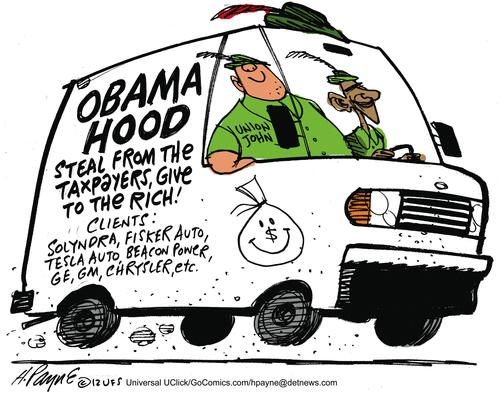
Returning to the mischaracterization of Robin Hood, this Payne cartoon does a good job of capturing my thoughts.
I especially like how Payne shows that the left-wing version of Robin Hood is all about a perniciously corrupt version of redistribution (though he should have included the Export-Import Bank on the side of the van). The genuine poor get crumbs while the well-connected interests make out like bandits.
Thank you so much for your time. I know how valuable it is. I also appreciate the fine family that you have and your commitment as a father and a husband.
Sincerely,
Everette Hatcher III, 13900 Cottontail Lane, Alexander, AR 72002, ph 501-920-5733, lowcostsqueegees@yahoo.com
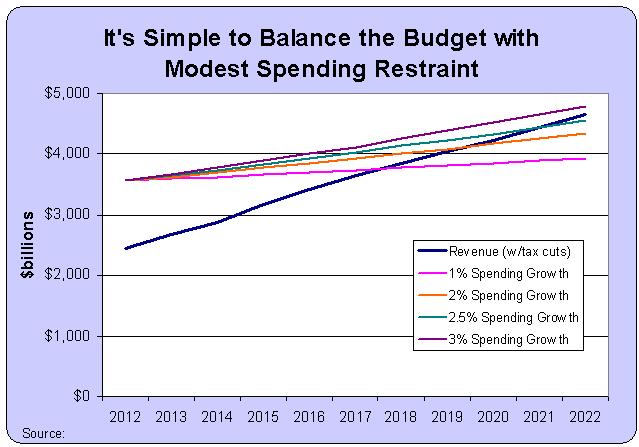
Now that new numbers have been released by the Congressional Budget Office, it’s time once again for me to show how easy it is to balance the budget with modest spending restraint (though please remember our goal should be smaller government, not fiscal balance).
I first did this back in September 2010, and showed that we could balance the budget in 10 years if federal spending was limited so it grew by 2 percent annually.
I repeated the exercise in January 2011 after new CBO numbers were released, and re-confirmed that a spending cap of 2 percent would eliminate red ink in just 10 years.
Most recently, back in January after CBO produced the new Economic and Budget Outlook, I crunched the numbers again and showed how a spending cap of 2 percent would balance the budget.
I’m happy to say that the new numbers finally give me some different results. We can now balance the budget if spending grows 2.5 percent annually.
In other words, spending can grow faster than inflation and the budget can be balanced with no tax hikes.
And here’s the video I narrated almost two years ago on this topic. The numbers have changed a bit, but the analysis is exactly the same.
In other words, ignore the politicians, bureaucrats, lobbyists, and special interests when they say we have to raises taxes because otherwise the budget would have to be cut by trillions of dollars. They’re either stupid or lying (mostly the latter, deliberately using the dishonest version of Washington budget math).
Modest fiscal restraint is all that we need, though it would be preferable to make genuine cuts in the burden of government spending.
______
Thank you so much for your time. I know how valuable it is. I also appreciate the fine family that you have and your commitment as a father and a husband.
Sincerely,
Everette Hatcher III, 13900 Cottontail Lane, Alexander, AR 72002, ph 501-920-5733, lowcostsqueegees@yahoo.com
I got on the Arkansas Times Blog and noticed that a person on there was bragging about the high minimum wage law in San Francisco and how everything was going so well there.
Couldn’t be better (the person using the username “Couldn’t be better) is bragging on California while Rick Perry just got finished with a recruiting tour of the state because so many California businesses are continuing to leave there for low tax Texas.
It has been a joy to watch Jerry Brown destroy the state with his liberal philosophy. At least he is not a Rino like Arnold. The liberals in California are getting a dose of their own medicine and the Phil Micklesons of the world will be relocating soon. Is that the utopia you are referring to?
Saline, Perry got zero (0) businesses because companies care about their employees also and Gov Goodhair has destroyed the Texas school system which no one thought could be made worse but he showed that there is no level of education that can’t be further destroyed by stupid Republicans.
Taxes aren’t the only reason anyone move but I know that Republicans only care about their money and people really don’t matter. Most Californians actually read and can see what the Tea Pot brains have done to Texas and the only good news is that in 20 years, when they start to rebuild Texas based on no oil or gas, that the Democratic Hispanic majority do care about families and their kid’s education. In the interim, Austin will continue to survive in their Alamo mode.
You are correct that Perry’s recent trip has not produced any immediate results. The Houston local CBS station reported on 2-13-13 that Rick Perry is empty handed so far on this one trip to California where he met with 20 business leaders who had expressed interest in moving to Texas where there are less taxes, and red tape. The fact that these business leaders requested Perry to come is not a good sign for California.
When you try and tax and spend too much then the business community will try and relocate to another state. That is exactly what is happening in California today.
Sometimes I wonder what planet liberals are from. The economy of California was the strongest in the nation in the 1970′s when Ronald Reagan was the governor, but after the green movement and other liberal regulators got a hold of it, things went south fast.
I could give you countless stories about people I know that have told me that their customers are in California, but they build their warehouses in surrounding states and ship their products into California. They tell me that you would have to be crazy to try to build a warehouse in California because of all the red tape you have to put up with.
President Obama has raised taxes on the rich just like California Governor Jerry Brown did. How is that working out for Jerry? Now businesses are leaving California for Texas. How do I know this is true? Look at what Dan Mitchell had to say recently on his blog:
Indeed, in the last five years Texas has gained 400,000 new jobs while California has lost 640,000. The Lone Star State’s rate of job growth was 33 percent higher than California’s last year, even as the Golden State finally pulled out of the recession. …Texas’s legislature has just trimmed its $188 billion two-year budget by 8 percent, and the state may have more revenue than it can legally spend because it is barred from raising outlays more than the rate of economic growth.
_____
Let me get you something to laugh about. Dan Mitchell posted three funny cartoons about people leaving California for Texas.
So it’s understandable that the Governor of Texas is telling employers in California that his state has a better climate for job creation.
John Fund of National Review opines on this bit of competition between states.
Texas governor Rick Perry knows how to start a rumble. Last week, he spent a mere $24,000 on radio ads in California, urging firms there to move to Texas, with its “zero state income tax, low overall tax burden, sensible regulations, and fair legal system.” …He begins a four-day barnstorming tour of California today, touting Texas’s virtues to business owners. …several observers acknowledged that Perry has gotten the better of the battle.
Indeed, in the last five years Texas has gained 400,000 new jobs while California has lost 640,000. The Lone Star State’s rate of job growth was 33 percent higher than California’s last year, even as the Golden State finally pulled out of the recession. …Texas’s legislature has just trimmed its $188 billion two-year budget by 8 percent, and the state may have more revenue than it can legally spend because it is barred from raising outlays more than the rate of economic growth.
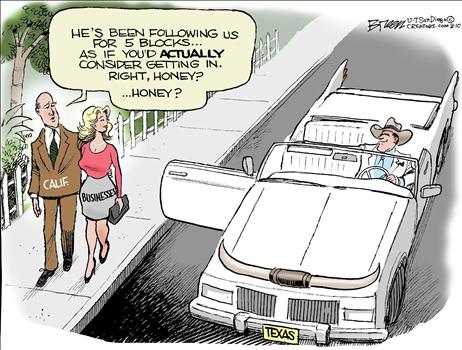
Here’s a very good Steve Breen cartoon about Perry’s fishing trip to the west coast.
Phil Mickelson said he will make “drastic changes” because of federal and California state tax increases. …The 42-year-old golfer said he would talk in more detail about his plans — possibly moving away from California or even retiring from golf… Mickelson said. “I’ll probably talk about it more in depth next week. …There are going to be some drastic changes for me because I happen to be in that zone that has been targeted both federally and by the state and, you know, it doesn’t work for me right now. So I’m going to have to make some changes.” …”If you add up all the federal and you look at the disability and the unemployment and the Social Security and the state, my tax rate’s 62, 63 percent,” said Mickelson, who lives in Rancho Santa Fe. “So I’ve got to make some decisions on what I’m going to do.”
He’s actually overstating his marginal tax rate. I suspect it’s closer to 50 percent.
California politicians got too greedy and now they may get 13.3 percent of nothing
But so what? It’s still outrageous and immoral that government is confiscating one-half of the income he generates.
Heck, medieval serfs were virtually slaves, yet they only had to give at most one-third of their output to the Lord of the Manor.
I hope he’s serious and that he escapes from the Golden State’s fiscal hell-hole.
And if he does, what will it mean for California government finances?
According to one estimate of 2011 earnings (comprising salary, winnings, bonuses, endorsements and appearances) Mickelson was then the second-highest paid athlete in the United States, earning an income of over $62 million, $53 million of which came from endorsements.
Now let’s bend over backwards to make sure we’re not exaggerating. Notwithstanding the Wikipedia estimate, let’s assume his annual taxable income will be only $40 million for 2013 and beyond.
With a 10.3 percent top tax rate, California would collect about $4.12 million per year. And Mickelson apparently thought that was tolerable.
But guess how much the politicians will collect if he leaves the state? I’m tempted to say zero, but they may still get some revenue because of California-based tournaments and other factors.
Find Phil Mickelson
I can say with great confidence, however, that California won’t collect $5.32 million, which is probably what the politicians assumed when they seduced voters into approving the 13.3 percent tax rate.
After all, that assumption only works if Mickelson is willing to be a fiscal slave for Jerry Brown and the rest of the crooks in Sacramento.
As such, I’ll also state with certainty that California’s politicians won’t collect $4 million if Mickelson leaves for another state. Or $3 million. Or $2 million. Or even $1 million.
The best they can hope for is that Mickelson decides to stay in the state while also reducing his taxable income. In that scenario, the politicians might still pocket a couple of million dollars.
Not as much as they collected when the tax rate was 10.3 percent, and far less than what they erroneously assumed they would get with a 13.3 percent rate.
Hopefully we’re all disgusted when insiders rig the system to rip off taxpayers. And I suspect you’re not surprised to see that the worst example on that list comes from California, which is in a race with Illinois to see which state can become the Greece of America.
The numbers are even larger in California, where a state psychiatrist was paid $822,000, a highway patrol officer collected $484,000 in pay and pension benefits and 17 employees got checks of more than $200,000 for unused vacation and leave. The best-paid staff in other states earned far less for the same work, according to the data.
Wow, $822,000 for a state psychiatrist. Not bad for government work. So what is Governor Jerry Brown doing to fix the mess? As you might expect, he’s part of the problem.
…the state’s highest-paid employees make far more than comparable workers elsewhere in almost all job and wage categories, from public safety to health care, base pay to overtime. …California has set a pattern of lax management, inefficient operations and out-of-control costs. …In California, Governor Jerry Brown hasn’t curbed overtime expenses that lead the 12 largest states or limited payments for accumulated vacation time that allowed one employee to collect $609,000 at retirement in 2011. …Last year, Brown waived a cap on accrued leave for prison guards while granting them additional paid days off. California’s liability for the unused leave of its state workers has more than doubled in eight years, to $3.9 billion in 2011, from $1.4 billion in 2003, according to the state’s annual financial reports. …The per-worker costs of delivering services in California vastly exceed those even in New York, New Jersey, Illinois and Ohio.
I suppose the silver lining to that dark cloud is that many bureaucrats now rank as part of the top 1 percent, so they’ll have to recycle some of their loot back to the political vultures in Sacramento.
But the biggest impact of the tax hike – as shown in the Ramirez cartoon – will be to accelerate the shift of entrepreneurs, investors, and small business owners to states that don’t steal as much. Indeed, a study from the Manhattan Institute looks at the exodus to lower-tax states.
The data also reveal the motives that drive individuals and businesses to leave California. One of these, of course, is work. …Taxation also appears to be a factor, especially as it contributes to the business climate and, in turn, jobs. Most of the destination states favored by Californians have lower taxes. States that have gained the most at California’s expense are rated as having better business climates. The data suggest that many cost drivers—taxes, regulations, the high price of housing and commercial real estate, costly electricity, union power, and high labor costs—are prompting businesses to locate outside California, thus helping to drive the exodus.
Does Government Have a Revenue or Spending Problem? People say the government has a debt problem. Debt is caused by deficits, which is the difference between what the government collects in tax revenue and the amount of government spending. Every time the government runs a deficit, the government debt increases. So what’s to blame: too […]
Former California Governor Arnold Schwarzenegger with his family I posted a portion of an article by John Fund of the Wall Street Journal that pointed out that many businesses are leaving California because of all of their government red tape and moving to Texas. My username is SalineRepublican and this is […]
John Fund at Chamber Day, Part 1 Last week I got to attend the first ever “Conservative Lunch Series” presented by KARN and Americans for Prosperity Foundation at the Little Rock Hilton on University Avenue. This monthly luncheon will be held the fourth Wednesday of every month. The speaker for today’s luncheon was John Fund. John […]
Is our country learning from history? California keeps raising their taxes on the wealthy and people keep moving from California to Texas. What does our federal government do? They also have been raising taxes on the wealthy lately. Take a look at this excellent video below and then read a great article by Dan Mitchell […]
You can’t blame someone for leaving one state for another if they have a better an opportunity to make money. Maryland to Texas, but Not Okay to Move from the United States to Singapore? July 12, 2012 by Dan Mitchell I’ve commented before about entrepreneurs, investors, and small business owners migrating from high tax states such […]
If our country is the grow the economy and get our budget balanced it will not be by raising taxes!!! The recipe for success was followed by Ronald Reagan in the 1980′s when he cut taxes and limited spending. As far as limiting spending goes only Bill Clinton (with his Republican Congress) were ability to […]
Gene Stallings used to interview the boys that dated his daughters. He asked his future son-in-laws if they played sports. He wanted to know if they had competed at something. Below is an article on what Stallings thinks about Texas A&M joining SEC. Stallings: SEC best fit for A&M By Troy Schulte Wednesday, September 7, […]
This week I watched on tv the replay of the last game in the series with Texas. It was the 1991 game in Little Rock against Texas. Right before that game Craig O’Neill pulled a prank on the Texas Athletic Dept. Listen to the clip above. The Arkansas Times Blog reported: Craig O’Neill tells all […]
I posted a portion of an article by John Fund of the Wall Street Journal that pointed out that many businesses are leaving California because of all of their government red tape and moving to Texas. My username is SalineRepublican and this is how “Couldn’tBeBetter” responded this morning: Saline, if Texas is so great, don’t […]
But I am downright stunned to learn that America’s high corporate tax rate is such an outlier that companies are even moving to welfare states such as the United Kingdom.
More big U.S. companies are reincorporating abroad despite a 2004 federal law that sought to curb the practice. One big reason: Taxes. Companies cite various reasons for moving, including expanding their operations and their geographic reach. But tax bills remain a primary concern. … Aon plc…relocated to the U.K. in April. Aon has told analysts it expects to reduce its tax rate, which averaged 28% over the past five years, by five percentage points over time, which could boost profits by about $100 million annually. Since 2009, at least 10 U.S. public companies have moved their incorporation address abroad or announced plans to do so, including six in the last year or so, according to a Wall Street Journal analysis of company filings and statements. …Eaton, a 101-year-old Cleveland-based maker of components and electrical equipment, announced in May that it would acquire Cooper Industries PLC, another electrical-equipment maker that had moved to Bermuda in 2002 and then to Ireland in 2009. It plans to maintain factories, offices and other operations in the U.S. while moving its place of incorporation—for now—to the office of an Irish law firm in downtown Dublin. …Eaton’s chief executive, Alexander Cutler, has been a vocal critic of the corporate tax code. “We have too high a domestic rate and we have a thoroughly uncompetitive international tax regime,” Mr. Cutler said on CNBC in January. …In moving from Dallas to the U.K. in 2009, Ensco followed rivals such as Transocean Ltd., Noble Corp. and Weatherford International Ltd. that had relocated outside the U.S. The company said the move would help it achieve “a tax rate comparable to that of some of Ensco’s global competitors.”
Wow. I can understand moving to Ireland, with its 12.5 percent corporate tax rate, but I wouldn’t have thought that the U.K.’s 24 percent rate was overly attractive.
But compared to the punitive 35 percent rate in the United States, I guess 24 percent doesn’t look that bad.
So what’s the solution? The obvious answer is to lower the corporate tax rate. But it also would help to eliminate worldwide taxation, as noted in the article.
Lawmakers of both parties have said the U.S. corporate tax code needs a rewrite and they are aiming to try next year. One shared source of concern is the top corporate tax rate of 35%—the highest among developed economies. By comparison, Ireland’s rate is 12.5%. …Critics of the tax code also say it puts U.S. companies at a disadvantage because it taxes their profits earned abroad. Most developed countries tax only domestic earnings. While executives would welcome a lower tax rate and an end to global taxation, some worry their tax bills could rise under other measures that could be included in a tax-overhaul package.
Both Obama and Romney have said that they favor a slightly lower corporate rate, but I’m skeptical about their true intentions. In any event, neither one of them is talking about a low rate, perhaps 15 percent of below.
For more information, here’s my video on corporate taxation.
And the issue of worldwide taxation may sound arcane, but this video explains why it also is important.
Let’s close by noting that there are two obstacles to pro-growth reform. First, any good reform will deprive politicians of tax revenue. And since they’ve spent the country into a fiscal ditch, that makes it very difficult to enact legislation that – at least on paper – means less money flowing to Washington.
Second, politicians are very reluctant to lower tax rates on groups that can be demagogued, such as “rich people” and “big corporations.” This is the destructive mentality that drives class-warfare tax policy.
So America faces a choice. Jobs, investment, and growth or big government, class warfare, and stagnation. The solution should be obvious…unless you’re a politicians interested in preserving power in Washington.
_________
Thank you so much for your time. I know how valuable it is. I also appreciate the fine family that you have and your commitment as a father and a husband.
Sincerely,
Everette Hatcher III, 13900 Cottontail Lane, Alexander, AR 72002, ph 501-920-5733, lowcostsqueegees@yahoo.com
Below is an excellent plan to balance the budget through spending cuts from Chris Edwards of the Cato Institute written in April of 2011. Here is the fourth and final part. I hope you will take advantage at least of some of these suggestions below.
The projected growth in Medicare, Medicaid, and Social Security is the main cause of America’s looming fiscal crisis. Budget experts and policymakers across the political spectrum understand the need to restructure these programs. The reforms listed in Table 1 include repealing the 2010 health care law and some initial efforts to control health care and Social Security costs.
For Social Security, the growth in initial benefits would be indexed to prices rather than wages, which would slow benefit growth over time. The proposal would save $41 billion annually by 2021 and growing amounts after that, according to the CBO.14 The plan also includes a CBO option to modestly raise the program’s normal retirement age.15
Medicaid should be converted from an open-ended matching grant program to a block grant, which would provide a fixed amount of funds to each state but allow state policymakers more program flexibility. That was the successful approach used for welfare reform in 1996. Converting Medicaid to a block grant would reduce federal costs, while encouraging innovation and cost reductions by the states. Setting the Medicaid block grant at the 2011 level of Medicaid spending would result in saving more than $200 billion annually within a decade.
The plan includes some modest Medicare changes based on CBO estimates, including increasing deductibles for services and increasing premiums for Part B to cover 35 percent of the program’s costs.16 The plan would repeal the 2010 health care law, including the higher revenues and spending. It further assumes that the Medicare improper payment rate, which is at least 10 percent, would be cut in half.
However, much larger reforms to the program are needed. Cato scholars have proposed moving to a system based on individual vouchers, personal savings, and consumer choice for elderly health care.17 The House Budget Committee has similarly proposed a plan to convert Medicare into a consumer-driven health system.18 Such reforms would create strong incentives for providers and patients to improve system quality and efficiency.
In recent decades, governments around the world have sold off state-owned assets to private investors.19 Airports, railroads, electric utilities, post offices, and other assets have been privatized. Privatization generally leads to reduced costs, higher-quality services, and increased innovation in formerly moribund government industries.
There are many federal assets that should be privatized. Table 1 includes the privatization of Amtrak, the air traffic control system, and the Army Corps of Engineers. Such reforms would reduce federal budget deficits and help spur economic growth.
Consider the nation’s air traffic control system, which is run by the Federal Aviation Administration.20 The FAA has struggled to expand capacity and upgrade its technology, and its modernization efforts have often fallen behind schedule and gone over budget. A series of incidents in 2011 indicated that the agency has serious workforce management problems. The air traffic control system needs major improvements to meet rising travel demands, but the FAA may not be capable of meeting the challenge.
The good news is that a number of countries have restructured their air traffic control systems and provide good models for U.S. reforms. Canada privatized its air traffic control system in 1996, setting up a private, nonprofit corporation, Nav Canada. The company is self-supporting from charges on aviation users. The Canadian system has received high marks for sound finances, solid management, and investment in new technologies.21 Aside from those advantages, a privatized system in the United States would save about $6 billion a year in general fund taxpayer costs.
Official projections show that without reforms federal spending will soar to more than 40 percent of GDP by 2050, and even higher after that. State and local spending comes on top of that, with the result that governments would consume more than half of the entire U.S. economy.
However, it seems inconceivable that voters and taxpayers would let the government grow to anywhere near that large. Indeed, the results of the 2010 elections indicate that there is already widespread disapproval of big government. It is also unlikely that the government would be able to raise taxes much above current levels to support higher spending because of our increasingly globalized economy.22
The upshot is that we will have to make major spending cuts sooner or later, and it would be better to make them sooner before we accumulate even more debt. Policymakers can start with the menu of cuts presented here, and then they should pursue other reforms such as restructuring Medicare. Leaders of other industrial nations have pursued vigorous cost-cutting when their government debt got out of control, and there is no reason why our political leaders shouldn’t do the same.
2 Congressional Budget Office, “Preliminary Analysis of the President’s Budget for 2012,” March 2011.
3 For these estimates, see Congressional Budget Office, “The Budget and Economic Outlook: Fiscal Years 2011 to 2021,” January 2011, p. 22.
4 For estimates of these adjustments, see Congressional Budget Office, “The Budget and Economic Outlook: Fiscal Years 2011 to 2021,” January 2011, p. 22.
5 This is the president’s budget as estimated by the CBO. See Congressional Budget Office, “Preliminary Analysis of the President’s Budget for 2012,” March 2011.
6 I assume that discretionary spending cuts are phased-in over 10 years, one-tenth each year. The proposed changes to Medicaid, Medicare, and Social Security would begin right away, but the savings would increase over time.
7 I modeled interest costs using CBO baseline projections regarding interest rates. I adjusted for the fact that public debt is projected to grow faster than indicated by the compounding of annual deficits in coming years.
8 In particular, see Budget of the U.S. Government, Fiscal Year 2012, Analytical Perspectives (Washington: Government Printing Office, February 2011), Table 33-1.
10Budget of the U.S. Government, Fiscal Year 2012, Analytical Perspectives (Washington: Government Printing Office, February 2011). See also Chris Edwards, “Federal Aid-to-State Programs Top 1,100,” Cato Institute Tax and Budget Bulletin no. 63, February 2011. Note that these state aid programs are a subset of the 2,000 total subsidy programs mentioned earlier.
13 Aside from the costs of the Iraq and Afghanistan wars, Department of Defense spending will be about $560 billion in fiscal 2011, up from $290 billion in fiscal 2001.
14 Congressional Budget Office, “Reducing the Deficit: Spending and Revenue Options,” March 2011.
15 Congressional Budget Office, “Reducing the Deficit: Spending and Revenue Options,” March 2011.
16 The savings for these options are from Congressional Budget Office, “Reducing the Deficit: Spending and Revenue Options,” March 2011.
18 House Committee on the Budget, “The Path to Prosperity,” April 2011. See also Rep. Paul Ryan (R-WI), “A Roadmap for America’s Future, Version 2.0,” January 2010.
21 For example, see Glen McDougall and Alasdair S. Roberts, “Commercializing Air Traffic Control: Have the Reforms Worked?” Suffolk University Law School, February 17, 2009.
22 This theme is explored in Chris Edwards and Daniel Mitchell, Global Tax Revolution (Washington: Cato Institute, 2008).
___________
Thank you so much for your time. I know how valuable it is. I also appreciate the fine family that you have and your commitment as a father and a husband.
Sincerely,
Everette Hatcher III, 13900 Cottontail Lane, Alexander, AR 72002, ph 501-920-5733, lowcostsqueegees@yahoo.com
Below is an excellent plan to balance the budget through spending cuts from Chris Edwards of the Cato Institute written in April of 2011. Why not take advantage of this paper to help balance the budget? Here is the third part.
The federal government operates more than 2,000 separate subsidy programs, a doubling of subsidy programs since the mid-1980s.9 The scope of federal activities has greatly expanded in recent decades, along with the size of the federal budget. The federal government subsidizes farm businesses, retirees, school lunches, rural utilities, the energy industry, rental housing, public broadcasting, job training, foreign aid activities, foreign purchases of weapons, urban transit services, and many other types of activities and people.
Each subsidy program costs money, generates a bureaucracy, spawns lobby groups, and encourages more people to demand freebies from the government. Individuals, businesses, and nonprofit groups that become hooked on federal subsidies essentially become tools of the state. They lose their independence, they have less incentive to innovate, and they shy away from criticizing the government.
Table 1 includes cuts to subsidies in agriculture, commerce, energy, housing, foreign aid, and other areas. These cuts wouldn’t eliminate all of the unjustified subsidies in the federal budget, but they would be a good start. Government subsidies are like addictive drugs, undermining America’s traditions of individual reliance, voluntary charity, and entrepreneurialism.
Under the Constitution, the federal government was assigned specific limited powers, and most government functions were left to the states. To ensure that people understood the limits on federal power, the Framers added the Constitution’s Tenth Amendment: “The powers not delegated to the United States by the Constitution, nor prohibited by it to the States, are reserved to the States respectively, or to the people.” The amendment embodies federalism, the idea that federal and state governments have separate areas of activity and that federal responsibilities are supposed to be “few and defined,” as James Madison noted.
Unfortunately, policymakers and the courts have mainly discarded federalism in recent decades. Congress has undertaken many activities that were traditionally reserved to state and local governments through the mechanism of “grants-in-aid.” Grant programs are subsidies that are combined with federal regulatory controls to micromanage state and local activities. In fiscal 2011, federal aid to the states will total $625 billion, which will be distributed through more than 1,100 separate programs.10
The theory behind grants-in-aid is that the federal government can operate programs in the national interest to efficiently solve local problems. However, the federal aid system does not work that way in practice. Most federal politicians are consumed by the competitive scramble to maximize subsidies for their states, regardless of efficiency, fairness, or any appreciation of overall budget limitations.
Furthermore, federal aid stimulates overspending by state governments and creates a web of complex federal regulations that destroy state innovation. At all levels of the aid system, the focus is on regulatory compliance and spending, not on delivering quality public services. The aid system destroys government accountability because each level of government can blame the other levels when programs fail. It is a “triumph of expenditure without responsibility.”
The federal aid system is a roundabout funding system for state and local activities. It serves no important economic purpose. By federalizing state and local activities, we are asking Congress to do the impossible—to efficiently plan for the competing needs of a diverse country of more than 300 million people.
The grants-in-aid system should be dramatically cut. Policymakers need to revive federalism and begin to terminate grant programs. Table 1 includes cuts to grants in the areas of agriculture, education, health care, justice, and transportation. The justice grants, for example, are for funding such items as bulletproof vests for local police.11 There is no reason why such activities should not be funded at the city or county level.
Cato Institute defense experts Christopher Preble and Benjamin Friedman have proposed a lengthy list of cuts to U.S. military spending totaling $1.2 trillion over 10 years.12 Within 10 years, their proposal would reduce spending by about $150 billion annually, based on a strategy of restraint and reduced intervention abroad.
In proposing their plan, Preble and Friedman argue that the United States would be better off taking a wait-and-see approach to distant threats, while letting friendly nations bear more of the costs of their own defense. They note that U.S. policymakers support many extraneous missions for the military aside from the basic requirement to defend the nation. There is no doubt that America’s military budget is bloated. Even aside from the wars in Iraq and Afghanistan, Department of Defense spending roughly doubled between 2001 and 2011.13
___________
Thank you so much for your time. I know how valuable it is. I also appreciate the fine family that you have and your commitment as a father and a husband.
Sincerely,
Everette Hatcher III, 13900 Cottontail Lane, Alexander, AR 72002, ph 501-920-5733, lowcostsqueegees@yahoo.com
Below is an excellent plan to balance the budget through spending cuts from Chris Edwards of the Cato Institute written in April of 2011. I thought you might find these suggestions helpful. Here is the second part.
Table 1 lists the proposed annual cuts for the balanced budget plan. By 2021, these include $150 billion in defense cuts and $490 billion in cuts to Medicare, Medicaid, Social Security, and the 2010 health care law. The table also includes other discretionary and entitlement cuts valued at $445 billion in 2011. With the assumed revenues, all these spending cuts would be saving the government $260 billion in annual interest costs by 2021.7 All in all, total spending in 2021 under this plan would be about $1.4 trillion lower than under either the CBO baseline or the president’s budget.
As a technical note, most of the figures in Table 1 are outlays for fiscal 2011 from President Obama’s fiscal 2012 budget.8 These cuts are expressed in 2011 dollars, but I’ve assumed that the value of these cuts would grow over time at the same rate as discretionary spending in the CBO baseline. The cuts in Table 1 marked with an asterisk are expressed in 2021 dollars and are generally based on CBO estimates.
The reforms listed in the table are deeper than the “duplication” and “waste” items often mentioned by federal policymakers, such as earmarks. The reality is that the nation faces a fiscal emergency, and we need to cut hundreds of billions of dollars of “meat” from federal departments, not just the obvious “fat.” If the activities to be cut are useful to society, then state governments or private groups should fund them, and those entities would probably be more efficient at doing so.
The cuts in Table 1 are illustrative of how to begin getting the federal budget under control. Further reforms are needed in addition to these cuts, particularly structural changes to Medicare. But the important thing is to start cutting right away because the longer we wait, the deeper the pile of debt we will have to dig out from.
Table 1 includes cuts to individual and business subsidies, cuts to state aid, cuts to military expenses, cuts to the growth in entitlement programs, and privatization of federal activities. The sections following the table discuss these various types of cuts, and further analysis of the cuts is available at www.DownsizingGovernment.org.
Table 1
Proposed Federal Budget Cuts
Agency and Activity
Annual Savings
$ billion
Department of Agriculture
End farm subsidies
29.5
Cut food subsidies by 50 percent
52.7
End rural subsidies
4.2
Total cuts
86.4
Department of Commerce
End telecom subsidies
2.3
End economic development subsidies
0.6
Total cuts
2.9
Department of Defense
Enact Preble/Friedman reforms**
150.0
Department of Education
End K-12 education subsidies
52.7
End student aid and all other programs
33.1
Total cuts (terminate the department)
85.8
Department of Energy
End subsidies for energy efficiency
10.2
End subsidies for vehicle technologies
5.2
End the technology loan program
1.2
End electricity research subsidies
2.0
End fossil energy research
1.1
Privatize the power marketing administrations
0.5
End nuclear energy subsidies
0.6
Total cuts
20.8
Department of Health and Human Services
Block grant Medicaid and freeze spending**
226.0
Repeal 2010 health care law**
87.0
Increase Medicare premiums**
39.8
Cut non-Medicaid state/local grants by 50%
37.7
Cut Medicare payment error rate by 50%
28.6
Increase Medicare deductibles**
12.6
Tort reform
10.0
Total cuts
441.7
Department of Housing and Urban Development
End rental assistance
28.6
End community development subsidies
15.0
End public housing subsidies
8.9
End housing finance and all other programs
8.3
Total cuts (terminate the department)
60.8
Department of Justice
End state and local grants
5.0
Department of Labor
End employment and training services
4.8
End Job Corps
1.7
End Community Service for Seniors
0.8
End trade adjustment assistance
1.3
Total cuts
8.6
Social Security
Price index initial benefits**
41.1
Raise the normal retirement age**
31.4
Cut Social Security disability program by 10%
13.2
Total cuts
85.7
Department of Transportation
End urban transit grants (federal fund savings)
5.8
Privatize air traffic control (federal fund savings)
5.8
Privatize Amtrak and end rail subsidies
2.9
Total cuts
14.5
Department of the Treasury
Cut earned income tax credit by 50%
22.5
End refundable part of child tax credit
22.9
Total cuts
45.4
Other Savings
Cut federal civilian compensation costs 10%
29.6
Cut foreign development aid by 50%
5.2
Cut NASA spending by 50%
9.8
Privatize the Corps of Engineers (Civil Works)
10.6
Repeal Davis-Bacon labor rules
9.0
End EPA state and local grants
6.5
End foreign military financing
5.4
End subsidies for the Corp. for Nat. Comm. Srv.
0.6
End subsidies to the Corp. for Public Broadcasting
0.5
End the Neighborhood Reinvestment Corp.
0.2
Total cuts
77.4
Grand total annual spending cuts
$1,084.9
Note: Data items are outlays for fiscal 2011, but items with ** refer to the value of savings in 2021.
Thank you so much for your time. I know how valuable it is. I also appreciate the fine family that you have and your commitment as a father and a husband.
Sincerely,
Everette Hatcher III, 13900 Cottontail Lane, Alexander, AR 72002, ph 501-920-5733, lowcostsqueegees@yahoo.com

 That class-warfare accusation struck me as a bit sketchy because when I looked at the data a couple of years ago, I put together this chart showing that rich people, on average, enjoyed deductions that were seven times as large as the deductions of middle-income taxpayers.
 including Mr. Ryan, passed a large tax cut in 2001, sped up its implementation in 2003 and predicted that prosperity would follow. The economic growth that actually followed — indeed, the whole history of the last 20 years — offers one of the most serious challenges to modern conservatism. Bill Clinton and the elder George Bush both raised taxes in the early 1990s, and conservatives predicted disaster. Instead, the economy boomed, and incomes grew at their fastest pace since the 1960s. Then came the younger Mr. Bush, the tax cuts, the disappointing expansion and the worst downturn since the Depression. Today, Mitt Romney and Mr. Ryan are promising another cut in tax rates and again predicting that good times will follow. …Mr. Romney and Mr. Ryan would do voters a service by explaining why a cut in tax rates would work better this time than last time.








 The Daily Hatch