Category Archives: Taxes

Bobby Jindal’s plan to abolish will change our nation in 20 years

Will Taxing the Rich Fix the Deficit?

Published on Jul 2, 2012

The government’s budget deficit in 2009 was $1.5 trillion. Many have suggested raising taxes on the rich to cover the difference between what the government collected in revenue and what it spent. Is that a realistic solution? Economics professor Antony Davies uses data to demonstrate why taxing the rich will not be sufficient to make the budget deficit disappear. He says, “The budget deficit is so large that there simply aren’t enough rich people to tax to raise enough to balance the budget.” Instead, it’s time to work on legitimate solutions, like cutting spending.

____________

I got to hear Bobby Jindal speak a few months ago in Hot Springs and he is the real deal. It is my view that if he is able to abolish the income tax in Louisiana then he will be able to grow the economy so much that other states will follow his lead and it will transform our nation.

Two months ago exactly, I appeared on TV to talk about the concept of eliminating the personal and corporate income tax in Louisiana.

Now Governor Jindal has unveiled a specific proposal.

The plan will eliminate two major tax types: personal income tax and corporate income and franchise tax. Eliminating income taxes in a revenue-neutral manner and improving sales tax administration will dramatically simplify Louisiana’s tax system and reduce administrative problems for families and small businesses. The effective start date of the program is January 1, 2014. …The plan will ensure revenue neutrality by…[b]roadening the state sales tax base and raising the state rate to 5.88%.

This is a superb plan.

Of all the possible ways for a state to generate revenue, the income tax is the most destructive.

My new man crush

That’s why researchers consistently have found that states without this punitive levy grow faster and create more jobs.

It’s also worth noting that jurisdictions such as Monaco, Bermuda, and the Cayman Islands manage to be very prosperous in the absence of an income tax, though the incredible wealth of these places is partly a function of bad policy elsewhere, so the comparison isn’t perfect.

Anyhow, Gov. Jindal expands on this research with some very powerful data.

Over the last ten years, more than 60 percent of the three million new jobs in American were created by the nine states without an income tax. Every year for the past 40 years, states without an income tax had faster growth than states with the highest income taxes.  Economic growth in the nine states without income taxes was 50 percent faster than in the nine states with the highest top income tax rates.  Over the past decade, states without income taxes have seen nearly 60 percent higher population growth than the national average. …While we have reversed the more than two-decade problem of out-migration, we can do more to keep people here. Here are a couple of staggering statistics. Between 1995 and 2010, according to IRS data, Louisiana lost $3 billion in adjusted gross income to Texas.

Amen.

I particularly like that he recognizes the power of tax competition as an argument for better tax policy. Taxpayers win when Texas and Louisiana compete to have less oppressive tax systems.

Indeed, this should help explain why I am so fixated on the importance of making governments compete with each other. Simply stated, governments are very prone to over-tax and over-spend if they think taxpayers have no escape options.

So let’s keep our fingers crossed that Gov. Jindal’s proposal gets a friendly reception from the state legislature.

If he succeeds, I imagine he will vault himself to the top tier of Republicans looking to replace Obama.

And, who knows, maybe he can reinvigorate the argument that we can replace the corrupt internal revenue code with a national sales tax?

P.S. Jindal is good on more than just tax policy. He’s already implemented some good school choice reform, notwithstanding wretched and predictable opposition from the state’s teachers’ union.

Controlling spending is the way to a balanced budget (includes editorial cartoons)

Does Government Have a Revenue or Spending Problem?

People say the government has a debt problem. Debt is caused by deficits, which is the difference between what the government collects in tax revenue and the amount of government spending. Every time the government runs a deficit, the government debt increases. So what’s to blame: too much spending, or too little tax revenue? Economics professor Antony Davies examines the data and concludes that the root cause of the debt is too much government spending.

______________

So many times politicians tell us that we have to raise taxes in order to balance the budget but the only way to balance the budget is to control spending. That is exactly what happened between 1994 and 1998.

I wrote about the Ryan budget two days ago, praising it for complying with Mitchell’s Golden Rule and reforming Medicare and Medicaid.

But I believe in being honest and nonpartisan, so I also groused that it wasn’t as good as the 2011 and 2012 versions.

Now it’s time to give the same neutral and dispassionate treatment to the budget proposed by Patty Murray, the Washington Democrat who chairs the Senate Budget Committee.

But I’m going to focus on a theme rather than numbers.

One part of her budget got me particularly excited. Her Committee’s “Foundation for Growth” blueprint makes a very strong assertion about the fiscal and economic history of the Clinton years.

The work done in the 1990s helped grow the economy, create jobs, balance the budget, and put our government on track to eliminate the national debt.

As elaborated in this passage, the 42nd President delivered very good results.

President Bill Clinton entered office in 1993 at a time when the country was facing serious deficit and debt problems. The year before, the federal government was taking in revenue equal 17.5 percent of GDP, but spending was 22.1 percent of the economy—a deficit of 4.7 percent. …The unemployment rate went from 7 percent at the beginning of 1993 to 3.9 percent at the end of 2000. Between 1993 and 2001, our economy gained more than 22 million jobs and experienced the longest economic expansion in our history.

And the Senate Democrats even identified one of the key reasons why economic and fiscal policy was so successful during the 1990s.

…federal spending dropped from 22.1 percent of GDP to 18.2 percent of GDP.

I fully agree with every word reprinted above. That’s the good news.

So what, then, is the bad news?

Well, Senator Murray may have reached the right conclusion, but she was wildly wrong in her analysis. For all intents and purposes, she claims that the 1993 tax hike produced most of the good results.

President Clinton’s 1993 tax deal…brought in new revenue from the wealthiest Americans and…our country created 22 million new jobs and achieved a balanced budget. President Clinton’s tax policies were not the only driver of economic growth, but our leaders’ ability to agree on a fiscally sustainable and economically sound path provided valuable certainty for American families and businesses.

First, let’s dispense with the myth that the 1993 tax hike balanced the budget. I obtained the fiscal forecasts that were produced by both the Congressional Budget Office and the Office of Management and Budget in early 1995 because I wanted to see whether a balanced budget was predicted.

As you can see in the chart, both of those forecasts showed perpetual deficits of about $200 billion. And these forecasts were made nearly 18 months after the Clinton tax hike was implemented.

So if even the White House’s own forecast from OMB didn’t foresee a balanced budget, what caused the actual fiscal situation to be much better than the estimates?

The simple answer is that spending was restrained. You can give credit to Bill Clinton. You can give credit to the GOP Congress that took power in early 1995. You can give the credit to both.

But regardless of who gets the credit, the period of spending restraint that began at that time was the change that produced a budget surplus, not the tax hike that was imposed 18 months earlier and which was associated with perpetual red ink.

But spending restraint tells only part of the story. With the exception of the 1993 tax hike, the Clinton years were a period of shrinking government and free market reform.

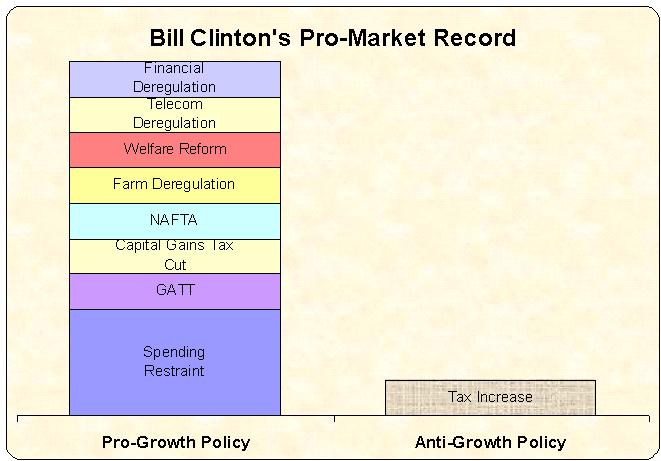
Clinton RecordTake a look at my homemade bar chart to compare the good policies of the 1990s with the bad policies. It’s not even close.

You may be thinking that my comparison is completely unscientific, and you’re right. I probably overlooked some good policies and some bad policies.

And my assumptions about weighting are very simplistic. Everything is equally important, with a big exception in that I made the government spending variable three times as important as everything else.

Why? Well, I think reducing the burden of government spending during the Clinton years was a major achievement.

But maybe we shouldn’t rely on my gut instincts. So let’s set aside my created-at-the-spur-of-the-moment bar chart and look at something that is scientific.

This chart is taken directly from Economic Freedom of the World, which uses dozens of variables to measure the overall burden of government.

As you can see, the United States score improved significantly during the Clinton years, showing that economic freedom was expanding and the size and scope of government was shrinking.

In other words, Patty Murray is correct. She is absolutely right to claim that Bill Clinton’s policies “helped grow the economy, create jobs, balance the budget.”

Now she needs to realize that those policies were small government and free markets.

Let me start this post by stating that George W. Bush was a bigger spender than Barack Obama (though the numbers are somewhat distorted by TARP, which caused a big increase in the burden of spending during Bush’s last fiscal year and artificially dampened outlays in Obama’s first fiscal year since repayments from the banks counted as negative spending).

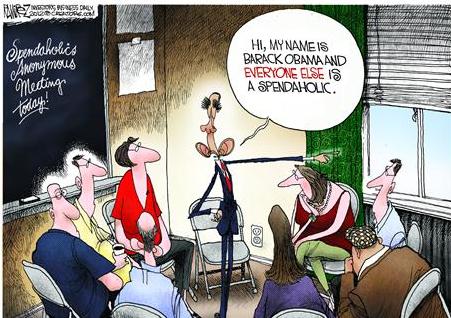
So I’m not trying to make a partisan point by sharing these cartoons. I don’t like it when Democrats increase the burden of government spending and I’m equally dismayed when Republicans engage in same type of profligacy.

That being said, I was a big dumbfounded when President Obama recently claimed that there’s not a spending problem in Washington.

We know that the United States has a huge long-run problem with deficits and debt according to both the Bank for International Settlements and the Organization for Economic Cooperation and Development.

We also know that tax revenues, measured as a share of GDP, will soon be above their post-World War II average and that the tax burden is expected to increase in coming decades.

So a person would have to be in serious denial to claim that spending isn’t a problem.

Which is the point Eric Allie makes in this cartoon.

Spending Problem Cartoon 1

And the point Robert Ariail makes in this cartoon.

Spending Problem Cartoon 2

Ditto for Bob Gorrell.

Spending Problem Cartoon 3

And Gary Varvel.

Spending Problem Cartoon 4

Last but not least, the great Michael Ramirez.

Spending Problem Cartoon 5.jpg

Gee, it’s almost like we’re seeing a pattern.

And if you like this spendaholic-in-denial theme, you can click here and here for further amusement.

P.S. Oh, by the way, if anybody’s actually interested in how to solve the spending problem (you know, the one that doesn’t exist), we do know the answer.

P.P.S. Remember when Obama claimed the private sector was doing fine? Well, here’s how cartoonists mocked him for that absurd comment.

Open letter to President Obama (Part 263)

Spending Restraint, Part I: Lessons from Ronald Reagan and Bill Clinton

Uploaded by on Feb 14, 2011

Ronald Reagan and Bill Clinton both reduced the relative burden of government, largely because they were able to restrain the growth of domestic spending. The mini-documentary from the Center for Freedom and Prosperity uses data from the Historical Tables of the Budget to show how Reagan and Clinton succeeded and compares their record to the fiscal profligacy of the Bush-Obama years.

________________


President Obama c/o The White House
1600 Pennsylvania Avenue NW
Washington, DC 20500

Dear Mr. President,

I know that you receive 20,000 letters a day and that you actually read 10 of them every day. I really do respect you for trying to get a pulse on what is going on out here.

If we want to get on the right track again in this country then we must lower taxes for the job creators.  Dan Mitchell points out that tax policy is not the only policy you need to pay attention to:

There are five major policy areas, each of which counts for 20 percent of a nation’s grade.

  1. Size of government
  2. Regulation
  3. Monetary Policy
  4. Trade
  5. Rule of Law/Property Rights

I’m a big fan of fundamental tax reform, in part because I believe in fairness and want to reduce corruption.

But I also think the flat tax will boost the economy’s performance, largely because lower tax rates are the key to good tax policy.

There are four basic reasons that I cite when explaining why lower rates improve growth.

  1. They lower the price of work and production compared to leisure.
  2. They lower the price of saving and investment relative to consumption.
  3. They increase the incentive to use resources efficiently rather than seek out loopholes.
  4. They attract jobs and investment from other nations.

As you can see, there’s nothing surprising or unusual on my list. Just basic microeconomic analysis.

Yet some people argue that lower tax rates don’t make a difference. And if lower tax rates don’t help an economy, then presumably there is no downside if Obama’s class-warfare tax policy is implemented.

Many of these people are citing David Leonhardt’s column in Saturday’s New York Times. The basic argument is that Bush cut tax rates, but the economy stunk, while Clinton increased tax rates and the economy did well.

The defining economic policy of the last decade, of course, was the Bush tax cuts. President George W. Bush and Congress, including Mr. Ryan, passed a large tax cut in 2001, sped up its implementation in 2003 and predicted that prosperity would follow. The economic growth that actually followed — indeed, the whole history of the last 20 years — offers one of the most serious challenges to modern conservatism. Bill Clinton and the elder George Bush both raised taxes in the early 1990s, and conservatives predicted disaster. Instead, the economy boomed, and incomes grew at their fastest pace since the 1960s. Then came the younger Mr. Bush, the tax cuts, the disappointing expansion and the worst downturn since the Depression. Today, Mitt Romney and Mr. Ryan are promising another cut in tax rates and again predicting that good times will follow. …Mr. Romney and Mr. Ryan would do voters a service by explaining why a cut in tax rates would work better this time than last time.

While I’ll explain below why I think he’s wrong, Leonhardt’s column is reasonably fair. He gives some space to both Glenn Hubbard and Phil Swagel, both of whom make good points.

“To me, the Bush tax cuts get too much attention,” said R. Glenn Hubbard, who helped design them as the chairman of Mr. Bush’s Council of Economic Advisers and is now a Romney adviser. “The pro-growth elements of the tax cuts were fairly modest in size,” he added, because they also included politically minded cuts like the child tax credit. Phillip L. Swagel, another former Bush aide, said that even a tax cut as large as Mr. Bush’s “doesn’t translate quickly into higher growth.” Why not? The main economic argument for tax cuts is simple enough. In the short term, they put money in people’s pockets. Longer term, people will presumably work harder if they keep more of the next dollar they earn. They will work more hours or expand their small business. This argument dominates the political debate.

I hope, by the way, that neither Hubbard nor Swagel made the Keynesian argument that tax cuts are pro-growth because “they put money in people’s pockets.” Leonhardt doesn’t directly attribute that argument to either of them, so I hope they’re only guilty of proximity to flawed thinking.

But that’s besides the point. Several people have asked my reaction to the column, so it’s time to recycle something I wrote back in February. It was about whether a nation should reform its tax system, but the arguments are the same if we replace “a flat tax” with “lower tax rates.”

…even though I’m a big advocate for better tax policy, the lesson from the Economic Freedom of the World Index…is that adopting a flat tax won’t solve a nation’s economic problems if politicians are doing the wrong thing in other areas.

There are five major policy areas, each of which counts for 20 percent of a nation’s grade.

  1. Size of government
  2. Regulation
  3. Monetary Policy
  4. Trade
  5. Rule of Law/Property Rights

Now let’s pick Ukraine as an example. As a proponent of tax reform, I like that lawmakers have implemented a 15 percent flat tax.

But that doesn’t mean Ukraine is a role model. When looking at the mix of all policies, the country gets a very poor score from Economic Freedom of the World Index, ranking 125 out of 141 nations.

Conversely, Denmark has a very bad tax system, but it has very free market policies in other areas, so it ranks 15 out of 141 countries.

In other words, tax policy isn’t some sort of magical elixir. The “size of government” variable accounts for just one-fifth on a country’s grade, and keep in mind that this also includes key sub-variables such as the burden of government spending.

Yes, lower tax rates are better for economic performance, just as wheels matter for a car’s performance. But if a car doesn’t have an engine, transmission, steering wheel, and brakes, it’s not going to matter how nice the wheels are.

Not let’s shift from theory to reality. Here’s the historical data for the United States from Economic Freedom of the World. As you can see, overall economic policy moved in the right direction during the Clinton years and in the wrong direction during the Bush-Obama years.

To be more specific, the bad policy of higher tax rates in the 1990s was more than offset by good reforms such as lower trade barriers, a lower burden of government spending, and less regulation.

Similarly, the good policy of lower tax rates last decade was more than offset by bad developments such as a doubling of the federal budget, imposition of costly regulations, and adoption of two new health entitlements.

This is why I have repeatedly challenged leftists by stating that I would be willing to go back to Bill Clinton’s tax rates if it meant I could also go back to the much lower levels of spending and regulation that existed when he left office.

_________________

Thank you so much for your time. I know how valuable it is. I also appreciate the fine family that you have and your commitment as a father and a husband.

Sincerely,

Everette Hatcher III, 13900 Cottontail Lane, Alexander, AR 72002, ph 501-920-5733, lowcostsqueegees@yahoo.com

New Evidence Shows States with No Income Tax Grow Faster and Create More Jobs

Will Taxing the Rich Fix the Deficit?

Published on Jul 2, 2012

The government’s budget deficit in 2009 was $1.5 trillion. Many have suggested raising taxes on the rich to cover the difference between what the government collected in revenue and what it spent. Is that a realistic solution? Economics professor Antony Davies uses data to demonstrate why taxing the rich will not be sufficient to make the budget deficit disappear. He says, “The budget deficit is so large that there simply aren’t enough rich people to tax to raise enough to balance the budget.” Instead, it’s time to work on legitimate solutions, like cutting spending.

_______

There are many states that really go after the rich in a big way with their state income tax. Evidently that is not the way to go if you want your economy to grow.

New Evidence Shows States with No Income Tax Grow Faster and Create More Jobs

December 15, 2012 by Dan Mitchell

One of the key ways of controlling state and local tax burdens, according to this map from the Tax Foundation, is to not have an income tax.

But that’s not too surprising. States have just a couple of ways of generating significant tax revenue, so it stands to reason that states without an income tax would have relatively low tax burdens.

Light-blue states have no broad-based income tax
The more important question is whether this approach leads to better economic performance. The evidence is pretty clear that zero-income-tax states grow faster and create more jobs.

I’ve already shared some important research on this topic, including this review of research in the Cato Journal by Richard Rahn, as well as this summary of similar analysis in Rich States, Poor States by Art Laffer and Steve Moore.

There’s even some evidence that people in low-tax states are happier than those in high-tax states, though I’m not sure that I trust that kind of subjective research since there’s also a study showing people are happier in high-tax nations.  (at least, unlike Brazil, nobody in the U.S. is talking about making happiness a responsibility of government).

Let’s return to the more substantive topic of taxes and economic performance. There’s a column examining this issue in today’s Wall Street Journal. Authored by two experts from the Kansas Policy Institute, it finds that states with no income tax have a lower burden of government spending.

In the midst of a dismal recovery where every job counts, one fact stands out: States that tax less achieve better economic performance. …The secret to having low taxes is controlling spending, and that’s exactly what low-tax-burden states do. States with an income tax spent 42% more per resident in 2011 than the nine states without an income tax. …Every state has public schools, social-service programs, prisons, etc. Some just find ways to provide essentially the same basket of services at lower prices.

They also reveal that lower taxes and lower spending translate into more growth and prosperity.

States that allow taxpayers and employers to keep more of their earnings are reaping the benefits. States without an income tax have significantly better growth in private sector GDP (59% versus 42%) over the last 10 years. They increased the number of jobs by 4.9% while jobs in the rest of the states declined by 2.6%. States without an income tax gained population (+5.5%) from domestic migration (U.S. residents moving in and out of states) while all other states as a whole lost 1.3% of population between 2000 and 2009.

The migration data is particularly powerful, and it’s one of the reasons why California’s class-warfare tax policy is so suicidal and why Texas is growing so rapidly. As I’ve said many times before, tax competition is a critical way of disciplining profligate governments and rewarding jurisdictions with more responsible fiscal policy.

Last but not least, if you want a powerful example of why income taxes are economic poison, read this research showing how Connecticut’s economic performance dropped after imposing a state income tax about 20 years ago.

P.S. Here’s a list of America’s greediest state and local governments, as measured by top income tax rates and most onerous sales tax systems.

P.P.S. Here’s the famous Moocher Index of state dependency, and you’ll notice that states with no income tax are more likely to be near the bottom of the list (with Alaska being a notable – but not surprising – exception).

P.P.P.S. And if you like state fiscal data, the Cato Institute’s Fiscal Policy Report Card on America’s Governors shows which states are moving in the wrong direction and right direction.

P.P.P.P.S. According to this map from a left-wing group, it also seems that states with no income tax do a better job of controlling welfare spending.

Open letter to President Obama (Part 259)

Spending Restraint, Part I: Lessons from Ronald Reagan and Bill Clinton

Uploaded by on Feb 14, 2011

Ronald Reagan and Bill Clinton both reduced the relative burden of government, largely because they were able to restrain the growth of domestic spending. The mini-documentary from the Center for Freedom and Prosperity uses data from the Historical Tables of the Budget to show how Reagan and Clinton succeeded and compares their record to the fiscal profligacy of the Bush-Obama years.

____________


President Obama c/o The White House
1600 Pennsylvania Avenue NW
Washington, DC 20500

Dear Mr. President,

I know that you receive 20,000 letters a day and that you actually read 10 of them every day. I really do respect you for trying to get a pulse on what is going on out here.

Why is it that so many times when Washington runs out of money they instantly think they need to get more from the taxpayers. Did you know that the federal government ran on about 3% of GDP in taxes the first 150 years it existed (excluding wartimes). Maybe the real problem is controlling government spending since we are giving the federal government much more than 3% of our GDP in taxes and they are currently spending about 24% of our GDP in federal dollars every year and running us into debt.

On 9-18-12 I noted on the Arkansaas Times Blog:

The federal government has how much money? Negative 16 trillion I believe. How can they pay for all our medical needs in the future without turning everything around on us at the state level? I guess liberals are the only ones dumb enough to believe Obama’s empty promises. He took over when there was a federal debt of around 10 trillion and now it is over 16 trillion. I guess we could do even better if we gave him his Obamacare and re-elected him. The only alternative is to elect a Republican House and Senate and President and kill Obamacare. I sure that sounds heartless to the liberals. Everything is working so good right now why change course.

Couldn’t be better responded with a good point,  “Interesting, Saline, that Republicans ran up that $10 trillion in the national debt during good times when they should have been paying it down or totally writing it off.”

I totally agree that Republicans have also had a lot to do with running up the debt. They have got us into wars that we have not budgeted for and we continue to pay for Japan and Germany’s defenses when they are wealthy enough to do it on their own.

However, what is the answer to getting us out of this budget mess? Is raising taxes the answer? Let’s see what the Clinton Administration had to say about that. Below is the last portion of an article by Dan Mitchell of the Cato Institute:

Debunking Myth after Myth in Financial Times Column by Former Clinton White House Economist
September 18, 2012 by Dan Mitchell

Even though I have remarked on many occasions that the burden of government was reduced during the Clinton years, that doesn’t mean Bill Clinton was in favor of smaller government. And it definitely doesn’t mean that his appointees believed in economic liberty.

Consider the case of Laura Tyson, who served as Chair of Clinton’s Council of Economic Advisers. She recently penned a column for the UK-based Financial Times that is riddled with disingenuous assertions.

Even though it deserves to be ignored, I can’t resist the temptation to make corrections.

Tyson myth:

The US economy needs efficient and progressive tax reform and it needs more revenues for deficit reduction. Revenue increases have been a significant component of all major deficit-reduction packages enacted over the past 30 years.

Factual correction:

This is remarkable. I assume Ms. Tyson reads the New York Times, so perhaps she overlooked or deliberate forgot the column that inadvertently revealed that the only successful deficit-reduction package in recent memory was the one that cut taxes instead of raising them.

Interestingly, that successful package was implemented during the Clinton years, but only after she left office.

During Tyson’s tenure at CEA, we did get a tax increase rather than a tax cut. But the Clinton Administration admitted 18 months later that the tax hike was a failure and was not going to balance the budget.

Yet she wants to push the same failed class-warfare tax policy today.

_________

Thank you so much for your time. I know how valuable it is. I also appreciate the fine family that you have and your commitment as a father and a husband.

Sincerely,

Everette Hatcher III, 13900 Cottontail Lane, Alexander, AR 72002, ph 501-920-5733, lowcostsqueegees@yahoo.com

_______

Spending Restraint, Part II: Lessons from Canada, Ireland, Slovakia, and New Zealand

Uploaded by on Feb 22, 2011

Nations can make remarkable fiscal progress if policy makers simply limit the growth of government spending. This video, which is Part II of a series, uses examples from recent history in Canada, Ireland, Slovakia, and New Zealand to demonstrate how it is possible to achieve rapid improvements in fiscal policy by restraining the burden of government spending. Part I of the series examined how Ronald Reagan and Bill Clinton were successful in controlling government outlays — particularly the burden of domestic spending programs. http://www.freedomandprosperity.org

100 years of the federal income tax

How Raising Taxes Will Not Balance the Budget: More Evidence

Published on Nov 15, 2012

Although it may seem counterintuitive, raising taxes on the rich does not actually increase the amount of taxes the government collects. How could this possibly be the case? According to Professor Antony Davies, it is because the many loopholes in federal income taxes, capital gains taxes, and many other taxes, enable people to partially avoid these taxes. Perhaps instead of discussing how to raise tax revenues, we should spend our energy simplifying the tax code. This would make it more difficult for people to avoid taxes and, Davies says, “The less time and money we spend trying to work around a complex tax code, the more time and money we will have available to put to more productive uses.”

Do you think that the tax code is too complicated? Let us know in the comments!

________________________

Sad day indeed 100 years ago.

What’s the worst thing about Delaware?

No, not Joe Biden. He’s just a harmless clown and the butt of some good jokes.

Instead, the so-called First State is actually the Worst State because 100 years ago, on this very day, Delaware made the personal income tax possible by ratifying the 16th Amendment.

Though, to be fair, I suppose the 35 states that already had ratified the Amendment were more despicable since they were even more anxious to enable this noxious levy (and Alabama was first in line, which is a further sign that Georgia deserved to win the Southeastern Conference Championship Game, but I digress).

Let’s not get bogged down in details. The purpose of this post is not to re-hash history, but to instead ask what lessons we can learn from the adoption of the income tax.

The most obvious lesson is that politicians can’t be trusted with additional powers. The first income tax had a top tax rate of just 7 percent and the entire tax code was 400 pages long. Now we have a top tax rate of 39.6 percent (even higher if you include additional levies for Medicare and Obamacare) and the tax code has become a 72,000-page monstrosity.

But the main lesson I want to discuss today is that giving politicians a new source of money inevitably leads to much higher spending.

Here’s a chart, based on data from the Office of Management and Budget, showing the burden of federal spending since 1789.

Since OMB only provides aggregate spending data for the 1789-1849 and 1850-190 periods, which would mean completely flat lines on my chart, I took some wild guesses about how much was spent during the War of 1812 and the Civil War in order to make the chart look a bit more realistic.

But that’s not very important. What I want people to notice is that we enjoyed a very tiny federal government for much of our nation’s history. Federal spending would jump during wars, but then it would quickly shrink back to a very modest level – averaging at most 3 percent of economic output.

Federal Spending 1789-2012

So what’s the lesson to learn from this data? Well, you’ll notice that the normal pattern of government shrinking back to its proper size after a war came to an end once the income tax was adopted.

In the pre-income tax days, the federal government had to rely on tariffs and excise taxes, and those revenues were incapable of generating much revenue for the government, both because of political resistance (tariffs were quite unpopular in agricultural states) and Laffer Curve reasons (high tariffs and excise taxes led to smuggling and noncompliance).

But once the politicians had a new source of revenue, they couldn’t resist the temptation to grab more money. And then we got a ratchet effect, with government growing during wartime, but then never shrinking back to its pre-war level once hostilities ended (Robert Higgs wrote a book about this unfortunate phenomenon).

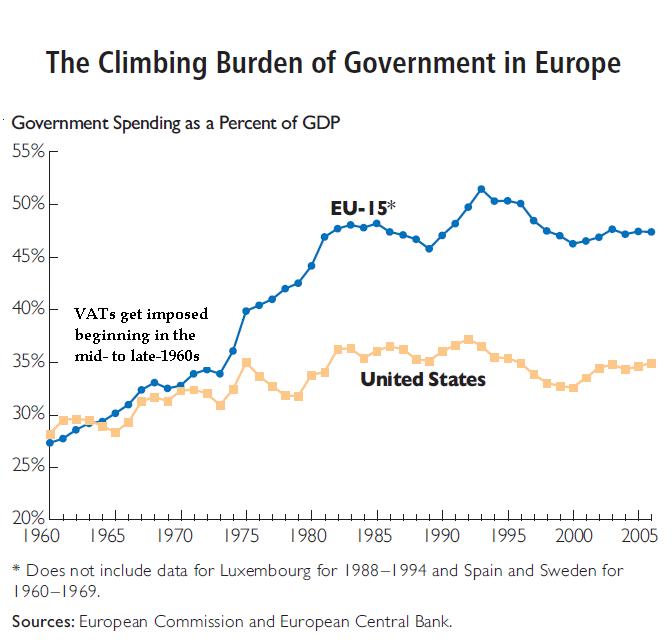
The same thing happened in Europe. The burden of government spending used to be quite modest on the other side of the Atlantic, with outlays consuming only about 10 percent of economic output.

Once European politicians got the income tax, however, that also enabled a big increase is the size of the state.

But Europe also gives us a very good warning about the dangers of giving politicians a second major source of revenue.

Here’s a chart I prepared for a study published when I was at the Heritage Foundation. You’ll notice from 1960-1970 that the overall burden of government spending in Europe was not that different than it was in the United States.

That’s about the time, however, that the European governments began to impose value-added taxes.

The rest, as they say, is history.

VAT and Govt Spending in EU

I’m not claiming, by the way, that the VAT is the only reason why the burden of government spending expanded in Europe. The Europeans also impose harsher payroll taxes and higher energy taxes. And their income taxes tend to be much more onerous for middle-income households.

But I am arguing that the VAT helped enable bigger government in Europe, just like the income tax decades earlier also enabled bigger government in both Europe and the United States.

So ask yourself a simple question: If we allow politicians in Washington to impose a VAT on top of the income tax, do you think they’ll use the money to expand the size and scope of government?

If it takes more than three seconds to answer that question, I suggest you emigrate to France as quickly as possible.

P.S. You probably won’t be surprised to learn that the crazy bureaucrats at the Paris-based OECD think the VAT is good for growth and jobs. Sort of makes you wonder why we’re subsidizing those statists with American tax dollars.

We got to starve the beast and not increase taxes (includes editorial cartoon)

Does Government Have a Revenue or Spending Problem?

People say the government has a debt problem. Debt is caused by deficits, which is the difference between what the government collects in tax revenue and the amount of government spending. Every time the government runs a deficit, the government debt increases. So what’s to blame: too much spending, or too little tax revenue? Economics professor Antony Davies examines the data and concludes that the root cause of the debt is too much government spending.

____________

We got to starve the beast and not increase taxes.

The statist agenda of ever-growing government requires more money going to Washington, which is why I think that proponents of limited government should do everything they can to block tax increases.

This is the “starve the beast” theory, and I’ve previously explained why I think it is a necessary part of any long-run strategy to restrain the burden of government spending.

He would never admit it, but Obama seems to agree, which is why he is dogmatically fixated on doing everything he can to seduce Republicans into supporting higher taxes.

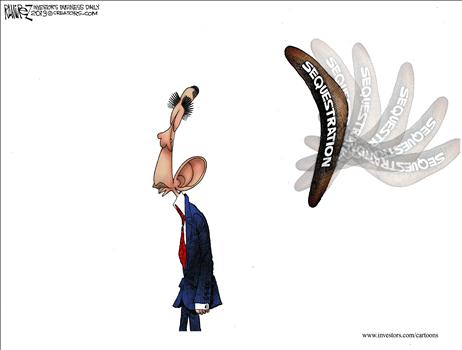
Obama Sequester Boomerang CartoonBut he miscalculated in thinking that the fiscal cliff tax hike somehow meant that he had permanently neutered the GOP, and he definitely goofed when he tried to use the sequester as a weapon to bully Republicans into another tax hike.

Ignoring the President’s hyperbole about the supposed catastrophic effects of a very modest reduction in the growth of the federal budget, Republicans have held firm.

And the President has suffered a painful political and policy defeat.

Here’s some of what was reported in The Hill about the President’s attitude.

The first months of President Obama’s second term are being built around a simple premise: No caving. …Obama is in an ultra-assertive mood, practically daring Republicans to defy his wishes. …Obama’s attitude is more akin to that of a general leading his forces into battle, confident that he can decimate the enemy. …On the sequester, for instance, Obama did little more than pay lip-service to the idea of a last-minute compromise to avert the package of cuts.

Well, Republicans did “defy his wishes” and it’s the worst possible outcome for the President. The growth of spending is being slowed and taxes are not going up.

Democrats on Capitol Hill also thought that the fiscal cliff tax hike would be a precedent for lots of future tax hikes. As reported by Politico, their analysis was misguided.

Democrats toasted the New Year’s fiscal cliff deal with the belief that they had set a crucial new precedent: Tax hikes would be part of any future deficit reduction package. Two months later, the champagne buzz is wearing off. …the exuberance expressed by many Democrats at the beginning of the year was misplaced. Efforts to avert the sequester never achieved liftoff, and Democrats are realizing that new tax revenues are off the table for the immediate future. …“We’ve tried everything we can,” Senate Majority Leader Harry Reid (D-Nev.) told reporters Thursday. “They will not budge on anything dealing with revenue.”

Byron York has the best analysis, explaining in his Washington Examiner column that Obama gambled and (at least so far) lost.

Nine months ago, Barack Obama likened his Republican opposition to an illness. If he could just defeat Mitt Romney, Obama said, then the illness might subside. “I believe that if we’re successful in this election — when we’re successful in this election — that the fever may break,” Obama told a fundraiser in Minneapolis last June. After Obama won re-election, there was extensive discussion among his supporters about whether the Republican “fever” would, in fact, break.

But this strategy appears to have boomeranged. Byron thinks that the White House is now in a weak position.

There was little speculation about whether something quite different might happen: Would determined GOP opposition break Obama’s fever?  That is, could Republicans weaken the president’s resolve to defeat the GOP and further raise taxes? That appears to be what has occurred, at least for the moment. …Friday morning, Obama seemed resigned to the possibility that he cannot win the further tax increases he seeks, and that after enlisting his entire administration in a campaign to frighten Americans about sequestration, the cuts have become a reality that he has to acknowledge.

While I’m glad the President goofed, I’m not under any illusion that winning a battle is the same thing as winning a war.

It’s quite possible that the modest sequester savings will be undone as part of the “continuing resolution” legislation to fund the federal government between March 27 and the rest of the fiscal year.

There will also be a debt limit fight later in the Spring, which will give proponents of bigger government another bite at the apple (though it’s a double-edged sword since advocates of limited government also can use the debt limit as a vehicle for reform).

And the President obviously won’t give up on his campaign for higher taxes. I worry that he’ll trick gullible GOPers into a tax hike at some point, either as part of a Trojan Horse tax reform or as part of a budget summit that produces something like Bowles-Simposon, a package of real tax hikes and illusory entitlement reforms.

But we can fight those battles down the road. Today, let’s enjoy the sweet smell of victory.

Open letter to President Obama (Part 253)

Dan Mitchell Discussing Fake Austerity in Europe on Fox Business

Published on May 9, 2012 by

No description available.

_________________


President Obama c/o The White House
1600 Pennsylvania Avenue NW
Washington, DC 20500

Dear Mr. President,

I know that you receive 20,000 letters a day and that you actually read 10 of them every day. I really do respect you for trying to get a pulse on what is going on out here.

I think Dan Mitchell is right about France heading the wrong direction. Mr. President you need to watch what happens to France in the next few years. It will not be pretty.

I’m a bad person. I know it’s not nice to take joy in the misery of others, but I can’t help but smile when I see a story about bad news in France.

In my defense, this is not because of hostility to French people, who have always been friendly to me. Instead, France has become the global symbol of statism (particularly since Sweden has been moving in the right direction). The French, for instance, are increasingly infamous for class-warfare tax policy and onerous levels of intervention.

And since it’s my job to promote liberty, I’ll confess that it’s easier for me to convince non-French policy makers that free markets and small government are the right approach when there’s more evidence that statism is failing in France.

So why am I smiling? Well, France wasn’t doing so well under the de facto socialist Nicolas Sarkozy, and it seems that things are looking even worse now that the de jure socialist Francois Hollande is in charge.

Here’s some of what Reuters recently reported.

“It’s always time for a tax hike!”

The French are bleaker about their country’s future than at any time since 2005, a new poll showed on Saturday, with 68 percent saying they are “rather” or “very” pessimistic… Hollande’s government has been reeling from unemployment at a 13-year high and a rash of job cuts in recent weeks at top employers like carmaker Peugeot and retailer Carrefour. The government launched a plan this week to create 150,000 state-sponsored jobs for youth. Only 34 percent of those surveyed were confident in the government’s ability to battle unemployment, and just 20 percent expect the government to be able to improve their buying power. …The poll found that the pessimism extended even to 58 percent of Socialist party supporters.

I’m wondering when the pessimism will spread to investors. France recently lost its triple-A credit rating, but the rating agencies don’t do a good job, so I think it’s much more important to look at the prices of credit default swaps.

In other words, how much does it cost for an investor to insure debt from the French government? According to this CNBC site, France isn’t viewed as being as creditworthy as nations such as Switzerland, Germany, and the United States, but it is closer to those countries than it is to Spain, Italy, or Portugal.

This is just a guess on my part, but I think France is reaching the point where investors are suddenly going to get concerned about the government’s ability to fulfill its promises.

If Hollande follows through on his threat to impose a “patriotic” 75-percent tax rate, for example, that could be the trigger that makes the bond market a lot more skittish. Particularly since it will result in fewer rich people in France.

I’ve already written about French entrepreneurs and investors leaving the country because of Hollande’s class-warfare tax agenda. It’s gotten so bad that even Hollywood types are packing their bags.

Actor Johnny Depp has moved out of France and returned to America because he didn’t want to become a permanent French resident and pay income tax there. …Depp has now moved his family out of France after government officials asked him to become a permanent resident, as he feared he would end up paying tax in both countries. He tells Britain’s The Guardian newspaper, “…France wanted a piece of me. They wanted me to become a permanent resident. Permanent residency status – which changes everything. They just want… Dough. Money… ” Depp goes on to explain that if he spends more than 183 days a year in France he will have to pay income tax in both Europe and America, adding, “So you essentially work for free.”

Wow, complaining that he doesn’t want to “work for free.” What is he, some sort of radical libertarian from the Tea Party?

But he may want to chat with fellow tax-averse actor Jon Lovitz before moving back to America. Obama’s class-warfare agenda isn’t as bad as what Hollande is trying to impose, but it’s not Hong Kong or the Cayman Islands either.

P.S. Here’s a very good Chuck Asay cartoon about the French economy.

P.P.S. In a few areas, France has better policy than the United States.

______________________

Thank you so much for your time. I know how valuable it is. I also appreciate the fine family that you have and your commitment as a father and a husband.

Sincerely,

Everette Hatcher III, 13900 Cottontail Lane, Alexander, AR 72002, ph 501-920-5733, lowcostsqueegees@yahoo.com

Open letter to President Obama (Part 252)

Dan Mitchell Commenting on Obama’s Failure to Propose a Fiscal Plan

Published on Aug 16, 2012 by

No description available.

___________


President Obama c/o The White House
1600 Pennsylvania Avenue NW
Washington, DC 20500

Dear Mr. President,

I know that you receive 20,000 letters a day and that you actually read 10 of them every day. I really do respect you for trying to get a pulse on what is going on out here.

We have to change the economic direction of our country!!! The Heritage Foundation gives us a plan to get our country on a firm financial basis again.

Amy Payne

August 31, 2012 at 9:09 am

Entering the final stretch of the presidential contest, Americans are facing a monumental choice. The American people will decide the direction of government and its role in their lives for the coming years.

The debate in Tampa this week raised a number of issues, including preserving the American dream of working hard to achieve success. The Heritage Foundation has extensive research and policy prescriptions on each of these issues:

Energy: America needs to end energy subsidies and restore a free market in the energy sector. We can and should develop our domestic energy sources in an environmentally responsible way. Go to Energy & Environment

School choice: America’s education focus should be our students. The best way to serve the needs of a diverse population is to give families the freedom to choose a school—public, private, charter, or home school—that best fits their children’s needs. See where your state stands

Free trade: America needs jobs, and promoting free trade is an excellent way to create high-quality jobs in America. We should have a free flow of goods, services, and investments between democratic nations. Catch up on the U.S. free trade record

The federal budget: Tackling the federal budget is a complex task, but it must be done. Heritage’s Saving the American Dream plan details ideas for reforming major entitlement programs, permanently balancing the budget, and reducing the national debt. See the Heritage plan

Tax reform: America’s families and businesses need tax relief. A tax cut here and there isn’t enough; we need fundamental tax reform. A tax system that is simple and fair would spur economic growth and protect those at the bottom of the income ladder. How it could be done

Repealing Obamacare: Obamacare doesn’t stop with government intrusion into your relationship with your doctor. It also raises taxes, adds to the U.S. deficit, and attacks religious and personal freedoms. Top 5 Reasons to Repeal Obamacare

Reforming Medicare: Medicare reform is not an option—it is a necessity. To keep the program working for those it is designed to help, we should give seniors more control over their health care decisions and guarantee better access to quality care. The way forward for Medicare

Next week, the debate will continue in Charlotte, and more policy issues may enter the mix.

There’s no way to predict how the election will turn out. But as Heritage’s Matt Spalding has written, “it will be a turning point in American history: Either our leaders will guide the country even further along the road to ‘progressivism’ or they will begin a long, slow turn back toward the principles of the American Founding.”

“The federal government has acquired an all but unquestioned dominance over virtually every area of American life,” Spalding says. “It acts without constitutional limits and is restricted only by expediency, political will, and (less and less) budget constraints.”

The Heritage Foundation recently published Changing America’s Course, which gives our political leaders recommendations on how to stay within the limits of the Constitution.

To put America on a path toward preserving and growing freedom, Spalding says, “The first step is to reduce the size and scope of government and unleash the engines of economic productivity and the institutions of cultural renewal.”

It is possible to change America’s course.

_____________

Thank you so much for your time. I know how valuable it is. I also appreciate the fine family that you have and your commitment as a father and a husband.

Sincerely,

Everette Hatcher III, 13900 Cottontail Lane, Alexander, AR 72002, ph 501-920-5733, lowcostsqueegees@yahoo.com

California raises taxes again!!!

California has been mad fun of several times in the past on this blog. Now they have done it again.

I was surprised when the people of Oregon voted for a tax increase back in early 2010.

Yes, I realize that the politicians and interest groups structured the measure so that the majority of voters would be unaffected. It was basically a class-warfare proposal, with a small fraction of the population being targeted to generate (at least in theory) a bunch of revenue that could be used to maintain a bloated and over-compensated state bureaucracy.

But I was nonetheless surprised because I figured voters would realize that upper-income taxpayers aren’t fatted calves idly awaiting slaughter. They can easily move to other states (particularly nearby zero-income tax states such as Washington and Nevada).

In other words, I thought Oregon voters understood that you shouldn’t drive away the geese that lay the golden eggs. A state isn’t like the old Soviet Empire, with an “Iron Curtain” of watchtowers and guard dogs to keep a population under control.

I was wrong about Oregon, so I shouldn’t be too surprised that California voters basically just made the same mistake.

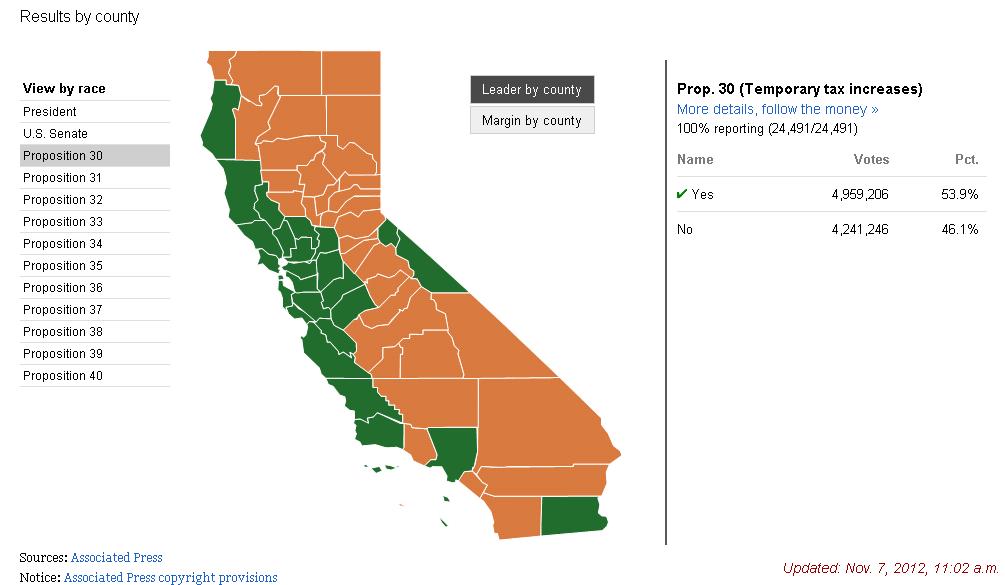
Yesterday, the looters and moochers of the Golden State voted for Prop 30, a measure to significantly boost both the state sales tax and also hike income tax rates on investors, entrepreneurs, and small business owners.

I’m generally reluctant to make predictions, but I feel safe in stating that this measure is going to accelerate California’s economic decline. Some successful taxpayers are going to tunnel under the proverbial Berlin Wall and escape to states with better (or less worse) fiscal policy. And that will mean fewer jobs and lower wages than otherwise would be the case.

It goes without saying, of course, that California’s politicians will respond to Prop 30 by increasing the burden of government spending. They then will act surprised when revenues fall short of projections because of the Laffer Curve.

The bottom line is that the state will remain in the fiscal ditch and I expect a Greek-style fiscal crisis. When that happens, I’ll be tempted to point and laugh and make snarky comments such as “you broke it, you bought it.” But my long-run worry is that Obama may push for a federal bailout.

Let’s now take a look at the other ballot measures I wrote about on Monday.

I said the two most important measures were Prop 30 in California and Prop 2 in Michigan. Well, we know things went the wrong way in the Golden State on Prop 30, but it seems the voters in the Wolverine State are a bit more rational.

Prop 2, which would have permanently rigged the rules even further in favor of government workers, was soundly defeated by a 58-42 margin. Taxpayers presumably recognized that it wouldn’t be a good idea to dig the hole even deeper.

Here’s a quick breakdown of the other ballot measures. A majority of them went the right way. I’ve underlined good votes.

Prop 38 and Prop 39 – Two additional tax hike measures, the first targeting individual taxpayers and the second targeting businesses. Rejected 73-27 and approved 60-40.

Prop 204 in Arizona – Renewing a one-cent increase in the state sales tax, ostensibly for the education bureaucracy. Rejected 65-35.

Issue 1 in Arkansas – Imposing a half-cent increase in the state sales tax, supposedly for highway spending. Approved 58-42.

Prop 5 in Michigan – Would require a two-thirds vote of both the state house and state senate to raise any tax. Rejected 69-31.

Prop B in Missouri – Raise the cigarette tax by 73 cents per pack. Rejected 51-49.

Constitutional Amendment Concurrent Resolution 13 in New Hampshire – A constitutional amendment to prohibit enactment of an income tax. Received 57 percent of the vote, but needed a super-majority for approval.

Measure 84 in Oregon – Would repeal the state’s death tax. Rejected 53-47.

Initiated Measure 15 in South Dakota – Increases the state sales tax from 4 percent to 5 percent. Rejected 57-43.

Initiative 1185 in Washington – Reaffirms the state’s two-thirds supermajority requirement before the state legislature can increase taxes. Approved 65-35.

Prop 114 in Arizona – Protects crime victims from being sued if they injure or kill criminals. Approved 80-20.

Amendment 2 in Louisiana – Strengthens right to keep and bear arms. Approved 73-27.

Amendment 64 in Colorado, Measure 80 in Oregon, and Initiative 502 in Washington – All of these ballot measures end marijuana prohibition to varying degrees. Approved 55-45 in Colorado. Rejected 55-45 in Oregon. Approved in Washington.

Prop 1 in Idaho – This measure would overturn recent legislative reforms to end tenure in government schools. Rejected 57-43.

Prop 3 in Michigan – Require 25 percent of electricity to come from renewables. Rejected 63-37.

Question 1 in Virginia – Limits eminent domain to public purposes. Approved 75-25.

Amendment 6 in Alabama, Amendment 1 in Florida, Prop E in Missouri, Legislative Referendum 122 in Montana, and Amendment A in Wyoming – These are all anti-Obamacare initiatives in some form or fashion. Approved 60-40 in Alabama. Rejected 51-49 in Florida. Approved 62-38 in Missouri. Approved 67-33 in Montana. Approved 77-23 in Wyoming.

Is there a single lesson or theme we can discern from all these results? Other than the fact that people in California and Oregon are downright crazy?

Beats me. I think most Americans still believe in the classical liberal vision of a small federal government. But I also think the entitlement culture is becoming a greater and greater problem.

P.S. Speaking of the Iron Curtain, Walter Williams imagines California with a barbed wire fence to stop tax escapees.

P.P.S. This great Chuck Asay cartoon imagines how future archaeologists will view the Golden State.

Related posts:

Ernie Dumas:Arkansas’s growth has come when income taxes were raised

Rep. Terry Rice. Terry Rice quoted my political hero Ronald Wilson Reagan in his speech last week. I have a son named Wilson Daniel Hatcher and he is named after two of the most respected men I have ever read about : Daniel from the Old Testament and Ronald Wilson Reagan. One of the thrills […]

Arkansas Times blogger picks California business environment over Texas, proves liberals don’t live in real world(Part 2)

       Former California Governor Arnold Schwarzenegger with his family   I posted a portion of an article by John Fund of the Wall Street Journal that pointed out that many businesses are leaving California because of all of their government red tape and moving to Texas. My username is SalineRepublican and this is […]

Arkansas Times blogger criticizes Texas and their approach to business

I posted a portion of an article by John Fund of the Wall Street Journal that pointed out that many businesses are leaving California because of all of their government red tape and moving to Texas. My username is SalineRepublican and this is how “Couldn’tBeBetter” responded this morning: Saline, if Texas is so great, don’t […]

John Fund’s talk in Little Rock 4-27-11(Part 4):Responding to liberals who criticize states like Texas that don’t have the red tape that California has

John Fund at Chamber Day, Part 1 Last week I got to attend the first ever “Conservative Lunch Series” presented by  KARN and Americans for Prosperity Foundation at the Little Rock Hilton on University Avenue. This monthly luncheon will be held the fourth Wednesday of every month. The speaker for today’s luncheon was John Fund. John […]

Why do people move to other states to avoid Arkansas’ high state income tax? (If you love Milton Friedman then you will love this post)

Milton Friedman served as economic advisor for two American Presidents – Richard Nixon and Ronald Reagan. Although Friedman was inevitably drawn into the national political spotlight, he never held public office. Milton Friedman’s Free to Choose (1980), episode 1 – Power of the Market. part 1 Mike Huckabee recently moved to Florida? Why? The answer […]