Category Archives: Taxes

Open letter to President Obama (Part 310)

(Mailed before Oct 1, 2012.)

President Obama c/o The White House
1600 Pennsylvania Avenue NW
Washington, DC 20500

Dear Mr. President,

I know that you receive 20,000 letters a day and that you actually read 10 of them every day. I really do respect you for trying to get a pulse on what is going on out here.

Congress better step up to the plate and avoid the huge tax increase coming at the end of 2012. You don’t want that this tax increase to go into affect do you?

Curtis Dubay

April 16, 2012 at 5:33 pm

In a bit of scheduling serendipity, Tax Freedom Day—the day when Americans finally earn enough income to pay off the bill for all federal, state, and local taxes for the year—falls on April 17 this year. That also happens to be Tax Filing Day 2012.

Absent tax changes made by Congress, Tax Freedom Day moves earlier or later in the calendar from year to year based on the economy. If the economy is stronger, then more Americans are working and wages are rising. Larger incomes mean they pay more taxes and Tax Freedom day falls later in the year. The reverse happens when the economy is weak, as it is today.

Tax Freedom Day next year promises to be much later than April 17, but unfortunately not because of a strong economy, which even the Obama Administration is not predicting. No, Tax Freedom Day will be much later if Congress and President Obama fail to act promptly and prevent Taxmageddon from striking America’s families and small businesses.

Taxmageddon is a $494 billion tax hike. Not only would it push Tax Freedom Day much deeper into 2013, it would also make next year’s Tax Day considerably more painful than it was this year: American households would face an average tax increase of $3,800.

A big portion of the Taxmageddon increase would occur because tax cuts enacted more than a decade ago lowered all tax rates and put in place a new 10 percent bracket. They also doubled the child tax credit from $500 to $1,000, reduced the marriage penalty, and reduced the tax disincentives toward saving. These tax cuts are all slated to expire at the end of 2012. In total, because of the expiration of just these three tax policies, 70 percent of Taxmageddon would fall directly on low-income and middle-income families. That’s about $346 billion less for families to spend and a whole lot more for government to spend.

That’s not all. If Congress fails to act, then a lot more Americans are going to pay the alternative minimum tax, or AMT. This tax was only supposed to be paid by “the rich.” But, as so often happens, a tax targeted at the rich expanded over time so that it now threatens millions of middle-income families.

If Congress fails to act, workers won’t have to wait very long to feel the effects. Every payday, they would see a jump in their payroll tax as it takes a bigger bite out of every paycheck. And that only reflects the direct hit they’ll face. The health care surtax on investment income and salaries over $250,000—which begins in 2013 along with five other tax hikes—would slow job creation, because it would take away resources from businesses, investors, and entrepreneurs.

Other Taxmageddon tax hikes, such as the expiration of the “tax extenders,” the rise of the death tax, and end of 100 percent expensing for business investment, would also slow the economy. These would make it harder for those out of work to find a job or for those looking for a new opportunity to land a better job. It would also slam the stock market, making it harder to rebuild depleted retirement savings.

Congress and President Obama need to show voters they actually can get important things done, even in an election year. Stopping a nearly $500 billion economy-crushing tax hike shouldn’t be controversial. So what’s the hold up?

_________

Thank you so much for your time. I know how valuable it is. I also appreciate the fine family that you have and your commitment as a father and a husband.

Sincerely,

Everette Hatcher III, 13900 Cottontail Lane, Alexander, AR 72002, ph 501-920-5733, lowcostsqueegees@yahoo.com

If you want the rich to pay a bigger percentage of the nation’s tax revenues then keep their tax rates low!!!

If you want the rich to pay a bigger percentage of the nation’s tax revenues then keep their tax rates low!!!

Evidence from England Shows that If You Want to “Soak the Rich,” Keep Tax Rates Low

September 26, 2012 by Dan Mitchell

I’ve pulled evidence from IRS publications to show that rich people paid a lot more to Uncle Sam after Reagan reduced the top tax rate from 70 percent to 28 percent.

The good ol’ days

But the Gipper wasn’t the only one to unleash the Laffer Curve. The United Kingdom saw similar dramatic results when Margaret Thatcher lowered the top tax rate from 83 percent to 40 percent. Allister Heath explains.

During the 1970s, when the tax system specialised in inflicting pain, the top one per cent of earners contributed 11pc of income tax. By 1986-87, with the top rate down to 60pc, that had increased to 14pc. After the top rate fell to 40pc in 1988, the top 1pc’s share jumped, reaching 21.3pc by 1999-2000, 24.4pc in 2007-08 and 26.5pc in 2009-10. Lower taxes fuelled a hard-work culture and an entrepreneurial revolution. Combined with globalisation and the much greater rewards available for skilled workers, Britain’s most successful individuals earned a lot and paid a lot in tax.

In other words, Margaret Thatcher’s supply-side tax rate reductions paid big dividends, both for the economy and for the Treasury.

Unfortunately, just as American politicians have forgotten (or decided to ignore) the lessons of the Reagan era, British politicians also have gravitated to a class-warfare approach. Allister points out that this is having a negative impact.

Yet times are changing, and not just because of the recession. HMRC recently slashed its forecasts for revenues from the top 1pc. It now believes the number of people expected to report £500,000 or more in earnings will fall by a tenth this year; those on £2m are set to drop by a third.

Why have the numbers headed in the wrong direction? There are almost certainly lots of factors, but tax policy has moved in the wrong direction and presumably deserves part of the blame. The top income tax rate is now 45 percent. The value-added tax has jumped to 20 percent. Allister provides more details.

Capital gains tax is too high. Luxury homes transactions are falling because of higher stamp duty. Britain is now a high tax economy; this is distorting work and investment decisions, gradually shifting talent and capital overseas. The overwhelming majority of high earners are already contributing disproportionately to the exchequer; tightening the screws further will be disastrously counter-productive. The lesson of the past 30 years is clear: the best way to entice the rich to pay even more tax is to keep rates low and allow them to get even richer.

I have to admit that I don’t want anyone to pay more tax, but I’m even less happy about punitively high tax rates. So I’m reluctantly willing to let the clowns in government have more money in exchange for a tax system that is more conducive to economic growth.

Here’s my Laffer Curve video, which explains more about the relationship of tax rates, taxable income, and tax revenue.

The ultimate goal, of course, is to shrink the central government so that the legitimate functions of the state can be financed at very low tax rates. Heck, if the United States and the United Kingdom had the kind of limited governments that existed 100 years ago, neither nation would even need a flat tax. A few user fees and excise taxes would suffice. Now that’s hope and change.

P.S. I periodically share two great Reagan videos, which can be seen here and here, but I also have a couple of inspiring videos of Thatcher in action, which can be viewed here and here.

Related posts:

The Laffer Curve Wreaks Havoc in the United Kingdom

I got to hear Arthur Laffer speak back in 1981 and he predicted what would happen in the next few years with the Reagan tax cuts and he was right with every prediction. The Laffer Curve Wreaks Havoc in the United Kingdom July 1, 2012 by Dan Mitchell Back in 2010, I excoriated the new […]

Liberals act like the Laffer Curve does not exist.

Raising taxes will not work. Liberals act like the Laffer Curve does not exist. The Laffer Curve Shows that Tax Increases Are a Very Bad Idea – even if They Generate More Tax Revenue April 10, 2012 by Dan Mitchell The Laffer Curve is a graphical representation of the relationship between tax rates, tax revenue, and […]

Dan Mitchell: “Romney is Right that You Can Lower Tax Rates and Reduce Tax Preferences without Hurting the Middle Class”

The Laffer Curve, Part I: Understanding the Theory Uploaded by afq2007 on Jan 28, 2008 The Laffer Curve charts a relationship between tax rates and tax revenue. While the theory behind the Laffer Curve is widely accepted, the concept has become very controversial because politicians on both sides of the debate exaggerate. This video shows […]

The flat tax will grow the economy

If we want the economy to grow then we should look closely at a flat tax. A Primer on the Flat Tax and Fundamental Tax Reform August 11, 2012 by Dan Mitchell In previous posts, I put together tutorials on the Laffer Curve, tax competition, and the economics of government spending. Today, we’re going to look […]

Open letter to President Obama (Part 123)

President Obama c/o The White House 1600 Pennsylvania Avenue NW Washington, DC 20500 Dear Mr. President, I know that you receive 20,000 letters a day and that you actually read 10 of them every day. I really do respect you for trying to get a pulse on what is going on out here. I got […]

Cartoons about Obama’s class warfare

I have written a lot about this in the past and sometimes you just have to sit back and laugh. Laughing at Obama’s Bumbling Class Warfare Agenda July 13, 2012 by Dan Mitchell We know that President Obama’s class-warfare agenda is bad economic policy. We know high tax rates undermine competitiveness. And we know tax increases […]

Open letter to President Obama (Part 111)

President Obama c/o The White House 1600 Pennsylvania Avenue NW Washington, DC 20500 Dear Mr. President, I know that you receive 20,000 letters a day and that you actually read 10 of them every day. I really do respect you for trying to get a pulse on what is going on out here. If our […]

Open letter to President Obama (Part 308)

Dan Mitchell Debating the Buffett Rule on CNBC

Published on Apr 10, 2012 by

No description available.


President Obama c/o The White House
1600 Pennsylvania Avenue NW
Washington, DC 20500

Dear Mr. President,

I know that you receive 20,000 letters a day and that you actually read 10 of them every day. I really do respect you for trying to get a pulse on what is going on out here.

Over and over you have said that the purpose of raising taxes on the rich would be to stop deficit spending. However, if we took all the money away from the rich we still would not have a balanced budget. Don’t we need to stop the overspending?

Mike Brownfield

April 16, 2012 at 2:22 pm

President Obama says his “Buffett Rule” — which imposes higher taxes on wealthy Americans and job creators — will help “stabilize our debt and deficits for the next decade.” But if you compare how much money his policy raises with how much he’d like to spend, you get a much different picture.

The Buffett Rule would impose a minimum 30 percent tax on businesses and families earning $1 million. That would bring in $47 billion in revenue in ten years. Next to the President’s budget, which adds $6.7 trillion to the national debt, you can see that Obama’s answer to America’s budget woes isn’t much of an answer at all. Do the math, and you’ll find that the Buffett Rule would cover just 0.7% of all of Obama’s debt and .1% of Obama’s spending.

As you can see, that’s a small drop in a very large bucket.

Thank you so much for your time. I know how valuable it is. I also appreciate the fine family that you have and your commitment as a father and a husband.

Sincerely,

Everette Hatcher III, 13900 Cottontail Lane, Alexander, AR 72002, ph 501-920-5733, lowcostsqueegees@yahoo.com

Open letter to President Obama (Part 306)

Rep. Paul Ryan’s Budget Problem – CBN.com

(Mailed before Oct 15, 2012.)

President Obama c/o The White House
1600 Pennsylvania Avenue NW
Washington, DC 20500

Dear Mr. President,

I know that you receive 20,000 letters a day and that you actually read 10 of them every day. I really do respect you for trying to get a pulse on what is going on out here.

I know that you feel that the justification for your compassion to the poor comes from your religious beliefs. Did you know that Congressman Ryan can say the same thing about his views.

Ryan Messmore

April 16, 2012 at 1:00 pm

How should one’s faith shape his or her engagement in the policy arena?

Political Correspondent David Brody recently asked that question of House Budget Committee Chairman Paul Ryan (R–WI) concerning the Republican budget plan. In a taped interview for the Christian Broadcasting Network (CBN), Ryan, a Roman Catholic, identified care for the poor as a fundamental tenet in the social teachings of his Church.

For Ryan, that teaching means: “Don’t keep people poor, don’t make people dependent on government so that they stay stuck at their station in life. Help people get out of poverty.”

Ryan believes his federal budget plan helps accomplish that goal. In a letter last year to then-Archbishop (now Cardinal) Timothy Dolan of New York, Ryan stated that his proposed budget better targets assistance to those in need, repairs the social safety net, and fulfills the mission of health and retirement security for all Americans. Furthermore, if the U.S. government continues to drive up the deficit through reckless spending, Ryan wrote that “the weakest will be hit three times over: by rising costs, by drastic cuts to programs they rely on, and by the collapse of individual support for charities that help the hungry, the homeless, the sick, refugees and others in need.”

In the CBN interview that aired last week, Ryan highlighted an additional principle of Catholic social teaching that informs his engagement in public policy: the principle of subsidiarity.

Subsidiarity holds that decisions are best made at the most local level available. As Ryan noted, when applied to political authority, this means federalism. Subsidiarity also holds that larger, more powerful institutions should refrain from undermining the freedom and integrity of smaller, less powerful ones. This is the aspect of the principle that Ryan picked up on most pointedly:

[Subsidiarity means] not having big government crowd out civic society, but…having     enough space in our communities so that we can interact with each other, and take care of    people who are down and out in our communities.

This principle arises out of a larger vision of social flourishing, one in which the common good is advanced “through our civic organizations, through our churches, through our charities, through all of our different groups where we interact with people as a community.”

Ryan has been attacked by those who hold a different view of government’s relationship to social well-being. His critics, including President Obama, seem to prefer that Washington, D.C., play a more direct and comprehensive role in pursuing the common good, even at the expense of civil society organizations that are often better equipped to serve people in need.

Some have tried to make the budget debate a conflict between those who do or do not care about the poor. But at its heart, this debate is about two contrasting visions of government’s proper role—in relation to prosperity, the common good, and to other institutions in society.

Ryan has reminded Americans in general—and people of faith in particular—of a principle that deserves more attention in budget discussions. The morality of a budget cannot be evaluated solely in terms of government welfare spending; it must also consider effects to the long-term well-being of the poor, the financial viability of the nation, and the freedom of other social institutions.

These criteria inform The Heritage Foundation’s own proposal for addressing the debt crises, called Saving the American Dream.

A federal budget that continues to promote the same unsatisfactory programs and accumulate unsustainable debt—while crowding out smaller institutions of society—is neither moral nor helpful to the poor.

Subsidiary and federalism are important principles that can help drive America’s budget debate in a better direction.

_______________

Thank you so much for your time. I know how valuable it is. I also appreciate the fine family that you have and your commitment as a father and a husband.

Sincerely,

Everette Hatcher III, 13900 Cottontail Lane, Alexander, AR 72002, ph 501-920-5733, lowcostsqueegees@yahoo.com

Putting up to 12% of your income away for private social security system is Australia’s plan

Putting up to 12% of your income away for private social security system is Australia’s plan.

Unexpected Praise for Australia’s Private Social Security System

April 21, 2013 by Dan Mitchell

As part of my “Question of the Week” series, I said that Australia probably would be the best option if the United States suffered some sort of Greek-style fiscal meltdown that led to a societal collapse.*

One reason I’m so bullish on Australia is that the nation has a privatized Social Security system called “Superannuation,” with workers setting aside 9 percent of their income in personal retirement accounts (rising to 12 percent by 2020).

Established almost 30 years ago, and made virtually universal about 20 years ago, this system is far superior to the actuarially bankrupt Social Security system in the United States.

Probably the most sobering comparison is to look at a chart of how much private wealth has been created in Superannuation accounts and then look at a chart of the debt that we face for Social Security.

To be blunt, the Aussies are kicking our butts. Their system gets stronger every day and our system generates more red ink every day.

And their system is earning praise from unexpected places. The Center for Retirement Research at Boston College, led by a former Clinton Administration official, is not a right-wing bastion. So it’s noteworthy when it publishes a study praising Superannuation.

Australia’s retirement income system is regarded by some as among the best in the world. It has achieved high individual saving rates and broad coverage at reasonably low cost to the government.

Since I wrote my dissertation on Australia’s system, I can say with confidence that the author is not exaggerating. It’s a very good role model, for reasons I’ve previously discussed.

Here’s more from the Boston College study.

The program requires employers to contribute 9 percent of earnings, rising to 12 percent by 2020, to a tax-advantaged retirement plan for each employee age 18 to 70 who earns more than a specified minimum amount. …Over 90 percent of employed Australians have savings in a Superannuation account, and the total assets in these accounts now exceed Australia’s Gross Domestic Product. …Australia has been extremely effective in achieving key goals of any retirement income system. …Its Superannuation Guarantee program has generated high and rising levels of saving by essentially the entire active workforce.

The study does include some criticisms, some of which are warranted. The system can be gamed by those who want to take advantage of the safety net retirement system maintained by the government.

Australia’s means-tested Age Pension creates incentives to reduce one’s “means” in order to collect a higher means-tested benefit. This can be done by spending down one’s savings and/or investing these savings in assets excluded from the Age Pension means test. What makes this situation especially problematic is that workers can currently access their Superannuation savings at age 55, ten years before becoming eligible for Age Pension benefits at 65. This ability creates an incentive to retire early, live on these savings until eligible for an Age Pension, and collect a higher benefit, sometimes referred to as “double dipping.”

Though I admit dealing with this issue may require a bit of paternalism. Should individuals be forced to turn their retirement accounts into an income stream (called annuitization) once they reach retirement age?

I’m torn on this issue. Paternalists sometimes do have good ideas, but shouldn’t people have the freedom to make their own decisions, even if they make mistakes? But does the answer to that question change when mistakes mean that those people will be taking money from taxpayers?

Fortunately, I don’t need to be wishy-washy on the other criticism in the study.

Australia’s system does have shortcomings. It is heavily dependent on defined contribution plans and is vulnerable to weaknesses in such programs.

I strongly disagree. A “defined contribution” account is something to applaud, not a shortcoming.

The author presumably is worried that a “DC” account leaves a worker vulnerable to the ups and downs of the market, whereas a “defined benefit” account promises a specific payment and removes that uncertainty. Sounds great, but the problem with “DB” accounts is that they almost inevitably seem to promise more than they can deliver. And that seems to be the case whether they’re supposedly based on real savings (like company retirement plans or pension funds for state and local bureaucrats) or based on pay-as-you-go taxation (like Social Security).

*Since I’m somewhat optimistic that America can be saved, I’m not recommending you head Down Under just yet.

P.S. I’m also a huge fan of Chile’s system of private accounts. At the risk of oversimplifying, Chile’s system is sort of like universal IRAs and Australia’s system is sort of like universal 401(k)s.

P.P.S. There’s much to admire about Australia, but its government is plenty capable of boneheaded policy. Heck, the government even provides workers’ compensation payments to people who get injured while having sex after work hours, simply because they were on a business-related trip. Talk about double dipping!

P.P.P.S. Here’s my video explaining why we should implement personal retirement accounts in the United States.

___________________

Saving Social Security with Personal Retirement Accounts

            Uploaded on Jan 10, 2011

There are two crises facing Social Security. First the program has a gigantic unfunded liability, largely thanks to demographics. Second, the program is a very bad deal for younger workers, making them pay record amounts of tax in exchange for comparatively meager benefits. This video explains how personal accounts can solve both problems, and also notes that nations as varied as Australia, Chile, Sweden, and Hong Kong have implemented this pro-growth reform.   http://www.freedomandprosperity.org

___________________
P.P.P.S. The death tax has been abolished in Australia, so there’s more to admire than just personal retirement accounts.

Two Social Security Cartoons

April 27, 2012 by Dan Mitchell

Since we recently learned Social Security is even more financially decrepit than previously estimated, let’s cheer ourselves up with a couple of cartoons.

This first one is a pretty good assessment of what’s going to happen in a few years if we don’t see reform. Think about what’s happening in Europe, if you don’t have a good imagination.

This cartoon covers the same topic, but looks at how an aging population is going to create unsustainable fiscal demands.

There are solutions, of course, but don’t hold your breath waiting for them to be implemented.

Incidentally, you may recognize the artistic style in the second cartoon. It’s by Ramirez. Here are links to some of his other cartoons that I found especially worthwhile: Here, hereherehereherehereherehere, and here.

Related posts:

Cartoons from Dan Mitchell’s blog that demonstrate what Obama is doing to our economy Part 3.2  (Two Social Security Cartoons)

I have put up lots of cartoons from Dan Mitchell’s blog before and they have got lots of hits before. Many of them have dealt with the economy, eternal unemployment benefits, socialism,  Greece,  welfare state or on gun control.   Two Social Security Cartoons April 27, 2012 by Dan Mitchell Since we recently learned Social Security is even […]

We got to reform Social Security now!!!

We got to reform Social Security now!!! Yes, We Should “Reform” Payroll Taxes, but only if that Means Personal Retirement Accounts January 2, 2013 by Dan Mitchell Washington is filled with debate and discussion about the economic burden of the federal income tax, which collected $1.13 trillion in FY2012 ($1.37 trillion if you include the corporate […]

“Feedback Friday” Letter to White House generated form letter response July 30,2012 on Social Security (part 16)

I have been writing President Obama letters and have not received a personal response yet.  (He reads 10 letters a day personally and responds to each of them.) However, I did receive a form letter in the form of an email on July 30, 2012. I don’t know which letter of mine generated this response so I have […]

Open letter to President Obama (Part 302.3)


President Obama c/o The White House
1600 Pennsylvania Avenue NW
Washington, DC 20500

Dear Mr. President,

I know that you receive 20,000 letters a day and that you actually read 10 of them every day. I really do respect you for trying to get a pulse on what is going on out here.

If you want the rich to pay a bigger percentage of the nation’s tax revenues then keep their tax rates low!!!

Evidence from England Shows that If You Want to “Soak the Rich,” Keep Tax Rates Low

September 26, 2012 by Dan Mitchell

I’ve pulled evidence from IRS publications to show that rich people paid a lot more to Uncle Sam after Reagan reduced the top tax rate from 70 percent to 28 percent.

The good ol’ days

But the Gipper wasn’t the only one to unleash the Laffer Curve. The United Kingdom saw similar dramatic results when Margaret Thatcher lowered the top tax rate from 83 percent to 40 percent. Allister Heath explains.

During the 1970s, when the tax system specialised in inflicting pain, the top one per cent of earners contributed 11pc of income tax. By 1986-87, with the top rate down to 60pc, that had increased to 14pc. After the top rate fell to 40pc in 1988, the top 1pc’s share jumped, reaching 21.3pc by 1999-2000, 24.4pc in 2007-08 and 26.5pc in 2009-10. Lower taxes fuelled a hard-work culture and an entrepreneurial revolution. Combined with globalisation and the much greater rewards available for skilled workers, Britain’s most successful individuals earned a lot and paid a lot in tax.

In other words, Margaret Thatcher’s supply-side tax rate reductions paid big dividends, both for the economy and for the Treasury.

Unfortunately, just as American politicians have forgotten (or decided to ignore) the lessons of the Reagan era, British politicians also have gravitated to a class-warfare approach. Allister points out that this is having a negative impact.

Yet times are changing, and not just because of the recession. HMRC recently slashed its forecasts for revenues from the top 1pc. It now believes the number of people expected to report £500,000 or more in earnings will fall by a tenth this year; those on £2m are set to drop by a third.

Why have the numbers headed in the wrong direction? There are almost certainly lots of factors, but tax policy has moved in the wrong direction and presumably deserves part of the blame. The top income tax rate is now 45 percent. The value-added tax has jumped to 20 percent. Allister provides more details.

Capital gains tax is too high. Luxury homes transactions are falling because of higher stamp duty. Britain is now a high tax economy; this is distorting work and investment decisions, gradually shifting talent and capital overseas. The overwhelming majority of high earners are already contributing disproportionately to the exchequer; tightening the screws further will be disastrously counter-productive. The lesson of the past 30 years is clear: the best way to entice the rich to pay even more tax is to keep rates low and allow them to get even richer.

I have to admit that I don’t want anyone to pay more tax, but I’m even less happy about punitively high tax rates. So I’m reluctantly willing to let the clowns in government have more money in exchange for a tax system that is more conducive to economic growth.

Here’s my Laffer Curve video, which explains more about the relationship of tax rates, taxable income, and tax revenue.

The ultimate goal, of course, is to shrink the central government so that the legitimate functions of the state can be financed at very low tax rates. Heck, if the United States and the United Kingdom had the kind of limited governments that existed 100 years ago, neither nation would even need a flat tax. A few user fees and excise taxes would suffice. Now that’s hope and change.

P.S. I periodically share two great Reagan videos, which can be seen here and here, but I also have a couple of inspiring videos of Thatcher in action, which can be viewed here and here.

__________

Thank you so much for your time. I know how valuable it is. I also appreciate the fine family that you have and your commitment as a father and a husband.

Sincerely,

Everette Hatcher III, 13900 Cottontail Lane, Alexander, AR 72002, ph 501-920-5733, lowcostsqueegees@yahoo.com

Related posts:

The Laffer Curve Wreaks Havoc in the United Kingdom

I got to hear Arthur Laffer speak back in 1981 and he predicted what would happen in the next few years with the Reagan tax cuts and he was right with every prediction. The Laffer Curve Wreaks Havoc in the United Kingdom July 1, 2012 by Dan Mitchell Back in 2010, I excoriated the new […]

Liberals act like the Laffer Curve does not exist.

Raising taxes will not work. Liberals act like the Laffer Curve does not exist. The Laffer Curve Shows that Tax Increases Are a Very Bad Idea – even if They Generate More Tax Revenue April 10, 2012 by Dan Mitchell The Laffer Curve is a graphical representation of the relationship between tax rates, tax revenue, and […]

Dan Mitchell: “Romney is Right that You Can Lower Tax Rates and Reduce Tax Preferences without Hurting the Middle Class”

The Laffer Curve, Part I: Understanding the Theory Uploaded by afq2007 on Jan 28, 2008 The Laffer Curve charts a relationship between tax rates and tax revenue. While the theory behind the Laffer Curve is widely accepted, the concept has become very controversial because politicians on both sides of the debate exaggerate. This video shows […]

The flat tax will grow the economy

If we want the economy to grow then we should look closely at a flat tax. A Primer on the Flat Tax and Fundamental Tax Reform August 11, 2012 by Dan Mitchell In previous posts, I put together tutorials on the Laffer Curve, tax competition, and the economics of government spending. Today, we’re going to look […]

Open letter to President Obama (Part 123)

President Obama c/o The White House 1600 Pennsylvania Avenue NW Washington, DC 20500 Dear Mr. President, I know that you receive 20,000 letters a day and that you actually read 10 of them every day. I really do respect you for trying to get a pulse on what is going on out here. I got […]

Cartoons about Obama’s class warfare

I have written a lot about this in the past and sometimes you just have to sit back and laugh. Laughing at Obama’s Bumbling Class Warfare Agenda July 13, 2012 by Dan Mitchell We know that President Obama’s class-warfare agenda is bad economic policy. We know high tax rates undermine competitiveness. And we know tax increases […]

Open letter to President Obama (Part 111)

President Obama c/o The White House 1600 Pennsylvania Avenue NW Washington, DC 20500 Dear Mr. President, I know that you receive 20,000 letters a day and that you actually read 10 of them every day. I really do respect you for trying to get a pulse on what is going on out here. If our […]

Open letter to President Obama (Part 302.2)

The Role of Economic Freedom

Uploaded by on Jan 6, 2012

According to the 2012 Index of Economic Freedom, a joint publication of The Heritage Foundation and The Wall Street Journal, global economic freedom has declined over the past year. But what does this mean for America and the world?

Economic freedom empowers ordinary people with greater opportunity and individual choice, and it lets people decide for themselves how best to achieve their highest aspirations. From the amount a government spends, to the individual property rights extended to its citizens, a nation’s economic freedom is closely tied to key values like the elimination of poverty and freedom from corruption.

To learn more about economic freedom and view the 2012 Index country rankings, visit us online at heritage.org/Index

___________


President Obama c/o The White House
1600 Pennsylvania Avenue NW
Washington, DC 20500

Dear Mr. President,

I know that you receive 20,000 letters a day and that you actually read 10 of them every day. I really do respect you for trying to get a pulse on what is going on out here.

We need less federal government control and more economic freedom in the USA!!!

Wow. I wasn’t surprised to learn that the United States dropped in the new rankings unveiled today in Economic Freedom of the World.

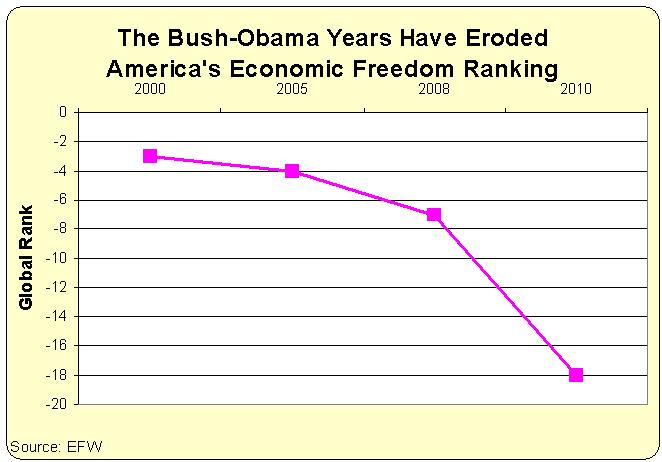
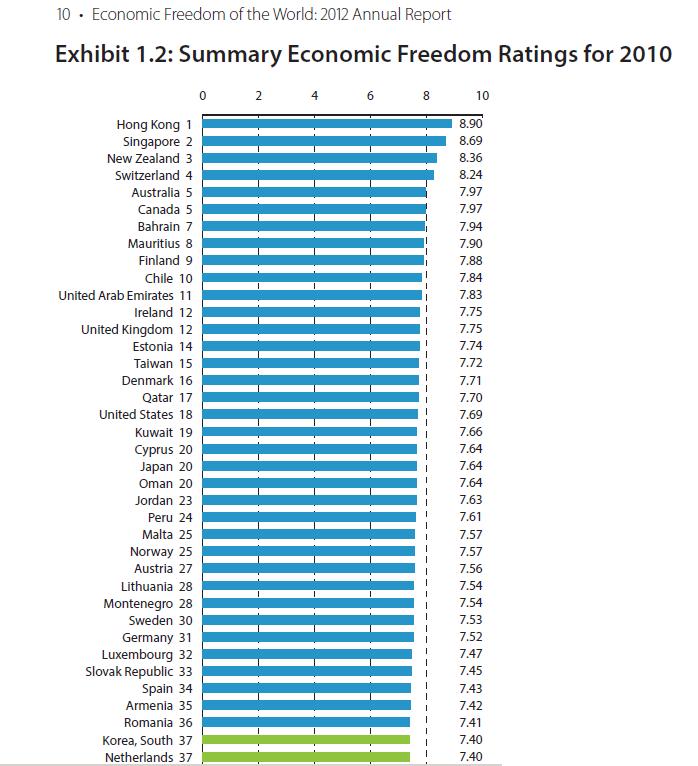
But I’m somewhat shocked to learn that we fell from 10th last year all the way down to 18th this year, as can be seen on the chart (click to enlarge).

Last year, the U.S. fell from 7th to 10th, and I though dropping three spots was bad. But falling by eight spots this past year is a stunning decline.

Who would have thought that Scandinavian welfare states such as Denmark and Finland would rank higher than the United States? Or that Ireland, with all its problems, would be above America?

But since I’m not a misery-loves-company guy, I’m happy to see some nations doing well. I’ve previously highlighted the good policies in Hong Kong and Singapore. And I’ve trumpeted the good policies in Switzerland and Australia, as well as Canada, Chile, and Estonia.

So kudos to the leaders in those nations.

American politicians, by contrast, deserve scorn. Let’s update the chart I posted when last year’s report was issued.

As you can see, it’s an understatement to say that the United States is heading in the wrong direction. We’re still considerably ahead of interventionist welfare states such as France and Italy, though I’m afraid to think about what the U.S. score will be five years from now.

Here’s what the authors of the report had to say about America’s decline.

The United States, long considered the standard bearer for economic freedom among large industrial nations, has experienced a substantial decline in economic freedom during the past decade. From 1980 to 2000, the United States was generally rated the third freest economy in the world, ranking behind only Hong Kong and Singapore. After increasing steadily during the period from 1980 to 2000, the chainlinked EFW rating of the United States fell from 8.65 in 2000 to 8.21 in 2005 and 7.70 in 2010. The chain-linked ranking of the United States has fallen precipitously from second in 2000 to eighth in 2005 and 19th in 2010 (unadjusted ranking of 18th).

For those interested in why the United States has dropped, the “size of government” score has fallen from 8.65 in 2000 to 7.70 in the latest report. That’s not a surprise since the burden of government spending has exploded during the Bush-Obama years.

But the trade score also dropped significantly over the same period, from 8.78 to 7.65. So the protectionists should be happy, even though the rest of us have less prosperity.

The most dramatic decline, though, was the in the “legal system and property rights” category, where the U.S. plummeted from 9.23 in 2000 down to 7.12 in the new report. We’re not quite Argentina (3.76!), to be sure, but the trend is very troubling.

__________

Thank you so much for your time. I know how valuable it is. I also appreciate the fine family that you have and your commitment as a father and a husband.

Sincerely,

Everette Hatcher III, 13900 Cottontail Lane, Alexander, AR 72002, ph 501-920-5733, lowcostsqueegees@yahoo.com

Tax Freedom Day

President Obama is from Illinois and he is running our nation like the politicians of Illinois run their state with lots of wasteful spending and too many high taxes.

It’s time to celebrate.

That’s because we have reached Tax Freedom Day, meaning that – in the aggregate – we have finally earned enough money to pay for all the federal, state, and local taxes that will be imposed on us this year by our political masters.

But we’re not collectivists, so aggregate measures don’t really matter. Our individual tax burdens can vary considerably depending on the level and composition of our income, as well as the state in which we live.

Speaking of that, the good folks of North Dakota are the only ones actually celebrating Tax Freedom Day on this exact date. If you look at the map, Tax Freedom Day is as early as late March for residents of Louisiana and Mississippi, and as late as May for the unfortunate residents of New York, Connecticut, and New Jersey.

Tax Freedom Day Map

You’ll notice, by the way, that Tax Freedom Day is correlated with average state income. That’s one of the reasons why low-income states tend to get better scores. Simply stated, it’s hard to collect a lot of revenue from people who don’t have much money.

And a state that historically has been wealthy, like Connecticut, will probably collect a lot of revenue even if it has a good tax system (though, for the record, Connecticut has veered dramatically in the wrong direction in the past couple of decades).

So if you want to measure whether a state has a good or bad tax system, I recommend the “fiscal” and “tax burden” categories in the “Freedom Index” from the Mercatus Center. Using that measure, South Dakota gets the best score (compared to the 6th-best score using Tax Freedom Day).

P.S. If you like maps, here are some interesting ones, starting with some international comparisons.

Here are some good state maps with useful information.

There’s even a local map.


Related posts:

Dan Mitchell explains what happened in Cyprus

Dan Mitchell explains what happened in Cyprus.   What Really Happened in Cyprus? April 14, 2013 by Dan Mitchell Did Cyprus become an economic basket case because it is a tax haven, as some leftists have implied? Did it get in trouble because the government overspent, which I have suggested? The answers to those questions are […]

Dan Mitchell on Obamacare (includes cartoons on Obamacare)

Some very good points by Dan Mitchell of the Cato Institute on Obamacare: Why We Should Be Optimistic about Repealing Obamacare and Fixing the Healthcare System April 10, 2013 by Dan Mitchell I’m going to make an assertion that seems utterly absurd. The enactment of Obamacare may have been good news. Before sending a team of medical […]

Dan Mitchell’s blog has great cartoon that demonstrates what President Obama has been doing the last 4 years!!!

I have put up lots of cartoons from Dan Mitchell’s blog before and they have got lots of hits before. Many of them have dealt with the economy, eternal unemployment benefits, socialism,  Greece,  welfare state or on gun control.     I’ve Obtained a Secret Pre-Release Copy of Obama’s Budget April 9, 2013 by Dan Mitchell The President is supposed to release […]

Dan Mitchell’s tribute to Margaret Thatcher

Very well said by Dan Mitchell. A Tribute to Margaret Thatcher April 8, 2013 by Dan Mitchell The woman who saved the United Kingdom has died. A Great Woman I got to meet Margaret Thatcher a couple of times and felt lucky each time that I was in the presence of someone who put her nation’s […]

Dan Mitchell, Ron Paul, and Milton Friedman on Immigration Debate (includes editorial cartoon)

I like Milton Friedman’s comments on this issue of immigration   and Ron Paul and Dan Mitchell do well on the issue too. Question of the Week: What’s Your Take on the Immigration Debate? April 7, 2013 by Dan Mitchell A reader from overseas wonders about my views on immigration, particularly amnesty. I confess that this is one of […]

Dan Mitchell on Texas v. California (includes editorial cartoon)

We should lower federal taxes because jobs are going to states like Texas that have low taxes. What Can We Learn by Comparing the Employment Situation in Texas vs. California? April 3, 2013 by Dan Mitchell One of the great things about federalism, above and beyond the fact that it both constrains the power of governments […]

Cartoons from Dan Mitchell’s blog on Obamacare

Third-Party Payer is the Biggest Economic Problem With America’s Health Care System Published on Jul 10, 2012 This mini-documentary from the Center for Freedom and Prosperity Foundation explains that “third-party payer” is the main problem with America’s health care system. This is why undoing Obamacare, while desirable, is just a small first step if we […]

Obamacare cartoons from Dan Mitchell’s blog

I have put up lots of cartoons from Dan Mitchell’s blog before and they have got lots of hits before. Many of them have dealt with the economy, eternal unemployment benefits, socialism,  Greece,  welfare state or on gun control. The funniest cartoon is the one with “Nurse Sebelius” stuffing the huge capsule down the kid’s throat!!! Obamacare […]

Editorial cartoon from Dan Mitchell’s blog on California’s sorry state of affairs

I have put up lots of cartoons from Dan Mitchell’s blog before and they have got lots of hits before. Many of them have dealt with the sequester, economy, eternal unemployment benefits, socialism,  minimum wage laws, tax increases, social security, high taxes in California, Obamacare,  Greece,  welfare state or on gun control. President Obama’s favorite state must be California because […]

Dan Mitchell of the Cato Institute:HUD has to go!!!! (includes political cartoon)

You want a suggestion on how to cut the government then start at HUD. I would prefer to eliminate all of it. Here are Dan Mitchell’s thoughts below: Sequestration’s Impact on HUD: Just 358 More Days and Mission Accomplished March 12, 2013 by Dan Mitchell As part of my “Question of the Week” series, I had […]

Use of our tax money is pretty stupid

Sad that the government wastes so much of our money and it wants more from us under President Obama.

Remember the Spending Quiz from 2010, which asked people to guess whether absurd examples of government waste were true or false?

Well, we have a new video on government waste, though bureaucrats and politicians have become so profligate it doesn’t even bother to trick people with fake examples.

Your Tax Dollars at Work

While very well done, I do have two small complaints about the video.

First, it asks whether we should cut spending or raise taxes to deal with the national debt. I think that’s too narrow. We shouldn’t be wasting money even if the budget was balanced and there wasn’t a penny of debt.

In other words, the problem isn’t deficits. Red ink is just a symptom. The real problem is that government is too big.

Second, the video sort of acquiesces to the dishonest Washington terminology by asking whether we should cut spending or raise taxes, implying those are the only two options. I favor genuine spending cuts, of course, but the most accurate way of phrasing the question is to ask whether we should cut spending, restrain spending, or let government grow on auto-pilot.

As I explained earlier this year, we can balance the budget in just 10 years if spending grows “only” 3.4 percent per year. When people understand that detail, there’s almost no support for higher taxes.

But I’m nitpicking. Overall, a very good video.

P.S. If the examples of pork-barrel spending in the video get you angry, you’ll probably have a stroke if you also watch the waste video from the folks at Government Gone Wild.


Related posts:

Dan Mitchell explains what happened in Cyprus

Dan Mitchell explains what happened in Cyprus.   What Really Happened in Cyprus? April 14, 2013 by Dan Mitchell Did Cyprus become an economic basket case because it is a tax haven, as some leftists have implied? Did it get in trouble because the government overspent, which I have suggested? The answers to those questions are […]

Dan Mitchell on Obamacare (includes cartoons on Obamacare)

Some very good points by Dan Mitchell of the Cato Institute on Obamacare: Why We Should Be Optimistic about Repealing Obamacare and Fixing the Healthcare System April 10, 2013 by Dan Mitchell I’m going to make an assertion that seems utterly absurd. The enactment of Obamacare may have been good news. Before sending a team of medical […]

Dan Mitchell’s blog has great cartoon that demonstrates what President Obama has been doing the last 4 years!!!

I have put up lots of cartoons from Dan Mitchell’s blog before and they have got lots of hits before. Many of them have dealt with the economy, eternal unemployment benefits, socialism,  Greece,  welfare state or on gun control.     I’ve Obtained a Secret Pre-Release Copy of Obama’s Budget April 9, 2013 by Dan Mitchell The President is supposed to release […]

Dan Mitchell’s tribute to Margaret Thatcher

Very well said by Dan Mitchell. A Tribute to Margaret Thatcher April 8, 2013 by Dan Mitchell The woman who saved the United Kingdom has died. A Great Woman I got to meet Margaret Thatcher a couple of times and felt lucky each time that I was in the presence of someone who put her nation’s […]

Dan Mitchell, Ron Paul, and Milton Friedman on Immigration Debate (includes editorial cartoon)

I like Milton Friedman’s comments on this issue of immigration   and Ron Paul and Dan Mitchell do well on the issue too. Question of the Week: What’s Your Take on the Immigration Debate? April 7, 2013 by Dan Mitchell A reader from overseas wonders about my views on immigration, particularly amnesty. I confess that this is one of […]

Dan Mitchell on Texas v. California (includes editorial cartoon)

We should lower federal taxes because jobs are going to states like Texas that have low taxes. What Can We Learn by Comparing the Employment Situation in Texas vs. California? April 3, 2013 by Dan Mitchell One of the great things about federalism, above and beyond the fact that it both constrains the power of governments […]

Cartoons from Dan Mitchell’s blog on Obamacare

Third-Party Payer is the Biggest Economic Problem With America’s Health Care System Published on Jul 10, 2012 This mini-documentary from the Center for Freedom and Prosperity Foundation explains that “third-party payer” is the main problem with America’s health care system. This is why undoing Obamacare, while desirable, is just a small first step if we […]

Obamacare cartoons from Dan Mitchell’s blog

I have put up lots of cartoons from Dan Mitchell’s blog before and they have got lots of hits before. Many of them have dealt with the economy, eternal unemployment benefits, socialism,  Greece,  welfare state or on gun control. The funniest cartoon is the one with “Nurse Sebelius” stuffing the huge capsule down the kid’s throat!!! Obamacare […]

Editorial cartoon from Dan Mitchell’s blog on California’s sorry state of affairs

I have put up lots of cartoons from Dan Mitchell’s blog before and they have got lots of hits before. Many of them have dealt with the sequester, economy, eternal unemployment benefits, socialism,  minimum wage laws, tax increases, social security, high taxes in California, Obamacare,  Greece,  welfare state or on gun control. President Obama’s favorite state must be California because […]

Dan Mitchell of the Cato Institute:HUD has to go!!!! (includes political cartoon)

You want a suggestion on how to cut the government then start at HUD. I would prefer to eliminate all of it. Here are Dan Mitchell’s thoughts below: Sequestration’s Impact on HUD: Just 358 More Days and Mission Accomplished March 12, 2013 by Dan Mitchell As part of my “Question of the Week” series, I had […]

Open letter to President Obama (Part 299)

FIRST PRESIDENTIAL DEBATE – Barack Obama VS Mitt Romney (Part 1)

Published on Oct 3, 2012 by

Barack Obama & Mitt Romney Full Presidential Debate

__________


President Obama c/o The White House
1600 Pennsylvania Avenue NW
Washington, DC 20500

Dear Mr. President,

I know that you receive 20,000 letters a day and that you actually read 10 of them every day. I really do respect you for trying to get a pulse on what is going on out here.

I heard Arthur Laffer speak in 1981 when he came to Memphis to speak to a group of students. He told exactly what was going to happen the next few years with the rapid growth of the US economy and everything he predicted came true. Liberals just ignore his views evidently. The Laffer Curve is based on history.

Alan Reynolds notes:

The U.S. already cut marginal tax rates across-the-board by more than 20 percent in 1964 and 1984 (the 1981 law, like that of 2001, was foolishly phased-in).  In both cases, the Table shows that revenues from the individual income tax were higher than before, as a share of GDP.  The economy grew much faster too, raising payroll and corporate tax receipts. 

The Tax Policy Center’s $5 Trillion Blunder: “Nonpartisan” nonsense

Posted by Alan Reynolds

In “The $5 Trillion Question: How Big Is Romney’s Cut” Wall Street Journal reporters Damlan Paletta and John D. McKinnon echo, once again, the journalistic convention of contrasting “the nonpartisan Tax Policy Center” with “the conservative American Enterprise Institute.”  In the English language, the opposite of “conservative” is not “nonpartisan.”   On the contrary, the phrase “nonpartisan” applies equally to the American Enterprise Institute (or Cato Institute) as it does to Tax Policy Center (TPC) – a front for the Brookings Institution and Urban Institute.   To be “nonpartisan” does not mean non-ideological, unbiased or even competent.  It simply means following a few rules so the IRS will allow the organization to receive tax-deductible contributions.   Governor Romney wants to severely curb such deductions (including his own), which does not necessarily make the TPC a disinterested observer, even if there really were one or two closet Republicans (or even non-Keynesians) at the TPC.

The U.S. already cut marginal tax rates across-the-board by more than 20 percent in 1964 and 1984 (the 1981 law, like that of 2001, was foolishly phased-in).  In both cases, the Table shows that revenues from the individual income tax were higher than before, as a share of GDP.  The economy grew much faster too, raising payroll and corporate tax receipts.   Until the TPC can explain how and why that happened, they cannot even pretend to predict that Romney’s more modest tax reform will lose any revenue, much less $5 trillion.  Incidentally, deductions were not significantly curbed in the tax laws of 1964 or 1981, or in the Tax Reform of 1986 (which merely substituted reduced itemized deductions for a much larger standard deduction).  If Romney puts a cap on deductions, either as a percentage of AGI or as a dollar limit, the net effect of his plan would raise revenues, particularly from people like Warren Buffett and Mitt Romney (who deduct millions in charitable contributions).

The Tax Policy Center’s fundamental error is to assume no behavioral response at all to lower tax rates – an “elasticity of taxable income” (ETI) of zero.   The academic evidence is that ETI is at least 0.4 for all taxpayers, as Martin Feldstein observed, mostly because ETI is above 1.0 for the top 1 percent, as I recently explained in the Journal.  Cut top rates and the rich report more income; raise top rates and much of their income disappears — through reduced economic activity and increased avoidance.

___________

Thank you so much for your time. I know how valuable it is. I also appreciate the fine family that you have and your commitment as a father and a husband.

Sincerely,

Everette Hatcher III, 13900 Cottontail Lane, Alexander, AR 72002, ph 501-920-5733, lowcostsqueegees@yahoo.com
Related posts:

Open letter to President Obama (Part 147)

President Obama c/o The White House 1600 Pennsylvania Avenue NW Washington, DC 20500 Dear Mr. President, I know that you receive 20,000 letters a day and that you actually read 10 of them every day. I really do respect you for trying to get a pulse on what is going on out here. If you […]

Romney responds to my letter on abortion

Francis Schaeffer February 21, 1982 (Part 1) Uploaded by DeBunker7 on Feb 21, 2008 I sent Romney 12 letters on the prolife movement and many of these letters including the writings of Dr. Francis Schaeffer. Here are two clips from Schaeffer that sum up his views on abortion. _______________ Francis Schaeffer February 21, 1982 (Part […]

Open letter to President Obama (Part 142 B)

President Obama c/o The White House 1600 Pennsylvania Avenue NW Washington, DC 20500 Dear Mr. President, I know that you receive 20,000 letters a day and that you actually read 10 of them every day. I really do respect you for trying to get a pulse on what is going on out here. This excessive […]

Open letter to President Obama (Part 136 B)

Real Time with Bill Maher March 16 2012 – Alexandra Pelosi Interviews Welfare Recipients in NYC Published on Mar 18, 2012 by vclubscenedotcom Real Time with Bill Maher March 16 2012 – Alexandra Pelosi Interviews Welfare Recipients ____________ President Obama c/o The White House 1600 Pennsylvania Avenue NW Washington, DC 20500 Dear Mr. President, I […]

Open letter to Republican Presidential Candidate Mitt Romney on our pro-life views (Part 12)

To Mitt Romney, Box 96861, Washington, DC 20090-6861,  From Everette Hatcher of http://www.thedailyhatch.org 13900 Cottontail Lane, Alexander, AR 72002 Did we forgive George Bush in 1988 for being pro-choice originally in 1980? We sure did. In fact, my former pastor, Adrian Rogers, had a chance to visit with Bush several times. He told him that the […]

Open letter to Republican Presidential Candidate Mitt Romney on our pro-life views (Part 11)

To Mitt Romney, Box 96861, Washington, DC 20090-6861,  From Everette Hatcher of http://www.thedailyhatch.org 13900 Cottontail Lane, Alexander, AR 72002 Did we forgive George Bush in 1988 for being pro-choice originally in 1980? We sure did. In fact, my former pastor, Adrian Rogers, had a chance to visit with Bush several times. He told him that the […]

Open letter to Republican Presidential Candidate Mitt Romney on our pro-life views (Part 10)

A Ronald Reagan radio address from 1975 addresses the topics of abortion and adoption. This comes from a collection of audio commentaries titled “Reagan in His Own Voice.” To Mitt Romney, Box 96861, Washington, DC 20090-6861,  From Everette Hatcher of http://www.thedailyhatch.org 13900 Cottontail Lane, Alexander, AR 72002 Did we forgive George Bush in 1988 for being […]

Open letter to Republican Presidential Candidate Mitt Romney on our pro-life views (Part 9)

To Mitt Romney, Box 96861, Washington, DC 20090-6861,  From Everette Hatcher of http://www.thedailyhatch.org 13900 Cottontail Lane, Alexander, AR 72002 Did we forgive George Bush in 1988 for being pro-choice originally in 1980? We sure did. In fact, my former pastor, Adrian Rogers, had a chance to visit with Bush several times. He told him that the […]

Open letter to Republican Presidential Candidate Mitt Romney on our pro-life views (Part 8)

Superbowl commercial with Tim Tebow and Mom. To Mitt Romney, Box 96994, Washington, DC 20077-7556  From Everette Hatcher of http://www.thedailyhatch.org 13900 Cottontail Lane, Alexander, AR 72002 Did we forgive George Bush in 1988 for being pro-choice originally in 1980? We sure did. In fact, my former pastor, Adrian Rogers, had a chance to visit with Bush […]

Open letter to Republican Presidential Candidate Mitt Romney on our pro-life views (Part 7)

___________________________________________ Francis Schaeffer is a hero of mine and I want to honor him with a series of posts on Sundays called “Schaeffer Sundays” which will include his writings and clips from his film series. I have posted many times in the past using his material. Philosopher and Theologian, Francis A. Schaeffer has argued, “If […]

Open letter to Republican Presidential Candidate Mitt Romney on our pro-life views (Part 6)

A Christian Manifesto by Francis Schaeffer (Part 1) To Mitt Romney, Box 149756, Boston, MA 02114-9756  From Everette Hatcher of http://www.thedailyhatch.org 13900 Cottontail Lane, Alexander, AR 72002 Did we forgive George Bush in 1988 for being pro-choice originally in 1980? We sure did. In fact, my former pastor, Adrian Rogers, had a chance to visit with […]

Open letter to Republican Presidential Candidate Mitt Romney on our pro-life views (Part 5)

Part 1 Part 2 To Mitt Romney, Box 149756, Boston, MA 02114-9756  From Everette Hatcher of http://www.thedailyhatch.org 13900 Cottontail Lane, Alexander, AR 72002 Did we forgive George Bush in 1988 for being pro-choice originally in 1980? We sure did. In fact, my former pastor, Adrian Rogers, had a chance to visit with Bush several times. He […]

Open letter to Republican Presidential Candidate Mitt Romney on our pro-life views (Part 4)

Part 1 Part 2 To Mitt Romney, Box 149756, Boston, MA 02114-9756  From Everette Hatcher of http://www.thedailyhatch.org 13900 Cottontail Lane, Alexander, AR 72002 Did we forgive George Bush in 1988 for being pro-choice originally in 1980? We sure did. In fact, my former pastor, Adrian Rogers, had a chance to visit with Bush several times. He […]

Open letter to Republican Presidential Candidate Mitt Romney on our pro-life views (Part 3)

To Mitt Romney, Box 96994, Washington, DC 20077-7556  From Everette Hatcher of http://www.thedailyhatch.org 13900 Cottontail Lane, Alexander, AR 72002 Did we forgive George Bush in 1988 for being pro-choice originally in 1980? We sure did. In fact, my former pastor, Adrian Rogers, had a chance to visit with Bush several times. He told him that the […]