The answer to the complicated tax system is the flat tax. Why can’t we simply it? (Below is an article from Dan Mitchell’s blog http://danieljmitchell.wordpress.com/ .)
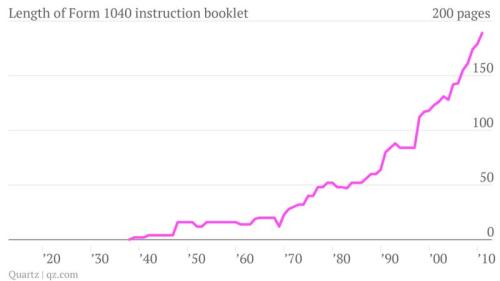
Everything that’s Wrong with the Tax System, in a Single Picture
But this new image may be the most effective of all of them. We don’t know what’s in the other 72,000 pages of tax code, but we’re all familiar with the basic 1040 tax form. Look at what the politicians have done to it over the past several decades.
The only answer, needless to say, is to throw the entire mess in the trash can and replace it with a simple and fair flat tax.
Here’s my brief explanation of how the flat tax would work and why it’s a good idea.
The Flat Tax: How it Works and Why it is Good for America
Uploaded on Mar 29, 2010
This Center for Freedom and Prosperity Foundation video shows how the flat tax would benefit families and businesses, and also explains how this simple and fair system would boost economic growth and eliminate the special-interest corruption of the internal revenue code. http://www.freedomandprosperity.org
Thank you so much for your time. I know how valuable it is. I also appreciate the fine family that you have and your commitment as a father and a husband.
Sincerely,
Everette Hatcher III, 13900 Cottontail Lane, Alexander, AR 72002, ph 501-920-5733, lowcostsqueegees@yahoo.com
Milton Friedman said that getting George Bush I to be his vice president was his biggest mistake because he knew that Bush was not a true conservative and sure enough George Bush did raise taxes when he later became President. Below is a speech by George W. Bush honoring Milton Friedman:
Milton Friedman Honored for Lifetime Achievements 2002/5/9
_______________
President Obama c/o The White House
1600 Pennsylvania Avenue NW
Washington, DC 20500
I watched the video by the Democrat National Convention on 9-6-12 that showed your beautiful wife saying about your family: “We sit around the dinner table (with our kids) and he is he last to be asked, ‘Oh yeah, how was your day Dad?’ You know really he is an afterthought.”
As a father and a husband I want to thank you for demonstrating to others that men need to keep their priorities straight.
If you don’t want people to try to avoid high taxes then lower their rates of taxation. That is pretty simple I think. Why would anyone raise tax rates and then complain when people go to trouble to avoid paying those high tax rates?
I’m not a fan of David Cameron, the United Kingdom’s Prime Minister.
Even though he belongs to the Conservative Party that produced the great Margaret Thatcher, Cameron seems to be a bit of guilt-ridden statist with his finger always in the air to see which way the wind is blowing. The policy results are not pretty.
Now I have another reason to dislike Cameron. He just condemned a comedian for legally seeking to minimize the amount of his income that is seized – and then wasted – by the U.K. government. Here are some of the details from The Telegraph.
Prime Minister David Cameron today branded the tax arrangement of comedian Jimmy Carr “morally wrong” after it emerged he was using a scheme which allows the wealthy to pay as little as one per cent of their income. …Speaking at the G20 summit the Prime Minister told ITV News: “I think some of these schemes – and I think particularly of the Jimmy Carr scheme – I have had time to read about and I just think this is completely wrong. “People work hard, they pay their taxes, they save up to go to one of his shows. They buy the tickets. He is taking the money from those tickets and he, as far as I can see, is putting all of that into some very dodgy tax avoiding schemes. …some of these schemes we have seen are quite frankly morally wrong.” …Lawyers for the comedian have…categorically denied any wrongdoing, saying the scheme had been disclosed to the relevant authorities in line with the law. …Chancellor George Osborne has claimed he was left “shocked” after finding the extent to which multi-millionaires were exploiting tax loopholes and vowed to take “action”.
I have no idea whether the specific “tax avoiding scheme” used by Carr is good tax policy (protecting against double taxation, for instance) or bad policy (such as a loophole that creates favoritism for a specific behavior), but that’s not the point of this post.
Instead, this is a moral question about whether people have some sort of obligation to pay extra tax, merely to get some sort of pat on the head from politicians. The same politicians, by the way, that squander the money on varying vote-buying schemes that undermine prosperity and create dependency.
I’d be willing to condemn Carr if I found out he’s some sort of statist who wants higher taxes for everybody else, but then (like John Kerry) takes steps to minimize his personal tax bill.
But I’d be condemning Carr for hypocrisy, not criticizing the idea of tax avoidance.
The United Kingdom has become a bloated welfare state (with horribly depressing implications, as you can read here and here). If people want to be moral, they should strive to pay the least amount possible to this corrupt and wasteful enterprise. The United States is not quite as bad (yet), but the same principle applies.
Politicians, needless to say, will violently disagree with this ethical viewpoint. So we can all expect more taxes, higher taxes, and additional draconian enforcement measures.
The only good news is that the Laffer Curve will prevent these greedy thugs from collecting nearly as much money as they think.
P.S. To get an idea of how the Conservative Party has declined, compare Cameron’s statist rhetoric to Margaret Thatcher’s comments that “there is no such thing as public money.”
__________
Thank you so much for your time. I know how valuable it is. I also appreciate the fine family that you have and your commitment as a father and a husband.
Sincerely,
Everette Hatcher III, 13900 Cottontail Lane, Alexander, AR 72002, ph 501-920-5733, lowcostsqueegees@yahoo.com
The answer to the complicated tax system is the flat tax. Why can’t we simply it? (Below is an article from Dan Mitchell’s blog http://danieljmitchell.wordpress.com/ .)
Everything that’s Wrong with the Tax System, in a Single Picture
But this new image may be the most effective of all of them. We don’t know what’s in the other 72,000 pages of tax code, but we’re all familiar with the basic 1040 tax form. Look at what the politicians have done to it over the past several decades.
The only answer, needless to say, is to throw the entire mess in the trash can and replace it with a simple and fair flat tax.
Here’s my brief explanation of how the flat tax would work and why it’s a good idea.
The Flat Tax: How it Works and Why it is Good for America
Uploaded on Mar 29, 2010
This Center for Freedom and Prosperity Foundation video shows how the flat tax would benefit families and businesses, and also explains how this simple and fair system would boost economic growth and eliminate the special-interest corruption of the internal revenue code. http://www.freedomandprosperity.org
Do governments ever cut spending? According to Dr. Stephen Davies, there are historical examples of government spending cuts in Canada, New Zealand, Sweden, and America. In these cases, despite popular belief, the government spending cuts did not cause economic stagnation. In fact, the spending cuts often accelerated economic growth by freeing up resources for the private sector.
DEBT LIMIT – A GUIDE TO AMERICAN FEDERAL DEBT MADE EASY.
A satirical short film taking a look at the national debt and how it applies to just one family. Watch the guy from the Ferris Bueller Superbowl Spot! Produced by Seth William Meier, DP/Edited by Craig Evans, 1st AC Brian Andrews, Sound Mixer Gus Salazar, Written and Directed by Brian Stepanek. Help us spread the word by clicking ads or at http://www.debtlimitusa.org.
________
Is Canada moving in a conservative direction to tackle their fiscal problems while the USA is going over the fiscal cliff? I was impressed by this statement below from this article from www.heritage.org :
In Canada, federal spending has been trending downward since 1993, according to Cato’s Chris Edwards. Canadians have cut spending in virtually every area except health care. The federal government now accounts for only 38 percent of total government spending. In the U.S., by contrast, the federal government accounts for 71 percent of total government spending.
It seems to me that we need to learn this important lesson from our neighbor from the north: CUT SPENDING AND LOWER TAXES AND GIVE MORE CONTROL BACK TO THE LOCAL GOVERNMENTS!!!!
Congressional lawmakers met last week to try to hammer out a deal to avert the fiscal cliff. Democrats insist on revenue increases as part of such a deal, saying new revenue is the only way to significantly reduce the national debt. However, it is not a lack of revenue that is driving U.S. debt; it is unrestrained federal spending. American lawmakers looking to solve America’s looming fiscal crisis need not look further than Canada.
Highlighted at a recent Cato Institute conference, our neighbor—and competitor—to the north serves as a good example of what it takes to return to a strong economy. The Great White North has turned around its fiscal situation and is now experiencing financial stability and economic growth.
In Canada, federal spending has been trending downward since 1993, according to Cato’s Chris Edwards. Canadians have cut spending in virtually every area except health care. The federal government now accounts for only 38 percent of total government spending. In the U.S., by contrast, the federal government accounts for 71 percent of total government spending.
The Canadian government, among other changes, altered benefit schedules for the Canadian Pension Plan to reduce the total amount of benefits paid.
In a similar vein, The Heritage Foundation suggests a variety of benefit changes to Social Security that would strengthen the program’s finances, for example, by raising the eligibility age slightly and replacing cost of living adjustments with the Chained Consumer Price Index for a more targeted measure of inflation in consumer goods. Bolder changes include gradually introducing a flat benefit that targets scarce resources to those seniors who need them the most and provides all seniors with protection from poverty in retirement.
Canada also cut corporate income tax rates. The U.S. has the highest rate among its competitors in the industrialized world. The combined federal and state corporate rate in the U.S. is over 39 percent. Canada now has a combined rate of only 25 percent.
Contrary to popular expectations, lower corporate tax rates have not resulted in significantly reduced corporate tax revenue in Canada. Instead, corporations based in Canada have reported more income since lower tax rates went into place. And Canada is experiencing low unemployment and a strong Canadian dollar.
The Heritage Foundation’s New Flat Tax would replace today’s complex tax system for individuals and business with a simple, neutral, and transparent tax system that would allow America to achieve its full economic potential.
Europe has not followed Canada’s example, and the resulting severe debt crises are sending people to the streets in an outbreak of violent protests. Out-of-control government spending and deficits have resulted in massive borrowing, which has led to bailouts for many European countries.
Here in the United States, we have all the ingredients necessary to create a similar debt crisis in the not-so-distant future. Over the past four decades, federal spending has increased 288 percent, nearly quadrupling in real terms. Thirty-two cents out of every dollar spent was borrowed in 2012. Debt held by the public is a staggering 73 percent of GDP, and our government has run trillion-dollar budget deficits four years in a row.
In less than 10 years, the U.S.’s publicly held debt will surpass the size of the entire U.S. economy and is projected to continue skyrocketing from there. (continues below chart)
To make matters worse, there is a dark demographic cloud on the horizon. In all Western nations, the proportion of older people as a share of the population is increasing. In the U.S., baby boomers are increasingly reaching retirement age, and in Europe, fertility rates are well below replacement level. As the populations of these countries age, entitlements will eat up an ever-increasing share of federal spending and place a greater strain on a smaller share of working-age taxpayers.
Solving America’s spending and debt challenges is possible. Canada’s example illustrates some of the steps this will take—including major cuts to federal spending, tax reform, and entitlement reform. If our leaders can find the courage to pursue this path, we can avoid an economic collapse and Save the American Dream.
Paul Bremmer is currently a member of the Young Leaders Program at The Heritage Foundation. For more information on interning at Heritage, please visit: http://www.heritage.org/about/departments/ylp.cfm.
_____________
_____________
Thank you so much for your time. I know how valuable it is. I also appreciate the fine family that you have and your commitment as a father and a husband.
Sincerely,
Everette Hatcher III, 13900 Cottontail Lane, Alexander, AR 72002, ph 501-920-5733, lowcostsqueegees@yahoo.com
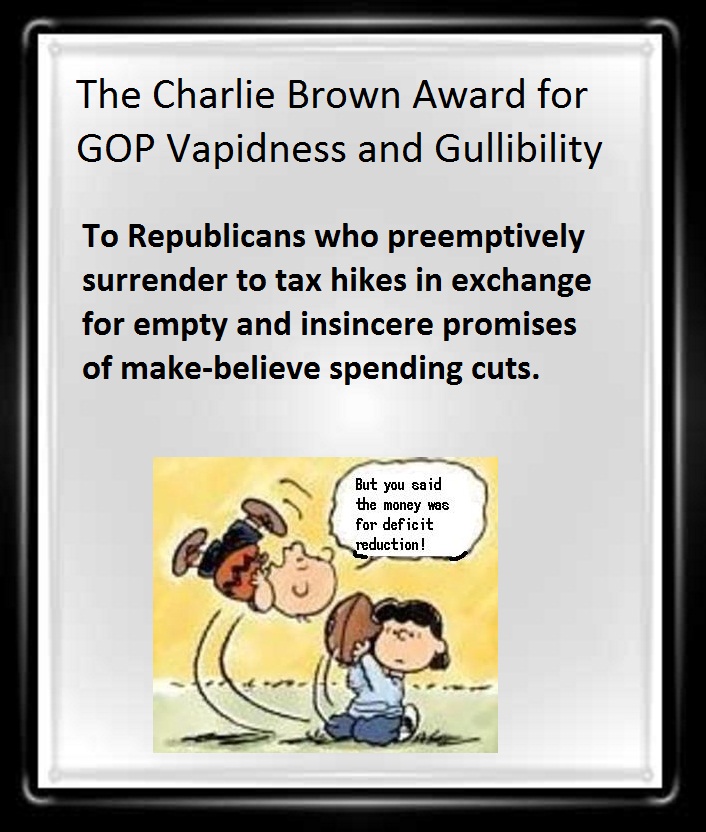
I truly do wonder how smart our elected representatives are in Washington. Mr President I know you are a Harvard graduate and these comments I guess are really aimed at my Republican friends mostly.I got up on 12-20-12 and read this article below from the Heritage Foundation with the reference to Charlie Brown getting fooled by Lucy again when he runs up and tries to kick the football and of course she moves it again.
Liberals in Congress have always tried to fool conservatives by promising future cuts if they provide higher taxes now. (This article below appeared on www.heritage.org on 12-20-12.)
Obama’s “Lucy Move the Football” Fiscal Cliff Plan Still Not Balanced
Volleys of negotiating counter-offers are coming in faster now that Christmas break and the looming fiscal cliff are just around the corner.
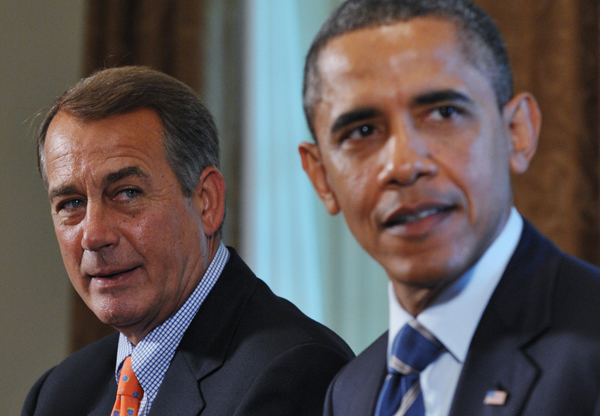
While there is much unsatisfactory with Speaker of the House John Boehner’s (R–OH) Sunday night proposal, let us not forget that the reason we are watching this needless, high stakes drama unfold is due to President Obama’s intractable insistence on tax increases on America’s high earners. After all, he and Congress could simply and quickly pass a bill to extend all current policies and avoid the fiscal cliff entirely—if he wanted to. No, this is really about hiking taxes on high earners. Thus the charade of deficit reduction continues.
Obama’s latest counteroffer is no more acceptable than his first offer. Short on details concerning actual spending reductions, especially on entitlements, it is replete with his requisite tax hikes and (we are shocked) new stimulus spending. The cherry on top is an extension of the debt limit for two years, essentially handing over authority to raise it to the President.
Right.
The President originally called for around $800 billion in tax hikes on America’s “highest” earners—those earning $250,000 and up. A ridiculous demand when the economy is still struggling under his big spending and regulatory policies, and one which would squarely hit smaller businesses. You know, the ones who actually create jobs.
Yet, just like Lucy and the football, when Boehner and company offered up $800 billion in tax hikes, Obama quickly doubled his demand to $1.5 trillion in tax hikes—again, all from the highest earners. They, he tells us, can afford to pay a little more. Never mind, of course, that the top 1 percent of earners already pay 37 percent of all income taxes. Somehow we are to believe this is a “balanced approach.”
Obama pitches all this on the pretext that we can simply go back to the tax rates we had under Clinton. Wrong! His dirty little tax secret is that he has already hiked taxes on high earners under Obamacare. First the law added a surtax of 0.9 percent in addition to the Medicare payroll tax on those earning over $250,000. For the first time ever, Obamacare will apply this higher rate of 3.8 percent to investment income on January 1. Obama won’t tell you that going back to Clinton-era tax rates will actually result in higher taxes on wages, dividends, and capital gains.
They say if you want less of something, then tax it. For Obama, this works fine on financial transactions, carbon emissions, driving, and junk food. But evidently, for him, not so much on a strong vibrant economy. And those Clinton boom years? They weren’t ushered in after the Clinton tax hike—only after the Clinton–Gingrich tax cut!
Rather than working with Republicans on tax proposals that will actually grow the economy, Obama is now simply fighting over his definition of “high income” while we are left to wonder how much this $1.2 trillion tax hike will slow the economy.
As for the $1.2 trillion spending reductions, the only reason they are there is because Boehner insisted on them. But $100 billion in cuts would whack the defense budget, which is already reeling from earlier budget cuts. Yet the real spending and debt crisis comes from unaffordable entitlement programs. While Obama is insisting on balance on the tax side, he is sorely lacking in leadership here. As a recent Washington Post editorial opined:
Elections do have consequences, and Mr. Obama ran on a clear platform of increasing taxes on the wealthy. But he was clear on something else, too: Deficit reduction must be “balanced,” including spending cuts as well as tax increases. Since 60 percent of the federal budget goes to entitlement programs such as Medicare, Medicaid and Social Security, there’s no way to achieve balance without slowing the rate of increase of those programs.
We know Obama is open to changing the inflation calculation and slowing the benefit growth in Social Security. But what else? What about the proposals in his own budget, which would increase premiums on Medicare? He could easily broaden his proposals with additional uncontroversial steps to begin the process of strengthening and reining in Social Security and Medicare. All he needs to do is lead.
Some polls may show that Americans think taxes should be part of a deficit deal; but what the polls do not always show is their utter distrust that Washington would use new revenues to actually reduce the deficit. Here, Obama does not let them down. He reportedly wants $80 billion in new spending on infrastructure and unemployment benefits.
In exchange for all of this, he wants to raise the debt limit by enough to fuel his big spending goals for two years. This is utterly unacceptable. Americans know you cannot reduce the deficit when you plan to actually spend more. Americans also know that when Washington lifts the debt limit, it will not control spending. The debt limit puts the very pressure lawmakers need to account for out-of-control spending and make vital course corrections to bring spending under control, lest we face a Euro-style debt crisis in the future.
White House Press Secretary Jay Carney is actually insisting that “[t]he President’s proposal is the only proposal we have seen that achieves the balance that is so necessary.” Balance, evidently, is in the eyes of the beholder. As the Post noted, 60 percent of the budget stems from entitlements.
In just 13 short years—by the time today’s kindergarteners enter college—entitlements and interest on the debt will eat up all tax revenues. A truly balanced approach must start where the problem starts—with substantive reforms to entitlements. While the President maintains that you cannot cut your way to prosperity, you certainly cannot tax your way there.
_______________
Below is a speech by George W. Bush honoring Milton Friedman:
Milton Friedman Honored for Lifetime Achievements 2002/5/9
Milton Friedman said that getting George Bush I to be his vice president was his biggest mistake because he knew that Bush was not a true conservative and sure enough George Bush did raise taxes when he later became President. I wonder if Jeb Bush has the same genes as his father.
What we need is some people in Washington that are brave enough to say that we have taken too much of the american people’s money and we have to make the painful spending cuts in order to balance the budget and not ask for any more tax increases!!!! Arkansas’ congressman Rick Crawford has also made the Charlie Brown mistake.
But I then pointed out that all of those scenarios were total fantasies and that it would be more realistic to envision me playing center field for the New York Yankees.
That’s why I like the anti-tax pledge of Americans for Tax Reform. You don’t solve America’s fiscal problems by saying no to all tax increases, but at least you don’t move in the wrong direction at a faster rate.
Notwithstanding the principled and pragmatic arguments against putting tax increases on the table, some Republicans – in a triumph of hope over experience – are preemptively acquiescing to tax hikes.
Jeb Bush, the former Florida governor, said Friday that he could back a broad deficit plan that increased taxes, a stance that puts him at odds with other prominent Republicans. Bush told a House panel he could get behind a plan that combined 10 dollars in spending cuts for every dollar of new revenue… “The problem is the 10 never materializes,” [Congressman Paul] Ryan said after Bush said he could support a revenue-increasing deficit deal. Norquist also has criticized deficit deals crafted in 1982 and 1990 – the latter agreed to by then-President George H.W. Bush, Jeb’s father – for failing to deliver on the spending side.
Kudos to Paul Ryan for making the obvious point about make-believe spending cuts. And Grover is correct about the failure of previous budget deals.
Indeed, I cited a New York Times column that inadvertently revealed that the only budget deal that worked was the 1997 pact that cut taxes rather than raised them.
Sen. Lindsey Graham (R-S.C.) said Tuesday he believed Republicans should consider eliminating loopholes in the tax code even if they aren’t replaced by additional tax cuts, a move that would break with an anti-tax pledge many GOP lawmakers have signed with activist Grover Norquist. “When you eliminate a deduction, it’s OK with me to use some of that money to get us out of debt. That’s where I disagree with the pledge,” Graham told ABC News. …”I’m willing to move my party, or try to, on the tax issue. I need someone on the Democratic side being willing to move their party on structural changes to entitlements.” Graham said, for instance, he would support a plan that included $4 in spending cuts for every $1 in tax increases. During a Republican debate last August, all eight Republican candidates in attendance said they would reject a proposal to trade $10 in spending cuts for even $1 in tax increases.
In some sense, Senator Graham’s comments are reasonable. With real spending cuts and less-damaging forms of tax hikes, an acceptable deal is possible. But only in Fantasia, not in Washington.
In the real world, all that Senator Graham has done is to move the debate slightly to the left.
But I do have nightmares about government getting even bigger, and that’s why I don’t want tax increases on the table. I don’t even want them in the room. Or the house. Or the neighborhood.
That’s why Jeb Bush and Lindsey Graham are the newest winners of the Charlie Brown Award. They’ve put blood in the water. I wonder if they’ll act surprised when hungry sharks show up looking for a meal?
_____________
In 1982 the Democrats promised future spending cuts if Ronald Reagan would agree to a tax increase, but you guessed it, the taxes were increased and the spending cuts never came. THE REAL PROBLEM IS NOT THAT WE DON’T HAVE ENOUGH TAXES BUT WE DON’T WANT TO CUT SPENDING!!!
Washington Could Learn a Lot from a Drug Addict
Concerning spending cuts Reagan believed, that members of Congress “wouldn’t lie to him when he should have known better.” However, can you believe a drug addict when he tells you he is not ever going to do his habit again? Congress is addicted to spending too much money. Lee Edwards wrote in his article “Golden Years” about Ronald Reagan:
Sometimes Reagan went along with a pragamatist like chief of staff James Baker, who persuaded the president to accept the Tax Equity and Fiscal Responsibility Act of 1982 (TEFRA), which turned out to be the great tax increase of 1982 — $98 billion over the next three years. That was too much for eighty-nine House Republicans (including second-term Congressman Newt Gingrich of Georgia) or for prominent conservative organizations from the American Conservative Union like the Conservative Caucus and the U.S. Chamber of Commerce, which all opposed the measure.
Baker assured his boss that Congress would approve three dollars in spending cuts for every dollar of tax increase. To Reagan, TEFRA looked like a pretty good “70 percent” deal. But Congress wound up cutting less than twenty-seven cents for every new tax dollar. What had seemed to be an acceptable 70-30 compromise turned out to be a 30-70 surrender. Ed Meese described TEFRA as “the greatest domestic error of the Reagan administration,” although it did leave untouched the individual tax rate reductions approved the previous year. (TEFRA was built on a series of business and excise taxes plus the removal of business tax deductions.)[xxx]
The basic problem was that Reagan believed, as Lyn Nofziger put it, that members of Congress “wouldn’t lie to him when he should have known better.”[xxxi] As a result of TEFRA, Reagan learned to “trust but verify,” whether he was dealing with a Speaker of the House or a president of the Soviet Union.
______________
_____________
Thank you so much for your time. I know how valuable it is. I also appreciate the fine family that you have and your commitment as a father and a husband.
Sincerely,
Everette Hatcher III, 13900 Cottontail Lane, Alexander, AR 72002, ph 501-920-5733, lowcostsqueegees@yahoo.com
Does Government Have a Revenue or Spending Problem?
People say the government has a debt problem. Debt is caused by deficits, which is the difference between what the government collects in tax revenue and the amount of government spending. Every time the government runs a deficit, the government debt increases. So what’s to blame: too much spending, or too little tax revenue? Economics professor Antony Davies examines the data and concludes that the root cause of the debt is too much government spending.
____________
(This letter was emailed to White House on 12-12-12.)
President Obama c/o The White House
1600 Pennsylvania Avenue NW
Washington, DC 20500
When you try and tax and spend too much then the business community will try and relocate to another state. That is exactly what is happening in California today. We need to lower taxes if we want to grow the economy.
Hopefully we’re all disgusted when insiders rig the system to rip off taxpayers. And I suspect you’re not surprised to see that the worst example on that list comes from California, which is in a race with Illinois to see which state can become the Greece of America.
The numbers are even larger in California, where a state psychiatrist was paid $822,000, a highway patrol officer collected $484,000 in pay and pension benefits and 17 employees got checks of more than $200,000 for unused vacation and leave. The best-paid staff in other states earned far less for the same work, according to the data.
Wow, $822,000 for a state psychiatrist. Not bad for government work. So what is Governor Jerry Brown doing to fix the mess? As you might expect, he’s part of the problem.
…the state’s highest-paid employees make far more than comparable workers elsewhere in almost all job and wage categories, from public safety to health care, base pay to overtime. …California has set a pattern of lax management, inefficient operations and out-of-control costs. …In California, Governor Jerry Brown hasn’t curbed overtime expenses that lead the 12 largest states or limited payments for accumulated vacation time that allowed one employee to collect $609,000 at retirement in 2011. …Last year, Brown waived a cap on accrued leave for prison guards while granting them additional paid days off. California’s liability for the unused leave of its state workers has more than doubled in eight years, to $3.9 billion in 2011, from $1.4 billion in 2003, according to the state’s annual financial reports. …The per-worker costs of delivering services in California vastly exceed those even in New York, New Jersey, Illinois and Ohio.
I suppose the silver lining to that dark cloud is that many bureaucrats now rank as part of the top 1 percent, so they’ll have to recycle some of their loot back to the political vultures in Sacramento.
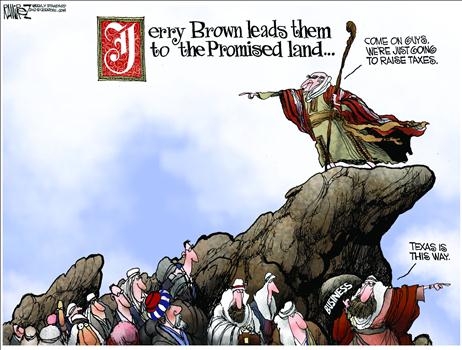
But the biggest impact of the tax hike – as shown in the Ramirez cartoon – will be to accelerate the shift of entrepreneurs, investors, and small business owners to states that don’t steal as much. Indeed, a study from the Manhattan Institute looks at the exodus to lower-tax states.
The data also reveal the motives that drive individuals and businesses to leave California. One of these, of course, is work. …Taxation also appears to be a factor, especially as it contributes to the business climate and, in turn, jobs. Most of the destination states favored by Californians have lower taxes. States that have gained the most at California’s expense are rated as having better business climates. The data suggest that many cost drivers—taxes, regulations, the high price of housing and commercial real estate, costly electricity, union power, and high labor costs—are prompting businesses to locate outside California, thus helping to drive the exodus.
Thank you so much for your time. I know how valuable it is. I also appreciate the fine family that you have and your commitment as a father and a husband.
Sincerely,
Everette Hatcher III, 13900 Cottontail Lane, Alexander, AR 72002, ph 501-920-5733, lowcostsqueegees@yahoo.com
I’m thinking of inventing a game, sort of a fiscal version of Pin the Tail on the Donkey.
Only the way it will work is that there will be a map of the world and the winner will be the blindfolded person who puts their pin closest to a nation such asAustralia or Switzerland that has a relatively low risk of long-run fiscal collapse.
That won’t be an easy game to win since we have data from the BIS, OECD, and IMF showing that government is growing far too fast in the vast majority of nations.
We also know that many states and cities suffer from the same problems.
A handful of local governments already have hit the fiscal brick wall, with many of them (gee, what a surprise) from California.
The most spectacular mess, though, is about to happen in Michigan.
After decades of sad and spectacular decline, it has come to this for Detroit: The city is $19 billion in debt and on the edge of becoming the nation’s largest municipal bankruptcy. An emergency manager says the city can make good on only a sliver of what it owes — in many cases just pennies on the dollar.
I could continue with a long list of profligate governments, but you get the idea. Some of these governments are collapsing at a quicker pace and some at a slower pace. But all of them are in deep trouble because they don’t follow my Golden Rule about restraining the burden of government spending so that it grows slower than the private sector.
Detroit obviously is an example of a government that is collapsing sooner rather than later.
Why? Simply stated, as the size and scope of the public sector increased, that created very destructive economic and political dynamics.
More and more people got lured into the wagon of government dependency, which puts an ever-increasing burden on a shrinking pool of producers.
Meanwhile, organized interest groups such as government bureaucrats used their political muscle to extract absurdly excessive compensation packages, putting an even larger burden of the dwindling supply of taxpayers.
But that’s not the main focus of this post. Instead, I want to highlight a particular excerpt from the article and make a point about how too many people are blindly – perhaps willfully – ignorant of the Laffer Curve.
Check out this sentence.
Property tax collections are down 20 percent and income tax collections are down by more than a third in just the past five years — despite some of the highest tax rates in the state.
This is a classic “Fox Butterfield mistake,” which occurs when someone fails to recognize a cause-effect relationship. In this case, the reporter should have recognized that tax collections are down because Detroit has very high tax rates.
The city has a lot more problems than just high tax rates, of course, but can there be any doubt that productive people have very little incentive to earn and report taxable income in Detroit?
And that’s the essential insight of the Laffer Curve. Politicians can’t – or at least shouldn’t – assume that a 20 percent increase in tax rates will lead to a 20 percent increase in tax revenue. They also have to consider the degree to which a higher tax rate will cause a change in taxable income.
In some cases, higher tax rates will discourage people from earning more taxable income.
In some cases, higher tax rates will discourage people from reporting all the income they earn.
In some cases, higher tax rates will encourage people to utilize tax loopholes to shrink their taxable income.
In some cases, higher tax rates will encourage migration, thus causing taxable income to disappear.
The Laffer Curve charts a relationship between tax rates and tax revenue. While the theory behind the Laffer Curve is widely accepted, the concept has become very controversial because politicians on both sides of the debate exaggerate. This video shows the middle ground between those who claim “all tax cuts pay for themselves” and those who claim tax policy has no impact on economic performance. This video, focusing on the theory of the Laffer Curve, is Part I of a three-part series. Part II reviews evidence of Laffer-Curve responses. Part III discusses how the revenue-estimating process in Washington can be improved. For more information please visit the Center for Freedom and Prosperity’s web site: http://www.freedomandprosperity.org
We got to cut spending or we will be in a fiscal crisis like Greece!!! Question of the Week: Has the European Fiscal Crisis Ended? January 12, 2013 by Dan Mitchell I’ve frequently commented on Europe’s fiscal mess and argued that excessive government spending is responsible for both the sovereign debt crisis and the economic stagnation […]
The Flat Tax: How it Works and Why it is Good for America Uploaded by afq2007 on Mar 29, 2010 This Center for Freedom and Prosperity Foundation video shows how the flat tax would benefit families and businesses, and also explains how this simple and fair system would boost economic growth and eliminate the special-interest […]
I have put up lots of cartoons from Dan Mitchell’s blog before and they have got lots of hits before. Many of them have dealt with the economy, eternal unemployment benefits, socialism, Greece, welfare state or on gun control. President Obama really does think that all his answers lie in raising taxes on the rich when the […]
__________ President Reagan, Nancy Reagan, Tom Selleck, Dudley Moore, Lucille Ball at a Tribute to Bob Hope’s 80th birthday at the Kennedy Center. 5/20/83. __________________________ Dan Mitchell is very good at giving speeches and making it very simple to understand economic policy and how it affects a nation. Mitchell also talks about slowing the growth […]
The Laffer Curve – Explained Uploaded by Eddie Stannard on Nov 14, 2011 This video explains the relationship between tax rates, taxable income, and tax revenue. The key lesson is that the Laffer Curve is not an all-or-nothing proposition, where we have to choose between the exaggerated claim that “all tax cuts pay for themselves” […]
President Obama c/o The White House 1600 Pennsylvania Avenue NW Washington, DC 20500 Dear Mr. President, I know that you receive 20,000 letters a day and that you actually read 10 of them every day. I really do respect you for trying to get a pulse on what is going on out here. The way […]
Dan Mitchell does a great job explaining the Laffer Curve President Obama c/o The White House 1600 Pennsylvania Avenue NW Washington, DC 20500 Dear Mr. President, I know that you receive 20,000 letters a day and that you actually read 10 of them every day. I really do respect you for trying to get a […]
I have put up lots of cartoons from Dan Mitchell’s blog before and they have got lots of hits before. Many of them have dealt with the economy, eternal unemployment benefits, socialism, Greece, welfare state or on gun control. Today’s cartoon deals with the Laffer curve. Revenge of the Laffer Curve…Again and Again and Again March 27, 2013 […]
I have put up lots of cartoons from Dan Mitchell’s blog before and they have got lots of hits before. Many of them have dealt with the sequester, economy, eternal unemployment benefits, socialism, minimum wage laws, tax increases, social security, high taxes in California, Obamacare, Greece, welfare state or on gun control. President Obama’s favorite state must be California because […]
Class Warfare just don’t pay it seems. Why can’t we learn from other countries’ mistakes? Class Warfare Tax Policy Causes Portugal to Crash on the Laffer Curve, but Will Obama Learn from this Mistake? December 31, 2012 by Dan Mitchell Back in mid-2010, I wrote that Portugal was going to exacerbate its fiscal problems by raising […]
Republicans would be stupid to raise taxes. Don’t Get Bamboozled by the Fiscal Cliff: Five Policy Reasons and Five Political Reasons Why Republicans Should Keep their No-Tax-Hike Promises December 6, 2012 by Dan Mitchell The politicians claim that they are negotiating about how best to reduce the deficit. That irks me because our fiscal problem is […]
The Laffer Curve – Explained Uploaded by Eddie Stannard on Nov 14, 2011 This video explains the relationship between tax rates, taxable income, and tax revenue. The key lesson is that the Laffer Curve is not an all-or-nothing proposition, where we have to choose between the exaggerated claim that “all tax cuts pay for themselves” […]
Dan Mitchell’s article and the video from his organization takes a hard look at President Obama’s tax record. Dissecting Obama’s Record on Tax Policy October 30, 2012 by Dan Mitchell The folks at the Center for Freedom and Prosperity have been on a roll in the past few months, putting out an excellent series of videos […]
The Laffer Curve, Part I: Understanding the Theory Uploaded by afq2007 on Jan 28, 2008 The Laffer Curve charts a relationship between tax rates and tax revenue. While the theory behind the Laffer Curve is widely accepted, the concept has become very controversial because politicians on both sides of the debate exaggerate. This video shows […]
I got to hear Arthur Laffer speak back in 1981 and he predicted what would happen in the next few years with the Reagan tax cuts and he was right with every prediction. The Laffer Curve Wreaks Havoc in the United Kingdom July 1, 2012 by Dan Mitchell Back in 2010, I excoriated the new […]
You can’t blame someone for leaving one state for another if they have a better an opportunity to make money. Maryland to Texas, but Not Okay to Move from the United States to Singapore? July 12, 2012 by Dan Mitchell I’ve commented before about entrepreneurs, investors, and small business owners migrating from high tax states such […]
Raising taxes will not work. Liberals act like the Laffer Curve does not exist. The Laffer Curve Shows that Tax Increases Are a Very Bad Idea – even if They Generate More Tax Revenue April 10, 2012 by Dan Mitchell The Laffer Curve is a graphical representation of the relationship between tax rates, tax revenue, and […]
Dan Mitchell of the Cato Institute shows why Obama’s plan to tax the rich will not solve our deficit problem. Explaining in the New York Post Why Obama’s Soak-the-Rich Tax Policy Is Doomed to Failure April 17, 2012 by Dan Mitchell I think high tax rates on certain classes of citizens are immoral and discriminatory. If the […]
You want the rich to pay more? Dan Mitchell observed:I explained that “rich” taxpayers declared much more income and paid much higher taxes after Reagan reduced the top tax rate from 70 percent to 28 percent. Liberals don’t understand good tax policies. Against 3-1 Odds, Promoting Good Tax Policy on Government TV April 12, 2012 by […]
Class warfare again from President Obama. Rejecting the Buffett Rule and Fighting Obama’s Class Warfare on CNBC April 10, 2012 by Dan Mitchell I’ve already explained why Warren Buffett is either dishonest or clueless about tax policy. Today, on CNBC, I got to debate the tax scheme that President Obama has named after the Omaha investor. […]
The government’s budget deficit in 2009 was $1.5 trillion. Many have suggested raising taxes on the rich to cover the difference between what the government collected in revenue and what it spent. Is that a realistic solution? Economics professor Antony Davies uses data to demonstrate why taxing the rich will not be sufficient to make the budget deficit disappear. He says, “The budget deficit is so large that there simply aren’t enough rich people to tax to raise enough to balance the budget.” Instead, it’s time to work on legitimate solutions, like cutting spending.
___________
(This letter was emailed to White House on 12-12-12.)
President Obama c/o The White House
1600 Pennsylvania Avenue NW
Washington, DC 20500
Can you blame the rich for moving when you raise taxes up too high? Milton Friedman rightly noted that people will seek their own self interest. He asked, “Is it really true that political self-interest is nobler somehow than economic self-interest?” The obvious answer is no. Take a look at this exchange between Friedman and Phil Donahue and then look at this article below that discusses what is going on now in France. No wonder that people are fleeing California for Texas too.
Phil Donohue: When you see around the globe the maldistribution of wealth, the desperate plight of millions of people in underdeveloped countries, when you see so few haves and so many have-nots, when you see the greed and the concentration of power, did you ever have a moment of doubt about capitalism? And whether greed is a good idea to run on?Milton Friedman: Well first of all tell me, is there some society you know that doesn’t run on greed? You think Russia doesn’t run on greed? You think China doesn’t run on greed? What is greed? Of course none of us are greedy. It’s only the other fella that’s greedy. The world runs on individuals pursuing their separate interests. The greatest achievements of civilization have not come from government bureaus. Einstein didn’t construct his theory under order from a bureaucrat. Henry Ford didn’t revolutionize the automobile industry that way. In the only cases in which the masses have escaped from the kind of grinding poverty that you are talking about, the only cases in recorded history are where they have had capitalism and largely free trade. If you want to know where the masses are worst off, it’s exactly in the kind of societies that depart from that. So that the record of history is absolutely crystal clear, there is no alternative way, so far discovered, of improving the lot of the ordinary people that can hold a candle to the productive activities that are unleashed by a free enterprise system.
Phil Donohue: Seems to reward not virtue as much as the ability to manipulate the system.
Milton Friedman: And what does reward virtue? You think the Communist commissar rewards virtue? You think a Hitler rewards virtue? Do you think… American presidents reward virtue? Do they choose their appointees on the basis of the virtue of the people appointed or on the basis of political clout? Is it really true that political self-interest is nobler somehow than economic self-interest? You know I think you are taking a lot of things for granted. And just tell me where in the world you find these angels that are going to organize society for us? Well, I don’t even trust you to do that.
I predicted back in May that well-to-do French taxpayers weren’t fools who would meekly sit still while the hyenas in the political class confiscated ever-larger shares of their income.
But the new President of France, Francois Hollande, doesn’t seem overly concerned by economic rationality and decided (Obama must be quite envious) that a top tax rate of 75 percent is fair.” And patriotic as well!
French Prime Minister: “I’m upset that the wildebeest aren’t remaining still for their disembowelment.”
But he’s not the only one. The nation’s top actor also decided that he doesn’t want to be a fatted calf. Indeed, it appears that there are entire communities of French tax exiles living just across the border in Belgium.
Best of all, the greedy politicians are throwing temper tantrums that the geese have found a better place for their golden eggs.
France’s prime minister has slammed wealthy citizens fleeing the country’s punitive tax on high incomes as greedy profiteers seeking to “become even richer”. Jean-Marc Ayrault’s outburst came after France’s best-known actor, Gerard Dépardieu, took up legal residence in a small village just over the border in Belgium, alongside hundreds of other wealthy French nationals seeking lower taxes. “Those who are seeking exile abroad are not those who are scared of becoming poor,” the prime minister declared after unveiling sweeping anti-poverty measures to help those hit by the economic crisis. These individuals are leaving “because they want to get even richer,” he said. “We cannot fight poverty if those with the most, and sometimes with a lot, do not show solidarity and a bit of generosity,” he added.
In the interests of accuracy, let’s re-write Monsieur Ayrault’s final quote from the excerpt. What he’s really saying is: “We cannot buy votes and create dependency if those that produce, and sometimes produce a lot, do not act like morons and let us rape and pillage without consequence.”
So as France gets ever-closer to fiscal collapse, part of me gets a bit of perverse pleasure from the news. Not because of dislike for the French. The people actually are very nice, in my experience, and France is a very pleasant place to visit. And it was even listed as the best place in the world to live, according to one ranking.
But it helps to have bad examples. And just as I’ve used Greece to help educate American lawmakers about the dangers of statism, I’ll also use France as an example of what not to do.
Thank you so much for your time. I know how valuable it is. I also appreciate the fine family that you have and your commitment as a father and a husband.
Sincerely,
Everette Hatcher III, 13900 Cottontail Lane, Alexander, AR 72002, ph 501-920-5733, lowcostsqueegees@yahoo.com
At the rate the federal government spends, it runs out of money on July 31. What programs should be cut to balance the budget and fund the government for the remaining five months of the year? Cutting NASA might buy two days; cutting the Navy could buy fifteen. It seems that balancing the budget may require more than just cutting government programs. What should be done?
The Debt Limit: Made Simple
(This letter was emailed to White House on 12-12-12.)
President Obama c/o The White House
1600 Pennsylvania Avenue NW
Washington, DC 20500
We got some big problems we got to take care of in this country. Will the liberal plan make things run smooth in the USA? There is no way that is going to happen. We got to take conservative principles and put them into practice in order to grow the economy. Instead, the liberal plan just loads more debt on our children.
Even as the country deals with the crisis of the “fiscal cliff,” there’s another crisis waiting in the wings. “The second act will occur early in 2013 when the federal government will exhaust its ability to issue debt legally,” writes Heritage’s J. D. Foster.
As computer programmers would say, the seemingly endless series of crises isn’t a bug; it’s a feature, a fundamental debate over the future of the country.
With Obamacare in place, the left has finished building its dream: a liberal welfare state. Yet that dream seems likely to turn into a nightmare. Without massive tax increases on the middle class, the welfare state is simply not affordable. “The foundation is falling out from beneath the building just as they have finished construction,” quips Yuval Levin.
That’s why Charles Kesler, editor of the Claremont Review of Books, remains upbeat that the future of the country is conservative.
In a Heritage First Principles essay published before the 2012 election, he wrote:
If the bankruptcy of the entitlement programs were handled just the right way, with world-class cynicism and opportunism, in an emergency demanding quick, painful action lest Grandma descend into an irreversible diabetic coma, then liberalism might succeed in maneuvering America into a Scandinavia-style überwelfare state, fueled by massive and regressive taxes cheerfully accepted by the citizenry.
But all that remains unlikely:
Odds are we stand instead at the twilight of the liberal welfare state. As it sinks, a new, more conservative system will likely rise that will feature some combination of more means-testing of benefits, a switch from defined-benefit to defined-contribution programs, greater devolution of authority to the states and localities, a new budget process that will force welfare expenditures to compete with other national priorities, and the redefinition of the welfare function away from fulfilling socioeconomic “rights” and toward charitably taking care of the truly needy as best the community can afford when private efforts have failed or proved inadequate.
His optimism about the future explains why Kesler’s book I Am the Change is subtitled Barack Obama and the Crisis of Liberalism.
Despite the election results, it’s the left that faces an existential crisis. Conservatives, meanwhile, have detailed plans that can transform entitlement programs, reduce federal spending and debt, and hold the line on taxes. That’s worth remembering—no matter how the fiscal cliff talks end up.
_____________
___________
Thank you so much for your time. I know how valuable it is. I also appreciate the fine family that you have and your commitment as a father and a husband.
Sincerely,
Everette Hatcher III, 13900 Cottontail Lane, Alexander, AR 72002, ph 501-920-5733, lowcostsqueegees@yahoo.com
This Center for Freedom and Prosperity Foundation video shows how the flat tax would benefit families and businesses, and also explains how this simple and fair system would boost economic growth and eliminate the special-interest corruption of the internal revenue code. www.freedomandprosperity.org
_______________
President Obama wants to engage in classwarfare but the economic facts are on the conservative’s side. In order to get out of this mess, we must lower the taxes of the job creators and lower federal spending at the same time in order to balance the budget before we end up arriving at Greece.
Here is a great article by Dan Mitchell that makes this issue of taxes very simple:
Notwithstanding that polling data, though, I fear that many people don’t really understand the economics of taxation. So I’m happy to share this little story that periodically winds up in my inbox.
===============================================
Suppose that every day, ten men go out for beer and the bill for all ten comes to $100. If they paid their bill the way we pay our taxes, it would go something like this…
The first four men (the poorest) would pay nothing
The fifth would pay $1
The sixth would pay $3
The seventh would pay $7
The eighth would pay $12
The ninth would pay $18
The tenth man (the richest) would pay $59
So, that’s what they decided to do.
The ten men drank in the bar every day and seemed quite happy with the arrangement, until one day, the owner threw them a curve ball.
“Since you are all such good customers,” he said, “I’m going to reduce the cost of your daily beer by $20″. Drinks for the ten men would now cost just $80.
The group still wanted to pay their bill the way we pay our taxes. So the first four men were unaffected. They would still drink for free. But what about the other six men ? How could they divide the $20 windfall so that everyone would get his fair share?
The bar owner suggested that it would be fair to reduce each man’s bill by a higher percentage the poorer he was, to follow the principle of the tax system they had been using, and he proceeded to work out the amounts he suggested that each should now pay.
And so the fifth man, like the first four, now paid nothing (100% saving).
The sixth now paid $2 instead of $3 (33% saving).
The seventh now paid $5 instead of $7 (28% saving).
The eighth now paid $9 instead of $12 (25% saving).
The ninth now paid $14 instead of $18 (22% saving).
The tenth now paid $49 instead of $59 (16% saving).
Each of the six was better off than before. And the first four continued to drink for free. But, once outside the bar, the men began to compare their savings.
“I only got a dollar out of the $20 saving,” declared the sixth man. He pointed to the tenth man,”but he got $10!”
“Yeah, that’s right,” exclaimed the fifth man. “I only saved a dollar too. It’s unfair that he got ten times more benefit than me!”
“That’s true!” shouted the seventh man. “Why should he get $10 back, when I got only $2? The wealthy get all the breaks!”
“Wait a minute,” yelled the first four men in unison, “we didn’t get anything at all. This new tax system exploits the poor!”
The nine men surrounded the tenth and beat him up.
The next night the tenth man didn’t show up for drinks so the nine sat down and had their beers without him. But when it came time to pay the bill, they discovered something important. They didn’t have enough money between all of them for even half of the bill!
And that, boys and girls, journalists and government ministers, is how our tax system works. The people who already pay the highest taxes will naturally get the most benefit from a tax reduction. Tax them too much, attack them for being wealthy, and they just may not show up anymore. In fact, they might start drinking overseas, where the atmosphere is somewhat friendlier.



 “Since you are all such good customers,” he said, “I’m going to reduce the cost of your daily beer by $20″. Drinks for the ten men would now cost just $80.


 The Daily Hatch