Category Archives: Taxes

Open letter to President Obama (Part 414)Let’s spend someone else’s money to solve our problems!!! That is the number one reason we have a national debt so high!!!

(Emailed to White House on 1-14-13.)

President Obama c/o The White House
1600 Pennsylvania Avenue NW
Washington, DC 20500

Dear Mr. President,

I know that you receive 20,000 letters a day and that you actually read 10 of them every day. I really do respect you for trying to get a pulse on what is going on out here.

Please explain to me if you ever do plan to balance the budget while you are President? I have written these things below about you and I really do think that you don’t want to cut spending in order to balance the budget. It seems you ever are daring the Congress to stop you from spending more.

President Barack Obama speaks about the debt limit in the East Room of the White House in Washington. | AP Photo

“The credit of the United States ‘is not a bargaining chip,’ Obama said on 1-14-13. However, President Obama keeps getting our country’s credit rating downgraded as he raises the debt ceiling higher and higher!!!!

Washington Could Learn a Lot from a Drug Addict

Just spend more, don’t know how to cut!!! Really!!! That is not living in the real world is it?

Making more dependent on government is not the way to go!!

Why is our government in over 16 trillion dollars in debt? There are many reasons for this but the biggest reason is people say “Let’s spend someone else’s money to solve our problems.” Liberals like Max Brantley have talked this way for years. Brantley will say that conservatives are being harsh when they don’t want the government out encouraging people to be dependent on the government. The Obama adminstration has even promoted a plan for young people to follow like Julia the Moocher.  

David Ramsey demonstrates in his Arkansas Times Blog post of 1-14-13 that very point:

Arkansas Politics / Health Care Arkansas’s share of Medicaid expansion and the national debt

Posted by on Mon, Jan 14, 2013 at 1:02 PM

Baby carrot Arkansas Medicaid expansion image

Imagine standing a baby carrot up next to the 25-story Stephens building in Little Rock. That gives you a picture of the impact on the national debt that federal spending in Arkansas on Medicaid expansion would have, while here at home expansion would give coverage to more than 200,000 of our neediest citizens, create jobs, and save money for the state.

Here’s the thing: while more than a billion dollars a year in federal spending would represent a big-time stimulus for Arkansas, it’s not even a drop in the bucket when it comes to the national debt.

Currently, the national debt is around $16.4 trillion. In fiscal year 2015, the federal government would spend somewhere in the neighborhood of $1.2 billion to fund Medicaid expansion in Arkansas if we say yes. That’s about 1/13,700th of the debt.

It’s hard to get a handle on numbers that big, so to put that in perspective, let’s get back to the baby carrot. Imagine that the height of the Stephens building (365 feet) is the $16 trillion national debt. That $1.2 billion would be the length of a ladybug. Of course, we’re not just talking about one year if we expand. Between now and 2021, the federal government projects to contribute around $10 billion. The federal debt is projected to be around $25 trillion by then, so we’re talking about 1/2,500th of the debt. Compared to the Stephens building? That’s a baby carrot.

______________

Here is how it will all end if everyone feels they should be allowed to have their “baby carrot.”

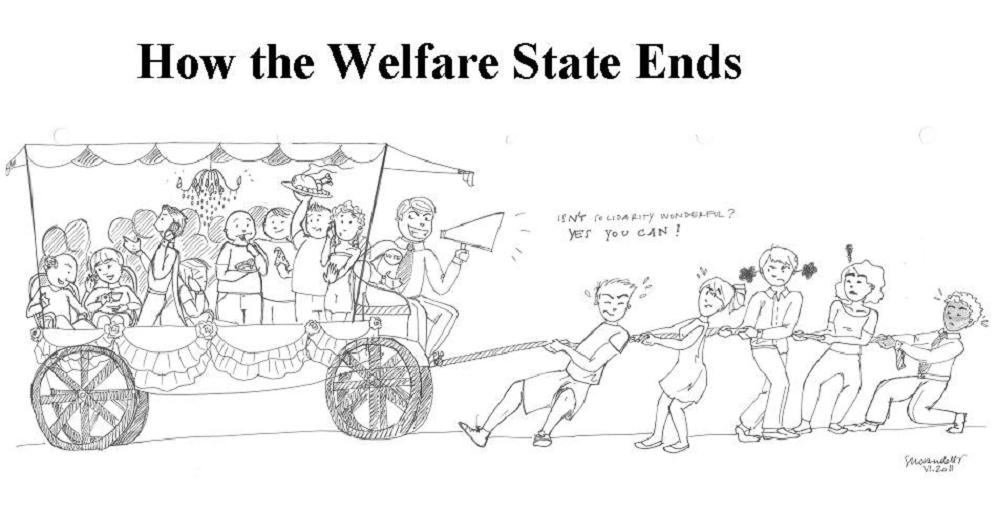
How sad it is that liberals just don’t get this reality.

Here is what the Founding Fathers had to say about welfare. David Weinberger noted:

While living in Europe in the 1760s, Franklin observed: “in different countries … the more public provisions were made for the poor, the less they provided for themselves, and of course became poorer. And, on the contrary, the less was done for them, the more they did for themselves, and became richer.”

Alexander Fraser Tytler, Lord Woodhouselee (15 October 1747 – 5 January 1813) was a Scottish lawyer, writer, and professor. Tytler was also a historian, and he noted, “A democracy cannot exist as a permanent form of government. It can only exist until the majority discovers it can vote itself largess out of the public treasury. After that, the majority always votes for the candidate promising the most benefits with the result the democracy collapses because of the loose fiscal policy ensuing, always to be followed by a dictatorship, then a monarchy.”

Thomas Jefferson to Joseph Milligan

April 6, 1816

[Jefferson affirms that the main purpose of society is to enable human beings to keep the fruits of their labor. — TGW]
 

To take from one, because it is thought that his own industry and that of his fathers has acquired too much, in order to spare to others, who, or whose fathers have not exercised equal industry and skill, is to violate arbitrarily the first principle of association, “the guarantee to every one of a free exercise of his industry, and the fruits acquired by it.” If the overgrown wealth of an individual be deemed dangerous to the State, the best corrective is the law of equal inheritance to all in equal degree; and the better, as this enforces a law of nature, while extra taxation violates it.

[From Writings of Thomas Jefferson, ed. Albert E. Bergh (Washington: Thomas Jefferson Memorial Association, 1904), 14:466.]

_______

Jefferson pointed out that to take from the rich and give to the poor through government is just wrong. Franklin knew the poor would have a better path upward without government welfare coming their way. Milton Friedman’s negative income tax is the best method for doing that and by taking away all welfare programs and letting them go to the churches for charity.

_____________

_________

Thank you so much for your time. I know how valuable it is. I also appreciate the fine family that you have and your commitment as a father and a husband.

Sincerely,

Everette Hatcher III, 13900 Cottontail Lane, Alexander, AR 72002, ph 501-920-5733, lowcostsqueegees@yahoo.com

Related Posts:

Related posts:

Welfare Spending Shattering All-Time Highs

  We got to act fast and get off this path of socialism. Morning Bell: Welfare Spending Shattering All-Time Highs Robert Rector and Amy Payne October 18, 2012 at 9:03 am It’s been a pretty big year for welfare—and a new report shows welfare is bigger than ever. The Obama Administration turned a giant spotlight […]

We need more brave souls that will vote against Washington welfare programs

We need to cut Food Stamp program and not extend it. However, it seems that people tell the taxpayers back home they are going to Washington and cut government spending but once they get up there they just fall in line with  everyone else that keeps spending our money. I am glad that at least […]

Welfare programs are not the answer for the poor

Government Must Cut Spending Uploaded by HeritageFoundation on Dec 2, 2010 The government can cut roughly $343 billion from the federal budget and they can do so immediately. __________ Liberals argue that the poor need more welfare programs, but I have always argued that these programs enslave the poor to the government. Food Stamps Growth […]

Private charities are best solution and not government welfare

Milton Friedman – The Negative Income Tax Published on May 11, 2012 by LibertyPen In this 1968 interview, Milton Friedman explained the negative income tax, a proposal that at minimum would save taxpayers the 72 percent of our current welfare budget spent on administration. http://www.LibertyPen.com Source: Firing Line with William F Buckley Jr. ________________ Milton […]

The book “After the Welfare State”

Dan Mitchell Commenting on Obama’s Failure to Propose a Fiscal Plan Published on Aug 16, 2012 by danmitchellcato No description available. ___________ After the Welfare State Posted by David Boaz Cato senior fellow Tom G. Palmer, who is lecturing about freedom in Slovenia and Tbilisi this week, asked me to post this announcement of his […]

President Obama responds to Heritage Foundation critics on welfare reform waivers

Is President Obama gutting the welfare reform that Bill Clinton signed into law? Morning Bell: Obama Denies Gutting Welfare Reform Amy Payne August 8, 2012 at 9:15 am The Obama Administration came out swinging against its critics on welfare reform yesterday, with Press Secretary Jay Carney saying the charge that the Administration gutted the successful […]

Welfare reform part 3

Thomas Sowell – Welfare Welfare reform was working so good. Why did we have to abandon it? Look at this article from 2003. The Continuing Good News About Welfare Reform By Robert Rector and Patrick Fagan, Ph.D. February 6, 2003 Six years ago, President Bill Clinton signed legislation overhauling part of the nation’s welfare system. […]

Welfare reform part 2

Uploaded by ForaTv on May 29, 2009 Complete video at: http://fora.tv/2009/05/18/James_Bartholomew_The_Welfare_State_Were_In Author James Bartholomew argues that welfare benefits actually increase government handouts by ‘ruining’ ambition. He compares welfare to a humane mousetrap. —– Welfare reform was working so good. Why did we have to abandon it? Look at this article from 2003. In the controversial […]

Why did Obama stop the Welfare Reform that Clinton put in?

Thomas Sowell If the welfare reform law was successful then why change it? Wasn’t Bill Clinton the president that signed into law? Obama Guts Welfare Reform Robert Rector and Kiki Bradley July 12, 2012 at 4:10 pm Today, the Obama Department of Health and Human Services (HHS) released an official policy directive rewriting the welfare […]

“Feedback Friday” Letter to White House generated form letter response July 10,2012 on welfare, etc (part 14)

I have been writing President Obama letters and have not received a personal response yet.  (He reads 10 letters a day personally and responds to each of them.) However, I did receive a form letter in the form of an email on July 10, 2012. I don’t know which letter of mine generated this response so I have […]
Dan Mitchell destroys Max Brantley’s contention that tax rates don’t put feet in motion!!!!

Dan Mitchell destroys Max Brantley’s contention that tax rates don’t put feet in motion!!!!

___________

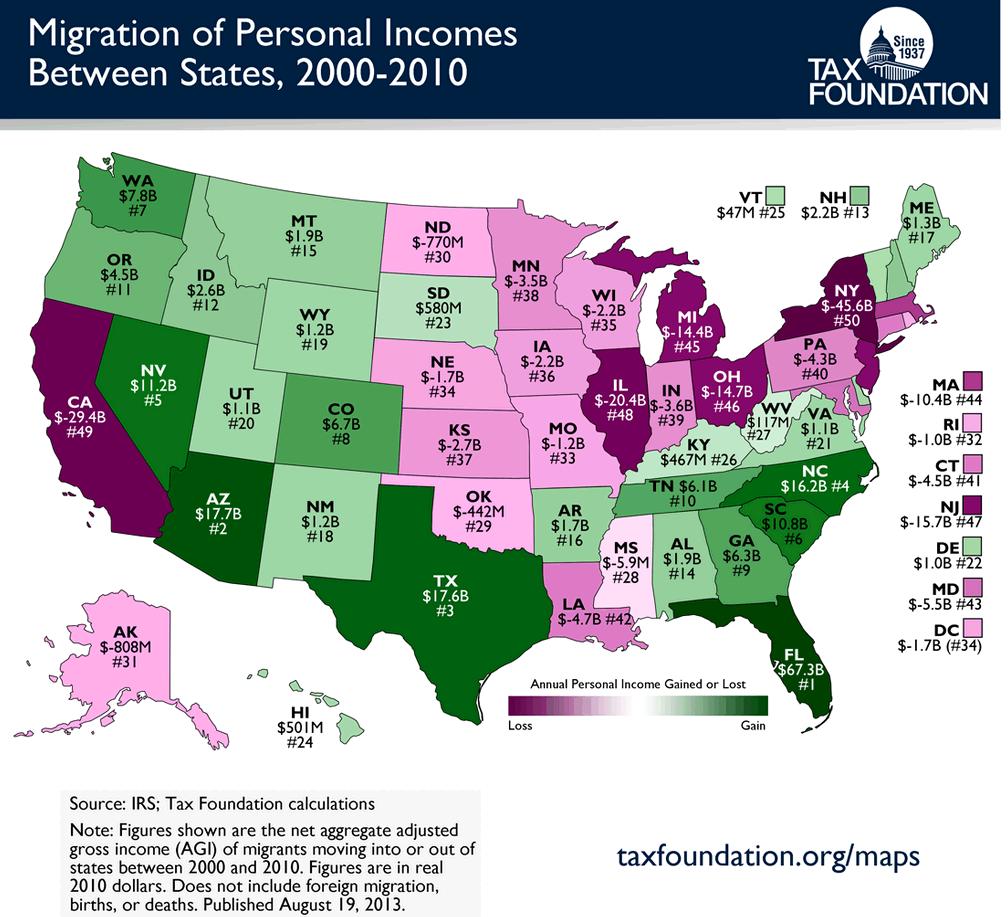
Max Brantley should be commended for admitting that tax rates do enter into the decision making process for many people when they decide to move. However, he falls short of admitting their full impact on these decisions.

Here is what the Washington Examiner  wrote about tax competition and tax migration inside the United States.

States like California…can’t afford to be hospitable to business while also funding massive public employee entitlements. …job-creating businesses flee big-government Blue States for limited-government Red States. In short order, Blue States find themselves in financial straits. …between 2000 and 2010, the big Blue States of New York, California, and Illinois chased off hundreds of thousands of residents taking billions in income with them ($45.6 billion, $29.4 billion, and $20.4 billion respectively). Each of these states have highly progressive, high-marginal rate tax codes. California, for example, has 10 income tax brackets and a top rate of 13.3 percent. New York has eight brackets and an 8.82 percent top rate. Where did all those formerly Blue State income go? To low-tax, Red State jurisdictions, including Florida (no income tax), Texas (no income tax), and Arizona (4.54 percent top rate). Those three alone raked in $67.3 billion, $17.7 billion, and $17.6 billion, respectively.

Dan Mitchell of the Cato Institute noted:

Indeed, there have been studies looking at how specific states are driving high-income taxpayers to emigrate. And that means big Laffer-Curve effects.

Which is good news because even politicians are probably capable of learning – sooner or later – that high tax rates won’t raise much revenue if the geese that lay the golden eggs decide to fly away.

_____________

In light of these facts some of Max Brantley comments just look off a little bit:

Here’s something fun to noodle with if you have time. A Jefferson County native was fascinated withthis website, How Money Walks, and I agree there’s some interesting stuff there.

The map (flash player required) uses IRS figures to show movement of wealth, as measured by adjusted gross income, from one place to another — broken down by state and metropolitan area. There’s an ideological angle,  naturally. It’s meant to show that rich people have walked away from high-tax places like California. I’m not ready to accept the premise entirely. Taxes alone don’t explain decisions to move. Arkansas, with a high income tax rate that has flattened over the years, still manages to be a “growth” state. Louisiana, where no tax break is off the table, was a loser over the time period.

I think you can see some other forces at work in just this one slice above, on Pulaski County. A huge amount of income here moved to suburban counties over the period studied, for a giant net loss. Pulaski did gain a nice chunk of income from people leaving Jefferson County. I don’t believe it was tax rates that put those feet in motion.

_____________

Here is the complete article from Dan Mitchell below:

Why Tax Migration and Federalism Mean Doom for Left-Wing States such as New York, California, and Illinois

Maybe this means I’m not a nice person (notwithstanding my high score for tenderness in a recent test), but I can’t help but be happy when I read bad news about fiscal policy in high-tax welfare states.

And because I’m a huge fan of tax competition, I get even happier when I find out that bloated governments are in trouble because people are escaping to places where government isn’t quite so greedy.

With that in mind, I smiled when I read what the Washington Examiner just wrote about tax competition and tax migration inside the United States.

States like California…can’t afford to be hospitable to business while also funding massive public employee entitlements. …job-creating businesses flee big-government Blue States for limited-government Red States. In short order, Blue States find themselves in financial straits. …between 2000 and 2010, the big Blue States of New York, California, and Illinois chased off hundreds of thousands of residents taking billions in income with them ($45.6 billion, $29.4 billion, and $20.4 billion respectively). Each of these states have highly progressive, high-marginal rate tax codes. California, for example, has 10 income tax brackets and a top rate of 13.3 percent. New York has eight brackets and an 8.82 percent top rate. Where did all those formerly Blue State income go? To low-tax, Red State jurisdictions, including Florida (no income tax), Texas (no income tax), and Arizona (4.54 percent top rate). Those three alone raked in $67.3 billion, $17.7 billion, and $17.6 billion, respectively.

Indeed, there have been studies looking at how specific states are driving high-income taxpayers to emigrate. And that means big Laffer-Curve effects.

Which is good news because even politicians are probably capable of learning – sooner or later – that high tax rates won’t raise much revenue if the geese that lay the golden eggs decide to fly away.

And since a picture tells a thousand words, here’s the map of taxable income migration put together by the Tax Foundation using IRS data.

Tax Foundation Income Migration Map

Before closing, I want to highlight one other passage from the Examiner column that touches on a very critical point.

Thanks to the few federalist principles that are still protected in the Constitution, Americans remain free to vote with their feet and escape economically suffocating places like California in order to move to the vastly more hospital economic climates found in Red States like Texas.

Amen. Federalism is a very valuable way of protecting people from statism. We see it when people move from New York. We see it when they escape from California. We see it from a big-picture perspective in the Tax Foundation map.

Federalism enables to producers to escape the looters and moochers.

But federalism has been weakened over the years by the expansion of federal government. If we want to bolster competition among the states – and therefore constrain the greed of the political class, we need to devolve programs from Washington.

This is why welfare reform during the Clinton years was such a good idea. And it’s why block-granting Medicaid is so desirable (above and beyond the fiscal need to implement good entitlement reform).

P.S. It’s rather appropriate that I’m writing about federalism since I’m now in Lausanne, Switzerland, for the 2013 Liberty Conference and Switzerland is probably the world’s best example of genuine federalism.

P.P.S. One small correction to the Examiner’s piece. Illinois is a high-tax state. Illinois is a big-government state. Illinois is a state heading toward fiscal collapse. There are many things wrong with the Land of Lincoln, but it hasn’t compounded those other mistakes with a “progressive” tax that discriminates against those who add more to economic output. Indeed, the fact that Illinois has a flat tax helps to explain why politicians had such a hard time pushing through a tax hike a couple of  years ago. They eventually succeeded, but the politicians faced an uphill battle because they couldn’t play the divide-and-conquer game of raising taxes on a limited segments of the population.

The Laffer Curve, Part III: Dynamic Scoring

Related posts:

Editorial cartoon from Dan Mitchell’s blog on California’s sorry state of affairs

I have put up lots of cartoons from Dan Mitchell’s blog before and they have got lots of hits before. Many of them have dealt with the sequester, economy, eternal unemployment benefits, socialism,  minimum wage laws, tax increases, social security, high taxes in California, Obamacare,  Greece,  welfare state or on gun control. President Obama’s favorite state must be California because […]

Are the states of Illinois and California going to join Detroit in Bankruptcy one day?

Dan Mitchell Commenting on Detroit’s Bankruptcy __________________________ Are the states of Illinois and California going to join Detroit in Bankruptcy one day?   One of the funniest cartoons I have see is one below about the states of Illinois, and California joining Detroit in bankruptcy some day. Should Detroit’s Bankruptcy Be an Early-Warning Sign for Washington? […]

California is the Greece of the USA, but Texas is not perfect either!!!

California is the Greece of the USA, but Texas is not perfect either!!! Just Because California Is Terrible, that Doesn’t Mean Texas Is Perfect January 21, 2013 by Dan Mitchell Texas is in much better shape than California. Taxes are lower, in part because Texas has no state income tax. No wonder the Lone Star State […]

Dan Mitchell on Texas v. California (includes editorial cartoon)

We should lower federal taxes because jobs are going to states like Texas that have low taxes. (We should lower state taxes too!!) What Can We Learn by Comparing the Employment Situation in Texas vs. California? April 3, 2013 by Dan Mitchell One of the great things about federalism, above and beyond the fact that it […]

Editorial cartoon from Dan Mitchell’s blog on California’s sorry state of affairs

I have put up lots of cartoons from Dan Mitchell’s blog before and they have got lots of hits before. Many of them have dealt with the sequester, economy, eternal unemployment benefits, socialism,  minimum wage laws, tax increases, social security, high taxes in California, Obamacare,  Greece,  welfare state or on gun control. President Obama’s favorite state must be California because […]

California raises taxes again!!!

California has been mad fun of several times in the past on this blog. Now they have done it again. California’s Economic Suicide and other News from Yesterday’s Ballot Measures November 7, 2012 by Dan Mitchell I was surprised when the people of Oregon voted for a tax increase back in early 2010. Yes, I realize […]

Ark Times blogger claims California is better than Texas but facts don’t bear that out (3 great political cartoons)

I got on the Arkansas Times Blog and noticed that a person on there was bragging about the high minimum wage law in San Francisco and how everything was going so well there. On 2-15-13 on the Arkansas Times Blog I posted: Couldn’t be better (the person using the username “Couldn’t be better)  is bragging […]

California dismal experience of trying to soak the rich

Is our country learning from history? California keeps raising their taxes on the wealthy and people keep moving from California to Texas. What does our federal government do? They also have been raising taxes on the wealthy lately. Take a look at this excellent video below and then read a great article by Dan Mitchell […]

California burdensome government causing some of business community to leave for Texas

Does Government Have a Revenue or Spending Problem? People say the government has a debt problem. Debt is caused by deficits, which is the difference between what the government collects in tax revenue and the amount of government spending. Every time the government runs a deficit, the government debt increases. So what’s to blame: too […]

California has forgotten the lessons of Ronald Reagan

If our country is the grow the economy and get our budget balanced it will not be by raising taxes!!! The recipe for success was followed by Ronald Reagan in the 1980′s when he cut taxes and limited spending. As far as limiting spending goes only Bill Clinton (with his Republican Congress) were ability to […]

Thomas Paine wrote, “There are two distinct classes of men in the nation, those who pay taxes, and those who receive and live upon the taxes.”

Funding Government by the Minute

Published on Mar 28, 2012

At the rate the federal government spends, it runs out of money on July 31. What programs should be cut to balance the budget and fund the government for the remaining five months of the year? Cutting NASA might buy two days; cutting the Navy could buy fifteen. It seems that balancing the budget may require more than just cutting government programs. What should be done?

___________________________

It is truly sad to me that so much of our money is taken by the federal government. Our founding fathers believed in small limited government. It seems that our President wants to play Santa Claus.
January 11, 2013 9:31AM

How Washington Grows Rich

I see that I’m quoted in Annie Lowrey’s New York Times Magazine story, “Washington’s Economic Boom, Financed by You”:

David Boaz, executive vice president of the Cato Institute, told me: “Washington’s economy is based on the confiscation and transfer of wealth produced elsewhere. Out in the country they’re growing food, building cars and designing software — all these things that raise our standard of living. Here in Washington, everyone is writing memos to each other about how to take some of that money and which special interest should get it.” I asked him if he liked living in the city, which has become undeniably nicer. Boaz sputtered a bit. “I can’t walk to lunch from my office without having to avoid the construction projects!” he said. “For Washington, it does mean better restaurants and better entertainment, and the potholes get filled faster. But for the country as a whole? I don’t think it’s a good thing for America.”

I’m confident I didn’t sputter, but otherwise this sounds right. I’ve been writing about the wealth of the Washington area and where it comes from for years.

In 2005 I wrote about – yes – the construction projects that block my way to lunch in a “big-government building boom.”

In 2006 I leaned on Waymon and Willie to offer some advice to parents:

Mammas, don’t let your babies grow up to be cowboys,

Don’t let ’em make software and sell people trucks,

Make ’em be bureaucrats and fed’rals and such.

Here are a few other links to discussions of Washington’s wealth, starting with the most recent news:

http://www.cato.org/blog/happy-new-year-washington

http://www.cato.org/blog/its-fall-washington-livin-still-good

http://www.cato.org/blog/lobbying-booming-business-politicized-economy

http://www.cato.org/blog/obamas-k-street-recovery-plan

http://www.cato.org/blog/no-recession-washington

http://www.cato.org/blog/washington-booming-bush-obama-years

I focused on why money flows to Washington way back in 1983 in the Wall Street Journal:

Business people know that you have to invest to make money. Businesses invest in factories, labor, research and development, marketing, and all the other processes that bring goods to consumers and, they hope, lead to profits. They also invest in political processes that may yield profits.

If more money can be made by investing in Washington than by drilling another oil well, money will be spent there.

Nobel laureate F.A. Hayek explained the process 40 years ago in his prophetic book The Road to Serfdom: “As the coercive power of the state will alone decide who is to have what, the only power worth having will be a share in the exercise of this directing power.”

As the size and power of government increase, we can expect more of society’s resources to be directed toward influencing government.

And all of this relates to an idea I discussed in Libertarianism: A Primer:

Libertarians developed a pre-Marxist class analysis that divided society into two basic classes: those who produced wealth and those who took it by force from others.  Thomas Paine, for instance, wrote, “There are two distinct classes of men in the nation, those who pay taxes, and those who receive and live upon the taxes.”  Similarly, Jefferson wrote in 1824, “We have more machinery of government than is necessary, too many parasites living on the labor of the industrious.”  Modern libertarians defend the right of productive people to keep what they earn, against a New Class of politicians and bureaucrats who would seize their earnings to transfer them to nonproducers.

Sheldon Richman has more on this libertarian class analysis that focused on “conflict between producers, no matter their station, and the parasitic political classes, both inside and outside the formal state,” or “between the tax-payers and tax-eaters.”

________________

President Obama plays Santa Claus but you played for the presents!!!

During previous Christmas seasons, I’ve shared some holiday humor.

This year, let’s enjoy a bunch of good cartoons.

Lisa Benson start our list, with this recognition of Time’s Man of the year. It’s so nice of the President to give away other’s people’s money.

Cartoon Christmas 1

And since Obama’s currently threatening to take the nation over the fiscal cliff unless he gets some class warfare tax policy, this Lisa Benson holiday cartoon from last year is worth sharing as well.

The second cartoon has the same theme.

Cartoon Christmas 2

The magnificent Chuck Asay offers this gem, with a message similar to one he produced earlier this year.

Cartoon Christmas 3

Asay also did a Christmas-themed cartoon last year.

Jerry Holbert provides this funny – but not so funny if you think about it – cartoon.

Cartoon Christmas 4

Here’s a good one from Glenn McCoy. This cartoon is a pretty good summary of how politics really works.

Cartoon Christmas 5

P.S. Here’s a bonus section. I can’t resist being a proud dad and sharing this family photo. It was taken while we had a meal break during some Christmas shopping.

December 2012

Not a bad brood, if I can offer an unbiased assessment.

My kids have made other appearances on the blog – here, here, here, here, and here.

Open letter to President Obama (Part 412) No good developments for limited government in 2012

(Emailed to White House on 1-9-13.)

President Obama c/o The White House
1600 Pennsylvania Avenue NW
Washington, DC 20500

Dear Mr. President,

I know that you receive 20,000 letters a day and that you actually read 10 of them every day. I really do respect you for trying to get a pulse on what is going on out here.

Not much accomplished in the area of liberty and freedom in the USA in 2012. If the founding fathers were here today that would be horrified that their idea of limited government had been transformed into what the federal government is today.

I’m not sure I could pick out a significant victory for human freedom in 2012.

Maybe I’m missing something, but the only good policy that’s even worth mentioning was the decision in Wisconsin to rein in the special privileges and excessive compensation for government workers.

But there definitely have been lots of sad developments.

The hard part is picking the most disappointing story.

1. Was it the craven decision by John Roberts to put politics before the Constitution and cast the deciding vote for Obamacare? This certainly could be the most disappointing event of the year, but technically it didn’t represent a step in the wrong direction since the Supreme Court basically gave a green light to unlimited federal power back in the 1930s and 1940s. The Obamacare case is best characterized as a failure to do the right thing. A very tragic decision, to be sure, but it maintained the status quo.

2. Was it the lawless decision by the Internal Revenue Service to impose a horrible regulation that forces American banks to put foreign law above U.S. law? This was a very bad development in the battle for tax competition, financial privacy, and fiscal sovereignty. But in the grand scheme of things, it’s just another in a long line of policies (such as FATCA) designed to increase the power of governments to impose and enforce bad tax policy.

3. Was it the Japanese government’s decision to double the value-added tax? I’m definitely not a fan of adding a VAT on top of the income tax, but Japan made that mistake years ago. The choice to increase the tax rate just shows why it’s dangerous to give politicians any new source of revenue. So this isn’t the worst policy development of 2012, particularly since the new Japanese government may suspend the tax hike.

4. Was it the delusional decision by 54 percent of California voters to impose a big, class-warfare tax hike? I thought the vote for Prop 30 was a very troubling development since it signaled that voters could be tricked into enacting class-warfare tax policy, even though they should have realized that more revenue for the state’s politicians would simply exacerbate the eventual fiscal collapse. But since I think this will be a learning experience on what not to do, I can’t put this at the top of my list.

5. Was it the French government’s punitive decision to impose a 75-percent top tax rate? This is a spectacularly misguided policy, and it’s already resulting in an exodus of entrepreneurs and other successful people. But just as I enjoy have California as a negative role model, I like using France as an example of bad policy. So it would be a bit hypocritical for me to list this as the worst policy of 2012.

6. Or was it the envy-motivated decisions by politicians in both Slovakia and the Czech Republic to replace flat tax systems with so-called progressive tax regimes? This is a strong candidate for the worst policy of the year. It’s very rare to see governments do the right thing, so it’s really tragic when politicians implement good reforms and later decide to reinstate class-warfare policies.

All things considered, I think this last option is the worst policy development of 2012. To be sure, I’m a bit biased since my work focuses on public finance issues and I’ve spent 20 years advocating for tax reform.

But I think there’s a strong case to be made, by anyone who believes in freedom, that politicians from Slovakia and the Czech Republic deserve the booby prize for worst public policy development of 2012.

Alvin Rabushka, sometimes referred to as the Father of the Flat Tax , summarizes the grim news.

On December 4, 2013, the center-left parliament of Slovakia modified the country’s historic 19% flat-rate tax…  Effective January 1, 2013, the income tax rate for corporations was raised from 19% to 23%, while that on individuals earning more than €39,600 (€1=$1.30) a year was raised to 25%, thereby creating two brackets of 19% and 25%. …On November 7, 2012, the lower house (Chamber of Deputies) of the national parliament approved a proposal to impose a second higher rate of 22% on annual income exceeding Czech Koruna (CZK) 100,000 ($5,200) per month.  President Vaclav Klaus signed the bill on December 22, 2012, which will take effect on January 1, 2013.

What’s especially depressing about these two defeats is that the supposedly right-wing parties deserve the blame.

Two nations filled with brain-dead conservative politicians

In Slovakia, all but one of the right-leaning parties in the old government decided to support the Greek bailout, leading to the collapse of the government and the election of a new socialist government that then sabotaged tax reform.

And in the Czech Republic, the current right-of-center government decided to scrap the flat tax for “fairness” reasons. I’m sure that will really be comforting to the Czech people as the economy suffers from less growth.

To understand what the people of those nations are losing, here’s my video on the flat tax.

Now for a bit of good news. There are still more than 25 flat tax jurisdictions in the world, including two of my favorite places – Hong Kong and Estonia.

So there are still some pockets of rationality. It’s just very unfortunate that the scope of human liberty is getting smaller every year.

P.S. The absolute worst thing that happened in 2012, if we look beyond public policy, was Georgia falling 4 yards short of beating Alabama in the Southeastern Conference Championship.

P.P.S. Speaking of sports, the best thing about 2012 occurred in Virginia Beach back in October.

_________

Thank you so much for your time. I know how valuable it is. I also appreciate the fine family that you have and your commitment as a father and a husband.

Sincerely,

Everette Hatcher III, 13900 Cottontail Lane, Alexander, AR 72002, ph 501-920-5733, lowcostsqueegees@yahoo.com

Related posts:

Open letter to President Obama (Part 201)Tea Party favorite Representative links article “Prescott and Ohanian: Taxes Are Much Higher Than You Think”

    (Emailed to White House on 12-21-12.) President Obama c/o The White House 1600 Pennsylvania Avenue NW Washington, DC 20500 Dear Mr. President, I know that you receive 20,000 letters a day and that you actually read 10 of them every day. I really do respect you for trying to get a pulse on […]

Open letter to President Obama (Part 200.2)Tea Party Republican Representative takes on the President concerning fiscal cliff

(Emailed to White House on 12-21-12.) President Obama c/o The White House 1600 Pennsylvania Avenue NW Washington, DC 20500 Dear Mr. President, I know that you receive 20,000 letters a day and that you actually read 10 of them every day. I really do respect you for trying to get a pulse on what is […]

Open letter to President Obama (Part 200.1)Tea Party favorite Representative shares link on facebook

(Emailed to White House on 12-21-12) President Obama c/o The White House 1600 Pennsylvania Avenue NW Washington, DC 20500 Dear Mr. President, I know that you receive 20,000 letters a day and that you actually read 10 of them every day. I really do respect you for trying to get a pulse on what is […]

Open letter to President Obama (Part 199) Tea Party favorite takes on President

  The federal government has a spending problem and Milton Friedman came up with the negative income tax to help poor people get out of the welfare trap. It seems that the government screws up about everything. Then why is President Obama wanting more taxes? _______________ Milton Friedman – The Negative Income Tax Published on […]

Tea Party Heroes Rep. David Schweikert (R-AZ),Justin Amash (R-MI), Tim Huelskamp (R-KS) have been punished by Boehner

I was sad to read that the Speaker John Boehner has been involved in punishing tea  party republicans. Actually I have written letters to several of these same tea party heroes telling them that I have emailed Boehner encouraging him to listen to them. Rep. David Schweikert (R-AZ),Justin Amash (R-MI), and Tim Huelskamp (R-KS). have been contacted […]

Some Tea Party heroes (Part 10)

Michael Tanner of the Cato Institute in his article, “Hitting the Ceiling,” National Review Online, March 7, 2012 noted: After all, despite all the sturm und drang about spending cuts as part of last year’s debt-ceiling deal, federal spending not only increased from 2011 to 2012, it rose faster than inflation and population growth combined. […]

Some Tea Party heroes (Part 9)

Michael Tanner of the Cato Institute in his article, “Hitting the Ceiling,” National Review Online, March 7, 2012 noted: After all, despite all the sturm und drang about spending cuts as part of last year’s debt-ceiling deal, federal spending not only increased from 2011 to 2012, it rose faster than inflation and population growth combined. […]

49 posts on Tea Party heroes of mine

Some of the heroes are Mo Brooks, Martha Roby, Jeff Flake, Trent Franks, Duncan Hunter, Tom Mcclintock, Devin Nunes, Scott Tipton, Bill Posey, Steve Southerland and those others below in the following posts. THEY VOTED AGAINST THE DEBT CEILING INCREASE IN 2011 AND WE NEED THAT TYPE OF LEADERSHIP NOW SINCE PRESIDENT OBAMA HAS BEEN […]

Some Tea Party Republicans win and some lose

I hated to see that Allen West may be on the way out. ABC News reported: Nov 7, 2012 7:20am What Happened to the Tea Party (and the Blue Dogs?) Some of the Republican Party‘s most controversial House members are clinging to narrow leads in races where only a few votes are left to count. […]

Some Tea Party heroes (Part 8)

Rep Himes and Rep Schweikert Discuss the Debt and Budget Deal Michael Tanner of the Cato Institute in his article, “Hitting the Ceiling,” National Review Online, March 7, 2012 noted: After all, despite all the sturm und drang about spending cuts as part of last year’s debt-ceiling deal, federal spending not only increased from 2011 […]

Dan Mitchell: Where Will You Go if America Collapses? (includes editorial cartoon)

Dan Mitchell has a great article below that I thought you would be interested in.

A reader from New York has a follow-up question for me.

Referencing a “Question of the Week” from last month, in which I expressed guarded optimism that America could be saved, she wants to know what I would do if things go the wrong way.

In other words, what if things go really wrong and America suffers a Greek-style fiscal collapse? And imagine how bad that might be since there wouldn’t be an IMF or European Central Bank capable of providing bailouts to the United States.

Perhaps because of an irrational form of patriotism, I’m fairly certain that I will always live in the United States and I will be fighting to preserve (or restore) liberty until my last breath.

But I probably would want my children someplace safe and stable, so I’ll answer the question from that perspective.

The obvious first choice is a zero-income tax jurisdiction like the Cayman Islands that is prosperous and reasonably well governed.

But I’m not sure about the long-run outlook for the Cayman Islands, in part because the politicians there have flirted with an income tax and in part because the jurisdiction inevitably would suffer if the United States was falling apart.

So what’s a place that is stable and not overly tied to the American economy.

Then the obvious choice is Switzerland. That nation’s long-run fiscal outlook is relatively favorable because of  modest-sized government and a very good spending control mechanism.

But while Switzerland is not dependent on the U.S. economy, it is surrounded by European welfare states. And I’m fairly certain that nations such as France, Italy, and (perhaps) Germany will collapse before America.

And even though most Swiss households have machine guns and the nation presumably can defend itself from barbarian hordes in search of a new welfare check, Switzerland’s probably not the ideal location.

Estonia is one of my favorite countries, and they’ve implemented some good reforms such as the flat tax. But I worry about demographic decline. Plus, I’m a weather wimp and it’s too chilly most of the year.

Another option is a stable nation in Latin America, perhaps Chile, Panama, or Costa Rica. I haven’t been to Chile, but I’m very impressed by the nation’s incredible progress in recent decades. I have been to Panama many times and it is one of my favorite nations. I’ve only been to Costa Rica two times, but it also seems like a nice country.

The bad news is that I don’t speak Spanish (and my kids don’t speak the language, either). The good news is that Hispanics appear to be the world’s happiest people, so that should count for something.

“G’day mate, we’ve privatized our social security system!”

This brings me to Australia, the country that probably would be at the top of my list. The burden of government spending in Australia is less than it is in the United States.

But the gap isn’t that large. The reason I like Australia is that the nation has a privatized Social Security system (called Superannuation) and the long-run fiscal outlook is much, much better than the United States.

Plus the Aussies are genuinely friendly and they speak an entertaining form of English.

So if America goes under, I recommend going Down Under.

____________

We don’t have to fall apart in the USA if we are willing to make the tough cuts and reshape the entitlements. Below is a great video that discusses this.

What Can We Cut to Balance the Budget

Published on Oct 16, 2012

If the U.S. government cut all government services except Social Security, Medicare, Medicaid, and payments on the debt, federal spending would still outpace revenues. Prof. Antony Davies argues that there are not specific cuts that will enable government to balance the budget. He says, “Nothing less than a redesign will solve this problem.” That redesign should begin by determining what the proper role of government is.

_________

Europe is going down the tubes fast if they keep on the same path.

There’s a rather simple solution to Europe’s fiscal crisis, but politicians will never do the right thing unless every other option is exhausted.

That’s why American taxpayers should not be involved in any sort of European bailout, either directly or indirectly.

This cartoon captures my sentiment.

At the risk of being picky, however, I would replace “Fed” with “USA/IMF” or something like that.

As I explained a few days ago, the Federal Reserve’s recent announcement that it will provide dollar liquidity to Europe is not necessarily objectionable. After all, the Europeans have to pay us back if they borrow dollars, with interest, at current exchange rates.

Yes, I worry European politicians may interpret the Fed’s actions as a signal that they can defer long-overdue reforms, and I also worry that it might be a precursor for easy-money policies in the future.

But the real threat to American taxpayers is that the International Monetary Fund may provide more bailouts to Europe.

I keep explaining that the only solution is for Europe’s welfare states to copy the Baltic nations and actually cut spending, but that will never happen if European politicians think that they can get an IMF handout (and thus shift some of their bad fiscal policy onto the backs of American taxpayers).

Open letter to President Obama (Part 410)The death tax discourages saving and investing

(Emailed to White House on 1-9-13.)

President Obama c/o The White House
1600 Pennsylvania Avenue NW
Washington, DC 20500

Dear Mr. President,

I know that you receive 20,000 letters a day and that you actually read 10 of them every day. I really do respect you for trying to get a pulse on what is going on out here.

The death tax discourages saving and investing.

Just before the end of the year, I shared some fascinating research about people dying quicker or living longer when there are changes in the death tax. Sort of the ultimate Laffer Curve response, particularly if it’s the former.

But the more serious point is that the death tax shouldn’t exist at all, as I’ve explained for USA Today. And in this CNBC debate, I argue that it is an immoral form of double taxation.

You’ll see that Jared sneakily tries to include wealth taxes and death taxes together in order to accuse me of an inaccuracy, but the chart (click to enlarge) clearly shows that there are many jurisdictions that wisely avoid this anti-competitive levy.

The data is a few years old, but it’s clear that the United states has one of the most punitive death tax systems in the world.

Unfortunately, this is a good description of many parts of our tax system. We also have the world’s highest corporate tax rate and we also have very high tax burdens on dividends and capital gains (and the tax rates on both just got worse thanks to the fiscal cliff legislation).

But probably the key difference between us is that Jared genuinely thinks government should be bigger and that the tax burden should be much higher.

Though I will give him credit. Not only does he want class-warfare tax hikes, such as a higher death tax, but he openly admits he wants to rape and pillage the middle class as well.

Not surprisingly, I argue that more revenue in Washington will exacerbate the real problem of a federal government that is too big and spending too much.

P.S. Here’s a cartoon that is only funny if you don’t think too deeply about what it means.

P.P.S. You’ll notice that the video in this post has good quality, unlike the fuzzy resolution and discontinuous footage in clips I’ve recently shared. That’s because Cato’s expert on such things is back in the office and we’re no longer relying on my sub-par technical knowledge.

_________

Thank you so much for your time. I know how valuable it is. I also appreciate the fine family that you have and your commitment as a father and a husband.

Sincerely,

Everette Hatcher III, 13900 Cottontail Lane, Alexander, AR 72002, ph 501-920-5733, lowcostsqueegees@yahoo.com

Related posts:

Open letter to President Obama (Part 201)Tea Party favorite Representative links article “Prescott and Ohanian: Taxes Are Much Higher Than You Think”

    (Emailed to White House on 12-21-12.) President Obama c/o The White House 1600 Pennsylvania Avenue NW Washington, DC 20500 Dear Mr. President, I know that you receive 20,000 letters a day and that you actually read 10 of them every day. I really do respect you for trying to get a pulse on […]

Open letter to President Obama (Part 200.2)Tea Party Republican Representative takes on the President concerning fiscal cliff

(Emailed to White House on 12-21-12.) President Obama c/o The White House 1600 Pennsylvania Avenue NW Washington, DC 20500 Dear Mr. President, I know that you receive 20,000 letters a day and that you actually read 10 of them every day. I really do respect you for trying to get a pulse on what is […]

Open letter to President Obama (Part 200.1)Tea Party favorite Representative shares link on facebook

(Emailed to White House on 12-21-12) President Obama c/o The White House 1600 Pennsylvania Avenue NW Washington, DC 20500 Dear Mr. President, I know that you receive 20,000 letters a day and that you actually read 10 of them every day. I really do respect you for trying to get a pulse on what is […]

Open letter to President Obama (Part 199) Tea Party favorite takes on President

  The federal government has a spending problem and Milton Friedman came up with the negative income tax to help poor people get out of the welfare trap. It seems that the government screws up about everything. Then why is President Obama wanting more taxes? _______________ Milton Friedman – The Negative Income Tax Published on […]

Tea Party Heroes Rep. David Schweikert (R-AZ),Justin Amash (R-MI), Tim Huelskamp (R-KS) have been punished by Boehner

I was sad to read that the Speaker John Boehner has been involved in punishing tea  party republicans. Actually I have written letters to several of these same tea party heroes telling them that I have emailed Boehner encouraging him to listen to them. Rep. David Schweikert (R-AZ),Justin Amash (R-MI), and Tim Huelskamp (R-KS). have been contacted […]

Some Tea Party heroes (Part 10)

Michael Tanner of the Cato Institute in his article, “Hitting the Ceiling,” National Review Online, March 7, 2012 noted: After all, despite all the sturm und drang about spending cuts as part of last year’s debt-ceiling deal, federal spending not only increased from 2011 to 2012, it rose faster than inflation and population growth combined. […]

Some Tea Party heroes (Part 9)

Michael Tanner of the Cato Institute in his article, “Hitting the Ceiling,” National Review Online, March 7, 2012 noted: After all, despite all the sturm und drang about spending cuts as part of last year’s debt-ceiling deal, federal spending not only increased from 2011 to 2012, it rose faster than inflation and population growth combined. […]

49 posts on Tea Party heroes of mine

Some of the heroes are Mo Brooks, Martha Roby, Jeff Flake, Trent Franks, Duncan Hunter, Tom Mcclintock, Devin Nunes, Scott Tipton, Bill Posey, Steve Southerland and those others below in the following posts. THEY VOTED AGAINST THE DEBT CEILING INCREASE IN 2011 AND WE NEED THAT TYPE OF LEADERSHIP NOW SINCE PRESIDENT OBAMA HAS BEEN […]

Some Tea Party Republicans win and some lose

I hated to see that Allen West may be on the way out. ABC News reported: Nov 7, 2012 7:20am What Happened to the Tea Party (and the Blue Dogs?) Some of the Republican Party‘s most controversial House members are clinging to narrow leads in races where only a few votes are left to count. […]

Some Tea Party heroes (Part 8)

Rep Himes and Rep Schweikert Discuss the Debt and Budget Deal Michael Tanner of the Cato Institute in his article, “Hitting the Ceiling,” National Review Online, March 7, 2012 noted: After all, despite all the sturm und drang about spending cuts as part of last year’s debt-ceiling deal, federal spending not only increased from 2011 […]

Open letter to President Obama (Part 408) We got to starve the spending beast!!!!

(Emailed to White House on 1-9-13.)

President Obama c/o The White House
1600 Pennsylvania Avenue NW
Washington, DC 20500

Dear Mr. President,

I know that you receive 20,000 letters a day and that you actually read 10 of them every day. I really do respect you for trying to get a pulse on what is going on out here.

Milton and Rose Friedman with President Bush.

Milton Friedman on Donahue 1979 (2/5)

I believe the “no new tax pledge” ultimately will work. Milton Friedman believed we should starve the beast and that is good enough for me. “If taxes are raised in order to keep down the deficit, the result is likely to be a higher norm for government spending.” Milton Friedman

There’s a debate among policy wonks about whether a no-tax-hike policy is an effective way of restraining the burden of government spending.

At the risk of over-simplifying, the folks who support the “starve the beast” theory argue that there are political and/or economic limits to government borrowing, so if you don’t let politicians tax more, you indirectly impose a cap on total spending (outlays = tax revenue + borrowing limit). We’ll call this the STB approach, for obvious reasons.

Critics of the theory, by contrast, say that a low-tax policy creates fiscal illusion by making government spending seem artificially cheap. After all, standard microeconomic analysis tells us that people will demand more of something when the perceived price is low (get a $1 of spending for 80 cents of tax = recipe for higher outlays). We’ll call this the “pay for government” approach, or PFG.

There’s almost surely some truth to both arguments, but the real issue if whether one effect is dominant – particularly in the long run. In other words, should supporters of small government fight tax increases? Or welcome them?

I’ve never studied this issue, but my gut instinct has been on the “STB” side of the debate. Here are a few of the reasons.

  1. The politicians and interest groups that favor bigger government seem especially anxious to convince anti-tax lawmakers to change their minds. If nothing else, that suggests higher taxes would “feed the beast.” I suppose this could be a clever example of reverse psychology, but something tells me that Harry Reid and Nancy Pelosi lack the cleverness and subtlety to pull off that kind of trick.
  2. The people who pay for government generally aren’t the ones who reap the benefits. And if you keep increasing taxes on the “rich,” as Obama proposes, why would that affect the preferences of the rest of the population? Especially the huge chunk of the population that doesn’t pay income tax? Simply stated, the PFG approach incorrectly assumes that payers and payees are the same.
  3. Casual empiricism certainly suggests that higher taxes are associated with more government, not less red ink. We see this, for instance, in the evidence I recently shared from Europe. Taxes have jumped in recent decades, but government debt also has climbed, which implies all additional revenue was spent, and then some.
  4. Just look at the real world, specifically the fiscal crisis in nations such as Greece. At the risk of stating the obvious, the recent events in Europe confirm that there does come a point when governments lose the ability to borrow. So if taxpayers somehow can prevent politicians from seizing more money, there is a de facto limit on government spending.

Seems like the STB approach makes sense, but not everyone thinks my theoretical musings and generic observations are all that’s needed to settle an argument.

Particularly when there are some very sensible people on the other side. The late Bill Niskanen wrote in the 2006 Cato Journal that:

There are three major problems with the starve-the-beast argument: (1) it is not a plausible economic theory; (2) it is inconsistent with the facts; and (3) it has diverted attention away from the political reforms needed to limit government growth.

I fully agree with Bill that there should be much more focus on restraining the growth of government, so there’s no disagreement on his third point. I think he’s wrong on the first point because half the population no longer pays federal income tax and the top 20 percent pay the lion’s share, but that’s a bit of a judgment call.

What about the facts? Bill does some regression analysis for the 1949-2005 period, where he looks at the change in federal spending as a share of GDP and tests its relationship with the level of tax receipts as a share of GDP, the change in the unemployment rate, and the change in interest payments (the latter two variables are there to hopefully wash out the effects of the business cycle and to limit the analysis to the spending that lawmakers actually can control).

Bill crunches the numbers and concludes:

For no extended period did these estimates reveal a significant positive relation between the change in federal spending as a percent of GDP and the level of federal receipts as a percent of GDP, the necessary condition for the starve-the-beast hypothesis to be confirmed.

Moreover, Bill even found evidence for the PFG approach when he looked solely at the 1981-2005 period.

A 1 percentage point increase in current federal receipts as a share of GDP apparently reduces the change in current federal spending as a share of GDP by about one-seventh of 1 percent a year indefinitely.

I don’t doubt that Bill’s numbers are sound. Indeed, Cato Adjunct Scholar Michael New re-crunched the numbers for the Cato Journal in 2009 and produced similar findings, even when looking only at non-defense discretionary spending.

But I don’t find this research very compelling, and it’s not just because I’m from Austrian school, which sometimes has a reputation for being skeptical about empirical analysis.

Here are some reasons why I’m not convinced, and even the biggest quant jocks in the world should share these concerns.

  1. Is 57 years of data (1949-2005) or 25 years of data (1981-2005) really enough to draw any sweeping conclusions, particularly when there could be many other factors involved? We would be very reluctant to jump to conclusions about the demand for Big Macs by interviewing a handful of customers and looking at just three variables.
  2. More important, why didn’t Bill measure changes in spending against legislated tax changes? After all, lawmakers rarely pay attention to tax receipts as a share of GDP, and that variable rarely if ever is part of the lawmaking process. But politicians are acutely aware of whether they are voting to either reduce taxes or increase them.
  3. And why use spending as a share of GDP rather than nominal spending or inflation-adjusted spending, particularly since Congress votes to spend specific amounts of money, not for outlays as a percent of economic output.
  4. Equally perplexing, why didn’t Bill include lags in his research? I’m not aware of any STB proponents who claim that there’s an instantaneous impact. Instead, they argue that long-term limits on revenue can impose long-run restraints on spending.

To be fair, Bill was breaking some new ground. There was not a lot of empirical analysis to that point, so there was no right or wrong way to test the relationship between taxing and spending. Niskanen picked one approach, and it’s the role of subsequent researchers to poke and prod the results and contemplate alternatives.

That’s exactly what Christina Romer and David Romer did in their article that appeared in the 2009 Brookings Papers on Economic Activity. They investigated the data from several angles and decided it made the most sense to look at legislated tax changes and look at the long-run impact on spending. And, in an attempt to test the STB hypothesis, they looked solely at major tax bills designed to reduce government revenue.

That’s the good news. The bad news is that this gave them only four pieces of data – the Revenue Act of 1948, the Kennedy tax cuts, the Reagan tax cuts, and the 2001/2003 Bush tax cuts.

Setting aside this problem of limited data, what did Romer and Romer discover? Their headline results were similar to Niskanen’s.

The results provide no support for the hypothesis that tax cuts restrain government spending.

That sounds like bad news for STB advocates. But if you dig into their findings, you find out that the real problem is that politicians can’t resist the temptation to feed the beast.

…roughly three-quarters of a long-run tax cut is typically undone by legislated tax increases of various sorts within five years. …The fact that policymakers have been able to largely reverse tax cuts helps to explain why the cuts have not reduced spending.

In other words, you can’t starve the beast if you don’t maintain the diet.

Which is basically what other economists concluded when analyzing the work of Romer and Romer. Here’s what Steven Davis of the University of Chicago wrote.

…if it takes 5 years for a new policymaker to reverse a previous tax cut, so that it remains in effect for 10 years rather than 5, the starve-thebeast effect roughly doubles. In the extreme case where tax cuts cannot be reversed, government spending cuts must eventually absorb the entire adjustment. Clearly, then, tax cuts can produce large starve-the-beast effects if they are sufficiently sticky.

And Jeffrey Miron of Harvard University had a similar interpretation.

…concerns over letting children play with matches—that is, giving politicians access to increased tax revenue—are valid. Thus, advocates of small government would seem to have good reason to oppose tax increases.

All things considered, I think that STB is correct.

But I’ll close by returning to one of Bill Niskanen’s points. He warned that the focus on tax limitation was harmful because it “diverted attention away from the political reforms needed to limit government growth.”

I fully agree. Too many politicians focus on the easy – and more politically popular – job of fighting tax increases. But then they fail to support measures to restrain the burden of government spending.

Or, as we saw during the Bush years, they cut taxes and then opened the spigot on the spending side of the fiscal equation. No wonder Romer and Romer found that tax cuts generally are reversed. Tax cuts are difficult to maintain and preserve if they are simply gimmicks put in place by feckless politicians.

P.S. Another interesting tidbit is that Romer and Romer acknowledge the Laffer Curve.

We also find that the overall rebound in revenue exceeds the portion due to legislated changes. The key source of the nonlegislated change in revenue is almost certainly the effect of the tax cut on economic activity.

Too bad Christina Romer didn’t share that insight with the President when she was at the Council of Economic Advisers.

_________

Thank you so much for your time. I know how valuable it is. I also appreciate the fine family that you have and your commitment as a father and a husband.

Sincerely,

Everette Hatcher III, 13900 Cottontail Lane, Alexander, AR 72002, ph 501-920-5733, lowcostsqueegees@yahoo.com

Related posts:

Open letter to President Obama (Part 201)Tea Party favorite Representative links article “Prescott and Ohanian: Taxes Are Much Higher Than You Think”

    (Emailed to White House on 12-21-12.) President Obama c/o The White House 1600 Pennsylvania Avenue NW Washington, DC 20500 Dear Mr. President, I know that you receive 20,000 letters a day and that you actually read 10 of them every day. I really do respect you for trying to get a pulse on […]

Open letter to President Obama (Part 200.2)Tea Party Republican Representative takes on the President concerning fiscal cliff

(Emailed to White House on 12-21-12.) President Obama c/o The White House 1600 Pennsylvania Avenue NW Washington, DC 20500 Dear Mr. President, I know that you receive 20,000 letters a day and that you actually read 10 of them every day. I really do respect you for trying to get a pulse on what is […]

Open letter to President Obama (Part 200.1)Tea Party favorite Representative shares link on facebook

(Emailed to White House on 12-21-12) President Obama c/o The White House 1600 Pennsylvania Avenue NW Washington, DC 20500 Dear Mr. President, I know that you receive 20,000 letters a day and that you actually read 10 of them every day. I really do respect you for trying to get a pulse on what is […]

Open letter to President Obama (Part 199) Tea Party favorite takes on President

  The federal government has a spending problem and Milton Friedman came up with the negative income tax to help poor people get out of the welfare trap. It seems that the government screws up about everything. Then why is President Obama wanting more taxes? _______________ Milton Friedman – The Negative Income Tax Published on […]

Tea Party Heroes Rep. David Schweikert (R-AZ),Justin Amash (R-MI), Tim Huelskamp (R-KS) have been punished by Boehner

I was sad to read that the Speaker John Boehner has been involved in punishing tea  party republicans. Actually I have written letters to several of these same tea party heroes telling them that I have emailed Boehner encouraging him to listen to them. Rep. David Schweikert (R-AZ),Justin Amash (R-MI), and Tim Huelskamp (R-KS). have been contacted […]

Some Tea Party heroes (Part 10)

Michael Tanner of the Cato Institute in his article, “Hitting the Ceiling,” National Review Online, March 7, 2012 noted: After all, despite all the sturm und drang about spending cuts as part of last year’s debt-ceiling deal, federal spending not only increased from 2011 to 2012, it rose faster than inflation and population growth combined. […]

Some Tea Party heroes (Part 9)

Michael Tanner of the Cato Institute in his article, “Hitting the Ceiling,” National Review Online, March 7, 2012 noted: After all, despite all the sturm und drang about spending cuts as part of last year’s debt-ceiling deal, federal spending not only increased from 2011 to 2012, it rose faster than inflation and population growth combined. […]

49 posts on Tea Party heroes of mine

Some of the heroes are Mo Brooks, Martha Roby, Jeff Flake, Trent Franks, Duncan Hunter, Tom Mcclintock, Devin Nunes, Scott Tipton, Bill Posey, Steve Southerland and those others below in the following posts. THEY VOTED AGAINST THE DEBT CEILING INCREASE IN 2011 AND WE NEED THAT TYPE OF LEADERSHIP NOW SINCE PRESIDENT OBAMA HAS BEEN […]

Some Tea Party Republicans win and some lose

I hated to see that Allen West may be on the way out. ABC News reported: Nov 7, 2012 7:20am What Happened to the Tea Party (and the Blue Dogs?) Some of the Republican Party‘s most controversial House members are clinging to narrow leads in races where only a few votes are left to count. […]

Some Tea Party heroes (Part 8)

Rep Himes and Rep Schweikert Discuss the Debt and Budget Deal Michael Tanner of the Cato Institute in his article, “Hitting the Ceiling,” National Review Online, March 7, 2012 noted: After all, despite all the sturm und drang about spending cuts as part of last year’s debt-ceiling deal, federal spending not only increased from 2011 […]

Open letter to President Obama (Part 406) Reagan and Clinton put you to shame when it comes to creating jobs

(Emailed to White House on 1-9-13.)

President Obama c/o The White House
1600 Pennsylvania Avenue NW
Washington, DC 20500

Dear Mr. President,

I know that you receive 20,000 letters a day and that you actually read 10 of them every day. I really do respect you for trying to get a pulse on what is going on out here.

Reagan and Clinton put you  to shame when it comes to creating jobs.

I shared a remarkable chart last year exposing Obama’s terrible record on job creation.

It showed that the economy enjoyed big employment increases during the Reagan and Clinton years, but it also revealed anemic data for the Obama years.

That’s not a surprise since Reagan was the most pro-freedom President since World War II and Clinton almost surely comes in second place.

Yes, Clinton did raise tax rates in his first year, but he put together a very strong record in subsequent years. He was particularly good about restraining the burden of government spending and overall economic freedom expanded during his reign.

He was no Reagan, to be sure, and the anti-government Congress that took power after the 1994 elections may deserve much of the credit for the good news during the Clinton years. Regardless, we had good economic performance during that period – unlike what we’ve seen during the Obama years.

Which makes this Michael Ramirez cartoon both amusing (in a tragic way) and economically accurate.

Obama v Reagan + Clinton

Since we’ve had relatively weak numbers for both jobs and growth this entire century, it would have been even better if the cartoon showed Bush and Obama both trying to raise the bar.

The real lesson is that big government is bad for jobs and growth, regardless of whether politicians have an “R” or “D” after their names.

P.S. Interestingly, now that the election is over, even the Washington Post is willing to publish charts confirming that Obama’s economic track record is miserable.

________

Thank you so much for your time. I know how valuable it is. I also appreciate the fine family that you have and your commitment as a father and a husband.

Sincerely,

Everette Hatcher III, 13900 Cottontail Lane, Alexander, AR 72002, ph 501-920-5733, lowcostsqueegees@yahoo.com

Related posts:

Open letter to President Obama (Part 201)Tea Party favorite Representative links article “Prescott and Ohanian: Taxes Are Much Higher Than You Think”

    (Emailed to White House on 12-21-12.) President Obama c/o The White House 1600 Pennsylvania Avenue NW Washington, DC 20500 Dear Mr. President, I know that you receive 20,000 letters a day and that you actually read 10 of them every day. I really do respect you for trying to get a pulse on […]

Open letter to President Obama (Part 200.2)Tea Party Republican Representative takes on the President concerning fiscal cliff

(Emailed to White House on 12-21-12.) President Obama c/o The White House 1600 Pennsylvania Avenue NW Washington, DC 20500 Dear Mr. President, I know that you receive 20,000 letters a day and that you actually read 10 of them every day. I really do respect you for trying to get a pulse on what is […]

Open letter to President Obama (Part 200.1)Tea Party favorite Representative shares link on facebook

(Emailed to White House on 12-21-12) President Obama c/o The White House 1600 Pennsylvania Avenue NW Washington, DC 20500 Dear Mr. President, I know that you receive 20,000 letters a day and that you actually read 10 of them every day. I really do respect you for trying to get a pulse on what is […]

Open letter to President Obama (Part 199) Tea Party favorite takes on President

  The federal government has a spending problem and Milton Friedman came up with the negative income tax to help poor people get out of the welfare trap. It seems that the government screws up about everything. Then why is President Obama wanting more taxes? _______________ Milton Friedman – The Negative Income Tax Published on […]

Tea Party Heroes Rep. David Schweikert (R-AZ),Justin Amash (R-MI), Tim Huelskamp (R-KS) have been punished by Boehner

I was sad to read that the Speaker John Boehner has been involved in punishing tea  party republicans. Actually I have written letters to several of these same tea party heroes telling them that I have emailed Boehner encouraging him to listen to them. Rep. David Schweikert (R-AZ),Justin Amash (R-MI), and Tim Huelskamp (R-KS). have been contacted […]

Some Tea Party heroes (Part 10)

Michael Tanner of the Cato Institute in his article, “Hitting the Ceiling,” National Review Online, March 7, 2012 noted: After all, despite all the sturm und drang about spending cuts as part of last year’s debt-ceiling deal, federal spending not only increased from 2011 to 2012, it rose faster than inflation and population growth combined. […]

Some Tea Party heroes (Part 9)

Michael Tanner of the Cato Institute in his article, “Hitting the Ceiling,” National Review Online, March 7, 2012 noted: After all, despite all the sturm und drang about spending cuts as part of last year’s debt-ceiling deal, federal spending not only increased from 2011 to 2012, it rose faster than inflation and population growth combined. […]

49 posts on Tea Party heroes of mine

Some of the heroes are Mo Brooks, Martha Roby, Jeff Flake, Trent Franks, Duncan Hunter, Tom Mcclintock, Devin Nunes, Scott Tipton, Bill Posey, Steve Southerland and those others below in the following posts. THEY VOTED AGAINST THE DEBT CEILING INCREASE IN 2011 AND WE NEED THAT TYPE OF LEADERSHIP NOW SINCE PRESIDENT OBAMA HAS BEEN […]

Some Tea Party Republicans win and some lose

I hated to see that Allen West may be on the way out. ABC News reported: Nov 7, 2012 7:20am What Happened to the Tea Party (and the Blue Dogs?) Some of the Republican Party‘s most controversial House members are clinging to narrow leads in races where only a few votes are left to count. […]

Some Tea Party heroes (Part 8)

Rep Himes and Rep Schweikert Discuss the Debt and Budget Deal Michael Tanner of the Cato Institute in his article, “Hitting the Ceiling,” National Review Online, March 7, 2012 noted: After all, despite all the sturm und drang about spending cuts as part of last year’s debt-ceiling deal, federal spending not only increased from 2011 […]

Why Are Republicans Willing to Help Obama Make America More Like Europe When the Welfare State Is Collapsing? (includes cartoons)

Why can’t we learn from history?

Washington frustrates me. The entire town is based on legalized corruption as an unworthy elite figure out new ways of accumulating unearned wealth by skimming money from the nation’s producers.

But one thing that especially irks me is the way people focus on the trees and forget about the forest. Politicians and journalists are now engaged in an inside-baseball game of analyzing every twist and turn of the fiscal cliff negotiations.

That’s all fine and well, but perhaps it would be a good idea to talk about the need to fix the real crisis of excessive spending instead of arguing about how fast we should be traveling in the wrong direction.

And let’s not delude ourselves. In the absence of real entitlement reform, the United States is doomed to repeat Europe’s mistakes.

And how are things going in Europe? Well, I’m glad you ask. Let’s look at some excerpts from an Associated Press report.

Another month, another record unemployment rate for the economy of the 17 European Union countries that use the euro. Figures released Friday by Eurostat, the EU’s statistics office, showed that the recession in the eurozone pushed unemployment up in the currency bloc to 11.7 percent in October, the highest level since the introduction of the euro in 1999. …Eurostat found that 18.7 million people were out of work across the eurozone, an increase of 173,000 on the previous month and 2.2 million higher than the year before. The wider 27-nation EU that includes non-euro countries such as Britain and Poland had an unemployment rate of 10.7 percent in October and a total of 25.9 million out of work. …”Talk of a `lost generation’ of young people now looks like an alarming possibility,” said Andrea Broughton, principal research fellow at the Institute for Employment Studies.

In other words, we may complain about America’s miserable track record on jobs during the Obama years, but at some point in the future we may someday look back on 8 percent unemployment as good news.

Unfortunately, the crowd in Washington doesn’t want to acknowledge that the real problem is spending. And I’m particularly irked (but not surprised) that Republicans now seem willing to go along with Obama even though they won this fight back in 2010 when they didn’t control the House and had fewer seats in the Senate. Here’s what I said to one of the local DC stations.

Dan Mitchell Comments on Washington’s Spending Problem and GOP Appeasement

I realize I’m sounding glum, so let’s close out this post with a couple of amusing cartoons about America’s European future.

I’ve already shared the “European Lemming” cartoon. This one has the same theme.

Cartoon Obama Iceberg

Other Eric Allie cartoons can be enjoyed here, here , hereherehere, and here.

And here another cartoon with the same theme.

Cartoon Obama Cliff

If you like this Bok cartoon, some of my other favorites can be seen here,  hereherehereherehere, and here.

If you still haven’t cheered up, this bit of Dave Barry humor about the European fiscal crisis is a classic, and I’d also recommend this bit of unintentional satire.

Open letter to President Obama (Part 404) Need to listen to ideas on cutting government spending from Senator Ted Cruz

(Emailed to White House on 1-3-13.)

President Obama c/o The White House
1600 Pennsylvania Avenue NW
Washington, DC 20500

Dear Mr. President,

I know that you receive 20,000 letters a day and that you actually read 10 of them every day. I really do respect you for trying to get a pulse on what is going on out here.

Ronald Reagan pictured above.

Ted Cruz has the right idea about cutting the size of government. He has some good ideas and he reminds me a lot of Rand Paul. He also has a great role model in Ronald Reagan who he quotes in the video clip below.

Less than one week ago, I identified three potential vehicles for some long-overdue fiscal reforms to restrain the burden of government spending.

In that post, I suggested that the “continuing resolution” was the best vehicle since lawmakers obviously would have to consider legislation to provide funding for the rest of the 2013 fiscal year.

The debt limit, by contrast, creates too many opportunities for demagoguery. Geithner and Bernanke have already demonstrated, for instance, that they’re willing to prevaricate and scare financial markets.

It’s much smarter to pick a fight on the “CR” since there not even a make-believe risk of default. Instead, the only thing that happens is that the “non-essential” parts of the federal government are shut down.

So I’m delighted to see that Ted Cruz, the new Senator from Texas, understands that the shutdown fight in 1995 led to very good results. I wrote a piece for National Review making the same point, so I’m delighted to hear someone else singing from the same sheet of music. Pay close attention at the 3:15 mark of this video.

Texas Sen. Ted Cruz on the Deficit, Gun Rights, Immigration

My only quibble is that he mentions the debt limit as the vehicle for the fight, when he should have mentioned the CR.

But I’m nit-picking. Cruz seems to get it. He puts the focus on the disease of too much government rather than fixating on the symptom of too much red ink.

He also understands that high tax rates discourage productive behavior, so he’s obviously not a fan of the President’s class-warfare approach.

Last but not least, you’ll also see he gave a very strong response on protecting the 2nd Amendment immediately following his discussion of fiscal policy.

Seems like there’s a chance he could be a second Rand Paul.

_________

Thank you so much for your time. I know how valuable it is. I also appreciate the fine family that you have and your commitment as a father and a husband.

Sincerely,

Everette Hatcher III, 13900 Cottontail Lane, Alexander, AR 72002, ph 501-920-5733, lowcostsqueegees@yahoo.com

Related posts:

Open letter to President Obama (Part 201)Tea Party favorite Representative links article “Prescott and Ohanian: Taxes Are Much Higher Than You Think”

    (Emailed to White House on 12-21-12.) President Obama c/o The White House 1600 Pennsylvania Avenue NW Washington, DC 20500 Dear Mr. President, I know that you receive 20,000 letters a day and that you actually read 10 of them every day. I really do respect you for trying to get a pulse on […]

Open letter to President Obama (Part 200.2)Tea Party Republican Representative takes on the President concerning fiscal cliff

(Emailed to White House on 12-21-12.) President Obama c/o The White House 1600 Pennsylvania Avenue NW Washington, DC 20500 Dear Mr. President, I know that you receive 20,000 letters a day and that you actually read 10 of them every day. I really do respect you for trying to get a pulse on what is […]

Open letter to President Obama (Part 200.1)Tea Party favorite Representative shares link on facebook

(Emailed to White House on 12-21-12) President Obama c/o The White House 1600 Pennsylvania Avenue NW Washington, DC 20500 Dear Mr. President, I know that you receive 20,000 letters a day and that you actually read 10 of them every day. I really do respect you for trying to get a pulse on what is […]

Open letter to President Obama (Part 199) Tea Party favorite takes on President

  The federal government has a spending problem and Milton Friedman came up with the negative income tax to help poor people get out of the welfare trap. It seems that the government screws up about everything. Then why is President Obama wanting more taxes? _______________ Milton Friedman – The Negative Income Tax Published on […]

Tea Party Heroes Rep. David Schweikert (R-AZ),Justin Amash (R-MI), Tim Huelskamp (R-KS) have been punished by Boehner

I was sad to read that the Speaker John Boehner has been involved in punishing tea  party republicans. Actually I have written letters to several of these same tea party heroes telling them that I have emailed Boehner encouraging him to listen to them. Rep. David Schweikert (R-AZ),Justin Amash (R-MI), and Tim Huelskamp (R-KS). have been contacted […]

Some Tea Party heroes (Part 10)

Michael Tanner of the Cato Institute in his article, “Hitting the Ceiling,” National Review Online, March 7, 2012 noted: After all, despite all the sturm und drang about spending cuts as part of last year’s debt-ceiling deal, federal spending not only increased from 2011 to 2012, it rose faster than inflation and population growth combined. […]

Some Tea Party heroes (Part 9)

Michael Tanner of the Cato Institute in his article, “Hitting the Ceiling,” National Review Online, March 7, 2012 noted: After all, despite all the sturm und drang about spending cuts as part of last year’s debt-ceiling deal, federal spending not only increased from 2011 to 2012, it rose faster than inflation and population growth combined. […]

49 posts on Tea Party heroes of mine

Some of the heroes are Mo Brooks, Martha Roby, Jeff Flake, Trent Franks, Duncan Hunter, Tom Mcclintock, Devin Nunes, Scott Tipton, Bill Posey, Steve Southerland and those others below in the following posts. THEY VOTED AGAINST THE DEBT CEILING INCREASE IN 2011 AND WE NEED THAT TYPE OF LEADERSHIP NOW SINCE PRESIDENT OBAMA HAS BEEN […]

Some Tea Party Republicans win and some lose

I hated to see that Allen West may be on the way out. ABC News reported: Nov 7, 2012 7:20am What Happened to the Tea Party (and the Blue Dogs?) Some of the Republican Party‘s most controversial House members are clinging to narrow leads in races where only a few votes are left to count. […]

Some Tea Party heroes (Part 8)

Rep Himes and Rep Schweikert Discuss the Debt and Budget Deal Michael Tanner of the Cato Institute in his article, “Hitting the Ceiling,” National Review Online, March 7, 2012 noted: After all, despite all the sturm und drang about spending cuts as part of last year’s debt-ceiling deal, federal spending not only increased from 2011 […]