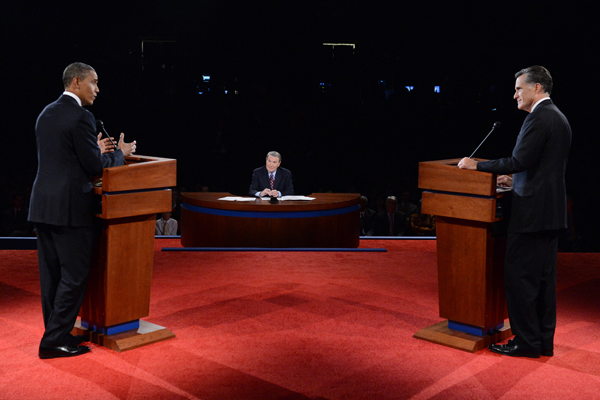
Barack Obama & Mitt Romney Full Presidential Debate
__________
Setting the record straight on the first presidential debate is very easy if you are a reader of the Heritage Foundation website!!! Here are some examples below taken from Romina Boccia‘s excellent article from October 4, 2012:
During last night’s presidential debate, claims were flying fast and furious. Some of these claims were true, others false. Here are the top 10—see which ones you can guess as either true or false.
4. Romney would cut taxes by $5 trillion.
Obama: “Governor Romney’s central economic plan calls for a $5 trillion tax cut.”
False.Governor Romney’s tax plan doesn’t cut taxes. His plan is revenue neutral.
5. Dodd–Frank promises to bail out “too-big-to-fail” firms.
Romney: “Dodd–Frank was passed. And it includes within it a number of provisions that I think has some unintended consequences that are harmful to the economy. One is it designates a number of banks as too big to fail, and they’re effectively guaranteed by the federal government.”
6. The oil industry receives $4 billion in corporate welfare that other businesses don’t get.
Obama: “The oil industry gets $4 billion a year in corporate welfare. Basically, they get deductions that those small businesses that Governor Romney refers to, they don’t get.”
False.A large part of that $4 billion figure comes from a broadly available tax provision and expensing options. These are neither subsidies nor corporate welfare. The tax deduction, under Internal Revenue Code Section 199, goes to all domestic manufacturing. Producers of clothing, roads, electricity, water, renewable energy projects, and many other things produced in the United States are eligible for the manufacturer’s tax deduction—including Hollywood movies.
FIRST PRESIDENTIAL DEBATE – Barack Obama VS Mitt Romney (Part 4)
Barack Obama & Mitt Romney Full Presidential Debate
__________
Setting the record straight on the first presidential debate is very easy if you are a reader of the Heritage Foundation website!!! Here are some examples below taken from Romina Boccia‘s excellent article from October 4, 2012:
During last night’s presidential debate, claims were flying fast and furious. Some of these claims were true, others false. Here are the top 10—see which ones you can guess as either true or false.
1. Governor Mitt Romney’s tax plan would burden the middle class.
President Obama: “[I]ndependent studies looking at this said the only way to meet Governor Romney’s pledge of not reducing the deficit or—or—or not adding to the deficit is by burdening middle-class families.”
Former Governor Romney: “You’ve raised [taxes] by $1 trillion under Obamacare [and] cut Medicare by $716 billion.”
True.Over the coming decade, Obamacare’s taxes will reach $1 trillion, including new taxes on workers’ wages and capital income, as well as taxes on insurers and manufacturers of medical products. Obamacare also cuts Medicare by $716 billion from 2013 to 2022 and uses the savings to pay for other provisions in Obamacare, not to help shore up Medicare’s finances. Many of Obamacare’s 18 new or increased taxes and penalties would fall directly on the middle class—like the ever-controversial individual mandate tax, which is primarily paid by middle- and low-income Americans, as reported by the Congressional Budget Office.
3. Seniors would receive vouchers under Medicare reform.
Obama: “The idea, which was originally presented by Congressman Ryan, your running mate, is that we would give a voucher to seniors and they could go out in the private marketplace and buy their own health insurance.”
False.There is no premium support proposal that would issue seniors a voucher. The Ryan proposal, like all major premium support models, is a defined-contribution system that would provide direct payment from the government to a health plan of a person’s choice, including traditional Medicare. Health plans would have to meet government standards, including benefit standards of the traditional Medicare program, plus new and much-needed protections against the costs of catastrophic illness. Moreover, Congressman Ryan is not the first to propose premium support; its origins are bipartisan and date back to the 1990s.
FIRST PRESIDENTIAL DEBATE – Barack Obama VS Mitt Romney (Part 2)
President Obama c/o The White House 1600 Pennsylvania Avenue NW Washington, DC 20500 Dear Mr. President, I know that you receive 20,000 letters a day and that you actually read 10 of them every day. I really do respect you for trying to get a pulse on what is going on out here. If you […]
Francis Schaeffer February 21, 1982 (Part 1) Uploaded by DeBunker7 on Feb 21, 2008 I sent Romney 12 letters on the prolife movement and many of these letters including the writings of Dr. Francis Schaeffer. Here are two clips from Schaeffer that sum up his views on abortion. _______________ Francis Schaeffer February 21, 1982 (Part […]
President Obama c/o The White House 1600 Pennsylvania Avenue NW Washington, DC 20500 Dear Mr. President, I know that you receive 20,000 letters a day and that you actually read 10 of them every day. I really do respect you for trying to get a pulse on what is going on out here. This excessive […]
Real Time with Bill Maher March 16 2012 – Alexandra Pelosi Interviews Welfare Recipients in NYC Published on Mar 18, 2012 by vclubscenedotcom Real Time with Bill Maher March 16 2012 – Alexandra Pelosi Interviews Welfare Recipients ____________ President Obama c/o The White House 1600 Pennsylvania Avenue NW Washington, DC 20500 Dear Mr. President, I […]
To Mitt Romney, Box 96861, Washington, DC 20090-6861, From Everette Hatcher of http://www.thedailyhatch.org 13900 Cottontail Lane, Alexander, AR 72002 Did we forgive George Bush in 1988 for being pro-choice originally in 1980? We sure did. In fact, my former pastor, Adrian Rogers, had a chance to visit with Bush several times. He told him that the […]
To Mitt Romney, Box 96861, Washington, DC 20090-6861, From Everette Hatcher of http://www.thedailyhatch.org 13900 Cottontail Lane, Alexander, AR 72002 Did we forgive George Bush in 1988 for being pro-choice originally in 1980? We sure did. In fact, my former pastor, Adrian Rogers, had a chance to visit with Bush several times. He told him that the […]
A Ronald Reagan radio address from 1975 addresses the topics of abortion and adoption. This comes from a collection of audio commentaries titled “Reagan in His Own Voice.” To Mitt Romney, Box 96861, Washington, DC 20090-6861, From Everette Hatcher of http://www.thedailyhatch.org 13900 Cottontail Lane, Alexander, AR 72002 Did we forgive George Bush in 1988 for being […]
To Mitt Romney, Box 96861, Washington, DC 20090-6861, From Everette Hatcher of http://www.thedailyhatch.org 13900 Cottontail Lane, Alexander, AR 72002 Did we forgive George Bush in 1988 for being pro-choice originally in 1980? We sure did. In fact, my former pastor, Adrian Rogers, had a chance to visit with Bush several times. He told him that the […]
Superbowl commercial with Tim Tebow and Mom. To Mitt Romney, Box 96994, Washington, DC 20077-7556 From Everette Hatcher of http://www.thedailyhatch.org 13900 Cottontail Lane, Alexander, AR 72002 Did we forgive George Bush in 1988 for being pro-choice originally in 1980? We sure did. In fact, my former pastor, Adrian Rogers, had a chance to visit with Bush […]
___________________________________________ Francis Schaeffer is a hero of mine and I want to honor him with a series of posts on Sundays called “Schaeffer Sundays” which will include his writings and clips from his film series. I have posted many times in the past using his material. Philosopher and Theologian, Francis A. Schaeffer has argued, “If […]
A Christian Manifesto by Francis Schaeffer (Part 1) To Mitt Romney, Box 149756, Boston, MA 02114-9756 From Everette Hatcher of http://www.thedailyhatch.org 13900 Cottontail Lane, Alexander, AR 72002 Did we forgive George Bush in 1988 for being pro-choice originally in 1980? We sure did. In fact, my former pastor, Adrian Rogers, had a chance to visit with […]
Part 1 Part 2 To Mitt Romney, Box 149756, Boston, MA 02114-9756 From Everette Hatcher of http://www.thedailyhatch.org 13900 Cottontail Lane, Alexander, AR 72002 Did we forgive George Bush in 1988 for being pro-choice originally in 1980? We sure did. In fact, my former pastor, Adrian Rogers, had a chance to visit with Bush several times. He […]
Part 1 Part 2 To Mitt Romney, Box 149756, Boston, MA 02114-9756 From Everette Hatcher of http://www.thedailyhatch.org 13900 Cottontail Lane, Alexander, AR 72002 Did we forgive George Bush in 1988 for being pro-choice originally in 1980? We sure did. In fact, my former pastor, Adrian Rogers, had a chance to visit with Bush several times. He […]
To Mitt Romney, Box 96994, Washington, DC 20077-7556 From Everette Hatcher of http://www.thedailyhatch.org 13900 Cottontail Lane, Alexander, AR 72002 Did we forgive George Bush in 1988 for being pro-choice originally in 1980? We sure did. In fact, my former pastor, Adrian Rogers, had a chance to visit with Bush several times. He told him that the […]
Obama Calls GOP Budget Plan “Prescription for Decline” Uploaded by PBSNewsHour on Apr 3, 2012 In a blistering attack on the House-Passed Republican budget Tuesday, President Obama called the plan proposed by Rep. Paul Ryan a “Trojan Horse” and “a prescription for decline.” Judy Woodruff, Jared Bernstein of the Center on Budget and Policy Priorities […]
Is President Obama gutting the welfare reform that Bill Clinton signed into law? Morning Bell: Obama Denies Gutting Welfare Reform Amy Payne August 8, 2012 at 9:15 am The Obama Administration came out swinging against its critics on welfare reform yesterday, with Press Secretary Jay Carney saying the charge that the Administration gutted the successful […]
I have written a lot about this in the past and sometimes you just have to sit back and laugh. Laughing at Obama’s Bumbling Class Warfare Agenda July 13, 2012 by Dan Mitchell We know that President Obama’s class-warfare agenda is bad economic policy. We know high tax rates undermine competitiveness. And we know tax increases […]
I have been writing President Obama letters and have not received a personal response yet. (He reads 10 letters a day personally and responds to each of them.) However, I did receive a form letter in the form of an email on June 15, 2012. I don’t know which letter of mine generated this response so I have […]
I have been writing President Obama letters and have not received a personal response yet. (He reads 10 letters a day personally and responds to each of them.) However, I did receive a form letter in the form of an email on April 3, 2011. I don’t know which letter of mine generated this response so I have linked […]
I have been writing President Obama letters and have not received a personal response yet. (He reads 10 letters a day personally and responds to each of them.) However, I did receive a form letter in the form of an email on March 7, 2011. I don’t know which letter of mine generated this response so I have […]
In an exclusive interview at The Heritage Foundation, Senate Minority Leader Mitch McConnell (R-KY) sharply criticized President Obama for engaging in class warfare and accused him of shifting the focus away from his own failed policies in advance of next year’s election.
“My view is he’ll have a hard time convincing Americans he deserves four more years of this,” McConnell said. “There’s nothing he’s done the American people approve of, so of course, he’s trying to change the subject.”
__________
I love these videos from the Heritage Foundation. They include great interviews and very good illustrations. Below are some links.
School choice offers families the opportunity to select schools that meet their child’s needs. Watch the video from Heritage Foundation explaining school choice, how it benefits parents and children and why school choice is needed.
What is School Choice? Uploaded by HeritageFoundation on Aug 2, 2011 School choice offers families the opportunity to select schools that meet their child’s needs. Watch the video from Heritage Foundation explaining school choice, how it benefits parents and children and why school choice is needed.
1,000 Days Without A Budget Uploaded by HeritageFoundation on Jan 24, 2012 http://blog.heritage.org | Today marks the 1,000th day since the United States Senate has passed a budget. While the House has put forth (and passed) its own budget, the Senate has failed to do the same. To help illustrate how extraordinary this failure has […]
Sen. Mitch McConnell: Americans Don’t Approve of Anything Obama Has Done Uploaded by HeritageFoundation on Dec 8, 2011 In an exclusive interview at The Heritage Foundation, Senate Minority Leader Mitch McConnell (R-KY) sharply criticized President Obama for engaging in class warfare and accused him of shifting the focus away from his own failed policies in […]
Senator Blunt Vows to Keep Pressure on President Obama Over Contraceptive Mandate Uploaded by HeritageFoundation on Feb 13, 2012 http://blog.heritage.org/2012/02/13/sen-blunt-vows-to-keep-pressure-on-obama-… | Sen. Roy Blunt (R-MO) introduced legislation to protect religious organizations from Obamacare’s overreach last summer. Now, as President Obama presses forward with his anti-conscience mandate, Blunt is prepared to keep the pressure on the […]
Senator Lee Fights Back Against Obama’s Unconstitutional “Recess” Appointments Uploaded by HeritageFoundation on Feb 13, 2012 Few lawmakers have expressed as much outrage over President Obama’s unconstitutional “recess” appointments as Sen. Mike Lee (R-UT). He was among the first to warn about the consequences of the president’s unilateral action on Jan. 4. More than a […]
Senator John Barrasso On the Fight Against Obamacare Uploaded by HeritageFoundation on Mar 26, 2012 Sen. John Barrasso earned the nickname “Wyoming’s Doctor” after working for 24 years as an orthopedic surgeon in Casper. Today he represents the state in the U.S. Senate and is one of the leading critics of Obamacare. More than two […]
David Barton on Glenn Beck – Part 3 of 5 Uploaded by ToRenewAmerica on Apr 9, 2010 Wallbuilders’ Founder and President David Barton joins Glenn Beck on the Fox News Channel for the full hour to discuss our Godly heritage and how faith was the foundational principle upon which America was built. _____________ David Barton is a historian […]
Rep. Paul Ryan Blames Obama for Dividing America Uploaded by HeritageFoundation on Oct 28, 2011 Rep. Paul Ryan (R-WI) is mighty disappointed with President Obama. The chairman of the House Budget Committee, who has bested Obama in head-to-head policy showdowns, blames the president for failing to outline a solution to the debt crisis while dividing […]
The Role of Economic Freedom Uploaded by HeritageFoundation on Jan 6, 2012 According to the 2012 Index of Economic Freedom, a joint publication of The Heritage Foundation and The Wall Street Journal, global economic freedom has declined over the past year. But what does this mean for America and the world? Economic freedom empowers ordinary […]
President Obama c/o The White House 1600 Pennsylvania Avenue NW Washington, DC 20500 Dear Mr. President, I know that you receive 20,000 letters a day and that you actually read 10 of them every day. I really do respect you for trying to get a pulse on what is going on out here. If you […]
Francis Schaeffer February 21, 1982 (Part 1) Uploaded by DeBunker7 on Feb 21, 2008 I sent Romney 12 letters on the prolife movement and many of these letters including the writings of Dr. Francis Schaeffer. Here are two clips from Schaeffer that sum up his views on abortion. _______________ Francis Schaeffer February 21, 1982 (Part […]
President Obama c/o The White House 1600 Pennsylvania Avenue NW Washington, DC 20500 Dear Mr. President, I know that you receive 20,000 letters a day and that you actually read 10 of them every day. I really do respect you for trying to get a pulse on what is going on out here. This excessive […]
Real Time with Bill Maher March 16 2012 – Alexandra Pelosi Interviews Welfare Recipients in NYC Published on Mar 18, 2012 by vclubscenedotcom Real Time with Bill Maher March 16 2012 – Alexandra Pelosi Interviews Welfare Recipients ____________ President Obama c/o The White House 1600 Pennsylvania Avenue NW Washington, DC 20500 Dear Mr. President, I […]
To Mitt Romney, Box 96861, Washington, DC 20090-6861, From Everette Hatcher of http://www.thedailyhatch.org 13900 Cottontail Lane, Alexander, AR 72002 Did we forgive George Bush in 1988 for being pro-choice originally in 1980? We sure did. In fact, my former pastor, Adrian Rogers, had a chance to visit with Bush several times. He told him that the […]
To Mitt Romney, Box 96861, Washington, DC 20090-6861, From Everette Hatcher of http://www.thedailyhatch.org 13900 Cottontail Lane, Alexander, AR 72002 Did we forgive George Bush in 1988 for being pro-choice originally in 1980? We sure did. In fact, my former pastor, Adrian Rogers, had a chance to visit with Bush several times. He told him that the […]
A Ronald Reagan radio address from 1975 addresses the topics of abortion and adoption. This comes from a collection of audio commentaries titled “Reagan in His Own Voice.” To Mitt Romney, Box 96861, Washington, DC 20090-6861, From Everette Hatcher of http://www.thedailyhatch.org 13900 Cottontail Lane, Alexander, AR 72002 Did we forgive George Bush in 1988 for being […]
To Mitt Romney, Box 96861, Washington, DC 20090-6861, From Everette Hatcher of http://www.thedailyhatch.org 13900 Cottontail Lane, Alexander, AR 72002 Did we forgive George Bush in 1988 for being pro-choice originally in 1980? We sure did. In fact, my former pastor, Adrian Rogers, had a chance to visit with Bush several times. He told him that the […]
Superbowl commercial with Tim Tebow and Mom. To Mitt Romney, Box 96994, Washington, DC 20077-7556 From Everette Hatcher of http://www.thedailyhatch.org 13900 Cottontail Lane, Alexander, AR 72002 Did we forgive George Bush in 1988 for being pro-choice originally in 1980? We sure did. In fact, my former pastor, Adrian Rogers, had a chance to visit with Bush […]
___________________________________________ Francis Schaeffer is a hero of mine and I want to honor him with a series of posts on Sundays called “Schaeffer Sundays” which will include his writings and clips from his film series. I have posted many times in the past using his material. Philosopher and Theologian, Francis A. Schaeffer has argued, “If […]
A Christian Manifesto by Francis Schaeffer (Part 1) To Mitt Romney, Box 149756, Boston, MA 02114-9756 From Everette Hatcher of http://www.thedailyhatch.org 13900 Cottontail Lane, Alexander, AR 72002 Did we forgive George Bush in 1988 for being pro-choice originally in 1980? We sure did. In fact, my former pastor, Adrian Rogers, had a chance to visit with […]
Part 1 Part 2 To Mitt Romney, Box 149756, Boston, MA 02114-9756 From Everette Hatcher of http://www.thedailyhatch.org 13900 Cottontail Lane, Alexander, AR 72002 Did we forgive George Bush in 1988 for being pro-choice originally in 1980? We sure did. In fact, my former pastor, Adrian Rogers, had a chance to visit with Bush several times. He […]
Part 1 Part 2 To Mitt Romney, Box 149756, Boston, MA 02114-9756 From Everette Hatcher of http://www.thedailyhatch.org 13900 Cottontail Lane, Alexander, AR 72002 Did we forgive George Bush in 1988 for being pro-choice originally in 1980? We sure did. In fact, my former pastor, Adrian Rogers, had a chance to visit with Bush several times. He […]
To Mitt Romney, Box 96994, Washington, DC 20077-7556 From Everette Hatcher of http://www.thedailyhatch.org 13900 Cottontail Lane, Alexander, AR 72002 Did we forgive George Bush in 1988 for being pro-choice originally in 1980? We sure did. In fact, my former pastor, Adrian Rogers, had a chance to visit with Bush several times. He told him that the […]
Obama Calls GOP Budget Plan “Prescription for Decline” Uploaded by PBSNewsHour on Apr 3, 2012 In a blistering attack on the House-Passed Republican budget Tuesday, President Obama called the plan proposed by Rep. Paul Ryan a “Trojan Horse” and “a prescription for decline.” Judy Woodruff, Jared Bernstein of the Center on Budget and Policy Priorities […]
Is President Obama gutting the welfare reform that Bill Clinton signed into law? Morning Bell: Obama Denies Gutting Welfare Reform Amy Payne August 8, 2012 at 9:15 am The Obama Administration came out swinging against its critics on welfare reform yesterday, with Press Secretary Jay Carney saying the charge that the Administration gutted the successful […]
I have written a lot about this in the past and sometimes you just have to sit back and laugh. Laughing at Obama’s Bumbling Class Warfare Agenda July 13, 2012 by Dan Mitchell We know that President Obama’s class-warfare agenda is bad economic policy. We know high tax rates undermine competitiveness. And we know tax increases […]
I have been writing President Obama letters and have not received a personal response yet. (He reads 10 letters a day personally and responds to each of them.) However, I did receive a form letter in the form of an email on June 15, 2012. I don’t know which letter of mine generated this response so I have […]
I have been writing President Obama letters and have not received a personal response yet. (He reads 10 letters a day personally and responds to each of them.) However, I did receive a form letter in the form of an email on April 3, 2011. I don’t know which letter of mine generated this response so I have linked […]
I have been writing President Obama letters and have not received a personal response yet. (He reads 10 letters a day personally and responds to each of them.) However, I did receive a form letter in the form of an email on March 7, 2011. I don’t know which letter of mine generated this response so I have […]
Both President Obama and Governor Romney discussed spending and budget deficits. Washington is currently spending around 23 percent of the economy (GDP), well above the historical average of about 20 percent of GDP. While revenues are temporarily low due to the recession and the sluggish recovery that has ensued, they will return to and indeed surpass their historical level of 18.1 percent once the economy recovers and Americans are back to work. Washington clearly has a spending problem. What the country needs is leadership that demands an end to the current irresponsible spending. This will curb budget deficits and rising debt that are threatening the economy. Americans are eager for solutions that get at the root of the problem: spending.
– Emily Goff
Spendingand Debt
The President’s response to the spending and debt crisis is revealed by what he does, not by what he says. In the fourth consecutive year of deficits exceeding $1 trillion, the President’s budget for fiscal year (FY) 2013 continued a practice of relentlessly higher spending. As analyzed by the non-partisan Congressional Budget Office (CBO), spending in the President’s budget was $1.15 trillion higher over 2013-2022. Roughly half of the increase came from policy changes, and the other half from increased interest payments due to chronic deficit spending. The President’s record total spending would remain higher than 22 percent of gross domestic product (GDP) throughout the decade, “well above the 21.0 percent average seen over the past 40 years,” CBO says.
The combination of policies in the President’s budget produces cumulative deficits of $6.4 trillion through 2022, $3.5 trillion more than CBO’s baseline – sharply different from the more than $5 trillion in deficit reduction the President’s budget claimed. Yet the President’s sole response to this crisis is to raise taxes. He ignored the recommendations of his own deficit reduction panel, the Bowles-Simpson Commission, and has offered no plan to reverse the devastating across the board spending cuts scheduled to start in January—instead insisting that Congress must find an answer. Congress does indeed need to respond—but so does the President.
– Patrick Louis Knudsen
Key Tax Points and Obama Falsehoods
President Obama and Governor Romney had a long back-and-forth on taxes to open the debate. They touched on two important tax topics vital to the future of the economy.
Most of the time was spent on Governor Romney’s tax plan. Romney’s plan, like most tax reform plans, would lower tax rates and make other changes to the tax code to encourage growth. The economy will not recover fully until we have tax reform.
Less time was spent on another important topic: the corporate income tax. The U.S. now has the highest corporate tax rate in the developed world, and we remain one of the only countries that taxes our businesses on the income they earn in foreign countries. We will continue to lose jobs to more competitive countries until we bring that high rate down from 35 percent to meet or fall below the 25 percent average in countries we compete with for new investment.
President Obama falsely claimed businesses can take a deduction for moving jobs overseas. No such deduction exists.
– Curtis Dubay
What Is Obama’s Tax Reform Plan?
President Obama has roundly criticized Governor Romney’s tax reform plan, but where’s the President’s plan? All President Obama has proposed is to raise taxes on those who run small businesses and hire workers, who are highly productive citizens and good investors. Otherwise, Obama’s proposals as detailed in his budget are little more than a cattlecall of housecleaning tweaks. This is especially astounding when one recalls that Governor Romney has no mighty engine of tax expertise at his beck and call, whereas the President has the Treasury Department, the National Economic Counsel, the Council of Economic Advisors, and many more able bodies on the government’s payroll eager to do his bidding.
With so much talent available to him, and yet no proposal for fundamental tax reform whatsoever, one can only presume President Obama is fundamentally content with the current individual income tax system.
– J.D. Foster
Tax Cuts vs. Tax Increases
President Obama mentioned how the middle class has benefited from his tax policies, for example from the extension of the Bush-era tax rates. How ironic, then, that the President’s own budget proposal for FY 2013 would raise taxes by $2 trillion. Oh, and then there’s Taxmageddon, which Congress and this President have yet to solve, despite warnings far and wide. All of that hardly adds up to responsible tax policy.
– Emily Goff
Obama on Romney’s Tax Reform
President Obama has utterly and consistently dissembled regarding Governor Romney’s tax reform plan. Contrary to Obama’s assertions, repeated unquestioningly in the mainstream media, the Romney plan is to cut individual income tax rates 20 percent, for tax reform to be revenue neutral, neither raising nor lower revenues in the aggregate, and for tax reform to be distributionally neutral, neither raising taxes on the middle class nor cutting them for upper earners. Analysis to the contrary by some outlets is simple misinformation, intentional or otherwise.
To be sure, it will be difficult to cut individual income tax rates the full 20 percent as Governor Romney proposes and still meet the criteria of revenue and distributional neutrality. Guess what? Tax reform will be terribly difficult no matter how it is pursued. Setting an ambitious goal is an essential step even to start the effort. Perhaps once the debate is fully underway, the nation will find cutting rates 20 percent is just too much, or perhaps the nation will find the exercise so liberating, and the prospects of a simpler tax system and a stronger economy so enticing, that 20 percent reductions are seen as too cautious. The point is, the current tax system needs replacing, and Romney has proposed a strong start. In contrast, President Obama has proposed higher tax rates.
– J.D. Foster
Tax Increases and the Economy
President Obama has long insisted on higher taxes for small businesses, investors, and upper-income earners. Apparently, it does not matter to him that this can only harm the economy, which has sputtered badly under his management. Apparently, it does not matter to the President that these individuals already pay a stunning share of the federal income tax burden. Apparently, it does not matter to Obama that these tax hikes would at most be a drop in the bucket toward reducing the budget deficit. All that matters to him, apparently, is that these taxpayers be punished with higher taxes for the transgression of earning a higher income. It should surprise no one, then, that a President so antagonistic to the forces of economic growth has managed to achieve so little of it.
– J.D. Foster
Government Spending
Time and time again, Americans have heard from President Obama and others in Washington that government investments—read: massive amounts of spending—will create the jobs Americans need. Time and time again they have been wrong. President Obama tonight dusted off that claim and called for even more government spending. It’s exactly the wrong prescription.
Government stimulus spending does not help the economy grow or “create” jobs, beyond perhaps a localized effect here and there. To make matters worse, Americans should be concerned about the fact that this spending has to be paid for, either through higher taxes or increased borrowing or both, which threaten to harm the economy further.
The private sector does a much better job than the federal government at creating jobs when and where there is demand for them. Try laying off on the anti-business regulatory onslaught from the National Labor Relations Board, the EPA, and others that is costing businesses millions of dollars. Try fixing Taxmageddonnow to give businesses the certainty about their tax rates next year that they need to make hiring decisions today. Do those things and you just might see the economy take off.
Here is what the Heritage Foundation Scholars had to say: Stop the Spending Both President Obama and Governor Romney discussed spending and budget deficits. Washington is currently spending around 23 percent of the economy (GDP), well above the historical average of about 20 percent of GDP. While revenues are temporarily low due to the recession […]
1980 Presidential Candidate Debate: Governor Ronald Reagan and President Jimmy Carter – 10/28/80 Above is the video of the complete debate. Below is the first part of the transcript that deals with the issue of inflation among other things. This segment begins at 28 minute mark. October 28, 1980 Debate Transcript October 28, 1980 The Carter-Reagan Presidential […]
Excellent questions!!! Morning Bell: 10 Questions for the First Presidential Debate Amy Payne October 3, 2012 at 9:05 am Tonight’s debate between President Barack Obama and former Governor Mitt Romney is supposed to focus on domestic policy, with a major concentration on the economy. Health care, the role of government, and philosophy of governing are […]
President Reagan and Nancy Reagan posing with Rock Hudson at White House State Dinner for President De La Madrid of Mexico. 5/15/84 . 1980 Presidential Candidate Debate: Governor Ronald Reagan and President Jimmy Carter – 10/28/80 Above is the video of the complete debate. Below is the second part of the transcript that deals with the […]
1980 Presidential Candidate Debate: Governor Ronald Reagan and President Jimmy Carter – 10/28/80 Above is the video of the complete debate. Below is the first part of the transcript that deals with the issue of nuclear weapons among other things. October 28, 1980 Debate Transcript October 28, 1980 The Carter-Reagan Presidential Debate RUTH HINERFELD, LEAGUE OF WOMEN […]
Mark Levin “I feel that we can do great things.” Mark is excited by the proposed Balanced Budget Amendment. He states that this would be a great thing for America to pass. He believes the Balanced Budget Amendment will help bring the nation back to it’s Constitutional roots. Mark explains what the amendment is and how it will work. In his February 1983 classic essay, Nobel Prize-winning economist Milton Friedman gives his opinion on a balanced budget amendment that requires a super majority to raise taxes. Friedman states, “The purpose of the balanced-budget-and-tax-limitation amendment is to limit the government in order to free the people—this time from excessive taxation. Its passage would go a long way to remedy the defect that has developed in our budgetary process.” Part #1 3-25-2011
___________________
Dear Senator Pryor,
Why not pass the Balanced Budget Amendment? As you know that federal deficit is at all time high (1.6 trillion deficit with revenues of 2.2 trillion and spending at 3.8 trillion).
On my blog www.HaltingArkansasLiberalswithTruth.com I took you at your word and sent you over 100 emails with specific spending cut ideas. However, I did not see any of them in the recent debt deal that Congress adopted. Now I am trying another approach. Every week from now on I will send you an email explaining different reasons why we need the Balanced Budget Amendment. It will appear on my blog on “Thirsty Thursday” because the government is always thirsty for more money to spend.
The best article I have ever read on the Balanced Budget Amendment was written by my favorite economist Milton Friedman. Here is the second portion below:
I have been much more surprised, and dismayed, by the criticism that has been expressed by persons who share my basic outlook about the importance of limiting government in order to preserve and expand individual freedom—for example, the editors of The Wall Street Journal and a former editor and current columnist, Vermont Royster. They do not question the objectives of the amendment, but they doubt its necessity and potential effectiveness.
Those doubts are presumably shared by many other thoughtful citizens of all shades of political opinion who are united by concern about the growth of government spending and deficits. Here, for their consideration, are my answers to the principal objections to the proposed amendment that I have come across, other than those that arise from a desire to have a still-bigger government:
1. The amendment is unnecessary. Congress and the President have the power to limit spending and balance the budget.
Taken seriously, this is an argument for scrapping most of the Constitution. Congress and the President have the power to preserve freedom of the press and of speech without the First Amendment. Does that make the First Amendment unnecessary? Not surprisingly, I know of no one who has criticized the balanced-budget amendment as unnecessary—however caustic his comments on congressional hypocrisy—who would draw the conclusion that the First Amendment should be scrapped.
It is essential to look not only at the power of Congress but at the incentives of its members—to act in such a way as to be re-elected. As Phil Gramm, a Democratic congressman from Texas, has said: Every time you vote on every issue, all the people who want the program are looking over your right shoulder and nobody’s looking over your left shoulder….In being fiscally responsible under such circumstances, we’re asking more of people than the Lord asks.”
Under present arrangements, Congress will not in fact balance the budget. Similarly, a President will not produce a balanced budget by using the kind of vetoes that would be required. The function of the amendment is to remedy the defect in our legislative procedure that distorts the will of the people as it is filtered through their representatives. The amendment process is the only effective way the public can treat the budget as a whole. That is the function of the First Amendment, as well—it treats free speech as a bundle. In its absence, Congress would consider each case “on its merits.” It is not hard to envisage the way unpopular groups and views would fare.
2. The President and Congress are guilty of hypocrisy in voting simultaneously for a large current deficit and for a constitutional amendment to prevent future deficits.
Of course, I have long believed that congressional hypocrisy and shortsightedness are the only reasons there is a ghost of a chance of getting Congress to pass an amendment limiting itself. Most members of Congress will do anything to postpone the problems they face by a couple of years—only Wall Street has a shorter perspective. If the hypocrisy did not exist, if Congress behaved “responsibly,” there would be no need for the amendment. Congress’s irresponsibility is the reason we need an amendment and at the same time the reason that there is a chance of getting one.
Hypocrisy may eventually lead to the passing of the amendment. But hypocrisy will not prevent the amendment from having important effects three or four years down the line—and from casting its shadow on events even earlier. Congress will not violate the Constitution lightly. Members of Congress will wriggle and squirm; they will seek, and no doubt find, subterfuges and evasions. But their actions will be significantly affected by the existence of the amendment. The experience of several states that have passed similar tax-limitation amendments provides ample evidence of that.
3. The amendment is substantive, not procedural and the Constitution should be limited to procedural matters. The fate of the Prohibition amendment is a cautionary tale that should give us pause in enacting substantive amendments.
If this amendment is substantive, so is the income-tax (sixteenth) amendment and so are many specific provisions of the Constitution. The income-tax amendment does not specify the rate of tax. It leaves that to Congress. Similarly, this amendment does not specify the size of the budget. It simply outlines a procedure for approving it: the same as now exists if total legislated outlays do not exceed an amount determined by prior events (the prior budget and the prior growth in national income); and by a majority of 60 percent if total legislated outlays do exceed that amount. The requirement of a supernormal majority is neither substantive nor undemocratic nor unprecedented. Witness the two-thirds majority necessary to override a presidential veto or to approve a treaty.
The prohibition amendment was incompatible with the basic aim of the Constitution, because it was not directed at limiting government. On the contrary, it limited the people and freed government to control them. The balanced-budget-tax-limitation amendment is thoroughly compatible with the basic role of the Constitution, because it seeks to improve the ability of the public to limit government.
4. The amendment is unduly rigid because it requires an annually balanced budget.
This is a misconception. Section 1 of the amendment prohibits a planned budget deficit unless it is explicitly approved by three fifths of the members of the House and Senate. It further requires the Congress and the President to “ensure that actual outlays do not exceed the outlays set forth in [the budget] statement.” But it does not require that actual receipts equal or exceed statement receipts. A deficit that emerged because a recession produced a reduction in tax receipts would not be in violation of the amendment, provided that outlays were no greater than statement outlays. This is a sensible arrangement: outlays can be controlled more readily over short periods than receipts.
I have never been willing to support an amendment calling for an annually balanced budget. I do support this one, because it has the necessary flexibility.
5. The amendment will be ineffective because (a) it requires estimates of receipts and outlays which can be fudged; (b) its language is fuzzy; (c) the Congress can find loopholes to evade it; (d) it contains no specific provisions for enforcement.
(a) It will be possible to evade the amendment by overestimating receipts—but only once, for the first year the amendment is effective. Thereafter, section 2 of the amendment limits each year’s statement receipts to the prior year’s statement receipts plus the prior rate of increase of national income. No further estimates of budget receipts are called for. This is one of the overlooked subtleties in the amendment.
Any further fudging would have to be of the national-income estimates. That is possible but both unlikely and not easy. What matters is not the level of national income but the percentage change in national income. Alterations of the definition of national income that affect levels are likely to have far less effect on percentage changes. Moreover, making the change in income artificially high in one year will tend to make it artificially low the next. All in all, I do not believe that this is a serious problem.
(b) The language is not fuzzy. The only undefined technical term is “national income.” The amendment also refers to “receipts” and “outlays,” terms of long-standing usage in government accounting; in section 4, total receipts and total outlays are defined explicitly.
Nor is the amendment a hastily drawn gimmick designed to provide a fig leaf to hide Congress’s sins. On the contrary, it is a sophisticated product, developed over a period of years, that reflects the combined wisdom of the many persons who participated in its development.
(c) Loopholes are a more serious problem. One obvious loophole—off-budget outlays—has been closed by phrasing the amendment in terms of total outlays and defining them to include “all outlays of the United States except those for repayment of debt principal.” But other, less obvious, loopholes have not been closed. Two are particularly worrisome: government credit guarantees, and mandating private expenditures for public purposes (e. g., antipollution devices on automobiles). These loopholes now exist and are now being resorted to. I wish there were some way to close them. No doubt the amendment would provide an incentive to make greater use of them. Yet I find it hard to believe that they are such attractive alternatives to direct government spending that they would render the amendment useless.
(d) No constitutional provision will be enforced unless it has widespread public support. That has certainly been demonstrated. However, if a provision does have widespread support—as public-opinion polls have clearly shown that this one does—legislators are not likely to flout it, which brings us back to the loopholes.
Equally important, legislators will find it in their own interest to confer an aura of inviolability on the amendment. This point has been impressed on me by the experience of legislators in states that have adopted amendments limiting state spending. Prior to the amendments, they had no effective defense against lobbyists urging spending programs—all of them, of course, for good purposes. Now they do. They can say: Your program is an excellent one; I would like to support it, but the total amount we can spend is fixed. To get funds for your program, we shall have to cut elsewhere. Where should we cut?” The effect is to force lobbyists to compete against one another rather than form a coalition against the general taxpayer.
That is the purpose of constitutional rules: to establish arrangements under which private interest coincides with the public interest. This amendment passes that test with flying colors.
6. The key problem is not deficits but the size of government spending.
My sentiments exactly. Which is why I have never supported an amendment directed solely at a balanced budget. I have written repeatedly that while I would prefer that the budget be balanced, I would rather have government spend $500 billion and run a deficit of $100 billion than have it spend $800 billion with a balanced budget. It matters greatly how the budget is balanced, whether by cutting spending or by raising taxes.
In my eyes, the chief merit of the amendment recommended by the Senate Judiciary Committee is precisely that it does limit spending. Section 1 requires that statement outlays be no greater than statement receipts; section 2 limits the maximum increase in statement receipts; the two together effectively limit statement outlays. Moreover, if in any year Congress manages to keep statement receipts and outlays below the maximum level, the effect is to lower the maximum level for future years, thus fostering a gradual ratcheting down of spending relative to national income.
A further strength of the amendment is the provision for approving an exceptional increase in statement receipts (hence in statement outlays). The spending-limitation amendment that was drafted by the National Tax Limitation Committee required a two-thirds majority of both houses in order to justify an exceptional increase in outlays. The amendment passed by the Senate requires only “a majority of the whole number of both houses of Congress.” However, the majority must vote for an explicit tax increase. I submit that it is far easier to get a two-thirds majority of Congress to approve an exceptional increase in spending than to get a simple majority to approve an explicit increase in taxes. So this is a stronger, not a weaker, amendment.
Section 6 proposed by Senator Armstrong in the course of Senate debate, makes the debt ceiling permanent and requires a supermajority vote to raise it. That provision was approved by a narrow majority composed of a coalition of right-wing Republicans and left-wing Democrats—the one group demonstrating its hardcore conservatism, the other seeking to reduce the chances of adoption of the basic amendment.
I do not favor the debt-limit provision. Its objective—to strengthen pressure on Congress to balance the budget—is fine, and it may be that it would do little harm. But it seems to me both unnecessary and potentially harmful. I trust that it will be eliminated if and when the amendment is finally approved by Congress. I shall favor the amendment even if the debt-limit provision is left in, but less enthusiastically.
7. The amendment introduces a near economic theory into the Constitution.
It does nothing of the kind—unless the idea that there should be some connection between receipts and outlays is a new economic theory. The amendment does not even change the present budget process, if Congress enacts a balanced budget that rises by no greater a percentage than does national income. But it does significantly stiffen the requirement for passing a budget that is in deficit or for raising the fraction of our income spent on our behalf by the government.
The amendment recommended by the Senate Judiciary Committee deserves the wholehearted backing of every believer in a limited government and maximum freedom for the individual.
Milton Friedman received the Nobel Prize in economics in 1976. He is the Paul Snowden Russell Distinguished Service Professor Emeritus of Economics at the University of Chicago and a senior research fellow at the Hoover Institution at Stanford University.
Basically Bill Clinton meant that we are all tied to the federal government to have many of our needs met when he said at the Democratic National Convention, “We’re all in this together.” I reject that philosophy and hope that America will turn away from that kind of slavery to the federal government mentality.
Did Bill Clinton hit a home run for Barack Obama last night?
My response:
The Democrats are counting, as they always have, on widespread economic ignorance. And Bill Clinton captured it perfectly last night when he contrasted the alleged Republican philosophy — “You’re on your own” — with the Democratic philosophy — “We’re all in this together.” I say “alleged” because no Republican says or believes what the Democrats claim, whereas both Clinton and Obama have repeatedly said “We’re all in this together.”
Republicans don’t say that because they recognize the fundamental place of cooperation — whether economic or charitable — in human affairs, and the role of government in providing “public goods” like national defense, clean air, and infrastructure — as well as certain “private goods” if voluntary measures prove insufficient. They believe, in short, in a free society.
By contrast, if “we’re all in this together” — and let’s be clear, when Democrats say that they aren’t talking about voluntary associations but about government programs — then we’re all dependent on government for our retirement, our health care, our education, and on and on. What better example than the Obama campaign’s much ridiculed ”Life of Julia“? The problem with that vision is that it’s a cruel hoax. Wherever it’s been tried, including in America, it’s failed. Social Security, Medicare, and Medicaid are all going broke. And even where our massive public programs hobble on, they’re massively inefficient compared to private alternatives. In pursuit of “fairness” — read, “free goods” — you can tax the rich only so far. That’s the economic ignorance that’s underneath the siren song that “we’re all in this together.”
INTERVIEW: DAN MITCHELL — Senior Fellow, Cato Institute — discussed the ObamaCare tax vs. penalty rhetoric, the growing number of people on disability, whether America is becoming Europe and President Obama’s tax-the-rich speech yesterday.
ObamaCare: Is It a Tax or a Penalty? Dan examines the messaging.
Obama’s Class Warfare: President Obama Monday proposed a one-year extension of the Bush-era tax cuts for American families earning less than $250,000 a year.
Spain Given Extra Year To Reach Deficit Reduction Targets. Spain is getting another year to meet its deficit-reduction targets. The country was given until 2014 to meet its goals in exchange for budget savings and an aid package for banks. Euro zone ministers were concerned that Spain, their fourth-largest economy, was on the path to a full bailout which they could not afford. Spain has been hit hard with bad debts from the housing crash and worldwide recession.
AEI’s Arthur Brooks writes in the WSJ: “America Already Is Europe: In spending, debt and progressivity of taxes, the U.S. is as much a social-welfare state as Spain.
________________
Not as many people are pulling the cart but it seems more are now jumping in the cart!!!
The leak of a video featuring former Governor Mitt Romney (R-MA) has sparked debate about government dependency and the number of people in the United States who do not pay federal income tax.
In the video, Romney refers to “47 percent” of Americans and says that they are “dependent upon government” and “pay no income tax.” While these groups are not necessarily one in the same, there is overlap between the two, and the percentages on government dependency and non-tax-paying are very similar.
It is true that nearly half of all tax filers—those who are filing an income form with the IRS—pay no federal income tax. It’s also true that millions of Americans receive direct government support in a host of ways, including income, food, housing, medical care, school lunches, and more.
In 2009, 47 percent of all tax filers paid no federal individual income taxes, and in 2011 that figure was 46 percent. This raises a crucial question, as Heritage’s Alison Fraser points out: “Should nearly 50 percent of Americans really be exempt from funding the most basic constitutional functions of government—along with education, food stamps, energy, welfare, foreign aid, veterans’ benefits, housing, and so forth?”
It stands to reason that those who have skin in the game—who are helping to pay for all of the government programs—will be more concerned about reining in out-of-control government spending, because they see their taxes going up and the country’s credit rating going down.
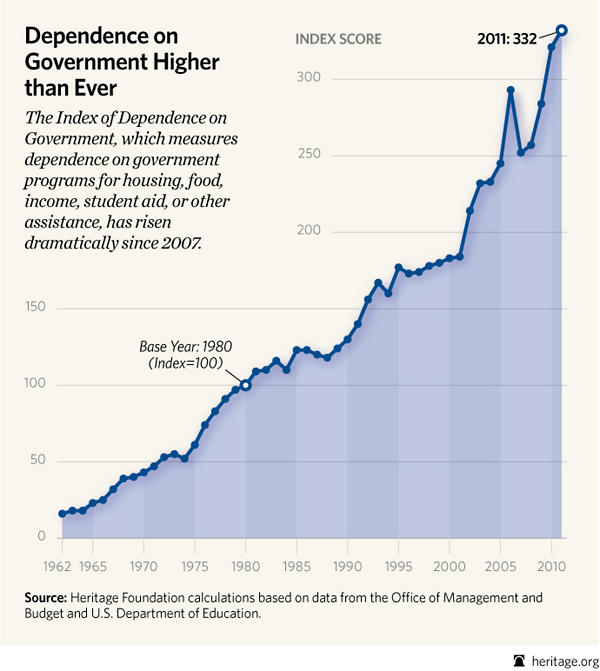
On the other hand, if you are on the receiving end of government benefits, that is likely to color your perception of how taxpayers’ money should be spent. According to the Heritage Foundation’s 2012 Index of Dependence on Government, 63.7 million Americans, or about one in five, is receiving direct government support from Social Security, welfare, or Pell Grants—and that is at its highest level ever. (continues below chart)
These individuals are very likely to be receiving additional benefits from other government programs such as Medicare or Medicaid, food stamps, etc., and the total share of Americans receiving benefits is likely to be even higher when considering benefits available on everything from housing to school lunches. The Wall Street Journal found that in 2011, 49 percent of Americans lived in a household where at least one member of the family received a government benefit.
Heritage has been publishing the Index of Dependence on Government for the past 10 years, and the Center for Data Analysis offered a preview yesterday of what next year’s report will look like, as it updates with the most recent data becoming available for 2011.
The outlook is grim: Government dependency is jumping for the fourth year in a row, and the Index has risen more than 31 percent in that time.
This is bad news for three reasons. First, the economy is so weak that people are going to the government for help. This is a stark repudiation of President Obama’s big-spending, “spread the wealth around” approach, because “giving everyone a shot” does not work unless the “shot” comes at the expense of the taxpayers.
Second, the nation can’t afford to continue increasing spending on these programs, as President Obama has proposed in each of his budgets. Federal spending is exploding—and it is already an eye-popping reality that 70.5 percent of federal spending goes to dependency-creating programs. We are spending more on dependency-creating programs while an ever-shrinking number of taxpayers are paying for them.
But third, and most importantly, it’s bad for Americans. The American Dream is about life, liberty, and the pursuit of happiness, through independence—not dependence on government. Government dependency erodes human dignity and civil society.
These programs were originally designed to help those who fall on hard times and need a safety net. Public policy should head back in that direction. The welfare reform of 1996 helped lift recipients out of poverty and back into jobs by requiring, among other things, that they work. President Obama has undone that requirement. And there are dozens more anti-poverty programs that should be revamped to help those who are able toward self-sufficiency.
At the same time, we must address the looming entitlements crisis: 78 million baby boomers are heading into retirement, and many of them will be entirely dependent on Social Security and Medicare for their income and health care. This dependency is a huge driver of future budget deficits.
We cannot continue on a course of unlimited government spending when fewer and fewer taxpayers are paying for that spending. That is the financial fact. But we also cannot sustain the American Dream on this course—and that is a fact that is intensely personal for every American.
Milton Friedman’s writings affected me greatly when I first discovered them and I wanted to share with you. Pay attention to the words of Gary Becker too. He is very good.
Ronald Reagan introduces this program, and traces a line from Adam Smith’s “The Wealth of Nations” to Milton Friedman’s work, describing Free to Choose as “a survival kit for you, for our nation and for freedom.” Dr. Friedman travels to Hungary and Czechoslovakia to learn how Eastern Europeans are rebuilding their collapsed economies. His conclusion: they must accept the verdict of history that governments create no wealth. Economic freedom is the only source of prosperity. That means free, private markets. Attempts to find a “third way” between socialism and free markets are doomed from the start. If the people of Eastern Europe are given the chance to make their own choices they will achieve a high level of prosperity. Friedman tells us individual stories about how small businesses struggle to survive against the remains of extensive government control. Friedman says, “Everybody knows what needs to be done. The property that is now in the hands of the state, needs to be gotten into the hands of private people who can use it in accordance with their own interests and values.” Eastern Europe has observed the history of free markets in the United States and wants to copy our success. After the documentary, Dr. Friedman talks further about government and the economy with Gary Becker of the University of Chicago and Samuel Bowles of the University of Massachusetts. In a wide-ranging discussion, they disagree about the results of economic controls in countries around the world, with Friedman defending his thesis that the best government role is the smallest one.
___________
Below is a portion of the transcript of the program and above you will find the complete video of the program:
Hello, I am Linda Chavez and welcome to Free to Choose. Joining Dr. Friedman for a discussion of the failure of socialism are Gary Becker from the University of Chicago and Samuel Bowles of the University of Massachusetts. Dr. Bowles, I think we can all agree that socialism has failed Eastern Europe. Dr. Friedman believes that the path out of that is the free market and I think he thinks there are lessons for the United States.
Chavez: I would like to bring this discussion back to the United States for a moment. What about socialism in the United States. There has been one area where we have tried to redistribute wealth. We have done that through our welfare policies and social security. Has that worked?
Friedman: For some people, it benefited, but taken as a whole, I think it has been a failure.
Becker: I agree with that. I think the big problem in the United States has been, of course, some of the welfare programs have been successful. But by trying to do too many things, the government is no longer doing the things that it should be doing. We all agree there are many things government should be doing. I agree with Milton __ he is a strong man to be say this is an issue between no government and 100% government. The question is what are the tasks that government should be doing. I believe the tasks are, of course, defense against outside aggression, internal protection, some infrastructure, protection of the people can’t make it. In every one of these areas, we are not doing very well. I think we are not doing well mainly because we are trying to do a lot of things we shouldn’t be doing. They can’t do all of them.
Chavez: I couldn’t help but think, Dr. Bowles, as I watched that film that the public housing area that we saw in Eastern Europe and the problems that we have here in the United States. Aren’t there some lessons to be learned?
Bowles: There is absolutely no reason why housing shouldn’t be privately owned. That does not mean that the government has no role in housing. It seems to me that housing is precisely something that ought to be a matter of private property. But we also know, from the experience of this country, that the market itself doesn’t provide housing that the rest of the public thinks is adequate for the vast majority of poor people in this country. Now that doesn’t mean it has to be done by government building the houses, but it certainly does mean that something has to be done or we are going to have the kind of homeless crisis that we have in this country and they are getting one in Eastern Europe too.
Becker: The homeless crisis is a tiny fraction of the population of the United States. Let’s not make that a major part of the housing problem in the United States. I am not at all convinced that there is any evidence suggesting that the private system cannot provide adequate housing. I think there is a good case to be made that there are poor people in this country and the government obviously has to help them out. We all agree on that. But should they be doing it by building housing or by giving them income and permitting them to spend as they see fit. I see no evidence from the U.S. or any other country who were better off when then government takes a major role in housing or any of these other particular activities that allocate resources.
Friedman: What role has been played in the difficulty of getting housing by government interventions? By rent control? By excessive building code regulations, many of which are designed to protect the interests of special groups. Government played a very large role.
______________
Thank you so much for your time. I know how valuable it is. I also appreciate the fine family that you have and your committment as a father and a husband.
Sincerely,
Everette Hatcher III, 13900 Cottontail Lane, Alexander, AR 72002, ph 501-920-5733, lowcostsqueegees@yahoo.com



 The Daily Hatch