Category Archives: spending out of control

Spending cut suggestions sent to Senator Mark Pryor electronically every Monday and displayed here on the www.thedailyhatch.org

Senator Mark Pryor wants our ideas on how to cut federal spending. Take a look at this video clip below:

I have faithfully sent spending cut suggestions to Senator Mark Pryor every Monday for almost a year now and at the same time I have posted all of them on www.thedailyhatch.org every monday after they have been sent electronically.

I have suggested cutting out the complete Dept of Education on several occasions.

Here are a few more I just emailed to him myself:

GUIDELINE #4: Terminate failed, outdated, and irrelevant programs.
President Ronald Reagan once pointed out that “a government bureau is the closest thing to eternal life we’ll ever see on earth.” A large portion of the current federal bureaucracy was created during the 1900s, 1930s, and 1960s in attempts to solve the unique problems of those eras.
Instead of replacing the outdated programs of the past, however, each period of government activism has built new programs on top of them. Ford Motor Company would not waste money today by building outdated Model T’s alongside their current Mustangs and Explorers. However, in 2004, the federal government still refuses to close down old agencies such as the Rural Utilities Service (designed to bring phones to rural America) and the U.S. Geological Survey (created to explore and detail the nation’s geography).
Government must be made light and flexible, adaptable to the new challenges the country will face in the 21st century. Weeding out the failed and outdated bureaucracies of the past will free resources to modernize the government.
Status Quo Bias. Lawmakers often acknowledge that certain programs show no positive effects. Regrettably, they also refuse to terminate even the most irrelevant programs. The most obvious reason for this timidity is an aversion to fighting the special interests that refuse to let their pet programs end without a bloody fight.
A less obvious reason is that eliminating government programs seems reckless and bold to legislators who have never known a federal government without them. Although thousands of programs have come and gone in the nation’s 228-year history, virtually all current programs were created before most lawmakers came to Washington. For legislators who are charged with budgeting and implementing the same familiar programs year after year, a sense of permanency sets in, and termination seems unfathomable.7 No one even remembers when a non-government entity addressed the problems.
The Department of Energy, for example, has existed for just one-tenth of the country’s history, yet closing it down seems ridiculous to those who cannot remember the federal government before 1977 and for whom appropriating and overseeing the department has been an annual ritual for years. Lawmakers need a long-term perspective to assure them the sky does not fall when a program is terminated. For example, the Bureau of Mines and the U.S. Travel and Tourism Administration, both closed in 1996, are barely remembered today.8
Instead of just assuming that whoever created the programs decades ago must have been filling some important need that probably exists today, lawmakers should focus on the future by asking themselves the following question: If this program did not exist, would I vote to create it? Because the answer for scores of programs would likely be “no,” Congress should:
  • Close down failed or outdated agencies, programs, and facilities, including:
  1. The U.S. Geological Survey9 (2004 spending: $841 million, discretionary);10
  2. The Maritime Administration ($633 million, discretionary);
  3. The International Trade Commission ($61 million, discretionary);
  4. The Economic Development Administration ($417 million, discretionary);
  5. The Low-Income Home Energy Assistance Program ($1,892 million, discretionary);
  6. The Technology Opportunities Program ($12 million, discretionary);
  7. Obsolete military bases;
  8. The Appalachian Regional Commission ($94 million, discretionary);
  9. Obsolete Veterans Affairs facilities;
  10. The Rural Utilities Service (-$1,493 million,11 mandatory); and
  11. Repeal Public Law 480′s non-emergency international food programs ($127 million, discretionary)

This is how bad it is getting:

  • Discretionary spending is the portion of the annual budget that Congress actually determines.
  • Since 2000, discretionary outlays surged 79 percent faster than inflation, to $1,408 billion. The “stimulus” is responsible for $111 billion of 2010 discretionary spending.
  • Between 1990 and 2000, $80 billion annually in new domestic spending was more than fully offset by a $100 billion cut in annual defense and homeland security spending, leaving (inflation-adjusted) discretionary spending slightly lower.
  • Since 2000, all types of discretionary spending have grown rapidly.
  • Overall, since 1990, domestic discretionary spending has risen 104 percent faster than inflation and defense/security discretionary spending has risen 51 percent.

Check out some of the links below:

Senator Pryor asks for Spending Cut Suggestions! Here are a few!(Part 139)

Senator Mark Pryor wants our ideas on how to cut federal spending. Take a look at this video clip below: Senator Pryor has asked us to send our ideas to him at cutspending@pryor.senate.gov and I have done so in the past and will continue to do so in the future. On May 11, 2011,  I emailed to […]

Senator Pryor asks for Spending Cut Suggestions! Here are a few!(Part 138)

Senator Mark Pryor wants our ideas on how to cut federal spending. Take a look at this video clip below: Senator Pryor has asked us to send our ideas to him at cutspending@pryor.senate.gov and I have done so in the past and will continue to do so in the future. On May 11, 2011,  I emailed to […]

Senator Pryor asks for Spending Cut Suggestions! Here are a few!(Part 137)

Senator Mark Pryor wants our ideas on how to cut federal spending. Take a look at this video clip below: Senator Pryor has asked us to send our ideas to him at cutspending@pryor.senate.gov and I have done so in the past and will continue to do so in the future. On May 11, 2011,  I emailed to […]

Senator Pryor asks for Spending Cut Suggestions! Here are a few!(Part 136)

Senator Mark Pryor wants our ideas on how to cut federal spending. Take a look at this video clip below: Senator Pryor has asked us to send our ideas to him at cutspending@pryor.senate.gov and I have done so in the past and will continue to do so in the future. On May 11, 2011,  I emailed to […]

Senator Pryor asks for Spending Cut Suggestions! Here are a few!(Part 135)

Senator Mark Pryor wants our ideas on how to cut federal spending. Take a look at this video clip below: Senator Pryor has asked us to send our ideas to him at cutspending@pryor.senate.gov and I have done so in the past and will continue to do so in the future. On May 11, 2011,  I emailed to […]

Senator Pryor asks for Spending Cut Suggestions! Here are a few!(Part 134)

Senator Mark Pryor wants our ideas on how to cut federal spending. Take a look at this video clip below: Senator Pryor has asked us to send our ideas to him at cutspending@pryor.senate.gov and I have done so in the past and will continue to do so in the future. On May 11, 2011,  I emailed to […]

Senator Pryor asks for Spending Cut Suggestions! Here are a few!(Part 133)

  Senator Mark Pryor wants our ideas on how to cut federal spending. Take a look at this video clip below: Senator Pryor has asked us to send our ideas to him at cutspending@pryor.senate.gov and I have done so in the past and will continue to do so in the future. On May 11, 2011,  I emailed […]

Senator Pryor asks for Spending Cut Suggestions! Here are a few!(Part 132)

Senator Mark Pryor wants our ideas on how to cut federal spending. Take a look at this video clip below: Senator Pryor has asked us to send our ideas to him at cutspending@pryor.senate.gov and I have done so in the past and will continue to do so in the future. On May 11, 2011,  I emailed to […]

Senator Pryor asks for Spending Cut Suggestions! Here are a few!(Part 131)

Senator Mark Pryor wants our ideas on how to cut federal spending. Take a look at this video clip below: Senator Pryor has asked us to send our ideas to him at cutspending@pryor.senate.gov and I have done so in the past and will continue to do so in the future. On May 11, 2011,  I emailed to […]

Taking on liberal Ark Times Blogger about America’s debt problem

Is the USA endanger of going broke? The answer is yes, although liberals don’t want to admit it. Elwood from the Arkansas Times Blog objected, take a look below:

How many paid attention to Cager Griffin on AETN debates using the familiar FEAR TACTIC of “AMERICA IS BROKE” in danger of becoming another “GREECE?” 

…Fayetteville Freethinkers takes the whole myth apart:

“The U.S. government is not broke,” said Marc Chandler, global head of currency strategy for Brown Brothers Harriman & Co. in New York. “There’s no evidence that the market is treating the U.S. government like it’s broke.”

The U.S. today is able to borrow at historically low interest rates, paying 0.68 percent on a two-year note that it had to offer at 5.1 percent before the financial crisis began in 2007. Financial products that pay off if Uncle Sam defaults aren’t attracting unusual investor demand. And tax revenue as a percentage of the economy is at a 60-year low, meaning if the government needs to raise cash and can summon the political will, it could do so…

A person, company or nation would be defined as “broke” if it couldn’t pay its bills, and that is not the case with the U.S. Despite an annual budget deficit expected to reach $1.6 trillion this year, the government continues to meet its financial obligations, and investors say there is little concern that will change.

The cost of insuring for five years a notional $10 million in U.S. government debt is $45,830, less than half the cost in February 2009, at the height of the financial crisis, according to data provider CMA data. That makes U.S. government debt the fifth safest of 156 countries rated and less likely to suffer default than any major economy, including every member of the G20.

___________

The simple fact is that the USA will owe up to 100 trillion in the future if entitlement reform is not put in. A Greece type collapse will result if nothing is done. How can Elwood just dismiss this size of unfunded liability?

Everyone has a cross to bear in life, some sort of burden or obligation, often self-imposed.

For some inexplicable reason, I’ve decided that one of my responsibilities is to educate a backwards and primitive people who seem impervious to common sense, simple logic, and strong principles.

As you’ve probably guessed already, I’m talking about Republicans.

I’ve already identified them at the Stupid Party, but they seem especially ill-informed and clueless on the topic of government borrowing.

I’ve specifically warned that they are economically (and politically) misguided when they focus on deficits and debt as America’s main fiscal problem.

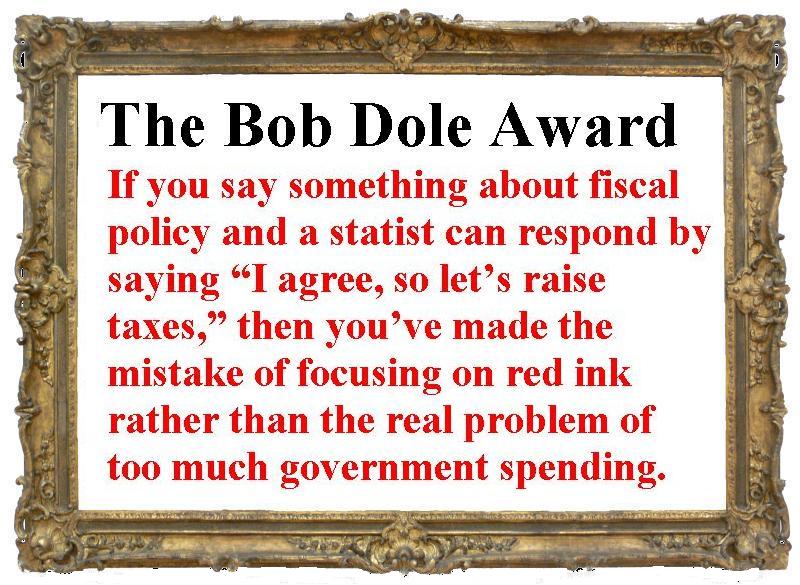
I even created a “Bob Dole Award” in hopes of getting this point across. Simply stated, fixating on debt opens the door for higher taxes.

And does anyone think our economy would be stronger, or our fiscal position would be better, if we replaced some debt-financed spending with some spending financed by class-warfare taxes?

Especially since the higher taxes almost certainly would trigger more spending, so government borrowing would stay the same and the only thing that would change is that we’d be saddled with even more waste.

Notwithstanding all my educational efforts, Republicans couldn’t resist jumping up and down and making loud noises earlier this week when the national debt hit the $16 trillion mark earlier this week (a google search for “$16 trillion debt” returned more than 24 million hits).

So let’s walk through (again) why this is misguided.

First, let’s clear up some numbers that cause confusion. Republicans are complaining about something called the “gross federal debt.” This number is largely meaningless (see table 7.1 of the OMB Historical Tables if you want to look at the details).

It is the combination of a somewhat meaningful number of more than $11 trillion known as “debt held by the public,” which is a measure of how much the federal government has borrowed over time from the private sector, and a totally irrelevant number  of about $4.5 trillion known as “debt held by federal government accounts.”

The latter number is simply a total of the IOUs that the government issues to itself, most notably the ones at the Social Security Trust Fund. But the “assets” in the Trust Fund at the Social Security Administration are offset by the “liabilities” at the Treasury Department. This is an empty bookkeeping gimmick, just as if you took a dollar out of your right pocket, put it in your left pocket, and left an IOU in exchange.

That being said, it is important to recognize that politicians have imposed poorly designed entitlement programs, and future spending on these programs will skyrocket far beyond current revenues. That growing gap, which is explained in this short video, is sometimes known as “unfunded liabilities.”

This number depends on a whole range of assumptions and can be measured in current dollars, constant dollars, and present value. I prefer the middle approach, which adjusts for inflation, and it’s worth noting that “unfunded liabilities” for Social Security and Medicare are more than $100 trillion.

That’s a number we should worry about, not the make-believe $4.5 trillion of IOUs that comprise part of the “gross national debt.”

Now let’s get to the most important issue. The reason we should worry about that $100 trillion number is that it is an estimate of how much the burden of spending will climb in the future. That additional spending will weaken the economy whether it is financed by borrowing or taxes.

Sort of helps to explain why entitlement reform is completely necessary if we want to keep America from a Greek-style fiscal collapse at some point in the future.

Here’s my video on the topic. In an ideal world, Republicans would not be allowed to talk about fiscal policy until they were first strapped in chairs, given a bunch of ADD medicine, and forced to watch this on automatic replay about 50 times.

Deficits are Bad, but the Real Problem is Spending

Uploaded by on Dec 15, 2009

Huge deficits and skyrocketing debt levels are creating considerable worry. This Center for Freedom and Prosperity Foundation video explains that that government borrowing is excessive – and will get worse in coming decades. But this mini-documentary explains that deficits and debt are merely the symptoms, and a rising burden of government spending is the real problem.

_______________

Now for the all-important caveats. Yes, a nation can reach a point where debt becomes a problem. All you have to do is look at the mess in Europe to understand that point.

And I’ve shared numbers from both the Bank for International Settlements and the Organization for Economic Cooperation and Development to indicate that almost all nations – including the U.S. – are going to face similar problems if government policy is left on autopilot.

What I want people to realize, though, is that governments only get into that kind of mess because there’s too much spending.

Government spending is the disease. The various ways of financing that spending – taxes, borrowing, and printing money – are symptoms of the underlying disease.

Dear Senator Pryor, why not pass the Balanced Budget Amendment? (“Thirsty Thursday”, Open letter to Senator Pryor)

Ronald Reagan Describes Milton Friedman

Uploaded by on Oct 2, 2011

_____________

Dear Senator Pryor,

Why not pass the Balanced  Budget Amendment? As you know that federal deficit is at all time high (1.6 trillion deficit with revenues of 2.2 trillion and spending at 3.8 trillion).

On my blog www.HaltingArkansasLiberalswithTruth.com I took you at your word and sent you over 100 emails with specific spending cut ideas. However, I did not see any of them in the recent debt deal that Congress adopted. Now I am trying another approach. Every week from now on I will send you an email explaining different reasons why we need the Balanced Budget Amendment. It will appear on my blog on “Thirsty Thursday” because the government is always thirsty for more money to spend.

My hero Milton Friedman was a big supporter of the Balanced Budget Amendment and in an article on this subject in 1983 he wrote:

“The key problem is not deficits but the size of government spending. […] I have never supported an amendment directed solely at a balanced budget. I have written repeatedly that while I would prefer that the budget be balanced, I would rather have government spend $500 billion and run a deficit of $100 billion than have it spend $800 billion with a balanced budget. It matters greatly how the budget is balanced, whether by cutting spending or by raising taxes.”

A Balanced Budget Amendment Should Make Tax & Debt Increases Difficult

As a member of the Conservative Action Project, CEO Susan Carleson and leaders of 28 other organizations, representing a broad cross section of the conservative movement, are united in supporting a Balanced Budget Amendment that actually reins in national spending and increasing our national debt – without raising taxes.

MEMO FOR THE MOVEMENT: A Balanced Budget Amendment — in addition to balancing the budget — should make it difficult to raise taxes, tough to increase the debt, and prohibit any court from ordering a tax increase or deciding budget priorities.

“I wish it were possible to obtain a single amendment to our Constitution. I would be willing to depend on that alone for the reduction of the administration of our government; I mean an additional article taking from the Federal Government the power of borrowing.”
Thomas Jefferson, 1798

RE: In accordance with the Budget Control Act of 2011, sometime between October 1 and December 31, 2011 both houses of Congress must vote on a balanced budget amendment (BBA) to the U.S. Constitution. It is important that any such amendment must protect taxpayers by not forcing automatic tax increases to keep revenues in line with rising expenditures. Our fiscal problems are caused not by under taxation–but by over-spending.

ISSUE-IN-BRIEF: Not all balanced budget Amendments were created equal. The most comprehensive BBA proposed is S.J. Resolution 10 co-sponsored by all 47 Republican members of the United States Senate. It caps spending at 18% of GDP; requires a 2/3 vote of congress to raise taxes; requires a 3/5 vote of congress to increase the debt ceiling; and prohibits any court from ordering an increase in taxes. Proposed BBA’s that do less can have the unintended effect of managing a tax increase instead of limiting spending and would be counter-productive and must be opposed.

A STRONG BBA MUST BE EASY TO UNDERSTAND AND NOT HAVE LOOPHOLES:

  • Require a Balanced Budget every year: The federal debt is on track to consume our country’s entire Gross Domestic Product. The BBA would force Washington to live within its means.
  • Prohibit Perpetual Deficit Spending: Deficit spending is a tax on future earnings.
  • A debt ceiling will actually be a ceiling: The debt ceiling has been raised 11 times in the past decade. S.J. 10–co-sponsored by 47 members of the U.S. Senate– would require a three-fifths majority in both chambers to raise the debt ceiling. This is also an important provision to prevent cheating and other budget gimmicks because actual spending cannot exceed actual revenue for long without hitting the debt limit.
  • Congress may waive BBA requirement by simple majority if a declaration of war is in effect; and it would require a three-fifths majority to waive if the country is engaged in a military conflict that causes an imminent and serious military threat to our national security.
  • Courts setting any budget priorities would be a problem. Court-ordered military cuts or activist “declaratory judgments” requiring increased welfare spending would also be intolerable. S.J. 10 can be improved with an explicit ban on courts exercising jurisdiction on any of these essential political questions.

A “Weak” BBA will increase the size of Government and pave the way for Tax Increases:

  • Unlike other proposals, such as a “Weak” BBA, not only should a BBA have a supermajority requirement to raise taxes, there should be no loopholes for creative accounting.
  • Without a limitation on tax increases and a specific prohibition on courts ordering revenue increases a “Weak” BBA would allow judges the power to implement higher taxes to bring the budget into balance.
  • A “Weak” BBA would allow a simple majority of Members of Congress to raise the federal debt ceiling and continue to borrow against future generations. That’s why there is a three-fifths majority requirement to raise the debt ceiling in S.J. 10

Why the Tax Hike Limitation Component is Important to any BBA:

As Milton Friedman wrote in defense of the Balanced Budget Amendment in 1983 in response to skepticism from the Wall Street Journal editorial board: http://www.theatlantic.com/magazine/archive/1983/02/washington-less-red-ink/5450/

“The key problem is not deficits but the size of government spending. […] I have never supported an amendment directed solely at a balanced budget. I have written repeatedly that while I would prefer that the budget be balanced, I would rather have government spend $500 billion and run a deficit of $100 billion than have it spend $800 billion with a balanced budget. It matters greatly how the budget is balanced, whether by cutting spending or by raising taxes.”

Americans Support a Balanced Budget Amendment:

Americans have always overwhelmingly support a balanced budget amendment. A Fox News poll (June 30), shows support is 72-20.

On Message, Inc., on behalf of Let Freedom Ring, shows 81% of the American people (including 74% of Democrats) support Congress balancing their budget every year. In addition 66% of Americans favor capping federal spending at the historically average 18% of GDP.

“Of course, the best way to permanently reduce spending would be to enact a balanced-budget amendment to the Constitution requiring a supermajority in both houses of Congress to run an annual deficit, raise tax rates, or increase the debit ceiling.”
James A. Baker III, Ronald Reagan’s Secretary of the Treasury from 1985-1988

Listing of transcripts and videos of “Free to Choose” episode 4 – From Cradle to Grave on www.theDailyHatch.org

In the last few years the number of people receiving Food Stamps has skyrocketed. President Obama has not cut any federal welfare programs but has increased them, and he  has used class warfare over and over the last few months and according to him equality at the finish line is the equality that we should all be talking about. However, socialism has never worked and it has always killed incentive to produce more. Milton Friedman shows in this film series below how so many people get caught in the “Welfare Trap.” Friedman also gives a great solution to this problem in the “negative income tax.” I am glad that I had the chance to be studying his work for over 30 years now.

In 1980 when I first sat down and read the book “Free to Choose” I was involved in Ronald Reagan’s campaign for president and excited about the race. Milton Friedman’s books and film series really helped form my conservative views. Take a look at one of my favorite films of his:

Friedman Friday:(“Free to Choose” episode 4 – From Cradle to Grave, Part 1 of 7)

Volume 4 – From Cradle to Grave
Abstract:

Since the Depression years of the 1930s, there has been almost continuous expansion of governmental efforts to provide for people’s welfare. First, there was a tremendous expansion of public works. The Social Security Act followed close behind. Soon other efforts extended governmental activities in all areas of the welfare sector. Growth of governmental welfare activity continued unabated, and today it has reached truly staggering proportions. Travelling in both Britain and the U.S., Milton Friedman points out that though many government welfare programs are well intentioned, they tend to have pernicious side effects. In Dr. Friedman’s view, perhaps the most serious shortcoming of governmental welfare activities is their tendency to strip away individual independence and dignity. This is because bureaucrats in welfare agencies are placed in positions of tremendous power over welfare recipients, exercising great influence over their lives. Because people never spend someone else’s money as carefully as they spend their own, inefficiency, waste, abuse, theft, and corruption are inevitable. In addition, welfare programs tend to be self-perpetuating because they destroy work incentives. Indeed, it is often in the welfare recipients’ best interests to remain unemployed. Dr. Friedman suggests a negative income tax as a way of helping the poor. The government would pay money to people falling below a certain income level. As they obtained jobs and earned money, they would continue to receive some payments from the government until their outside income reached a certain ceiling. This system would make people better off who sought work and earned income. This contrasts with many of today’s programs where one dollar earned means nearly one dollar lost in welfare payments.

Volume 4 – From Cradle to Grave
Transcript:
Friedman: After the 2nd World War, New York City authorities retained rent control supposedly to help their poorer citizens. The intentions were good. This in the Bronx was one result.
By the 50’s the same authorities were taxing their citizens. Including those who lived in the Bronx and other devastated areas beyond the East River to subsidize public housing. Another idea with good intentions yet poor people are paying for this, subsidized apartments for the well-to-do. When government at city or federal level spends our money to help us, strange things happen.
The idea that government had to protect us came to be accepted during the terrible years of the Depression. Capitalism was said to have failed. And politicians were looking for a new approach.
Franklin Delano Roosevelt was a candidate for the presidency. He was governor of New York State. At the governor’s mansion in Albany, he met repeatedly with friends and colleagues to try to find some way out of the Depression. The problems of the day were to be solved by government action and government spending. The measures that FDR and his associates discussed here derived from a long line of past experience. Some of the roots of these measures go back to Bismark’s Germany at the end of the 19th Century. The first modern state to institute old age pensions and other similar measures on the part of government. In the early 20th Century Great Britain followed suit under Lloyd George and Churchill. It too instituted old age pensions and similar plans.
These precursors of the modern welfare state had little effect on practice in the United States. But they did have a very great effect on the intellectuals on the campus like those who gathered here with FDR. The people who met here had little personal experience of the horrors of the Depression but they were confident that they had the solution. In their long discussions as they sat around this fireplace trying to design programs to meet the problems raised by the worst Depression in the history of the United States, they quite naturally drew upon the ideas that were prevalent at the time. The intellectual climate had become one in which it was taken for granted that government had to play a major role in solving the problems in providing what came later to be called Security from Cradle to Grave.
Roosevelt’s first priority after his election was to deal with massive unemployment. A Public Works program was started. The government financed projects to build highways, bridges and dams. The National Recovery Administration was set up to revitalize industry. Roosevelt wanted to see America move into a new era. The Social Security Act was passed and other measures followed. Unemployment benefits, welfare payments, distribution of surplus food. With these measures, of course, came rules, regulations and red tape as familiar today as they were novel then. The government bureaucracy began to grow and it’s been growing ever since.
This is just a small part of the Social Security empire today. Their headquarters in Baltimore has 16 rooms this size. All these people are dispensing our money with the best possible intentions. But at what cost?
In the 50 years since the Albany meetings, we have given government more and more control over our lives and our income. In New York State alone, these government buildings house 11,000 bureaucrats. Administering government programs that cost New York taxpayers 22 billion dollars. At the federal level, the Department of Health, Education and Welfare alone has a budget larger than any government in the world except only Russia and the United States.
Yet these government measures often do not help the people they are supposed to. Richard Brown’s daughter, Helema, needs constant medical attention. She has a throat defect and has to be connected to a breathing machine so that she’ll survive the nights. It’s expensive treatment and you might expect the family to qualify for a Medicaid grant.
Richard Brown: No, I don’t get it, cause I’m not eligible for it. I make a few dollars too much and the salary that I make I can’t afford to really live and to save anything is out of the question. And I mean, I live, we live from payday to payday. I mean literally from payday to payday.
Friedman: His struggle isn’t made any easier by the fact that Mr. Brown knows that if he gave up his job as an orderly at the Harlem Hospital, he would qualify for a government handout. And he’d be better off financially.
Hospital Worker: Mr. Brown, do me a favor please? There is a section patient.
Friedman: It’s a terrible pressure on him. But he is proud of the work that he does here and he’s strong enough to resist the pressure.
Richard Brown: I’m Mr. Brown. Your fully dilated and I’m here to take you to the delivery. Try not to push, please. We want to have a nice sterile delivery.
Friedman: Mr. Brown has found out the hard way that welfare programs destroy an individual’s independence.
Richard Brown: We’ve considered welfare. We went to see, to apply for welfare but, we were told that we were only eligible for $5.00 a month. And, to receive this $5.00 we would have to cash in our son’s savings bonds. And that’s not even worth it. I don’t believe in something for nothing anyway.
Mrs. Brown: I think a lot of people are capable of working and are willing to work, but it’s just the way it is set up. It, the mother and the children are better off if the husband isn’t working or if the husband isn’t there. And this breaks up so many poor families.
Friedman: One of the saddest things is that many of the children whose parents are on welfare will in their turn end up in the welfare trap when they grow up. In this public housing project in the Bronx, New York, 3/4’s of the families are now receiving welfare payments.
Well Mr. Brown wanted to keep away from this kind of thing for a very good reason. The people who get on welfare lose their human independence and feeling of dignity. They become subject to the dictates and whims of their welfare supervisor who can tell them whether they can live here or there, whether they may put in a telephone, what they may do with their lives. They are treated like children, not like responsible adults and they are trapped in the system. Maybe a job comes up which looks better than welfare but they are afraid to take it because if they lose it after a few months it maybe six months or nine months before they can get back onto welfare. And as a result, this becomes a self-perpetuating cycle rather than simply a temporary state of affairs.
Things have gone even further elsewhere. This is a huge mistake. A public housing project in Manchester, England.
Well we’re 3,000 miles away from the Bronx here but you’d never know it just by looking around. It looks as if we are at the same place. It’s the same kind of flats, the same kind of massive housing units, decrepit even though they were only built 7 or 8 years ago. Vandalism, graffiti, the same feeling about the place. Of people who don’t have a great deal of drive and energy because somebody else is taking care of their day to day needs because the state has deprived them of an incentive to find jobs to become responsible people to be the real support for themselves and their families.

Other segments:

Milton Friedman Friday:(“Free to Choose” episode 4 – From Cradle to Grave, Part 7 of 7)

I am currently going through his film series “Free to Choose” which is one the most powerful film series I have ever seen. TEMIN: We don’t think the big capital arose before the government did? VON HOFFMAN: Listen, what are we doing here? I mean __ defending big government is like defending death and taxes. […]

Milton Friedman Friday:(“Free to Choose” episode 4 – From Cradle to Grave, Part 6 of 7)

I am currently going through his film series “Free to Choose” which is one the most powerful film series I have ever seen worked pretty well for a whole generation. Now anything that works well for a whole generation isn’t entirely bad. From the fact __ from that fact, and the undeniable fact that things […]

Milton Friedman discusses Reagan and Reagan discusses Friedman

Uploaded by YAFTV on Aug 19, 2009 Nobel Laureate Dr. Milton Friedman discusses the principles of Ronald Reagan during this talk for students at Young America’s Foundation’s 25th annual National Conservative Student Conference MILTON FRIEDMAN ON RONALD REAGAN In Friday’s WSJ, Milton Friedman reflectedon Ronald Reagan’s legacy. (The link should work for a few more […]

Milton Friedman Friday:(“Free to Choose” episode 4 – From Cradle to Grave, Part 5 of 7)

 I am currently going through his film series “Free to Choose” which is one the most powerful film series I have ever seen. PART 5 of 7 MCKENZIE: Ah, well, that’s not on our agenda actually. (Laughter) VOICE OFF SCREEN: Why not? MCKENZIE: I boldly repeat the question, though, the expectation having been __ having […]

War on poverty is a failure in USA

Milton Friedman’s solution to limiting poverty Liberals just don’t get it. They should listen to Milton Friedman (who is quoted in this video below concerning the best way to limit poverty). New Video Shows the War on Poverty Is a Failure Posted by Daniel J. Mitchell The Center for Freedom and Prosperity has released another […]

Milton Friedman Friday: (“Free to Choose” episode 4 – From Cradle to Grave, Part 4 of 7)

 I am currently going through his film series “Free to Choose” which is one the most powerful film series I have ever seen. PART 4 of 7 The massive growth of central government that started after the depression has continued ever since. If anything, it has even speeded up in recent years. Each year there […]

Milton Friedman Friday: (“Free to Choose” episode 4 – From Cradle to Grave, Part 3 of 7)

 I am currently going through his film series “Free to Choose” which is one the most powerful film series I have ever seen. PART 3 OF 7 Worse still, America’s depression was to become worldwide because of what lies behind these doors. This is the vault of the Federal Reserve Bank of New York. Inside […]


Milton Friedman Friday:(“Free to Choose” episode 4 – From Cradle to Grave, Part 2 of 7)

 I am currently going through his film series “Free to Choose” which is one the most powerful film series I have ever seen. For the past 7 years Maureen Ramsey has had to buy food and clothes for her family out of a government handout. For the whole of that time, her husband, Steve, hasn’t […]

Friedman Friday:(“Free to Choose” episode 4 – From Cradle to Grave, Part 1 of 7)

Friedman Friday:(“Free to Choose” episode 4 – From Cradle to Grave, Part 1 of 7) Volume 4 – From Cradle to Grave Abstract: Since the Depression years of the 1930s, there has been almost continuous expansion of governmental efforts to provide for people’s welfare. First, there was a tremendous expansion of public works. The Social Security Act […]

Open letters to President Obama displayed here on www.thedailyhatch.org

I have been writing letters to President Obama almost all of 2012. I have received several responses from the White House but none of the responses have been personal responses from the President.

Below is a letter I wrote to the President and a form letter response that I got followed by links to other letters I have written him.

KIreland.jpg 

Science Matters #2: Former supermodel Kathy Ireland tells Mike Huckabee about how she became pro-life after reading what the science books have to say.

President Obama c/o The White House
1600 Pennsylvania Avenue NW
Washington, DC 20500

Dear Mr. President,

I know that you receive 20,000 letters a day and that you actually read 10 of them every day. I really do respect you for trying to get a pulse on what is going on out here.

I wanted to talk to you today about your views on abortion. Everyone remembers Kathy Ireland from her Sports Illustrated days and actually she has became a very successful business person.  However, I wanted to talk about her pro-life views.

_____________

Back on April 27, 2009 Fox News ran a story by Hollie McKay(Supermodel Kathy Ireland Lashes Out Against Pro Choice,”) on  Ireland.

It’s no secret that the majority of Hollywood stars are strong advocates for a woman’s right to choose whether or not she wants to terminate a pregnancy, however former “Sports Illustrated” supermodel-turned-entrepreneur-turned-author Kathy Ireland has gone against the grain of the glitterati and spoken out against abortion.

“My entire life I was pro-choice — who was I to tell another woman what she could or couldn’t do with her body? But when I was 18, I became a Christian and I dove into the medical books, I dove into science,” Ireland told Tarts while promoting her insightful new book “Real Solutions for Busy Mom: Your Guide to Success and Sanity.”

“What I read was astounding and I learned that at the moment of conception a new life comes into being. The complete genetic blueprint is there, the DNA is determined, the blood type is determined, the sex is determined, the unique set of fingerprints that nobody has had or ever will have is already there.”

However Ireland admitted that she did everything she could to avoid becoming a believer in pro-life.

“I called Planned Parenthood and begged them to give me their best argument and all they could come up with that it is really just a clump of cells and if you get it early enough it doesn’t even look like a baby. Well, we’re all clumps of cells and the unborn does not look like a baby the same way the baby does not look like a teenager, a teenager does not look like a senior citizen. That unborn baby looks exactly the way human beings are supposed to look at that stage of development. It doesn’t suddenly become a human being at a certain point in time,” Ireland argued. “I’ve also asked leading scientists across our country to please show me some shred of evidence that the unborn is not a human being. I didn’t want to be pro-life, but this is not a woman’s rights issue but a human rights issue.”

My good friend Dr. Kevin R. Henke is a scientist and also an atheistic evolutionist. I had a lot of discussions with Kevin over religious views. I remember going over John 7:17 with him one day. It says:

John 7:17 (Amplified Bible)

17If any man desires to do His will (God’s pleasure), he will know (have the needed illumination to recognize, and can tell for himself) whether the teaching is from God or whether I am speaking from Myself and of My own accord and on My own authority.

I challenged Kevin to read a chapter a day of the Book of John and pray to God and ask God, “Dear God, if you are there then reveal yourself to me, and I pledge to serve you the rest of my life.”

Kevin did that and he even wrote down the thoughts that came to his mind and sent it to me and these thoughts filled a notebook.

Kevin did not become a Christian, but I am still praying for him. I do respect Kevin because he is an honest man. Interestingly enough he  told me that he was pro-life because the unborn baby has all the genetic code at  the time of conception that they will have for the rest of their life. Below are some other comments by other scientists:

Dr. Hymie Gordon (Mayo Clinic): “By all criteria of modern molecular biology, life is present from the moment of conception.”

Dr. Micheline Matthews-Roth (Harvard University Medical School): “It is scientifically correct to say that an individual human life begins at conception.”

Dr. Alfred Bongioanni (University of Pennsylvania): “I have learned from my earliest medical education that human life begins at the time of conception.”

Dr. Jerome LeJeune, “the Father of Modern Genetics” (University of Descartes, Paris): “To accept the fact that after fertilization has taken place a new human has come into being is no longer a matter of taste or opinion . . . it is plain experimental evidence.”

__

Thank you so much for your time. I know how valuable it is. I also appreciate the fine family that you have and your committment as a father and a husband.

Sincerely,

Everette Hatcher III, 13900 Cottontail Lane, Alexander, AR 72002, ph 501-920-5733, lowcostsqueegees@yahoo.com

_______________

I actually mailed this to President Obama about a week ago and got this email back:

The White House, Washington


April 16, 2012

Dear Everette:

Thank you for taking the time to share your views on abortion.  This is a heart-wrenching issue, and I appreciate your input and thoughts.

I am committed to making my Administration the most open and transparent in history, and part of delivering on that promise is hearing from people like you.  I take seriously your opinions and respect your point of view on this issue.  Please know that your concerns will be on my mind in the days ahead.

Thank you, again, for writing.  I encourage you to visit www.WhiteHouse.gov to learn more about my Administration or to contact me in the future.

Sincerely,

Barack Obama

An open letter to President Obama (Part 65)

Leader Cantor On CNN Responding To President Obama’s State of the Union Address Uploaded by EricCantor on Jan 25, 2012 ______________ President Obama c/o The White House 1600 Pennsylvania Avenue NW Washington, DC 20500 Dear Mr. President, I know that you receive 20,000 letters a day and that you actually read 10 of them every day. I […]


“Feedback Friday” Letter to White House generated form letter response March 7, 2011 (part 3)

I have been writing President Obama letters and have not received a personal response yet.  (He reads 10 letters a day personally and responds to each of them.) However, I did receive a form letter in the form of an email on March 7, 2011. I don’t know which letter of mine generated this response so I have […]


An open letter to President Obama (Part 58) “Our national debt threatens our security”

Liam Fox Issues a Warning to America Uploaded by HeritageFoundation on Feb 28, 2012 Britain’s Liam Fox has a warning for America: Fix the debt problem now or suffer the consequences of less power on the world stage. The former U.K. secretary of state for defense visited Heritage to explain why the America’s debt is […]

“Feedback Friday” Letter to White House generated form letter response Jan 27, 2011 (part 2)

I have been writing President Obama letters and have not received a personal response yet.  (He reads 10 letters a day personally and responds to each of them.) However, I did receive a form letter in the form of an email on January 27, 2011. I don’t know which letter of mine generated this response so I have […]

“Feedback Friday” Letter to White House generated form letter response Jan 25, 2011 (part 1)

I have been writing President Obama letters and have not received a personal response yet.  (He reads 10 letters a day personally and responds to each of them.) However, I did receive a form letter in the form of an email on January 25, 2011. I don’t know which letter of mine generated this response so I have […]

An open letter to President Obama (Part 48 of my response to State of Union Speech 1-24-12)

An open letter to President Obama (Part 48 of my response to State of Union Speech 1-24-12) Rep Michael Burgess response Uploaded by MichaelCBurgessMD on Jan 25, 2012 This week Dr. Burgess provides an update from Washington and responds to President Obama’s State of the Union address. President Obama’s state of the union speech Jan 24, 2012 […]

An open letter to President Obama (Part 47, A response to your budget)

Corker Says President’s 2012 Budget Proposal Shows “Lack of Urgency” on Spending Uploaded by senatorcorker on Feb 14, 2011 In remarks on the Senate floor today, U.S. Senator Bob Corker, R-Tenn., expressed disappointment in President Obama’s 2012 budget proposal, saying it displayed a “lack of urgency” to get federal spending under control. Corker has introduced […]

An open letter to President Obama (Part 1 of State of Union Speech 1-24-12)

President Obama’s state of the union speech Jan 24, 2012 Feb 6, 2012 President Obama c/o The White House 1600 Pennsylvania Avenue NW Washington, DC 20500 Dear Mr. President, I know that you receive 20,000 letters a day and that you actually read 10 of them every day. I really do respect you for trying […]

An open letter to President Obama

  January 25, 2012 President Obama c/o The White House 1600 Pennsylvania Avenue NW Washington, DC 20500 Dear Mr. President, I know that you receive 20,000 letters a day and that you actually read 10 of them every day. I really do respect you for trying to get a pulse on what is going on […]


Will our president attempt to cut the budget?

I hate that so many times in the history of the USA our national leader will not cut the federal budget and attempt to balance it like everyone else has to balance their family budget at home.

I feel like a pendulum this election season. Something will happen that makes me want to eviscerate Obama’s statist policies and I’ll write a foaming-at-the-mouth post warning that the President is turning America into Greece.

But then Romney will do something odious and I’ll sound the warning sign with a we-don’t-need-another-big-spender-like-Bush post.

Today, it’s Obama’s turn on the chopping block. I went on Neil Cavuto’s Fox Business News program and commented on the fact that the President doesn’t have a fiscal plan.

We started by discussing the President’s failure to embrace the findings of his own Fiscal Commission and then shifted to the big-picture issue of whether the American people have become ensnared by the dependency mindset and are willing to vote for Greek-style fiscal policy.

Published on Aug 16, 2012 by

No description available.

________________

One thing I should have added is that Obama actually does have a fiscal plan. He’s just not willing to be as honest as the leftists who have admitted that you need to screw the middle class with higher taxes to fund big government.

My own personal guess is that he would impose a value-added tax if he thought it was politically feasible. Not that I’m showing any great insight. After all, Obama already has made the ridiculous statement that a VAT is “something that has worked for other countries.”

But because he’s running for reelection, he’d rather just demagogue the Ryan plan rather than show his own cards.

P.S. Even the cartoonist for the Washington Post doesn’t think the VAT is something that is working for other countries. This cartoon is a classic and definitely worth sharing. And you can enjoy other VAT cartoons here and here.

In tonight’s debate I wish Romney would throw George W. Bush under the bus for his big spending!!

 Spending Restraint, Part I: Lessons from Ronald Reagan and Bill Clinton

Uploaded by on Feb 14, 2011

Ronald Reagan and Bill Clinton both reduced the relative burden of government, largely because they were able to restrain the growth of domestic spending. The mini-documentary from the Center for Freedom and Prosperity uses data from the Historical Tables of the Budget to show how Reagan and Clinton succeeded and compares their record to the fiscal profligacy of the Bush-Obama years.

______________

I noticed in the second presidential debate that there was a missed opportunity by Mitt Romney to throw former President George W. Bush under the bus for Bush’s big spending policies that turned President Clinton’s surplus into a large deficit (2001 to 2008). However, Romney did not take advantage of that opportunity to show people that he was serious about cutting spending and balancing the budget.

Supporters Urge Romney to Announce that He Intends to Reverse the Statist Policies of Obama…and Bush

October 19, 2012 by Dan Mitchell

People in the political world say that President Obama threw Secretary of State Clinton under the bus in an attempt to protect himself from political fallout from Libya.

I don’t follow those issues, so I can’t comment about the veracity of that charge, but I find it very interesting that some conservatives are urging Mitt Romney to throw former President George W. Bush under the bus.

More specifically, they’re urging him to condemn Bush’s statism and to attack Obama for continuing Bush’s failed policies.

Since I’ve attacked Bush for expanding the burden of government spending and reducing economic freedom, this resonates with me.

Phil Kerpen of American Commitment nails the issue in a column for Fox News.

Romney’s biggest missed opportunity in the second debate wasn’t on Libya…he should have connected the dots between Obama and Bush to illustrate the accurate point that on the most significant dimensions of economic policy, Obama has accelerated Bush’s policy errors rather than reversing them. In the crucible of the 2008 financial crisis, President Bush famously remarked that “I chucked aside my free-market principles .” He was referring to TARP, his infamous big bank bailout. Obama supported the bill and voted for it. …On government spending, it’s the same story. Bush racked up one of the most disastrous records of out-of-control spending and debt the country had ever seen. Every aspect of the federal budget jumped under Bush. …Obama came in and continued spending recklessly. Bush’s $152 billion stimulus bill failed and so did Obama’s $821 billion stimulus bill. Bush flushed $25 billion in bailout funds to Chrysler and General Motors, and Obama added another $20 billion before finally recognizing that the companies would inevitably file for bankruptcy. All of the pre-bankruptcy bailout dollars were lost. …On the biggest economic policy questions, the Bush/Geithner/Bernanke approach is almost indistinguishable from the Obama/Geithner/Bernanke approach. It hasn’t worked. Obama’s failed policies of the present are all too similar to Bush’s failed policies of the past.

Amen. Bush was a statist, period.

Peter Wallison of the American Enterprise Institute made similar points in an article for the Weekly Standard.

Obama’s claim that Bush’s policies caused the recession resonates with American voters. Almost four years after George W. Bush left office, polls show the American people continue to blame him—more than Obama—for the recession that created today’s dismal economic conditions. Throughout the fall and in their debates, it’s a sure thing that Obama will continue to argue that Romney is just another George W. Bush. How can Romney respond? …Romney should not deny Bush’s error. Although Clinton began the process of forcing low mortgage underwriting standards, Bush continued and enhanced it. Instead, Romney should point out that the government should never have been in the housing finance business, and that he will eliminate Fannie and Freddie to restore a functioning housing market—something Obama has failed to do in almost four years.

But here’s where I disagree with Kerpen and Wallison, or at least where I would add a big caveat to their analysis. What makes them think that Romney would be any different that Bush or Obama?

This post highlights a few of Romney’s policies that would undermine free markets and expand the public sector.

If all one cares about is whether politicians have an “R” or a “D” after their names, then my concerns don’t matter.

But if you’re actually interested in making America a better place, then policy matters a lot.

I’ll close with a final point. I have no idea whether Romney is a closet statist or a closet Reaganite. All I’m saying is that, if Romney wins, people who value limited government and freedom should begin working on November 7 to take whatever steps are necessary to prevent Romney from becoming another RINO such as Bush or Nixon.

Milton Friedman on controlling spending Part 2

Mark Levin “I feel that we can do great things.”

Uploaded by on Mar 26, 2011

Mark Levin “I feel that we can do great things.” Mark is excited by the proposed Balanced Budget Amendment. He states that this would be a great thing for America to pass. He believes the Balanced Budget Amendment will help bring the nation back to it’s Constitutional roots. Mark explains what the amendment is and how it will work. In his February 1983 classic essay, Nobel Prize-winning economist Milton Friedman gives his opinion on a balanced budget amendment that requires a super majority to raise taxes. Friedman states, “The purpose of the balanced-budget-and-tax-limitation amendment is to limit the government in order to free the people—this time from excessive taxation. Its passage would go a long way to remedy the defect that has developed in our budgetary process.” Part #1 3-25-2011

___________________

The best article I have ever read on the Balanced Budget Amendment was written by my favorite economist Milton Friedman. Here is the second portion below:

Washington: Less Red Ink

I have been much more surprised, and dismayed, by the criticism that has been expressed by persons who share my basic outlook about the importance of limiting government in order to preserve and expand individual freedom—for example, the editors of The Wall Street Journal and a former editor and current columnist, Vermont Royster. They do not question the objectives of the amendment, but they doubt its necessity and potential effectiveness.

Those doubts are presumably shared by many other thoughtful citizens of all shades of political opinion who are united by concern about the growth of government spending and deficits. Here, for their consideration, are my answers to the principal objections to the proposed amendment that I have come across, other than those that arise from a desire to have a still-bigger government:

1. The amendment is unnecessary. Congress and the President have the power to limit spending and balance the budget.

Taken seriously, this is an argument for scrapping most of the Constitution. Congress and the President have the power to preserve freedom of the press and of speech without the First Amendment. Does that make the First Amendment unnecessary? Not surprisingly, I know of no one who has criticized the balanced-budget amendment as unnecessary—however caustic his comments on congressional hypocrisy—who would draw the conclusion that the First Amendment should be scrapped.

It is essential to look not only at the power of Congress but at the incentives of its members—to act in such a way as to be re-elected. As Phil Gramm, a Democratic congressman from Texas, has said: Every time you vote on every issue, all the people who want the program are looking over your right shoulder and nobody’s looking over your left shoulder….In being fiscally responsible under such circumstances, we’re asking more of people than the Lord asks.”

Under present arrangements, Congress will not in fact balance the budget. Similarly, a President will not produce a balanced budget by using the kind of vetoes that would be required. The function of the amendment is to remedy the defect in our legislative procedure that distorts the will of the people as it is filtered through their representatives. The amendment process is the only effective way the public can treat the budget as a whole. That is the function of the First Amendment, as well—it treats free speech as a bundle. In its absence, Congress would consider each case “on its merits.” It is not hard to envisage the way unpopular groups and views would fare.

2. The President and Congress are guilty of hypocrisy in voting simultaneously for a large current deficit and for a constitutional amendment to prevent future deficits.

Of course, I have long believed that congressional hypocrisy and shortsightedness are the only reasons there is a ghost of a chance of getting Congress to pass an amendment limiting itself. Most members of Congress will do anything to postpone the problems they face by a couple of years—only Wall Street has a shorter perspective. If the hypocrisy did not exist, if Congress behaved “responsibly,” there would be no need for the amendment. Congress’s irresponsibility is the reason we need an amendment and at the same time the reason that there is a chance of getting one.

Hypocrisy may eventually lead to the passing of the amendment. But hypocrisy will not prevent the amendment from having important effects three or four years down the line—and from casting its shadow on events even earlier. Congress will not violate the Constitution lightly. Members of Congress will wriggle and squirm; they will seek, and no doubt find, subterfuges and evasions. But their actions will be significantly affected by the existence of the amendment. The experience of several states that have passed similar tax-limitation amendments provides ample evidence of that.

3. The amendment is substantive, not procedural and the Constitution should be limited to procedural matters. The fate of the Prohibition amendment is a cautionary tale that should give us pause in enacting substantive amendments.

If this amendment is substantive, so is the income-tax (sixteenth) amendment and so are many specific provisions of the Constitution. The income-tax amendment does not specify the rate of tax. It leaves that to Congress. Similarly, this amendment does not specify the size of the budget. It simply outlines a procedure for approving it: the same as now exists if total legislated outlays do not exceed an amount determined by prior events (the prior budget and the prior growth in national income); and by a majority of 60 percent if total legislated outlays do exceed that amount. The requirement of a supernormal majority is neither substantive nor undemocratic nor unprecedented. Witness the two-thirds majority necessary to override a presidential veto or to approve a treaty.

The prohibition amendment was incompatible with the basic aim of the Constitution, because it was not directed at limiting government. On the contrary, it limited the people and freed government to control them. The balanced-budget-tax-limitation amendment is thoroughly compatible with the basic role of the Constitution, because it seeks to improve the ability of the public to limit government.

4. The amendment is unduly rigid because it requires an annually balanced budget.

This is a misconception. Section 1 of the amendment prohibits a planned budget deficit unless it is explicitly approved by three fifths of the members of the House and Senate. It further requires the Congress and the President to “ensure that actual outlays do not exceed the outlays set forth in [the budget] statement.” But it does not require that actual receipts equal or exceed statement receipts. A deficit that emerged because a recession produced a reduction in tax receipts would not be in violation of the amendment, provided that outlays were no greater than statement outlays. This is a sensible arrangement: outlays can be controlled more readily over short periods than receipts.

I have never been willing to support an amendment calling for an annually balanced budget. I do support this one, because it has the necessary flexibility.

5. The amendment will be ineffective because (a) it requires estimates of receipts and outlays which can be fudged; (b) its language is fuzzy; (c) the Congress can find loopholes to evade it; (d) it contains no specific provisions for enforcement.

(a) It will be possible to evade the amendment by overestimating receipts—but only once, for the first year the amendment is effective. Thereafter, section 2 of the amendment limits each year’s statement receipts to the prior year’s statement receipts plus the prior rate of increase of national income. No further estimates of budget receipts are called for. This is one of the overlooked subtleties in the amendment.

Any further fudging would have to be of the national-income estimates. That is possible but both unlikely and not easy. What matters is not the level of national income but the percentage change in national income. Alterations of the definition of national income that affect levels are likely to have far less effect on percentage changes. Moreover, making the change in income artificially high in one year will tend to make it artificially low the next. All in all, I do not believe that this is a serious problem.

(b) The language is not fuzzy. The only undefined technical term is “national income.” The amendment also refers to “receipts” and “outlays,” terms of long-standing usage in government accounting; in section 4, total receipts and total outlays are defined explicitly.

Nor is the amendment a hastily drawn gimmick designed to provide a fig leaf to hide Congress’s sins. On the contrary, it is a sophisticated product, developed over a period of years, that reflects the combined wisdom of the many persons who participated in its development.

(c) Loopholes are a more serious problem. One obvious loophole—off-budget outlays—has been closed by phrasing the amendment in terms of total outlays and defining them to include “all outlays of the United States except those for repayment of debt principal.” But other, less obvious, loopholes have not been closed. Two are particularly worrisome: government credit guarantees, and mandating private expenditures for public purposes (e. g., antipollution devices on automobiles). These loopholes now exist and are now being resorted to. I wish there were some way to close them. No doubt the amendment would provide an incentive to make greater use of them. Yet I find it hard to believe that they are such attractive alternatives to direct government spending that they would render the amendment useless.

(d) No constitutional provision will be enforced unless it has widespread public support. That has certainly been demonstrated. However, if a provision does have widespread support—as public-opinion polls have clearly shown that this one does—legislators are not likely to flout it, which brings us back to the loopholes.

Equally important, legislators will find it in their own interest to confer an aura of inviolability on the amendment. This point has been impressed on me by the experience of legislators in states that have adopted amendments limiting state spending. Prior to the amendments, they had no effective defense against lobbyists urging spending programs—all of them, of course, for good purposes. Now they do. They can say: Your program is an excellent one; I would like to support it, but the total amount we can spend is fixed. To get funds for your program, we shall have to cut elsewhere. Where should we cut?” The effect is to force lobbyists to compete against one another rather than form a coalition against the general taxpayer.

That is the purpose of constitutional rules: to establish arrangements under which private interest coincides with the public interest. This amendment passes that test with flying colors.

6. The key problem is not deficits but the size of government spending.

My sentiments exactly. Which is why I have never supported an amendment directed solely at a balanced budget. I have written repeatedly that while I would prefer that the budget be balanced, I would rather have government spend $500 billion and run a deficit of $100 billion than have it spend $800 billion with a balanced budget. It matters greatly how the budget is balanced, whether by cutting spending or by raising taxes.

In my eyes, the chief merit of the amendment recommended by the Senate Judiciary Committee is precisely that it does limit spending. Section 1 requires that statement outlays be no greater than statement receipts; section 2 limits the maximum increase in statement receipts; the two together effectively limit statement outlays. Moreover, if in any year Congress manages to keep statement receipts and outlays below the maximum level, the effect is to lower the maximum level for future years, thus fostering a gradual ratcheting down of spending relative to national income.

A further strength of the amendment is the provision for approving an exceptional increase in statement receipts (hence in statement outlays). The spending-limitation amendment that was drafted by the National Tax Limitation Committee required a two-thirds majority of both houses in order to justify an exceptional increase in outlays. The amendment passed by the Senate requires only “a majority of the whole number of both houses of Congress.” However, the majority must vote for an explicit tax increase. I submit that it is far easier to get a two-thirds majority of Congress to approve an exceptional increase in spending than to get a simple majority to approve an explicit increase in taxes. So this is a stronger, not a weaker, amendment.

Section 6 proposed by Senator Armstrong in the course of Senate debate, makes the debt ceiling permanent and requires a supermajority vote to raise it. That provision was approved by a narrow majority composed of a coalition of right-wing Republicans and left-wing Democrats—the one group demonstrating its hardcore conservatism, the other seeking to reduce the chances of adoption of the basic amendment.

I do not favor the debt-limit provision. Its objective—to strengthen pressure on Congress to balance the budget—is fine, and it may be that it would do little harm. But it seems to me both unnecessary and potentially harmful. I trust that it will be eliminated if and when the amendment is finally approved by Congress. I shall favor the amendment even if the debt-limit provision is left in, but less enthusiastically.

7. The amendment introduces a near economic theory into the Constitution.

It does nothing of the kind—unless the idea that there should be some connection between receipts and outlays is a new economic theory. The amendment does not even change the present budget process, if Congress enacts a balanced budget that rises by no greater a percentage than does national income. But it does significantly stiffen the requirement for passing a budget that is in deficit or for raising the fraction of our income spent on our behalf by the government.

The amendment recommended by the Senate Judiciary Committee deserves the wholehearted backing of every believer in a limited government and maximum freedom for the individual.

Milton Friedman received the Nobel Prize in economics in 1976. He is the Paul Snowden Russell Distinguished Service Professor Emeritus of Economics at the University of Chicago and a senior research fellow at the Hoover Institution at Stanford University.

Senator Pryor asks for Spending Cut Suggestions! Here are a few!(Part 162)

Senator Pryor asks for Spending Cut Suggestions! Here are a few!(Part 162)

Senator Mark Pryor wants our ideas on how to cut federal spending. Take a look at this video clip below:

Senator Pryor has asked us to send our ideas to him at cutspending@pryor.senate.gov and I have done so in the past and will continue to do so in the future.

On May 11, 2011,  I emailed to this above address and I got this email back from Senator Pryor’s office:

Please note, this is not a monitored email account. Due to the sheer volume of correspondence I receive, I ask that constituents please contact me via my website with any responses or additional concerns. If you would like a specific reply to your message, please visit http://pryor.senate.gov/contact. This system ensures that I will continue to keep Arkansas First by allowing me to better organize the thousands of emails I get from Arkansans each week and ensuring that I have all the information I need to respond to your particular communication in timely manner.  I appreciate you writing. I always welcome your input and suggestions. Please do not hesitate to contact me on any issue of concern to you in the future.

I just did. I went to the Senator’s website and sent this below:

Here are some great suggestions from the Heritage Foundation.  Alison Acosta Fraser Director, Thomas A. Roe Institute for Economic Policy Studies

Nowhere to Cut?

  • In 2011, the federal government wasted $115.3 billion of taxpayers’ money in improper payments: money paid in the wrong amount, to the wrong person, or for the wrong reason. Most of these excess payments—$107 billion, or 93 percent—were in just 10 programs, including Medicare fee-for-service ($28.8 billion), Medicaid ($21.9 billion), the Earned Income Tax Credit ($15.2 billion), and Unemployment Insurance ($13.7 billion). Implementation of updated computer systems and fraud detection methods and stricter documentation requirements would reduce payment errors.
  • Federally subsidized Amtrak lost $84.5 million on its food and beverage services in 2011, and $833.8 million over the past 10 years. It has never broken even on these services.
  • The Government Accountability Office (GAO) identified 34 areasin which federal agencies or initiatives have overlapping goals or duplicative services, which cost taxpayers billions of dollars each year. There are:
    • More than 80 economic development programs operating out of four different agencies: the Departments of Agriculture, Commerce, and Housing and Urban Development, and the Small Business Administration;
    • More than 100 economic development programs spread across five agencies within the Department of Transportation;
    • Seven federal agencies, including the Departments of Education, Health and Human Services, and Housing and Urban Development, which have more than 20 programs addressing homelessness;
    • 44 employment and training programs in the Departments of Education, Health and Human Services, and Labor; and
    • 82 programs on teacher quality run through the Departments of Defense, Education, and Energy, as well as NASA and the National Science Foundation.

Milton Friedman on controlling spending

Mark Levin “I feel that we can do great things.”

Uploaded by on Mar 26, 2011

Mark Levin “I feel that we can do great things.” Mark is excited by the proposed Balanced Budget Amendment. He states that this would be a great thing for America to pass. He believes the Balanced Budget Amendment will help bring the nation back to it’s Constitutional roots. Mark explains what the amendment is and how it will work. In his February 1983 classic essay, Nobel Prize-winning economist Milton Friedman gives his opinion on a balanced budget amendment that requires a super majority to raise taxes. Friedman states, “The purpose of the balanced-budget-and-tax-limitation amendment is to limit the government in order to free the people—this time from excessive taxation. Its passage would go a long way to remedy the defect that has developed in our budgetary process.” Part #1 3-25-2011

The best article I have ever read on the Balanced Budget Amendment was written by my favorite economist Milton Friedman. Here is the first portion below:

Washington: Less Red Ink

An argument that the balanced-budget amendment would be a rare merging of public and private interests.

Our elected representatives in Congress have been voting larger expenditures year after year—larger not only in dollars but as a fraction of the national income. Tax revenue has been rising as well, but nothing like so rapidly. As a result, deficits have grown and grown.

At the same time, the public has demonstrated increasing resistance to higher spending, higher taxes, and higher deficits. Every survey of public opinion shows a large majority that believes that government is spending too much money, and that the government budget should be balanced.

How is it that a government of the majority produces results that the majority opposes?

The paradox reflects a defect in our political structure. We are ruled by a majority—but it is a majority composed of a coalition of minorities representing special interests. A particular minority may lose more from programs benefiting other minorities than it gains from programs benefiting itself. It might be willing to give up its own programs as part of a package deal eliminating all programs—but, currently, there is no way it can express that preference.

Similarly, it is not in the interest of a legislator to vote against a particular appropriation bill if that vote would create strong enemies while a vote in its favor would alienate few supporters. That is why simply electing the right people is not a solution. Each of us will be favorably inclined toward a legislator who has voted for a bill that confers a large benefit on us, as we perceive it. Yet who among us will oppose a legislator because he has voted for a measure that, while requiring a large expenditure, will increase the taxes on each of us by a few cents or a few dollars? When we are among the few who benefit, it pays us to keep track of the vote. When we are among the many who bear the cost, it does not pay us even to read about it.

The result is a major defect in the legislative procedure whereby a budget is enacted: each measure is considered separately, and the final budget is the sum of the separate items, limited by no effective, overriding total. That defect will not be remedied by Congress itself—as the failure of one attempt after another at reforming the budget process has demonstrated. It simply is not in the self-interest of legislators to remedy it—at least not as they have perceived their self-interest.

Dissatisfaction with ever-increasing spending and taxes first took the form of pressure on legislators to discipline themselves. When it became clear that they could not or would not do so, the dissatisfaction took the form of a drive for constitutional amendments at both the state and the federal levels. The drive captured national attention when Proposition 13, reducing property taxes, was passed in California; it has held public attention since, scoring successes in state after state. The constitutional route remains the only one by which the general interest of the public can be expressed, by which package deals, as it were, can be realized.

Two national organizations have led this drive: the National Tax Limitation Committee (NTLC), founded in 1975 as a single-issue, nonpartisan organization to serve as a clearinghouse for information on attempts to limit taxes at a local, state, or federal level, and to assist such attempts; and the National Taxpayers Union (NTU), which led the drive to persuade state legislatures to pass resolutions calling for a constitutional convention to enact an amendment requiring the federal government to balance its budget. Thirty-one states have already passed resolutions calling for a convention. If three more pass similar resolutions, the Constitution requires Congress to call such a convention—a major reason Congress has been active in producing its own amendment.

The amendment that was passed by the Senate last August 4, by a vote of 69 to 31 (two more than the two thirds required for approval of a constitutional amendment), had its origin in 1973 in a California proposition that failed at the time but passed in 1979 in improved form (not Proposition 13). A drafting committee organized by the NTLC produced a draft amendment applicable to the federal government in late 1978. The NTU contributed its own version. The Senate Judiciary Committee approved a final version on May 19, 1981, after lengthy hearings and with the cooperation of all the major contributors to the earlier work. In my opinion, the committee’s final version was better than any earlier draft. That version was adopted by the Senate except for the addition of section 6, proposed by Senator William Armstrong, of Colorado, a Republican. Approval by the Senate, like the sponsorship of the amendment, was bipartisan: forty-seven Republicans, twenty-one Democrats, and one Independent voted for the amendment.

The House Democratic leadership tried to prevent a vote on the amendment in the House before last November’s elections. However, a discharge petition forced a vote on it on October 1, the last full day of the regular session. The amendment was approved by a majority (236 to 187), but not by the necessary two thirds. Again, the majority was bipartisan: 167 Republicans, 69 Democrats. In view of its near passage and the widespread public support for it, the amendment is sure to be reintroduced in the current session of Congress. Hence it remains a very live issue.

The amendment as adopted by the Senate would achieve two related objectives: first, it would increase the likelihood that the federal budget would be brought into balance, not by prohibiting an unbalanced budget but by making it more difficult to enact a budget calling for a deficit; second, it would check the growth of government spending—again, not by prohibiting such growth but by making it more difficult.

The amendment is very much in the spirit of the first ten amendments—the Bill of Rights. Their purpose was to limit the government in order to free the people. Similarly, the purpose of the balanced-budget-and-tax-limitation amendment is to limit the government in order to free the people—this time from excessive taxation. Its passage would go a long way to remedy the defect that has developed in our budgetary process. By the same token, it would make it more difficult for supporters of ever-bigger government to attain their goals.

It is no surprise, therefore, that a torrent of criticism has been loosed against the proposed amendment by people who believe that our problems arise not from excessive government but from our failure to give government enough power, enough control over us as individuals. It is no surprise that Tip O’Neill and his fellow advocates of big government tried to prevent a vote in the House on the amendment, and used all the pressure at their command to prevent its receiving a two-thirds majority.

It is no surprise, either, that when the amendment did come to a vote in the House, a substantial majority voted for it. After all, in repeated opinion polls, more than three quarters of the public have favored such an amendment. Their representatives do not find it easy to disregard that sentiment in an open vote—which is why Democratic leaders tried to prevent the amendment from coming to a vote. When their hand was forced, they quickly introduced a meaningless substitute that was overwhelmingly defeated (346 to 77) but gave some representatives an opportunity to cast a recorded vote for a token budget-balancing amendment while at the same time voting against the real thing.

Milton Friedman received the Nobel Prize in economics in 1976. He is the Paul Snowden Russell Distinguished Service Professor Emeritus of Economics at the University of Chicago and a senior research fellow at the Hoover Institution at Stanford University.