The Flat Tax would lower the incentive to avoid paying taxes to the government. Then it seems that those who complain about all the Washington influence-peddling and lobbying should support the Flat Tax. Max Brantley of the Arkansas Times complains probably the most but there is no way he would favor trying to lesson the problem with a Flat Tax.
I’ve been very critical of Obama’s class-warfare ideology because it leads to bad fiscal policy. But perhaps it is time to give some attention to other arguments against high tax rates.
Robert Samuelson, a columnist for the Washington Post, has a very important insight about tax rates and sleaze in Washington.
His column is mostly about Obama’s anti-tax reform agenda, but it includes this very important passage.
…many politicians support tax breaks for favored groups (the elderly, the poor, small business) and causes (homeownership, attending college, “green” industries). This enhances their power. The man who really pronounced the death sentence for the Tax Reform Act of 1986 was Bill Clinton, who increased the top rate to 39.6 percent rather than broadening the base. As the top rate rose, so did the value of generating new tax breaks. Ironically, many of the people who complain the loudest about Washington influence-peddling and lobbying are the same people who support higher tax rates, which stimulate more influence-peddling and lobbying.
The last sentence is key. Higher tax rates are good news for the politicians, interest groups, bureaucrats, and lobbyists that dominate Washington.
Here’s a simple example. Let’s pretend we have a modest tax rate of 20 percent. Now imagine you are part of an industry with $200 million in profits and you want a special tax break. How much are you willing to pay to get that loophole?
Well, with a 20 percent tax, the most you can save (assuming the loophole is huge and you wipe out all your tax liability) is $40 million.
So how much would you spend on lobbyists, campaign contributions, etc, in order to get that loophole? That’s hard to answer, because it would require some estimate of the probability of success. But one thing we can safely assume is that the industry would never spend more than $40 million.
But let’s now assume you live in a world with 50 percent tax rates. Does that change the incentive for influence peddling in Washington? Of course it does. The industry’s tax bill is now $100 million, so it now has an incentive to spend up to that amount to get special treatment.
So now let’s consider a couple of additional hypothetical questions.
First, imagine you’re a lobbyist. Do you think you will get more business if tax rates are high, or if tax rates are low?
Second, imagine you are a politician. Do you think you will get more campaign contributions if tax rates are high, or if tax rates are low?
The answers are obvious, and so are the implications. Yes, higher tax rates are bad for growth and competitiveness. And, yes, they are unfair and discriminatory.
But they also foment and encourage sleaze in D.C., and that’s something that honest leftists should hate as much as the rest of us.
The Flat Tax: How it Works and Why it is Good for America
Both videos have good information (at least I like to think), but kudos to Samuelson for drawing an important link between high tax rates and corruption.
How Raising Taxes Will Not Balance the Budget: More Evidence
Published on Nov 15, 2012
Although it may seem counterintuitive, raising taxes on the rich does not actually increase the amount of taxes the government collects. How could this possibly be the case? According to Professor Antony Davies, it is because the many loopholes in federal income taxes, capital gains taxes, and many other taxes, enable people to partially avoid these taxes. Perhaps instead of discussing how to raise tax revenues, we should spend our energy simplifying the tax code. This would make it more difficult for people to avoid taxes and, Davies says, “The less time and money we spend trying to work around a complex tax code, the more time and money we will have available to put to more productive uses.”
Do you think that the tax code is too complicated? Let us know in the comments!
____________
I have done my part by writing letters over and over and over to John Boehner begging him to hold the line on spending and to not give in to President Obama on tax increases. I doubt seriously that he will do that. Here is an article below that shares my same concerns.
Michael Tanner is a senior fellow at the Cato Institute and author of Leviathan on the Right: How Big-Government Conservatism Brought Down the Republican Revolution.
They hadn’t even finished counting the ballots in Florida when House speaker John Boehner indicated that Republicans were preparing to surrender on issues ranging from taxes to health-care reform.
With regard to taxes, Boehner signaled that he was once again open to a “grand bargain” to avoid the looming fiscal cliff. While he kept an increase in tax rates off the table for now, Boehner said that he was open to “additional revenue” as part of a deal. Such additional revenue could, of course, take many forms, such as closing loopholes, raising fees, or counting on increased economic growth. But by preemptively conceding on revenue, Speaker Boehner takes the focus off the need to cut spending.
Giving in on key Republican principles such as taxes is no way to rebuild the party.
Speaker Boehner correctly noted that everyone agrees we can’t keep spending more than we take in. But that implies that the problem is simply the difference between what comes in and what goes out. It’s not.
The Congressional Budget Office projects that, under current policy, federal spending will reach 46 percent of GDP by mid-century — even if we never add another new government program. True, a substantial portion of that spending will be interest on the federal debt. Theoretically, therefore, if taxes were increased enough to cover spending and close the deficit, adding no additional debt, we’d have far lower interest payments, meaning that total levels of government spending would be lower in the future. Lower, but not that low: Even if one assumes that the government accumulated no additional debt beyond the $16.2 trillion it currently owes, federal government spending would still approach 30 percent of GDP by 2050. Throw in state and local spending, and government at all levels would consume roughly half of everything produced in this country. We might have no deficit, but we would have both higher government spending and a bigger tax burden than Greece has today.
Boehner’s willingness to give in so easily on revenues makes it less likely that there will be real spending cuts as part of any deal. We’re likely to get more of the sort of smoke-and-mirrors measures that the president has already proposed, such as reliance on phantom savings from ending the wars in Iraq and Afghanistan, double-counting cuts that were already included in last year’s budget agreement, and the perennial promises to eliminate “fraud, waste, and abuse.” Just look at how illusory the alleged spending cuts in last year’s debt-ceiling deal turned out to be: In the twelve months following that deal, federal spending actually increased by 3.6 percent, an average of $11 billion more every month.
At a minimum, Speaker Boehner seems to have given up any leverage that he might have had to demand the entitlement reforms necessary for any long-term spending restraint. Having conceded on taxes, what does he have left to trade?
For that matter, even his line in the sand about tax rates seems unlikely to hold. Having already surrendered to the idea of tax hikes, the debate becomes one not about whether to raise taxes but about which taxes or whose taxes to increase.
Similarly, the speaker sent conflicting signals on whether or not Republicans will continue to pursue repeal of Obamacare. Boehner first told Diane Sawyer that “Obamacare is the law of the land,” and that Republicans will no longer devote political capital to repealing it, while maintaining that there “may be parts of it that we believe need to be changed.” Later he walked those comments back in a tweet, saying that full repeal remained a Republican goal.
If nothing else, Boehner’s health-care remarks muddy the party’s position on a crucial issue.
It is not as though Obamacare has become significantly more popular. Exit polls showed that even an electorate that reelected President Obama opposed the new health-care law by 49 to 44 percent. And many of the law’s most damaging and unpopular provisions have not even kicked in yet. Next year, for instance, will see the implementation of many of its new taxes, including the medical-device tax, a Medicare payroll-tax hike for those making over $200,000, and a new surtax on investment income for the same group. And, of course, in 2014, just in time for the midterm elections, Americans will be hit by the law’s individual and employer mandates.
Obviously, with the Democrats in control of the Senate and President Obama reelected, Obamacare was not going to be repealed this year. But that doesn’t mean that Republicans should stop fighting it. House Republicans still have the power of the purse, and state governments have been entrusted with the law’s implementation. At least ten states have refused to set up the insurance exchanges that the law stipulates. (Governors Bob McDonell of Virginia and Sam Brownback of Kansas are the latest to announce that their states will not do so.) At least another eight states simply will not be able to set one up before the law’s deadline of January 1, 2014. That means that the Obama administration will have to seek additional funding in order to operate federal exchanges in those states. House Republicans should refuse to appropriate any such funds and should block attempts by HHS to shift funds appropriated for other purposes.
But can Americans count on House Republicans to hold the line in the wake of Boehner’s comments?
Republicans certainly took a drubbing in this year’s elections. Rethinking and repositioning may well be necessary, especially on immigration and social-issues messaging. But let us not forget that Republicans are only two years removed from a historic landslide victory won in part by opposition to government spending, taxes, and Obamacare. And, despite the Democrats’ best attempts to paint House Republicans as plutocrat-loving, grandma-hating obstructionists, the GOP caucus lost a net of only four seats. Indeed, the Tea Party Caucus, for all the criticism it received, lost only three seats.
John Boehner knows that the Republican brand could use some refurbishment, but surrendering on taxes, spending, and health care is hardly an auspicious way to begin the task.
John Boehner, Speaker of the House H-232, The Capital, Washington, DC 20515 Dear Mr. Speaker, I know that you will have to meet with newly re-elected President Obama soon and he will probably be anxious for you to raise taxes and federal spending, but he will want you to leave runaway entitlement programs alone. When that happens then you […]
John Boehner, Speaker of the House H-232, The Capital, Washington, DC 20515 Dear Mr. Speaker, I know that you will have to meet with newly re-elected President Obama soon and he will probably be anxious for you to raise taxes and federal spending, but he will want you to leave runaway entitlement programs alone. DON’T LET THEM RAISE THAT […]
John Boehner, Speaker of the House H-232, The Capital, Washington, DC 20515 Dear Mr. Speaker, I know that you will have to meet with newly re-elected President Obama soon and he will probably be anxious for you to raise taxes and federal spending, but he will want you to leave runaway entitlement programs alone. When that happens then you […]
John Boehner, Speaker of the House H-232, The Capital, Washington, DC 20515 Dear Mr. Speaker, I know that you will have to meet with newly re-elected President Obama soon and he will probably be anxious for you to raise taxes and federal spending, but he will want you to leave runaway entitlement programs alone. DO NOT TAKE THE […]
John Boehner, Speaker of the House H-232, The Capital, Washington, DC 20515 Dear Mr. Speaker, I know that you will have to meet with newly re-elected President Obama soon and he will probably be anxious for you to raise taxes and federal spending, but he will want you to leave runaway entitlement programs alone. When that happens then you […]
Open letter to Speaker of the House John Boehner (Part 2 on raising taxes) John Boehner, Speaker of the House H-232, The Capital, Washington, DC 20515 Dear Mr. Speaker, I know that you will have to meet with newly re-elected President Obama soon and he will probably be anxious for you to raise taxes and federal spending, but […]
John Boehner, Speaker of the House H-232, The Capital, Washington, DC 20515 Dear Mr. Speaker, I know that you will have to meet with newly re-elected President Obama soon and he will probably be anxious for you to raise taxes and federal spending, but he will want you to leave runaway entitlement programs alone. When that happens then you […]
Max Brantley of the Arkansas Times noted: House Speaker John Boehner was spotted in Little Rock yesterday — lunch at Whole Hog Cafe and at Cajun’s Wharf during the evening hours. My spin on John Boehner is very simple. He needs to be brave enough to join those conservatives in the House that really do […]
Sen. Marco Rubio (R-FL), born to Cuban immigrants, told us in an exclusive interview Wednesday that the pope should make time to see dissidents. Rubio was at Heritage to promote freedom in Cuba, particularly as it relates to technology and Internet access.
_______________
President Obama c/o The White House
1600 Pennsylvania Avenue NW
Washington, DC 20500
Michael Tanner is a senior fellow at the Cato Institute and author of Leviathan on the Right: How Big-Government Conservatism Brought Down the Republican Revolution.
As Greece, and now Spain and Italy, struggle with the crushing burden of debt brought on by the modern welfare state, perhaps we should shift our gaze some 1,200 miles north to see how austerity can actually work.
Exhibit #1 is Estonia. This small Baltic nation recently had a spate of notoriety when its president, Toomas Ilves, got into a Twitter debate with Paul Krugman over the country’s austerity policies. Krugman sneered at Estonia as the “poster child for austerity defenders,” remarking of the nation’s recovery from recession, “this is what passes for economic triumph?” In return, President Ilves criticized Krugman as “smug, overbearing, and patronizing.”
Twitter-borne tit-for-tat aside, here are the facts: Estonia had been one of the showcases for free-market economic policies and had been growing steadily until the 2008 economic crisis burst a debt-fueled property bubble, shut off credit flows, and curbed export demand, plunging the country into a severe economic downturn.
However, instead of increasing government spending in hopes of stimulating the economy, as Krugman has urged, the Estonians rejected Keynesianism in favor of genuine austerity. Among other measures, the Estonian government cut public-sector wages by 10 percent, gradually raised the retirement age from 61 to 65 by 2026, reduced eligibility for health benefits, and liberalized the country’s labormarket, making it easier for businesses to hire and fire workers.
Estonia did unfortunately enact a small increase in its value-added tax, but it deliberately kept taxes low on businesses, investors, and entrepreneurs, refusing to make changes to its flat 21 percent income tax. In fact, the government has put in place plans to reduce the income tax to 20 percent by 2015.
Cutting government spending, reducing taxes, and liberalizing labor markets brings more economic growth, increased employment, less debt, and more prosperity.
Today, Estonia is actually running a budget surplus. Its national debt is 6 percent of GDP. By comparison, Greece’s is 159 percent of GDP. Ours is 102 percent.
Economic growth has been a robust 7.6 percent, the best in the EU. And, although the unemployment rate remains too high, at 11.7 percent, that is down from 19 percent during the worst of the recession. It’s hard to see how a Krugman-style stimulus would have done much better.
Next door, Latvia has also embarked on a successful austerity program. In 2008, facing a deep recession — the worst in Europe, with a 24 percent drop in GDP from 2007 to 2009 — and a run on the country’s largest bank, Latvia turned to Europe for a €7.5 billion bailout. But unlike Greece and other countries that seem to look at such assistance as a form of permanent welfare payment, Latvia used the EU loan as an opportunity to make the painful government reforms necessary to restore long-term economic health.
Latvia embarked on the toughest budget cuts in Europe. Half of all government-run agencies were eliminated, the number of public employees was reduced by a third, and public-sector wages were slashed by an average of 25 percent.
In the end, Latvia borrowed just €4.4 billion of the available €7.5 billion, and its economy is on the rebound. Unemployment, which reached 19 percent at the height of the recession, has declined to around 15 percent. Real GDP growth was 5.5 percent last yearCanada and is expected to be at least 3.5 percent this year. This year’s budget deficit will be just 1.2 percent of GDP, and the national debt is just 37 percent of GDP and declining. The credit-rating agencies recently upgraded the country’s credit-worthiness. And, while Greece mulls leaving the euro zone, Latvia has been pronounced eligible for membership.
The third Baltic country, Lithuania, also dramatically cut government spending — as much as 30 percent in nominal terms — including reductions in public-sector wages of 20 to 30 percent and pension cuts of as much as 11 percent. Unfortunately, Lithuania may have undermined the effects of those cuts by also raising taxes, including a significant hike in corporate taxes. Still, Lithuania is expected to see its economy grow by 2.2 percent this year.
Krugman and others do have a point in saying that the Baltic countries benefit from strong trade opportunities with neighbors such as Sweden and Finland that have growing economies. And it is true that, while their recoveries have been strong, none of the Baltic countries is expected to fully return to pre-recession levels of prosperity until 2014 at the earliest. On the other hand, when are Greece, Spain, or for that matter the United States — none of which has done much if anything to reduce government spending — likely to return to pre-recession growth?
If the Baltics are not a sufficient example of the value of cutting government, we can look a bit to the west, to Switzerland. Switzerland’s constitution includes provisions that limit the country’s ability both to run debt (the growth in government spending can be no higher than average revenue growth, calculated over a multi-year period) and to increasetaxes (taxes can be increased only by a double-majority referendum, meaning that a majority of voters in a majority of cantons would have to approve the increase).
As a result, total government spending in Switzerland at all levels of government is just 34 percent of GDP, compared to an average of 52 percent in the EU, and more than 41 percent in the United States. Switzerland’s national debt is just 41 percent of GDP and shrinking at a time when other European countries are becoming more insolvent. Switzerland’s economic growth has not yet returned to pre-recession levels, but it is better than the growth in, say, Greece or Spain. And its unemployment rate is just 3.1 percent, the lowest in Europe.
If that’s not enough evidence, we can just look to our own neighbor Canada. The Canadian federal government has been reducing spending in real terms since the 1990s. As a result, federal spending as a share of GDP has fallen from 22 percent in 1995 to just 15.9 percent today. Compare that to the United States, where the federal government spends 24 percent of GDP, roughly half again as much. And, while Canadian provincial governments spend appreciably more than do most U.S. states, total government spending at all levels in Canada has declined from 53 percent in the 1990s to just 42 percent today — still far too high, but clearly moving in the right direction.
Canada has also cut taxes. Corporate tax rates at the federal level were slashed from 29 percent in 2000 to 15 percent today, less than half the U.S. federal rate. Capital-gains taxes were also cut, as were, to a lesser degree, income taxes.
When Canada — led for so long by the ultra-liberal Pierre Trudeau — has smaller government and lower taxes than the U.S., something is seriously out of whack.
As a result of these changes, Canada’s national debt is now less than 34 percent of GDP. Its budget deficit this year will be just 3.5 percent of GDP, while ours will be 8.3 percent. Canada’s economy will grow at 2.6 percent this year — a modest rate but faster than ours — and its unemployment rate is 7.3 percent, again better than ours.
All these countries are following the successful examples set by other nations such as Chile, Ireland, and New Zealand in the 1980s and ’90s, and Slovakia from 2000 to 2003.
Of course, none of these examples is perfect, and cuts in government spending will not, by themselves, cure all ills. These countries often benefited from circumstances aside from fiscal discipline. Still, the evidence is there. Cutting government spending, reducing taxes, and liberalizing labor markets brings more economic growth, increased employment, less debt, and more prosperity. The opposite is also true: Bigger government and higher taxes result in more economic misery — see Greece, Spain, etc.
As the United States looks to its future, it is time to decide which path we will follow.
______________
___________
Thank you so much for your time. I know how valuable it is. I also appreciate the fine family that you have and your commitment as a father and a husband.
Sincerely,
Everette Hatcher III, 13900 Cottontail Lane, Alexander, AR 72002, ph 501-920-5733, lowcostsqueegees@yahoo.com
Social Security is a Ponzi Scheme but Blake who is a blogger said I was off base. Ark Times reader says Social Security is not Ponzi Scheme Social Security Disaster Walter E. Williams Columnist, Townhall.com Politicians who are principled enough to point out the fraud of Social Security, referring to it as a lie and […]
We got to do something soon about Social Security. The Case for Social Security Personal Accounts Posted by Daniel J. Mitchell There are two crises facing Social Security. First the program has a gigantic unfunded liability, largely caused by demographics. Second, the program is a very bad deal for younger workers, making them pay record […]
Senator Obama’s Social Security Tax Plan Uploaded by afq2007 on Jul 23, 2008 In addition to several other tax increases, Senator Barack Obama wants to increase the Social Security payroll tax burden by imposing the tax on income above $250,000. This would be a sharp departure from current law, which only requires that the tax […]
Saving Social Security with Personal Retirement Accounts Uploaded by afq2007 on Jan 10, 2011 There are two crises facing Social Security. First the program has a gigantic unfunded liability, largely thanks to demographics. Second, the program is a very bad deal for younger workers, making them pay record amounts of tax in exchange for comparatively meager benefits. This […]
“Saving the American Dream: The Heritage Plan to Fix the Debt, Cut Spending, and Restore Prosperity,” Heritage Foundation, May 10, 2011 by Stuart Butler, Ph.D. , Alison Acosta Fraser and William Beach is one of the finest papers I have ever read. Over the next few days I will post portions of this paper, but […]
Is Social Security a Ponzi Scheme? I just started a series on this subject. In this article below you will see where the name “Ponzi scheme” came from and if it should be applied to the Social Security System. Ponzi! Ponzi! Ponzi! 9/14/2011 | Email John Stossel | Columnist’s Archive Ponzi! Ponzi! Ponzi! There, I […]
Uploaded by LibertyPen on Jan 8, 2009 Professor Williams explains what’s ahead for Social Security Dan Mitchell on Social Security I have said that Social Security is a Ponzi scheme and sometimes you will hear someone in the public say the same thing. Yes, It Is a Ponzi Scheme by Michael D. Tanner Michael Tanner […]
I’ve repeatedly tried to expose pervasive fiscal dishonesty in Washington.
In these John Stossel and Judge Napolitano interviews, for instance, I explain that the crooks in DC have created a system that allows them to claim they’re cutting the budget when the burden of government spending actually is rising.
This sleazy system is designed in part to deceive the American people, and the current squabbling over the fiscal cliff is a good example. The President claims he has a “balanced approach” that involves budget cuts, but look at the second chart at this link and you will see that he’s really proposing bigger government.
…President Obama and John Boehner are playing by the dysfunctional Beltway rules. The rules work if you like bigger government, but Republicans need a new strategy, which starts by exposing the rigged game of “baseline budgeting.” …numbers have no real meaning because they are conjured in the wilderness of mirrors that is the federal budget process. Since 1974, Capitol Hill’s “baseline” has automatically increased spending every year according to Congressional Budget Office projections, which means before anyone has submitted a budget or cast a single vote. Tax and spending changes are then measured off that inflated baseline, not in absolute terms. …Democrats designed this system to make it easier to defend annual spending increases and to portray any reduction in the baseline as a spending “cut.” Chris Wallace called Timothy Geithner on this “gimmick” on “Fox News Sunday” this week, only to have the Treasury Secretary insist it’s real. …in the current debate the GOP is putting itself at a major disadvantage by negotiating off the phony baseline. …If Republicans really want to slow the growth in spending, they need to stop playing by Beltway rules and start explaining to America why Mr. Obama keeps saying he’s cutting spending even as spending and deficits keep going up and up and up.
But let’s return to the American fiscal situation. Republicans almost certainly will lose the battle over the fiscal cliff because they meekly are playing cards with a rigged deck controlled by the other side.
They key thing to understand is that (barring a recession) tax revenues rise every year. Indeed, the Congressional Budget Office projects that tax revenue will climb by an average of more than 6 percent annually over the next 10 years – even if the 2001 and 2003 tax cuts are made permanent.
So all that’s really needed to bring red ink under control is a modest bit of spending restraint. This video is from 2010, but the analysis is still completely relevant today.
It’s amazing how good things happen when you follow the Golden Rule of fiscal policy.
The politicians claim that they are negotiating about how best to reduce the deficit. That irks me because our fiscal problem is excessive government spending. Red ink is merely a symptom of that underlying problem.
But that’s a rhetorical gripe. My bigger concern is that politicians are prevaricating. They’re really talking about higher taxes in order to enable a bigger burden of government spending, not less red ink. I make this point in an interview on Fox Business Network.
This is the point where I often elaborate on issues raised in the interview, but let’s instead build on the discussion to look at policy and political reasons why the GOP should not surrender to Obama’s tax demands as part of fight over the fiscal cliff.
Here are the policy arguments against higher taxes.
1. There is no need for higher taxes since the budget can be balanced merely by restraining spending so that it grows 2.5 percent each year.
According to the most recent Congressional Budget Office fiscal estimate, the 2001 and 2003 tax cuts can be made permanent and red ink can be wiped out in just 10 years so long as politicians simply control the growth of federal spending so that outlays don’t grow faster than 2.5 percent each year. Other nations have shown that this type of spending restraint is very successful, while no nation has ever taxed its way to fiscal success.
2. Since the tax increases stick and the supposed spending cuts quickly evaporate, budget deals that raise taxes have a long history of failure.
Last year, in an article that was designed to browbeat Republicans for being unreasonable about tax hikes, a New York Times columnist inadvertently revealed that the only budget deal that actually led to a fiscal surplus was the 1997 agreement that lowered taxes instead of increasing them. None of the tax-hike budget deals ever resulted in a balanced budget.
3. America’s short-run fiscal problem is the result of too much government spending, not inadequate tax revenue.
Because of large spending increases during the Bush-Obama years, the burden of federal spending has doubled in just 11 years. This is why today’s fiscal numbers look so grim. Some argue that tax revenues are below their long-run average of 18 percent of GDP, but CBO estimates show that tax collections will be above the long-run average by the end of the decade even if all the 2001 and 2003 tax cuts are made permanent. And the White House recently admitted this was true as well.
4. America’s long-run fiscal problem is the result of too much government spending, not inadequate tax revenue.
In the absence of entitlement reform, the burden of federal spending will double, measured as a share of GDP, and the overall burden of government will exceed the levels that currently exist in every single European welfare state. Tax revenues also will climb as a share of GDP thanks to “real-bracket creep,” so there is no plausible argument that the long-run problem is inadequate revenue.
5. The European evidence shows that genuine spending cuts are the only effective way of solving a fiscal crisis.
Nations such as Italy, Greece, France, Spain, Ireland, Portugal, and the United Kingdom have imposed massive tax increases, yet their fiscal problems remain. Indeed, in some cases, these nations are in worse shape because the tax hikes contributed to anemic economic performances. Some of these countries have belatedly begun to trim their spending burdens, but generally by relying on transitory savings rather than permanent reductions in the obligations of the welfare state. The only relative success stories on the continent are Switzerland, which never got into trouble in the first place thanks to a spending cap, and the Baltic nations, which imposed genuine spending cuts when the crisis first began and now are reaping the rewards of that fiscal discipline.
And here are the political arguments against higher taxes.
1. With Republicans easily retaining control of the House of Representatives, the election was not a mandate to raise taxes.
Nobody argued that there was a mandate to raise taxes before the election, when Republicans controlled the House and Democrats controlled the White House and Senate, so how can there be a mandate to raise taxes today since the election didn’t change anything? Some assert that Obama has a mandate since he campaigned in favor of his soak-the-rich tax plan. That’s true, but House Republicans prevailed after campaigning against class-warfare taxes, so that’s a wash.
2. The GOP prevailed in the exact same tax battle back in 2010, before they controlled the House and when they had fewer seats in the Senate.
This is not the first fiscal cliff battle. The same fight took place at the end of 2010. At the time, Democrats has an overwhelming majority in the House and even stronger control of the Senate than they do today. But by holding firm and staying united, Republicans prevailed. If they lose today, when they have far more political power, it will be a damning indictment of their incompetence.
3. Acquiescing to tax hikes would set a tone of weakness for 2013 and 2014, much as the 2011 “shutdown fight” needlessly gave Obama the upper hand on fiscal battles in 2011 and 2012.
5. Integrity matters, so politicians who promised the people that they wouldn’t raise taxes should honor those commitments.
I realize that it is silly to make an argument about honor and integrity when we’re discussing the actions of politicians, but I’m old fashioned. A promise should mean something. And even if promises don’t mean anything to these guys, they should remember that voters don’t like dishonesty.
I’m not terribly hopeful that any of my advice will be followed, so let’s close this post with some gallows humor.
In the debate of job creation and how best to pursue it as a policy goal, one point is forgotten: Government doesn’t create jobs. Government only diverts resources from one use to another, which doesn’t create new employment.
Video produced by Caleb Brown and Austin Bragg.
_____________
These posts are all dealing with issues that President Obama did not help on in his first term. I am hopeful that he will continue to respond to my letters that I have written him and that he will especially reconsider his view on the following import issue which deals with holding down federal spending. Is President Obama going to bankrupt our country by going from 10 trillion to 22 trillion in debt?
I have a lot of respect for Tea Party heroes like Tim Huelskamp , Idaho First District Congressman Raúl R. Labrador, and Justin Amash who are willing to vote against proposals that increase our spending. They all favor balancing the budget.
It is a fact that we must balance the budget soon. I do not believe that we can wait to balance the budget at some distant time in the future. The financial markets will not allow us a long time to get our house in order. Look at how things have been going the last four years and no matter how anyone tries to spin it, we are going down the financial drain fast.
Spending has skyrocketed under President Obama, but of late some are claiming that the opposite is true. Case in point: MarketWatch columnist Rex Nutting wrote, “Obama spending binge never happened,” and Politifact rated this statement “mostly true.”
But Mitt Romney this week said that “Since President Obama assumed office three years ago, federal spending has accelrated at a pace without precedent in recent history.” So who has it right? Mitt Romney.
What Politifact must have missed is a very important data point: President Obama signed most of the spending attributed to President George W. Bush’s last year in office, which was assigned wrongly to Bush in Nutting’s piece. (Heritage’s Emily Goff and Alison Fraser set the record straight on The Foundry.)
Nutting argues that President G.W. Bush’s second term spending bills from Fiscal Year 2006-2009 averaged 8.1% and President Obama’s annualized growth averaged 1.4%. The reason why Nutting included FY 2009 is because it was “the last of George W. Bush’s presidency — federal spending rose by 17.9% from $2.98 trillion to $3.52 trillion.” This assumption is incorrect and dishonest. This flaw in Nutting’s analysis is the reason why the Obama numbers are wrong and Nutting’s whole piece is based on flawed data.
Nutting operates under the flawed assumption that President Obama is not responsible for FY 2009 spending. Under normal circumstances Nutting would be correct. If Congress were a functioning body that passed appropriations bills on time, then this analysis would be correct. The fact of the matter is that in recent history Congress has not done appropriations bills on time and in FY 2009, President Obama signed these spending bills into law that President Bush would have under different circumstances.
Usually, the president in office prior to a new president would have helped craft and sign into law government spending bills applied to the first 9 months of spending the next year and a president’s new term. A fiscal year starts on October 1 of the year prior to the calendar year to September 30th of the calendar year. In other words the fiscal year starts three months early.
In FY2009, Congress did not complete work by September 30, 2008. President Bush did sign some appropriations bills and a continuing resolution to keep the government running into President Obama’s first term, yet a Democrat controlled Congress purposely held off on the big spending portions of the appropriations bills until Obama took office. They did so for the purposes of jacking up spending. President Obama signed the final FY2009 spending bills on March 11, 2009.
Congressional Quarterly (subscription required) maps out a history of the FY 2009 final appropriations bills (H.R. 1105 and PL 111-8), that would lead one to attribute most of the accelerated spending in FY 2009 to President Obama in a piece titled “2009 Legislative Summary: Fiscal 2009 Omnibus.” From CQ, “the omnibus provided a total of $1.05 trillion — $410 billion of it for discretionary programs — and included many of the domestic spending increases Democrats were unable to get enacted while George W. Bush was president.” If accepted as true, this statement alone undercuts Nutting’s whole premise that FY 2009 is wholly Bush spending.
President Bush signed only three of the twelve appropriations bills for FY 2009: Defense; Military Construction/Veterans Affairs; and, Homeland Security. President Bush also signed a continuing resolution that kept the government running until March 6, 2009 that level of funding the remaining nine appropriations bills at FY 2008 levels. President Bush and his spending should only be judged on these three appropriations bills and FY 2008 levels of funding for the remaining nine appropriations bills. Bush never consented to the dramatic increase in spending for FY 2009 and he should not be blamed for that spending spree.
The Democrats purposely held off on the appropriations process because they hoped they could come into 2009 with a new Democrat-friendly Congress and a President who would sign bloated spending bills. Remember, President Obama was in the Senate when these bills were crafted and he was part of this process to craft bloated spending bills. CQ reported that “in delaying the nine remaining bills until 2009, Democrats gambled that they would come out of the November 2008 elections with bigger majorities in both chambers and a Democrat in the White House who would support more funding for domestic programs.” And they did.
If you trust CQ’s reporting, and I do, then this is damning. Democrats in Congress purposely held off on pushing bloated appropriations bills because they knew President Bush would not sign the bill and Republicans in the Senate would block consideration of it. You have to remember that the Senate went from 51-49 Democrat control under President Bush’s last year to 59-41 in the early days of President Obama. On April 28, 2009, Senator Arlen Specter switched parties from Republican to Democrat to give the Democrats a 60 vote filibuster proof majority in the Senate. The House had a similar conversion from a 233-202 Democrat majority to 257-178 Democrat majority. Democrats were banking on a big enough majorities in the Senate and House that they could pass the bloated spending bill and they got it.
Bush issued a veto threat on the bloated spending bills pending in Congress in late 2008. CQ estimated that the final spending bill “provided about $31 billion more in discretionary funding than was included in the fiscal 2008 versions of the nine bills” which is “about $19 billion more than Bush sought.” I would argue that Obama gets credit for the whole $31 billion in new spending. The most damning fact from the CQ piece is that “Bush had threatened to veto spending bills that exceeded his request.”
Now one can argue that even $31 billion is a drop in the bucket when one considers that spending went from $2.98 trillion to $3.52 trillion. Much of the spike in increased spending is on the mandatory spending side, and much of it can be attributed to President Obama. Look at OMB Tables on FY 2008 spending versus FY 2009 spending and you can see why the numbers spiked between those two years.
Overall spending, mandatory and discretionary spending went from $2.98 trillion in FY 2008 to $3.52 trillion in FY 2009. There were two of the big spikes in spending from FY’08 to ’09. One was in Federal Payments for Individuals not including Social Security and Medicare from $758 billion in FY’08 to 918 billion in FY’09. President Obama’s Stimulus spending bill included an increase in food stamps and an extension of unemployment benefits that should not be attributable to President Bush. Also, the category of “Other Federal” spending spiked from $261 billion to $540 billion. This includes TARP spending that was recovered on the back end by President Obama further distorting the Nutting analysis.
So how can Nutting attribute spending to President Bush that he expressly vowed to veto? Also, some of the mandatory spending has been wrongly attributed to President Bush in Nutting’s analysis. Finally, TARP spending under Bush and the recovery of TARP money under Obama further distorts these numbers.
This is unethical and fuzzy math. The Truth-O-Meter may want to consider these facts when further analyzing the complications and distortions in analysis used by Nutting to argue that Obama is more fiscally responsible than his predecessors.
The Obama campaign’s “Life of Julia” ad is a disturbing sign. It suggests that political strategists, pollsters, and campaign advisers must think that the people living off government are getting to the point where they can out-vote the people paying for government.
If that’s true, America is doomed to become another Greece – which would be an appropriate fate since, for all intents and purposes, Julia is the fictional twin of a real-life Greek woman who thought it was government’s job to give her things.
In general, I think the best response to Julia is mockery, which is why I shared this Iowahawk parody and this Ramirez cartoon.
But we also need a serious discussion of why dependency is a bad thing, which is why I’m glad the Center for Freedom and Prosperity has produced this new “Economics 101″ video.
It’s narrated by Emily O’Neill, who contrasts the moocher mentality of Julia with how she wants her life to develop. To give away the message, she wants the kind of fulfillment that only exists when you earn things.
This is perhaps the key issue for America’s future, which is why I hope you’ll share this video widely. Otherwise, we my face a future where this Chuck Asay cartoon becomes reality. Speaking of Asay, this cartoon is a pretty good summary of what the Julia ad is really saying.
___________
Thank you so much for your time. I know how valuable it is. I also appreciate the fine family that you have and your commitment as a father and a husband.
Sincerely,
Everette Hatcher III, 13900 Cottontail Lane, Alexander, AR 72002, ph 501-920-5733, lowcostsqueegees@yahoo.com
Not because my leftist opponent grabbed more air time (mostly because the host started challenging him, which also happens periodically when I’m on Kudlow’s show), but because he gave me a giant opening to completely destroy his arguments and I failed to seize the opportunity.
I think the points I made to wrap up the debate were fine, but I would be much happier with my performance if I had pointed out this huge hole in his position.
Thank you so much for your time. I know how valuable it is. I also appreciate the fine family that you have and your commitment as a father and a husband.
Sincerely,
Everette Hatcher III, 13900 Cottontail Lane, Alexander, AR 72002, ph 501-920-5733, lowcostsqueegees@yahoo.com
I do appreciate the fact that Speaker Boehner’s office took time to respond to my many emails to his office recently concerning the runaway spending in our country by the federal government. In this email below Speaker Boehner says he is committed to cutting spending but if that is true then why is he punishing Tea Party Republicans ( Rep. David Schweikert (R-AZ),Justin Amash (R-MI), and Tim Huelskamp (R-KS). ) for voting against new spending.
It is obvious to me that if President Obama gets his hands on more money then he will continue to spend away our children’s future. He has already taken the national debt from 11 trillion to 16 trillion in just 4 years. Over, and over, and over, and over, and over and over I have written Speaker Boehner and the Congressmen (Griffin, Womack, Crawford) in Arkansas concerning this. I am hoping they will stand up against this reckless spending that our federal government has done and will continue to do if given the chance.
Thank you for taking the time to contact me. It’s good to hear from you.
Your ideas, comments, and questions help make possible my goal of leading a House of Representatives that listens and reflects the will of the American people. That’s why I’d like to ask you to keep speaking out by:
Visiting Speaker.gov to sign up for email updates on issues that concern you;
I made a Pledge to America to focus on removing government barriers to private-sector job creation and economic growth – that includes cutting spending to help end the uncertainty facing job creators; repealing the job-crushing health care law and replacing it with common sense reforms that lower costs; reining in excessive regulations; and promoting an American Energy Initiative that increases energy production to create jobs and lower energy prices. I also pledged to lead an effort to reform Congress and rebuild the bonds of trust between the American people and their representatives in Washington. I hope you’ll stay engaged and keep me updated on your thoughts as we work to keep this pledge.
Open letter to Speaker of the House John Boehner (Part 53) John Boehner, Speaker of the House H-232, The Capital, Washington, DC 20515 Dear Mr. Speaker, I know that you will have to meet with newly re-elected President Obama soon and he will probably be anxious for you to raise taxes and federal spending, but […]
Open letter to Speaker of the House John Boehner (Part 52) John Boehner, Speaker of the House H-232, The Capital, Washington, DC 20515 Dear Mr. Speaker, I know that you will have to meet with newly re-elected President Obama soon and he will probably be anxious for you to raise taxes and federal spending, but […]
Open letter to Speaker of the House John Boehner (Part 51) John Boehner, Speaker of the House H-232, The Capital, Washington, DC 20515 Dear Mr. Speaker, I know that you will have to meet with newly re-elected President Obama soon and he will probably be anxious for you to raise taxes and federal spending, but […]
Open letter to Speaker of the House John Boehner (Part 50) John Boehner, Speaker of the House H-232, The Capital, Washington, DC 20515 Dear Mr. Speaker, I know that you will have to meet with newly re-elected President Obama soon and he will probably be anxious for you to raise taxes and federal spending, but […]
Open letter to Speaker of the House John Boehner (Part 49) John Boehner, Speaker of the House H-232, The Capital, Washington, DC 20515 Dear Mr. Speaker, I know that you will have to meet with newly re-elected President Obama soon and he will probably be anxious for you to raise taxes and federal spending, but […]
Open letter to Speaker of the House John Boehner (Part 48) John Boehner, Speaker of the House H-232, The Capital, Washington, DC 20515 Dear Mr. Speaker, I know that you will have to meet with newly re-elected President Obama soon and he will probably be anxious for you to raise taxes and federal spending, but […]
Open letter to Speaker of the House John Boehner (Part 47) John Boehner, Speaker of the House H-232, The Capital, Washington, DC 20515 Dear Mr. Speaker, I know that you will have to meet with newly re-elected President Obama soon and he will probably be anxious for you to raise taxes and federal spending, but […]
Open letter to Speaker of the House John Boehner (Part 46) John Boehner, Speaker of the House H-232, The Capital, Washington, DC 20515 Dear Mr. Speaker, I know that you will have to meet with newly re-elected President Obama soon and he will probably be anxious for you to raise taxes and federal spending, but […]
Open letter to Speaker of the House John Boehner (Part 45) John Boehner, Speaker of the House H-232, The Capital, Washington, DC 20515 Dear Mr. Speaker, I know that you will have to meet with newly re-elected President Obama soon and he will probably be anxious for you to raise taxes and federal spending, but […]
Open letter to Speaker of the House John Boehner (Part 44) John Boehner, Speaker of the House H-232, The Capital, Washington, DC 20515 Dear Mr. Speaker, I know that you will have to meet with newly re-elected President Obama soon and he will probably be anxious for you to raise taxes and federal spending, but […]
Open letter to Speaker of the House John Boehner (Part 43) John Boehner, Speaker of the House H-232, The Capital, Washington, DC 20515 Dear Mr. Speaker, I know that you will have to meet with newly re-elected President Obama soon and he will probably be anxious for you to raise taxes and federal spending, but […]
Open letter to Speaker of the House John Boehner (Part 42) John Boehner, Speaker of the House H-232, The Capital, Washington, DC 20515 Dear Mr. Speaker, I know that you will have to meet with newly re-elected President Obama soon and he will probably be anxious for you to raise taxes and federal spending, but […]
Open letter to Speaker of the House John Boehner (Part 41) John Boehner, Speaker of the House H-232, The Capital, Washington, DC 20515 Dear Mr. Speaker, I know that you will have to meet with newly re-elected President Obama soon and he will probably be anxious for you to raise taxes and federal spending, but […]
Open letter to Speaker of the House John Boehner (Part 40) John Boehner, Speaker of the House H-232, The Capital, Washington, DC 20515 Dear Mr. Speaker, I know that you will have to meet with newly re-elected President Obama soon and he will probably be anxious for you to raise taxes and federal spending, but […]
Open letter to Speaker of the House John Boehner (Part 39) John Boehner, Speaker of the House H-232, The Capital, Washington, DC 20515 Dear Mr. Speaker, I know that you will have to meet with newly re-elected President Obama soon and he will probably be anxious for you to raise taxes and federal spending, but […]
Open letter to Speaker of the House John Boehner (Part 38) John Boehner, Speaker of the House H-232, The Capital, Washington, DC 20515 Dear Mr. Speaker, I know that you will have to meet with newly re-elected President Obama soon and he will probably be anxious for you to raise taxes and federal spending, but […]
Open letter to Speaker of the House John Boehner (Part 37) John Boehner, Speaker of the House H-232, The Capital, Washington, DC 20515 Dear Mr. Speaker, I know that you will have to meet with newly re-elected President Obama soon and he will probably be anxious for you to raise taxes and federal spending, but […]
Open letter to Speaker of the House John Boehner (Part 36) John Boehner, Speaker of the House H-232, The Capital, Washington, DC 20515 Dear Mr. Speaker, I know that you will have to meet with newly re-elected President Obama soon and he will probably be anxious for you to raise taxes and federal spending, but […]
Open letter to Speaker of the House John Boehner (Part 35) John Boehner, Speaker of the House H-232, The Capital, Washington, DC 20515 Dear Mr. Speaker, I know that you will have to meet with newly re-elected President Obama soon and he will probably be anxious for you to raise taxes and federal spending, but […]
Open letter to Speaker of the House John Boehner (Part 34) John Boehner, Speaker of the House H-232, The Capital, Washington, DC 20515 Dear Mr. Speaker, I know that you will have to meet with newly re-elected President Obama soon and he will probably be anxious for you to raise taxes and federal spending, but […]
Open letter to Speaker of the House John Boehner (Part 33) John Boehner, Speaker of the House H-232, The Capital, Washington, DC 20515 Dear Mr. Speaker, I know that you will have to meet with newly re-elected President Obama soon and he will probably be anxious for you to raise taxes and federal spending, but […]
Open letter to Speaker of the House John Boehner (Part 32) John Boehner, Speaker of the House H-232, The Capital, Washington, DC 20515 Dear Mr. Speaker, I know that you will have to meet with newly re-elected President Obama soon and he will probably be anxious for you to raise taxes and federal spending, but […]
Open letter to Speaker of the House John Boehner (Part 31) John Boehner, Speaker of the House H-232, The Capital, Washington, DC 20515 Dear Mr. Speaker, I know that you will have to meet with newly re-elected President Obama soon and he will probably be anxious for you to raise taxes and federal spending, but […]
Open letter to Speaker of the House John Boehner (Part 30) John Boehner, Speaker of the House H-232, The Capital, Washington, DC 20515 Dear Mr. Speaker, I know that you will have to meet with newly re-elected President Obama soon and he will probably be anxious for you to raise taxes and federal spending, but […]
Open letter to Speaker of the House John Boehner (Part 29) John Boehner, Speaker of the House H-232, The Capital, Washington, DC 20515 Dear Mr. Speaker, I know that you will have to meet with newly re-elected President Obama soon and he will probably be anxious for you to raise taxes and federal spending, but […]
Open letter to Speaker of the House John Boehner (Part 28) John Boehner, Speaker of the House H-232, The Capital, Washington, DC 20515 Dear Mr. Speaker, I know that you will have to meet with newly re-elected President Obama soon and he will probably be anxious for you to raise taxes and federal spending, but […]
Open letter to Speaker of the House John Boehner (Part 27) John Boehner, Speaker of the House H-232, The Capital, Washington, DC 20515 Dear Mr. Speaker, I know that you will have to meet with newly re-elected President Obama soon and he will probably be anxious for you to raise taxes and federal spending, but […]
Open letter to Speaker of the House John Boehner (Part 26) John Boehner, Speaker of the House H-232, The Capital, Washington, DC 20515 Dear Mr. Speaker, I know that you will have to meet with newly re-elected President Obama soon and he will probably be anxious for you to raise taxes and federal spending, but […]
Open letter to Speaker of the House John Boehner (Part 25) John Boehner, Speaker of the House H-232, The Capital, Washington, DC 20515 Dear Mr. Speaker, I know that you will have to meet with newly re-elected President Obama soon and he will probably be anxious for you to raise taxes and federal spending, but […]
Open letter to Speaker of the House John Boehner (Part 24) John Boehner, Speaker of the House H-232, The Capital, Washington, DC 20515 Dear Mr. Speaker, I know that you will have to meet with newly re-elected President Obama soon and he will probably be anxious for you to raise taxes and federal spending, but […]


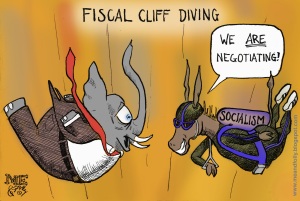 I’m not terribly hopeful that any of my advice will be followed, so let’s close this post with some gallows humor.


 The Daily Hatch