Category Archives: spending out of control

Open letter to President Obama (Part 199) Tea Party favorite takes on President


The federal government has a spending problem and Milton Friedman came up with the negative income tax to help poor people get out of the welfare trap. It seems that the government screws up about everything. Then why is President Obama wanting more taxes?

_______________

Milton Friedman – The Negative Income Tax

Published on May 11, 2012 by

In this 1968 interview, Milton Friedman explained the negative income tax, a proposal that at minimum would save taxpayers the 72 percent of our current welfare budget spent on administration. http://www.LibertyPen.com

Source: Firing Line with William F Buckley Jr.

________________

Milton Friedman describes the welfare state’s effect on private charitable activity

Uploaded by on Oct 12, 2009

From “Free to Choose” (1980), Part IV: “From Cradle to Grave.”

(This letter was emailed to White House on 12-20-12.)

President Obama c/o The White House
1600 Pennsylvania Avenue NW
Washington, DC 20500

Dear Mr. President,

I know that you receive 20,000 letters a day and that you actually read 10 of them every day. I really do respect you for trying to get a pulse on what is going on out here.

Does Government Have a Revenue or Spending Problem?

People say the government has a debt problem. Debt is caused by deficits, which is the difference between what the government collects in tax revenue and the amount of government spending. Every time the government runs a deficit, the government debt increases. So what’s to blame: too much spending, or too little tax revenue? Economics professor Antony Davies examines the data and concludes that the root cause of the debt is too much government spending.

____________

Marlin Stutzman represents Indiana’s 3rd District in the U.S. House of Representatives and I have written about him several times before. The Cato Institute has given him a 99% rating on keeping his promises about cutting spending. Here is his article on the “Fiscal Cliff” for The Journal Gazette

Published: December 16, 2012 3:00 a.m.

New approach beckons for the new year …

Marlin Stutzman

As Hoosiers look forward to spending the upcoming holidays with family and friends, Washington is on the cusp of its latest fiscal crisis, and the menace of tax hikes on Jan. 1 is casting a shadow over what should be a joyful season. Unfortunately, this scene is all too familiar to the American people.

Despite numerous opportunities, Congress and the White House refuse to come to grips with out-of-control spending and offer long-term solutions to solve the federal government’s $16 trillion debt crisis.

Hoosiers have every right to be frustrated and discouraged with Washington, D.C., as the country heads toward bankruptcy, our nation’s broken entitlement programs teeter on the verge of insolvency, and looming tax hikes threaten thousands of Hoosier jobs.

The facts are alarming. Washington borrows more than 40 cents of every dollar it spends, Medicare’s own trustees have calculated that the program will reach insolvency in just 12 short years, and President Obama’s tax proposals jeopardize more than 15,000 jobs here in Indiana.

Despite his promise to cut the deficit in half by the end of his first term, Obama increased the national debt by more than $4 trillion. In just four years, this administration has stacked up more debt than every president from George Washington to Bill Clinton combined. A child born today inherits a $52,000 share of Uncle Sam’s borrowed spending. Meanwhile, their grandparents are left with the empty promises of a broken entitlement system.

Each day, 10,000 baby boomers reach retirement age and Medicare’s worker-to-beneficiary ratio grows weaker. In 2000, four current workers supported each beneficiary, but that number is on pace to fall below three. As that number declines, health care costs continue to climb. Nearly one in three primary care doctors is limiting the number of Medicare patients they see, and that number will only grow as Obamacare continues to be implemented. That’s unacceptable to the millions of seniors who were promised that the program would be there in their retirement.

Although Hoosiers understand that our economic crisis is, at heart, a debt crisis, Obama has focused nearly exclusively on tax hikes to fuel more deficit spending. Hoosiers know Washington can’t tax its way out of a spending mess. Under the most optimistic projections, Obama’s taxes will only cover eight days of government spending.

Despite these facts, the focus of the current fiscal cliff talks seems to remain on taxes, and when politicians focus on taxes instead of cuts and reforms, they leave middle class families out to dry. If we’re serious about fixing these fundamental problems, we have to rein in Washington’s runaway spending, give permanent tax certainty, and do the tough work of entitlement reform.

We need immediately to cut spending, responsibly cap future expenditures and put our nation’s finances on a path toward healthy balance. The House-passed budget, The Path to Prosperity, would have reduced the fiscal year 2013 deficit to less than $800 billion and put us on a path to paying off the debt.

Instead of threatening families and small businesses with the constant threat of higher taxes, we need to give certainty by extending the current tax rates for all Americans. In August, House Republicans and some Democrats voted to prevent these looming tax hikes, setting the stage for real tax reform in the year to come. The Senate should pass that extension without delay.

In addition, we must save Medicare while there’s still time. House Republicans have shown that we can reform Medicare for future generations without making any changes for current seniors. By expanding opportunity and empowering patients, younger workers can choose plans that meet their individual needs. We offer multiple guaranteed coverage options and, if it meets their unique needs, patients can choose the traditional Medicare plan.

In Indiana, we know that problems are only solved with honesty and hard work. Washington has an opportunity to tackle these challenges. This is difficult work, but no one was sent to Washington to make easy decisions.

As the new year approaches, there’s no better time to break Washington’s old habits and fix what’s broken.

Marlin Stutzman, a Republican, represents Indiana’s 3rd District in the U.S. House of Representatives. He wrote this for The Journal Gazette.
_____________

_____________

Thank you so much for your time. I know how valuable it is. I also appreciate the fine family that you have and your commitment as a father and a husband.

Sincerely,

Everette Hatcher III, 13900 Cottontail Lane, Alexander, AR 72002, ph 501-920-5733, lowcostsqueegees@yahoo.com
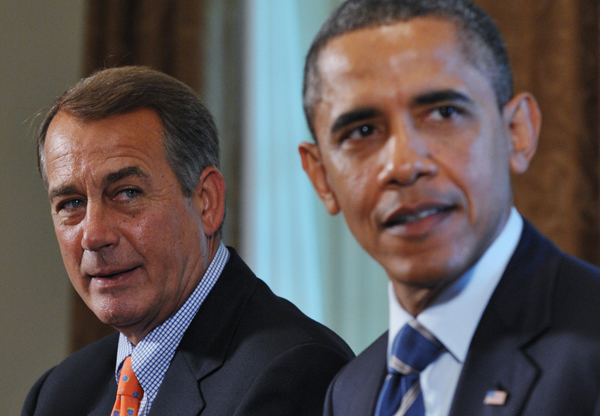
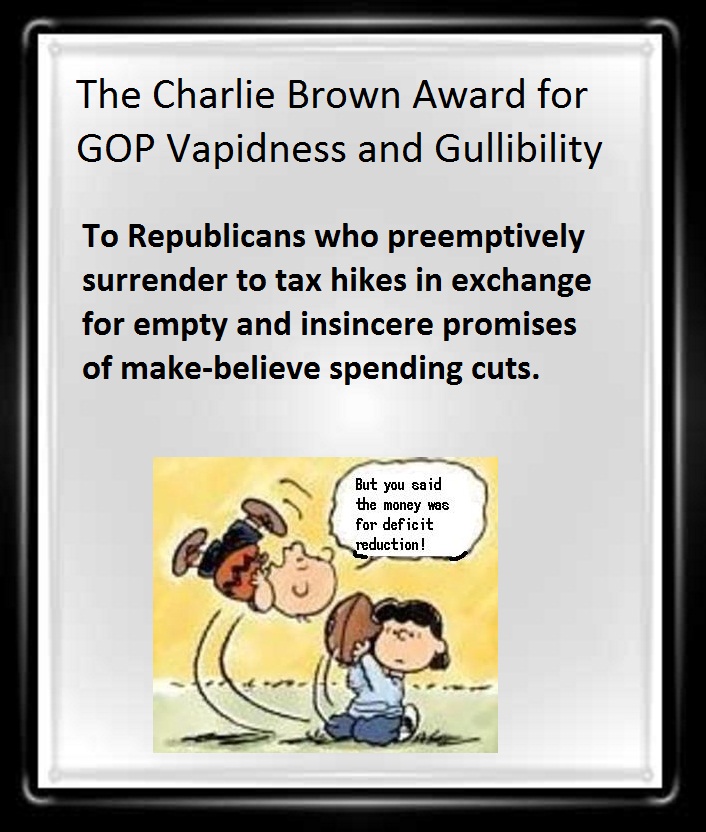
Why does the “Lucy move the football” reference apply to Republicans on the fiscal cliff?

I truly do wonder how smart our elected representatives are in Washington. I got up on 12-20-12 and read this article below from the Heritage Foundation with the reference to Charlie Brown getting fooled by Lucy again when he runs up and tries  to kick the football and of course she moves it again.

Liberals in Congress have always tried to fool conservatives by promising future cuts if they provide higher taxes now. (This article below appeared on www.heritage.org on 12-20-12.)

Obama’s “Lucy Move the Football” Fiscal Cliff Plan Still Not Balanced

Alison Acosta Fraser

December 18, 2012 at 3:25 pm

Volleys of negotiating counter-offers are coming in faster now that Christmas break and the looming fiscal cliff are just around the corner.

While there is much unsatisfactory with Speaker of the House John Boehner’s (R–OH) Sunday night proposal, let us not forget that the reason we are watching this needless, high stakes drama unfold is due to President Obama’s intractable insistence on tax increases on America’s high earners. After all, he and Congress could simply and quickly pass a bill to extend all current policies and avoid the fiscal cliff entirely—if he wanted to. No, this is really about hiking taxes on high earners. Thus the charade of deficit reduction continues.

Obama’s latest counteroffer is no more acceptable than his first offer. Short on details concerning actual spending reductions, especially on entitlements, it is replete with his requisite tax hikes and (we are shocked) new stimulus spending. The cherry on top is an extension of the debt limit for two years, essentially handing over authority to raise it to the President.

Right.

The President originally called for around $800 billion in tax hikes on America’s “highest” earners—those earning $250,000 and up. A ridiculous demand when the economy is still struggling under his big spending and regulatory policies, and one which would squarely hit smaller businesses. You know, the ones who actually create jobs.

Yet, just like Lucy and the football, when Boehner and company offered up $800 billion in tax hikes, Obama quickly doubled his demand to $1.5 trillion in tax hikes—again, all from the highest earners. They, he tells us, can afford to pay a little more. Never mind, of course, that the top 1 percent of earners already pay 37 percent of all income taxes. Somehow we are to believe this is a “balanced approach.”

Obama pitches all this on the pretext that we can simply go back to the tax rates we had under Clinton. Wrong! His dirty little tax secret is that he has already hiked taxes on high earners under Obamacare. First the law added a surtax of 0.9 percent in addition to the Medicare payroll tax on those earning over $250,000. For the first time ever, Obamacare will apply this higher rate of 3.8 percent to investment income on January 1. Obama won’t tell you that going back to Clinton-era tax rates will actually result in higher taxes on wages, dividends, and capital gains.

They say if you want less of something, then tax it. For Obama, this works fine on financial transactions, carbon emissions, driving, and junk food. But evidently, for him, not so much on a strong vibrant economy. And those Clinton boom years? They weren’t ushered in after the Clinton tax hikeonly after the Clinton–Gingrich tax cut!

Rather than working with Republicans on tax proposals that will actually grow the economy, Obama is now simply fighting over his definition of “high income” while we are left to wonder how much this $1.2 trillion tax hike will slow the economy.

As for the $1.2 trillion spending reductions, the only reason they are there is because Boehner insisted on them. But $100 billion in cuts would whack the defense budget, which is already reeling from earlier budget cuts. Yet the real spending and debt crisis comes from unaffordable entitlement programs. While Obama is insisting on balance on the tax side, he is sorely lacking in leadership here. As a recent Washington Post editorial opined:

Elections do have consequences, and Mr. Obama ran on a clear platform of increasing taxes on the wealthy. But he was clear on something else, too: Deficit reduction must be “balanced,” including spending cuts as well as tax increases. Since 60 percent of the federal budget goes to entitlement programs such as Medicare, Medicaid and Social Security, there’s no way to achieve balance without slowing the rate of increase of those programs.

We know Obama is open to changing the inflation calculation and slowing the benefit growth in Social Security. But what else? What about the proposals in his own budget, which would increase premiums on Medicare? He could easily broaden his proposals with additional uncontroversial steps to begin the process of strengthening and reining in Social Security and Medicare. All he needs to do is lead.

Some polls may show that Americans think taxes should be part of a deficit deal; but what the polls do not always show is their utter distrust that Washington would use new revenues to actually reduce the deficit. Here, Obama does not let them down. He reportedly wants $80 billion in new spending on infrastructure and unemployment benefits.

In exchange for all of this, he wants to raise the debt limit by enough to fuel his big spending goals for two years. This is utterly unacceptable. Americans know you cannot reduce the deficit when you plan to actually spend more. Americans also know that when Washington lifts the debt limit, it will not control spending. The debt limit puts the very pressure lawmakers need to account for out-of-control spending and make vital course corrections to bring spending under control, lest we face a Euro-style debt crisis in the future.

White House Press Secretary Jay Carney is actually insisting that “[t]he President’s proposal is the only proposal we have seen that achieves the balance that is so necessary.” Balance, evidently, is in the eyes of the beholder. As the Post noted, 60 percent of the budget stems from entitlements.

In just 13 short years—by the time today’s kindergarteners enter college—entitlements and interest on the debt will eat up all tax revenues. A truly balanced approach must start where the problem starts—with substantive reforms to entitlements. While the President maintains that you cannot cut your way to prosperity, you certainly cannot tax your way there.

_______________

Below is a speech by George W. Bush honoring Milton Friedman:

Milton Friedman Honored for Lifetime Achievements 2002/5/9

Milton Friedman said that getting George Bush I to be his vice president was his biggest mistake because he knew that Bush was not a true conservative and sure enough George Bush did raise taxes when he later became President. I wonder if Jeb Bush has the same genes as his father.

What we need is some people in Washington that are brave enough to say that we have taken too much of the american people’s money and we have to make the painful spending cuts in order to balance the budget and not ask for any more tax increases!!!! Arkansas’ congressman Rick Crawford has also made the Charlie Brown mistake but he has backed off it since.

Even though America’s fiscal problem is entirely the result of too much government spending, I wrote earlier this year that there were all sorts of scenarios where I would agree to a tax increase.

But I then pointed out that all of those scenarios were total fantasies and that it would be more realistic to envision me playing center field for the New York Yankees.

The fundamental problem is that politicians never follow through on promises to reduce spending – even if you use the dishonest Washington definition that a spending cut occurs whenever the budget doesn’t rise as fast as previously planned.

And to make matters worse, they always seem to want class-warfare tax hikes that do heavy economic damage rather than the loophole closers that at least get rid of some of the inefficient corruption in the tax code.

That’s why I like the anti-tax pledge of Americans for Tax Reform. You don’t solve America’s fiscal problems by saying no to all tax increases, but at least you don’t move in the wrong direction at a faster rate.

Notwithstanding the principled and pragmatic arguments against putting tax increases on the table, some Republicans – in a triumph of hope over experience – are preemptively acquiescing to tax hikes.

Here’s what Jeb Bush said.

Jeb Bush, the former Florida governor, said Friday that he could back a broad deficit plan that increased taxes, a stance that puts him at odds with other prominent Republicans. Bush told a House panel he could get behind a plan that combined 10 dollars in spending cuts for every dollar of new revenue… “The problem is the 10 never materializes,” [Congressman Paul] Ryan said after Bush said he could support a revenue-increasing deficit deal. Norquist also has criticized deficit deals crafted in 1982 and 1990 – the latter agreed to by then-President George H.W. Bush, Jeb’s father – for failing to deliver on the spending side.

Kudos to Paul Ryan for making the obvious point about make-believe spending cuts. And Grover is correct about the failure of previous budget deals.

Indeed, I cited a New York Times column that inadvertently revealed that the only budget deal that worked was the 1997 pact that cut taxes rather than raised them.

Jeb Bush isn’t the only apostate. Here’s what Senator Graham had to say.

Sen. Lindsey Graham (R-S.C.) said Tuesday he believed Republicans should consider eliminating loopholes in the tax code even if they aren’t replaced by additional tax cuts, a move that would break with an anti-tax pledge many GOP lawmakers have signed with activist Grover Norquist. “When you eliminate a deduction, it’s OK with me to use some of that money to get us out of debt. That’s where I disagree with the pledge,” Graham told ABC News. …”I’m willing to move my party, or try to, on the tax issue. I need someone on the Democratic side being willing to move their party on structural changes to entitlements.” Graham said, for instance, he would support a plan that included $4 in spending cuts for every $1 in tax increases. During a Republican debate last August, all eight Republican candidates in attendance said they would reject a proposal to trade $10 in spending cuts for even $1 in tax increases.

In some sense, Senator Graham’s comments are reasonable. With real spending cuts and less-damaging forms of tax hikes, an acceptable deal is possible. But only in Fantasia, not in Washington.

In the real world, all that Senator Graham has done is to move the debate slightly to the left.

I’ve noted that tax increases are political poison for the Republican Party, but I don’t lose sleep worrying about the GOP.

But I do have nightmares about government getting even bigger, and that’s why I don’t want tax increases on the table. I don’t even want them in the room. Or the house. Or the neighborhood.

That’s why Jeb Bush and Lindsey Graham are the newest winners of the Charlie Brown Award. They’ve put blood in the water. I wonder if they’ll act surprised when hungry sharks show up looking for a meal?

_____________

In 1982 the Democrats promised future spending cuts if Ronald Reagan would agree to a tax increase, but you guessed it, the taxes were increased and the spending cuts never came. THE REAL PROBLEM IS NOT THAT WE DON’T HAVE ENOUGH TAXES BUT WE DON’T WANT TO CUT SPENDING!!!

Washington Could Learn a Lot from a Drug Addict

Concerning spending cuts Reagan believed, that members of Congress “wouldn’t lie to him when he should have known better.” However, can you believe a drug addict when he tells you he is not ever going to do his habit again? Congress is addicted to spending too much money.  Lee Edwards wrote in his article “Golden Years” about Ronald Reagan:

Sometimes Reagan went along with a pragamatist like chief of staff James Baker, who persuaded the president to accept the Tax Equity and Fiscal Responsibility Act of 1982 (TEFRA), which turned out to be the great tax increase of 1982 — $98 billion over the next three years. That was too much for eighty-nine House Republicans (including second-term Congressman Newt Gingrich of Georgia) or for prominent conservative organizations from the American Conservative Union like the Conservative Caucus and the U.S. Chamber of Commerce, which all opposed the measure.

Baker assured his boss that Congress would approve three dollars in spending cuts for every dollar of tax increase. To Reagan, TEFRA looked like a pretty good “70 percent” deal. But Congress wound up cutting less than twenty-seven cents for every new tax dollar. What had seemed to be an acceptable 70-30 compromise turned out to be a 30-70 surrender. Ed Meese described TEFRA as “the greatest domestic error of the Reagan administration,” although it did leave untouched the individual tax rate reductions approved the previous year. (TEFRA was built on a series of business and excise taxes plus the removal of business tax deductions.)[xxx]

The basic problem was that Reagan believed, as Lyn Nofziger put it, that members of Congress “wouldn’t lie to him when he should have known better.”[xxxi] As a result of TEFRA, Reagan learned to “trust but verify,” whether he was dealing with a Speaker of the House or a president of the Soviet Union.

_________

Related posts:

Open letter to President Obama (Part 201)Tea Party favorite Representative links article “Prescott and Ohanian: Taxes Are Much Higher Than You Think”

    (Emailed to White House on 12-21-12.) President Obama c/o The White House 1600 Pennsylvania Avenue NW Washington, DC 20500 Dear Mr. President, I know that you receive 20,000 letters a day and that you actually read 10 of them every day. I really do respect you for trying to get a pulse on […]

Open letter to President Obama (Part 200.2)Tea Party Republican Representative takes on the President concerning fiscal cliff

(Emailed to White House on 12-21-12.) President Obama c/o The White House 1600 Pennsylvania Avenue NW Washington, DC 20500 Dear Mr. President, I know that you receive 20,000 letters a day and that you actually read 10 of them every day. I really do respect you for trying to get a pulse on what is […]

Open letter to President Obama (Part 200.1)Tea Party favorite Representative shares link on facebook

 (Emailed to White House on 12-21-12) President Obama c/o The White House 1600 Pennsylvania Avenue NW Washington, DC 20500 Dear Mr. President, I know that you receive 20,000 letters a day and that you actually read 10 of them every day. I really do respect you for trying to get a pulse on what is […]

Open letter to President Obama (Part 199) Tea Party favorite takes on President

  The federal government has a spending problem and Milton Friedman came up with the negative income tax to help poor people get out of the welfare trap. It seems that the government screws up about everything. Then why is President Obama wanting more taxes? _______________ Milton Friedman – The Negative Income Tax Published on […]

Tea Party Heroes Rep. David Schweikert (R-AZ),Justin Amash (R-MI), Tim Huelskamp (R-KS) have been punished by Boehner

I was sad to read that the Speaker John Boehner has been involved in punishing tea  party republicans. Actually I have written letters to several of these same tea party heroes telling them that I have emailed Boehner encouraging him to listen to them. Rep. David Schweikert (R-AZ),Justin Amash (R-MI), and Tim Huelskamp (R-KS). have been contacted […]

Some Tea Party heroes (Part 10)

Michael Tanner of the Cato Institute in his article, “Hitting the Ceiling,” National Review Online, March 7, 2012 noted: After all, despite all the sturm und drang about spending cuts as part of last year’s debt-ceiling deal, federal spending not only increased from 2011 to 2012, it rose faster than inflation and population growth combined. […]

Dear Senator Pryor, why not pass the Balanced Budget Amendment? (“Thirsty Thursday”, Open letter to Senator Pryor)

Ryan on Recent Economic News, Milton Friedman and Freedom

Published on Jul 30, 2012 by

Paul Ryan: What Would Milton Friedman Say About Dismal Economic News?

On the 100th anniversary of the birth of economist Milton Friedman, United States Congressman Paul Ryan reflects on the state of the US Economy and offers his take on what Friedman would say about the public policy prescriptions emanating from the current Administration in Washington, D.C

_______________

Dear Senator Pryor,

Why not pass the Balanced  Budget Amendment? As you know that federal deficit is at all time high (1.6 trillion deficit with revenues of 2.2 trillion and spending at 3.8 trillion).

On my blog www.HaltingArkansasLiberalswithTruth.com I took you at your word and sent you over 100 emails with specific spending cut ideas. However, I did not see any of them in the recent debt deal that Congress adopted. Now I am trying another approach. Every week from now on I will send you an email explaining different reasons why we need the Balanced Budget Amendment. It will appear on my blog on “Thirsty Thursday” because the government is always thirsty for more money to spend.

Milton Friedman also wanted to see the Balanced Budget Amendment tied to a percentage of GDP and then passed by Congress.

Posted on: November 18th, 2011

By Chairman Rob Gleason

I have given a tremendous amount of thought to the idea of a federal balanced budget amendment. I considered this issue not only as the Chairman of the Republican Party of Pennsylvania but as a father, as a business owner and as an American. I kept coming back to one main prevailing thought which is that if America doesn’t start living within its means and soon, our country will lose the economic fabric that has made our country great. The American dream will be gone. It is a scary thought and one that should provoke thorough debate as our county continues to spiral down the path of fiscal insolvency.

Our country spends more than we take in and the bottom-line is, as a country, we have a spending problem. Our addiction to government spending has led to a downgrade of everyone’s credit rating, because America’s credit rating is our credit rating as well. The downgrade has a direct impact on the loss of global economic power that forces all of us to pay more. Our addiction to big government spending has cost us jobs especially when you consider costly regulations that do more harm than good. Although we hear Democrats call for more government spending as a means to create more jobs, it has not worked and Americans should not be fooled again.

As Pennsylvania’s families weigh spending decisions every day, they know they must have a balanced family budget. If our families ran their households the way that the Federal government runs their budget, the effects would be clear. Their bills wouldn’t have been paid. Their house would be foreclosed. Their car would be repossessed. They would be out on the street.

Pennsylvania businesses must also weigh spending decisions every day. They must meet payroll. They must pay their taxes. They must deliver a quality product if they want return business. If they don’t, payroll is missed. Jobs are lost. Their company goes under.

As a country, we can’t stand in the way of real fiscal reform. The dream of a safe and healthy retirement seems to be farther away for everyone. Without a balanced budget amendment, families across America could see losses in everything they have worked so hard to build, from retirement savings to home values to their own job and maybe even to the safety and security of their own family.

A balanced budget amendment is a guarantee that forces government to make the tough decisions now rather than lay mountains of debt on future generations.  I hope you consider this issue no matter what party affiliation you may be. As Americans, Pennsylvanians, fathers and mothers, we owe it to current and future generations to live within our means and keep the American dream alive.

________

Thank you again for your time and for this opportunity to share my ideas with you.

Sincerely,

Everette Hatcher

Ronald Reagan and Milton Friedman supported Balanced Budget Amendment

Remarks at a Rally Supporting the Proposed Constitutional Amendment for a Balanced Federal Budget

For more information on the ongoing works of President Reagan’s Foundation, please visit http://www.reaganfoundation.org

_______________

Ronald Reagan was a firm believer in the Balanced Budget Amendment and Milton Friedman was a key advisor to Reagan. Friedman’s 1980 film series taught the lesson of restraining growth of the federal budget.


UHLER: A better balanced budget amendment

Vital changes needed to keep road to further reforms open

There is a problem brewing in the House of Representatives of which most conservatives in and outside Congress are largely unaware. It has to do with H.J. Res. 1 – the balanced budget amendment – soon to be voted on per the debt-ceiling “deal” struck by Congress and the president. While H.J. Res. 1 is a solid first effort – and we have urged support for it as a symbolic vote – it is possibly fatally flawed and should be revised.

After years of indifference to constitutional fiscal discipline, Congress is once again stirring. In 1982, then-President Ronald Reagan, convened a federal amendment drafting committee led by Milton Friedman, Jim Buchanan, Bill Niskanen, Walter Williams and many others, and fashioned Senate Joint Resolution 58, a tax limitation-balanced budget amendment, which garnered 67 votes in the Senate under the able leadership of Sen. Orrin G. Hatch, Utah Republican. After a successful discharge petition forced a House vote, the amendment failed to achieve the two-thirds vote necessary in a Tip O’Neill-Jim Wright-controlled House. In 1996, Newt Gingrich and company came within one vote of passing a fiscal amendment in the House.

Currently, H.J. Res. 1 is designed as a classic balanced budget amendment in which outlays can be as great as, but no more than, receipts for that year. However, it requires an estimate of receipts, which is notoriously faulty, and it does not necessarily produce surpluses with which to pay down our massive debt. Furthermore, it contains a second limit on outlays – “not more than 18 percent of the economic output of the United States” – without defining such output or resolving the inevitable conflict between the outlay calculations in the two provisions.

This could be fixed by restructuring the amendment as a spending or outlay limit based on prior year receipts or outlays (known numbers), adjusted only for inflation and population changes. This will produce surpluses in most years with which to pay down debts and will reduce government spending as a share of gross domestic product over time, right-sizing government and increasing the rate of economic growth for the benefit of all citizens, especially those least able to compete.

Section 4 of H.J. Res. 1 might best be described as a supreme example of the law of unintended consequences. This section imposes on the president a constitutional responsibility to present a balanced budget. Surely, the drafters were saying to themselves “We’ll fix that guy in the White House. Now he will have to fess up and either propose specific tax increases or specific spending cuts. He won’t be able to duck reality any longer.” The only problem is that this section is at odds with our Constitution in that it gives the president a constitutional power over fiscal matters never intended by the Founders.

For much of our history, the president did not propose a budget. In the Budget and Accounting Act of 1921, which established the Bureau of the Budget, now the Office of Management and Budget and the General Accounting Office, the president was statutorily authorized to propose a budget. Presidents have always shaped the budget and spending using their negotiating opportunities and veto pen. Wearing their chief administrator hat, earlier presidents sought to save money from the amounts appropriated by Congress, getting things done for less, impounding funds they did not think essential to spend. Congress‘ ceiling on an appropriation was not also the spending floor for the president, as it is now.

Section 4 appears to give the president co-equal power with Congress not only to present a budget but to shape it, in conflict with congressional budget authority. At a minimum, it is likely to create a conflict over the amount of allowed annual spending. The president surely will be guided by his own Office of Management and Budget, whose budget and receipts calculations will undoubtedly differ from the Congressional Budget Office’s numbers that will direct Congress. We should not start the budget process each year with this kind of conflict.

It would be better to restore the historic role of the president to impound and otherwise reduce expenditures by repealing and revising appropriate portions of the Congressional Budget and Impoundment Control Act of 1974 so a fiscally conservative president is a revitalized partner in cutting the size of government.

Section 5 requires a supermajority vote for “a bill to increase revenues.” Whether one agrees or disagrees with making tax increases more difficult, this language is troublesome because it requires some government bureaucrat or bureaucracy to make a calculation or estimate of the effect of tax law changes on revenues. Proponents of a bill to increase cash flow to the government will argue that their tax law changes are “revenue neutral” and will likely persuade the Joint Committee on Taxation or Congressional Budget Office to back them up. Once again, estimators would be in control.

If we ever expect to convert our income-based tax system to a consumption tax, better not to require a two-thirds vote as liberals will use such a supermajority voting rule to stymie tax system reform.

There are other issues, as well, with debt limit and national emergency supermajority votes and definitions. While this balanced budget amendment – H.J. Res. 1 – has deserved a “yes” vote as a demonstration of commitment to constitutional fiscal discipline, it can and must be revised before the showdown vote in the House this fall.

Lewis K. Uhler is president of the National Tax Limitation Committee.

Obama voted against debt ceiling increase

FULL speech – Obama’s speaks to congress in 2006 about the debt ceiling

Uploaded on Jul 16, 2011

Is there one Congressman with moxey bold enough to read this speech into the Congressional record during THIS current debate? …or MSM?

____________

The shoe is on the other foot now.

Here is part of Congress’s transcript from March 16, 2006:

Obama- Mr. President, I rise today to talk about America’s debt problem.

The fact that we are here today to debate raising America’s debt limit is a sign of leadership failure. It is a sign that the U.S. Government can’t pay its own bills. It is a sign that we now depend on ongoing financial assistance from foreign countries to finance our Government’s reckless fiscal policies.

Over the past 5 years, our federal debt has increased by $3.5 trillion to $8.6 trillion. That is “trillion” with a “T.” That is money that we have borrowed from the Social Security trust fund, borrowed from China and Japan, borrowed from American taxpayers. And over the next 5 years, between now and 2011, the President’s budget will increase the debt by almost another $3.5 trillion…

Increasing America’s debt weakens us domestically and internationally. Leadership means that “the buck stops here.” Instead, Washington is shifting the burden of bad choices today onto the backs of our children and grandchildren. America has a debt problem and a failure of leadership. Americans deserve better.

I therefore intend to oppose the effort to increase America’s debt limit…


Here is one of my favorite videos on this subject below:

What Is The Debt Ceiling?

Published on May 19, 2013

What is the debt ceiling and why does it matter? Find out:http://BankruptingAmerica.org/DebtCei…

Congress’s dance with the debt limit can be confusing and, frankly, the details can be a real snooze fest for many Americans. Sometimes a little humor clarifies the absurdities of Washington antics better than flow charts and talk of trillions.

The 31-second video and accompanying infographic “The Debt Ceiling Explained” by Bankrupting America offers the facts, leavened with a dose of levity. The conclusion is serious, however: The country’s debt threatens economic growth, and spending cuts are the answer.

_________________________

It is obvious to me that if President Obama gets his hands on more money then he will continue to spend away our children’s future. He has already taken the national debt from 11 trillion to 16 trillion in just 4 years. Over, and over, and over, and over, and over and over I have written Speaker Boehner and written every Republican that represents Arkansans in Arkansas before (GriffinWomackCrawford, and only Senator Boozman got a chance to respond) concerning this. I am hoping they will stand up against this reckless spending that our federal government has done and will continue to do if given the chance.

Why don’t the Republicans  just vote no on the next increase to the debt ceiling limit. I have praised over and over and over the 66 House Republicans that voted no on that before. If they did not raise the debt ceiling then we would have a balanced budget instantly.  I agree that the Tea Party has made a difference and I have personally posted 49 posts on my blog on different Tea Party heroes of mine.

What would happen if the debt ceiling was not increased? Yes President Obama would probably cancel White House tours and he would try to stop mail service or something else to get on our nerves but that is what the Republicans need to do.

I have written and emailed Senator Pryor over, and over again with spending cut suggestions but he has ignored all of these good ideas in favor of keeping the printing presses going as we plunge our future generations further in debt. I am convinced if he does not change his liberal voting record that he will no longer be our senator in 2014.

I have written hundreds of letters and emails to President Obama and I must say that I have been impressed that he has had the White House staff answer so many of my letters. The White House answered concerning Social Security (two times), Green Technologieswelfaresmall businessesObamacare (twice),  federal overspendingexpanding unemployment benefits to 99 weeks,  gun controlnational debtabortionjumpstarting the economy, and various other  issues.   However, his policies have not changed, and by the way the White House after answering over 50 of my letters before November of 2012 has not answered one since.   President Obama is committed to cutting nothing from the budget that I can tell.

 I have praised over and over and over the 66 House Republicans that voted no on that before. If they did not raise the debt ceiling then we would have a balanced budget instantly.  I agree that the Tea Party has made a difference and I have personally posted 49 posts on my blog on different Tea Party heroes of mine.

_________________________


Open letter to Congressman Womack: Total Welfare Spending Is Rising Despite Attempts at Reform


December 19, 2012

The Honorable Steve Womack
United States House of Representatives
1508 Longworth House Office Building
Washington, D.C. 20515-0403

Dear Congressman Womack,

This is the second time I have written to you about this. It is obvious to me that if President Obama gets his hands on more money then he will continue to spend away our children’s future. He has already taken the national debt from 11 trillion to 16 trillion in just 4 years. Over, and over, and over, and over, and over and over I have written Speaker Boehner and written every Republican that represents Arkansans in Arkansas before (Griffin, Womack, Crawford, and only Senator Boozman got a chance to respond) concerning this. I am hoping they will stand up against this reckless spending that our federal government has done and will continue to do if given the chance. (The Heritage Foundations says that Boehner is giving in to President Obama in this upcoming deal.)

I have written and emailed Senator Pryor over, and over again with spending cut suggestions but he has ignored all of these good ideas in favor of keeping the printing presses going as we plunge our future generations further in debt. I am convinced if he does not change his liberal voting record that he will no longer be our senator in 2014.

I have written hundreds of letters and emails to President Obama and I must say that I have been impressed that he has had the White House staff answer so many of my letters. However, his policies have not changed. He is committed to cutting nothing from the budget that I can tell.

Evidently the Republicans have proposed raising tax rates as a possible compromise to avoid going over the fiscal cliff. Let me make a few comments about that.

First, if raising the debt ceiling is part of this agreement then we are losing our leverage over President Obama. We have enough votes to block a debt ceiling increase. We want a balanced budget but if President Obama does not get a debt ceiling increase then he will have to balance the budget immediately.

Second, spending is our problem and it is not tax revenue. The problem in Washington is not lack of revenue but our lack of spending restraint. We almost had a balanced budget in 2007 and if we had frozen spending at 2007 levels then we would be close to a balanced budget now. Instead of controlling spending our spending has gone from 2.7 trillion to 3.8 trillion in just 5 short years!!!

Third, my blog has exploded the last few days with clicks on past posts I have done like the one below. Take a look at this post below and see why it is one of my most popular.

Fourth, I have included some wise words from a fellow Tea Party favorite like you below. Mo Brooks’ words are true now like they were in August of 2011 when he voted against the debt ceiling increase then.

Fifth, let me share these two videos with you that make very good points concerning this issue:

This video belows shows how silly the federal government is when they pass “spending cuts.”

The problem in Washington is not lack of revenue but our lack of spending restraint. This video below makes that point.

Please take the time to read Mo Brooks’ words and respond to me and tell me if you will vote against the debt ceiling increase. It is the only leverage we have on President Obama. Others have responded to me in the past and for that I am very grateful.

Thank you for your time.

Sincerely,

Everette Hatcher, 13900 Cottontail Lane, Alexander, AR 72002, cell ph 501-920-5733, lowcostsqueegees@yahoo.com, www.thedailyhatch.org

Total Welfare Spending Is Rising Despite Attempts at Reform

Everyone wants to know more about the budget and here is some key information with a chart from the Heritage Foundation and a video from the Cato Institute.

Total means-tested welfare spending (cash, food, housing, medical care, and social services for the poor) has increased 17-fold since the beginning of Lyndon Johnson’s War on Poverty in 1964. Though the current trend is unsustainable, the Obama Administration plans to increase future welfare spending rather than enact true policy reforms.

WELFARE SPENDING IN INFLATION-ADJUSTED DOLLARS (2010)

Receive Information on Federal Budget Data

First Name
Last Name
Email Address
Zip Code
SUBMIT
Download

Total Welfare Spending Is Rising Despite Attempts at Reform

Source: Heritage Foundation calculations based on data from current and previous White House Office of Management and Budget documents and other official government sources.

Chart 10 of 42

In Depth

  • Policy Papers for Researchers

  • Technical Notes

    The charts in this book are based primarily on data available as of March 2011 from the Office of Management and Budget (OMB) and the Congressional Budget Office (CBO). The charts using OMB data display the historical growth of the federal government to 2010 while the charts using CBO data display both historical and projected growth from as early as 1940 to 2084. Projections based on OMB data are taken from the White House Fiscal Year 2012 budget. The charts provide data on an annual basis except… Read More

  • Authors

    Emily GoffResearch Assistant
    Thomas A. Roe Institute for Economic Policy StudiesKathryn NixPolicy Analyst
    Center for Health Policy StudiesJohn FlemingSenior Data Graphics Editor

  • _________________
  • Here is another Tea Party hero you need to listen to:
    Rep. Brooks on Fox Business: BBA and the Debt Ceiling Vote

    Print

    Share


    Rep. Mo Brooks To Vote No On Obama-Reid-Boehner Debt Ceiling Bill

    08/01/11

    Washington, D.C. – Today Congressman Mo Brooks (R-AL) made the following statement concerning his vote on the Budget Control Act of 2011:

    Summary

    The Obama-Reid-Boehner Debt Ceiling Bill is bad for America, bad political process, bad for national defense, does not prevent unsustainable budget deficits, kicks the debt ceiling crises down the road to 2013 (when America will have more debt and less financial strength with which to fix the problem), and fails to satisfactorily decrease the risk of an American credit rating downgrade.

    Overview

    America must, and will, raise the debt ceiling.  The question is not whether Congress will raise the debt ceiling; the question is when and how.  Regardless of when the debt ceiling is raised, every bill and obligation of America to its citizens and creditors will be paid in full (albeit, with the exception of creditors, some payments may be delayed).

    I have voted to raise the debt ceiling provided the debt ceiling bill makes America’s financial condition better, not worse.

    I voted to raise the debt ceiling on July 22, 2011, when I voted for the Cut, Cap and Balance Plan (cutting FY 2012 expenditures by a modest $111 billion in the context of a $1.5 trillion deficit; capping federal government expenditures within historically justifiable 18-20% ranges; and passing a Balanced Budget Constitutional Amendment that protect future generations of Americans from revisiting the financial mess we face).

    I voted to raise the debt ceiling on July 29, 2011, when I voted for the Boehner Plan (which included a Balanced Budget Constitutional Amendment requirement).

    I will not vote for the Obama-Reid-Boehner Debt Bill (herein the “Debt Bill”) because it is not up to the financial challenges America faces. 

    Background:  The Problem

    Years of spending binges by the federal government have come home to roost.  America’s debt exceeds $14 trillion.  America has suffered three consecutive years of trillion dollar deficits (and faces trillion dollar deficits into the foreseeable future).

    Annual deficits and accumulated debt force America to confront two major financial threats, both with one common cause: unsustainable budget deficits.

    In the short term, America faces a debt ceiling crisis.  Over the longer term, America faces a debt crisis. 

    If trillion dollar deficits continue indefinitely, America’s insolvency and bankruptcy is certain, thereby risking America’s national defense, Social Security, Medicare, Medicaid, NASA, and everything else the federal government does.

    Debt Bill Deficiencies That Compel a “No” Vote

    The accumulative deficiencies in the Debt Bill compel me to vote “No.”  The deficiencies are:

    1. Minimal Time for Consideration and Deliberation.

    The Debt Bill is 74 pages of interwoven, complicated legal and budgetary terms.  I have read and studied the Debt Bill in the limited time available.  The Debt Bill forces onto our children and grandchildren another $2.4 trillion in debt burden, yet we are expected to vote on it with less than 24 hours notice.

    This is insufficient time to thoroughly understand the Debt Bill’s nuances, for budget experts to digest the Debt Bill and offer their insights, for the public to analyze the legislation and share their insight, and for Congress to make a wise and deliberative decision.

    While some argue the Debt Bill must pass by the White House’s August 2 deadline; I believe it is better to act wisely than in haste.  The economy will be much worse if Congress, in haste, makes a $2.4 trillion error. 

    2. Significant Defense Cuts in FY 2012 & 2013.

    In FY 2012, the Debt Bill cuts national defense by $2 to $17 billion (the variance is due to different Debt Bill interpretations by the House Armed Services Committee).

    The Debt Bill creates a 12-member Joint Select Committee (six Senators and six Congressmen; six Republicans and six Democrats).  By November 23, the Committee must recommend $1.2 trillion in deficit reduction measures (spending cuts and/or tax increases).  If the Committee makes a recommendation, Congress must vote on the recommendation on or before January 15

    If the Committee splits 6-6 and makes no recommendation, or if either House of Congress rejects the Committee’s recommendation, then the Debt Bill mandates that the Defense budget be cut $60 Billion in FY 2013 (i.e. – in the fiscal year beginning 14 months from now, on October 1, 2013).

    National defense is the top priority of the federal government.  If the Debt Bill passes, there is an unnecessary and substantial risk that it will trigger risky defense cuts in just 14 months that undermine the defense capabilities of America.

    3. The Bill Does Not Fix the Underlying Problem.

    The Bill makes America’s financial challenges worse by inadequately addressing unsustainable deficits that threaten America with insolvency and bankruptcy and force debt ceiling increases.

    The Debt Bill’s “cuts” bind no future Congresses.  Hence, the only “cuts” that count are those for Fiscal Years 2012 and 2013.

    In FY 2012, the Debt Bill cuts discretionary federal government spending by only $7 billion (versus FY 2011 levels), while overall federal government spending actually increases (“discretionary spending” is less than 30% of total federal government spending). 

    In FY 2013, the Debt Bill increases discretionary federal government spending by $4 billion (over FY 2012 levels).  Overall federal government spending again increases significantly.

    Hence, in both FY 2012 and 2013, the federal government deficit is estimated to exceed $1 trillion/year if the Debt Bill passes and, under the best of scenarios, the Debt Bill’s “solution” increases America’s debt by $2.4 trillion in less than two years, which makes America’s debt problem much worse, not better.

    4. Balanced Budget Constitutional Amendment. 

    The Debt Bill requires a vote of Congress on a Balanced Budget Constitutional Amendment but does not require that Congress pass a Balanced Budget Amendment. 

    The July 29 Boehner Bill required passage of a Balanced Budget Amendment before the Phase II debt ceiling increase would occur.  The Debt Bill eliminates the requirement for a Balanced Budget Amendment, thereby eliminating the only long-term fix to America’s unsustainable deficits. 

    5. Punting the Debt Ceiling Crisis to 2013. 

    Because of 2012 election considerations, the Debt Bill “kicks the can down the road” to 2013, when a financially weaker America will be less capable of facing yet another debt ceiling crisis. 

    America will be weaker because debt service burdens will be $2.4 trillion more and the total debt of $16.7 trillion will likely be subject to higher interest rates and more onerous payment obligations.

    America must face its unsustainable deficit issue while it is stronger, not weaker.  The longer America waits, the worse the economic outcome will be.

    6. Credit Rating Cuts.

    In my judgment, the Debt Bill substantially increases the long-term risk of a cut in America’s credit rating. 

    Standard & Poor stated on July 14, 2011, that America’s credit rating is at risk if Washington has “not achieved a credible solution to the rising U.S. government debt burden and [is] not likely to achieve one in the foreseeable future.”  Standard & Poor president Deven Sharma reiterated this concern on July 27, 2011 when he testified before the House Financial Services Committee that, “The more important issue is really the long-term growth rate of the debt… that is the more important issue at hand.”

    Similarly, Moody’s stated on July 13, 2011 that, if the debt ceiling is raised, America’s credit rating outlook “would very likely be changed to negative… unless [there is a] substantial and credible agreement [on] long-term deficit reduction.”

    The Debt Bill does not cut America’s short or long-term deficits enough to minimize the risk of downgrade in America’s credit rating… a downgrade that will, in turn, drive up America’s debt service cost and reduce funding for all other federal government programs.  To make matters worse, if America’s interest rates go up; state, local and private interest rates are likely to also go up… thereby hurting all Americans at every level.

    The Solution

    The best solution that protects America from the short term debt ceiling and long term insolvency threats is a debt ceiling increase coupled with a Balanced Budget Constitutional Amendment that is phased in over a 5 year period.

    Inasmuch as constitutional amendments often take years to pass, time that America may not have, the debt ceiling should be raised in a two-step process.  The first step partially raises the debt ceiling when Congress passes a substantive and effective Balanced Budget Amendment.  If the Senate and House concur, this can be done in as little as a week.

    The second step raises the rest of the debt ceiling requirement when the states ratify the proposed Balanced Budget Amendment.  This process gives the states an incentive to ratify the Balanced Budget Amendment in less than one year (or trigger the effects of not raising the debt ceiling).

Open letter to Senator Boozman: Copy of my letter to President Obama on Socialism (Part 116.7)

Senator John Boozman, 320 Hart Senate Office Building Washington, DC 20510 Phone: (202) 224-4843 Fax: (202) 228-1371
Dear Senator Boozman,

I want to thank you for taking the time out of your busy day to respond to my earlier letter to you on this same subject.

It is obvious to me that if President Obama gets his hands on more money then he will continue to spend away our children’s future. He has already taken the national debt from 11 trillion to 16 trillion in just 4 years. Over, and over, and over, and over, and over and over I have written Speaker Boehner and written every Republican that represents Arkansans in Arkansas before (Griffin, Womack, Crawford, and only Senator Boozman got a chance to respond) concerning this. I am hoping they will stand up against this reckless spending that our federal government has done and will continue to do if given the chance.

I have written and emailed Senator Pryor over, and over again with spending cut suggestions but he has ignored all of these good ideas in favor of keeping the printing presses going as we plunge our future generations further in debt. I am convinced if he does not change his liberal voting record that he will no longer be our senator in 2014.

I have written hundreds of letters and emails to President Obama and I must say that I have been impressed that he has had the White House staff answer so many of my letters. However, his policies have not changed. He is committed to cutting nothing from the budget that I can tell.

Evidently the Republicans have proposed raising tax rates as a possible compromise to avoid going over the fiscal cliff. Let me make a few comments about that.

First, if raising the debt ceiling is part of this agreement then we are losing our leverage over President Obama. We have enough votes to block a debt ceiling increase. We want a balanced budget but if President Obama does not get a debt ceiling increase then he will have to balance the budget immediately.

Second, spending is our problem and it is not tax revenue. The problem in Washington is not lack of revenue but our lack of spending restraint. We almost had a balanced budget in 2007 and if we had frozen spending at 2007 levels then we would be close to a balanced budget now. Instead of controlling spending our spending has gone from 2.7 trillion to 3.8 trillion in just 5 short years!!!

Third, my blog has exploded the last few days with clicks on past posts I have done like the one below. Take a look at this post below and see why it is one of my most popular. You will notice that it is an open letter  that I sent to President Obama about socialism.

Fourth, I have included some wise words from a fellow Tea Party favorite like you below. Mo Brooks’ words are true now like they were in August of 2011 when he voted against the debt ceiling increase then.

Fifth, let me share these two videos with you that make very good points concerning this issue:

This video belows shows how silly the federal government is when they pass “spending cuts.”

The problem in Washington is not lack of revenue but our lack of spending restraint. This video below makes that point.

Please take the time to read Mo Brooks’ words and respond to me and tell me if you will vote against the debt ceiling increase. It is the only leverage we have on President Obama. Others have responded to me in the past including you and for that I am very grateful.

Thank you for your time.

Sincerely,

Everette Hatcher, 13900 Cottontail Lane, Alexander, AR 72002, cell ph 501-920-5733, lowcostsqueegees@yahoo.com, www.thedailyhatch.org

________________

Hayek on Socialism

Uploaded by on Aug 21, 2009

Friedrich Hayek talks about socialism.

________________

President Obama c/o The White House
1600 Pennsylvania Avenue NW
Washington, DC 20500

Dear Mr. President,

I know that you receive 20,000 letters a day and that you actually read 10 of them every day. I really do respect you for trying to get a pulse on what is going on out here. 

Socialism tries to plan out everything and it hurts the free market. We can see how this has played out especially in the last four years in the USA.

Glenn Beck Presents F A Hayek’s “The Road to Serfdom” Part 1

Uploaded by on Jun 13, 2010

This video via user TheConservatube; thank you!

What F.A. Hayek saw, and what most all his contemporaries missed, was that every step away from the free market and toward government planning represented a compromise of human freedom generally and a step toward a form of dictatorship–and this is true in all times and places. He demonstrated this against every claim that government control was really only a means of increasing social well-being. Hayek said that government planning would make society less liveable, more brutal, more despotic. Socialism in all its forms is contrary to freedom.

Nazism, he wrote, is not different in kind from Communism. Further, he showed that the very forms of government that England and America were supposedly fighting abroad were being enacted at home, if under a different guise. Further steps down this road, he said, can only end in the abolition of effective liberty for everyone.

Capitalism, he wrote, is the only system of economics compatible with human dignity, prosperity, and liberty. To the extent we move away from that system, we empower the worst people in society to manage what they do not understand.

__________

Thank you so much for your time. I know how valuable it is. I also appreciate the fine family that you have and your commitment as a father and a husband.

Sincerely,

Everette Hatcher III, 13900 Cottontail Lane, Alexander, AR 72002, ph 501-920-5733, lowcostsqueegees@yahoo.com

_______________

__________

Here is another Tea Party hero you need to listen to:
Rep. Brooks on Fox Business: BBA and the Debt Ceiling Vote

Print

Share


Rep. Mo Brooks To Vote No On Obama-Reid-Boehner Debt Ceiling Bill

08/01/11

Washington, D.C. – Today Congressman Mo Brooks (R-AL) made the following statement concerning his vote on the Budget Control Act of 2011:

Summary

The Obama-Reid-Boehner Debt Ceiling Bill is bad for America, bad political process, bad for national defense, does not prevent unsustainable budget deficits, kicks the debt ceiling crises down the road to 2013 (when America will have more debt and less financial strength with which to fix the problem), and fails to satisfactorily decrease the risk of an American credit rating downgrade.

Overview

America must, and will, raise the debt ceiling.  The question is not whether Congress will raise the debt ceiling; the question is when and how.  Regardless of when the debt ceiling is raised, every bill and obligation of America to its citizens and creditors will be paid in full (albeit, with the exception of creditors, some payments may be delayed).

I have voted to raise the debt ceiling provided the debt ceiling bill makes America’s financial condition better, not worse.

I voted to raise the debt ceiling on July 22, 2011, when I voted for the Cut, Cap and Balance Plan (cutting FY 2012 expenditures by a modest $111 billion in the context of a $1.5 trillion deficit; capping federal government expenditures within historically justifiable 18-20% ranges; and passing a Balanced Budget Constitutional Amendment that protect future generations of Americans from revisiting the financial mess we face).

I voted to raise the debt ceiling on July 29, 2011, when I voted for the Boehner Plan (which included a Balanced Budget Constitutional Amendment requirement).

I will not vote for the Obama-Reid-Boehner Debt Bill (herein the “Debt Bill”) because it is not up to the financial challenges America faces. 

Background:  The Problem

Years of spending binges by the federal government have come home to roost.  America’s debt exceeds $14 trillion.  America has suffered three consecutive years of trillion dollar deficits (and faces trillion dollar deficits into the foreseeable future).

Annual deficits and accumulated debt force America to confront two major financial threats, both with one common cause: unsustainable budget deficits.

In the short term, America faces a debt ceiling crisis.  Over the longer term, America faces a debt crisis. 

If trillion dollar deficits continue indefinitely, America’s insolvency and bankruptcy is certain, thereby risking America’s national defense, Social Security, Medicare, Medicaid, NASA, and everything else the federal government does.

Debt Bill Deficiencies That Compel a “No” Vote

The accumulative deficiencies in the Debt Bill compel me to vote “No.”  The deficiencies are:

1. Minimal Time for Consideration and Deliberation.

The Debt Bill is 74 pages of interwoven, complicated legal and budgetary terms.  I have read and studied the Debt Bill in the limited time available.  The Debt Bill forces onto our children and grandchildren another $2.4 trillion in debt burden, yet we are expected to vote on it with less than 24 hours notice.

This is insufficient time to thoroughly understand the Debt Bill’s nuances, for budget experts to digest the Debt Bill and offer their insights, for the public to analyze the legislation and share their insight, and for Congress to make a wise and deliberative decision.

While some argue the Debt Bill must pass by the White House’s August 2 deadline; I believe it is better to act wisely than in haste.  The economy will be much worse if Congress, in haste, makes a $2.4 trillion error. 

2. Significant Defense Cuts in FY 2012 & 2013.

In FY 2012, the Debt Bill cuts national defense by $2 to $17 billion (the variance is due to different Debt Bill interpretations by the House Armed Services Committee).

The Debt Bill creates a 12-member Joint Select Committee (six Senators and six Congressmen; six Republicans and six Democrats).  By November 23, the Committee must recommend $1.2 trillion in deficit reduction measures (spending cuts and/or tax increases).  If the Committee makes a recommendation, Congress must vote on the recommendation on or before January 15

If the Committee splits 6-6 and makes no recommendation, or if either House of Congress rejects the Committee’s recommendation, then the Debt Bill mandates that the Defense budget be cut $60 Billion in FY 2013 (i.e. – in the fiscal year beginning 14 months from now, on October 1, 2013).

National defense is the top priority of the federal government.  If the Debt Bill passes, there is an unnecessary and substantial risk that it will trigger risky defense cuts in just 14 months that undermine the defense capabilities of America.

3. The Bill Does Not Fix the Underlying Problem.

The Bill makes America’s financial challenges worse by inadequately addressing unsustainable deficits that threaten America with insolvency and bankruptcy and force debt ceiling increases.

The Debt Bill’s “cuts” bind no future Congresses.  Hence, the only “cuts” that count are those for Fiscal Years 2012 and 2013.

In FY 2012, the Debt Bill cuts discretionary federal government spending by only $7 billion (versus FY 2011 levels), while overall federal government spending actually increases (“discretionary spending” is less than 30% of total federal government spending). 

In FY 2013, the Debt Bill increases discretionary federal government spending by $4 billion (over FY 2012 levels).  Overall federal government spending again increases significantly.

Hence, in both FY 2012 and 2013, the federal government deficit is estimated to exceed $1 trillion/year if the Debt Bill passes and, under the best of scenarios, the Debt Bill’s “solution” increases America’s debt by $2.4 trillion in less than two years, which makes America’s debt problem much worse, not better.

4. Balanced Budget Constitutional Amendment. 

The Debt Bill requires a vote of Congress on a Balanced Budget Constitutional Amendment but does not require that Congress pass a Balanced Budget Amendment. 

The July 29 Boehner Bill required passage of a Balanced Budget Amendment before the Phase II debt ceiling increase would occur.  The Debt Bill eliminates the requirement for a Balanced Budget Amendment, thereby eliminating the only long-term fix to America’s unsustainable deficits. 

5. Punting the Debt Ceiling Crisis to 2013. 

Because of 2012 election considerations, the Debt Bill “kicks the can down the road” to 2013, when a financially weaker America will be less capable of facing yet another debt ceiling crisis. 

America will be weaker because debt service burdens will be $2.4 trillion more and the total debt of $16.7 trillion will likely be subject to higher interest rates and more onerous payment obligations.

America must face its unsustainable deficit issue while it is stronger, not weaker.  The longer America waits, the worse the economic outcome will be.

6. Credit Rating Cuts.

In my judgment, the Debt Bill substantially increases the long-term risk of a cut in America’s credit rating. 

Standard & Poor stated on July 14, 2011, that America’s credit rating is at risk if Washington has “not achieved a credible solution to the rising U.S. government debt burden and [is] not likely to achieve one in the foreseeable future.”  Standard & Poor president Deven Sharma reiterated this concern on July 27, 2011 when he testified before the House Financial Services Committee that, “The more important issue is really the long-term growth rate of the debt… that is the more important issue at hand.”

Similarly, Moody’s stated on July 13, 2011 that, if the debt ceiling is raised, America’s credit rating outlook “would very likely be changed to negative… unless [there is a] substantial and credible agreement [on] long-term deficit reduction.”

The Debt Bill does not cut America’s short or long-term deficits enough to minimize the risk of downgrade in America’s credit rating… a downgrade that will, in turn, drive up America’s debt service cost and reduce funding for all other federal government programs.  To make matters worse, if America’s interest rates go up; state, local and private interest rates are likely to also go up… thereby hurting all Americans at every level.

The Solution

The best solution that protects America from the short term debt ceiling and long term insolvency threats is a debt ceiling increase coupled with a Balanced Budget Constitutional Amendment that is phased in over a 5 year period.

Inasmuch as constitutional amendments often take years to pass, time that America may not have, the debt ceiling should be raised in a two-step process.  The first step partially raises the debt ceiling when Congress passes a substantive and effective Balanced Budget Amendment.  If the Senate and House concur, this can be done in as little as a week.

The second step raises the rest of the debt ceiling requirement when the states ratify the proposed Balanced Budget Amendment.  This process gives the states an incentive to ratify the Balanced Budget Amendment in less than one year (or trigger the effects of not raising the debt ceiling).

“THIRSTY THURSDAY” open letters to Senator Pryor displayed here on the www.thedailyhatch.org

For almost a year now I have been writing an open letter to Senator Mark Pryor every week in what I call “Thirsty Thursday” because the government is always thirsty for more of our money and the only way to stop it is to pass the BALANCED BUDGET AMENDMENT!!!!! I have electronically sent all of these letters to him before I post them on the blog. Below are some of the links. Check them out:

Dear Senator Pryor,

Why not pass the Balanced Budget Amendment? As you know that federal deficit is at all time high (1.6 trillion deficit with revenues of 2.2 trillion and spending at 3.8 trillion).

On my blog www.HaltingArkansasLiberalswithTruth.com I took you at your word and sent you over 100 emails with specific spending cut ideas. However, I did not see any of them in the recent debt deal that Congress adopted. Now I am trying another approach. Every week from now on I will send you an email explaining different reasons why we need the Balanced Budget Amendment. It will appear on my blog on “Thirsty Thursday” because the government is always thirsty for more money to spend.

In this paper below you will read:

America cannot raise taxes to continue overspending, because tax hikes shrink our economy and grow our government. America cannot borrow more to continue overspending, because borrowing puts an enormous financial burden on the American children of tomorrow. A BBA will help address this long-term problem because, after the multi-year process for securing ratification of the BBA by three-quarters of the states, the BBA will keep federal spending under control in subsequent years.

Washington has not been able to cut spending so the BBA is needed to force Washington to do the right thing. Your father David Pryor was the governor of Arkansas and he knew what it meant to have a balanced budget by mandate.

Thank you again for this opportunity to share my ideas with you.

Sincerely,

Everette Hatcher, lowcostsqueegees@yahoo.com

Balanced Budget Amendment: Cut Spending Later, Cut Spending Now

March 31, 2011


Two key principles should govern congressional consideration of an amendment to the U.S. Constitution that requires the federal government to balance its budget:

  • First Principle: A Balanced Budget Amendment (BBA) is important to help bring long-term fiscal responsibility to America’s future when the BBA takes effect after ratification by three-quarters of the state legislatures; it is equally important for Congress to cut spending nowto address the current overspending crisis.
  • Second Principle: An effective BBA will include three elements to: (a) control spending, taxation, and borrowing, (b) ensure the defense of America, and (c) enforce the requirement to balance the budget.

Cuts for the Future, Cuts for the Present

Federal spending is out of control—both obligations for the future and spending right now.

Congress must get spending under control in the long term. America cannot raise taxes to continue overspending, because tax hikes shrink our economy and grow our government. America cannot borrow more to continue overspending, because borrowing puts an enormous financial burden on the American children of tomorrow. A BBA will help address this long-term problem because, after the multi-year process for securing ratification of the BBA by three-quarters of the states, the BBA will keep federal spending under control in subsequent years.

Congress also must get spending under control in the short term. Federal overspending is not simply about the future, but also about the present. Under the President’s Fiscal Year 2012 Budget Submission, measured by the Congressional Budget Office, the federal government will spend $1.2 trillion more than it will take in, a gargantuan burden of additional debt forced on future generations to pay current bills.

Thus, America needs both a Balanced Budget Amendment for the long term and deep cuts in federal spending starting right now, without waiting for a BBA to take effect. As Congress considers budget resolutions, appropriations bills, appropriations continuing resolutions, and debt limit bills, Congress should take every opportunity now to cut federal spending, including for the biggest overspending problem: the ever-growing entitlement programs.

Congress should recognize that the best way to encourage state legislatures to ratify a BBA is to demonstrate, through consistent congressional cuts in spending, that the American people have the will to accept spending cuts to balance the budget.

Elements of a Successful Balanced Budget Amendment

A successful BBA will:

  • Control spending, taxing, and borrowing through a requirement to balance the budget.The BBA should cap annual spending at a level not exceeding either: (a) a specified percentage of the value of goods and services the economy produces in a year (known as gross domestic product, or GDP), or (b) the level of revenues. To ensure that Congress cannot simply balance the budget by continually raising taxes instead of cutting overspending, the BBA should require Congress to act by supermajority votes if Members wish to raise taxes. Any authority the BBA grants Congress to deal with economic slowdowns, by waiving temporarily the requirement that spending not exceed the GDP percentage or revenue level, should specify the amount of above-revenue spending allowed and require supermajority votes.
  • Defend America. The BBA should allow Congress by supermajority votes to waive temporarily compliance with the balanced budget requirement when waiver is essential to pay for the defense of Americans from attack.
  • Enforce the balanced budget requirement. The BBA should provide for its own enforcement, but must specifically exclude courts from any enforcement of the BBA, so unelected judges do not make policy decisions such as determining the appropriate level of funding for federal programs. A government that spends money in excess of its revenues must borrow to cover the difference. Therefore, to enforce the requirement to balance the budget, the BBA should prohibit government issuance of debt, except when necessary to finance a temporary deficit resulting from congressional supermajority votes discussed above.

America is in a fiscal crisis. Our government spends too much. Overspending must stop immediately. Overspending will stop only if Congress cuts spending now, including with respect to the ever-expanding entitlement programs. For the future, Congress and three-quarters of state legislatures can adopt and ratify a Balanced Budget Amendment to the U.S. Constitution to anchor the American willingness to live within a balanced budget.

David S. Addington is Vice President for Domestic and Economic Policy, and J. D. Foster, Ph.D., is Norman B. Ture Senior Fellow in the Economics of Fiscal Policy, at The Heritage Foundation.

Dear Senator Pryor, why not pass the Balanced Budget Amendment? (“Thirsty Thursday”, Open letter to Senator Pryor)

Dear Senator Pryor, Why not pass the Balanced  Budget amendment? As you know that federal deficit is at all time high (1.6 trillion deficit with revenues of 2.2 trillion and spending at 3.8 trillion). On my blog http://www.HaltingArkansasLiberalswithTruth.com I took you at your word and sent you over 100 emails with specific spending cut ideas. However, […]

Dear Senator Pryor, why not pass the Balanced Budget Amendment? (“Thirsty Thursday”, Open letter to Senator Pryor)

Dear Senator Pryor, Why not pass the Balanced  Budget Amendment? As you know that federal deficit is at all time high (1.6 trillion deficit with revenues of 2.2 trillion and spending at 3.8 trillion). On my blog http://www.HaltingArkansasLiberalswithTruth.com I took you at your word and sent you over 100 emails with specific spending cut ideas. However, […]

Dear Senator Pryor, why not pass the Balanced Budget Amendment? ( “Thirsty Thursday,” Open letter to Senator Pryor)

Dear Senator Pryor, Why not pass the Balanced Budget Amendment? As you know that federal deficit is at all time high (1.6 trillion deficit with revenues of 2.2 trillion and spending at 3.8 trillion). On my blog www.HaltingArkansasLiberalswithTruth.com I took you at your word and sent you over 100 emails with specific spending cut ideas. However, I did […]

Dear Senator Pryor, why not pass the Balanced Budget Amendment? ( “Thirsty Thursday,” Open letter to Senator Pryor)

Dear Senator Pryor, Why not pass the Balanced  Budget Amendment? As you know that federal deficit is at all time high (1.6 trillion deficit with revenues of 2.2 trillion and spending at 3.8 trillion). On my blog www.HaltingArkansasLiberalswithTruth.com I took you at your word and sent you over 100 emails with specific spending cut ideas. However, I did […]

Dear Senator Pryor, why not pass the Balanced Budget Amendment? ( “Thirsty Thursday,” Open letter to Senator Pryor)

Dear Senator Pryor,  Why not pass the Balanced Budget Amendment? As you know that federal deficit is at all time high (1.6 trillion deficit with revenues of 2.2 trillion and spending at 3.8 trillion). On my blog www.HaltingArkansasLiberalswithTruth.com I took you at your word and sent you over 100 emails with specific spending cut ideas. However, I did […]

Dear Senator Pryor, why not pass the Balanced Budget Amendment? (“Thirsty Thursday,” Open letter to Senator Pryor)

Dear Senator Pryor, Why not pass the Balanced Budget Amendment? As you know that federal deficit is at all time high (1.6 trillion deficit with revenues of 2.2 trillion and spending at 3.8 trillion). On my blog www.HaltingArkansasLiberalswithTruth.com I took you at your word and sent you over 100 emails with specific spending cut ideas. However, I did […]

Dear Senator Pryor, why not pass the Balanced Budget Amendment? ( “Thirsty Thursday,” Open letter to Senator Pryor)

Dear Senator Pryor, Why not pass the Balanced Budget Amendment? As you know that federal deficit is at all time high (1.6 trillion deficit with revenues of 2.2 trillion and spending at 3.8 trillion). On my blog www.HaltingArkansasLiberalswithTruth.com I took you at your word and sent you over 100 emails with specific spending cut ideas. However, I did […]

Dear Senator Pryor, why not pass the Balanced Budget Amendment? ( “Thirsty Thursday,” Open letter to Senator Pryor)

Dear Senator Pryor, Why not pass the Balanced Budget Amendment? As you know that federal deficit is at all time high (1.6 trillion deficit with revenues of 2.2 trillion and spending at 3.8 trillion). On my blog www.HaltingArkansasLiberalswithTruth.com I took you at your word and sent you over 100 emails with specific spending cut ideas. However, I did […]

Representative Crawford reads and responds to my letter


RAISE TAXES: Report says Rick Crawford will break from GOP and back millionaires tax.

I recently wrote an open letter to Congressman Rick Crawford and I put it on his facebook page. I personally do not have a facebook page so I used my son Wilson’s facebook page and here is what Congressman Crawford said:

Wilson- I agree with you that we have a spending problem and not a revenue problem in this country. As you might know I have been a strong advocate for permanent spending controls, like a Balanced Budget Amendment, that will ensure we do not continue spending money that we do not have. Thank you for your thoughts and know that I am fighting everyday to rein in federal spending and to pay down our crushing national debt.

I am very impressed that Congressman Crawford got back to me so soon. I am hopeful that he will join the 66 brave Tea Party Republicans who voted against the debt ceiling increase back in August of 2011,  Tea Party heroes like Rep. Todd Rokita,  Ben Quayle (R-AZ), Jeff Landry (R, LA-03),  Raúl R. Labrador , Tim HuelskampRep. Justin Amash (R-MI),  , Brooks, Mo (AL – 5), Buerkle, Ann Marie (NY – 25),Chabot, Steven (OH – 1),Duncan, Jeff (SC – 3), Fleischmann, Chuck (TN – 3) ,Gowdy, Trey (SC – 4) ,Griffith, H. Morgan (VA – 9) , Harris, Andy (MD – 1) ,Huizenga, Bill (MI – 2) , Mulvaney, Mick (SC – 5) , Pompeo, Mike (KS – 4) , Ribble, Reid (WI – 8), Rigell, E. Scott (VA – 2) , Ross, Dennis (FL – 12) ,Schweikert, David (AZ – 5), Scott, Austin (GA – 8) , Scott, Tim (SC – 1) , Southerland, Steve (FL – 2) , Stutzman, Marlin (IN – 3) , Walberg, Timothy (MI – 7) , Walsh, Joe (IL – 8),and Woodall, Rob (GA – 7) .

I have written about these Tea Party heroes over and over and over. They are the only hope that we have to stopping this federal government spending problem that we have. I like John Boehner a lot but if he keeps trying to give in to the Democratic demands to raise taxes and raise the debt limit then we need to do something about getting more conservative representation in the speaker chair. Newt didn’t put up with this kind of thing in the 1990’s when he worked with Clinton. As a result we had 4 balanced budgets in a row. DO YOU THINK THAT CLINTON WOULD HAVE DONE THAT WITHOUT NEWT STANDING UP TO HIM?

I was sad to read that the Speaker John Boehner has been involved in punishing tea  party republicans. Actually I have written letters to several of these same tea party heroes telling them that I have emailed Boehner encouraging him to listen to them. Rep. David Schweikert (R-AZ),Justin Amash (R-MI), and Tim Huelskamp (R-KS). have been contacted by me before and I have posted things about them too.

With Purge, House GOP Leadership Reaches New Low

Posted by Tad DeHaven

In December 2010, I wrote that “An indicator of the incoming House Republican majority’s seriousness about cutting spending will be which members the party selects to head the various committees.” The final roster ended up leaving a lot to be desired from a limited government perspective. For example, the House Republican leadership and its allies went with Rep. Hal Rogers (R-KY), aka “The Prince of Pork,” to head up the Appropriations Committee.

Two years later, the committee situation is about to get even worse now that the House Republican leadership has decided to send a message that casting a vote according to one’s beliefs instead of one’s instructions is a punishable offense. On Monday, four congressmen were booted from “plum” committee assignments for failing to sufficiently toe the leadership line. I suspect that the purge was motivated, at least in part, by Team Boehner’s desire to have the rest of the rank and file think twice before casting a “no” vote on whatever lousy deal is struck with the White House to avoid the “fiscal cliff.”

Three of the purged Republicans are returning members of the 2010 freshmen “Tea Party Class”: Rep. David Schweikert (R-AZ), Justin Amash (R-MI), and Tim Huelskamp (R-KS). Over the past year, I have been keeping a loose record of how the freshmen voted on opportunities to eliminate programs and prevent spending increases. On seven particularly telling votes*, Schweikert and Amash voted in favor of limited government every time. Out of 87 freshmen, only Schweikert, Amash, and five others had a perfect record. Huelskamp was six for seven. He also was one of only four Republicans on the House Agriculture Committee to vote against the bloated farm bill that passed out of the committee in July. The fourth outcast, Rep. Walter Jones (R-NC), had become an irritant to the Republican establishment after turning against the Iraq War and associating himself with more libertarian Republicans like Rep. Ron Paul (R-TX).

The best that can be said for Team Boehner thus far is that it isn’t Team Pelosi. A common excuse is that House Republicans have been constrained by Democratic control of the Senate and White House. While there is an element of truth to that claim, we’re talking about a House Republican majority that wouldn’t even vote to get rid of the loan guarantee program that led to the Solyndra debacle. The reality is that most Republicans were only ever interested in using Solyndra to score political points against the White House. Ditto pretty much every other White House spending endeavor that House Republicans claim to oppose.

*Votes were to terminate the Economic Development Administration, Advanced Manufacturing Technology Consortia, Essential Air Service program, Title 17 Energy Loan Guarantees, Community Block Development Grant program, against reauthorizing the Export-Import Bank, and against the Continuing Appropriations Act in September.

Related posts:

Open letter to Speaker of the House John Boehner (Part 53)

Open letter to Speaker of the House John Boehner (Part 53) John Boehner, Speaker of the House H-232, The Capital, Washington, DC 20515 Dear Mr. Speaker, I know that you will have to meet with newly re-elected President Obama soon and he will probably be anxious for you to raise taxes and  federal spending, but […]

Open letter to Speaker of the House John Boehner (Part 52)

Open letter to Speaker of the House John Boehner (Part 52) John Boehner, Speaker of the House H-232, The Capital, Washington, DC 20515 Dear Mr. Speaker, I know that you will have to meet with newly re-elected President Obama soon and he will probably be anxious for you to raise taxes and  federal spending, but […]

Open letter to Speaker of the House John Boehner (Part 51)

Open letter to Speaker of the House John Boehner (Part 51) John Boehner, Speaker of the House H-232, The Capital, Washington, DC 20515 Dear Mr. Speaker, I know that you will have to meet with newly re-elected President Obama soon and he will probably be anxious for you to raise taxes and  federal spending, but […]

Open letter to Speaker of the House John Boehner (Part 50)

Open letter to Speaker of the House John Boehner (Part 50) John Boehner, Speaker of the House H-232, The Capital, Washington, DC 20515 Dear Mr. Speaker, I know that you will have to meet with newly re-elected President Obama soon and he will probably be anxious for you to raise taxes and  federal spending, but […]

Open letter to Speaker of the House John Boehner (Part 49)

Open letter to Speaker of the House John Boehner (Part 49) John Boehner, Speaker of the House H-232, The Capital, Washington, DC 20515 Dear Mr. Speaker, I know that you will have to meet with newly re-elected President Obama soon and he will probably be anxious for you to raise taxes and  federal spending, but […]

Open letter to Speaker of the House John Boehner (Part 48)

Open letter to Speaker of the House John Boehner (Part 48) John Boehner, Speaker of the House H-232, The Capital, Washington, DC 20515 Dear Mr. Speaker, I know that you will have to meet with newly re-elected President Obama soon and he will probably be anxious for you to raise taxes and  federal spending, but […]

Open letter to Speaker of the House John Boehner (Part 47)

Open letter to Speaker of the House John Boehner (Part 47) John Boehner, Speaker of the House H-232, The Capital, Washington, DC 20515 Dear Mr. Speaker, I know that you will have to meet with newly re-elected President Obama soon and he will probably be anxious for you to raise taxes and  federal spending, but […]

Open letter to Speaker of the House John Boehner (Part 46)

Open letter to Speaker of the House John Boehner (Part 46) John Boehner, Speaker of the House H-232, The Capital, Washington, DC 20515 Dear Mr. Speaker, I know that you will have to meet with newly re-elected President Obama soon and he will probably be anxious for you to raise taxes and  federal spending, but […]

Open letter to Speaker of the House John Boehner (Part 45)

Open letter to Speaker of the House John Boehner (Part 45) John Boehner, Speaker of the House H-232, The Capital, Washington, DC 20515 Dear Mr. Speaker, I know that you will have to meet with newly re-elected President Obama soon and he will probably be anxious for you to raise taxes and  federal spending, but […]

Open letter to Speaker of the House John Boehner (Part 44)

Open letter to Speaker of the House John Boehner (Part 44) John Boehner, Speaker of the House H-232, The Capital, Washington, DC 20515 Dear Mr. Speaker, I know that you will have to meet with newly re-elected President Obama soon and he will probably be anxious for you to raise taxes and  federal spending, but […]

Open letter to President Obama (Part 196)

Economics 101: Learning From Sweden’s Free Market Renaissance

Uploaded by on Mar 8, 2010

Sweden is a powerful example of the importance of public policy. The Nordic nation became rich between 1870 and 1970 when government was very small, but then began to stagnate as welfare state policies were implemented in the 1970s and 1980s. The CF&P Foundation video explains that Sweden is now shifting back to economic freedom in hopes of undoing the damage caused by an excessive welfare state. www.freedomandprosperity.org

__________________

Milton Friedman – The Negative Income Tax

Published on May 11, 2012 by

In this 1968 interview, Milton Friedman explained the negative income tax, a proposal that at minimum would save taxpayers the 72 percent of our current welfare budget spent on administration. http://www.LibertyPen.com

Source: Firing Line with William F Buckley Jr.

________________


President Obama c/o The White House
1600 Pennsylvania Avenue NW
Washington, DC 20500

Dear Mr. President,

I know that you receive 20,000 letters a day and that you actually read 10 of them every day. I really do respect you for trying to get a pulse on what is going on out here.

We got to cut our welfare state. Why not look at other countries like Sweden have learned this lesson of over spending and are trying to cut back now.

Sweden must be a schizophrenic country. Something strange is happening, after all, if a statist like Jeffrey Sachs and a rabid libertarian like yours truly both cited it as a role model in our remarks last month at the United Nations.

So who’s right? Well, it depends what you care about.

In a column for Bloomberg, Anders Aslund elaborates on Sweden’s efforts to reduce the size of the state.

Not so long ago, Sweden could claim world leadership in unmitigated Keynesian economics, with a 90 percent marginal tax rate and a welfare state second to none. …but in the last two decades the country has been reformed. Public spending has fallen by no less than one-fifth of gross domestic product, taxes have dropped and markets have opened up. …no turnabout has been as dramatic as Sweden’s. From 1970 until 1989, taxes rose exorbitantly, killing private initiative, while entitlements became excessive. Laws were often altered and became unpredictable. As a consequence, Sweden endured two decades of low growth. In 1991-93, the country suffered a severe crash in real estate and banking that reduced GDP by 6 percent. Public spending had surged to 71.7 percent of GDP in 1993, and the budget deficit reached 11 percent of GDP. …Sweden’s traditional scourge is taxes, which used to be the highest in the world. The current government has cut them every year and abolished wealth taxes. Inheritance and gift taxes are also gone. Until 1990, the maximum marginal income tax rate was 90 percent. Today, it is 56.5 percent. That is still one of the world’s highest, after Belgium’s 59.4 and there is strong public support for a cut to 50 percent. The 26 percent tax on corporate profits may seem reasonable from an American perspective, but Swedish business leaders want to reduce it to 20 percent.

Interestingly, the Swedish people and the Swedish elite (just like the Estonians, as I discussed in my takedown of Paul Krugman) seem to understand that there’s no going back to the statist era of the 1970s and 1980s.

Where are the left-wing intellectuals to challenge this new order? They have disappeared. The old socialist research organizations have closed down. The Center for Labor Market Studies was a state institution that generated propaganda, not research, and the government closed it. The Trade Union Confederation had a sophisticated research institute, which it eliminated for not being sufficiently political. The union economists, who dominated Swedish economic debate in the 1970s and ’80s, have been replaced by bank economists. The free-market right has influential research centers in Stockholm. After many years of absence from the debate, I attended a conference on the Swedish economy in the southern city of Malmo last month. …the 180 speakers represented the full range of Swedish views. I was amazed to hear how far the consensus had moved to the free- market right, even among Social Democrats and trade-union leaders. …The Social Democrats haven’t only joined the free-market consensus, but seem to attack the current government from the right, pushing for a better business environment. Gone are demands for the restoration of social benefits. Opinion polls have rewarded the Social Democrats for their right turn with sharply improved ratings.

In other words, Sweden is a lot like Canada – a nation that took a misguided turn to the left but since then has moved significantly in the right direction.

I’m not willing to trade places with either nation, but that may change at some point. The Bush-Obama policies of bigger government and more intervention have made America less attractive, while other nations have learned from their mistakes.

If Sweden adopts a flat tax and figures out how to cancel winter, I may have to move there.

P.S. Sweden’s government-run healthcare system can be quite emasculating

_______

Thank you so much for your time. I know how valuable it is. I also appreciate the fine family that you have and your commitment as a father and a husband.

Sincerely,

Everette Hatcher III, 13900 Cottontail Lane, Alexander, AR 72002, ph 501-920-5733, lowcostsqueegees@yahoo.com